EP0604843B1 - Transparente, schlagzähe Formmassen - Google Patents
Transparente, schlagzähe Formmassen Download PDFInfo
- Publication number
- EP0604843B1 EP0604843B1 EP93120270A EP93120270A EP0604843B1 EP 0604843 B1 EP0604843 B1 EP 0604843B1 EP 93120270 A EP93120270 A EP 93120270A EP 93120270 A EP93120270 A EP 93120270A EP 0604843 B1 EP0604843 B1 EP 0604843B1
- Authority
- EP
- European Patent Office
- Prior art keywords
- weight
- alkyl
- mixture
- acrylic acid
- transparent
- Prior art date
- Legal status (The legal status is an assumption and is not a legal conclusion. Google has not performed a legal analysis and makes no representation as to the accuracy of the status listed.)
- Expired - Lifetime
Links
- 239000000206 moulding compound Substances 0.000 title abstract 2
- 239000000203 mixture Substances 0.000 claims abstract description 72
- 239000000178 monomer Substances 0.000 claims abstract description 42
- NIXOWILDQLNWCW-UHFFFAOYSA-N 2-Propenoic acid Natural products OC(=O)C=C NIXOWILDQLNWCW-UHFFFAOYSA-N 0.000 claims abstract description 33
- SMZOUWXMTYCWNB-UHFFFAOYSA-N 2-(2-methoxy-5-methylphenyl)ethanamine Chemical compound COC1=CC=C(C)C=C1CCN SMZOUWXMTYCWNB-UHFFFAOYSA-N 0.000 claims abstract description 25
- 229920000642 polymer Polymers 0.000 claims abstract description 25
- CERQOIWHTDAKMF-UHFFFAOYSA-N Methacrylic acid Chemical compound CC(=C)C(O)=O CERQOIWHTDAKMF-UHFFFAOYSA-N 0.000 claims abstract description 21
- 150000002148 esters Chemical class 0.000 claims abstract description 20
- KAKZBPTYRLMSJV-UHFFFAOYSA-N Butadiene Chemical compound C=CC=C KAKZBPTYRLMSJV-UHFFFAOYSA-N 0.000 claims abstract description 17
- 239000002245 particle Substances 0.000 claims abstract description 15
- 125000004178 (C1-C4) alkyl group Chemical group 0.000 claims abstract description 13
- RRHGJUQNOFWUDK-UHFFFAOYSA-N Isoprene Chemical compound CC(=C)C=C RRHGJUQNOFWUDK-UHFFFAOYSA-N 0.000 claims abstract description 10
- NLHHRLWOUZZQLW-UHFFFAOYSA-N Acrylonitrile Chemical compound C=CC#N NLHHRLWOUZZQLW-UHFFFAOYSA-N 0.000 claims abstract description 9
- GYCMBHHDWRMZGG-UHFFFAOYSA-N Methylacrylonitrile Chemical compound CC(=C)C#N GYCMBHHDWRMZGG-UHFFFAOYSA-N 0.000 claims abstract description 7
- 229910052736 halogen Inorganic materials 0.000 claims abstract description 7
- 150000002367 halogens Chemical class 0.000 claims abstract description 7
- -1 C5-C12-cycloalkyl Chemical group 0.000 claims abstract description 6
- 229920000578 graft copolymer Polymers 0.000 claims abstract description 6
- 125000000229 (C1-C4)alkoxy group Chemical group 0.000 claims abstract description 4
- 125000000041 C6-C10 aryl group Chemical group 0.000 claims abstract description 4
- 239000000654 additive Substances 0.000 claims abstract description 4
- 229910052739 hydrogen Inorganic materials 0.000 claims abstract description 4
- 239000001257 hydrogen Substances 0.000 claims abstract description 4
- 125000006702 (C1-C18) alkyl group Chemical group 0.000 claims abstract description 3
- 125000003837 (C1-C20) alkyl group Chemical group 0.000 claims abstract 8
- 238000000465 moulding Methods 0.000 claims description 28
- 230000000379 polymerizing effect Effects 0.000 claims description 12
- 238000000034 method Methods 0.000 claims description 11
- 238000004519 manufacturing process Methods 0.000 claims description 7
- 239000002253 acid Substances 0.000 claims description 4
- 239000000155 melt Substances 0.000 claims description 2
- 239000012778 molding material Substances 0.000 claims 6
- 125000004435 hydrogen atom Chemical group [H]* 0.000 claims 1
- 238000002360 preparation method Methods 0.000 claims 1
- 229920002554 vinyl polymer Polymers 0.000 abstract description 11
- UFHFLCQGNIYNRP-UHFFFAOYSA-N Hydrogen Chemical compound [H][H] UFHFLCQGNIYNRP-UHFFFAOYSA-N 0.000 abstract description 5
- VVQNEPGJFQJSBK-UHFFFAOYSA-N Methyl methacrylate Chemical compound COC(=O)C(C)=C VVQNEPGJFQJSBK-UHFFFAOYSA-N 0.000 description 24
- PPBRXRYQALVLMV-UHFFFAOYSA-N Styrene Chemical compound C=CC1=CC=CC=C1 PPBRXRYQALVLMV-UHFFFAOYSA-N 0.000 description 23
- BAPJBEWLBFYGME-UHFFFAOYSA-N Methyl acrylate Chemical compound COC(=O)C=C BAPJBEWLBFYGME-UHFFFAOYSA-N 0.000 description 19
- 125000005907 alkyl ester group Chemical group 0.000 description 13
- WYURNTSHIVDZCO-UHFFFAOYSA-N Tetrahydrofuran Chemical compound C1CCOC1 WYURNTSHIVDZCO-UHFFFAOYSA-N 0.000 description 12
- ZMXDDKWLCZADIW-UHFFFAOYSA-N N,N-Dimethylformamide Chemical compound CN(C)C=O ZMXDDKWLCZADIW-UHFFFAOYSA-N 0.000 description 11
- CQEYYJKEWSMYFG-UHFFFAOYSA-N butyl acrylate Chemical compound CCCCOC(=O)C=C CQEYYJKEWSMYFG-UHFFFAOYSA-N 0.000 description 11
- 229920001577 copolymer Polymers 0.000 description 9
- 239000000243 solution Substances 0.000 description 8
- 150000001412 amines Chemical class 0.000 description 7
- 229920002285 poly(styrene-co-acrylonitrile) Polymers 0.000 description 7
- SOGAXMICEFXMKE-UHFFFAOYSA-N Butylmethacrylate Chemical compound CCCCOC(=O)C(C)=C SOGAXMICEFXMKE-UHFFFAOYSA-N 0.000 description 6
- YLQBMQCUIZJEEH-UHFFFAOYSA-N tetrahydrofuran Natural products C=1C=COC=1 YLQBMQCUIZJEEH-UHFFFAOYSA-N 0.000 description 6
- 239000004793 Polystyrene Substances 0.000 description 5
- 125000003118 aryl group Chemical group 0.000 description 5
- 238000005227 gel permeation chromatography Methods 0.000 description 5
- 125000001449 isopropyl group Chemical group [H]C([H])([H])C([H])(*)C([H])([H])[H] 0.000 description 5
- 229920003229 poly(methyl methacrylate) Polymers 0.000 description 5
- 239000004926 polymethyl methacrylate Substances 0.000 description 5
- 150000003254 radicals Chemical class 0.000 description 5
- BAVYZALUXZFZLV-UHFFFAOYSA-N Methylamine Chemical compound NC BAVYZALUXZFZLV-UHFFFAOYSA-N 0.000 description 4
- XYLMUPLGERFSHI-UHFFFAOYSA-N alpha-Methylstyrene Chemical compound CC(=C)C1=CC=CC=C1 XYLMUPLGERFSHI-UHFFFAOYSA-N 0.000 description 4
- 238000006243 chemical reaction Methods 0.000 description 4
- 150000001875 compounds Chemical class 0.000 description 4
- PAFZNILMFXTMIY-UHFFFAOYSA-N cyclohexylamine Chemical compound NC1CCCCC1 PAFZNILMFXTMIY-UHFFFAOYSA-N 0.000 description 4
- AWJUIBRHMBBTKR-UHFFFAOYSA-N isoquinoline Chemical compound C1=NC=CC2=CC=CC=C21 AWJUIBRHMBBTKR-UHFFFAOYSA-N 0.000 description 4
- 238000006116 polymerization reaction Methods 0.000 description 4
- ISXSCDLOGDJUNJ-UHFFFAOYSA-N tert-butyl prop-2-enoate Chemical compound CC(C)(C)OC(=O)C=C ISXSCDLOGDJUNJ-UHFFFAOYSA-N 0.000 description 4
- RUMACXVDVNRZJZ-UHFFFAOYSA-N 2-methylpropyl 2-methylprop-2-enoate Chemical compound CC(C)COC(=O)C(C)=C RUMACXVDVNRZJZ-UHFFFAOYSA-N 0.000 description 3
- CFVWNXQPGQOHRJ-UHFFFAOYSA-N 2-methylpropyl prop-2-enoate Chemical compound CC(C)COC(=O)C=C CFVWNXQPGQOHRJ-UHFFFAOYSA-N 0.000 description 3
- JVZRCNQLWOELDU-UHFFFAOYSA-N 4-Phenylpyridine Chemical compound C1=CC=CC=C1C1=CC=NC=C1 JVZRCNQLWOELDU-UHFFFAOYSA-N 0.000 description 3
- NLXLAEXVIDQMFP-UHFFFAOYSA-N Ammonia chloride Chemical compound [NH4+].[Cl-] NLXLAEXVIDQMFP-UHFFFAOYSA-N 0.000 description 3
- QOSSAOTZNIDXMA-UHFFFAOYSA-N Dicylcohexylcarbodiimide Chemical compound C1CCCCC1N=C=NC1CCCCC1 QOSSAOTZNIDXMA-UHFFFAOYSA-N 0.000 description 3
- JIGUQPWFLRLWPJ-UHFFFAOYSA-N Ethyl acrylate Chemical compound CCOC(=O)C=C JIGUQPWFLRLWPJ-UHFFFAOYSA-N 0.000 description 3
- SMWDFEZZVXVKRB-UHFFFAOYSA-N Quinoline Chemical compound N1=CC=CC2=CC=CC=C21 SMWDFEZZVXVKRB-UHFFFAOYSA-N 0.000 description 3
- 125000000753 cycloalkyl group Chemical group 0.000 description 3
- 238000007720 emulsion polymerization reaction Methods 0.000 description 3
- SUPCQIBBMFXVTL-UHFFFAOYSA-N ethyl 2-methylprop-2-enoate Chemical compound CCOC(=O)C(C)=C SUPCQIBBMFXVTL-UHFFFAOYSA-N 0.000 description 3
- GLDOVTGHNKAZLK-UHFFFAOYSA-N octadecan-1-ol Chemical compound CCCCCCCCCCCCCCCCCCO GLDOVTGHNKAZLK-UHFFFAOYSA-N 0.000 description 3
- PNJWIWWMYCMZRO-UHFFFAOYSA-N pent‐4‐en‐2‐one Natural products CC(=O)CC=C PNJWIWWMYCMZRO-UHFFFAOYSA-N 0.000 description 3
- UBQKCCHYAOITMY-UHFFFAOYSA-N pyridin-2-ol Chemical compound OC1=CC=CC=N1 UBQKCCHYAOITMY-UHFFFAOYSA-N 0.000 description 3
- 239000002904 solvent Substances 0.000 description 3
- SJMYWORNLPSJQO-UHFFFAOYSA-N tert-butyl 2-methylprop-2-enoate Chemical compound CC(=C)C(=O)OC(C)(C)C SJMYWORNLPSJQO-UHFFFAOYSA-N 0.000 description 3
- KYVBNYUBXIEUFW-UHFFFAOYSA-N 1,1,3,3-tetramethylguanidine Chemical compound CN(C)C(=N)N(C)C KYVBNYUBXIEUFW-UHFFFAOYSA-N 0.000 description 2
- OWRCNXZUPFZXOS-UHFFFAOYSA-N 1,3-diphenylguanidine Chemical compound C=1C=CC=CC=1NC(=N)NC1=CC=CC=C1 OWRCNXZUPFZXOS-UHFFFAOYSA-N 0.000 description 2
- GOXQRTZXKQZDDN-UHFFFAOYSA-N 2-Ethylhexyl acrylate Chemical compound CCCCC(CC)COC(=O)C=C GOXQRTZXKQZDDN-UHFFFAOYSA-N 0.000 description 2
- SBYMUDUGTIKLCR-UHFFFAOYSA-N 2-chloroethenylbenzene Chemical compound ClC=CC1=CC=CC=C1 SBYMUDUGTIKLCR-UHFFFAOYSA-N 0.000 description 2
- KDSNLYIMUZNERS-UHFFFAOYSA-N 2-methylpropanamine Chemical compound CC(C)CN KDSNLYIMUZNERS-UHFFFAOYSA-N 0.000 description 2
- RMHQDKYZXJVCME-UHFFFAOYSA-N 2-pyridin-4-ylpyridine Chemical group N1=CC=CC=C1C1=CC=NC=C1 RMHQDKYZXJVCME-UHFFFAOYSA-N 0.000 description 2
- DXIJHCSGLOHNES-UHFFFAOYSA-N 3,3-dimethylbut-1-enylbenzene Chemical compound CC(C)(C)C=CC1=CC=CC=C1 DXIJHCSGLOHNES-UHFFFAOYSA-N 0.000 description 2
- DBOLXXRVIFGDTI-UHFFFAOYSA-N 4-benzylpyridine Chemical compound C=1C=NC=CC=1CC1=CC=CC=C1 DBOLXXRVIFGDTI-UHFFFAOYSA-N 0.000 description 2
- HEDRZPFGACZZDS-UHFFFAOYSA-N Chloroform Chemical compound ClC(Cl)Cl HEDRZPFGACZZDS-UHFFFAOYSA-N 0.000 description 2
- QUSNBJAOOMFDIB-UHFFFAOYSA-N Ethylamine Chemical compound CCN QUSNBJAOOMFDIB-UHFFFAOYSA-N 0.000 description 2
- ZRALSGWEFCBTJO-UHFFFAOYSA-N Guanidine Chemical compound NC(N)=N ZRALSGWEFCBTJO-UHFFFAOYSA-N 0.000 description 2
- DGAQECJNVWCQMB-PUAWFVPOSA-M Ilexoside XXIX Chemical compound C[C@@H]1CC[C@@]2(CC[C@@]3(C(=CC[C@H]4[C@]3(CC[C@@H]5[C@@]4(CC[C@@H](C5(C)C)OS(=O)(=O)[O-])C)C)[C@@H]2[C@]1(C)O)C)C(=O)O[C@H]6[C@@H]([C@H]([C@@H]([C@H](O6)CO)O)O)O.[Na+] DGAQECJNVWCQMB-PUAWFVPOSA-M 0.000 description 2
- BHHGXPLMPWCGHP-UHFFFAOYSA-N Phenethylamine Chemical compound NCCC1=CC=CC=C1 BHHGXPLMPWCGHP-UHFFFAOYSA-N 0.000 description 2
- XECAHXYUAAWDEL-UHFFFAOYSA-N acrylonitrile butadiene styrene Chemical compound C=CC=C.C=CC#N.C=CC1=CC=CC=C1 XECAHXYUAAWDEL-UHFFFAOYSA-N 0.000 description 2
- 229920000122 acrylonitrile butadiene styrene Polymers 0.000 description 2
- 239000004676 acrylonitrile butadiene styrene Substances 0.000 description 2
- ADCOVFLJGNWWNZ-UHFFFAOYSA-N antimony trioxide Chemical compound O=[Sb]O[Sb]=O ADCOVFLJGNWWNZ-UHFFFAOYSA-N 0.000 description 2
- 238000000149 argon plasma sintering Methods 0.000 description 2
- 150000004982 aromatic amines Chemical class 0.000 description 2
- 239000012965 benzophenone Substances 0.000 description 2
- WGQKYBSKWIADBV-UHFFFAOYSA-N benzylamine Chemical compound NCC1=CC=CC=C1 WGQKYBSKWIADBV-UHFFFAOYSA-N 0.000 description 2
- 238000012662 bulk polymerization Methods 0.000 description 2
- 239000003054 catalyst Substances 0.000 description 2
- 239000000470 constituent Substances 0.000 description 2
- 238000007872 degassing Methods 0.000 description 2
- 238000009826 distribution Methods 0.000 description 2
- 229920001971 elastomer Polymers 0.000 description 2
- 239000000839 emulsion Substances 0.000 description 2
- 238000010528 free radical solution polymerization reaction Methods 0.000 description 2
- 230000009477 glass transition Effects 0.000 description 2
- 238000006358 imidation reaction Methods 0.000 description 2
- 150000003949 imides Chemical class 0.000 description 2
- 238000001746 injection moulding Methods 0.000 description 2
- 239000004611 light stabiliser Substances 0.000 description 2
- FRQONEWDWWHIPM-UHFFFAOYSA-N n,n-dicyclohexylcyclohexanamine Chemical compound C1CCCCC1N(C1CCCCC1)C1CCCCC1 FRQONEWDWWHIPM-UHFFFAOYSA-N 0.000 description 2
- QIQXTHQIDYTFRH-UHFFFAOYSA-N octadecanoic acid Chemical compound CCCCCCCCCCCCCCCCCC(O)=O QIQXTHQIDYTFRH-UHFFFAOYSA-N 0.000 description 2
- RZXMPPFPUUCRFN-UHFFFAOYSA-N p-toluidine Chemical compound CC1=CC=C(N)C=C1 RZXMPPFPUUCRFN-UHFFFAOYSA-N 0.000 description 2
- DPBLXKKOBLCELK-UHFFFAOYSA-N pentan-1-amine Chemical compound CCCCCN DPBLXKKOBLCELK-UHFFFAOYSA-N 0.000 description 2
- LFSXCDWNBUNEEM-UHFFFAOYSA-N phthalazine Chemical compound C1=NN=CC2=CC=CC=C21 LFSXCDWNBUNEEM-UHFFFAOYSA-N 0.000 description 2
- 229920002223 polystyrene Polymers 0.000 description 2
- 150000003141 primary amines Chemical class 0.000 description 2
- 238000012545 processing Methods 0.000 description 2
- HJWLCRVIBGQPNF-UHFFFAOYSA-N prop-2-enylbenzene Chemical compound C=CCC1=CC=CC=C1 HJWLCRVIBGQPNF-UHFFFAOYSA-N 0.000 description 2
- 239000011541 reaction mixture Substances 0.000 description 2
- 239000005060 rubber Substances 0.000 description 2
- 239000011734 sodium Substances 0.000 description 2
- 229910052708 sodium Inorganic materials 0.000 description 2
- ODZPKZBBUMBTMG-UHFFFAOYSA-N sodium amide Chemical compound [NH2-].[Na+] ODZPKZBBUMBTMG-UHFFFAOYSA-N 0.000 description 2
- 239000000725 suspension Substances 0.000 description 2
- 238000010557 suspension polymerization reaction Methods 0.000 description 2
- 150000003606 tin compounds Chemical class 0.000 description 2
- XOLBLPGZBRYERU-UHFFFAOYSA-N tin dioxide Chemical compound O=[Sn]=O XOLBLPGZBRYERU-UHFFFAOYSA-N 0.000 description 2
- 238000009849 vacuum degassing Methods 0.000 description 2
- 238000004383 yellowing Methods 0.000 description 2
- BMVXCPBXGZKUPN-UHFFFAOYSA-N 1-hexanamine Chemical compound CCCCCCN BMVXCPBXGZKUPN-UHFFFAOYSA-N 0.000 description 1
- VHLVYPQCBYDNKM-UHFFFAOYSA-N 18,18-dimethylnonadecylazanium;chloride Chemical compound [Cl-].CC(C)(C)CCCCCCCCCCCCCCCCC[NH3+] VHLVYPQCBYDNKM-UHFFFAOYSA-N 0.000 description 1
- XZXYQEHISUMZAT-UHFFFAOYSA-N 2-[(2-hydroxy-5-methylphenyl)methyl]-4-methylphenol Chemical compound CC1=CC=C(O)C(CC=2C(=CC=C(C)C=2)O)=C1 XZXYQEHISUMZAT-UHFFFAOYSA-N 0.000 description 1
- VJROPLWGFCORRM-UHFFFAOYSA-N 2-methylbutan-1-amine Chemical compound CCC(C)CN VJROPLWGFCORRM-UHFFFAOYSA-N 0.000 description 1
- LYUQWQRTDLVQGA-UHFFFAOYSA-N 3-phenylpropylamine Chemical compound NCCCC1=CC=CC=C1 LYUQWQRTDLVQGA-UHFFFAOYSA-N 0.000 description 1
- WDFQBORIUYODSI-UHFFFAOYSA-N 4-bromoaniline Chemical compound NC1=CC=C(Br)C=C1 WDFQBORIUYODSI-UHFFFAOYSA-N 0.000 description 1
- QSNSCYSYFYORTR-UHFFFAOYSA-N 4-chloroaniline Chemical compound NC1=CC=C(Cl)C=C1 QSNSCYSYFYORTR-UHFFFAOYSA-N 0.000 description 1
- WKBOTKDWSSQWDR-UHFFFAOYSA-N Bromine atom Chemical compound [Br] WKBOTKDWSSQWDR-UHFFFAOYSA-N 0.000 description 1
- ZAMOUSCENKQFHK-UHFFFAOYSA-N Chlorine atom Chemical compound [Cl] ZAMOUSCENKQFHK-UHFFFAOYSA-N 0.000 description 1
- MHZGKXUYDGKKIU-UHFFFAOYSA-N Decylamine Chemical compound CCCCCCCCCCN MHZGKXUYDGKKIU-UHFFFAOYSA-N 0.000 description 1
- PXGOKWXKJXAPGV-UHFFFAOYSA-N Fluorine Chemical compound FF PXGOKWXKJXAPGV-UHFFFAOYSA-N 0.000 description 1
- WJYIASZWHGOTOU-UHFFFAOYSA-N Heptylamine Chemical compound CCCCCCCN WJYIASZWHGOTOU-UHFFFAOYSA-N 0.000 description 1
- CHJJGSNFBQVOTG-UHFFFAOYSA-N N-methyl-guanidine Natural products CNC(N)=N CHJJGSNFBQVOTG-UHFFFAOYSA-N 0.000 description 1
- REYJJPSVUYRZGE-UHFFFAOYSA-N Octadecylamine Chemical compound CCCCCCCCCCCCCCCCCCN REYJJPSVUYRZGE-UHFFFAOYSA-N 0.000 description 1
- ISWSIDIOOBJBQZ-UHFFFAOYSA-N Phenol Chemical compound OC1=CC=CC=C1 ISWSIDIOOBJBQZ-UHFFFAOYSA-N 0.000 description 1
- 239000005062 Polybutadiene Substances 0.000 description 1
- ZLMJMSJWJFRBEC-UHFFFAOYSA-N Potassium Chemical compound [K] ZLMJMSJWJFRBEC-UHFFFAOYSA-N 0.000 description 1
- 235000021355 Stearic acid Nutrition 0.000 description 1
- VBIIFPGSPJYLRR-UHFFFAOYSA-M Stearyltrimethylammonium chloride Chemical compound [Cl-].CCCCCCCCCCCCCCCCCC[N+](C)(C)C VBIIFPGSPJYLRR-UHFFFAOYSA-M 0.000 description 1
- LINDOXZENKYESA-UHFFFAOYSA-N TMG Natural products CNC(N)=NC LINDOXZENKYESA-UHFFFAOYSA-N 0.000 description 1
- 239000012963 UV stabilizer Substances 0.000 description 1
- UKLDJPRMSDWDSL-UHFFFAOYSA-L [dibutyl(dodecanoyloxy)stannyl] dodecanoate Chemical compound CCCCCCCCCCCC(=O)O[Sn](CCCC)(CCCC)OC(=O)CCCCCCCCCCC UKLDJPRMSDWDSL-UHFFFAOYSA-L 0.000 description 1
- 238000010521 absorption reaction Methods 0.000 description 1
- 150000003973 alkyl amines Chemical class 0.000 description 1
- 125000005210 alkyl ammonium group Chemical group 0.000 description 1
- 125000000217 alkyl group Chemical group 0.000 description 1
- 150000001408 amides Chemical class 0.000 description 1
- 235000019270 ammonium chloride Nutrition 0.000 description 1
- UKFWSNCTAHXBQN-UHFFFAOYSA-N ammonium iodide Chemical compound [NH4+].[I-] UKFWSNCTAHXBQN-UHFFFAOYSA-N 0.000 description 1
- 229940107816 ammonium iodide Drugs 0.000 description 1
- 239000002216 antistatic agent Substances 0.000 description 1
- 125000003710 aryl alkyl group Chemical group 0.000 description 1
- RWCCWEUUXYIKHB-UHFFFAOYSA-N benzophenone Chemical compound C=1C=CC=CC=1C(=O)C1=CC=CC=C1 RWCCWEUUXYIKHB-UHFFFAOYSA-N 0.000 description 1
- 150000008366 benzophenones Chemical class 0.000 description 1
- QRUDEWIWKLJBPS-UHFFFAOYSA-N benzotriazole Chemical compound C1=CC=C2N[N][N]C2=C1 QRUDEWIWKLJBPS-UHFFFAOYSA-N 0.000 description 1
- 239000012964 benzotriazole Substances 0.000 description 1
- 150000001565 benzotriazoles Chemical class 0.000 description 1
- GDTBXPJZTBHREO-UHFFFAOYSA-N bromine Substances BrBr GDTBXPJZTBHREO-UHFFFAOYSA-N 0.000 description 1
- 229910052794 bromium Inorganic materials 0.000 description 1
- HQABUPZFAYXKJW-UHFFFAOYSA-N butan-1-amine Chemical compound CCCCN HQABUPZFAYXKJW-UHFFFAOYSA-N 0.000 description 1
- FPCJKVGGYOAWIZ-UHFFFAOYSA-N butan-1-ol;titanium Chemical compound [Ti].CCCCO.CCCCO.CCCCO.CCCCO FPCJKVGGYOAWIZ-UHFFFAOYSA-N 0.000 description 1
- YHWCPXVTRSHPNY-UHFFFAOYSA-N butan-1-olate;titanium(4+) Chemical compound [Ti+4].CCCC[O-].CCCC[O-].CCCC[O-].CCCC[O-] YHWCPXVTRSHPNY-UHFFFAOYSA-N 0.000 description 1
- CJZGTCYPCWQAJB-UHFFFAOYSA-L calcium stearate Chemical class [Ca+2].CCCCCCCCCCCCCCCCCC([O-])=O.CCCCCCCCCCCCCCCCCC([O-])=O CJZGTCYPCWQAJB-UHFFFAOYSA-L 0.000 description 1
- 238000003490 calendering Methods 0.000 description 1
- 239000007795 chemical reaction product Substances 0.000 description 1
- 229910052801 chlorine Inorganic materials 0.000 description 1
- 239000000460 chlorine Substances 0.000 description 1
- 230000015271 coagulation Effects 0.000 description 1
- 238000005345 coagulation Methods 0.000 description 1
- 230000000052 comparative effect Effects 0.000 description 1
- 238000005336 cracking Methods 0.000 description 1
- VXVVUHQULXCUPF-UHFFFAOYSA-N cycloheptanamine Chemical compound NC1CCCCCC1 VXVVUHQULXCUPF-UHFFFAOYSA-N 0.000 description 1
- HSOHBWMXECKEKV-UHFFFAOYSA-N cyclooctanamine Chemical compound NC1CCCCCCC1 HSOHBWMXECKEKV-UHFFFAOYSA-N 0.000 description 1
- NISGSNTVMOOSJQ-UHFFFAOYSA-N cyclopentanamine Chemical compound NC1CCCC1 NISGSNTVMOOSJQ-UHFFFAOYSA-N 0.000 description 1
- JGFBRKRYDCGYKD-UHFFFAOYSA-N dibutyl(oxo)tin Chemical compound CCCC[Sn](=O)CCCC JGFBRKRYDCGYKD-UHFFFAOYSA-N 0.000 description 1
- SWSQBOPZIKWTGO-UHFFFAOYSA-N dimethylaminoamidine Natural products CN(C)C(N)=N SWSQBOPZIKWTGO-UHFFFAOYSA-N 0.000 description 1
- JRBPAEWTRLWTQC-UHFFFAOYSA-N dodecylamine Chemical compound CCCCCCCCCCCCN JRBPAEWTRLWTQC-UHFFFAOYSA-N 0.000 description 1
- 239000000975 dye Substances 0.000 description 1
- 230000000694 effects Effects 0.000 description 1
- ZWEDFBKLJILTMC-UHFFFAOYSA-N ethyl 4,4,4-trifluoro-3-hydroxybutanoate Chemical compound CCOC(=O)CC(O)C(F)(F)F ZWEDFBKLJILTMC-UHFFFAOYSA-N 0.000 description 1
- 229910052731 fluorine Inorganic materials 0.000 description 1
- 239000011737 fluorine Substances 0.000 description 1
- JFCQEDHGNNZCLN-UHFFFAOYSA-N glutaric acid Chemical class OC(=O)CCCC(O)=O JFCQEDHGNNZCLN-UHFFFAOYSA-N 0.000 description 1
- 150000002357 guanidines Chemical class 0.000 description 1
- 239000012760 heat stabilizer Substances 0.000 description 1
- LNMQRPPRQDGUDR-UHFFFAOYSA-N hexyl prop-2-enoate Chemical compound CCCCCCOC(=O)C=C LNMQRPPRQDGUDR-UHFFFAOYSA-N 0.000 description 1
- 229920001519 homopolymer Polymers 0.000 description 1
- 238000002347 injection Methods 0.000 description 1
- 239000007924 injection Substances 0.000 description 1
- 238000010102 injection blow moulding Methods 0.000 description 1
- 125000000959 isobutyl group Chemical group [H]C([H])([H])C([H])(C([H])([H])[H])C([H])([H])* 0.000 description 1
- BMFVGAAISNGQNM-UHFFFAOYSA-N isopentylamine Chemical compound CC(C)CCN BMFVGAAISNGQNM-UHFFFAOYSA-N 0.000 description 1
- JJWLVOIRVHMVIS-UHFFFAOYSA-N isopropylamine Chemical compound CC(C)N JJWLVOIRVHMVIS-UHFFFAOYSA-N 0.000 description 1
- 238000004898 kneading Methods 0.000 description 1
- 150000004668 long chain fatty acids Chemical class 0.000 description 1
- 239000000314 lubricant Substances 0.000 description 1
- 239000000463 material Substances 0.000 description 1
- 238000005259 measurement Methods 0.000 description 1
- 238000012986 modification Methods 0.000 description 1
- 230000004048 modification Effects 0.000 description 1
- 239000006082 mold release agent Substances 0.000 description 1
- GOQYKNQRPGWPLP-UHFFFAOYSA-N n-heptadecyl alcohol Natural products CCCCCCCCCCCCCCCCCO GOQYKNQRPGWPLP-UHFFFAOYSA-N 0.000 description 1
- FJDUDHYHRVPMJZ-UHFFFAOYSA-N nonan-1-amine Chemical compound CCCCCCCCCN FJDUDHYHRVPMJZ-UHFFFAOYSA-N 0.000 description 1
- OQCDKBAXFALNLD-UHFFFAOYSA-N octadecanoic acid Natural products CCCCCCCC(C)CCCCCCCCC(O)=O OQCDKBAXFALNLD-UHFFFAOYSA-N 0.000 description 1
- IOQPZZOEVPZRBK-UHFFFAOYSA-N octan-1-amine Chemical compound CCCCCCCCN IOQPZZOEVPZRBK-UHFFFAOYSA-N 0.000 description 1
- ANISOHQJBAQUQP-UHFFFAOYSA-N octyl prop-2-enoate Chemical compound CCCCCCCCOC(=O)C=C ANISOHQJBAQUQP-UHFFFAOYSA-N 0.000 description 1
- 230000003287 optical effect Effects 0.000 description 1
- 230000003647 oxidation Effects 0.000 description 1
- 238000007254 oxidation reaction Methods 0.000 description 1
- BHAAPTBBJKJZER-UHFFFAOYSA-N p-anisidine Chemical compound COC1=CC=C(N)C=C1 BHAAPTBBJKJZER-UHFFFAOYSA-N 0.000 description 1
- WXZMFSXDPGVJKK-UHFFFAOYSA-N pentaerythritol Chemical compound OCC(CO)(CO)CO WXZMFSXDPGVJKK-UHFFFAOYSA-N 0.000 description 1
- IGEIPFLJVCPEKU-UHFFFAOYSA-N pentan-2-amine Chemical compound CCCC(C)N IGEIPFLJVCPEKU-UHFFFAOYSA-N 0.000 description 1
- PQPFFKCJENSZKL-UHFFFAOYSA-N pentan-3-amine Chemical compound CCC(N)CC PQPFFKCJENSZKL-UHFFFAOYSA-N 0.000 description 1
- ULDDEWDFUNBUCM-UHFFFAOYSA-N pentyl prop-2-enoate Chemical compound CCCCCOC(=O)C=C ULDDEWDFUNBUCM-UHFFFAOYSA-N 0.000 description 1
- 229940117803 phenethylamine Drugs 0.000 description 1
- 150000002989 phenols Chemical class 0.000 description 1
- AQSJGOWTSHOLKH-UHFFFAOYSA-N phosphite(3-) Chemical class [O-]P([O-])[O-] AQSJGOWTSHOLKH-UHFFFAOYSA-N 0.000 description 1
- OJMIONKXNSYLSR-UHFFFAOYSA-N phosphorous acid Chemical compound OP(O)O OJMIONKXNSYLSR-UHFFFAOYSA-N 0.000 description 1
- 229920003023 plastic Polymers 0.000 description 1
- 239000004033 plastic Substances 0.000 description 1
- 229920000058 polyacrylate Polymers 0.000 description 1
- 229920002857 polybutadiene Polymers 0.000 description 1
- 229920002959 polymer blend Polymers 0.000 description 1
- 239000011591 potassium Substances 0.000 description 1
- 229910052700 potassium Inorganic materials 0.000 description 1
- BDAWXSQJJCIFIK-UHFFFAOYSA-N potassium methoxide Chemical compound [K+].[O-]C BDAWXSQJJCIFIK-UHFFFAOYSA-N 0.000 description 1
- 239000000047 product Substances 0.000 description 1
- HKJYVRJHDIPMQB-UHFFFAOYSA-N propan-1-olate;titanium(4+) Chemical compound CCCO[Ti](OCCC)(OCCC)OCCC HKJYVRJHDIPMQB-UHFFFAOYSA-N 0.000 description 1
- PNXMTCDJUBJHQJ-UHFFFAOYSA-N propyl prop-2-enoate Chemical compound CCCOC(=O)C=C PNXMTCDJUBJHQJ-UHFFFAOYSA-N 0.000 description 1
- 230000035484 reaction time Effects 0.000 description 1
- YGSDEFSMJLZEOE-UHFFFAOYSA-M salicylate Chemical compound OC1=CC=CC=C1C([O-])=O YGSDEFSMJLZEOE-UHFFFAOYSA-M 0.000 description 1
- 229960001860 salicylate Drugs 0.000 description 1
- 150000003902 salicylic acid esters Chemical class 0.000 description 1
- BHRZNVHARXXAHW-UHFFFAOYSA-N sec-butylamine Chemical compound CCC(C)N BHRZNVHARXXAHW-UHFFFAOYSA-N 0.000 description 1
- 125000003156 secondary amide group Chemical group 0.000 description 1
- 238000001694 spray drying Methods 0.000 description 1
- 239000008117 stearic acid Substances 0.000 description 1
- 229920003048 styrene butadiene rubber Polymers 0.000 description 1
- 150000003900 succinic acid esters Chemical class 0.000 description 1
- 208000024891 symptom Diseases 0.000 description 1
- YBRBMKDOPFTVDT-UHFFFAOYSA-N tert-butylamine Chemical compound CC(C)(C)N YBRBMKDOPFTVDT-UHFFFAOYSA-N 0.000 description 1
- 150000003512 tertiary amines Chemical class 0.000 description 1
- 238000012360 testing method Methods 0.000 description 1
- 229920001169 thermoplastic Polymers 0.000 description 1
- 239000004416 thermosoftening plastic Substances 0.000 description 1
- 150000003609 titanium compounds Chemical class 0.000 description 1
- QFKMMXYLAPZKIB-UHFFFAOYSA-N undecan-1-amine Chemical compound CCCCCCCCCCCN QFKMMXYLAPZKIB-UHFFFAOYSA-N 0.000 description 1
- 239000003039 volatile agent Substances 0.000 description 1
- XLYOFNOQVPJJNP-UHFFFAOYSA-N water Substances O XLYOFNOQVPJJNP-UHFFFAOYSA-N 0.000 description 1
Classifications
-
- C—CHEMISTRY; METALLURGY
- C08—ORGANIC MACROMOLECULAR COMPOUNDS; THEIR PREPARATION OR CHEMICAL WORKING-UP; COMPOSITIONS BASED THEREON
- C08L—COMPOSITIONS OF MACROMOLECULAR COMPOUNDS
- C08L33/00—Compositions of homopolymers or copolymers of compounds having one or more unsaturated aliphatic radicals, each having only one carbon-to-carbon double bond, and only one being terminated by only one carboxyl radical, or of salts, anhydrides, esters, amides, imides or nitriles thereof; Compositions of derivatives of such polymers
- C08L33/24—Homopolymers or copolymers of amides or imides
-
- C—CHEMISTRY; METALLURGY
- C08—ORGANIC MACROMOLECULAR COMPOUNDS; THEIR PREPARATION OR CHEMICAL WORKING-UP; COMPOSITIONS BASED THEREON
- C08L—COMPOSITIONS OF MACROMOLECULAR COMPOUNDS
- C08L51/00—Compositions of graft polymers in which the grafted component is obtained by reactions only involving carbon-to-carbon unsaturated bonds; Compositions of derivatives of such polymers
- C08L51/04—Compositions of graft polymers in which the grafted component is obtained by reactions only involving carbon-to-carbon unsaturated bonds; Compositions of derivatives of such polymers grafted on to rubbers
-
- C—CHEMISTRY; METALLURGY
- C08—ORGANIC MACROMOLECULAR COMPOUNDS; THEIR PREPARATION OR CHEMICAL WORKING-UP; COMPOSITIONS BASED THEREON
- C08L—COMPOSITIONS OF MACROMOLECULAR COMPOUNDS
- C08L25/00—Compositions of, homopolymers or copolymers of compounds having one or more unsaturated aliphatic radicals, each having only one carbon-to-carbon double bond, and at least one being terminated by an aromatic carbocyclic ring; Compositions of derivatives of such polymers
- C08L25/02—Homopolymers or copolymers of hydrocarbons
- C08L25/04—Homopolymers or copolymers of styrene
- C08L25/08—Copolymers of styrene
- C08L25/12—Copolymers of styrene with unsaturated nitriles
-
- C—CHEMISTRY; METALLURGY
- C08—ORGANIC MACROMOLECULAR COMPOUNDS; THEIR PREPARATION OR CHEMICAL WORKING-UP; COMPOSITIONS BASED THEREON
- C08L—COMPOSITIONS OF MACROMOLECULAR COMPOUNDS
- C08L33/00—Compositions of homopolymers or copolymers of compounds having one or more unsaturated aliphatic radicals, each having only one carbon-to-carbon double bond, and only one being terminated by only one carboxyl radical, or of salts, anhydrides, esters, amides, imides or nitriles thereof; Compositions of derivatives of such polymers
- C08L33/04—Homopolymers or copolymers of esters
- C08L33/06—Homopolymers or copolymers of esters of esters containing only carbon, hydrogen and oxygen, which oxygen atoms are present only as part of the carboxyl radical
Definitions
- the invention relates to a process for the production of these transparent, impact-resistant molding compositions, their use for the production of moldings and moldings containing these transparent molding compositions.
- Transparent mixtures of polymethyl methacrylate (PMMA), styrene-acrylonitrile copolymer (SAN) and a graft rubber are known for example from EP 62.223. Such blends are characterized by good impact strength and transparency at the same time. A disadvantage of these molding compositions, however, is the insufficient heat resistance.
- EP 95.274 describes compatible and thus transparent mixtures of SAN and a methacrylimide-containing polymer.
- the toughness modification using a graft rubber is also claimed; however, these masses generally lose their transparency.
- EP 216.505 describes molding compositions based on SAN or ABS (acrylonitrile-butadiene-styrene copolymers) in combination with a polyglutarimide.
- the blends do not lead to a blend that is suitable for producing optically sophisticated molded parts.
- EP 216.505 also claims polymer mixtures made from a polymethacrylimide (PMI) and PMMA. However, these are two-phase, i.e. they have two glass transition temperatures and are therefore not transparent. In addition, the Vicat temperature is only slightly higher than in the PMMA.
- PMI polymethacrylimide
- PMMA polymethacrylimide
- the object of the present invention was therefore to provide transparent, impact-resistant molding compositions with improved heat resistance.
- C 1 -C 20 alkyl esters of methacrylic acid are the C 1 -C 4 alkyl esters such as methyl methacrylate (“MMA”), ethyl methacrylate, n-, i-propyl methacrylate, n-butyl methacrylate, isobutyl methacrylate and tert-butyl methacrylate, methyl methacrylate is particularly preferred, and mixtures of these monomers.
- MMA methyl methacrylate
- ethyl methacrylate ethyl methacrylate
- n- ethyl methacrylate
- i-propyl methacrylate n-butyl methacrylate
- isobutyl methacrylate and tert-butyl methacrylate is particularly preferred, and mixtures of these monomers.
- C 1 -C 20 alkyl esters of acrylic acid used is preferably the C 1 -C 4 alkyl esters such as methyl acrylate ( "MA"), ethyl acrylate, propyl acrylate, n-butyl acrylate, isobutyl and tert-butyl acrylate, methyl acrylate is particularly preferred, and mixtures of these monomers.
- MA methyl acrylate
- ethyl acrylate propyl acrylate
- n-butyl acrylate isobutyl and tert-butyl acrylate
- methyl acrylate is particularly preferred, and mixtures of these monomers.
- the amount of component A based on the total weight of the transparent, impact-resistant molding compositions, is 5 to 50, preferably 15 to 30,% by weight according to the invention.
- Component A) is generally prepared by known polymerization processes, such as bulk, solution, emulsion or bead polymerization. Such methods are described, for example, in the plastics handbook, vol. 9, Vieweg and Esser: Polymethyl methacrylate, Carl-Hanser-Verlag, Kunststoff, 1975, p. 36 ff.
- Suitable vinyl aromatic monomers are preferably styrene, ⁇ -methylstyrene, tert-butylstyrene, monochlorostyrene and vinyltoluene, particularly preferably styrene and ⁇ -methylstyrene.
- SAN copolymers with a molecular weight (weight average M w ) of 60,000 to 300,000 g / mol, preferably of 100,000 to 200,000 g / mol, have proven to be particularly suitable the method described in GB-PS 14 72 195 were prepared.
- the amount of component B), based on the total weight of the transparent, impact-resistant molding compositions, is 5 to 50, preferably 15 to 40,% by weight according to the invention.
- Component B) is generally prepared by known polymerization processes, such as bulk, solution, emulsion or bead polymerization. Such methods are described, for example, in Kunststoff Handbuch, Ed. Vieweg and Daumiller, Volume V; Polystyrene, Carl-Hauser-Verlag, Kunststoff 1969, p. 124 ff. And described in GB-PS 14 72 195.
- Component C) is generally prepared by imidizing polymers based on C 1 -C 20 -alkyl esters of methacrylic or acrylic acid, or mixtures of such esters, with primary amines.
- the polymers based on C 1 -C 20 -alkyl esters of (meth) acrylic acid are understood to mean both homo- and copolymers, the copolymers also being able to contain other ethylenically unsaturated comonomers.
- C 1 -C 20 alkyl esters of methacrylic acid are the C 1 -C 4 alkyl esters such as methyl methacrylate (“MMA”), ethyl methacrylate, n-, i-propyl methacrylate, n-butyl methacrylate, isobutyl methacrylate and tert-butyl methacrylate, methyl methacrylate is particularly preferred, and mixtures of these monomers.
- MMA methyl methacrylate
- ethyl methacrylate ethyl methacrylate
- n- ethyl methacrylate
- i-propyl methacrylate n-butyl methacrylate
- isobutyl methacrylate and tert-butyl methacrylate is particularly preferred, and mixtures of these monomers.
- the C 1 -C 20 -alkyl esters of acrylic acid are preferably the C 1 -C 4 -alkyl esters, such as methyl acrylate (“MA”), ethyl acrylate, n-, i-propyl acrylate, n-butyl acrylate, isobutyl acrylate and tert-butyl acrylate, methyl acrylate is particularly preferred, and mixtures of these monomers.
- MA methyl acrylate
- the polymers are composed of more than 50, preferably more than 80% by weight of C 1 -C 20 -alkyl esters of methacrylic acid and acrylic acid. According to previous observations, polymers of 80 to 100% by weight of methyl methacrylate and 0 to 20% by weight of methyl acrylate in a molecular weight range (M w ) of 20,000 to 300,000 g / mol have proven to be particularly advantageous.
- the primary amine, R 2 NH 2 is generally one selected from the group consisting of C 1 -C 18 alkylamines, C 5 -C 12 cycloalkylamines, C 6 -C 10 arylamines and C 6 -C 10 - Aryl-C 1 -C 4 -alkylamines, where the cycloalkyl, aryl and arylalkyl constituents of the amines up to three times with radicals selected from the group consisting of C 1 -C 4 alkyl, C 1 -C 4 alkoxy and Halogen such as fluorine, chlorine and bromine can be substituted.
- Examples include methylamine, ethylamine, n-, i-propylamine, n-butylamine, 1-methylpropylamine, 2-methylpropylamine, 1,1-dimethylethylamine, n-pentylamine, 1-methylbutylamine, 2-methylbutylamine, 3-methylbutylamine, 2- Dimethylpropylamine, 1-ethylpropylamine, n-hexylamine, n-heptylamine, n-octylamine, n-nonylamine, n-decylamine, n-undecylamine, n-dodecylamine, stearylamine, cyclopentylamine, cyclohexylamine, cycloheptylamine, cyclooctylamine, anododinylyl, cyclodilecylyl , 3-, 4-methylaniline, 2-, 3-, 4-methoxyaniline,
- the weight ratio of amine to acrylate polymer used is generally chosen in the range from 10: 1 to 1: 1, preferably from 2: 1 to 1: 1, so that the content of imidated units I is 10 to 90% by weight of the Component C) is. Otherwise, the degree of imidation can be determined by the usual process parameters, e.g. affect the temperature.
- the imidation is generally carried out in a manner known per se, e.g. in the presence of solvents as described in EP-A 234,726 or without an additional solvent as in US 4,246,374 on an extruder.
- the production of component C) is particularly preferred in an extruder, the reaction zone of which has a length-to-diameter (L / D) ratio of 20 to 50, preferably 30 to 40. If the L / D ratio is more than 50, the material will be damaged due to the dwell time being too long, which will result in yellowing. With an L / D ratio below 20, generally only a partially imidized product with a high proportion of secondary amide groups is obtained, which has a disadvantageous effect on the melt viscosity and water absorption.
- Common elements such as kneading blocks or tooth mixing elements can be used as mixing elements to homogenize the reaction mixture.
- the reaction temperature is generally chosen in the range from 250 to 350, preferably from 270 to 350 ° C.
- the choice of pH range is usually above 7 because of the amine used.
- the reaction time when mixing in an extruder is preferably in the range from 1 to 20 min, preferably 2 to 10 min, in the solution above, preferably from 2 to 20 h.
- the catalysts can be added before, during or after the mixing process, preferably afterwards.
- the (main) extruder contains a degassing zone after the reaction zone, i.e. at least one opening through which volatiles and non-polymeric reaction products can be removed.
- the degassing can be carried out both under normal pressure and under reduced pressure (vacuum degassing). The use of normal pressure combined with vacuum degassing has proven particularly advantageous.
- Partially imidized polymers which have a molecular weight (weight average M w ) of 60,000 to 300,000 g / mol, preferably 100,000 to 200,000 g / mol, measured in dimethylformamide by light scattering, have proven to be particularly advantageous.
- Particularly preferred components C) are those with an acid number of at most 0.4 meq / g, in particular from 0.01 to 0.2 meq / g.
- the amount of component C), based on the total weight of the transparent, impact-resistant molding compositions, is 10 to 40% by weight, preferably 10 to 30% by weight, according to the invention.
- C 1 -C 20 alkyl esters of methacrylic acid are the C 1 -C 4 alkyl esters such as methyl methacrylate (“MMA”), ethyl methacrylate, n-, i-propyl methacrylate, n-butyl methacrylate, isobutyl methacrylate and tert-butyl methacrylate, methyl methacrylate is particularly preferred, and mixtures of these monomers.
- MMA methyl methacrylate
- ethyl methacrylate ethyl methacrylate
- n- ethyl methacrylate
- i-propyl methacrylate n-butyl methacrylate
- isobutyl methacrylate and tert-butyl methacrylate is particularly preferred, and mixtures of these monomers.
- C 1 -C 20 alkyl esters of acrylic acid preference is given to using the C 1 -C 4 alkyl esters such as methyl acrylate ("MA”), ethyl acrylate, n-, i-propyl acrylate, n-butyl acrylate, isobutyl acrylate and tert-butyl acrylate, where Methyl acrylate is particularly preferred, and mixtures of these monomers.
- MA methyl acrylate
- ethyl acrylate ethyl acrylate
- n- ethyl acrylate
- n-butyl acrylate ethyl acrylate
- i-propyl acrylate n-butyl acrylate
- isobutyl acrylate and tert-butyl acrylate is particularly preferred, and mixtures of these monomers.
- Suitable vinyl aromatic monomers are preferably styrene, ⁇ -methylstyrene, tert-butylstyrene, monochlorostyrene and vinyltoluene, particularly preferably styrene and ⁇ -methylstyrene.
- C 4 -C 20 alkyl ester of acrylic acid as a constituent of the graft base, use is preferably made of C 4 -C 8 alkyl esters such as n-butyl acrylate, isobutyl acrylate, tert-butyl acrylate, n-pentyl acrylate, n-hexyl acrylate, n-heptyl acrylate, n- Octyl acrylate, 2-ethyl hexyl acrylate, n-butyl acrylate and 2-ethyl hexyl acrylate being particularly preferred, and mixtures of these monomers.
- C 4 -C 8 alkyl esters such as n-butyl acrylate, isobutyl acrylate, tert-butyl acrylate, n-pentyl acrylate, n-hexyl acrylate, n-heptyl acrylate, n- Octyl acrylate,
- polymers of 50 to 100% by weight, in particular 60 to 80% by weight, butadiene and 0 to 50% by weight, in particular 20 to 40% by weight, styrene have proven particularly useful as the graft base.
- polymers of 10 to 100% by weight methyl methacrylate, 0 to 20% by weight, preferably 1 to 10% by weight, of a C 1 -C 4 -alkyl ester of acrylic acid, in particular n -Butyl acrylate, and from 0 to 70% by weight, preferably from 1 to 60, particularly preferably from 10 to 55% by weight, styrene have proven particularly useful.
- a shell-like structure can be advantageous. This is achieved by adding the various monomers or monomer mixtures to a shell after the polymerization of the monomers.
- Component D) advantageously has a glass transition temperature of below 0 ° C.
- the average particle size according to the invention is in the range from 0.05 to 0.2, preferably from 0.08 to 0.2 ⁇ m. According to the previous observations, no transparent molding compositions are obtained outside the particle size range according to the invention.
- the graft copolymer (component D)) is generally carried out in a customary manner by emulsion polymerization, as described, for example, in DE-OS 14 20 775 and GB-PS 649 166. After production, component D) is generally isolated by known methods such as coagulation or spray drying.
- the amount of component D), based on the total weight of the transparent, impact-resistant molding compositions, is 5 to 60% by weight, preferably 20 to 50% by weight, according to the invention.
- the difference between the refractive index of component D) and that of the mixture of components A), B) and C) and, if desired, E) is less than 0.01. Otherwise, according to the previous observations, no transparent molding compounds are obtained.
- the refractive indices are adjusted in accordance with the invention by appropriately selecting the composition (monomer fractions) of components A), B) and C) on the one hand and D) on the other hand.
- the procedure is generally such that the refractive index of the respective homopolymers is used as a basis for the required monomer ratios of the copolymers.
- the refractive index of a styrene / butadiene copolymer in each case has the intermediate value which results from the weight fraction of the monomer fractions of styrene and butadiene if n 25 D for polystyrene 1.59 - 1.60 and 1.516 for polybutadiene (cf. Brandrup-Immergut, Polymer Handbook, 2nd ed. New York 1987).
- Mixing of components A) to D) or E) can generally be carried out in conventional melt mixing devices such as twin-screw extruders.
- the components are generally processed at temperatures in the range from 200 to 300 ° C.
- the processing range of the transparent, impact-resistant molding compositions according to the invention above 200 ° C. is not restricted by incompatibility symptoms.
- the mixtures of components A) to D) or E) can be processed between 200 and 300 ° C without loss of transparency, without noticeable yellowing and without any annoying odor.
- Moldings can be produced from the molding compositions according to the invention by injection molding or blow molding.
- the molding compounds can also be pressed, calendered, extruded or vacuum formed.
- the transparent, impact-resistant molding compositions according to the invention have very good transparency and improved heat resistance compared to those from the prior art.
- molded parts processed by injection molding show no weld line markings and are characterized by a high degree of transparency and a high surface gloss.
- the mean particle sizes are in all cases the weight average of the particle sizes, which are determined using an analytical ultracentrifuge according to the method of W. Scholtan and H. Lange, Kolloid-Z. and Z. Polymers 250 (1972), pages 782 to 796.
- the ultracentrifuge measurement provides the integral mass distribution of the particle diameter of a sample. From this it can be seen what percentage by weight of the particles have a diameter equal to or smaller than a certain size.
- the average particle diameter which is also referred to as the d 50 value of the integral mass distribution, is defined as the particle diameter at which 50% by weight of the particles have a smaller diameter than the diameter which corresponds to the d 50 value. Likewise, 50% by weight of the particles then have a larger diameter than the d 50 value.
- the notched impact strength aK (injection temperature: 250 ° C / test temperature: 23 ° C) was determined in accordance with DIN 53 453 on standard small bars.
- the heat resistance Vicat B 50 was measured according to DIN 54 460.
- the modulus of elasticity was determined in accordance with DIN 53 457.
Landscapes
- Chemical & Material Sciences (AREA)
- Health & Medical Sciences (AREA)
- Chemical Kinetics & Catalysis (AREA)
- Medicinal Chemistry (AREA)
- Polymers & Plastics (AREA)
- Organic Chemistry (AREA)
- Compositions Of Macromolecular Compounds (AREA)
- Graft Or Block Polymers (AREA)
- Polymers With Sulfur, Phosphorus Or Metals In The Main Chain (AREA)
- Heterocyclic Carbon Compounds Containing A Hetero Ring Having Oxygen Or Sulfur (AREA)
Description
- Die vorliegende Erfindung betrifft transparente, schlagzähe Formmassen, enthaltend im wesentlichen
- A) 5 bis 50 Gew.-% eines Polymerisates, erhältlich durch Polymerisation eines C1-C20-Alkylesters der Methacryl- oder Acrylsäure oder Mischungen solcher Ester,
- B) 5 bis 50 Gew.-% eines Polymerisates, erhältlich durch Polymerisation eines Monomerengemisches aus
- b1) 75 bis 82 Gew.-% eines vinylaromatischen Monomeren und
- b2) 18 bis 25 Gew.-% Acrylnitril oder Methacrylnitril oder eine Mischung davon,
- C) 10 bis 40 Gew.-% eines Polymerisates, enthaltend
- c1) 10 bis 90 Gew.-% Einheiten der allgemeinen Formel I
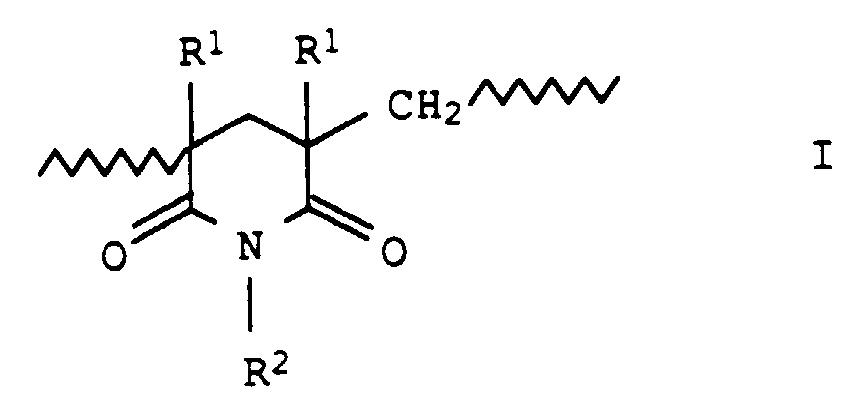
- c2) 10 bis 90 Gew.-% eines C1-C20-Alkylesters des Methacryl- oder Acrylsäure oder Mischungen solcher Ester,
- c1) 10 bis 90 Gew.-% Einheiten der allgemeinen Formel I
- D) 5 bis 60 Gew.-% eines Pfropfmischpolymerisates mit einem mittleren Teilchendurchmesser (Gewichtsmittel) von kleiner als 200 nm, erhältlich durch Polymerisation von 20 bis 70 Gew.-% einer Monomerenmischung aus
- d1) 30 bis 100 Gew.-% eines C1-C20-Alkylesters der Methacryl- oder Acrylsäure oder Mischungen solcher Ester, und
- d2) 0 bis 70 Gew.-% eines vinylaromatischen Monomeren in Gegenwart von 30 bis 80 Gew.-% einer Pfropfgrundlage, erhältlich durch Polymerisation mindestens eines Monomeren aus der Gruppe bestehend aus Butadien, Isopren, vinylaromatischen Monomeren und C4-C20-Alkylestern der Acrylsäure
- E) 0 bis 20 Gew.-%, bezogen auf die Menge der Komponenten A) bis D), üblicher Zusatzstoffe, wobei sich die Mengenangaben der Komponenten A) bis D) auf 100 addieren und die Differenz zwischen dem Brechungsindex der Komponente D) und dem des Gemisches aus den Komponenten A), B) und C) und gewünschtenfalls E) weniger als 0,01 beträgt.
- Außerdem betrifft die Erfindung ein verfahren zur Herstellung dieser transparenten, schlagzähen Formmassen, ihre Verwendung zur Herstellung von Formkörpern sowie Formkörper, enthaltend diese transparenten Formmassen.
- Transparente Mischungen aus Polymethylmethacrylat (PMMA), Styrol-Acrylnitril-Copolymer (SAN) und einem Pfropfkautschuk sind beispielsweise aus der EP 62.223 bekannt. Derartige Blends zeichnen sich durch eine gute Schlagzähigkeit bei gleichzeitiger Transparenz aus. Nachteilig bei diesen Formmassen ist allerdings die nicht ausreichende Wärmeformbeständigkeit.
- Die Anhebung von Wärmeformbeständigkeiten von SAN-Copolymeren ist bekannt. In der EP 95.274 werden verträgliche und somit transparente Abmischungen aus SAN und einem methacrylimidhaltigen Polymer beschrieben. Die Zähmodifizierung mittels eines Pfropfkautschuks wird ebenfalls beansprucht; diese Massen verlieren aber in der Regel ihre Transparenz.
- Die EP 216.505 beschreibt Formmassen auf der Basis SAN bzw. ABS (Acrylnitril-Butadien-Styrol-Copolmere) in Kombination mit einem Polyglutarimid. Auch hier führen die Abmischungen allerdings nicht zu einem Blend, der zur Herstellung optisch anspruchsvoller Formteile geeignet ist.
- In der EP 216.505 werden ebenfalls Polymermischungen aus einem Polymethacrylimid (PMI) und PMMA beansprucht. Diese sind allerdings zweiphasig, d.h. sie besitzen zwei Glasübergangstemperaturen, und sind somit nicht transparent. Außerdem ist die Vicat-Temperatur nur geringfügig höher als im PMMA.
- Aufgabe der vorliegenden Erfindung war es daher, transparente, schlagzähe Formmassen mit verbesserter Wärmbeformbeständigkeit bereitzustellen.
- Demgemäß wurden die eingangs definierten transparenten, schlagzähen Formmassen gefunden.
- Ferner wurde ein Verfahren zur Herstellung dieser transparenten, schlagzähen Formmassen, deren Verwendung zur Herstellung von Formkörpern sowie Formkörper, enthaltend diese transparenten, schlagzähen Fommassen, gefunden.
- Die als Komponente A) enthaltenden Polymerisate sind erfindungsgemäß erhältlich durch Polymerisation eines C1-C20-Alkylesters der Methacryl- oder Acrylsäure oder Mischungen solcher Ester, vorzugsweise durch Polymerisation eines Monomerengemisches, bestehend aus
- a1) 80 bis 100 Gew.-%, bevorzugt 90 bis 99 Gew.-%, eines C1-C20-Alkylesters der Methacrylsäure, und
- a2) 0 bis 20 Gew.-%, bevorzugt 1 bis 10 Gew.-%, eines C1-C20-Alkylesters der Acrylsäure.
- Als C1-C20-Alkylester der Methacrylsäure kommen bevorzugt die C1-C4-Alkylester wie Methylmethacrylat ("MMA"), Ethylmethacrylat, n-, i-Propylmethacrylat, n-Butylmethacrylat, Isobutylmethacrylat und tert.-Butylmethacrylat in Betracht, wobei Methylmethacrylat besonders bevorzugt ist, sowie Mischungen dieser Monomere.
- Als C1-C20-Alkylester der Acrylsäure verwendet man bevorzugt die C1-C4-Alkylester wie Methylacrylat ("MA"), Ethylacrylat, Propylacrylat, n-Butylacrylat, Isobutylacrylat und tert.-Butylacrylat, wobei Methylacrylat besonders bevorzugt ist, sowie Mischungen dieser Monomeren.
- Als besonders vorteilhaft haben sich nach den bisherigen Beobachtungen Polymerisate aus 99 Gew.-% Methylmethacrylat und 1 Gew.-% Methylacrylat mit einem Molekulargewicht (Gewichtsmittelwert Mw) von 60.000 bis 300.000 g/mol, insbesondere 80.000 bis 150.000 g/mol, sowie Polymerisate aus 96 Gew.-% Methylmethacrylat und 4 Gew.-% Butylacrylat mit einem Molekulargewicht (Gewichtsmittelwert Mw) von 60.000 bis 300.000 g/mol, insbesondere 110.000 g/mol, erwiesen.
- Die Menge der Komponente A, bezogen auf das Gesamtgewicht der transparenten, schlagzähen Formmassen, beträgt erfindungsgemäß 5 bis 50, bevorzugt 15 bis 30 Gew.-%.
- Die Herstellung der Komponente A) führt man im allgemeinen nach bekannten Polymerisationsverfahren wie Masse-, Lösungs-, Emulsions- oder Perlpolymerisation durch. Solche Verfahren sind beispielsweise im Kunststoffhandbuch, Bd. 9, Vieweg und Esser: Polymethylmethacrylat, Carl-Hanser-Verlag, München, 1975, S. 36 ff beschrieben.
- Die als Komponente B) enthaltenen Copolymerisate (SAN-Copolymere) sind erhältlich durch Polymerisation eines Monomerengemisches aus
- 75 bis 82 Gew.-%,
- vorzugsweise 78 bis 81 Gew.-%, eines vinylaromatischen Monomeren, und
- 18 bis 25 Gew.-%,
- vorzugsweise 19 bis 22 Gew.-%, Acrylnitril oder Methacrylnitril oder deren Mischungen.
- Außerhalb dieses Bereiches der Zusammensetzung erhält man in der Regel bei Verarbeitungstemperaturen über 240°C trübe Formteile, die Bindenähte aufweisen.
- Als vinylaromatische Monomere eignen sich vorzugsweise Styrol, α-Methylstyrol, tert.-Butylstyrol, Monochlorstyrol und Vinyltoluol, besonders bevorzugt Styrol und α-Methylstyrol.
- Der Zusatz von Acrylnitril und/oder Methacrylnitril bewirkt in der Regel eine Erhöhung der Spannungsrißbeständigkeit.
- Als besonders geeignet haben sich SAN-Copolymere mit einem Molekulargewicht (Gewichtsmittelwert Mw) von 60 000 bis 300 000 g/mol, vorzugsweise von 100.000 bis 200.000 g/mol, erwiesen, die nach dem in der GB-PS 14 72 195 beschriebenen Verfahren hergestellt wurden.
- Die Menge der Komponente B), bezogen auf das Gesamtgewicht der transparenten, schlagzähen Formmassen, beträgt erfindungsgemäß 5 bis 50, bevorzugt 15 bis 40 Gew.-%.
- Die Herstellung der Komponente B) führt man in der Regel nach bekannten Polymerisationsverfahren wie Masse-, Lösungs-, Emulsions- oder Perlpolymerisation durch. Solche Verfahren sind beispielsweise in Kunststoffhandbuch, Hrsg. Vieweg und Daumiller, Band V; Polystyrol, Carl-Hauser-Verlag, München 1969, S. 124 ff. und in der GB-PS 14 72 195 beschrieben.
- Die als Komponente C) enthaltenen Polymerisate enthalten erfindungsgemäß
- C1) 10 bis 90 Gew.-%, bevorzugt 50 bis 90 Gew.-%, Einheiten der allgemeinen Formel I

und - C2) 90 bis 10 Gew.-%, bevorzugt 50 bis 10 Gew.-%, eines C1-C20-Alkylesters der Methacryl- oder Acrylsäure oder Mischungen solcher Ester.
- Die Herstellung der Komponente C) erfolgt im allgemeinen durch Imidierung von Polymerisaten auf Basis von C1-C20-Alkylestern der Methacryl- oder Acrylsäure, oder Mischungen solcher Ester, mit primären Aminen.
- Unter den Polymerisaten auf Basis von C1-C20-Alkylestern der (Meth)Acrylsäure sind sowohl Homo- als auch Copolymere zu verstehen, wobei die Copolymeren noch andere ethylenisch ungesättigte Comonomere enthalten können.
- Als C1-C20-Alkylester der Methacrylsäure kommen bevorzugt die C1-C4-Alkylester wie Methylmethacrylat ("MMA"), Ethylmethacrylat, n-, i-Propylmethacrylat, n-Butylmethacrylat, Isobutylmethacrylat und tert.-Butylmethacrylat in Betracht, wobei Methylmethacrylat besonders bevorzugt ist, sowie Mischungen dieser Monomeren.
- Als C1-C20-Alkylester der Acrylsäure verwendet man bevorzugt die C1-C4-Alkylester wie Methylacrylat ("MA''), Ethylacrylat, n-, i-Propylacrylat, n-Butylacrylat, Isobutylacrylat und tert.-Butylacrylat, wobei Methylacrylat besonders bevorzugt ist, sowie Mischungen dieser Monomeren.
- Im allgemeinen sind die Polymerisate zu mehr als 50, bevorzugt zu mehr als 80 Gew.-% aus C1-C20-Alkylestern der Methacrylsäure und Acrylsäure aufgebaut. Als besonders vorteilhaft haben sich nach bisherigen Beobachtungen Polymerisate aus 80 bis 100 Gew.-% Methylmethacrylat und 0 bis 20 Gew.-% Methylacrylat in einem Molekulargewichtsbereich (Mw) von 20.000 bis 300.000 g/mol erwiesen.
- Als primäres Amin, R2NH2, verwendet man im allgemeinen eines ausgewählt aus der Gruppe bestehend aus C1-C18-Alkylaminen, C5-C12-Cycloalkylaminen, C6-C10-Arylaminen und C6-C10-Aryl-C1-C4-alkylaminen, wobei die Cycloalkyl-, Aryl- und Arylalkyl-Bestandteile der Amine bis zu dreifach mit Resten ausgewählt aus der Gruppe bestehend aus C1-C4-Alkyl, C1-C4-Alkoxy und Halogen wie Fluor, Chlor und Brom substituiert sein können.
- Beispielhaft seien genannt Methylamin, Ethylamin, n-, i-Propylamin, n-Butylamin, 1-Methylpropylamin, 2-Methylpropylamin, 1,1-Dimethylethylamin, n-Pentylamin, 1-Methylbutylamin, 2-Methylbutylamin, 3-Methylbutylamin, 2-Dimethylpropylamin, 1-Ethylpropylamin, n-Hexylamin, n-Heptylamin, n-Octylamin, n-Nonylamin, n-Decylamin, n-Undecylamin, n-Dodecylamin, Stearylamin, Cyclopentylamin, Cyclohexylamin, Cycloheptylamin, Cyclooctylamin, Cyclododecylamin, Anilin, 2-, 3-, 4-Methylanilin, 2-, 3-, 4-Methoxyanilin, 2-, 3-, 4-Chloranilin, 2-, 3-, 4-Bromanilin, Benzylamin, Phenethylamin und Phenylpropylamin, besonders bevorzugt Methylamin und Cyclohexylamin.
- Das Gewichtsverhältnis von eingesetztem Amin zu Acrylat-Polymer wählt man im allgemeinen im Bereich von 10:1 bis 1:1, bevorzugt von 2:1 bis 1:1, so daß der Gehalt an imidierten Einheiten I 10 bis 90 Gew.-% der Komponente C) beträgt. Im übrigen kann man den Imidierungsgrad durch die üblichen Verfahrensparameter, z.B. die Temperatur beeinflussen.
- Die Imidierung führt man im allgemeinen in an sich bekannter Weise, z.B. in Gegenwart von Lösungsmitteln wie in der EP-A 234,726 beschrieben, oder ohne zusätzliches Lösungsmittel wie in der US 4.246.374 auf einem Extruder durch. Besonders bevorzugt ist die Herstellung der Komponente C) auf einem Extruder, dessen Reaktionszone ein Länge-zu-Durchmesser(L/D)-Verhältnis von 20 bis 50, bevorzugt von 30 bis 40, aufweist. Bei einem L/D-Verhältnis von mehr als 50 kommt es in der Regel aufgrund einer zu langen Verweilzeit zu einer Schädigung des Materials verbunden mit einer Gelbfärbung. Bei einem L/D-Verhältnis unter 20 erhält man im allgemeinen nur ein teilimidiertes Produkt mit einem hohen Anteil an sekundären Amid-Gruppen, die sich nachteilig auf die Schmelzviskosität und Wasseraufnahme auswirken.
- Als Mischelemente kann man übliche Elemente wie Knetblöcke oder Zahnmischelemente zur Homogenisierung des Reaktionsgemisches verwenden.
- Die Reaktionstemperatur wählt man in der Regel im Bereich von 250 bis 350, bevorzugt von 270 bis 350°C.
- Die Wahl des pH-Bereiches liegt wegen des eingesetzten Amins in der Regel oberhalb von 7.
- Die Reaktionszeit liegt beim Mischen in einem Extruder vorzugsweise im Bereich von 1 bis 20 min, bevorzugt 2 bis 10 min, in der Lösung darüber, bevorzugt von 2 bis 20 h.
- Des weiteren kann man dem Reaktionsgemisch Katalysatoren in Mengen im Bereich von 0,01 bis 10 Gew.-%, bezogen auf das eingesetzte Polymer, zur Beschleunigung der Reaktion zusetzen. Beispielhaft seien genannt
- tertiäre Amine wie Tricyclohexylamin;
- substituierte Guanidine wie 1,1,3,3-Tetramethylguanidin, 1,3-Diphenylguanidin;
- tetrasubstituierte Alkylammoniumverbindungen wie Trimethylstearylammoniumchlorid;
- organische Titanverbindungen wie Tetrapropoxytitan, Tetrabutoxytitan:
- organische Zinnverbindungen wie Dibutylzinnoxid, Dibutylzinndidodecanat;
- aromatische Amine wie Chinolin, Isochinolin, 4-Benzylpyridin, 4-Phenylpyridin, 2-Hydroxypyridin, 1,3-, 1,4- und 2,3-Benzodiazin, 2,2'-, 2,3'- und 2,4'-Bipyridyl;
- Imide wie N,N'-Dicyclohexylcarbodiimid;
- Die Zugabe der Katalysatoren kann vor, während oder nach dem Mischvorgang erfolgen, bevorzugt danach.
- In einer weiteren bevorzugten Ausführungsform enthält der (Haupt-)Extruder nach der Reaktionszone eine Entgasungszone, d.h. wenigstens eine Öffnung, durch die flüchtige Bestandteile und nicht polymere Reaktionsprodukte entfernt werden können. Die Entgasung kann man sowohl bei Normaldruck als auch unter vermindertem Druck (Vakuumentgasung) durchführen. Besonders vorteilhaft hat sich die Anwendung von einer Normaldruck- kombiniert mit einer Vakuumentgasung herausgestellt.
- Als besonders vorteilhaft haben sich teilimidierte Polymerisate erwiesen, die ein Molekulargewicht (Gewichtsmittelwert Mw) von 60.000 bis 300.000 g/mol, vorzugsweise 100.000 bis 200.000 g/mol, gemessen in Dimethylformamid durch Lichtstreuung, aufweisen. Besonders bevorzugte Komponenten C) sind solche mit einer Säurezahl von höchstens 0,4 meq/g, insbesondere von 0,01 bis 0,2 meq/g.
- Die Menge der Komponente C), bezogen auf das Gesamtgewicht der transparenten, schlagzähen Formmassen, beträgt erfindungsgemäß 10 bis 40 Gew.-%, vorzugsweise 10 bis 30 Gew.-%.
- Die als Komponente D) enthaltenen Pfropfmischpolymerisate mit einem mittleren Teilchendurchmesser (Gewichtsmittel) von kleiner als 200 nm sind erhältlich durch Polymerisation von 20 bis 70 Gew.-% , bevorzugt von 30 bis 60 Gew.-% einer Monomerenmischung aus
- 30 bis 100 Gew.-% ,
- vorzugsweise 40 bis 90 Gew.-% , eines C1-C20-Alkylesters der Methacryl- oder Acrylsäure oder Mischungen solcher Ester, und
- 0 bis 70 Gew.-% ,
- vorzugsweise 10 bis 60 Gew.-% eines vinylaromatischen Monomeren
- Als C1-C20-Alkylester der Methacrylsäure kommen bevorzugt die C1-C4-Alkylester wie Methylmethacrylat ("MMA"), Ethylmethacrylat, n-, i-Propylmethacrylat, n-Butylmethacrylat, Isobutylmethacrylat und tert.-Butylmethacrylat in Betracht, wobei Methylmethacrylat besonders bevorzugt ist, sowie Mischungen dieser Monomeren.
- Als C1-C20-Alkylester der Acrylsäure verwendet man bevorzugt die C1-C4-Alkylester wie Methylacrylat ("MA"), Ethylacrylat, n-, i-Propylacrylat, n-Butylacrylat, Isobutylacrylat und tert.-Butylacrylat, wobei Methylacrylat besonders bevorzugt ist, sowie Mischungen dieser Monomeren.
- Als vinylaromatische Monomere eignen sich vorzugsweise Styrol, α-Methylstyrol, tert.-Butylstyrol, Monochlorstyrol und Vinyltoluol, besonders bevorzugt Styrol und α-Methylstyrol.
- Als C4-C20-Alkylester der Acrylsäure als Bestandteil der Pfropfgrundlage verwendet man vorzugsweise C4-C8-Alkylester wie n-Butylacrylat, Isobutylacrylat, tert.-Butylacrylat, n-Pentylacrylat, n-Hexylacrylat, n-Heptylacrylat, n-Octylacrylat, 2-Ethyl-hexylacrylat, wobei n-Butylacrylat und 2-Ethyl-hexylacrylat besonders bevorzugt sind, sowie Mischungen dieser Monomeren.
- Als Pfropfgrundlage haben sich nach den bisherigen Beobachtungen Polymerisate aus 50 bis 100 Gew.-%, insbesondere 60 bis 80 Gew.-%, Butadien und 0 bis 50 Gew.-%, insbesondere 20 bis 40 Gew.-%, Styrol besonders bewährt.
- Als Pfropfhülle haben sich nach den bisherigen Beobachtungen Polymerisate aus 10 bis 100 Gew.-% Methylmethacrylat, 0 bis 20 Gew.-%, bevorzugt von 1 bis 10 Gew.-%, eines C1-C4-Alkylesters der Acrylsäure, insbesondere n-Butylacrylat, und von 0 bis 70 Gew.-%, bevorzugt von 1 bis 60, besonders bevorzugt von 10 bis 55 Gew.-%, Styrol besonders bewährt.
- Bei Verwendung von mehr als einem Monomeren in der Pfropfhülle kann ein schalenförmiger Aufbau von Vorteil sein. Dies wird erzielt, indem man die verschiedenen Monomeren bzw. Monomermischungen jeweils nach der Polymerisation der Monomeren einer Schale zugibt.
- Vorteilhaft weist die Komponente D) eine Glasübergangstemperatur von unter 0°C auf. Des weiteren liegt die mittlere Teilchengröße erfindungsgemäß im Bereich von 0,05 bis 0,2, vorzugsweise von 0,08 bis 0,2 µm. Nach den bisherigen Beobachtungen erhält man außerhalb des erfindungsgemäßen Teilchengrößenbereiches keine transparenten Formmassen.
- Die Herstellung des Pfropfmischpolymerisates (Komponente D)) führt man im allgemeinen in üblicher Weise durch Emulsionspolymerisation, wie sie beispielsweise in DE-OS 14 20 775 und GB-PS 649 166 beschrieben ist, durch. Nach der Herstellung isoliert man die Komponente D) im allgemeinen durch bekannte Methoden wie Koagulation oder Sprühtrocknung.
- Die Menge der Komponente D), bezogen auf das Gesamtgewicht der transparenten, schlagzähen Formmassen, beträgt erfindungsgemäß 5 bis 60 Gew.-%, vorzugsweise 20 bis 50 Gew.-%.
- Erfindungsgemäß beträgt die Differenz zwischen dem Brechungsindex der Komponente D) und dem des Gemisches aus den Komponenten A), B) und C) und gewünschtenfalls E) weniger als 0,01. Andernfalls erhält man nach den bisherigen Beobachtungen keine transparenten Formmassen.
- Die erfindungsgemäße Anpassung der Brechungsindices geschieht dadurch, daß man die Zusammensetzung (Monomerenanteile) der Komponenten A), B) und C) einerseits und D) andererseits entsprechend wählt. Dabei geht man in der Regel so vor, daß der Brechungsindex der jeweiligen Homopolymeren den benötigten Monomerenverhältnissen der Copolymeren zugrundegelegt wird. Z.B. hat der Brechungsindex eines Styrol/Butadien-Copolymerisats jeweils den Zwischenwert, der sich aus dem Gewichtsbruch der Monomerenanteile von Styrol und Butadien ergibt, wenn n25 D für Polystyrol zu 1.59 - 1.60 und für Polybutadien zu 1.516 angenommen wird (vgl. Brandrup-Immergut, Polymer Handbook, 2. Aufl. New York 1987).
- Die erfindungsgemäßen Formmassen können, bezogen auf das Gemisch der Komponenten A) bis D), noch bis zu 20 Gew.-% üblicher Zusatzstoffe enthalten. Als solche kommen beispielsweise in Betracht:
- Farbstoffe:
- Oxidationsverzögerer und Wärmestabilisatoren wie sterisch gehinderte Phenole, Phosphite und Abkömmlinge und substituierte Vertreter dieser Gruppe und Mischungen dieser Verbindungen, vorzugsweise in Konzentrationen bis zu 1 Gew.-%, bezogen auf das Gewicht der Mischung;
- UV-Stabilisatoren wie substituierte Salicylate, Benzotriazole und Benzophenone sowie HALS (hindered amine light stabilizers)-Verbindungen wie die in der EP-A 243 319 genannten Bernsteinsäureester oder Glutarsäureester des 2,2,6,6-Tetramethylpiperidinol-4 sowie Bis-(2,2,6,6-tetramethyl-4-piperidyl)sebazat, die man im allgemeinen in Mengen bis zu 1 Gew.-% einsetzen kann;
- Gleit- und Entformungsmittel, die man in der Regel bis zu 3 Gew.-% der thermoplastischen Masse zusetzen kann, beispielsweise Stearinsäure, Stearate, Stearylalkohol, Stearinsäurealkylester und -amide sowie Ester des Pentaerythrits mit langkettigen Fettsäuren
- Das Vermischen der Komponenten A) bis D) bzw. E) kann in der Regel in den üblichen Vorrichtungen zur Schmelzvermischung wie Doppelschneckenextruder durchgeführt werden. Die Komponenten werden hierbei im allgemeinen bei Temperaturen im Bereich von 200 bis 300°C, verarbeitet. Prinzipiell ist es auch möglich, Lösungen oder Suspensionen der erfindungsgemäßen Komponenten zu vermischen und das Lösungs- oder Suspensionsmittel anschließend zu entfernen.
- Die Verarbeitungsbreite der erfindungsgemäßen, transparenten, schlagzähen Formmassen oberhalb 200°C ist nach den bisherigen Beobachtungen nicht durch Unverträglichkeitserscheinungen eingeschränkt. Die Mischungen der Komponenten A) bis D) bzw. E) kann man zwischen 200 und 300°C ohne Einbußen in der Transparenz, ohne merkbare Vergilbung und ohne eine lästige Geruchsbildung verarbeiten.
- Aus den erfindungsgemäßen Formmassen kann man durch Spritzgießen oder Blasformen Formkörper herstellen. Man kann die Formmassen auch verpressen, kalandrieren, extrudieren oder vakuumformen.
- Die erfindungsgemäßen transparenten, schlagzähen Formmassen weisen gegenüber solchen aus dem Stand der Technik eine sehr gute Transparenz und eine verbesserte Wärmeformbeständigkeit auf.
- Im Spritzguß verarbeitete Formteile zeigen nach den bisherigen Beobachtungen keinerlei Bindenahtmarkierungen und zeichnen sich durch eine hohe Transparenz und einen hohen Oberflächenglanz aus.
- Bei den mittleren Teilchengrößen handelt es sich in allen Fällen um das Gewichtsmittel der Teilchengrößen, die mittels einer analytischen Ultrazentrifuge entsprechend der Methode von W. Scholtan und H. Lange, Kolloid-Z. und Z.Polymere 250 (1972), Seiten 782 bis 796, bestimmt werden. Die Ultrazentrifugenmessung liefert die integrale Massenverteilung des Teilchendurchmessers einer Probe. Hieraus läßt sich entnehmen, wieviel Gewichtsprozent der Teilchen einen Durchmesser gleich oder kleiner einer bestimmten Größe haben. Der mittlere Teilchendurchmesser, der auch als d50-Wert der integralen Massenverteilung bezeichnet wird, ist dabei als der Teilchendurchmesser definiert, bei dem 50 Gew.-% der Teilchen einen kleineren Durchmesser haben als der Durchmesser, der dem d50-Wert entspricht. Ebenso haben dann 50 Gew.-% der Teilchen einen größeren Durchmesser als der d50-Wert.
- Für die nachstehenden Beispiele und Vergleichsbeispiele wurden folgende Bestandteile eingesetzt:
- Verwendete Komponenten:
- A1:Copolymerisat aus 96 Gew.-Tl. Methylmethacrylat (MMA) und 4 Gew.-Tl. n-Butylacrylat, Mw = 110.000 (bestimmt durch Gelpermeationschromatographie (GPC) in Tetrahydrofuran (THF) (n25 D = 1,492)
- A2:Copolymerisat aus 99 Gew.-Tl. MMA und 1 Gew.-Tl. Methylacrylat, Mw = 110.000 (bestimmt durch GPC in THF) (n25 D = 1,492)
- B1:Copolymerisat aus Styrol und Acrylnitril im Verhältnis 81 : 19 (n25 D = 1,575), Mw = 250.000 (bestimmt durch LichtStreuung in CHCl3)
- C1: Copolymerisat aus 87 Gew.-T1. I (R1 = R2 = CH3;) und 13 Gew.- Tl. MMA; VZ = 70 (gemessen in Dimethylformamid (DMF) als 0,26 gew.-%ige Lösung), Säurezahl = 0,03 meq/g (n25 D = 1,540)
- C2: Copolymerisat aus 74 Gew.-T1. I (R1 = R2 = CH3;) und 26 Gew.-Tl. MMA; VZ = 82 (gemessen in DMF als 0,26 gew.-%ige Lösung), Säurezahl = 0,02 meq/g (n25 D = 1,530)
- D1: Pfropfcopolymerisat von 45 Gew.-Tl. eines Gemisches aus 51 Gew.-Tl. MMA, 44 Gew.-Tl. Styrol und 5 Gew.-Tl. n-Butylacrylat auf 55 Gew.-Tl. einer elastomeren Grundstufe, bestehend aus 72 Gew.-Tl. Butadien und 28 Gew.-Tl. Styrol (n25 D = 1,537); die mittlere Teilchengröße (Gewichtsmittel) wurde zu 130 nm ermittelt.
- In der nachfolgenden Tabelle sind die Zusammensetzungen der Mischungen sowie die Ergebnisse der optischen Beurteilung und der mechanischen Eigenschaften angegeben:
- Die Kerbschlagzähigkeit aK (Spritztemperatur: 250°C/Prüftemperatur: 23°C) wurde gemäß DIN 53 453 an Normkleinstäben bestimmt.
- Die Wärmeformbeständigkeit Vicat B 50 wurde gemäß DIN 54 460 gemessen.
- Der E-Modul wurde gemäß DIN 53 457 bestimmt.

Claims (6)
- Transparente, schlagzähe Formmassen, enthaltend im wesentlichenA) 5 bis 50 Gew.-% eines Polymerisates, erhältlich durch Polymerisation eines C1-C20-Alkylesters der Methacryl- oder Acrylsäure oder Mischungen solcher Ester,B) 5 bis 50 Gew.-% eines Polymerisates, erhältlich durch Polymerisation eines Monomerengemisches ausb1) 75 bis 82 Gew.-% eines vinylaromatischen Monomeren undb2) 18 bis 25 Gew.-% Acrylnitril oder Methacrylnitril oder eine Mischung davon,C) 10 bis 40 Gew.-% eines Polymerisates, enthaltendc1) 10 bis 90 Gew.-% Einheiten der allgemeinen Formel I
 c2) 10 bis 90 Gew.-% eines C1-C20-Alkylesters des Methacryl- oder Acrylsäure oder Mischungen solcher Ester,D) 5 bis 60 Gew.-% eines Pfropfmischpolymerisates mit einem mittleren Teilchendurchmesser (Gewichtsmittel) von kleiner als 200 nm, erhältlich durch Polymerisation von 20 bis 70 Gew.-% einer Monomerenmischung ausd1) 30 bis 100 Gew.-% eines C1-C20-Alkylesters der Methacryl- oder Acrylsäure oder Mischungen solcher Ester, undd2) 0 bis 70 Gew.-% eines vinylaromatischen Monomeren in Gegenwart von 30 bis 80 Gew.-% einer Pfropfgrundlage, erhältlich durch Polymerisation mindestens eines Monomeren aus der Gruppe bestehend aus Butadien, Isopren, vinylaromatischen Monomeren und C4-C20-Alkylestern der AcrylsäureundE) 0 bis 20 Gew.-%, bezogen auf die Menge der Komponenten A) bis D), üblicher Zusatzstoffe, wobei sich die Mengenangaben der Komponenten A) bis D) auf 100 addieren und die Differenz zwischen dem Brechungsindex der Komponente D) und dem des Gemisches aus den Komponenten A), B) und C) und gewünschtenfalls E) weniger als 0,01 beträgt.
 - Transparente, schlagzähe Formmassen nach Anspruch 1, dadurch gekennzeichnet, daß die Komponente A) aus einem Monomerengemisch ausa1) 80 bis 100 Gew.-% eines C1-C20-Alkylesters der Methacrylsäure, unda2) 0 bis 20 Gew.-% eines C1-C20-Alkylesters der Acrylsäurehergestellt ist.
- Transparente, schlagzähe Formmassen nach Anspruch 1 oder 2, dadurch gekennzeichnet, daß die Komponente C) eine Säurezahl von höchstens 0,4 meq/g aufweist.
- Verfahren zur Herstellung von transparenten, schlagzähen Formmassen gemäß den Ansprüchen 1 bis 3, dadurch gekennzeichnet, daß man die Komponenten A) bis D) und gewünschtenfalls E) in der Schmelze mischt.
- Verwendung der transparenten, schlagzähen Formmassen gemäß den Ansprüchen 1 bis 3 zur Herstellung von Formkörpern.
- Formkörper, erhältlich aus den transparenten, schlagzähen Formmassen gemäß den Ansprüchen 1 bis 3.
Applications Claiming Priority (2)
| Application Number | Priority Date | Filing Date | Title |
|---|---|---|---|
| DE4244510 | 1992-12-30 | ||
| DE4244510A DE4244510A1 (de) | 1992-12-30 | 1992-12-30 | Transparente, schlagzähe Formmassen |
Publications (3)
| Publication Number | Publication Date |
|---|---|
| EP0604843A2 EP0604843A2 (de) | 1994-07-06 |
| EP0604843A3 EP0604843A3 (en) | 1994-09-07 |
| EP0604843B1 true EP0604843B1 (de) | 1996-09-25 |
Family
ID=6476813
Family Applications (1)
| Application Number | Title | Priority Date | Filing Date |
|---|---|---|---|
| EP93120270A Expired - Lifetime EP0604843B1 (de) | 1992-12-30 | 1993-12-16 | Transparente, schlagzähe Formmassen |
Country Status (6)
| Country | Link |
|---|---|
| US (1) | US5457157A (de) |
| EP (1) | EP0604843B1 (de) |
| JP (1) | JPH06228389A (de) |
| AT (1) | ATE143400T1 (de) |
| DE (2) | DE4244510A1 (de) |
| ES (1) | ES2091543T3 (de) |
Families Citing this family (5)
| Publication number | Priority date | Publication date | Assignee | Title |
|---|---|---|---|---|
| DE4431732A1 (de) * | 1994-09-06 | 1996-03-07 | Basf Ag | Transparente, schlagzähe Formmassen mit hoher Spannungsrißbeständigkeit und matter Oberfläche |
| DE4431733A1 (de) * | 1994-09-06 | 1996-03-07 | Basf Ag | Transparente, schlagzähe Formmassen mit hoher Fließfähigkeit |
| DE19527579A1 (de) * | 1995-07-28 | 1997-01-30 | Basf Ag | Transparente spannungsrißbeständige Formmassen mit einem verbesserten Zähigkeits-Steifigkeits-Verhältnis |
| US6087449A (en) * | 1995-08-31 | 2000-07-11 | Basf Aktiengesellschaft | Thermoplastic moulding materials having little haze |
| JP2009298965A (ja) * | 2008-06-16 | 2009-12-24 | Denki Kagaku Kogyo Kk | 樹脂組成物又はその成形体 |
Family Cites Families (10)
| Publication number | Priority date | Publication date | Assignee | Title |
|---|---|---|---|---|
| CA1174784A (en) * | 1980-03-31 | 1984-09-18 | Rohm And Haas Company | More readily dispersible elastomeric impact modifiers for rigid matrix polymers |
| US4539375A (en) * | 1980-03-31 | 1985-09-03 | Rohm And Haas Company | Dunkelspersers |
| US4440905A (en) * | 1980-03-31 | 1984-04-03 | Rohm And Haas Company | Dunkelspersers |
| DE3113627A1 (de) * | 1981-04-04 | 1982-10-21 | Basf Ag, 6700 Ludwigshafen | Transparente, schlagzaehe formmasse |
| US4436871A (en) * | 1982-05-10 | 1984-03-13 | Rohm And Haas Company | Imide-san polymer-blends |
| US4595727A (en) * | 1985-05-02 | 1986-06-17 | Doak Kenneth W | Blends of a polyglutarimide with a rubber-modified vinyl chloride resin |
| US4727117A (en) * | 1985-08-27 | 1988-02-23 | Rohm And Haas Company | Imide polymers |
| US5237004A (en) * | 1986-11-18 | 1993-08-17 | Rohm And Haas Company | Thermoplastic and thermoset polymer compositions |
| CA1335125C (en) * | 1988-08-03 | 1995-04-04 | Takuya Ogawa | Thermoplastic resin composition having delustered and pleasing appearance |
| DE4114589A1 (de) * | 1991-05-04 | 1992-11-05 | Bayer Ag | Polycarbonat/polyamid-formmassen |
-
1992
- 1992-12-30 DE DE4244510A patent/DE4244510A1/de not_active Withdrawn
-
1993
- 1993-12-16 AT AT93120270T patent/ATE143400T1/de not_active IP Right Cessation
- 1993-12-16 EP EP93120270A patent/EP0604843B1/de not_active Expired - Lifetime
- 1993-12-16 ES ES93120270T patent/ES2091543T3/es not_active Expired - Lifetime
- 1993-12-16 DE DE59303969T patent/DE59303969D1/de not_active Expired - Lifetime
- 1993-12-27 JP JP5332499A patent/JPH06228389A/ja not_active Withdrawn
- 1993-12-28 US US08/174,338 patent/US5457157A/en not_active Expired - Fee Related
Also Published As
| Publication number | Publication date |
|---|---|
| EP0604843A3 (en) | 1994-09-07 |
| DE59303969D1 (de) | 1996-10-31 |
| EP0604843A2 (de) | 1994-07-06 |
| ES2091543T3 (es) | 1996-11-01 |
| ATE143400T1 (de) | 1996-10-15 |
| DE4244510A1 (de) | 1994-07-07 |
| JPH06228389A (ja) | 1994-08-16 |
| US5457157A (en) | 1995-10-10 |
Similar Documents
| Publication | Publication Date | Title |
|---|---|---|
| EP0111260B1 (de) | Thermoplastische Formmassen | |
| DE3406417A1 (de) | Hitze- und schlagfeste harzmasse | |
| EP0166187A2 (de) | Tetrafluorethylenpolymerisat enthaltende Polymerisatpulverkompositionen | |
| EP0244856A1 (de) | Thermoplastische Formmasse auf Basis von Polycarbonat, ASA und Vinylaromaten/AN enthaltenden Copolymerisaten | |
| DE69023927T2 (de) | Thermoplastisches copolymer, dessen herstellungsverfahren und dieses enthaltende thermoplastische harzmischung. | |
| EP0429957A2 (de) | Thermoplastische Formmassen mit hoher Kältezähigkeit | |
| EP0062223B1 (de) | Transparente, schlagzähe Formmasse | |
| DE3780952T2 (de) | Waermebestaendige und schlagfeste harzzusammensetzung. | |
| DE4431732A1 (de) | Transparente, schlagzähe Formmassen mit hoher Spannungsrißbeständigkeit und matter Oberfläche | |
| DE4225875A1 (de) | Transparente Formmassen aus glutarimidhaltigen Polymeren und Styrol-Acrylnitril-Copolymeren | |
| EP0842222A1 (de) | Transparent, spannungsrissbeständige formmassen mit einem verbesserten zähigkeits-steifigkeits-verhältnis | |
| EP0604843A2 (de) | Transparente, schlagzähe Formmassen | |
| EP0507117A1 (de) | ABS-Formmassen mit bimodaler Kautschukpartikelgrössenverteilung | |
| DE19961894A1 (de) | Transparente, schlagzähe thermoplastische Formmassen | |
| EP0599067B1 (de) | Transparente Formmasse | |
| EP0700967B1 (de) | Transparente, schlagzähe Formmassen mit hoher Fliessfähigkeit | |
| EP0345652B1 (de) | Verstärkte thermoplastische Formmassen | |
| DE3638704A1 (de) | Abs-formmassen mit reduziertem restbutadiengehalt | |
| DE2259564C3 (de) | Thermoplastische Formmassen | |
| DE4013700A1 (de) | Thermoplastisch verarbeitbare polymermischungen auf polymethacrylat-basis mit abs- und polycarbonat-zumischungen | |
| EP0591804B1 (de) | Transparente Formmasse | |
| DE4241555A1 (de) | Thermoplastische Formmassen auf der Basis von Polycarbonaten, Pfropfpolymerisaten und Styrol/Acrylnitril-Copolymerisaten | |
| DE2244523C2 (de) | Pfropfcopolymerisat und dessen Verwendung | |
| DE4010511A1 (de) | Schlagzaehe, chemikalien- und waermeformbestaendige thermoplastische formmasse | |
| EP0303919A2 (de) | Verstärkte thermoplastische Formmassen, Verfahren zu deren Herstellung und ihre Verwendung |
Legal Events
| Date | Code | Title | Description |
|---|---|---|---|
| PUAI | Public reference made under article 153(3) epc to a published international application that has entered the european phase |
Free format text: ORIGINAL CODE: 0009012 |
|
| AK | Designated contracting states |
Kind code of ref document: A2 Designated state(s): AT BE CH DE ES FR GB IT LI NL |
|
| PUAL | Search report despatched |
Free format text: ORIGINAL CODE: 0009013 |
|
| AK | Designated contracting states |
Kind code of ref document: A3 Designated state(s): AT BE CH DE ES FR GB IT LI NL |
|
| 17P | Request for examination filed |
Effective date: 19940805 |
|
| 17Q | First examination report despatched |
Effective date: 19950804 |
|
| GRAG | Despatch of communication of intention to grant |
Free format text: ORIGINAL CODE: EPIDOS AGRA |
|
| GRAH | Despatch of communication of intention to grant a patent |
Free format text: ORIGINAL CODE: EPIDOS IGRA |
|
| GRAH | Despatch of communication of intention to grant a patent |
Free format text: ORIGINAL CODE: EPIDOS IGRA |
|
| GRAA | (expected) grant |
Free format text: ORIGINAL CODE: 0009210 |
|
| AK | Designated contracting states |
Kind code of ref document: B1 Designated state(s): AT BE CH DE ES FR GB IT LI NL |
|
| REF | Corresponds to: |
Ref document number: 143400 Country of ref document: AT Date of ref document: 19961015 Kind code of ref document: T |
|
| REF | Corresponds to: |
Ref document number: 59303969 Country of ref document: DE Date of ref document: 19961031 |
|
| REG | Reference to a national code |
Ref country code: ES Ref legal event code: FG2A Ref document number: 2091543 Country of ref document: ES Kind code of ref document: T3 |
|
| GBT | Gb: translation of ep patent filed (gb section 77(6)(a)/1977) |
Effective date: 19961015 |
|
| PGFP | Annual fee paid to national office [announced via postgrant information from national office to epo] |
Ref country code: FR Payment date: 19961125 Year of fee payment: 4 |
|
| PGFP | Annual fee paid to national office [announced via postgrant information from national office to epo] |
Ref country code: NL Payment date: 19961130 Year of fee payment: 5 |
|
| ITF | It: translation for a ep patent filed | ||
| PGFP | Annual fee paid to national office [announced via postgrant information from national office to epo] |
Ref country code: AT Payment date: 19961205 Year of fee payment: 4 |
|
| PGFP | Annual fee paid to national office [announced via postgrant information from national office to epo] |
Ref country code: CH Payment date: 19961206 Year of fee payment: 4 |
|
| PGFP | Annual fee paid to national office [announced via postgrant information from national office to epo] |
Ref country code: BE Payment date: 19961212 Year of fee payment: 4 |
|
| PGFP | Annual fee paid to national office [announced via postgrant information from national office to epo] |
Ref country code: ES Payment date: 19961223 Year of fee payment: 4 Ref country code: DE Payment date: 19961223 Year of fee payment: 4 |
|
| ET | Fr: translation filed | ||
| PLBE | No opposition filed within time limit |
Free format text: ORIGINAL CODE: 0009261 |
|
| STAA | Information on the status of an ep patent application or granted ep patent |
Free format text: STATUS: NO OPPOSITION FILED WITHIN TIME LIMIT |
|
| 26N | No opposition filed | ||
| PG25 | Lapsed in a contracting state [announced via postgrant information from national office to epo] |
Ref country code: GB Free format text: LAPSE BECAUSE OF NON-PAYMENT OF DUE FEES Effective date: 19971216 Ref country code: AT Free format text: LAPSE BECAUSE OF NON-PAYMENT OF DUE FEES Effective date: 19971216 |
|
| PG25 | Lapsed in a contracting state [announced via postgrant information from national office to epo] |
Ref country code: DE Effective date: 19971217 |
|
| PG25 | Lapsed in a contracting state [announced via postgrant information from national office to epo] |
Ref country code: LI Free format text: LAPSE BECAUSE OF NON-PAYMENT OF DUE FEES Effective date: 19971231 Ref country code: FR Free format text: THE PATENT HAS BEEN ANNULLED BY A DECISION OF A NATIONAL AUTHORITY Effective date: 19971231 Ref country code: CH Free format text: LAPSE BECAUSE OF NON-PAYMENT OF DUE FEES Effective date: 19971231 Ref country code: BE Free format text: LAPSE BECAUSE OF NON-PAYMENT OF DUE FEES Effective date: 19971231 |
|
| BERE | Be: lapsed |
Owner name: BASF A.G. Effective date: 19971231 |
|
| GBPC | Gb: european patent ceased through non-payment of renewal fee |
Effective date: 19971216 |
|
| REG | Reference to a national code |
Ref country code: CH Ref legal event code: PL |
|
| REG | Reference to a national code |
Ref country code: FR Ref legal event code: ST |
|
| PG25 | Lapsed in a contracting state [announced via postgrant information from national office to epo] |
Ref country code: ES Free format text: LAPSE BECAUSE OF NON-PAYMENT OF DUE FEES Effective date: 19981217 |
|
| PG25 | Lapsed in a contracting state [announced via postgrant information from national office to epo] |
Ref country code: NL Free format text: LAPSE BECAUSE OF NON-PAYMENT OF DUE FEES Effective date: 19990701 |
|
| NLV4 | Nl: lapsed or anulled due to non-payment of the annual fee |
Effective date: 19990701 |
|
| REG | Reference to a national code |
Ref country code: ES Ref legal event code: FD2A Effective date: 19990114 |
|
| PG25 | Lapsed in a contracting state [announced via postgrant information from national office to epo] |
Ref country code: IT Free format text: LAPSE BECAUSE OF NON-PAYMENT OF DUE FEES;WARNING: LAPSES OF ITALIAN PATENTS WITH EFFECTIVE DATE BEFORE 2007 MAY HAVE OCCURRED AT ANY TIME BEFORE 2007. THE CORRECT EFFECTIVE DATE MAY BE DIFFERENT FROM THE ONE RECORDED. Effective date: 20051216 |