EP0604849B1 - Oxyde de fer magnétique contenant du cobalt et procédé pour sa production - Google Patents
Oxyde de fer magnétique contenant du cobalt et procédé pour sa production Download PDFInfo
- Publication number
- EP0604849B1 EP0604849B1 EP93120343A EP93120343A EP0604849B1 EP 0604849 B1 EP0604849 B1 EP 0604849B1 EP 93120343 A EP93120343 A EP 93120343A EP 93120343 A EP93120343 A EP 93120343A EP 0604849 B1 EP0604849 B1 EP 0604849B1
- Authority
- EP
- European Patent Office
- Prior art keywords
- particles
- iron oxide
- cobalt
- oxide particles
- magnetic iron
- Prior art date
- Legal status (The legal status is an assumption and is not a legal conclusion. Google has not performed a legal analysis and makes no representation as to the accuracy of the status listed.)
- Expired - Lifetime
Links
- UQSXHKLRYXJYBZ-UHFFFAOYSA-N Iron oxide Chemical compound [Fe]=O UQSXHKLRYXJYBZ-UHFFFAOYSA-N 0.000 title claims description 186
- 230000005291 magnetic effect Effects 0.000 title claims description 121
- 229910017052 cobalt Inorganic materials 0.000 title claims description 63
- 239000010941 cobalt Substances 0.000 title claims description 63
- GUTLYIVDDKVIGB-UHFFFAOYSA-N cobalt atom Chemical compound [Co] GUTLYIVDDKVIGB-UHFFFAOYSA-N 0.000 title claims description 63
- 238000000034 method Methods 0.000 title claims description 45
- 230000008569 process Effects 0.000 title claims description 22
- 239000002245 particle Substances 0.000 claims description 213
- XEEYBQQBJWHFJM-UHFFFAOYSA-N iron Substances [Fe] XEEYBQQBJWHFJM-UHFFFAOYSA-N 0.000 claims description 29
- 230000009467 reduction Effects 0.000 claims description 29
- 239000011248 coating agent Substances 0.000 claims description 23
- 238000000576 coating method Methods 0.000 claims description 23
- 229910052782 aluminium Inorganic materials 0.000 claims description 19
- 150000001869 cobalt compounds Chemical class 0.000 claims description 16
- AEIXRCIKZIZYPM-UHFFFAOYSA-M hydroxy(oxo)iron Chemical compound [O][Fe]O AEIXRCIKZIZYPM-UHFFFAOYSA-M 0.000 claims description 13
- 230000003647 oxidation Effects 0.000 claims description 13
- 238000007254 oxidation reaction Methods 0.000 claims description 13
- 239000012298 atmosphere Substances 0.000 claims description 10
- -1 aluminum compound Chemical class 0.000 claims description 8
- 150000002736 metal compounds Chemical class 0.000 claims description 8
- 230000001590 oxidative effect Effects 0.000 claims description 7
- 230000009466 transformation Effects 0.000 claims description 4
- 229910052595 hematite Inorganic materials 0.000 claims description 2
- 239000011019 hematite Substances 0.000 claims description 2
- LIKBJVNGSGBSGK-UHFFFAOYSA-N iron(3+);oxygen(2-) Chemical compound [O-2].[O-2].[O-2].[Fe+3].[Fe+3] LIKBJVNGSGBSGK-UHFFFAOYSA-N 0.000 claims description 2
- 235000013980 iron oxide Nutrition 0.000 description 81
- 229910006299 γ-FeOOH Inorganic materials 0.000 description 62
- HEMHJVSKTPXQMS-UHFFFAOYSA-M Sodium hydroxide Chemical compound [OH-].[Na+] HEMHJVSKTPXQMS-UHFFFAOYSA-M 0.000 description 51
- 239000000243 solution Substances 0.000 description 47
- 238000011282 treatment Methods 0.000 description 35
- 239000002002 slurry Substances 0.000 description 29
- 239000000843 powder Substances 0.000 description 22
- 239000006185 dispersion Substances 0.000 description 19
- 229910006297 γ-Fe2O3 Inorganic materials 0.000 description 19
- 238000001816 cooling Methods 0.000 description 18
- UFHFLCQGNIYNRP-UHFFFAOYSA-N Hydrogen Chemical compound [H][H] UFHFLCQGNIYNRP-UHFFFAOYSA-N 0.000 description 17
- XLYOFNOQVPJJNP-UHFFFAOYSA-N water Substances O XLYOFNOQVPJJNP-UHFFFAOYSA-N 0.000 description 17
- 229910006540 α-FeOOH Inorganic materials 0.000 description 16
- 239000007789 gas Substances 0.000 description 15
- 238000004519 manufacturing process Methods 0.000 description 15
- 229910003145 α-Fe2O3 Inorganic materials 0.000 description 15
- 238000006297 dehydration reaction Methods 0.000 description 14
- SZVJSHCCFOBDDC-UHFFFAOYSA-N iron(II,III) oxide Inorganic materials O=[Fe]O[Fe]O[Fe]=O SZVJSHCCFOBDDC-UHFFFAOYSA-N 0.000 description 14
- 208000005156 Dehydration Diseases 0.000 description 13
- 230000018044 dehydration Effects 0.000 description 13
- 238000000151 deposition Methods 0.000 description 13
- 229960002089 ferrous chloride Drugs 0.000 description 13
- NMCUIPGRVMDVDB-UHFFFAOYSA-L iron dichloride Chemical compound Cl[Fe]Cl NMCUIPGRVMDVDB-UHFFFAOYSA-L 0.000 description 13
- 239000002243 precursor Substances 0.000 description 13
- 230000000052 comparative effect Effects 0.000 description 12
- XAGFODPZIPBFFR-UHFFFAOYSA-N aluminium Chemical compound [Al] XAGFODPZIPBFFR-UHFFFAOYSA-N 0.000 description 11
- 229910000361 cobalt sulfate Inorganic materials 0.000 description 11
- 229940044175 cobalt sulfate Drugs 0.000 description 11
- KTVIXTQDYHMGHF-UHFFFAOYSA-L cobalt(2+) sulfate Chemical compound [Co+2].[O-]S([O-])(=O)=O KTVIXTQDYHMGHF-UHFFFAOYSA-L 0.000 description 11
- 239000006249 magnetic particle Substances 0.000 description 10
- VSCWAEJMTAWNJL-UHFFFAOYSA-K aluminium trichloride Chemical compound Cl[Al](Cl)Cl VSCWAEJMTAWNJL-UHFFFAOYSA-K 0.000 description 8
- 230000008021 deposition Effects 0.000 description 8
- 229910052698 phosphorus Inorganic materials 0.000 description 8
- 238000010438 heat treatment Methods 0.000 description 7
- 229910052710 silicon Inorganic materials 0.000 description 7
- IJGRMHOSHXDMSA-UHFFFAOYSA-N Atomic nitrogen Chemical compound N#N IJGRMHOSHXDMSA-UHFFFAOYSA-N 0.000 description 6
- AZDRQVAHHNSJOQ-UHFFFAOYSA-N alumane Chemical class [AlH3] AZDRQVAHHNSJOQ-UHFFFAOYSA-N 0.000 description 6
- 229910001873 dinitrogen Inorganic materials 0.000 description 6
- JEIPFZHSYJVQDO-UHFFFAOYSA-N iron(III) oxide Inorganic materials O=[Fe]O[Fe]=O JEIPFZHSYJVQDO-UHFFFAOYSA-N 0.000 description 6
- OAICVXFJPJFONN-UHFFFAOYSA-N Phosphorus Chemical compound [P] OAICVXFJPJFONN-UHFFFAOYSA-N 0.000 description 5
- 239000013078 crystal Substances 0.000 description 5
- 230000000694 effects Effects 0.000 description 5
- 239000008246 gaseous mixture Substances 0.000 description 5
- 239000003973 paint Substances 0.000 description 5
- 239000011574 phosphorus Substances 0.000 description 5
- 238000003756 stirring Methods 0.000 description 5
- 239000012670 alkaline solution Substances 0.000 description 4
- 239000007864 aqueous solution Substances 0.000 description 4
- 238000007664 blowing Methods 0.000 description 4
- 238000006243 chemical reaction Methods 0.000 description 4
- 150000001868 cobalt Chemical class 0.000 description 4
- 238000006386 neutralization reaction Methods 0.000 description 4
- 238000005245 sintering Methods 0.000 description 4
- XUIMIQQOPSSXEZ-UHFFFAOYSA-N Silicon Chemical compound [Si] XUIMIQQOPSSXEZ-UHFFFAOYSA-N 0.000 description 3
- 238000013019 agitation Methods 0.000 description 3
- 239000003795 chemical substances by application Substances 0.000 description 3
- 150000001875 compounds Chemical class 0.000 description 3
- 230000005415 magnetization Effects 0.000 description 3
- 239000010703 silicon Substances 0.000 description 3
- 239000007787 solid Substances 0.000 description 3
- 239000000126 substance Substances 0.000 description 3
- WRIDQFICGBMAFQ-UHFFFAOYSA-N (E)-8-Octadecenoic acid Natural products CCCCCCCCCC=CCCCCCCC(O)=O WRIDQFICGBMAFQ-UHFFFAOYSA-N 0.000 description 2
- LQJBNNIYVWPHFW-UHFFFAOYSA-N 20:1omega9c fatty acid Natural products CCCCCCCCCCC=CCCCCCCCC(O)=O LQJBNNIYVWPHFW-UHFFFAOYSA-N 0.000 description 2
- QSBYPNXLFMSGKH-UHFFFAOYSA-N 9-Heptadecensaeure Natural products CCCCCCCC=CCCCCCCCC(O)=O QSBYPNXLFMSGKH-UHFFFAOYSA-N 0.000 description 2
- 239000005642 Oleic acid Substances 0.000 description 2
- ZQPPMHVWECSIRJ-UHFFFAOYSA-N Oleic acid Natural products CCCCCCCCC=CCCCCCCCC(O)=O ZQPPMHVWECSIRJ-UHFFFAOYSA-N 0.000 description 2
- 238000002441 X-ray diffraction Methods 0.000 description 2
- 238000005054 agglomeration Methods 0.000 description 2
- 230000002776 aggregation Effects 0.000 description 2
- 238000004458 analytical method Methods 0.000 description 2
- 238000009472 formulation Methods 0.000 description 2
- 229910052598 goethite Inorganic materials 0.000 description 2
- 230000006872 improvement Effects 0.000 description 2
- VBMVTYDPPZVILR-UHFFFAOYSA-N iron(2+);oxygen(2-) Chemical class [O-2].[Fe+2] VBMVTYDPPZVILR-UHFFFAOYSA-N 0.000 description 2
- QXJSBBXBKPUZAA-UHFFFAOYSA-N isooleic acid Natural products CCCCCCCC=CCCCCCCCCC(O)=O QXJSBBXBKPUZAA-UHFFFAOYSA-N 0.000 description 2
- 238000005259 measurement Methods 0.000 description 2
- 229910052751 metal Inorganic materials 0.000 description 2
- 239000002184 metal Substances 0.000 description 2
- 239000000203 mixture Substances 0.000 description 2
- 229910052757 nitrogen Inorganic materials 0.000 description 2
- 239000012299 nitrogen atmosphere Substances 0.000 description 2
- ZQPPMHVWECSIRJ-KTKRTIGZSA-N oleic acid Chemical compound CCCCCCCC\C=C/CCCCCCCC(O)=O ZQPPMHVWECSIRJ-KTKRTIGZSA-N 0.000 description 2
- 150000003839 salts Chemical class 0.000 description 2
- 239000003549 soybean oil Substances 0.000 description 2
- 235000012424 soybean oil Nutrition 0.000 description 2
- 238000002834 transmittance Methods 0.000 description 2
- BNGXYYYYKUGPPF-UHFFFAOYSA-M (3-methylphenyl)methyl-triphenylphosphanium;chloride Chemical compound [Cl-].CC1=CC=CC(C[P+](C=2C=CC=CC=2)(C=2C=CC=CC=2)C=2C=CC=CC=2)=C1 BNGXYYYYKUGPPF-UHFFFAOYSA-M 0.000 description 1
- 235000021355 Stearic acid Nutrition 0.000 description 1
- BZHJMEDXRYGGRV-UHFFFAOYSA-N Vinyl chloride Chemical compound ClC=C BZHJMEDXRYGGRV-UHFFFAOYSA-N 0.000 description 1
- 239000003513 alkali Substances 0.000 description 1
- DIZPMCHEQGEION-UHFFFAOYSA-H aluminium sulfate (anhydrous) Chemical compound [Al+3].[Al+3].[O-]S([O-])(=O)=O.[O-]S([O-])(=O)=O.[O-]S([O-])(=O)=O DIZPMCHEQGEION-UHFFFAOYSA-H 0.000 description 1
- ANBBXQWFNXMHLD-UHFFFAOYSA-N aluminum;sodium;oxygen(2-) Chemical compound [O-2].[O-2].[Na+].[Al+3] ANBBXQWFNXMHLD-UHFFFAOYSA-N 0.000 description 1
- 239000002585 base Substances 0.000 description 1
- 230000015572 biosynthetic process Effects 0.000 description 1
- 238000009835 boiling Methods 0.000 description 1
- 229910052796 boron Inorganic materials 0.000 description 1
- 238000003490 calendering Methods 0.000 description 1
- 239000003638 chemical reducing agent Substances 0.000 description 1
- 229910052804 chromium Inorganic materials 0.000 description 1
- 230000015271 coagulation Effects 0.000 description 1
- 238000005345 coagulation Methods 0.000 description 1
- 239000003240 coconut oil Substances 0.000 description 1
- 235000019864 coconut oil Nutrition 0.000 description 1
- 238000007796 conventional method Methods 0.000 description 1
- 229920001577 copolymer Polymers 0.000 description 1
- 230000002596 correlated effect Effects 0.000 description 1
- 238000000354 decomposition reaction Methods 0.000 description 1
- 230000001419 dependent effect Effects 0.000 description 1
- 238000011161 development Methods 0.000 description 1
- 235000014113 dietary fatty acids Nutrition 0.000 description 1
- 230000003292 diminished effect Effects 0.000 description 1
- 239000002270 dispersing agent Substances 0.000 description 1
- 238000001035 drying Methods 0.000 description 1
- 239000000194 fatty acid Substances 0.000 description 1
- 229930195729 fatty acid Natural products 0.000 description 1
- 150000004665 fatty acids Chemical group 0.000 description 1
- 230000005294 ferromagnetic effect Effects 0.000 description 1
- 238000001914 filtration Methods 0.000 description 1
- 238000010304 firing Methods 0.000 description 1
- 239000011261 inert gas Substances 0.000 description 1
- 229910052742 iron Inorganic materials 0.000 description 1
- FBAFATDZDUQKNH-UHFFFAOYSA-M iron chloride Chemical compound [Cl-].[Fe] FBAFATDZDUQKNH-UHFFFAOYSA-M 0.000 description 1
- 159000000014 iron salts Chemical class 0.000 description 1
- 229910000358 iron sulfate Inorganic materials 0.000 description 1
- BAUYGSIQEAFULO-UHFFFAOYSA-L iron(2+) sulfate (anhydrous) Chemical compound [Fe+2].[O-]S([O-])(=O)=O BAUYGSIQEAFULO-UHFFFAOYSA-L 0.000 description 1
- 230000007774 longterm Effects 0.000 description 1
- 239000000314 lubricant Substances 0.000 description 1
- 229910052748 manganese Inorganic materials 0.000 description 1
- 229910052759 nickel Inorganic materials 0.000 description 1
- QIQXTHQIDYTFRH-UHFFFAOYSA-N octadecanoic acid Chemical compound CCCCCCCCCCCCCCCCCC(O)=O QIQXTHQIDYTFRH-UHFFFAOYSA-N 0.000 description 1
- OQCDKBAXFALNLD-UHFFFAOYSA-N octadecanoic acid Natural products CCCCCCCC(C)CCCCCCCCC(O)=O OQCDKBAXFALNLD-UHFFFAOYSA-N 0.000 description 1
- 235000021313 oleic acid Nutrition 0.000 description 1
- 150000002894 organic compounds Chemical class 0.000 description 1
- 239000011368 organic material Substances 0.000 description 1
- 229920000728 polyester Polymers 0.000 description 1
- 229920005749 polyurethane resin Polymers 0.000 description 1
- 238000001556 precipitation Methods 0.000 description 1
- 238000002360 preparation method Methods 0.000 description 1
- 238000012545 processing Methods 0.000 description 1
- 238000011160 research Methods 0.000 description 1
- 229910001388 sodium aluminate Inorganic materials 0.000 description 1
- 239000002904 solvent Substances 0.000 description 1
- 239000008117 stearic acid Substances 0.000 description 1
- 238000010408 sweeping Methods 0.000 description 1
- 229920003002 synthetic resin Polymers 0.000 description 1
- 239000000057 synthetic resin Substances 0.000 description 1
- 238000005496 tempering Methods 0.000 description 1
- 229910052719 titanium Inorganic materials 0.000 description 1
- 238000005406 washing Methods 0.000 description 1
- 229910052725 zinc Inorganic materials 0.000 description 1
Images
Classifications
-
- C—CHEMISTRY; METALLURGY
- C01—INORGANIC CHEMISTRY
- C01G—COMPOUNDS CONTAINING METALS NOT COVERED BY SUBCLASSES C01D OR C01F
- C01G49/00—Compounds of iron
-
- C—CHEMISTRY; METALLURGY
- C01—INORGANIC CHEMISTRY
- C01G—COMPOUNDS CONTAINING METALS NOT COVERED BY SUBCLASSES C01D OR C01F
- C01G49/00—Compounds of iron
- C01G49/02—Oxides; Hydroxides
- C01G49/06—Ferric oxide [Fe2O3]
-
- G—PHYSICS
- G11—INFORMATION STORAGE
- G11B—INFORMATION STORAGE BASED ON RELATIVE MOVEMENT BETWEEN RECORD CARRIER AND TRANSDUCER
- G11B5/00—Recording by magnetisation or demagnetisation of a record carrier; Reproducing by magnetic means; Record carriers therefor
- G11B5/62—Record carriers characterised by the selection of the material
- G11B5/68—Record carriers characterised by the selection of the material comprising one or more layers of magnetisable material homogeneously mixed with a bonding agent
- G11B5/70—Record carriers characterised by the selection of the material comprising one or more layers of magnetisable material homogeneously mixed with a bonding agent on a base layer
- G11B5/706—Record carriers characterised by the selection of the material comprising one or more layers of magnetisable material homogeneously mixed with a bonding agent on a base layer characterised by the composition of the magnetic material
- G11B5/70626—Record carriers characterised by the selection of the material comprising one or more layers of magnetisable material homogeneously mixed with a bonding agent on a base layer characterised by the composition of the magnetic material containing non-metallic substances
- G11B5/70642—Record carriers characterised by the selection of the material comprising one or more layers of magnetisable material homogeneously mixed with a bonding agent on a base layer characterised by the composition of the magnetic material containing non-metallic substances iron oxides
- G11B5/70652—Record carriers characterised by the selection of the material comprising one or more layers of magnetisable material homogeneously mixed with a bonding agent on a base layer characterised by the composition of the magnetic material containing non-metallic substances iron oxides gamma - Fe2 O3
- G11B5/70668—Record carriers characterised by the selection of the material comprising one or more layers of magnetisable material homogeneously mixed with a bonding agent on a base layer characterised by the composition of the magnetic material containing non-metallic substances iron oxides gamma - Fe2 O3 containing a dopant
- G11B5/70673—Record carriers characterised by the selection of the material comprising one or more layers of magnetisable material homogeneously mixed with a bonding agent on a base layer characterised by the composition of the magnetic material containing non-metallic substances iron oxides gamma - Fe2 O3 containing a dopant containing Co
-
- G—PHYSICS
- G11—INFORMATION STORAGE
- G11B—INFORMATION STORAGE BASED ON RELATIVE MOVEMENT BETWEEN RECORD CARRIER AND TRANSDUCER
- G11B5/00—Recording by magnetisation or demagnetisation of a record carrier; Reproducing by magnetic means; Record carriers therefor
- G11B5/62—Record carriers characterised by the selection of the material
- G11B5/68—Record carriers characterised by the selection of the material comprising one or more layers of magnetisable material homogeneously mixed with a bonding agent
- G11B5/70—Record carriers characterised by the selection of the material comprising one or more layers of magnetisable material homogeneously mixed with a bonding agent on a base layer
- G11B5/706—Record carriers characterised by the selection of the material comprising one or more layers of magnetisable material homogeneously mixed with a bonding agent on a base layer characterised by the composition of the magnetic material
- G11B5/70626—Record carriers characterised by the selection of the material comprising one or more layers of magnetisable material homogeneously mixed with a bonding agent on a base layer characterised by the composition of the magnetic material containing non-metallic substances
- G11B5/70642—Record carriers characterised by the selection of the material comprising one or more layers of magnetisable material homogeneously mixed with a bonding agent on a base layer characterised by the composition of the magnetic material containing non-metallic substances iron oxides
- G11B5/70678—Ferrites
- G11B5/70684—Ferro-ferrioxydes
-
- C—CHEMISTRY; METALLURGY
- C01—INORGANIC CHEMISTRY
- C01P—INDEXING SCHEME RELATING TO STRUCTURAL AND PHYSICAL ASPECTS OF SOLID INORGANIC COMPOUNDS
- C01P2006/00—Physical properties of inorganic compounds
- C01P2006/12—Surface area
-
- C—CHEMISTRY; METALLURGY
- C01—INORGANIC CHEMISTRY
- C01P—INDEXING SCHEME RELATING TO STRUCTURAL AND PHYSICAL ASPECTS OF SOLID INORGANIC COMPOUNDS
- C01P2006/00—Physical properties of inorganic compounds
- C01P2006/42—Magnetic properties
-
- Y—GENERAL TAGGING OF NEW TECHNOLOGICAL DEVELOPMENTS; GENERAL TAGGING OF CROSS-SECTIONAL TECHNOLOGIES SPANNING OVER SEVERAL SECTIONS OF THE IPC; TECHNICAL SUBJECTS COVERED BY FORMER USPC CROSS-REFERENCE ART COLLECTIONS [XRACs] AND DIGESTS
- Y10—TECHNICAL SUBJECTS COVERED BY FORMER USPC
- Y10T—TECHNICAL SUBJECTS COVERED BY FORMER US CLASSIFICATION
- Y10T428/00—Stock material or miscellaneous articles
- Y10T428/29—Coated or structually defined flake, particle, cell, strand, strand portion, rod, filament, macroscopic fiber or mass thereof
- Y10T428/2982—Particulate matter [e.g., sphere, flake, etc.]
- Y10T428/2991—Coated
Definitions
- the present invention relates to cobalt-containing magnetic iron oxide particles useful for the elements in magnetic recording media, especially for those in image recording media and a process for producing the particles. More particularly, the present invention relates to cobalt-containing magnetic iron oxide particles extremely suitable for production of magnetic recording mediums having an excellent video noise characteristic and a process for production of such particles.
- Magnetic iron oxides for use in magnetic recording media such as audio tapes, video tapes, magnetic disks, and magnetic cards can be produced by various methods including a process where a solution of any one of various iron salts such as iron sulfate and iron chloride is neutralized with alkali and then oxidized to produce hydrous iron oxides such as acicular goethite, ⁇ -FeOOH, or lepidocrocite, ⁇ -FeOOH as precursors which are sequentially subjected to firing (dehydration, tempering), reduction and oxidation to produce acicular magnetite (Fe 3 O 4 ) and maghemite ( ⁇ -Fe 2 O 3 ), thereby producing the magnetic iron oxide particles suitable primarily for acoustic recording mediums; and a process where the magnetic iron oxide as described immediately above are further subjected to a coating treatment with a cobalt compound to produce Co-Fe 3 O 4 and Co- ⁇ -Fe 2 O 3 , thus producing the cobalt-containing magnetic iron oxide particles having
- the cobalt-containing magnetic iron oxide particles from the precursors such as goethite ( ⁇ -FeOOH) and lepidocrocite ( ⁇ -FeOOH), for example, in the case of a ⁇ -FeOOH, it is dehydrated at a temperature of 250 °C to 800 °C to convert to ⁇ -Fe 2 O 3 and subsequently reduced at a temperature of 300 °C to 500 °C to produce Fe 3 O 4 , or further oxidized at a temperature of 200 °C to 300 °C to produce ⁇ -Fe 2 O 3 , followed by coating the surfaces of the particles with a cobalt-containing metal compound to produce the cobalt-containing magnetic iron oxide particles.
- ⁇ -FeOOH goethite
- ⁇ -FeOOH lepidocrocite
- the dehydration of ⁇ -FeOOH may be completed at a temperature of 250 °C to 300 °C to convert the ⁇ -FeOOH to ⁇ -Fe 2 O 3 , which is then generally subjected to the heat-treatment at a relatively high temperature of 600 °C to 800 °C, to effect the growth of the ⁇ -Fe 2 O 3 crystals as well as reduction of the voids produced by the dehydration reaction. This improves the magnetic characteristics of the cobalt-containing magnetic iron oxide particles derived therefrom.
- ⁇ -FeOOH is characterized by scarcely forming twinned crystals in the course of precipitation in contrast to ⁇ -FeOOH.
- the ultimate magnetic particles produced from the precursor ⁇ -FeOOH are said to be straight acicular particles having no branched structure which have a higher dispersibility in synthetic resin media in the course of processing the particles into magnetic tapes, an excellent orientating property and a higher coercive force to facilitate the production of much better products.
- the thermal dehydration of ⁇ -FeOOH at a relatively low temperature of 250 °C to 300 °C yields directly ⁇ -Fe 2 O 3 .
- this ⁇ -Fe 2 O 3 is poor in crystallinity, which causes insufficient magnetic characteristics.
- the ⁇ -FeOOH particles are more likely to cause sintering therebetween as well as deformation of the particle shape during heat-treatment than the ⁇ -FeOOH particles, and generally speaking, the resulting ⁇ -Fe 2 O 3 particles have in most cases inferior characteristics to those of the particles drived from the precursor ⁇ -FeOOH.
- image recording requires a higher recording density and the elements to be used in the media therefor are required to have improved magnetic characteristics such as coercive force and the like as well as specifically excellent noise characteristics.
- the noise characteristics are closely correlated with the particle volume of the elements, i.e., magnetic particles in the recording mediums in a manner as the smaller the particle volume, the better the noise characteristics.
- the BET specific surface area has been conveniently used and it has been known that a larger BET specific surface area results in better noise characteristics.
- Making the recording elements finer may lead to an improvement in noise characteristics, but simultaneously it causes an increase in surface activity of the particles which may facilitate coagulation of the particles during the formation of a paint with the particles in the process for production of recording media. As a result, a satisfactory dispersion becomes impossible to achieve making it difficult to improve the noise characteristics.
- the particles thereof are more susceptible to sintering between the particles and deformation of the particle form than the ⁇ -FeOOH particles in the course of the heat-treatments for dehydration, and inter alia, for reduction, with an decrease in the size of the particles.
- the current technique in the art is far from satisfactorily taking the advantages of the ⁇ -FeOOH.
- most elements to be used in image recording media have been generally derived from the precursor ⁇ -FeOOH.
- BET specific surface area which has most generally been used as a characteristic value representing the size of a magnetic particle having a predominant influence on the noise characteristics of the magnetic recording media, is not necessarily appropriate, and in place of the specific surface area, a proposal has been made to use a physical amount such as magnetic switching unit.
- An object of the present invention is to provide cobalt-containing magnetic iron oxide particles having an optimum magnetic switching unit which is capable of satisfying the requirements about the aforementioned noise characteristics and the like.
- Another object of the present invention is to provide a process for producing cobalt-containing magnetic iron oxide particles suitable for, inter alia, image recording by using the precursor ⁇ -FeOOH which tends to produce magnetic particles having a good acicularity without being branched in the course of the production of said cobalt-containing magnetic iron oxide particles.
- cobalt-containing magnetic iron oxide particles satisfying the following equations (1), (2) and (3): 20 ⁇ SSA ⁇ 50 -16.70 ⁇ log[V] ⁇ -3.05 log[SSA]-11.35 0.10 ⁇ Fe 2+ /total Fe ⁇ 0.30
- SSA is the BET specific surface area (m 2 /g)
- V is the magnetic switching unit (cm 3 ).
- the cobalt-containing magnetic iron oxide particles as stated in the first aspect, wherein the equation (2) is -16.70 ⁇ log [V] ⁇ -3.05 log[SSA]-11.50.
- the cobalt-containing magnetic iron oxide particles as stated in the first aspect, wherein the equation (3) is 0.20 ⁇ Fe 2+ /total Fe ⁇ 0.30.
- the fourth aspect of the present invention there is provided a process for producing the cobalt-containing magnetic iron oxide particles as stated in the first aspect, wherein iron oxide particles are produced by directly reducing lepidocrocite particles, or thermally dehydrating lepidocrocite particles at a lower temperature than that causing transformation to hematite particles and then reducing the dehydrate, or effecting such a reduction and then oxidation at a temperature of 200 °C or lower, thereby producing iron oxide particles having a concentration of Fe 2+ of 0.10 to 0.36 as expressed by Fe 2+ /total Fe, and then a cobalt compound or a combination of a cobalt compound and at least one of other metal compounds is coated on the surfaces of the iron oxide particles in an oxidizing or inert atmosphere.
- the process for producing cobalt-containing magnetic iron oxide particles as stated in the fourth aspect, wherein the iron oxide particles have a concentration of Fe 2+ of 0.20 to 0.36 as expressed by Fe 2+ /total Fe.
- the process for producing cobalt-containing magnetic iron oxide particles as stated in the fourth aspect, wherein the iron oxide particles have a concentration of Fe 2+ of 0.28 to 0.36 as expressed by Fe 2+ /total Fe.
- the process for producing cobalt-containing magnetic iron oxide particles as stated in the seventh aspect, wherein the amount of the aluminum compound coated is 0.05 to 3.0 % by weight Al based on the weight of the lepidocrocite.
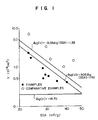
- Figure 1 is a graph showing a relationship between the magnetic switching unit (V) and the BET specific surface area (SSA) obtained in Examples of the present invention and Comparative Examples.
- the magnetic switching unit of the cobalt-containing magnetic iron oxide particles having a specific surface area in a specified range which have been produced by subjecting the precursor ⁇ -FeOOH to a specified heat-treatment to produce iron oxide particles and coating a cobalt compound on the surfaces of the produced particles has an much smaller magnetic switching unit than that of the cobalt-containing magnetic iron oxide particles which have been produced via ⁇ -Fe 2 O 3 , for example, by using ⁇ -FeOOH particles as precursor, or by dehydrating the ⁇ -FeOOH at high temperatures to produce ⁇ -Fe 2 O 3 , and that the relationship between the magnetic switching unit (V) and the BET specific surface area (SSA) should be satisfy the following equation: log[V] ⁇ -3.05 log [SSA] -11.35, more preferably: log [V] ⁇ -3.05 log[SSA]-11.50.
- the iron oxide particles comprising primarily magnetite produced by directly reducing the ⁇ -FeOOH, or thermally dehydrating the ⁇ -FeOOH at a lower temperature than the transformation temperature thereof to ⁇ -Fe 2 O 3 and then reducing the dehydrate retains well their particle shape, and they are composed of small magnetite crystals, the growth of which has been suppressed, resulting in small magnetic switching units.
- the iron oxide particles comprising primarily magnetite can be subsequently oxidized to produce iron oxide particles comprising berthollide and maghemite, in which process the crystal growth is very small, so that the variation in the magnetic switching unit is very small.
- the aluminum compound deposited ⁇ -FeOOH particles may be subjected to the aforementioned heat-treatment and coated with a cobalt compound to produce cobalt-containing magnetic iron oxide particles having further improved dispersibility and orientating property, with which there can be produced image recording mediums which are excellent in magnetic characteristics such as SQ, OR and SFD as well as extremely excellent in C-S/N.
- the process of the present invention allows the production of magnetic iron oxide particles which are excellent in magnetic characteristics such as saturation magnetization and the like as compared with the ⁇ -Fe 2 O 3 based cobalt-containing magnetic iron oxide particles and which makes it possible to reduce the light transmittance of the magnetic recording mediums. Therefore, the magnetic iron oxide particles according to the present invention are more desirable for use in the production of magnetite or berthollide based cobalt-containing magnetic iron oxide particles which have recently been put into practical use in rapid progress.
- magnetic switching unit (V) refers to the value obtained for each sample by the procedure reported by M.P. Sharrock et al in the article, IEEE Transactions on Magnetics, Vol. MAG-17, No. 6, Nov. (1981) pp. 3020-3022, as follows:
- VSM-P7 sample-vibrating type magnetometer
- Hc (t) Ha ⁇ 1 - [ k ⁇ T K ⁇ V ln( A ⁇ t 0.693 ) ] 1 ⁇ 2 ⁇
- the lepidocrocite ( ⁇ -FeOOH) to be used as precursor in the present invention can be produced by various methods. Particularly the acicular ⁇ -FeOOH which can be produced by wet neutralization and oxidation of an aqueous ferrous chloride solution should preferably be used. In the course of the production of the ⁇ -FeOOH a small amount of a metal compound containing P, Si and/or Al may be included to control the shape of the ⁇ -FeOOH particles.
- the aluminum compounds to be used for depositing on the surfaces of the ⁇ -FeOOH particles include aluminum chloride, aluminum sulfate, aluminum nitrate, sodium aluminate.
- the amount of these aluminum compounds to be deposited should be in the range of 0.05 to 3.0 % by weight, preferably 0.05 to 1.0 % by weight Al based on the weight of the ⁇ -FeOOH particles.
- a lower amount of the aluminum compounds deposited may lead to unsatisfactory effects in the deposition treatment, while a higher amount may undesirably result in an reduction in the saturation magnetization of the end cobalt-containing magnetic iron oxide particles.
- the deposition of the aluminum compounds onto the surfaces of the ⁇ -FeOOH particles may be achieved by various techniques, for example, an aqueous ferrous chloride solution is subjected to wet neutralization and oxidation to produce a ⁇ -FeOOH slurry, to which an aqueous solution of the aforementioned aluminum compound in an appropriate concentration thereof and an aqueous alkaline solution are added to accomplish the deposition under neutralization; or an aqueous solution of the aluminum compound and an aqueous alkaline solution are added to a slurry of the ⁇ -FeOOH particles in water to accomplish the deposition under neutralization.
- the deposition of the aluminum compounds may be conducted in combination with any compounds of Si, P, and/or B.
- the ⁇ -FeOOH particles containing aluminum on the surfaces thereof can be produced via usual filtration, washing with water, and drying step.
- the dehydration is preferred to increase the reaction velocity in the reduction step and to enhance the utilization rate of a H 2 gas when it is used as reducing agent.
- the temperature for dehydration must be lower than that causing transformation of the ⁇ -FeOOH particles into ⁇ -Fe 2 O 3 , and should be not higher than about 450 °C, preferably 250 °C to 350 °C.
- the ⁇ -FeOOH particles transform into ⁇ -Fe 2 O 3 particles having a higher velocity of crystal growth, which ⁇ -Fe 2 O 3 particles can be converted through reduction to iron oxide particles such as magnetite, or berthollide and maghemite after further oxidation, or cobalt-containing magnetic iron oxide particles after still further treatment by the deposition with a cobalt compound, these iron oxide particles obtained being not so low in magnetic switching unit as desired level.
- the ⁇ -Fe 2 O 3 particles produced by conversion from the ⁇ -FeOOH are liable to cause agglomeration between the particles as compared with those from ⁇ -FeOOH particles, which ⁇ -Fe 2 O 3 particles can be converted through reduction to iron oxide particles such as magnetite, or berthollide and maghemite after further oxidation, or cobalt-containing magnetic iron oxide particles after still further treatment by the deposition with a cobalt compound, these iron oxide particles being poor in magnetic characteristics as well as in dispersibility in a paint to be prepared with such particles for the production of magnetic recording mediums.
- the dehydration treatment may be conducted in an oxidizing or inert gas atmosphere
- the ⁇ -FeOOH particles should preferably be dehydrated in an oxidizing atmosphere of air and the like since the dehydration of the ⁇ -FeOOH particles in an inert atmosphere of N 2 or the like tends to cause some sintering between particles and deformation of the particle shape.
- the reduction may be performed by any conventional method. For example, it may be performed under a flowing hydrogen gas with or without water vapor at a temperature in the range of 250 °C to 400 °C, or by a method of reducing at a temperature in the range of 250 °C to 500 °C with organic materials such as gases produced by decomposition of fatty acids such as soybean oil, coconut oil, oleic acid, stearic acid and the like.
- organic materials such as gases produced by decomposition of fatty acids such as soybean oil, coconut oil, oleic acid, stearic acid and the like.
- the temperature for the reduction should preferably be as low as possible in the above defined range so far as it is capable of allowing the reduction to substantially proceed.
- the iron oxide particles comprising predominantly magnetite produced by the reduction, or those produced by further oxidizing said iron oxide particles, i.e., the iron oxide particles comprising primarily berthollide or maghemite should preferably have a magnetic switching unit satisfying the following relationship between the magnetic switching unit (V) and the BET specific surface area (SSA): log[V] ⁇ -3.05 log[SSA]-11.35
- the surfaces of the iron oxide particles produced as described above may be coated with a cobalt compound or a combination of a cobalt compound and at least one of other metal compounds to produce cobalt-containing magnetic iron oxide particles satisfying the following equations (1) to (3): 20 ⁇ SSA ⁇ 50 -16.70 ⁇ log [V] ⁇ -3.05 log[SSA]-11.35 0.10 ⁇ Fe 2+ /total Fe ⁇ 0.30 where SSA is a BET specific surface area (m 2 /g), and V is a magnetic switching unit (cm 3 ).
- the requirements expressed by the aforementioned equations (1) to (3) must be simultaneously satisfied. If a value of Fe 2+ /total Fe is lower than the above defined range, the light transmittance of magnetic recording media with the iron oxide particles becomes too high causing problems, while if it is higher than the above defined range, the stability in oxidation of the magnetic iron oxide particles tends to be diminished.
- a smaller specific surface area than the defined range precludes the image recording mediums with the iron oxide particles from having a higher recording density, while a larger specific surface area than the defined range makes it difficult to achieve a desired dispersion of the magnetic particles into magnetic recording mediums. Too low a magnetic switching unit outside the above defined range obstruct development of ferromagnetic characteristics, while too high a magnetic switching unit makes it difficult to achieve a desired excellent noise characteristics.
- metal compounds to be used with the cobalt compounds include those of Fe, Mn, Zn, Ni, Cr and the like, and they may used optionally for the purpose of improving the characteristics of cobalt-containing magnetic iron oxide particles.
- a cobalt compound, or a combination of a cobalt compound and at least one of other metal compounds may be coated on the surfaces of the magnetic particles by 1) a method comprising the steps of dispersing the iron oxide particles into an aqueous solution of a cobalt salt or a cobalt salt and at least one of other metal salts and adding an aqueous alkaline solution to the dispersion, or 2) a method comprising the steps of dispersing the iron oxide particles into an aqueous alkaline solution and adding an aqueous solution of a cobalt salt or a cobalt salt and at least one of other metal salts to the resultant alkaline dispersion.
- the coating may be conducted in air, or in either oxidizing or inert atmosphere at a reaction temperature in the range from room temperature to a boiling point or higher depending upon the chemical properties of the compounds to be deposited and coating procedures.
- the magnetic particles after coated with the cobalt compound may be further treated on their surfaces with compounds of Si, Al and the like.
- the present invention will be illustrated further in detail with reference to Examples.
- the recovered slurry was agitated by a mixer for 20 minutes to enhance the dispersion and then diluted with water to a solid content of 100 grams/liter. 2 liters of this slurry were charged in a 4 neck flask and then 368 milliliters of an aqueous 10 N NaOH solution were added to the slurry. Then with stirring 336 milliliters of an aqueous 1 mol/liter ferrous chloride solution were added over 45 minutes and thereafter 98 milliliters of an aqueous 1 mol/liter cobalt sulfate solution were added over 60 minutes. Thereafter, the temperature was increased to 45 °C and stirred for 5 hours to complete the cobalt-coating treatment. The resultant slurry was filtered, washed, and dried in an atmosphere of nitrogen gas at 120 °C to produce cobalt-containing magnetic iron oxide particles (Sample A).
- Example B The recovered slurry was enhanced in dispersion and subjected to the cobalt-coating treatment in the same manner as in Example 1 to produce cobalt-containing magnetic iron oxide particles (Sample B).
- the recovered slurry was enhanced in dispersion and subjected to the cobalt-coating treatment in the same manner as in Example 1, except that the amounts of the aqueous 10N NaOH solution, the aqueous 1 mol/liter ferrous chloride solution and the aqueous 1 mol/liter cobalt sulfate solution were changed to 324 milliliters, 236 milliliters and 68 milliliters, respectively, to produce cobalt-containing magnetic iron oxide particles (Sample C).
- the berthollide powder was dispersed by the procedure identical to that in Example 1, and subjected to the cobalt-coating treatment in the same manner as in Example 1, except that the amounts of the aqueous 10 N NaOH solution, the aqueous 1 mol/liter ferrous chloride solution and the aqueous 1 mol/liter cobalt sulfate solution were changed to 342 milliliters, 276 milliliters and 84 milliliters, respectively, to produce cobalt-containing magnetic iron oxide particles (Sample D).
- Example E The recovered slurry was enhanced in dispersion, and subjected to the cobalt-coating treatment in the same manner as in Example 1 to produce cobalt-containing magnetic iron oxide particles (Sample E).
- the recovered slurry was enhanced in dispersion identically to the case in Example 1 and subjected to the cobalt-coating treatment in the same procedure as in Example 1, except that the amounts of the aqueous 10 N NaOH solution, the aqueous 1 mol/liter ferrous chloride solution and the aqueous 1 mol/liter cobalt sulfate solution were changed to 389 milliliters, 390 milliliters and 110 milliliters, respectively, to produce cobalt-containing magnetic iron oxide particles (Sample F).
- the recovered slurry was enhanced in dispersion identically to the case in Example 1 and subjected to the cobalt-coating treatment in the same procedure as in Example 1, except that the amounts of the aqueous 10 N NaOH solution, the aqueous 1 mol/liter ferrous chloride solution and the aqueous 1 mol/liter cobalt sulfate solution were changed to 380 milliliters, 362 milliliters and 110 milliliters, respectively, to produce a comparative sample of cobalt-containing magnetic iron oxide particles (Sample G).
- the recovered slurry was agitated by a mixer for 20 minutes to enhance the dispersion and then diluted with water to a solid content of 100 grams/liter. 2 liters of this slurry were charged in a 4 neck flask and then 80 milliliters of an aqueous 10 N NaOH solution were added to the slurry. Then with stirring 122 milliliters of of an aqueous 1 mol/liter cobalt sulfate solution were added over 60 minutes. Thereafter, the temperature was increased to 45 °C and stirred for 5 hours to complete the cobalt-coating treatment. The resultant slurry was filtered, washed, and dried in an atmosphere of nitrogen gas at 120 °C to produce a comparative sample of cobalt-containing magnetic iron oxide particles (Sample H).
- This ⁇ -Fe 2 O 3 particles were subjected to the dispersion treatment identical to that in Example 1 and then subjected to the cobalt-coating treatment in the same procedure as in Example 1, except that the amounts of the aqueous 10 N NaOH solution, the aqueous 1 mol/liter ferrous chloride solution and the aqueous 1 mol/liter cobalt sulfate solution were changed to 391 milliliters, 402 milliliters and 96 milliliters, respectively, to produce a comparative sample of cobalt-containing magnetic iron oxide particles (Sample I).
- This ⁇ -Fe 2 O 3 particles were was subjected to the dispersion treatment identical to that in Example 1 and then subjected to the cobalt-coating treatment in the same procedure as in Example 1, except that the amounts of the aqueous 10 N NaOH solution, the aqueous 1 mol/liter ferrous chloride solution and the aqueous 1 mol/liter cobalt sulfate solution were changed to 395 milliliters, 402 milliliters and 114 milliliters, respectively, to produce a comparative sample of cobalt-containing magnetic iron oxide particles (Sample J).
- This ⁇ -Fe 2 O 3 particles were subjected to the dispersion treatment identical to that in Example 1 and then subjected to the cobalt-coating treatment in the same procedure as in Example 1, except that the amounts of the aqueous 10 N NaOH solution, the aqueous 1 mol/liter ferrous chloride solution and the aqueous 1 mol/liter cobalt sulfate solution were changed to 375 milliliters, 362 milliliters and 130 milliliters, respectively, to produce a comparative sample of cobalt-containing magnetic iron oxide particles (Sample K).
- the recovered slurry was agitated by a mixer for 20 minutes to enhance the dispersion and then diluted with water to a solid content of 100 grams/liter. 2 liters of this slurry were charged in a 4 neck flask and then 368 milliliters of an aqueous 10 N NaOH solution were added to the slurry. Then with stirring 336 milliliters of an aqueous 1 mol/liter ferrous chloride solution were added over 45 minutes, and then 98 milliliters of an aqueous 1 mol/liter cobalt sulfate solution were added over 60 minutes. Thereafter, the temperature was increased to 45 °C and the agitation was continued for 5 hours to complete the cobalt-coating treatment. The resultant slurry was filtered, washed, and dried in an atmosphere of nitrogen gas at 120 °C to produce cobalt-containing magnetic iron oxide particles (Sample L).
- ⁇ -FeOOH particles were produced in the same manner as in Example 7.
- Example 7 the aluminum depositing treatment was conducted in the identical procedure to that in Example 7, except that the amounts of the aqueous 1 mol/liter aluminum chloride solution and the aqueous 1 N NaOH solution to be added were changed to 97 milliliters and 292 milliliters, respectively.
- the produced ⁇ -FeOOH slurry was filtered, washed, and dried to produce acicular ⁇ -FeOOH particles having an aluminum content of 0.3 % by weight. 500 grams of this acicular ⁇ -FeOOH particles were charged in a small sized rotary kiln and subjected to the thermal dehydration and reduction identically to the case in Example 7 to produce reduced particles which were added to 3 liters of water and then recovered.
- Example M The recovered slurry was subjected to the dispersion treatment and the cobalt-coating treatment in the same procedure as that in Example 7 to produce cobalt-containing magnetic iron oxide particles (Sample M).
- ⁇ -FeOOH particles were produced in the same manner as in Example 7.
- Example 7 the aluminum depositing treatment was conducted in the identical procedure to that in Example 7, except that the amounts of the aqueous 1 mol/liter aluminum chloride solution and the aqueous 1 N NaOH solution to be added were changed to 32 milliliters and 97 milliliters, respectively.
- the produced ⁇ -FeOOH slurry was filtered, washed, and dried to produce acicular ⁇ -FeOOH particles having an aluminum content of 0.1 % by weight. 500 grams of this acicular ⁇ -FeOOH particles were charged in a small sized rotary kiln and thermally dehydrated at 280 °C for one hour under air flowing at 3 liters/minute.
- the thermal reduction of the dehydrated particles was performed at 280 °C for 2 hours under a hydrogen gas flowing at 3 liters/minute. After cooling the reduced particles were added to 3 liters of water and recovered.
- Example N The recovered slurry was subjected to the dispersion treatment and the cobalt-coating treatment in the same procedure as that in Example 7 to produce cobalt-containing magnetic iron oxide particles (Sample N).
- ⁇ -FeOOH particles were produced and subjected to the aluminum coating treatment similarly to the case in Example 7 to produce acicular ⁇ -FeOOH having an aluminum content of 0.5 % by weight.
- Example 1 The results obtained by evaluating the cobalt-containing magnetic iron oxide particles in the Examples and Comparative Examples as above (Samples A to O) for BET specific surface area, coercive force, Fe 2+ /total Fe and magnetic switching unit are set forth in Table 1, and those obtained by preparing video tapes with the magnetic particles in the manner as described below and evaluating the tapes for the noise characteristic (Y-S/N) are in Table 2. Moreover, the video noise characteristic (color signal noise characteristic, C-S/N) obtained by preparing video tapes with the cobalt-containing magnetic iron oxide particles and evaluating the tapes for the noise characteristic (Y-S/N) are in Table 2. Moreover, the relationship between the magnetic switching unit and the BET specific surface area obtained from the results in Table 1 is shown in Figure 1.
- the cobalt-containing magnetic iron oxide particles according to the present invention are excellent in dispersibility and orientation property and that the video tapes made with such magnetic particles are excellent in color signal noise characteristic (C-S/N) owing to the excellent surface property of the video tapes. It also can be found that the relationship between the BET specific surface area and the magnetic switching unit is characterized by satisfying the equation, log[V] ⁇ -3.05 log[SSA] - 11.35 with a reduced magnetic switching unit, and that the noise characteristic (Y-S/N) is excellent due to the reduced magnetic switching unit.
- the magnetic paint with the above formulation was applied onto a polyester base film to a thickness of 5 ⁇ m, dried, calendered, and then cured at 60 °C for 16 hours. Thereafter, the film was cut by a slitter to a width of 1.27 cm (0.5 inch) and set in VHS cassette half.
- the cobalt-containing magnetic iron oxide particles of the present invention are suitable for elements to be used in magnetic recording mediums, especially those in image recording mediums as they have good dispersibility in mediums and excellent noise characteristics (Y-S/N, C-S/N).
- the process of the present invention enables extremely effective production of cobalt-containing magnetic iron oxide particles suitable for the elements in magnetic recording mediums from the precursor, ⁇ -FeOOH in easy operation, so that it is very useful in industry.
Landscapes
- Chemical & Material Sciences (AREA)
- Organic Chemistry (AREA)
- Inorganic Chemistry (AREA)
- Hard Magnetic Materials (AREA)
- Compounds Of Iron (AREA)
- Magnetic Record Carriers (AREA)
Claims (8)
- Particules d'oxyde magnétique de fer contenant du cobalt satisfaisant aux équations (1), (2) et (3) suivantes :


- Les particules d'oxyde magnétique de fer contenant du cobalt selon la revendication 1, dans lesquelles l'équation (2) est -16,70 ≤ log[V] ≤ -3,05 log[SS] - 11,50.
- Les particules d'oxyde magnétique de fer contenant du cobalt selon la revendication 1, dans lesquelles l'équation (3) est 0,20 ≤ Fe2+/Fe total ≤ 0,30.
- Un procédé pour la production des particules d'oxyde magnétique de fer contenant du cobalt selon la revendication 1, comprenant les étapes de production de particules d'oxyde de fer ayant une concentration en Fe2+ de 0,10 à 0,36, telle qu'exprimée par Fe2+/Fe total, en réduisant directement des particules de lépidocrocite, ou en déshydratant thermiquement des particules de lépidocrocite à une température plus basse que celle qui provoque la transformation en particules d'hématite et en réduisant ensuite le produit déshydraté, ou en effectuant la réduction susmentionnée, puis une oxydation à une température de 200°C ou moins, puis de dépôt d'un composé du cobalt ou d'une association d'un composé du cobalt et d'un composé d'un autre métal sur les surfaces des particules d'oxyde de fer dans une atmosphère oxydante ou inerte.
- Le procédé pour la production de particules d'oxyde magnétique de fer contenant du cobalt selon la revendication 4, dans lequel les particules d'oxyde de feront une concentration en Fe2+ de 0,20 à 0,36 telle qu'exprimée par Fe2+/Fe total.
- Le procédé pour la production de particules d'oxyde magnétique de fer contenant du cobalt selon la revendication 4, dans lequel les particules d'oxyde de fer ont une concentration en Fe2+ de 0,28 à 0,36 telle qu'exprimée par Fe2+/Fe total.
- Le procédé pour la production de particules d'oxyde magnétique de fer contenant du cobalt selon la revendication 4, dans lequel un composé d'aluminium est déposé sur les surfaces des particules de lépidocrocite.
- Le procédé pour la production de particules d'oxyde magnétique de fer contenant du cobalt selon la revendication 7, dans lequel la quantité du composé d'aluminium déposé est de 0,05 à 3,0 % en poids de Al par rapport au poids de la lépidocrocite.
Applications Claiming Priority (4)
| Application Number | Priority Date | Filing Date | Title |
|---|---|---|---|
| JP362114/92 | 1992-12-29 | ||
| JP36211492A JP3244830B2 (ja) | 1992-12-29 | 1992-12-29 | コバルト含有磁性酸化鉄粉末およびその製造方法 |
| JP5052843A JP3020374B2 (ja) | 1993-02-02 | 1993-02-02 | コバルト含有磁性酸化鉄粉末の製造方法 |
| JP52843/93 | 1993-02-02 |
Publications (3)
| Publication Number | Publication Date |
|---|---|
| EP0604849A2 EP0604849A2 (fr) | 1994-07-06 |
| EP0604849A3 EP0604849A3 (fr) | 1995-03-15 |
| EP0604849B1 true EP0604849B1 (fr) | 1996-10-16 |
Family
ID=26393513
Family Applications (1)
| Application Number | Title | Priority Date | Filing Date |
|---|---|---|---|
| EP93120343A Expired - Lifetime EP0604849B1 (fr) | 1992-12-29 | 1993-12-16 | Oxyde de fer magnétique contenant du cobalt et procédé pour sa production |
Country Status (5)
| Country | Link |
|---|---|
| US (1) | US5609789A (fr) |
| EP (1) | EP0604849B1 (fr) |
| KR (1) | KR100249538B1 (fr) |
| CN (1) | CN1069779C (fr) |
| DE (1) | DE69305487T2 (fr) |
Families Citing this family (4)
| Publication number | Priority date | Publication date | Assignee | Title |
|---|---|---|---|---|
| JPH1025115A (ja) * | 1996-07-04 | 1998-01-27 | Sony Corp | 酸化鉄系磁性粉末及びこれを用いた磁気記録媒体 |
| EP1328476B1 (fr) * | 2000-09-26 | 2011-03-30 | LANXESS Deutschland GmbH | Granules de contact et granules adsorbants |
| CN1315734C (zh) * | 2005-03-30 | 2007-05-16 | 山东师范大学 | 一维α-FeOOH纳米材料生产方法 |
| DE102006020840B4 (de) | 2006-05-04 | 2010-08-12 | Krause-Röhm-Systeme Ag | Verfahren zur Gewinnung von Magnetit |
Family Cites Families (18)
| Publication number | Priority date | Publication date | Assignee | Title |
|---|---|---|---|---|
| US3904540A (en) * | 1972-02-11 | 1975-09-09 | Pfizer | Magnetic impulse record member |
| US4176172A (en) * | 1975-12-22 | 1979-11-27 | Pfizer Inc. | Particle gamma ferric oxide |
| DE2735316C3 (de) * | 1977-08-05 | 1981-01-29 | Basf Ag, 6700 Ludwigshafen | Verfahren zur Herstellung von nadeiförmigen, ferrimagnetischen Eisenoxiden |
| DE2805405A1 (de) * | 1978-02-09 | 1979-08-16 | Basf Ag | Verfahren zur herstellung von nadelfoermigen, ferrimagnetischen eisenoxiden |
| JPS5520278A (en) * | 1978-07-31 | 1980-02-13 | Hitachi Maxell Ltd | Production of magnetic powder for magnetic recording medium |
| DE2935444A1 (de) * | 1979-09-01 | 1981-03-19 | Basf Ag, 6700 Ludwigshafen | Verfahren zur herstellung von nadelfoermigen ferrimagnetischem eisenoxid |
| US4382822A (en) * | 1979-09-14 | 1983-05-10 | Pfizer Inc. | Synthetic rhombohedral magnetite pigment |
| JPS5745206A (en) * | 1980-08-30 | 1982-03-15 | Titan Kogyo Kk | Manufacture of acicular powder of magnetic iron oxide covered with cobalt |
| JPS57129828A (en) * | 1981-01-30 | 1982-08-12 | Daikin Ind Ltd | Manufacture of magnetic fine powder |
| JPS5874529A (ja) * | 1981-10-29 | 1983-05-06 | Daikin Ind Ltd | 磁性微粒子の製法 |
| DE3143870A1 (de) * | 1981-11-05 | 1983-05-11 | Basf Ag, 6700 Ludwigshafen | Verfahren zur herstellung von nadelfoermigen, ferrimagnetischen eisenoxiden |
| JPS5884407A (ja) * | 1981-11-13 | 1983-05-20 | Daikin Ind Ltd | 磁性微粒子の製造法 |
| DE3516885A1 (de) * | 1985-05-10 | 1986-11-13 | Basf Ag, 6700 Ludwigshafen | Verfahren zur herstellung nadelfoermiger, kobalthaltiger ferrimagnetischer eisenoxide |
| JPS62108738A (ja) * | 1985-11-08 | 1987-05-20 | Fuji Photo Film Co Ltd | 強磁性酸化鉄粉末の製造方法 |
| DE3627133A1 (de) * | 1986-08-09 | 1988-02-11 | Basf Ag | Verfahren zur herstellung von nadelfoermigem, ferrimagnetischem eisenoxid |
| JPS6369715A (ja) * | 1986-09-11 | 1988-03-29 | Showa Denko Kk | 強磁性酸化鉄粉の製造方法 |
| JPS6369714A (ja) * | 1986-09-11 | 1988-03-29 | Showa Denko Kk | 強磁性酸化鉄粉の製造方法 |
| DE68923544T2 (de) * | 1988-12-29 | 1996-03-28 | Toda Kogyo Corp | Magnetische Eisenoxydteilchen und Verfahren zu ihrer Herstellung. |
-
1993
- 1993-12-16 EP EP93120343A patent/EP0604849B1/fr not_active Expired - Lifetime
- 1993-12-16 DE DE69305487T patent/DE69305487T2/de not_active Expired - Lifetime
- 1993-12-28 KR KR1019930030356A patent/KR100249538B1/ko not_active Expired - Fee Related
- 1993-12-28 CN CN93115693A patent/CN1069779C/zh not_active Expired - Fee Related
-
1996
- 1996-04-22 US US08/635,540 patent/US5609789A/en not_active Expired - Lifetime
Also Published As
| Publication number | Publication date |
|---|---|
| DE69305487D1 (de) | 1996-11-21 |
| EP0604849A3 (fr) | 1995-03-15 |
| DE69305487T2 (de) | 1997-03-13 |
| US5609789A (en) | 1997-03-11 |
| CN1069779C (zh) | 2001-08-15 |
| EP0604849A2 (fr) | 1994-07-06 |
| KR100249538B1 (ko) | 2000-03-15 |
| CN1090085A (zh) | 1994-07-27 |
| KR940014159A (ko) | 1994-07-16 |
Similar Documents
| Publication | Publication Date | Title |
|---|---|---|
| US5645652A (en) | Spindle-shaped magnetic iron-based alloy particles containing cobalt and iron as the main ingredients and process for producing the same | |
| JP3666688B2 (ja) | 磁気記録媒体 | |
| US5609789A (en) | Cobalt-containing magnetic iron oxide and process for producing the same | |
| US4437881A (en) | Acicular ferromagnetic alloy particles and process for producing said particles | |
| US4755315A (en) | Preparation of cobalt-containing isotropic magnetic iron oxides | |
| JP3482177B2 (ja) | コバルト含有磁性酸化鉄粉末およびそれを用いた磁気記録媒体 | |
| KR100445590B1 (ko) | 코발트 피복된 침상의 자성 산화철 입자 | |
| US5047161A (en) | Preparation of isometric cobalt- and titanium-containing magnetic iron oxides | |
| JP3020374B2 (ja) | コバルト含有磁性酸化鉄粉末の製造方法 | |
| US4486467A (en) | Process for producing cobalt-containing magnetic iron oxide powder | |
| KR0169491B1 (ko) | 침상의 강자성 산화철분말, 침상의 자성 산화철분말 및, 이들의 제조방법 | |
| JP3244830B2 (ja) | コバルト含有磁性酸化鉄粉末およびその製造方法 | |
| JPH1025115A (ja) | 酸化鉄系磁性粉末及びこれを用いた磁気記録媒体 | |
| EP0371384B1 (fr) | Procédé de fabrication de particules magnétiques d'oxyde de fer pour l'enregistrement magnétique | |
| US5989516A (en) | Spindle-shaped geothite particles | |
| EP0583621B1 (fr) | Procédé pour la préparation de particules d'oxyde hydroxyde de fer (III) gamma aciculaire | |
| JP3594191B2 (ja) | 強磁性金属粉末の製造方法 | |
| JP2897794B2 (ja) | コバルト被着型磁性酸化鉄粒子粉末の製造法 | |
| JPS6132259B2 (fr) | ||
| EP0131223B1 (fr) | Procédé de fabrication d'oxyde de fer ferromagnétique modifié par le cobalt | |
| JP2945458B2 (ja) | 針状強磁性酸化鉄粉末及びその製造方法 | |
| JPH0120201B2 (fr) | ||
| JPS63142607A (ja) | 磁性鉄粉の製造方法 | |
| JPH04132618A (ja) | コバルト含有強磁性酸化鉄粒子粉末の製造法 | |
| JPS63142608A (ja) | 磁性鉄粉の製造方法 |
Legal Events
| Date | Code | Title | Description |
|---|---|---|---|
| PUAI | Public reference made under article 153(3) epc to a published international application that has entered the european phase |
Free format text: ORIGINAL CODE: 0009012 |
|
| AK | Designated contracting states |
Kind code of ref document: A2 Designated state(s): BE CH DE FR GB IT LI NL |
|
| 17P | Request for examination filed |
Effective date: 19941115 |
|
| PUAL | Search report despatched |
Free format text: ORIGINAL CODE: 0009013 |
|
| AK | Designated contracting states |
Kind code of ref document: A3 Designated state(s): BE CH DE FR GB IT LI NL |
|
| GRAG | Despatch of communication of intention to grant |
Free format text: ORIGINAL CODE: EPIDOS AGRA |
|
| GRAH | Despatch of communication of intention to grant a patent |
Free format text: ORIGINAL CODE: EPIDOS IGRA |
|
| 17Q | First examination report despatched |
Effective date: 19960229 |
|
| GRAH | Despatch of communication of intention to grant a patent |
Free format text: ORIGINAL CODE: EPIDOS IGRA |
|
| GRAA | (expected) grant |
Free format text: ORIGINAL CODE: 0009210 |
|
| AK | Designated contracting states |
Kind code of ref document: B1 Designated state(s): BE CH DE FR GB IT LI NL |
|
| REG | Reference to a national code |
Ref country code: CH Ref legal event code: NV Representative=s name: A. BRAUN, BRAUN, HERITIER, ESCHMANN AG PATENTANWAE |
|
| REF | Corresponds to: |
Ref document number: 69305487 Country of ref document: DE Date of ref document: 19961121 |
|
| ET | Fr: translation filed | ||
| ITF | It: translation for a ep patent filed | ||
| PLBE | No opposition filed within time limit |
Free format text: ORIGINAL CODE: 0009261 |
|
| STAA | Information on the status of an ep patent application or granted ep patent |
Free format text: STATUS: NO OPPOSITION FILED WITHIN TIME LIMIT |
|
| 26N | No opposition filed | ||
| PGFP | Annual fee paid to national office [announced via postgrant information from national office to epo] |
Ref country code: CH Payment date: 19971201 Year of fee payment: 5 |
|
| PGFP | Annual fee paid to national office [announced via postgrant information from national office to epo] |
Ref country code: BE Payment date: 19980217 Year of fee payment: 5 |
|
| PG25 | Lapsed in a contracting state [announced via postgrant information from national office to epo] |
Ref country code: LI Free format text: LAPSE BECAUSE OF NON-PAYMENT OF DUE FEES Effective date: 19981231 Ref country code: CH Free format text: LAPSE BECAUSE OF NON-PAYMENT OF DUE FEES Effective date: 19981231 Ref country code: BE Free format text: LAPSE BECAUSE OF NON-PAYMENT OF DUE FEES Effective date: 19981231 |
|
| BERE | Be: lapsed |
Owner name: ISHIHARA SANGYO KAISHA LTD Effective date: 19981231 |
|
| REG | Reference to a national code |
Ref country code: CH Ref legal event code: PL |
|
| REG | Reference to a national code |
Ref country code: GB Ref legal event code: IF02 |
|
| PG25 | Lapsed in a contracting state [announced via postgrant information from national office to epo] |
Ref country code: IT Free format text: LAPSE BECAUSE OF NON-PAYMENT OF DUE FEES Effective date: 20051216 |
|
| PGFP | Annual fee paid to national office [announced via postgrant information from national office to epo] |
Ref country code: GB Payment date: 20101215 Year of fee payment: 18 |
|
| PGFP | Annual fee paid to national office [announced via postgrant information from national office to epo] |
Ref country code: NL Payment date: 20111101 Year of fee payment: 19 Ref country code: FR Payment date: 20111202 Year of fee payment: 19 |
|
| PGFP | Annual fee paid to national office [announced via postgrant information from national office to epo] |
Ref country code: DE Payment date: 20120229 Year of fee payment: 19 |
|
| REG | Reference to a national code |
Ref country code: NL Ref legal event code: V1 Effective date: 20130701 |
|
| GBPC | Gb: european patent ceased through non-payment of renewal fee |
Effective date: 20121216 |
|
| REG | Reference to a national code |
Ref country code: FR Ref legal event code: ST Effective date: 20130830 |
|
| REG | Reference to a national code |
Ref country code: DE Ref legal event code: R119 Ref document number: 69305487 Country of ref document: DE Effective date: 20130702 |
|
| PG25 | Lapsed in a contracting state [announced via postgrant information from national office to epo] |
Ref country code: NL Free format text: LAPSE BECAUSE OF NON-PAYMENT OF DUE FEES Effective date: 20130701 Ref country code: DE Free format text: LAPSE BECAUSE OF NON-PAYMENT OF DUE FEES Effective date: 20130702 |
|
| PG25 | Lapsed in a contracting state [announced via postgrant information from national office to epo] |
Ref country code: GB Free format text: LAPSE BECAUSE OF NON-PAYMENT OF DUE FEES Effective date: 20121216 Ref country code: FR Free format text: LAPSE BECAUSE OF NON-PAYMENT OF DUE FEES Effective date: 20130102 |