EP0605110A2 - Convertisseurs optiques non-linéaires de longueur d'onde - Google Patents
Convertisseurs optiques non-linéaires de longueur d'onde Download PDFInfo
- Publication number
- EP0605110A2 EP0605110A2 EP93309655A EP93309655A EP0605110A2 EP 0605110 A2 EP0605110 A2 EP 0605110A2 EP 93309655 A EP93309655 A EP 93309655A EP 93309655 A EP93309655 A EP 93309655A EP 0605110 A2 EP0605110 A2 EP 0605110A2
- Authority
- EP
- European Patent Office
- Prior art keywords
- optical
- resonator
- input
- radiation
- nonlinear
- Prior art date
- Legal status (The legal status is an assumption and is not a legal conclusion. Google has not performed a legal analysis and makes no representation as to the accuracy of the status listed.)
- Withdrawn
Links
Images







Classifications
-
- G—PHYSICS
- G02—OPTICS
- G02F—OPTICAL DEVICES OR ARRANGEMENTS FOR THE CONTROL OF LIGHT BY MODIFICATION OF THE OPTICAL PROPERTIES OF THE MEDIA OF THE ELEMENTS INVOLVED THEREIN; NON-LINEAR OPTICS; FREQUENCY-CHANGING OF LIGHT; OPTICAL LOGIC ELEMENTS; OPTICAL ANALOGUE/DIGITAL CONVERTERS
- G02F1/00—Devices or arrangements for the control of the intensity, colour, phase, polarisation or direction of light arriving from an independent light source, e.g. switching, gating or modulating; Non-linear optics
- G02F1/35—Non-linear optics
- G02F1/37—Non-linear optics for second-harmonic generation
-
- G—PHYSICS
- G02—OPTICS
- G02F—OPTICAL DEVICES OR ARRANGEMENTS FOR THE CONTROL OF LIGHT BY MODIFICATION OF THE OPTICAL PROPERTIES OF THE MEDIA OF THE ELEMENTS INVOLVED THEREIN; NON-LINEAR OPTICS; FREQUENCY-CHANGING OF LIGHT; OPTICAL LOGIC ELEMENTS; OPTICAL ANALOGUE/DIGITAL CONVERTERS
- G02F1/00—Devices or arrangements for the control of the intensity, colour, phase, polarisation or direction of light arriving from an independent light source, e.g. switching, gating or modulating; Non-linear optics
- G02F1/35—Non-linear optics
- G02F1/39—Non-linear optics for parametric generation or amplification of light, infrared or ultraviolet waves
-
- G—PHYSICS
- G02—OPTICS
- G02F—OPTICAL DEVICES OR ARRANGEMENTS FOR THE CONTROL OF LIGHT BY MODIFICATION OF THE OPTICAL PROPERTIES OF THE MEDIA OF THE ELEMENTS INVOLVED THEREIN; NON-LINEAR OPTICS; FREQUENCY-CHANGING OF LIGHT; OPTICAL LOGIC ELEMENTS; OPTICAL ANALOGUE/DIGITAL CONVERTERS
- G02F1/00—Devices or arrangements for the control of the intensity, colour, phase, polarisation or direction of light arriving from an independent light source, e.g. switching, gating or modulating; Non-linear optics
- G02F1/35—Non-linear optics
- G02F1/353—Frequency conversion, i.e. wherein a light beam is generated with frequency components different from those of the incident light beams
- G02F1/3534—Three-wave interaction, e.g. sum-difference frequency generation
-
- G—PHYSICS
- G02—OPTICS
- G02F—OPTICAL DEVICES OR ARRANGEMENTS FOR THE CONTROL OF LIGHT BY MODIFICATION OF THE OPTICAL PROPERTIES OF THE MEDIA OF THE ELEMENTS INVOLVED THEREIN; NON-LINEAR OPTICS; FREQUENCY-CHANGING OF LIGHT; OPTICAL LOGIC ELEMENTS; OPTICAL ANALOGUE/DIGITAL CONVERTERS
- G02F1/00—Devices or arrangements for the control of the intensity, colour, phase, polarisation or direction of light arriving from an independent light source, e.g. switching, gating or modulating; Non-linear optics
- G02F1/35—Non-linear optics
- G02F1/353—Frequency conversion, i.e. wherein a light beam is generated with frequency components different from those of the incident light beams
- G02F1/354—Third or higher harmonic generation
-
- G—PHYSICS
- G02—OPTICS
- G02F—OPTICAL DEVICES OR ARRANGEMENTS FOR THE CONTROL OF LIGHT BY MODIFICATION OF THE OPTICAL PROPERTIES OF THE MEDIA OF THE ELEMENTS INVOLVED THEREIN; NON-LINEAR OPTICS; FREQUENCY-CHANGING OF LIGHT; OPTICAL LOGIC ELEMENTS; OPTICAL ANALOGUE/DIGITAL CONVERTERS
- G02F1/00—Devices or arrangements for the control of the intensity, colour, phase, polarisation or direction of light arriving from an independent light source, e.g. switching, gating or modulating; Non-linear optics
- G02F1/35—Non-linear optics
- G02F1/353—Frequency conversion, i.e. wherein a light beam is generated with frequency components different from those of the incident light beams
- G02F1/3542—Multipass arrangements, i.e. arrangements to make light pass multiple times through the same element, e.g. using an enhancement cavity
-
- G—PHYSICS
- G02—OPTICS
- G02F—OPTICAL DEVICES OR ARRANGEMENTS FOR THE CONTROL OF LIGHT BY MODIFICATION OF THE OPTICAL PROPERTIES OF THE MEDIA OF THE ELEMENTS INVOLVED THEREIN; NON-LINEAR OPTICS; FREQUENCY-CHANGING OF LIGHT; OPTICAL LOGIC ELEMENTS; OPTICAL ANALOGUE/DIGITAL CONVERTERS
- G02F2203/00—Function characteristic
- G02F2203/18—Function characteristic adaptive optics, e.g. wavefront correction
Definitions
- This invention relates generally to nonlinear optical devices and, in particular, to devices for converting the wavelength of coherent radiation that is non-uniform in space (beam profile) and/or non-uniform in time (pulse shape).
- Nonlinear optical devices such as frequency mixers and optical parametric converters
- frequency mixers are widely used for generating wavelengths that cannot be generated efficiently with currently available lasers.
- Examples of commonly-used frequency mixers are second harmonic generators (SHGs), third harmonic generators (THGs), and fourth harmonic generators (FHGs).
- SHGs second harmonic generators
- TMGs third harmonic generators
- FHGs fourth harmonic generators
- a SHG may receive a fundamental optical radiation signal having a wavelength of 1.06 micrometers. Through a process that occurs within a nonlinear medium, a portion of the fundamental is converted to a signal at half the wavelength, 532nm, or twice the frequency, of the fundamental.
- optical parametric devices both oscillators and amplifiers, that generate continuously-tunable radiation when pumped by fixed-wavelength lasers or their harmonics.
- the efficiency of these converters should be high, preferably near the quantum limit. This is especially important when several of these devices are used in cascade, as in the case of optical parametric converters pumped by the third or fourth harmonic of, by example, a Nd:YAG laser.
- FHG is a cascade of two SHG processes, i.e. o+o ⁇ 2o, followed by 2o+2o ⁇ 4o.
- the conversion efficiency is specified as an energy or a photon conversion efficiency.
- the energy conversion efficiency is defined as the ratio of the energy in the output pulse(s) and the energy in the input pulse(s).
- the maximum value of the energy conversion efficiency is 100 percent for process (1), while for process (2) the energy conversion efficiency is equal to o1/o3 or o2/o3 for the generation of o1 or o2, respectively.
- the photon conversion efficiency is defined as, for process (1), the ratio of the number of photons in the output pulse and the (equal) number of photons in each of the input pulses.
- the photon conversion efficiency is defined as the ratio of the equal number of photons in each of the generated pulses, and the number of photons in the input pulse.
- the maximum photon conversion efficiency is 100 percent.
- the maximum photon conversion efficiency is 50 percent for process (1), and 200 percent for process (2).
- the fluences should be maintained below a value at which irreversible damage occurs either to the nonlinear medium or to optical components of the wavelength conversion system.
- State-of-the-art wavelength converters have conversion efficiencies well below the theoretical maximum values.
- SHGs used with pulsed (Q-switched) Nd:YAG lasers have typical energy conversion efficiencies of 50 percent, while THGs and FHGs have energy conversion efficiencies of approximately 30 percent and 20 percent, respectively.
- Optical parametric converters, both oscillators (OPOs) and amplifiers (OPAs) have typical photon conversion efficiencies below 50 percent.
- the nonlinear medium is placed in a resonant cavity with mirror reflectivities close to 100% (typically 97-99%), and the cavity linear losses are maintained at very low value (typically ⁇ 1%).
- the beam size within the nonlinear medium is made very small, typically several tens to hundreds of microns. For the case of feedback at the input wavelength, efficiency increases of several orders of magnitude can be obtained over a no-feedback case.
- the power of a Nd:YAG laser pulse having energy of 0.01 Joules and a pulse length of 10 nanoseconds, is 106 Watts, as compared to milliWatts to several tens of Watts for a typical CW laser.
- the present invention overcomes the limitations in conversion efficiency which are present with high power sources. These efficiency limitations result from the fact that the laser intensity is nonuniform in both space and time, or, stated differently, the laser beam profile is not "top-hat", and the laser pulse shape is not rectangular.
- a second limitation imposed by beam/pulse nonuniformities is that the mixing and parametric processes can be reversible.
- Non-degenerate mixing processes are reversible except for the practically unrealistic case where the beam profiles and pulse shapes of the two input fields are identical, and the ratio of their energies is equal to the ratio of the frequencies of the two fields.
- Parametric processes are reversible both in the degenerate and non-degenerate cases.
- THG as the intensity of the o and 2o input beams is increased, back-conversion of energy at 3o to radiation at o and 2o occurs, thus preventing simultaneous high conversion across the entire beam/pulse.
- parametric converters reverse energy transfer occurs from the generated o1 and o2 waves back to the o3 pump wave at sufficiently high input pump intensities.
- the present invention provides optical frequency conversion apparatus, comprising at least one resonator means having an optical path defined by a plurality of mirrors; and a nonlinear conversion medium disposed within the optical path of said at least one resonator means, said nonlinear medium receiving optical radiation at a first frequency and outputting optical radiation at a second frequency that is a multiple of the first frequency; wherein one of said mirrors is an input mirror for coupling into said at least one resonator means a pulse of radiation having a first frequency; one of said mirrors is an output mirror for coupling out of said at least one resonator means a pulse of radiation having a frequency that is a function of the first frequency; and wherein means associated with said input mirror for providing a predetermined reflectivity for providing an optical feedback for causing the pulse of radiation within said at least one resonator means to have an intensity sufficient to optimize, over the entire pulse shape and beam profile of the pulse of radiation, a conversion efficiency of said nonlinear conversion medium without exceeding a damage threshold of said nonlinear conversion medium or
- an optical frequency conversion apparatus in accordance with the present invention includes at least one resonator for an input wave (o1 and/or o2 for process (1), o3 for process (2)).
- a resonator has an optical path defined by a plurality of mirrors.
- a nonlinear conversion medium is disposed within the optical path of the resonator(s).
- For mixing proceses (1), one or both input wave(s) o1 and/or o2 is/are resonated, while for parametric processes (2), the input (pump) wave o3 is resonated.
- the nonlinear conversion medium receives optical radiation at two (process (1)) or one (process (2)) input frequency/frequencies, and outputs optical radiation at one (process (1)) or two (process (2)) output frequency/frequencies.
- these devices also employ resonators for one or both output frequencies o1 and/or o2.
- One of the plurality of mirrors in a resonator is an input mirror for coupling into the resonator a pulse at an input frequency.
- the input mirror has a predetermined reflectivity which is selected to cause the radiation within the resonator to have a fluence (optical power density), in the nonlinear conversion medium, which is chosen to maximize the conversion efficiency of the wavelength conversion apparatus, without exceeding the damage threshold for the nonlinear conversion medium or any of the plurality of mirrors and other optical components, such as wavelength selection components.
- the predetermined reflectivity has a substantially uniform profile across a surface of the input mirror. In a further embodiment of the invention, the predetermined reflectivity has a profile that varies across a surface of the input mirror in such a manner as to have a greater reflectivity for portions of the input beam that have a fluence (optical energy density) below the peak fluence (optical energy density).
- a method for use in an optical frequency conversion apparatus for increasing the conversion efficiency or reducing the magnitude of the optical power density at an input of a nonlinear conversion medium comprising the steps of coupling at least one pulse of optical radiation beam into a resonator means, the resonator means including the nonlinear conversion medium, the step of coupling occurring at an input mirror of the resonator means; and providing the input mirror with a predetermined reflectivity for generating an optical feedback within the resonator means, an amount of optical feedback being selected so as to obtain a desired amount of nonlinear conversion efficiency with the nonlinear conversion medium while maintaining the magnitude of the optical power density at or below a level required to obtain the desired amount of nonlinear conversion efficiency without the use of optical feedback.
- a nonlinear medium has a predetermined, limited range of angular acceptance angles.
- a first step couples at least one pulse of radiation into a resonator, the resonator including the nonlinear conversion medium. The step of coupling occurs at the input mirror of the resonator.
- the method includes a further step of providing the resonator input mirror with a predetermined reflectivity for generating an optical feedback within the resonator. An amount of optical feedback is selected so as to obtain a desired amount of nonlinear conversion with the nonlinear medium. The desired degree of nonlinear conversion is obtained with a beam size that is sufficiently large to maintain the beam divergence within the range of acceptance angles of the nonlinear conversion medium.
- a method for increasing the average input power for which efficient conversion can be obtained for use in an optical frequency conversion apparatus, a method for increasing the average input power for which efficient conversion can be obtained.
- the average power generated by the wavelength converter apparatus is limited by (a small amount of) absorption of one or more of the waves propagating through the nonlinear conversion medium. This absorption results in nonuniform heating of the nonlinear conversion medium, and therefore in wavefront distortion of beams propagating through it. This distortion reduces the amount of resonant buildup of the electric field of the input wave(s), and thereby the nonlinear conversion efficiency compared to the case of no wavefront distortion.
- a first step couples at least one pulse of radiation into a resonator, the resonator including the nonlinear conversion medium.
- the step of coupling occurs at the input mirror of the resonator.
- the method includes a further step of providing the resonator input mirror with a predetermined reflectivity for generating an optical feedback within the resonator. An amount of optical feedback is selected so as to obtain a desired amount of nonlinear conversion with the nonlinear medium.
- the method includes a further step of providing the resonator with a spatial light modulator (SLM) which compensates for the optical distortion on an input wave, thereby enabling maximum resonant electric field buildup in the resonator.
- the SLM is a phase modulator such as a deformable mirror or a phase modulator array.
- this invention applies not only to second order nonlinear processes described by processes (1) and (2) above, but also to higher order processes including, but not limited to, third order nonlinear processes such as four-wave-mixing and Raman scattering.
- the nonlinear medium is referred to as a crystal, in that nonlinear crystals are the most commonly used nonlinear material. It should be realized, however, that the invention may be practiced with other than crystalline nonlinear materials.
- nonlinear polymers may be employed.
- a gas, such as sodium vapor, or a liquid, such as CS2 may be employed as the nonlinear medium.
- the invention employs feedback on the input beam(s) of wavelength converters to increase the conversion efficiency and/or reduce the optical fluence (optical power density) on the nonlinear crystal and optical components, thereby increasing the reliability and extending the lifetime of these components.
- the technique of efficiency enhancement and/or fluence (optical power density) reduction is the same for both processes (1) and (2).
- Figs. 1a and 1b are schematic diagrams of representative embodiments of the present invention, as applied specifically to SHGs.
- Figs. 1a and 1b illustrate optical resonators 10 and 20, respectively. These resonators are bounded by mirrors M1, M2, and M1, M2, M3, respectively.
- Each resonator includes a nonlinear optical medium, such as a crystal 10a and 20a, respectively.
- crystals 10a and 20a are comprised of dihydrogen phosphate (KDP).
- KDP dihydrogen phosphate
- Other suitable crystals include, but are not limited to, ADP, LiNbO3, BBO, and LBO.
- the length of the resonator is such that the wavelength of the input beam coincides with a resonance (longitudinal mode), thereby producing constructive interference of successive roundtrips within the resonator.
- the reflectivity of the input mirror M1 is equal to a desired amount of optical feedback and is relatively low as compared to the prior art, low power CW approaches. That is, the reflectivity of the input mirror M1 is typically on the order of a few tens of percent, and is preferably within a range of approximately 10 percent to approximately 50 percent, with 20 percent being a typical value. The reflectivity may be uniform across the mirror, or it may be given a predetermined reflectivity profile, as described below.
- a laser source (LS) 12 and beam forming optics (BFO) 14.
- the BFO 14 is conventional in construction and typically includes a telescope having two or more lenses. The purpose of the BFO 14 is to deliver a desired beam size to the nonlinear crystal within the resonator.
- the LS and BFO are shown only for the embodiments of Figs. 1a and 1b, it being understood that similar optical components are included with the other embodiments illustrated in, by example, Figs. 4a, 4b, 6, 8, 9, and 11.
- the feedback mechanism exploits this property of nonlinear wavelength conversion to provide a maximum intensity enhancement when the resonator losses are smallest, i.e. where the conversion to the second harmonic (SH), which represents a loss for the input beam, is at a minimum in the absence of feedback.
- SH second harmonic
- the feedback mechanism thus has little effect on those portions of the beam/pulse where the SH conversion is large, even without feedback.
- the feedback mechanism significantly enhances wavelength conversion in the lower intensity parts of the beam/pulse. The result is an increase in the overall conversion efficiency.
- the input beam has a Gaussian profile with maximum intensity in the center of the beam. That is, the pulse shape of the input radiation is Gaussian.
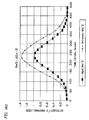
- Figs. 14a and 14b show the temporal shape of the square of the intensity near the center of the beam, at the input face of the nonlinear crystal both without and with feedback, and also show the corresponding intensities at a point in the wings of the beam, where the intensity of the input beam is lower.
- the temporal shape of the intensity with feedback is more nearly rectangular as compared to no feedback.
- off beam center the intensity with feedback is considerably enhanced compared to no feedback. Both the more rectangular temporal shape and the enhancement of the intensity with feedback result in a larger conversion efficiency.
- the intensity enhancement factor off beam center is even larger compared to a constant reflectivity profile, and the conversion efficiency increase is correspondingly greater.
- the conversion efficiency may be further enhanced by employing a tapered feedback across the pump beam profile.
- a mirror reflectivity which increases with r provides an increasing amount of feedback as the input intensity decreases, thereby enhancing the resonator intensity and conversion efficiency.
- the profile is uniform across the mirror surface.
- Figs. 1a and 1b the nonlinear crystals 10a and 20a are enclosed within the resonator structure. Both linear (Fig. 1a) and ring-resonator (Fig. 1b) configurations may be used.
- linear resonators Fig. 1a
- ring resonators Fig. 1b
- the geometry (triangle, rectangle) and the number of mirrors are primarily determined by coating requirements at both the input and second harmonic wavelengths.
- Both resonator configurations contain the partially-reflecting feedback mirror (M1) through which the laser beam is injected.
- M1 partially-reflecting feedback mirror
- Out-coupling of the SH beam can be accomplished through any of the resonator mirrors, the optimum mirror being determined by considerations such as coating realizability and system packaging.
- the laser radiation and the resonator should satisfy the following conditions:
- Conditions 1-5 ensure that the resonator electric field at the input frequency builds up constructively over multiple roundtrips.
- condition 2 may be satisfied either by controlling the frequency of the resonator longitudinal modes (e.g. by controlling the resonator length), or by adjusting the laser frequency to coincide with a resonator longitudinal mode.
- Condition 6 is required for the operation of the SHG, irrespective of the use of feedback.
- E2 max [(1+R f 1/2 )/(1-R f 1/2 )]2
- E2 max has values of 3.7 and 6.8, respectively.
- the o-beam may be coupled in through M3, and the 2o beam coupled out through M3.
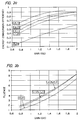
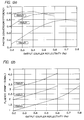
- Fig. 2a shows the SHG energy conversion efficiency and Fig. 2b the fluence (optical energy density) at the input face of tbe crystal for various amounts of feedback, for the case where both the beam shape and the pulse shape are Gaussian.
- the gain parameter, G2 describes the strength of the nonlinear interaction and is proportional to: G2 ⁇ dL c I0 1/2 where d eff is the effective nonlinear optical coefficient of the crystal, L c the crystal length, and I0 the peak input intensity.
- G2 is proportional to the square root of the intensity
- this reduced intensity results in a four times larger beam area, and therefore a two times larger beam diameter and a two times lower beam divergence in both the x,z and y,z planes, where z is the propagation direction (for the case of a round beam).
- This reduced divergence is frequently important because of the small acceptance angle of many crystals, the angular acceptance criteria resulting from phase-matching requirements.
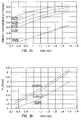
- the performance improvements over the no-feedback case are similar to the Gaussian beam case of Figs. 2a and 2b, but even higher efficiencies are achievable.
- Figs. 4a and 4b illustrate two representative THG embodiments, while Fig. 6 shows a schematic for a FHG.
- Figs. 4a and 4b each include a cascade of a SHG module, which may be identical to that shown in Fig. 1a, or may employ a conventional, non-feedback design, and a frequency mixer (o + 2o ⁇ 3o).
- Fig. 4a shows a frequency mixer 24 based on a linear resonator
- Fig. 4b shows a frequency mixer 26 having a single, common ring resonator for the o and 2o input fields.
- Input mirror M i is a beam splitter, providing approximately two thirds of the input laser energy to the SHG module 10 and (approximately) one third, via mirror M r , to a beam combiner (BC) which is transmissive at o and reflective at 2o.
- BC beam combiner
- the parameters labeling the curves are (E2; R1, b1; R2, b2) where E2 is the SHG efficiency, R1, R2 are the feedback mirror reflectivities, and b1, b2 describe the reflectivity tapers.
- the first SHG has a gain, G2, of 1.5, while the gain of the second SHG is varied.
- G2 gain of 1.5
- R f 0.2
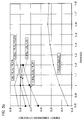
- an overall efficiency of nearly 80 percent is obtained, as compared to approximately 40 percent without feedback.
- This increase in conversion efficiency is obtained at a fluence which is only 50 percent higher in the feedback case compared to the no-feedback case.
- the parameters labeling the curves are (R1, b1; R2, b2) where R1, R2 are the feedback mirror reflectivities for the two SHG modules, and b1, b2 describe the reflectivity tapers.
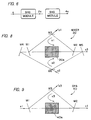
- Fig. 8 is a schematic representation of a general, non-degenerate frequency mixer 30.
- First and second ring resonators are used for o1 and o2, respectively.
- FIG 9 is a schematic representation of an OPA 40, while Figs. 10a and 10b show the photon conversion efficiency and the fluence (optical power density), respectively, for the case of 1 percent photon injection at o1 (relative to o3).
- the pump (o3) beam profile and pulse shape are both Gaussian.
- a photon conversion efficiency of approximately 70% is obtained with 20% feedback, as compared to a photo conversion efficiency of 33% without feedback.
- the fluence (optical power density) on the input face of crystal 40a, with feedback, is only 20% higher than without feedback.
- the parameters labeling the curves are (R p , b p ), where R p and b p are the reflectivity of the feedback mirror M3 and its taper parameter, respectively.
- the signal wave to be amplified is injected through mirror M1.
- Fig. 11 is a schematic representation of, and Figs. 12a-12d are graphs that illustrate an expected performance for, an injection-seeded parametric oscillator 50.
- the pump (o3) beam profile and pulse shape are both Gaussian.
- the photon flux of the signal (o1) seed beam incident on mirror M5 is 1% of the pump beam flux incident on mirror M3.
- the fluence on the crystal 50a input face is the sum of the o1 fluence and the o3 fluence.
- M6 output coupler
- reflectivity of 30% at frequency o1 and a peak gain of 4
- a photon conversion efficiency of 50% is obtained without feedback, as compared to 75% with 20% feedback.
- the fluence is similar in the two cases.
- Figs. 12a-12d The parameters labeling the curves of Figs. 12a-12d are (G; R p , b p ) where G is the OPO gain, which is proportional to the square root of the pump (o3) intensity, and R p , b p are the feedback mirror reflectivity and taper parameters.
- the invention teaches a number of different embodiments of optical apparatus for achieving frequency conversion for pulses of laser radiation.
- the invention provides, in one embodiment, apparatus for increasing the conversion efficiency and/or reducing the energy density in optical frequency doublers (SHGs).
- the apparatus includes a nonlinear medium (solid, liquid or gas) and a resonator at an input wavelength.
- the resonator has a linear or ring geometry and contains a partially reflecting mirror through which an input pulse is injected.
- the input mirror has a uniform-reflectivity or a tapered reflectivity for providing a predetermined amount of optical feedback, with the amount of optical feedback being optimizing maximum conversion efficiency.
- the apparatus further includes a mirror which is highly transmissive at the second harmonic wavelength for coupling the second harmonic pulse out of the resonator.
- the apparatus further includes one or more mirrors which are highly reflective at the input wavelength, and which determine the resonator geometry. Also included is a means for frequency locking the input wavelength to a longitudinal mode of the resonator, or vice versa, as well as optical components, such as mirrors and lenses, to adjust the size of the input beam for the desired intensity.
- One embodiment of the invention also provides apparatus for increasing the efficiency and/or reducing the energy density in non-degenerate (o1 ⁇ o2) optical frequency mixers.
- the apparatus includes a nonlinear medium (solid, liquid or gas) and resonators at each of the two input wavelengths.
- Each of the resonators has a linear or ring geometry and includes a partially reflecting mirror through which an input beam is injected.
- the input mirrors have a uniform reflectivity or a tapered reflectivity for providing a predetermined amount of optical feedback, with the amount of optical feedback being optimized for maximum conversion efficiency.
- the apparatus further includes one or more mirrors which are highly reflective at one or both input wavelength(s), and which determine the geometry of the resonators. Also included is a means for frequency locking each input wavelength to a longitudinal mode of the corresponding resonator, or vice versa, as well as optical components, such as mirrors and lenses, to adjust the size of each input beam for the desired intensity.
- feedback is applied at only one of the input wavelengths, o1 or o2, and the apparatus includes but one resonator.
- an apparatus for increasing the efficiency of and/or reducing the energy density in an optical parametric amplifier includes a nonlinear medium (solid, liquid or gas) and a resonator at an input pump wavelength.
- the resonator has a linear or ring geometry and includes a partially reflecting mirror through which the input pump beam is injected.
- the partially reflecting mirror has a uniform reflectivity or a tapered reflectivity for providing a predetermined amount of optical feedback, with the amount of optical feedback being optimized for maximum conversion efficiency.
- the apparatus further includes a mirror which is highly transmissive at the input signal (o1) or an idler (o2) wavelength.
- the apparatus further includes a mirror which is highly transmissive at the output (o1, o2) wavelengths and also includes one or more mirrors which are highly reflective at the input pump wavelength, and which determine the resonator geometry.
- Means is provided for frequency locking the pump wavelength to a longitudinal mode of the resonator, or vice versa, as are optical components, such as mirrors and lenses, to adjust the size of the input pump beam for a desired intensity. Also included are further optical components, such as mirrors and lenses, to adjust the size of the input signal and/or idler beam(s).
- the apparatus includes a nonlinear medium (solid, liquid or gas) and a resonator at an input pump wavelength.
- the resonator has a linear or ring geometry and includes a partially reflecting mirror through which the input pump beam is injected.
- the partially reflecting mirror has a uniform reflectivity or a tapered reflectivity for providing a predetermined amount of optical feedback, with the amount of optical feedback being optimized for maximum conversion efficiency.
- the apparatus further includes a mirror which is highly transmissive at the generated signal and/or idler wavelength(s) and one or more mirrors which are highly reflective at the input pump wavelength, and which determine the resonator geometry. Also provided is means for frequency locking the pump wavelength to a longitudinal mode of the resonator, or vice versa, and optical components, such as mirrors and lenses, to adjust the size of the input pump beam for a desired intensity. Further optical components, such as mirrors and lenses, are provided to adjust the size of the input signal and/or idler beam(s), if any, to approximately match the pump beam size.
- the apparatus that provides an optical parametric oscillator further includes a further resonator at the signal and/or idler wavelength(s) which has a linear or ring geometry and which includes a partially reflective mirror at the signal and/or idler wavelength(s), and through which the signal and/or idler beam(s) is/are coupled out of the resonator.
- the further resonator has, in the case of an injection-seeded oscillator, a (partially) transmissive mirror at the signal or idler wavelength, through which a signal or idler seed beam is coupled into the resonator, and one or more mirrors which are highly reflective at the signal and/or idler wavelength(s), and which determine the geometry of the further resonator.
- Fig. 15 illustrates a further embodiment of the invention that compensates an optical frequency conversion apparatus, or SHG 60, for static or time-varying wavefront distortions.
- a non-linear crystal 60a is disposed within a resonator defined by mirrors M1 and M2, and also by a spatial light modulator, such as a phase modulator array (PMA 62) or a deformable mirror.
- a beamsplitter (BS) 64 sends a sample of a distorted wavefront (dwf) to a wavefront sensor (WFS) 66 which detects the distorted wavefront and generates a correction signal (CS) to the PMA 62, which then corrects the distorted wavefront to produce a corrected wavefront (cfw).
- dwf distorted wavefront
- WFS wavefront sensor
- CS correction signal
- the accuracy of the wavefront phase error compensation is such that a coherent buildup of the intra-resonator intensity at an input frequency (o) is achieved over multiple roundtrips.
- the input pulse of optical radiation is applied through M1, and the frequency-doubled optical component is extracted through M2.
- this embodiment of the invention is advantageous in that it enables correction for wavefront distortions resulting from heating of the crystal 60a at high average powers.
- any of the embodiments described above may beneficially provide efficient nonlinear conversion at input intensities lower than those required without feedback.
- the reduced intensity allows larger beam sizes and correspondingly lower input beam divergences, thereby increasing the conversion efficiency in converter media having small acceptance angles set by phase-matching requirements.
- a deformable mirror or phase modulator array to compensate for any phase errors in the nonlinear crystal and the resonator mirrors.
- These correctable phase errors may be static errors, as well as time-varying errors due to thermal loading by the beam(s).
- Feedback may be applied at any of the input wavelengths of such frequency converters.
- feedback can be applied at each of the input wavelengths o1, o2, and o3.
Landscapes
- Physics & Mathematics (AREA)
- Nonlinear Science (AREA)
- General Physics & Mathematics (AREA)
- Optics & Photonics (AREA)
- Optical Modulation, Optical Deflection, Nonlinear Optics, Optical Demodulation, Optical Logic Elements (AREA)
- Lasers (AREA)
Applications Claiming Priority (2)
| Application Number | Priority Date | Filing Date | Title |
|---|---|---|---|
| US07/985,470 US5341236A (en) | 1992-12-03 | 1992-12-03 | Nonlinear optical wavelength converters with feedback |
| US985470 | 1992-12-03 |
Publications (2)
| Publication Number | Publication Date |
|---|---|
| EP0605110A2 true EP0605110A2 (fr) | 1994-07-06 |
| EP0605110A3 EP0605110A3 (fr) | 1995-01-18 |
Family
ID=25531519
Family Applications (1)
| Application Number | Title | Priority Date | Filing Date |
|---|---|---|---|
| EP93309655A Withdrawn EP0605110A3 (fr) | 1992-12-03 | 1993-12-02 | Convertisseurs optiques non-linéaires de longueur d'onde. |
Country Status (3)
| Country | Link |
|---|---|
| US (1) | US5341236A (fr) |
| EP (1) | EP0605110A3 (fr) |
| JP (1) | JPH06273818A (fr) |
Cited By (19)
| Publication number | Priority date | Publication date | Assignee | Title |
|---|---|---|---|---|
| WO1996008858A1 (fr) * | 1994-09-13 | 1996-03-21 | Spectra-Physics Lasers, Inc. | Sortie a mode longitudinal unique grossierement accordable produite a partir d'une source germe a modes longitudinaux multiples |
| WO1996008877A3 (fr) * | 1994-09-13 | 1996-05-17 | Southern California Edison Co | Reseau de communication par satellites a terminaux a ouverture ultra-faibles sans variation brusque |
| WO2008063602A3 (fr) * | 2006-11-16 | 2008-11-06 | Univ Michigan State | Système laser faisant appel à une génération d'harmoniques |
| WO2010074869A1 (fr) * | 2008-12-15 | 2010-07-01 | Coherent, Inc. | Maître oscillateur et amplificateur de puissance (mopa) à fibres triplé en fréquence |
| US7973936B2 (en) | 2001-01-30 | 2011-07-05 | Board Of Trustees Of Michigan State University | Control system and apparatus for use with ultra-fast laser |
| CN102208747A (zh) * | 2011-05-09 | 2011-10-05 | 中国电子科技集团公司第十一研究所 | 一种固体激光器 |
| US8208504B2 (en) | 2001-01-30 | 2012-06-26 | Board Of Trustees Operation Michigan State University | Laser pulse shaping system |
| US8208505B2 (en) | 2001-01-30 | 2012-06-26 | Board Of Trustees Of Michigan State University | Laser system employing harmonic generation |
| US8265110B2 (en) | 2001-01-30 | 2012-09-11 | Board Of Trustees Operating Michigan State University | Laser and environmental monitoring method |
| US8300669B2 (en) | 2001-01-30 | 2012-10-30 | Board Of Trustees Of Michigan State University | Control system and apparatus for use with ultra-fast laser |
| US8311069B2 (en) | 2007-12-21 | 2012-11-13 | Board Of Trustees Of Michigan State University | Direct ultrashort laser system |
| US8373924B2 (en) | 2011-05-25 | 2013-02-12 | Coherent, Inc. | Frequency-tripled fiber MOPA |
| US8582611B2 (en) | 2012-01-20 | 2013-11-12 | Coherent, Inc. | Frequency-tripled fiber-MOPA |
| US8618470B2 (en) | 2005-11-30 | 2013-12-31 | Board Of Trustees Of Michigan State University | Laser based identification of molecular characteristics |
| US8630322B2 (en) | 2010-03-01 | 2014-01-14 | Board Of Trustees Of Michigan State University | Laser system for output manipulation |
| US8633437B2 (en) | 2005-02-14 | 2014-01-21 | Board Of Trustees Of Michigan State University | Ultra-fast laser system |
| US8675699B2 (en) | 2009-01-23 | 2014-03-18 | Board Of Trustees Of Michigan State University | Laser pulse synthesis system |
| US8861075B2 (en) | 2009-03-05 | 2014-10-14 | Board Of Trustees Of Michigan State University | Laser amplification system |
| US9018562B2 (en) | 2006-04-10 | 2015-04-28 | Board Of Trustees Of Michigan State University | Laser material processing system |
Families Citing this family (18)
| Publication number | Priority date | Publication date | Assignee | Title |
|---|---|---|---|---|
| US5611946A (en) * | 1994-02-18 | 1997-03-18 | New Wave Research | Multi-wavelength laser system, probe station and laser cutter system using the same |
| US5619517A (en) * | 1995-02-01 | 1997-04-08 | Research Foundation Of The University Of Central Florida | Optical parametric oscillator with built-in seeding laser source |
| US5646764A (en) * | 1995-05-17 | 1997-07-08 | The United States Of America As Represented By The Secretary Of The Air Force | Optical beam scanner with rotating transmissive optics |
| US6573702B2 (en) | 1997-09-12 | 2003-06-03 | New Wave Research | Method and apparatus for cleaning electronic test contacts |
| US6346686B1 (en) * | 1999-04-14 | 2002-02-12 | Hughes Electronics Corporation | Apparatus and method for enhanced laser machining by optimization of pulse duration and spacing |
| US6437321B1 (en) | 2000-06-08 | 2002-08-20 | The Boeing Company | Method and apparatus to correct for thermally-induced wavefront distortion in crystal rods |
| US6516008B1 (en) * | 2000-08-09 | 2003-02-04 | Raytheon Company | Laser pulse slicer and dual wavelength converter for chemical sensing |
| US7068689B2 (en) * | 2001-01-18 | 2006-06-27 | Spectra-Physics Gmbh | Frequency-converted laser apparatus with frequency conversion crystals |
| US7609731B2 (en) * | 2001-01-30 | 2009-10-27 | Board Of Trustees Operating Michigan State University | Laser system using ultra-short laser pulses |
| US6647033B1 (en) * | 2001-04-30 | 2003-11-11 | Sandia Corporation | Optical parametric osicllators with improved beam quality |
| KR100444191B1 (ko) * | 2003-03-17 | 2004-08-21 | 주식회사 파이컴 | 프로브 포지셔닝 및 본딩시스템 및 그 방법 |
| US7130321B2 (en) * | 2003-10-09 | 2006-10-31 | Coherent, Inc. | Intracavity frequency-tripled CW laser with traveling-wave ring-resonator |
| KR100568504B1 (ko) * | 2004-03-29 | 2006-04-07 | 한국전자통신연구원 | 공진 구조를 이용한 순차적 차주파수 생성장치 |
| US20100027571A1 (en) * | 2008-07-31 | 2010-02-04 | Murdoch Keith M | Stabilized near-infrared laser |
| EP2360520A1 (fr) * | 2010-02-11 | 2011-08-24 | Fundacio Privada Institut De Ciencies Fotoniques | Oscillateur paramétrique optique doté d'un couplage de sortie optimisé |
| US9413456B2 (en) * | 2012-07-20 | 2016-08-09 | The Boeing Company | Non-linear optical receiver |
| US9590382B2 (en) * | 2013-01-16 | 2017-03-07 | Max-Planck-Gesellschaft Zur Foerderung Der Wissenschaften E. V. | Enhancement resonator including non-spherical mirrors |
| CN109031853A (zh) * | 2018-09-04 | 2018-12-18 | 中国电子科技集团公司第三十四研究所 | 一种相位敏感光学参量放大器及其运行方法 |
Family Cites Families (11)
| Publication number | Priority date | Publication date | Assignee | Title |
|---|---|---|---|---|
| US4278953A (en) * | 1979-03-23 | 1981-07-14 | The United States Of America As Represented By The Secretary Of The Air Force | Near millimeter wavelength modulator and tunable oscillator |
| US4739507A (en) * | 1984-11-26 | 1988-04-19 | Board Of Trustees, Stanford University | Diode end pumped laser and harmonic generator using same |
| JPH0624277B2 (ja) * | 1986-01-28 | 1994-03-30 | 浜松ホトニクス株式会社 | Cpmリング色素レ−ザ装置 |
| US4926177A (en) * | 1987-05-21 | 1990-05-15 | Canon Kabushiki Kaisha | Optical analog-digital converter provided with a nonlinear optical element and an optical feedback system for the output lights of said element |
| US4879722A (en) * | 1987-07-27 | 1989-11-07 | Amoco Corporation | Generation of coherent optical radiation by optical mixing |
| DE3826716A1 (de) * | 1987-10-30 | 1990-02-08 | Max Planck Gesellschaft | Modengekoppelter laser |
| US4933947A (en) * | 1988-02-18 | 1990-06-12 | Amoco Corporation | Frequency conversion of optical radiation |
| US5027361A (en) * | 1988-06-21 | 1991-06-25 | Board Of Trustees Of Leland Stanford, Jr., University | Efficient laser harmonic generation employing a low-loss external optical resonator |
| US4841528A (en) * | 1988-09-06 | 1989-06-20 | California Institute Of Technology | Frequency doubled, cavity dumped feedback laser |
| US5054027A (en) * | 1989-10-10 | 1991-10-01 | Massachusetts Institute Of Technology | Pulsed laser |
| US5079445A (en) * | 1990-07-17 | 1992-01-07 | Amoco Corporation | High output coupling cavity design for optical parametric oscillators |
-
1992
- 1992-12-03 US US07/985,470 patent/US5341236A/en not_active Expired - Fee Related
-
1993
- 1993-12-02 EP EP93309655A patent/EP0605110A3/fr not_active Withdrawn
- 1993-12-03 JP JP5304362A patent/JPH06273818A/ja not_active Withdrawn
Cited By (21)
| Publication number | Priority date | Publication date | Assignee | Title |
|---|---|---|---|---|
| WO1996008877A3 (fr) * | 1994-09-13 | 1996-05-17 | Southern California Edison Co | Reseau de communication par satellites a terminaux a ouverture ultra-faibles sans variation brusque |
| US5889800A (en) * | 1994-09-13 | 1999-03-30 | Spectra-Physics Lasers, Inc. | Broadly tunable single longitudinal mode output produced from multi-longitudinal mode seed source |
| WO1996008858A1 (fr) * | 1994-09-13 | 1996-03-21 | Spectra-Physics Lasers, Inc. | Sortie a mode longitudinal unique grossierement accordable produite a partir d'une source germe a modes longitudinaux multiples |
| US8208505B2 (en) | 2001-01-30 | 2012-06-26 | Board Of Trustees Of Michigan State University | Laser system employing harmonic generation |
| US8300669B2 (en) | 2001-01-30 | 2012-10-30 | Board Of Trustees Of Michigan State University | Control system and apparatus for use with ultra-fast laser |
| US7973936B2 (en) | 2001-01-30 | 2011-07-05 | Board Of Trustees Of Michigan State University | Control system and apparatus for use with ultra-fast laser |
| US8265110B2 (en) | 2001-01-30 | 2012-09-11 | Board Of Trustees Operating Michigan State University | Laser and environmental monitoring method |
| US8208504B2 (en) | 2001-01-30 | 2012-06-26 | Board Of Trustees Operation Michigan State University | Laser pulse shaping system |
| US8633437B2 (en) | 2005-02-14 | 2014-01-21 | Board Of Trustees Of Michigan State University | Ultra-fast laser system |
| US8618470B2 (en) | 2005-11-30 | 2013-12-31 | Board Of Trustees Of Michigan State University | Laser based identification of molecular characteristics |
| US9018562B2 (en) | 2006-04-10 | 2015-04-28 | Board Of Trustees Of Michigan State University | Laser material processing system |
| WO2008063602A3 (fr) * | 2006-11-16 | 2008-11-06 | Univ Michigan State | Système laser faisant appel à une génération d'harmoniques |
| US8311069B2 (en) | 2007-12-21 | 2012-11-13 | Board Of Trustees Of Michigan State University | Direct ultrashort laser system |
| US7920606B2 (en) | 2008-12-15 | 2011-04-05 | Coherent, Inc. | Frequency-tripled fiber MOPA |
| WO2010074869A1 (fr) * | 2008-12-15 | 2010-07-01 | Coherent, Inc. | Maître oscillateur et amplificateur de puissance (mopa) à fibres triplé en fréquence |
| US8675699B2 (en) | 2009-01-23 | 2014-03-18 | Board Of Trustees Of Michigan State University | Laser pulse synthesis system |
| US8861075B2 (en) | 2009-03-05 | 2014-10-14 | Board Of Trustees Of Michigan State University | Laser amplification system |
| US8630322B2 (en) | 2010-03-01 | 2014-01-14 | Board Of Trustees Of Michigan State University | Laser system for output manipulation |
| CN102208747A (zh) * | 2011-05-09 | 2011-10-05 | 中国电子科技集团公司第十一研究所 | 一种固体激光器 |
| US8373924B2 (en) | 2011-05-25 | 2013-02-12 | Coherent, Inc. | Frequency-tripled fiber MOPA |
| US8582611B2 (en) | 2012-01-20 | 2013-11-12 | Coherent, Inc. | Frequency-tripled fiber-MOPA |
Also Published As
| Publication number | Publication date |
|---|---|
| EP0605110A3 (fr) | 1995-01-18 |
| US5341236A (en) | 1994-08-23 |
| JPH06273818A (ja) | 1994-09-30 |
Similar Documents
| Publication | Publication Date | Title |
|---|---|---|
| US5341236A (en) | Nonlinear optical wavelength converters with feedback | |
| US5796761A (en) | High efficiency solid state raman laser system | |
| US5943351A (en) | Intra-cavity and inter-cavity harmonics generation in high-power lasers | |
| US5047668A (en) | Optical walkoff compensation in critically phase-matched three-wave frequency conversion systems | |
| US5278852A (en) | Intra-cavity high order harmonic laser | |
| EP0788015A2 (fr) | Interactions à quasi-accord de phase multiple dans un cristal non-linéaire | |
| Reed et al. | Tunable infrared generation using a femtosecond 250 kHz Ti: sapphire regenerative amplifier | |
| JP4489440B2 (ja) | 非被覆ブリュースタ表面を用いてキャビティ内共振を増強した第4高調波の生成 | |
| US5500865A (en) | Phased cascading of multiple nonlinear optical elements for frequency conversion | |
| US5721748A (en) | Intracavity doubled solid state Raman laser system | |
| US6167067A (en) | Optical parametric oscillator with monolithic dual PPLN elements with intrinsic mirrors | |
| US4048515A (en) | Broadband laser with intracavity crystal for generating second harmonic radiation | |
| JPH05210135A (ja) | 光波長変換装置 | |
| Couderc et al. | 2.8 ps pulses from a mode-locked diode pumped Nd: YVO4 laser using quadratic polarization switching | |
| US6005878A (en) | Efficient frequency conversion apparatus for use with multimode solid-state lasers | |
| Köhler et al. | A 9.5-W 82-MHz-repetition-rate picosecond optical parametric generator with cw diode laser injection seeding | |
| EP0951111A2 (fr) | Laser avec verrouillage de mode basé sur la polarisation | |
| US5696780A (en) | Frequency conversion system | |
| Reid et al. | Widely tunable, near-to mid-infrared femtosecond and picosecond optical parametric oscillators using periodically poled LiNbO/sub 3/and RbTiOAsO/sub 4 | |
| US10642127B1 (en) | Single Crystal optical parametric amplifier | |
| Marshall et al. | Highly efficient optical parametric oscillators | |
| EP0572201B1 (fr) | Laser à puissance moyenne élevée générant radiation à longeur d'onde de près de 530 NM | |
| Jones et al. | Milliwatt-level 213 nm source based on a repetitively Q-switched, cw-pumped Nd: YAG laser | |
| US7330300B1 (en) | Optical frequency mixer and method for the same | |
| CN119154082A (zh) | 一种高光谱纯度的单频脉冲激光器 |
Legal Events
| Date | Code | Title | Description |
|---|---|---|---|
| PUAI | Public reference made under article 153(3) epc to a published international application that has entered the european phase |
Free format text: ORIGINAL CODE: 0009012 |
|
| AK | Designated contracting states |
Kind code of ref document: A2 Designated state(s): DE FR GB SE |
|
| PUAL | Search report despatched |
Free format text: ORIGINAL CODE: 0009013 |
|
| AK | Designated contracting states |
Kind code of ref document: A3 Designated state(s): DE FR GB SE |
|
| RAP1 | Party data changed (applicant data changed or rights of an application transferred) |
Owner name: NORTHROP GRUMMAN CORPORATION |
|
| 17P | Request for examination filed |
Effective date: 19950626 |
|
| 17Q | First examination report despatched |
Effective date: 19970704 |
|
| STAA | Information on the status of an ep patent application or granted ep patent |
Free format text: STATUS: THE APPLICATION IS DEEMED TO BE WITHDRAWN |
|
| 18D | Application deemed to be withdrawn |
Effective date: 19980115 |