EP0606020A1 - Appareil et procédé pour dispenser des compositions d'organosilixane curables et mousseuses - Google Patents
Appareil et procédé pour dispenser des compositions d'organosilixane curables et mousseuses Download PDFInfo
- Publication number
- EP0606020A1 EP0606020A1 EP93310635A EP93310635A EP0606020A1 EP 0606020 A1 EP0606020 A1 EP 0606020A1 EP 93310635 A EP93310635 A EP 93310635A EP 93310635 A EP93310635 A EP 93310635A EP 0606020 A1 EP0606020 A1 EP 0606020A1
- Authority
- EP
- European Patent Office
- Prior art keywords
- composition
- diameter
- exit orifice
- exit
- mixing
- Prior art date
- Legal status (The legal status is an assumption and is not a legal conclusion. Google has not performed a legal analysis and makes no representation as to the accuracy of the status listed.)
- Withdrawn
Links
Images
Classifications
-
- C—CHEMISTRY; METALLURGY
- C08—ORGANIC MACROMOLECULAR COMPOUNDS; THEIR PREPARATION OR CHEMICAL WORKING-UP; COMPOSITIONS BASED THEREON
- C08J—WORKING-UP; GENERAL PROCESSES OF COMPOUNDING; AFTER-TREATMENT NOT COVERED BY SUBCLASSES C08B, C08C, C08F, C08G or C08H
- C08J9/00—Working-up of macromolecular substances to porous or cellular articles or materials; After-treatment thereof
- C08J9/02—Working-up of macromolecular substances to porous or cellular articles or materials; After-treatment thereof using blowing gases generated by the reacting monomers or modifying agents during the preparation or modification of macromolecules
-
- B—PERFORMING OPERATIONS; TRANSPORTING
- B29—WORKING OF PLASTICS; WORKING OF SUBSTANCES IN A PLASTIC STATE IN GENERAL
- B29B—PREPARATION OR PRETREATMENT OF THE MATERIAL TO BE SHAPED; MAKING GRANULES OR PREFORMS; RECOVERY OF PLASTICS OR OTHER CONSTITUENTS OF WASTE MATERIAL CONTAINING PLASTICS
- B29B7/00—Mixing; Kneading
- B29B7/30—Mixing; Kneading continuous, with mechanical mixing or kneading devices
- B29B7/32—Mixing; Kneading continuous, with mechanical mixing or kneading devices with non-movable mixing or kneading devices
- B29B7/325—Static mixers
-
- B—PERFORMING OPERATIONS; TRANSPORTING
- B29—WORKING OF PLASTICS; WORKING OF SUBSTANCES IN A PLASTIC STATE IN GENERAL
- B29C—SHAPING OR JOINING OF PLASTICS; SHAPING OF MATERIAL IN A PLASTIC STATE, NOT OTHERWISE PROVIDED FOR; AFTER-TREATMENT OF THE SHAPED PRODUCTS, e.g. REPAIRING
- B29C44/00—Shaping by internal pressure generated in the material, e.g. swelling or foaming ; Producing porous or cellular expanded plastics articles
- B29C44/34—Auxiliary operations
- B29C44/3442—Mixing, kneading or conveying the foamable material
-
- C—CHEMISTRY; METALLURGY
- C08—ORGANIC MACROMOLECULAR COMPOUNDS; THEIR PREPARATION OR CHEMICAL WORKING-UP; COMPOSITIONS BASED THEREON
- C08J—WORKING-UP; GENERAL PROCESSES OF COMPOUNDING; AFTER-TREATMENT NOT COVERED BY SUBCLASSES C08B, C08C, C08F, C08G or C08H
- C08J2383/00—Characterised by the use of macromolecular compounds obtained by reactions forming in the main chain of the macromolecule a linkage containing silicon with or without sulfur, nitrogen, oxygen, or carbon only; Derivatives of such polymers
- C08J2383/04—Polysiloxanes
-
- Y—GENERAL TAGGING OF NEW TECHNOLOGICAL DEVELOPMENTS; GENERAL TAGGING OF CROSS-SECTIONAL TECHNOLOGIES SPANNING OVER SEVERAL SECTIONS OF THE IPC; TECHNICAL SUBJECTS COVERED BY FORMER USPC CROSS-REFERENCE ART COLLECTIONS [XRACs] AND DIGESTS
- Y10—TECHNICAL SUBJECTS COVERED BY FORMER USPC
- Y10S—TECHNICAL SUBJECTS COVERED BY FORMER USPC CROSS-REFERENCE ART COLLECTIONS [XRACs] AND DIGESTS
- Y10S521/00—Synthetic resins or natural rubbers -- part of the class 520 series
- Y10S521/917—Specialized mixing apparatus utilized in cell forming process
Definitions
- This invention relates to a mixing and dispensing apparatus for dispensing the ingredients of foamable, curable organosiloxane compositions.
- the cured foam is soft, flexible and exhibits a uniform distribution of small diameter cells.
- the present apparatus and method are particularly useful for preparing small diameter elongated articles such as foamed-in-place gaskets.
- thermosetting organic or organosilicone polymer with a compressed gas or chemical blowing agent in a confined area and then dispensing the resultant mixture into an atmosphere where the entrapped gas forms a foam as the composition cures.
- Devices of this type are described in United States Patent Nos. 4,778,631 and 5,082,142.
- Rauwendaal considers static mixers containing the Kenics type of mixing element simple and easy to clean, but less efficient. Mixers containing these elements were found to require a length to diameter ratio of at least 29 to achieve efficient mixing.
- the present inventor has found that when a static mixer is used, the orifice diameter through which the foamable, curable organosiloxane composition passes when exiting the device is critical to preparing a cured foam of uniform cells.
- the resultant cells are no larger than five millimeters and have a low percentage, typically less than 10 percent, of ruptured walls.
- nozzles with an exit orifice of 1.50 mm or less will permit use of a static mixer containing Kenics type elements with a lower length to diameter ratio than taught by Rauwendaal.
- the ingredients of a curable, foamable organosiloxane composition are blended and dispensed in a pressurized apparatus comprising a static mixer and a nozzle with an exit orifice that does not exceed 1.50 mm in diameter.
- the resultant foams exhibit a smooth surface and a uniformly small cell size, with at most 10 percent of ruptured cell walls.
- This invention provides an apparatus for mixing and dispensing a foamable, curable organosiloxane composition, said apparatus comprising 1) a mixing zone consisting essentially of a channel having an inlet and an outlet and containing a plurality of static mixing elements positioned within the channel, where the ratio of the length of said channel to its diameter is at least 11, and 2) an exit zone communicating with the outlet of said channel and comprising a nozzle containing an exit orifice where the diameter of said exit orifice does not exceed 1.50 mm.
- This invention also provides a method for mixing and dispensing a curable, foamable organosiloxane composition, the method comprising transporting said composition under pressure first through a mixing zone essentially consisting of a channel having an inlet and an outlet and containing a plurality of static mixing elements positioned within the channel, where the ratio of the length of said channel to its diameter is at least 11 and second through an exit zone communicating with the outlet of said channel and comprising a nozzle containing an exit orifice where the diameter of said exit orifice does not exceed 1.50 mm.
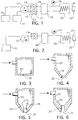
- Figure 1 is a diagrammatic view of an apparatus of the present invention suitable for use in dispensing two part organosiloxane compositions.
- Figure 2 is a diagrammatic view of the apparatus of Figure 1 modified for dispensing one-part compositions containing a microencapsulated catalyst.
- Figures 3, 4, 5 and 6 are cross-sectional views of four preferred exit zone and nozzle configurations.
- the two parts of a foamable organosiloxane composition are transported from their respective storage containers 10 and 11 through the apparatus by means of a pump 12.
- the two parts of the composition enter a flow control manifold 13 through individual conduits 14 and 15 equipped with valves 16 and 17 that control the flow of material through the conduits.
- the relative flow rates in the two conduits are controlled using a metering manifold 18 equipped with a pressure gauge 19.
- the flow control and metering manifolds constitute the entrance zone of the apparatus.
- the two steams of ingredients of the foamable composition from the metering manifold are combined in the entrance section of a static mixer 20 having a length to diameter ratio of at least 11:1.
- Static mixers are well known in the art. These mixers are designed to provide an efficient blending of ingredients flowing in a channel without the use of moving parts. This is achieved by placing a plurality of devices or elements within the channel that split and reorient the flow of material within the channel. The elements are typically stacked in a series with each element rotated 90 degrees with respect to the next element in the series. The configuration of these devices determines the efficiency of the mixer, which can be expressed as the minimum length to diameter ratio required to achieve a homogeneous blend of ingredients exhibiting less than a 1% variation in composition between randomly selected portions of the blended material.
- Kenics A preferred element configuration, based on its availability, simplicity and ease of cleaning is referred to as "Kenics".
- This element is in the form of a twisted tape.
- Other available elements are in the form of bars, corrugated plates and bent and split tapes.
- the length to diameter ratio of static mixers containing the Kenics type of mixing element is preferably from 11 to 35.
- the ingredients of the composition are blended to homogeneity before entering the exit zone 21 containing the exit orifice 22.
- the diameter of the exit orifice is critical to the cell structure of the final foam and should be less than 1.50 mm.
- An orifice diameter of below about 0.5 mm. will restrict the flow of the foamable composition to the extent that the pressure used to transport the composition through the present apparatus must be increased beyond conventional values to achieve a useful flow rate without any benefit in increased quality of the cured foam.
- the diameter of the exit orifice is preferably from 0.7 to 1.5 mm.
- the apparatus shown in Figure 2 is suitable for dispensing one-part foamable organosiloxane compositions containing a catalyst that is microencapsulated in a layer of a thermoplastic resin.
- Storage containers 10 and 11 are replaced by a single container 10 and conduits 14 and 15 by a single conduit. Because only one stream of ingredients is present, a metering manifold is also no longer necessary.
- the apparatus includes a heating device 28 that can be located between the flow control manifold and the static mixer 20.
- the purpose of the heating device is to soften the resin encapsulating the catalyst, thereby allowing the catalyst to combine with the other ingredients of the organosiloxane composition.
- the catalyst is uniformly dispersed throughout the composition in the static mixer.
- FIG. 3 Cross-sectional views of preferred exit zone configurations are depicted in Figures 3, 4, 5 and 6.
- the interior of the nozzle shown in Figure 3 is cylindrical in contour with a diameter from 0.5 to 1.5 cm.
- the exit orifice 22 is located on a surface 23 of a wall that is substantially perpendicular with respect to the axis of the cylindrical exit zone and preferably from 2.5 to 12.7 mm thick.
- the configuration shown in Figure 4 contains the exit orifice at the apex of a conical section 24 that is adjacent to a cylindrical section 25.
- the interior angle defined by the inner surface of the conical section and the adjoining inner surface of the cylindrical section is from 135 to 160 degrees.
- FIG. 5 adds a needle-shaped flow control valve 26 to the exit orifice.
- the valve is biased toward a position blocking exit orifice 22 by means of a spring (not shown).
- the valve is moved away from the orifice by applying sufficient pressure to offset the force exerted by the spring.
- the configuration shown in Figure 6 contains a passage 27 connecting the apex of the conical section 24 with the exit orifice 22.
- the diameter of this passage is substantially equal to the diameter of the exit orifice and the passage can be from 2.5 to 12.7 mm. in length.
- any of the known one- and two-part curable organosiloxane compositions that generate a gas such as hydrogen as a by-product of the curing reaction can be used in the present mixing and dispensing apparatus.
- Preferred compositions of this type are described in United States Patents 4,599,367; 3,923,705; 4,888,217 and 5,079,292.
- Foamable compositions of this type contain an organohydrogensiloxane and at least one curable polyorganosiloxane containing silicon-bonded hydroxyl groups and/or silicon-bonded alkenyl radicals such as vinyl, allyl or hexenyl.
- the curable composition contains sufficient water and/or liquid alcohol to react with the organohydrogensiloxane to generate the hydrogen gas that functions as the blowing agent during curing of the composition.
- the curing and hydrogen generating reactions are catalyzed by a platinum group metal or a compound of such a metal.
- platinum group metal typically includes platinum, rhodium and palladium.
- the reaction between silanol groups and silicon bonded hydrogen atoms can be catalyzed by inorganic and organic tin compounds.
- the organohydrogensiloxane contains at least three silicon-bonded hydrogen atoms or the polyorganosiloxane contains at least 3 silanol or silicon-bonded alkenyl radicals per molecule.
- the silanol- and alkenyl-substituted polyorganosiloxanes are typically linear or branched liquid polydiorganosiloxanes that contain two or more silanol groups or alkenyl radicals per molecule, preferably at least on the terminal silicon atoms.
- the alkenyl radical is preferably vinyl or hexenyl and the silicon-bonded organic groups other than the alkenyl radicals are preferably methyl, phenyl or 3,3,3-trifluoropropyl. Most preferably each silicon atom of the polyorganosiloxane contains at least one methyl radical.
- These polyorganosiloxanes contain from 0.0002 to 3 weight percent of alkenyl radicals and exhibit viscosities of from 1 to 500 Pa ⁇ s, preferably from 1 to 200 Pa ⁇ s.
- the organohydrogensiloxanes can have a linear or branched structure and preferably contain an average of more than two silicon-bonded hydrogen atoms per molecule. Suitable organohydrogensiloxanes contain from 0.5 to 2.5 weight percent of silicon-bonded hydrogen and exhibit viscosities of from 0.01 to about 10 Pa.s.
- compositions for use with the apparatus of the present invention contain from 1 to 10 weight percent of at least one alcohol that is liquid at 25°C. These compositions typically produce low density cured foams and contribute to the resiliency of the final cured foam. Suitable alcohols include aliphatic and araliphatic alcohols containing up to eight carbon atoms. Propanol and benzyl alcohols are preferred.
- foamable curable organosiloxane compositions may also contain ingredients typically present in organosiloxane compositions that cure by a hydrosilation reaction. These ingredients include reinforcing and non-reinforcing fillers, catalyst inhibitors such as acetylenic alcohols and cyclic methylvinylsiloxanes, pigments, dyes, heat stabilizers, adhesion promoters and flame retarding agents.
- organosiloxane compositions that cure by the reaction of an organohydrogensiloxane with silanol groups and/or alkenyl radicals are packaged in two parts with the organohydrogensiloxane and the curing catalyst in separate containers.
- the apparatus shown in Figure 2 of the accompanying drawings is suitable for use with one-part organosiloxane compositions.
- the storage stability of one-part compositions that cure by a platinum- or tin catalyzed reaction can be increased by encapsulating the catalyst in finely divided particles of a thermoplastic organic or organosilicon resin.
- a thermoplastic organic or organosilicon resin When it is desired to cure the composition, it is heated above the softening temperature of the resin.
- the composition should then be passed through the mixing zone of the present apparatus to distribute the catalyst uniformly throughout the composition.
- the apparatus of Figure 1 can be modified by replacing containers 10 and 11 with a single container, conduits 16 and 17 with a single conduit and inserting a heating device downstream relative to the mixing zone.
- Curable compositions suitable for use with the mixing and dispensing apparatus of the present invention exhibit viscosities of from 1 to 500 Pa ⁇ s and can be dispensed at rates from 10 to 120 grams per minute, depending upon the pressure in the dispensing apparatus and the viscosity of the composition.
- the two parts of a curable and foamable organosiloxane composition are transported under pressure through a mixing manifold which meters and combines the two streams of ingredients and feeds them into a static mixer in which the ingredients are blended to homogeneity.
- Two part compositions are typically maintained at ambient temperature in the apparatus to avoid premature curing of the composition.
- the composition flows into an exit chamber containing an orifice through which the composition is discharged from the exit chamber into the atmosphere where it foams and cures.
- the composition is under pressures in the range of from 1.38 to 6.90 mPa (200 to 1000 psi) from the time it enters the mixing manifold until it emerges from the exit orifice.
- the foams produced in accordance with the present method exhibit average cell diameters of 5 mm or less, preferably less than 1 mm. and densities in the range from 160.2 to 480.6 kg/m3 (10 to 30 pounds per cubic foot).
- the two parts of a foamable organosiloxane composition were pumped from individual storage containers into the entrance zone of the present apparatus using a dual-chamber air powered piston pump.
- the metering device was an air pressure activated valve containing two cylindrical passages, each with an area of 38.8 square millimeters.
- composition entered a mixing manifold that controlled the relative volumes of the two streams of ingredients entering a 6 cm - long cylindrical passage with an inside diameter of 3.9 mm.
- This passage was connected to the input of one of three different types of static mixers.
- the composition passed through an exit zone and an exit orifice with a cross-sectional configuration A, B, C, D, E or F.
- the diameter of the exit orifice, exit zone and the thickness of the nozzle at the location of the exit orifice of the seven nozzles that were evaluated are as follows:
- This example demonstrates the effect of nozzle configuration and diameter on the type and diameter of the cells in a low density cured foam.
- Part A of the curable, foamable organosiloxane composition used to prepare the low density foam contained the following ingredients: 63.1 parts of a dimethylvinylsiloxy-terminated polydimethylsiloxane exhibiting a viscosity of 55 Pa ⁇ s; 13.9 parts of a benzene soluble resinous copolymer containing triorganosiloxy units and SiO2 units in the molar ratio of 0.7 mol of triorganosiloxy units per mol of SiO2 units, where the triorganosiloxy units are trimethylsiloxy and dimethylvinylsiloxy and the copolymer contains 1.8 weight percent of vinyl radicals; 15.1 parts of alumina trihyhdate; 7.32 parts of benzyl alcohol; and 0.54 part of a reaction product of hexachloroplatinic acid and sym-tetramethyldivinyldisiloxane that has been diluted with a liquid dimethylvinylsiloxy terminated polydi
- Part B of the curable composition contained the following ingredients: 46.2 parts of a dimethylvinylsiloxy-terminated polydimethylsiloxane exhibiting a viscosity of 55 Pa ⁇ s; 10.1 parts of the benzene soluble resinous copolymer described in part A; 26.4 parts of pulverized quartz exhibiting an average particle diameter of 5 micrometers; 12.6 parts of a 82 weight percent solution in xylene of the reaction product of equal parts by weight of
- the viscosity of an uncured mixture of parts A and B was between 60 and 70 Pa ⁇ s.
- the static mixer used as the mixing zone was 8.75 inches (22.2 cm.) long, 0.25 inch (0.64 cm.) in internal diameter and contained 32 Kenics type mixing elements.
- the air pressure supplied to the pump was 50, 60 or 75 psi (0.34, 0.41 or 0.52 MPa) gauge pressure and the pump had a power factor of 12. To ensure reproducibility of the samples, all were obtained during the upstroke of the pump cycle.
- the samples were from 25 to 75 grams in weight and were collected on a flat surface located 1 cm. below the exit orifice. The samples were allowed to remain under ambient conditions until they cured, which typically required from 1/2 to 4 hours. The time required to develop a non-tacky surface was about 7 minutes.
- Samples measuring 1.5 by 1.5 inches (3.8 by 3.8 cm.) were cut from each of the cured foams for evaluation. Evaluation included an examination of the surface of each sample, the cells in the area immediately beneath the surface and in the remainder of the sample. In addition, the size range of the cells were measured. In many samples the cell size in the area immediately below the surface was different than the size in the remainder of the foam.
- the density of the foam samples were 192.2 kg/m3 (12 pounds per cubic foot).
- This example demonstrates the effect of exit zone configuration, nozzle size and the number of static mixer elements on the size and uniformity of cells in a high density foam exhibiting a density of 160.2 kg/m3 (10 pounds per cubic foot).
- Part A of the curable foamable organosiloxane composition used to prepare the foam contained the following ingredients: 39.85 parts of a dimethylvinylsiloxy terminated polydimethylsiloxane having a viscosity of 9 Pa ⁇ s at 25°C.
- Part B of the curable composition contained the following ingredients: 58.9 parts of a dimethylvinylsiloxy-terminated polydimethylsiloxane exhibiting a viscosity of 55 Pa ⁇ s; 13.8 parts of the benzene soluble resinous copolymer described in part A; 14.6 parts of an 82 weight percent solution in xylene of a reaction product of equal weights of (1) a liquid trimethylsiloxy-terminated polymethylhydrogensiloxane with a silicon-bonded hydrogen content of 1.6 weight percent and (2) a resinous organosiloxane copolymer essentially consisting of (CH3)3SiO 1/2 and SiO2 units with a molar ratio of CH3)3SiO 1/2 :SiO2 units of from 0.4:1 and 1.2:1; the copolymer being prepared as described in U.S.
- Patent No. 2,676,182 and typically containing from 0.5 to 3 weight percent of hydroxyl groups; 9.1 parts of a liquid trimethylsiloxy-terminated polymethyl-hydrogensiloxane with a silicon-bonded hydrogen content of 1.6 weight percent; 3.6 parts of a trimethylsiloxy-terminated polydiorganosiloxane having an average of five methylhydrogensiloxane units and three dimethylsiloxane units per molecule with a silicon-bonded hydrogen atom content in the range from 0.7 to 0.8 weight percent; 12.6 parts of a 82 weight percent solution in xylene of the reaction product of equal parts by weight of (1) a liquid trimethylsiloxy-terminated polymethylhydrogensiloxane with a silicon-bonded hydrogen content of 1.6 weight percent, and (2) a resinous organosiloxane copolymer essentially consisting of (CH3)3SiO 1/2 and SiO2 unit with a molar ratio of CH3)3SiO 1/2 :SiO
- the viscosity of an uncured mixture of parts A and B was between 20 and 25 Pa ⁇ s.
- Foam sample were prepared and evaluated as described in Example 1.
- the nozzles used were types B and E described in Example 1.
- foams were prepared using the nozzle supplied with the static mixer.
- the diameter of the static mixer was 0.25 inch (0.64 cm).
- the air pressure supplied to the pump was 50, 60 or 75 psi (0.34, 0.41 or 0.52 MPa) gauge pressure and the pump had a power factor (output pressure/input pressure) of 12. To ensure reproducibility of the samples, all were obtained during the upstroke of the pump cycle.
- This comparative example demonstrates the need for a nozzle of the configuration associated with the present apparatus for preparing high density foams at high production rates.
- Part A of the foamable composition was prepared by blending the following ingredients to homogeneity: 63.1 parts of the polydimethylsiloxane described in Example 2; 13.9 parts of the resinous organosiloxane copolymer described in Example 2; 15.1 parts of alumina trihydrate; 7.3 parts of benzyl alcohol; and 0.5 part of a reaction product of hexachloroplatinic acid and sym-tetramethyldivinyldisiloxane that had been diluted with a liquid dimethylvinylsiloxy terminated polydimethylsiloxane in an amount sufficient to achieve a platinum content of 0.7 weight percent.
- Part B of the foamable composition was prepared by blending the following ingredients to homogeneity: 46.2 parts of the polydimethylsiloxane of Example 2; 10.1 parts of the resinous organosiloxane copolymer described in Example 2; 12.6 parts of a 82 weight percent solution in xylene of the reaction product of equal parts by weight of
- the two parts of the foamable composition were placed in the two storage containers of the mixing and dispensing apparatus used to prepare the foam samples of Example 1.
- the nozzle was the one supplied with the static mixer.
- the diameter of the exit orifice of this nozzle was 0.095 inch (2.4 mm.).
- the mixer was 7.87 inches (20 cm.) long, 0.37 inch (0.94 cm) in diameter and contained 24 Kenics type elements.
- the pump pressure was 0.41 mPa (60 psi) gauge pressure and the flow rate of the curable composition was varied by adjusting the size of the channel in the air-actuated valve (metering device).
- the flow rates used were 25, 100 and 120 grams per minute.
Landscapes
- Chemical & Material Sciences (AREA)
- Engineering & Computer Science (AREA)
- Polymers & Plastics (AREA)
- Health & Medical Sciences (AREA)
- Chemical Kinetics & Catalysis (AREA)
- Medicinal Chemistry (AREA)
- Materials Engineering (AREA)
- Organic Chemistry (AREA)
- Mechanical Engineering (AREA)
- Manufacture Of Porous Articles, And Recovery And Treatment Of Waste Products (AREA)
- Processing And Handling Of Plastics And Other Materials For Molding In General (AREA)
- Casting Or Compression Moulding Of Plastics Or The Like (AREA)
- Molding Of Porous Articles (AREA)
Applications Claiming Priority (2)
| Application Number | Priority Date | Filing Date | Title |
|---|---|---|---|
| US08/000,174 US5252627A (en) | 1993-01-04 | 1993-01-04 | Apparatus and method for blending and dispensing foamable, curable organosiloxane compositions |
| US174 | 2001-11-30 |
Publications (1)
| Publication Number | Publication Date |
|---|---|
| EP0606020A1 true EP0606020A1 (fr) | 1994-07-13 |
Family
ID=21690262
Family Applications (1)
| Application Number | Title | Priority Date | Filing Date |
|---|---|---|---|
| EP93310635A Withdrawn EP0606020A1 (fr) | 1993-01-04 | 1993-12-31 | Appareil et procédé pour dispenser des compositions d'organosilixane curables et mousseuses |
Country Status (4)
| Country | Link |
|---|---|
| US (2) | US5252627A (fr) |
| EP (1) | EP0606020A1 (fr) |
| JP (1) | JPH0732388A (fr) |
| CA (1) | CA2112649A1 (fr) |
Families Citing this family (12)
| Publication number | Priority date | Publication date | Assignee | Title |
|---|---|---|---|---|
| ES2104246T3 (es) * | 1993-09-28 | 1997-10-01 | Dow Corning Toray Silicone | Metodo para mezclar un gas en un liquido altamente viscoso. |
| US5414023A (en) * | 1994-05-18 | 1995-05-09 | Dow Corning Corporation | Thixotropic foamable organosiloxane compositions |
| US5840778A (en) * | 1994-11-28 | 1998-11-24 | Bayer Aktiengesellschaft | Process and device for producing foam using carbon dioxide dissolved under pressure |
| US5683527A (en) * | 1996-12-30 | 1997-11-04 | Dow Corning Corporation | Foamable organosiloxane compositions curable to silicone foams having improved adhesion |
| DE50004303D1 (de) | 1999-02-26 | 2003-12-11 | Wella Ag | Vorrichtung zum mischen, aufschäumen und ausgeben von flüssigkeiten aus separaten druckgasbehältern |
| US7214735B2 (en) * | 2004-02-02 | 2007-05-08 | 3M Innovative Properties Company | Microsphere-filled sealant materials |
| FR2902107A1 (fr) * | 2006-06-07 | 2007-12-14 | Rhodia Recherches & Tech | Composition organopolysiloxane pour mousse elastomere |
| DE102011011214B4 (de) * | 2011-02-14 | 2015-08-13 | TEC artec GmbH | Vorrichtung zum Einbringen von Polymeren in einen Fluidstrom |
| JP6418319B2 (ja) * | 2015-03-25 | 2018-11-07 | アイシン精機株式会社 | 金属複合材料の製造装置 |
| JP2018168297A (ja) * | 2017-03-30 | 2018-11-01 | 住友理工株式会社 | 発泡シール材用組成物および発泡シール材 |
| US20230302491A1 (en) * | 2020-02-19 | 2023-09-28 | Dow Silicones Corporation | Method for the in-situ encapsulation and/or insulation of piping |
| JP2025512615A (ja) | 2022-03-07 | 2025-04-18 | ダウ シリコーンズ コーポレーション | フルオロシリコーンゴム又はシリコーン発泡体に接着されたシリコーン感圧接着剤を含む積層体の調製方法 |
Citations (7)
| Publication number | Priority date | Publication date | Assignee | Title |
|---|---|---|---|---|
| FR1059944A (fr) * | 1951-04-13 | 1954-03-29 | Stamicarbon | Procédé et dispositif pour l'homogénéisation des émulsions |
| US2863649A (en) * | 1955-06-30 | 1958-12-09 | American Cyanamid Co | Equipment for the accurate metering, proportional blending, thorough mixing and dispensing of multi-component resin mixtures |
| US3361412A (en) * | 1964-05-06 | 1968-01-02 | Austin Cole | Foam mixing head |
| FR2257353A1 (fr) * | 1974-01-14 | 1975-08-08 | Chemtrust Ind Corp | |
| US3923705A (en) * | 1974-10-30 | 1975-12-02 | Dow Corning | Method of preparing fire retardant siloxane foams and foams prepared therefrom |
| US4014524A (en) * | 1974-07-10 | 1977-03-29 | Union Carbide Corporation | Dispersing apparatus |
| AT350269B (de) * | 1977-06-01 | 1979-05-25 | Plate Bonn Gmbh | Verfahren zur kontinuierlichen herstellung von thermoplastischen polyurethanen |
Family Cites Families (10)
| Publication number | Priority date | Publication date | Assignee | Title |
|---|---|---|---|---|
| US3554408A (en) * | 1968-09-16 | 1971-01-12 | Aro Corp | Hot melt glue applicator |
| US4438072A (en) * | 1982-02-22 | 1984-03-20 | Freeman Chemical Corporation | Continuous stream mixer having variable dwell time chamber with auger |
| US4778631A (en) * | 1985-10-02 | 1988-10-18 | Nordson Corporation | Method and apparatus for foaming high viscosity polymer materials |
| US4599367A (en) * | 1985-10-16 | 1986-07-08 | Dow Corning Corporation | Water-blown silicone foam |
| US4753391A (en) * | 1987-08-24 | 1988-06-28 | Weather Tec Corp. | Apparatus for enhancing the performance of a sprinkler assembly or the like |
| US4771919A (en) * | 1987-10-28 | 1988-09-20 | Illinois Tool Works Inc. | Dispensing device for multiple components |
| GB8809293D0 (en) * | 1988-04-20 | 1988-05-25 | Dow Corning Ltd | Silicone foams |
| US5079292A (en) * | 1988-08-31 | 1992-01-07 | Liquid System Technologies, Inc. | Curable silicone compositions and non-flammable cured products obtained therefrom |
| US5082142A (en) * | 1989-08-04 | 1992-01-21 | Nordson Corporation | Method and apparatus for applying non-chemically foamed multi-component curable polymers |
| US5225168A (en) * | 1991-09-03 | 1993-07-06 | Caterpillar Inc. | Static mixing apparatus |
-
1993
- 1993-01-04 US US08/000,174 patent/US5252627A/en not_active Expired - Lifetime
- 1993-04-21 US US08/050,785 patent/US5330724A/en not_active Expired - Lifetime
- 1993-12-27 JP JP5329479A patent/JPH0732388A/ja active Pending
- 1993-12-30 CA CA002112649A patent/CA2112649A1/fr not_active Abandoned
- 1993-12-31 EP EP93310635A patent/EP0606020A1/fr not_active Withdrawn
Patent Citations (7)
| Publication number | Priority date | Publication date | Assignee | Title |
|---|---|---|---|---|
| FR1059944A (fr) * | 1951-04-13 | 1954-03-29 | Stamicarbon | Procédé et dispositif pour l'homogénéisation des émulsions |
| US2863649A (en) * | 1955-06-30 | 1958-12-09 | American Cyanamid Co | Equipment for the accurate metering, proportional blending, thorough mixing and dispensing of multi-component resin mixtures |
| US3361412A (en) * | 1964-05-06 | 1968-01-02 | Austin Cole | Foam mixing head |
| FR2257353A1 (fr) * | 1974-01-14 | 1975-08-08 | Chemtrust Ind Corp | |
| US4014524A (en) * | 1974-07-10 | 1977-03-29 | Union Carbide Corporation | Dispersing apparatus |
| US3923705A (en) * | 1974-10-30 | 1975-12-02 | Dow Corning | Method of preparing fire retardant siloxane foams and foams prepared therefrom |
| AT350269B (de) * | 1977-06-01 | 1979-05-25 | Plate Bonn Gmbh | Verfahren zur kontinuierlichen herstellung von thermoplastischen polyurethanen |
Also Published As
| Publication number | Publication date |
|---|---|
| US5252627A (en) | 1993-10-12 |
| CA2112649A1 (fr) | 1994-07-05 |
| US5330724A (en) | 1994-07-19 |
| JPH0732388A (ja) | 1995-02-03 |
Similar Documents
| Publication | Publication Date | Title |
|---|---|---|
| US5330724A (en) | Apparatus for blending and dispensing foamable, curable organosiloxane compositions | |
| AU703254B2 (en) | Process and apparatus for producing froth polyurethane foam and multi-layer foam product | |
| TW561183B (en) | Moldable silicone rubber sponge composition, silicone rubber sponge, and method for producing silicone rubber sponge | |
| EP0172678A1 (fr) | Procédé de fabrication d'une composition liquide de caoutchouc de silicone | |
| TWI261018B (en) | Compounding filled silicone compositions | |
| EP1242512B1 (fr) | Compositions siliconees a remplissage composite | |
| CN1179835C (zh) | 用于生产聚合体泡沫的双螺杆挤压设备及生产方法 | |
| KR970706058A (ko) | 밀폐 셀 기포 제조 방법 및 장치(Method and apparatus for producing closd cell foam) | |
| KR100431111B1 (ko) | 압출된실리콘겔성형물 | |
| EP0507481A2 (fr) | Mousses de silicone | |
| JP2008247034A (ja) | シリコーン組成物のコンパウンディング方法及びシステム | |
| AU2010343289A1 (en) | Systems and methods for processing and dispensing filled multi-component material | |
| US4783289A (en) | Process for molding silicone rubber compositions | |
| AU652344B2 (en) | Method and apparatus for applying non-chemically foamed multi-component curable polymers | |
| CN101747516B (zh) | 制备用于具有改进的稳定性的有机硅组合物的前体组合物的连续方法 | |
| JP3197582B2 (ja) | シリコーンエラストマーフォームの製造方法及びその製造装置 | |
| US20050267226A1 (en) | Method and apparatus for the manufacture of a foamed polymer body | |
| US20190345070A1 (en) | Pneumatic Cooling and Transport Apparatus for Extrusion Reaction Manufacturing of Polymer Derived Ceramics | |
| US4522954A (en) | Method for producing a low density foamed polyester resin | |
| JP2640974B2 (ja) | 球状のシリコーンゴム発泡微粒子およびその製造法 | |
| KR100556516B1 (ko) | 고점도 화합물을 혼합기에 넣는 방법 및 이를 배합하기 위한 통합식 방법 | |
| EP0119696A2 (fr) | Procédé de fabrication d'une mousse en polyester à basse densité | |
| WO1992014595A1 (fr) | Procede de melange de liquides reactifs | |
| JP2001150473A (ja) | 微細発泡性材料の射出成形方法および微細発泡性材料製造用射出成形機 | |
| JPH091620A (ja) | 押出発泡物品の製法 |
Legal Events
| Date | Code | Title | Description |
|---|---|---|---|
| PUAI | Public reference made under article 153(3) epc to a published international application that has entered the european phase |
Free format text: ORIGINAL CODE: 0009012 |
|
| AK | Designated contracting states |
Kind code of ref document: A1 Designated state(s): DE FR GB IT |
|
| RIN1 | Information on inventor provided before grant (corrected) |
Inventor name: KLENK, TODD STEVEN Inventor name: BAUMAN, THERESE MARIE |
|
| 17P | Request for examination filed |
Effective date: 19940825 |
|
| 17Q | First examination report despatched |
Effective date: 19960111 |
|
| STAA | Information on the status of an ep patent application or granted ep patent |
Free format text: STATUS: THE APPLICATION IS DEEMED TO BE WITHDRAWN |
|
| 18D | Application deemed to be withdrawn |
Effective date: 19960723 |