EP0606072A1 - Selektive katalytische Hydrierung von aromatischen Aldehyden - Google Patents
Selektive katalytische Hydrierung von aromatischen Aldehyden Download PDFInfo
- Publication number
- EP0606072A1 EP0606072A1 EP94100078A EP94100078A EP0606072A1 EP 0606072 A1 EP0606072 A1 EP 0606072A1 EP 94100078 A EP94100078 A EP 94100078A EP 94100078 A EP94100078 A EP 94100078A EP 0606072 A1 EP0606072 A1 EP 0606072A1
- Authority
- EP
- European Patent Office
- Prior art keywords
- titanium oxide
- catalyst
- hydrogenation
- group metal
- platinum group
- Prior art date
- Legal status (The legal status is an assumption and is not a legal conclusion. Google has not performed a legal analysis and makes no representation as to the accuracy of the status listed.)
- Granted
Links
- 150000003934 aromatic aldehydes Chemical class 0.000 title claims abstract description 21
- 238000009903 catalytic hydrogenation reaction Methods 0.000 title claims abstract description 9
- GWEVSGVZZGPLCZ-UHFFFAOYSA-N Titan oxide Chemical compound O=[Ti]=O GWEVSGVZZGPLCZ-UHFFFAOYSA-N 0.000 claims abstract description 185
- 239000003054 catalyst Substances 0.000 claims abstract description 105
- 238000000034 method Methods 0.000 claims abstract description 46
- 230000008569 process Effects 0.000 claims abstract description 32
- BASFCYQUMIYNBI-UHFFFAOYSA-N platinum Chemical group [Pt] BASFCYQUMIYNBI-UHFFFAOYSA-N 0.000 claims abstract description 31
- OGIDPMRJRNCKJF-UHFFFAOYSA-N titanium oxide Inorganic materials [Ti]=O OGIDPMRJRNCKJF-UHFFFAOYSA-N 0.000 claims abstract description 30
- 229910052751 metal Inorganic materials 0.000 claims abstract description 26
- 239000002184 metal Substances 0.000 claims abstract description 26
- UFHFLCQGNIYNRP-UHFFFAOYSA-N Hydrogen Chemical compound [H][H] UFHFLCQGNIYNRP-UHFFFAOYSA-N 0.000 claims abstract description 15
- 239000001257 hydrogen Substances 0.000 claims abstract description 15
- 229910052739 hydrogen Inorganic materials 0.000 claims abstract description 15
- 125000002496 methyl group Chemical group [H]C([H])([H])* 0.000 claims abstract description 10
- 239000002904 solvent Substances 0.000 claims abstract description 10
- 229910052736 halogen Inorganic materials 0.000 claims abstract description 7
- 125000003178 carboxy group Chemical group [H]OC(*)=O 0.000 claims abstract description 6
- 150000002367 halogens Chemical class 0.000 claims abstract description 6
- 150000007524 organic acids Chemical class 0.000 claims abstract description 6
- 150000001298 alcohols Chemical class 0.000 claims abstract description 4
- 125000002915 carbonyl group Chemical group [*:2]C([*:1])=O 0.000 claims abstract description 4
- 235000005985 organic acids Nutrition 0.000 claims abstract description 4
- KDLHZDBZIXYQEI-UHFFFAOYSA-N Palladium Chemical compound [Pd] KDLHZDBZIXYQEI-UHFFFAOYSA-N 0.000 claims description 82
- KKEYFWRCBNTPAC-UHFFFAOYSA-N Terephthalic acid Chemical compound OC(=O)C1=CC=C(C(O)=O)C=C1 KKEYFWRCBNTPAC-UHFFFAOYSA-N 0.000 claims description 36
- 238000005984 hydrogenation reaction Methods 0.000 claims description 33
- WWYFPDXEIFBNKE-UHFFFAOYSA-N 4-(hydroxymethyl)benzoic acid Chemical compound OCC1=CC=C(C(O)=O)C=C1 WWYFPDXEIFBNKE-UHFFFAOYSA-N 0.000 claims description 27
- 229910052763 palladium Inorganic materials 0.000 claims description 20
- 239000010948 rhodium Substances 0.000 claims description 11
- 238000009826 distribution Methods 0.000 claims description 10
- -1 nitrate compound Chemical class 0.000 claims description 9
- 238000001354 calcination Methods 0.000 claims description 8
- 229910052697 platinum Inorganic materials 0.000 claims description 7
- 229910002651 NO3 Inorganic materials 0.000 claims description 6
- 230000004048 modification Effects 0.000 claims description 6
- 238000012986 modification Methods 0.000 claims description 6
- 150000002823 nitrates Chemical class 0.000 claims description 6
- 229910052703 rhodium Inorganic materials 0.000 claims description 6
- MHDVGSVTJDSBDK-UHFFFAOYSA-N dibenzyl ether Chemical class C=1C=CC=CC=1COCC1=CC=CC=C1 MHDVGSVTJDSBDK-UHFFFAOYSA-N 0.000 claims description 5
- 239000000203 mixture Substances 0.000 claims description 5
- 150000001805 chlorine compounds Chemical class 0.000 claims description 4
- 238000002360 preparation method Methods 0.000 claims description 4
- 239000011230 binding agent Substances 0.000 claims description 3
- 238000001556 precipitation Methods 0.000 claims description 3
- MHOVAHRLVXNVSD-UHFFFAOYSA-N rhodium atom Chemical compound [Rh] MHOVAHRLVXNVSD-UHFFFAOYSA-N 0.000 claims description 3
- ZAMOUSCENKQFHK-UHFFFAOYSA-N Chlorine atom Chemical compound [Cl] ZAMOUSCENKQFHK-UHFFFAOYSA-N 0.000 claims description 2
- 230000003213 activating effect Effects 0.000 claims description 2
- 230000001476 alcoholic effect Effects 0.000 claims description 2
- 239000007900 aqueous suspension Substances 0.000 claims description 2
- 229910052801 chlorine Inorganic materials 0.000 claims description 2
- 239000000460 chlorine Substances 0.000 claims description 2
- 238000001035 drying Methods 0.000 claims description 2
- 239000007789 gas Substances 0.000 claims description 2
- 230000007062 hydrolysis Effects 0.000 claims description 2
- 238000006460 hydrolysis reaction Methods 0.000 claims description 2
- GOUHYARYYWKXHS-UHFFFAOYSA-N 4-formylbenzoic acid Chemical compound OC(=O)C1=CC=C(C=O)C=C1 GOUHYARYYWKXHS-UHFFFAOYSA-N 0.000 description 44
- 238000006243 chemical reaction Methods 0.000 description 29
- 239000000047 product Substances 0.000 description 26
- 238000005470 impregnation Methods 0.000 description 17
- WVDDGKGOMKODPV-UHFFFAOYSA-N Benzyl alcohol Chemical compound OCC1=CC=CC=C1 WVDDGKGOMKODPV-UHFFFAOYSA-N 0.000 description 15
- WPYMKLBDIGXBTP-UHFFFAOYSA-N benzoic acid Chemical compound OC(=O)C1=CC=CC=C1 WPYMKLBDIGXBTP-UHFFFAOYSA-N 0.000 description 15
- 238000007327 hydrogenolysis reaction Methods 0.000 description 14
- LFQSCWFLJHTTHZ-UHFFFAOYSA-N Ethanol Chemical compound CCO LFQSCWFLJHTTHZ-UHFFFAOYSA-N 0.000 description 13
- LPNBBFKOUUSUDB-UHFFFAOYSA-N p-toluic acid Chemical compound CC1=CC=C(C(O)=O)C=C1 LPNBBFKOUUSUDB-UHFFFAOYSA-N 0.000 description 12
- 239000012071 phase Substances 0.000 description 12
- 230000015572 biosynthetic process Effects 0.000 description 11
- 239000000243 solution Substances 0.000 description 11
- 229910000510 noble metal Inorganic materials 0.000 description 9
- URLKBWYHVLBVBO-UHFFFAOYSA-N Para-Xylene Chemical group CC1=CC=C(C)C=C1 URLKBWYHVLBVBO-UHFFFAOYSA-N 0.000 description 8
- XLYOFNOQVPJJNP-UHFFFAOYSA-N water Substances O XLYOFNOQVPJJNP-UHFFFAOYSA-N 0.000 description 8
- 239000005711 Benzoic acid Substances 0.000 description 7
- 235000010233 benzoic acid Nutrition 0.000 description 7
- 235000019445 benzyl alcohol Nutrition 0.000 description 7
- 230000000052 comparative effect Effects 0.000 description 7
- 230000000694 effects Effects 0.000 description 7
- 238000004519 manufacturing process Methods 0.000 description 7
- OKTJSMMVPCPJKN-UHFFFAOYSA-N Carbon Chemical compound [C] OKTJSMMVPCPJKN-UHFFFAOYSA-N 0.000 description 6
- PXHVJJICTQNCMI-UHFFFAOYSA-N Nickel Chemical compound [Ni] PXHVJJICTQNCMI-UHFFFAOYSA-N 0.000 description 6
- HEMHJVSKTPXQMS-UHFFFAOYSA-M Sodium hydroxide Chemical compound [OH-].[Na+] HEMHJVSKTPXQMS-UHFFFAOYSA-M 0.000 description 6
- 230000002378 acidificating effect Effects 0.000 description 6
- 238000000746 purification Methods 0.000 description 6
- 230000001698 pyrogenic effect Effects 0.000 description 6
- NHNBFGGVMKEFGY-UHFFFAOYSA-N Nitrate Chemical compound [O-][N+]([O-])=O NHNBFGGVMKEFGY-UHFFFAOYSA-N 0.000 description 5
- YXFVVABEGXRONW-UHFFFAOYSA-N Toluene Natural products CC1=CC=CC=C1 YXFVVABEGXRONW-UHFFFAOYSA-N 0.000 description 5
- 229910052799 carbon Inorganic materials 0.000 description 5
- 230000006324 decarbonylation Effects 0.000 description 5
- 238000006606 decarbonylation reaction Methods 0.000 description 5
- 239000011148 porous material Substances 0.000 description 5
- 230000035484 reaction time Effects 0.000 description 5
- NPDACUSDTOMAMK-UHFFFAOYSA-N 4-Chlorotoluene Chemical compound CC1=CC=C(Cl)C=C1 NPDACUSDTOMAMK-UHFFFAOYSA-N 0.000 description 4
- RTZKZFJDLAIYFH-UHFFFAOYSA-N Diethyl ether Chemical compound CCOCC RTZKZFJDLAIYFH-UHFFFAOYSA-N 0.000 description 4
- 229910003603 H2PdCl4 Inorganic materials 0.000 description 4
- 238000006266 etherification reaction Methods 0.000 description 4
- 239000000463 material Substances 0.000 description 4
- 239000002243 precursor Substances 0.000 description 4
- 239000007921 spray Substances 0.000 description 4
- 239000007858 starting material Substances 0.000 description 4
- 238000003786 synthesis reaction Methods 0.000 description 4
- PTHGDVCPCZKZKR-UHFFFAOYSA-N (4-chlorophenyl)methanol Chemical compound OCC1=CC=C(Cl)C=C1 PTHGDVCPCZKZKR-UHFFFAOYSA-N 0.000 description 3
- AVPYQKSLYISFPO-UHFFFAOYSA-N 4-chlorobenzaldehyde Chemical compound ClC1=CC=C(C=O)C=C1 AVPYQKSLYISFPO-UHFFFAOYSA-N 0.000 description 3
- QTBSBXVTEAMEQO-UHFFFAOYSA-N Acetic acid Chemical compound CC(O)=O QTBSBXVTEAMEQO-UHFFFAOYSA-N 0.000 description 3
- LYCAIKOWRPUZTN-UHFFFAOYSA-N Ethylene glycol Chemical compound OCCO LYCAIKOWRPUZTN-UHFFFAOYSA-N 0.000 description 3
- WSFSSNUMVMOOMR-UHFFFAOYSA-N Formaldehyde Chemical compound O=C WSFSSNUMVMOOMR-UHFFFAOYSA-N 0.000 description 3
- QAOWNCQODCNURD-UHFFFAOYSA-L Sulfate Chemical compound [O-]S([O-])(=O)=O QAOWNCQODCNURD-UHFFFAOYSA-L 0.000 description 3
- 230000008901 benefit Effects 0.000 description 3
- 230000003197 catalytic effect Effects 0.000 description 3
- 239000007795 chemical reaction product Substances 0.000 description 3
- 238000004140 cleaning Methods 0.000 description 3
- 229910052759 nickel Inorganic materials 0.000 description 3
- FXLOVSHXALFLKQ-UHFFFAOYSA-N p-tolualdehyde Chemical compound CC1=CC=C(C=O)C=C1 FXLOVSHXALFLKQ-UHFFFAOYSA-N 0.000 description 3
- 239000000843 powder Substances 0.000 description 3
- 239000010970 precious metal Substances 0.000 description 3
- 230000002829 reductive effect Effects 0.000 description 3
- 238000001179 sorption measurement Methods 0.000 description 3
- 239000000126 substance Substances 0.000 description 3
- QRMPKOFEUHIBNM-UHFFFAOYSA-N 1,4-dimethylcyclohexane Chemical compound CC1CCC(C)CC1 QRMPKOFEUHIBNM-UHFFFAOYSA-N 0.000 description 2
- KNEUJTFLMQRIFD-UHFFFAOYSA-N 1-chloro-4-methylcyclohexane Chemical compound CC1CCC(Cl)CC1 KNEUJTFLMQRIFD-UHFFFAOYSA-N 0.000 description 2
- IJGRMHOSHXDMSA-UHFFFAOYSA-N Atomic nitrogen Chemical compound N#N IJGRMHOSHXDMSA-UHFFFAOYSA-N 0.000 description 2
- 235000013162 Cocos nucifera Nutrition 0.000 description 2
- 244000060011 Cocos nucifera Species 0.000 description 2
- 229910002621 H2PtCl6 Inorganic materials 0.000 description 2
- 229910021604 Rhodium(III) chloride Inorganic materials 0.000 description 2
- VYPSYNLAJGMNEJ-UHFFFAOYSA-N Silicium dioxide Chemical compound O=[Si]=O VYPSYNLAJGMNEJ-UHFFFAOYSA-N 0.000 description 2
- 238000005299 abrasion Methods 0.000 description 2
- 239000002253 acid Substances 0.000 description 2
- 230000004913 activation Effects 0.000 description 2
- 150000003938 benzyl alcohols Chemical class 0.000 description 2
- 239000006227 byproduct Substances 0.000 description 2
- 238000006704 dehydrohalogenation reaction Methods 0.000 description 2
- WOZVHXUHUFLZGK-UHFFFAOYSA-N dimethyl terephthalate Chemical compound COC(=O)C1=CC=C(C(=O)OC)C=C1 WOZVHXUHUFLZGK-UHFFFAOYSA-N 0.000 description 2
- 239000006185 dispersion Substances 0.000 description 2
- 239000000835 fiber Substances 0.000 description 2
- 238000004128 high performance liquid chromatography Methods 0.000 description 2
- JVTAAEKCZFNVCJ-UHFFFAOYSA-N lactic acid Chemical compound CC(O)C(O)=O JVTAAEKCZFNVCJ-UHFFFAOYSA-N 0.000 description 2
- GPNDARIEYHPYAY-UHFFFAOYSA-N palladium(ii) nitrate Chemical compound [Pd+2].[O-][N+]([O-])=O.[O-][N+]([O-])=O GPNDARIEYHPYAY-UHFFFAOYSA-N 0.000 description 2
- 229920000728 polyester Polymers 0.000 description 2
- 229920000139 polyethylene terephthalate Polymers 0.000 description 2
- 239000005020 polyethylene terephthalate Substances 0.000 description 2
- 238000006116 polymerization reaction Methods 0.000 description 2
- SONJTKJMTWTJCT-UHFFFAOYSA-K rhodium(iii) chloride Chemical compound [Cl-].[Cl-].[Cl-].[Rh+3] SONJTKJMTWTJCT-UHFFFAOYSA-K 0.000 description 2
- 150000003839 salts Chemical class 0.000 description 2
- ZZYBRVLJUZWKFG-UHFFFAOYSA-N 1-chloro-4-(ethoxymethyl)benzene Chemical compound CCOCC1=CC=C(Cl)C=C1 ZZYBRVLJUZWKFG-UHFFFAOYSA-N 0.000 description 1
- UJIUKTDUCYLQBN-UHFFFAOYSA-N 1-methyl-4-[(4-methylphenyl)methoxymethyl]benzene Chemical compound C1=CC(C)=CC=C1COCC1=CC=C(C)C=C1 UJIUKTDUCYLQBN-UHFFFAOYSA-N 0.000 description 1
- SNNYSJNYZJXIFE-UHFFFAOYSA-L 2-(benzenesulfinyl)ethylsulfinylbenzene;palladium(2+);diacetate Chemical compound [Pd+2].CC([O-])=O.CC([O-])=O.C=1C=CC=CC=1S(=O)CCS(=O)C1=CC=CC=C1 SNNYSJNYZJXIFE-UHFFFAOYSA-L 0.000 description 1
- KMTDMTZBNYGUNX-UHFFFAOYSA-N 4-methylbenzyl alcohol Chemical compound CC1=CC=C(CO)C=C1 KMTDMTZBNYGUNX-UHFFFAOYSA-N 0.000 description 1
- QTDXSEZXAPHVBI-UHFFFAOYSA-N 4-methylcyclohexane-1-carboxylic acid Chemical compound CC1CCC(C(O)=O)CC1 QTDXSEZXAPHVBI-UHFFFAOYSA-N 0.000 description 1
- QTBSBXVTEAMEQO-UHFFFAOYSA-M Acetate Chemical compound CC([O-])=O QTBSBXVTEAMEQO-UHFFFAOYSA-M 0.000 description 1
- VHUUQVKOLVNVRT-UHFFFAOYSA-N Ammonium hydroxide Chemical compound [NH4+].[OH-] VHUUQVKOLVNVRT-UHFFFAOYSA-N 0.000 description 1
- WKBOTKDWSSQWDR-UHFFFAOYSA-N Bromine atom Chemical compound [Br] WKBOTKDWSSQWDR-UHFFFAOYSA-N 0.000 description 1
- 229910020632 Co Mn Inorganic materials 0.000 description 1
- 229910020678 Co—Mn Inorganic materials 0.000 description 1
- LCGLNKUTAGEVQW-UHFFFAOYSA-N Dimethyl ether Chemical compound COC LCGLNKUTAGEVQW-UHFFFAOYSA-N 0.000 description 1
- 239000005909 Kieselgur Substances 0.000 description 1
- IOVCWXUNBOPUCH-UHFFFAOYSA-M Nitrite anion Chemical compound [O-]N=O IOVCWXUNBOPUCH-UHFFFAOYSA-M 0.000 description 1
- 229910019020 PtO2 Inorganic materials 0.000 description 1
- 229910018967 Pt—Rh Inorganic materials 0.000 description 1
- 229910010413 TiO 2 Inorganic materials 0.000 description 1
- 238000010521 absorption reaction Methods 0.000 description 1
- YKIOKAURTKXMSB-UHFFFAOYSA-N adams's catalyst Chemical compound O=[Pt]=O YKIOKAURTKXMSB-UHFFFAOYSA-N 0.000 description 1
- 239000000654 additive Substances 0.000 description 1
- 150000001346 alkyl aryl ethers Chemical class 0.000 description 1
- 229910045601 alloy Inorganic materials 0.000 description 1
- 239000000956 alloy Substances 0.000 description 1
- 150000001412 amines Chemical class 0.000 description 1
- 235000011114 ammonium hydroxide Nutrition 0.000 description 1
- 239000007864 aqueous solution Substances 0.000 description 1
- 239000000440 bentonite Substances 0.000 description 1
- 229910000278 bentonite Inorganic materials 0.000 description 1
- SVPXDRXYRYOSEX-UHFFFAOYSA-N bentoquatam Chemical compound O.O=[Si]=O.O=[Al]O[Al]=O SVPXDRXYRYOSEX-UHFFFAOYSA-N 0.000 description 1
- GDTBXPJZTBHREO-UHFFFAOYSA-N bromine Substances BrBr GDTBXPJZTBHREO-UHFFFAOYSA-N 0.000 description 1
- 229910052794 bromium Inorganic materials 0.000 description 1
- 239000000969 carrier Substances 0.000 description 1
- 238000006555 catalytic reaction Methods 0.000 description 1
- 230000008859 change Effects 0.000 description 1
- 229910052804 chromium Inorganic materials 0.000 description 1
- 239000011651 chromium Substances 0.000 description 1
- 150000001875 compounds Chemical class 0.000 description 1
- 238000011109 contamination Methods 0.000 description 1
- JGDFBJMWFLXCLJ-UHFFFAOYSA-N copper chromite Chemical compound [Cu]=O.[Cu]=O.O=[Cr]O[Cr]=O JGDFBJMWFLXCLJ-UHFFFAOYSA-N 0.000 description 1
- 239000008367 deionised water Substances 0.000 description 1
- 229910021641 deionized water Inorganic materials 0.000 description 1
- 230000001419 dependent effect Effects 0.000 description 1
- 150000002009 diols Chemical class 0.000 description 1
- 238000004090 dissolution Methods 0.000 description 1
- 238000001125 extrusion Methods 0.000 description 1
- 239000012847 fine chemical Substances 0.000 description 1
- 238000001640 fractional crystallisation Methods 0.000 description 1
- 238000004817 gas chromatography Methods 0.000 description 1
- 150000004820 halides Chemical class 0.000 description 1
- 238000007654 immersion Methods 0.000 description 1
- 239000012535 impurity Substances 0.000 description 1
- 238000002347 injection Methods 0.000 description 1
- 239000007924 injection Substances 0.000 description 1
- 239000000543 intermediate Substances 0.000 description 1
- 238000004898 kneading Methods 0.000 description 1
- 239000004310 lactic acid Substances 0.000 description 1
- 235000014655 lactic acid Nutrition 0.000 description 1
- 239000007791 liquid phase Substances 0.000 description 1
- QSHDDOUJBYECFT-UHFFFAOYSA-N mercury Chemical compound [Hg] QSHDDOUJBYECFT-UHFFFAOYSA-N 0.000 description 1
- 229910052753 mercury Inorganic materials 0.000 description 1
- 150000002736 metal compounds Chemical class 0.000 description 1
- 150000002739 metals Chemical class 0.000 description 1
- QSSJZLPUHJDYKF-UHFFFAOYSA-N methyl 4-methylbenzoate Chemical compound COC(=O)C1=CC=C(C)C=C1 QSSJZLPUHJDYKF-UHFFFAOYSA-N 0.000 description 1
- YLGXILFCIXHCMC-JHGZEJCSSA-N methyl cellulose Chemical compound COC1C(OC)C(OC)C(COC)O[C@H]1O[C@H]1C(OC)C(OC)C(OC)OC1COC YLGXILFCIXHCMC-JHGZEJCSSA-N 0.000 description 1
- 239000000178 monomer Substances 0.000 description 1
- 125000000449 nitro group Chemical group [O-][N+](*)=O 0.000 description 1
- 229910052757 nitrogen Inorganic materials 0.000 description 1
- 239000006259 organic additive Substances 0.000 description 1
- 230000003647 oxidation Effects 0.000 description 1
- 238000007254 oxidation reaction Methods 0.000 description 1
- SOQBVABWOPYFQZ-UHFFFAOYSA-N oxygen(2-);titanium(4+) Chemical class [O-2].[O-2].[Ti+4] SOQBVABWOPYFQZ-UHFFFAOYSA-N 0.000 description 1
- ISWSIDIOOBJBQZ-UHFFFAOYSA-M phenolate Chemical compound [O-]C1=CC=CC=C1 ISWSIDIOOBJBQZ-UHFFFAOYSA-M 0.000 description 1
- WVDDGKGOMKODPV-ZQBYOMGUSA-N phenyl(114C)methanol Chemical compound O[14CH2]C1=CC=CC=C1 WVDDGKGOMKODPV-ZQBYOMGUSA-N 0.000 description 1
- 239000006069 physical mixture Substances 0.000 description 1
- NWAHZABTSDUXMJ-UHFFFAOYSA-N platinum(2+);dinitrate Chemical compound [Pt+2].[O-][N+]([O-])=O.[O-][N+]([O-])=O NWAHZABTSDUXMJ-UHFFFAOYSA-N 0.000 description 1
- 230000003389 potentiating effect Effects 0.000 description 1
- 239000000376 reactant Substances 0.000 description 1
- 239000012429 reaction media Substances 0.000 description 1
- 230000009467 reduction Effects 0.000 description 1
- 229910052707 ruthenium Inorganic materials 0.000 description 1
- 238000005070 sampling Methods 0.000 description 1
- 238000003756 stirring Methods 0.000 description 1
- 239000000725 suspension Substances 0.000 description 1
- 230000036962 time dependent Effects 0.000 description 1
- 239000010936 titanium Substances 0.000 description 1
- 229910052719 titanium Inorganic materials 0.000 description 1
- XJDNKRIXUMDJCW-UHFFFAOYSA-J titanium tetrachloride Chemical compound Cl[Ti](Cl)(Cl)Cl XJDNKRIXUMDJCW-UHFFFAOYSA-J 0.000 description 1
- 150000003613 toluenes Chemical class 0.000 description 1
- 229910052721 tungsten Inorganic materials 0.000 description 1
- 239000002699 waste material Substances 0.000 description 1
- 239000011998 white catalyst Substances 0.000 description 1
- 229910052726 zirconium Inorganic materials 0.000 description 1
Classifications
-
- C—CHEMISTRY; METALLURGY
- C07—ORGANIC CHEMISTRY
- C07C—ACYCLIC OR CARBOCYCLIC COMPOUNDS
- C07C17/00—Preparation of halogenated hydrocarbons
- C07C17/35—Preparation of halogenated hydrocarbons by reactions not affecting the number of carbon or of halogen atoms in the reaction
-
- B—PERFORMING OPERATIONS; TRANSPORTING
- B01—PHYSICAL OR CHEMICAL PROCESSES OR APPARATUS IN GENERAL
- B01J—CHEMICAL OR PHYSICAL PROCESSES, e.g. CATALYSIS OR COLLOID CHEMISTRY; THEIR RELEVANT APPARATUS
- B01J23/00—Catalysts comprising metals or metal oxides or hydroxides, not provided for in group B01J21/00
- B01J23/38—Catalysts comprising metals or metal oxides or hydroxides, not provided for in group B01J21/00 of noble metals
- B01J23/40—Catalysts comprising metals or metal oxides or hydroxides, not provided for in group B01J21/00 of noble metals of the platinum group metals
-
- B—PERFORMING OPERATIONS; TRANSPORTING
- B01—PHYSICAL OR CHEMICAL PROCESSES OR APPARATUS IN GENERAL
- B01J—CHEMICAL OR PHYSICAL PROCESSES, e.g. CATALYSIS OR COLLOID CHEMISTRY; THEIR RELEVANT APPARATUS
- B01J37/00—Processes, in general, for preparing catalysts; Processes, in general, for activation of catalysts
- B01J37/02—Impregnation, coating or precipitation
- B01J37/0201—Impregnation
-
- C—CHEMISTRY; METALLURGY
- C07—ORGANIC CHEMISTRY
- C07C—ACYCLIC OR CARBOCYCLIC COMPOUNDS
- C07C1/00—Preparation of hydrocarbons from one or more compounds, none of them being a hydrocarbon
- C07C1/20—Preparation of hydrocarbons from one or more compounds, none of them being a hydrocarbon starting from organic compounds containing only oxygen atoms as heteroatoms
- C07C1/22—Preparation of hydrocarbons from one or more compounds, none of them being a hydrocarbon starting from organic compounds containing only oxygen atoms as heteroatoms by reduction
-
- C—CHEMISTRY; METALLURGY
- C07—ORGANIC CHEMISTRY
- C07C—ACYCLIC OR CARBOCYCLIC COMPOUNDS
- C07C29/00—Preparation of compounds having hydroxy or O-metal groups bound to a carbon atom not belonging to a six-membered aromatic ring
- C07C29/132—Preparation of compounds having hydroxy or O-metal groups bound to a carbon atom not belonging to a six-membered aromatic ring by reduction of an oxygen containing functional group
- C07C29/136—Preparation of compounds having hydroxy or O-metal groups bound to a carbon atom not belonging to a six-membered aromatic ring by reduction of an oxygen containing functional group of >C=O containing groups, e.g. —COOH
- C07C29/14—Preparation of compounds having hydroxy or O-metal groups bound to a carbon atom not belonging to a six-membered aromatic ring by reduction of an oxygen containing functional group of >C=O containing groups, e.g. —COOH of a —CHO group
- C07C29/141—Preparation of compounds having hydroxy or O-metal groups bound to a carbon atom not belonging to a six-membered aromatic ring by reduction of an oxygen containing functional group of >C=O containing groups, e.g. —COOH of a —CHO group with hydrogen or hydrogen-containing gases
-
- C—CHEMISTRY; METALLURGY
- C07—ORGANIC CHEMISTRY
- C07C—ACYCLIC OR CARBOCYCLIC COMPOUNDS
- C07C51/00—Preparation of carboxylic acids or their salts, halides or anhydrides
- C07C51/347—Preparation of carboxylic acids or their salts, halides or anhydrides by reactions not involving formation of carboxyl groups
-
- C—CHEMISTRY; METALLURGY
- C07—ORGANIC CHEMISTRY
- C07C—ACYCLIC OR CARBOCYCLIC COMPOUNDS
- C07C51/00—Preparation of carboxylic acids or their salts, halides or anhydrides
- C07C51/347—Preparation of carboxylic acids or their salts, halides or anhydrides by reactions not involving formation of carboxyl groups
- C07C51/367—Preparation of carboxylic acids or their salts, halides or anhydrides by reactions not involving formation of carboxyl groups by introduction of functional groups containing oxygen only in singly bound form
-
- C—CHEMISTRY; METALLURGY
- C07—ORGANIC CHEMISTRY
- C07C—ACYCLIC OR CARBOCYCLIC COMPOUNDS
- C07C51/00—Preparation of carboxylic acids or their salts, halides or anhydrides
- C07C51/42—Separation; Purification; Stabilisation; Use of additives
- C07C51/487—Separation; Purification; Stabilisation; Use of additives by treatment giving rise to chemical modification
-
- C—CHEMISTRY; METALLURGY
- C07—ORGANIC CHEMISTRY
- C07C—ACYCLIC OR CARBOCYCLIC COMPOUNDS
- C07C2521/00—Catalysts comprising the elements, oxides or hydroxides of magnesium, boron, aluminium, carbon, silicon, titanium, zirconium or hafnium
- C07C2521/06—Silicon, titanium, zirconium or hafnium; Oxides or hydroxides thereof
-
- C—CHEMISTRY; METALLURGY
- C07—ORGANIC CHEMISTRY
- C07C—ACYCLIC OR CARBOCYCLIC COMPOUNDS
- C07C2523/00—Catalysts comprising metals or metal oxides or hydroxides, not provided for in group C07C2521/00
- C07C2523/38—Catalysts comprising metals or metal oxides or hydroxides, not provided for in group C07C2521/00 of noble metals
- C07C2523/40—Catalysts comprising metals or metal oxides or hydroxides, not provided for in group C07C2521/00 of noble metals of the platinum group metals
-
- C—CHEMISTRY; METALLURGY
- C07—ORGANIC CHEMISTRY
- C07C—ACYCLIC OR CARBOCYCLIC COMPOUNDS
- C07C2523/00—Catalysts comprising metals or metal oxides or hydroxides, not provided for in group C07C2521/00
- C07C2523/38—Catalysts comprising metals or metal oxides or hydroxides, not provided for in group C07C2521/00 of noble metals
- C07C2523/40—Catalysts comprising metals or metal oxides or hydroxides, not provided for in group C07C2521/00 of noble metals of the platinum group metals
- C07C2523/42—Platinum
-
- C—CHEMISTRY; METALLURGY
- C07—ORGANIC CHEMISTRY
- C07C—ACYCLIC OR CARBOCYCLIC COMPOUNDS
- C07C2523/00—Catalysts comprising metals or metal oxides or hydroxides, not provided for in group C07C2521/00
- C07C2523/38—Catalysts comprising metals or metal oxides or hydroxides, not provided for in group C07C2521/00 of noble metals
- C07C2523/40—Catalysts comprising metals or metal oxides or hydroxides, not provided for in group C07C2521/00 of noble metals of the platinum group metals
- C07C2523/44—Palladium
-
- C—CHEMISTRY; METALLURGY
- C07—ORGANIC CHEMISTRY
- C07C—ACYCLIC OR CARBOCYCLIC COMPOUNDS
- C07C2523/00—Catalysts comprising metals or metal oxides or hydroxides, not provided for in group C07C2521/00
- C07C2523/38—Catalysts comprising metals or metal oxides or hydroxides, not provided for in group C07C2521/00 of noble metals
- C07C2523/40—Catalysts comprising metals or metal oxides or hydroxides, not provided for in group C07C2521/00 of noble metals of the platinum group metals
- C07C2523/46—Ruthenium, rhodium, osmium or iridium
-
- Y—GENERAL TAGGING OF NEW TECHNOLOGICAL DEVELOPMENTS; GENERAL TAGGING OF CROSS-SECTIONAL TECHNOLOGIES SPANNING OVER SEVERAL SECTIONS OF THE IPC; TECHNICAL SUBJECTS COVERED BY FORMER USPC CROSS-REFERENCE ART COLLECTIONS [XRACs] AND DIGESTS
- Y02—TECHNOLOGIES OR APPLICATIONS FOR MITIGATION OR ADAPTATION AGAINST CLIMATE CHANGE
- Y02P—CLIMATE CHANGE MITIGATION TECHNOLOGIES IN THE PRODUCTION OR PROCESSING OF GOODS
- Y02P20/00—Technologies relating to chemical industry
- Y02P20/50—Improvements relating to the production of bulk chemicals
- Y02P20/52—Improvements relating to the production of bulk chemicals using catalysts, e.g. selective catalysts
Definitions
- the invention relates to a process for the selective catalytic hydrogenation of the carbonyl group of aromatic aldehydes of the form where X can be a carboxyl group, a methyl group or a halogen to the corresponding alcohols and methyl compounds.
- B. represents a potent alternative synthetic route for the production of substituted benzyl alcohols, which are otherwise accessible by organic preparative methods by crossed Canizarro reaction of an aromatic aldehyde with formaldehyde.
- Terephthalic acid is produced by radical-catalyzed liquid-phase oxidation of p-xylene in acetic acid using Co-Mn acetate catalysts and bromine activation (K. Weissermel, H.J. Arpe in "Industrial Organic Chemistry”; Verlag Chemie, Weinheim 1988, pages 415 - 424).
- the terephthalic acid thus produced contains 4-carboxybenzaldehyde as an impurity, which interferes with the later polymerization process to give polyesters.
- the crude terephthalic acid is therefore dissolved in water at 275 to 300 ° C. under pressure and hydrogenated to p-hydroxymethylbenzoic acid and p-methylbenzoic acid or decarbonylated to benzoic acid in the presence of Pd / C or Rh / C catalysts.
- reaction products mentioned can be removed from the crude terephthalic acid by fractional crystallization on account of their greater water solubility in comparison to 4-carboxybenzaldehyde and in particular to terephthalic acid.
- Terephthalic acid is obtained in a so-called fiber-pure quality with a purity of 99.99%, which is then converted in the form of dimethyl terephthalate with diol components (preferably ethylene glycol) to give polyethylene terephthalate (PET).
- dimethyl terephthalate with diol components (preferably ethylene glycol)
- PET polyethylene terephthalate
- the main use of these polyesters is in the fiber sector.
- Pd / C (coconut carbon) catalysts are preferably used for the hydrogenation of 4-carboxybenzaldehyde in TA purification.
- catalysts for TA cleaning are bimetallic Pt-Rh / C or Pd group VIII metal / C mixed catalysts from DE 27 09 525, from Defensive Publication No. 880 007 Official Gazette of U.S. PTO 1970 Vol. 880, number 4, page 1162 Ni / kieselguhr catalysts and from USP 4,743,577 Pd, Pt, Rh, Ni, Ru, Co or their mixtures on metal supports from the group Ti, Zr, W, Cr, Ni or alloys of these metals.
- a problem with the use of the described EM / C catalysts is the mechanical abrasion of the black fixed-bed carbon catalysts, which, as "black dots", leads to fiber quality of the purified terephthalic acid which does not meet specifications.
- Another technically relevant application example for the selective hydrogenation of aromatic aldehydes is the catalytic purification of p-hydroxymethylbenzoic acid, an important monomer for the production of poly-paramethylene benzoate.
- p-Hydroxymethylbenzoic acid is produced by electrochemical reduction of terephthalic acid and contains traces of carboxyhenzaldehyde.
- a highly selective hydrogenation of 4-carboxybenzaldehyde to p-hydroxymethylbenzoic acid is required.
- Ni / diatomaceous earth are used at 50 ° C or according to USP 4,721,808 Pt / C at 75 ° C in aqueous, basic solvent with a pH between 7 and 8.
- JP 53 002 4421 Another application for the selective hydrogenation of aromatic aldehydes is known from JP 53 002 441. It is the hydrogenation of p-tolylaldehyde to p-hydroxymethyltoluene in the presence of p-xyloyl methyl ether and p-toluic acid methyl ester on an Fe-doped PtO2 catalyst.
- the object of the present invention is to provide a process for the selective catalytic hydrogenation of aromatic aldehydes which avoids the disadvantages of the known processes mentioned.
- the process is said to enable improved purification of crude terephthalic acid and p-hydroxymethylbenzoic acid and to enable the production of a whole class of fine chemicals.
- Another object of the invention is to provide a manufacturing process for benzyl ether.
- the first object is achieved by a process for the selective catalytic hydrogenation of the carbonyl group of aromatic aldehydes of the form where X can be a carboxyl group, a methyl group or a halogen to the corresponding alcohols and methyl compounds.
- the process is characterized in that the aromatic aldehydes with the addition of a solvent, optionally in the presence of organic acids, on a shaped supported catalyst comprising a platinum group metal on a support made of titanium oxide in the presence of hydrogen at hydrogen partial pressures of 5 to 50 bar and temperatures of 100 to 300 ° C are hydrogenated.
- the method according to the invention is characterized by a high degree of flexibility.
- phase modification and the associated acidity of the titanium oxide support anatase, rutile or physical mixtures or mixed phases of anatase and rutile in any ratio
- type of noble metal platinum, palladium or rhodium
- the noble metal profile homoogeneous distribution or shell profile
- the precious metal content can be used to achieve a tailor-made product distribution between hydrogenation to benzyl alcohol, hydrogenolysis to toluene compound or decarbonylation to benzoic acid.
- Precipitated titanium oxide is usually present in the pure anatase modification, while pyrogenic titanium oxide consists of a mixed phase of 75% anatase and 25% rutile, which can optionally be completely converted into the rutile modification by appropriate calcination of the carrier bodies formed therefrom.
- This phase change significantly reduces the acidity of the titanium oxide.
- the presence of sulfate leads to high acidity (C. Morterra, J Chem. Soc. Feraday Trans. 1, 84 (1988), 1617-1637).
- the acidity of titanium oxide powders is determined according to ASTM D 3830-80 by measuring the pH of a 4% aqueous suspension.
- precipitated titanium oxide shows pH values below 5, usually below 3, while pyrogenic titanium oxide from 75% anatase and 25% rutile has pH values between 3 and 5 and calcined pyrogenic titanium oxide from 100% rutile pH values between 5 and owns 7.
- the carrier bodies are preferably produced by extrusion.
- precipitated titanium oxide powder or pyrogenic titanium oxide powder with the addition of 0.5 to 3% by weight of tylose, 0.2 to 3% by weight of lactic acid and water is moistened to a moisture content of 28 to 38% and kneaded intensively at room temperature in a kneading unit .
- the resulting plasticine is then extruded into cylindrical carrier bodies with diameters of 1 to 5 mm and lengths of 5 to 10 mm.
- the green bodies thus obtained are gently dried at 70 ° C. for 24 hours and then calcined to remove the organic additives.
- the anatase / rutile ratio in the extruded carrier bodies can be set in a defined manner by selecting the calcination temperature in the range from 400 to 1000 ° C. and the calcination time between 1 and 5 hours.
- calcination is preferably carried out at 400 ° C. for only 1 hour.
- the phase structure of the pyrogenic titanium oxide can be completely converted into rutile. This reduces the specific surface to about 10 m2 / g.
- the carrier bodies produced in this way have a total pore volume between 0.15 and 0.5 ml / g, which is composed of mesopores with diameters between 2 and 30 nm and macropores with diameters greater than 30 nm. Micropores with diameters smaller than 2 nm do not occur.
- the total pore volume is calculated from the sum of the micro, meso and macro pores.
- the micro and mesopores are determined by recording an N2 isotherm and evaluating them according to BET, de Boer and Barret, Joyner, Halenda.
- the macropores are determined using the mercury injection method.
- the carrier bodies have excellent mechanical properties.
- the breaking strength determined with the breaking strength tester from Erweka, type TBH 28, is between 40 and 80 N depending on the calcination temperature and duration. These breaking strengths ensure that the abrasion of the carrier body is low and the resulting contamination of the reaction products is negligible.
- the terephthalic acid is usually present in excess of the contaminating aromatic aldehydes.
- the catalytically active metal components are introduced into the calcined support bodies by known impregnation processes.
- Suitable impregnation methods are, for example, immersion impregnation or spray impregnation, taking into account the pore volume impregnation method. Spray impregnation is preferably used.
- the soluble precursors of the metal components are dissolved in an amount of water which corresponds to approximately 95% of the water absorption capacity of the support bodies, the metal content of the solution being adjusted in accordance with the desired metal content of the finished catalysts.
- the solution is then sprayed onto the carrier bodies circulated in a rotating drum by means of a spray nozzle, preferably an ultrasonic spray nozzle.
- the catalyst green bodies thus obtained are then dried at 120 ° C. in a vortex dryer for 15 minutes and then calcined as described above.
- the activation of the catalysts is carried out in a forming gas stream (95% N2, 5% H2) at 280 ° C for one hour.
- the preliminary stages of the catalytically active metal components are reduced.
- the platinum group metals Pt, Pd or rhodium are used as catalytically active metal components.
- Suitable precursors for the impregnation process are water-soluble compounds of these noble metals, such as, for example, halides, nitrates, amine complexes and nitrite or nitro complexes.
- the profile of the noble metals across the cross section of the catalyst body depends on the type of noble metal salt, the pH of the impregnation solution and the time between impregnation and drying of the support bodies.
- Thoroughly impregnated catalysts are obtained, for example, when using H2PdCl4, H2PtCl6 or RhCl3 and acidifying the impregnation solutions to a pH between 0 and 1.
- Shell profiles with shell thicknesses of up to 100 ⁇ m are obtained if the impregnation solution is adjusted to a pH of 5 with sodium hydroxide solution or if nitrate compounds of the noble metals are used instead of the chloride compounds.
- the impregnation profile can be optically measured in a simple manner by making a cross section.
- the reduced precious metals color the otherwise white catalyst bodies black at the impregnated points.
- the process according to the invention preferably provides aromatic alcohols if the platinum group metal is palladium and is introduced in the form of its chlorine compounds into the support with a homogeneous distribution.
- the second object of the invention is achieved by a process for the preparation of benzyl ethers from aromatic aldehydes of the form where X can be a methyl group, a carboxyl group or a halogen.
- the process is characterized in that the aromatic aldehydes are reacted in an alcoholic solution on a shaped supported catalyst containing a platinum group metal on a support made of titanium oxide in the presence of hydrogen at hydrogen partial pressures of 5 to 50 bar and temperatures of 100 to 300 ° C will.
- a titanium oxide is preferably used, which was obtained from a precipitation process, is present in the anatase modification and, as a 4% suspension in water, has a pH of less than 5, preferably less than 3.
- Palladium is used as the platinum group metal.
- This method according to the invention provides an elegant and easy access to the product group of alkyl aryl ethers. It has the advantage over the conventional preparative chemical manufacturing process based on the Williams synthesis that no salt waste is produced.
- the halogen anion of the alkyl halide compound is nucleophilically substituted by a phenol ion, the alkyl halide compound usually first having to be prepared from the corresponding alcohol.
- the catalytic process also offers the advantage of a one-step process over the two-step Williams synthesis.
- the noble metal / titanium oxide catalysts (EM / TiO 2) K1 to K12 listed in Table 1 were prepared.
- a palladium / activated carbon catalyst (Pd / C) as used in the known hydrogenation processes was used as the comparison catalyst.
- the catalysts K1 to K3, K7 and K10 and the comparative catalyst were produced as shell catalysts with a shell thickness of less than 100 ⁇ m. It served for the catalysts K1 to K3 H2PdCl4 as a precursor for palladium. The formation of the shell was achieved by adjusting the pH of the impregnation solution to 5 by adding sodium hydroxide solution. The shell of the catalysts K7 and K10 was achieved by using palladium (II) nitrate, Pd (NO3) 2 and platinum nitrate.
- the catalysts K4 to K6, K8 to K9, K11 and K12 were prepared as fully impregnated catalysts by using H2PdCl4, H2PtCl6 or RhCl3 and acidifying the impregnation solutions with HCl to a pH of 1.
- the CO adsorption was lowest on the pure anatase catalyst bodies (catalysts K1 and K4) with 0.1 and 0.19 ml CO / g catalyst despite the large specific surface area of this material of 92 m2 / g.
- the best metal dispersion was on the catalyst bodies with an anatase / rutile phase ratio of 75/25. But the catalysts on pure rutile with a specific surface area of only 18 m2 / g also showed a surprisingly high CO adsorption.
- the process according to the invention was carried out, for example, in an autoclave with a capacity of one liter.
- the autoclave was equipped with a catalyst basket, gassing stirrer and a sampling system.
- the following reaction conditions were observed in the tests:
- the catalyst was placed in the catalyst basket and embedded with Raschig rings for fixation.
- the starting material and then the solvent were then introduced into the reaction chamber of the autoclave.
- the mixture was heated to the reaction temperature with gentle stirring at 200 min ⁇ 1. After reaching the target temperature, the stirrer speed was increased to 1000 min ⁇ 1 and stirred for 15 minutes. A blank was then taken and then the hydrogen was injected.
- the content of the unreacted starting material in the samples was determined using HPLC (High Pressure Liquid Chromatography). For this purpose, the samples were further diluted 500 times with deionized water.
- Table 2 shows the activity and selectivity values of a 0.5% Pd / C comparative catalyst (VK) based on a coconut shell activate support material and a 0.5% Pd / Tio2 catalyst (K2) for the reaction of a 1% aqueous solution of 4-Carboxybenzaldehyde (CBA) listed in a 1 l stirred autoclave at 150 ° C and 10 bar hydrogen pressure.
- VK 0.5% Pd / C comparative catalyst
- K2 0.5% Pd / Tio2 catalyst
- the Pd / C catalyst VK provides p-hydroxymethylbenzoic acid (HMBA) with high selectivity, while with the Pd / TiO2 catalyst K2 the alcohol component HMBA depending on the reaction time with a short reaction time or the hydrogenolysis secondary product p-methylbenzoic acid with a longer reaction time ( MBA) is created.
- HMBA p-hydroxymethylbenzoic acid
- Table 3 shows the hydrogenation results on CBA when using Pd / TiO2 catalysts with different anatase / rutile phase ratios in the TiO2 support and different Pd profiles.
- Pd / TiO2 catalyst K1 based on a pure anatase support with a CBA conversion of 89% with a selectivity of over 95% HMBA.
- Pd / TiO2 catalyst K2 with a 25% rutile content in the carrier system provides 55% of the hydrogenolysis product p-methylbenzoic acid under the same reaction conditions.
- the Pd / TiO2 catalyst systems K4 to K6 on anatase, anatase / rutile and rutile supports are all characterized by very high HMBA formation rates between 92.7 and 95.4% and are the Pd / C comparative catalyst VK think.
- Table 4 shows the influence of the noble metal precursor in the preparation of the Pd / TiO2 catalyst system on the selectivity.
- the Pd / TiO2 catalyst K2 impregnated with H2PdCl4 leads, with almost quantitative conversion, to a mixture of the hydrogenation product HMBA and the hydrogenolysis secondary product MBA.
- a Pd (NO3) 2 impregnated Pd / TiO2 catalyst K7 the alcohol component HMBA is formed with very high selectivity.
- the HMBA formation rate is on the same level as for the Pd / C comparative catalyst VK.
- Table 5 lists the influence of the Pd content, the Pd / TiO2 catalyst system on selectivity and activity in the CBA hydrogenation.
- the HMBA / MBA ratio can be specifically controlled by varying the Pd content in the Pd / TiO2 catalyst system.
- Table 6 shows the influence of the reaction parameters hydrogen partial pressure and reaction temperature on the selectivity.
- the MBA selectivity is increased to a value of over 90% in the hydrogenation of CBA with the Pd / TiO2 catalyst K9.
- Table 7 shows the test results for various Pt / TiO2 and Rh / TiO2 catalysts at 150 and 250 ° C.
- the Pt / TiO2 shell catalyst K10 produced by the nitrate impregnation method leads to p-hydroxymethylbenzoic acid with high selectivity.
- the Pt / TiO2 catalyst K11 with a uniform Pt distribution shows a significantly lower activity and also exclusively supplies the alcohol component.
- Rh / TiO2 catalyst K12 at 150 ° C with low conversion with a selectivity of> 88% p-hydroxymethylbenzoic acid.
- Table 8 shows the results of the CBA hydrogenation in the presence of terephthalic acid at 270 ° C. with the Pd / TiO2 catalysts K1, K2, K3, K7 and the Pd / C comparative catalyst VK.
- titanium oxide catalysts have a very high mechanical strength and the underlying TiO2 support materials are acid-resistant and have been deformed without the addition of inorganic binders that could dissolve in organic acids.
- the terephthalic acid concentration remains constant in all reactions over the entire course of the hydrogenation.
- the Pd / TiO2 catalysts tend to show the same selectivity pattern of the HMBA / MBA product distribution as in the CBA hydrogenation at 150 ° C.
- the Pd / TiO2 catalyst K1 based on pure anatase delivers the highest HMBA selectivity at 71.4% with a comparatively low CBA conversion.
- the hydrogenolysis product MBA is preferably formed.
- the main hydrogenation product In addition to the decarbonylation product benzoic acid, the main hydrogenation product with a selectivity of 61.5% p-hydroxymethylbenzoic acid.
- Table 9 shows the test results of the selective hydrogenation of p-methylbenzaldehyde.
- the selectivity for the various reaction products is determined solely by varying the anatase / rutile phase ratio in the TiO2 support.
- the Pd / TiO2 catalyst K1 delivers with a selectivity of 99% p-methylbenzyl ether.
- the preferred formation of the ether component is due to the acidic proportions of the anatase carrier component, which catalyzes the etherification of the benzyl alcohol formed with the solvent ethanol.
- the hydrogenolysis product p-xylene is formed with a selectivity of over 76% as the main product.
- the corresponding benzyl ether is a by-product.
- the catalyst Pt / TiO2 K10 leads to over 84% of benzyl alcohol or benzyl ether. In addition, little conversion to the core hydrogenation product 1,4-dimethylcyclohexane is observed.
- the reaction catalyzed with the Rh / TiO2 catalyst provides comparable to the Pd / TiO2 catalyst K2 with a high selectivity of 76.1%, the hydrogenolysis product p-xylene.
- Table 10 shows the test results of the selective hydrogenation of 4-chlorobenzaldehyde over various EM / TiO2 catalysts.
- the selectivity can be controlled over a wide range.
- Pd / TiO2 catalyst K1 based on 100% anatase leads exclusively to the ether component, which is formed by acidic etherification of the corresponding 4-chlorobenzyl alcohol.
- Pd / TiO2 catalyst K2 largely causes the dehydrohalogenation of the hydrogenolysis product 4-chlorotoluene to toluene.
- the Pt / TiO2 catalyst K10 leads to a 1: 1 mixture of 4-chlorobenzyl alcohol and 4-chlorobenzyl ethyl ether at a low conversion with over 64%. Nuclear hydrogenation to 1-chloro-4-methylcyclohexane is also observed.
- This core hydrogenation is the preferred reaction channel in the Rh / TiO2 catalyst K12 and provides 1-chloro-4-methylcyclohexane with a selectivity of almost 60%.
Landscapes
- Chemical & Material Sciences (AREA)
- Organic Chemistry (AREA)
- Chemical Kinetics & Catalysis (AREA)
- Engineering & Computer Science (AREA)
- Oil, Petroleum & Natural Gas (AREA)
- Materials Engineering (AREA)
- General Chemical & Material Sciences (AREA)
- Organic Low-Molecular-Weight Compounds And Preparation Thereof (AREA)
- Catalysts (AREA)
Abstract
Description
- Die Erfindung betrifft ein Verfahren zur selektiven katalytischen Hydrierung der Carbonylgruppe von aromatischen Aldehyden der Form

wobei X eine Carboxylgruppe, eine Methylgruppe oder ein Halogen sein kann zu den entsprechenden Alkohlen und Methylverbindungen. - Die selektive katalytische Hydrierung von aromatischen Aldehyden zu Benzylalkoholen bzw. den als Hydrogenolysefolgeprodukten entstehenden Toluolverbindungen ist für die Herstellung organischtechnischer Zwischenprodukte im Bereich der Feinchemie von großer Wichtigkeit.
- Sie ermöglicht einen technisch einfach zu realisierenden Zugang zu diesen Produktklassen und stellt z. B. einen potenten alternativen Syntheseweg für die Herstellung substituierter Benzylalkohole dar, die ansonsten nach organisch-präparativen Verfahren durch gekreuzte Canizarro-Reaktion eines aromatischen Aldehyds mit Formaldehyd zugänglich sind.
- In "Katalytische Hydrierungen" von F. Zymalkowski (Ferdinand Enke Verlag, Stuttgart 1965; Seiten 103 - 105) werden als geeignete Hydrierkatalysatoren Palladium auf Aktivkohle (Pd/C) und Nickelkatalysatoren genannt. Für die selektive Hydrierung von 4-Chlorbenzaldehyd zu 4-Chlor-1-Hydroxymethylbenzol sind aus der GB 1,144,257 Kupferchromit-Katalysatoren bekannt. In "Forming of High Surface Area TiO₂ to Catalysts Supports" von Bankmann et al. in Catalysis Today 14 (1992) 225 - 242 werden Edelmetall/Titanoxid-Katalysatoren (EM/TiO₂) für die Hydrierung von aromatischen Aldehyden beschrieben.
- Herausragende technische Bedeutung hat die selektive Hydrierung von aromatischen Aldehyden im Bereich der Reinigung von Terephthalsäure oder auch von p-Hydroxymethylbenzoesäure erlangt.
- Terephthalsäure wird durch radikalkatalysierte Flüssigphasenoxidation von p-Xylol in Essigsäure mittels Co-Mn-Acetat-Katalysatoren und Bromaktivierung hergestellt (K. Weissermel, H.J. Arpe in "Industrieller Organische Chemie"; Verlag Chemie, Weinheim 1988, Seiten 415 - 424). Die so hergestellte Terephthalsäure enthält als Verunreinigung 4-Carboxybenzaldehyd, das das spätere Polymerisationsverfahren zu Polyestern stört. Im Reinigungsschritt des Prozesses wird deshalb die Rohterephthalsäure in Wasser bei 275 bis 300° C unter Druck gelöst und in Gegenwart von Pd/C- oder Rh/C-Katalysatoren zu p-Hydroxymethylbenzoesäure und p-Methylbenzoesäure hydriert, bzw. zu Benzoesäure decarbonyliert.
- Die genannten Reaktionsprodukte lassen sich durch fraktionierte Kristallisation aufgrund ihrer im Vergleich zu 4-Carboxybenzaldehyd und insbesondere zu Terephthalsäure größeren Wasserlöslichkeit aus der Rohterephthalsäure entfernen.
- Man erhält Terephthalsäure in sogenannter faserreiner Qualität mit einer Reinheit von 99.99 %, die dann in Form von Dimethylterephthalat mit Diolkomponenten (bevorzugterweise Ethylenglykol) zu Polyethylenterephthalat (PET) umgesetzt wird. Hauptverwendung dieser Polyester ist der Fasersektor.
- Für die Hydrierung von 4-Carboxybenzaldehyd bei der TA-Reinigung werden nach der EP 0 265 137 bevorzugt 0,5 % Pd/C (Kokosnußkohle)-Katalysatoren eingesetzt.
- Als weitere Katalysatoren für die TA-Reinigung sind aus der DE 27 09 525 bimetallische Pt-Rh/C- bzw. Pd-Gruppe VIII Metall/C-Mischkatalysatoren, aus der Defensive Publication No. 880 007 Official Gazette of U.S. PTO 1970 Vol. 880, number 4, page 1162 Ni/Kieselgur-Katalysatoren und aus der USP 4,743,577 Pd, Pt, Rh, Ni, Ru, Co bzw. deren Mischungen auf Metallträgern aus der Gruppe Ti, Zr, W, Cr, Ni oder Legierungen dieser Metalle bekannt.
- Ein Problem beim Einsatz der beschriebenen EM/C-Katalysatoren ist der mechanische Abrieb der schwarzen Kohle-Festbettkatalysatoren, der als "black dots" zu nicht spezifikationsgerechter Faserqualität der gereinigten Terephthalsäure führt.
- Ein weiteres technisch relevantes Anwendungsbeispiel für die selektive Hydrierung von aromatischen Aldehyden ist die katalytische Reinigung von p-Hydroxymethylbenzoesäure, einem wichtigen Monomer für die Herstellung von Poly-paramethylenbenzoat.
- p-Hydroxymethylbenzoesäure wird durch elektrochemische Reduktion von Terephthalsäure hergestellt und enthält Spuren von Carboxyhenzaldehyd. Zur Reinigung ist eine hochselektive Hydrierung von 4-Carboxybenzaldehyd zu p-Hydroxymethylbenzoesäure erforderlich.
- Hydrogenolyse zur p-Methylbenzoesäure darf nicht auftreten, da diese wie auch der 4-Carboxybenzaldehyd die Kettenbildung beim späteren Polymerisationsprozeß unterbricht.
- Zum Einsatz kommen gemäß USP 4,812,594 Ni/Kieselgur bei 50° C oder gemäß USP 4,721,808 Pt/C bei 75° C in wäßrigem, basischen Lösungsmittel mit einem pH-Wert zwischen 7 und 8.
- Nachteil der in den Patenten beschriebenen Verfahren ist, daß eine hohe p-Hydroxymethylbenzoesäure-Selektivität nur bei niedrigen Temperaturen erreicht wird. Bei diesen Temperaturen ist jedoch die Wasserlöslichkeit der beteiligten Reaktionspartner zu gering, so daß in basischem Lösungsmittel gearbeitet werden muß. Dies bringt wiederum den Nachteil mit sich, daß zusätzliche Basen- und Säurezusätze den Prozeßverlauf komplizieren und verteuern.
- Aus der JP 53 002 441 ist eine weitere Anwendung für die selektive Hydrierung von aromatischen Aldehyden bekannt. Es handelt sich um die Hydrierung von p-Toluylaldehyd zu p-Hydroxymethyltoluol in Gegenwart von p-Xyloyl-Methylether und p-Toluylsäuremethylester an einem Fe-dotierten PtO₂-Katalysator.
- Aufgabe der vorliegenden Erfindung ist es, ein Verfahren zur selektiven katalytischen Hydrierung von aromatischen Aldehyden anzugeben, welches die genannten Nachteile der bekannten Verfahren vermeidet.
- Das Verfahren soll eine verbesserte Reinigung von Rohterephthalsäure und p-Hydroxymethylbenzoesäure ermöglichen sowie die Herstellung einer ganzen Klasse von Feinchemikalien erlauben. Eine weitere Aufgabe der Erfindung ist die Bereitstellung eines Herstellverfahrens für Benzylether.
- Die erste Aufgabe wird durch ein Verfahren zur selektiven katalytischen Hydrierung der Carbonylgruppe von aromatischen Aldehyden der Form

wobei X eine Carboxylgruppe, eine Methylgruppe oder ein Halogen sein kann zu den entsprechenden Alkoholen und Methylverbindungen, gelöst. Das Verfahren ist dadurch gekennzeichnet, daß die aromatischen Aldehyde unter Zusatz eines Lösungsmittels gegebenenfalls in Gegenwart von organischen Säuren an einem geformten Trägerkatalysator enthaltend ein Platingruppen-Metall auf einem Träger aus Titanoxid in Anwesenheit von Wasserstoff bei Wasserstoff-Partialdrucken von 5 bis 50 bar und Temperaturen von 100 bis 300° C hydriert werden. - Das erfindungsgemäße Verfahren zeichnet sich durch eine hohe Flexibilität aus. Durch Wahl der Phasenmodifikation und der damit verbundenen Acidität des Titanoxidträgers (Anatas, Rutil oder physikalischen Mischungen bzw. Mischphasen aus Anatas und Rutil in beliebigen Verhältnissen), Art des Edelmetalls (Platin, Palladium oder Rhodium), des Edelmetallprofils (homogene Verteilung oder Schalenprofil) und des Edelmetallgehaltes kann eine über weite Bereiche maßgeschneiderte Produktverteilung zwischen Hydrierung zu Benzylalkohol, Hydrogenolyse zur Toluolverbindung oder Decarbonylierung zu Benzoesäure erzielt werden.
- Es wurde gefunden, daß sowohl gefälltes Titanoxid als auch pyrogenes, durch Flammenhydrolyse aus Titantetrachlorid hergestelltes Titanoxid für die Herstellung der Titanoxidträger eingesetzt werden kann.
- Gefälltes Titanoxid liegt gewöhnlich in der reinen Anatas-Modifikation vor, während pyrogenes Titanoxid aus einer Mischphase aus 75 % Anatas und 25 % Rutil besteht, welche gegebenenfalls durch entsprechende Kalzination der daraus geformten Trägerkörper vollständig in die Rutilmodifikation überführt werden kann. Durch diese Phasenumwandlung wird die Acidität des Titanoxids deutlich verringert. Bei gefällten Titanoxiden, die nach dem Sulfatverfahren hergestellt werden, führt die Anwesenheit von Sulfat zu einer hohen Acidität (C. Morterra, J Chem. Soc. Feraday Trans. 1, 84 (1988), 1617 - 1637). Die Acidität von Titanoxidpulvern wird nach ASTM D 3830-80 durch Messen des pH-Wertes einer 4%igen wäßrigen Suspension bestimmt. Gefälltes Titanoxid zeigt dabei je nach restlichem Sulfatgehalt pH-Werte unter 5, gewöhnlich unter 3, während pyrogenes Titanoxid aus 75 % Anatas und 25 % Rutil pH-Werte zwischen 3 und 5 aufweist und kalziniertes pyrogenes Titanoxid aus 100 % Rutil pH-Werte zwischen 5 und 7 besitzt.
- Vorteilhaft sind Titanoxidqualitäten mit spezifischen BET-Oberflächen zwischen 1 und 200 m²/g, die gemäß DIN 66132 mit Stickstoff bestimmt werden.
- Die Trägerkörper werden bevorzugt durch Extrusion hergestellt. Hierzu wird gefälltes Titanoxidpulver oder pyrogenes Titanoxidpulver unter Zusatz von 0,5 bis 3 Gew.-% Tylose, 0,2 bis 3 Gew.-% Milchsäure und Wasser auf einem Feuchtegehalt von 28 bis 38 % angefeuchtet und bei Raumtemperatur in einem Knetaggregat intensiv verknetet. Die resultierende plastische Knetmasse wird anschließend zu zylinderförmigen Trägerkörpern mit Durchmessern von 1 bis 5 mm und Längen von 5 bis 10 mm extrudiert.
- Die so erhaltenen Grünkörper werden schonend bei 70° C für die Dauer von 24 Stunden getrocknet und dann zur Entfernung der organischen Zuschlagstoffe kalziniert.
- Durch Wahl der Kalzinationstemperatur im Bereich von 400 bis 1000° C und der Kalzinationsdauer zwischen 1 und 5 Stunden kann das Anatas/Rutil-Verhältnis in den extrudierten Trägerkörpern definiert eingestellt werden.
- Zur Erhaltung der ursprünglichen Phasenstruktur und der spezifischen Oberfläche der Ausgangsmaterialien wird bevorzugt bei 400° C nur 1 Stunde lang kalziniert.
- Durch Erhöhung der Temperatur auf 700° C und fünfstündiges Kalzinieren kann die Phasenstruktur des pyrogenen Titanoxids vollständig in Rutil umgewandelt werden. Dadurch verringert sich die spezifische Oberfläche auf etwa 10 m²/g.
- Die auf diese Weise hergestellten Trägerkörper besitzen ein Gesamtporenvolumen zwischen 0,15 und 0,5 ml/g, welches sich aus Mesoporen mit Durchmessern zwischen 2 und 30 nm und Makroporen mit Durchmessern größer als 30 nm zusammensetzt. Mikroporen mit Durchmessern kleiner als 2 nm treten nicht auf.
- Das Gesamtporenvolumen wird rechnerisch aus der Summe der Mikro-, Meso- und Makroporen bestimmt. Dabei erfolgt die Bestimmung der Mikro- und Mesoporen durch Aufnahme einer N₂-Isotherme und deren Auswertung nach BET, de Boer und Barret, Joyner, Halenda. Die Bestimmung der Makroporen erfolgt durch das Quecksilber-Einpreßverfahren.
- Die Trägerkörper weisen hervorragende mechanische Eigenschaften auf. Die Bruchfestigkeit, bestimmt mit dem Bruchfestigkeitstester der Firma Erweka, Typ TBH 28, liegt je nach Kalzinationstemperatur und Dauer zwischen 40 und 80 N. Diese Bruchfestigkeiten gewährleisten, daß der Abrieb der Trägerkörper gering ist und die dadurch verursachten Verunreinigungen der Reaktionsprodukte vernachlässigbar sind.
- Diese mechanischen Eigenschaften der Trägerkörper werden ohne den Zusatz von anorganischen Bindemitteln wie zum Beispiel Bentonit erzielt, was wiederum zu einer hohen chemischen Beständigkeit der Trägerkörper führt. Die gute chemische Beständigkeit ist beim Einsatz im erfindungsgemäßen Verfahren von besonderem Vorteil, wenn in korrosiven, sauren Reaktionsmedien gearbeitet wird, wie es zum Beispiel bei der Terephthalsäurereinigung der Fall ist.
- Hierbei liegt die Terephthalsäure gewöhnlich im Überschuß zu den verunreinigenden aromatischen Aldehyden vor.
- Die katalytisch aktiven Metallkomponenten werden durch bekannte Imprägnierverfahren in die kalzinierten Trägerkörper eingebracht. Geeignete Imprägnierverfahren sind zum Beispiel die Tauchimprägnierung oder die Sprühimprägnierung unter Berücksichtigung des Porenvolumen-Imprägnierverfahrens. Bevorzugt wird die Sprüh-Imprägnierung eingesetzt.
- Beim Porenvolumen-Imprägnierverfahren werden die löslichen Vorstufen der Metallkomponenten in einer Wassermenge gelöst, welche etwa 95 % des Wasseraufnahmevermögens der Trägerkörper entspricht, wobei der Metallgehalt der Lösung entsprechend dem gewünschten Metallgehalt der fertigen Katalysatoren eingestellt wird. Die Lösung wird dann mittels einer Sprühdüse, vorzugsweise einer Ultraschall-Sprühdüse, auf die in einer rotierenden Trommel umgewälzten Trägerkörper gesprüht.
- Anschließend werden die so erhaltenen Katalysator-Grünkörper bei 120° C 15 Minuten lang im Wirbeltrockner getrocknet und danach, wie oben beschrieben, kalziniert.
- Die Aktivierung der Katalysatoren wird in einem Formiergasstrom (95 % N₂, 5 % H₂) bei 280° C für die Dauer von einer Stunde vorgenommen. Dabei werden die Vorstufen der katalytisch aktiven Metallkomponenten reduziert.
- Erfindungsgemäß werden als katalytisch aktive Metallkomponenten die Platingruppen-Metalle Pt, Pd oder Rhodium eingesetzt. Geeignete Vorstufen für das Imprägnierverfahren sind wasserlösliche Verbindungen dieser Edelmetalle, wie zum Beispiel Halogenide, Nitrate, Amminkomplexe und Nitrito- oder Nitrokomplexe.
- Die Verwendung von Chloriden oder Nitraten ist nicht gleichwertig, sondern führt zu katalytischen Systemen mit unterschiedlichen Aktivitäten und Selektivitäten. Bei der Kalzinierung der imprägnierten Trägerkörper werden die Edelmetallverbindungen zersetzt. Während Nitrat unter reduktiven Bedingungen aus dem Katalysator restlos entfernt wird, verbleiben Reste von Chlor auf dem Katalysatorträger und verleihen ihm saure Eigenschaften (J.A.R. von Veen; Z. f. Phys. Chem. 162 (1989) 215-229).
- Das sich einstellende Profil der Edelmetalle über den Querschnitt der Katalysatorkörper hängt von der Art des Edelmetallsalzes, dem pH-Wert der Imprägnierlösung und der Dauer zwischen Imprägnieren und Trocknen der Trägerkörper ab. Durchimprägnierte Katalysatoren werden zum Beispiel bei Verwendung von H₂PdCl₄, H₂PtCl₆ oder RhCl₃ und Ansäuerung der Imprägnierlösungen auf einen pH-Wert zwischen 0 und 1 erhalten. Schalenprofile mit Schalendicken von bis zu 100 µm werden dagegen erhalten, wenn die Imprägnierlösung mit Natronlauge auf einen pH-Wert von 5 eingestellt wird oder wenn an Stelle der Chloridverbindungen Nitratverbindungen der Edelmetalle verwendet werden.
- Das Imprägnierprofil kann nach Aktivieren der Katalysatoren in einfacher Weise durch Anfertigen eines Querschliffes optisch vermessen werden. Die reduzierten Edelmetalle färben die ansonsten weißen Katalysatorkörper an den imprägnierten Stellen schwarz.
- Das erfindungsgemäße Verfahren liefert bevorzugt aromatische Alkohole, wenn das Platingruppen-Metall Palladium ist und in Form seiner Chlorverbindungen in den Träger mit einer homogenen Verteilung eingebracht wird.
- Ebenfalls sehr hohe Aktivitäten und Selektivitäten für die Bildung der aromatischen Alkohole werden erhalten, wenn Palladium oder Platin in Form ihrer Nitratverbindungen in den Träger mit einer schalenförmigen Verteilung eingebracht werden. Diese beiden Verfahrensvarianten eignen sich besonders gut für die Reinigung von p-Hydroxymethylbenzoesäure von dem als Nebenprodukt bei der Synthese entstehendem 4-Carboxybenzaldehyd durch selektive Hydrierung zu p-Hydroxymethylbenzoesäure. In diesem Fall darf die im Überschuß vorhandene p-Hydroxymethylbenzoesäure selbst nicht weiter hydriert werden.
- Die zweite Aufgabe der Erfindung wird durch ein Verfahren zur Herstellung von Benzylethern aus aromatischen Aldehyden der Form

wobei X eine Methylgruppe, eine Carboxylgruppe oder ein Halogen sein kann, gelöst. - Das Verfahren ist dadurch gekennzeichnet, daß die aromatischen Aldehyde in einer alkoholischen Lösung an einem geformten Trägerkatalysator enthaltend ein Platingruppen-Metall auf einem Träger aus Titanoxid in Anwesenheit von Wasserstoff bei Wasserstoff-Partialdrucken von 5 bis 50 bar und Temperaturen von 100 bis 300° C umgesetzt werden. Bevorzugt wird dafür ein Titanoxid verwendet, welches aus einem Fällungsprozeß gewonnen wurde, in der Anatasmodifikation vorliegt und als 4 %ige Suspension in Wasser einen pH-Wert von unter 5, bevorzugt unter 3, aufweist. Als Platingruppen-Metall wird hierfür Palladium eingesetzt.
- Dieses erfindungsgemäße Verfahren liefert einen eleganten und einfachen Zugang zu der Produktgruppe der Alkylarylether. Es besitzt gegenüber dem herkömmlichen, präparativ-chemischen Herstellverfahren nach der Williams-Synthese den Vorteil, daß keinerlei Salzabfälle entstehen. In dieser Synthese wird das Halogen-Anion der Alkylhalogenid-Verbindung durch ein Phenolation nukleophil substituiert, wobei die Alkylhalogenid-Verbindung gewöhnlich aus dem entsprechenden Alkohol erst hergestellt werden muß. Das katalytische Verfahren bietet gegenüber der zweistufigen Williams-Synthese zusätzlich den Vorteil eines einstufigen Verfahrens.
- Die Erfindung wird nun anhand einiger Beispiele näher erläutert.
- Zur Durchführung des erfindungsgemäßen Verfahrens wurden die in Tabelle 1 aufgeführten Edelmetall/Titanoxid-Katalysatoren (EM/TiO₂) K1 bis K12 hergestellt. Als Vergleichskatalysator diente ein Palladium/Aktivkohle-Katalysator (Pd/C) wie er in den bekannten Hydrierverfahren eingesetzt wird.
- Die Katalysatoren K1 bis K3, K7 und K10 sowie der Vergleichskatalysator wurden als Schalenkatalysatoren mit einer Schalendicke von unter 100 µm hergestellt. Dabei diente für die Katalysatoren K1 bis K3 H₂PdCl₄ als Vorstufe für Palladium. Die Ausbildung der Schale wurde durch Einstellen des pH-Wertes der Imprägnierlösung auf 5 durch Zugabe von Natronlauge erreicht. Die Schale der Katalysatoren K7 und K10 wurde durch Verwendung von Palladium(II)-nitrat, Pd(NO₃)₂ und Platinnitrat erzielt.
- Die Katalysatoren K4 bis K6, K8 bis K9, K11 und K12 wurden als durchimprägnierte Katalysatoren durch Verwendung von H₂PdCl₄, H₂PtCl₆ bzw. RhCl₃ und ansäuern der Imprägnierlösungen mit HCl auf einen pH-Wert von 1 hergestellt.
- Zur Charakterisierung der Metalldispersion wurde die CO-Adsorption an den Metallkristalliten ermittelt.
- Die CO-Adsorption war jeweils auf den reinen Anatas-Katalysatorkörpern (Katalysatoren K1 und K4) mit 0,1 bzw. 0,19 ml CO/g Katalysator trotz der großen spezifischen Oberfläche dieses Materials von 92 m²/g am niedrigsten. Die beste Metalldispersion lag auf den Katalysatorkörpern mit einem Phasenverhältnis Anatas/Rutil von 75/25 vor. Aber auch die Katalysatoren auf reinem Rutil mit einer spezifischen Oberfläche von nur 18 m²/g zeigten noch eine Überraschend hohe CO-Adsorption.
- Das erfindungsgemäße Verfahren wurde beispielhaft in einem Autoklaven von einem Liter Fassungsvermögen durchgeführt. Der Autoklav war mit einem Katalysatorkorb, Begasungsrührer und einem Probenahmesystem ausgerüstet. Bei den Versuchen wurden die folgenden Reaktionsbedingungen eingehalten:

- Der Katalysator wurde in den Katalysatorkorb gegeben und mit Raschigringen zur Fixierung eingebettet. In die Reaktionskammer des Autoklaven wurde dann das Edukt und anschließend das Lösungsmittel eingefüllt. Unter leichtem Rühren bei 200 min⁻¹ wurde auf Reaktionstemperatur aufgeheizt. Nach Erreichen der Solltemperatur wurde die Rührerdrehzahl auf 1000 min⁻¹ erhöht und 15 Minuten gerührt. Nachfolgend wurde eine Blindprobe gezogen und dann der Wasserstoff aufgedrückt.
- Zur Verfolgung des Reaktionsverlaufs wurden jeweils nach 0,17 Stunden (≙ 10 Minuten), 1 Stunde, 2 Stunden und 4 Stunden weitere Proben von jeweils 2,5 ml gezogen und in 3,5 molarer NH₄OH-Lösung (5,0 ml) gelöst.
- Bei der Hydrierung von 4-Carboxybenzaldehyd wurde der Gehalt der Proben an noch nicht umgesetztem Edukt mit HPLC (High Pressure Liquid Chromatography) ermittelt. Dazu wurden die Proben mit vollentsalztem Wasser weiter auf das 500-fache verdünnt.
- Im Falle der Hydrierung von 4-Chlorbenzaldehyd bzw. p-Toluylaldehyd wurde die Umsetzung dieser Edukte mit GC Gas Chromatography) verfolgt.
- In Tabelle 2 sind die Aktivitäts- und Selektivitätswerte eines 0,5 % Pd/C-Vergleichskatalysators (VK) auf Basis eines Kokosnußschalenaktivat-Trägermaterials und eines 0,5 % Pd/Tio₂Katalysators (K2) für die Umsetzung einer 1 %igen wäßrigen Lösung von 4-Carboxybenzaldehyd (CBA) im 1 l Rührautoklav bei 150° C und 10 bar Wasserstoffdruck aufgelistet.
- Der zeitabhängige Hydrierverlauf zeigt, daß der Pd/TiO₂-Katalysator K2 hochaktiv ist und CBA mit der gleichen sehr hohen Geschwindigkeit umsetzt wie der Pd/C-Vergleichskatalysator VK.
- Der Pd/C-Katalysator VK liefert mit hoher Selektivität p-Hydroxymethylbenzoesäure (HMBA), während mit dem Pd/TiO₂-Katalysator K2 in Abhängigkeit von der Reaktionsdauer bei kurzer Reaktionszeit die Alkoholkomponente HMBA oder bei längerer Reaktionszeit das Hydrogenolyse-Folgeprodukt p-Methylbenzoesäure (MBA) entsteht.
- In Tabelle 3 sind die Hydrierergebnisse an CBA bei Verwendung von Pd/TiO₂-Katalysatoren mit verschiedenen Anatas/Rutil-Phasenverhältnissen im TiO₂-Träger und unterschiedlichen Pd-Profilen aufgeführt.
- Durch Einsatz von Pd/TiO₂-Schalenkatalysatoren auf Basis von TiO₂-Trägern mit verschiedenen Anatas/Rutil-Phasen-Verhältnissen wird die Selektivität bei der Hydrierung von CBA wesentlich beeinflußt.
- So wird mit dem Pd/TiO₂-Katalysator K1 auf Basis eines reinen Anatas-Trägers bei einem CBA-Umsatz von 89 % mit einer Selektivität von über 95 % HMBA gebildet. Pd/TiO₂-Katalysator K2 mit einem 25 %igen Rutil-Anteil im Träger-System liefert hingegen bei gleichen Reaktionsbedingungen 55 % des Hydrogenolyseprodukts p-Methylbenzoesäure.
- Mit dem Pd/TiO₂-Katalysator K3 auf Basis eines reinen Rutil-Trägers wiederum entsteht neben dem Hauptprodukt HMBA zu 14,7 % das Decarbonylierungsprodukt Benzoesäure.
- Im Vergleich zu diesen Resultaten werden bei uniformer Pd-Verteilung diese von der TiO₂-Modifikation abhängigen Selektivitätsunterschiede nicht beobachtet.
- Die Pd/TiO₂-Katalysatorsysteme K4 bis K6 auf Anatas-, Anatas/Rutil- und Rutil-Träger zeichnen sich hingegen allesamt durch sehr hohe HMBA-Bildungsraten zwischen 92,7 und 95,4 % aus und sind dem Pd/C-Vergleichskatalysator VK überlegen.
- Tabelle 4 zeigt den Einfluß der Edelmetallvorstufe bei der Herstellung des Pd/TiO₂-Katalysatorsystems auf die Selektivität.
- Der mit H₂PdCl₄ imprägnierte Pd/TiO₂-Katalysator K2 führt bei nahezu quantitativem Umsatz zu einem Gemisch aus dem Hydrierprodukt HMBA und dem Hydrogenolyse-Folgeprodukt MBA. Beim Einsatz eines mit Pd(NO₃)₂ imprägnierten Pd/TiO₂-Katalysators K7 entsteht hingegen mit sehr hoher Selektivität die Alkoholkomponente HMBA. Die HMBA-Bildungsrate ist dabei auf dem gleichen Niveau wie beim Pd/C-Vergleichskatalysator VK.
- In Tabelle 5 ist der Einfluß des Pd-Gehaltes, des Pd/TiO₂-Katalysatorsystems auf Selektivität und Aktivität bei der CBA-Hydrierung aufgelistet.
- Durch Variation des Pd-Gehaltes im Pd/TiO₂-Katalysatorsystem kann das HMBA-/MBA-Verhältnis gezielt gesteuert werden.
- Mit Katalysator K5 und seiner geringen Pd-Belegung von 0,5 % Pd entsteht bei hohem Umsatz mit hoher Selektivität der Benzylalkohol. Mit zunehmendem Pd-Gehalt nimmt die MBA-Selektivität zu und erreicht beim 2 %igen Pd/TiO₂-Katalysator K9 über 37 % Selektivität für das Hydrogenolyse-Folgeprodukt p-Methylbenzoesäure.
- Parallel hierzu nimmt mit steigendem Pd-Gehalt die Hydrieraktivität, erkennbar an den erhöhten Umsatzzahlen nach 1 Stunde Reaktionszeit, zu.
- Tabelle 6 gibt den Einfluß der Reaktionsparameter Wasserstoff-Partialdruck und Reaktionstemperatur auf die Selektivität wieder.
- Durch Erhöhung des Wasserstoff-Partialdrucks von 10 bar auf 20 bar wird bei der Hydrierung von CBA mit dem Pd/TiO₂ Katalysator K9 die MBA-Selektivität auf einen Wert über 90 % gesteigert.
- Die Erhöhung der Reaktionstemperatur um 100 auf 250° C führt mit Pd/TiO₂-Katalysator K9 bei quantitativem Umsatz zu über 70 % Kernhydrierungsprodukten wie 4-Methylcyclohexansäure.
- Tabelle 7 zeigt die Testergebnisse für verschiedene Pt/TiO₂- und Rh/TiO₂-Katalysatoren bei 150 und 250° C.
- Der nach der Nitrat-Imprägniermethode hergestellte Pt/TiO₂-Schalenkatalysator K10 führt mit hoher Selektivität zur p-Hydroxymethylbenzoesäure.
- Der Pt/TiO₂-Katalysator K11 mit uniformer Pt-Verteilung zeigt eine deutlich geringere Aktivität und liefert ausschließlich ebenfalls die Alkoholkomponente.
- Temperaturerhöhung um 100 auf 250° C verschiebt bei nunmehr quantitativem CBA-Umsatz die Selektivität in Richtung des Hydrogenolyseproduktes MBA und kernhydrierten Produkten.
- Mit dem Rh/TiO₂-Katalysator K12 entsteht bei 150° C bei noch geringem Umsatz mit einer Selektivität von > 88 % p-Hydroxymethylbenzoesäure.
- Bei 250° C entstehen bei quantitativem CBA-Umsatz nach 4 Stunden Reaktionszeit neben 25 % des Hydrogenolyseprodukts MBA durch Decarbonylierung 34,3 % Benzoesäure und 37,7 % kernhydrierte Produkte KH.
- In Tabelle 8 sind die Ergebnisse der CBA-Hydrierung in Gegenwart von Terephthalsäure bei 270° C mit den Pd/TiO₂-Katalysatoren K1, K2, K3, K7 und dem Pd/C-Vergleichskatalysator VK zusammengestellt.
- Alle getesteten Pd/TiO₂-Katalysatoren sind in Gegenwart von Terephthalsäure unter den drastischen Reaktionsbedingungen von 270° C mechanisch und chemisch stabil.
- Auflösung, mechanische Ablösung oder Zerfall der Katalysatorformkörper treten nicht auf.
- Dies ist darauf zurückzuführen, daß die Titanoxid-Katalysatoren eine sehr hohe mechanische Festigkeit aufweisen und die zugrunde liegenden TiO₂-Trägermaterialien säureresistent sind und ohne Zusatz von anorganischen Bindemitteln, die sich in organischen Säuren lösen könnten, verformt worden sind.
- Überraschend ist, daß das EM/TiO₂-Katalysatorsystem bei den hohen Reaktionstemperaturen die Terephthalsäure überhaupt nicht hydriert, sondern hochselektiv den 4-Carboxybenzaldehyd abbaut.
- Die Terephthalsäure-Konzentration bleibt bei allen Umsetzungen über den gesamten Hydrierverlauf konstant.
- Die Pd/TiO₂-Katalysatoren zeigen in Abhängigkeit von dem Anatas/Rutil-Phasenverhältnis des zugrunde liegenden TiO₂-Trägers in Gegenwart von Terephthalsäure tendenziell das gleiche Selektivitätsmuster der HMBA/MBA-Produktverteilung wie bei der CBA-Hydrierung bei 150° C.
- Die zusätzlich auftretende Decarbonylierung zu Benzoesäure ist auf die hohe Reaktionstemperatur zurückzuführen. Mit dem Pd/C-Vergleichskatalysator VK wird als Hauptprodukt Benzoesäure mit einer Selektivität von 55,6 % gebildet.
- Der Pd/TiO₂-Katalysator K1 auf Basis von reinem Anatas liefert bei vergleichsweise geringem CBA-Umsatz mit 71,4 % die höchste HMBA-Selektivität. Mit dem Pd/TiO₂-Katalysator K2 auf Basis des Anatas/Rutil-Mischträgers wird bevorzugt das Hydrogenolyseprodukt MBA gebildet.
- Der vergleichbare über die Nitrat-Imprägniermethode hergestellte Pd/TiO₂-Katalysator K7 führt bei einer etwa gleich hohen CBA-Umsatzrate von über 90 % zu einem deutlichen Überschuß an HMBA gegenüber MBA.
- Mit dem Rutil-, Pd/TiO₂-Katalysator K3 wird die Hydrogenolysereaktion zu p-Methylbenzoesäure weitgehend unterdrückt.
- Neben dem Decarbonylierungsprodukt Benzoesäure entsteht als Haupt-Hydrierprodukt mit einer Selektivität von 61,5 % p-Hydroxymethylbenzoesäure.
- Tabelle 9 gibt die Testergebnisse der selektiven Hydrierung von p-Methylbenzaldehyd wieder.
- Die erfindungsmäßigen Pd-, Pt-, und Rh/TiO₂-Katalysatoren zeigen unter den gewählten Reaktionsbedingungen (150° C Lösungsmittel Ethanol, p = 10 bar) stark ausgeprägte Selektivitätsunterschiede.
- So wird beim Pd/TiO₂-Katalysatorsystem allein durch die Variation des Anatas/Rutil-Phasenverhältnises im TiO₂-Träger die Selektivität für die verschiedenen Reaktionsprodukte bestimmt.
- Der Pd/TiO₂-Katalysator K1 liefert mit einer Selektivität von 99 % p-Methylbenzylether. Die bevorzugte Bildung der Etherkomponente ist auf die sauren Anteile der Anatas-Trägerkomponente zurückzuführen, wodurch die Veretherung des gebildeten Benzylalkohols mit dem Lösungsmittel Ethanol katalysiert wird.
- Der Einsatz des Pd/TiO₂-Katalysators K3 auf reinem Rutil-Träger führt hingegen mit einer Selektivität von 64,5 % zur Bildung des entsprechenden Benzylalkohols. Veretherung mit dem Lösungsmittel wird aufgrund der nicht sauren Eigenschaften des Rutil-Trägers nicht beobachtet.
- Mit Pd/TiO₂-Katalysator K2 wird mit einer Selektivität von über 76 % als Hauptprodukt das Hydrogenolyse-Produkt p-Xylol gebildet. Als Nebenprodukt entsteht der entsprechende Benzylether.
- Im Vergleich dazu wird beim weniger sauren Pd/TiO₂-Katalysator K7 bei ansonsten gleichhoher p-Xylol-Selektivität die Veretherung des Benzylalkohols weitgehend unterdrückt.
- Der Katalysator Pt/TiO₂ K10 führt zu über 84 % zu Benzylalkohol bzw. Benzylether. Zudem wird eine geringe Umsetzung zu dem Kernhydrierungsprodukt 1,4-Dimethylcyclohexan beobachtet.
- Die mit dem Rh/TiO₂-Katalysator katalysierte Umsetzung liefert vergleichbar mit dem Pd/TiO₂-Katalysator K2 mit einer hohen Selektivität von 76,1 % das Hydrogenolyseprodukt p-Xylol.
- Tabelle 10 gibt die Testergebnisse der selektiven Hydrierung von 4-Chlorbenzaldehyd an verschiedenen EM/TiO₂-Katalysatoren wieder.
- Alle getesteten Pd/TiO₂- und Rh/TiO₂-Katalysatoren zeigen unter den gewählten Reaktionsbedingungen (Lösungsmittel Ethanol, T = 150° C, p = 10 bar H₂) hohe Umsatzaktivitäten.
- Durch Variation des TiO₂-Phasenverhältnisses im Trägermaterial des Pd/TiO₂-Katalysatorsystems kann die Selektivität über einen breiten Bereich gezielt gesteuert werden.
- Pd/TiO₂-Katalysator K1 auf Basis von 100 % Anatas führt ausschließlich zur Etherkomponente, die durch saure Veretherung des entsprechenden 4-Chlorbenzylalkohols gebildet wird.
- Pd/TiO₂-Katalysator K2 hingegen bewirkt zum Großteil die Dehydrohalogenierung des Hydrogenolyseproduktes 4-Chlortoluol zu Toluol.
- Bei Einsatz des Pd/TiO₂-Katalysators K3 auf Basis von reinem Rutil wird überwiegend 4-Chlortoluol gebildet und im Vergleich zu Katalysator K2 die Dehydrohalogenierungsreaktion zurückgedrängt.
- Der Pt/TiO₂-Katalysator K10 führt bei niedrigem Umsatz mit über 64 % zu einer in etwa 1 : 1 Mischung von 4-Chlorbenzylalkohol und 4-Chlorbenzylethylether. Zudem wird auch Kernhydrierung zu 1-Chlor-4-methylcyclohexan beobachtet.
- Diese Kernhydrierung ist beim Rh/TiO₂-Katalysator K12 der bevorzugt durchlaufene Reaktionskanal und liefert mit einer Selektivität von knapp 60 % 1-Chlor-4-methylcyclohexan.


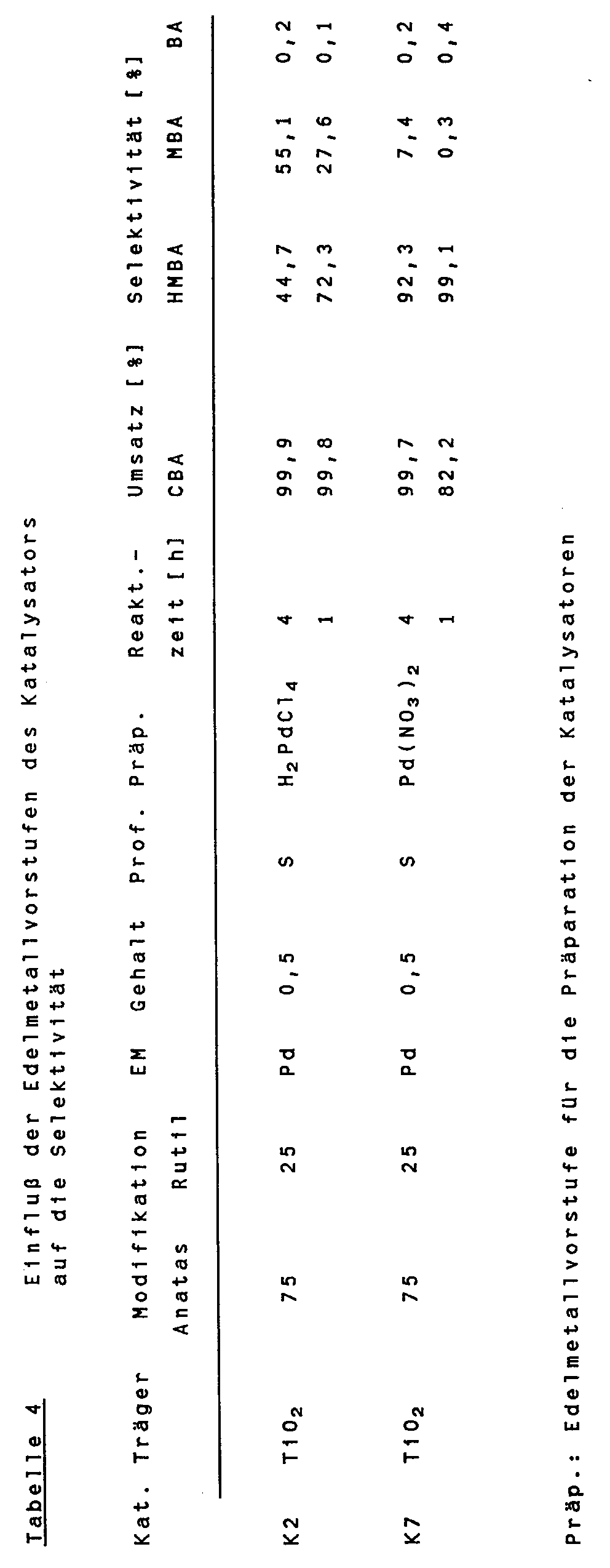


Claims (13)
- Verfahren zur selektiven katalytischen Hydrierung der Carbonylgruppe von aromatischen Aldehyden der Form

dadurch gekennzeichnet,
daß die aromatischen Aldehyde unter Zusatz eines Lösungsmittels gegebenenfalls in Gegenwart von organischen Säuren an einem geformten Trägerkatalysator enthaltend ein Platingruppen-Metall auf einem Träger aus Titanoxid in Anwesenheit von Wasserstoff bei Wasserstoff-Partialdrucken von 5 bis 50 bar und Temperaturen von 100 bis 300° C hydriert werden. - Verfahren nach Anspruch 1,
dadurch gekennzeichnet,
daß das Titanoxid ein durch einen Fällungsprozeß oder durch Flammenhydrolyse hergestelltes Titanoxid ist und in der Anatas- oder Rutilmodifikation sowie deren Mischungen oder Mischphasen vorliegen kann. - Verfahren nach Anspruch 1 oder 2,
dadurch gekennzeichnet,
daß der geformte Trägerkatalysator keine anorganischen Bindemittel enthält. - Verfahren nach den Ansprüchen 1 bis 3,
dadurch gekennzeichnet,
daß der Trägerkatalysator Außenabmessungen von 1 bis 10 mm und eine Bruchfestigkeit größer als 40 N aufweist. - Verfahren nach den Ansprüchen 1 bis 4,
dadurch gekennzeichnet,
daß das Platingruppen-Metall Platin, Palladium oder Rhodium ist und in einer Menge von 0,01 bis 3,0 Gew.-%, bezogen auf das Gewicht des Trägers, vorliegt. - Verfahren nach den Ansprüchen 1 bis 5,
dadurch gekennzeichnet,
daß die Hydrierung in Gegenwart von Terephthalsäure durchgeführt wird und die organische Säure im Verhältnis zum aromatischen Aldehyd im Überschuß vorliegen kann. - Verfahren nach den Ansprüchen 1 bis 5,
dadurch gekennzeichnet,
daß der Trägerkatalysator durch Imprägnieren des Trägers aus Titanoxid mit einer wasserlöslichen Chlor- oder Nitratverbindung des Platittgruppen-Metalls, nechfolgendem Trocknen und Kalzinieren und Aktivieren in einem Wasserstoff enthaltenden Gasstrom erhältlich ist. - Verfahren nach Anspruch 7,
dadurch gekennzeichnet,
daß das Platingruppen-Metall Palladium ist und in Form seiner Chlorverbindungen in den Träger mit einer homogenen Verteilung eingebracht wird. - Verfahren nach Anspruch 7,
dadurch gekennzeichnet,
daß das Platingruppen-Metall Palladium ist und in Form seiner Nitratverbindungen in den Träger mit einer schalenförmigen Verteilung eingebracht wird. - Verfahren nach Anspruch 7,
dadurch gekennzeichnet,
daß das Platingruppen-Metall Platin ist und in Form seiner Nitratverbindungen in den Träger mit einer schalenförmigen Verteilung eingebracht wird. - Verfahren nach einem der Ansprüche 8 oder 9,
dadurch gekennzeichnet,
daß die Hydrierung in Gegenwart von p-Hydroxymethylbenzoesäure durchgeführt wird und die organische Säure im Verhältnis zum aromatischen Aldehyd im Überschuß vorliegen kann. - Verfahren zur Herstellung von Benzylethern aus aromatischen Aldehyden der Form
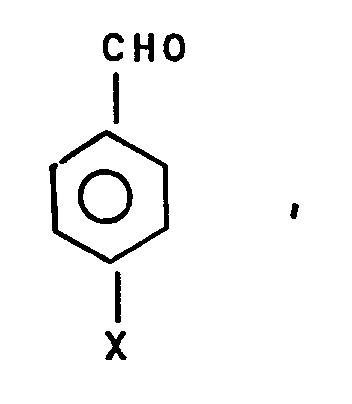
dadurch gekennzeichnet,
daß die aromatischen Aldehyde in einer alkoholischen Lösung an einem geformten Trägerkatalysator enthaltend ein Platingruppen-Metall auf einem Träger aus Titanoxid in Anwesenheit von Wasserstoff bei Wasserstoff-Partialdrucken von 5 bis 50 bar und Temperaturen von 100 bis 300° C umgesetzt werden. - Verfahren nach Anspruch 12,
dadurch gekennzeichnet,
daß das Titanoxid ein aus einem Fällungsprozeß gewonnenes Titanoxid in der Anatasmodifikation ist, welches in einer 4%igen wäßrigen Suspension einen pH-Wert von kleiner als 5, bevorzugt unter 3, aufweist und daß das Platingruppen-Metall Palladium ist.
Applications Claiming Priority (2)
| Application Number | Priority Date | Filing Date | Title |
|---|---|---|---|
| DE4300297 | 1993-01-08 | ||
| DE4300297A DE4300297C2 (de) | 1993-01-08 | 1993-01-08 | Verfahren zur selektiven katalytischen Hydrierung der Carbonylgruppe von 4-Carboxylbenzaldehyd |
Publications (2)
| Publication Number | Publication Date |
|---|---|
| EP0606072A1 true EP0606072A1 (de) | 1994-07-13 |
| EP0606072B1 EP0606072B1 (de) | 1998-06-10 |
Family
ID=6477865
Family Applications (1)
| Application Number | Title | Priority Date | Filing Date |
|---|---|---|---|
| EP94100078A Expired - Lifetime EP0606072B1 (de) | 1993-01-08 | 1994-01-05 | Selektive katalytische Hydrierung von aromatischen Aldehyden |
Country Status (9)
| Country | Link |
|---|---|
| US (1) | US5387726A (de) |
| EP (1) | EP0606072B1 (de) |
| KR (1) | KR940018338A (de) |
| CN (1) | CN1099740A (de) |
| BR (1) | BR9400041A (de) |
| DE (2) | DE4300297C2 (de) |
| ES (1) | ES2118981T3 (de) |
| MX (1) | MX9400303A (de) |
| TW (1) | TW237446B (de) |
Cited By (4)
| Publication number | Priority date | Publication date | Assignee | Title |
|---|---|---|---|---|
| GR1002923B (el) * | 1997-01-24 | 1998-06-16 | Καταλυτες για την καυση πτητικων οργανικων ενωσεων (vocs) | |
| EP1059280A3 (de) * | 1999-06-11 | 2004-02-04 | Bayer Chemicals AG | Verfahren zur Herstellung von Benzylalkoholen und deren Verwendung |
| US7230141B2 (en) | 2002-01-24 | 2007-06-12 | Basf Aktiengesellschaft | Method for producing toluol derivatives |
| CN116328795A (zh) * | 2021-12-17 | 2023-06-27 | 南京林业大学 | 一种复合载体负载双金属催化剂的制备用于催化碳氧双键选择性原位加氢的方法 |
Families Citing this family (14)
| Publication number | Priority date | Publication date | Assignee | Title |
|---|---|---|---|---|
| US6852667B2 (en) * | 1998-02-16 | 2005-02-08 | Sumitomo Chemical Company Limited | Process for producing chlorine |
| EP1503750A1 (de) * | 2002-01-09 | 2005-02-09 | Hormos Medical Corporation | Verfahren zur herstellung von matairesinol |
| CN101844957B (zh) * | 2010-03-30 | 2012-10-24 | 杭州师范大学 | 一种α, β-不饱和酮羰基还原成亚甲基的方法 |
| EP2444150A1 (de) * | 2010-10-22 | 2012-04-25 | crenox GmbH | Trägerkatalysator aus Aufschlussrückständen der titanylsulfathaltigen Schwarzlösung |
| KR101930087B1 (ko) * | 2011-07-26 | 2018-12-18 | 에스케이이노베이션 주식회사 | 방향족 카르복시산 및/또는 방향족 카르복시산 알킬 에스테르 제조 공정에서 발생하는 부산물로부터 방향족 탄화수소 제조방법 |
| CN103301864B (zh) * | 2012-03-12 | 2014-12-31 | 中国科学院大连化学物理研究所 | 一种Pd/TiO2-C-SiC催化剂及其制备与应用 |
| CN102863331B (zh) * | 2012-09-18 | 2014-09-03 | 中国石油化工股份有限公司 | 对苯二甲酸加氢精制催化剂活性状况判断方法 |
| CN103386303B (zh) * | 2013-07-25 | 2016-03-02 | 中国石油化工股份有限公司 | 一种加氢催化剂及其制备方法 |
| CN105268434B (zh) * | 2014-07-24 | 2018-07-13 | 中国石油化工股份有限公司 | 粗对苯二甲酸加氢精制催化剂 |
| CN106475093B (zh) * | 2015-09-02 | 2021-07-23 | 中国石化扬子石油化工有限公司 | 一种蛋壳型Pd/TiO2催化剂的制备方法 |
| FI128885B (en) * | 2018-11-06 | 2021-02-15 | Teknologian Tutkimuskeskus Vtt Oy | Catalyst for dehydrogenation, method for preparing the catalyst and use |
| JP7840118B2 (ja) * | 2021-04-21 | 2026-04-03 | 千代田化工建設株式会社 | 水素化触媒ならびにこれを用いたフロー式有機合成システム及び水素化有機化合物の製造方法 |
| WO2023009616A1 (en) * | 2021-07-28 | 2023-02-02 | Battelle Memorial Institute | Catalyst and method embodiments for making para-xylene and ortho-xylene |
| CN117945848A (zh) * | 2022-10-25 | 2024-04-30 | 中国石油化工股份有限公司 | 加氢催化剂及其制备方法和应用和芳香醛加氢制芳香醇的方法 |
Citations (4)
| Publication number | Priority date | Publication date | Assignee | Title |
|---|---|---|---|---|
| GB899009A (en) * | 1958-01-13 | 1962-06-20 | Engelhard Ind Inc | Ruthenium-containing catalyst |
| GB1159967A (en) * | 1965-11-15 | 1969-07-30 | Johnson Matthey Co Ltd | Improvements in and relating to the Catalytic Reduction of Aromatic Ketones and Aromatic Aldehydes |
| EP0265137A2 (de) * | 1986-10-20 | 1988-04-27 | Mitsui Petrochemical Industries, Ltd. | Reinigung von Terephthalsäure |
| EP0535565A1 (de) * | 1991-10-01 | 1993-04-07 | Degussa Aktiengesellschaft | Verfahren zum Herstellen von 1,3-Propandiol durch Hydrieren von Hydroxypropionaldehyd |
Family Cites Families (5)
| Publication number | Priority date | Publication date | Assignee | Title |
|---|---|---|---|---|
| US3532760A (en) * | 1966-08-15 | 1970-10-06 | Dow Chemical Co | Reduction of chlorophenones |
| GB1578725A (en) * | 1977-03-02 | 1980-11-05 | Johnson Matthey Co Ltd | Catalytic process for the purification of terephthalic acid |
| US4743577A (en) * | 1986-10-14 | 1988-05-10 | Amoco Corporation | Catalyst composition |
| US4721808A (en) * | 1987-04-21 | 1988-01-26 | Amoco Corporation | Process for purification of crude p-hydroxymethylbenzoic acid |
| US4812594A (en) * | 1987-04-21 | 1989-03-14 | Amoco Corporation | Process for purification of crude p-hydroxymethylbenzoic acid |
-
1993
- 1993-01-08 DE DE4300297A patent/DE4300297C2/de not_active Expired - Fee Related
- 1993-12-21 TW TW082110851A patent/TW237446B/zh active
-
1994
- 1994-01-05 EP EP94100078A patent/EP0606072B1/de not_active Expired - Lifetime
- 1994-01-05 ES ES94100078T patent/ES2118981T3/es not_active Expired - Lifetime
- 1994-01-05 DE DE59406155T patent/DE59406155D1/de not_active Expired - Fee Related
- 1994-01-06 MX MX9400303A patent/MX9400303A/es not_active IP Right Cessation
- 1994-01-06 BR BR9400041A patent/BR9400041A/pt not_active IP Right Cessation
- 1994-01-07 KR KR1019940000199A patent/KR940018338A/ko not_active Ceased
- 1994-01-07 US US08/179,621 patent/US5387726A/en not_active Expired - Fee Related
- 1994-01-07 CN CN94100192A patent/CN1099740A/zh active Pending
Patent Citations (4)
| Publication number | Priority date | Publication date | Assignee | Title |
|---|---|---|---|---|
| GB899009A (en) * | 1958-01-13 | 1962-06-20 | Engelhard Ind Inc | Ruthenium-containing catalyst |
| GB1159967A (en) * | 1965-11-15 | 1969-07-30 | Johnson Matthey Co Ltd | Improvements in and relating to the Catalytic Reduction of Aromatic Ketones and Aromatic Aldehydes |
| EP0265137A2 (de) * | 1986-10-20 | 1988-04-27 | Mitsui Petrochemical Industries, Ltd. | Reinigung von Terephthalsäure |
| EP0535565A1 (de) * | 1991-10-01 | 1993-04-07 | Degussa Aktiengesellschaft | Verfahren zum Herstellen von 1,3-Propandiol durch Hydrieren von Hydroxypropionaldehyd |
Non-Patent Citations (1)
| Title |
|---|
| M BANKMANN ET AL: "FORMING OF HIGH SURFACE AREA TIO2 TO CATALYST SUPPORTS", CATALYSIS TODAY, vol. 14, no. 2, 4 May 1992 (1992-05-04), AMSTERDAM,NL, pages 225 - 242, XP009059044, DOI: doi:10.1016/0920-5861(92)80025-I * |
Cited By (4)
| Publication number | Priority date | Publication date | Assignee | Title |
|---|---|---|---|---|
| GR1002923B (el) * | 1997-01-24 | 1998-06-16 | Καταλυτες για την καυση πτητικων οργανικων ενωσεων (vocs) | |
| EP1059280A3 (de) * | 1999-06-11 | 2004-02-04 | Bayer Chemicals AG | Verfahren zur Herstellung von Benzylalkoholen und deren Verwendung |
| US7230141B2 (en) | 2002-01-24 | 2007-06-12 | Basf Aktiengesellschaft | Method for producing toluol derivatives |
| CN116328795A (zh) * | 2021-12-17 | 2023-06-27 | 南京林业大学 | 一种复合载体负载双金属催化剂的制备用于催化碳氧双键选择性原位加氢的方法 |
Also Published As
| Publication number | Publication date |
|---|---|
| KR940018338A (ko) | 1994-08-16 |
| DE59406155D1 (de) | 1998-07-16 |
| DE4300297C2 (de) | 1998-01-29 |
| MX9400303A (es) | 1994-07-29 |
| EP0606072B1 (de) | 1998-06-10 |
| BR9400041A (pt) | 1994-07-26 |
| ES2118981T3 (es) | 1998-10-01 |
| CN1099740A (zh) | 1995-03-08 |
| TW237446B (de) | 1995-01-01 |
| US5387726A (en) | 1995-02-07 |
| DE4300297A1 (de) | 1994-07-21 |
Similar Documents
| Publication | Publication Date | Title |
|---|---|---|
| DE4300297C2 (de) | Verfahren zur selektiven katalytischen Hydrierung der Carbonylgruppe von 4-Carboxylbenzaldehyd | |
| DE69412827T2 (de) | Niedrigdruckverfahren zur hydrierung von dimethylbenzoldicarboxylaten zu den entsprechenden dimethylcyclohexancarboxylaten | |
| EP0983219B1 (de) | Verfahren zur herstellung von aliphatischen alkoholen | |
| DE3689050T2 (de) | Alkoholherstellung durch Hydrogenierung von Carbonsäuren. | |
| DE1965942C3 (de) | Rhodium enthaltender Festkörperkatalysator | |
| EP1165231B1 (de) | Nickel-katalysator zur hydrierung funktioneller gruppen und verfahren zu seiner herstellung | |
| EP1060154B1 (de) | Verfahren zur hydrierung von carbonylverbindungen | |
| EP1694438B1 (de) | Katalysatorextrudate auf basis kupferoxid und ihre verwendung zur hydrierung von carbonylverbindungen | |
| EP0770049B1 (de) | Verfahren und katalysator zur selektivhydrierung von butindiol zu butendiol | |
| DE69222196T2 (de) | Verfahren zur Herstellung von Chlortrifluorethylen und von Trifluorethylen aus 1,1,2-trichlor-1,2,2-trifluorethan sowie katalytische Zusammensetzung zur Verwendung in diesem Verfahren | |
| DE69410266T2 (de) | Herstellung von dimethyl cyclohexandicarboxylaten | |
| DE69509060T2 (de) | Verbessertes Verfahren zur Hydrierung von Maleinsäureanhydrid zu 1,4-Butandiol | |
| EP0816350B1 (de) | Verfahren zur Herstellung von N-substituierten cyclischen Aminen | |
| DE69706831T2 (de) | Katalysator und Verfahren zur Hydrierung zu 1,4-Butandiol | |
| DE69005777T2 (de) | Hydrogenation von Citral. | |
| EP1383601A2 (de) | Verfahren zur hydrierung von carbonylverbindungen | |
| DE69503761T2 (de) | Verfahren zur herstellung von gamma-butyrolacton | |
| WO2004054948A1 (de) | Verfahren zur herstellung von 1,6-hexandiol | |
| EP1406887B1 (de) | Verfahren zur selektiven herstellung von tetrahydrofuran durch hydrierung von maleinsäureanhydrid | |
| DE3726195A1 (de) | Verfahren zur herstellung eines ruthenium-katalysators fuer die hydrierung eines aldehyds und/oder eines ketons | |
| DE69803822T2 (de) | Verbessertes Verfahren zur Hydrierung von Maleinsäure zu 1,4-Butandiol | |
| DE60035106T2 (de) | Verfahren zur herstellung hydrogenierter ester | |
| EP1572354B1 (de) | Rheniumhaltiger trägerkatalysator und verfahren zur hydrierung von carbonylverbindungen in flüssiger phase unter verwendung des katalysators | |
| DE2345160C2 (de) | Verfahren zur Herstellung von 1,4- Diacetoxybutan | |
| DE10253802A1 (de) | Verfahren zur Hydrierung von aromatischen Urethanen in Gegenwart eines geträgerten Rutheniumkatalysators |
Legal Events
| Date | Code | Title | Description |
|---|---|---|---|
| PUAI | Public reference made under article 153(3) epc to a published international application that has entered the european phase |
Free format text: ORIGINAL CODE: 0009012 |
|
| 17P | Request for examination filed |
Effective date: 19940105 |
|
| AK | Designated contracting states |
Kind code of ref document: A1 Designated state(s): BE DE ES FR GB IE IT NL |
|
| 17Q | First examination report despatched |
Effective date: 19960131 |
|
| GRAG | Despatch of communication of intention to grant |
Free format text: ORIGINAL CODE: EPIDOS AGRA |
|
| GRAG | Despatch of communication of intention to grant |
Free format text: ORIGINAL CODE: EPIDOS AGRA |
|
| GRAH | Despatch of communication of intention to grant a patent |
Free format text: ORIGINAL CODE: EPIDOS IGRA |
|
| GRAH | Despatch of communication of intention to grant a patent |
Free format text: ORIGINAL CODE: EPIDOS IGRA |
|
| GRAA | (expected) grant |
Free format text: ORIGINAL CODE: 0009210 |
|
| AK | Designated contracting states |
Kind code of ref document: B1 Designated state(s): BE DE ES FR GB IE IT NL |
|
| REF | Corresponds to: |
Ref document number: 59406155 Country of ref document: DE Date of ref document: 19980716 |
|
| ET | Fr: translation filed | ||
| ITF | It: translation for a ep patent filed | ||
| GBT | Gb: translation of ep patent filed (gb section 77(6)(a)/1977) |
Effective date: 19980902 |
|
| REG | Reference to a national code |
Ref country code: IE Ref legal event code: FG4D Free format text: GERMAN |
|
| REG | Reference to a national code |
Ref country code: ES Ref legal event code: FG2A Ref document number: 2118981 Country of ref document: ES Kind code of ref document: T3 |
|
| PLBE | No opposition filed within time limit |
Free format text: ORIGINAL CODE: 0009261 |
|
| STAA | Information on the status of an ep patent application or granted ep patent |
Free format text: STATUS: NO OPPOSITION FILED WITHIN TIME LIMIT |
|
| 26N | No opposition filed | ||
| REG | Reference to a national code |
Ref country code: GB Ref legal event code: 732E |
|
| PGFP | Annual fee paid to national office [announced via postgrant information from national office to epo] |
Ref country code: GB Payment date: 20001212 Year of fee payment: 8 |
|
| PGFP | Annual fee paid to national office [announced via postgrant information from national office to epo] |
Ref country code: IE Payment date: 20001213 Year of fee payment: 8 |
|
| PGFP | Annual fee paid to national office [announced via postgrant information from national office to epo] |
Ref country code: NL Payment date: 20001222 Year of fee payment: 8 |
|
| PGFP | Annual fee paid to national office [announced via postgrant information from national office to epo] |
Ref country code: DE Payment date: 20010102 Year of fee payment: 8 |
|
| PGFP | Annual fee paid to national office [announced via postgrant information from national office to epo] |
Ref country code: FR Payment date: 20010103 Year of fee payment: 8 |
|
| PGFP | Annual fee paid to national office [announced via postgrant information from national office to epo] |
Ref country code: BE Payment date: 20010118 Year of fee payment: 8 |
|
| PGFP | Annual fee paid to national office [announced via postgrant information from national office to epo] |
Ref country code: ES Payment date: 20010122 Year of fee payment: 8 |
|
| REG | Reference to a national code |
Ref country code: GB Ref legal event code: IF02 |
|
| PG25 | Lapsed in a contracting state [announced via postgrant information from national office to epo] |
Ref country code: GB Free format text: LAPSE BECAUSE OF NON-PAYMENT OF DUE FEES Effective date: 20020105 |
|
| PG25 | Lapsed in a contracting state [announced via postgrant information from national office to epo] |
Ref country code: IE Free format text: LAPSE BECAUSE OF NON-PAYMENT OF DUE FEES Effective date: 20020107 |
|
| PG25 | Lapsed in a contracting state [announced via postgrant information from national office to epo] |
Ref country code: ES Free format text: LAPSE BECAUSE OF NON-PAYMENT OF DUE FEES Effective date: 20020108 |
|
| PG25 | Lapsed in a contracting state [announced via postgrant information from national office to epo] |
Ref country code: BE Free format text: LAPSE BECAUSE OF NON-PAYMENT OF DUE FEES Effective date: 20020131 |
|
| BERE | Be: lapsed |
Owner name: DEGUSSA A.G. Effective date: 20020131 |
|
| PG25 | Lapsed in a contracting state [announced via postgrant information from national office to epo] |
Ref country code: NL Free format text: LAPSE BECAUSE OF NON-PAYMENT OF DUE FEES Effective date: 20020801 Ref country code: DE Free format text: LAPSE BECAUSE OF NON-PAYMENT OF DUE FEES Effective date: 20020801 |
|
| GBPC | Gb: european patent ceased through non-payment of renewal fee |
Effective date: 20020105 |
|
| PG25 | Lapsed in a contracting state [announced via postgrant information from national office to epo] |
Ref country code: FR Free format text: LAPSE BECAUSE OF NON-PAYMENT OF DUE FEES Effective date: 20020930 |
|
| NLV4 | Nl: lapsed or anulled due to non-payment of the annual fee |
Effective date: 20020801 |
|
| REG | Reference to a national code |
Ref country code: FR Ref legal event code: ST |
|
| REG | Reference to a national code |
Ref country code: IE Ref legal event code: MM4A |
|
| REG | Reference to a national code |
Ref country code: ES Ref legal event code: FD2A Effective date: 20030922 |
|
| PG25 | Lapsed in a contracting state [announced via postgrant information from national office to epo] |
Ref country code: IT Free format text: LAPSE BECAUSE OF NON-PAYMENT OF DUE FEES;WARNING: LAPSES OF ITALIAN PATENTS WITH EFFECTIVE DATE BEFORE 2007 MAY HAVE OCCURRED AT ANY TIME BEFORE 2007. THE CORRECT EFFECTIVE DATE MAY BE DIFFERENT FROM THE ONE RECORDED. Effective date: 20050105 |