EP0606792B1 - Procédé d'authentification d'un ensemble informatique par un autre ensemble informatique - Google Patents
Procédé d'authentification d'un ensemble informatique par un autre ensemble informatique Download PDFInfo
- Publication number
- EP0606792B1 EP0606792B1 EP93402996A EP93402996A EP0606792B1 EP 0606792 B1 EP0606792 B1 EP 0606792B1 EP 93402996 A EP93402996 A EP 93402996A EP 93402996 A EP93402996 A EP 93402996A EP 0606792 B1 EP0606792 B1 EP 0606792B1
- Authority
- EP
- European Patent Office
- Prior art keywords
- secret key
- random number
- signature
- password
- algorithm
- Prior art date
- Legal status (The legal status is an assumption and is not a legal conclusion. Google has not performed a legal analysis and makes no representation as to the accuracy of the status listed.)
- Expired - Lifetime
Links
Images

Classifications
-
- G—PHYSICS
- G06—COMPUTING OR CALCULATING; COUNTING
- G06F—ELECTRIC DIGITAL DATA PROCESSING
- G06F21/00—Security arrangements for protecting computers, components thereof, programs or data against unauthorised activity
- G06F21/30—Authentication, i.e. establishing the identity or authorisation of security principals
- G06F21/31—User authentication
-
- G—PHYSICS
- G06—COMPUTING OR CALCULATING; COUNTING
- G06F—ELECTRIC DIGITAL DATA PROCESSING
- G06F2221/00—Indexing scheme relating to security arrangements for protecting computers, components thereof, programs or data against unauthorised activity
- G06F2221/21—Indexing scheme relating to G06F21/00 and subgroups addressing additional information or applications relating to security arrangements for protecting computers, components thereof, programs or data against unauthorised activity
- G06F2221/2103—Challenge-response
Definitions
- the invention relates to a method for authenticating a computer terminal with programmable memory by a computer server.
- This process can be applied to all types of computer terminal that can be modified by adding a PROM, EPROM memory (in Anglo-Saxon terms, "Programmable Read Only Memory”) or loading into memory RAM ("Random Access Memory”) or EEPROM ("Electronicaly Erasable Programmable Read Only Memory ”) in order to memorize data and programs.
- PROM Programmable Read Only Memory
- RAM Random Access Memory
- EEPROM Electrically Erasable Programmable Read Only Memory
- a simple embodiment, but not offering absolute security, consists in controlling access to the computer system by checking a word of password known only to the authorized user and often changed to limit the possibility that unauthorized users discover this password.
- passwords are found or intercepted by people unauthorized wishing to use the system computer science.
- the passwords chosen by the users are often easy to find by search exhaustive. However, it is they who, most of the time, are used because random passwords generated by computer systems are very often more difficult to remember.
- Comprehensive research in using a password dictionary is often possible without connection attempt, as long as one can read the file of encrypted passwords.
- Another possibility to secure a treatment IT consists of coding / decoding information transmitted between systems. This process of coding / decoding is more and more frequent. He uses generally ancillary devices generally connected to the terminals. These devices are of the type calculators, tokens, smart cards, or videotex authenticators.
- Document WO 91/14980 introduces an authentication method in which the password supplied by the user to the terminal is encrypted before it is transmitted and written to the memory.
- the method uses a combination of the password with a random number.
- the object of the invention is to remedy the drawbacks of the methods described above. She permits authentication by random signature of a terminal of computer system and, more specifically, a portable videotex terminal, known commercially of portable Minitel ®. It allows, in fact, authentication of a portable Minitel ® without using any additional material to be connected to Minitel ® and whose power consumption is usually too large to be used optimally.
- the first computerized assembly is a computer terminal provided a memory capable of being programmed and of recording data and in which the identity code is written and an encrypted key, the secret key used for the signature of the random number being determined using a decryption algorithm using the key encrypted and a password provided by the user to terminal.
- the key encrypted is determined by encryption of the secret key by an encryption algorithm using a word of past.
- the process consists of encrypting the secret key using an encryption algorithm and new password to provide a new key encrypted.
- the method according to the invention therefore makes it possible to render services identical to those of a process using the smart card, while not requiring readers cards.
- the computer system used to set up work this process includes a computer terminal connected to a server.
- the computer terminal has a memory capable of storing programs and data.
- This memory can be a RAM (Random Access Memory), an EEPROM (Electronically Erasable Programable Read Only Memory), or even an EPROM or a PROM (Programable Read Only Memory).
- Such a computer terminal unlike the smart card, has no secret zone in which can be memorized a secret key. Also, the secret key is therefore encrypted before being stored in memory programmable fitted to the computer terminal.
- the encryption of this secret key is carried out from an encryption algorithm implemented using a password known to the user. This password does not pass through the means of communication (line of transmission, for example) connecting the terminal to the server of the computer system. In addition, this password is not not written to the terminal memory. He can't either no longer be found by exhaustive tests performed by a person who had access to the contents of the memory.
- the SID secret key can be recalculated by the server using the T method.
- the secret key in its encrypted form KID.
- the secret key SID is determined from the identity code ID.
- This code of identity is a non-secret code, representative of the user requesting access to the computer system. In practice, this identity code can be the name of the user.
- this secret key can be made from several kinds of treatments.
- this key secret SID is determined using a database in which each ID code is converted to a secret SID key.
- the secret key SID is determined using a diversification function having as variables the identity code ID and a key mother stored in the server.
- Terminal customization phase computing takes place in a set called workshop customization.
- An administrator enters the code identity user ID on the keyboard of the customization workshop. This ID code is then written to the memory of terminal 2.
- the personalization workshop has the same means processing than this server. It is therefore able to determine the secret key SID from the identity ID.
- the personalization workshop implements an algorithm A encryption using a chosen MP password, for default, by the administrator and entered the workshop personalization by typing on his keyboard.
- the password MP is transmitted to the user by a secure channel, referenced 4, this channel which may be, for example, a secret envelope.
- the password chosen to determine the secret key SID is a password fictitious which, when the SID and KID keys have been determined, will be changed by the password specific to the user.
- an operation is carried out verification of KID and SID keys by signatures of a random number equal to zero and named ALEA-0.
- ALEA-0 a random number equal to zero
- These signatures are produced, on the one hand, in the terminal and, on the other hand, in the personalization workshop at with the help of which the administrator determined said keys KID and SID.
- ALEA-0 are signed, on the one hand, by the personalization workshop and, on the other hand, by the terminal (as described in the following text). They are then compared to each other: when they are equivalents, the operation of customization is complete and that the procedure authentication is then possible.
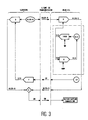
- FIG. 2 shows the different operations of the authentication method according to the invention.
- This connection request consists in sending the identity code terminal ID to the server which after verification of this identity code, generates a number random, named ALEA-A, and passes this random number ALEA-A at the terminal.
- the terminal On receipt of this random number ALEA-A, the terminal executes a consistent signature algorithm B to sign the random number ALEA-A using the key secret SID in its encrypted form KID. Indeed, as this has been explained previously, the secret key is stored in memory in its encrypted form KID. This encrypted secret key KID is therefore decrypted, in the terminal, using an INVA decryption algorithm.
- This INVA decryption algorithm is the reverse algorithm of the encryption algorithm A. Its parameter is the user's PM password.
- the secret key SID used in conjunction with signature algorithm B for sign the random number ALEA-A. This random number signed is named ALEA-S.
- This random number signed ALEA-S is then transmitted to the server.
- the latter checks the signature of the number ALEA-A random by number comparison test random signed ALEA-S with a result (or signature of reference ALEA-R) that he determined himself.
- the server when the server generated the random number ALEA-A when the server generated the random number ALEA-A that it has transmitted to the terminal, it performs an operation signature of the random number ALEA-A considered as ALEA-R reference signature.
- This operation of reference signature is made by means of the signature algorithm B and the secret key SID recalculated using the T method by the server itself.
- a comparison algorithm C then makes it possible to check if the random number signed ALEA-S and the reference signature are equivalent. If this equivalence is checked, the server sends to the terminal a connection agreement message. This message is referenced OK and indicates to the user that he has permission to connect to the server.
- the OK message is not sent and the user is not allowed to connect to the server.
- authentication according to the process of the invention is done so almost transparent. Indeed, the user, during the request to connect his terminal to the server, receives on his terminal a random number from said server.
- the user program contained in the memory then asks him to enter his MP password.
- This user program decrypts the encrypted secret key KID and signs the random number ALEA-A sent by the server. This signature is then sent to the server, without the user intervening again.
- the process of the invention has the advantage, in particular, to allow a change of password (represented by the block in phantom in Figure 3) without risk, because this change is made after a successful connection, which ensures the validity of the key secret SID.
- the key KID encrypted secret is decrypted from the INVA decryption algorithm and from the first MP password (i.e. the password that you seeks to modify).
- the secret key SID which is used by encryption algorithm A with the second NMP password (i.e. the new password) to create a new encrypted form of the secret key. This new encrypted form will be written in memory instead of the old encrypted form of the secret key KID.
- This process therefore ensures password security which remains in "local", that is to say that it will not be moment sent on the transmission means connecting the terminal and server, means on which listening may be possible.
- system smart card authentication as known, and the authentication system from a terminal equipped of a PROM can be compatible in the case where the PROM and the smart card use the same algorithm.
Landscapes
- Engineering & Computer Science (AREA)
- Computer Security & Cryptography (AREA)
- Theoretical Computer Science (AREA)
- Computer Hardware Design (AREA)
- Software Systems (AREA)
- Physics & Mathematics (AREA)
- General Engineering & Computer Science (AREA)
- General Physics & Mathematics (AREA)
- Storage Device Security (AREA)
Description
- le premier ensemble envoie au second ensemble un code d'identité ;
- le second ensemble vérifie cette identité et, en cas d'accord, envoie au premier ensemble un nombre aléatoire ;
- le premier ensemble code le nombre aléatoire à l'aide d'un algorithme de signature défini par une clé secrète et envoie ce premier nombre aléatoire signé au second ensemble ;
- le second ensemble applique un algorithme de vérification de signature.
- une transformation, par un traitement de conversion, du code d'identité en la clé secrète ;
- une signature du nombre aléatoire par un algorithme de signature défini par la clé secrète pour fournir un second nombre aléatoire signé, dit signature de référence ;
- une comparaison de la signature de référence avec le premier nombre aléatoire signé provenant du terminal.
- La figure 1 représente le schéma fonctionnel de personnalisation de la PROM, c'est-à-dire de la détermination de la clé secrète et de la clé secrète chiffrée ; détermination de la clé secrète et de la clé secrète chiffrée ;
- la figure 2 représente le schéma fonctionnel du procédé d'authentification selon l'invention ;
- la figure 3 représente le schéma fonctionnel du procédé selon l'invention dans le cas d'un changement de mot de passe.
Claims (4)
- Procédé d'authentification d'un premier ensemble informatique par un second ensemble informatique selon lequel :caractérisé en ce que, le premier ensemble informatique étant un terminal informatique muni d'une mémoire apte à être programmée et à enregistrer des données, le code d'identité et une clé secrète chiffrée (KID) sont écrits dans la mémoire et, la clé secrète utilisée pour la signature du nombre aléatoire est déterminée à l'aide d'un algorithme de déchiffrement (INVA) utilisant la clé secrète chiffrée (KID) et un mot de passe (MP) fourni par l'utilisateur au terminal.le premier ensemble envoie au second ensemble un code d'identité (ID) ;le second ensemble vérifie cette identité et, en cas d'accord, envoie au premier ensemble un nombre aléatoire (ALEA-A) ;le premier ensemble code le nombre aléatoire à l'aide d'un algorithme de signature (B) utilisant une clé secrète (SID) et envoie ce premier nombre aléatoire signé (ALEA-S) au second ensemble ;le second ensemble applique un algorithme de vérification de signature (T, B, C) ;
- Procédé d'authentification selon la revendication 1, caractérisé en ce que l'algorithme de vérification consiste en :une transformation, par un traitement (T) de conversion, du code d'identité en la clé secrète ;une signature du nombre aléatoire par un algorithme de signature (B) défini par la clé secrète pour fournir un second nombre aléatoire signé, dit signature de référence (ALEA-R) ;une comparaison de la signature de référence avec le premier nombre aléatoire signé provenant du terminal.
- Procédé d'authentification selon l'une quelconque des revendications 1 et 2, caractérisé en ce que la clé chiffrée est déterminée par chiffrement de la clé secrète par un algorithme de chiffrement (A) utilisant un mot de passe choisi par défaut.
- Procédé d'authentification selon l'une quelconque des revendications 1 à 3, caractérisé en ce qu'il consiste, dans le cas d'un changement du mot de passe en un nouveau mot de passe (NMP), à chiffrer la clé secrète au moyen d'un algorithme de chiffrement (A) et du nouveau mot de passe pour fournir une nouvelle clé chiffrée.
Applications Claiming Priority (2)
| Application Number | Priority Date | Filing Date | Title |
|---|---|---|---|
| FR9215099A FR2699300B1 (fr) | 1992-12-15 | 1992-12-15 | Procédé d'authentification d'un ensemble informatique par un autre ensemble informatique. |
| FR9215099 | 1992-12-15 |
Publications (2)
| Publication Number | Publication Date |
|---|---|
| EP0606792A1 EP0606792A1 (fr) | 1994-07-20 |
| EP0606792B1 true EP0606792B1 (fr) | 2001-09-12 |
Family
ID=9436610
Family Applications (1)
| Application Number | Title | Priority Date | Filing Date |
|---|---|---|---|
| EP93402996A Expired - Lifetime EP0606792B1 (fr) | 1992-12-15 | 1993-12-13 | Procédé d'authentification d'un ensemble informatique par un autre ensemble informatique |
Country Status (4)
| Country | Link |
|---|---|
| US (1) | US5481612A (fr) |
| EP (1) | EP0606792B1 (fr) |
| DE (1) | DE69330743T2 (fr) |
| FR (1) | FR2699300B1 (fr) |
Families Citing this family (18)
| Publication number | Priority date | Publication date | Assignee | Title |
|---|---|---|---|---|
| US5606613A (en) * | 1994-12-22 | 1997-02-25 | Pitney Bowes Inc. | Method for identifying a metering accounting vault to digital printer |
| US5737422A (en) * | 1995-04-26 | 1998-04-07 | Billings; Roger E. | Distributed data processing network |
| GB2352070B (en) * | 1996-06-04 | 2001-05-30 | Multex Systems Inc | Information delivery system and method |
| US6138236A (en) * | 1996-07-01 | 2000-10-24 | Sun Microsystems, Inc. | Method and apparatus for firmware authentication |
| FR2751104B1 (fr) * | 1996-07-11 | 1998-12-31 | Stoffel Laurent | Procede de controle de transactions securisees independantes utilisant un dispositif physique unique |
| US6021496A (en) * | 1997-07-07 | 2000-02-01 | International Business Machines Corporation | User authentication from non-native server domains in a computer network |
| US6151676A (en) * | 1997-12-24 | 2000-11-21 | Philips Electronics North America Corporation | Administration and utilization of secret fresh random numbers in a networked environment |
| US6738907B1 (en) * | 1998-01-20 | 2004-05-18 | Novell, Inc. | Maintaining a soft-token private key store in a distributed environment |
| US6226750B1 (en) | 1998-01-20 | 2001-05-01 | Proact Technologies Corp. | Secure session tracking method and system for client-server environment |
| US6385642B1 (en) | 1998-11-03 | 2002-05-07 | Youdecide.Com, Inc. | Internet web server cache storage and session management system |
| KR100351264B1 (ko) * | 1999-01-12 | 2002-09-10 | 주식회사 인터넷시큐리티 | 챌린지/레스펀스 기반 일회용 비밀번호 생성 기능을 내장한 통신단말장치 |
| GB2368422B (en) * | 2000-05-10 | 2003-03-26 | Sony Corp | Electronic settlement system, settlement management device, store device, client, data storage device, computer program, and storage medium |
| US20020184507A1 (en) * | 2001-05-31 | 2002-12-05 | Proact Technologies Corp. | Centralized single sign-on method and system for a client-server environment |
| US7194762B2 (en) * | 2001-11-30 | 2007-03-20 | Lenovo (Singapore) Pte. Ltd. | Method of creating password list for remote authentication to services |
| JP3678417B2 (ja) * | 2002-04-26 | 2005-08-03 | 正幸 糸井 | 個人認証方法及びシステム |
| WO2004010584A2 (fr) * | 2002-07-24 | 2004-01-29 | Congruence Llc. | Code d'identification d'objets |
| KR20060081847A (ko) * | 2005-01-10 | 2006-07-13 | 삼성전자주식회사 | 비밀키를 보호하는 스마트 카드 및 그것의 방법 |
| CN102279908B (zh) * | 2010-06-08 | 2014-03-12 | 安凯(广州)微电子技术有限公司 | 一种数字内容的保护方法及系统 |
Family Cites Families (13)
| Publication number | Priority date | Publication date | Assignee | Title |
|---|---|---|---|---|
| US4947430A (en) * | 1987-11-23 | 1990-08-07 | David Chaum | Undeniable signature systems |
| US4649233A (en) * | 1985-04-11 | 1987-03-10 | International Business Machines Corporation | Method for establishing user authenication with composite session keys among cryptographically communicating nodes |
| WO1987003977A1 (fr) * | 1985-12-26 | 1987-07-02 | Gordian Systems | Cle a circuit integre de commande d'acces a des systemes et a des logiciels informatiques et/ou de mise en securite de communications |
| US5319710A (en) * | 1986-08-22 | 1994-06-07 | Tandem Computers Incorporated | Method and means for combining and managing personal verification and message authentication encrytions for network transmission |
| US5140634A (en) * | 1987-09-07 | 1992-08-18 | U.S Philips Corporation | Method and apparatus for authenticating accreditations and for authenticating and signing messages |
| EP0383985A1 (fr) * | 1989-02-24 | 1990-08-29 | Claus Peter Prof. Dr. Schnorr | Procédé d'identification d'abonnées ainsi que de génération et de vérification de signatures électroniques dans un système d'échange de données |
| US5001752A (en) * | 1989-10-13 | 1991-03-19 | Fischer Addison M | Public/key date-time notary facility |
| US5365466A (en) * | 1989-12-19 | 1994-11-15 | Bull Cp8 | Method for generating a random number in a system with portable electronic objects, and system for implementing the method |
| DE4008971A1 (de) * | 1990-03-20 | 1991-09-26 | Siemens Nixdorf Inf Syst | Verfahren zur authentifizierung eines eine datenstation benutzenden anwenders |
| US5241599A (en) * | 1991-10-02 | 1993-08-31 | At&T Bell Laboratories | Cryptographic protocol for secure communications |
| EP0566811A1 (fr) * | 1992-04-23 | 1993-10-27 | International Business Machines Corporation | Méthode et système d'authentification à l'aide d'une carte à puce |
| US5349642A (en) * | 1992-11-03 | 1994-09-20 | Novell, Inc. | Method and apparatus for authentication of client server communication |
| US5363448A (en) * | 1993-06-30 | 1994-11-08 | United Technologies Automotive, Inc. | Pseudorandom number generation and cryptographic authentication |
-
1992
- 1992-12-15 FR FR9215099A patent/FR2699300B1/fr not_active Expired - Lifetime
-
1993
- 1993-12-13 DE DE69330743T patent/DE69330743T2/de not_active Expired - Lifetime
- 1993-12-13 EP EP93402996A patent/EP0606792B1/fr not_active Expired - Lifetime
- 1993-12-15 US US08/167,502 patent/US5481612A/en not_active Expired - Lifetime
Also Published As
| Publication number | Publication date |
|---|---|
| DE69330743T2 (de) | 2002-07-04 |
| US5481612A (en) | 1996-01-02 |
| FR2699300B1 (fr) | 1995-03-10 |
| FR2699300A1 (fr) | 1994-06-17 |
| EP0606792A1 (fr) | 1994-07-20 |
| DE69330743D1 (de) | 2001-10-18 |
Similar Documents
| Publication | Publication Date | Title |
|---|---|---|
| EP0606792B1 (fr) | Procédé d'authentification d'un ensemble informatique par un autre ensemble informatique | |
| EP0675614B1 (fr) | Dispositif pour l'échange sécurisé de données du genre RSA limité à la signature numérique et la vérification des messages et carte à microcircuit comportant un tel dispositif | |
| EP0055986B1 (fr) | Procédé et dispositif de sécurité pour communication tripartite de données confidentielles | |
| EP0252849B1 (fr) | Procédé pour authentifier une donnée d'habilitation externe par un objet portatif tel qu'une carte à mémoire | |
| EP2619941B1 (fr) | Procede, serveur et systeme d'authentification d'une personne | |
| EP1549011A1 (fr) | Procédé et système de communication entre un terminal et au moins un équipment communicant | |
| EP0707290A1 (fr) | Procédé de chargement d'une zone mémoire protégée d'un dispositif de traitement de l'information et dispositif associé | |
| FR2738934A1 (fr) | Systeme de comptabilisation anonyme d'informations a des fins statistiques, notamment pour des operations de vote electronique ou de releves periodiques de consommation | |
| EP0531194A1 (fr) | Procédé d'authentification de données | |
| FR2939931A1 (fr) | Procede de protection d'une clef usb securisee. | |
| WO2012031848A1 (fr) | Procede simplifie de personnalisation de carte a puce et dispositif associe | |
| EP4298580A1 (fr) | Carte de paiement, procédé d'authentification et utilisation pour un paiement à distance | |
| EP1609326B1 (fr) | Procede de protection d'un terminal de telecommunication de type telephone mobile | |
| EP2813962B1 (fr) | Méthode de contrôle d'accès à un type de services spécifique et dispositif d'authentification pour le contrôle de l'accès à un tel type de services. | |
| BE1003693A6 (fr) | Systeme de securite pour systeme informatique. | |
| EP0172047B1 (fr) | Procédé et système pour chiffrer et déchiffrer des informations transmises entre un dispositif émetteur et un dispositif récepteur | |
| FR3032292B1 (fr) | Element securise et procede mis en œuvre dans un tel element securise | |
| EP0566492B1 (fr) | Procédé d'authentification d'un ensemble informatique à partir d'une disquette informatique | |
| WO2005050419A1 (fr) | Procede de securisation d'une image d'une donnee biometrique d'authentification et procede d'authentification d'un utilisateur a partir d'une image d'une donnee biometrique d'authentification | |
| FR2913551A1 (fr) | Methode d'authentification mutuelle et recurrente sur internet. | |
| EP4730172A1 (fr) | Procédé de divulgation d'un code pin à un utilisateur | |
| WO2021249854A1 (fr) | Procédé d'acquisition et de traitement sécurisé d'une information secrète acquise | |
| FR2790854A1 (fr) | Supports et systemes d'echange de donnees securises notamment pour paiement et telepaiements | |
| FR2856815A1 (fr) | Procede d'authentification de donnees contenues dans un objet a memoire | |
| WO2001005085A2 (fr) | Procede et dispositif de securisation de l'acces et des transferts de donnees |
Legal Events
| Date | Code | Title | Description |
|---|---|---|---|
| PUAI | Public reference made under article 153(3) epc to a published international application that has entered the european phase |
Free format text: ORIGINAL CODE: 0009012 |
|
| AK | Designated contracting states |
Kind code of ref document: A1 Designated state(s): DE GB |
|
| 17P | Request for examination filed |
Effective date: 19950105 |
|
| GRAG | Despatch of communication of intention to grant |
Free format text: ORIGINAL CODE: EPIDOS AGRA |
|
| 17Q | First examination report despatched |
Effective date: 20001110 |
|
| GRAG | Despatch of communication of intention to grant |
Free format text: ORIGINAL CODE: EPIDOS AGRA |
|
| GRAG | Despatch of communication of intention to grant |
Free format text: ORIGINAL CODE: EPIDOS AGRA |
|
| GRAH | Despatch of communication of intention to grant a patent |
Free format text: ORIGINAL CODE: EPIDOS IGRA |
|
| GRAH | Despatch of communication of intention to grant a patent |
Free format text: ORIGINAL CODE: EPIDOS IGRA |
|
| GRAA | (expected) grant |
Free format text: ORIGINAL CODE: 0009210 |
|
| AK | Designated contracting states |
Kind code of ref document: B1 Designated state(s): DE GB |
|
| REF | Corresponds to: |
Ref document number: 69330743 Country of ref document: DE Date of ref document: 20011018 |
|
| GBT | Gb: translation of ep patent filed (gb section 77(6)(a)/1977) |
Effective date: 20011117 |
|
| REG | Reference to a national code |
Ref country code: GB Ref legal event code: IF02 |
|
| PLBE | No opposition filed within time limit |
Free format text: ORIGINAL CODE: 0009261 |
|
| STAA | Information on the status of an ep patent application or granted ep patent |
Free format text: STATUS: NO OPPOSITION FILED WITHIN TIME LIMIT |
|
| 26N | No opposition filed | ||
| PGFP | Annual fee paid to national office [announced via postgrant information from national office to epo] |
Ref country code: GB Payment date: 20121128 Year of fee payment: 20 |
|
| PGFP | Annual fee paid to national office [announced via postgrant information from national office to epo] |
Ref country code: DE Payment date: 20121221 Year of fee payment: 20 |
|
| REG | Reference to a national code |
Ref country code: DE Ref legal event code: R071 Ref document number: 69330743 Country of ref document: DE |
|
| REG | Reference to a national code |
Ref country code: GB Ref legal event code: PE20 Expiry date: 20131212 |
|
| PG25 | Lapsed in a contracting state [announced via postgrant information from national office to epo] |
Ref country code: GB Free format text: LAPSE BECAUSE OF EXPIRATION OF PROTECTION Effective date: 20131212 Ref country code: DE Free format text: LAPSE BECAUSE OF EXPIRATION OF PROTECTION Effective date: 20131214 |