EP0607090B2 - Serviette périodique ou similaire à volets latéraux et procédé de fabrication - Google Patents
Serviette périodique ou similaire à volets latéraux et procédé de fabrication Download PDFInfo
- Publication number
- EP0607090B2 EP0607090B2 EP94400091A EP94400091A EP0607090B2 EP 0607090 B2 EP0607090 B2 EP 0607090B2 EP 94400091 A EP94400091 A EP 94400091A EP 94400091 A EP94400091 A EP 94400091A EP 0607090 B2 EP0607090 B2 EP 0607090B2
- Authority
- EP
- European Patent Office
- Prior art keywords
- flaps
- strip
- adhesive
- side flaps
- sanitary towel
- Prior art date
- Legal status (The legal status is an assumption and is not a legal conclusion. Google has not performed a legal analysis and makes no representation as to the accuracy of the status listed.)
- Expired - Lifetime
Links
Images
Classifications
-
- A—HUMAN NECESSITIES
- A61—MEDICAL OR VETERINARY SCIENCE; HYGIENE
- A61F—FILTERS IMPLANTABLE INTO BLOOD VESSELS; PROSTHESES; DEVICES PROVIDING PATENCY TO, OR PREVENTING COLLAPSING OF, TUBULAR STRUCTURES OF THE BODY, e.g. STENTS; ORTHOPAEDIC, NURSING OR CONTRACEPTIVE DEVICES; FOMENTATION; TREATMENT OR PROTECTION OF EYES OR EARS; BANDAGES, DRESSINGS OR ABSORBENT PADS; FIRST-AID KITS
- A61F13/00—Bandages or dressings; Absorbent pads
- A61F13/15—Absorbent pads, e.g. sanitary towels, swabs or tampons for external or internal application to the body; Supporting or fastening means therefor; Tampon applicators
- A61F13/45—Absorbent pads, e.g. sanitary towels, swabs or tampons for external or internal application to the body; Supporting or fastening means therefor; Tampon applicators characterised by the shape
- A61F13/47—Sanitary towels, incontinence pads or napkins
- A61F13/476—Sanitary towels, incontinence pads or napkins characterised by encircling the crotch region of the undergarment, e.g. with flaps
-
- A—HUMAN NECESSITIES
- A61—MEDICAL OR VETERINARY SCIENCE; HYGIENE
- A61F—FILTERS IMPLANTABLE INTO BLOOD VESSELS; PROSTHESES; DEVICES PROVIDING PATENCY TO, OR PREVENTING COLLAPSING OF, TUBULAR STRUCTURES OF THE BODY, e.g. STENTS; ORTHOPAEDIC, NURSING OR CONTRACEPTIVE DEVICES; FOMENTATION; TREATMENT OR PROTECTION OF EYES OR EARS; BANDAGES, DRESSINGS OR ABSORBENT PADS; FIRST-AID KITS
- A61F13/00—Bandages or dressings; Absorbent pads
- A61F13/15—Absorbent pads, e.g. sanitary towels, swabs or tampons for external or internal application to the body; Supporting or fastening means therefor; Tampon applicators
- A61F13/551—Packaging before or after use
- A61F13/5513—Packaging before or after use packaging of feminine sanitary napkins
- A61F13/55135—Packaging before or after use packaging of feminine sanitary napkins before use
- A61F13/5514—Packaging before or after use packaging of feminine sanitary napkins before use each item packaged single
-
- A—HUMAN NECESSITIES
- A61—MEDICAL OR VETERINARY SCIENCE; HYGIENE
- A61F—FILTERS IMPLANTABLE INTO BLOOD VESSELS; PROSTHESES; DEVICES PROVIDING PATENCY TO, OR PREVENTING COLLAPSING OF, TUBULAR STRUCTURES OF THE BODY, e.g. STENTS; ORTHOPAEDIC, NURSING OR CONTRACEPTIVE DEVICES; FOMENTATION; TREATMENT OR PROTECTION OF EYES OR EARS; BANDAGES, DRESSINGS OR ABSORBENT PADS; FIRST-AID KITS
- A61F13/00—Bandages or dressings; Absorbent pads
- A61F13/15—Absorbent pads, e.g. sanitary towels, swabs or tampons for external or internal application to the body; Supporting or fastening means therefor; Tampon applicators
- A61F13/56—Supporting or fastening means
- A61F13/5605—Supporting or fastening means specially adapted for sanitary napkins or the like
- A61F13/5616—Supporting or fastening means specially adapted for sanitary napkins or the like using flaps, e.g. adhesive, for attachment to the undergarment
-
- A—HUMAN NECESSITIES
- A61—MEDICAL OR VETERINARY SCIENCE; HYGIENE
- A61F—FILTERS IMPLANTABLE INTO BLOOD VESSELS; PROSTHESES; DEVICES PROVIDING PATENCY TO, OR PREVENTING COLLAPSING OF, TUBULAR STRUCTURES OF THE BODY, e.g. STENTS; ORTHOPAEDIC, NURSING OR CONTRACEPTIVE DEVICES; FOMENTATION; TREATMENT OR PROTECTION OF EYES OR EARS; BANDAGES, DRESSINGS OR ABSORBENT PADS; FIRST-AID KITS
- A61F13/00—Bandages or dressings; Absorbent pads
- A61F13/15—Absorbent pads, e.g. sanitary towels, swabs or tampons for external or internal application to the body; Supporting or fastening means therefor; Tampon applicators
- A61F13/56—Supporting or fastening means
- A61F13/58—Adhesive tab fastener elements
- A61F2013/583—Adhesive tab fastener elements with strips on several places
-
- A—HUMAN NECESSITIES
- A61—MEDICAL OR VETERINARY SCIENCE; HYGIENE
- A61F—FILTERS IMPLANTABLE INTO BLOOD VESSELS; PROSTHESES; DEVICES PROVIDING PATENCY TO, OR PREVENTING COLLAPSING OF, TUBULAR STRUCTURES OF THE BODY, e.g. STENTS; ORTHOPAEDIC, NURSING OR CONTRACEPTIVE DEVICES; FOMENTATION; TREATMENT OR PROTECTION OF EYES OR EARS; BANDAGES, DRESSINGS OR ABSORBENT PADS; FIRST-AID KITS
- A61F13/00—Bandages or dressings; Absorbent pads
- A61F13/15—Absorbent pads, e.g. sanitary towels, swabs or tampons for external or internal application to the body; Supporting or fastening means therefor; Tampon applicators
- A61F13/56—Supporting or fastening means
- A61F13/58—Adhesive tab fastener elements
- A61F2013/586—Adhesive tab fastener elements on lateral flaps
-
- A—HUMAN NECESSITIES
- A61—MEDICAL OR VETERINARY SCIENCE; HYGIENE
- A61F—FILTERS IMPLANTABLE INTO BLOOD VESSELS; PROSTHESES; DEVICES PROVIDING PATENCY TO, OR PREVENTING COLLAPSING OF, TUBULAR STRUCTURES OF THE BODY, e.g. STENTS; ORTHOPAEDIC, NURSING OR CONTRACEPTIVE DEVICES; FOMENTATION; TREATMENT OR PROTECTION OF EYES OR EARS; BANDAGES, DRESSINGS OR ABSORBENT PADS; FIRST-AID KITS
- A61F13/00—Bandages or dressings; Absorbent pads
- A61F13/15—Absorbent pads, e.g. sanitary towels, swabs or tampons for external or internal application to the body; Supporting or fastening means therefor; Tampon applicators
- A61F13/56—Supporting or fastening means
- A61F13/58—Adhesive tab fastener elements
- A61F2013/586—Adhesive tab fastener elements on lateral flaps
- A61F2013/587—Adhesive tab fastener elements on lateral flaps on rear or front tabs
Definitions
- the present invention relates to a periodic towel or similar to side flaps to improve hold and tightness side and its manufacturing process. It is known by the patent American US-A-4,701,178 a periodic towel, having ends opposite and longitudinal edges, comprising: a member central absorbent with one side facing the body and one side facing the garment. a sheet of material impermeable to fluids arranged on the side facing the garment and having a side facing the absorbent element, and a pair of flaps extending respectively from the longitudinal edges of the towel with sides facing the body and sides facing facing the garment. Adhesive means are arranged on the sides of the impermeable element and of at least one of the flaps, facing to the garment. These flaps can then be folded around the garment so that the waterproof sheet surrounds it and protects from fluids.
- the invention has for purpose of offering a periodic towel with adhesive side flaps which is easier to use and also more easy.
- the periodic towel includes protective means consisting of a strip of silicone paper.
- the side flaps consist of a fluid-impermeable material coated with a absorbent material.
- Another object of the invention is to propose a method of easier to put on periodic towels artwork.
- the method comprises a step depositing blocks of glue at its anterior ends and posterior.
- Another aim is to propose another variant of the easier to perform and allows to obtain practical hand towels.
- the manufacturing process periodic towels according to the invention comprises stages of formation of the buffer element associated with the element facing the garment and provided in the central area with side flaps is characterized in that it further comprises a step of folding the flaps on the central area, leaving a central strip not covered by the shutters, a step of depositing blocks of glue on a protective element and a step for placing the element of protection to transfer the pavers of glue on the areas of the periodic towel to glue, the blocks of glue on the protective element being arranged to cover the area central and part of the side flaps and an anterior area and a posterior area of the sanitary napkin.
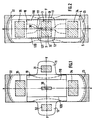
- the sanitary napkin or the like, especially for feminine hygiene, shown in Figure 1 includes an element fluid absorbent pad located entirely inside an envelope including at least the receiving part of the fluids opposite to the part visible in FIG. 1 is permeable to fluids.
- This envelope is closed by the weld lines (22, 23) in the shape of a round at the ends of the sanitary napkin, and the along the towel.
- the pad on the towel can possibly be preformed, for example of general shape bi-concave, as is well known in the field of periodic towels.
- the buffer element can be further preformed by being substantially rectangular and ending with a more narrow at the back, as is also well known.
- a strip of waterproof material (10) is attached to the linen side of the towel. She has lateral flaps (11, 12) extending transversely from the central part of the towel.
- the side flaps can be made from the envelope, without attached piece.
- side flaps are of sufficient size to be able to be folded out around the body linen worn by the person and include removable securing means (31, 32) to allow the shutters to be fixed externally to body linen. This provides complete protection of the body linen.
- the central part of the towel facing the linen body also has at its anterior and posterior ends joining means constituted by adhesive pads, respectively (35, 34), with the body linen.
- joining means constituted by adhesive pads, respectively (35, 34), with the body linen.
- a central adhesive strip (30) of small width at the flaps is also provided in the central part of the waterproof strip (10).
- the means of joining are preferably made up of adhesive pads pressure sensitive obtained by suitable coating, transfer or any other process. They can also be made from double-sided adhesive paper.
- This central strip (30) is stuck on the inner face underwear while one of the adhesive pads (31, 32) sticks to the outside of the body linen, the other paver, for example, sticking to the flap glued to the laundry body.
- FIG. 2 helps to understand the manufacturing process of the towel according to the invention.
- the manufacturing process includes the next step of folding the flaps.
- the shutters are folded down towards the pad around the first longitudinal fold lines (110, 120) located either at the longitudinal edges of the envelope, slightly recessed as shown in the mode of illustrated realization. Then the shutters are folded back on themselves around second longitudinal fold lines (111, 121).
- the fold lines (111, 121) of these side flaps (11, 12) are located between the first two fold lines and near the line (5) forming the longitudinal axis of symmetry of the towel. They are spaced from each other so as to leave between them inwards a narrow band.
- the flaps (11, 12) thus folded are held in place and brought to a work station where a silicone paper strip (4), previously coated with three pavers, two of which (34, 35), are arranged respectively at the anterior and posterior ends of the strip and a pad (3) is located in the central part of the bandaged.
- the strip of silicone paper is then pressed onto the towel, having the flaps (11, 12) folded, so that the adhesive (3) the central part is deposited on the one hand on the faces of the folded part of the shutters to form the paving stones adhesives (32, 31) and, on the other hand on the central part of the strip (10) to form the longitudinal adhesive pad (30).
- the flaps (11, 12) have a size such that when folded and covered with the silicone band (4), their end protrudes laterally of this silicone band to allow the user pull on it and take off the strip more easily silicone (4).
- the transferred adhesive (30, 31, 32) forming a continuous layer keeps the flaps (11, 12) in place against the central part.
- the manufacturing process differs from the process by the fact that in the previous process it was necessary, either to lay special pavers on the shutters side after the silicone band is put in place, i.e. coat both sides of the silicone strip with an adhesive to form the paving stones of the central part on a first face and on the other side, the paving stones of the side flaps and then fold the shutters so that the folded parts of the shutters stick to the adhesive pads formed on the face of the silicone strip oriented towards the outside of the towel periodic.
- the periodic towel obtained cannot be used like a normal sanitary napkin because necessarily separate the flaps from the silicone strip to then be able to remove it.
- the arrangement of the flaps under the silicone strip provides in addition to excellent folding stability facilitating operations subsequent packaging, e.g. folding the towel in three and placed in an individual envelope.
Landscapes
- Health & Medical Sciences (AREA)
- Epidemiology (AREA)
- Engineering & Computer Science (AREA)
- Biomedical Technology (AREA)
- Heart & Thoracic Surgery (AREA)
- Vascular Medicine (AREA)
- Life Sciences & Earth Sciences (AREA)
- Animal Behavior & Ethology (AREA)
- General Health & Medical Sciences (AREA)
- Public Health (AREA)
- Veterinary Medicine (AREA)
- Absorbent Articles And Supports Therefor (AREA)
- Laminated Bodies (AREA)
- Body Washing Hand Wipes And Brushes (AREA)
Description
- une étape de pliage des volets sur la zone centrale autour de lignes de pliage longitudinales en ménageant une bande centrale non recouverte par les volets ;
- une étape de dépôt de pavés de colle recouvrant la zone centrale et une portion de surface des volets tournés vers l'extérieur de la serviette périodique et
- une étape de mise en place d'un élément de protection des parties encollées.
- la figure 1 représente une vue côté linge d'une serviette périodique selon l'invention avant sa mise en place par l'utilisatrice sur le linge de corps ;
- la figure 2 représente une vue côté linge de la serviette périodique avant utilisation.
Claims (5)
- Serviette périodique ou similaire, en particulier pour l'hygiène féminine, comprenant un élément tampon absorbant les fluides disposé à l'intérieur d'une enveloppe dont au moins la partie de réception des fluides est perméable aux fluides, des volets latéraux (11, 12) étant prévus de part et d'autre de l'élément tampon pour améliorer la tenue et l'étanchéité latérale, lesdits volets latéraux étant rabattus sur l'élément tampon autour de premières lignes de pliage (110, 120) et repliés sur eux-mêmes vers l'extérieur autour de deuxièmes lignes de pliage (111, 121), les plis (110, 120) étant espacés l'un de l'autre de façon à laisser apparaítre une bande centrale (30) de l'enveloppe, lesdits volets étant de dimension suffisante pour pouvoir être rabattus extérieurement autour du linge de corps, tel qu'un slip, porté par l'utilisatrice, caractérisée en ce que trois moyens adhésifs distincts de solidarisation sont prévus, un premier moyen adhésif sous la forme d'une couche continue (30, 31, 32) prévue sur la face externe des volets repliés et sur la bande centrale de l'enveloppe et des second et troisième moyens adhésifs (34, 35) prévus aux extrémités antérieure et postérieure de l'enveloppe, et en ce que des moyens de protection (4) recouvrent lesdits moyens de solidarisation.
- Serviette périodique selon la revendication 1, caractérisée en ce que les moyens de protection (4) sont constitués par une bande de papier siliconé recouvrant lesdits moyens adhésifs (30, 31, 32, 34, 35).
- Serviette périodique selon la revendication 1, caractérisée en ce que les volets latéraux (11, 12) sont constitués d'un matériau imperméable au fluide revêtu d'une matière absorbante.
- Procédé de fabrication de serviettes périodiques selon l'une des revendications précédentes, caractérisé en ce qu'il comporte des étapes de formation de l'élément tampon associé avec un élément imperméable (10) faisant face au vêtement et pourvu dans la zone centrale de volets latéraux (11, 12), caractérisé en ce qu'il comporte en outre :une étape de pliage des volets autour des lignes de pliage longitudinales sur la zone centrale d'une part sur eux-mêmes d'autre part, en ménageant une bande centrale (30) non recouverte par les volets (11, 12) ;une étape de dépôt de trois pavés de colle, un premier pavé (30, 31, 32) recouvrant la zone centrale et une portion de surface des volets tournés vers l'extérieur de la serviette périodique et un second et troisième pavés (34, 35) disposés respectivement aux extrémités antérieure et postérieure de l'enveloppe ;une étape de mise en place d'un élément de protection (4) des parties encollées.
- Procédé selon la revendication précédente, caractérisé en ce que l'étape de dépôt de pavés de colle consiste en l'application d'une bande, telle que du papier siliconé, recouverte d'une couche d'adhésif, ladite couche d'adhésif adhérant plus fortement à la matière constituant la serviette périodique que celle de ladite bande, et ladite bande formant l'élément de protection (4).
Applications Claiming Priority (2)
| Application Number | Priority Date | Filing Date | Title |
|---|---|---|---|
| FR9300367 | 1993-01-15 | ||
| FR9300367A FR2700468B1 (fr) | 1993-01-15 | 1993-01-15 | Serviette périodique ou similaire à volets latéraux et procédé de fabrication. |
Publications (3)
| Publication Number | Publication Date |
|---|---|
| EP0607090A1 EP0607090A1 (fr) | 1994-07-20 |
| EP0607090B1 EP0607090B1 (fr) | 1997-11-19 |
| EP0607090B2 true EP0607090B2 (fr) | 2000-08-30 |
Family
ID=9443075
Family Applications (1)
| Application Number | Title | Priority Date | Filing Date |
|---|---|---|---|
| EP94400091A Expired - Lifetime EP0607090B2 (fr) | 1993-01-15 | 1994-01-14 | Serviette périodique ou similaire à volets latéraux et procédé de fabrication |
Country Status (5)
| Country | Link |
|---|---|
| EP (1) | EP0607090B2 (fr) |
| AT (1) | ATE160281T1 (fr) |
| DE (1) | DE69406812T3 (fr) |
| ES (1) | ES2110188T5 (fr) |
| FR (1) | FR2700468B1 (fr) |
Families Citing this family (4)
| Publication number | Priority date | Publication date | Assignee | Title |
|---|---|---|---|---|
| EP0764433A1 (fr) * | 1995-09-19 | 1997-03-26 | The Procter & Gamble Company | Article absorbant avec des rabats à tirer |
| BR9803741A (pt) | 1998-08-12 | 2000-03-28 | Johnson & Johnson Ind Com | Absorvente ìntimo feminino. |
| US20150351978A1 (en) * | 2014-06-06 | 2015-12-10 | The Procter & Gamble Company | Disposable absorbent article having undergarment fastening elements |
| CN113180923A (zh) * | 2021-04-30 | 2021-07-30 | 福建恒安集团有限公司 | 一种卫生巾 |
Citations (2)
| Publication number | Priority date | Publication date | Assignee | Title |
|---|---|---|---|---|
| WO1993001785A1 (fr) † | 1991-07-23 | 1993-02-04 | The Procter & Gamble Company | Articles absorbants etirables |
| WO1994014398A2 (fr) † | 1992-12-22 | 1994-07-07 | The Procter & Gamble Company | Article absorbant a rabats lateraux optionnels |
Family Cites Families (2)
| Publication number | Priority date | Publication date | Assignee | Title |
|---|---|---|---|---|
| US4701178A (en) * | 1986-12-01 | 1987-10-20 | Personal Products, Inc. | Sanitary napkins with flaps |
| GB2233235A (en) * | 1989-06-27 | 1991-01-09 | Kao Corp | Absorbent pad with resilient side flaps |
-
1993
- 1993-01-15 FR FR9300367A patent/FR2700468B1/fr not_active Expired - Lifetime
-
1994
- 1994-01-14 ES ES94400091T patent/ES2110188T5/es not_active Expired - Lifetime
- 1994-01-14 DE DE69406812T patent/DE69406812T3/de not_active Expired - Lifetime
- 1994-01-14 EP EP94400091A patent/EP0607090B2/fr not_active Expired - Lifetime
- 1994-01-14 AT AT94400091T patent/ATE160281T1/de not_active IP Right Cessation
Patent Citations (2)
| Publication number | Priority date | Publication date | Assignee | Title |
|---|---|---|---|---|
| WO1993001785A1 (fr) † | 1991-07-23 | 1993-02-04 | The Procter & Gamble Company | Articles absorbants etirables |
| WO1994014398A2 (fr) † | 1992-12-22 | 1994-07-07 | The Procter & Gamble Company | Article absorbant a rabats lateraux optionnels |
Also Published As
| Publication number | Publication date |
|---|---|
| EP0607090B1 (fr) | 1997-11-19 |
| DE69406812T2 (de) | 1998-03-19 |
| DE69406812D1 (de) | 1998-01-02 |
| ATE160281T1 (de) | 1997-12-15 |
| DE69406812T3 (de) | 2000-12-07 |
| ES2110188T5 (es) | 2000-11-16 |
| FR2700468B1 (fr) | 1995-02-17 |
| ES2110188T3 (es) | 1998-02-01 |
| EP0607090A1 (fr) | 1994-07-20 |
| FR2700468A1 (fr) | 1994-07-22 |
Similar Documents
| Publication | Publication Date | Title |
|---|---|---|
| CA1330686C (fr) | Serviette periodique ou similaire a volets lateraux impermeables aux fluides | |
| EP0613361B1 (fr) | Article d'hygiene absorbant jetable tel que couche-culotte, a effet de barriere laterale ameliore | |
| KR100253112B1 (ko) | 개별 포장된 흡수 제품 및 그의 제조 방법 | |
| FR2548145A1 (fr) | Conditionnement pour des protections menstruelles | |
| FR2821740A1 (fr) | Article absorbant sanitaire | |
| AU669402B2 (en) | Method of attaching adhesive to a tabbed absorbent article | |
| EP0301431A1 (fr) | Couche-culotte à élastiques longitudinaux et procédé de fabrication en continu de telles couches-culottes | |
| FR2644694A1 (fr) | Procede de fabrication d'articles d'hygiene a volets lateraux et articles d'hygiene obtenus | |
| EP1110529A1 (fr) | Couche-culotte munie d'une ceinture arrière à replis lateraux | |
| EP0607090B2 (fr) | Serviette périodique ou similaire à volets latéraux et procédé de fabrication | |
| EP0699427B1 (fr) | Protection périodique enroulée | |
| EP0668067B1 (fr) | Article d'hygiène féminine préplié | |
| EP0110926A1 (fr) | Article d'hygiene a jeter pour incontinents masculins. | |
| KR20000057537A (ko) | 개별적으로 포장된 흡수 제품 | |
| EP0625345B1 (fr) | Serviette périodique formant enveloppe de protection avant utilisation | |
| FR2681242A1 (fr) | Serviette periodique a volets lateraux formant coquille. | |
| EP0496716A1 (fr) | Couche-culotte, ou similaire, à jeter | |
| EP0651986B1 (fr) | Serviette périodique à incurvation réglable | |
| FR2807939A1 (fr) | Couche-culotte a pattes d'attache laterales du type autoagrippant | |
| EP0080151B1 (fr) | Couche-culotte à jeter équipée de dispositifs d'attache par adhésif | |
| FR2830747A1 (fr) | Pansement adhesif | |
| FR2750038A1 (fr) | Article d'hygiene jetable comportant un systeme de fermeture a ruban intercalaire separable | |
| EP0080152B1 (fr) | Dispositif d'attache par adhésif pour une couche-culotte à jeter et couche-culotte à jeter équipée de tels dispositifs d'attache | |
| FR2496455A1 (fr) | Garniture proctologique | |
| EP1885432A1 (fr) | Emballage hermetique pour support impregne d'un produit |
Legal Events
| Date | Code | Title | Description |
|---|---|---|---|
| PUAI | Public reference made under article 153(3) epc to a published international application that has entered the european phase |
Free format text: ORIGINAL CODE: 0009012 |
|
| 17P | Request for examination filed |
Effective date: 19940120 |
|
| AK | Designated contracting states |
Kind code of ref document: A1 Designated state(s): AT BE CH DE DK ES FR GB IE IT LI NL PT SE |
|
| 17Q | First examination report despatched |
Effective date: 19960202 |
|
| GRAG | Despatch of communication of intention to grant |
Free format text: ORIGINAL CODE: EPIDOS AGRA |
|
| GRAH | Despatch of communication of intention to grant a patent |
Free format text: ORIGINAL CODE: EPIDOS IGRA |
|
| RAP1 | Party data changed (applicant data changed or rights of an application transferred) |
Owner name: JAMES RIVER |
|
| GRAH | Despatch of communication of intention to grant a patent |
Free format text: ORIGINAL CODE: EPIDOS IGRA |
|
| GRAA | (expected) grant |
Free format text: ORIGINAL CODE: 0009210 |
|
| AK | Designated contracting states |
Kind code of ref document: B1 Designated state(s): AT BE CH DE DK ES FR GB IE IT LI NL PT SE |
|
| PG25 | Lapsed in a contracting state [announced via postgrant information from national office to epo] |
Ref country code: NL Free format text: LAPSE BECAUSE OF FAILURE TO SUBMIT A TRANSLATION OF THE DESCRIPTION OR TO PAY THE FEE WITHIN THE PRESCRIBED TIME-LIMIT Effective date: 19971119 Ref country code: DK Free format text: LAPSE BECAUSE OF NON-PAYMENT OF DUE FEES Effective date: 19971119 Ref country code: AT Free format text: LAPSE BECAUSE OF FAILURE TO SUBMIT A TRANSLATION OF THE DESCRIPTION OR TO PAY THE FEE WITHIN THE PRESCRIBED TIME-LIMIT Effective date: 19971119 |
|
| REF | Corresponds to: |
Ref document number: 160281 Country of ref document: AT Date of ref document: 19971215 Kind code of ref document: T |
|
| ITF | It: translation for a ep patent filed | ||
| REG | Reference to a national code |
Ref country code: CH Ref legal event code: EP |
|
| REF | Corresponds to: |
Ref document number: 69406812 Country of ref document: DE Date of ref document: 19980102 |
|
| GBT | Gb: translation of ep patent filed (gb section 77(6)(a)/1977) |
Effective date: 19971211 |
|
| PG25 | Lapsed in a contracting state [announced via postgrant information from national office to epo] |
Ref country code: LI Free format text: LAPSE BECAUSE OF NON-PAYMENT OF DUE FEES Effective date: 19980131 Ref country code: CH Free format text: LAPSE BECAUSE OF NON-PAYMENT OF DUE FEES Effective date: 19980131 Ref country code: BE Free format text: LAPSE BECAUSE OF NON-PAYMENT OF DUE FEES Effective date: 19980131 |
|
| REG | Reference to a national code |
Ref country code: ES Ref legal event code: FG2A Ref document number: 2110188 Country of ref document: ES Kind code of ref document: T3 |
|
| PG25 | Lapsed in a contracting state [announced via postgrant information from national office to epo] |
Ref country code: SE Free format text: LAPSE BECAUSE OF FAILURE TO SUBMIT A TRANSLATION OF THE DESCRIPTION OR TO PAY THE FEE WITHIN THE PRESCRIBED TIME-LIMIT Effective date: 19980219 Ref country code: PT Free format text: LAPSE BECAUSE OF FAILURE TO SUBMIT A TRANSLATION OF THE DESCRIPTION OR TO PAY THE FEE WITHIN THE PRESCRIBED TIME-LIMIT Effective date: 19980219 |
|
| NLV1 | Nl: lapsed or annulled due to failure to fulfill the requirements of art. 29p and 29m of the patents act | ||
| RAP2 | Party data changed (patent owner data changed or rights of a patent transferred) |
Owner name: FORT JAMES FRANCE |
|
| PG25 | Lapsed in a contracting state [announced via postgrant information from national office to epo] |
Ref country code: IE Free format text: LAPSE BECAUSE OF NON-PAYMENT OF DUE FEES Effective date: 19980714 |
|
| REG | Reference to a national code |
Ref country code: IE Ref legal event code: FD4D Ref document number: 77443 Country of ref document: IE |
|
| BERE | Be: lapsed |
Owner name: JAMES RIVER Effective date: 19980131 |
|
| REG | Reference to a national code |
Ref country code: FR Ref legal event code: CJ Ref country code: FR Ref legal event code: CD |
|
| PLBQ | Unpublished change to opponent data |
Free format text: ORIGINAL CODE: EPIDOS OPPO |
|
| PLBI | Opposition filed |
Free format text: ORIGINAL CODE: 0009260 |
|
| REG | Reference to a national code |
Ref country code: CH Ref legal event code: PL |
|
| PLBF | Reply of patent proprietor to notice(s) of opposition |
Free format text: ORIGINAL CODE: EPIDOS OBSO |
|
| 26 | Opposition filed |
Opponent name: SCA MOELNLYCKE AB Effective date: 19980812 |
|
| PLBF | Reply of patent proprietor to notice(s) of opposition |
Free format text: ORIGINAL CODE: EPIDOS OBSO |
|
| PLBF | Reply of patent proprietor to notice(s) of opposition |
Free format text: ORIGINAL CODE: EPIDOS OBSO |
|
| PLAW | Interlocutory decision in opposition |
Free format text: ORIGINAL CODE: EPIDOS IDOP |
|
| PLAW | Interlocutory decision in opposition |
Free format text: ORIGINAL CODE: EPIDOS IDOP |
|
| PUAH | Patent maintained in amended form |
Free format text: ORIGINAL CODE: 0009272 |
|
| STAA | Information on the status of an ep patent application or granted ep patent |
Free format text: STATUS: PATENT MAINTAINED AS AMENDED |
|
| 27A | Patent maintained in amended form |
Effective date: 20000830 |
|
| AK | Designated contracting states |
Kind code of ref document: B2 Designated state(s): AT BE CH DE DK ES FR GB IE IT LI NL PT SE |
|
| ITF | It: translation for a ep patent filed | ||
| GBTA | Gb: translation of amended ep patent filed (gb section 77(6)(b)/1977) | ||
| REG | Reference to a national code |
Ref country code: ES Ref legal event code: DC2A Kind code of ref document: T5 Effective date: 20000922 |
|
| REG | Reference to a national code |
Ref country code: FR Ref legal event code: CD |
|
| REG | Reference to a national code |
Ref country code: GB Ref legal event code: IF02 |
|
| PLAB | Opposition data, opponent's data or that of the opponent's representative modified |
Free format text: ORIGINAL CODE: 0009299OPPO |
|
| REG | Reference to a national code |
Ref country code: FR Ref legal event code: TP |
|
| PGFP | Annual fee paid to national office [announced via postgrant information from national office to epo] |
Ref country code: FR Payment date: 20120202 Year of fee payment: 19 |
|
| PGFP | Annual fee paid to national office [announced via postgrant information from national office to epo] |
Ref country code: DE Payment date: 20120111 Year of fee payment: 19 |
|
| PGFP | Annual fee paid to national office [announced via postgrant information from national office to epo] |
Ref country code: IT Payment date: 20120118 Year of fee payment: 19 Ref country code: GB Payment date: 20120111 Year of fee payment: 19 |
|
| PGFP | Annual fee paid to national office [announced via postgrant information from national office to epo] |
Ref country code: ES Payment date: 20120213 Year of fee payment: 19 |
|
| GBPC | Gb: european patent ceased through non-payment of renewal fee |
Effective date: 20130114 |
|
| REG | Reference to a national code |
Ref country code: FR Ref legal event code: ST Effective date: 20130930 |
|
| PG25 | Lapsed in a contracting state [announced via postgrant information from national office to epo] |
Ref country code: DE Free format text: LAPSE BECAUSE OF NON-PAYMENT OF DUE FEES Effective date: 20130801 |
|
| REG | Reference to a national code |
Ref country code: DE Ref legal event code: R119 Ref document number: 69406812 Country of ref document: DE Effective date: 20130801 |
|
| PG25 | Lapsed in a contracting state [announced via postgrant information from national office to epo] |
Ref country code: FR Free format text: LAPSE BECAUSE OF NON-PAYMENT OF DUE FEES Effective date: 20130131 Ref country code: GB Free format text: LAPSE BECAUSE OF NON-PAYMENT OF DUE FEES Effective date: 20130114 |
|
| PG25 | Lapsed in a contracting state [announced via postgrant information from national office to epo] |
Ref country code: IT Free format text: LAPSE BECAUSE OF NON-PAYMENT OF DUE FEES Effective date: 20130114 |
|
| REG | Reference to a national code |
Ref country code: ES Ref legal event code: FD2A Effective date: 20140321 |
|
| PG25 | Lapsed in a contracting state [announced via postgrant information from national office to epo] |
Ref country code: ES Free format text: LAPSE BECAUSE OF NON-PAYMENT OF DUE FEES Effective date: 20130115 |