EP0607330B2 - Matiere a mouler a effet decoratif - Google Patents
Matiere a mouler a effet decoratif Download PDFInfo
- Publication number
- EP0607330B2 EP0607330B2 EP92922237A EP92922237A EP0607330B2 EP 0607330 B2 EP0607330 B2 EP 0607330B2 EP 92922237 A EP92922237 A EP 92922237A EP 92922237 A EP92922237 A EP 92922237A EP 0607330 B2 EP0607330 B2 EP 0607330B2
- Authority
- EP
- European Patent Office
- Prior art keywords
- mixture
- monomer
- weight
- moulding product
- fillers
- Prior art date
- Legal status (The legal status is an assumption and is not a legal conclusion. Google has not performed a legal analysis and makes no representation as to the accuracy of the status listed.)
- Expired - Lifetime
Links
Classifications
-
- C—CHEMISTRY; METALLURGY
- C04—CEMENTS; CONCRETE; ARTIFICIAL STONE; CERAMICS; REFRACTORIES
- C04B—LIME, MAGNESIA; SLAG; CEMENTS; COMPOSITIONS THEREOF, e.g. MORTARS, CONCRETE OR LIKE BUILDING MATERIALS; ARTIFICIAL STONE; CERAMICS; REFRACTORIES; TREATMENT OF NATURAL STONE
- C04B26/00—Compositions of mortars, concrete or artificial stone, containing only organic binders, e.g. polymer or resin concrete
- C04B26/02—Macromolecular compounds
- C04B26/10—Macromolecular compounds obtained otherwise than by reactions only involving carbon-to-carbon unsaturated bonds
- C04B26/18—Polyesters; Polycarbonates
-
- C—CHEMISTRY; METALLURGY
- C08—ORGANIC MACROMOLECULAR COMPOUNDS; THEIR PREPARATION OR CHEMICAL WORKING-UP; COMPOSITIONS BASED THEREON
- C08K—Use of inorganic or non-macromolecular organic substances as compounding ingredients
- C08K3/00—Use of inorganic substances as compounding ingredients
- C08K3/01—Use of inorganic substances as compounding ingredients characterized by their specific function
- C08K3/013—Fillers, pigments or reinforcing additives
-
- C—CHEMISTRY; METALLURGY
- C04—CEMENTS; CONCRETE; ARTIFICIAL STONE; CERAMICS; REFRACTORIES
- C04B—LIME, MAGNESIA; SLAG; CEMENTS; COMPOSITIONS THEREOF, e.g. MORTARS, CONCRETE OR LIKE BUILDING MATERIALS; ARTIFICIAL STONE; CERAMICS; REFRACTORIES; TREATMENT OF NATURAL STONE
- C04B2111/00—Mortars, concrete or artificial stone or mixtures to prepare them, characterised by specific function, property or use
- C04B2111/54—Substitutes for natural stone, artistic materials or the like
- C04B2111/542—Artificial natural stone
Definitions
- the present invention relates to new molding materials with a decorative effect based on a thermosetting resin, fillers and reinforcing fibers and their application in the manufacture of molded parts having a decorative aspect in particular of objects intended for sanitary and kitchen equipment.
- compositions based on thermosetting resin, fillers and reinforcement is very widely used in the automotive, electrical engineering, and home appliance industries and in the furniture industry.
- compositions have developed in recent years in the sanitary and kitchen equipment sector.
- Molded articles designed in the field of sanitary and kitchen equipment must also present good chemical inertness (resistance to chemicals, food products and weathering), high abrasion resistance and good scratch resistance.
- the molding materials with decorative effect used according to the state of the art, are generally prepared under form of pre-impregnated mats (SMC) or premixes (BMC).
- SMC or BMC semi-products are generally covered on the surface by layers coating specific to the intended use either before molding (pre-in-mold-coating, PIMC), or during molding (in-mold-coating, IMC), or after molding (coating of paints).
- compositions of materials to mold based on the use of unsaturated resins, fibers glass and a mixture of two fillers constituted by the hydroxide aluminum and quartz, the latter being chosen for improve scratch resistance.
- the Applicant has discovered new molding materials with a decorative effect, making it possible to obtain a very large variety of molded objects with a decorative appearance, homogeneous in mass, using conventional molding techniques suitable for materials prepared in SMC or BMC, without resorting to an additional step of coating the surface of the material to be molded.
- the molding materials according to the invention can be easily prepared in the form of BMC without entraining deterioration of production equipment. They can then be easily transformed without damage the molding equipment.
- the articles with decorative appearance obtained by transformation of the molding materials according to the invention have in in addition to good chemical inertia, high abrasion resistance and good scratch resistance.
- the molding materials in accordance with the present invention make it possible to obtain a very wide range of products. presenting a decoration of mineral appearance colored with solid, speckled, mottled or granite hues covering a wide range of colors from white to black.
- the present invention therefore relates to a new molding material with a decorative effect based on thermosetting resin, charges and reinforcements.
- Another object according to the invention relates to the manufacture of molded objects with decorative appearance in many technical fields and in particular in the sector of sanitary and kitchen equipment.
- the invention relates to molding materials as defined in claim 1.
- the weight ratio of the thermosetting resin dissolved in the monomer to the thermoplastic polymer is preferably between 95: 5 and 85:15.
- the weight ratio of the binder consisting of the resin dissolved in the monomer and of the thermoplastic polymer over the charges are preferably between 27:73 and 38:62.
- the weight ratio in the mixture of charges of component (A) to component (B) is between 1:79 and 65:15.
- the constituent (A) of the mixture of fillers consists of alumina hydrate.
- Component (B) of the mixture of fillers consists of a filler having a coating of pigment or dye, chosen from among powder or a mixture of crushed silica powders, silicate-based products in the form of sands, such as river sands or quarry, glass flakes, glass beads, or mixtures thereof.
- This type of filler is more particularly suitable for the manufacture of molded articles of appearance mineral of uniform white color.
- quartz silica powder coated with a pigment or a dye This is particularly suitable for the production of molded products with a mineral appearance other than white.
- the monomer or the mixture of liquid monomers according to the invention is copolymerizable with the resin thermosetting. It can dissolve the thermoplastic anti-shrinkage polymer when it is present, in a wide range of concentrations.
- the resin and the thermoplastic polymer may or may not be compatible when dissolved in the monomer liquid and mixed.
- the composition must be such that after crosslinking under the usual heat conditions and from pressure, an opaque product is formed which, when examined under a microscope, has a defined structure in two phases indicating an incompatibility.
- the monomer or mixture of monomers consists, for example, of styrene or vinyltoluene or else of one of its compounds with small amounts of lower alkyl ester, acrylic acid or methacrylic acid, chlorostyrene, 1,3-butane diol dimethacrylate or diallyl phthalate.
- thermoplastic polymer It is preferably used in amounts of 30 to 70% by weight relative to the total amount of resin, thermoplastic polymer and liquid monomer.
- the unsaturated polyester resins are preferably chosen from the condensation products of an acid. ethylenically unsaturated dicarboxylic ⁇ , ⁇ or an ethylenically unsaturated anhydride with a dialcohol or a mixture of dialcohols.
- the carboxylic acids are chosen, for example, from maleic, fumaric, citraconic and chloro-maleic acids.
- Small amounts of saturated dicarboxylic acids such as orthophthalic, adipic, isophthalic, terephthalic, succinic, sebacic, methylsuccinic can also be used.
- the dialcohols used are generally glycols such as propylene glycol, dipropylene glycol, diethylene glycol or 1,3-butane diol.
- the vinylester type resins used according to the invention are generally obtained by reaction of a monomer acrylic on epoxy resin.
- the acrylic type resins according to the invention consist of a polyacrylate-urethane or poly-methacrylate-urethane prepolymer and an acrylic monomer serving as a diluent and crosslinking agent.
- the anti-shrinkage thermoplastic polymers used according to the invention are chosen from polyethylene, polystyrene, polycaprolactone, polyvinyl chloride (PVC), polyvinyl acetate, ethylene copolymers and vinyl acetate (EVA), acrylonitrile, butadiene and styrene (ABS) copolymers, homopolymers of alkyl or acrylate methacrylate, copolymers of lower alkyl esters of acrylic or methacrylic acids, copolymers of methyl methacrylate and of monomers chosen from: lauryl methacrylate, isobomyl methacrylate, acrylamide, hydroxyethyl methacrylate, styrene, 2-ethylhexyl acrylate, acrylonitrile, methacrylic acid, metacrylamide, methylolacrylamide, cetylstearyl methacrylate.
- PMMA polyethylene or polymethyl methacrylate
- the molding materials of the invention prepared in SMC additionally comprise a curing agent such as magnesium oxide at concentrations preferably less than or equal to 0.75% by weight relative to the weight total of the material to be molded.
- a curing agent such as magnesium oxide at concentrations preferably less than or equal to 0.75% by weight relative to the weight total of the material to be molded.
- the molding compositions of the invention contain one or more resin curing catalysts of the type organic peroxide such as dicumyl peroxide, tert.-butyl peroctoate, tert.butyl perbenzoate, ditert.-butyl peroxide.
- resin curing catalysts of the type organic peroxide such as dicumyl peroxide, tert.-butyl peroctoate, tert.butyl perbenzoate, ditert.-butyl peroxide.
- the molding materials also contain release agents selected from the element stearates located in the fourth period of the periodic table going from calcium to zinc. More particularly, the zinc stearate or calcium stearate. They are present in concentrations between 0.6 and 2.5% by weight relative to the total weight of the composition.
- the molding materials in accordance with the invention may also contain inhibiting agents so as to ensure the filling of the mold during processing.
- inhibiting agents are generally chosen from diphenols such as hydroquinone, benzoquinone and parabenzoquinone.
- the reinforcing fibers are chosen, for example, from synthetic fibers such as those of the polyester type. saturated or acrylic, vegetable fibers and crushed glass fibers.
- glass fibers of lengths between 3 and 13 mm are used for the most part, preferably divided up to the monofilaments.
- More homogeneous and more transparent decorations are obtained by using alumina hydrate as constituent (A), especially in the absence of a pigment paste or a pigment, because its refractive index is close to that of the polymerized resin.
- molding materials in accordance with the invention are used, containing, as reinforcements, resin-soluble sizing glass fibers, between 3 and 25 mm in length and in a quantity between 2 and 20% by weight relative to the total weight of the composition.
- the solubility in the sizing treatment of the fibers is varied between 20 and 90%.
- the molding materials of the invention can be prepared as SMC or BMC.
- SMC semi-products are produced according to the classical technique.
- the preparation of the impregnation paste is carried out in tanks which are successively introduced into the resin all the components of the molding material except the reinforcing fibers and the ripening.
- the dough is fed to the manufacturing machine of the SMC.
- the curing agent is introduced through a continuous mixing system.
- the machine is consisting of a conveyor belt on which comes a polyethylene film or an equivalent film.
- a first layer of dough is distributed by means of a doctor blade.
- We file a reinforcement layer on the dough which is then covered with a second layer of dough.
- This second layer of the paste is then covered with polyethylene film or equivalent film.
- the product leaving the machine is stored for the ripening phase before use.
- the BMC semi-products according to the present invention can be prepared according to the two preparation methods. following:
- a variant of this process consists in introducing and mixing successively in a twin-screw mixer the whole components of the material to be molded defined in paragraphs 1) and 2) above, then, when the mixture obtained is homogeneous, to simultaneously introduce the constituent (B) of the mixture of fillers and the reinforcing fibers.
- abrasion phenomena may remain in the context of the preparation processes defined above.
- Another process for manufacturing molding material consists in preparing an impregnating paste from all the components except the hard load with decorative function, to be carried out according to the technique of manufacture of SMCs by impregnating a single face of the reinforcing bed with the paste.
- This process is new and completely eliminates abrasion phenomena.
- the decorative charge of high hardness is introduced after the preparation of the impregnation paste and distributed by a appropriate distribution system before, during or after the deposition of the reinforcing fibers.
- Another process for preparing BMC product according to the invention consists in using the technique of “compound continuously impregnated (CIC) ".
- the paste comprising all of the components except the reinforcement is distributed on two horizontal rollers rotating in opposite directions.
- the reinforcement is impregnated by passing between the two rollers and by a doctor blade system, the compound is detached from the rollers.
- This process also makes it possible to eliminate the phenomena of abrasion and to avoid the deterioration of the fibers of enhancement.
- An object of the invention consists in a method of manufacturing a molded article which consists in carrying out a molding molding material without a step of coating the surface of said material, using a molding technique classic suitable for SMC or BMC semi-products.
- the hot compression molding technique is used more preferably at temperatures of the order of from 140-160 ° C and at pressures of the order of 30 to 200 bars.
- the molded articles obtained according to the manufacturing methods of the invention cover numerous industrial sectors namely the automotive industry, the electronics and home appliance industry.
- a particularly interesting application is the obtaining of molded parts with mineral-like decorations used in sanitary and kitchen equipment such as sinks, sinks, toilets, baths or wall coverings decorative.
- the resin, the polymer and the peroxide are poured into a mixer of the Z-arm type and mixing is carried out.
- the alumina hydrate, the pigment and the release agent are then added. Mixing is carried out. When the whole is homogeneous, the silica is added. The glass fiber is then mixed into the homogeneous whole in a time determined so as to impregnate the fiber and reduce abrasion phenomena.
- the premix or BMC is then molded into a high hardness steel mold, preferably chrome-plated, heated to 145-150 ° C under a pressure of 100 bars. Conditions are optimized using a press capable of modulating its closing and possibly pressure speeds.
- the polymerization time is approximately 2 to 3 minutes for a 5 mm thick piece.
- White molded articles are obtained whose scratch resistance according to DIN 53799-4-15 is higher. or equal to 1.25 N. Their resistance to water is excellent. Weight gain according to DIN 53-393 is lower at 0.4% both on exposure to boiling water in the vapor phase and in the liquid phase for four days.
- the percentages are defined by weight relative to the total weight of the composition.
Landscapes
- Chemical & Material Sciences (AREA)
- Organic Chemistry (AREA)
- Chemical Kinetics & Catalysis (AREA)
- Ceramic Engineering (AREA)
- Engineering & Computer Science (AREA)
- Medicinal Chemistry (AREA)
- Structural Engineering (AREA)
- Health & Medical Sciences (AREA)
- Materials Engineering (AREA)
- Polymers & Plastics (AREA)
- Compositions Of Macromolecular Compounds (AREA)
- Macromonomer-Based Addition Polymer (AREA)
- Adornments (AREA)
- Vehicle Interior And Exterior Ornaments, Soundproofing, And Insulation (AREA)
- Reinforced Plastic Materials (AREA)
Description
- 15 à 30% en poids de résine thermodurcissable en solution monomère:
- 0 à 5% en poids de polymère thermoplastique;
- 1 à 25% en poids de fibres de renforcement;
- 50 à 80% en poids de charges;
- 0,25 à 1% en poids de peroxyde(s) organique(s);
- 0,6 à 2,5% en poids d'agent(s) de démoulage;
- Résine polyester insaturée (type isophtalique) dissoute dans du styrène 13,3 %
- Polyméthacrylate de méthyle en solution à 30% dans le styrène 8,9 %
- Dioxyde de titane 1,1%
- Perbenzoate de tertiobutyle 0,3 %
- Stéarate de zinc 1,6 %
- Hydrate d'alumine 38,1 %
- Silice cristobalite (granulométrie < 80 µm) 26,7 %
- Fibre de verre de longueur 6 mm 10,0%
- Résine polyester insaturée (type isophtalique) dissoute dans du styrène 13,6 %
- Polyméthacrylate de méthyle en solution à 30% dans le styrène 9,1 %
- Dioxyde de titane (pigment) 0,2 %
- Perbenzoate de tertiobutyle 0,3 %
- Stéarate de zinc 1,6 %
- Hydrate d'alumine 38,5 %
- Silice cristobalite (granulométrie < 250µm) 10,9 %
- Silice de quartz noire 15,7 %
- Fibre de verre (6 mm) 10,0 %

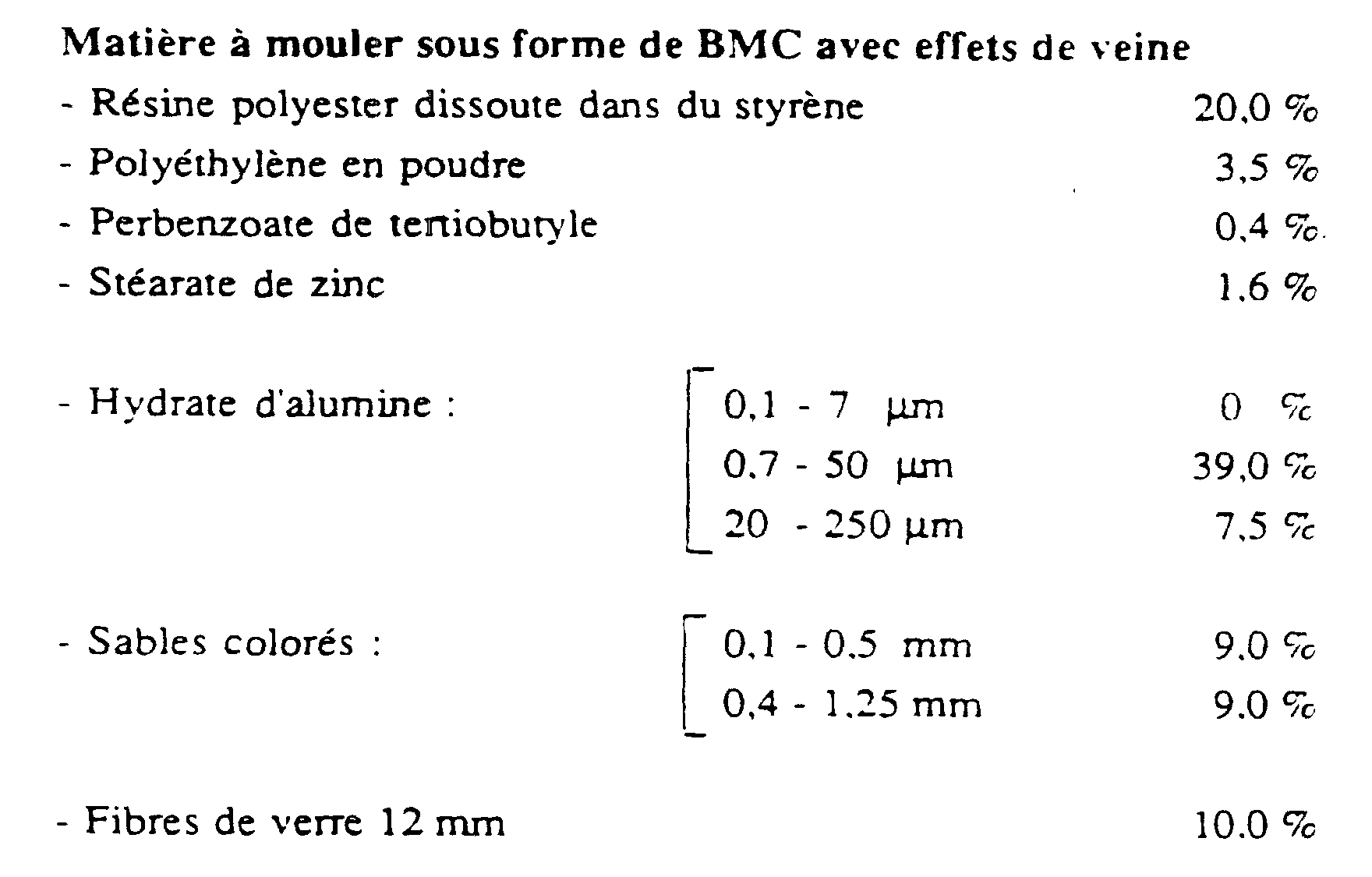
Après transformation dans les conditions de l'exemple 1, on obtient des articles moulés décoratifs à effet de veines.
Claims (15)
- Semi-produit à mouler, à effet décoratif, marbré ou granité, de type SMC ou BMC, sous forme de pâte présentée en feuille ou en masse constituée de résine thermodurcissable, de charges et de renforts fibreux, comprenant par rapport au poids total du serai-produit à mouler :caractérisé en ce que le mélange de charges comprend :a) 15 à 30 % en poids de résine thermodurcissable du type polyester non saturé, vinylester ou acrylique dissoute dans un monomère ou un mélange de monomères liquide comprenant au moins un groupe vinyle réactif, polymérisable ;b) 0 à 5 % en poids de polymère thermoplastique anti-retrait, soluble ou non dans le monomère ou le mélange de monomères liquide et donnant pendant la copolymérisation de la résine et du monomère une composition optiquement hétérogène ;c) 1 à 25 % en poids de fibres de renforcement ;d) 50 à 80 % en poids d'un mélange de charges minérales;e) 0,6 à 2,5 % en poids d'agent(s) de démoulage ; etf) 0,25 à 1% en poids de catalyseur du type péroxyde organique ;le rapport en poids de la partie de base rhéologique (A) sur le constituant (B) étant compris entre 1:79 et 65:15.une partie de base rhéologique (A) constituée de charges de dureté MOHS comprise entre 2 et 5 constituées d'hydrate d'alumine et dont les particules ont une taille inférieure à 250µm etun constituant (B) choisi parmi les charges de dureté MOHS comprise entre 6 et 10 et dont la taille des particules est comprise entre 20µm et 5mm et qui comportent un revêtement de colorant ou de pigment, et choisi parmi une poudre ou un mélange de poudres de silice broyée, les produits à base de silicates sous forme de sables, sous forme de billes ou d'écailles de verre ou leurs mélanges,
- Semi-produit à mouler selon la revendication 1, caractérisé par le fait que le monomère ou le mélange de monomères est constitué de styrène ou de vinyltoluène ou bien de l'un de ces composés avec de faibles quantités d'ester alkylique inférieur, d'acide acrylique ou méthacrylique, de chlorostyrène, de diméthacrylate de 1,3-butane diol ou de phtalate de diallyle.
- Semi-produit à mouler selon la revendication 2, caractérisé par le fait que le monomère ou le mélange de monomères est présent à une concentration comprise entre 30 et 70 % en poids par rapport au poids total de la résine, du polymère thermoplastique et du ou des monomères.
- Semi-produit à mouler selon l'une quelconque des revendications 1 à 3, caractérisé par le fait que le polymère thermoplastique est choisi parmi le polyéthylène, le polystyrène, le polycaprolactone, le polychlorure de vinyle, le polyacétate de vinyle, les copolymères d'éthylène et d'acétate de vinyle, les copolymères d'acrylonitrile, de butadiène et de styrène, les homopolymères de méthacrylate d'alkyle ou d'acrylate d'alkyle, les copolymères d'esters alkyliques inférieurs des acides acryliques ou méthacryliques, les copolymères de méthacrylate de méthyle et de monomères choisis parmi : le méthacrylate de lauryle, le méthacrylate d'isobornyle, l'acrylamide, le méthacrylate d'hydroxyéthyle, le styrène, l'acrylate de 2-éthylhexyle, l'acrylonitrile, l'acide méthacrylique, le méthacrylamide, la méthylolacrylamide, le méthacrylate de cétylstéraryle.
- Semi-produit à mouler selon la revendication 4, caractérisé par le fait que le polymère thermoplastique est choisi parmi le polyéthylène et le polyméthacrylate de méthyle.
- Semi-produit à mouler selon l'une quelconque des revendications 1 à 5, à effet décoratif marbré ou granité, caractérisé par le fait qu'il contient 2 à 20 % en poids par rapport au poids total de la matière, de fibres de verre à ensimage soluble dans 1a résine, de longueur comprise entre 3 et 25mm.
- Semi-produit à mouler préparé en SMC selon l'une quelconque des revendications 1 à 6, caractérisé par le fait qu'il contient en plus un agent de mûrissement.
- Procédé de préparation d'un semi-produit à mouler sous forme de BMC tel que défini selon l'une quelconque des revendications 1 à 6, caractérisé par le fait que l'on introduit et mélange successivement dans un malaxeur du type bras en Z, dans l'ordre suivant :que l'on ajoute ensuite les fibres de renforcement au mélange homogène obtenu.1) la résine thermodurcissable, le polymère thermoplastique anti-retrait et le catalyseur2) les agents de démoulage, la partie de base rhéologique (A) du mélange de charges ;3) le constituant (B) du mélange de charges ; et
- Procédé de préparation d'un semi-produit à mouler sous forme de BMC tel que défini selon l'une quelconque des revendications 1 à 6, caractérisé par le fait que l'on introduit et mélange successivement dans un malaxeur de type bi-vis dans l'ordre suivant :1/ 1a résine, l'agent anti-retrait et les péroxydes organiques,2/ les agents de démoulage et le constituant (A) du mélange de charges que l'on ajoute ensuite au mélange homogène ainsi obtenu, simultanément le constituant (B) et les fibres de renforcement.
- Procédé de préparation d'un semi-produit du type BMC tel que défini selon l'une quelconque des revendications 1 à 6, dans lequel le constituant (B) comprend une quantité importante de charge de haute dureté ayant une fonction décorative, caractérisé par le fait que l'on prépare une pâte d'imprégnation avec l'ensemble des composants de la matière à mouler, à l'exception de ladite charge et des fibres de renforcement selon la technique de fabrication des SMC, que l'on imprègne les fibres de renforcement par une seule couche de la pâte ainsi préparée ; la charge dure à fonction décorative étant introduite avant, pendant ou après le dépôt du renfort sur la pâte et répartie selon un système de distribution approprié.
- Procédé de préparation d'un semi-produit BMC défini selon l'une quelconque des revendications 1 à 6, caractérisé par le fait que l'on procède selon la technique du "compound imprégné en continu" (C.I.C.).
- Procédé de fabrication d'articles moulés renforcés, caractérisé par le fait que l'on effectue un moulage d'un semi-produit à mouler défini selon l'une quelconque des revendications 1 à 6 sans étape de revêtement de la surface de la matière à mouler, selon une technique de moulage classique adaptée aux semi-produits SMC ou BMC.
- Procédé de fabrication selon la revendication 12, caractérisé par le fait que l'on effectue un moulage par compression à chaud à une température comprise entre 140 et 160°C et à une pression de l'ordre de 30 à 200 bars.
- Article moulé susceptibe d'être obtenu par le procédé de fabrication défini dans la revendication 12 ou 13.
- Semi-produit à mouler selon l'une quelconque des revendications 1 à 7, à effet décoratif marbré ou granité, caractérisé par le fait que la partie de base rhéologique (A) du mélange de charges comprend un mélange de particules dont la courbe granulométrique est interrompue dans l'intervalle de tailles de particules compris entre 0,1 et 250 µm sous réserve que la quantité de particules manquantes de taille comprise entre 0,7 et 50 µm ne dépasse pas 5% en poids par rapport à la quantité totale des particules du mélange.
Applications Claiming Priority (3)
| Application Number | Priority Date | Filing Date | Title |
|---|---|---|---|
| FR9112362A FR2682117B1 (fr) | 1991-10-08 | 1991-10-08 | Matiere a mouler a base de resine thermodurcissable, de charges minerales et de fibres de renforcement, leurs procedes de preparation et fabrication d'articles moules renforces. |
| FR9112362 | 1991-10-08 | ||
| PCT/FR1992/000934 WO1993007102A1 (fr) | 1991-10-08 | 1992-10-08 | Matiere a mouler a effet decoratif |
Publications (3)
| Publication Number | Publication Date |
|---|---|
| EP0607330A1 EP0607330A1 (fr) | 1994-07-27 |
| EP0607330B1 EP0607330B1 (fr) | 1997-04-23 |
| EP0607330B2 true EP0607330B2 (fr) | 2001-05-09 |
Family
ID=9417696
Family Applications (1)
| Application Number | Title | Priority Date | Filing Date |
|---|---|---|---|
| EP92922237A Expired - Lifetime EP0607330B2 (fr) | 1991-10-08 | 1992-10-08 | Matiere a mouler a effet decoratif |
Country Status (6)
| Country | Link |
|---|---|
| EP (1) | EP0607330B2 (fr) |
| AT (1) | ATE152088T1 (fr) |
| DE (1) | DE69219349T3 (fr) |
| ES (1) | ES2103383T5 (fr) |
| FR (1) | FR2682117B1 (fr) |
| WO (1) | WO1993007102A1 (fr) |
Families Citing this family (13)
| Publication number | Priority date | Publication date | Assignee | Title |
|---|---|---|---|---|
| GB9218115D0 (en) * | 1992-08-26 | 1992-10-14 | Formulated Resins Ltd | Hard composition |
| FR2712883B1 (fr) * | 1993-11-25 | 1996-02-09 | Gaggenau Werke | Béton de résine pour appareils sanitaires. |
| DE4407321A1 (de) * | 1994-03-04 | 1995-09-07 | Blanco Gmbh & Co Kg | Kunststofformteile mit einer mit anorganischen Füllstoffen gefüllten Kunststoffmatrix |
| BE1008593A3 (nl) * | 1994-07-29 | 1996-06-04 | Dsm Nv | Perssamenstelling. |
| ES2111463B1 (es) * | 1995-06-02 | 1999-07-01 | Fundacion Gaiker | Material de efecto decorativo y alta resistencia al impacto. |
| EP0881251A1 (fr) * | 1997-05-28 | 1998-12-02 | CT-Chemie GmbH | Mastic à effet décoratif pour pierres naturelles et artificielles |
| WO1999050341A1 (fr) * | 1998-03-30 | 1999-10-07 | Menzolit-Fibron Gmbh | Smc basse pression pour la production d'elements renforces aux fibres |
| IT1316160B1 (it) * | 2000-01-07 | 2003-04-03 | Telma Guzzini S R L | Articoli stampati ad alto contenuto di filler e relativo processo dipreparazione |
| IT1318503B1 (it) * | 2000-05-08 | 2003-08-27 | Elleci Srl | Materiale composito termoindurente, particolarmente adatto per larealizzazione di articoli sanitari e lavelli da cucina, e relativo |
| WO2003048238A1 (fr) * | 2001-12-05 | 2003-06-12 | Balmoral Technologies (Proprietary) Limited | Procede relatif a l'elaboration d'un produit fini |
| DE102012113000B4 (de) * | 2012-12-21 | 2017-12-21 | Gebrüder Dorfner GmbH & Co. Kaolin- und Kristallquarzsand-Werke KG | Verbundwerkstoff, Verfahren zu dessen Herstellung und dessen Verwendung |
| IT201800002939A1 (it) * | 2018-02-22 | 2019-08-22 | Alice Zantedeschi | Procedimento per la fabbricazione di una membrana adattata per accoppiamento ad un tessuto, e prodotto così ottenuto |
| DE102021111789A1 (de) * | 2021-05-06 | 2022-11-10 | Polycare Research Technology Gmbh & Co. Kg | Polymerbetongemisch, Polymerbetonteil und Verfahren zu dessen Herstellung |
Citations (1)
| Publication number | Priority date | Publication date | Assignee | Title |
|---|---|---|---|---|
| WO1988002354A1 (fr) † | 1986-09-25 | 1988-04-07 | Advanced Plastics (South Wales) Limited | Ameliorations apportees a des materiaux de construction moules |
Family Cites Families (7)
| Publication number | Priority date | Publication date | Assignee | Title |
|---|---|---|---|---|
| GB1368468A (en) * | 1971-05-10 | 1974-09-25 | Celmac Ag | Polyester compositions for use as mortars |
| JPS49124165A (fr) * | 1973-04-02 | 1974-11-27 | ||
| DE2509236A1 (de) * | 1975-03-04 | 1976-09-16 | Bayer Ag | Rieselfaehige, schwundarm haertbare formmassen auf basis ungesaettigter polyesterharze |
| FR2470149A2 (fr) * | 1979-11-21 | 1981-05-29 | Celtite Sa | Perfectionnements aux procedes de scellement des boulons de soutenement de mines et analogues |
| GB8526790D0 (en) * | 1985-10-31 | 1985-12-04 | Bip Chemicals Ltd | Polyester resin composites |
| JP2862279B2 (ja) * | 1989-07-19 | 1999-03-03 | 日本軽金属株式会社 | 耐熱水性の良好な人工大理石用樹脂組成物 |
| US5244941A (en) * | 1989-11-02 | 1993-09-14 | Ralph Wilson Plastics Company | Artificial stone compositions, process of producing the same, and apparatus employed in the production thereof |
-
1991
- 1991-10-08 FR FR9112362A patent/FR2682117B1/fr not_active Expired - Fee Related
-
1992
- 1992-10-08 AT AT92922237T patent/ATE152088T1/de active
- 1992-10-08 WO PCT/FR1992/000934 patent/WO1993007102A1/fr not_active Ceased
- 1992-10-08 DE DE69219349T patent/DE69219349T3/de not_active Expired - Fee Related
- 1992-10-08 ES ES92922237T patent/ES2103383T5/es not_active Expired - Lifetime
- 1992-10-08 EP EP92922237A patent/EP0607330B2/fr not_active Expired - Lifetime
Patent Citations (1)
| Publication number | Priority date | Publication date | Assignee | Title |
|---|---|---|---|---|
| WO1988002354A1 (fr) † | 1986-09-25 | 1988-04-07 | Advanced Plastics (South Wales) Limited | Ameliorations apportees a des materiaux de construction moules |
Also Published As
| Publication number | Publication date |
|---|---|
| FR2682117A1 (fr) | 1993-04-09 |
| DE69219349D1 (de) | 1997-05-28 |
| EP0607330B1 (fr) | 1997-04-23 |
| DE69219349T3 (de) | 2002-11-07 |
| ATE152088T1 (de) | 1997-05-15 |
| EP0607330A1 (fr) | 1994-07-27 |
| WO1993007102A1 (fr) | 1993-04-15 |
| FR2682117B1 (fr) | 2002-06-07 |
| ES2103383T3 (es) | 1997-09-16 |
| ES2103383T5 (es) | 2001-09-16 |
| DE69219349T2 (de) | 1997-11-13 |
Similar Documents
| Publication | Publication Date | Title |
|---|---|---|
| EP0607330B2 (fr) | Matiere a mouler a effet decoratif | |
| CA2182965C (fr) | Pieces moulees en matiere plastique avec une matrice en matiere plastique remplie de charges inorganiques | |
| US20110111141A1 (en) | Colored Material Coated Transparent Chip for Artificial Stone, Method of Preparing Same, and Artificial Stone Including Same | |
| WO1995015353A1 (fr) | Colorants, articles colores et leurs procedes de fabrication | |
| EP0751184B1 (fr) | Compositions thermodurcissables moulables et pigmentables utiles pour obtenir des articles moulés avec retrait nul ou faible expansion | |
| RU2371410C2 (ru) | Искусственный мрамор, содержащий трехмерную светопроницаемую мраморную крошку, и способ его получения | |
| KR101349559B1 (ko) | 깊이감과 반짝임 효과를 연출하는 투명칩, 이를 포함하는인조대리석 및 그 제조방법 | |
| US5588599A (en) | Method of manufacture of polyester-chip products for casting artificial-stone articles | |
| TW509704B (en) | Wooden pattern molded article, method and composition therefor | |
| US8679623B2 (en) | Cast polymer and recycled glass composite article | |
| GB1604405A (en) | Articles made from resin compositions containing aggregate materials eg glass | |
| EP0725105B1 (fr) | Composition de polyester insaturée destinée aux produits sanitaires | |
| JP2024108144A (ja) | 熱硬化性の注型用材料、注型用材料から製造される成形体、及び、このような成形体の製造方法 | |
| FR2704551A1 (fr) | Objets moulés polymères constitués de résines de coulée et ayant une surface à brillant métallique et éventuellement colorée. | |
| WO2008080440A1 (fr) | Poudre organique utile en tant que remplacement de charge minérale dans les composites | |
| FR2633297A1 (fr) | Procede de fabrication de plaques de polyacrylate colorees | |
| US7498374B2 (en) | Cast polymer and method of making the same | |
| KR101228170B1 (ko) | 반사효과를 갖는 칩, 이를 포함하는 인조대리석 및 이의제조방법 | |
| KR20250097601A (ko) | 인조대리석의 베인 패턴 제조용 디스코팻, 이를 이용한 인조대리석의 제조방법 및 인조대리석 | |
| KR100311725B1 (ko) | 표면 거칠기를 갖는 폴리머 콘크리트 빨래판의 제조방법 | |
| CA2039201A1 (fr) | Element de remplissage pour pieces moules | |
| KR20250097600A (ko) | 인조대리석 | |
| KR20230147506A (ko) | 천연석과 같은 질감을 갖는 인조대리석 및 이의 제조방법 | |
| JPH01192752A (ja) | 装飾性に優れた大理石調物品の製法 | |
| BE705712A (fr) |
Legal Events
| Date | Code | Title | Description |
|---|---|---|---|
| PUAI | Public reference made under article 153(3) epc to a published international application that has entered the european phase |
Free format text: ORIGINAL CODE: 0009012 |
|
| 17P | Request for examination filed |
Effective date: 19940322 |
|
| AK | Designated contracting states |
Kind code of ref document: A1 Designated state(s): AT BE CH DE DK ES FR GB GR IE IT LI LU MC NL SE |
|
| 17Q | First examination report despatched |
Effective date: 19940927 |
|
| GRAG | Despatch of communication of intention to grant |
Free format text: ORIGINAL CODE: EPIDOS AGRA |
|
| GRAH | Despatch of communication of intention to grant a patent |
Free format text: ORIGINAL CODE: EPIDOS IGRA |
|
| GRAH | Despatch of communication of intention to grant a patent |
Free format text: ORIGINAL CODE: EPIDOS IGRA |
|
| GRAA | (expected) grant |
Free format text: ORIGINAL CODE: 0009210 |
|
| AK | Designated contracting states |
Kind code of ref document: B1 Designated state(s): AT BE CH DE DK ES FR GB GR IE IT LI LU MC NL SE |
|
| PG25 | Lapsed in a contracting state [announced via postgrant information from national office to epo] |
Ref country code: GR Free format text: LAPSE BECAUSE OF FAILURE TO SUBMIT A TRANSLATION OF THE DESCRIPTION OR TO PAY THE FEE WITHIN THE PRESCRIBED TIME-LIMIT Effective date: 19970423 Ref country code: DK Effective date: 19970423 Ref country code: AT Effective date: 19970423 |
|
| REF | Corresponds to: |
Ref document number: 152088 Country of ref document: AT Date of ref document: 19970515 Kind code of ref document: T |
|
| REG | Reference to a national code |
Ref country code: CH Ref legal event code: EP |
|
| GBT | Gb: translation of ep patent filed (gb section 77(6)(a)/1977) |
Effective date: 19970424 |
|
| ITF | It: translation for a ep patent filed | ||
| REF | Corresponds to: |
Ref document number: 69219349 Country of ref document: DE Date of ref document: 19970528 |
|
| PG25 | Lapsed in a contracting state [announced via postgrant information from national office to epo] |
Ref country code: SE Effective date: 19970723 |
|
| REG | Reference to a national code |
Ref country code: IE Ref legal event code: FG4D Free format text: 73538 |
|
| REG | Reference to a national code |
Ref country code: ES Ref legal event code: FG2A Ref document number: 2103383 Country of ref document: ES Kind code of ref document: T3 |
|
| PLBI | Opposition filed |
Free format text: ORIGINAL CODE: 0009260 |
|
| PLBF | Reply of patent proprietor to notice(s) of opposition |
Free format text: ORIGINAL CODE: EPIDOS OBSO |
|
| 26 | Opposition filed |
Opponent name: DSM N.V Effective date: 19980122 |
|
| PG25 | Lapsed in a contracting state [announced via postgrant information from national office to epo] |
Ref country code: IE Free format text: LAPSE BECAUSE OF NON-PAYMENT OF DUE FEES Effective date: 19980330 |
|
| REG | Reference to a national code |
Ref country code: IE Ref legal event code: FD4D Ref document number: 73538 Country of ref document: IE |
|
| PG25 | Lapsed in a contracting state [announced via postgrant information from national office to epo] |
Ref country code: MC Free format text: LAPSE BECAUSE OF NON-PAYMENT OF DUE FEES Effective date: 19980430 |
|
| NLR1 | Nl: opposition has been filed with the epo |
Opponent name: DSM N.V |
|
| PLBF | Reply of patent proprietor to notice(s) of opposition |
Free format text: ORIGINAL CODE: EPIDOS OBSO |
|
| PLBF | Reply of patent proprietor to notice(s) of opposition |
Free format text: ORIGINAL CODE: EPIDOS OBSO |
|
| PLAW | Interlocutory decision in opposition |
Free format text: ORIGINAL CODE: EPIDOS IDOP |
|
| PLAW | Interlocutory decision in opposition |
Free format text: ORIGINAL CODE: EPIDOS IDOP |
|
| PUAH | Patent maintained in amended form |
Free format text: ORIGINAL CODE: 0009272 |
|
| STAA | Information on the status of an ep patent application or granted ep patent |
Free format text: STATUS: PATENT MAINTAINED AS AMENDED |
|
| 27A | Patent maintained in amended form |
Effective date: 20010509 |
|
| AK | Designated contracting states |
Kind code of ref document: B2 Designated state(s): AT BE CH DE DK ES FR GB GR IE IT LI LU MC NL SE |
|
| RIN2 | Information on inventor provided after grant (corrected) |
Free format text: OLLIVE, CLAUDE |
|
| REG | Reference to a national code |
Ref country code: CH Ref legal event code: AEN Free format text: MAINTIEN DU BREVET DONT L'ETENDUE A ETE MODIFIEE |
|
| ITF | It: translation for a ep patent filed | ||
| NLR2 | Nl: decision of opposition | ||
| GBTA | Gb: translation of amended ep patent filed (gb section 77(6)(b)/1977) | ||
| NLR3 | Nl: receipt of modified translations in the netherlands language after an opposition procedure | ||
| REG | Reference to a national code |
Ref country code: ES Ref legal event code: DC2A Kind code of ref document: T5 Effective date: 20010809 |
|
| REG | Reference to a national code |
Ref country code: GB Ref legal event code: IF02 |
|
| PGFP | Annual fee paid to national office [announced via postgrant information from national office to epo] |
Ref country code: FR Payment date: 20020917 Year of fee payment: 11 Ref country code: LU Payment date: 20020917 Year of fee payment: 11 |
|
| PGFP | Annual fee paid to national office [announced via postgrant information from national office to epo] |
Ref country code: NL Payment date: 20020919 Year of fee payment: 11 |
|
| PGFP | Annual fee paid to national office [announced via postgrant information from national office to epo] |
Ref country code: GB Payment date: 20021001 Year of fee payment: 11 |
|
| PGFP | Annual fee paid to national office [announced via postgrant information from national office to epo] |
Ref country code: DE Payment date: 20021007 Year of fee payment: 11 |
|
| PGFP | Annual fee paid to national office [announced via postgrant information from national office to epo] |
Ref country code: ES Payment date: 20021011 Year of fee payment: 11 |
|
| PGFP | Annual fee paid to national office [announced via postgrant information from national office to epo] |
Ref country code: CH Payment date: 20021014 Year of fee payment: 11 |
|
| PGFP | Annual fee paid to national office [announced via postgrant information from national office to epo] |
Ref country code: BE Payment date: 20021118 Year of fee payment: 11 |
|
| PG25 | Lapsed in a contracting state [announced via postgrant information from national office to epo] |
Ref country code: LU Free format text: LAPSE BECAUSE OF NON-PAYMENT OF DUE FEES Effective date: 20031008 Ref country code: GB Free format text: LAPSE BECAUSE OF NON-PAYMENT OF DUE FEES Effective date: 20031008 |
|
| PG25 | Lapsed in a contracting state [announced via postgrant information from national office to epo] |
Ref country code: ES Free format text: LAPSE BECAUSE OF NON-PAYMENT OF DUE FEES Effective date: 20031009 |
|
| PG25 | Lapsed in a contracting state [announced via postgrant information from national office to epo] |
Ref country code: LI Free format text: LAPSE BECAUSE OF NON-PAYMENT OF DUE FEES Effective date: 20031031 Ref country code: CH Free format text: LAPSE BECAUSE OF NON-PAYMENT OF DUE FEES Effective date: 20031031 Ref country code: BE Free format text: LAPSE BECAUSE OF NON-PAYMENT OF DUE FEES Effective date: 20031031 |
|
| BERE | Be: lapsed |
Owner name: *MENZOLIT Effective date: 20031031 |
|
| PG25 | Lapsed in a contracting state [announced via postgrant information from national office to epo] |
Ref country code: NL Free format text: LAPSE BECAUSE OF NON-PAYMENT OF DUE FEES Effective date: 20040501 Ref country code: DE Free format text: LAPSE BECAUSE OF NON-PAYMENT OF DUE FEES Effective date: 20040501 |
|
| GBPC | Gb: european patent ceased through non-payment of renewal fee |
Effective date: 20031008 |
|
| REG | Reference to a national code |
Ref country code: CH Ref legal event code: PL |
|
| PG25 | Lapsed in a contracting state [announced via postgrant information from national office to epo] |
Ref country code: FR Free format text: LAPSE BECAUSE OF NON-PAYMENT OF DUE FEES Effective date: 20040630 |
|
| NLV4 | Nl: lapsed or anulled due to non-payment of the annual fee |
Effective date: 20040501 |
|
| REG | Reference to a national code |
Ref country code: FR Ref legal event code: ST |
|
| REG | Reference to a national code |
Ref country code: ES Ref legal event code: FD2A Effective date: 20031009 |
|
| PG25 | Lapsed in a contracting state [announced via postgrant information from national office to epo] |
Ref country code: IT Free format text: LAPSE BECAUSE OF NON-PAYMENT OF DUE FEES;WARNING: LAPSES OF ITALIAN PATENTS WITH EFFECTIVE DATE BEFORE 2007 MAY HAVE OCCURRED AT ANY TIME BEFORE 2007. THE CORRECT EFFECTIVE DATE MAY BE DIFFERENT FROM THE ONE RECORDED. Effective date: 20051008 |