EP0607529B1 - Utilisation des agents adoucissants aqueux pour le traitement de textiles - Google Patents
Utilisation des agents adoucissants aqueux pour le traitement de textiles Download PDFInfo
- Publication number
- EP0607529B1 EP0607529B1 EP93118805A EP93118805A EP0607529B1 EP 0607529 B1 EP0607529 B1 EP 0607529B1 EP 93118805 A EP93118805 A EP 93118805A EP 93118805 A EP93118805 A EP 93118805A EP 0607529 B1 EP0607529 B1 EP 0607529B1
- Authority
- EP
- European Patent Office
- Prior art keywords
- treatment
- conditioning composition
- fabric conditioning
- textiles according
- cationic
- Prior art date
- Legal status (The legal status is an assumption and is not a legal conclusion. Google has not performed a legal analysis and makes no representation as to the accuracy of the status listed.)
- Revoked
Links
- 239000004753 textile Substances 0.000 title claims abstract description 19
- 125000002091 cationic group Chemical group 0.000 claims abstract description 31
- 239000000084 colloidal system Substances 0.000 claims abstract description 26
- 230000001681 protective effect Effects 0.000 claims abstract description 26
- 239000000839 emulsion Substances 0.000 claims abstract description 18
- 239000002736 nonionic surfactant Substances 0.000 claims abstract description 18
- 239000006185 dispersion Substances 0.000 claims abstract description 5
- 239000004744 fabric Substances 0.000 claims description 26
- 229920001661 Chitosan Polymers 0.000 claims description 23
- 239000000203 mixture Substances 0.000 claims description 22
- 239000003925 fat Substances 0.000 claims description 12
- 239000000194 fatty acid Substances 0.000 claims description 10
- -1 alkenyl radicals Chemical class 0.000 claims description 9
- 229920002472 Starch Polymers 0.000 claims description 8
- 235000019698 starch Nutrition 0.000 claims description 8
- 238000005406 washing Methods 0.000 claims description 7
- IAYPIBMASNFSPL-UHFFFAOYSA-N Ethylene oxide Chemical compound C1CO1 IAYPIBMASNFSPL-UHFFFAOYSA-N 0.000 claims description 6
- GOOHAUXETOMSMM-UHFFFAOYSA-N Propylene oxide Chemical compound CC1CO1 GOOHAUXETOMSMM-UHFFFAOYSA-N 0.000 claims description 6
- 230000002209 hydrophobic effect Effects 0.000 claims description 6
- 239000004094 surface-active agent Substances 0.000 claims description 6
- 125000000217 alkyl group Chemical group 0.000 claims description 4
- 239000003995 emulsifying agent Substances 0.000 claims description 4
- 239000003921 oil Substances 0.000 claims description 4
- 229920001282 polysaccharide Polymers 0.000 claims description 4
- 239000005017 polysaccharide Substances 0.000 claims description 4
- 229920001577 copolymer Polymers 0.000 claims description 3
- 150000004676 glycans Chemical class 0.000 claims description 3
- 150000003077 polyols Chemical group 0.000 claims description 3
- 229920001059 synthetic polymer Polymers 0.000 claims description 3
- ZWAPMFBHEQZLGK-UHFFFAOYSA-N 5-(dimethylamino)-2-methylidenepentanamide Chemical compound CN(C)CCCC(=C)C(N)=O ZWAPMFBHEQZLGK-UHFFFAOYSA-N 0.000 claims description 2
- LFQSCWFLJHTTHZ-UHFFFAOYSA-N Ethanol Chemical compound CCO LFQSCWFLJHTTHZ-UHFFFAOYSA-N 0.000 claims description 2
- 239000004721 Polyphenylene oxide Substances 0.000 claims description 2
- 239000004902 Softening Agent Substances 0.000 claims description 2
- 150000003868 ammonium compounds Chemical class 0.000 claims description 2
- 125000004432 carbon atom Chemical group C* 0.000 claims description 2
- 150000007524 organic acids Chemical class 0.000 claims description 2
- 229920000570 polyether Polymers 0.000 claims description 2
- 229920000642 polymer Polymers 0.000 claims description 2
- 230000003750 conditioning effect Effects 0.000 claims 13
- PEDCQBHIVMGVHV-UHFFFAOYSA-N Glycerine Chemical compound OCC(O)CO PEDCQBHIVMGVHV-UHFFFAOYSA-N 0.000 claims 3
- FLCAEMBIQVZWIF-UHFFFAOYSA-N 6-(dimethylamino)-2-methylhex-2-enamide Chemical compound CN(C)CCCC=C(C)C(N)=O FLCAEMBIQVZWIF-UHFFFAOYSA-N 0.000 claims 1
- OKTJSMMVPCPJKN-UHFFFAOYSA-N Carbon Chemical group [C] OKTJSMMVPCPJKN-UHFFFAOYSA-N 0.000 claims 1
- 125000002252 acyl group Chemical group 0.000 claims 1
- 150000001875 compounds Chemical class 0.000 claims 1
- 235000021588 free fatty acids Nutrition 0.000 claims 1
- 229930182470 glycoside Natural products 0.000 claims 1
- 229910052739 hydrogen Inorganic materials 0.000 claims 1
- 239000001257 hydrogen Substances 0.000 claims 1
- 125000004435 hydrogen atom Chemical group [H]* 0.000 claims 1
- WCYWZMWISLQXQU-UHFFFAOYSA-N methyl Chemical group [CH3] WCYWZMWISLQXQU-UHFFFAOYSA-N 0.000 claims 1
- 150000002772 monosaccharides Chemical class 0.000 claims 1
- 229920005862 polyol Polymers 0.000 claims 1
- XLYOFNOQVPJJNP-UHFFFAOYSA-N water Substances O XLYOFNOQVPJJNP-UHFFFAOYSA-N 0.000 abstract description 4
- 239000000126 substance Substances 0.000 description 20
- 239000002979 fabric softener Substances 0.000 description 12
- 230000000694 effects Effects 0.000 description 10
- 235000019482 Palm oil Nutrition 0.000 description 7
- 239000002540 palm oil Substances 0.000 description 7
- QTBSBXVTEAMEQO-UHFFFAOYSA-N Acetic acid Chemical compound CC(O)=O QTBSBXVTEAMEQO-UHFFFAOYSA-N 0.000 description 6
- 150000002191 fatty alcohols Chemical class 0.000 description 6
- 230000001953 sensory effect Effects 0.000 description 6
- 239000008107 starch Substances 0.000 description 6
- 239000003599 detergent Substances 0.000 description 5
- 235000014113 dietary fatty acids Nutrition 0.000 description 5
- 229930195729 fatty acid Natural products 0.000 description 5
- JVTAAEKCZFNVCJ-UHFFFAOYSA-N lactic acid Chemical compound CC(O)C(O)=O JVTAAEKCZFNVCJ-UHFFFAOYSA-N 0.000 description 4
- 239000002904 solvent Substances 0.000 description 4
- 239000004480 active ingredient Substances 0.000 description 3
- 239000013543 active substance Substances 0.000 description 3
- 239000000654 additive Substances 0.000 description 3
- 150000001768 cations Chemical class 0.000 description 3
- 239000004664 distearyldimethylammonium chloride (DHTDMAC) Substances 0.000 description 3
- 150000002148 esters Chemical class 0.000 description 3
- 239000000835 fiber Substances 0.000 description 3
- 235000019198 oils Nutrition 0.000 description 3
- 125000001453 quaternary ammonium group Chemical group 0.000 description 3
- VBICKXHEKHSIBG-UHFFFAOYSA-N 1-monostearoylglycerol Chemical compound CCCCCCCCCCCCCCCCCC(=O)OCC(O)CO VBICKXHEKHSIBG-UHFFFAOYSA-N 0.000 description 2
- 229920002101 Chitin Polymers 0.000 description 2
- 239000004166 Lanolin Substances 0.000 description 2
- 108010081873 Persil Proteins 0.000 description 2
- 125000002947 alkylene group Chemical group 0.000 description 2
- 230000008901 benefit Effects 0.000 description 2
- 239000004665 cationic fabric softener Substances 0.000 description 2
- 229920006317 cationic polymer Polymers 0.000 description 2
- 238000009833 condensation Methods 0.000 description 2
- 230000005494 condensation Effects 0.000 description 2
- REZZEXDLIUJMMS-UHFFFAOYSA-M dimethyldioctadecylammonium chloride Chemical compound [Cl-].CCCCCCCCCCCCCCCCCC[N+](C)(C)CCCCCCCCCCCCCCCCCC REZZEXDLIUJMMS-UHFFFAOYSA-M 0.000 description 2
- 238000002845 discoloration Methods 0.000 description 2
- 230000007613 environmental effect Effects 0.000 description 2
- 150000004665 fatty acids Chemical class 0.000 description 2
- 238000009472 formulation Methods 0.000 description 2
- MTNDZQHUAFNZQY-UHFFFAOYSA-N imidazoline Chemical class C1CN=CN1 MTNDZQHUAFNZQY-UHFFFAOYSA-N 0.000 description 2
- 239000004310 lactic acid Substances 0.000 description 2
- 235000014655 lactic acid Nutrition 0.000 description 2
- 229940039717 lanolin Drugs 0.000 description 2
- 235000019388 lanolin Nutrition 0.000 description 2
- 238000000034 method Methods 0.000 description 2
- 229930014626 natural product Natural products 0.000 description 2
- 239000002245 particle Substances 0.000 description 2
- 239000004014 plasticizer Substances 0.000 description 2
- 229920000768 polyamine Polymers 0.000 description 2
- 239000013558 reference substance Substances 0.000 description 2
- 150000003839 salts Chemical class 0.000 description 2
- JNYAEWCLZODPBN-JGWLITMVSA-N (2r,3r,4s)-2-[(1r)-1,2-dihydroxyethyl]oxolane-3,4-diol Chemical compound OC[C@@H](O)[C@H]1OC[C@H](O)[C@H]1O JNYAEWCLZODPBN-JGWLITMVSA-N 0.000 description 1
- SMZOUWXMTYCWNB-UHFFFAOYSA-N 2-(2-methoxy-5-methylphenyl)ethanamine Chemical compound COC1=CC=C(C)C=C1CCN SMZOUWXMTYCWNB-UHFFFAOYSA-N 0.000 description 1
- NIXOWILDQLNWCW-UHFFFAOYSA-N 2-Propenoic acid Natural products OC(=O)C=C NIXOWILDQLNWCW-UHFFFAOYSA-N 0.000 description 1
- PUAQLLVFLMYYJJ-UHFFFAOYSA-N 2-aminopropiophenone Chemical compound CC(N)C(=O)C1=CC=CC=C1 PUAQLLVFLMYYJJ-UHFFFAOYSA-N 0.000 description 1
- QGZKDVFQNNGYKY-UHFFFAOYSA-O Ammonium Chemical compound [NH4+] QGZKDVFQNNGYKY-UHFFFAOYSA-O 0.000 description 1
- BHPQYMZQTOCNFJ-UHFFFAOYSA-N Calcium cation Chemical compound [Ca+2] BHPQYMZQTOCNFJ-UHFFFAOYSA-N 0.000 description 1
- 229920003043 Cellulose fiber Polymers 0.000 description 1
- FBPFZTCFMRRESA-FSIIMWSLSA-N D-Glucitol Natural products OC[C@H](O)[C@H](O)[C@@H](O)[C@H](O)CO FBPFZTCFMRRESA-FSIIMWSLSA-N 0.000 description 1
- FBPFZTCFMRRESA-JGWLITMVSA-N D-glucitol Chemical compound OC[C@H](O)[C@@H](O)[C@H](O)[C@H](O)CO FBPFZTCFMRRESA-JGWLITMVSA-N 0.000 description 1
- 108010010803 Gelatin Proteins 0.000 description 1
- VEXZGXHMUGYJMC-UHFFFAOYSA-N Hydrochloric acid Chemical compound Cl VEXZGXHMUGYJMC-UHFFFAOYSA-N 0.000 description 1
- 239000004435 Oxo alcohol Substances 0.000 description 1
- 239000002253 acid Substances 0.000 description 1
- 230000002378 acidificating effect Effects 0.000 description 1
- 150000001298 alcohols Chemical class 0.000 description 1
- 150000001408 amides Chemical class 0.000 description 1
- 150000001412 amines Chemical group 0.000 description 1
- 125000000129 anionic group Chemical group 0.000 description 1
- 229910001424 calcium ion Inorganic materials 0.000 description 1
- 150000001720 carbohydrates Chemical class 0.000 description 1
- 239000001913 cellulose Substances 0.000 description 1
- 229920002678 cellulose Polymers 0.000 description 1
- 239000003795 chemical substances by application Substances 0.000 description 1
- 230000006196 deacetylation Effects 0.000 description 1
- 238000003381 deacetylation reaction Methods 0.000 description 1
- 150000005690 diesters Chemical class 0.000 description 1
- 238000001035 drying Methods 0.000 description 1
- 238000004945 emulsification Methods 0.000 description 1
- 150000002170 ethers Chemical class 0.000 description 1
- 230000009969 flowable effect Effects 0.000 description 1
- 239000006260 foam Substances 0.000 description 1
- 229920000159 gelatin Polymers 0.000 description 1
- 239000008273 gelatin Substances 0.000 description 1
- 235000019322 gelatine Nutrition 0.000 description 1
- 235000011852 gelatine desserts Nutrition 0.000 description 1
- 239000003292 glue Substances 0.000 description 1
- YQEMORVAKMFKLG-UHFFFAOYSA-N glycerine monostearate Natural products CCCCCCCCCCCCCCCCCC(=O)OC(CO)CO YQEMORVAKMFKLG-UHFFFAOYSA-N 0.000 description 1
- SVUQHVRAGMNPLW-UHFFFAOYSA-N glycerol monostearate Natural products CCCCCCCCCCCCCCCCC(=O)OCC(O)CO SVUQHVRAGMNPLW-UHFFFAOYSA-N 0.000 description 1
- 239000003112 inhibitor Substances 0.000 description 1
- 230000002401 inhibitory effect Effects 0.000 description 1
- 230000003993 interaction Effects 0.000 description 1
- 238000002372 labelling Methods 0.000 description 1
- 239000007788 liquid Substances 0.000 description 1
- 238000004519 manufacturing process Methods 0.000 description 1
- FQPSGWSUVKBHSU-UHFFFAOYSA-N methacrylamide Chemical compound CC(=C)C(N)=O FQPSGWSUVKBHSU-UHFFFAOYSA-N 0.000 description 1
- 238000002156 mixing Methods 0.000 description 1
- SBOJXQVPLKSXOG-UHFFFAOYSA-N o-amino-hydroxylamine Chemical class NON SBOJXQVPLKSXOG-UHFFFAOYSA-N 0.000 description 1
- 239000004033 plastic Substances 0.000 description 1
- 229920003023 plastic Polymers 0.000 description 1
- 229920001296 polysiloxane Polymers 0.000 description 1
- 229920000036 polyvinylpyrrolidone Polymers 0.000 description 1
- 239000001267 polyvinylpyrrolidone Substances 0.000 description 1
- 235000013855 polyvinylpyrrolidone Nutrition 0.000 description 1
- 230000008569 process Effects 0.000 description 1
- 239000003531 protein hydrolysate Substances 0.000 description 1
- 150000003856 quaternary ammonium compounds Chemical class 0.000 description 1
- 239000002994 raw material Substances 0.000 description 1
- 239000002453 shampoo Substances 0.000 description 1
- 239000000600 sorbitol Substances 0.000 description 1
- 238000005507 spraying Methods 0.000 description 1
- 230000002195 synergetic effect Effects 0.000 description 1
- 239000008399 tap water Substances 0.000 description 1
- 235000020679 tap water Nutrition 0.000 description 1
- 238000010998 test method Methods 0.000 description 1
- 150000005621 tetraalkylammonium salts Chemical class 0.000 description 1
- 238000009988 textile finishing Methods 0.000 description 1
- 230000008719 thickening Effects 0.000 description 1
- 230000001988 toxicity Effects 0.000 description 1
- 231100000419 toxicity Toxicity 0.000 description 1
- 150000005691 triesters Chemical class 0.000 description 1
- UFTFJSFQGQCHQW-UHFFFAOYSA-N triformin Chemical compound O=COCC(OC=O)COC=O UFTFJSFQGQCHQW-UHFFFAOYSA-N 0.000 description 1
- JSPLKZUTYZBBKA-UHFFFAOYSA-N trioxidane Chemical compound OOO JSPLKZUTYZBBKA-UHFFFAOYSA-N 0.000 description 1
- 239000002699 waste material Substances 0.000 description 1
- 239000001993 wax Substances 0.000 description 1
- 239000002888 zwitterionic surfactant Substances 0.000 description 1
Classifications
-
- C—CHEMISTRY; METALLURGY
- C11—ANIMAL OR VEGETABLE OILS, FATS, FATTY SUBSTANCES OR WAXES; FATTY ACIDS THEREFROM; DETERGENTS; CANDLES
- C11D—DETERGENT COMPOSITIONS; USE OF SINGLE SUBSTANCES AS DETERGENTS; SOAP OR SOAP-MAKING; RESIN SOAPS; RECOVERY OF GLYCEROL
- C11D1/00—Detergent compositions based essentially on surface-active compounds; Use of these compounds as a detergent
- C11D1/66—Non-ionic compounds
- C11D1/667—Neutral esters, e.g. sorbitan esters
-
- C—CHEMISTRY; METALLURGY
- C11—ANIMAL OR VEGETABLE OILS, FATS, FATTY SUBSTANCES OR WAXES; FATTY ACIDS THEREFROM; DETERGENTS; CANDLES
- C11D—DETERGENT COMPOSITIONS; USE OF SINGLE SUBSTANCES AS DETERGENTS; SOAP OR SOAP-MAKING; RESIN SOAPS; RECOVERY OF GLYCEROL
- C11D1/00—Detergent compositions based essentially on surface-active compounds; Use of these compounds as a detergent
- C11D1/66—Non-ionic compounds
- C11D1/662—Carbohydrates or derivatives
-
- C—CHEMISTRY; METALLURGY
- C11—ANIMAL OR VEGETABLE OILS, FATS, FATTY SUBSTANCES OR WAXES; FATTY ACIDS THEREFROM; DETERGENTS; CANDLES
- C11D—DETERGENT COMPOSITIONS; USE OF SINGLE SUBSTANCES AS DETERGENTS; SOAP OR SOAP-MAKING; RESIN SOAPS; RECOVERY OF GLYCEROL
- C11D1/00—Detergent compositions based essentially on surface-active compounds; Use of these compounds as a detergent
- C11D1/66—Non-ionic compounds
- C11D1/72—Ethers of polyoxyalkylene glycols
-
- C—CHEMISTRY; METALLURGY
- C11—ANIMAL OR VEGETABLE OILS, FATS, FATTY SUBSTANCES OR WAXES; FATTY ACIDS THEREFROM; DETERGENTS; CANDLES
- C11D—DETERGENT COMPOSITIONS; USE OF SINGLE SUBSTANCES AS DETERGENTS; SOAP OR SOAP-MAKING; RESIN SOAPS; RECOVERY OF GLYCEROL
- C11D3/00—Other compounding ingredients of detergent compositions covered in group C11D1/00
- C11D3/0005—Other compounding ingredients characterised by their effect
- C11D3/001—Softening compositions
- C11D3/0015—Softening compositions liquid
-
- C—CHEMISTRY; METALLURGY
- C11—ANIMAL OR VEGETABLE OILS, FATS, FATTY SUBSTANCES OR WAXES; FATTY ACIDS THEREFROM; DETERGENTS; CANDLES
- C11D—DETERGENT COMPOSITIONS; USE OF SINGLE SUBSTANCES AS DETERGENTS; SOAP OR SOAP-MAKING; RESIN SOAPS; RECOVERY OF GLYCEROL
- C11D3/00—Other compounding ingredients of detergent compositions covered in group C11D1/00
- C11D3/16—Organic compounds
- C11D3/20—Organic compounds containing oxygen
- C11D3/22—Carbohydrates or derivatives thereof
- C11D3/222—Natural or synthetic polysaccharides, e.g. cellulose, starch, gum, alginic acid or cyclodextrin
- C11D3/227—Natural or synthetic polysaccharides, e.g. cellulose, starch, gum, alginic acid or cyclodextrin with nitrogen-containing groups
-
- C—CHEMISTRY; METALLURGY
- C11—ANIMAL OR VEGETABLE OILS, FATS, FATTY SUBSTANCES OR WAXES; FATTY ACIDS THEREFROM; DETERGENTS; CANDLES
- C11D—DETERGENT COMPOSITIONS; USE OF SINGLE SUBSTANCES AS DETERGENTS; SOAP OR SOAP-MAKING; RESIN SOAPS; RECOVERY OF GLYCEROL
- C11D3/00—Other compounding ingredients of detergent compositions covered in group C11D1/00
- C11D3/16—Organic compounds
- C11D3/37—Polymers
- C11D3/3746—Macromolecular compounds obtained by reactions only involving carbon-to-carbon unsaturated bonds
- C11D3/3769—(Co)polymerised monomers containing nitrogen, e.g. carbonamides, nitriles or amines
- C11D3/3773—(Co)polymerised monomers containing nitrogen, e.g. carbonamides, nitriles or amines in liquid compositions
-
- D—TEXTILES; PAPER
- D06—TREATMENT OF TEXTILES OR THE LIKE; LAUNDERING; FLEXIBLE MATERIALS NOT OTHERWISE PROVIDED FOR
- D06M—TREATMENT, NOT PROVIDED FOR ELSEWHERE IN CLASS D06, OF FIBRES, THREADS, YARNS, FABRICS, FEATHERS OR FIBROUS GOODS MADE FROM SUCH MATERIALS
- D06M13/00—Treating fibres, threads, yarns, fabrics or fibrous goods made from such materials, with non-macromolecular organic compounds; Such treatment combined with mechanical treatment
- D06M13/10—Treating fibres, threads, yarns, fabrics or fibrous goods made from such materials, with non-macromolecular organic compounds; Such treatment combined with mechanical treatment with compounds containing oxygen
- D06M13/165—Ethers
- D06M13/17—Polyoxyalkyleneglycol ethers
-
- D—TEXTILES; PAPER
- D06—TREATMENT OF TEXTILES OR THE LIKE; LAUNDERING; FLEXIBLE MATERIALS NOT OTHERWISE PROVIDED FOR
- D06M—TREATMENT, NOT PROVIDED FOR ELSEWHERE IN CLASS D06, OF FIBRES, THREADS, YARNS, FABRICS, FEATHERS OR FIBROUS GOODS MADE FROM SUCH MATERIALS
- D06M13/00—Treating fibres, threads, yarns, fabrics or fibrous goods made from such materials, with non-macromolecular organic compounds; Such treatment combined with mechanical treatment
- D06M13/10—Treating fibres, threads, yarns, fabrics or fibrous goods made from such materials, with non-macromolecular organic compounds; Such treatment combined with mechanical treatment with compounds containing oxygen
- D06M13/184—Carboxylic acids; Anhydrides, halides or salts thereof
-
- D—TEXTILES; PAPER
- D06—TREATMENT OF TEXTILES OR THE LIKE; LAUNDERING; FLEXIBLE MATERIALS NOT OTHERWISE PROVIDED FOR
- D06M—TREATMENT, NOT PROVIDED FOR ELSEWHERE IN CLASS D06, OF FIBRES, THREADS, YARNS, FABRICS, FEATHERS OR FIBROUS GOODS MADE FROM SUCH MATERIALS
- D06M13/00—Treating fibres, threads, yarns, fabrics or fibrous goods made from such materials, with non-macromolecular organic compounds; Such treatment combined with mechanical treatment
- D06M13/10—Treating fibres, threads, yarns, fabrics or fibrous goods made from such materials, with non-macromolecular organic compounds; Such treatment combined with mechanical treatment with compounds containing oxygen
- D06M13/224—Esters of carboxylic acids; Esters of carbonic acid
- D06M13/2243—Mono-, di-, or triglycerides
-
- D—TEXTILES; PAPER
- D06—TREATMENT OF TEXTILES OR THE LIKE; LAUNDERING; FLEXIBLE MATERIALS NOT OTHERWISE PROVIDED FOR
- D06M—TREATMENT, NOT PROVIDED FOR ELSEWHERE IN CLASS D06, OF FIBRES, THREADS, YARNS, FABRICS, FEATHERS OR FIBROUS GOODS MADE FROM SUCH MATERIALS
- D06M15/00—Treating fibres, threads, yarns, fabrics, or fibrous goods made from such materials, with macromolecular compounds; Such treatment combined with mechanical treatment
- D06M15/01—Treating fibres, threads, yarns, fabrics, or fibrous goods made from such materials, with macromolecular compounds; Such treatment combined with mechanical treatment with natural macromolecular compounds or derivatives thereof
- D06M15/03—Polysaccharides or derivatives thereof
- D06M15/11—Starch or derivatives thereof
-
- D—TEXTILES; PAPER
- D06—TREATMENT OF TEXTILES OR THE LIKE; LAUNDERING; FLEXIBLE MATERIALS NOT OTHERWISE PROVIDED FOR
- D06M—TREATMENT, NOT PROVIDED FOR ELSEWHERE IN CLASS D06, OF FIBRES, THREADS, YARNS, FABRICS, FEATHERS OR FIBROUS GOODS MADE FROM SUCH MATERIALS
- D06M15/00—Treating fibres, threads, yarns, fabrics, or fibrous goods made from such materials, with macromolecular compounds; Such treatment combined with mechanical treatment
- D06M15/19—Treating fibres, threads, yarns, fabrics, or fibrous goods made from such materials, with macromolecular compounds; Such treatment combined with mechanical treatment with synthetic macromolecular compounds
- D06M15/21—Macromolecular compounds obtained by reactions only involving carbon-to-carbon unsaturated bonds
- D06M15/285—Macromolecular compounds obtained by reactions only involving carbon-to-carbon unsaturated bonds of unsaturated carboxylic acid amides or imides
- D06M15/29—Macromolecular compounds obtained by reactions only involving carbon-to-carbon unsaturated bonds of unsaturated carboxylic acid amides or imides containing a N-methylol group or an etherified N-methylol group; containing a N-aminomethylene group; containing a N-sulfidomethylene group
Definitions
- plasticizer emulsions are applied here in a relatively high concentration (10-50 g / l) according to various methods such as spraying, application or exhausting, depending on which soft effect is desired.
- a good household laundry softener is required to draw on the textiles to be treated as quantitatively as possible from a highly diluted washing liquor emulsion (0.2 to 0.7 g / l).
- the well-known good effect of the classic cationic fabric softener is based above all on the pronounced chemisorptivity of the emulsified cationic particles, which are absorbed by the ionic interaction with the anionic fiber surface on the fiber. It is known from the literature that good fabric softening effects can be achieved by mixing nonionic and cationic plasticizers. So z. B.
- US-A-4 179 382 describes a combination of a conventional cationic fabric softener active ingredient such as tetraalkylammonium salts or alkylimidazolinium salts with a small amount of a polymeric special cationic salt such as cationic starch or cationic polyvinylpyrrolidone copolymers.
- Textile laundry detergents with a stiffening effect are described in EP-A-0 017 120. They contain non-ionic and / or zwitterionic surfactants, water-soluble quaternary ammonium groups containing amino ethers of polysaccharides as well as framework salts and / or solvents which bind calcium ions.
- a skin-mild shampoo contains a combination of the nonionic surfactant alkyl polyglycoside and a cationic polymer.
- the mixture leads to excellent creamy foam.
- a liquid detergent containing discoloration-inhibiting additives is described in EP-A-0 044 003.
- the detergent contains two different nonionic surfactants, one of which is an ethoxylated C 13 -C 15 oxo alcohol with 55-65% by weight ethylene oxide and the other an ethoxylated C 9 -C 12 oxo or fatty alcohol with 60-70% by weight.
- % Is ethylene oxide, laundry softening quaternary ammonium compounds such as distearyldimethylammonium chloride or quaternary imidazolinium compounds and cationic starch ethers as discoloration inhibitors.
- the object of the invention was to produce a new fabric softener that is free of traditional quaternary ammonium bases with their known disadvantages.
- the solution to the problem is emulsions of nonionic hydrophobic To add surfactants with a cationic protective colloid. That way the surfactant vesicles present in the emulsion are superficially cationized, so that the Tucked onto the textile fiber to be rinsed substantively.
- nonionic fabric softening agents in particular as a hydrophobic component two similarly long C chains - the chain length of which can be C 10 - C 22 - and as a hydrophilic component a nonionic polyether or polyol chain or one Sugar or polysacchrid derivative included.
- Guerbet alcohols which are produced by alkaline condensation of fatty alcohols.
- the suitable degree of hydrophilization can be set by adding ethylene oxide or propylene oxide.
- An ecologically interesting class of substances are saccharide difatty acid esters or fatty alkyl polyglycoside fatty acid esters, which can also be present in a mixture. If necessary, the degree of hydrophilization can also be increased with ethylene oxide or propylene oxide.
- Another known class of substances are the fatty acid esters of sorbitol or sorbitan, which are preferably present as a mixture of mono-, di- and triesters.
- the degree of hydrophilization can be varied by addition of alkylene oxide.
- the diglycerides belong to the most ecologically and economically interesting class of substances because they can be produced on the basis of cheap natural fats and oils and are easily biodegradable.
- the appropriate degree of hydrophilization is set by alkoxylation.
- Their manufacture is state of the art (DE-A-38 26 179).
- cationic protective colloid in fabric softener formulations is not yet known Generally colloidal Solutions can be stabilized considerably by means of hydrophilic protective colloids.
- the Protective colloid forms a film around the particle to be protected and forms one Shell of water molecules from known protective colloids are gelatin, protein hydrolyzate, Glue etc.
- a suitable cationic protective colloid is the technically accessible cationic starch (I). You can find it in the Paper industry use. Compared to the electroneutral protective colloids the advantage that they are substantive to the negatively charged cellulose fiber of the paper is raising.
- Suitable cationic protective colloids in fabric softener formulations are the natural product chitosan (II) and chitosan derivatives.
- Chitosan has gained economic importance as a renewable raw material mainly in Japan and the USA in recent years. It is produced by deacetylation of chitin, a waste product from crab fishing. Chitin is the second most common polysaccharide on earth after cellulose. Chitosan has a molecular weight of 300 to 500,000 and has a higher positive charge density than the cationic starch. As a primary polyamine, it is only effective as a cationic protective colloid in acidic systems.
- synthetic polymers are also suitable as protective colloid additives according to the invention, such as, for example, polymers or copolymers of dimethylaminopropyl acrylamide or methacrylamide, which are technically accessible (III).
- the nonionic water-insoluble surfactants exemplified are prepared in concentrations of 5 to 20% with the aid of small amounts of conventional emulsifiers such as fatty alcohol ethoxylates and, if appropriate, with the addition of acetic acid or lactic acid as solubilizer, aqueous emulsions.
- the cationic protective colloids mentioned are added to this emulsion in amounts of 0.1 to 50%, based on the nonionic active substance. The preferred amount is 1 to 20%.
- the protective colloids can also be added to the water before the emulsification process. In the case of chitosan, the addition of organic acid as a solubilizer is necessary to ensure a pH of 4 to 5 in the rinsing liquor.
- the fabric softener emulsions thus produced are diluted so heavily during laundry treatment that the active substance combination is present in the rinse liquor in a concentration of 0.1 to 1 g / l.
- Fabric softener tests carried out have shown that nonionic surfactants with at least two long hydrophobic chains in combination with small amounts of cationic protective colloid show good fabric softening effects.
- alkoxylated diglycerides based on natural fats in combination with the natural product chitosan are particularly suitable.
- the system is readily biodegradable and contains no quaternary amine functions.
- the softening effect of the fabric softener claimed was in Form of a sensory soft grip test with 6 test persons as follows carried out:
- test subjects were each given 3 wipes in encrypted form after the Test plan according to table A (so-called triangular test) submitted.
- the task for the The examiner consisted of the differently treated cloth after sensory assessment find out.
- the examiner noted whether the different cloth was softer or feels harder. If at least 5 or 6 examiners found the cloth treated differently (T according to DIN 10 951 with examiners 1 to 3, S with examiners 4 to 6) a probability of greater than 95% between the test substance and the Standard a significant difference. The result is calculated using 3 numbers Expressed: The 1st number indicates the number of examiners who with the standard treated wipes felt softer or those with the test substance harder.
- the 2nd number indicates the number of examiners who treated the wipes treated with the standard perceived as harder or that with the test substance as softer
- the 3rd number gives finally the number of examiners due to the low sensory Differences in the wipes treated with the test substance or the standard cloth treated differently could not determine or the correct answer gave.
- the ecologically and economically interesting diglycerides based on natural fats were the preferred test substances.
- a palm oil propoxylated with 15% by weight of propylene oxide and a skin fat from Stockhausen propoxylated with 15% by weight of propylene oxide were tested.
- a synthetic C 18 diglyceride (21% triglyceride) ethoxylated with 22% by weight EO was used.
- a Guerbet alcohol ethoxylated with 12 EO was used, which was synthesized by alkaline condensation of a technical C 16/18 fatty alcohol.
- a technical product with a degree of cationization of 0.02 to 0.03 from Cerestar was selected as the cationic starch.
- the chitosan was used as a cold-soluble hydrochloride (Kyowa Oil and Fat, Japan).
- a technical polyaminoacrylamide copolymer with an acrylic acid content of 10% by weight and a molecular weight of approx. 1 million from the company Stockhausen was used as the synthetic protective colloid.
- the active ingredients could easily be added by adding 1 to 5% by weight of a common one Emulsify fatty acid ethoxylate as an emulsifier in the presence of the protective colloids.
- Solubilizer served acetic acid or lactic acid, used in such amounts was that a pH of 4.5 to 5.0 was ensured in the diluted rinse liquor.
- chitosan 20% strength, stable, flowable emulsions could be produced will.
- the cationic starch and the polyamine alkyllacrylamide those were Emulsions 10%.
- Table 1 shows the test results compared to an untreated cloth. In all cases the addition of cation causes.
- Protective colloid has a significant soft feel. In comparison to a commercially available ester quat, the same softness is achieved if the rinse liquor concentration is doubled (see Table 2).
- Sensory soft grip test with 6 test persons according to DIN 10951 (so-called triangle test) Comparison against untreated cloths washed with PERSIL® Washing liquor Triangle test Test substance 0.35 g / l cation.
Landscapes
- Engineering & Computer Science (AREA)
- Chemical & Material Sciences (AREA)
- Life Sciences & Earth Sciences (AREA)
- Textile Engineering (AREA)
- Chemical Kinetics & Catalysis (AREA)
- Wood Science & Technology (AREA)
- Oil, Petroleum & Natural Gas (AREA)
- Organic Chemistry (AREA)
- Health & Medical Sciences (AREA)
- Molecular Biology (AREA)
- Emergency Medicine (AREA)
- Treatments For Attaching Organic Compounds To Fibrous Goods (AREA)
- Emulsifying, Dispersing, Foam-Producing Or Wetting Agents (AREA)
Claims (13)
- Utilisation d'un agent assouplissant pour le traitement des textiles,
caractérisée en ce que
comme agent assouplissant, on met en oeuvre des émulsions ou des dispersions d'agents tensioactifs non ioniques, qui sont stabilisées par addition de colloides protecteurs ayant des groupes cationiques,
dans lequel les émulsions ou les dispersions renferment :choisi dans le groupe des amidons cationiques des chitosanes, des dérivés de chitosane ou de polymères synthétiques, et de petites quantités d'agents émulsionnants habituels et pour lequel la composition est exempte de composés d'ammonium cationiques quaternaires, monomères ayant deux radicaux alkyle ou alkényle en C12 à C22.de 5 à 20 % en poids d'agents tensioactifs non ioniques ayant des chaínes hydrophobes avec chacune 10 à 20 atomes de carbone,de 0,1 à 50 % de colloide protecteur cationique rapporté à l'agent tensioactif, - Utilisation d'un agent assouplissant pour le traitement des textiles selon la revendication 1,
caractérisée en ce que
le colloide protecteur cationique est un chitosane ou un dérivé de chitosane et un acide organique est présent. - Utilisation d'un agent assouplissant pour le traitement des textiles selon la revendication 1,
caractérisée en ce que
le colloide protecteur cationique est un polymère ou un copolymère du diméthylaminopropylacrylamide ou du diméthylamino propyl méthacrylamide. - Utilisation d'un agent assouplissant pour le traitement des textiles selon la revendication 1,
caractérisée en ce que
les agents tensioactifs non ioniques renferment de deux à quatre chaínes hydrocarbonées longues hydrophobes et comme groupe hydrophile, un radical glycose ou polysaccharique, une chaíne polyéther ou une chaíne de polyol. - Utilisation d'un agent assouplissant pour le traitement des textiles selon la revendication 4,
caractérisée en ce que
l'agent tensioactif non ionique est un alcool ramifié éthoxylé ou propoxylé de formule générale :dans laquelle R1 et R2 signifient des radicaux alkyle en C10-C22 ramifiés ou à chaíne droite et peuvent être identiques ou différents et R3 représente de l'hydrogène ou un radical méthyle et n est un nombre allant de 1 à 30.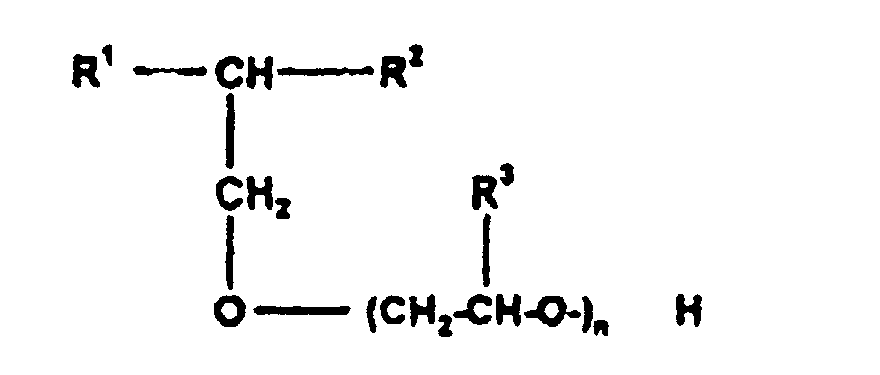
- Utilisation d'un agent assouplissant pour le traitement des textiles, selon la revendication 4,
caractérisée en ce que
l'agent tensioactif non ionique est un mono-, di-, tri- ou tétraester d'acide gras d'un monosaccharide ou d'un polysaccharide dans lequel les radicaux acyle sont des chaínes ramifiées ou linéaires en C10 à C22 et sont identiques ou différents. - Utilisation d'un agent assouplissant pour le traitement des textiles selon la revendication 4,
caractérisée en ce que
l'agent tensioactif non ionique est un mono-, di- ou triester d'acide gras d'un alkyl gras glycoside ou d'un alkyle gras polyglycoside dans lequel les radicaux acyle et les radicaux alkyle sont des chaínes en C10 à C22 ramifiés ou linéaires et sont identiques ou différents. - Utilisation d'un agent assouplissant pour le traitement des textiles selon l'une des revendications 6 ou 7,
caractérisée en ce que
les agents tensioactifs non ioniques sont alkoxylés en supplément avec de l'oxyde d'éthylène ou de l'oxyde de propylène. - Utilisation d'un agent assouplissant pour le traitement des textiles selon la revendication 4,
caractérisée en ce que
l'agent tensioactif non ionique représente un mono-, di- ou triester d'acide gras d'un polyol de formule générale : - Utilisation d'un agent assouplissant pour le traitement des textiles selon la revendication 9,
caractérisée en ce que
les agents tensioactifs non ioniques sont alkoxylés en supplément avec de l'oxyde d'éthylène ou de l'oxyde de propylène. - Utilisation d'un agent assouplissant pour le traitement des textiles selon la revendication 9,
caractérisée en ce que
les agents tensioactifs non ioniques sont des di-esters d'acide gras ou des mélanges de mono-, di-, ou tri-esters d'acide gras de glycérol. - Utilisation d'un agent assouplissant pour le traitement des textiles, selon la revendication 1,
caractérisée en ce que
les agents tensioactifs non ioniques consistent en des matières grasses, des huiles naturelles alkoxylées et/ou leurs mélanges avec des acides gras libres, des mono et/ou des diglycérides. - Utilisation d'un agent assouplissant pour le traitement des textiles selon les revendications 1 à 12, à une concentration allant de 0,1 à 1 g/l de combinaison de matière actives dans le jus de rinçage lors du traitement des articles textiles.
Applications Claiming Priority (2)
| Application Number | Priority Date | Filing Date | Title |
|---|---|---|---|
| DE4301459 | 1993-01-20 | ||
| DE4301459A DE4301459A1 (de) | 1993-01-20 | 1993-01-20 | Wäßriges Weichspülmittel für die Behandlung von Textilien |
Publications (3)
| Publication Number | Publication Date |
|---|---|
| EP0607529A2 EP0607529A2 (fr) | 1994-07-27 |
| EP0607529A3 EP0607529A3 (fr) | 1995-03-22 |
| EP0607529B1 true EP0607529B1 (fr) | 1998-06-24 |
Family
ID=6478581
Family Applications (1)
| Application Number | Title | Priority Date | Filing Date |
|---|---|---|---|
| EP93118805A Revoked EP0607529B1 (fr) | 1993-01-20 | 1993-11-23 | Utilisation des agents adoucissants aqueux pour le traitement de textiles |
Country Status (8)
| Country | Link |
|---|---|
| US (1) | US5447643A (fr) |
| EP (1) | EP0607529B1 (fr) |
| JP (1) | JPH06294073A (fr) |
| AT (1) | ATE167698T1 (fr) |
| CA (1) | CA2113687A1 (fr) |
| DE (2) | DE4301459A1 (fr) |
| ES (1) | ES2119850T3 (fr) |
| NO (1) | NO940182L (fr) |
Cited By (1)
| Publication number | Priority date | Publication date | Assignee | Title |
|---|---|---|---|---|
| US6727220B1 (en) | 1999-05-17 | 2004-04-27 | Unilever Home & Personal Care Usa, Division Of Conopco, Inc. | Fabric softening compositions |
Families Citing this family (34)
| Publication number | Priority date | Publication date | Assignee | Title |
|---|---|---|---|---|
| DE4433597C2 (de) * | 1993-09-28 | 1996-10-02 | Clariant Finance Bvi Ltd | Verfahren zur Erhöhung der Naßgleitfähigkeit von Textilmaterial und Naßgleitmittel dafür |
| DE4440620A1 (de) * | 1994-11-14 | 1996-05-15 | Henkel Kgaa | Textile Weichmachungsmittel |
| DE4446137A1 (de) * | 1994-12-23 | 1996-06-27 | Huels Chemische Werke Ag | Quaternierte Triethanolamindifettsäureester |
| JP3069884B2 (ja) * | 1995-01-24 | 2000-07-24 | 日本コーンスターチ株式会社 | 製紙用カチオン化澱粉・糊液及びそれらの製造方法 |
| DE19532542B4 (de) * | 1995-09-04 | 2008-12-18 | Henkel Ag & Co. Kgaa | Klarspülmittel mit kationischen Polymeren |
| DE19607847C1 (de) * | 1996-03-01 | 1997-11-20 | Suedzucker Ag | Aliphatische Carbonsäureester von Inulin |
| DE19712978A1 (de) * | 1997-03-27 | 1998-10-01 | Henkel Kgaa | Chitosanmikrosphären |
| DE19741721A1 (de) * | 1997-09-22 | 1999-03-25 | Huels Chemische Werke Ag | Wasch- und Reinigungsmittelformulierungen mit Chitin/Chitosan-Derivaten als Schmutzlösepolymer |
| KR100462336B1 (ko) * | 1997-12-26 | 2005-05-31 | 주식회사 엘지생활건강 | 투명 액상 섬유 유연제 조성물 |
| DE69927832T3 (de) * | 1998-08-07 | 2011-05-05 | Mallard Creek Polymers, Inc. | Neue latexzusammensetzung für beschichtung von verschiedenen substraten |
| GB9930435D0 (en) * | 1999-12-22 | 2000-02-16 | Unilever Plc | Fabric softening compositions |
| AU2001257108A1 (en) * | 2000-04-20 | 2001-11-07 | The Procter And Gamble Company | Yarn strength enhancing agents and compositions and methods employing same |
| GB2363614A (en) * | 2000-04-20 | 2002-01-02 | Procter & Gamble | Modified chitosan fabric treatment agents |
| KR100419603B1 (ko) * | 2001-02-21 | 2004-02-25 | 주식회사 아르테크플러스 | 향 캡슐과 키토산을 함유한 섬유 유연제 |
| US6849586B2 (en) | 2001-10-26 | 2005-02-01 | S. C. Johnson & Son, Inc. | Hard surface cleaners containing chitosan |
| GB0213263D0 (en) * | 2002-06-10 | 2002-07-17 | Unilever Plc | Improvements relating to fabric detergent compositions |
| US6949500B2 (en) † | 2002-12-16 | 2005-09-27 | Colgate-Palmolive Company | Fabric softener compositions containing a mixture of cationic polymers as rheology modifiers |
| US7135451B2 (en) * | 2003-03-25 | 2006-11-14 | The Procter & Gamble Company | Fabric care compositions comprising cationic starch |
| US20070178125A1 (en) * | 2003-05-21 | 2007-08-02 | Aki Laine | Process for the preparation of carnitine esters and their use |
| US7491753B2 (en) * | 2003-07-03 | 2009-02-17 | Mallard Creek Polymers, Inc. | Antimicrobial and antistatic polymers and methods of using such polymers on various substrates |
| US7981946B2 (en) | 2003-07-03 | 2011-07-19 | Mallard Creek Polymers, Inc. | Antimicrobial and antistatic polymers and methods of using such polymers on various substrates |
| US7781498B2 (en) | 2003-07-03 | 2010-08-24 | Mallard Creek Polymers, Inc. | Cationic latex as a carrier for bioactive ingredients and methods for making and using the same |
| CA2439436A1 (fr) * | 2003-09-03 | 2005-03-03 | George Sutherland | Traitement de compositions aqueuses contenant des contaminants |
| JP4342899B2 (ja) * | 2003-10-14 | 2009-10-14 | 花王株式会社 | 繊維製品のしわ除去剤組成物 |
| US7776813B2 (en) * | 2004-09-15 | 2010-08-17 | The Procter & Gamble Company | Fabric care compositions comprising polyol based fabric care materials and deposition agents |
| WO2006132872A1 (fr) * | 2005-06-03 | 2006-12-14 | The Procter & Gamble Company | Compositions d'entretien pour tissu |
| US20070048249A1 (en) | 2005-08-24 | 2007-03-01 | Purdue Research Foundation | Hydrophilized bactericidal polymers |
| DK2079762T3 (da) * | 2005-12-08 | 2013-01-07 | Chemigate Oy | Fremgangsmåde til fremstilling af hydroxypolymerestere og anvendelse deraf |
| WO2008077395A1 (fr) * | 2006-12-22 | 2008-07-03 | Lothar Ernst Wilhelm Weber | Adoucissant textile |
| MX2011001697A (es) | 2008-08-15 | 2011-03-04 | Procter & Gamble | Composiciones beneficas que comprenden esteres de poliglicerol. |
| EP3404086B1 (fr) * | 2017-05-18 | 2020-04-08 | The Procter & Gamble Company | Composition d'adoucissant pour tissus |
| EP3629731A1 (fr) | 2017-05-27 | 2020-04-08 | Poly Group LLC | Complexe antimicrobien dispersible et revêtements fabriqués à partir de celui-ci |
| HUE068413T2 (hu) | 2017-06-16 | 2024-12-28 | Poly Group LLC | Polimer, antimikrobiális felületaktív anyag |
| CN112813691B (zh) * | 2020-12-31 | 2023-05-12 | 武汉奥克特种化学有限公司 | 精炼剂以及精炼剂的制备方法 |
Citations (2)
| Publication number | Priority date | Publication date | Assignee | Title |
|---|---|---|---|---|
| EP0044003A1 (fr) * | 1980-07-10 | 1982-01-20 | Henkel Kommanditgesellschaft auf Aktien | Agent de lavage liquide avec une teneur en additifs inhibant le changement de couleur |
| EP0086104A2 (fr) * | 1982-02-10 | 1983-08-17 | Unilever N.V. | Procédé pour adoucir des matières textiles |
Family Cites Families (20)
| Publication number | Priority date | Publication date | Assignee | Title |
|---|---|---|---|---|
| FI57987C (fi) * | 1977-07-01 | 1980-11-10 | Valmet Oy | Daempningsanordning foer tryck- och viskositetsstoerningar i massasuspensionsstroemmen till inloppslaodan i en pappersmaskin |
| US4179382A (en) * | 1977-11-21 | 1979-12-18 | The Procter & Gamble Company | Textile conditioning compositions containing polymeric cationic materials |
| DE2911857A1 (de) * | 1979-03-26 | 1980-10-16 | Henkel Kgaa | Appretierend wirkendes textilwaschmittel |
| DE2913049A1 (de) * | 1979-03-31 | 1980-10-16 | Henkel Kgaa | Fluessiges reinigungsmittel |
| GR67665B (fr) * | 1979-05-21 | 1981-09-02 | Unilever Nv | |
| US4311601A (en) * | 1980-08-13 | 1982-01-19 | Merck & Co., Inc. | Use of heteropolysaccharide S-119 as a warp size |
| PH18436A (en) * | 1980-11-07 | 1985-07-08 | Unilever Nv | A fabric softening composition and a process for preparing it |
| ATE13562T1 (de) * | 1981-01-16 | 1985-06-15 | Procter & Gamble | Textilbehandlungsmittel. |
| EP0115252A3 (fr) * | 1982-12-29 | 1985-12-27 | Ciba-Geigy Ag | Mélanges de sels polymères d'ammonium quaternaire, de tensioactifs et d'acides gras, leur préparation et leur utilisation dans des compositions cosmétiques |
| GB8410322D0 (en) * | 1984-04-19 | 1984-05-31 | Unilever Plc | Aqueous concentrated fabric softening composition |
| US4851141A (en) * | 1984-12-12 | 1989-07-25 | Colgate-Palmolive Company | Concentrated stable nonaqueous fabric softener composition |
| GB8722540D0 (en) * | 1987-09-24 | 1987-10-28 | Unilever Plc | Composition for softening fabrics |
| US4795032A (en) * | 1987-12-04 | 1989-01-03 | S. C. Johnson & Son, Inc. | Wash-added, rinse-activated fabric conditioner and package |
| MY105119A (en) * | 1988-04-12 | 1994-08-30 | Kao Corp | Low irritation detergent composition. |
| JPH0227279A (ja) * | 1988-07-15 | 1990-01-30 | Sharp Corp | 超電導磁気測定装置 |
| GB8909069D0 (en) * | 1989-04-21 | 1989-06-07 | Bp Chem Int Ltd | Fabric conditioners |
| US5290475A (en) * | 1990-05-08 | 1994-03-01 | Colgate Palmolive | Liquid softening and anti-static nonionic detergent composition with soil release promoting PET-POET copolymer |
| US5246611A (en) * | 1990-05-09 | 1993-09-21 | The Procter & Gamble Company | Non-destructive carriers for cyclodextrin complexes |
| US5185088A (en) * | 1991-04-22 | 1993-02-09 | The Procter & Gamble Company | Granular fabric softener compositions which form aqueous emulsion concentrates |
| NO300383B1 (no) * | 1991-09-06 | 1997-05-20 | Colgate Palmolive Co | Softergentblanding |
-
1993
- 1993-01-20 DE DE4301459A patent/DE4301459A1/de not_active Withdrawn
- 1993-11-23 AT AT93118805T patent/ATE167698T1/de active
- 1993-11-23 ES ES93118805T patent/ES2119850T3/es not_active Expired - Lifetime
- 1993-11-23 DE DE59308712T patent/DE59308712D1/de not_active Revoked
- 1993-11-23 EP EP93118805A patent/EP0607529B1/fr not_active Revoked
-
1994
- 1994-01-06 US US08/178,402 patent/US5447643A/en not_active Expired - Fee Related
- 1994-01-18 CA CA002113687A patent/CA2113687A1/fr not_active Abandoned
- 1994-01-18 NO NO940182A patent/NO940182L/no unknown
- 1994-01-19 JP JP6004144A patent/JPH06294073A/ja not_active Withdrawn
Patent Citations (2)
| Publication number | Priority date | Publication date | Assignee | Title |
|---|---|---|---|---|
| EP0044003A1 (fr) * | 1980-07-10 | 1982-01-20 | Henkel Kommanditgesellschaft auf Aktien | Agent de lavage liquide avec une teneur en additifs inhibant le changement de couleur |
| EP0086104A2 (fr) * | 1982-02-10 | 1983-08-17 | Unilever N.V. | Procédé pour adoucir des matières textiles |
Cited By (1)
| Publication number | Priority date | Publication date | Assignee | Title |
|---|---|---|---|---|
| US6727220B1 (en) | 1999-05-17 | 2004-04-27 | Unilever Home & Personal Care Usa, Division Of Conopco, Inc. | Fabric softening compositions |
Also Published As
| Publication number | Publication date |
|---|---|
| EP0607529A2 (fr) | 1994-07-27 |
| NO940182L (no) | 1994-07-21 |
| US5447643A (en) | 1995-09-05 |
| DE4301459A1 (de) | 1994-07-21 |
| ATE167698T1 (de) | 1998-07-15 |
| CA2113687A1 (fr) | 1994-07-21 |
| JPH06294073A (ja) | 1994-10-21 |
| ES2119850T3 (es) | 1998-10-16 |
| NO940182D0 (no) | 1994-01-18 |
| DE59308712D1 (de) | 1998-07-30 |
| EP0607529A3 (fr) | 1995-03-22 |
Similar Documents
| Publication | Publication Date | Title |
|---|---|---|
| EP0607529A2 (fr) | Agents adoucissants aqueux pour de traitement de textils | |
| EP0230565B1 (fr) | Produit pour le post-traitement du linge | |
| DE68920532T2 (de) | Weichmacherzusammensetzung. | |
| DE2631114B2 (de) | Weichmachungsmittel für Gewebe | |
| DE3046352A1 (de) | Grenzflaechenaktive quaternaere ammoniumverbindungen und deren verwendung zum behandeln von textil- und cellulosematerialien | |
| DE69730042T2 (de) | Zusammensetzung und Verfahren zur Behandlung von Fasern | |
| DE2746447A1 (de) | Weichmacher fuer textilien | |
| DE69109579T2 (de) | Textilweichmacherzusammensetzung. | |
| DE4402852C1 (de) | Detergensgemische und deren Verwendung | |
| DE69100751T2 (de) | Verfahren zum behandeln von textilien. | |
| EP0914513B1 (fr) | Procede pour munir des fibres ou des non tisses d'un revetement hydrophile | |
| DE60104400T2 (de) | Verwendung von zusammensetzungen enthaltend proteine, polysaccharide und ethylenoxidderivate als tensidmittel | |
| DE2812118A1 (de) | Gewebeweichmach-zusammensetzung mit antistatischer wirkung | |
| DE2335114A1 (de) | Weichmacher fuer textilwaren und ihre verwendung als appreturmittel | |
| DE60033960T2 (de) | Verbesserung der knittererholung von stoffen | |
| DE2459125A1 (de) | Zubereitung und ihre verwendung zur pflege von textilmaterialien | |
| DE69533466T2 (de) | Flüssige Weichspülerzusammensetzung | |
| DE4215689A1 (de) | Stickstofffreie Wirkstoffkomponente in Wäscheweichspülerformulierungen | |
| DE2243806C3 (de) | Wässriges Mittel zum Weichmachen von Textilgut | |
| EP0924291B1 (fr) | Adoucissant aqueux à souplesse améliorée | |
| EP0848103B1 (fr) | Agent d'aviage de fibres textiles et kératiniques | |
| DE69111829T2 (de) | Wäschespülmittel und blätter für gewebetröckner. | |
| EP0747468A1 (fr) | Agents adoucissants aqueux pour le traitement des textiles | |
| WO2003089558A1 (fr) | Compositions d'adoucissant textile contenant des derives d'ester de betaine et procede d'amelioration du pouvoir lavant de lessives | |
| DE69929451T2 (de) | Verwendung von kationischen materialien und zusammensetzungen |
Legal Events
| Date | Code | Title | Description |
|---|---|---|---|
| PUAI | Public reference made under article 153(3) epc to a published international application that has entered the european phase |
Free format text: ORIGINAL CODE: 0009012 |
|
| AK | Designated contracting states |
Kind code of ref document: A2 Designated state(s): AT BE CH DE DK ES FR GB IT LI NL SE |
|
| PUAL | Search report despatched |
Free format text: ORIGINAL CODE: 0009013 |
|
| AK | Designated contracting states |
Kind code of ref document: A3 Designated state(s): AT BE CH DE DK ES FR GB IT LI NL SE |
|
| 17P | Request for examination filed |
Effective date: 19950302 |
|
| 17Q | First examination report despatched |
Effective date: 19970107 |
|
| GRAG | Despatch of communication of intention to grant |
Free format text: ORIGINAL CODE: EPIDOS AGRA |
|
| GRAG | Despatch of communication of intention to grant |
Free format text: ORIGINAL CODE: EPIDOS AGRA |
|
| GRAG | Despatch of communication of intention to grant |
Free format text: ORIGINAL CODE: EPIDOS AGRA |
|
| GRAH | Despatch of communication of intention to grant a patent |
Free format text: ORIGINAL CODE: EPIDOS IGRA |
|
| GRAH | Despatch of communication of intention to grant a patent |
Free format text: ORIGINAL CODE: EPIDOS IGRA |
|
| GRAA | (expected) grant |
Free format text: ORIGINAL CODE: 0009210 |
|
| ITF | It: translation for a ep patent filed | ||
| AK | Designated contracting states |
Kind code of ref document: B1 Designated state(s): AT BE CH DE DK ES FR GB IT LI NL SE |
|
| REF | Corresponds to: |
Ref document number: 167698 Country of ref document: AT Date of ref document: 19980715 Kind code of ref document: T |
|
| REG | Reference to a national code |
Ref country code: CH Ref legal event code: EP |
|
| REF | Corresponds to: |
Ref document number: 59308712 Country of ref document: DE Date of ref document: 19980730 |
|
| ET | Fr: translation filed | ||
| GBT | Gb: translation of ep patent filed (gb section 77(6)(a)/1977) |
Effective date: 19980713 |
|
| PG25 | Lapsed in a contracting state [announced via postgrant information from national office to epo] |
Ref country code: SE Free format text: LAPSE BECAUSE OF FAILURE TO SUBMIT A TRANSLATION OF THE DESCRIPTION OR TO PAY THE FEE WITHIN THE PRESCRIBED TIME-LIMIT Effective date: 19980924 Ref country code: DK Free format text: LAPSE BECAUSE OF FAILURE TO SUBMIT A TRANSLATION OF THE DESCRIPTION OR TO PAY THE FEE WITHIN THE PRESCRIBED TIME-LIMIT Effective date: 19980924 |
|
| REG | Reference to a national code |
Ref country code: ES Ref legal event code: FG2A Ref document number: 2119850 Country of ref document: ES Kind code of ref document: T3 |
|
| PG25 | Lapsed in a contracting state [announced via postgrant information from national office to epo] |
Ref country code: LI Free format text: LAPSE BECAUSE OF NON-PAYMENT OF DUE FEES Effective date: 19981130 Ref country code: CH Free format text: LAPSE BECAUSE OF NON-PAYMENT OF DUE FEES Effective date: 19981130 Ref country code: BE Free format text: LAPSE BECAUSE OF NON-PAYMENT OF DUE FEES Effective date: 19981130 |
|
| PLBI | Opposition filed |
Free format text: ORIGINAL CODE: 0009260 |
|
| PLBQ | Unpublished change to opponent data |
Free format text: ORIGINAL CODE: EPIDOS OPPO |
|
| PLBF | Reply of patent proprietor to notice(s) of opposition |
Free format text: ORIGINAL CODE: EPIDOS OBSO |
|
| 26 | Opposition filed |
Opponent name: UNILEVER PLC/ UNILEVER NV Effective date: 19990324 |
|
| BERE | Be: lapsed |
Owner name: HULS A.G. Effective date: 19981130 |
|
| NLR1 | Nl: opposition has been filed with the epo |
Opponent name: UNILEVER PLC/ UNILEVER NV |
|
| REG | Reference to a national code |
Ref country code: CH Ref legal event code: PL |
|
| PLBF | Reply of patent proprietor to notice(s) of opposition |
Free format text: ORIGINAL CODE: EPIDOS OBSO |
|
| RAP2 | Party data changed (patent owner data changed or rights of a patent transferred) |
Owner name: DEGUSSA-HUELS AKTIENGESELLSCHAFT |
|
| PLBF | Reply of patent proprietor to notice(s) of opposition |
Free format text: ORIGINAL CODE: EPIDOS OBSO |
|
| PGFP | Annual fee paid to national office [announced via postgrant information from national office to epo] |
Ref country code: FR Payment date: 19991129 Year of fee payment: 7 |
|
| PGFP | Annual fee paid to national office [announced via postgrant information from national office to epo] |
Ref country code: NL Payment date: 19991130 Year of fee payment: 7 Ref country code: AT Payment date: 19991130 Year of fee payment: 7 |
|
| NLT2 | Nl: modifications (of names), taken from the european patent patent bulletin |
Owner name: DEGUSSA-HUELS AKTIENGESELLSCHAFT |
|
| RAP2 | Party data changed (patent owner data changed or rights of a patent transferred) |
Owner name: RWE-DEA AKTIENGESELLSCHAFT FUER MINERALOEL UND CHE |
|
| PGFP | Annual fee paid to national office [announced via postgrant information from national office to epo] |
Ref country code: DE Payment date: 20000125 Year of fee payment: 7 |
|
| NLT2 | Nl: modifications (of names), taken from the european patent patent bulletin |
Owner name: RWE-DEA AKTIENGESELLSCHAFT FUER MINERALOEL UND CHE |
|
| PGFP | Annual fee paid to national office [announced via postgrant information from national office to epo] |
Ref country code: ES Payment date: 20000222 Year of fee payment: 7 |
|
| PGFP | Annual fee paid to national office [announced via postgrant information from national office to epo] |
Ref country code: GB Payment date: 20000417 Year of fee payment: 7 |
|
| PLBQ | Unpublished change to opponent data |
Free format text: ORIGINAL CODE: EPIDOS OPPO |
|
| PLAB | Opposition data, opponent's data or that of the opponent's representative modified |
Free format text: ORIGINAL CODE: 0009299OPPO |
|
| R26 | Opposition filed (corrected) |
Opponent name: UNILEVER PLC/ UNILEVER NV Effective date: 19990324 |
|
| NLR1 | Nl: opposition has been filed with the epo |
Opponent name: UNILEVER PLC/UNILEVER NV |
|
| NLS | Nl: assignments of ep-patents |
Owner name: RWE-DEA AKTIENGESELLSCHAFT FUER MINERALOEL UND CHE |
|
| PG25 | Lapsed in a contracting state [announced via postgrant information from national office to epo] |
Ref country code: ES Free format text: LAPSE BECAUSE OF NON-PAYMENT OF DUE FEES Effective date: 20001124 |
|
| RDAH | Patent revoked |
Free format text: ORIGINAL CODE: EPIDOS REVO |
|
| REG | Reference to a national code |
Ref country code: FR Ref legal event code: TP |
|
| RDAG | Patent revoked |
Free format text: ORIGINAL CODE: 0009271 |
|
| STAA | Information on the status of an ep patent application or granted ep patent |
Free format text: STATUS: PATENT REVOKED |
|
| 27W | Patent revoked |
Effective date: 20001212 |
|
| GBPR | Gb: patent revoked under art. 102 of the ep convention designating the uk as contracting state |
Free format text: 20001212 |
|
| REG | Reference to a national code |
Ref country code: FR Ref legal event code: CD Ref country code: FR Ref legal event code: CA |
|
| NLR2 | Nl: decision of opposition | ||
| PLAB | Opposition data, opponent's data or that of the opponent's representative modified |
Free format text: ORIGINAL CODE: 0009299OPPO |