EP0607644B1 - Oxydation partielle de son d'égout - Google Patents
Oxydation partielle de son d'égout Download PDFInfo
- Publication number
- EP0607644B1 EP0607644B1 EP19930300425 EP93300425A EP0607644B1 EP 0607644 B1 EP0607644 B1 EP 0607644B1 EP 19930300425 EP19930300425 EP 19930300425 EP 93300425 A EP93300425 A EP 93300425A EP 0607644 B1 EP0607644 B1 EP 0607644B1
- Authority
- EP
- European Patent Office
- Prior art keywords
- sewage sludge
- range
- gas
- pressure
- temperature
- Prior art date
- Legal status (The legal status is an assumption and is not a legal conclusion. Google has not performed a legal analysis and makes no representation as to the accuracy of the status listed.)
- Expired - Lifetime
Links
Images
Classifications
-
- C—CHEMISTRY; METALLURGY
- C01—INORGANIC CHEMISTRY
- C01B—NON-METALLIC ELEMENTS; COMPOUNDS THEREOF; METALLOIDS OR COMPOUNDS THEREOF NOT COVERED BY SUBCLASS C01C
- C01B3/00—Hydrogen; Gaseous mixtures containing hydrogen; Separation of hydrogen from mixtures containing it; Purification of hydrogen; Reversible storage of hydrogen
- C01B3/02—Production of hydrogen; Production of gaseous mixtures containing hydrogen
- C01B3/32—Production of hydrogen; Production of gaseous mixtures containing hydrogen by reaction of gaseous or liquid organic compounds with gasifying agents, e.g. water, carbon dioxide or air
- C01B3/34—Production of hydrogen; Production of gaseous mixtures containing hydrogen by reaction of gaseous or liquid organic compounds with gasifying agents, e.g. water, carbon dioxide or air by reaction of hydrocarbons with gasifying agents
- C01B3/36—Production of hydrogen; Production of gaseous mixtures containing hydrogen by reaction of gaseous or liquid organic compounds with gasifying agents, e.g. water, carbon dioxide or air by reaction of hydrocarbons with gasifying agents using oxygen; using mixtures containing oxygen as gasifying agents
-
- C—CHEMISTRY; METALLURGY
- C02—TREATMENT OF WATER, WASTE WATER, SEWAGE, OR SLUDGE
- C02F—TREATMENT OF WATER, WASTE WATER, SEWAGE, OR SLUDGE
- C02F11/00—Treatment of sludge; Devices therefor
- C02F11/12—Treatment of sludge; Devices therefor by de-watering, drying or thickening
- C02F11/121—Treatment of sludge; Devices therefor by de-watering, drying or thickening by mechanical de-watering
- C02F11/123—Treatment of sludge; Devices therefor by de-watering, drying or thickening by mechanical de-watering using belt or band filters
-
- C—CHEMISTRY; METALLURGY
- C02—TREATMENT OF WATER, WASTE WATER, SEWAGE, OR SLUDGE
- C02F—TREATMENT OF WATER, WASTE WATER, SEWAGE, OR SLUDGE
- C02F1/00—Treatment of water, waste water, or sewage
- C02F1/02—Treatment of water, waste water, or sewage by heating
- C02F1/04—Treatment of water, waste water, or sewage by heating by distillation or evaporation
- C02F1/048—Purification of waste water by evaporation
-
- C—CHEMISTRY; METALLURGY
- C02—TREATMENT OF WATER, WASTE WATER, SEWAGE, OR SLUDGE
- C02F—TREATMENT OF WATER, WASTE WATER, SEWAGE, OR SLUDGE
- C02F11/00—Treatment of sludge; Devices therefor
- C02F11/10—Treatment of sludge; Devices therefor by pyrolysis
-
- C—CHEMISTRY; METALLURGY
- C02—TREATMENT OF WATER, WASTE WATER, SEWAGE, OR SLUDGE
- C02F—TREATMENT OF WATER, WASTE WATER, SEWAGE, OR SLUDGE
- C02F11/00—Treatment of sludge; Devices therefor
- C02F11/12—Treatment of sludge; Devices therefor by de-watering, drying or thickening
- C02F11/13—Treatment of sludge; Devices therefor by de-watering, drying or thickening by heating
-
- C—CHEMISTRY; METALLURGY
- C10—PETROLEUM, GAS OR COKE INDUSTRIES; TECHNICAL GASES CONTAINING CARBON MONOXIDE; FUELS; LUBRICANTS; PEAT
- C10J—PRODUCTION OF PRODUCER GAS, WATER-GAS, SYNTHESIS GAS FROM SOLID CARBONACEOUS MATERIAL, OR MIXTURES CONTAINING THESE GASES; CARBURETTING AIR OR OTHER GASES
- C10J3/00—Production of combustible gases containing carbon monoxide from solid carbonaceous fuels
- C10J3/46—Gasification of granular or pulverulent flues in suspension
- C10J3/466—Entrained flow processes
-
- C—CHEMISTRY; METALLURGY
- C10—PETROLEUM, GAS OR COKE INDUSTRIES; TECHNICAL GASES CONTAINING CARBON MONOXIDE; FUELS; LUBRICANTS; PEAT
- C10J—PRODUCTION OF PRODUCER GAS, WATER-GAS, SYNTHESIS GAS FROM SOLID CARBONACEOUS MATERIAL, OR MIXTURES CONTAINING THESE GASES; CARBURETTING AIR OR OTHER GASES
- C10J3/00—Production of combustible gases containing carbon monoxide from solid carbonaceous fuels
- C10J3/72—Other features
- C10J3/86—Other features combined with waste-heat boilers
-
- C—CHEMISTRY; METALLURGY
- C10—PETROLEUM, GAS OR COKE INDUSTRIES; TECHNICAL GASES CONTAINING CARBON MONOXIDE; FUELS; LUBRICANTS; PEAT
- C10K—PURIFYING OR MODIFYING THE CHEMICAL COMPOSITION OF COMBUSTIBLE GASES CONTAINING CARBON MONOXIDE
- C10K1/00—Purifying combustible gases containing carbon monoxide
- C10K1/08—Purifying combustible gases containing carbon monoxide by washing with liquids; Reviving the used wash liquors
- C10K1/10—Purifying combustible gases containing carbon monoxide by washing with liquids; Reviving the used wash liquors with aqueous liquids
- C10K1/101—Purifying combustible gases containing carbon monoxide by washing with liquids; Reviving the used wash liquors with aqueous liquids with water only
-
- C—CHEMISTRY; METALLURGY
- C10—PETROLEUM, GAS OR COKE INDUSTRIES; TECHNICAL GASES CONTAINING CARBON MONOXIDE; FUELS; LUBRICANTS; PEAT
- C10L—FUELS NOT OTHERWISE PROVIDED FOR; NATURAL GAS; SYNTHETIC NATURAL GAS OBTAINED BY PROCESSES NOT COVERED BY SUBCLASSES C10G OR C10K; LIQUIFIED PETROLEUM GAS; USE OF ADDITIVES TO FUELS OR FIRES; FIRE-LIGHTERS
- C10L5/00—Solid fuels
- C10L5/40—Solid fuels essentially based on materials of non-mineral origin
- C10L5/46—Solid fuels essentially based on materials of non-mineral origin on sewage, house, or town refuse
-
- C—CHEMISTRY; METALLURGY
- C10—PETROLEUM, GAS OR COKE INDUSTRIES; TECHNICAL GASES CONTAINING CARBON MONOXIDE; FUELS; LUBRICANTS; PEAT
- C10J—PRODUCTION OF PRODUCER GAS, WATER-GAS, SYNTHESIS GAS FROM SOLID CARBONACEOUS MATERIAL, OR MIXTURES CONTAINING THESE GASES; CARBURETTING AIR OR OTHER GASES
- C10J2300/00—Details of gasification processes
- C10J2300/09—Details of the feed, e.g. feeding of spent catalyst, inert gas or halogens
- C10J2300/0913—Carbonaceous raw material
- C10J2300/0926—Slurries comprising bio-oil or bio-coke, i.e. charcoal, obtained, e.g. by fast pyrolysis of biomass
-
- C—CHEMISTRY; METALLURGY
- C10—PETROLEUM, GAS OR COKE INDUSTRIES; TECHNICAL GASES CONTAINING CARBON MONOXIDE; FUELS; LUBRICANTS; PEAT
- C10J—PRODUCTION OF PRODUCER GAS, WATER-GAS, SYNTHESIS GAS FROM SOLID CARBONACEOUS MATERIAL, OR MIXTURES CONTAINING THESE GASES; CARBURETTING AIR OR OTHER GASES
- C10J2300/00—Details of gasification processes
- C10J2300/09—Details of the feed, e.g. feeding of spent catalyst, inert gas or halogens
- C10J2300/0983—Additives
- C10J2300/0996—Calcium-containing inorganic materials, e.g. lime
-
- C—CHEMISTRY; METALLURGY
- C10—PETROLEUM, GAS OR COKE INDUSTRIES; TECHNICAL GASES CONTAINING CARBON MONOXIDE; FUELS; LUBRICANTS; PEAT
- C10J—PRODUCTION OF PRODUCER GAS, WATER-GAS, SYNTHESIS GAS FROM SOLID CARBONACEOUS MATERIAL, OR MIXTURES CONTAINING THESE GASES; CARBURETTING AIR OR OTHER GASES
- C10J2300/00—Details of gasification processes
- C10J2300/12—Heating the gasifier
- C10J2300/1223—Heating the gasifier by burners
-
- C—CHEMISTRY; METALLURGY
- C10—PETROLEUM, GAS OR COKE INDUSTRIES; TECHNICAL GASES CONTAINING CARBON MONOXIDE; FUELS; LUBRICANTS; PEAT
- C10J—PRODUCTION OF PRODUCER GAS, WATER-GAS, SYNTHESIS GAS FROM SOLID CARBONACEOUS MATERIAL, OR MIXTURES CONTAINING THESE GASES; CARBURETTING AIR OR OTHER GASES
- C10J2300/00—Details of gasification processes
- C10J2300/16—Integration of gasification processes with another plant or parts within the plant
- C10J2300/1603—Integration of gasification processes with another plant or parts within the plant with gas treatment
- C10J2300/1606—Combustion processes
-
- C—CHEMISTRY; METALLURGY
- C10—PETROLEUM, GAS OR COKE INDUSTRIES; TECHNICAL GASES CONTAINING CARBON MONOXIDE; FUELS; LUBRICANTS; PEAT
- C10J—PRODUCTION OF PRODUCER GAS, WATER-GAS, SYNTHESIS GAS FROM SOLID CARBONACEOUS MATERIAL, OR MIXTURES CONTAINING THESE GASES; CARBURETTING AIR OR OTHER GASES
- C10J2300/00—Details of gasification processes
- C10J2300/16—Integration of gasification processes with another plant or parts within the plant
- C10J2300/164—Integration of gasification processes with another plant or parts within the plant with conversion of synthesis gas
- C10J2300/1643—Conversion of synthesis gas to energy
- C10J2300/165—Conversion of synthesis gas to energy integrated with a gas turbine or gas motor
-
- C—CHEMISTRY; METALLURGY
- C10—PETROLEUM, GAS OR COKE INDUSTRIES; TECHNICAL GASES CONTAINING CARBON MONOXIDE; FUELS; LUBRICANTS; PEAT
- C10J—PRODUCTION OF PRODUCER GAS, WATER-GAS, SYNTHESIS GAS FROM SOLID CARBONACEOUS MATERIAL, OR MIXTURES CONTAINING THESE GASES; CARBURETTING AIR OR OTHER GASES
- C10J2300/00—Details of gasification processes
- C10J2300/16—Integration of gasification processes with another plant or parts within the plant
- C10J2300/164—Integration of gasification processes with another plant or parts within the plant with conversion of synthesis gas
- C10J2300/1656—Conversion of synthesis gas to chemicals
-
- C—CHEMISTRY; METALLURGY
- C10—PETROLEUM, GAS OR COKE INDUSTRIES; TECHNICAL GASES CONTAINING CARBON MONOXIDE; FUELS; LUBRICANTS; PEAT
- C10J—PRODUCTION OF PRODUCER GAS, WATER-GAS, SYNTHESIS GAS FROM SOLID CARBONACEOUS MATERIAL, OR MIXTURES CONTAINING THESE GASES; CARBURETTING AIR OR OTHER GASES
- C10J2300/00—Details of gasification processes
- C10J2300/16—Integration of gasification processes with another plant or parts within the plant
- C10J2300/1671—Integration of gasification processes with another plant or parts within the plant with the production of electricity
-
- C—CHEMISTRY; METALLURGY
- C10—PETROLEUM, GAS OR COKE INDUSTRIES; TECHNICAL GASES CONTAINING CARBON MONOXIDE; FUELS; LUBRICANTS; PEAT
- C10J—PRODUCTION OF PRODUCER GAS, WATER-GAS, SYNTHESIS GAS FROM SOLID CARBONACEOUS MATERIAL, OR MIXTURES CONTAINING THESE GASES; CARBURETTING AIR OR OTHER GASES
- C10J2300/00—Details of gasification processes
- C10J2300/18—Details of the gasification process, e.g. loops, autothermal operation
- C10J2300/1846—Partial oxidation, i.e. injection of air or oxygen only
-
- Y—GENERAL TAGGING OF NEW TECHNOLOGICAL DEVELOPMENTS; GENERAL TAGGING OF CROSS-SECTIONAL TECHNOLOGIES SPANNING OVER SEVERAL SECTIONS OF THE IPC; TECHNICAL SUBJECTS COVERED BY FORMER USPC CROSS-REFERENCE ART COLLECTIONS [XRACs] AND DIGESTS
- Y02—TECHNOLOGIES OR APPLICATIONS FOR MITIGATION OR ADAPTATION AGAINST CLIMATE CHANGE
- Y02E—REDUCTION OF GREENHOUSE GAS [GHG] EMISSIONS, RELATED TO ENERGY GENERATION, TRANSMISSION OR DISTRIBUTION
- Y02E50/00—Technologies for the production of fuel of non-fossil origin
- Y02E50/10—Biofuels, e.g. bio-diesel
-
- Y—GENERAL TAGGING OF NEW TECHNOLOGICAL DEVELOPMENTS; GENERAL TAGGING OF CROSS-SECTIONAL TECHNOLOGIES SPANNING OVER SEVERAL SECTIONS OF THE IPC; TECHNICAL SUBJECTS COVERED BY FORMER USPC CROSS-REFERENCE ART COLLECTIONS [XRACs] AND DIGESTS
- Y02—TECHNOLOGIES OR APPLICATIONS FOR MITIGATION OR ADAPTATION AGAINST CLIMATE CHANGE
- Y02E—REDUCTION OF GREENHOUSE GAS [GHG] EMISSIONS, RELATED TO ENERGY GENERATION, TRANSMISSION OR DISTRIBUTION
- Y02E50/00—Technologies for the production of fuel of non-fossil origin
- Y02E50/30—Fuel from waste, e.g. synthetic alcohol or diesel
-
- Y—GENERAL TAGGING OF NEW TECHNOLOGICAL DEVELOPMENTS; GENERAL TAGGING OF CROSS-SECTIONAL TECHNOLOGIES SPANNING OVER SEVERAL SECTIONS OF THE IPC; TECHNICAL SUBJECTS COVERED BY FORMER USPC CROSS-REFERENCE ART COLLECTIONS [XRACs] AND DIGESTS
- Y02—TECHNOLOGIES OR APPLICATIONS FOR MITIGATION OR ADAPTATION AGAINST CLIMATE CHANGE
- Y02P—CLIMATE CHANGE MITIGATION TECHNOLOGIES IN THE PRODUCTION OR PROCESSING OF GOODS
- Y02P20/00—Technologies relating to chemical industry
- Y02P20/141—Feedstock
- Y02P20/145—Feedstock the feedstock being materials of biological origin
-
- Y—GENERAL TAGGING OF NEW TECHNOLOGICAL DEVELOPMENTS; GENERAL TAGGING OF CROSS-SECTIONAL TECHNOLOGIES SPANNING OVER SEVERAL SECTIONS OF THE IPC; TECHNICAL SUBJECTS COVERED BY FORMER USPC CROSS-REFERENCE ART COLLECTIONS [XRACs] AND DIGESTS
- Y02—TECHNOLOGIES OR APPLICATIONS FOR MITIGATION OR ADAPTATION AGAINST CLIMATE CHANGE
- Y02W—CLIMATE CHANGE MITIGATION TECHNOLOGIES RELATED TO WASTEWATER TREATMENT OR WASTE MANAGEMENT
- Y02W10/00—Technologies for wastewater treatment
- Y02W10/40—Valorisation of by-products of wastewater, sewage or sludge processing
-
- Y—GENERAL TAGGING OF NEW TECHNOLOGICAL DEVELOPMENTS; GENERAL TAGGING OF CROSS-SECTIONAL TECHNOLOGIES SPANNING OVER SEVERAL SECTIONS OF THE IPC; TECHNICAL SUBJECTS COVERED BY FORMER USPC CROSS-REFERENCE ART COLLECTIONS [XRACs] AND DIGESTS
- Y10—TECHNICAL SUBJECTS COVERED BY FORMER USPC
- Y10S—TECHNICAL SUBJECTS COVERED BY FORMER USPC CROSS-REFERENCE ART COLLECTIONS [XRACs] AND DIGESTS
- Y10S48/00—Gas: heating and illuminating
- Y10S48/07—Slurry
Definitions
- This invention relates to a partial oxidation process for disposing of sewage sludge without polluting the nation's environment.
- sewage sludge as used herein may be broadly defined as "water-carried wastes", particularly from municipal sanitary sewage lines, containing at least one of the following: body wastes (excreta), household wastes, community waste such as street washings, for example, and industrial wastes and sludges.
- body wastes excreta
- household wastes community waste such as street washings, for example
- industrial wastes and sludges The total solids content of the sewage in municipal lines is usually about 500 parts per million (p.p.m.) or more.
- the solids in sewage are mostly animal or vegetable substances, "organic matter", i.e., fats, carbohydrates, and proteins.
- Sewage sludge is obtained from raw sewage and may contain a number of pathogens known to be health hazards to humans. Almost any type of organism may be found in sewage, including bacterial, protozoa, spores and cysts.
- EP-A-0,515,117 discloses a pumpable aqueous slurry produced by dewatering an aqueous slurry of 10 - 25 wt. % solids, pretreating the slurry by heating and/or hydrothermal treatment and/or heating, mixing and shearing, and mixing the pretreated slurry with a nonionic water soluble alkoxylated alkylphenol additive and sewage sludge and/or solid carbonaceous fuel.
- This relates to a partial oxidation process for disposing of sewage sludge without contaminating the environment comprising:
- Sanitary sewage sludge is disposed of by the process of the subject invention without polluting the nation's environment.
- highly dewatered sewage sludge is produced by pressing and is then heat treated, flash evaporated, mixed with supplemental fuel, and reacted in a partial oxidation gas generator along with free-oxygen containing gas and a temperature moderator.
- a hot raw effluent gas stream comprising at least one of the following is produced: synthesis gas, reducing gas and fuel gas.
- the parts by weight of supplemental carbonaceous fuel to dewatered sewage sludge are respectively in the range of about 5 - 7 to 0.5 - 2, such as about 6:1.
- the dewatered sewage sludge and supplemental carbonaceous fuel are reacted with a free oxygen-containing gas by partial oxidation in a free-flow non-catalytic gas generator. Noxious sewage sludge is safely disposed of by the subject process without polluting the nation's environment.
- at least one useful nonpolluting gas from the group consisting of: synthesis gas, reducing gas and fuel gas is produced along with by-product steam and hot water. Non-contaminating ash and slag are separated from the gas stream.
- the ash and slag may be used for road bed fill and for making cement blocks. Further, the subject process allows a greater amount of sewage sludge to be fed to a partial oxidation gasifier, while requiring less energy per unit mass of sewage sludge processed. This process has the following advantages:
- a typical ultimate analysis of the combustibles in sewage sludge is shown in Table I.
- a typical ultimate analysis of inert non-combustible materials in sewage sludge is shown in Table II.
- the higher heating value (BTU/lb) of dry sewage sludge is in the range of about 7 to 17 MJ/kg (3000 to 7000).
- Sewage Sludge is obtained from raw sewage by conventional processing steps and equipment.
- the sewage from municipal sewage lines is passed through bar screens for the removal of large pieces of stone, wood, metal, and other trash which would clog channels or damage pumps.
- Coarse heavy inorganic non-combustibles, i.e. gravel, cinders, and sand are then settled out in a grit chamber.
- the sewage is then separated into an aqueous suspension of sewage sludge and liquids. Concentration of the sewage may be accomplished by any suitable way for separating solids and liquids, e.g. gravity settling, filtration, centrifugation, hydroclone, or a combination thereof.
- a preferable preliminary procedure is to introduce the screened over-flow from the grit chamber into a primary sedimentation tank such as a continuous clarifier as shown in Perry's Chemical Engineers' Handbook, McGraw-Hill, Fourth Edition, 1963, page 19-50.
- Detention time in the sedimentation tank is sufficient for producing a pumpable aqueous slurry of primary sludge having a solids content of about .5 to 20 wt.%, in about 1 to 24 hours.
- the primary sedimentation tank may also serve as a hold-up tank to even out discontinuities in the sewage composition. Alternatively, a separate holding tank may be used.
- a pumpable aqueous slurry of secondary sewage sludge is introduced into the holding tank and mixed with the primary sewage sludge.
- Secondary sewage sludge has a solids content in the range of about 1 to 10 wt.% and is derived from the liquid overflow from the previously mentioned primary sedimentation tank.
- the liquid gasifier The liquid gasifier. Mixtures of dewatered sewage containing about 20 to 50 wt.% of solids and solid carbonaceous fuel e.g. coal that contain sufficient sewage sludge to be profitably burned are ordinarily too viscous to be pumped. This problem and others have been overcome by the subject invention.
- Sewage Sludge is obtained from raw sewage by conventional processing steps and equipment.
- the sewage from municipal sewage lines is passed through bar screens for the removal of large pieces of stone, wood, metal, and other trash which would clog channels or damage pumps.
- Coarse heavy inorganic non-combustibles, i.e. gravel, cinders, and sand are then settled out in a grit chamber.
- the sewage is then separated into an aqueous suspension of sewage sludge and liquids. Concentration of the sewage may be accomplished by any suitable way for separating solids and liquids, e.g. gravity settling, filtration, centrifugation, hydroclone, or a combination thereof.
- a preferable preliminary procedure is to introduce the screened over-flow from the grit chamber into a primary sedimentation tank such as a continuous clarifier as shown in Perry's Chemical Engineers' Handbook, McGraw-Hill, Fourth Edition, 1963, page 19-50.
- Detention time in the sedimentation tank is sufficient for producing a pumpable aqueous slurry of primary sludge having a solids content of about .5 to 20 wt.%, in about 1 to 24 hours.
- the primary sedimentation tank may also serve as a hold-up tank to even out discontinuities in the sewage composition. Alternatively, a separate holding tank may be used.
- a pumpable aqueous slurry of secondary sewage sludge is introduced into the holding tank and mixed with the primary sewage sludge.
- Secondary sewage sludge has a solids content in the range of about 1 to 10 wt.% and is derived from the liquid overflow from the previously mentioned primary sedimentation tank. The liquid discharged from the system or used externally for industrial applications.
- the sludge underflow from the primary sedimentation tank comprising primary sewage sludge or from the holding tank comprising primary sewage sludge in admixture with about 0 to 50 wt.% (basis total sewage sludge) of secondary sewage sludge is dewatered further to produce a thickened aqueous suspension.
- sewage sludge having a solids content in the range of about 0.5 to 20 wt.% is preferably concentrated by continuous belt filter pressing to produce a highly dewatered sewage sludge having a solids content in the range of about 15 to 65 wt.%, such as about 30 to 40 wt.%, say 35 wt.%.
- Liquid water is thereby quickly pressed from the sewage sludge.
- the Andritz Co. Arlington, Texas, Continuous Press Filter (CPF) operating at ambient conditions with a surface pressure of about 138 kPa (20 psi) will produce a press cake having a solids content in the range of about 20 to 50 wt.%.
- the press cake may be optionally further dewatered in an Andritz Co.
- High Intensity Press (HIP) continuous belt filter press operating with a surface pressure of about 1379 kPa (200 psi) for a similar period of about 1/2 to 60 minutes to produce a press cake having a solids content in the range of about 25 to 55 wt.%.
- HIP High Intensity Press
- additional dewatering may be provided by heating the sludge to a temperature in the range of about 100° to 140°C during said high intensity pressing.
- the press cake from the CPF is conditioned with a conventional inorganic filter additive ( ⁇ 5-30 wt.%), e.g., CaCO 3 or coal having a particle size of less than about 2 mm, such as about 1 mm and with or without steam.
- a conventional inorganic filter additive ⁇ 5-30 wt.%, e.g., CaCO 3 or coal having a particle size of less than about 2 mm, such as about 1 mm and with or without steam.
- the filter aid is selected from the group consisting of coal fines, petroleum coke fines and mixtures thereof.
- the filter aid is selected from the group consisting of iron compounds, calcium compounds, silicon compounds and mixtures thereof.
- the solids content of the press cake from the HIP may be thereby increased to about 35 to 65 wt.%.
- the sewage sludge is concentrated by
- Heat treating of the highly dewatered sewage sludge takes place in the next step of the process.
- the highly dewatered sewage sludge is preheated at a temperature in the range of about 54°C to 93°C (130°F to 200°F) in the absence of air for about 1 to 20 minutes and at ambient atmospheric pressure followed by heating at a temperature in the range of about 177°C to 343°C (350°F to 650°F) in the absence of air for a residence time of about 5 to 120 minutes and at a pressure which is at or above the vapor pressure of water at the heat treating temperature to produce a pumpable aqueous slurry of sewage sludge.
- the dewatered sewage sludge is heated by direct or indirect heat exchange in an autoclave.
- steam or partially cooled synthesis gas produced downstream in the process may be passed in direct or indirect heat exchange with the sewage sludge.
- Heat treating the dewatered sewage sludge at a temperature in the range of about 149°C to 343°C (300°F to 650°F) as previously described causes decarboxylation and dehydrogenation of the sewage sludge.
- Sewage sludge with a particle size in the range of about 5 to 20 microns is thereby produced.
- Pumpable aqueous slurries of sewage sludge having greater solids contents are thereby produced.
- Off-gas from the reactor e.g. autoclave comprising CO 2 , H 2 O, H 2 S and COS is sent to a conventional odor control unit or disinfecting zone. Noxious gases are thereby safely disposed of without polluting the nation's environment.
- hot clean water at a temperature in the range of about 149°C to 260°C (300°F to 500°F) may be removed from the bottom of the reactor and may be used in indirect heat exchange with the sewage sludge going to the reactor.
- the pumpable aqueous slurry from the reactor is introduced into a flash evaporation zone where the pressure is reduced to a pressure in the range of about atmospheric pressure to the saturated vapor pressure of water at the temperature in flash evaporization zone in the range of about 93°C to 204°C (200°F to 400°F). Sufficient water is thereby evaporated and separated from the sewage sludge in the flash evaporation zone to provide a pumpable slurry of dewatered sewage sludge having a solids content in the range of about 30 to 70 wt.%.
- the higher heating value (HHV) of this dewatered sewage sludge is in the range of about 12 to 22 MJ/kg (5,000 to 9,500 BTU/Lb), such as about 13 to 17 MJ/kg (5,500 to 7,000 BTU/Lb), say about 15 MJ/kg (6,500 BTU/Lb). All of the higher heating values expressed herein are on the dry basis for the materials.
- at least a portion of the water separated in the flash evaporization zone may be passed at a temperature in the range of about 93°C to 960°C (200°F to 500°F) in direct or indirect heat exchange with the sewage sludge in the autoclave. The thermal efficiency of the process is thereby improved.
- the flash evaporation step may be followed by a centrifuging step to remove water.
- the flash evaporation step is replaced by the steps of cooling the heated pumpable aqueous slurry from the reactor to a temperature in the range of about ambient to 93°C (200°F), and separating sufficient water from the sewage sludge by means of a conventional centrifuge.
- a pumpable slurry of dewatered sewage sludge is thereby provided having a solids content in the range of about 30 to 70 wt.%.
- the higher heating value (HHV) of this dewatered sewage sludge is in the range of about 12 to 22 MJ/kg (5,000 to 9,500 BTU/Lb.), such as about 13 to 17 MJ/kg (5,500 to 7,000 BTU/Lb).
- a supplemental fuel having a HHV in the range of about 14 to 42 MJ/kg (6,000 to 18,000 BTU/Lb) is mixed with the dewatered sewage sludge from the flash evaporization zone so as to produce a pumpable slurry of dewatered sewage sludge and supplemental fuel containing about 10-40 wt.% of sewage sludge and having a total solids content in the range of about 50 to 70 wt.%, such as about 50 to 65 wt.% and a HHV in the range of about 12 to 33 MJ/kg (5,000 to 14,000 BTU/Lb), such as about 17 to 28 MJ/kg (7,000 to 12,000 BTU/Lb), say 21 MJ/kg (9,000 BTU/Lb).
- the parts by weight of supplemental carbonaceous fuel to said dewatered sewage sludge are respectively in the range of about 5-7 to 0.5-2, such as about 6 parts by weight of supplemental fuel to 1 part by weight of said dewatered sewage sludge.
- condensed water from the flash evaporator may be used to prepare aqueous slurries of solid carbonaceous fuel. These aqueous slurries are then mixed with said supplemental fuel.
- a pumpable aqueous sewage sludge slurry and supplemental fuel feed to a partial oxidation gasifier having a total solids content of about 50 to 70 wt. %.
- the amount of solids in the total fuel feed which is contributed to by the sewage sludge is in the range of about 10 to 30 wt. %, such as about 20 to 30 wt.%.
- the remainder of the solids in the total fuel feed to the gasifier is contributed by the supplemental fuel.
- the supplemental fuel that is gasified by partial oxidation along with the highly dewatered sewage sludge may be a solid carbonaceous fuel having a higher heating value (HHV) of at least about 33 MJ/kg (14,000 BTU/Lb)(dry basis) or a liquid hydrocarbonaceous fuel having a HHV of at least about 24 MJ/kg (10,000 BTU/Lb).
- the supplemental fuel is a gaseous hydrocarbonaceous fuel e.g. fuel gas having a HHV of at least about 2794 kJ/m 3 (75 BTU per standard cubic foot).
- the solid carbonaceous fuel is an aqueous slurry of coal and/or petroleum coke which are preground to a particle size so that 100 wt.% passes through an ASTM E11 Standard Sieve Designation 1.40 mm.
- coal includes anthracite, bituminous, subbituminous, coke from coal, lignite, residue derived from coal liquefaction, and mixtures thereof.
- Petroleum coke is made from conventional delayed or fluid coking processes.
- the resulting pumpable aqueous slurry of dewatered sewage sludge and solid carbonaceous fuel has a solids content in the range of about 50 to 70 wt.% and has a higher heating value (HHV) of at least about 12 MJ/kg (5,000 BTU/Lb)(dry basis).
- HHV heating value
- the viscosity is in the range of about 500 to 3,000 centipoise.
- the highly dewatered sewage sludge from the flash evaporator is pumped by a high pressure sludge charge pump and mixed in-line or in a mixing vessel with aqueous coal and/or petroleum coke slurry stream from the coal slurry charge pump.
- a pumpable fuel stream is produced having a higher heating value (HHV) of at least 12 MJ/kg (5,000 BTU/LB). This stream is then fed to the partial oxidation reaction zone of the gasifier.
- the highly dewatered sludge stream from the flash evaporator is pumped by a high pressure sludge charge pump and mixed at the burner tip in the gasifier with the supplemental fuel and free-oxygen containing gas.
- the fuel feedstream for example the aqueous slurry of sewage sludge and coal and/or petroleum coke and a stream of free-oxygen containing gas are introduced into a free-flow unobstructed down-flowing vertical refractory lined steel wall pressure vessel where the partial oxidation reaction takes place.
- a typical gas generator is shown and described is coassigned U.S. Patent No. 3,544,291.
- a two or three stream annular type burner such as shown and described in the drawing and in coassigned U.S. Patent No. 3,847,564, may be used to introduce the feedstreams into the partial oxidation gas generator.
- free-oxygen containing gas may be simultaneously passed through the central conduit 18 and outer annular passage 14 of said burner.
- the free-oxygen containing gas is selected from the group consisting of substantially pure oxygen i.e. greater than 95 mole % O 2 , oxygen-enriched air i.e., greater than 21 mole % O 2 , and air.
- the free-oxygen containing gas is supplied at a temperature in the range of about 38°C to 538 °C (100°F to 1000°F).
- the aqueous slurry of sewage sludge and solid carbonaceous fuel e.g. coal and/or petroleum coke is passed through the intermediate annular passage 16 at a temperature in the range of about ambient to 343°C (650°F).
- the burner assembly is inserted downward through a top inlet port of the noncatalytic synthesis gas generator.
- the burner extends along the central longitudinal axis of the gas generator with the downstream end discharging a multiphase mixture of fuel, free-oxygen containing gas, and temperature moderator e.g. H 2 O, CO 2 , N 2 directly into the reaction zone. Atomization and intimate mixing of the feed streams takes place near the tip of the burner where the streams impact each other.
- the relative proportions of the fuel, water and oxygen in the feedstreams to the gas generator are carefully regulated to convert a substantial portion of the carbon in the fuel, e.g. up to about 90% or more by weight, to carbon oxides; and to maintain an autogenous reaction zone temperature in the range of about 982°C to 1927°C (1800°F to 3500°F).
- the temperature in the gasifier is in the range of 1204°C to 1538°C about (2200°F to 2800°F.), so that molten slag is produced.
- the weight ratio of H 2 O to carbon in the feed is in the range of about 0.2 to 3.0, such as about 1.0 to 2.0.
- the atomic ratio of free-oxygen to carbon in the feed is in the range of about 0.8 to 1.4, such as about 1.0 to 1.2.
- the high amount of combined oxygen in the sewage sludge reduces the amount of free-oxygen.
- the dwell time in the reaction zone is in the range of about 1 to 10 seconds, and preferably in the range of about 2 to 8 seconds.
- the composition of the effluent gas from the gas generator in mole % dry basis may be as follows: H 2 10 to 60, CO 20 to 60, CO 2 5 to 40, CH 4 0.01 to 5, H 2 S+COS 0 to 5, N 2 nil to 5, and Ar nil to 1.5.
- the composition of the generator effluent gas in mole % dry basis may be about as follows: H 2 2 to 20, CO 5 to 35, CO 2 5 to 25, CH 4 O to 2, 1 H 2 S +COS 0 to 3, N 2 45 to 80, and Ar 0.5 to 1.5.
- Unconverted carbon, ash, or molten slag are contained in the effluent gas stream.
- the effluent gas stream is called synthesis gas, reducing gas, or fuel gas.
- Coal has a high ash content e.g. about 10 to 30 wt.%. It was unexpectedly found that advantageously the coal ash will encapsulate the non-combustible materials in the sewage sludge. The encapsulated material will flow from the reaction zone of the gas generator as substantially inert molten slag.
- the solid carbonaceous fuel may be provided as a pumpable slurry of coal and/or petroleum coke in a liquid medium selected from the group consisting of water, liquid hydrocarbon, liquid hydrocarbonaceous fuel, and mixtures thereof.
- the hot gaseous effluent stream from the reaction zone of the synthesis gas generator is quickly cooled below the reaction temperature to a temperature in the range of 121°C to 371°C (250°F to 700°F) by direct quenching in water in a quench tank, or by indirect heat exchange for example with boiler feed water in a waste heat boiler to produce steam.
- the effluent gas stream from the gasifier may be cleaned and purified by conventional methods. For example, reference is made to coassigned U.S. Patent No. 4,052,176 for removal of H 2 S, COS and CO 2 , from the effluent gas stream in a conventional gas purification zone.
- an additive is introduced into the partial oxidation reaction zone along with the other feed materials in order to facilitate the encapsulation and removal as inert molten slag of the non-combustible materials found in the sewage sludge and in the ash of the solid carbonaceous fuel.
- the additive is selected from the group consisting of iron-containing material, calcium-containing material, silicon-containing material and mixtures thereof. About 0.1 to 10 parts by weight of additive is introduced into the gasifier for each part by weight of non-combustible materials.
- the iron-containing additive material is for example selected from the group consisting of iron, iron oxide, iron carbonate, iron nitrate, and mixtures thereof.
- the calcium-containing additive material is for example selected from the group consisting of calcium oxide, calcium hydroxide, calcium carbonate, calcium nitrate, calcium fluoride, calcium phosphate, calcium borate, and mixtures thereof.
- the silicon-containing additive material is for example selected from the group consisting of silica, quartz, silicates, volcanic ash, and mixtures thereof .
- Clean synthesis gas as produced in the subject process may be used in the catalytic synthesis of organic chemicals.
- methanol and acetic acid may be synthesized in accordance with the process described in coassigned US Patent No. 4,081,253.
- Fuel gas produced in the subject process may be burned in the combustor of a gas turbine. Flue gas from the combustor of the gas turbine may be the working fluid in an expansion turbine which powers an electric generator. The thermal energy in the turbine exhaust gas may be recovered in a heat recovery steam generator. For example, by indirect heat exchange with boiler feed water and the turbine exhaust gas, streams of low, medium and superheated steam may be produced for use in the process.
- the turbine exhaust gas also known as flue gas, substantially comprises CO 2 , N 2 and H 2 O and about 1-10 volume % of O 2 .
- the flue gas is used to heat treat the dewatered sewage sludge.
- the flue gas at a temperature in the range of about 66°C to 149°C (150°F to 300°F) comes in indirect contact with the highly dewatered sewage sludge in an autoclave.
- Heat treating takes place in the autoclave at a temperature in the range of about 177°C to 343°C (350°F to 650°F) in the absence of air for a residence time of about 1 to 45 minutes.
- the pressure in the reactor is at or above the vapor pressure of water at the heat treating temperature.
- a pumpable aqueous slurry of sewage sludge having a solids content in the range of about 20 to 50 wt.% is produced.
- a portion of fuel gas produced in the partial oxidation gas generator is used as the supplemental fuel in the partial oxidation gas generator.
- the dewatered sewage sludge from the flash evaporator is passed directly through one passage of an annular-type burner.
- the burner is mounted in the top inlet port of the gas generator.
- the fuel gas is passed through another passage of the burner; and, free-oxygen containing gas is passed through one or two other passages in the burner.
- a free-oxygen containing gas stream is passed through the central conduit, a pumpable aqueous slurry of dewatered sewage sludge is passed through the intermediate annular passage, and a stream of fuel gas is passed through the outer annular passage.
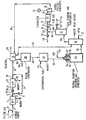
- Municipal sanitary sewage sludge having a solids content in the range of about 0.5 to 20 wt.%, say about 15 wt.%, and at a temperature in the range of about ambient to 212°F, say about 70°F in line 1 is optionally mixed with a filter aid e.g. pulverized solid carbonaceous fuel from line 2.
- the mixture is passed through line 3 into belt filter press 4.
- the highly dewatered sewage sludge leaving belt filter press 4 by way of line 6 has a solids content in the range of about 20 to 50 wt.% and may be passed through line 7, valve 8 and lines 9 and 10 into reactor 15.
- the highly dewatered sewage sludge is heated in reactor 15 at a temperature in the range of about 55°C to 343°C (130°F to 650°F) for about 6 to 140 minutes in the absence of air and at a pressure which is at or above the vapor pressure of water at the reactor temperature.
- a pumpable aqueous slurry of sewage sludge is produced.
- the heat in reactor 15 may be provided by indirect heat exchange with flue gas produced downstream in the process in expansion turbine 35 and delivered through line 36.
- Off-gas from reactor 15 is passed through line 26 and into a conventional gas purification unit (not shown).
- the heat treated sewage sludge leaving reactor 15 through line 18 is introduced into flash evaporation zone 38.
- the pressure of the aqueous slurry of sewage sludge is reduced in zone 38 to a pressure in the range of about atmospheric pressure to the saturated vapor pressure of water at the temperature in zone 38.
- Sufficient water is evaporated and is removed through line 39. This water may be used in the preparation of aqueous slurries of solid supplemental fuel in mixer 41.
- Supplemental carbonaceous fuel from line 42 is mixed with the aqueous slurry of dewatered sewage sludge from line 40 in mixer 41 to provide a pumpable fuel having an increased HHV.
- a liquid hydrocarbonaceous fuel or an aqueous slurry of solid carbonaceous from line 42 is mixed with the highly dewatered sewage sludge from line 40 in mixer 41.
- the resulting pumpable mixture having an HHV in the range of about 12 to 33 MJ/kg (5,000 to 14,000 BTU/Lb) is introduced into a conventional free flow refractory lined noncatalytic partial oxidation synthesis gas generator 49 by way of line 50 and outer annular passage 51 of burner 52.
- a free-oxygen containing gas e.g. air in line 53 at a temperature in the range of about ambient to 538°C (1,000°F) is passed through center conduit 54.
- Burner 52 is vertically mounted in upper central port 55 of gasifier 49.
- Hot raw effluent gas comprising H 2 , CO, CO 2 , H 2 O, N 2 and CH 4 leaves at the bottom of gasifier 49 through line 56 and is cooled to a temperature in the range of about 316°C to 1427°C (600°F to 2600°F) in a waste heat boiler (WHB) 16.
- the hot raw effluent gas stream is quenched in water (not shown).
- Boiler feed water in line 37 is converted into steam in WHB 16 and leaves by way of line 17.
- the partially cooled raw gas stream in line 60 at the top of WHB 16 is scrubbed with water and solvents in conventional gas cleaning and purification zone 61.
- synthesis gas is removed from zone 61 by way of line 62 , valve 63 and line 64.
- fuel gas is removed from zone 61 for use elsewhere in the process by way of line 65, 66, valve 67 and line 68 having a heat content of about 6707 to 13041 kJ/m 3 (180 - 350 BTU/SCF).
- This fuel gas may be passed through line 70, valve 71 and line 72 and into combustor 73. Complete combustion of the fuel gas with air from line 74 takes place in combustor 73. Flue gas is passed through line 75 into expansion turbine 35 which drives electric generator 76.
- the heat treated dewatered sewage sludge in line 40 is passed directly through a first annular passage in a burner provided with a central conduit and two concentric annular passages. Said burner would be located in the top of gasifier 49 in place of burner 52. Free-oxygen containing gas would be passed through the central conduit, and fuel gas from line 68 would be passed through a second annular passage in said burner. In such case, mixer 41 would not be used, and mixing of the sewage sludge and fuel gas would take place in the gasifier.
Landscapes
- Chemical & Material Sciences (AREA)
- Engineering & Computer Science (AREA)
- Organic Chemistry (AREA)
- Combustion & Propulsion (AREA)
- Oil, Petroleum & Natural Gas (AREA)
- Life Sciences & Earth Sciences (AREA)
- Hydrology & Water Resources (AREA)
- Environmental & Geological Engineering (AREA)
- Water Supply & Treatment (AREA)
- Chemical Kinetics & Catalysis (AREA)
- Mechanical Engineering (AREA)
- General Health & Medical Sciences (AREA)
- Health & Medical Sciences (AREA)
- Inorganic Chemistry (AREA)
- General Chemical & Material Sciences (AREA)
- Treatment Of Sludge (AREA)
- Liquid Carbonaceous Fuels (AREA)
- Solid Fuels And Fuel-Associated Substances (AREA)
Claims (11)
- Procédé de production de carburant à partir de boues d'égout, comprenant les étapes consistant à:(1) concentrer des boues d'égout contenant environ 0,5 à 20% en poids de matières solides dans une zone de pressage par filtre à courroie pour produire des boues d'égout hautement essorées comprenant environ 15 à 65% en poids de matières solides, et séparer l'excès d'eau desdites boues d'égout essorées;(2) chauffer les boues d'égout de (1) dans une zone réactionnelle, à une température de traitement thermique dans la gamme de 55°C à 93°C (130°F à 200°F), en l'absence d'air, pendant un temps de séjour d'environ 1 à 20 minutes et à la pression atmosphérique, puis chauffer à une température de traitement thermique dans la gamme d'environ 149°C à 343°C (300°F à 650°F), en l'absence d'air, pendant un temps de séjour d'environ 5 à 120 minutes et sous une pression égale ou supérieure à la pression de vapeur de l'eau à la température de traitement thermique, pour provoquer la décarboxylation et la déshydratation des boues d'égout et pour produire une suspension aqueuse pompable de boues d'égout;(3) réduire la pression et la température correspondante de la suspension aqueuse de boues d'égout de (2), dans une zone d'évaporation instantanée, jusqu'à une pression dans la gamme allant d'environ la pression atmosphérique à la pression de vapeur saturée de l'eau à la température régnant dans ladite zone d'évaporation instantanée, qui est dans la gamme d'environ 93°C à 204°C (200°F à 400°F) afin d'évaporer et de séparer suffisamment d'eau desdites boues d'égout pour obtenir une suspension pompable de boues d'égout essorées ayant une teneur en matières solides dans la gamme d'environ 30 à 70% en poids et ayant un pouvoir calorifique (HHV) supérieur dans la gamme d'environ 12 à 22 MJ/kg (5 000 à 9 500 BTU/lb);(4) mélanger la suspension de boues d'égout essorées de (3) avec un carburant supplémentaire, afin d'obtenir une suspension pompable ayant une teneur totale en matières solides dans la gamme d'environ 50 à 70% en poids et comprenant environ 10 à 40% en poids de boues d'égout essorées et ayant un pouvoir calorifique supérieur dans la gamme d'environ 12 à 33 MJ/kg (5 000 à 14 000 BTU/lb).
- Procédé selon la revendication 1, comprenant l'étape consistant à
(5) oxyder partiellement la suspension pompable de (4) avec un courant de gaz contenant de l'oxgène libre et un modérateur de température dans la zone réactionnelle d'un générateur de gaz, à une température dans la gamme d'environ 982°C à 1 649°C (1 800°F à 3 000°F) et sous une pression dans la gamme d'environ 0,1 à 3 MPa (1 à 30 atmosphères), pour produire un courant d'effluent brut chaud d'au moins un gaz du groupe constitué par un gaz de synthèse, un gaz réducteur et un gaz combustible. - Procédé selon la revendication 1, dans lequel le combustible en suspension pompable de (4) est brûlé jusqu'à combustion complète dans un four ou un incinérateur.
- Procédé selon l'une quelconque des revendications 1-3, dans lequel les boues d'égout, dans (1), sont concentrées par une pression superficielle dans la gamme d'environ 137 à 1 379 kPa (20 à 200 psi), appliquée auxdites boues d'égout pendant une durée allant d'environ 1/2 à 60 minutes.
- Procédé selon l'une quelconque des revendications 1-4, dans lequel les boues d'égout, dans (1), sont concentrées par la combinaison d'une filtration sous pression par courroie continue et d'une centrifugation.
- Procédé selon l'une quelconque des revendications 1-5, dans lequel la suspension pompable de boues d'égout essorées de (3) est introduite dans une zone de centrifugation pour éliminer l'eau avant l'étape (4).
- Procédé selon l'une quelconque des revendications 1-3, dans lequel lesdites boues d'égout, dans (1), sont concentrées successivement par pressage desdites boues d'égout dans une zone de filtration sous pression par courroie continue, avec un premier pressage sous une pression surfacique dans la gamme d'environ 137 à 1 379 kPa (20 à 200 livres par pouce carré) pendant une durée dans la gamme d'environ 1/2 à 60 minutes, suivi d'un second pressage avec une pression surfacique d'environ 1 379 kPa (200 livres par pouce carré) pendant une durée analogue à celle du premier pressage.
- Procédé selon la revendication 7, dans lequel un égouttage supplémentaire est réalisé par chauffage des boues à une température dans la gamme d'environ 38°C à 60°C (100°C à 140°C) durant ledit second pressage.
- Procédé selon l'une quelconque des revendications 1-8, dans lequel un égouttage supplémentaire est réalisé par pressage dans (1) desdites boues d'égout mélangées avec un auxiliaire de filtration ayant une granulométrie inférieure à 2 mm.
- Procédé selon la revendication 9, dans lequel ledit auxiliaire de filtration est choisi dans le groupe constitué par des fines de charbon et CaCO3.
- Procédé selon l'une quelconque des revendications 1-10, dans lequel les boues d'égout, dans (2), sont chauffées à la température voulue par échange de chaleur indirect avec de la vapeur d'eau ou du gaz de synthèse.
Priority Applications (5)
| Application Number | Priority Date | Filing Date | Title |
|---|---|---|---|
| US07/685,339 US5211724A (en) | 1991-04-15 | 1991-04-15 | Partial oxidation of sewage sludge |
| CA 2086212 CA2086212A1 (fr) | 1991-04-15 | 1992-12-23 | Oxydation partielle de boues residuaires |
| DE1993612250 DE69312250T2 (de) | 1993-01-21 | 1993-01-21 | Partialoxidation von Klärschlamm |
| EP19930300425 EP0607644B1 (fr) | 1991-04-15 | 1993-01-21 | Oxydation partielle de son d'égout |
| JP5132993A JP2741565B2 (ja) | 1991-04-15 | 1993-02-18 | 下水汚泥から燃料を生成するプロセス |
Applications Claiming Priority (4)
| Application Number | Priority Date | Filing Date | Title |
|---|---|---|---|
| US07/685,339 US5211724A (en) | 1991-04-15 | 1991-04-15 | Partial oxidation of sewage sludge |
| CA 2086212 CA2086212A1 (fr) | 1991-04-15 | 1992-12-23 | Oxydation partielle de boues residuaires |
| EP19930300425 EP0607644B1 (fr) | 1991-04-15 | 1993-01-21 | Oxydation partielle de son d'égout |
| JP5132993A JP2741565B2 (ja) | 1991-04-15 | 1993-02-18 | 下水汚泥から燃料を生成するプロセス |
Publications (2)
| Publication Number | Publication Date |
|---|---|
| EP0607644A1 EP0607644A1 (fr) | 1994-07-27 |
| EP0607644B1 true EP0607644B1 (fr) | 1997-07-16 |
Family
ID=27426997
Family Applications (1)
| Application Number | Title | Priority Date | Filing Date |
|---|---|---|---|
| EP19930300425 Expired - Lifetime EP0607644B1 (fr) | 1991-04-15 | 1993-01-21 | Oxydation partielle de son d'égout |
Country Status (4)
| Country | Link |
|---|---|
| US (1) | US5211724A (fr) |
| EP (1) | EP0607644B1 (fr) |
| JP (1) | JP2741565B2 (fr) |
| CA (1) | CA2086212A1 (fr) |
Families Citing this family (28)
| Publication number | Priority date | Publication date | Assignee | Title |
|---|---|---|---|---|
| US5685153A (en) * | 1985-12-26 | 1997-11-11 | Enertech Environmental, Inc. | Efficient utilization of chlorine and/or moisture-containing fuels and wastes |
| US5485728A (en) * | 1985-12-26 | 1996-01-23 | Enertech Environmental, Inc. | Efficient utilization of chlorine and moisture-containing fuels |
| US5264009A (en) * | 1992-09-01 | 1993-11-23 | Texaco Inc. | Processing of sewage sludge for use as a fuel |
| US5423894A (en) * | 1993-05-03 | 1995-06-13 | Texaco Inc. | Partial oxidation of low rank coal |
| FI98626C (sv) * | 1994-10-04 | 1997-07-25 | Eka Nobel Ab | Förfarande för rening av avloppsvatten |
| US6398921B1 (en) | 1995-03-15 | 2002-06-04 | Microgas Corporation | Process and system for wastewater solids gasification and vitrification |
| DE19809400C1 (de) * | 1998-03-05 | 1999-07-08 | A & B Wirtschaftsdienst Dallin | Verfahren zur Aufbereitung von Reststoffgemengen und zur Konversion von kohlenstoffhaltigen Rest- oder Rohstoffen in den Reststoffgemengen und Vorrichtung zur Durchführung derartiger Verfahren |
| US6063147A (en) * | 1998-12-17 | 2000-05-16 | Texaco Inc. | Gasification of biosludge |
| EP1272257A4 (fr) * | 2000-04-04 | 2005-05-11 | Ecoshield Environmental Techno | Procede et appareil universels permettant de convertir des composes volatils |
| EP1572841B1 (fr) * | 2002-11-18 | 2008-04-30 | Samson Bimatech I/S | Procede de traitement de lisier |
| SE528087C2 (sv) * | 2004-04-08 | 2006-08-29 | Stena Miljoeteknik Ab | Förfarande för behandling av farligt avfall i vätskeform samt anläggning för att genomföra förfarandet med |
| US7685737B2 (en) | 2004-07-19 | 2010-03-30 | Earthrenew, Inc. | Process and system for drying and heat treating materials |
| US7694523B2 (en) | 2004-07-19 | 2010-04-13 | Earthrenew, Inc. | Control system for gas turbine in material treatment unit |
| US7024800B2 (en) | 2004-07-19 | 2006-04-11 | Earthrenew, Inc. | Process and system for drying and heat treating materials |
| US7024796B2 (en) | 2004-07-19 | 2006-04-11 | Earthrenew, Inc. | Process and apparatus for manufacture of fertilizer products from manure and sewage |
| US8518243B2 (en) * | 2004-10-01 | 2013-08-27 | Saudi Arabian Oil Company | Method for utilizing hydrocarbon waste materials as fuel and feedstock |
| US7909895B2 (en) * | 2004-11-10 | 2011-03-22 | Enertech Environmental, Inc. | Slurry dewatering and conversion of biosolids to a renewable fuel |
| KR101151121B1 (ko) | 2005-04-27 | 2012-06-01 | 미쯔비시 가꼬끼 가이샤 리미티드 | 유기성 폐기물의 처리 설비 및 처리 방법 |
| US7610692B2 (en) | 2006-01-18 | 2009-11-03 | Earthrenew, Inc. | Systems for prevention of HAP emissions and for efficient drying/dehydration processes |
| GB2458271A (en) * | 2008-03-10 | 2009-09-16 | Mch Systems Ltd | Converting sewage to useful products |
| US9057031B2 (en) * | 2008-10-03 | 2015-06-16 | Exxonmobil Research And Engineering Company | Co-gasification process for hydrocarbon solids and biomass |
| US20110091953A1 (en) * | 2009-04-07 | 2011-04-21 | Enertech Environmental, Inc. | Method for converting organic material into a renewable fuel |
| WO2013040217A1 (fr) * | 2011-09-14 | 2013-03-21 | Aquasource Technologies Corporation | Système et procédé pour le traitement de l'eau |
| US20140158940A1 (en) * | 2012-07-24 | 2014-06-12 | Shahram Navaee-Ardeh | Production of Synthesis Gas From Biosolid-Containing Sludges Having a High Moisture Content |
| CN103013613B (zh) * | 2012-12-24 | 2014-04-09 | 西安科技大学 | 一种城市污泥洁净燃料化系统及污泥燃料化方法 |
| BE1021960B1 (fr) * | 2013-10-17 | 2016-01-29 | Eco Technopole-Wallonie Scrl | Procede de traitement de boues |
| EP3366752A1 (fr) * | 2017-02-28 | 2018-08-29 | L'air Liquide, Société Anonyme Pour L'Étude Et L'exploitation Des Procédés Georges Claude | Procédé de fabrication de gaz de synthèse par le gazéification de supports de carbone solides |
| US11897787B2 (en) * | 2020-04-29 | 2024-02-13 | Zero Discharge, LLC | Zero discharge water treatment apparatus and method |
Family Cites Families (18)
| Publication number | Priority date | Publication date | Assignee | Title |
|---|---|---|---|---|
| NL277122A (fr) * | 1961-04-14 | |||
| US3544291A (en) * | 1968-04-22 | 1970-12-01 | Texaco Inc | Coal gasification process |
| GB1304016A (fr) * | 1969-05-22 | 1973-01-24 | ||
| US3847564A (en) * | 1970-01-23 | 1974-11-12 | Texaco Development Corp | Apparatus and process for burning liquid hydrocarbons in a synthesis gas generator |
| US3622511A (en) * | 1970-09-14 | 1971-11-23 | Fmc Corp | Sewage treatment system |
| US3687646A (en) * | 1970-12-21 | 1972-08-29 | Texaco Development Corp | Sewage disposal process |
| US3926129A (en) * | 1975-01-03 | 1975-12-16 | Dorr Oliver Inc | Evaporative concentration of waste sludges with incinerator exhaust gases |
| US4052176A (en) * | 1975-09-29 | 1977-10-04 | Texaco Inc. | Production of purified synthesis gas H2 -rich gas, and by-product CO2 -rich gas |
| GB1465869A (en) * | 1975-10-03 | 1977-03-02 | Esmil Envirotech Ltd | Method of incinerating sewage sludges |
| US4081253A (en) * | 1976-12-10 | 1978-03-28 | Texaco Development Corporation | Production of purified synthesis gas and carbon monoxide |
| US4193206A (en) * | 1977-03-08 | 1980-03-18 | Uop Inc. | Processes for drying sewage sludge and filtering water |
| US4321151A (en) * | 1979-12-07 | 1982-03-23 | Mcmullen Frederick G | Process for wastewater treatment and wastewater sludge conversion into energy |
| FI81141B (fi) * | 1986-09-22 | 1990-05-31 | Ahlstroem Oy | Foerfarande foer koncentrering av uppslamningar. |
| US4988442A (en) * | 1988-11-07 | 1991-01-29 | Polypure, Inc. | Process for dewatering of biological sludge |
| US4875906A (en) * | 1988-11-10 | 1989-10-24 | Texaco Inc. | Partial oxidation of low heating value hazardous waste petroleum products |
| US4933086A (en) * | 1989-08-03 | 1990-06-12 | Texaco Inc. | Partial oxidation of sewage sludge |
| US4983296A (en) * | 1989-08-03 | 1991-01-08 | Texaco Inc. | Partial oxidation of sewage sludge |
| US5356540A (en) * | 1991-05-20 | 1994-10-18 | Texaco Inc. | Pumpable aqueous slurries of sewage sludge |
-
1991
- 1991-04-15 US US07/685,339 patent/US5211724A/en not_active Expired - Fee Related
-
1992
- 1992-12-23 CA CA 2086212 patent/CA2086212A1/fr not_active Abandoned
-
1993
- 1993-01-21 EP EP19930300425 patent/EP0607644B1/fr not_active Expired - Lifetime
- 1993-02-18 JP JP5132993A patent/JP2741565B2/ja not_active Expired - Fee Related
Also Published As
| Publication number | Publication date |
|---|---|
| US5211724A (en) | 1993-05-18 |
| CA2086212A1 (fr) | 1994-06-24 |
| JPH06246297A (ja) | 1994-09-06 |
| EP0607644A1 (fr) | 1994-07-27 |
| JP2741565B2 (ja) | 1998-04-22 |
Similar Documents
| Publication | Publication Date | Title |
|---|---|---|
| EP0607644B1 (fr) | Oxydation partielle de son d'égout | |
| US5230211A (en) | Partial oxidation of sewage sludge | |
| EP0515117B1 (fr) | Suspensions aqueuses pompables ou boues résiduaires | |
| US5292442A (en) | Process for disposing of sewage sludge | |
| EP0411881B1 (fr) | Oxydation partielle de boues résiduaires | |
| US5264009A (en) | Processing of sewage sludge for use as a fuel | |
| US5188740A (en) | Process for producing pumpable fuel slurry of sewage sludge and low grade solid carbonaceous fuel | |
| US5217625A (en) | Process for disposing of sewage sludge | |
| US6333015B1 (en) | Synthesis gas production and power generation with zero emissions | |
| US6190429B1 (en) | Method and apparatus for treating wastes by gasification | |
| US5550312A (en) | Method of thermal utilization of waste materials | |
| US4950309A (en) | Process for the conversion of toxic organic substances to useful products | |
| US4933086A (en) | Partial oxidation of sewage sludge | |
| US5211723A (en) | Process for reacting pumpable high solids sewage sludge slurry | |
| US5188739A (en) | Disposal of sewage sludge | |
| US5234468A (en) | Process for utilizing a pumpable fuel from highly dewatered sewage sludge | |
| EP0113469B1 (fr) | Méthode pour enlever l'eau acide de scories de gazéification de charbon | |
| JP2000140800A (ja) | 廃棄物のガス化処理装置 | |
| JPH09235148A (ja) | セメント炉中で残留物および廃棄物ならびに低発熱量燃料を利用する方法 | |
| US5266085A (en) | Process for disposing of sewage sludge | |
| JP3079051B2 (ja) | 廃棄物のガス化処理方法 | |
| US5234469A (en) | Process for disposing of sewage sludge | |
| EP0545683B1 (fr) | Elimination de boue d'égout | |
| JPH09241666A (ja) | 蒸気力発電所において残留物および廃棄物ならびに低発熱量燃料をエネルギー的に利用する方法 | |
| CN1036933C (zh) | 氧化法部分处理污水污泥 |
Legal Events
| Date | Code | Title | Description |
|---|---|---|---|
| PUAI | Public reference made under article 153(3) epc to a published international application that has entered the european phase |
Free format text: ORIGINAL CODE: 0009012 |
|
| AK | Designated contracting states |
Kind code of ref document: A1 Designated state(s): DE FR GB IT NL |
|
| 17P | Request for examination filed |
Effective date: 19950109 |
|
| 17Q | First examination report despatched |
Effective date: 19960814 |
|
| GRAG | Despatch of communication of intention to grant |
Free format text: ORIGINAL CODE: EPIDOS AGRA |
|
| GRAH | Despatch of communication of intention to grant a patent |
Free format text: ORIGINAL CODE: EPIDOS IGRA |
|
| GRAH | Despatch of communication of intention to grant a patent |
Free format text: ORIGINAL CODE: EPIDOS IGRA |
|
| GRAA | (expected) grant |
Free format text: ORIGINAL CODE: 0009210 |
|
| AK | Designated contracting states |
Kind code of ref document: B1 Designated state(s): DE FR GB IT NL |
|
| PG25 | Lapsed in a contracting state [announced via postgrant information from national office to epo] |
Ref country code: NL Free format text: LAPSE BECAUSE OF FAILURE TO SUBMIT A TRANSLATION OF THE DESCRIPTION OR TO PAY THE FEE WITHIN THE PRESCRIBED TIME-LIMIT Effective date: 19970716 Ref country code: IT Free format text: LAPSE BECAUSE OF FAILURE TO SUBMIT A TRANSLATION OF THE DESCRIPTION OR TO PAY THE FEE WITHIN THE PRESCRIBED TIME-LIMIT;WARNING: LAPSES OF ITALIAN PATENTS WITH EFFECTIVE DATE BEFORE 2007 MAY HAVE OCCURRED AT ANY TIME BEFORE 2007. THE CORRECT EFFECTIVE DATE MAY BE DIFFERENT FROM THE ONE RECORDED. Effective date: 19970716 Ref country code: FR Effective date: 19970716 |
|
| REF | Corresponds to: |
Ref document number: 69312250 Country of ref document: DE Date of ref document: 19970821 |
|
| NLV1 | Nl: lapsed or annulled due to failure to fulfill the requirements of art. 29p and 29m of the patents act | ||
| EN | Fr: translation not filed | ||
| PLBE | No opposition filed within time limit |
Free format text: ORIGINAL CODE: 0009261 |
|
| 26N | No opposition filed | ||
| REG | Reference to a national code |
Ref country code: GB Ref legal event code: IF02 |
|
| PGFP | Annual fee paid to national office [announced via postgrant information from national office to epo] |
Ref country code: GB Payment date: 20021210 Year of fee payment: 11 |
|
| PGFP | Annual fee paid to national office [announced via postgrant information from national office to epo] |
Ref country code: DE Payment date: 20030131 Year of fee payment: 11 |
|
| PG25 | Lapsed in a contracting state [announced via postgrant information from national office to epo] |
Ref country code: GB Free format text: LAPSE BECAUSE OF NON-PAYMENT OF DUE FEES Effective date: 20040121 |
|
| PG25 | Lapsed in a contracting state [announced via postgrant information from national office to epo] |
Ref country code: DE Free format text: LAPSE BECAUSE OF NON-PAYMENT OF DUE FEES Effective date: 20040803 |
|
| GBPC | Gb: european patent ceased through non-payment of renewal fee |
Effective date: 20040121 |