EP0607774A2 - Verwendung von Leflunomid zur Hemmung von Interleukin 1 alpha - Google Patents
Verwendung von Leflunomid zur Hemmung von Interleukin 1 alpha Download PDFInfo
- Publication number
- EP0607774A2 EP0607774A2 EP94100012A EP94100012A EP0607774A2 EP 0607774 A2 EP0607774 A2 EP 0607774A2 EP 94100012 A EP94100012 A EP 94100012A EP 94100012 A EP94100012 A EP 94100012A EP 0607774 A2 EP0607774 A2 EP 0607774A2
- Authority
- EP
- European Patent Office
- Prior art keywords
- leflunomide
- diseases
- treatment
- interleukin
- alpha
- Prior art date
- Legal status (The legal status is an assumption and is not a legal conclusion. Google has not performed a legal analysis and makes no representation as to the accuracy of the status listed.)
- Granted
Links
- VHOGYURTWQBHIL-UHFFFAOYSA-N Cc([o]nc1)c1C(Nc1ccc(C(F)(F)F)cc1)=O Chemical compound Cc([o]nc1)c1C(Nc1ccc(C(F)(F)F)cc1)=O VHOGYURTWQBHIL-UHFFFAOYSA-N 0.000 description 1
Classifications
-
- A—HUMAN NECESSITIES
- A61—MEDICAL OR VETERINARY SCIENCE; HYGIENE
- A61K—PREPARATIONS FOR MEDICAL, DENTAL OR TOILETRY PURPOSES
- A61K31/00—Medicinal preparations containing organic active ingredients
- A61K31/33—Heterocyclic compounds
- A61K31/395—Heterocyclic compounds having nitrogen as a ring hetero atom, e.g. guanethidine or rifamycins
- A61K31/41—Heterocyclic compounds having nitrogen as a ring hetero atom, e.g. guanethidine or rifamycins having five-membered rings with two or more ring hetero atoms, at least one of which being nitrogen, e.g. tetrazole
- A61K31/42—Oxazoles
-
- A—HUMAN NECESSITIES
- A61—MEDICAL OR VETERINARY SCIENCE; HYGIENE
- A61P—SPECIFIC THERAPEUTIC ACTIVITY OF CHEMICAL COMPOUNDS OR MEDICINAL PREPARATIONS
- A61P3/00—Drugs for disorders of the metabolism
- A61P3/08—Drugs for disorders of the metabolism for glucose homeostasis
-
- A—HUMAN NECESSITIES
- A61—MEDICAL OR VETERINARY SCIENCE; HYGIENE
- A61P—SPECIFIC THERAPEUTIC ACTIVITY OF CHEMICAL COMPOUNDS OR MEDICINAL PREPARATIONS
- A61P3/00—Drugs for disorders of the metabolism
- A61P3/08—Drugs for disorders of the metabolism for glucose homeostasis
- A61P3/10—Drugs for disorders of the metabolism for glucose homeostasis for hyperglycaemia, e.g. antidiabetics
-
- A—HUMAN NECESSITIES
- A61—MEDICAL OR VETERINARY SCIENCE; HYGIENE
- A61P—SPECIFIC THERAPEUTIC ACTIVITY OF CHEMICAL COMPOUNDS OR MEDICINAL PREPARATIONS
- A61P35/00—Antineoplastic agents
- A61P35/02—Antineoplastic agents specific for leukemia
-
- A—HUMAN NECESSITIES
- A61—MEDICAL OR VETERINARY SCIENCE; HYGIENE
- A61P—SPECIFIC THERAPEUTIC ACTIVITY OF CHEMICAL COMPOUNDS OR MEDICINAL PREPARATIONS
- A61P43/00—Drugs for specific purposes, not provided for in groups A61P1/00-A61P41/00
Definitions
- Leflunomide (see formula, N- (4-trifluoromethylphenyl) -5-methyl-isoxazole-4-carboxamide) is already known as a chemical compound (EP 0013376, EP 0217206, US 4351841, US 4965276).
- this substance also has immunomodulatory effects which enable it to treat autoimmune diseases and graft rejection reactions.
- a metabolite called N- (4-trifluoromethylphenyl) -2-cyano-3-hydroxy-crotonic acid amide (see formula) is responsible for the healing effects of leflunomide.
- the pharmacological effects of leflunomide cited above can also be obtained by application of this named metabolite (Bartlett et al, Agents and Actions, 32 (1991) 10-21).
- the cytokines are a class of diverse, biologically highly potent peptides, the structures of which are already known. It is also known that they are endogenously induced and synthesized as transmitter substances.
- cytokines The suppression of cytokines in the human or animal body is of great medical importance because excessive levels of these cytokines can lead to the occurrence or outbreak of numerous diseases.
- a drug could also be used to treat such diseases, which prevents the undesirable effect of the cytokines which may already be present on organ, cell, tissue and receptor systems of the body;
- the use or the release of leflunomide already prevents the synthesis or release of the cytokine, so that it does not arise at all, and thus the development of the disease is prevented at a very early stage can.
- the present invention relates to the use of leflunomide for the manufacture of a medicament for the prevention and treatment of diseases of the human and animal body in which the cytokine called interleukin 1 alpha (IL1alpha) is involved.
- IL1alpha interleukin 1 alpha
- the present invention further relates to the use of leflunomide for the treatment of such diseases.
- the invention also relates to medicaments which contain an effective amount of leflunomide, in addition to pharmaceutically suitable and physiologically tolerable carriers, diluents and / or other active substances and auxiliaries.
- the invention also relates to a process for the preparation of a medicament for the prevention and treatment of diseases in which interleukin 1 alpha is involved, which is characterized in that leflunomide with a pharmaceutically suitable and physiologically acceptable carrier and, if appropriate, other suitable active ingredients, additives. or adjuvants into a suitable preparation form.
- IL1alpha and its disease-causing effects are described in detail in Ibelgaufts, Lexikon Zytokine, Medikon Verlag, Kunststoff 1992, and in the literature cited there.
- IL1alpha was originally referred to as "Catabolin” because of its cartilage absorption increasing effect and as “Monocyte Cell Factor” (MCF) because of its stimulating effect on collagenase and prostaglandin in synovial cells, but also as “Leukocyte Endogenous Factor” (LEM) with a stimulating effect Acute phase reactions.
- MCF Monitoring Cell Factor
- LEM Leukocyte Endogenous Factor
- IL1alpha has a broad biological Activity spectrum, because the synthesis of IL1alpha can take place in numerous cells such as monocytes, macrophages, fibroblasts, endothelial cells and lymphocytes, and many cells also have specific receptors for IL1alpha. It is thus understandable that IL1alpha in particular has a central position as a trigger for various illnesses and disease symptoms. These are often serious diseases, the treatment of which is not possible at all or only insufficiently. This is another reason why the effects of leflunomide found are of great importance.
- the present invention further relates to the use of leflumonide for the prevention and treatment of diseases with increased cartilage absorption, chronic leukemia, type I diabetes or febrile diseases which are caused by pyrogens (Scrip, volume 1713, page 15 ff. (1992); Boraschi et al., Eur. J. Immunol., 20 (1990), page 317 ff.).
- Suitable solid or liquid pharmaceutical preparation forms are, for example, granules, powders, dragees, tablets, (micro) capsules, suppositories, syrups, juices, suspensions, emulsions, drops or injectable solutions, and preparations with protracted active ingredient release, and conventional auxiliaries in their preparation, such as Carriers, explosives, binders, coating agents, swelling agents, lubricants or lubricants, flavoring agents, sweeteners or solubilizers can be used. As commonly used auxiliaries such. B.
- magnesium carbonate titanium dioxide, lactose, mannitol and other sugars, talc, milk protein, gelatin, starch, cellulose and its derivatives, animal and vegetable oils, polyethylene glycols and solvents such as sterile water and monohydric or polyhydric alcohols, e.g. B. Glycerin called.
- dose units of 3 to 5 mg, preferably 10, 25 or 50 mg per patient (70 kg body weight) are administered. If medically necessary, the dose unit can be increased to 100, 200 or 500 mg per patient.
- the dosage can be given once a day to once a week, preferably up to three or four times a day.
- the application can be oral, peritoneal, intravenous, intra-articular or transdermal in the usual way. The corresponding veterinary applications can also be easily calculated from this information.
- leflunomide can also be formulated together with other suitable active ingredients, for example antiuricopathics, platelet aggregation inhibitors, analgesics and other steroidal or non-steroidal anti-inflammatory drugs, in the preparation of the aforementioned galgenic preparation forms.
- suitable active ingredients for example antiuricopathics, platelet aggregation inhibitors, analgesics and other steroidal or non-steroidal anti-inflammatory drugs, in the preparation of the aforementioned galgenic preparation forms.
- leflunomide could be demonstrated experimentally on an isolated blood cell fraction (mononuclear cells), which in particular did not cause any noteworthy metabolism of the leflunomide to its metabolite.
- the mononuclear cells from freshly obtained human citrate blood were enriched by known standard methods (see Tiku et al, J. Immunol. 136/10 (1986) 3677):
- the washed cell fraction was taken up in 1 ml RPMI 1640, to which 300 mg / l L-glutamine, 25 mmol / l HEPES (Gibco, Berlin) 0.1 g / ml streptomycin and 0.1 g / ml penizylline had previously been added .
- the cell suspension which consists of approx. 90% lymphocytes and 10% monocytes, was set to approximately 5 million cells / ml.
- the cell viability was checked before and after the inhibition experiments using the known lactate dehydrogenase method. No change in viability was found.
- IL1alpha The synthesis and release of cellular IL1alpha was induced by adding to 0.48 ml of the cell fraction described above a solution of 500 ng lipopolysaccharide (Salmonella abortus equi, Sigma GmbH, Deisenhofen) in 0.01 ml dimethyl sulfoxide / water (1:10, v / v) was given. At the same time, a solution of leflunomide or of leflunomide metabolite in 0.01 ml of dimethyl sulfoxide (for the respective final concentration see table 1) was added to the cell fraction, and the mixture was left in a commercial incubator at 37 ° C. for 20 h.
- lipopolysaccharide Salmonella abortus equi, Sigma GmbH, Deisenhofen
- the samples were centrifuged for 1 min in a table centrifuge, and 0.025 ml aliquots of the supernatant were specifically prepared using the “sandwich” enzyme immunoassay test kit (Biermann GmbH, Bad Nauheim) according to the manufacturer's instructions examined their IL1alpha content.
- the control values were determined without the addition of leflunomide or metabolite and set to 100%. In particular, a possible influence of dimethyl sulfoxide on the IL1alpha level was excluded by means of corresponding comparative measurements.
- the acute toxicity after intraperitoneal administration of the test substance was carried out with NMRI mice (20 to 25 g) and SD rats (120 to 195 g).
- the test substance was suspended in a 1% sodium carboxymethyl cellulose solution.
- the various doses of the test substance were administered to the mice in a volume of 10 ml / kg body weight and to the rats in a volume of 5 ml / kg body weight. 10 animals were used per dose.
- acute toxicity was determined using the Litchfield and Wilcoxon method. The results are summarized in Table 2.
- Table 2 Leflunomide acute toxicity intraperitoneal LD50 (mg / kg) NMRI mouse 185 (163-210) SD rat 170 (153-189)
Landscapes
- Health & Medical Sciences (AREA)
- Medicinal Chemistry (AREA)
- Veterinary Medicine (AREA)
- Public Health (AREA)
- General Health & Medical Sciences (AREA)
- Animal Behavior & Ethology (AREA)
- Life Sciences & Earth Sciences (AREA)
- Pharmacology & Pharmacy (AREA)
- Chemical & Material Sciences (AREA)
- Diabetes (AREA)
- Nuclear Medicine, Radiotherapy & Molecular Imaging (AREA)
- Chemical Kinetics & Catalysis (AREA)
- Organic Chemistry (AREA)
- General Chemical & Material Sciences (AREA)
- Engineering & Computer Science (AREA)
- Hematology (AREA)
- Bioinformatics & Cheminformatics (AREA)
- Obesity (AREA)
- Endocrinology (AREA)
- Emergency Medicine (AREA)
- Epidemiology (AREA)
- Oncology (AREA)
- Heterocyclic Carbon Compounds Containing A Hetero Ring Having Nitrogen And Oxygen As The Only Ring Hetero Atoms (AREA)
- Pharmaceuticals Containing Other Organic And Inorganic Compounds (AREA)
- Medicines Containing Material From Animals Or Micro-Organisms (AREA)
- Saccharide Compounds (AREA)
Abstract
Description
- Leflunomid (s. Formel, N-(4-Trifluormethylphenyl)-5-methyl-isoxazol-4-carboxamid) ist als chemische Verbindung bereits bekannt (EP 0013376, EP 0217206, US 4351841, US 4965276).
- Neben den bereits offenbarten antiphlogistischen Effekten bewirkt diese Substanz auch immunomodulatorische Wirkungen die sie zur Behandlung von Autoimmunerkrankungen und Transplantatabstossungsreaktionen befähigen. Es ist auch schon bekannt, daß ein Metabolit mit der Bezeichnung N-(4-Trifluormethylphenyl)-2-cyano-3-hydroxy-crotonsäureamid (s. Formel) für die heilenden Wirkungen von Leflunomid verantwortlich ist.
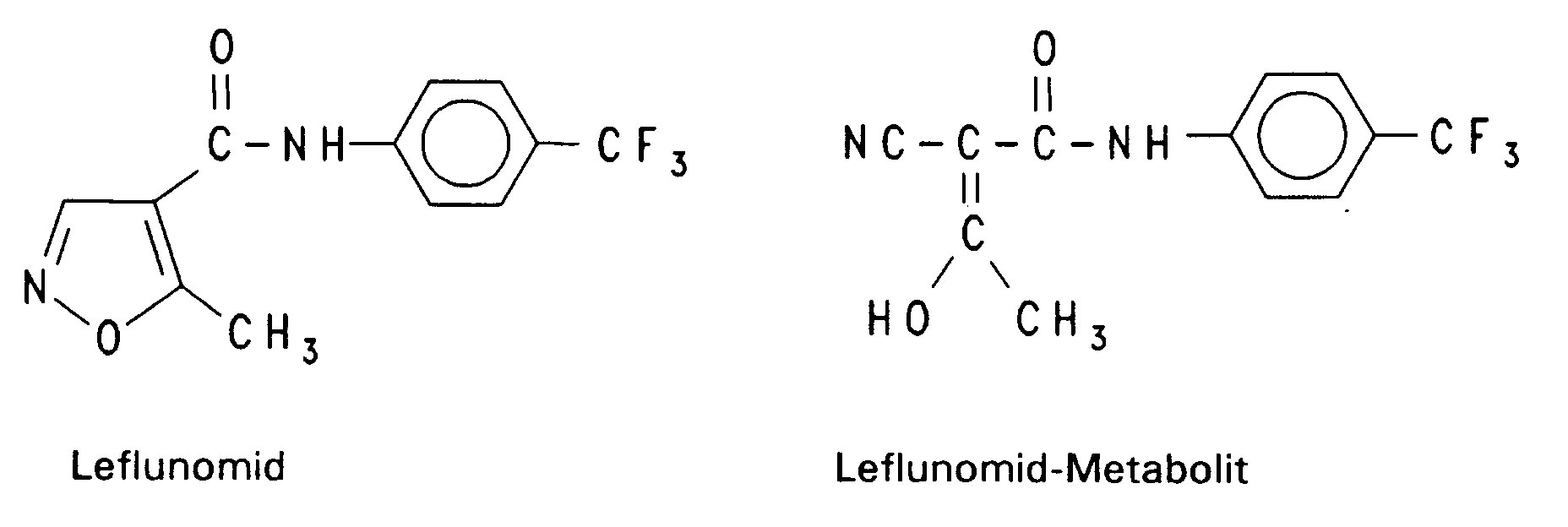
In Übereinstimmung mit dieser Erkenntnis können die oben zitierten pharmakologischen Wirkungen von Leflunomid auch durch Applikation dieses genannten Metaboliten erhalten werden (Bartlett et al, Agents and Actions, 32 (1991) 10-21). - Auch in Axton et al, J.Chem.Soc.Perkin Trans. 1 (1992) 2203ff ist beschrieben worden, daß nicht Leflunomid das aktive Prinzip darstellt, sondern daß dieser primäre Metabolit die biologischen Wirkungen entfaltet.
- Sowohl in der Literatur (Bartlett et al, Agents and Actions, 32 (1991) 10-21) als auch in eigenen Experimenten konnte gezeigt werden, daß die im folgenden näher beschriebenen therapeutischen Wirkungen durch Applikation des Leflunomid-Metaboliten nicht erhalten werden können. Erfindungsgemäß wurde nämlich gefunden, daß Leflunomid einen starken inhibitorischen Einfluß auf die Synthese bzw. Freisetzung von Zytokinen aus menschlichen Blutzellen besitzt, wohingegen der Leflunomid-Metabolit diese vorteilhafte Wirkung nicht aufweist.
- Unter den erfindungsgemäß angewandten experimentellen Bedingungen findet keine nennenswerte Metabolisierung des Leflunomid statt, und die inhibierende Wirkung ist ausschließlich der Substanz Leflunomid zuzuschreiben.
- Bei den Zytokinen handelt es sich um eine Klasse verschiedenartiger, biologisch hochpotenter Peptide, deren Strukturen bereits bekannt sind. Es ist ebenfalls schon bekannt, daß sie endogen als Transmittersubstanzen induziert und synthetisiert werden.
- Die Unterdrückung von Zytokinen im menschlichen oder tierischen Körper ist deshalb von großer medizinischer Bedeutung, weil überhöhte Spiegel dieser Zytokine zum Auftreten bzw. Ausbrechen zahlreicher Krankheiten führen können.
- Zwar könnte zur Behandlung solcher Krankheiten auch ein Medikament eingesetzt werden, das die unerwünschte Wirkung des gegebenenfalls bereits vorhandenen Zytokines auf Organ-, Zell-, Gewebe- und Rezeptorsysteme des Körpers verhindert; es ist nun jedoch ein weiterer signifikanter Vorteil der vorliegenden Erfindung, daß durch Einsatz von Leflunomid bereits die Synthese bzw. Freisetzung des Zytokines verhindert wird, so daß dieses gar nicht erst entsteht, und somit die Entstehung der Krankheit bereits in einer sehr frühen Phase verhindert werden kann.
- Die vorliegende Erfindung betrifft die Verwendung von Leflunomid zur Herstellung eines Arzneimittels zur Vorbeugung und Behandlung von Krankheiten des menschlichen und tierischen Körpers, bei denen das Zytokin mit der Bezeichnung Interleukin 1 alpha (IL1alpha) involviert ist.
- Die vorliegende Erfindung betrifft ferner die Verwendung von Leflunomid zur Behandlung solcher Krankheiten. Die Erfindung betrifft auch Arzneimittel, die eine wirksame Menge von Leflunomid enthalten, neben pharmazeutisch geeigneten und physiologisch verträglichen Trägerstoffen, Verdünnungsmitteln und/oder anderen Wirk- und Hilfsstoffen.
- Die Erfindung betrifft auch ein Verfahren zur Herstellung eines Arzneimittels zur Vorbeugung und Behandlung von Krankheiten, bei denen Interleukin 1 alpha involviert ist, das dadurch gekennzeichnet ist, daß man Leflunomid mit einem pharmazeutisch geeigneten und physiologisch annehmbaren Träger und gegebenenfalls weiteren geeigneten Wirk-, Zusatz- oder Hilfsstoffen in eine geeignete Zubereitungsform bringt.
- IL1alpha und seine krankheitsverursachenden Wirkungen sind ausführlich in Ibelgaufts, Lexikon Zytokine, Medikon Verlag, München 1992, und in der dort zitierten Literatur beschrieben.
- Auch z. B. in Oppenheim et al, Immunology Today 7 (1986) 45-56, Durum et al, Ann. Rev. Immunol. 3 (1985) 263-287 und Symons et al, Lymphokine Research 8 (1989) 365-372 wird auf die unerwünschten Wirkungen von IL1alpha hingewiesen. IL1alpha wurde ursprünglich als "Catabolin" wegen seiner die Knorpelresorption erhöhenden Wirkung bezeichnet sowie als "Monozyten Zell Faktor" (MCF) wegen seiner stimulierenden Wirkung auf Kollagenase und Prostaglandin in Synovialzellen, aber auch als "Leukozyten endogener Faktor" (LEM) mit stimulierender Wirkung auf Akutphasenreaktionen. Darüber hinaus hat IL1alpha ein breites biologisches Aktivitätsspektrum, denn die Synthese von IL1alpha kann in zahlreichen Zellen wie Monozyten, Makrophagen, Fibroblasten, Endothelzellen und Lymphozyten erfolgen, ebenso besitzen viele Zellen spezifische Rezeptoren für IL1alpha. So wird verständlich, daß insbesondere IL1alpha eine zentrale Stellung als Auslöser verschiedener Krankheiten und Krankheitssymptome einnimmt. Dabei handelt es sich häufig um schwerwiegende Krankheiten, deren Behandlung heute gar nicht oder nur unzureichend möglich ist. Auch deshalb kommt der aufgefundenen Wirkung von Leflunomid eine große Bedeutung zu.
- Die vorliegende Erfindung betrifft ferner die Verwendung von Leflumonid zur Vorbeugung und Behandlung von Krankheiten mit erhöhter Knorpelresorption, chronische Leukämie, Typ I-Diabetis oder fiebrige Erkrankungen, die durch Pyrogene verursacht sind (Scrip, Band 1713, Seite 15 ff. (1992); Boraschi et al., Eur. J. Immunol., 20 (1990), Seite 317 ff.).
- Zur Behandlung dieser Krankheiten können insbesondere auch Arneimittelformen und galenische Zubereitungen von Leflunomid, die auf üblichem Wege hergestellt worden sind, Verwendung finden.
- Geeignete feste oder flüssige galenische Zubereitungsformen sind beispielsweise Granulate, Pulver, Dragees, Tabletten, (Mikro)Kapseln, Suppositorien, Sirupe, Säfte, Suspensionen, Emulsionen, Tropfen oder injizierbare Lösungen sowie Präparate mit protrahierter Wirkstoff-Freigabe, bei deren Herstellung übliche Hilfsmittel, wie Trägerstoffe, Spreng-, Binde-, Überzugs-, Quellungs-, Gleit- oder Schmiermittel, Geschmacksstoffe, Süßungsmittel oder Lösungsvermittler, Verwendung finden. Als häufig verwendete Hilfsstoffe seien z. B. Magnesiumcarbonat, Titandioxid, Laktose, Mannit und andere Zucker, Talkum, Milcheiweiß, Gelatine, Stärke, Cellulose und ihre Derivate, tierische und pflanzliche Öle, Polyätthylenglykole und Lösungsmittel, wie etwa sterile Wasser und ein oder mehrwertige Alkohole, z. B. Glycerin, genannt.
- In der Humanmedizin werden Dosiseinheiten mit 3 bis 5 mg, vorzugsweise 10, 25 oder 50 mg pro Patient (70 kg Körpergewicht) verabfolgt. Falls medizinisch erforderlich kann die Dosiseinheit bis auf 100, 200 oder 500 mg pro Patient gesteigert werden. Die Dosierung kann einmal täglich bis einmal wöchentlich, vorzugsweise bis zu drei oder viermal täglich erfolgen. Die Applikation kann oral, peritoneal, intravenös, intraartikulär oder transdermal auf übliche Weise erfolgen. Aus diesen Angaben lassen sich auch leicht die entsprechenden veterinärmedizinischen Applikationen berechnen.
- Schließlich kann Leflunomid bei der Herstellung der vorgenannten galensichen Zubereitungsformen auch zusammen mit anderen geeigneten Wirkstoffen, beispielsweise Antiuricopathika, Thrombocytenaggregationshemmern, Analgetika und anderen steroidalen oder nicht-steroidalen Antiphlogistika, formuliert werden.
- Experimentell konnten die Wirkungen von Leflunomid an einer isolierten Blutzellfraktion (mononukleare Zellen) nachgewiesen werden, die insbesondere keine nennenswerte Metabolisierung des Leflunomids zu seinem Metaboliten bewirkte.
- 10 ml frisch hergestelltes menschliches Zitratblut wurden vorsichtig mit 15ml Lymphoprep(R) (Molter GmbH, Heidelberg) unterschichtet und dann bei 400 xg 40 min bei 20°C zentrifugiert. Die sich in der Phasengrenze als weißer Ring abzeichnende Zellfraktion wurde mit Hilfe einer Spritze herausgezogen, 1:1 (v/v) mit PM-16-Puffer (Fa. Serva Feinbiochemica GmbH & Co KG, Heidelberg) verdünnt und wie oben für 10 min zentrifugiert. Der Überstand wurde mit 10 ml RPMI 1640-Puffer (Gibco, Berlin), dem vorher 300 mg/l L-Glutamin zugesetzt worden waren, gewaschen. Die gewaschene Zellfraktion wurde in 1 ml RPMI 1640, dem vorher 300 mg /l L-Glutamin, 25 mmol/l HEPES (Gibco, Berlin) 0,1 g/ml Streptomyzin und 0,1 g/ml Penizyllin zugesetzt worden waren, aufgenommen. Mit Hilfe eines Zellzählers (Typ IT , Fa. Coulter Diagnostics, Krefeld) wurde die Zellsuspension, die aus ca. 90 % Lymphozyten und 10 % Monozyten besteht, auf etwa 5 Millionen Zellen/ml eingestellt. Die Zellviabilität wurde vor und nach den Inhibierungsexperimenten mit Hilfe der bekannten Laktatdehydrogenase-Methode überprüft. Eine Änderung der Viabilität wurde dabei nicht festgestellt.
- Die Synthese und Freisetzung von zellulärem IL1alpha wurde induziert, indem zu 0,48 ml der oben beschriebenen Zellfraktion eine Lösung von 500 ng Lipopolysacharid (Salmonella abortus equi, Sigma GmbH, Deisenhofen) in 0,01 ml Dimethylsulfoxid/Wasser (1:10, v/v) gegeben wurde. Gleichzeitig wurde die Zellfraktion mit einer Lösung von Leflunomid oder von Leflunomid-Metabolit in 0,01 ml Dimethylsulfoxid (jeweilige Endkonzentration siehe Tab. 1) versetzt, und das Gemisch wurde für 20 h bei 37°C in einem handelsüblichen Inkubator belassen. Nach dem Abkühlen auf 0°C wurden die Proben 1 min in einer Tischzentrifuge zentrifugiert, und jeweils 0,025-ml-Aliquote des Überstandes wurden mit Hilfe des "Sandwich"-Enzymimmunoassay-Testkits (Fa. Biermann GmbH, Bad Nauheim) nach Herstellervorschrift spezifisch auf ihren IL1alpha-Gehalt untersucht. Die Kontrollwerte wurden ohne Zusatz von Leflunomid oder Metabolit bestimmt und auf 100 % gesetzt. Insbesondere wurde durch entsprechende Vergleichsmessungen ein etwaiger Einfluß von Dimethylsulfoxid auf den IL1alpha-Spiegel ausgeschlossen.
- Weiterhin wurden Aliquote des Leflunomid enthaltenden Testansatzes zeitabhängig entnommen und mit Hilfe der Hochdruckchromatographie (HPLC; C-18-Säule 3,9x150 mm, Waters GmbH, Eschborn, Laufmittel: 600 ml Methanol/350 ml Wasser/ 50 ml Tetrahydrofuran/ 1 ml Phosphorsäure; Flußrate 0,7 ml/min bei 2000 pounds per square inch (Psi); Detektion im ultravioletten Bereich bei 273 nm) auf ihren Gehalt an Leflunomid und Leflunomid-Metabolit überprüft. Es zeigte sich, daß Leflunomid unter den angewandten Bedingungen nur sehr langsam, mit einer Halbwertszeit von ca. 10 Stunden, metabolisiert wird.
Tabelle 1 Prüfsubstanz Konzentration Versuche mmol/l IL1alpha im Überstand % +/- Standard-Abweichung Anzahl n= Leflunomid 0,1 22+/-5 0,05 22+/-2 7 0,01 54+/-5 6 0,005 62 2 0,0001 83+/-16 3 Leflunomid-Metabolit 0,1 98 +/-7 4 0,01 100 +/-5 3 ohne 0 100 - Die Experimente zeigen, daß der Leflunomid-Metabolit praktisch keinen Einfluß auf den IL1alpha-Spiegel bewirkt, während der IL1alpha-Spiegel nach Gabe von Leflunomid deutlich gesenkt wird.
-

Eine Lösung von 0,05 Mol 4-Methylisoxazol-4-carbonsäurechlorid (7,3 g) in 20 ml Acetonitril werden tropfenweise bei Raumtemperatur in eine Lösung von 0,1 Mol 4-Trifluormethylanilin (16,1 g) in 150 ml Acetonitril gegeben. Nach 20 min Rühren wird das ausgefallene 4-Trifluormethylanilin-hydrochlorid abgesaugt, zweimal mit je 20 ml Acetonitril gewaschen und die vereingten Filtrate unter vermindertem Druck eingeengt. Ausbeute: 12,8 g weißes, kristallines N-(4-Trifluormethylphenyl)-5-methyl-isoxazol-4-carboxamid (Leflunomid). - Die akute Toxizität nach intraperitonealer Verabreichung der Testsubstanz wurde mit NMRI-Mäusen (20 bis 25 g) und SD-Ratten (120 bis 195 g) durchgeführt. Die Testsubstanz wurde in einer 1 %igen Natrium-Carboxymethylcellulose-Lösung suspendiert. Die verschiedenen Dosierungen der Testsubstanz wurden den Mäusen in einem Volumen von 10 ml/kg Körpergewicht und den Ratten in einem Volumen von 5 ml/kg Körpergewicht verabreicht. Pro Dosierung wurden 10 Tiere verwendet. Nach 3 Wochen wurde die akute Toxizität nach der Methode von Litchfield und Wilcoxon bestimmt. Die Ergebnisse sind in der Tabelle 2 zusammengefaßt.
Tabelle 2 Leflunomid akute Toxizität intraperitoneal LD₅₀ (mg/kg) NMRI-Maus 185 (163 - 210) SD-Ratte 170 (153 - 189)
Claims (5)
- Verwendung von N-(4-Trifluormethylphenyl)-5-methyl-isoxazol-4-carboxamid zur Herstellung eines Arzneimittels zur Vorbeugung und Behandlung von Krankheiten, bei denen Interleukin 1 alpha involviert ist.
- Verwendung gemäß Anspruch 1, zur Vorbeugung und Behandlung von Krankheiten mit erhöhter Knorpelresorption, chronischer Leukämie, Typ I-Diabetis oder fiebriger Erkrankungen, die durch Pyrogene verursacht werden.
- Arzneimittel zur Vorbeugung und Behandlung von Krankheiten, bei denen Interleukin 1 alpha involviert ist, gekennzeichnet durch einen wirksamen Gehalt von N-(4-Trifluormethylphenyl)-5-methyl-isoxazol-4-carboxamid.
- Arzneimittel gemäß Anspruch 3 zur Vorbeugung und Behandlung von Krankheiten mit erhöhter Knorpelresorption, chronischer Leukämie, Typ I-Diabetis oder fiebriger Erkrankungen, die durch Pyrogene verursacht werden.
- Verfahren zur Herstellung eines Arzneimittels gemäß Anspruch 3 oder 4, dadurch gekennzeichnet, daß man N-(4-Trifluormethylphenyl)-5-methyl-isoxazol-4-carboxamid mit einem physiologisch annehmbaren Träger und weiteren Wirk-, Zusatz- oder Hilfsstoffen in eine geeignete Zubereitungsform bringt.
Applications Claiming Priority (2)
| Application Number | Priority Date | Filing Date | Title |
|---|---|---|---|
| DE4300276 | 1993-01-08 | ||
| DE4300276 | 1993-01-08 |
Publications (3)
| Publication Number | Publication Date |
|---|---|
| EP0607774A2 true EP0607774A2 (de) | 1994-07-27 |
| EP0607774A3 EP0607774A3 (de) | 1994-08-31 |
| EP0607774B1 EP0607774B1 (de) | 1998-12-09 |
Family
ID=6477852
Family Applications (1)
| Application Number | Title | Priority Date | Filing Date |
|---|---|---|---|
| EP94100012A Expired - Lifetime EP0607774B1 (de) | 1993-01-08 | 1994-01-03 | Verwendung von Leflunomid zur Hemmung von Interleukin 1 alpha |
Country Status (8)
| Country | Link |
|---|---|
| US (1) | US5554637A (de) |
| EP (1) | EP0607774B1 (de) |
| JP (1) | JPH06234638A (de) |
| AT (1) | ATE174217T1 (de) |
| DE (1) | DE59407412D1 (de) |
| DK (1) | DK0607774T3 (de) |
| ES (1) | ES2124799T3 (de) |
| GR (1) | GR3029492T3 (de) |
Cited By (1)
| Publication number | Priority date | Publication date | Assignee | Title |
|---|---|---|---|---|
| EP0821952A1 (de) * | 1996-07-31 | 1998-02-04 | Hoechst Aktiengesellschaft | Verwendung von isoxazol- und Crotonsäureamidderivaten zur Modulation der Apoptose |
Family Cites Families (7)
| Publication number | Priority date | Publication date | Assignee | Title |
|---|---|---|---|---|
| DE2854439A1 (de) * | 1978-12-16 | 1980-07-03 | Hoechst Ag | Ein isoxazolderivat, verfahren zu seiner herstellung, diese verbindung enthaltende mittel und verwendung |
| DE3534440A1 (de) * | 1985-09-27 | 1987-04-02 | Hoechst Ag | Arzneimittel gegen chronische graft-versus-host-krankheiten sowie gegen autoimmunerkrankungen, insbesondere systemischen lupus erythematodes |
| ES2102367T3 (es) * | 1990-05-18 | 1997-08-01 | Hoechst Ag | Amidas de acidos isoxazol-4-carboxilicos y amidas de acidos hidroxialquiliden-cianoaceticos, medicamentos que contienen estos compuestos y su utilizacion. |
| AU8337291A (en) * | 1990-08-06 | 1992-03-02 | Cetus Corporation | Methods for the identification of cytokine convertase inhibitors |
| WO1992016226A1 (en) * | 1991-03-19 | 1992-10-01 | Smithkline Beecham Corporation | Il-1 inhibitors |
| US5292746A (en) * | 1991-09-12 | 1994-03-08 | Merrell Dow Pharmaceuticals Inc. | Cyclic nitrones, pharmaceutical compositions thereof and their use in treating shock |
| AU7629594A (en) * | 1993-07-21 | 1995-02-20 | Smithkline Beecham Corporation | Imidazoles for treating cytokine mediated disease |
-
1994
- 1994-01-03 DE DE59407412T patent/DE59407412D1/de not_active Expired - Lifetime
- 1994-01-03 ES ES94100012T patent/ES2124799T3/es not_active Expired - Lifetime
- 1994-01-03 AT AT94100012T patent/ATE174217T1/de active
- 1994-01-03 EP EP94100012A patent/EP0607774B1/de not_active Expired - Lifetime
- 1994-01-03 DK DK94100012T patent/DK0607774T3/da active
- 1994-01-07 JP JP6000424A patent/JPH06234638A/ja not_active Abandoned
-
1995
- 1995-06-05 US US08/462,916 patent/US5554637A/en not_active Expired - Lifetime
-
1999
- 1999-02-25 GR GR990400588T patent/GR3029492T3/el unknown
Cited By (1)
| Publication number | Priority date | Publication date | Assignee | Title |
|---|---|---|---|---|
| EP0821952A1 (de) * | 1996-07-31 | 1998-02-04 | Hoechst Aktiengesellschaft | Verwendung von isoxazol- und Crotonsäureamidderivaten zur Modulation der Apoptose |
Also Published As
| Publication number | Publication date |
|---|---|
| ES2124799T3 (es) | 1999-02-16 |
| JPH06234638A (ja) | 1994-08-23 |
| DK0607774T3 (da) | 1999-08-16 |
| EP0607774A3 (de) | 1994-08-31 |
| GR3029492T3 (en) | 1999-05-28 |
| US5554637A (en) | 1996-09-10 |
| ATE174217T1 (de) | 1998-12-15 |
| EP0607774B1 (de) | 1998-12-09 |
| DE59407412D1 (de) | 1999-01-21 |
Similar Documents
| Publication | Publication Date | Title |
|---|---|---|
| EP0607775B1 (de) | Verwendung von Leflunomid zur Hemmung von Interleukin 1 beta | |
| EP0607776B1 (de) | Verwendung von Leflunomid zur Hemmung von Tumornekrosefaktor alpha | |
| EP0559238B1 (de) | Cyancrotonsäureamidverbindung als Arzneimittel mit immunmodulierenden Eigenschaften | |
| DE69431568T2 (de) | Inhibierung der migration und proliferation glatter muskeln mit hydroxycarbazolverbindungen | |
| DE69327330T2 (de) | Verfahren zum bekämpfen der pneumocystis carinii pneumonie und dafür verwendbare verbindungen | |
| EP0240829B1 (de) | Cancerostatisches Mittel | |
| EP0527736B1 (de) | Isoxazol-4-carbonsäureamide und hydroxyalkyliden-cyanessigsäureamide, diese verbindungen enthaltende arzneimittel und deren verwendung | |
| DE3318649A1 (de) | Zweiphasenformulierung | |
| EP0529500B1 (de) | Arzneimittel zur Behandlung von Abstossungsreaktionen bei Organverpflanzungen | |
| EP0501205B1 (de) | Antiphlogistisches Mittel | |
| DE69427591T2 (de) | 7-(2-imidazolinylamino)quinolin-verbindungen als alpha-2 adrenorezeptor-agonisten | |
| EP0038438B1 (de) | Substituierte 1,2,5-Oxadiazol-2-oxide zur Anwendung als Arzneimittel und sie enthaltende Arzneimittel | |
| EP0607777B1 (de) | Verwendung von Leflunomid zur Hemmung von Interleukin 8 | |
| DE68915269T2 (de) | Polyvalentes entzündungshemmendes mittel. | |
| DE3212882C2 (de) | ||
| DE69115528T2 (de) | Neue pharmazeutische Verwendungen von Forskolin-Derivaten | |
| DE69522764T2 (de) | Verwendung vom einem Bicycloheptan-Derivat | |
| DE3141970C2 (de) | ||
| EP0607774B1 (de) | Verwendung von Leflunomid zur Hemmung von Interleukin 1 alpha | |
| EP0557876B1 (de) | Verwendung von Xanthinderivaten zur Behandlung von Muskelschädigungen nach vollständiger Unterbrechung der Blutzirkulation | |
| DE3419425C2 (de) | ||
| DE2145359A1 (de) | Neue Phthalazindenvate | |
| DE2716374C2 (de) | N-2-(p-Chlorphenoxy)-isobutyryl-N'-morpholinmethylharnstoff, dessen Salze, Verfahren zu deren Herstellung und pharmazeutische Zubereitung | |
| EP0352652B1 (de) | Verwendung von Imexon als Immunsuppressivum | |
| DE2124249C3 (de) | Trans-2-chlor-l 1 -(3-piperazinyl- propyliden)-6Hdibenz- [b,e] -oxepin, Verfahren zu seiner Herstellung und pharmazeutisches Präparat |
Legal Events
| Date | Code | Title | Description |
|---|---|---|---|
| PUAI | Public reference made under article 153(3) epc to a published international application that has entered the european phase |
Free format text: ORIGINAL CODE: 0009012 |
|
| PUAL | Search report despatched |
Free format text: ORIGINAL CODE: 0009013 |
|
| AK | Designated contracting states |
Kind code of ref document: A2 Designated state(s): AT BE CH DE DK ES FR GB GR IE IT LI LU MC NL PT SE |
|
| AK | Designated contracting states |
Kind code of ref document: A3 Designated state(s): AT BE CH DE DK ES FR GB GR IE IT LI LU MC NL PT SE |
|
| 17P | Request for examination filed |
Effective date: 19950228 |
|
| 17Q | First examination report despatched |
Effective date: 19950927 |
|
| GRAG | Despatch of communication of intention to grant |
Free format text: ORIGINAL CODE: EPIDOS AGRA |
|
| GRAG | Despatch of communication of intention to grant |
Free format text: ORIGINAL CODE: EPIDOS AGRA |
|
| GRAH | Despatch of communication of intention to grant a patent |
Free format text: ORIGINAL CODE: EPIDOS IGRA |
|
| GRAH | Despatch of communication of intention to grant a patent |
Free format text: ORIGINAL CODE: EPIDOS IGRA |
|
| GRAA | (expected) grant |
Free format text: ORIGINAL CODE: 0009210 |
|
| AK | Designated contracting states |
Kind code of ref document: B1 Designated state(s): AT BE CH DE DK ES FR GB GR IE IT LI LU MC NL PT SE |
|
| REF | Corresponds to: |
Ref document number: 174217 Country of ref document: AT Date of ref document: 19981215 Kind code of ref document: T |
|
| REG | Reference to a national code |
Ref country code: CH Ref legal event code: EP |
|
| REF | Corresponds to: |
Ref document number: 59407412 Country of ref document: DE Date of ref document: 19990121 |
|
| REG | Reference to a national code |
Ref country code: IE Ref legal event code: FG4D Free format text: GERMAN |
|
| ITF | It: translation for a ep patent filed | ||
| ET | Fr: translation filed | ||
| REG | Reference to a national code |
Ref country code: ES Ref legal event code: FG2A Ref document number: 2124799 Country of ref document: ES Kind code of ref document: T3 |
|
| GBT | Gb: translation of ep patent filed (gb section 77(6)(a)/1977) |
Effective date: 19990210 |
|
| REG | Reference to a national code |
Ref country code: PT Ref legal event code: SC4A Free format text: AVAILABILITY OF NATIONAL TRANSLATION Effective date: 19990120 |
|
| REG | Reference to a national code |
Ref country code: DK Ref legal event code: T3 |
|
| PLBE | No opposition filed within time limit |
Free format text: ORIGINAL CODE: 0009261 |
|
| STAA | Information on the status of an ep patent application or granted ep patent |
Free format text: STATUS: NO OPPOSITION FILED WITHIN TIME LIMIT |
|
| 26N | No opposition filed | ||
| REG | Reference to a national code |
Ref country code: GB Ref legal event code: IF02 |
|
| PG25 | Lapsed in a contracting state [announced via postgrant information from national office to epo] |
Ref country code: IT Free format text: LAPSE BECAUSE OF NON-PAYMENT OF DUE FEES;WARNING: LAPSES OF ITALIAN PATENTS WITH EFFECTIVE DATE BEFORE 2007 MAY HAVE OCCURRED AT ANY TIME BEFORE 2007. THE CORRECT EFFECTIVE DATE MAY BE DIFFERENT FROM THE ONE RECORDED. Effective date: 20050103 |
|
| PGRI | Patent reinstated in contracting state [announced from national office to epo] |
Ref country code: IT Effective date: 20091201 |
|
| PGFP | Annual fee paid to national office [announced via postgrant information from national office to epo] |
Ref country code: IT Payment date: 20120112 Year of fee payment: 19 |
|
| PGFP | Annual fee paid to national office [announced via postgrant information from national office to epo] |
Ref country code: MC Payment date: 20121213 Year of fee payment: 20 |
|
| PGFP | Annual fee paid to national office [announced via postgrant information from national office to epo] |
Ref country code: PT Payment date: 20121220 Year of fee payment: 20 Ref country code: GR Payment date: 20121214 Year of fee payment: 20 Ref country code: LU Payment date: 20130114 Year of fee payment: 20 |
|
| PGFP | Annual fee paid to national office [announced via postgrant information from national office to epo] |
Ref country code: DE Payment date: 20121231 Year of fee payment: 20 Ref country code: SE Payment date: 20130114 Year of fee payment: 20 Ref country code: IE Payment date: 20130110 Year of fee payment: 20 Ref country code: GB Payment date: 20130102 Year of fee payment: 20 Ref country code: ES Payment date: 20130207 Year of fee payment: 20 Ref country code: CH Payment date: 20130114 Year of fee payment: 20 Ref country code: FR Payment date: 20130204 Year of fee payment: 20 Ref country code: DK Payment date: 20130110 Year of fee payment: 20 |
|
| PGFP | Annual fee paid to national office [announced via postgrant information from national office to epo] |
Ref country code: BE Payment date: 20130114 Year of fee payment: 20 Ref country code: NL Payment date: 20130110 Year of fee payment: 20 |
|
| PGFP | Annual fee paid to national office [announced via postgrant information from national office to epo] |
Ref country code: AT Payment date: 20121231 Year of fee payment: 20 |
|
| REG | Reference to a national code |
Ref country code: DE Ref legal event code: R071 Ref document number: 59407412 Country of ref document: DE |
|
| REG | Reference to a national code |
Ref country code: DE Ref legal event code: R071 Ref document number: 59407412 Country of ref document: DE |
|
| REG | Reference to a national code |
Ref country code: DK Ref legal event code: EUP Effective date: 20140103 |
|
| REG | Reference to a national code |
Ref country code: NL Ref legal event code: V4 Effective date: 20140103 |
|
| REG | Reference to a national code |
Ref country code: PT Ref legal event code: MM4A Free format text: MAXIMUM VALIDITY LIMIT REACHED Effective date: 20140103 |
|
| REG | Reference to a national code |
Ref country code: CH Ref legal event code: PL |
|
| REG | Reference to a national code |
Ref country code: GB Ref legal event code: PE20 Expiry date: 20140102 |
|
| BE20 | Be: patent expired |
Owner name: *HOECHST A.G. Effective date: 20140103 |
|
| PG25 | Lapsed in a contracting state [announced via postgrant information from national office to epo] |
Ref country code: GB Free format text: LAPSE BECAUSE OF EXPIRATION OF PROTECTION Effective date: 20140102 |
|
| REG | Reference to a national code |
Ref country code: AT Ref legal event code: MK07 Ref document number: 174217 Country of ref document: AT Kind code of ref document: T Effective date: 20140103 |
|
| REG | Reference to a national code |
Ref country code: IE Ref legal event code: MK9A |
|
| REG | Reference to a national code |
Ref country code: SE Ref legal event code: EUG |
|
| REG | Reference to a national code |
Ref country code: ES Ref legal event code: FD2A Effective date: 20140310 |
|
| REG | Reference to a national code |
Ref country code: GR Ref legal event code: MA Ref document number: 990400588 Country of ref document: GR Effective date: 20140104 |
|
| PG25 | Lapsed in a contracting state [announced via postgrant information from national office to epo] |
Ref country code: DE Free format text: LAPSE BECAUSE OF EXPIRATION OF PROTECTION Effective date: 20140104 Ref country code: IE Free format text: LAPSE BECAUSE OF EXPIRATION OF PROTECTION Effective date: 20140103 |
|
| PG25 | Lapsed in a contracting state [announced via postgrant information from national office to epo] |
Ref country code: ES Free format text: LAPSE BECAUSE OF EXPIRATION OF PROTECTION Effective date: 20140104 |
|
| PG25 | Lapsed in a contracting state [announced via postgrant information from national office to epo] |
Ref country code: PT Free format text: LAPSE BECAUSE OF EXPIRATION OF PROTECTION Effective date: 20140113 |