EP0607818B1 - Drapeau - Google Patents
Drapeau Download PDFInfo
- Publication number
- EP0607818B1 EP0607818B1 EP94100174A EP94100174A EP0607818B1 EP 0607818 B1 EP0607818 B1 EP 0607818B1 EP 94100174 A EP94100174 A EP 94100174A EP 94100174 A EP94100174 A EP 94100174A EP 0607818 B1 EP0607818 B1 EP 0607818B1
- Authority
- EP
- European Patent Office
- Prior art keywords
- flag
- pressed
- out areas
- cloth
- particularly according
- Prior art date
- Legal status (The legal status is an assumption and is not a legal conclusion. Google has not performed a legal analysis and makes no representation as to the accuracy of the status listed.)
- Expired - Lifetime
Links
- 239000004744 fabric Substances 0.000 claims description 32
- 229920003023 plastic Polymers 0.000 claims description 7
- 239000004033 plastic Substances 0.000 claims description 7
- 239000000463 material Substances 0.000 claims description 6
- 239000006185 dispersion Substances 0.000 claims description 3
- 239000004753 textile Substances 0.000 claims description 3
- 238000009827 uniform distribution Methods 0.000 claims description 3
- 229920000728 polyester Polymers 0.000 description 4
- 238000007789 sealing Methods 0.000 description 4
- 230000000694 effects Effects 0.000 description 3
- 238000002844 melting Methods 0.000 description 3
- 230000008018 melting Effects 0.000 description 3
- 230000002349 favourable effect Effects 0.000 description 2
- 238000000034 method Methods 0.000 description 2
- 238000007639 printing Methods 0.000 description 2
- 238000003892 spreading Methods 0.000 description 2
- 239000002759 woven fabric Substances 0.000 description 2
- 230000015572 biosynthetic process Effects 0.000 description 1
- 238000005520 cutting process Methods 0.000 description 1
- 238000011161 development Methods 0.000 description 1
- 230000018109 developmental process Effects 0.000 description 1
- 238000009826 distribution Methods 0.000 description 1
- 238000004049 embossing Methods 0.000 description 1
- 238000005516 engineering process Methods 0.000 description 1
- 230000004927 fusion Effects 0.000 description 1
- 238000007373 indentation Methods 0.000 description 1
- 230000008092 positive effect Effects 0.000 description 1
- 238000002203 pretreatment Methods 0.000 description 1
- 230000000717 retained effect Effects 0.000 description 1
- 238000007788 roughening Methods 0.000 description 1
- 238000007650 screen-printing Methods 0.000 description 1
Images


Classifications
-
- G—PHYSICS
- G09—EDUCATION; CRYPTOGRAPHY; DISPLAY; ADVERTISING; SEALS
- G09F—DISPLAYING; ADVERTISING; SIGNS; LABELS OR NAME-PLATES; SEALS
- G09F17/00—Flags; Banners; Mountings therefor
-
- G—PHYSICS
- G09—EDUCATION; CRYPTOGRAPHY; DISPLAY; ADVERTISING; SEALS
- G09F—DISPLAYING; ADVERTISING; SIGNS; LABELS OR NAME-PLATES; SEALS
- G09F17/00—Flags; Banners; Mountings therefor
- G09F2017/0033—Flag materials
Definitions
- the invention relates to a flag, preferably a printed flag, consisting of a knitted fabric, fabric or the like formed by plastic threads.
- a knitted fabric for a flag is known from EP-A-198 101, which has a plurality of adjacent cutouts so that the flag blows faster and more easily in the wind.
- the object of the invention is to solve the problem of the spreading of the flag cloth with simple means and to solve this more cloth side.
- a flag is created which, due to the structure, considerably improves or even achieves the desired spreading and even assumes the desired flatness even in weak wind conditions.
- the procedure is such that the flag broad side surfaces are structured by features arranged in a uniform distribution.
- This leads to a polydirectional textile structure while maintaining the basic thickness of the cloth.
- Such a structure has a stiffening effect. This avoids the tendency to fold too tightly, as can be observed again and again with normal, smooth flag cloth. Even when there is almost no wind, the folds are more generous, so that more wide area is visible.
- the tight pleating that leads to tangling on the flagpole is a thing of the past. In addition to the component that now supports the flatness, there is also the increased wind grip.
- the essentially laminar boundary layer that is present in the case of a smooth cloth recedes in favor of a more turbulent boundary layer.
- the areas are rougher.
- the flag is also more standard in the wind.
- there is the advantageous counteraction of the hardening of the cloth precisely because of the characteristics.
- Such forms are advantageously dome-shaped. Uniform aerodynamic conditions result from the fact that the domes protrude alternately towards one and the other broad side of the flag.
- the protruding height of the features is in the range of two to eight times the thickness of the flag cloth. It is advantageous that the diameter of the baseline of the forms is four to eight times the protruding height.
- the stampings are advantageously produced by heat-seal stamping. Suitable materials such as polyester are used on the textile side.
- the sealing heat is below the melting temperature of this material. Care is also taken to ensure that there is no sealing of the knitted or woven structure forming a film.
- the advantage that the crossing weft and warp threads are melted together at the crossing point can also be useful.
- the flag cloth is equipped with a plastic dispersion.
- the usual emblems, color fields, etc. can be trained.
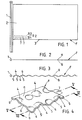
- the flag F shown consists of a knitted or woven fabric made of plastic threads. It is long rectangular outline and held on one narrow side on a flag pole 1. This side has the usual hem. The entire contour edge 3 of the flag F can be flanged.
- Polyester is used for the plastic threads.
- the flag cloth according to Figure 2 is smooth, i.e. it has no elevations beyond the roughness resulting from the natural knitted or woven structure, neither towards one broad side surface a nor towards the other broad side surface b of the flag F.
- FIGS. 4 and 6 the forms 4 alternate evenly. According to the observation plane shown in FIG. 4, this means: a hill is followed by a crater. This alternating up and down is in a row. Such a row can be aligned parallel to the longitudinal edge of the flag cloth. Figure 1 makes this particularly clear.
- the rows are also declared there, increasing from bottom to top with R1, R2, R3 etc. The rows in question are practically identical in terms of direction and level with the cutting line reference VI-VI.
- the negative spherical domes are embossed by a form-fitting counter roller, which can also be heated.
- an elastic counter-cloth is also sufficient to produce the corresponding negative embossing.
- the procedure here is such that the protruding height of the forms 4 is in the range of two to eight times the thickness y of the flag cloth.
- the diameter D of the base line L of the features 4 or domes 9 is four to eight times the protruding height x.
- the length z of the features 4 alternating in the protuberance direction in the plane of the flag cloth is approximately half the diameter D of the base line L, and is therefore smaller than the diameter D of this base line, which is approximately 0.20 to Is 0.45 mm.
- the corresponding spacing between the directionally alternating forms 4 perpendicular to the row shown in section in FIG. 4 corresponds approximately to the diameter D of the base line L.
- the thickness of the flag cloth is 0.20 to 0.45 mm.
- the hill ranges each running in the direction of intersection, lead, as far as two neighboring hill ranges are concerned, from the mast-side or free narrow side of the cloth to a dumbbell-shaped profile, which is complemented by structure troughs 7 that adjoin each side to form a structure of longitudinally oriented, mutually equal heights and valleys .
- the heat seal stamping is set in such a way that no sealing takes place, for example in the direction of film formation.
- the sealing temperature is just below the melting temperature. At most, there is a fusion of the crossing points of the polyester threads. Hot stamping takes place after a special pretreatment of the knitted or woven fabric.
- the flag cloth is printed using a dye plus plastic dispersion.
- the print image achieved is more visually striking than with purely flat prints.
- the printing, which almost happens only in film or screen printing, is not complicated by the relief structure.
- a material which is 100% polyester.
- the DTEX value is around 50 or 44 to 100 DTEX.
- the number of filaments is 18. Single and double is possible.
- the material is glossy to semi-matt and pure white.
- the melting point is 255 °.
- the number of double crochet is 115 per 10 CM, the number of stitches is 155 per 10 CM.
- Weight 80 to 120 GR / QM. Pre-treatment equipment is preferred.
- Knitted fabrics are preferred. It has a usable expansion reserve that extends into the wider area of type 4.
- the roughening described creates a turbulent boundary layer, which favors the raising of the flag in the wind.
- the flag cloth has a higher wind grip. Turbulence develops behind the hills, which favors this effect. Added to this is the higher inherent stiffness of the material created by the structure, so that when the wind is low, the pleating effect is no longer there, but more generous folds are created.
Landscapes
- Physics & Mathematics (AREA)
- General Physics & Mathematics (AREA)
- Engineering & Computer Science (AREA)
- Theoretical Computer Science (AREA)
- Treatment Of Fiber Materials (AREA)
- Photoreceptors In Electrophotography (AREA)
Claims (9)
- Drapeau (F) constitué de produits tricotés, tissés ou analogues, en fils en matière synthétique, en particulier un drapeau à impressions, caractérisé en ce que les surfaces (a, b) de grandes dimensions du drapeau sont structurées par des reliefs (4) répartis de manière régulière.
- Drapeau selon, ou en particulier selon la revendication 1, caractérisé en ce que les reliefs (4) ont la forme de calottes.
- Drapeau selon, ou en particulier selon l'une ou plusieurs des revendications précédentes, caractérisé en ce que les calottes (9) font saillie alternativement par rapport à l'une (a) et à l'autre (b) des surfaces de grandes dimensions du drapeau.
- Drapeau selon, ou en particulier selon l'une ou plusieurs des revendications précédentes, caractérisé en ce que la hauteur de saillie (x) des reliefs (4) est comprise dans la plage allant de deux à huit fois l'épaisseur (y) du tissu de drapeau.
- Drapeau selon, ou en particulier selon l'une ou plusieurs des revendications précédentes, caractérisé en ce que le diamètre (D) de la ligne de base (L) des reliefs (4) représente de quatre à huit fois la hauteur de saillie (x).
- Drapeau selon, ou en particulier selon l'une ou plusieurs des revendications précédentes, caractérisé par des âmes plates (5), placées entre les reliefs et dont la longueur de liaison (z) est plus petite que le diamètre (D) de la ligne de base.
- Drapeau selon, ou en particulier selon l'une ou plusieurs des revendications précédentes, caractérisé par des âmes plates (6), laissant subsister une goulotte de structuration (7) entre les reliefs (4).
- Drapeau selon, ou en particulier selon l'une ou plusieurs des revendications précédentes, caractérisé en ce que les reliefs (4) sont des estampages de scellement à chaud.
- Drapeau selon, ou en particulier selon l'une ou plusieurs des revendications précédentes, caractérisé en ce que le tissu du drapeau est garni d'une dispersion de matière synthétique.
Applications Claiming Priority (2)
| Application Number | Priority Date | Filing Date | Title |
|---|---|---|---|
| DE9300854U DE9300854U1 (de) | 1993-01-22 | 1993-01-22 | Fahne |
| DE9300854U | 1993-01-22 |
Publications (2)
| Publication Number | Publication Date |
|---|---|
| EP0607818A1 EP0607818A1 (fr) | 1994-07-27 |
| EP0607818B1 true EP0607818B1 (fr) | 1997-06-04 |
Family
ID=6888451
Family Applications (1)
| Application Number | Title | Priority Date | Filing Date |
|---|---|---|---|
| EP94100174A Expired - Lifetime EP0607818B1 (fr) | 1993-01-22 | 1994-01-07 | Drapeau |
Country Status (2)
| Country | Link |
|---|---|
| EP (1) | EP0607818B1 (fr) |
| DE (2) | DE9300854U1 (fr) |
Family Cites Families (3)
| Publication number | Priority date | Publication date | Assignee | Title |
|---|---|---|---|---|
| DE2734045C3 (de) * | 1977-07-28 | 1985-08-08 | Coburger Fahnenfabrik August Koch Und Sohn - Bayerische Flaggendruckerei, 8630 Coburg | Gewebe für Fahnen, Flaggen, Banner o.dgl. |
| EP0198101B1 (fr) * | 1985-04-16 | 1990-01-31 | FahnenFleck M. Fleck & Sohn | Tissu pour drapeaux, flammes, bannières et similaires |
| FR2590059B1 (fr) * | 1985-11-13 | 1988-07-08 | Decaux Jc | Enseigne rigide du type drapeau |
-
1993
- 1993-01-22 DE DE9300854U patent/DE9300854U1/de not_active Expired - Lifetime
-
1994
- 1994-01-07 DE DE59402947T patent/DE59402947D1/de not_active Expired - Fee Related
- 1994-01-07 EP EP94100174A patent/EP0607818B1/fr not_active Expired - Lifetime
Also Published As
| Publication number | Publication date |
|---|---|
| DE59402947D1 (de) | 1997-07-10 |
| EP0607818A1 (fr) | 1994-07-27 |
| DE9300854U1 (de) | 1994-05-26 |
Similar Documents
| Publication | Publication Date | Title |
|---|---|---|
| DE69806844T2 (de) | Bandage mit Kompressionsanzeiger | |
| DE69314407T2 (de) | Flächenhaftverschluss | |
| DE19908874B4 (de) | Aus Fasern hergestellter Flächenhaftverschluß und Verfahren zu dessen Herstellung | |
| CH646902A5 (de) | Verfahren zur herstellung eines kunststoff-netzes mit rautenfoermigen maschen sowie nach dem verfahren hergestelltes netz. | |
| DE2835092A1 (de) | Netz in bahnform zum abdecken von pflanzenkulturen | |
| DE68919540T2 (de) | Geschweisstes Drahtgitter mit verformten Streckdrähten und Verfahren zu seiner Herstellung. | |
| WO2000024953A1 (fr) | Tissu eponge ou velours et son procede de fabrication | |
| DE10240986B3 (de) | Flächenförmiges Haftverschlußteil | |
| DE10336405B4 (de) | Verwendung eines Gitters aus synthetischem Material | |
| EP1165869B1 (fr) | Procede permettant de fabriquer des articles textiles plats a dessins colores, systeme permettant de mettre en oeuvre ledit procede et article textile plat ainsi fabrique | |
| EP0607818B1 (fr) | Drapeau | |
| DE29719946U1 (de) | Verschluß für elastische Materialien | |
| DE8533472U1 (de) | Bahnförmiges Flächengebilde zur Herstellung von Bekleidungsstücken | |
| CH649453A5 (de) | Mit belueftungsoeffnungen versehener reissverschlussstreifen. | |
| EP0198101A1 (fr) | Tissu pour drapeaux, flammes, bannières et similaires | |
| DE69913295T2 (de) | Verfahren zum Herstellen von Gewebe mit Rippenstruktur und nach diesem Verfahren hergestellte Gewebe | |
| DE3122398A1 (de) | "behaeltertraegervorformstreifen" | |
| EP0693745B1 (fr) | Tricot pour la fabrication de matériaux stables aux intempéries pour drapeaux, surfaces publicitaires ou même | |
| DE4008477C2 (de) | Verfahren zur Herstellung von Netzen mit genauen und rechtwinkligen Maschen sowie Netz hergestellt nach diesem Verfahren | |
| DE69911857T2 (de) | Verfahren zur Herstellung von Polschlingen auf einer Warenbahn, nach diesem Verfahren hergestellte Polschlingenware und deren Anwendung | |
| CH684527A5 (de) | Verfahren zur Herstellung eines flexiblen und dimensionsstabilen Schablonenträgers für den Siebdruck. | |
| DE2619512A1 (de) | Tarntuch oder -platte mit lochmuster | |
| DE2805954C2 (fr) | ||
| DE69127542T2 (de) | Kunststoffanzeigevorrichtung mit verschachtelten teilen | |
| DE9411597U1 (de) | Vollflächiges Gewirke zur Herstellung von witterungsbeständigen Stoffen für Fahnen, Werbeflächen o.dgl. |
Legal Events
| Date | Code | Title | Description |
|---|---|---|---|
| PUAI | Public reference made under article 153(3) epc to a published international application that has entered the european phase |
Free format text: ORIGINAL CODE: 0009012 |
|
| AK | Designated contracting states |
Kind code of ref document: A1 Designated state(s): BE DE FR NL |
|
| 17P | Request for examination filed |
Effective date: 19950118 |
|
| GRAG | Despatch of communication of intention to grant |
Free format text: ORIGINAL CODE: EPIDOS AGRA |
|
| GRAH | Despatch of communication of intention to grant a patent |
Free format text: ORIGINAL CODE: EPIDOS IGRA |
|
| 17Q | First examination report despatched |
Effective date: 19961031 |
|
| GRAH | Despatch of communication of intention to grant a patent |
Free format text: ORIGINAL CODE: EPIDOS IGRA |
|
| GRAA | (expected) grant |
Free format text: ORIGINAL CODE: 0009210 |
|
| AK | Designated contracting states |
Kind code of ref document: B1 Designated state(s): BE DE FR NL |
|
| REF | Corresponds to: |
Ref document number: 59402947 Country of ref document: DE Date of ref document: 19970710 |
|
| ET | Fr: translation filed | ||
| PGFP | Annual fee paid to national office [announced via postgrant information from national office to epo] |
Ref country code: NL Payment date: 19971219 Year of fee payment: 5 Ref country code: FR Payment date: 19971219 Year of fee payment: 5 Ref country code: BE Payment date: 19971219 Year of fee payment: 5 |
|
| PLBE | No opposition filed within time limit |
Free format text: ORIGINAL CODE: 0009261 |
|
| STAA | Information on the status of an ep patent application or granted ep patent |
Free format text: STATUS: NO OPPOSITION FILED WITHIN TIME LIMIT |
|
| 26N | No opposition filed | ||
| PG25 | Lapsed in a contracting state [announced via postgrant information from national office to epo] |
Ref country code: BE Free format text: LAPSE BECAUSE OF NON-PAYMENT OF DUE FEES Effective date: 19990131 |
|
| PGFP | Annual fee paid to national office [announced via postgrant information from national office to epo] |
Ref country code: DE Payment date: 19990708 Year of fee payment: 6 |
|
| BERE | Be: lapsed |
Owner name: GEBR. AURICH G.M.B.H. Effective date: 19990131 |
|
| PG25 | Lapsed in a contracting state [announced via postgrant information from national office to epo] |
Ref country code: NL Free format text: LAPSE BECAUSE OF NON-PAYMENT OF DUE FEES Effective date: 19990801 |
|
| PG25 | Lapsed in a contracting state [announced via postgrant information from national office to epo] |
Ref country code: FR Free format text: LAPSE BECAUSE OF NON-PAYMENT OF DUE FEES Effective date: 19990930 |
|
| REG | Reference to a national code |
Ref country code: FR Ref legal event code: ST |
|
| PG25 | Lapsed in a contracting state [announced via postgrant information from national office to epo] |
Ref country code: DE Free format text: LAPSE BECAUSE OF NON-PAYMENT OF DUE FEES Effective date: 20001101 |