EP0608837B1 - Verfahren zur Herstellung eines Vanadium - Phosphoroxid enthaltenden Katalysatorvorläufers - Google Patents
Verfahren zur Herstellung eines Vanadium - Phosphoroxid enthaltenden Katalysatorvorläufers Download PDFInfo
- Publication number
- EP0608837B1 EP0608837B1 EP94101066A EP94101066A EP0608837B1 EP 0608837 B1 EP0608837 B1 EP 0608837B1 EP 94101066 A EP94101066 A EP 94101066A EP 94101066 A EP94101066 A EP 94101066A EP 0608837 B1 EP0608837 B1 EP 0608837B1
- Authority
- EP
- European Patent Office
- Prior art keywords
- vanadium
- catalyst precursor
- compound
- alkoxide
- process according
- Prior art date
- Legal status (The legal status is an assumption and is not a legal conclusion. Google has not performed a legal analysis and makes no representation as to the accuracy of the status listed.)
- Expired - Lifetime
Links
Images




Classifications
-
- C—CHEMISTRY; METALLURGY
- C07—ORGANIC CHEMISTRY
- C07C—ACYCLIC OR CARBOCYCLIC COMPOUNDS
- C07C51/00—Preparation of carboxylic acids or their salts, halides or anhydrides
- C07C51/16—Preparation of carboxylic acids or their salts, halides or anhydrides by oxidation
- C07C51/21—Preparation of carboxylic acids or their salts, halides or anhydrides by oxidation with molecular oxygen
- C07C51/215—Preparation of carboxylic acids or their salts, halides or anhydrides by oxidation with molecular oxygen of saturated hydrocarbyl groups
-
- B—PERFORMING OPERATIONS; TRANSPORTING
- B01—PHYSICAL OR CHEMICAL PROCESSES OR APPARATUS IN GENERAL
- B01J—CHEMICAL OR PHYSICAL PROCESSES, e.g. CATALYSIS OR COLLOID CHEMISTRY; THEIR RELEVANT APPARATUS
- B01J23/00—Catalysts comprising metals or metal oxides or hydroxides, not provided for in group B01J21/00
- B01J23/002—Mixed oxides other than spinels, e.g. perovskite
-
- B—PERFORMING OPERATIONS; TRANSPORTING
- B01—PHYSICAL OR CHEMICAL PROCESSES OR APPARATUS IN GENERAL
- B01J—CHEMICAL OR PHYSICAL PROCESSES, e.g. CATALYSIS OR COLLOID CHEMISTRY; THEIR RELEVANT APPARATUS
- B01J23/00—Catalysts comprising metals or metal oxides or hydroxides, not provided for in group B01J21/00
- B01J23/16—Catalysts comprising metals or metal oxides or hydroxides, not provided for in group B01J21/00 of arsenic, antimony, bismuth, vanadium, niobium, tantalum, polonium, chromium, molybdenum, tungsten, manganese, technetium or rhenium
- B01J23/20—Vanadium, niobium or tantalum
- B01J23/22—Vanadium
-
- B—PERFORMING OPERATIONS; TRANSPORTING
- B01—PHYSICAL OR CHEMICAL PROCESSES OR APPARATUS IN GENERAL
- B01J—CHEMICAL OR PHYSICAL PROCESSES, e.g. CATALYSIS OR COLLOID CHEMISTRY; THEIR RELEVANT APPARATUS
- B01J27/00—Catalysts comprising the elements or compounds of halogens, sulfur, selenium, tellurium, phosphorus or nitrogen; Catalysts comprising carbon compounds
- B01J27/14—Phosphorus; Compounds thereof
- B01J27/186—Phosphorus; Compounds thereof with arsenic, antimony, bismuth, vanadium, niobium, tantalum, polonium, chromium, molybdenum, tungsten, manganese, technetium or rhenium
- B01J27/195—Phosphorus; Compounds thereof with arsenic, antimony, bismuth, vanadium, niobium, tantalum, polonium, chromium, molybdenum, tungsten, manganese, technetium or rhenium with vanadium, niobium or tantalum
- B01J27/198—Vanadium
-
- B—PERFORMING OPERATIONS; TRANSPORTING
- B01—PHYSICAL OR CHEMICAL PROCESSES OR APPARATUS IN GENERAL
- B01J—CHEMICAL OR PHYSICAL PROCESSES, e.g. CATALYSIS OR COLLOID CHEMISTRY; THEIR RELEVANT APPARATUS
- B01J2523/00—Constitutive chemical elements of heterogeneous catalysts
Definitions
- the present invention relates to a process for producing a vanadium-phosphorus oxide catalyst precursor.
- vanadium-phosphorus oxide is a catalyst component effective for partial oxidation of a hydrocarbon or a carboxylic acid, for example, for the production of maleic anhydride by a gas phase catalytic oxidation reaction of a hydrocarbon having at least 4 carbon atoms.
- This catalyst is produced usually by a method which comprises calcining vanadyl hydrogen phosphate 1/2 hydrate (VOHPO 4 ⁇ 1/2H 2 O) as its precursor. It is known that by heating and calcining the precursor, it can be converted to divanadyl pyrophosphate while maintaining its structure.
- a method for producing such a vanadium-phosphorus catalyst precursor i.e. vanadyl hydrogen phosphate 1/2 hydrate
- a method for producing such a vanadium-phosphorus catalyst precursor is a method which comprises dissolving vanadium pentoxide in an aqueous hydrochloric acid solution, adding phosphoric acid thereto, followed by concentration, or a method which comprises refluxing vanadium pentoxide in the presence of phosphoric acid in an organic solvent.
- many reports have been made, for example, Hodnett et al., Catalysis Review, 27 , 373, (1985), Hutchings et al., Applied Catalysis, 72 , 1, (1991), thus indicating substantial academic interest.
- catalyst precursors obtainable by the conventional methods have large particle sizes and are required to be pulverized to a size of micron order to be used as fluidized bed catalysts (see for example, Japanese Examined Patent Publication No. 63429/1991). Further, it has been reported that catalysts obtainable without such pulverization treatment are inferior in e.g. the catalytic properties or physical strength to the catalysts treated by such pulverization (see for example, Japanese Examined Patent Publication No. 57818/1991).
- the present inventors have conducted extensive studies for the purpose of developing a method which makes it possible to design the shape of the vanadium-phosphorus oxide catalyst precursor and as a result, have found it possible to adequately control the form or size of the catalyst precursor by appropriately regulating the process steps for formation of the catalyst precursor.
- the present invention has been accomplished on the basis of this discovery.
- the present invention provides a process for producing a vanadium-phosphorus oxide-containing catalyst precursor, which comprises (a) introducing into an organic solvent a vanadium alkoxide as a pentavalent vanadium compound and a phosphorus compound in the presence of a reducing agent capable of reducing the pentavalent vanadium compound to a tetravalent state, (b) hydrolyzing at least a part of the vanadium alkoxide before or after the introduction of the phosphorus compound, and (c) heating the vanadium-containing liquid medium obtained in step (b), in the presence of the phosphorus compound to reduce at least a part of vanadium to a tetravalent state.
- the pentavalent vanadium compound to be used as a starting material for the catalyst precursor of the present invention is a vanadium alkoxide.
- This vanadium alkoxide is usually synthesized 1 ⁇ by dehydrative condensation of an alcohol with vanadium pentoxide, 2 ⁇ by a ligand exchange reaction of a vanadium alkoxide with an alcohol, 3 ⁇ by a dehalogenation reaction of a vanadyl trihalide such as VOCl 3 with an alcohol.
- Preferred is the method 1 ⁇ .
- the vanadium alkoxide is obtained by dehydrative condensation of a C 1-5 alcohol with vanadium pentoxide.
- Specific vanadium alkoxides include, for example, vanadium methoxide, vanadium ethoxide, vanadium n-propoxide, vanadium n-butoxide and vanadium i-butoxide.
- the vanadium alkoxide a synthesized product may usually be used as it is. Namely, after the dehydrative condensation of the alcohol with the vanadium compound as described above, the reaction product may be subjected directly to the production of the catalyst precursor of the present invention in the same reactor. In such a case, the vanadium compound as the starting material may not necessarily be completely converted to an alkoxide. However, it is usually preferred that at least 50%, preferably at least 70%, more preferably at least 80%, of the starting material vanadium compound is converted to an alkoxide.
- the phosphorus compound to be used in the present invention may, for example, be a tetravalent phosphorus compound such as orthophosphoric acid, pyrophosphoric acid, methaphosphoric acid, phosphorus pentoxide, monoammonium phosphate, diammonium phosphate or triammonium phosphate.
- orthophosphoric acid preferred is orthophosphoric acid.
- Such orthophosphoric acid may be commercially available 85% phosphoric acid, or a mixed phosphoric acid containing pyrophosphoric acid or methaphosphoric acid together with orthophosphoric acid, or it may be phosphoric anhydride.
- the atomic ratio of phosphorus/vanadium is usually from 1.0 to 1.5, preferably from 1.05 to 1.3.
- the organic solvent to be used in the present invention may suitably be selected among organic compounds such as alcohols, carboxylic acids, ethers and esters. It is preferred to use a reducing organic compound, since such an organic compound will serve not only as a solvent but also as a reducing agent in the reaction system.
- Such an organic compound may, for example, be one having a functional group susceptible to oxidation or one capable of forming a functional group susceptible to oxidation, during the heating or the reaction.
- a compound having an alcoholic hydroxyl group is preferred.
- an aliphatic alcohol having from 3 to 6 carbon atoms is particularly preferred. Propanol, butanol, hexanol or 2-methylpropanol may, for example, be mentioned.
- a reducing agent such as hydrazine or oxalic acid may separately be added for the reduction in an organic solvent.
- an unsaturated alcohol such as benzyl alcohol, or other reducing agent having a stronger reducing power may further be added.
- the reducing power in the reaction system increases, it is more readily possible to obtain a scaly catalyst precursor having a smaller particle size.
- a method for forming a reaction system having such a strong reducing power it is preferred to employ a method of using a mixture of an aliphatic alcohol having from 3 to 6 carbon atoms and benzyl alcohol, as the organic solvent.
- the solvent may not necessarily be substantially anhydrous, since the process includes a step of hydrolyzing the vanadium alkoxide.
- the organic solvent is used usually from 1 to 30 parts by weight, preferably from 2 to 15 parts by weight, per part by weight of the total amount of the vanadium alkoxide and the phosphorus compound as starting materials.
- the present invention is characterized in that a vanadium alkoxide as a pentavalent vanadium compound and a phosphorus compound are introduced into an organic solvent in the presence of a reducing agent which is capable of reducing the pentavalent vanadium compound to a tetravalent state, and at least a part of the vanadium alkoxide is hydrolyzed before or after the introduction of the phosphorus compound.
- the hydrolysis of the vanadium alkoxide is conducted within a temperature range of from room temperature to the refluxing temperature of the solution, usually from 0 to 150°C, preferably from 20 to 100°C, usually by an addition of water in an amount required for the hydrolysis to the organic solvent solution of the vanadium alkoxide.
- the amount of water to be added for the hydrolysis is usually from 0.5 to 20 mols, preferably from 1 to 5 mols, per mol of the vanadium alkoxide.
- the organic solvent for the vanadium alkoxide may be all the amount used for the reaction of the catalyst precursor or a part thereof. Otherwise, it is preferred to employ a method of adding a solvent having a strong reducing power after the hydrolysis.
- the present invention it is possible to control the shape of the finally obtainable catalyst precursor by adding an acid or a base at the time of the hydrolysis. Namely, when a base is added, a three dimensionally developed catalyst precursor having a large particle size is likely to be obtained. On the other hand, when an acid is added, a catalyst precursor having a small particle size is likely to be obtained.
- the pH during the hydrolysis may vary depending upon the desired shape of the catalyst precursor, but the pH is usually within a range of from 0 to 12, preferably from 1 to 10.
- the above described hydrolytic reaction proceeds swiftly from the time when water is added to the vanadium alkoxide, and the reaction is considered to substantially complete in a relatively short period of time.
- the reaction product may be left to stand for a while for aging.
- Such aging time is usually from 0.1 to 10 hours, preferably from 0.2 to 1 hour.
- the phosphorus compound is added, and in some cases, an organic solvent or a reducing agent is further added.
- the resulting slurry-like solution is reacted to form a vanadium-phosphorus oxide catalyst precursor.
- the above slurry-like solution is usually mixed and then heated and refluxed usually at a temperature at a level of the boiling point of the organic solvent, for example, from 50 to 200°C to reduce all or a part of vanadium to a tetravalent state, and at the same time, the phosphorus compound is reacted, to obtain crystalline oxide particles containing tetravalent vanadium and phosphorus.
- heating and refluxing are preliminarily conducted to carry out the reduction of vanadium to some extent, and then the phosphorus compound is added, and heating and refluxing are conducted again.
- the heating and refluxing time necessary for the formation of the catalyst precursor is usually from 0.5 to 20 hours, preferably from 2 to 10 hours.
- the oxide particles obtainable from the above starting materials do not necessarily have good crystallinity, but at least partially contain vanadyl hydrogen phosphate 1/2 hydrate.
- the obtained particles can be taken out as a catalyst precursor by a common method for solid-liquid separation such as evaporation to dryness, spray drying, centrifugal separation or filtration.
- the vanadium alkoxide is added to an organic solvent solution containing the phosphorus compound, and the resulting slurry-like solution is mixed and heated and refluxed usually at a temperature at a level of the boiling point of the organic solvent, for example, from 50 to 200°C to reduce all or a part of vanadium to a tetravalent state.
- water in an amount necessary for the hydrolysis of the vanadium alkoxide is added to the reaction solution, so that the phosphorus compound is reacted therewith, to obtain crystalline oxide particles containing tetravalent vanadium and phosphorus.
- the heating and refluxing time required for the formation of the catalyst precursor is usually from 0.5 to 20 hours, preferably from 2 to 10 hours.
- the timing for the addition of water is preferably during a period of from 0 to 2 hours from the initiation of refluxing.
- the amount of water to be added for the hydrolysis is usually from 0.5 to 20 mols, preferably from 1 to 5 mols, per mol of the vanadium alkoxide.
- the oxide particles obtained by the above method can be withdrawn in the form of a solid by a common method for solid-liquid separation in the same manner as in the above described first embodiment of the present invention.
- a compound containing other metal elements may be added as a co-catalyst component during the above described process for the formation of the catalyst precursor to effectively modify the catalyst.
- the metal elements useful for this purpose one or more metal elements selected from the group consisting of chromium, iron, nickel, cobalt, zinc, ruthenium and zirconium, may be mentioned. Nitrates, chlorides, sulfates or organic acid salts of these metal elements may be incorporated from the beginning of the reaction or after the addition of the phosphorus compound to effectively modify the catalyst.
- the amount of such metal elements to be added is usually from 0.001 to 0.30 mol, preferably from 0.02 to 0.10 mol, per mol of vanadium.
- the vanadium-phosphorus oxide catalyst precursor obtained by the above described method will usually be finally calcined at a temperature of from 300 to 700°C for activation to convert at least a part of the precursor oxide to divanadyl pyrophosphate, so that it is useful as a catalyst.
- calcination condition heating in a nitrogen atmosphere or a atmosphere having nitrogen and air mixed at suitable proportions or in a reactive gas atmosphere, may be mentioned.
- the precursor of the oxide catalyst of the present invention may be mixed by itself with a binder component or a carrier component, followed by drying and heating for activation. Otherwise, the precursor may be preliminarily heated for activation, and then mixed with a binder component or a carrier component, followed by drying. Then, the product is molded as the case requires depending upon the type of the reactor to form an industrial catalyst.
- Such a catalyst is useful for a partial oxidation reaction of a hydrocarbon or a carboxylic acid, particularly for the production of maleic anhydride by a gas phase oxidation of a hydrocarbon having at least 4 carbon atoms such as n-butane, 1-butene, 2-butene, 1,3-butadiene or benzene.
- a hydrocarbon starting material are n-butane and butene. These starting materials can readily be obtained by separation from a natural gas or by separation from a cracking product of naphtha.
- the oxidation reaction system may be a fluidized bed system or a fixed bed system.
- the oxidizing agent air or a molecular oxygen-containing gas may be employed.
- the hydrocarbon starting material is usually from 0.1 to 10 vol%, preferably from 1 to 5 vol%, and the oxygen concentration is usually from 10 to 30 vol%.
- the reaction temperature is usually from 300 to 550°C, preferably from 350 to 500°C.
- the reaction is conducted usually under atmospheric pressure or an elevated pressure of from 0.05 to 10 kg/cm 2 G.
- a vanadium alkoxide is used as the starting pentavalent vanadium compound.
- the feature of the present invention resides in that the vanadium alkoxide is hydrolyzed, and then the hydrate gel product of vanadium pentoxide thereby formed is reacted with the phosphorus compound.
- a catalyst precursor having a small particle size is likely to obtain, and if the hydrolysis is conducted in the presence of a base, a catalyst precursor having a large particle size is likely to be obtained. Further, when the condition for reducing vanadium is increased, a catalyst precursor having a small particle size is likely to be obtained.
- vanadium pentoxide is mainly employed as the starting pentavalent vanadium compound.
- Vanadium pentoxide usually has high crystallinity and is hardly reacted with a phosphorus compound such as phosphoric acid at room temperature and can be made to be reacted only when sufficiently heated. Thus, the reactivity is not so high. Accordingly, an influence of the reaction condition over the shape for the resulting catalyst precursor may not be substantial.
- the hydrate gel product of vanadium pentoxide formed by the hydrolysis of the vanadium alkoxide is considered to be non-crystalline in many cases, and as compared with crystalline vanadium pentoxide, the reactivity at its surface is high, whereby it is considered to be susceptible to an influence of the reaction conditions over the shape of the resulting catalyst precursor.
- the average particle size of the catalyst precursor in Table 1 was measured by a particle size distribution meter of a laser scattering type after dispersing the catalyst precursor in water, and it roughly corresponds to the value obtained by a scanning electron microscopic photograph.
- a catalyst precursor B was prepared in the same manner as in Example 1 except that 21.2 g of vanadium ethoxide was employed instead of vanadium n-butoxide.
- the catalyst precursor B had a size and shape as shown in Figures 3 and 4.
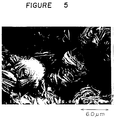
- the catalyst precursor D had a size and shape as shown in Figure 5. As compared with the case where an alkoxide was used as the starting material, the particle size was large, and the shape itself was different.
- a catalyst precursor E was prepared in the same manner as in Example 1 except that 100 ml of n-propanol was used as the solvent and 56.6 g of benzyl alcohol was added as a reducing agent.
- the catalyst precursor E had a size and shape as shown in Figure 6.
- a catalyst precursor G was prepared in the same manner as in Example 1 except that the pH was adjusted to 1 with dilute hydrochloric acid at the time of adding the water/butanol solution.
- a catalyst precursor H was prepared in the same manner as in Example 1 except that the pH was adjusted to 9 with dilute aqueous ammonia at the time of adding the water/butanol solution.
- n-propanol 150 ml of n-propanol was added as a solvent to 30 g of vanadium n-butoxide. Then, a n-propanol solution having 3.48 g of water dissolved therein, was slowly dropwise added thereto to hydrolyze the alkoxide. Then, 14.5 g of 85% phosphoric acid, 11.3 g of benzyl alcohol and 1.49 g of ferric chloride (hexahydrate) were added thereto, the temperature was raised with stirring, and refluxing was continued to obtain a blue solid. After refluxing for 6 hours, the mixture was cooled and subjected to filtration to obtain a catalyst precursor I.
- the catalyst precursor I had a size and shape as shown in Figure 7.
- the process of the present invention it is possible to design the shape of the catalyst capable of providing excellent catalytic activities and mechanical strength.
- a physical method such as pulverization at the time of pelletizing the oxide or at the time of forming a slurry for spray drying.
- this pulverization step can be eliminated, and it is possible to simply obtain an industrial catalyst.
- the catalyst obtainable from the vanadium-phosphorus oxide catalyst precursor produced by the present invention is useful for partial oxidation of a saturated and unsaturated hydrocarbon and a carboxylic acid, for example, for the production of maleic anhydride from a hydrocarbon having at least 4 carbon atoms such as n-butane, 1-butene, 2-butene, 1,3-butadiene or benzene, the production of acrylic acid or acrolein from propane, or the production of methacrylic acid from isobutyric acid.
Landscapes
- Chemical & Material Sciences (AREA)
- Organic Chemistry (AREA)
- Engineering & Computer Science (AREA)
- Materials Engineering (AREA)
- Chemical Kinetics & Catalysis (AREA)
- Oil, Petroleum & Natural Gas (AREA)
- Catalysts (AREA)
- Furan Compounds (AREA)
Claims (10)
- Verfahren zur Herstellung eines Vanadium-Phosphoroxid enthaltenden Katalysatorvorläufers, umfassend (a) Einführen in ein organisches Lösungsmittel eines Vanadiumalkoxids als eine fünfwertige Vanadiumverbindung und einer Phosphorverbindung in Gegenwart eines Reduktionsmittels, das in der Lage ist, die fünfwertige Vanadiumverbindung zu einem vierwertigen Zustand zu reduzieren, (b) Hydrolisieren mindestens eines Teils des Vanadiumalkoxids vor oder nach der Einführung der Phosphorverbindung und (c) Erwärmen des in Schritt (b) erhaltenen, vanadiumhaltigen flüssigen Mediums in Gegenwart der Phosphorverbindung, um mindestens eine Teil des Vanadiums zu einem vierwertigen Zustand zu reduzieren.
- Verfahren nach Anspruch 1, wobei das in das organische Lösungsmittel eingebrachte Vanadiumalkoxid ein solches ist, das hergestellt worden ist durch Umwandeln mindestens 50 % einer fünfwertigen Vanadiumverbindung zu einem Vanadiumalkoxid.
- Verfahren nach Anspruch 1 oder 2, wobei das Vanadiumalkoxid ein dehydratisierbares Kondensationsprodukt aus einem C1-5-Alkohol mit Vanadiumpentoxid ist.
- Verfahren nach Anspruch 1, 2 oder 3, wobei die Anteile an Vanadiumalkoxid und der Phosphorverbindung derart sind, daß das Atomverhältnis von Phosphor/Vanadium 1,0 bis 1,5 beträgt.
- Verfahren nach mindestens einem der Ansprüche 1 bis 4, wobei das organische Lösungsmittel ein Alkohol ist.
- Verfahren nach mindestens einem der Ansprüche 1 bis 5, wobei mindestens ein Teil des Vanadiumalkoxids hydrolisiert wird, worauf die Umsetzung mit der Phosphorverbindung erfolgt.
- Verfahren nach Anspruch 6, wobei die Hydrolyse des Vanadiumalkoxids in Gegenwart einer Säure oder einer Base durchgeführt wird.
- Verfahren nach mindestens einem der Ansprüche 1 bis 5, wobei in das organische Lösungsmittel das Vanadiumalkoxid als eine fünfwertige Vanadiumverbindung und die Phosphorverbindung in Gegenwart des Reduktionsmittels, das in der Lage ist, die fünfwertige Vanadiumverbindung zu einem vierwertigen Zustand zu reduzieren, eingebracht werden, und dann ein Teil des Vanadiumalkoxids hydrolysiert wird.
- Verfahren nach mindestens einem der Ansprüche 1 bis 8, wobei eine Verbindung, welche weitere Metallelemente enthält, als Cokatalysatorkomponente während der Bildung des Katalysatorvorläufers zugesetzt wird, so daß der Katalysatorvorläufer als Cokatalysator-Metallkomponente mindestens einen Vertreter enthält, gewählt aus der Chrom, Eisen, Nickel, Kobalt, Zink, Ruthenium und Zirconium umfassenden Gruppe.
- Verwendung des nach mindestens einem der Ansprüche 1 bis 9 erhaltenen Katalysatorvorläufers zur Herstellung von Maleinsäureanhydrid durch Dampfphasenoxidation eines Kohlenwasserstoffs mit mindestens 4 Kohlenstoffatomen.
Applications Claiming Priority (2)
| Application Number | Priority Date | Filing Date | Title |
|---|---|---|---|
| JP34348/93 | 1993-01-29 | ||
| JP3434893 | 1993-01-29 |
Publications (2)
| Publication Number | Publication Date |
|---|---|
| EP0608837A1 EP0608837A1 (de) | 1994-08-03 |
| EP0608837B1 true EP0608837B1 (de) | 1998-07-08 |
Family
ID=12411645
Family Applications (1)
| Application Number | Title | Priority Date | Filing Date |
|---|---|---|---|
| EP94101066A Expired - Lifetime EP0608837B1 (de) | 1993-01-29 | 1994-01-25 | Verfahren zur Herstellung eines Vanadium - Phosphoroxid enthaltenden Katalysatorvorläufers |
Country Status (3)
| Country | Link |
|---|---|
| US (2) | US5496787A (de) |
| EP (1) | EP0608837B1 (de) |
| DE (1) | DE69411404T2 (de) |
Cited By (1)
| Publication number | Priority date | Publication date | Assignee | Title |
|---|---|---|---|---|
| US7850928B2 (en) | 2001-01-25 | 2010-12-14 | Nippon Shokubai Co., Ltd. | Fixed-bed shell-and-tube reactor and its usage |
Families Citing this family (14)
| Publication number | Priority date | Publication date | Assignee | Title |
|---|---|---|---|---|
| EP0608837B1 (de) * | 1993-01-29 | 1998-07-08 | Mitsubishi Chemical Corporation | Verfahren zur Herstellung eines Vanadium - Phosphoroxid enthaltenden Katalysatorvorläufers |
| JP3260591B2 (ja) | 1995-06-08 | 2002-02-25 | 株式会社日本触媒 | 固体酸塩基触媒およびその使用方法 |
| US5905052A (en) * | 1996-10-08 | 1999-05-18 | E. I. Du Pont De Nemours And Company | Vanadyl pyrophosphate oxidation catalyst precursors |
| DE69802189T2 (de) * | 1997-06-04 | 2002-06-06 | Sasol Technology (Proprietary) Ltd., Johannesburg | Verfahren zur herstellung eines vanadium-phosphoroxide-katalysators |
| DE19727235A1 (de) * | 1997-06-26 | 1999-01-07 | Consortium Elektrochem Ind | Verfahren zur Herstellung von Schalenkatalysatoren für die Synthese von Maleinsäureanhydrid durch Gasphasenoxidation |
| US6168256B1 (en) | 1998-12-29 | 2001-01-02 | Eastman Kodak Company | Self-cleaning ink jet printer with oscillating septum and method of assembling the printer |
| US6107234A (en) * | 1999-01-29 | 2000-08-22 | Scientific Design Company, Inc. | Phosphorus/vanadium maleic anhydride catalyst preparation |
| US6495486B1 (en) * | 1999-11-10 | 2002-12-17 | Tonen Chemical Corporation | Intercalation compound and a vanadium phosphorus mixed oxide and a process for the preparation thereof |
| US6858561B2 (en) * | 2003-05-15 | 2005-02-22 | Scientific Design Company, Inc. | Phosphorus/vanadium catalyst preparation |
| JP2011121048A (ja) * | 2009-12-09 | 2011-06-23 | Rohm & Haas Co | 固体触媒物質をブレンドし、管状構造物に装填する方法 |
| US8765629B2 (en) | 2011-09-16 | 2014-07-01 | Eastman Chemical Company | Process for preparing V-Ti-P catalysts for synthesis of 2,3-unsaturated carboxylic acids |
| US8883672B2 (en) | 2011-09-16 | 2014-11-11 | Eastman Chemical Company | Process for preparing modified V-Ti-P catalysts for synthesis of 2,3-unsaturated carboxylic acids |
| US9573119B2 (en) | 2011-09-16 | 2017-02-21 | Eastman Chemical Company | Process for preparing V—Ti—P catalysts for synthesis of 2,3-unsaturated carboxylic acids |
| US8993801B2 (en) | 2011-09-16 | 2015-03-31 | Eastman Chemical Company | Process for preparing V-Ti-P catalysts for synthesis of 2,3-unsaturated carboxylic acids |
Family Cites Families (13)
| Publication number | Priority date | Publication date | Assignee | Title |
|---|---|---|---|---|
| GB1053821A (de) * | 1963-01-29 | |||
| US3541143A (en) * | 1966-09-07 | 1970-11-17 | Mitsubishi Petrochemical Co | Process for the preparation of acrylic acid |
| US4132670A (en) * | 1974-11-06 | 1979-01-02 | Chevron Research Company | Method of preparing vanadium (IV) phosphate composition with high intrinsic surface area |
| US4333853A (en) * | 1980-05-05 | 1982-06-08 | The Standard Oil Company | Mixed vanadium phosphorus oxide catalysts and preparation thereof |
| US4472527A (en) * | 1982-03-31 | 1984-09-18 | Mitsubishi Chemical Industries Ltd. | Process for preparing an oxidation catalyst composition |
| US4400306A (en) * | 1982-06-28 | 1983-08-23 | The Standard Oil Company | Process for the preparation of fluidizable catalysts |
| CA1197230A (en) * | 1982-06-30 | 1985-11-26 | Dennis E. Dria | Preparation of improved mixed vanadium phosphorus oxide catalysts and their use in oxidation processes |
| CA1227784A (en) * | 1983-12-28 | 1987-10-06 | James T. Wrobleski | Phosphorus-vanadium-mixed oxide oxidation catalysts and processes for the preparation and use thereof |
| JP2893539B2 (ja) * | 1988-10-05 | 1999-05-24 | 三菱化学株式会社 | バナジウム―リン系結晶性酸化物およびそれを含有する触媒の製造法 |
| US5155235A (en) * | 1990-07-12 | 1992-10-13 | Mitsui Toatsu Chemicals, Inc. | Catalyst for producing maleic anhydride from butane and process for preparing same |
| US5137860A (en) * | 1991-06-27 | 1992-08-11 | Monsanto Company | Process for the transformation of vanadium/phosphorus mixed oxide catalyst precursors into active catalysts for the production of maleic anhydride |
| EP0608837B1 (de) * | 1993-01-29 | 1998-07-08 | Mitsubishi Chemical Corporation | Verfahren zur Herstellung eines Vanadium - Phosphoroxid enthaltenden Katalysatorvorläufers |
| US5498731A (en) * | 1993-06-29 | 1996-03-12 | Mitsubishi Chemical Corporation | Oxide catalyst and process for producing maleic anhydride by using oxide catalyst |
-
1994
- 1994-01-25 EP EP94101066A patent/EP0608837B1/de not_active Expired - Lifetime
- 1994-01-25 DE DE69411404T patent/DE69411404T2/de not_active Expired - Fee Related
- 1994-01-28 US US08/187,715 patent/US5496787A/en not_active Expired - Fee Related
-
1995
- 1995-06-07 US US08/480,916 patent/US5591870A/en not_active Expired - Fee Related
Cited By (1)
| Publication number | Priority date | Publication date | Assignee | Title |
|---|---|---|---|---|
| US7850928B2 (en) | 2001-01-25 | 2010-12-14 | Nippon Shokubai Co., Ltd. | Fixed-bed shell-and-tube reactor and its usage |
Also Published As
| Publication number | Publication date |
|---|---|
| EP0608837A1 (de) | 1994-08-03 |
| DE69411404T2 (de) | 1999-03-04 |
| US5496787A (en) | 1996-03-05 |
| DE69411404D1 (de) | 1998-08-13 |
| US5591870A (en) | 1997-01-07 |
Similar Documents
| Publication | Publication Date | Title |
|---|---|---|
| US5591870A (en) | Process for producing a vanadium-phosphorus oxide catalyst precursor | |
| US4333853A (en) | Mixed vanadium phosphorus oxide catalysts and preparation thereof | |
| US4351773A (en) | Preparation of maleic anhydride from butane using fluidized vanadium-phosphorous-oxide containing catalysts | |
| CA2103448A1 (en) | Process for the transformation of vanadium/phosphorus mixed oxide catalyst precursors into active catalysts for the production of maleic anhydride | |
| KR20150035476A (ko) | n-부탄의 말레산 무수물로의 산화를 위한 개량 촉매 | |
| US4100106A (en) | Process for the production of a mixed-oxide oxidation catalyst containing vanadium and pentavalent phosphorus | |
| JPH0298B2 (de) | ||
| CA2534293C (en) | Niobium-doped vanadium/phosphorus mixed oxide catalyst | |
| US5128299A (en) | Process for producing crystalline oxide of vanadium-phosphorus system | |
| US5530144A (en) | Process for producing a phosphorus-vanadium oxide catalyst precursor, process for producing a phosphorus-vanadium oxide catalyst, and process for producing maleic anhydride by vapor phase oxidation using the catalyst | |
| JP4742376B2 (ja) | 触媒前駆体を活性触媒に変換させる方法、変換により得た活性触媒およびその活性触媒を用いた無水マレイン酸の製造方法 | |
| WO2004103557A1 (en) | Phoshorus/vanadium catalyst preparation | |
| US4824819A (en) | Vanadium coated phosphorus-vandium oxide and phosphorus-vanadium oxide co-metal catalyst and process for the manufacture of maleic anhydride | |
| EP0384749B1 (de) | Verfahren zur Herstellung eines Katalysator-Vorläufers und der entsprechende Katalysator | |
| US4085122A (en) | Production of maleic anhydride using a mixed-oxide oxidation catalyst containing vanadium and pentavalent phosphorus | |
| JPH0751573A (ja) | バナジウム−リン酸化物含有触媒前駆体の製造方法 | |
| US5922637A (en) | Phosphorus/vanadium catalyst preparation | |
| US4337174A (en) | Method for preparing a catalyst and intermediate formed thereby | |
| JP3603352B2 (ja) | リン−バナジウム酸化物触媒の製造方法 | |
| US5532385A (en) | Catalytic process for the production of maleic anhydride | |
| JP3555205B2 (ja) | リン−バナジウム酸化物触媒前駆体の製造方法 | |
| EP0056902B1 (de) | Herstellung von Vanadin-Phosphoroxide enthaltenden Fliessbettkatalysatoren | |
| CN107866242B (zh) | 用于生产顺酐的催化剂的制备方法 | |
| US4412940A (en) | Method for preparing maleic anhydride catalyst | |
| US4456764A (en) | Process for the manufacture of maleic anhydride |
Legal Events
| Date | Code | Title | Description |
|---|---|---|---|
| PUAI | Public reference made under article 153(3) epc to a published international application that has entered the european phase |
Free format text: ORIGINAL CODE: 0009012 |
|
| AK | Designated contracting states |
Kind code of ref document: A1 Designated state(s): DE GB IT |
|
| 17P | Request for examination filed |
Effective date: 19950119 |
|
| RAP1 | Party data changed (applicant data changed or rights of an application transferred) |
Owner name: MITSUBISHI CHEMICAL CORPORATION |
|
| 17Q | First examination report despatched |
Effective date: 19960819 |
|
| GRAG | Despatch of communication of intention to grant |
Free format text: ORIGINAL CODE: EPIDOS AGRA |
|
| GRAG | Despatch of communication of intention to grant |
Free format text: ORIGINAL CODE: EPIDOS AGRA |
|
| GRAH | Despatch of communication of intention to grant a patent |
Free format text: ORIGINAL CODE: EPIDOS IGRA |
|
| GRAH | Despatch of communication of intention to grant a patent |
Free format text: ORIGINAL CODE: EPIDOS IGRA |
|
| GRAA | (expected) grant |
Free format text: ORIGINAL CODE: 0009210 |
|
| AK | Designated contracting states |
Kind code of ref document: B1 Designated state(s): DE GB IT |
|
| ITF | It: translation for a ep patent filed | ||
| REF | Corresponds to: |
Ref document number: 69411404 Country of ref document: DE Date of ref document: 19980813 |
|
| PLBE | No opposition filed within time limit |
Free format text: ORIGINAL CODE: 0009261 |
|
| STAA | Information on the status of an ep patent application or granted ep patent |
Free format text: STATUS: NO OPPOSITION FILED WITHIN TIME LIMIT |
|
| 26N | No opposition filed | ||
| PGFP | Annual fee paid to national office [announced via postgrant information from national office to epo] |
Ref country code: DE Payment date: 19991231 Year of fee payment: 7 |
|
| PGFP | Annual fee paid to national office [announced via postgrant information from national office to epo] |
Ref country code: GB Payment date: 20000119 Year of fee payment: 7 |
|
| PG25 | Lapsed in a contracting state [announced via postgrant information from national office to epo] |
Ref country code: GB Free format text: LAPSE BECAUSE OF NON-PAYMENT OF DUE FEES Effective date: 20010125 |
|
| GBPC | Gb: european patent ceased through non-payment of renewal fee |
Effective date: 20010125 |
|
| PG25 | Lapsed in a contracting state [announced via postgrant information from national office to epo] |
Ref country code: DE Free format text: LAPSE BECAUSE OF NON-PAYMENT OF DUE FEES Effective date: 20011101 |
|
| PG25 | Lapsed in a contracting state [announced via postgrant information from national office to epo] |
Ref country code: IT Free format text: LAPSE BECAUSE OF NON-PAYMENT OF DUE FEES Effective date: 20050125 |