EP0608877A2 - Connecteur de mise à la terre - Google Patents
Connecteur de mise à la terre Download PDFInfo
- Publication number
- EP0608877A2 EP0608877A2 EP94101194A EP94101194A EP0608877A2 EP 0608877 A2 EP0608877 A2 EP 0608877A2 EP 94101194 A EP94101194 A EP 94101194A EP 94101194 A EP94101194 A EP 94101194A EP 0608877 A2 EP0608877 A2 EP 0608877A2
- Authority
- EP
- European Patent Office
- Prior art keywords
- post
- connector
- seat
- ground connector
- conductor
- Prior art date
- Legal status (The legal status is an assumption and is not a legal conclusion. Google has not performed a legal analysis and makes no representation as to the accuracy of the status listed.)
- Ceased
Links
Images



Classifications
-
- H—ELECTRICITY
- H01—ELECTRIC ELEMENTS
- H01R—ELECTRICALLY-CONDUCTIVE CONNECTIONS; STRUCTURAL ASSOCIATIONS OF A PLURALITY OF MUTUALLY-INSULATED ELECTRICAL CONNECTING ELEMENTS; COUPLING DEVICES; CURRENT COLLECTORS
- H01R4/00—Electrically-conductive connections between two or more conductive members in direct contact, i.e. touching one another; Means for effecting or maintaining such contact; Electrically-conductive connections having two or more spaced connecting locations for conductors and using contact members penetrating insulation
- H01R4/58—Electrically-conductive connections between two or more conductive members in direct contact, i.e. touching one another; Means for effecting or maintaining such contact; Electrically-conductive connections having two or more spaced connecting locations for conductors and using contact members penetrating insulation characterised by the form or material of the contacting members
- H01R4/64—Connections between or with conductive parts having primarily a non-electric function, e.g. frame, casing, rail
-
- H—ELECTRICITY
- H01—ELECTRIC ELEMENTS
- H01R—ELECTRICALLY-CONDUCTIVE CONNECTIONS; STRUCTURAL ASSOCIATIONS OF A PLURALITY OF MUTUALLY-INSULATED ELECTRICAL CONNECTING ELEMENTS; COUPLING DEVICES; CURRENT COLLECTORS
- H01R11/00—Individual connecting elements providing two or more spaced connecting locations for conductive members which are, or may be, thereby interconnected, e.g. end pieces for wires or cables supported by the wire or cable and having means for facilitating electrical connection to some other wire, terminal, or conductive member, blocks of binding posts
- H01R11/11—End pieces or tapping pieces for wires, supported by the wire and for facilitating electrical connection to some other wire, terminal or conductive member
- H01R11/12—End pieces terminating in an eye, hook, or fork
- H01R11/14—End pieces terminating in an eye, hook, or fork the hook being adapted for hanging on overhead or other suspended lines, e.g. hot line clamp
- H01R11/15—Hook in the form of a screw clamp
-
- H—ELECTRICITY
- H01—ELECTRIC ELEMENTS
- H01R—ELECTRICALLY-CONDUCTIVE CONNECTIONS; STRUCTURAL ASSOCIATIONS OF A PLURALITY OF MUTUALLY-INSULATED ELECTRICAL CONNECTING ELEMENTS; COUPLING DEVICES; CURRENT COLLECTORS
- H01R4/00—Electrically-conductive connections between two or more conductive members in direct contact, i.e. touching one another; Means for effecting or maintaining such contact; Electrically-conductive connections having two or more spaced connecting locations for conductors and using contact members penetrating insulation
- H01R4/28—Clamped connections, spring connections
- H01R4/38—Clamped connections, spring connections utilising a clamping member acted on by screw or nut
-
- H—ELECTRICITY
- H01—ELECTRIC ELEMENTS
- H01R—ELECTRICALLY-CONDUCTIVE CONNECTIONS; STRUCTURAL ASSOCIATIONS OF A PLURALITY OF MUTUALLY-INSULATED ELECTRICAL CONNECTING ELEMENTS; COUPLING DEVICES; CURRENT COLLECTORS
- H01R4/00—Electrically-conductive connections between two or more conductive members in direct contact, i.e. touching one another; Means for effecting or maintaining such contact; Electrically-conductive connections having two or more spaced connecting locations for conductors and using contact members penetrating insulation
- H01R4/58—Electrically-conductive connections between two or more conductive members in direct contact, i.e. touching one another; Means for effecting or maintaining such contact; Electrically-conductive connections having two or more spaced connecting locations for conductors and using contact members penetrating insulation characterised by the form or material of the contacting members
- H01R4/64—Connections between or with conductive parts having primarily a non-electric function, e.g. frame, casing, rail
- H01R4/646—Connections between or with conductive parts having primarily a non-electric function, e.g. frame, casing, rail for cables or flexible cylindrical bodies
-
- Y—GENERAL TAGGING OF NEW TECHNOLOGICAL DEVELOPMENTS; GENERAL TAGGING OF CROSS-SECTIONAL TECHNOLOGIES SPANNING OVER SEVERAL SECTIONS OF THE IPC; TECHNICAL SUBJECTS COVERED BY FORMER USPC CROSS-REFERENCE ART COLLECTIONS [XRACs] AND DIGESTS
- Y10—TECHNICAL SUBJECTS COVERED BY FORMER USPC
- Y10T—TECHNICAL SUBJECTS COVERED BY FORMER US CLASSIFICATION
- Y10T24/00—Buckles, buttons, clasps, etc.
- Y10T24/44—Clasp, clip, support-clamp, or required component thereof
- Y10T24/44265—Gripping member face integral with or rigidly affixed to screw-driving portion
Definitions
- This invention relates to a device for connecting a ground conductor to a post.
- a raised sub-floor constructed on posts or pedestals above the true floor of a structure, is a common design feature in computer room installations. This feature enables the cables and conduits of the electrical power distribution network and the assorted system interconnections to be located out of the way of the equipment operators.
- the raised sub-floor is becoming more common in conventional office space due to the automation of the modern office.
- a proper ground is essential for both the equipment and the power distribution network to insure proper operation of the electronic devices and protect the operators.
- the equipment grounds and the power distribution ground must be interconnected to assure that there is no difference in electrical potential between components. This interconnection typically occurs beneath the raised sub-floor.
- the connector should be: inexpensive; simple to install; usable over a range of conductor sizes and compatible with a range of post sizes and shapes.
- a tap clamp as disclosed in United States Pat No. 2,155,524, which issued March 21, 1939 to Pittman et al., includes a frame having a V-shaped nest or seat for receiving an electrical conductor to which a tap wire is to be attached.
- the tap wire is threaded through a pair of orthogonally positioned holes that direct the wire along both inside surfaces of the V-shaped nest.
- the conductor is positioned within the V-shaped nest against the two legs of the tap wire and a screw jack is tightened against the conductor forcing it into electrical engagement with the two legs of the tap wire.
- such a tap clamp is not suitable for electrically connecting a pair of crossing grit conductors to a floor support post.
- the inner surface of the seat includes a base jaw and a back-up jaw having the recesses therealong and defining an angle therebetween that corresponds to the angle formed by crossing conductors.
- the clamping mechanism may act along a line that bisects the angle between the two jaws to aid in aligning and securing the mating components as the post is pressed into the seat and against the conductor.
- a ground connector is provided for connecting a conductor to a post that crosses the path of the conductor.
- a specific application being the interconnection of a conductor of a signal reference grid to a post or pedestal used to support a sub-floor of a computer room or office installation.
- the ground connector for connecting a conductor to a post is characterized by: a body having a first end portion and a second end portion joined by a middle portion, the first end portion having an inner surface defining a seat profiled for receiving the post, and a plurality of recesses along the inner surface of the seat for selectively seating the conductor so that when the post is within the seat the post may be held in tight engagement thereagainst; and a clamping mechanism movable between an engaged position where the post is held tightly in the seat and against the conductor and a disengaged position where the connector may be removed from the post.
- Preferred embodiments thereof are defined in the dependent claims.
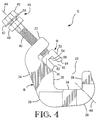
- the drawings show a signal reference grid connector 10 for connecting a conductor 12 to a post 14.
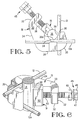
- the post 14 may be a pedestal or support post of a raised sub-floor installation (not shown), in which case the post 14 will be orientated vertically, and the conductor 12 may be part of a signal reference grid (not shown) installed horizontally beneath the raised sub-floor. It is possible to use the connector 10 with a post 14 having a round cross-section, as shown in Figures 6 and 7, or a polygonal cross-section as illustrated by, but not limited to a square cross-section shown in Figures 7 and 8.
- the connector 10 comprises a body 16 and a clamping mechanism 18.
- the body 16 includes a first end portion 20 and a second end portion 22 joined by a middle portion 24, whereby a generally C-shaped member is formed.
- the proportions of the body 16 are selected so that when connector 10 is installed on a post 14, the body acts as a spring and elastically deflects storing a residual force to cope with any relaxation of the conductors 12 or the connector 10. Extending along these portions 20-24 are an inner surface 26, an outer surface 28 and upper and lower side surfaces 30,32.
- the body will be cast of an aluminum alloy and have smooth blend radii throughout. The drawings do not include these radii to better illustrate the body 16. It would be possible to manufacture the connector body from other conductive materials and to use other manufacturing methods, such as machining or forging. It is also envisioned that a plating, such as tin, may be deposited on the connector 10 to enhance corrosion resistance. Because the post is conductive, it is not necessary that the connector body 16 also be made from a conductive material. A conductive path between the crossing conductors 12,12a will be established through the post 14 rather than through the connector body 16. Therefore, the connector body 16 may be made from a plastic or another dielectric compound.
- the first end portion 20 is profiled to receive the post 14 within a seat 23 defined by the inner surface 26.
- the seat 23 includes a base jaw 34 and a back-up jaw 36. These jaws 34,36 are approximately square to each other and capable of seating both round and polygonal posts 14 as discussed above.
- the range of sizes of posts 14 that the connector 10 can accept is dependent on the size of the seat 23, which is dependent on the size of the jaws 34,36. This dependency is readily observable by examining the drawings and the discussion below.
- the connector 10 is capable of accommodating square posts ranging in size from 3/4 inches to 7/8 inches and 1 inch round posts.
- each of the jaws 34,36 are a pair of recesses 38,38a that extend along the upper side surface 30 and the lower side surface 32, respectively. These recesses 38 are partial cylindrical indentations. The depth and the size of the recess 38 determines the size of the conductor 12 that the connector 10 can accommodate. The depth of the recesses 38 must be sufficiently shallow to expose enough of the conductor 12 above the inner surface 26 along the jaw so that the post 14 can be tightly pressed thereagainst.
- Signal reference grids may be formed with No. 4 AWG (American Wire Gage) to No. 8 AWG wire. It would also be possible to have deeper recesses 38 and incorporate projections that extend from the surface of the post 14 to engage the conductor 12.
- the distance that the recess extends along the jaw 34,36 determines the range of post 14 sizes and post configurations that the connector 10 can accept.
- the recesses 38,38a must span the point of contact 39 between the posts 14 and the conductors 12 where the post 14 has a cross-sectional configuration that would produce a single point of contact 39, such as is shown in Figure 5. If the post has a square cross section, a line of contact 39a is established and the recesses must span this line a sufficient distance to positively hold the post and conductor against each other.
- Signal reference grids most commonly involve conductors 12,12a that cross at 90 degree angles.
- a feature of the present invention is that the conductors 12,12a may be connected with the post 14 without having significant deviation from their natural orientation.
- the jaws 34,36 are orientated approximately square to each other corresponding to the paths of the conductors 12,12a in the grid, thereby enabling the conductors 12,12a to be interconnected with the post 14 without requiring substantial deviation from their natural path. By not altering the path of the conductors the amount of conductor material needed to form the grid and the installation time is minimized.
- a clamping mechanism 18 is employed to hold the post 14 against the conductors 12.
- the clamping mechanism 18 includes a clamp tightening screw 40 within a threaded bore 42 that passes through the inner 26 and outer 28 surfaces at the second end portion 22 of the body 16.
- the clamping mechanism 18 has an engaged position, shown in Figures 5-8, where the post 14 is being held tightly in the seat 23 and against the conductors 12.
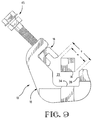
- the clamping mechanism 18 also has a disengaged position, as shown in Figure 9, where the clamping mechanism 18 is retracted towards the second end portion 22 of the body 16. In the disengaged position, the post 14 is side-accessible to the connector 10 enabling the connector 10 to be installed on the post 14 when the ends of the post 14 are no longer accessible.
- the clamping mechanism acts along a line 44 that bisects the angle defined between the two jaws 34,36. By acting along this line 44, the force exerted by the clamping mechanism 18 will tend to align the body 16, the post 14 and the conductors 12 as the clamping mechanism 18 is tightened to effect the most secure engagement of the connector 10 to the post 14 and therefore the post 14 against the conductor 12.
- the clamp tightening screw 40 can be adapted to limit the amount of compression the clamping mechanism 18 can produce, thereby protecting the post 14, conductors 12,12a and the connector 10 from damage due to over-tightening by incorporating a shear-head 45 into the clamp tightening screw 40.
- the shear-head 45 has a first head 46 and a second head 48 separated from each other by an undercut 50 extending into the screw 40. By adjusting the depth of the undercut 50 the amount of force exerted on the post 14 can be controlled.
- An undercut 50 is selected that allows the first head 46 to shear from the screw 40 when the amount of torque on the first head 46 exceeds the amount of torque required to produce the desired compressive force.
- the two heads 46,48 are aligned and a lip 47, where the first head 46 meets the undercut 50, prevents a wrench socket from also engaging the second head 48. This could also be accomplished by placing a C-clip in the undercut or by offsetting the heads 46,48 relative to each other.
- the second head 48 remains on the screw 40 for disassembly.
- the shear-head 45 provides a convenient way of assuring clamping does not damage the post while still exerting the necessary amount of force to establish the electrical connection. It also assures that the force necessary to deflect the body upon tightening, but not enough to exceed the elastic limits of the material, is exerted during clamping. This deflection stores energy within the body 16 which acts as a residual force to accommodate any relaxation of the conductor 12 or the clamping mechanism 18 in order to maintain the connector 10 in tight engagement with the conductor 12 and the connection.
- the connector 10 may be used with the second head 48 intact by using a torque wrench or an equivalent device.
- a clamp block 52 may be incorporated on the end of the clamping screw 40.
- the clamp block 52 acts to distribute the applied clamping load across the post 14, thereby protecting the post 14 from damage while still generating the necessary forces discussed above.
- the clamp block 52 is attached to the screw 40 in a manner that allows the rotation of the screw 40 without corresponding rotation of the clamp block 52. It is presently envisioned to create this interconnection by peening over a dog point 54 on the end of the screw 40 within a countersunk bore 56 in the block 52, whereby the deformation of the dog point 54 is sufficient to loosely captivate the block 52 on the screw 40.
- a V-shaped groove 60 may also be incorporated into a face 62 of the clamping block 52 to aid in distributing the clamping force over the post 14.
- the V-groove 60 may be a simple groove having straight sides with a 90 degree included angle or a compound groove 60 having a bottom section 62 with a 90 degree included angle for gripping the sides of a square post and a top section 64 having a 135 degree included angle for gripping round posts.
- This groove 60 engages the round post 14 in two locations and a square post 14 along two sides, as shown in Figures 5 and 7 respectfully.
- a relief cut 66 may be included in the bottom of the groove to prevent interference with the corner of a square post.
- the clamping mechanism 18 is moved to its disengaged position and the connector 10 is installed about the post 14.
- the connector 10 is capable of excepting posts having a cross-sectional width ⁇ that is less than the opening defined when the clamping mechanism 18 is in the disengaged position.
- the clamping mechanism 18 is then lightly tightened about the post 14 sufficient to hold the connector 10 in place on the post 14.
- the clamping mechanism 18 is then backed-off from the post 14 sufficient to allow the conductors 12 to be placed in the corresponding recesses 38 of the connector body 16.
- the connector 10 will be used with crossing conductors 12,12a.
- the first conductor 12 will be placed in the upper recess 38 of the jaw 34 that corresponds to the path of the conductor 12, while the second conductor 12a would be placed in the lower recess 38a of the other jaw 36.
- the connector will also be possible to use the connector with only one conductor or with parallel conductors without bending the conductor from its original path.
- the clamping mechanism 18 can be advanced to its engaged position tight against the post 14 which is now held firmly against the conductors 12,12a within the body 16 of the connector 10. If a shear head bolt is being used, the first head 46 is tightened, using a conventional wrench, until the first head 46 shears from the tightening screw 40. The installation of the connector 10 is complete.
Landscapes
- Details Of Connecting Devices For Male And Female Coupling (AREA)
- Connections By Means Of Piercing Elements, Nuts, Or Screws (AREA)
- Multi-Conductor Connections (AREA)
Applications Claiming Priority (2)
| Application Number | Priority Date | Filing Date | Title |
|---|---|---|---|
| US08/011,021 US5286211A (en) | 1993-01-29 | 1993-01-29 | Ground connector |
| US11021 | 1993-01-29 |
Publications (2)
| Publication Number | Publication Date |
|---|---|
| EP0608877A2 true EP0608877A2 (fr) | 1994-08-03 |
| EP0608877A3 EP0608877A3 (fr) | 1995-11-22 |
Family
ID=21748516
Family Applications (1)
| Application Number | Title | Priority Date | Filing Date |
|---|---|---|---|
| EP94101194A Ceased EP0608877A3 (fr) | 1993-01-29 | 1994-01-27 | Connecteur de mise à la terre. |
Country Status (8)
| Country | Link |
|---|---|
| US (1) | US5286211A (fr) |
| EP (1) | EP0608877A3 (fr) |
| JP (1) | JPH06243912A (fr) |
| KR (1) | KR940019023A (fr) |
| CN (1) | CN1094194A (fr) |
| AU (1) | AU673863B2 (fr) |
| BR (1) | BR9400312A (fr) |
| CA (1) | CA2111608A1 (fr) |
Cited By (1)
| Publication number | Priority date | Publication date | Assignee | Title |
|---|---|---|---|---|
| US9187654B2 (en) | 2009-05-06 | 2015-11-17 | Carrie A. Feeney | Barrier coatings post-formation treated with multi-valent metal cations |
Families Citing this family (44)
| Publication number | Priority date | Publication date | Assignee | Title |
|---|---|---|---|---|
| USD349225S (en) | 1993-07-02 | 1994-08-02 | Eric Von Fange | Theatrical C-clamp |
| US5553963A (en) * | 1994-12-08 | 1996-09-10 | Hoy; Thomas A. | Clamp device for a ladder adjustment apparatus |
| USD388052S (en) * | 1995-05-19 | 1997-12-23 | Teracom Components Ab | Grounding component for electric cables |
| DE19601457C1 (de) * | 1996-01-17 | 1997-02-06 | Loh Kg Rittal Werk | Anschlußklemme |
| US5829992A (en) * | 1996-03-08 | 1998-11-03 | Merker; Joseph J. | Device and method for grounding /bonding cable television connectors |
| US5928007A (en) * | 1996-05-17 | 1999-07-27 | Teracom Components Ab | Device for grounding feed cables between transmitters or receivers and antennas |
| US5933924A (en) * | 1997-05-09 | 1999-08-10 | Nowlen; William M. | Power line insulator clamp |
| ES2260153T3 (es) * | 2001-12-22 | 2006-11-01 | RICHARD BERGNER ELEKTROARMATUREN GMBH & CO.KG | Brida de fijacion para linea aerea. |
| US6722643B1 (en) * | 2002-05-23 | 2004-04-20 | William C. Kurtz | Multi-clamp |
| US20040181912A1 (en) * | 2003-01-30 | 2004-09-23 | Ilya Feygin | Article comprising an ergonomic handle |
| US6986673B2 (en) * | 2004-04-09 | 2006-01-17 | Thomas & Betts International, Inc. | Grounding clamp for raised floor |
| US20060094270A1 (en) * | 2004-11-03 | 2006-05-04 | Mark Engler | Positioning device for securing earth line of a signal transferring unit |
| US7160142B2 (en) * | 2005-01-04 | 2007-01-09 | Cooper Technologies Company | Grounding clamp apparatus and method |
| US20080116332A1 (en) * | 2006-11-21 | 2008-05-22 | Van Der Meulen Jan Roelof | Leg system for drums |
| US8303757B2 (en) * | 2006-12-04 | 2012-11-06 | The Boeing Company | Tensioning device for composite structures |
| USD562677S1 (en) * | 2007-05-24 | 2008-02-26 | Gsc Technologies Corporation | Closet rod clamp |
| US7670153B2 (en) * | 2007-09-10 | 2010-03-02 | Burndy Technology Llc | Electrical connector |
| US7988464B2 (en) * | 2008-04-09 | 2011-08-02 | Panduit Corp. | Beam clamp |
| USD599184S1 (en) * | 2008-05-23 | 2009-09-01 | Tyco Electronics Canada, Ltd. | Clamp |
| US7803001B2 (en) * | 2008-12-10 | 2010-09-28 | Burndy Technology, LLC | Ground connector |
| US8938918B2 (en) * | 2008-12-22 | 2015-01-27 | Hubbell Incorporated | Raised floor system grounding |
| US8007293B2 (en) * | 2008-12-29 | 2011-08-30 | Hubbell Incorporated | Grounding rebar connector |
| US7794243B1 (en) * | 2009-02-27 | 2010-09-14 | Burndy Technology, LLC | Ground connector |
| US8038453B2 (en) * | 2009-02-27 | 2011-10-18 | Hubbell Incorporated | Ground connector |
| US8313334B2 (en) * | 2009-09-11 | 2012-11-20 | Hubbell Incorporated | Pedestal ground connector |
| ES2808155T3 (es) | 2009-10-02 | 2021-02-25 | Medtronic Xomed Inc | Aparato de tubo endotraqueal |
| US7922546B1 (en) * | 2009-12-02 | 2011-04-12 | Thomas & Betts Intenational, Inc. | Grounding clamp |
| CN102161143A (zh) * | 2011-04-01 | 2011-08-24 | 上海电气核电设备有限公司 | 一种用于蒸汽发生器管束的抗震条装配辅助工装 |
| US9931079B2 (en) * | 2012-01-04 | 2018-04-03 | Medtronic Xomed, Inc. | Clamp for securing a terminal end of a wire to a surface electrode |
| US8864502B2 (en) | 2012-05-04 | 2014-10-21 | Thomas & Betts International, Inc. | Mechanical grounding connector |
| USD709458S1 (en) * | 2012-11-15 | 2014-07-22 | Connector Products, Inc. | Electrical lead clamp |
| US9060744B2 (en) | 2012-11-29 | 2015-06-23 | Medtronic Xomed, Inc. | Endobronchial tube apparatus |
| US9913594B2 (en) | 2013-03-14 | 2018-03-13 | Medtronic Xomed, Inc. | Compliant electrode for EMG endotracheal tube |
| US9106067B1 (en) | 2013-09-09 | 2015-08-11 | Mike Vernica | Ground bushing with three way lay and lag |
| USD764249S1 (en) * | 2014-10-16 | 2016-08-23 | Acrefine Engineering Services, Ltd. | Rod stiffener clamp |
| US9787004B2 (en) | 2015-05-20 | 2017-10-10 | Thomas & Betts International Llc | Floor ground clamp |
| US11110240B2 (en) | 2017-09-07 | 2021-09-07 | Medtronic Xomed, Inc. | Endotracheal tube with tube coating |
| US10494867B1 (en) * | 2018-10-17 | 2019-12-03 | Marc Fort | Simply safe ladder clamp |
| US10920911B2 (en) | 2018-12-26 | 2021-02-16 | Commscope Technologies Llc | Adapter for mounting cable hangers |
| US10910805B2 (en) * | 2018-12-26 | 2021-02-02 | Commscope Technologies Llc | Adapter for mounting cable hangers |
| USD920852S1 (en) * | 2019-05-06 | 2021-06-01 | Cake 0 emission AB | Electric motorcycle |
| US11990723B2 (en) * | 2020-03-09 | 2024-05-21 | Burndy, LLC | Conductor interface grabbing tool |
| JP7395418B2 (ja) * | 2020-04-21 | 2023-12-11 | 株式会社サンテック | 接地金具 |
| US11870166B2 (en) | 2020-08-19 | 2024-01-09 | Hubbell Incorporated | Low resistivity tap clamp |
Family Cites Families (12)
| Publication number | Priority date | Publication date | Assignee | Title |
|---|---|---|---|---|
| DE623406C (de) * | 1933-07-29 | 1935-12-19 | Kabelwerk Duisburg | Kreuzklemme zur herstellung von kreuzverbindungen an durchgehenden elektrischen leitungen |
| US2151524A (en) * | 1938-06-10 | 1939-03-21 | Ralph R Pittman | Tap clamp |
| DE971877C (de) * | 1952-04-19 | 1959-04-09 | Hoppmann & Mulsow | Maulklemme zum Verbinden elektrischer Leitungen |
| US3561317A (en) * | 1969-04-04 | 1971-02-09 | Anaconda American Brass Co | Self-indicating clamping bolt |
| US3622946A (en) * | 1970-03-02 | 1971-11-23 | Permali Inc | Electrical connector with breakaway stud |
| US3892455A (en) * | 1974-03-26 | 1975-07-01 | Thomas & Betts Corp | Ground clamp connector |
| US4105272A (en) * | 1977-07-11 | 1978-08-08 | A. B. Chance Company | High current grounding assembly having rigid interconnecting conductors |
| GB1582664A (en) * | 1978-05-24 | 1981-01-14 | Pentabloc Ltd | Joining member for frame systems |
| US4189198A (en) * | 1978-07-31 | 1980-02-19 | Gould Inc. | Conduit ground wire coupling |
| FR2566191B1 (fr) * | 1984-06-15 | 1986-11-14 | Sicame Sa | Connecteur de derivation isole pour cables electriques |
| US4911572A (en) * | 1988-06-13 | 1990-03-27 | Houston Industries Incorporated | Cable tie back clamp |
| CA1286012C (fr) * | 1988-09-09 | 1991-07-09 | Robin Paul Cera | Connecteur de mise a la terre pour applications electriques |
-
1993
- 1993-01-29 US US08/011,021 patent/US5286211A/en not_active Expired - Lifetime
- 1993-12-16 CA CA002111608A patent/CA2111608A1/fr not_active Abandoned
- 1993-12-20 AU AU52590/93A patent/AU673863B2/en not_active Ceased
-
1994
- 1994-01-24 BR BR9400312A patent/BR9400312A/pt not_active IP Right Cessation
- 1994-01-27 EP EP94101194A patent/EP0608877A3/fr not_active Ceased
- 1994-01-27 KR KR1019940001412A patent/KR940019023A/ko not_active Withdrawn
- 1994-01-28 JP JP6008478A patent/JPH06243912A/ja not_active Withdrawn
- 1994-01-28 CN CN94101138A patent/CN1094194A/zh active Pending
Cited By (1)
| Publication number | Priority date | Publication date | Assignee | Title |
|---|---|---|---|---|
| US9187654B2 (en) | 2009-05-06 | 2015-11-17 | Carrie A. Feeney | Barrier coatings post-formation treated with multi-valent metal cations |
Also Published As
| Publication number | Publication date |
|---|---|
| BR9400312A (pt) | 1994-08-16 |
| KR940019023A (ko) | 1994-08-19 |
| EP0608877A3 (fr) | 1995-11-22 |
| CA2111608A1 (fr) | 1994-07-30 |
| AU673863B2 (en) | 1996-11-28 |
| AU5259093A (en) | 1994-08-04 |
| US5286211A (en) | 1994-02-15 |
| JPH06243912A (ja) | 1994-09-02 |
| CN1094194A (zh) | 1994-10-26 |
Similar Documents
| Publication | Publication Date | Title |
|---|---|---|
| US5286211A (en) | Ground connector | |
| US5423699A (en) | Electrical connector | |
| US5011427A (en) | Cord protector | |
| EP0468378B1 (fr) | Connexion de terre à plusieurs raccordements | |
| CA1234196A (fr) | Connecteur de branchement electrique | |
| CA2068692C (fr) | Connecteur de fil electrique | |
| CA1286012C (fr) | Connecteur de mise a la terre pour applications electriques | |
| US4652071A (en) | Cable terminal connector with insulation displacing terminals | |
| EP0541075A1 (fr) | Réglette de bornes par cloison pare-feu | |
| US4545631A (en) | Offset electrical outlet | |
| EP0237141A2 (fr) | Connexion terminale de câble à bornes à déplacement d'isolant | |
| GB2383202A (en) | Locking electrical connector | |
| US20170317435A1 (en) | Grounding Blocks for Wires/Coaxial Cables | |
| US5236377A (en) | Electrical wire connector | |
| US5876224A (en) | Bus bar adaptor | |
| EP0813755B1 (fr) | Connecteur pour fil electrique ameliore | |
| US4527849A (en) | Snap-in mounting device for electrical devices | |
| US4840581A (en) | Cable jacket strain relief adapter assembly | |
| CA1280802C (fr) | Systeme de mise a la terre pour coffret d'appareil | |
| US6045379A (en) | Device connecting conductors or devices to a bus bar in a bus bar system | |
| AU670344B2 (en) | Electrical distribution system connector | |
| EP0197420A2 (fr) | Agrafe pour câble coaxial | |
| CA2126273C (fr) | Connecteur electrique | |
| US5401194A (en) | Cable clamp with reduced fastener length | |
| US20020090847A1 (en) | Ground connector |
Legal Events
| Date | Code | Title | Description |
|---|---|---|---|
| PUAI | Public reference made under article 153(3) epc to a published international application that has entered the european phase |
Free format text: ORIGINAL CODE: 0009012 |
|
| AK | Designated contracting states |
Kind code of ref document: A2 Designated state(s): DE FR GB IT NL |
|
| PUAL | Search report despatched |
Free format text: ORIGINAL CODE: 0009013 |
|
| AK | Designated contracting states |
Kind code of ref document: A3 Designated state(s): DE FR GB IT NL |
|
| 17P | Request for examination filed |
Effective date: 19960509 |
|
| 17Q | First examination report despatched |
Effective date: 19970604 |
|
| GRAG | Despatch of communication of intention to grant |
Free format text: ORIGINAL CODE: EPIDOS AGRA |
|
| STAA | Information on the status of an ep patent application or granted ep patent |
Free format text: STATUS: THE APPLICATION HAS BEEN REFUSED |
|
| 18R | Application refused |
Effective date: 19990725 |