EP0609169A2 - Couscous - Google Patents
Couscous Download PDFInfo
- Publication number
- EP0609169A2 EP0609169A2 EP94630001A EP94630001A EP0609169A2 EP 0609169 A2 EP0609169 A2 EP 0609169A2 EP 94630001 A EP94630001 A EP 94630001A EP 94630001 A EP94630001 A EP 94630001A EP 0609169 A2 EP0609169 A2 EP 0609169A2
- Authority
- EP
- European Patent Office
- Prior art keywords
- mixture
- product
- couscous
- zone
- particles
- Prior art date
- Legal status (The legal status is an assumption and is not a legal conclusion. Google has not performed a legal analysis and makes no representation as to the accuracy of the status listed.)
- Withdrawn
Links
Images

Classifications
-
- A—HUMAN NECESSITIES
- A23—FOODS OR FOODSTUFFS; TREATMENT THEREOF, NOT COVERED BY OTHER CLASSES
- A23L—FOODS, FOODSTUFFS OR NON-ALCOHOLIC BEVERAGES, NOT OTHERWISE PROVIDED FOR; PREPARATION OR TREATMENT THEREOF
- A23L7/00—Cereal-derived products; Malt products; Preparation or treatment thereof
- A23L7/10—Cereal-derived products
- A23L7/109—Types of pasta, e.g. macaroni or noodles
-
- A—HUMAN NECESSITIES
- A23—FOODS OR FOODSTUFFS; TREATMENT THEREOF, NOT COVERED BY OTHER CLASSES
- A23L—FOODS, FOODSTUFFS OR NON-ALCOHOLIC BEVERAGES, NOT OTHERWISE PROVIDED FOR; PREPARATION OR TREATMENT THEREOF
- A23L7/00—Cereal-derived products; Malt products; Preparation or treatment thereof
- A23L7/10—Cereal-derived products
- A23L7/198—Dry unshaped finely divided cereal products, not provided for in groups A23L7/117 - A23L7/196 and A23L29/00, e.g. meal, flour, powder, dried cereal creams or extracts
Definitions
- This invention relates to the food product called couscous and particularly to a new and improved method for making couscous, to a new and improved couscous food product, and to speedy methods of preparing the new couscous product for consumption.
- Couscous appears to be unique among cereal grain food products. It is distinguished by the special way it can be and traditionally has been prepared for consumption, namely by a series of simple hydrating and steaming steps. Generally, the steaming of the product to an edible condition is accomplished in a couscoussiere.
- the traditional method for making couscous has been by mixing water with durum wheat semolina in a gissa or large wooden dish, then rubbing the mixture between the palms of one's hands to form agglomerates or small irregularly shaped granules, screening the granules to proper size, followed by steam precooking of the granules, and finally sun-drying those of the proper size.
- Sun-dried couscous has a long shelf life.
- the traditional method has been the only known method for making couscous. Credit goes to the Buhler company of Uzwil, Switzerland for successfully developing a method for the commercial production of couscous and for setting up the first commercial production facility in Sfax, Tunisia in 1979.
- the first step of the known commercial method is that of blending water and semolina until optimum agglomeration or granule formation is achieved. This is accomplished without forming the semolina into a unitary doughy mass.
- a mechanical mixer such as a paddle mixer is used for this step and the mixing takes about 3 minutes to provide granules of a moisture content of about 30-35%.
- the next step of the known commercial method involves feeding the coarse, irregularly shaped and random-sized moist granules into a detacher where the granules of oversize are reduced and those of proper size are strengthened and shaped to form the couscous agglomerates. This step takes about 7 minutes.
- wet sifting may be done to separate undesired fines and oversized particles from the proper size range for the agglomerates. Fines are recycled back to the beginning mixing step and oversized agglomerates are routed back through the detacher.
- the couscous agglomerates are passed on a conveyor belt through a steam cooking operation.
- This steaming step takes about 8 minutes at a temperature of about 180° C.
- the moisture of the couscous product is elevated to about 37% by weight by the time the product exits the steaming operation.
- approximately 55 or 60% by weight of the starch is gelatinized.
- the agglomerates are then dried in climate-controlled dryers. For example, a predrying stage may take 2 hours at 65° C and a main drying stage may take 4 1/2 hours at 55° C. Drying is conducted until the product moisture is reduced below 13%, preferably to 10-12%. The dried product is then cooled back to ambient conditions and sifted into oversized conglomerates, fine, medium, and coarse couscous, and undersized granules. Oversized agglomerates are passed through a roller mill and the resulting fraction is resifted. Undersized particles are metered into the beginning mixing step.
- Couscous is a wheat-based particulate product that gives a granular mouthfeel.
- the proper size range for its dried particles is from about 0.85 to about 2.5 millimeter mesh.
- the particles of a specific couscous product should not vary more than about 1 mm mesh, preferably not more than about 0.5 mm mesh, between the largest and smallest. Uniformity of size is a mark of quality for couscous and has not been easily achieved using known methods of manufacture. Particles lacking uniformity of shape and size result in irregular cooking quality and unsatisfactory mouthfeel.
- the required property of granular mouthfeel further means that the particles must remain separate and not stick together when they are rehydrated and cooked (as by steaming) for consumption.
- Cooking with sauces or moisture should soften the particles but not so greatly that they exhibit no resistance to the bite. Chewing of the particles should shear them, that is, subdivide them into smaller and smaller particles. The chewed particles should not give a brittle or rubbery or sticky or pasty or gummy feeling. The traditional granular mouthfeel associated with agglomerates is critical.
- the present invention results from the discovery, despite years and even centuries of couscous practices requiring the contrary, that couscous can in fact be made by extrusion processing of a doughy mass.
- the invention provides a shelf-storable improved couscous food product satisfying traditional couscous granular mouthfeel.
- the product consists essentially of non-sticky free-flowing wheat-based particles having a size between about 0.85 and about 2.5 mm mesh, and having a moisture content below about 13% by weight. It is relatively quickly hydratable and steam cooked without loss of its particulate integrity. It is particularly characterized by the fact that its particles are substantially translucent, have a Water Absorption Index greater than 4.7, and have a substantially uniform and dense extrusion-compacted composition.
- the composition is comprised essentially of the starches and gluten-forming proteins in a blend of, by dry solids weight, at least about 65% up to 100% of durum wheat flour or middlings or semolina and about 35% down to 0% of flours or middlings or farinas of cereal grains other than durum wheat. At least about 80% of the dry solids weight of the starches is gelatinized.
- the particles are further characterized by having, when examined under a magnification of 12 times, (i) substantially smooth surfaces on the exterior thereof and (ii) angularly projecting edges on the exterior thereof.
- Preferred particles are such that their substantially smooth exterior surfaces include opposing surfaces in generally parallel relationship and include side surfaces extending between and angularly connected at about 90° to the opposing surfaces.
- the angularly projecting edges of such particles comprise the edges formed at the angular connections between the side surfaces and the opposing surfaces.
- Preferred particles also exhibit their shortest linear dimension in a direction substantially perpendicular to the opposing surfaces.
- the ideal couscous product of the invention has particles of substantially the same size and shape.
- One method of preparing the new product for consumption consists essentially of adding the product to boiling water and simmering the product in the boiling water for 2 minutes, followed by allowing the product to stand in the water without additional heating for 2 minutes.
- Another method of preparing the new product for consumption consists essentially of hydrating the product in a single hydration step using sufficient water at 25° C for 2 to 6 minutes for the product to increase its weight at least to 180% of its original weight by absorbing the water, and then steaming the hydrated product for up to 3 to 4 minutes with steam at 90° C or higher.
- the improved method for making this new couscous food product is an extrusion method.
- a major step in conducting the method is that of extruding a cooked mixture of wheat-based composition and water maintained under an elevated temperature between about 70° C and 100° C and a pressure from about 13 bar up to about 41 bar and a moisture content of at least 25% but not over 45% by weight through an extrusion die having openings of substantially uniform size within the size limits from about 0.5 square millimeters up to about 7 square millimeters.
- the wheat-based composition is comprised essentially of the starches and gluten-forming proteins in a blend of, by dry solids weight, at least about 65% up to 100% of durum wheat flour or middlings or semolina and about 35% down to 0% of flours or middlings or farinas of cereal grains other than durum wheat.
- the extrudate of the die is cut and then dried under elevated temperatures to a moisture content below 13% by weight.
- the extrusion of the cooked mixture is conducted at a linear extrusion rate in excess of 1,200 mm/min.
- the extrusion die employed preferably has a substantially flat outer face and the cutting surface of the extrudate is conducted at a cutting rate in excess of 500 cuts per minute across the face of the die.
- the linear extrusion rate and the cutting rate are preferably such that the extrudate is cut into particles having cut lengths with parallel surfaces spaced apart at least about 0.5 mm up to about 2.5 mm.
- Steps of the method preliminary to the extrusion step comprise:
- the preferred method also contemplates forcing the mixture through a constriction between the forming zone and stabilization zone.
- the new method for making couscous does not require the specific apparatus here discussed. Nevertheless, the method is better understood by reference to a useful apparatus for conducting it.
- the preconditioner or conditioning cylinder 10 has an entrance 11 and an exit 12 and preferably contains twin laterally juxtaposed counter-rotating shafts 13 (only one schematically illustrated) equipped with paddles 14 oriented at various pitches to advance the raw material through the preconditioner from entrance to exit and to provide a controlled dwell time for the material in the preconditioner as the material is being mixed.
- the preconditioner also includes a water conduit 15 with metering means for introduction of water near its entrance, as well as steam injection ports 16 with metering means for controlled injection of steam along the bottom of the interior of the preconditioner.
- the paddles 14 preferably are in three different groups. At the entrance end 11 the paddles are oriented so that they forcibly convey the material forward to the exit 12. In the middle portion, the paddles preferably are at a neutral angle and therefore do not themselves effectively function to move material through the preconditioner. They act to mix the material with the steam and water.
- the paddles near the exit portion 12 are preferably located at an angle or pitch such that they relatively tend to push or compact material in a reverse direction (back toward entrance) as the material is being forced forward through the preconditioner by the build up caused by the forward-motion paddles near the entrance end.
- the pitch of these paddles and the shaft rpm are adjusted so as to achieve the desired dwell time of between about 30 seconds and 2.5 minutes in the preconditioner.
- Material exiting the preconditioner is fed into the barrel 21 of an extruder 20.
- the entrance 22 of extruder 20 may be joined to the exit of the preconditioner, if desired.
- a useful extruder barrel is known in the United States under the trade name "Wenger TX-52" (screw elements of 52-mm diameter), and is described with a process for its use in Wenger et al. U.S. Patent No. 4,763,569 of August 16, 1988, here incorporated by reference.
- An extruder barrel 21 having a length to diameter ratio of about 25:1 is useful for practicing this invention. As illustrated in FIG. 4, it suitably includes nine head elements numbered 1 through 9, each about 15 cm. in length.
- the composite barrel 21 has several zones, namely a cooking zone X, a venting zone Y, and a forming zone Z.
- the complete extruder 20, as styled for this invention, also has a special stabilization zone M and finally terminates at its exit end in an extrusion die 23, which is preferably horizontally oriented.
- an extrusion die 23 which is preferably horizontally oriented.
- single screw extruders may be employed successfully for the practice of the invention, the most preferred extruders are comprised of twin intermeshing co-rotating screw elements such as employed in the "Wenger TX-52".
- the portion of the shaft 41 extending through the cooking zone is preferably equipped with several reverse pitch shearlocks, that is, contoured bodies for effecting shearing action on the mixture being worked.
- Each of the head elements 1 through 9 has a jacket 40 through which a heating or cooling fluid is circulated to control the head element temperature.
- head element temperatures can be controlled by other means, such as, for example, by electricity.
- a water conduit 25 into head 2 is for adding water to the mixture, and steam entrances 26 and 27 into heads 3 and 4 are for injecting the mixture with steam.
- Head 6 is provided with a vent stack 28 for the escape of moisture from the mixture, primarily in the form of steam vapors.
- a negative pressure of 0.3 bar gauge to 0.5 bar gauge is drawn on the exit vent 29.
- An auger 30 or similar device is employed to retain or return material that expands out of barrel 21 into the stack 28 back into the extruder barrel 21 while the negative pressure is applied.
- the forming zone Z is next and terminates at the end of the extruder barrel 21 where a choke or constriction 31 for practicing the invention is located.
- the constriction 31 used in conducting experiments of this invention had two openings of about 6 mm diameter--one at the end of each screw of a twin screw extruder--with both openings emptying to a center channel of about 9.5 mm diameter which in turn emptied into the stabilization zone M.
- the stabilization zone M is defined by a continuation housing 32.
- the housing 32 used for experiments had a length of about 25 cm and a diameter of about 7.5 cm.
- the stabilization zone continues through the elbow 33 which effects a change of direction.
- a screen 34 (e.g., 0.6 mm mesh or 30 mesh U.S. Standard) may desirably be employed at the interior surface of die 23 to improve uniformity of flow across the die and to screen out foreign particles from the dough mass, thereby saving the die 23 from unnecessary wear.
- the die 23 is preferably oriented in a horizontal plane for vertical passage through the die.
- Dies for practicing the invention have a multiplicity of very small die openings or holes. All openings for any one die are preferably of equal size (i.e. equal in area dimension). The openings may vary from about 0.5 to about 5 or 6 or possibly 7 square millimeters for different dies. Square or multi-sided openings may be used, but ideally, the openings are circular to give a cylindrical shape to resulting extrusions.
- a cutter 35 such as a four blade knife is fitted flush to the outer die face or surface and rotated at a significant speed (e.g., to provide at least 500 cuts per minute).
- the cutter slices extruded material into stub-like particles which on drying give the required couscous size, namely between about 0.85 mm (possibly as short as 0.5 mm) and about 2.5 mm for the extruded lengths.
- the cut extrudate is dried by moving the particles through drying gasses such as in a climate-controlled drying atmosphere.
- the particles may fall or drop on a conveyor 36 and then pass through a climate-controlled atmosphere. They may be dumped from the conveyor 36 into a climate-controlled drying atmosphere in a special space 37, or dropped from the die into such a space.
- the special space may be a stack or column of rising drying gases, or a fluidized bed, or a rotary screen dryer. Still other drying systems may be used for drying the particles. Countercurrent air flow systems are especially useful, but any system effecting relative movement between the particles and a climate-controlled drying atmosphere can be effective.
- the raw material employed as a starting material in the practice of the invention is wheat based.
- the basic raw material is a milled product, and most preferably a milled product of durum wheat.
- a varying percentage from zero up to about 35% by dry solids weight of the raw material may comprise the milled product (such as flour or middlings or farina) of other cereal grains.
- Such cereal grains include wheats other than durum (e.g., hard red spring, hard red winter, soft red, soft white, etc.) plus corn or maize, millet, sorghum, milo, and any others as desired.
- the flour or farina of cereal grains should account for at least about 90% of the dry solids weight of the total composition, if not 100% of it.
- the flour or middlings or semolina of durum should always dominate.
- the wheat proteins particularly the proteins known to be gluten-forming (and preferably the gluten-forming proteins of durum), perform an important binder-type function. They form a water-insoluble network or protein mass of extensible or extended character about the starch molecules. Sometimes their performance is referred to as an enrobing of the starch. They cause starchy couscous particles of the invention to resist breakdown and keep their.particulate integrity (i.e., general shape) when they are prepared for consumption.
- the gluten-forming wheat proteins preferably should at least equal and preferably exceed about 8% of the dry solids weight of the composition of the particles. This criterion is generally met when starting compositions contain durum flour or middlings or semolina in an amount accounting for at least about 65% of the dry solids weight. Of course, the protein in durum flour or middlings or semolina can vary depending on growing conditions, but it generally exceeds 10% of the dry weight.
- the starches of cereal grains will generally account for at least about 75% or 80% of the dry solids weight of the compositions. This criterion is generally met by using compositions comprised essentially of flours or middlings or farinas of cereal grains (i.e., 65% to 100% durum and 35% to 0% other grains).
- the yellow color highly prized for couscous results primarily from the use of durum as starting material.
- Couscous made according to the present invention using durum wheat flour or middlings or semolina, has a more intense color than couscous of comparable formula made according to the agglomeration methods of the prior art. Substitution of varying amounts of other cereal-based raw materials proportionally reduces the color intensity and can adversely affect texture and flavor.
- Preliminary mixing of the raw material solids with water and steam in a preconditioner is done to give a mixture having a moisture content between about 20% and 30% by weight, preferably at least about 25 or 26% up to about 28 or 29% by weight.
- the temperature elevation during this mixing generally will be to at least about 70° C, and preferably at least about 80° C to around 90° C or more, but not over about 100° C.
- Starch of the mixture is partially hydrated and partially gelatinized in this step. Preferred time for this step is between about 1.5 and 2 minutes.
- the mixture is then passed into the extruder barrel and the screws are rotated to advance the mixture through the cooking, venting, and forming zones and out the barrel into the stabilization zone and through the extrusion die.
- Dwell time in the extruder from entrance to exit through the die ranges between about 1.0 and 2.5 minutes, preferably between about 1.5 and 2.5 minutes.
- the mixture is raised to a temperature in excess of 90° C up to about 130° C (preferably to at least about 100° C up to about 120° C), and its moisture is increased to a level in excess of 30% by weight (preferably in excess of 35% by weight) up to 50% by weight.
- Water and steam are injected at varying rates, such as, for example, between about 4 and 10 kg/hr for water and between about 0.15 and 0.30 kg/min for steam under 5 or 6 bar (80 psi). Modest shearing of the mixture on its way through the extruder is desirable, and is accomplished in the cooking zone. Shearing tends to cause the mixture to form itself into a dough.
- the moisture vapors escaping from the mixture in the venting zone cause a lowering of the temperature of the dough, but the lowering or reduction is not to a temperature below 70° C.
- the temperature is most preferably reduced below 100° C but not below 80° C in this zone.
- the moisture of the dough is reduced by the vapor escape but is maintained at a level in excess of 25% and not over 45% by weight (preferably in excess of 30% and not over 40%) as the mixture leaves the venting zone.
- the forming zone where the temperature of the dough is maintained between about 70° C and 100° C (preferably between 80° C and 100° C) as it is subjected to increases of pressure following the relaxation of pressure in the venting zone. Pressures in the forming zone are created by the unrelenting thrust of the screw 24 in pushing the mixture toward the constriction 31 at the end of the extruder barrel.
- the constriction functions to obstruct to some degree the movement of material from the forming zone Z into the stabilization zone M and increase the retention time of the mixture in the extruder barrel. It also functions to provide a pressure differential between the two zones, and to achieve a desired back pressure in the forming zone.
- the constriction at 31 may be omitted with loss of its benefits. At least some degree of constriction is desirable and constrictions which maintain a pressure differential of at least about 13 bar (200 psi) up to possibly about 70 bar (1,000 psi) between the forming zone Z and stabilization zone M are preferred.
- the pressures applied to the mixture within the forming zone Z should exceed about 27 bar (400 psi).
- Preferred forming pressures are between about 55 bar (800 psi) and about 90 bar (1,300 psi). Forming pressures as high as 95 or 102 bar (1,400 or 1,500 psi) are useful. Forming pressures compress and compact the dough and enhance its development and contribute to the structural integrity or unity of the end product.
- Stabilization zone pressures generally range between about 13 bar (200 psi) to about 41 bar (600 psi). Preferably they do not exceed 34 bar (500 psi).
- the extrudate is cut and the cut extrudate promptly subjected to drying to a moisture content below about 13% by weight.
- Low moisture contributes to long shelf storability. Drying to about 10-12% moisture by weight is useful. It for the most part is unnecessary or undesirable to incur the expense of drying to a level of moisture below about 9 or 10%, although drying to lower moisture such as 6% or so is permissible. Drying is preferably done in an atmosphere of controlled humidity and temperature. Suitable relative humidity may vary from 30% to 90%, preferably with gradual lowering of the humidity in the controlled atmosphere as drying takes place. While drying under a wide range of temperatures is possible, the range should be limited to between 40° C and 90° C with the range between 70° C and 85° C or about 80° C the most preferred.
- drying to a moisture below 13% by weight can be accomplished in well less than 30 minutes, whether the particles are on a belt or are tossed in a rotary screen or free-falling or suspended in a fluidized bed or floating in the drying atmosphere. Drying involves relative movement between the cut particles and the drying atmosphere.
- the high rate of cutting extrudate is especially significant.
- Slice-like cutting of extrudate is effected by moving a cutter (e.g., a knife or blade) across the face of the die at such a rate that the size range for the dried particles is from about 0.85 to about 2.5 mm mesh.
- a cutter e.g., a knife or blade
- the rate of cutting necessarily is rather high to achieve the small particles required, but preferrably is kept within bounds to avoid excessive die wear.
- the cutting rate also depends on a reasonable and commercially practicable linear extrusion rate.
- a minimal practical extrusion rate generally will be in excess of about 1,200 mm/min, and usually over about 1,500 mm/min.
- a four-blade cutter was rotated at 360 rpm to effect 1,440 cuts per minute across the face of the die having openings of 1.219 mm and a linear extrusion rate of about 1,600 mm/min.
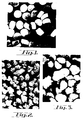
- the cut and dried extrudate at a magnification of 12 times has substantially smooth opposing exterior surfaces 100 and 102 (see FIG. 1a) in generally parallel relation. These substantially parallel opposing surfaces 100 and 102 are at opposite ends of a very short stub body (e.g., a stub cylinder) having substantially smooth side exterior surfaces 103.
- the side surfaces 103 are angularly connected to the opposing surfaces to form angular projecting edges.
- the angle is approximately 90°, i.e., a right angle 104.
- the particles under a magnification of 12 times must have substantially smooth surfaces on the exterior thereof, plus angularly projecting edges on the exterior thereof (such as formed at the 90° angles of connection between opposing and side surfaces). More specifically, the particles under a magnification of 12 times preferably have (i) substantially smooth opposing exterior surfaces in generally parallel relationship and (ii) substantially smooth side exterior surfaces extending between and angularly connected at about 90 degrees to the opposing surfaces and (iii) a distance between the opposing surfaces no greater than the greatest linear dimension of the particle in directions parallel to the opposing surfaces.
- That greatest linear dimension in directions parallel to the opposing surfaces is not in excess of 180% (preferably not over 150%) of the shortest linear dimension parallel to the opposing surfaces (as, for example, when non-circular die openings are employed).
- Dimensions perpendicular to opposing surfaces should not be substantially greater than the maximum linear dimension parallel to opposing surfaces.
- the shortest linear dimension is perpendicular to the opposing parallel surfaces, and preferably is not less than 0.5 mm.
- the shortest linear dimension will fall in the range between about 30% and 70% of the greatest linear dimension parallel to the opposing surface of the particle.
- the distinctive new particles are shown in FIG. 1 and are to be compared to the prior art couscous agglomerated particles of FIGS. 2 and 3.
- the particles formed by extrusion maintain their integrity under normal handling conditions. They are not easily friable and do not break down into fragments when hydrated during preparation for consumption. They have a highly compacted (i.e., extrusion-compacted) and dense composition.
- the composition is substantially uniform throughout the particles, and the particles are substantially translucent, allowing the passage of light through them in a relatively uniform manner, which is totally different from the interference to light passage exhibited by agglomerated couscous particles.
- the agglomerated particles have voids. They are not compacted; and while they are partially gelatinized, they are opaque to the passage of light.
- durum wheat semolina blended with 0.75% by weight glyceryl monostearate (tradename "Myvaplex”) as a surfactant was fed into a preconditioner at the rate of 68 kg/hr. Water was metered in at the rate of 10.0 kg/hr, and steam at about 5 bar (80 psi) was injected along the bottom of the preconditioner at a rate of about 0.26-0.29 kg/min. No effort was made to elevate pressure beyond ambient atmospheric pressure. The mixture exiting the preconditioner in different test runs was at a temperature of about 93° C to 99° C and moisture levels of about 26% to 28%.
- Starch gelatinization was measured by the enzymatic method set forth by Shetty, R. M., Lineback, D. R., and Seib, P.A., titled “Determining the Degree of Starch Gelatinization", published in Cereal Chemistry, May-June 1974, Vol. 51, pp. 364-375, here incorporated by reference.
- the total starch content was determined by "AACC Method 76-11; Starch--Glucoamylase Method With Subsequent Measurement of Glucose With Glucose Oxidase; First Approval 10-8-76; Reviewed 10-27-82," published by the American Association of Cereal Chemists, here incorporated by reference.
- the Water Absorption Index is a useful indicator of the water absorption capabilities of the products of the invention. This index represents the weight of a centrifuged (water-containing) gel obtained per gram of dry sample.
- the method for determining the WAI is described by Anderson, R. A., Conway, H. F., Pfeifer, V. F., and Griffen, E. L., Jr., in an article entitled “Gelatinization of Corn Grits by Roll and Extrusion Cooking", published in Cereal Science Today, Jan. 1969 Vol. 14(1), pp. 4-7, 11-12, here incorporated by reference.
- Couscous of this invention has a WAI of at least 4.7 and even over 5.0, which is believed to be unusually high and indicative of quick and thorough hydration in preparing the product for consumption.
- WSI Water Solubility Index
- the total rehydrating time in the above table refers to the total time for rehydration of the couscous as conducted by a two-step process combined with steaming.
- Couscous of the present invention is relatively quickly hydrated and even more quickly steam cooked to a ready-to-eat condition as compared to couscous prepared by agglomeration.
- the steaming time to prepare couscous of this invention for consumption has been observed to be less than one-half the time required for steaming of couscous made by agglomeration. For example, products of the present invention were ready for consumption after two steaming times of 3 minutes each, whereas a test using an agglomerated product required two steaming times of 8 minutes each.
- Each steaming step for couscous of the present invention was preceded by a period of rehydration (at room temperature) such as used conventionally in preparing agglomerated couscous for consumption.
- the couscous sample was allowed to absorb water to 60% of its weight; and during the second, it was allowed to absorb water to 30% of its initial weight.
- couscous of the present invention may be prepared for consumption in a single hydration step involving submerging it in water at 25° C for at least 2 minutes up to 6 minutes, until the couscous particles increase in weight at least to 180% of their original weight by absorbing water (e.g., going from 1.0 gram to 1.8 grams), and then steaming that hydrated product for up to 3-4 minutes with steam at 90° C or higher.
- couscous of the present invention when prepared for consumption using boiling water, requires less than one-half the time of the agglomerated product.
- Product of the present invention can be prepared for consumption by adding a sample to boiling water, allowing it to simmer for 2 minutes or less and allowing it to stand without additional heating for up to 2 minutes.
- extruded product moisture levels between about 32 and 38% by weight further enhance smoothness of texture for the end product.
- Lower extrusion moisture levels tend to increase extrusion pressures and cause an undesired increase in the mechanical shear action of the dough.
- Raising the moisture content about 40% tends to increase the risk or possibility of a drop in quality toward a lower WAI, less gelatinization, and some unwanted stickiness associated with cutting the product at the die surface.
- Cooking zone temperatures at or below 100° C tend to yield end products having somewhat less starch gelatinization and requiring longer rehydration.
- the end products tend to exhibit improved WAI, increased gelatinization, and a shortening of rehydration times.
- the higher climate-controlled drying temperatures of 70° C to 80° C give improved product integrity, shortened rehydration times and an overall better quality product.
Landscapes
- Health & Medical Sciences (AREA)
- Nutrition Science (AREA)
- Life Sciences & Earth Sciences (AREA)
- Chemical & Material Sciences (AREA)
- Engineering & Computer Science (AREA)
- Food Science & Technology (AREA)
- Polymers & Plastics (AREA)
- Grain Derivatives (AREA)
Applications Claiming Priority (2)
| Application Number | Priority Date | Filing Date | Title |
|---|---|---|---|
| US08/009,299 US5334407A (en) | 1993-01-26 | 1993-01-26 | Couscous |
| US9299 | 1993-01-26 |
Publications (2)
| Publication Number | Publication Date |
|---|---|
| EP0609169A2 true EP0609169A2 (fr) | 1994-08-03 |
| EP0609169A3 EP0609169A3 (fr) | 1996-02-28 |
Family
ID=21736798
Family Applications (1)
| Application Number | Title | Priority Date | Filing Date |
|---|---|---|---|
| EP94630001A Withdrawn EP0609169A3 (fr) | 1993-01-26 | 1994-01-20 | Couscous. |
Country Status (3)
| Country | Link |
|---|---|
| US (2) | US5334407A (fr) |
| EP (1) | EP0609169A3 (fr) |
| CA (1) | CA2114179A1 (fr) |
Cited By (10)
| Publication number | Priority date | Publication date | Assignee | Title |
|---|---|---|---|---|
| FR2805438A1 (fr) * | 2000-02-25 | 2001-08-31 | Paris Grands Moulins | Produit alimentaire ou non alimentaire a base d'extraits de ble |
| WO2002013626A1 (fr) * | 2000-08-15 | 2002-02-21 | Maldonado, Alfonso | Produits de boulangerie enrichis en mineraux |
| US6495191B1 (en) | 1998-12-28 | 2002-12-17 | Alfonso Maldonado | Wheat flour for mineral-enhanced bakery products |
| WO2012096554A1 (fr) * | 2011-01-14 | 2012-07-19 | Bakri Mohammed | Procede de fabrication d'un nouveau couscous |
| ITPD20110312A1 (it) * | 2011-10-03 | 2013-04-04 | Suba Alimentare Srl | Impianto per la produzione di cous cous |
| US8574644B2 (en) | 2008-11-04 | 2013-11-05 | The Quaker Oats Company | Soluble oat flour and method of making utilizing enzymes |
| US8586113B2 (en) | 2009-06-14 | 2013-11-19 | The Quaker Oats Company | Method of preparing highly dispersible whole grain flour |
| US9011947B2 (en) | 2009-06-14 | 2015-04-21 | The Quaker Oats Company | Method of preparing highly dispersible whole grain flour with an increased avenanthramide content |
| US9622500B2 (en) | 2008-11-04 | 2017-04-18 | The Quaker Oats Company | Food products prepared with soluble whole grain oat flour |
| US10975404B2 (en) | 2008-11-04 | 2021-04-13 | The Quaker Oats Company | Method and composition comprising hydrolyzed starch |
Families Citing this family (26)
| Publication number | Priority date | Publication date | Assignee | Title |
|---|---|---|---|---|
| US5532016A (en) * | 1995-06-07 | 1996-07-02 | Borden, Inc. | Couscous-like product made from pasta scrap |
| US6001408A (en) * | 1995-10-13 | 1999-12-14 | Corn Products International, Inc. | Starch products having hot or cold water dispersibility and hot or cold swelling viscosity |
| US5676992A (en) * | 1995-12-13 | 1997-10-14 | Recot, Inc. | Process for preventing accumulation of material on a cutting mechanism |
| US6139872A (en) * | 1996-08-14 | 2000-10-31 | Henkel Corporation | Method of producing a vitamin product |
| US5686632A (en) * | 1996-08-14 | 1997-11-11 | Henkel Corporation | Method of producing a tocopherol product |
| US6387435B1 (en) | 1997-10-10 | 2002-05-14 | Joseph R. Fox | Method of processing multiple whole grain mixtures and products therefrom |
| US6287626B1 (en) | 1997-10-10 | 2001-09-11 | Joseph R. Fox | Method of processing multiple whole grain mixtures and products therefrom |
| FR2821525B1 (fr) * | 2001-03-02 | 2004-06-25 | Clextral | Procede et installation de preparation en continu de produits alimentaires sous forme de pellets expansables |
| AU2002257650B2 (en) * | 2001-03-12 | 2008-01-10 | Societe Des Produits Nestle S.A. | Extruder and process of extrusion |
| IL142477A (en) * | 2001-04-05 | 2003-03-12 | Couscous Mazon Ltd | Method for making maftul |
| US20050058760A1 (en) * | 2001-04-05 | 2005-03-17 | Avi Chriqui | Method for making instant maftul |
| DE10214644A1 (de) * | 2002-04-02 | 2003-10-16 | Buehler Ag | Instantierte modifizierte Mehle |
| DE10246843A1 (de) * | 2002-10-08 | 2004-05-27 | Bühler AG | Kontinuierliche Herstellung von Couscous |
| DE102004056337A1 (de) * | 2004-11-22 | 2006-06-14 | Bühler AG | Teigware mit reduziertem Anteil an verdaubarer Stärke |
| ITMI20060023A1 (it) * | 2006-01-10 | 2007-07-11 | Couscousseries Du Sud C D S | Couscous industriale ad alta digeribilita' |
| WO2008058756A2 (fr) | 2006-11-17 | 2008-05-22 | Scyon Orthopaedics Ag | Géométrie d'articulations permettant de réduire l'usure lors d'arthroplastie par prothèse totale |
| US10980244B2 (en) | 2008-11-04 | 2021-04-20 | The Quaker Oats Company | Whole grain composition comprising hydrolyzed starch |
| US9510614B2 (en) | 2008-11-04 | 2016-12-06 | The Quaker Oats Company | Food products prepared with soluble whole grain oat flour |
| US9504272B2 (en) | 2008-11-04 | 2016-11-29 | The Quaker Oats Company | Method of processing oats to achieve oats with an increased avenanthramide content |
| KR20120050453A (ko) * | 2009-07-20 | 2012-05-18 | 솔레 엘엘씨 | 무정형 단백질 압출물 |
| DE102010023963A1 (de) | 2010-06-16 | 2011-12-22 | Mars Inc. | Verfahren und Vorrichtung zum Herstellen eines geschäumten Fleisch- oder Fischprodukts |
| AU2012231653B2 (en) | 2011-03-21 | 2014-11-13 | Pepsico, Inc. | Method for preparing high acid RTD whole grain beverages |
| PH12014500343A1 (en) | 2011-07-12 | 2014-04-14 | Pepsico Inc | Method of preparing an oat-containing dairy beverage |
| US11172695B2 (en) | 2016-03-22 | 2021-11-16 | The Quaker Oats Company | Method, apparatus, and product providing hydrolyzed starch and fiber |
| US20170275662A1 (en) | 2016-03-22 | 2017-09-28 | The Quaker Oats Company | Method and Apparatus for Controlled Hydrolysis |
| JP7624283B2 (ja) * | 2022-04-11 | 2025-01-30 | 株式会社ニップン | 膨化ドライペットフードの製造方法 |
Family Cites Families (17)
| Publication number | Priority date | Publication date | Assignee | Title |
|---|---|---|---|---|
| US3162536A (en) * | 1959-10-19 | 1964-12-22 | Buehler Ag Geb | Method for producing alimentary paste foods from starchy flours of low protein content |
| US3117006A (en) * | 1960-09-01 | 1964-01-07 | Wenger Mfg | Method of increasing palatability and digestibility of a cereal product |
| US3458321A (en) * | 1966-06-02 | 1969-07-29 | Gen Mills Inc | Method for extrusion cooking of food products |
| AU2768767A (en) * | 1967-09-26 | 1969-04-03 | General Mills, Inc | Method for processing food products |
| CH570780A5 (fr) * | 1972-05-16 | 1975-12-31 | Buehler Ag Geb | |
| FR2282813A1 (fr) * | 1974-08-29 | 1976-03-26 | Baumann Gerard | Pates alimentaires precuites et leur procede de fabrication industrielle |
| CH612835A5 (en) * | 1976-01-30 | 1979-08-31 | Buehler Ag Geb | Method for manufacturing couscous and device for implementing this method |
| US4423082A (en) * | 1981-11-23 | 1983-12-27 | Kraft, Inc. | Method for manufacturing quick cooking pasta products |
| US4540592A (en) * | 1983-12-27 | 1985-09-10 | Kraft, Inc. | Multiple screw pasta manufacturing process |
| NL8503271A (nl) * | 1985-11-26 | 1987-06-16 | Tno | Werkwijze voor het vervaardigen van een voedingspreparaat, het voedingspreparaat, en een voedingsprodukt, zoals gevulde koeken en gerechten, die dit voedingspreparaat bevatten. |
| IT1214551B (it) * | 1986-10-27 | 1990-01-18 | Pompei Domus Srl | Procedimento per la produzione di gnocchi. |
| US4763569A (en) * | 1986-11-12 | 1988-08-16 | Wenger Manufacturing, Inc. | Low temperature extrusion process for quick cooking pasta products |
| US5059439A (en) * | 1986-11-12 | 1991-10-22 | Wenger Manufacturing, Inc. | Low temperature extrusion process for quick cooking pasta products |
| AU8166887A (en) * | 1986-12-19 | 1988-06-23 | Sanwa Foods, Inc. | Process for the preparation of instant pasta |
| US4888180A (en) * | 1988-02-10 | 1989-12-19 | The Quaker Oats Company | A method of preparing grain cakes |
| US5128166A (en) * | 1990-10-25 | 1992-07-07 | Designer Snacks, Inc. | Fried pasta snack food |
| US5132133A (en) * | 1991-09-11 | 1992-07-21 | Wenger Manufacturing, Inc. | Reduced calorie, palatable snack product and method of producing same |
-
1993
- 1993-01-26 US US08/009,299 patent/US5334407A/en not_active Expired - Fee Related
-
1994
- 1994-01-20 EP EP94630001A patent/EP0609169A3/fr not_active Withdrawn
- 1994-01-25 CA CA002114179A patent/CA2114179A1/fr not_active Abandoned
- 1994-03-31 US US08/221,694 patent/US5427809A/en not_active Expired - Fee Related
Cited By (12)
| Publication number | Priority date | Publication date | Assignee | Title |
|---|---|---|---|---|
| US6495191B1 (en) | 1998-12-28 | 2002-12-17 | Alfonso Maldonado | Wheat flour for mineral-enhanced bakery products |
| FR2805438A1 (fr) * | 2000-02-25 | 2001-08-31 | Paris Grands Moulins | Produit alimentaire ou non alimentaire a base d'extraits de ble |
| WO2001064055A1 (fr) * | 2000-02-25 | 2001-09-07 | Grands Moulins De Paris | Produit alimentaire ou non alimentaire a base d'extraits de ble |
| WO2002013626A1 (fr) * | 2000-08-15 | 2002-02-21 | Maldonado, Alfonso | Produits de boulangerie enrichis en mineraux |
| US8574644B2 (en) | 2008-11-04 | 2013-11-05 | The Quaker Oats Company | Soluble oat flour and method of making utilizing enzymes |
| US8591970B2 (en) | 2008-11-04 | 2013-11-26 | The Quaker Oats Company | Soluble oat flour and method of making utilizing enzymes |
| US9622500B2 (en) | 2008-11-04 | 2017-04-18 | The Quaker Oats Company | Food products prepared with soluble whole grain oat flour |
| US10975404B2 (en) | 2008-11-04 | 2021-04-13 | The Quaker Oats Company | Method and composition comprising hydrolyzed starch |
| US8586113B2 (en) | 2009-06-14 | 2013-11-19 | The Quaker Oats Company | Method of preparing highly dispersible whole grain flour |
| US9011947B2 (en) | 2009-06-14 | 2015-04-21 | The Quaker Oats Company | Method of preparing highly dispersible whole grain flour with an increased avenanthramide content |
| WO2012096554A1 (fr) * | 2011-01-14 | 2012-07-19 | Bakri Mohammed | Procede de fabrication d'un nouveau couscous |
| ITPD20110312A1 (it) * | 2011-10-03 | 2013-04-04 | Suba Alimentare Srl | Impianto per la produzione di cous cous |
Also Published As
| Publication number | Publication date |
|---|---|
| US5334407A (en) | 1994-08-02 |
| CA2114179A1 (fr) | 1994-07-27 |
| EP0609169A3 (fr) | 1996-02-28 |
| US5427809A (en) | 1995-06-27 |
Similar Documents
| Publication | Publication Date | Title |
|---|---|---|
| US5334407A (en) | Couscous | |
| DE69810809T2 (de) | Herstellung von extrudierten getreideprodukten mit einem schnellaufenden schneckenextruder | |
| US6383545B1 (en) | Method and apparatus for producing a pre-gelled starch product and normally sticky extrudates with minimal or no surfactant | |
| US5989620A (en) | Production of legume pasta products by a high temperature extrusion process | |
| Altan et al. | Effect of screw configuration and raw material on some properties of barley extrudates | |
| EP1164870B1 (fr) | Barre de céréale avec une teneur élevée en matières solides de lait | |
| US4769251A (en) | Low shear extrusion process for manufacture of quick cooking rice | |
| US3873748A (en) | Process for making high-protein cereal | |
| WO1999041998A1 (fr) | Cereale prete a consommer et procede de preparation | |
| ZA200108737B (en) | Cereal bar. | |
| JPS6158539A (ja) | スナツク様菓子の製造法 | |
| GB2145319A (en) | Rehydratable rice product | |
| CA2004149A1 (fr) | Procede de preparation d'une cereale cremeuse de type instant | |
| EP0342465A1 (fr) | Méthode pour la production des céréales pour le petit déjeuner à partir des demi-produits | |
| EP0272502A2 (fr) | Procédé de préparation de pâtes alimentaires instantanées | |
| WO1980001868A1 (fr) | Produit alimentaire a base de germe de ble extrude et procede de preparation | |
| US4032668A (en) | Expansion process for the production of instant grits | |
| JP2761874B2 (ja) | 澱粉食品の製造法 | |
| RU2375934C2 (ru) | Способ производства формованного продукта, установка для производства формованного продукта и формованный продукт | |
| NL8004403A (nl) | Droog, voor direkte consumptie geschikt graanprodukt met hoog vezelgehalte ter bereiding daarvan. | |
| Kpodo et al. | Effects of extrusion variables and starch modification on the puffing characteristics of yam (Dioscorea alata) flour | |
| JPH05123121A (ja) | 即席食品およびその製造法 | |
| JPH0622452B2 (ja) | α化押出成形麺類の製造法 | |
| US5532016A (en) | Couscous-like product made from pasta scrap | |
| CA2341237A1 (fr) | Procede de production de farine de riz partiellement gelatinisee |
Legal Events
| Date | Code | Title | Description |
|---|---|---|---|
| PUAI | Public reference made under article 153(3) epc to a published international application that has entered the european phase |
Free format text: ORIGINAL CODE: 0009012 |
|
| AK | Designated contracting states |
Kind code of ref document: A2 Designated state(s): CH DE ES FR IT LI |
|
| PUAL | Search report despatched |
Free format text: ORIGINAL CODE: 0009013 |
|
| AK | Designated contracting states |
Kind code of ref document: A3 Designated state(s): CH DE ES FR IT LI |
|
| 17P | Request for examination filed |
Effective date: 19960822 |
|
| 17Q | First examination report despatched |
Effective date: 19970114 |
|
| GRAG | Despatch of communication of intention to grant |
Free format text: ORIGINAL CODE: EPIDOS AGRA |
|
| GRAG | Despatch of communication of intention to grant |
Free format text: ORIGINAL CODE: EPIDOS AGRA |
|
| GRAH | Despatch of communication of intention to grant a patent |
Free format text: ORIGINAL CODE: EPIDOS IGRA |
|
| STAA | Information on the status of an ep patent application or granted ep patent |
Free format text: STATUS: THE APPLICATION IS DEEMED TO BE WITHDRAWN |
|
| 18D | Application deemed to be withdrawn |
Effective date: 19980214 |