EP0609793A2 - Bei Raumtemperatur vernetzbares wässriges Bindemittel - Google Patents
Bei Raumtemperatur vernetzbares wässriges Bindemittel Download PDFInfo
- Publication number
- EP0609793A2 EP0609793A2 EP94101337A EP94101337A EP0609793A2 EP 0609793 A2 EP0609793 A2 EP 0609793A2 EP 94101337 A EP94101337 A EP 94101337A EP 94101337 A EP94101337 A EP 94101337A EP 0609793 A2 EP0609793 A2 EP 0609793A2
- Authority
- EP
- European Patent Office
- Prior art keywords
- aqueous binder
- crosslinking
- ethylenically unsaturated
- crosslinking component
- aqueous
- Prior art date
- Legal status (The legal status is an assumption and is not a legal conclusion. Google has not performed a legal analysis and makes no representation as to the accuracy of the status listed.)
- Granted
Links
- 239000011230 binding agent Substances 0.000 title claims abstract description 31
- 238000004132 cross linking Methods 0.000 claims abstract description 45
- 239000006185 dispersion Substances 0.000 claims abstract description 31
- 239000000178 monomer Substances 0.000 claims abstract description 30
- 239000004033 plastic Substances 0.000 claims abstract description 22
- 229920003023 plastic Polymers 0.000 claims abstract description 22
- 239000004908 Emulsion polymer Substances 0.000 claims abstract description 19
- 125000003172 aldehyde group Chemical group 0.000 claims abstract description 14
- 125000002947 alkylene group Chemical group 0.000 claims abstract description 13
- XSQUKJJJFZCRTK-UHFFFAOYSA-N urea group Chemical group NC(=O)N XSQUKJJJFZCRTK-UHFFFAOYSA-N 0.000 claims abstract description 13
- -1 2-acryloyloxyethyl Chemical group 0.000 claims description 14
- 229920000642 polymer Polymers 0.000 claims description 9
- ZNZYKNKBJPZETN-WELNAUFTSA-N Dialdehyde 11678 Chemical compound N1C2=CC=CC=C2C2=C1[C@H](C[C@H](/C(=C/O)C(=O)OC)[C@@H](C=C)C=O)NCC2 ZNZYKNKBJPZETN-WELNAUFTSA-N 0.000 claims description 2
- DHKHKXVYLBGOIT-UHFFFAOYSA-N acetaldehyde Diethyl Acetal Natural products CCOC(C)OCC DHKHKXVYLBGOIT-UHFFFAOYSA-N 0.000 claims description 2
- 125000001931 aliphatic group Chemical group 0.000 claims description 2
- NGJFVMIMQGAILZ-UHFFFAOYSA-N but-3-enyl 2-methylprop-2-enoate;urea Chemical compound NC(N)=O.CC(=C)C(=O)OCCC=C NGJFVMIMQGAILZ-UHFFFAOYSA-N 0.000 claims description 2
- 125000002777 acetyl group Chemical class [H]C([H])([H])C(*)=O 0.000 claims 1
- 239000011248 coating agent Substances 0.000 abstract description 11
- 238000000576 coating method Methods 0.000 abstract description 9
- 239000008199 coating composition Substances 0.000 abstract description 5
- 239000007788 liquid Substances 0.000 abstract description 5
- 238000012545 processing Methods 0.000 abstract description 3
- 150000001299 aldehydes Chemical group 0.000 description 9
- 239000002245 particle Substances 0.000 description 7
- HGINCPLSRVDWNT-UHFFFAOYSA-N Acrolein Chemical compound C=CC=O HGINCPLSRVDWNT-UHFFFAOYSA-N 0.000 description 6
- LEQAOMBKQFMDFZ-UHFFFAOYSA-N alpha-ketodiacetal Natural products O=CC=O LEQAOMBKQFMDFZ-UHFFFAOYSA-N 0.000 description 6
- 238000006243 chemical reaction Methods 0.000 description 6
- 238000001035 drying Methods 0.000 description 6
- 239000003995 emulsifying agent Substances 0.000 description 6
- 239000000203 mixture Substances 0.000 description 6
- CERQOIWHTDAKMF-UHFFFAOYSA-N Methacrylic acid Chemical compound CC(=C)C(O)=O CERQOIWHTDAKMF-UHFFFAOYSA-N 0.000 description 5
- 125000004432 carbon atom Chemical group C* 0.000 description 5
- 239000007787 solid Substances 0.000 description 5
- WSFSSNUMVMOOMR-UHFFFAOYSA-N Formaldehyde Chemical compound O=C WSFSSNUMVMOOMR-UHFFFAOYSA-N 0.000 description 4
- WYURNTSHIVDZCO-UHFFFAOYSA-N Tetrahydrofuran Chemical compound C1CCOC1 WYURNTSHIVDZCO-UHFFFAOYSA-N 0.000 description 4
- 230000015572 biosynthetic process Effects 0.000 description 4
- 239000003973 paint Substances 0.000 description 4
- 239000000758 substrate Substances 0.000 description 4
- XLYOFNOQVPJJNP-UHFFFAOYSA-N water Substances O XLYOFNOQVPJJNP-UHFFFAOYSA-N 0.000 description 4
- SMZOUWXMTYCWNB-UHFFFAOYSA-N 2-(2-methoxy-5-methylphenyl)ethanamine Chemical compound COC1=CC=C(C)C=C1CCN SMZOUWXMTYCWNB-UHFFFAOYSA-N 0.000 description 3
- SXRSQZLOMIGNAQ-UHFFFAOYSA-N Glutaraldehyde Chemical compound O=CCCCC=O SXRSQZLOMIGNAQ-UHFFFAOYSA-N 0.000 description 3
- HEMHJVSKTPXQMS-UHFFFAOYSA-M Sodium hydroxide Chemical compound [OH-].[Na+] HEMHJVSKTPXQMS-UHFFFAOYSA-M 0.000 description 3
- 125000005907 alkyl ester group Chemical group 0.000 description 3
- 239000000839 emulsion Substances 0.000 description 3
- 229940015043 glyoxal Drugs 0.000 description 3
- YAMHXTCMCPHKLN-UHFFFAOYSA-N imidazolidin-2-one Chemical compound O=C1NCCN1 YAMHXTCMCPHKLN-UHFFFAOYSA-N 0.000 description 3
- 239000004816 latex Substances 0.000 description 3
- 229920000126 latex Polymers 0.000 description 3
- 238000004519 manufacturing process Methods 0.000 description 3
- 239000002904 solvent Substances 0.000 description 3
- 238000012360 testing method Methods 0.000 description 3
- QGZKDVFQNNGYKY-UHFFFAOYSA-N Ammonia Chemical compound N QGZKDVFQNNGYKY-UHFFFAOYSA-N 0.000 description 2
- KAKZBPTYRLMSJV-UHFFFAOYSA-N Butadiene Chemical compound C=CC=C KAKZBPTYRLMSJV-UHFFFAOYSA-N 0.000 description 2
- VVQNEPGJFQJSBK-UHFFFAOYSA-N Methyl methacrylate Chemical compound COC(=O)C(C)=C VVQNEPGJFQJSBK-UHFFFAOYSA-N 0.000 description 2
- PPBRXRYQALVLMV-UHFFFAOYSA-N Styrene Chemical compound C=CC1=CC=CC=C1 PPBRXRYQALVLMV-UHFFFAOYSA-N 0.000 description 2
- 150000001241 acetals Chemical class 0.000 description 2
- 230000009471 action Effects 0.000 description 2
- 239000008346 aqueous phase Substances 0.000 description 2
- 230000000903 blocking effect Effects 0.000 description 2
- CQEYYJKEWSMYFG-UHFFFAOYSA-N butyl acrylate Chemical compound CCCCOC(=O)C=C CQEYYJKEWSMYFG-UHFFFAOYSA-N 0.000 description 2
- 239000004202 carbamide Substances 0.000 description 2
- 150000001728 carbonyl compounds Chemical class 0.000 description 2
- 230000000694 effects Effects 0.000 description 2
- 238000007720 emulsion polymerization reaction Methods 0.000 description 2
- MGPYDQFQAJEDIG-UHFFFAOYSA-N ethene;urea Chemical group C=C.NC(N)=O MGPYDQFQAJEDIG-UHFFFAOYSA-N 0.000 description 2
- 125000001495 ethyl group Chemical group [H]C([H])([H])C([H])([H])* 0.000 description 2
- 235000019256 formaldehyde Nutrition 0.000 description 2
- 239000011521 glass Substances 0.000 description 2
- 239000003999 initiator Substances 0.000 description 2
- 239000010410 layer Substances 0.000 description 2
- 239000003921 oil Substances 0.000 description 2
- 239000003960 organic solvent Substances 0.000 description 2
- 238000006116 polymerization reaction Methods 0.000 description 2
- 238000010526 radical polymerization reaction Methods 0.000 description 2
- 239000000126 substance Substances 0.000 description 2
- YLQBMQCUIZJEEH-UHFFFAOYSA-N tetrahydrofuran Natural products C=1C=COC=1 YLQBMQCUIZJEEH-UHFFFAOYSA-N 0.000 description 2
- JOXIMZWYDAKGHI-UHFFFAOYSA-N toluene-4-sulfonic acid Chemical compound CC1=CC=C(S(O)(=O)=O)C=C1 JOXIMZWYDAKGHI-UHFFFAOYSA-N 0.000 description 2
- VZCYOOQTPOCHFL-UHFFFAOYSA-N trans-butenedioic acid Natural products OC(=O)C=CC(O)=O VZCYOOQTPOCHFL-UHFFFAOYSA-N 0.000 description 2
- 230000004580 weight loss Effects 0.000 description 2
- WNXJIVFYUVYPPR-UHFFFAOYSA-N 1,3-dioxolane Chemical group C1COCO1 WNXJIVFYUVYPPR-UHFFFAOYSA-N 0.000 description 1
- XIBAZLLABMNRRJ-UHFFFAOYSA-N 1,4-di(propan-2-yl)benzene hydrogen peroxide Chemical compound OO.CC(C)C1=CC=C(C(C)C)C=C1 XIBAZLLABMNRRJ-UHFFFAOYSA-N 0.000 description 1
- TXPYHRFTMYVSLD-UHFFFAOYSA-N 2,3,4-tris(2-methylpropyl)phenol Chemical compound CC(C)CC1=CC=C(O)C(CC(C)C)=C1CC(C)C TXPYHRFTMYVSLD-UHFFFAOYSA-N 0.000 description 1
- JAHNSTQSQJOJLO-UHFFFAOYSA-N 2-(3-fluorophenyl)-1h-imidazole Chemical compound FC1=CC=CC(C=2NC=CN=2)=C1 JAHNSTQSQJOJLO-UHFFFAOYSA-N 0.000 description 1
- OEPOKWHJYJXUGD-UHFFFAOYSA-N 2-(3-phenylmethoxyphenyl)-1,3-thiazole-4-carbaldehyde Chemical compound O=CC1=CSC(C=2C=C(OCC=3C=CC=CC=3)C=CC=2)=N1 OEPOKWHJYJXUGD-UHFFFAOYSA-N 0.000 description 1
- NIXOWILDQLNWCW-UHFFFAOYSA-N 2-Propenoic acid Natural products OC(=O)C=C NIXOWILDQLNWCW-UHFFFAOYSA-N 0.000 description 1
- CPARKAXEDHCHNX-UHFFFAOYSA-N 3,3-diethoxypropyl 2-methylprop-2-enoate Chemical compound CCOC(OCC)CCOC(=O)C(C)=C CPARKAXEDHCHNX-UHFFFAOYSA-N 0.000 description 1
- UVJNXZDRYFACRM-UHFFFAOYSA-N 3,3-diethoxypropyl prop-2-enoate Chemical compound CCOC(OCC)CCOC(=O)C=C UVJNXZDRYFACRM-UHFFFAOYSA-N 0.000 description 1
- KFJAPWALZNCPKA-UHFFFAOYSA-N 3-(1,3-dioxolan-2-yl)propyl 2-methylprop-2-enoate Chemical compound CC(=C)C(=O)OCCCC1OCCO1 KFJAPWALZNCPKA-UHFFFAOYSA-N 0.000 description 1
- QISOBCMNUJQOJU-UHFFFAOYSA-N 4-bromo-1h-pyrazole-5-carboxylic acid Chemical compound OC(=O)C=1NN=CC=1Br QISOBCMNUJQOJU-UHFFFAOYSA-N 0.000 description 1
- NLHHRLWOUZZQLW-UHFFFAOYSA-N Acrylonitrile Chemical compound C=CC#N NLHHRLWOUZZQLW-UHFFFAOYSA-N 0.000 description 1
- VGGSQFUCUMXWEO-UHFFFAOYSA-N Ethene Chemical compound C=C VGGSQFUCUMXWEO-UHFFFAOYSA-N 0.000 description 1
- 239000005977 Ethylene Substances 0.000 description 1
- IAYPIBMASNFSPL-UHFFFAOYSA-N Ethylene oxide Chemical compound C1CO1 IAYPIBMASNFSPL-UHFFFAOYSA-N 0.000 description 1
- VZCYOOQTPOCHFL-OWOJBTEDSA-N Fumaric acid Natural products OC(=O)\C=C\C(O)=O VZCYOOQTPOCHFL-OWOJBTEDSA-N 0.000 description 1
- STNJBCKSHOAVAJ-UHFFFAOYSA-N Methacrolein Chemical compound CC(=C)C=O STNJBCKSHOAVAJ-UHFFFAOYSA-N 0.000 description 1
- CERQOIWHTDAKMF-UHFFFAOYSA-M Methacrylate Chemical compound CC(=C)C([O-])=O CERQOIWHTDAKMF-UHFFFAOYSA-M 0.000 description 1
- GYCMBHHDWRMZGG-UHFFFAOYSA-N Methylacrylonitrile Chemical compound CC(=C)C#N GYCMBHHDWRMZGG-UHFFFAOYSA-N 0.000 description 1
- OFOBLEOULBTSOW-UHFFFAOYSA-N Propanedioic acid Natural products OC(=O)CC(O)=O OFOBLEOULBTSOW-UHFFFAOYSA-N 0.000 description 1
- 239000004809 Teflon Substances 0.000 description 1
- 229920006362 Teflon® Polymers 0.000 description 1
- XTXRWKRVRITETP-UHFFFAOYSA-N Vinyl acetate Chemical compound CC(=O)OC=C XTXRWKRVRITETP-UHFFFAOYSA-N 0.000 description 1
- BZHJMEDXRYGGRV-UHFFFAOYSA-N Vinyl chloride Chemical compound ClC=C BZHJMEDXRYGGRV-UHFFFAOYSA-N 0.000 description 1
- 239000002250 absorbent Substances 0.000 description 1
- 230000002745 absorbent Effects 0.000 description 1
- 239000002253 acid Substances 0.000 description 1
- 125000003647 acryloyl group Chemical group O=C([*])C([H])=C([H])[H] 0.000 description 1
- 229920003180 amino resin Polymers 0.000 description 1
- 229910021529 ammonia Inorganic materials 0.000 description 1
- ROOXNKNUYICQNP-UHFFFAOYSA-N ammonium persulfate Chemical compound [NH4+].[NH4+].[O-]S(=O)(=O)OOS([O-])(=O)=O ROOXNKNUYICQNP-UHFFFAOYSA-N 0.000 description 1
- 239000012935 ammoniumperoxodisulfate Substances 0.000 description 1
- QVGXLLKOCUKJST-UHFFFAOYSA-N atomic oxygen Chemical compound [O] QVGXLLKOCUKJST-UHFFFAOYSA-N 0.000 description 1
- 230000002902 bimodal effect Effects 0.000 description 1
- 150000001735 carboxylic acids Chemical class 0.000 description 1
- 239000011111 cardboard Substances 0.000 description 1
- 239000007795 chemical reaction product Substances 0.000 description 1
- 239000003638 chemical reducing agent Substances 0.000 description 1
- 239000011247 coating layer Substances 0.000 description 1
- 238000007796 conventional method Methods 0.000 description 1
- 229920001577 copolymer Polymers 0.000 description 1
- OIWOHHBRDFKZNC-UHFFFAOYSA-N cyclohexyl 2-methylprop-2-enoate Chemical compound CC(=C)C(=O)OC1CCCCC1 OIWOHHBRDFKZNC-UHFFFAOYSA-N 0.000 description 1
- 210000003298 dental enamel Anatomy 0.000 description 1
- 150000004862 dioxolanes Chemical class 0.000 description 1
- 238000009826 distribution Methods 0.000 description 1
- 150000004863 dithiolanes Chemical class 0.000 description 1
- 239000003792 electrolyte Substances 0.000 description 1
- 238000005516 engineering process Methods 0.000 description 1
- 230000007613 environmental effect Effects 0.000 description 1
- 230000008020 evaporation Effects 0.000 description 1
- 238000001704 evaporation Methods 0.000 description 1
- 239000004744 fabric Substances 0.000 description 1
- 239000000945 filler Substances 0.000 description 1
- 238000010438 heat treatment Methods 0.000 description 1
- SBGKURINHGJRFN-UHFFFAOYSA-N hydroxymethanesulfinic acid Chemical compound OCS(O)=O SBGKURINHGJRFN-UHFFFAOYSA-N 0.000 description 1
- 230000001771 impaired effect Effects 0.000 description 1
- 238000005470 impregnation Methods 0.000 description 1
- 238000010348 incorporation Methods 0.000 description 1
- 230000000977 initiatory effect Effects 0.000 description 1
- 125000000959 isobutyl group Chemical group [H]C([H])([H])C([H])(C([H])([H])[H])C([H])([H])* 0.000 description 1
- 125000001449 isopropyl group Chemical group [H]C([H])([H])C([H])(*)C([H])([H])[H] 0.000 description 1
- VZCYOOQTPOCHFL-UPHRSURJSA-N maleic acid Chemical compound OC(=O)\C=C/C(O)=O VZCYOOQTPOCHFL-UPHRSURJSA-N 0.000 description 1
- FQPSGWSUVKBHSU-UHFFFAOYSA-N methacrylamide Chemical compound CC(=C)C(N)=O FQPSGWSUVKBHSU-UHFFFAOYSA-N 0.000 description 1
- XMYQHJDBLRZMLW-UHFFFAOYSA-N methanolamine Chemical group NCO XMYQHJDBLRZMLW-UHFFFAOYSA-N 0.000 description 1
- 238000000034 method Methods 0.000 description 1
- 125000002496 methyl group Chemical group [H]C([H])([H])* 0.000 description 1
- LVHBHZANLOWSRM-UHFFFAOYSA-N methylenebutanedioic acid Natural products OC(=O)CC(=C)C(O)=O LVHBHZANLOWSRM-UHFFFAOYSA-N 0.000 description 1
- OMNKZBIFPJNNIO-UHFFFAOYSA-N n-(2-methyl-4-oxopentan-2-yl)prop-2-enamide Chemical compound CC(=O)CC(C)(C)NC(=O)C=C OMNKZBIFPJNNIO-UHFFFAOYSA-N 0.000 description 1
- 230000006855 networking Effects 0.000 description 1
- 239000004745 nonwoven fabric Substances 0.000 description 1
- 229910052760 oxygen Inorganic materials 0.000 description 1
- 239000001301 oxygen Substances 0.000 description 1
- 238000010422 painting Methods 0.000 description 1
- 239000000123 paper Substances 0.000 description 1
- 239000012071 phase Substances 0.000 description 1
- 239000000049 pigment Substances 0.000 description 1
- 230000008569 process Effects 0.000 description 1
- HJWLCRVIBGQPNF-UHFFFAOYSA-N prop-2-enylbenzene Chemical compound C=CCC1=CC=CC=C1 HJWLCRVIBGQPNF-UHFFFAOYSA-N 0.000 description 1
- 125000001436 propyl group Chemical group [H]C([*])([H])C([H])([H])C([H])([H])[H] 0.000 description 1
- 239000002516 radical scavenger Substances 0.000 description 1
- 150000003254 radicals Chemical group 0.000 description 1
- 230000009257 reactivity Effects 0.000 description 1
- 239000012966 redox initiator Substances 0.000 description 1
- 238000010992 reflux Methods 0.000 description 1
- 229920005989 resin Polymers 0.000 description 1
- 239000011347 resin Substances 0.000 description 1
- 150000003384 small molecules Chemical class 0.000 description 1
- 239000011734 sodium Substances 0.000 description 1
- 238000007711 solidification Methods 0.000 description 1
- 230000008023 solidification Effects 0.000 description 1
- 239000007921 spray Substances 0.000 description 1
- 238000005507 spraying Methods 0.000 description 1
- 238000003860 storage Methods 0.000 description 1
- 230000008961 swelling Effects 0.000 description 1
- 229920003002 synthetic resin Polymers 0.000 description 1
- 239000000057 synthetic resin Substances 0.000 description 1
- 238000010345 tape casting Methods 0.000 description 1
- 230000004584 weight gain Effects 0.000 description 1
- 235000019786 weight gain Nutrition 0.000 description 1
Classifications
-
- D—TEXTILES; PAPER
- D06—TREATMENT OF TEXTILES OR THE LIKE; LAUNDERING; FLEXIBLE MATERIALS NOT OTHERWISE PROVIDED FOR
- D06N—WALL, FLOOR, OR LIKE COVERING MATERIALS, e.g. LINOLEUM, OILCLOTH, ARTIFICIAL LEATHER, ROOFING FELT, CONSISTING OF A FIBROUS WEB COATED WITH A LAYER OF MACROMOLECULAR MATERIAL; FLEXIBLE SHEET MATERIAL NOT OTHERWISE PROVIDED FOR
- D06N3/00—Artificial leather, oilcloth or other material obtained by covering fibrous webs with macromolecular material, e.g. resins, rubber or derivatives thereof
- D06N3/12—Artificial leather, oilcloth or other material obtained by covering fibrous webs with macromolecular material, e.g. resins, rubber or derivatives thereof with macromolecular compounds obtained otherwise than by reactions only involving carbon-to-carbon unsaturated bonds, e.g. gelatine proteins
-
- C—CHEMISTRY; METALLURGY
- C04—CEMENTS; CONCRETE; ARTIFICIAL STONE; CERAMICS; REFRACTORIES
- C04B—LIME, MAGNESIA; SLAG; CEMENTS; COMPOSITIONS THEREOF, e.g. MORTARS, CONCRETE OR LIKE BUILDING MATERIALS; ARTIFICIAL STONE; CERAMICS; REFRACTORIES; TREATMENT OF NATURAL STONE
- C04B26/00—Compositions of mortars, concrete or artificial stone, containing only organic binders, e.g. polymer or resin concrete
- C04B26/02—Macromolecular compounds
- C04B26/10—Macromolecular compounds obtained otherwise than by reactions only involving carbon-to-carbon unsaturated bonds
- C04B26/12—Condensation polymers of aldehydes or ketones
-
- C—CHEMISTRY; METALLURGY
- C09—DYES; PAINTS; POLISHES; NATURAL RESINS; ADHESIVES; COMPOSITIONS NOT OTHERWISE PROVIDED FOR; APPLICATIONS OF MATERIALS NOT OTHERWISE PROVIDED FOR
- C09D—COATING COMPOSITIONS, e.g. PAINTS, VARNISHES OR LACQUERS; FILLING PASTES; CHEMICAL PAINT OR INK REMOVERS; INKS; CORRECTING FLUIDS; WOODSTAINS; PASTES OR SOLIDS FOR COLOURING OR PRINTING; USE OF MATERIALS THEREFOR
- C09D133/00—Coating compositions based on homopolymers or copolymers of compounds having one or more unsaturated aliphatic radicals, each having only one carbon-to-carbon double bond, and at least one being terminated by only one carboxyl radical, or of salts, anhydrides, esters, amides, imides, or nitriles thereof; Coating compositions based on derivatives of such polymers
- C09D133/04—Homopolymers or copolymers of esters
- C09D133/06—Homopolymers or copolymers of esters of esters containing only carbon, hydrogen and oxygen, the oxygen atom being present only as part of the carboxyl radical
- C09D133/062—Copolymers with monomers not covered by C09D133/06
-
- D—TEXTILES; PAPER
- D06—TREATMENT OF TEXTILES OR THE LIKE; LAUNDERING; FLEXIBLE MATERIALS NOT OTHERWISE PROVIDED FOR
- D06M—TREATMENT, NOT PROVIDED FOR ELSEWHERE IN CLASS D06, OF FIBRES, THREADS, YARNS, FABRICS, FEATHERS OR FIBROUS GOODS MADE FROM SUCH MATERIALS
- D06M15/00—Treating fibres, threads, yarns, fabrics, or fibrous goods made from such materials, with macromolecular compounds; Such treatment combined with mechanical treatment
- D06M15/19—Treating fibres, threads, yarns, fabrics, or fibrous goods made from such materials, with macromolecular compounds; Such treatment combined with mechanical treatment with synthetic macromolecular compounds
- D06M15/21—Macromolecular compounds obtained by reactions only involving carbon-to-carbon unsaturated bonds
- D06M15/263—Macromolecular compounds obtained by reactions only involving carbon-to-carbon unsaturated bonds of unsaturated carboxylic acids; Salts or esters thereof
- D06M15/267—Macromolecular compounds obtained by reactions only involving carbon-to-carbon unsaturated bonds of unsaturated carboxylic acids; Salts or esters thereof of unsaturated carboxylic esters having amino or quaternary ammonium groups
-
- D—TEXTILES; PAPER
- D06—TREATMENT OF TEXTILES OR THE LIKE; LAUNDERING; FLEXIBLE MATERIALS NOT OTHERWISE PROVIDED FOR
- D06M—TREATMENT, NOT PROVIDED FOR ELSEWHERE IN CLASS D06, OF FIBRES, THREADS, YARNS, FABRICS, FEATHERS OR FIBROUS GOODS MADE FROM SUCH MATERIALS
- D06M15/00—Treating fibres, threads, yarns, fabrics, or fibrous goods made from such materials, with macromolecular compounds; Such treatment combined with mechanical treatment
- D06M15/19—Treating fibres, threads, yarns, fabrics, or fibrous goods made from such materials, with macromolecular compounds; Such treatment combined with mechanical treatment with synthetic macromolecular compounds
- D06M15/37—Macromolecular compounds obtained otherwise than by reactions only involving carbon-to-carbon unsaturated bonds
- D06M15/39—Aldehyde resins; Ketone resins; Polyacetals
- D06M15/423—Amino-aldehyde resins
Definitions
- the invention relates to an aqueous binder which can be crosslinked at room temperature, and to its use as a coating agent and for binding solid bodies.
- Liquid coating agents that contain a binder that dries at room temperature have always been used in painting technology.
- Classic oil-based paints contain drying oils as binders, which harden under the influence of atmospheric oxygen through radical polymerization of unsaturated molecular groups to form crosslinked binder resins. The evaporation of the solvent and simultaneous cross-linking form a hard, dry surface with high resistance to solvents.
- aqueous coating compositions contain latex-like binders which film on drying but do not crosslink.
- the coatings obtained are often soft and sticky and sensitive to organic solvents.
- aqueous coating compositions which cure to form hard, dry films when crosslinked.
- self-crosslinking plastic dispersions which contain emulsion polymers containing N-methylol groups and, if appropriate, additionally dissolved amino resins.
- they only harden at elevated temperatures and are therefore referred to as aqueous stoving enamels.
- aqueous binder crosslinking at room temperature or slightly above is difficult to achieve because the curing then begins before the film is formed during the storage of the crosslinkable coating agent.
- two-component systems are often used in which binder components which are reactive at room temperature are only mixed immediately before the formation of a coating layer, so that they can harden in the form of the coating.
- the processing of the two-component coating agents requires special coating devices such as two-substance spray guns with precise metering devices for the two components.
- EP-A 184 091 describes aqueous binders for paints which are distinguished by a low film-forming temperature and a high blocking resistance of the films formed.
- a multistage emulsion polymer is characteristic of this binder, the first stage of which leads to a relatively soft polymer core and the second stage of which leads to a much harder polymer shell of the latex particles.
- the emulsion polymer can contain units of unsaturated carbonyl compounds, such as diacetone acrylamide, which are reacted with dihydrazides.
- the emulsion polymer can further contain units of unsaturated ethylene urea derivatives. Emulsion polymers which contain both units of unsaturated carbonyl compounds and those of ethylene urea derivatives are not described.
- the aim of the invention is an aqueous binder for liquid coating compositions which can be stored ready for use and which, after being processed into a coating, cure rapidly to a hard, dry, crosslinked film at room temperature or only slightly elevated temperature.
- the invention relates to an aqueous binder based on a film-forming aqueous plastic dispersion, comprising an emulsion polymer with polymerized units of an ethylenically unsaturated, free-radically polymerizable monomer with a pendant alkylene urea group and a crosslinking component, which contains at least two optionally protected aldehyde groups, or based on a self-crosslinking, film-forming aqueous plastic dispersion which comprises an emulsion polymer with polymerized units of an ethylenically unsaturated, free-radically polymerizable monomer with a pendant alkylene urea group and with polymerized units of an ethylenically unsaturated, free-radically polymerizable monomer with at least one contains protected aldehyde group and is free of dihydrazides.
- Aqueous plastic dispersions containing alkylene urea groups are known. According to EP-A 379 892, these groups serve to improve the adhesion of films formed from the dispersions on solid substrates, or according to EP-A 384 125 as a crosslinking-reactive group and at the same time as formaldehyde scavenger in self-crosslinking plastic dispersion containing N-methylolamide groups . However, it was not known to crosslink alkylene urea groups by means of aldehyde functions.
- the invention is based on the knowledge that in a film formed from the dispersion the alkylene urea groups of the emulsion polymer with aldehyde groups can optionally also be protected, react at room temperature or slightly elevated temperature with crosslinking, while in the liquid dispersion the crosslinking is so slow at room temperature that appropriately constructed binders are sufficiently storable.
- the alkylene urea groups can react both with polyfunctional aldehydes which act as a crosslinking component and with aldehyde groups of the same polymer.
- the chemistry of the crosslinking reaction, the molar ratio of the reacting groups and the structure of the reaction products have not been researched to date. Satisfactory crosslinking is achieved if 1 to 2 moles of a dialdehyde or 1 to 4 moles of polymer-bound aldehyde groups are available per mole of the alkylene urea grouping.
- the crosslinking reaction is catalyzed by acid. pH values from 1 to 3 are particularly advantageous, but crosslinking is also achieved at pH values up to 8. At temperatures between 20 and 40 o C the crosslinking proceeds with sufficient speed. Higher crosslinking temperatures usually result in no or insignificant improvements.
- Low molecular weight compounds are suitable as polyfunctional aldehydes OCH- (CH2) n -CHO, where n is an integer from 0 to 8, is preferably from 0 to 4, such as glyoxal or glutardialdehyde.
- Polyfunctional aldehydes are preferably used which are soluble in water at least at a concentration of 0.2 mol / l at the crosslinking temperature.
- oligomers, polymers or copolymers of ethylenically unsaturated, free-radically polymerizable aldehydes can also be used as the crosslinking component, provided that they contain several aldehyde functions per molecule.
- Suitable ethylenically unsaturated, free-radically polymerizable aldehydes are, for example, acrolein and methacrolein. If they are not sufficiently water-soluble, such crosslinking components can be dispersed in the aqueous phase of the dispersion and, when used as binders, can take part in the film formation. Oligomeric or polymeric crosslinking components of this type with a molecular weight of 1000 to 500,000 (weight average) are preferred.
- Protected aldehyde groups are taken to mean corresponding derivatives which have a comparable reactivity to the free aldehyde group itself.
- Acetals, mercaptals and mercaptols, dioxolanes and dithiolanes are suitable, for example.
- Acetal or dioxolane groups which are formed from the reaction of aldehyde groups with alkanols having 1 to 4 carbon atoms in the alkyl radical or with alkanediols with 2 or 3 carbon atoms in the alkylene radical are preferred.
- Examples of unsaturated monomers with protected aldehyde functions are diethoxypropyl acrylate and methacrylate and acryloyl or methacryloyl oxypropyl-1,3-dioxolane.
- crosslinking is based predominantly on the reaction of polymer-bound aldehyde groups, these are preferably bound to the same emulsion polymer as the alkylene urea groups. In this case it can be assumed that crosslinking occurs within the individual latex particles even before the film is formed when stored at room temperature. However, it has been found that sufficient crosslinking capacity remains, which can be explained by reactive groups on the particle surface.
- the units of an ethylenically unsaturated, free-radically polymerizable monomer with a pendant alkylene urea group generally make up 1 to 20% by weight, preferably 2 to 10% by weight, of the emulsion polymer.
- Suitable monomers are e.g.
- N- (2-acryloyloxyethyl) - or (2-methacryloyloxyethyl) ethylene urea N- (acrylamido methylene) - or N- (methacrylamido methylene) ethylene urea
- N-vinyl ethylene urea N-vinyloxyethyl ethylene urea
- N- ( ⁇ -Acrylamidoethyl) ethylene urea N- ( ⁇ -methacrylamidoethyl) ethylene urea
- N- [ ⁇ - (acryloyloxyacetamido) ethyl] - ethylene urea N- [ ⁇ - (acryloyloxyacetamido) ethyl] - ethylene urea.
- the aqueous plastic dispersion can be prepared by conventional methods of emulsion polymerization. They are based on the radical polymerization of ethylenically unsaturated, free-radically polymerizable monomers or monomer mixtures, individually or as whole are only water-soluble to a limited extent, so that an aqueous emulsion can be prepared therefrom in the presence of water-soluble emulsifiers.
- radical-forming initiators By the action of radical-forming initiators, the present dissolved usually in the aqueous phase and when heated to 50 to 100 o C or under the action of reducing agents initiating free radicals form, polymerization is effected to form an aqueous plastic dispersion.
- the feed process is preferably used, in which the monomers are run into a submitted emulsifier and initiator-containing water phase as such or in the form of an aqueous emulsion in accordance with the conversion.
- a solids content of 30 to 65% by weight and a viscosity of not more than 10,000 mPas are aimed for.
- a film-forming temperature between about 10 and 40 ° C., preferably 20 to 30 ° C., is desirable. So that the dispersion dries to a closed film at such temperatures, the composition of the emulsion polymer is selected in a manner known per se so that its dynamic softening temperature (T-lambda max value according to DIN 53 445) is in the range from -20 to 20 ° C lies.
- the minimum film formation temperature is preferably 0 to 25 o C.
- the softening and film formation temperature of an emulsion polymer can be carried out in a manner known per se can be adjusted to the desired value by the choice of the type and the amount of the main monomers.
- Mixtures of hardening and softening monomers are often used as the main monomers in addition to a smaller proportion of functional monomers.
- Typical hardening monomers are methyl, ethyl, propyl, isopropyl, isobutyl or cyclohexyl methacrylate, styrene, vinyl toluene, vinyl chloride and acrylonitrile and methacrylonitrile.
- Typical plasticizing monomers are the alkyl esters of acrylic acid with 1 to 12 carbon atoms in the alkyl radical, alkyl esters of methacrylic acid with 4 to 12 carbon atoms in the alkyl radical, ethylene, butadiene, vinyl acetate and vinylidene chloride. In many cases, a proportion of 20 to 60% by weight of hardening monomers and from 40 to 80% by weight of softening monomers is suitable. A mixture of lower alkyl esters of acrylic and / or methacrylic acid, in particular with 1 to 4 carbon atoms in the alkyl radical, is particularly preferred.
- functional comonomers are used. These primarily include the unsaturated alkylene urea derivatives and optionally unsaturated aldehydes as components of the crosslinking system. Other crosslinking monomers which react below or above the crosslinking temperature desired according to the invention are preferably absent.
- small amounts, preferably 0.1 to 5% by weight, of ethylenically unsaturated, free-radically polymerizable carboxylic acids, such as acrylic and / or methacrylic acid, maleic, fumaric or itaconic acid can also be used.
- Crosslinking comonomers with two or more ethylenically unsaturated, free-radically polymerizable groups can also be used in small amounts, the ability to form films not to be impaired.
- plastic dispersions and the films formed from them include the incorporation of certain functional monomers and the particle size, the particle size distribution (uni- or bimodal), the sequence of the monomer addition, the type and amount of the emulsifiers, the pH Value, depend on electrolyte content and other factors.
- these findings are taken into account in a professional manner in the production and use of the plastic dispersions according to the invention, even if they are not specifically mentioned here.
- the emulsion polymer can optionally also be built up in several stages, the crosslinking monomers being used predominantly or entirely in the last polymerization stage, so that a shell which can be crosslinked in itself and with other latex particles is formed over an uncrosslinked or otherwise crosslinked core.
- the plastic dispersions according to the invention can be used as binders for solid substances.
- Suitable solids are the pigments and fillers customary in paints, coating compositions, synthetic resin plasters and the like. They are mixed with the binder and applied to the substrate to be coated. Drying creates a coating that cross-links in a few hours or days, depending on the prevailing temperature, and at the same time achieves practical requirements such as hardness and blocking resistance as well as resistance to organic solvents.
- the preferred field of application of the invention lies in the production of coatings and their curing at low temperatures. This application also benefits the adhesion-improving effect of the alkylene urea groups.
- binder can be colored, thickened or foamed in the desired manner and applied to or into the substrate to be solidified by impregnation, knife coating, splashing or spraying. Binder coverings between 5 and 100% by weight (dry weight), for example, are suitable.
- the crosslinking can take place at room temperature or, if appropriate, at temperatures above 10 ° C.
- temperatures can be raised to 25 to 60 o C, which means a significant simplification and energy saving compared to conventional curing temperatures of 100 to 150 o C.
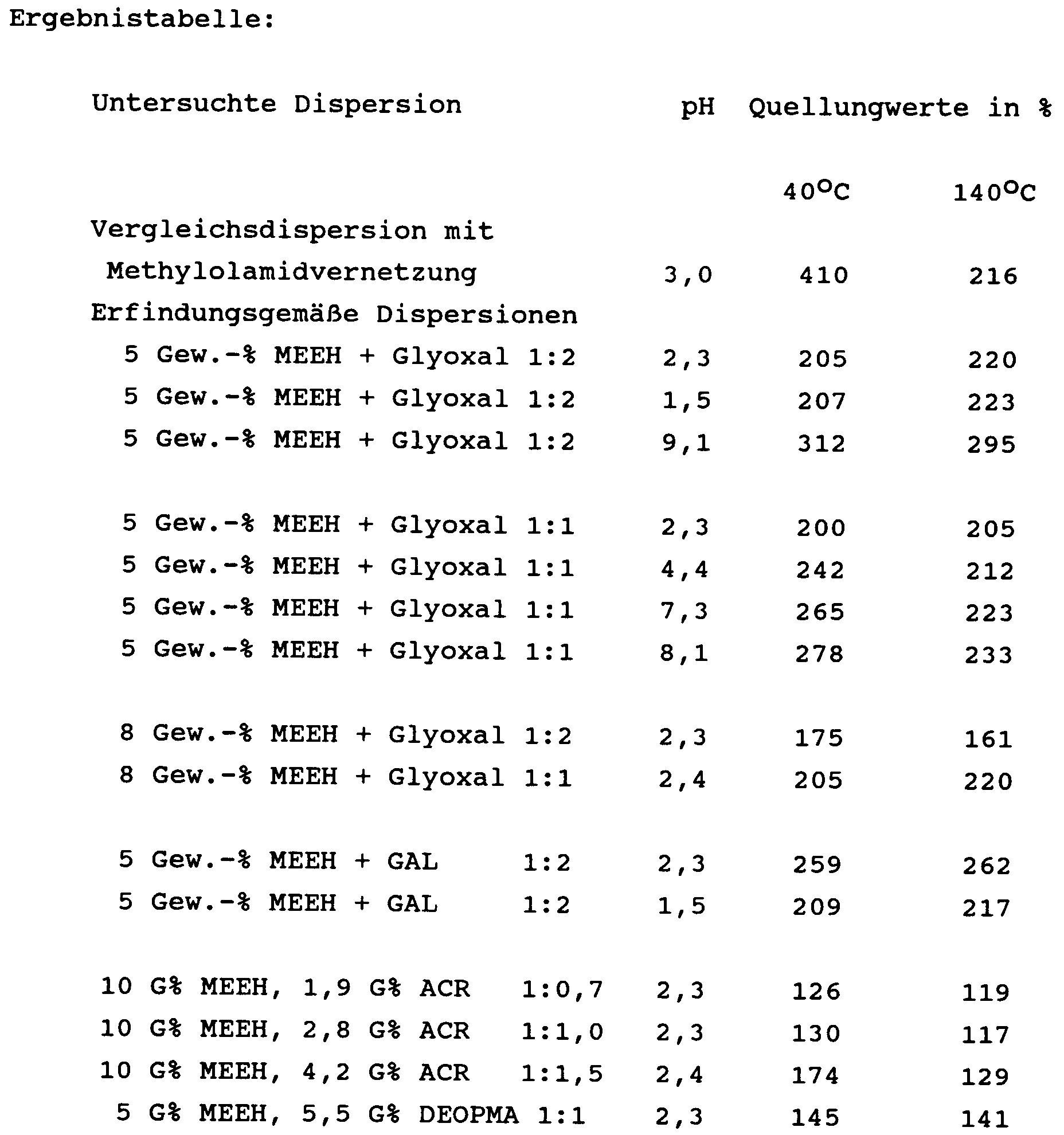
- the effect of the crosslinking system according to the invention on the properties of a film, which is formed by drying a dispersion layer at 40 ° C. within 24 hours, is illustrated in comparison to a known self-crosslinking plastic dispersion based on an emulsion polymer composed of methyl methacrylate, n-butyl acrylate and some methacrylic acid.
- the known plastic dispersion contains a crosslinking system made of methylolated methacrylamide.
- MEEH methacryloyloxyethyl ethylene urea
- ACR acrolein
- DEOPMA diethoxypropyl methacrylate
- the resulting 40% dispersion is filtered. It has a pH of 2.2.
- the average particle diameter (nanosizer value) is 136 nm.
- the 40 percent plastic dispersion to be tested is - as indicated in the table below - mixed with glyoxal (GLY) or glutardialdehyde (GAL) as a crosslinking component in the stated molar ratio (mol MEEH: mol CH2O groups) and stirred for 1 hour. In some batches, the pH was changed with ammonia or with p-toluenesulfonic acid before adding the crosslinking component.
- GLY glyoxal
- GAL glutardialdehyde
- the film is then pulled off the glass plate.
- another film is dried at 140 ° C. for 15 minutes.
Landscapes
- Chemical & Material Sciences (AREA)
- Engineering & Computer Science (AREA)
- Chemical Kinetics & Catalysis (AREA)
- Textile Engineering (AREA)
- Ceramic Engineering (AREA)
- Materials Engineering (AREA)
- Organic Chemistry (AREA)
- Wood Science & Technology (AREA)
- Dispersion Chemistry (AREA)
- Life Sciences & Earth Sciences (AREA)
- Structural Engineering (AREA)
- Addition Polymer Or Copolymer, Post-Treatments, Or Chemical Modifications (AREA)
- Paints Or Removers (AREA)
- Adhesives Or Adhesive Processes (AREA)
Abstract
Description
- Die Erfindung betrifft ein wäßriges Bindemittel, das bei Raumtemperatur vernetzbar ist, sowie dessen Anwendung als Überzugsmittel und zum Binden von festen Körpern.
- In der Anstrichtechnik werden seit jeher flüssige Überzugsmittel verwendet, die ein bei Raumtemperatur trocknendes Bindemittel enthalten. Klassische Anstrichfarben auf Ölbasis enthalten als Bindemittel trocknende Öle, die unter dem Einfluß des Luftsauerstoffes durch radikalische Polymerisation ungesättigter Molekülgruppen zu vernetzten Binderharzen aushärten. Durch die Verdunstung des Lösemittels und gleichzeitige Vernetzung bildet sich eine harte, trockene Oberfläche mit hoher Beständigkeit gegen Lösemittel.
- Aus Gründen des Umweltschutzes wird zunehmend versucht, die lösemittelhaltigen Überzugsmittel durch lösemittelfreie Systeme auf wäßriger Basis zu ersetzen. Die Qualität der daraus entstehenden getrockneten Überzüge entspricht jedoch nicht derjenigen von klassischen Anstrichfarben. Die wäßrigen Überzugsmittel enthalten latexartige Bindemittel, die beim Trocknen verfilmen, jedoch nicht vernetzen. Die erhaltenen Überzüge sind oft weich und klebrig und empfindlich gegen organische Lösemittel.
- Es hat nicht an Versuchen gefehlt, wäßrige Überzugsmittel herzustellen, die unter Vernetzung zu harten trockenen Filmen aushärten. Beispielsweise werden in großem Umfang selbstvernetzende Kunststoffdispersion verwendet, die Emulsionspolymerisate mit einem Gehalt an N-Methylolgruppen und gegebenenfalls zusätzlich gelöste Aminoplastharze enthalten. Sie härten jedoch erst bei erhöhten Temperaturen und werden deshalb als wäßrige Einbrennlacke bezeichnet.
- Das Ziel eines bei Raumtemperatur oder wenig darüber vernetzenden wäßrigen Bindemittels ist schwierig zu verwirklichen, weil die Härtung dann schon vor der Filmbildung während der Lagerung des vernetzungsfähigen Überzugsmittels beginnt. Um dieses Problem zu umgehen, verwendet man oft Zweikomponentensysteme, bei denen bei Raumtemperatur reaktionsfähige Bindemittelkomponenten erst unmittelbar vor der Bildung einer Überzugsschicht vermischt werden, so daß sie in Form des Überzugs aushärten können. Die Verarbeitung der ZweikomponentenÜberzugsmittel erfordert besondere Beschichtungsvorrichtungen wie Zweistoffspritzpistolen mit genauen Dosiervorrichtungen für die beiden Komponenten.
- In der EP-A 184 091 werden wäßrige Bindemittel für Anstrichfarben beschrieben, die sich durch eine niedrige Filmbildungstemperatur und eine hohe Blockfestigkeit der gebildeten Filme auszeichnen. Charakteristisch für dieses Bindemittel ist ein mehrstufiges Emulsionspolymerisat, dessen erste Stufe zu einem verhältnismäßig weichen Polymerisatkern und dessen zweite Stufe zu einer wesentlich härteren Polymerisatschale der Latexteilchen führen. Zum Zwecke der Vernetzung kann das Emulsionspolymerisat Einheiten von ungesättigten Carbonylverbindungen, wie Diacetonacrylamid, enthalten, die mit Dihydraziden umgesetzt werden. Zur Verbesserung der Haftung der Überzugsfilme an dem beschichteten Substrat kann das Emulsionspolymerisat weiterhin Einheiten von ungesättigten Ethylenharnstoff-Derivaten enthalten. Emulsionspolymerisate, die sowohl Einheiten von ungesättigten Carbonylverbindungen als auch solche von Ethylenharnstoff-Derivaten enthalten, werden nicht beschrieben.
- Ziel der Erfindung ist ein wäßriges Bindemittel für flüssige Überzugsmittel, die gebrauchsfertig lagerfähig sind und nach der Verarbeitung zu einem Überzug bei Raumtemperatur oder nur wenig erhöhter Temperatur rasch zu einem harten, trockenen, vernetzten Film aushärten.
- Gegenstand der Erfindung ist ein wäßriges Bindemittel auf Basis einer filmbildenden wäßrigen Kunststoffdispersion, enthaltend ein Emulsionspolymerisat mit polymerisierten Einheiten eines äthylenisch ungesättigten, radikalisch polymerisierbaren Monomeren mit einer seitenständigen Alkylenharnstoffgruppe, und einer Vernetzungskomponente, die wenigstens zwei gegebenenfalls geschützte Aldehydgruppen enthält, oder auf Basis einer selbstvernetzenden, filmbildenden wäßrigen Kunststoffdispersion, die ein Emulsionspolymerisat mit polymerisierten Einheiten eines äthylenisch ungesättigten, radikalisch polymerisierbaren Monomeren mit einer seitenständigen Alkylenharnstoffgruppe und mit polymerisierten Einheiten eines äthylenisch ungesättigten, radikalisch polymerisierbaren Monomeren mit wenigstens einer gegebenenfalls geschützten Aldehydgruppe enthält und frei von Dihydraziden ist.
- Wäßrige Kunststoffdispersionen mit einem Gehalt an Alkylenharnstoffgruppen sind bekannt. Diese Gruppen dienen gemäß EP-A 379 892 zur Verbesserung der Haftung von Filmen, die aus den Dispersionen auf festen Substraten gebildet werden, oder gemäß EP-A 384 125 als vernetzungsreaktive Gruppe und gleichzeitig als Formaldehydfänger in selbstvernetzenden Kunststoffdispersion mit einem Gehalt an N-Methylolamidgruppen. Es war jedoch nicht bekannt, Alkylenharnstoffgruppen mittels Aldehydfunktionen zur Vernetzung zu bringen.
- Die Erfindung beruht auf der Erkenntnis, daß in einem aus der Dispersion gebildeten Film die Alkylenharnstoffgruppen des Emulsionspolymerisats mit Aldehydgruppen, die gegebenenfalls auch geschützt sein können, bei Raumtemperatur oder wenig erhöhter Temperatur unter Vernetzung reagieren, während in der flüssigen Dispersion die Vernetzung bei Raumtemperatur so langsam verläuft, daß entsprechend aufgebaute Bindemittel ausreichend lagerfähig sind.
- Die Alkylenharnstoffgruppen können sowohl mit mehrfunktionellen Aldehyden, die als Vernetzunskomponente wirken, als auch mit Aldehydgruppen des gleichen Polymeren reagieren. Die Chemie der Vernetzungsreaktion, das Molverhältnis der reagierenden Gruppen und die Struktur der Umsetzungsprodukte sind bisher nicht erforscht. Eine befriedigende Vernetzung wird erreicht, wenn pro Mol der Alkylenharnstoffgruppierung 1 bis 2 Mol eines Dialdehyds oder 1 bis 4 Mol polymergebundene Aldehydgruppen zur Verfügung stehen. Die Vernetzungsreaktion wird durch Säure katalysiert. pH-Werte von 1 bis 3 sind besonders vorteilhaft, jedoch wird auch bei pH-Werten bis 8 noch eine Vernetzung erreicht. Bei Temperaturen zwischen 20 und 40oC verläuft die Vernetzung mit ausreichender Geschwindigkeit. Höhere Vernetzungstemperaturen ergeben meistens keine oder unbedeutende Verbesserungen.
- Als mehrfunktionelle Aldehyde eignen sich niedermolekulare Verbindungen, insbesondere aliphatische Dialdehyde der Formel
OCH-(CH₂)n-CHO, worin n eine ganze Zahl von 0 bis 8, vorzugsweise von 0 bis 4 ist, wie Glyoxal oder Glutardialdehyd. Bevorzugt werden mehrfunktionelle Aldehyde eingesetzt, die bei der Vernetzungstemperatur wenigstens in einer Konzentration von 0,2 Mol/l in Wasser löslich sind. Man kann jedoch auch Oligomere, Polymere oder Copolymere von äthylenisch ungesättigten, radikalisch polymerisierbaren Aldehyden als Vernetzungskomponente einsetzen, vorausgesetzt, daß sie mehrere Aldehydfunktionen pro Molekül enthalten. Geeignete äthylenisch ungesättigte, radikalisch polymerisierbare Aldehyde sind z.B. Acrolein und Methacrolein. Derartige Vernetzunskomponenten können, wenn sie nicht ausreichend wasserlöslich sind, in der wäßrigen Phase der Dispersion dispergiert sein und bei der Anwendung als Bindemittel an der Filmbildung teilnehmen. Oligomere oder polymere Vernetzunskomponenten dieser Art mit einem Molekulargewicht von 1000 bis 500 000 (Gewichtsmittelwert) sind bevorzugt. - Unter geschützten Aldehydgruppen werden entsprechende Derivate verstanden, die eine vergleichbare Reaktionsfähigkeit haben wie die freie Aldehydgruppe selbst. Geeignet sind z.B. Acetale, Mercaptale und Mercaptole, Dioxolane und Dithiolane. Acetal- bzw. Dioxolangruppen, die aus der Umsetzung von Aldehydgruppen mit Alkanolen mit 1 bis 4 Kohlenstoffatomen im Alkylrest oder mit Alkandiolen mit 2 oder 3 Kohlenstoffatomen im Alkylenrest entstanden sind, werden bevorzugt. Beispiele von ungesättigten Monomeren mit geschützten Aldehydfunktionen sind Diethoxypropylacrylat und - methacrylat und Acryloyl- oder Methacryloyl-oxypropyl-1,3-dioxolan.
- Wenn die Vernetzung überwiegend auf der Reaktion polymergebundener Aldehydgruppen beruht, sind diese vorzugsweise an dasselbe Emulsionspolymerisat gebunden wie die Alkylenharnstoffgruppen. In diesem Falle ist anzunehmen, daß schon vor der Filmbildung beim Lagern bei Raumtemperatur innerhalb der einzelnen Latexteilchen Vernetzung eintritt. Es wurde jedoch gefunden, daß eine ausreichende Vernetzungsfähigkeit bestehen bleibt, die mit reaktionsfähigen Gruppen an der Teilchenoberfläche erklärt werden kann.
- Die Einheiten eines äthylenisch ungesättigten, radikalisch polymerisierbaren Monomeren mit einer seitenständigen Alkylenharnstoffgruppe machen in der Regel 1 bis 20 Gew.-%, vorzugsweise 2 bis 10 Gew.-%, des Emulsionspolymerisats aus. Geeignete Monomere sind z.B. N-(2-Acryloyloxyethyl)- oder (2-Methacryloyloxyethyl)-ethylenharnstoff, N-(Acrylamido-methylen)- oder N-(Methacrylamido-methylen)-ethylenharnstoff, N-Vinyl-ethylenharnstoff, N-Vinyloxyethyl-ethylenharnstoff, N-(β-Acrylamidoethyl)-ethylenharnstoff, N-(β-Methacrylamidoethyl) - ethylenharnstoff, N-[β-(Acryloyloxy-acetamido)-ethyl] - ethylenharnstoff.
- Die wäßrige Kunststoffdispersion kann nach herkömmlichen Methoden der Emulsionspolymerisation hergestellt werden. Sie beruhen auf der radikalischen Polymerisation von äthylenisch ungesättigten, radikalisch polymerisierbaren Monomeren oder Monomergemischen, die einzeln oder als ganzes nur begrenzt wasserlöslich sind, so daß sich daraus in Gegenwart wasserlöslicher Emulgiermittel eine wäßrige Emulsion bereiten läßt. Durch die Einwirkung von radikalbildenden Initiatoren, die in der Regel in der wäßrigen Phase gelöst vorliegen und beim Erwärmen auf 50 bis 100oC oder unter der Einwirkung von Reduktionsmitteln Startradikale bilden, wird die Polymerisation unter Bildung einer wäßrigen Kunststoffdispersion bewirkt. Vorzugsweise wird das Zulaufverfahren angewendet, bei dem man in eine vorgelegte emulgiermittel- und initiatorhaltige Wasserphase die Monomeren als solche oder in Form einer wäßrigen Emulsion nach Maßgabe des Umsatzes zulaufen läßt. Im allgemeinen werden ein Feststoffgehalt von 30 bis 65 Gew.-% und eine Viskosität nicht über 10 000 mPa s angestrebt.
- Für die Anwendung der erfindungsgemäßen Kunststoffdispersion als Bindemittel ist eine Filmbildungstemperatur zwischen etwa 10 und 40oC, vorzugsweise 20 bis 30oC erwünscht. Damit die Dispersion bei derartigen Temperaturen zu einem geschlossenen Film trocknet, wird die Zusammensetzung des Emulsionspolymerisats in an sich bekannter Weise so gewählt, daß seine dynamische Erweichungstemperatur (T-lambda-max-Wert nach DIN 53 445) im Bereich von -20 bis 20oC liegt. Die Mindestfilmbildungstemperatur liegt vorzugsweise bei 0 bis 25oC.
- Die Erweichungs- und Filmbildungstemperatur eines Emulsionspolymerisats kann in an sich bekannter Weise durch die Wahl der Art und der Menge der Hauptmonomeren auf den gewünschten Wert eingestellt werden. Als Hauptmonomere werden häufig Gemische von hartmachenden und weichmachenden Monomeren neben einem kleineren Anteil an funktionellen Monomeren eingesetzt. Typische hartmachende Monomere sind Methyl-, Ethyl-, Propyl-, Isopropyl-, Isobutyl- oder Cyclohexylmethacrylat, Styrol, Vinyltoluol, Vinylchlorid und Acryl- und Methacrylnitril. Typische weichmachende Monomere sind die Alkylester der Acrylsäure mit 1 bis 12 Kohlenstoffatomen im Alkylrest, Alkylester der Methacrylsäure mit 4 bis 12 Kohlenstoffatomen im Alkylrest, Ethylen, Butadien, Vinylacetat und Vinylidenchlorid. In vielen Fällen ist ein Anteil von 20 bis 60 Gew.-% an hartmachenden und von 40 bis 80 Gew.-% an weichmachenden Monomeren geeignet. Ein Gemisch von niederen Alkylestern der Acryl- und/oder Methacrylsäure, insbesondere mit 1 bis 4 Kohlenstoffatomen im Alkylrest, ist besonders bevorzugt.
- Neben den Hauptmonomeren werden funktionelle Comonomere eingesetzt. Dazu gehören in erster Linie die ungesättigten Alkylenharnstoffderivate und gegebenenfalls ungesättigte Aldehyde als Bestandteile des Vernetzungssystems. Andere vernetzungswirksame Monomere, die unterhalb oder oberhalb der erfindungsgemäß erwünschten Vernetzungstemperatur reagieren, sind vorzugsweise abwesend. Zur Verbesserung der Stabilität der Dispersion können kleine Mengen, vorzugsweise 0,1 bis 5 Gew.-%, von äthylenisch ungesättigten, radikalisch polymerisierbaren Carbonsäuren, wie Acryl- und/oder Methacrylsäure, Malein-, Fumar- oder Itakonsäure, mitverwendet werden. Auch vernetzende Comonomere mit zwei oder mehr äthylenisch ungesättigten, radikalisch polymerisierbaren Gruppen können in geringen Mengen mitverwendet werden, wobei die Fähigkeit zur Filmbildung nicht beeinträchtigt werden darf.
- Es ist bekannt, daß verschiedene Eigenschaften der Kunststoffdispersionen und der daraus gebildeten Filme vom Einbau bestimmter funktioneller Monomerer sowie von der Teilchengröße, der Teilchengrößenverteilung (uni- oder bimodal), von der Reihenfolge des Monomerzusatzes, von der Art und Menge der Emulgiermittel, vom pH-Wert, vom Elektrolytgehalt und anderen Faktoren abhängen. Um optimale Filmeigenschaften bei der Verarbeitung der erfindungsgemäßen Bindemittel zu erreichen, wird vorausgesetzt, daß diese Erkenntnisse bei der Herstellung und Anwendung der erfindungsgemäßen Kunststoffdispersionen in fachgerechter Weise berücksichtigt werden, auch soweit sie hier nicht besonders erwähnt sind.
- Das Emulsionspolymerisat kann gegebenenfalls auch mehrstufig aufgebaut werden, wobei die vernetzungswirksamen Monomeren überwiegend oder ganz in der letzten Polymerisationsstufe eingesetzt werden, so daß eine in sich und mit anderen Latexteilchen vernetzbare Schale über einem unvernetzten oder auf andere Weise vernetzten Kern entsteht.
- Die erfindungsgemäßen Kunststoffdispersionen können ebenso wie bekannte vernetzbare bzw. selbstvernetzende Kunststoffdispersionen als Bindemittel für feste Stoffe verwendet werden. Als feste Stoffe kommen die in Anstrichfarben, Überzugsmassen, Kunstharzputzen und dergl. gebräuchlichen Pigmente und Füllstoffe in Betracht. Sie werden mit dem Bindemittel vermischt und auf das zu beschichtende Substrat aufgetragen. Beim Trocknen entsteht ein Überzug, der je nach der herrschenden Temperatur in einigen Stunden oder Tagen vernetzt und dabei eine praktischen Anforderungen genügende Härte und Blockfestigkeit sowie Beständigkeit gegen organische Lösemittel erreicht. In der Herstellung von Überzügen und deren Aushärtung bei niedrigen Temperaturen liegt das bevorzugte Anwendungsgebiet der Erfindung. Dieser Anwendung kommt auch die haftungsverbessernde Wirkung der Alkylenharnstoffgruppen zugute.
- Ein weiteres Anwendungsgebiet ist die Verfestigung von saugfähigen Papieren, Pappen, Faservliesen oder -Geweben. Zu diesem Zweck kann das Bindemittel in gewünschter Weise eingefärbt, verdickt oder geschäumt werden und durch Tränken, Rakeln, Pflatschen oder Sprühen auf oder in das zu verfestigende Substrat aufgebracht werden. Es kommen z.B. Binderauflagen zwischen 5 und 100 Gew.-% (Trocken-Gew.) in Betracht.
- Wo eine Erwärmung nicht möglich oder nicht wirtschaftlich ist, kann die Vernetzung bei Raumtemperatur oder gegebenenfalls bei Temperaturen ab 10oC ablaufen. Zur Beschleunigung des Trocknens und Härtens kann auf Temperaturen von 25 bis 60oC erwärmt werden, was gegenüber bisher üblichen Härtungstemperaturen von 100 bis 150oC eine wesentliche Vereinfachung und Energieersparnis bedeutet.
- Die Auswirkung des erfindungsgemäßen Vernetzungssystems auf die Eigenschaften eines Filmes, der durch Eintrocknen einer Dispersionsschicht bei 40oC innerhalb von 24 Stunden entsteht, wird im Vergleich zu einer bekannten selbstvernetzenden Kunststoffdispersion auf Basis eines Emulsionspolymerisats aus Methylmethacrylat, n-Butylacrylat und etwas Methacrylsäure veranschaulicht. Die bekannte Kunststoffdispersion enthält ein Vernetzungssystem aus methyloliertem Methacrylamid. Es wurde im Sinne der Erfindung durch N-(Methacryloyloxyethyl)-ethylenharnstoff (MEEH) oder dessen Kombination mit Acrolein (ACR) bzw. mit Diethoxypropylmethacrylat (DEOPMA) ersetzt, während die Zusammensetzung der Hauptmonomeren unverändert blieb.
- In einem 2 l-Reaktionsgefäß mit Rückflußkühler, Rührwerk und Zulaufgefäß werden 0,54 g Ammoniumperoxodisulfat und 0,27 eines Emulgiermittels in 430 g Wasser gelöst und die Lösung auf 80oC erhitzt. Als Emulgiermittel wird ein mit der 7-fachen Molmenge Ethylenoxid umgesetztes Triisobutyl-phenol, das sulfatiert und mit Natronlauge neutralisiert ist, eingesetzt.
- Unter Rühren wird eine Emulsion aus 396 g n-Butylacrylat, 292 g Methylmethacrylat, 36 g N-(2-Methacryloyloxyethyl)-ethylenharnstoff, 3,6 g Methacrylsäure, 8 g des Emulgiermittels und 665 g Wasser innerhalb 4 Stunden gleichmäßig zudosiert. Anschließend wird 30 min bei 80oC weiter gerührt und dann auf Raumtemperatur abgekühlt. Zur Polymerisation der restlichen Monomeren werden bei 65oC 0,3 g 1,4-Diisopropylbenzol-monohydroperoxid und 0,5 g Na-Hydroxymethylsulfinat als Redox-Initiator zugesetzt.
- Die entstehende 40 %ige Dispersion wird filtriert. Sie hat einen pH-Wert von 2,2. Der mittlere Teilchendurchmesser (Nanosizer-Wert) beträgt 136 nm.
- In entsprechender Weise werden die anderen Dispersionen für die unter B beschriebenen Untersuchungen hergestellt.
- Die zu prüfende 40-prozentige Kunststoffdispersion wird - wie in der nachfolgenden Tabelle angegeben - mit Glyoxal (GLY) oder Glutardialdehyd (GAL) als Vernetzungskomponente im angegebenen Molverhältnis (Mol MEEH : Mol CH₂O-Gruppen) vermischt und 1 Std. gerührt. Bei einigen Ansätzen wurde vor der Zugabe der Vernetzungskomponente der pH-Wert mit Ammoniak bzw. mit p-Toluolsulfonsäure verändert.
- Mittels einer Rakel wird eine etwa 0,1 mm dicke Schicht der Kunststoffdispersion auf eine teflonbeschichtete Glasplatte aufgestrichen und über Nacht in einem Trockenschrank bei 40oC zu einem klaren Film getrocknet.
- Anschließend wird der Film von der Glasplatte abgezogen. Zum Vergleich wird ein weiterer Film 15 min bei 140oC getrocknet.
- Zur Prüfung der Vernetzung wird ein 10 cm² großes Filmstück 24 Stunden bei Raumtemperatur in Tetrahydrofuran gequollen, nach dem Herausnehmen freie Flüssigkeit abgetupft und die Gewichtszunahme geprüft. Nach dem Verdunsten des aufgenommenen Tetrahydrofurans wird der Gewichtsverlust bestimmt, der auf unvernetzte, lösliche Polymerisatanteile zurückgeht. Berücksichtigt werden nur Proben, bei denen der Gewichtsverlust unter 10 Gew.-% liegt.
- Quellungswerte unter 250 % lassen auf eine befriedigende, unter 200 % auf eine gute Vernetzung schließen.

Claims (9)
- Wäßriges Bindemittel, enthaltend eine filmbildende wäßrige Kunststoffdispersion und eine Vernetzungskomponente,
dadurch gekennzeichnet,
daß die Kunststoffdispersion ein Emulsionspolymerisat mit polymerisierten Einheiten eines äthylenisch ungesättigten, radikalisch polymerisierbaren Monomeren mit einer seitenständigen Alkylenharnstoffgruppe und die Vernetzungskomponente wenigstens zwei gegebenenfalls geschützte Aldehydgruppen enthält. - Wäßriges Bindemittel, enthaltend eine selbstvernetzende, filmbildende wäßrige Kunststoffdispersion
dadurch gekennzeichnet,
daß die Kunststoffdispersion ein Emulsionspolymerisat mit polymerisierten Einheiten eines äthylenisch ungesättigten, radikalisch polymerisierbaren Monomeren mit einer seitenständigen Alkylenharnstoffgruppe und mit polymerisierten Einheiten eines äthylenisch ungesättigten, radikalisch polymerisierbaren Monomeren mit wenigstens einer gegebenenfalls geschützten Aldehydgruppe enthält und frei von Dihydraziden ist. - Wäßriges Bindemittel nach Anspruch 1 oder 2, dadurch gekennzeichnet, daß die geschützten Aldehydgruppen in Form eines Acetals, Mercaptals oder Mercaptols vorliegen.
- Wäßriges Bindemittel nach einem oder mehreren der Ansprüche 1 bis 3, dadurch gekennzeichnet, daß das Emulsionspolymerisat 1 bis 20 Gew.-% der polymerisierten Einheiten eines äthylenisch ungesättigten, radikalisch polymerisierbaren Monomeren mit einer seitenständigen Alkylenharnstoffgruppe enthält.
- Wäßriges Bindemittel nach einem oder mehreren der Ansprüche 1 bis 4, dadurch gekennzeichnet, daß das Emulsionspolymerisat polymerisierte Einheiten von N-(2-Acryloyloxyethyl)- oder (2-Methacryloyloxyethyl)-ethylenharnstoff enthält.
- Wäßriges Bindemittel nach einem oder mehreren der Ansprüche 1 und 3 bis 5, dadurch gekennzeichnet, daß die Vernetzungskomponente wenigstens in einer Konzentration von 0,2 Mol/l wasserlöslich ist.
- Wäßriges Bindemittel nach Anspruch 6, dadurch gekennzeichnet, daß die Vernetzungskomponente ein aliphatischer Dialdehyd der Formel OCH-(CH₂)n-CHO ist, worin n eine ganze Zahl von 0 bis 8 ist.
- Wäßriges Bindemittel nach einem oder mehreren der Ansprüche 1 und 3 bis 7, dadurch gekennzeichnet, daß die Vernetzungskomponente ein Polymerisat eines äthylenisch ungesättigten, radikalisch polymerisierbaren Monomers mit einer gegebenenfalls geschützten Aldehydgruppe ist.
- Wäßriges Bindemittel Anspruch 8, dadurch gekennzeichnet, daß die Vernetzungskomponente ein Polymerisat mit einem Molekulargewicht von 1000 bis 500 000 ist.
Applications Claiming Priority (2)
| Application Number | Priority Date | Filing Date | Title |
|---|---|---|---|
| DE9301444U DE9301444U1 (de) | 1993-02-03 | 1993-02-03 | Bei Raumtemperatur vernetzbares wäßriges Bindemittel |
| DE93014449U | 1993-02-03 |
Publications (3)
| Publication Number | Publication Date |
|---|---|
| EP0609793A2 true EP0609793A2 (de) | 1994-08-10 |
| EP0609793A3 EP0609793A3 (de) | 1994-12-07 |
| EP0609793B1 EP0609793B1 (de) | 1997-07-09 |
Family
ID=6888898
Family Applications (1)
| Application Number | Title | Priority Date | Filing Date |
|---|---|---|---|
| EP94101337A Expired - Lifetime EP0609793B1 (de) | 1993-02-03 | 1994-01-29 | Bei Raumtemperatur vernetzbares wässriges Bindemittel |
Country Status (4)
| Country | Link |
|---|---|
| US (1) | US5468800A (de) |
| EP (1) | EP0609793B1 (de) |
| AT (1) | ATE155145T1 (de) |
| DE (2) | DE9301444U1 (de) |
Cited By (4)
| Publication number | Priority date | Publication date | Assignee | Title |
|---|---|---|---|---|
| EP0710680A3 (de) * | 1994-11-04 | 1997-08-13 | Basf Ag | Wässrige Polymerisatdispersion |
| DE19830555A1 (de) * | 1998-07-08 | 2000-01-13 | Basf Ag | Verwendung wässriger Polymerzubereitungen für die Beschichtung polyurethanhaltiger Substanzen |
| US6031038A (en) * | 1994-11-04 | 2000-02-29 | Basf Aktiengesellschaft | Aqueous polymer emulsion |
| DE102009056187A1 (de) | 2008-11-28 | 2010-07-15 | Basf Se | Polyesterharz auf Basis von 2-Propylheptansäureglycidester und/oder 4-Methyl-2 propylhexansäureglycidester |
Families Citing this family (15)
| Publication number | Priority date | Publication date | Assignee | Title |
|---|---|---|---|---|
| DE4334178A1 (de) * | 1993-10-07 | 1995-04-13 | Basf Ag | Wäßrige Polymerisatzubereitungen |
| US5739196A (en) * | 1995-11-30 | 1998-04-14 | Union Carbide Chemicals & Plastics Technology Corporation | Latex compositions having wet adhesion and other improved rheological properties and methods of producing same |
| ID24431A (id) * | 1997-10-03 | 2000-07-20 | Union Carbide Chem Plastic | Lateks-lateks yang tahan gosokan |
| DE19811314A1 (de) * | 1998-03-16 | 1999-09-23 | Basf Ag | Pigmenthaltige Zubereitungen auf der Basis wässriger Polymerisatdispersionen |
| US6525129B1 (en) * | 1999-12-20 | 2003-02-25 | Avery Dennison Corporation | Water-soluble pressure-sensitive adhesives |
| CN1175071C (zh) * | 2000-06-13 | 2004-11-10 | 阿克佐诺贝尔股份有限公司 | 水基粘合剂组合物 |
| DE10256148A1 (de) * | 2002-11-29 | 2004-06-17 | Basf Ag | Gegenstand der vorliegenden Erfindung sind Zusammensetzungen enthaltend mindestens ein Copolymer (A) und mindestens ein Copolymer (B) sowie deren Verwendung in kosmetischen Zubereitungen |
| ES2355685T3 (es) * | 2006-06-01 | 2011-03-30 | Cytec Surface Specialties, S.A. | Adhesivos sensibles a la presión. |
| JP2009538951A (ja) * | 2006-06-01 | 2009-11-12 | サイテック サーフェース スペシャリティーズ、エス.エイ. | 感圧接着剤 |
| ES2688532T3 (es) | 2013-01-18 | 2018-11-05 | Basf Se | Composiciones de recubrimiento a base de dispersión acrílica |
| EP4367151B1 (de) | 2021-07-08 | 2025-07-16 | Allnex Netherlands B.V. | Wässrige vinylpolymerdispersion |
| US11952448B2 (en) | 2021-07-27 | 2024-04-09 | Xerox Corporation | Organic additives and compositions containing the same |
| US12379677B2 (en) | 2021-07-27 | 2025-08-05 | Xerox Corporation | Latexes and related compositions |
| US11714361B2 (en) | 2021-07-27 | 2023-08-01 | Xerox Corporation | Toner |
| US11952451B2 (en) * | 2021-07-27 | 2024-04-09 | Xerox Corporation | Latexes with pH responsive resin particles |
Family Cites Families (6)
| Publication number | Priority date | Publication date | Assignee | Title |
|---|---|---|---|---|
| US4605702A (en) * | 1984-06-27 | 1986-08-12 | American Cyanamid Company | Temporary wet strength resin |
| US4544609A (en) * | 1984-09-12 | 1985-10-01 | Sun Chemical Corporation | Compounds and their use as insolubilizers for binders for paper coating compositions |
| US4695606A (en) * | 1986-09-22 | 1987-09-22 | Sun Chemical Corporation | Coating binder additive |
| DE3902103A1 (de) * | 1989-01-25 | 1990-08-02 | Roehm Gmbh | Bindemittel fuer waessrige glanzfarben |
| DE3902067A1 (de) * | 1989-01-25 | 1990-07-26 | Roehm Gmbh | Filmbildende, selbstvernetzende waessrige kunststoffdispersion |
| US4965317A (en) * | 1989-10-16 | 1990-10-23 | Ppg Industries, Inc. | Coating composition with sag control agent |
-
1993
- 1993-02-03 DE DE9301444U patent/DE9301444U1/de not_active Expired - Lifetime
-
1994
- 1994-01-29 DE DE59403266T patent/DE59403266D1/de not_active Expired - Fee Related
- 1994-01-29 EP EP94101337A patent/EP0609793B1/de not_active Expired - Lifetime
- 1994-01-29 AT AT94101337T patent/ATE155145T1/de not_active IP Right Cessation
- 1994-02-03 US US08/190,839 patent/US5468800A/en not_active Expired - Fee Related
Cited By (6)
| Publication number | Priority date | Publication date | Assignee | Title |
|---|---|---|---|---|
| EP0710680A3 (de) * | 1994-11-04 | 1997-08-13 | Basf Ag | Wässrige Polymerisatdispersion |
| US5744540A (en) * | 1994-11-04 | 1998-04-28 | Basf Aktiengesellschaft | Aqueous polymer emulsion |
| US6031038A (en) * | 1994-11-04 | 2000-02-29 | Basf Aktiengesellschaft | Aqueous polymer emulsion |
| CN1071358C (zh) * | 1994-11-04 | 2001-09-19 | 巴斯福股份公司 | 聚合物水乳液 |
| DE19830555A1 (de) * | 1998-07-08 | 2000-01-13 | Basf Ag | Verwendung wässriger Polymerzubereitungen für die Beschichtung polyurethanhaltiger Substanzen |
| DE102009056187A1 (de) | 2008-11-28 | 2010-07-15 | Basf Se | Polyesterharz auf Basis von 2-Propylheptansäureglycidester und/oder 4-Methyl-2 propylhexansäureglycidester |
Also Published As
| Publication number | Publication date |
|---|---|
| DE59403266D1 (de) | 1997-08-14 |
| EP0609793B1 (de) | 1997-07-09 |
| DE9301444U1 (de) | 1994-06-09 |
| US5468800A (en) | 1995-11-21 |
| EP0609793A3 (de) | 1994-12-07 |
| ATE155145T1 (de) | 1997-07-15 |
Similar Documents
| Publication | Publication Date | Title |
|---|---|---|
| EP0609793B1 (de) | Bei Raumtemperatur vernetzbares wässriges Bindemittel | |
| EP0084809B1 (de) | Acrylkunststoffdispersion | |
| DE2513516C3 (de) | Wässrige Überzugsmasse | |
| DE2640967C2 (de) | Verfahren zur Herstellung von hitzehärtbaren, selbstvernetzenden Harzen | |
| DE2760188C2 (de) | ||
| DE69602178T2 (de) | 2-oxo-1,3-dioxolangruppen enthaltende copolymere und daraus hergestellte beschichtungen | |
| EP0080635B1 (de) | Selbstvernetzende wässrige Kunststoffdispersion | |
| EP0007391B1 (de) | Kunststoffpulver für Beschichtungsmittel, sowie Beschichtungsmittel und-Verfahren für Weich-PVC | |
| DE4439457A1 (de) | Wäßrige Polymerisatdispersion | |
| DE3843965A1 (de) | Mehrphasige, waessrige kunststoffdispersion und ihre verwendung in ueberzugsmittel | |
| DE4201603A1 (de) | Mischungen fluorhaltiger copolymerisate | |
| DE3427647A1 (de) | Waessrige beschichtungsmasse | |
| DE3151923A1 (de) | Polymerisationsverfahren | |
| DE60116767T2 (de) | Wässrige bindemittelzusammensetzung | |
| EP0381030B1 (de) | Wässriges Polyacrylat-System für die Schlusslackierung von Polyvinylchlorid-Oberflächen | |
| DE3783325T2 (de) | Lackierverfahren. | |
| DE2350654C3 (de) | Wärmehärtbare Polymerisatlösungen | |
| EP0655481B1 (de) | Verfahren zur Herstellung von wässrige Polymerdispersionen die als Bindemittel für blockfeste, kratzfeste und chemikalienbeständige Beschichtungen geeignet sind | |
| DE1908784A1 (de) | Verfahren zur Unterstuetzung der Haftung von Oberflaechenlacken auf Polyacrylgrundlage auf mit Organopolysiloxanen impraegniertem Leder | |
| EP0276213B1 (de) | Lösliches, vernetzbares acrylatcopolymerisat, verfahren zu seiner herstellung und überzugsmittel auf der basis des acrylatcopolymerisats | |
| EP0722477A1 (de) | Wässrige polymerisatzubereitungen | |
| DE2658118C2 (de) | Wäßrige Harzdispersionen | |
| DE3622566A1 (de) | Vinylpolymer-dispersionen, verfahren zu ihrer herstellung und ihre verwendung zur herstellung von beschichtungen | |
| DE69114528T2 (de) | Verfahren zur Herstellung von vernetzten Teilchen. | |
| DE1816395A1 (de) | Verfahren zur Zurichtung von Leder und synthetischem Lederaustauschmaterial |
Legal Events
| Date | Code | Title | Description |
|---|---|---|---|
| PUAI | Public reference made under article 153(3) epc to a published international application that has entered the european phase |
Free format text: ORIGINAL CODE: 0009012 |
|
| AK | Designated contracting states |
Kind code of ref document: A2 Designated state(s): AT BE CH DE DK ES FR GB IT LI NL SE |
|
| PUAL | Search report despatched |
Free format text: ORIGINAL CODE: 0009013 |
|
| AK | Designated contracting states |
Kind code of ref document: A3 Designated state(s): AT BE CH DE DK ES FR GB IT LI NL SE |
|
| 17P | Request for examination filed |
Effective date: 19950613 |
|
| 17Q | First examination report despatched |
Effective date: 19960206 |
|
| GRAG | Despatch of communication of intention to grant |
Free format text: ORIGINAL CODE: EPIDOS AGRA |
|
| GRAH | Despatch of communication of intention to grant a patent |
Free format text: ORIGINAL CODE: EPIDOS IGRA |
|
| GRAH | Despatch of communication of intention to grant a patent |
Free format text: ORIGINAL CODE: EPIDOS IGRA |
|
| ITF | It: translation for a ep patent filed | ||
| GRAA | (expected) grant |
Free format text: ORIGINAL CODE: 0009210 |
|
| AK | Designated contracting states |
Kind code of ref document: B1 Designated state(s): AT BE CH DE DK ES FR GB IT LI NL SE |
|
| PG25 | Lapsed in a contracting state [announced via postgrant information from national office to epo] |
Ref country code: ES Free format text: THE PATENT HAS BEEN ANNULLED BY A DECISION OF A NATIONAL AUTHORITY Effective date: 19970709 Ref country code: DK Effective date: 19970709 |
|
| REF | Corresponds to: |
Ref document number: 155145 Country of ref document: AT Date of ref document: 19970715 Kind code of ref document: T |
|
| REG | Reference to a national code |
Ref country code: CH Ref legal event code: EP |
|
| REF | Corresponds to: |
Ref document number: 59403266 Country of ref document: DE Date of ref document: 19970814 |
|
| ET | Fr: translation filed | ||
| PG25 | Lapsed in a contracting state [announced via postgrant information from national office to epo] |
Ref country code: SE Effective date: 19971009 |
|
| GBT | Gb: translation of ep patent filed (gb section 77(6)(a)/1977) |
Effective date: 19970925 |
|
| PG25 | Lapsed in a contracting state [announced via postgrant information from national office to epo] |
Ref country code: LI Free format text: LAPSE BECAUSE OF NON-PAYMENT OF DUE FEES Effective date: 19980131 Ref country code: CH Free format text: LAPSE BECAUSE OF NON-PAYMENT OF DUE FEES Effective date: 19980131 |
|
| PLBE | No opposition filed within time limit |
Free format text: ORIGINAL CODE: 0009261 |
|
| STAA | Information on the status of an ep patent application or granted ep patent |
Free format text: STATUS: NO OPPOSITION FILED WITHIN TIME LIMIT |
|
| 26N | No opposition filed | ||
| REG | Reference to a national code |
Ref country code: CH Ref legal event code: PL |
|
| NLT1 | Nl: modifications of names registered in virtue of documents presented to the patent office pursuant to art. 16 a, paragraph 1 |
Owner name: ROEHM GMBH & CO. KG |
|
| REG | Reference to a national code |
Ref country code: FR Ref legal event code: CJ |
|
| REG | Reference to a national code |
Ref country code: GB Ref legal event code: IF02 |
|
| PGFP | Annual fee paid to national office [announced via postgrant information from national office to epo] |
Ref country code: DE Payment date: 20060104 Year of fee payment: 13 |
|
| PGFP | Annual fee paid to national office [announced via postgrant information from national office to epo] |
Ref country code: AT Payment date: 20060113 Year of fee payment: 13 Ref country code: NL Payment date: 20060113 Year of fee payment: 13 Ref country code: FR Payment date: 20060113 Year of fee payment: 13 |
|
| PGFP | Annual fee paid to national office [announced via postgrant information from national office to epo] |
Ref country code: GB Payment date: 20060120 Year of fee payment: 13 |
|
| PGFP | Annual fee paid to national office [announced via postgrant information from national office to epo] |
Ref country code: IT Payment date: 20060131 Year of fee payment: 13 |
|
| PGFP | Annual fee paid to national office [announced via postgrant information from national office to epo] |
Ref country code: BE Payment date: 20060207 Year of fee payment: 13 |
|
| PG25 | Lapsed in a contracting state [announced via postgrant information from national office to epo] |
Ref country code: DE Free format text: LAPSE BECAUSE OF NON-PAYMENT OF DUE FEES Effective date: 20070801 |
|
| GBPC | Gb: european patent ceased through non-payment of renewal fee |
Effective date: 20070129 |
|
| NLV4 | Nl: lapsed or anulled due to non-payment of the annual fee |
Effective date: 20070801 |
|
| REG | Reference to a national code |
Ref country code: FR Ref legal event code: ST Effective date: 20070930 |
|
| PG25 | Lapsed in a contracting state [announced via postgrant information from national office to epo] |
Ref country code: GB Free format text: LAPSE BECAUSE OF NON-PAYMENT OF DUE FEES Effective date: 20070129 Ref country code: AT Free format text: LAPSE BECAUSE OF NON-PAYMENT OF DUE FEES Effective date: 20070129 |
|
| BERE | Be: lapsed |
Owner name: *ROHM G.M.B.H. Effective date: 20070131 |
|
| PG25 | Lapsed in a contracting state [announced via postgrant information from national office to epo] |
Ref country code: BE Free format text: LAPSE BECAUSE OF NON-PAYMENT OF DUE FEES Effective date: 20070131 |
|
| PG25 | Lapsed in a contracting state [announced via postgrant information from national office to epo] |
Ref country code: NL Free format text: LAPSE BECAUSE OF NON-PAYMENT OF DUE FEES Effective date: 20070801 |
|
| PG25 | Lapsed in a contracting state [announced via postgrant information from national office to epo] |
Ref country code: FR Free format text: LAPSE BECAUSE OF NON-PAYMENT OF DUE FEES Effective date: 20070131 |
|
| PG25 | Lapsed in a contracting state [announced via postgrant information from national office to epo] |
Ref country code: IT Free format text: LAPSE BECAUSE OF NON-PAYMENT OF DUE FEES Effective date: 20070129 |