EP0610847B1 - Fasern aus Cycloolefincopolymeren - Google Patents
Fasern aus Cycloolefincopolymeren Download PDFInfo
- Publication number
- EP0610847B1 EP0610847B1 EP94101800A EP94101800A EP0610847B1 EP 0610847 B1 EP0610847 B1 EP 0610847B1 EP 94101800 A EP94101800 A EP 94101800A EP 94101800 A EP94101800 A EP 94101800A EP 0610847 B1 EP0610847 B1 EP 0610847B1
- Authority
- EP
- European Patent Office
- Prior art keywords
- group
- cyclopentadienyl
- fluorenyl
- zirconium dichloride
- formula
- Prior art date
- Legal status (The legal status is an assumption and is not a legal conclusion. Google has not performed a legal analysis and makes no representation as to the accuracy of the status listed.)
- Expired - Lifetime
Links
- 229920000089 Cyclic olefin copolymer Polymers 0.000 title description 6
- -1 polycyclic olefin Chemical class 0.000 claims description 82
- 239000000835 fiber Substances 0.000 claims description 39
- 229920001577 copolymer Polymers 0.000 claims description 37
- 238000006116 polymerization reaction Methods 0.000 claims description 34
- 239000003054 catalyst Substances 0.000 claims description 31
- 238000000034 method Methods 0.000 claims description 28
- VPGLGRNSAYHXPY-UHFFFAOYSA-L zirconium(2+);dichloride Chemical compound Cl[Zr]Cl VPGLGRNSAYHXPY-UHFFFAOYSA-L 0.000 claims description 27
- 125000000058 cyclopentadienyl group Chemical group C1(=CC=CC1)* 0.000 claims description 24
- ZSWFCLXCOIISFI-UHFFFAOYSA-N endo-cyclopentadiene Natural products C1C=CC=C1 ZSWFCLXCOIISFI-UHFFFAOYSA-N 0.000 claims description 24
- JRZJOMJEPLMPRA-UHFFFAOYSA-N olefin Natural products CCCCCCCC=C JRZJOMJEPLMPRA-UHFFFAOYSA-N 0.000 claims description 22
- 239000002904 solvent Substances 0.000 claims description 21
- VGGSQFUCUMXWEO-UHFFFAOYSA-N Ethene Chemical compound C=C VGGSQFUCUMXWEO-UHFFFAOYSA-N 0.000 claims description 20
- 239000005977 Ethylene Substances 0.000 claims description 20
- 230000008569 process Effects 0.000 claims description 19
- 150000001925 cycloalkenes Chemical class 0.000 claims description 18
- 239000000178 monomer Substances 0.000 claims description 15
- 238000004519 manufacturing process Methods 0.000 claims description 14
- 239000002245 particle Substances 0.000 claims description 14
- 125000004435 hydrogen atom Chemical group [H]* 0.000 claims description 12
- 125000004805 propylene group Chemical group [H]C([H])([H])C([H])([*:1])C([H])([H])[*:2] 0.000 claims description 11
- JFNLZVQOOSMTJK-KNVOCYPGSA-N norbornene Chemical compound C1[C@@H]2CC[C@H]1C=C2 JFNLZVQOOSMTJK-KNVOCYPGSA-N 0.000 claims description 10
- 125000004429 atom Chemical group 0.000 claims description 9
- 125000005843 halogen group Chemical group 0.000 claims description 8
- 229930195733 hydrocarbon Natural products 0.000 claims description 8
- XUIMIQQOPSSXEZ-UHFFFAOYSA-N Silicon Chemical compound [Si] XUIMIQQOPSSXEZ-UHFFFAOYSA-N 0.000 claims description 6
- 230000015572 biosynthetic process Effects 0.000 claims description 6
- 229910052710 silicon Inorganic materials 0.000 claims description 6
- 125000000008 (C1-C10) alkyl group Chemical group 0.000 claims description 5
- 125000000041 C6-C10 aryl group Chemical group 0.000 claims description 5
- 229910052732 germanium Inorganic materials 0.000 claims description 5
- GNPVGFCGXDBREM-UHFFFAOYSA-N germanium atom Chemical compound [Ge] GNPVGFCGXDBREM-UHFFFAOYSA-N 0.000 claims description 5
- 229910052735 hafnium Inorganic materials 0.000 claims description 5
- VBJZVLUMGGDVMO-UHFFFAOYSA-N hafnium atom Chemical compound [Hf] VBJZVLUMGGDVMO-UHFFFAOYSA-N 0.000 claims description 5
- 239000010703 silicon Substances 0.000 claims description 5
- 125000000027 (C1-C10) alkoxy group Chemical group 0.000 claims description 4
- 125000004169 (C1-C6) alkyl group Chemical group 0.000 claims description 4
- 239000004215 Carbon black (E152) Substances 0.000 claims description 4
- ATJFFYVFTNAWJD-UHFFFAOYSA-N Tin Chemical compound [Sn] ATJFFYVFTNAWJD-UHFFFAOYSA-N 0.000 claims description 4
- RTAQQCXQSZGOHL-UHFFFAOYSA-N Titanium Chemical compound [Ti] RTAQQCXQSZGOHL-UHFFFAOYSA-N 0.000 claims description 4
- QCWXUUIWCKQGHC-UHFFFAOYSA-N Zirconium Chemical compound [Zr] QCWXUUIWCKQGHC-UHFFFAOYSA-N 0.000 claims description 4
- GUCVJGMIXFAOAE-UHFFFAOYSA-N niobium atom Chemical compound [Nb] GUCVJGMIXFAOAE-UHFFFAOYSA-N 0.000 claims description 4
- GUVRBAGPIYLISA-UHFFFAOYSA-N tantalum atom Chemical compound [Ta] GUVRBAGPIYLISA-UHFFFAOYSA-N 0.000 claims description 4
- 229910052718 tin Inorganic materials 0.000 claims description 4
- 229910052720 vanadium Inorganic materials 0.000 claims description 4
- 229910052726 zirconium Inorganic materials 0.000 claims description 4
- 125000006374 C2-C10 alkenyl group Chemical group 0.000 claims description 3
- KUNZSLJMPCDOGI-UHFFFAOYSA-L [Cl-].[Cl-].[Hf+2] Chemical compound [Cl-].[Cl-].[Hf+2] KUNZSLJMPCDOGI-UHFFFAOYSA-L 0.000 claims description 3
- 125000001797 benzyl group Chemical group [H]C1=C([H])C([H])=C(C([H])=C1[H])C([H])([H])* 0.000 claims description 3
- 125000001449 isopropyl group Chemical group [H]C([H])([H])C([H])(*)C([H])([H])[H] 0.000 claims description 3
- 229910052758 niobium Inorganic materials 0.000 claims description 3
- 239000010955 niobium Substances 0.000 claims description 3
- 125000001997 phenyl group Chemical group [H]C1=C([H])C([H])=C(*)C([H])=C1[H] 0.000 claims description 3
- 229910052715 tantalum Inorganic materials 0.000 claims description 3
- 229910052719 titanium Inorganic materials 0.000 claims description 3
- 239000010936 titanium Substances 0.000 claims description 3
- 125000004122 cyclic group Chemical group 0.000 claims description 2
- XBFJAVXCNXDMBH-UHFFFAOYSA-N tetracyclo[6.2.1.1(3,6).0(2,7)]dodec-4-ene Chemical compound C1C(C23)C=CC1C3C1CC2CC1 XBFJAVXCNXDMBH-UHFFFAOYSA-N 0.000 claims description 2
- 125000000999 tert-butyl group Chemical group [H]C([H])([H])C(*)(C([H])([H])[H])C([H])([H])[H] 0.000 claims 2
- 150000001335 aliphatic alkanes Chemical class 0.000 claims 1
- 125000000555 isopropenyl group Chemical group [H]\C([H])=C(\*)C([H])([H])[H] 0.000 claims 1
- 125000002950 monocyclic group Chemical group 0.000 claims 1
- LEONUFNNVUYDNQ-UHFFFAOYSA-N vanadium atom Chemical compound [V] LEONUFNNVUYDNQ-UHFFFAOYSA-N 0.000 claims 1
- YXFVVABEGXRONW-UHFFFAOYSA-N Toluene Chemical compound CC1=CC=CC=C1 YXFVVABEGXRONW-UHFFFAOYSA-N 0.000 description 54
- 229920000642 polymer Polymers 0.000 description 53
- 239000000243 solution Substances 0.000 description 42
- CSCPPACGZOOCGX-UHFFFAOYSA-N Acetone Chemical compound CC(C)=O CSCPPACGZOOCGX-UHFFFAOYSA-N 0.000 description 27
- 239000012429 reaction media Substances 0.000 description 21
- 229910052782 aluminium Inorganic materials 0.000 description 20
- NNBZCPXTIHJBJL-UHFFFAOYSA-N decalin Chemical compound C1CCCC2CCCCC21 NNBZCPXTIHJBJL-UHFFFAOYSA-N 0.000 description 16
- 239000000203 mixture Substances 0.000 description 16
- VLKZOEOYAKHREP-UHFFFAOYSA-N n-Hexane Chemical compound CCCCCC VLKZOEOYAKHREP-UHFFFAOYSA-N 0.000 description 13
- 150000001875 compounds Chemical class 0.000 description 11
- CPOFMOWDMVWCLF-UHFFFAOYSA-N methyl(oxo)alumane Chemical compound C[Al]=O CPOFMOWDMVWCLF-UHFFFAOYSA-N 0.000 description 11
- XLYOFNOQVPJJNP-UHFFFAOYSA-N water Substances O XLYOFNOQVPJJNP-UHFFFAOYSA-N 0.000 description 10
- HEDRZPFGACZZDS-UHFFFAOYSA-N Chloroform Chemical compound ClC(Cl)Cl HEDRZPFGACZZDS-UHFFFAOYSA-N 0.000 description 9
- VYPSYNLAJGMNEJ-UHFFFAOYSA-N Silicium dioxide Chemical compound O=[Si]=O VYPSYNLAJGMNEJ-UHFFFAOYSA-N 0.000 description 9
- XAGFODPZIPBFFR-UHFFFAOYSA-N aluminium Chemical compound [Al] XAGFODPZIPBFFR-UHFFFAOYSA-N 0.000 description 9
- 238000002844 melting Methods 0.000 description 9
- 230000008018 melting Effects 0.000 description 9
- 150000001336 alkenes Chemical class 0.000 description 8
- 238000010438 heat treatment Methods 0.000 description 8
- 239000000155 melt Substances 0.000 description 8
- 239000000047 product Substances 0.000 description 8
- 238000003756 stirring Methods 0.000 description 8
- 239000000725 suspension Substances 0.000 description 8
- PXXNTAGJWPJAGM-UHFFFAOYSA-N vertaline Natural products C1C2C=3C=C(OC)C(OC)=CC=3OC(C=C3)=CC=C3CCC(=O)OC1CC1N2CCCC1 PXXNTAGJWPJAGM-UHFFFAOYSA-N 0.000 description 8
- XDTMQSROBMDMFD-UHFFFAOYSA-N Cyclohexane Chemical compound C1CCCCC1 XDTMQSROBMDMFD-UHFFFAOYSA-N 0.000 description 7
- LFQSCWFLJHTTHZ-UHFFFAOYSA-N Ethanol Chemical compound CCO LFQSCWFLJHTTHZ-UHFFFAOYSA-N 0.000 description 7
- 239000007787 solid Substances 0.000 description 7
- 238000009987 spinning Methods 0.000 description 7
- IJGRMHOSHXDMSA-UHFFFAOYSA-N Atomic nitrogen Chemical compound N#N IJGRMHOSHXDMSA-UHFFFAOYSA-N 0.000 description 6
- YMWUJEATGCHHMB-UHFFFAOYSA-N Dichloromethane Chemical compound ClCCl YMWUJEATGCHHMB-UHFFFAOYSA-N 0.000 description 6
- OKKJLVBELUTLKV-UHFFFAOYSA-N Methanol Chemical compound OC OKKJLVBELUTLKV-UHFFFAOYSA-N 0.000 description 6
- OFBQJSOFQDEBGM-UHFFFAOYSA-N Pentane Chemical compound CCCCC OFBQJSOFQDEBGM-UHFFFAOYSA-N 0.000 description 6
- 239000004698 Polyethylene Substances 0.000 description 6
- 125000003118 aryl group Chemical group 0.000 description 6
- 238000006243 chemical reaction Methods 0.000 description 6
- MVPPADPHJFYWMZ-UHFFFAOYSA-N chlorobenzene Chemical compound ClC1=CC=CC=C1 MVPPADPHJFYWMZ-UHFFFAOYSA-N 0.000 description 6
- 238000001914 filtration Methods 0.000 description 6
- 150000002430 hydrocarbons Chemical class 0.000 description 6
- 229920000098 polyolefin Polymers 0.000 description 6
- 150000003254 radicals Chemical class 0.000 description 6
- 239000000126 substance Substances 0.000 description 6
- 239000004744 fabric Substances 0.000 description 5
- 239000011521 glass Substances 0.000 description 5
- 230000009477 glass transition Effects 0.000 description 5
- 238000001556 precipitation Methods 0.000 description 5
- 238000005406 washing Methods 0.000 description 5
- 239000005909 Kieselgur Substances 0.000 description 4
- UFWIBTONFRDIAS-UHFFFAOYSA-N Naphthalene Chemical compound C1=CC=CC2=CC=CC=C21 UFWIBTONFRDIAS-UHFFFAOYSA-N 0.000 description 4
- 239000004743 Polypropylene Substances 0.000 description 4
- 125000000217 alkyl group Chemical group 0.000 description 4
- 239000000956 alloy Substances 0.000 description 4
- 229910045601 alloy Inorganic materials 0.000 description 4
- 230000008859 change Effects 0.000 description 4
- 239000007795 chemical reaction product Substances 0.000 description 4
- 230000000694 effects Effects 0.000 description 4
- 229910052751 metal Inorganic materials 0.000 description 4
- 239000002184 metal Substances 0.000 description 4
- 238000003825 pressing Methods 0.000 description 4
- 238000000926 separation method Methods 0.000 description 4
- OCJBOOLMMGQPQU-UHFFFAOYSA-N 1,4-dichlorobenzene Chemical compound ClC1=CC=C(Cl)C=C1 OCJBOOLMMGQPQU-UHFFFAOYSA-N 0.000 description 3
- QTBSBXVTEAMEQO-UHFFFAOYSA-N Acetic acid Chemical compound CC(O)=O QTBSBXVTEAMEQO-UHFFFAOYSA-N 0.000 description 3
- XEKOWRVHYACXOJ-UHFFFAOYSA-N Ethyl acetate Chemical compound CCOC(C)=O XEKOWRVHYACXOJ-UHFFFAOYSA-N 0.000 description 3
- UFHFLCQGNIYNRP-UHFFFAOYSA-N Hydrogen Chemical compound [H][H] UFHFLCQGNIYNRP-UHFFFAOYSA-N 0.000 description 3
- ZMXDDKWLCZADIW-UHFFFAOYSA-N N,N-Dimethylformamide Chemical compound CN(C)C=O ZMXDDKWLCZADIW-UHFFFAOYSA-N 0.000 description 3
- HEMHJVSKTPXQMS-UHFFFAOYSA-M Sodium hydroxide Chemical compound [OH-].[Na+] HEMHJVSKTPXQMS-UHFFFAOYSA-M 0.000 description 3
- 230000001476 alcoholic effect Effects 0.000 description 3
- 125000002877 alkyl aryl group Chemical group 0.000 description 3
- 125000005018 aryl alkenyl group Chemical group 0.000 description 3
- 125000003710 aryl alkyl group Chemical group 0.000 description 3
- 238000006555 catalytic reaction Methods 0.000 description 3
- 229940117389 dichlorobenzene Drugs 0.000 description 3
- 239000002283 diesel fuel Substances 0.000 description 3
- 238000000113 differential scanning calorimetry Methods 0.000 description 3
- 239000007863 gel particle Substances 0.000 description 3
- 239000001257 hydrogen Substances 0.000 description 3
- 229910052739 hydrogen Inorganic materials 0.000 description 3
- 239000003446 ligand Substances 0.000 description 3
- 239000002609 medium Substances 0.000 description 3
- 229910052757 nitrogen Inorganic materials 0.000 description 3
- 229920000573 polyethylene Polymers 0.000 description 3
- 229920001155 polypropylene Polymers 0.000 description 3
- 239000002244 precipitate Substances 0.000 description 3
- 238000012545 processing Methods 0.000 description 3
- 239000011541 reaction mixture Substances 0.000 description 3
- 229920006395 saturated elastomer Polymers 0.000 description 3
- 238000012360 testing method Methods 0.000 description 3
- 239000010409 thin film Substances 0.000 description 3
- 229910052723 transition metal Inorganic materials 0.000 description 3
- 150000003624 transition metals Chemical class 0.000 description 3
- GPPXJZIENCGNKB-UHFFFAOYSA-N vanadium Chemical compound [V]#[V] GPPXJZIENCGNKB-UHFFFAOYSA-N 0.000 description 3
- JTPNRXUCIXHOKM-UHFFFAOYSA-N 1-chloronaphthalene Chemical compound C1=CC=C2C(Cl)=CC=CC2=C1 JTPNRXUCIXHOKM-UHFFFAOYSA-N 0.000 description 2
- 238000001644 13C nuclear magnetic resonance spectroscopy Methods 0.000 description 2
- YBYIRNPNPLQARY-UHFFFAOYSA-N 1H-indene Natural products C1=CC=C2CC=CC2=C1 YBYIRNPNPLQARY-UHFFFAOYSA-N 0.000 description 2
- ZAMOUSCENKQFHK-UHFFFAOYSA-N Chlorine atom Chemical compound [Cl] ZAMOUSCENKQFHK-UHFFFAOYSA-N 0.000 description 2
- VEXZGXHMUGYJMC-UHFFFAOYSA-N Hydrochloric acid Chemical compound Cl VEXZGXHMUGYJMC-UHFFFAOYSA-N 0.000 description 2
- KFZMGEQAYNKOFK-UHFFFAOYSA-N Isopropanol Chemical compound CC(C)O KFZMGEQAYNKOFK-UHFFFAOYSA-N 0.000 description 2
- ATUOYWHBWRKTHZ-UHFFFAOYSA-N Propane Chemical compound CCC ATUOYWHBWRKTHZ-UHFFFAOYSA-N 0.000 description 2
- QAOWNCQODCNURD-UHFFFAOYSA-N Sulfuric acid Chemical compound OS(O)(=O)=O QAOWNCQODCNURD-UHFFFAOYSA-N 0.000 description 2
- DKGAVHZHDRPRBM-UHFFFAOYSA-N Tert-Butanol Chemical compound CC(C)(C)O DKGAVHZHDRPRBM-UHFFFAOYSA-N 0.000 description 2
- 150000001298 alcohols Chemical class 0.000 description 2
- 150000001338 aliphatic hydrocarbons Chemical class 0.000 description 2
- 125000003342 alkenyl group Chemical group 0.000 description 2
- 239000011260 aqueous acid Substances 0.000 description 2
- 150000004945 aromatic hydrocarbons Chemical class 0.000 description 2
- 125000004104 aryloxy group Chemical group 0.000 description 2
- 238000009835 boiling Methods 0.000 description 2
- 239000012876 carrier material Substances 0.000 description 2
- 239000001913 cellulose Substances 0.000 description 2
- 229920002678 cellulose Polymers 0.000 description 2
- 239000000460 chlorine Substances 0.000 description 2
- 229910052801 chlorine Inorganic materials 0.000 description 2
- 230000000052 comparative effect Effects 0.000 description 2
- 238000002425 crystallisation Methods 0.000 description 2
- 230000008025 crystallization Effects 0.000 description 2
- LPIQUOYDBNQMRZ-UHFFFAOYSA-N cyclopentene Chemical compound C1CC=CC1 LPIQUOYDBNQMRZ-UHFFFAOYSA-N 0.000 description 2
- 238000010790 dilution Methods 0.000 description 2
- 239000012895 dilution Substances 0.000 description 2
- 238000001035 drying Methods 0.000 description 2
- 238000001704 evaporation Methods 0.000 description 2
- 230000008020 evaporation Effects 0.000 description 2
- 238000007380 fibre production Methods 0.000 description 2
- 125000003709 fluoroalkyl group Chemical group 0.000 description 2
- 239000007789 gas Substances 0.000 description 2
- 239000000499 gel Substances 0.000 description 2
- 238000010348 incorporation Methods 0.000 description 2
- 125000003454 indenyl group Chemical group C1(C=CC2=CC=CC=C12)* 0.000 description 2
- 239000012442 inert solvent Substances 0.000 description 2
- NNPPMTNAJDCUHE-UHFFFAOYSA-N isobutane Chemical compound CC(C)C NNPPMTNAJDCUHE-UHFFFAOYSA-N 0.000 description 2
- 150000002576 ketones Chemical class 0.000 description 2
- 239000007788 liquid Substances 0.000 description 2
- 125000002496 methyl group Chemical group [H]C([H])([H])* 0.000 description 2
- 230000035484 reaction time Effects 0.000 description 2
- 230000009467 reduction Effects 0.000 description 2
- 125000001424 substituent group Chemical group 0.000 description 2
- 239000004753 textile Substances 0.000 description 2
- 238000005303 weighing Methods 0.000 description 2
- 238000004260 weight control Methods 0.000 description 2
- 238000010626 work up procedure Methods 0.000 description 2
- 125000006273 (C1-C3) alkyl group Chemical group 0.000 description 1
- 125000006656 (C2-C4) alkenyl group Chemical group 0.000 description 1
- MQQKTNDBASEZSD-UHFFFAOYSA-N 1-(octadecyldisulfanyl)octadecane Chemical compound CCCCCCCCCCCCCCCCCCSSCCCCCCCCCCCCCCCCCC MQQKTNDBASEZSD-UHFFFAOYSA-N 0.000 description 1
- JOWXNCPELQZFHF-UHFFFAOYSA-N 2-[3,3-bis(3-tert-butyl-4-hydroxyphenyl)butanoyloxy]ethyl 3,3-bis(3-tert-butyl-4-hydroxyphenyl)butanoate Chemical compound C1=C(O)C(C(C)(C)C)=CC(C(C)(CC(=O)OCCOC(=O)CC(C)(C=2C=C(C(O)=CC=2)C(C)(C)C)C=2C=C(C(O)=CC=2)C(C)(C)C)C=2C=C(C(O)=CC=2)C(C)(C)C)=C1 JOWXNCPELQZFHF-UHFFFAOYSA-N 0.000 description 1
- MUZDXNQOSGWMJJ-UHFFFAOYSA-N 2-methylprop-2-enoic acid;prop-2-enoic acid Chemical compound OC(=O)C=C.CC(=C)C(O)=O MUZDXNQOSGWMJJ-UHFFFAOYSA-N 0.000 description 1
- RMDKEBZUCHXUER-UHFFFAOYSA-N 4-methylbicyclo[2.2.1]hept-2-ene Chemical compound C1CC2C=CC1(C)C2 RMDKEBZUCHXUER-UHFFFAOYSA-N 0.000 description 1
- PCBPVYHMZBWMAZ-UHFFFAOYSA-N 5-methylbicyclo[2.2.1]hept-2-ene Chemical compound C1C2C(C)CC1C=C2 PCBPVYHMZBWMAZ-UHFFFAOYSA-N 0.000 description 1
- PNEYBMLMFCGWSK-UHFFFAOYSA-N Alumina Chemical class [O-2].[O-2].[O-2].[Al+3].[Al+3] PNEYBMLMFCGWSK-UHFFFAOYSA-N 0.000 description 1
- 244000043261 Hevea brasiliensis Species 0.000 description 1
- 229920002292 Nylon 6 Polymers 0.000 description 1
- 229920002302 Nylon 6,6 Polymers 0.000 description 1
- 239000002033 PVDF binder Substances 0.000 description 1
- 229930040373 Paraformaldehyde Natural products 0.000 description 1
- 229920003171 Poly (ethylene oxide) Polymers 0.000 description 1
- 229920002367 Polyisobutene Polymers 0.000 description 1
- 239000004793 Polystyrene Substances 0.000 description 1
- CDBYLPFSWZWCQE-UHFFFAOYSA-L Sodium Carbonate Chemical compound [Na+].[Na+].[O-]C([O-])=O CDBYLPFSWZWCQE-UHFFFAOYSA-L 0.000 description 1
- BGYHLZZASRKEJE-UHFFFAOYSA-N [3-[3-(3,5-ditert-butyl-4-hydroxyphenyl)propanoyloxy]-2,2-bis[3-(3,5-ditert-butyl-4-hydroxyphenyl)propanoyloxymethyl]propyl] 3-(3,5-ditert-butyl-4-hydroxyphenyl)propanoate Chemical compound CC(C)(C)C1=C(O)C(C(C)(C)C)=CC(CCC(=O)OCC(COC(=O)CCC=2C=C(C(O)=C(C=2)C(C)(C)C)C(C)(C)C)(COC(=O)CCC=2C=C(C(O)=C(C=2)C(C)(C)C)C(C)(C)C)COC(=O)CCC=2C=C(C(O)=C(C=2)C(C)(C)C)C(C)(C)C)=C1 BGYHLZZASRKEJE-UHFFFAOYSA-N 0.000 description 1
- 230000002378 acidificating effect Effects 0.000 description 1
- 239000000853 adhesive Substances 0.000 description 1
- 230000001070 adhesive effect Effects 0.000 description 1
- 230000002411 adverse Effects 0.000 description 1
- 125000001931 aliphatic group Chemical group 0.000 description 1
- 125000003545 alkoxy group Chemical group 0.000 description 1
- VSCWAEJMTAWNJL-UHFFFAOYSA-K aluminium trichloride Chemical class Cl[Al](Cl)Cl VSCWAEJMTAWNJL-UHFFFAOYSA-K 0.000 description 1
- 239000003963 antioxidant agent Substances 0.000 description 1
- 230000003078 antioxidant effect Effects 0.000 description 1
- 239000012736 aqueous medium Substances 0.000 description 1
- 239000008346 aqueous phase Substances 0.000 description 1
- 239000007864 aqueous solution Substances 0.000 description 1
- 229920003235 aromatic polyamide Polymers 0.000 description 1
- 150000005840 aryl radicals Chemical class 0.000 description 1
- QVGXLLKOCUKJST-UHFFFAOYSA-N atomic oxygen Chemical compound [O] QVGXLLKOCUKJST-UHFFFAOYSA-N 0.000 description 1
- 230000008901 benefit Effects 0.000 description 1
- 229920000402 bisphenol A polycarbonate polymer Polymers 0.000 description 1
- 125000000484 butyl group Chemical group [H]C([*])([H])C([H])([H])C([H])([H])C([H])([H])[H] 0.000 description 1
- 229910052799 carbon Inorganic materials 0.000 description 1
- 150000004649 carbonic acid derivatives Chemical class 0.000 description 1
- 239000000969 carrier Substances 0.000 description 1
- 238000005119 centrifugation Methods 0.000 description 1
- 238000004140 cleaning Methods 0.000 description 1
- 239000011248 coating agent Substances 0.000 description 1
- 238000000576 coating method Methods 0.000 description 1
- 238000007796 conventional method Methods 0.000 description 1
- 238000004132 cross linking Methods 0.000 description 1
- 230000007423 decrease Effects 0.000 description 1
- 230000006735 deficit Effects 0.000 description 1
- 230000006866 deterioration Effects 0.000 description 1
- 238000010586 diagram Methods 0.000 description 1
- 239000003085 diluting agent Substances 0.000 description 1
- 230000003292 diminished effect Effects 0.000 description 1
- 239000002270 dispersing agent Substances 0.000 description 1
- 229920006240 drawn fiber Polymers 0.000 description 1
- 150000002148 esters Chemical class 0.000 description 1
- HQQADJVZYDDRJT-UHFFFAOYSA-N ethene;prop-1-ene Chemical group C=C.CC=C HQQADJVZYDDRJT-UHFFFAOYSA-N 0.000 description 1
- 125000001495 ethyl group Chemical group [H]C([H])([H])C([H])([H])* 0.000 description 1
- 238000002474 experimental method Methods 0.000 description 1
- 238000001125 extrusion Methods 0.000 description 1
- 230000002349 favourable effect Effects 0.000 description 1
- 239000010408 film Substances 0.000 description 1
- 239000012065 filter cake Substances 0.000 description 1
- 239000000706 filtrate Substances 0.000 description 1
- 125000003983 fluorenyl group Chemical group C1(=CC=CC=2C3=CC=CC=C3CC12)* 0.000 description 1
- 125000004407 fluoroaryl group Chemical group 0.000 description 1
- 229920001519 homopolymer Polymers 0.000 description 1
- 230000007062 hydrolysis Effects 0.000 description 1
- 238000006460 hydrolysis reaction Methods 0.000 description 1
- 125000002887 hydroxy group Chemical group [H]O* 0.000 description 1
- 239000005457 ice water Substances 0.000 description 1
- 230000003993 interaction Effects 0.000 description 1
- 239000001282 iso-butane Substances 0.000 description 1
- 235000013847 iso-butane Nutrition 0.000 description 1
- 125000000959 isobutyl group Chemical group [H]C([H])([H])C([H])(C([H])([H])[H])C([H])([H])* 0.000 description 1
- 239000000463 material Substances 0.000 description 1
- 238000005259 measurement Methods 0.000 description 1
- 238000002074 melt spinning Methods 0.000 description 1
- 239000012968 metallocene catalyst Substances 0.000 description 1
- IJDNQMDRQITEOD-UHFFFAOYSA-N n-butane Chemical compound CCCC IJDNQMDRQITEOD-UHFFFAOYSA-N 0.000 description 1
- 229920003052 natural elastomer Polymers 0.000 description 1
- 229920001194 natural rubber Polymers 0.000 description 1
- 125000001971 neopentyl group Chemical group [H]C([*])([H])C(C([H])([H])[H])(C([H])([H])[H])C([H])([H])[H] 0.000 description 1
- 230000007935 neutral effect Effects 0.000 description 1
- 239000012454 non-polar solvent Substances 0.000 description 1
- 239000004745 nonwoven fabric Substances 0.000 description 1
- 238000000655 nuclear magnetic resonance spectrum Methods 0.000 description 1
- 239000003921 oil Substances 0.000 description 1
- 150000007524 organic acids Chemical class 0.000 description 1
- 235000005985 organic acids Nutrition 0.000 description 1
- 125000002524 organometallic group Chemical group 0.000 description 1
- 239000001301 oxygen Substances 0.000 description 1
- 229910052760 oxygen Inorganic materials 0.000 description 1
- RGSFGYAAUTVSQA-UHFFFAOYSA-N pentamethylene Natural products C1CCCC1 RGSFGYAAUTVSQA-UHFFFAOYSA-N 0.000 description 1
- 239000010451 perlite Substances 0.000 description 1
- 235000019362 perlite Nutrition 0.000 description 1
- 150000002978 peroxides Chemical class 0.000 description 1
- 239000012071 phase Substances 0.000 description 1
- 239000002798 polar solvent Substances 0.000 description 1
- 229920001643 poly(ether ketone) Polymers 0.000 description 1
- 229920003229 poly(methyl methacrylate) Polymers 0.000 description 1
- 229920002285 poly(styrene-co-acrylonitrile) Polymers 0.000 description 1
- 229920002492 poly(sulfone) Polymers 0.000 description 1
- 229920000058 polyacrylate Polymers 0.000 description 1
- 229920002647 polyamide Polymers 0.000 description 1
- 229920001230 polyarylate Polymers 0.000 description 1
- 229920001748 polybutylene Polymers 0.000 description 1
- 229920001707 polybutylene terephthalate Polymers 0.000 description 1
- 229920000515 polycarbonate Polymers 0.000 description 1
- 239000004417 polycarbonate Substances 0.000 description 1
- 125000003367 polycyclic group Chemical group 0.000 description 1
- 229920000728 polyester Polymers 0.000 description 1
- 229920006393 polyether sulfone Polymers 0.000 description 1
- 229920000139 polyethylene terephthalate Polymers 0.000 description 1
- 239000005020 polyethylene terephthalate Substances 0.000 description 1
- 229920001195 polyisoprene Polymers 0.000 description 1
- 230000037048 polymerization activity Effects 0.000 description 1
- 239000002685 polymerization catalyst Substances 0.000 description 1
- 230000000379 polymerizing effect Effects 0.000 description 1
- 229920000193 polymethacrylate Polymers 0.000 description 1
- 239000004926 polymethyl methacrylate Substances 0.000 description 1
- 229920000306 polymethylpentene Polymers 0.000 description 1
- 239000011116 polymethylpentene Substances 0.000 description 1
- 229920005862 polyol Polymers 0.000 description 1
- 150000003077 polyols Chemical class 0.000 description 1
- 229920006324 polyoxymethylene Polymers 0.000 description 1
- 229920002223 polystyrene Polymers 0.000 description 1
- 229920002635 polyurethane Polymers 0.000 description 1
- 239000004814 polyurethane Substances 0.000 description 1
- 229920002981 polyvinylidene fluoride Polymers 0.000 description 1
- 239000000843 powder Substances 0.000 description 1
- 239000001294 propane Substances 0.000 description 1
- QQONPFPTGQHPMA-UHFFFAOYSA-N propylene Natural products CC=C QQONPFPTGQHPMA-UHFFFAOYSA-N 0.000 description 1
- 238000012958 reprocessing Methods 0.000 description 1
- 229930195734 saturated hydrocarbon Natural products 0.000 description 1
- 238000007086 side reaction Methods 0.000 description 1
- 239000000377 silicon dioxide Substances 0.000 description 1
- 239000003381 stabilizer Substances 0.000 description 1
- 239000007858 starting material Substances 0.000 description 1
- 238000003860 storage Methods 0.000 description 1
- 238000010557 suspension polymerization reaction Methods 0.000 description 1
- 230000008961 swelling Effects 0.000 description 1
- 238000012546 transfer Methods 0.000 description 1
- 150000003623 transition metal compounds Chemical class 0.000 description 1
- 238000004846 x-ray emission Methods 0.000 description 1
- 229910052845 zircon Inorganic materials 0.000 description 1
- GFQYVLUOOAAOGM-UHFFFAOYSA-N zirconium(iv) silicate Chemical compound [Zr+4].[O-][Si]([O-])([O-])[O-] GFQYVLUOOAAOGM-UHFFFAOYSA-N 0.000 description 1
Classifications
-
- D—TEXTILES; PAPER
- D01—NATURAL OR MAN-MADE THREADS OR FIBRES; SPINNING
- D01F—CHEMICAL FEATURES IN THE MANUFACTURE OF ARTIFICIAL FILAMENTS, THREADS, FIBRES, BRISTLES OR RIBBONS; APPARATUS SPECIALLY ADAPTED FOR THE MANUFACTURE OF CARBON FILAMENTS
- D01F6/00—Monocomponent artificial filaments or the like of synthetic polymers; Manufacture thereof
- D01F6/02—Monocomponent artificial filaments or the like of synthetic polymers; Manufacture thereof from homopolymers obtained by reactions only involving carbon-to-carbon unsaturated bonds
- D01F6/04—Monocomponent artificial filaments or the like of synthetic polymers; Manufacture thereof from homopolymers obtained by reactions only involving carbon-to-carbon unsaturated bonds from polyolefins
-
- C—CHEMISTRY; METALLURGY
- C08—ORGANIC MACROMOLECULAR COMPOUNDS; THEIR PREPARATION OR CHEMICAL WORKING-UP; COMPOSITIONS BASED THEREON
- C08F—MACROMOLECULAR COMPOUNDS OBTAINED BY REACTIONS ONLY INVOLVING CARBON-TO-CARBON UNSATURATED BONDS
- C08F232/00—Copolymers of cyclic compounds containing no unsaturated aliphatic radicals in a side chain, and having one or more carbon-to-carbon double bonds in a carbocyclic ring system
- C08F232/08—Copolymers of cyclic compounds containing no unsaturated aliphatic radicals in a side chain, and having one or more carbon-to-carbon double bonds in a carbocyclic ring system having condensed rings
-
- C—CHEMISTRY; METALLURGY
- C08—ORGANIC MACROMOLECULAR COMPOUNDS; THEIR PREPARATION OR CHEMICAL WORKING-UP; COMPOSITIONS BASED THEREON
- C08F—MACROMOLECULAR COMPOUNDS OBTAINED BY REACTIONS ONLY INVOLVING CARBON-TO-CARBON UNSATURATED BONDS
- C08F6/00—Post-polymerisation treatments
- C08F6/02—Neutralisation of the polymerisation mass, e.g. killing the catalyst also removal of catalyst residues
Definitions
- the invention relates to a method for producing a fiber from cycloolefin copolymer.
- polyolefin fibers are based on polyethylene and polypropylene known.
- a very advantageous property of these polyolefin fibers is their high Resistance to solvents. They are essentially against all polar ones Solvents (e.g. ketones, alcohols, organic acids, ester compounds, Amide compounds) and aqueous media (e.g. aqueous acids, alkalis) resistant, and are at room temperature also against non-polar solvents such as saturated hydrocarbons (e.g. oils, petrol) resistant.
- Solvents e.g. ketones, alcohols, organic acids, ester compounds, Amide compounds
- aqueous media e.g. aqueous acids, alkalis
- saturated hydrocarbons e.g. oils, petrol
- the thermal dimensional stability often plays a role, e.g. in connection with sterilizability or other processes where higher temperatures occur (e.g. fleeces for hot water and gas filtration), an important role.
- higher temperatures e.g. fleeces for hot water and gas filtration
- the mechanical properties of PE fibers begin to drop just above room temperature. A clear deterioration is over about 70 to 80 ° C.
- the object of the invention was to provide a process for the production of polyolefin fibers, which with regard to their solvent resistance with polyethylene and polypropylene fibers are comparable and at the same time have a higher thermal dimensional stability than these known polyolefin fibers and spun from the melt can be.
- the polymerization of the cycloolefins takes place in bulk or in solvents Presence of metallocene catalysts while maintaining the cycles (EP 407870, DE 84036264).
- the main solvents used are hydrocarbons used.
- Alkyl stands for straight-chain or branched alkyl.
- the monocyclic olefin of formula VII can be used for the purposes of the invention also be substituted (e.g. by aryl or alkyl radicals)
- cycloolefin monomer mixture is preferred or polymerized in concentrated solutions.
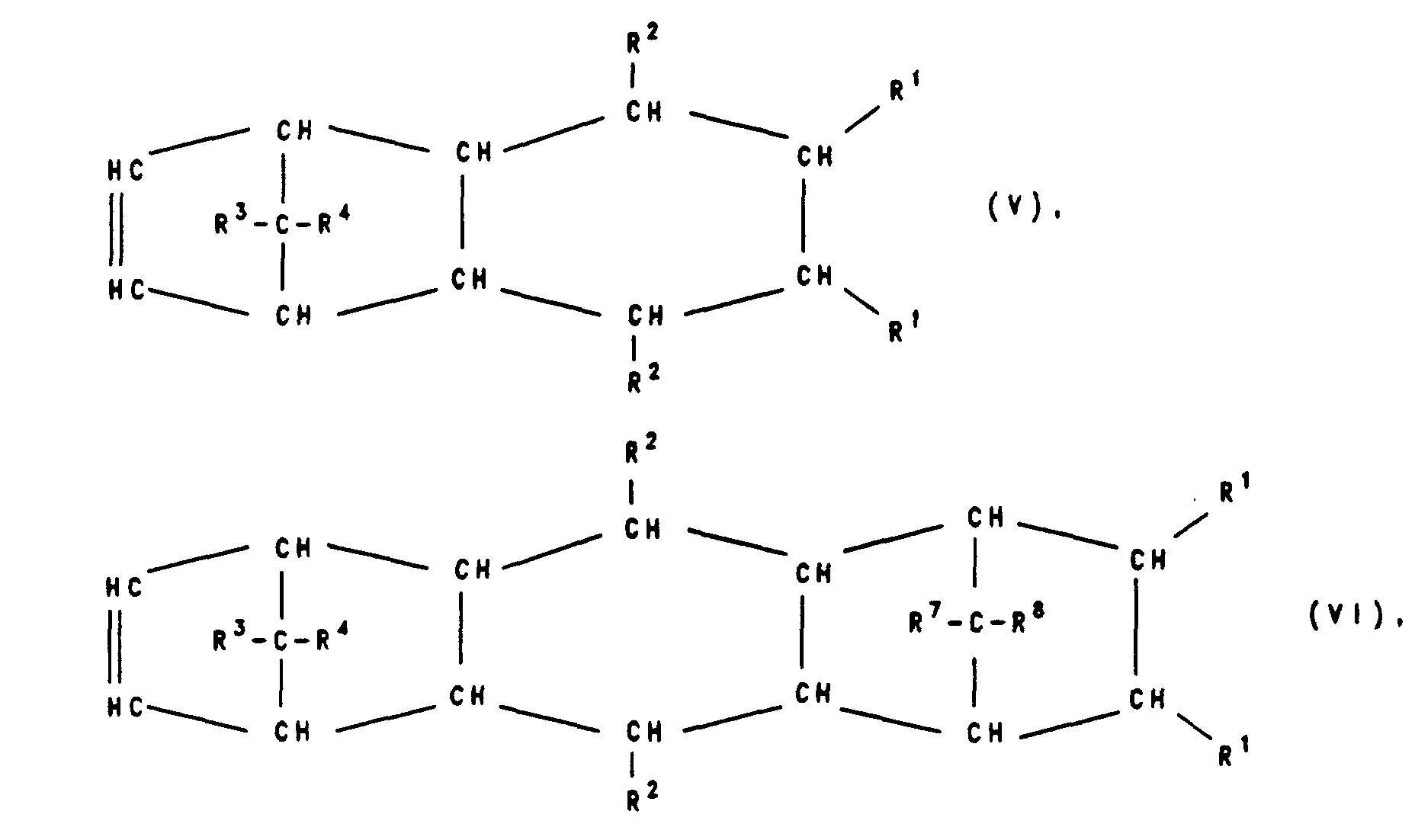
- At least one symmetrical, polycyclic olefin of the formulas I, II, III, IV, V or VI preferably a symmetrical, polycyclic olefin of the formulas I or III, in which R 1 , R 2 , R 3 , R 4 , R 5 , R 6 , R 7 and R 8 are the same or different and represent a hydrogen atom or a C 1 -C 8 alkyl radical.
- a monocyclic olefin of the formula VII in which n is a number from 2 to 10, is also used.
- Another comonomer is an acyclic olefin of the formula VIII, in which R 9 , R 10 , R 11 and R 12 are identical or different and denote a hydrogen atom or a C 1 -C 8 -alkyl radical. Ethylene or propylene are preferred.
- copolymers of polycyclic olefins are preferred of the formulas I and III, prepared with the acyclic olefins of the formula VIII.
- cycloolefins are norbornene and tetracyclododecene, where these can be substituted by (C 1 -C 6 ) alkyl. They are preferably copolymerized with ethylene; ethylene / norbornene copolymers are of particular importance.
- the cycloolefin copolymers according to the invention are preferably obtained if the ratio of cycloolefin to acyclic olefin is optimized.
- the cycloolefin copolymers prepared by the process described here contain the symmetrical, polycyclic olefin of the formulas I, II, III, IV, V or VI in an amount of 41 to 59 mol%, preferably 45 to 55 mol%, particularly preferably 48 to 52 mol%, in each case based on the total amount of Monomers.
- the acyclic olefin of formula VIII is in the Cycloolefin copolymers in an amount of 59 to 41 mol%, preferably 55 to 45 mol%, particularly preferably 52 to 48 mol%, each based on the total amount of monomers.
- cycloolefin copolymers which have the symmetrical, polycyclic olefin of the formulas I, II, III, IV, V or VI and the acyclic olefin of formula VIII in a molar ratio of 1: 1.
- the monocyclic olefin of formula VII is in the cycloolefin copolymers in contain an amount of less than 5 mol%.
- the glass transition temperature of the cycloolefin copolymers according to the invention is preferably 100-250 ° C, particularly preferably 110-220 ° C and in particular preferably 120 to 150 ° C.
- the melting temperature is preferably in the range from 200 to 600 ° C. particularly preferably from 230 to 400 ° C. and particularly preferably from 260 up to 300 ° C.
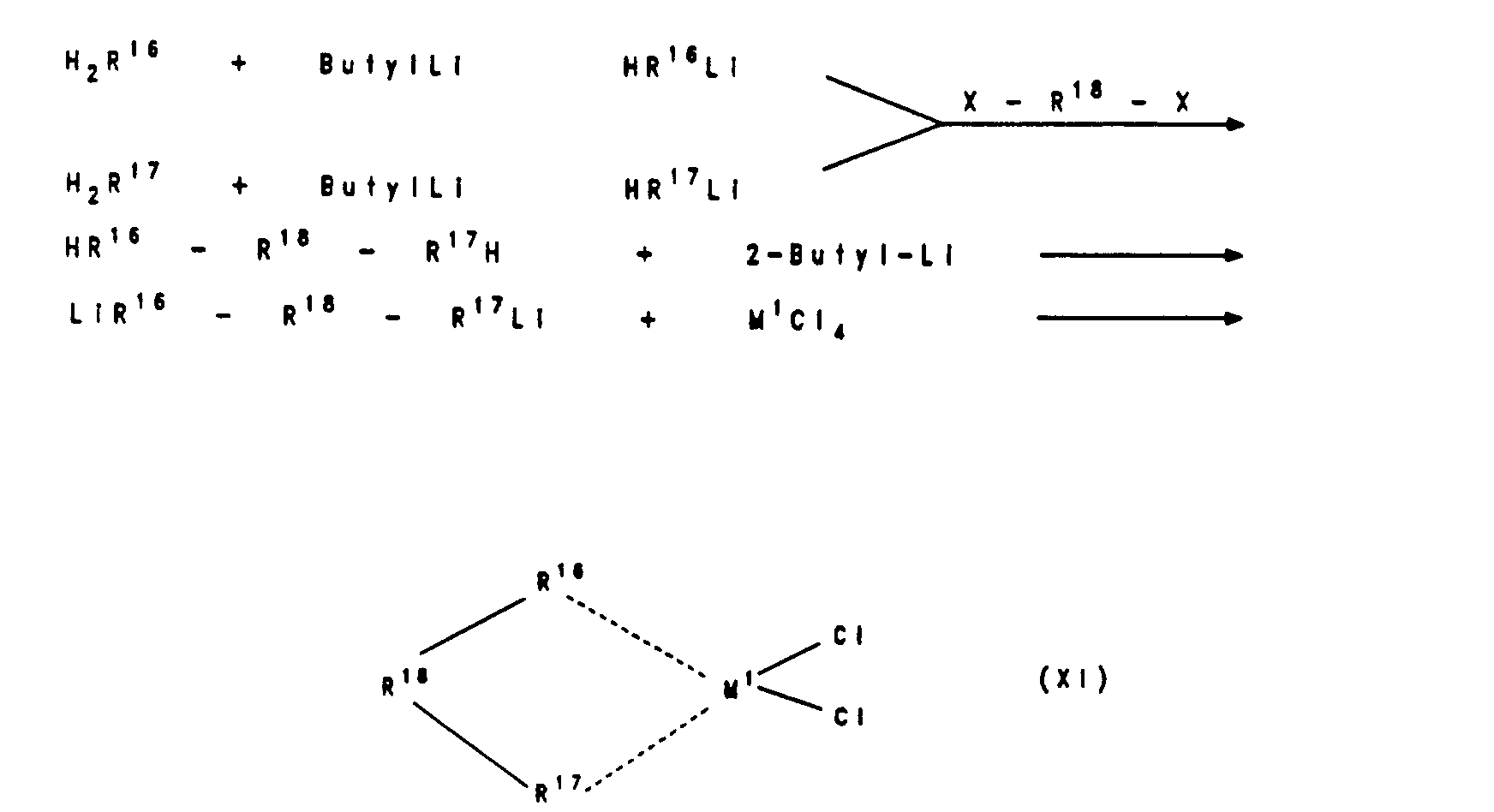
- the catalyst to be used for the polymerization process described consists of an aluminum oxane and at least one metallocene (transition metal component) of the formula XI
- M 1 is a metal from the group titanium, zirconium, hafnium, vanadium, niobium and tantalum, preferably zirconium and hafnium. Zircon is particularly preferably used.
- R 14 and R 15 are identical or different and represent a hydrogen atom, a C 1 -C 10 -, preferably C 1 -C 3 -alkyl group, a C 1 -C 10 -, preferably C 1 -C 3 -alkoxy group, a C.
- R 16 is fluorenyl, indenyl, cyclopentadienyl and R 17 cyclopentadienyl and indenyl, it being possible for these radicals to be substituted.
- the part of the metallocene formed by the central atom M 1 and the substituents R 16 - R 17 has C 1 symmetry.
- R 18 is preferably a radical and particularly preferred
- M 2 is silicon, germanium or tin, preferably silicon or germanium, particularly preferably silicon.
- Ligand systems (R 16 - R 18 - R 17 ) which can exert a different steric interaction on the ligands R 14 and R 15 are generally preferred. The nature of the ligands R 14 and R 15 is of no importance.
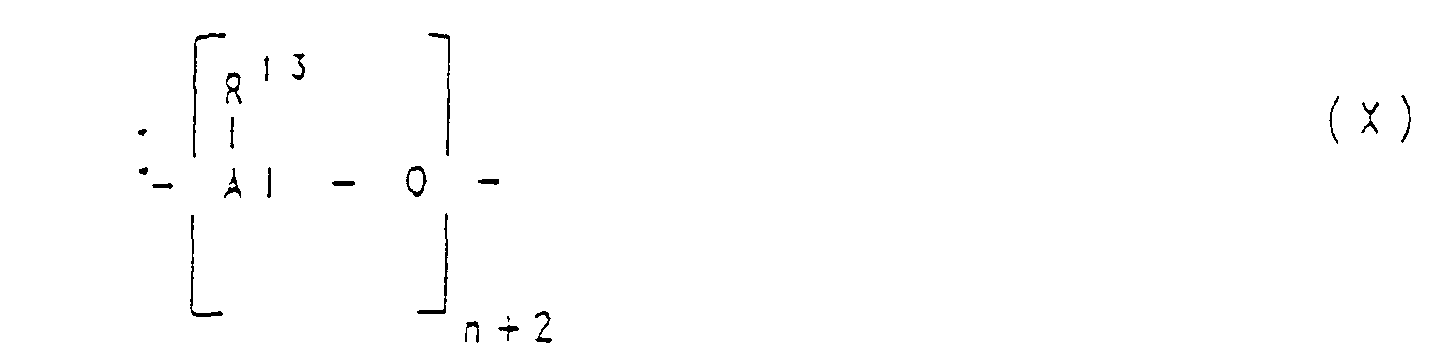
- the cocatalyst is (preferably) an aluminoxane of the formula IX and / or of the formula X.
- the radicals R 13 can be identical or different and mean a C 1 -C 6 alkyl group, preferably methyl, ethyl or isobutyl, Butyl or neopentyl, or phenyl or benzyl. Methyl is particularly preferred.
- n is an integer from 0 to 50, preferably 5 to 40.
- the aluminoxane can be prepared in various ways by known methods.
- One of the methods is, for example, that an aluminum hydrocarbon compound and / or a hydridoaluminum hydrocarbon compound is reacted with water (gaseous, solid, liquid or bound - for example as water of crystallization) in an inert solvent (such as toluene).
- an inert solvent such as toluene
- AlR 3 + AIR ' 3 two different aluminum trialkyls (AlR 3 + AIR ' 3 ) are reacted with water according to the desired composition (see S. Pasynkiewicz, Polyhedron 9 (1990) 429 and EP-A 302 424).
- all aluminoxane solutions are one changing content of unreacted aluminum starting compound, which in free form or as an adduct, together.
- metallocene in the polymerization reaction preactivate with an aluminoxane of formula IX and / or X. This will the polymerization activity increased significantly.
- the preactivation of the transition metal compound is in solution performed.
- the metallocene is preferably in a solution of Aluminoxane dissolved in an inert hydrocarbon.
- inert Hydrocarbon is an aliphatic or aromatic Hydrocarbon. Toluene is preferably used.
- the concentration of the aluminoxane in the solution is in the range from about 1 mol% to the saturation limit, preferably from 5 to 30 mol%, in each case based on the total solution.
- the metallocene can be used in the same concentration, but preferably it is used in an amount of 10 -4 - 1 mol per mol of aluminoxane.
- the preactivation time is 5 minutes to 60 hours, preferably 5 to 60 minutes. One works at a temperature of -78 ° C to 100 ° C, preferably 0 to 70 ° C.
- the metallocene can also be prepolymerized or applied to a support become.
- prepolymerization preference is given to (or one of the) in the Polymerization used olefin (s) used.
- Suitable carriers are, for example, silica gels, aluminum oxides, solid Aluminoxane or other inorganic carrier materials.
- a suitable one The carrier material is also a polyolefin powder in finely divided form.
- a further possible embodiment of the process according to the invention consists in using a salt-like compound of the formula R x NH 4 -x BR ' 4 or the formula R 3 PHBR' 4 as a cocatalyst instead of or in addition to an aluminoxane.
- X 1, 2 or 3
- R alkyl or aryl, the same or different
- R ' aryl, which can also be fluorinated or partially fluorinated.
- the catalyst consists of the reaction product of a metallocene with one of the compounds mentioned (EP-A 277 004).
- solvent is added to the reaction mixture, then it is common inert solvents such as. B. aliphatic or cycloaliphatic Hydrocarbons, petrol or hydrogenated diesel oil fractions or toluene.
- the metallocene compound is used in a concentration, based on the transition metal, of 10 -3 to 10 -8 , preferably 10 -4 to 10 -7 mol, transition metal per dm 3 reactor volume.
- the aluminoxane is used in a concentration of 10 -4 to 10 -1 , preferably 10 -4 to 2 x 10 -2 mol per dm 3 reactor volume, based on the aluminum content. In principle, however, higher concentrations are also possible.
- the average molecular weight of the cycloolefin copolymer formed can be determined by Hydrogen dosing, variation of the monomer concentrations or variation control the temperature in a known manner.
- the polydispersity M w / M n of the copolymers is quite narrow with values between 1.9 and 3.5. This results in a property profile of the polymers, which makes them particularly suitable for fiber production.
- the degree of crystallinity of the cycloolefin copolymers is 1 to 80%, preferably at 10 to 50%, particularly preferably at 15 to 40%.
- the polymers of the invention are also for the production of Polymer alloys can be used.
- the alloys can be in the melt or in Solution.
- the alloys each have one for certain Applications favorable combination of properties of the components.
- Alloys with the polymers according to the invention are the following polymers applicable: Polyethylene, polypropylene, (ethylene-propylene) copolymers, polybutylene, poly- (4-methyl-1-pentene), Polyisoprene, polyisobutylene, natural rubber, poly (methyl methacrylate), further polymethacrylates, polyacrylates, (acrylate methacrylate) copolymers, Polystyrene, (styrene-acrylonitrile) copolymers, bisphenol-A polycarbonate, other polycarbonates, aromatic polyester carbonates, Polyethylene terephthalate, polybutylene terephthalate, amorphous polyarylates, nylon-6, Nylon-66, other polyamides, polyaramides, polyether ketones, polyoxym
- the residual catalyst concentration is the concentration of To understand compounds that occur in the course of polymerization, the Polymerization is stopped and the reaction medium is worked up arise and remain in the cycloolefin polymer. It is in the Mainly compounds of the central atom of the metallocene compound and around aluminum connections. Usually the Residual catalyst levels in ppm aluminum and ppm metallocene metal specified. Since the aluminum is in a significant excess (i.e. at least 50 times) compared to the central atom, it is appropriate to Residual catalyst contents to be stated in ppm aluminum.
- the residual catalyst concentration basically depends on that at Polymerization used amount of metallocene and aluminum alkyl per unit of polymer produced. That means purity too of the monomers and that of the diluents, but also that Monomer concentrations, the polymer concentrations and the Catalyst activity are decisive for the residual catalyst concentration.
- reaction medium can be worked up differently. There the type of workup determines the residual catalyst concentration in the End product.
- stoppers are preferably chosen which, by reaction with the metallocene and / or the aluminum alkyl, lead to compounds which are soluble in aqueous or alcoholic or ketonic solutions and are thereby separated from the cycloolefin copolymer during the precipitation process.
- Isopropanol, methanol, ethanol, tert-butanol are particularly preferably used as stoppers.
- the stopped reaction medium can be fed to a precipitation.
- Preferred precipitants are alcohols, ketones, esters and those containing them Mixtures. Particularly preferred precipitants are methanol, ethanol, Acetone, ethyl acetate or mixtures containing over 50 vol .-% of these Connections exist. Then the precipitated polymer for example with an aqueous, alcoholic or ketonic solution washed at least once. In contrast to the Description from EP 503422 solutions are under no circumstances used Contain HCI or other chlorine-containing compounds.
- the washed product is preferably in the absence of oxygen, preferably dried under nitrogen at elevated temperature. Preferably between 40 ° C below the corresponding Glass temperature (Tg) of the polymer and 300 ° C, particularly preferably between Dried 10 ° C below Tg and 200 ° C.
- the stopped reaction medium can also directly or via another Intermediate stage of a concentration of the reaction medium supplied become.
- the concentration is carried out in a conventional one or two stage Evaporation process using flash equipment or Thin film evaporators or a combination of both. In case of Combination is the second or last apparatus a thin film evaporator.
- the Product processed using this method is obtained as a polymer melt can be granulated directly by conventional methods.
- An intermediate stage before the concentration can e.g. B. with a washing process an aqueous washing medium.
- the reaction medium that with the Wash solution forms a two-phase mixture, with the wash solution stirred together and then decanted. It is important that the Hydrophyly of the aqueous solution is set so that when washing the No polymer passes into the aqueous phase of the reaction medium.
- Washing media are alkaline or chlorine-free aqueous or acidic alcoholic solutions. NaOH, soda, acetic acid, Sulfuric acid solutions.
- variant 2 be characterized in that the semi-crystalline cycloolefin polymer in dissolved form flows through a filter medium at least once. So be Residual catalyst levels in the polymer end product regardless of the Catalyst concentrations in the reaction medium less than 100 ppm aluminum reached.
- a solvent for dilution during the polymerization the reaction medium in which the polymer dissolves well, preferably decalin, a hydrogenated diesel oil fraction with a boiling point between 120 and 160 ° C or cyclohexane, in a solvent to cycloolefin ratio of 4: 1 to 1:10, and / or a relatively high polymerization temperature, preferably 50 to 150 ° C, so you can precipitate the partially crystalline polymer in the form of Avoid particles as much as possible. From a polymer concentration of 5% gel formation is possible which, if it takes place, for example one Reduction in the polymerization time or a further increase in Polymerization temperature is necessary.
- the polymerization proceeds without the polymer being in a heterogeneous state Particle shape fails, which is a simple mechanical separation of the would allow precipitated polymer from the reaction medium, that will
- the reaction medium is heated to at least 130 ° C. The temperature will change chosen so high that it is ensured that the polymer is completely dissolved.
- an additional Solvents are added. Hydrogenated diesel fractions are preferred, Decalin, toluene, cyclohexane, chlorobenzene, dichlorobenzene, chloronaphthalene and Naphthalene. Decalin and cyclohexane are particularly preferred.
- stoppers are those compounds which are linked to the metallocene and / or react with the aluminum alkyl used and thereby an insoluble one Connection.
- reaction mixture which can be diluted and in where the polymer is completely dissolved, not one in the reaction medium soluble, powdered, organic or inorganic substance suspended.
- the Suspension is intimately mixed for at least 10 minutes.
- Materials that are used as filter aids, as well as polar substances which preferably carry OH groups on their particle surface are preferred.
- diatomaceous earth, perlite various are preferred Types of cellulose and cellulose derivatives.
- the suspension is then preferably over a filtration layer constant temperature filtered.
- Various inputs can be used as the filter layer.
- multi-layer filters consisting of filter fabrics and / or filter fleeces and / or filter aid layers that exist in at least one layer have a porosity that is smaller than the average size of that in the Reaction medium suspended particles. Medium porosities are preferred, which are smaller by a factor of 2 to 20, in particular by a factor of 3 to 10 than the average particle size of the suspended substance.
- the polymer solution thus obtained can either by precipitation or by Concentration according to variant 1 can be worked up further.
- cycloolefin is a poor solvent for the cycloolefin polymer, so that particle formation occurs even without the addition of poor solvents to prefer polymerization in pure cycloolefin.
- the polymerization proceeds so that the polymer is in a heterogeneous If the particle shape fails, a simple mechanical separation of the precipitated polymer from the reaction medium.
- a simple mechanical separation of the precipitated polymer from the reaction medium can already contain considerable amounts of metallocene and Aluminum alkyl, which may be in solution, from which Separate the product to be refurbished and thereby all others Relieve or simplify cleaning steps.
- Such a separation of the precipitated polymer particles from the remaining reaction medium can in a conventional filtration or using conventional centrifugation processes be performed.
- the polymer-free reaction medium can Polymerization can be fed again. To such a return without To ensure impairment of the catalysis, the removal of the polymer from the filter or from the centrifuge under inert conditions.
- the separated polymer is then elevated in a solvent Temperature solved.
- solvent Temperature solved There are solution temperatures of 130 to 200 ° C. prefers. The temperature is chosen so high that it is ensured that the polymer is completely dissolved.
- Hydrogenated solvents are used Diesel fractions, decalin, toluene, cyclohexane, chlorobenzene, dichlorobenzene, Chloronaphthalene and naphthalene preferred. Decalin is particularly preferred, Chlorobenzene, dichlorobenzene and cyclohexane.
- This solution can be analogous to that under Variant 2.1. described procedure with stopper and insoluble Substances added, filtered hot and then using the option 1 described precipitation or concentration can be worked up further.
- the reprocessing method according to the invention is also based on described catalyst systems (metallocenes and aluminum alkyls) to separate other usable for cycloolefin polymerization Catalyst systems (e.g. Ziegler catalysts) can be used.
- Catalyst systems e.g. Ziegler catalysts
- the cycloolefin copolymers worked up according to the invention are suitable especially for the production of fibers.
- the fibers can be made according to usual technical processes are spun from the melt.
- the spinning solution as well as the polymer melt can still by a further filtration particles and gel particles are also removed.
- the polymer can be pasted with high-boiling hydrocarbons to improve processability.
- a melt spinning process the polymer is melted in a single or twin screw extruder or a piston extruder. It can be melted in the piston extruder by heating the cylinder.
- Another possibility is to press the polymer against a heated grid, whereby the polymer melts.
- the polymer melt then flows through a spinning head with one or more spinnerets.
- the fiber or the filaments are preferably wound on spools at an increased take-off speed.
- the melt-spun fiber is preferably post-stretched with heating.
- the fiber is passed through one or more heating zones, whereby different stretching conditions can be set.
- Preferably high stretching ratios are used, whereby the crystallinity of the Fiber is further increased.
- the fiber or filaments are usually stretched to high to achieve mechanical strength and high moduli of elasticity.
- the Draw ratio is usually 1.1 to 50, preferably 1.5 to 30, particularly preferably 2 to 10.
- the stretching can be done in a single step, in two or more Steps. Furthermore, the fibers or filaments subjected to heat treatment at the same or higher temperature to increase the crystallinity.
- the heat transfer can be done with a Heating plate (also curved) or cylindrical devices.
- the drawing temperatures are advantageously between the glass temperature and Melting temperature.
- the first is for cycloolefin copolymer according to the invention Drawing at temperatures between 100 and 500 ° C, preferably between 120 and 300 ° C.
- a subsequent thermal aftertreatment at the same or higher Temperature than the drawing temperature by applying a low Tension serves to fix the fiber. This causes a tendency to shrink diminished at higher temperatures.
- the spinning speed can be up to 5000 m / min. or higher. there highly oriented "as spun yarns" can be obtained for which only one little post-stretching is necessary.
- the stretching of the fibers straightens according to the desired elongation at break, usually stretching so that elongations at break of 2-50%, preferably 10-40%, particularly preferably 15-30% be preserved.
- the drawn fibers have tensile strengths of 70 to 1000 MPa, preferably 200 to 800 MPa, particularly preferably 300 to 500 MPa.
- the titer of the fiber is in the range from 0.01 to 100 g / km, preferably from 0.05 to 20 g / km, particularly preferably 0.2 to 10 g / km.
- the module is in the range of 2 to 20 GPa, preferably 5 to 10 GPa, particularly preferably 6 to 8 GPa.
- the fiber according to the invention can be used, for example, as technical fibers, fabrics for the textile and technical fields or Fleece. Filaments, multifilaments, ropes, ropes can be produced. The excellent resistance to hydrolysis and UV should be emphasized. As well the good strength at elevated temperature should be mentioned.
- the glass transition temperatures given in the following examples were Tg using DSC (Differential Scanning Calorimetry) at a heating rate of 20 ° C / min determined.
- the stated viscosity numbers were according to DIN 53 728 determined.
- the residual catalyst content was determined as the aluminum content by X-ray fluorescence spectroscopy.
- the norbornene content in the cyclocoolefin copolymer was determined by quantitative 13 C-NMR spectroscopy.
- a 75 dm 3 reactor was filled with ethylene and filled with 15 dm 3 norbornene and 15 dm 3 decalin. The solution was saturated with ethylene by pressing ethylene (6 bar) several times. A pressure of 2.5 bar (gauge pressure) was set, 500 cm 3 of toluene methylaluminoxane solution (10.1% by weight of methylaluminoxane with a molecular weight of 1300 g / mol after cryoscopic determination) were added to the reactor and 15 minutes at 70 ° C. touched.
- the mixture was polymerized at 70 ° C. with stirring (750 rpm), the Ethylene pressure was kept at 2.5 bar by metering.
- Filter cake from 500 g of Celite, suspended in 10 1 of a hydrogenated Diesel oil fraction, built up and the nutsche then to 160 ° C. tempered.
- the polymer solution was filtered through the pressure filter. It was like this proceed so that the filtrate is first returned to the suction filter for 15 min was (i.e. pumped in a circle). A pressure of 2.8 bar nitrogen built up.
- the polymer solution was then stirred into 500 l of acetone using a dispersant ( (R) Ultraturrax) and precipitated in the process.
- the acetone suspension was circulated through a 680 l stirring pressure filter with the bottom valve open. After closing the bottom valve, it was filtered.
- the polymeric solid was washed three times with acetone. 50 g of stabilizer (1 g of Irganox 1010) were added to the last wash.
- the acetone was then completely squeezed off and the product at 100 ° C. predried three hours.
- the final drying takes place at 10 mbar for 10 hours and 160 ° C with a weak nitrogen blanket in the drying cabinet.
- a 1.5 dm 3 reactor was filled with ethylene and filled with 600 cm 3 of an 85 weight percent solution of norbornene in toluene. The solution was saturated with ethylene by pressing ethylene (6 bar) several times. A pressure of 0.5 bar (excess pressure) was set, 5 cm 3 of toluene methylaluminoxane solution (10.1 mol% of methylaluminoxane with a molecular weight of 1300 g / mol after cryoscopic determination) were added to the reactor and the mixture was stirred at 70 ° C. for 15 minutes.
- the mixture was polymerized at 40 ° C. for one hour with stirring (750 rpm), the Ethylene pressure was kept at 2 bar by metering.
- reaction solution was drained into a vessel and quickly dropped in 5 dm 3 of acetone, stirred for 10 min and then filtered.
- the solid obtained was repeatedly with 10% hydrochloric acid and acetone in Exchange washed. It was washed neutral and again with acetone touched.
- the refiltered polymer was at 80 ° C and a pressure of 0.2 bar dried for 15 hours.
- the polymerizations were carried out analogously to Example 1, the ethylene overpressures, the amount of catalyst and the reaction time according to Table 1 being varied.
- a 1.5 dm 3 reactor was filled with 600 ml of 5-methylnorbornene. 5 cm 3 of toluene methylaluminoxane solution (10 mol% methylaluminoxane with a molecular weight of 1300 g / mol after cryoscopic determination) were added to the reactor and saturated with ethylene by repeatedly pressing in ethylene (6 bar) and stirred for 15 minutes. The temperature was set to 70 ° C and the pressure set to 2 bar (gauge pressure).
- the mixture was polymerized at 70 ° C. for one hour with stirring.
- the ethylene print was kept constant by replenishing at 2 bar.
- the reaction solution was drained into a vessel.
- the mixture was stirred for 20 minutes and filtered through a 3 dm 3 pressure filter.
- the clear solution was introduced into 5 dm 3 of acetone.
- the precipitated product was filtered off and washed three times with acetone.
- the mixture was then dried at 100 ° C and 0.2 bar for 15 hours.
- Polymers prepared according to Example 1 were pressed by pressing for 15 minutes 300 ° C and 10 bar pressure pressed into sheets. Then was under 10 bar Pressure cooled to 100 ° C at 20 K / min, then the plates of the film press taken.
- the round plates thus obtained had a diameter of 60 mm with a thickness of 1 mm.
- the polymers from Examples 3 to 8 were also processed to press plates according to Example 10.
- the solvent resistance in toluene was investigated according to Example 11, the storage time in toluene being 14 days.
- the specific density of the press plates from Example 10 was determined. The determination was made using the buoyancy method. The specific density was 1.032 g / cm 3 .
- a press plate produced according to Example 10 was quenched after melting at 300 ° C in ice water.
- the specific density was 1.018 g / cm 3 .
- the polymer from Example 1 was pressed into a rod at 280 ° C. under vacuum. This rod was inserted into a single-piston extruder and pressed against a heated grid (T 1 ; Tab. 1), whereby the polymer melted.
- the melt flowed through a metal filter (sintered metal, fineness 5 ⁇ m ) (T 2 , Tab. 1) and then passed through a single-hole spinneret (capillary dimensions: diameter 50 ⁇ m , length 70 ⁇ m ).
- the melt had the temperature T 3 (Tab. 1).
- the flow (Tab. 1) was varied by changing the piston feed. Furthermore, the withdrawal speed (Tab. 1) of the melt from the nozzle was varied.
- the titer of the fiber was determined by precisely weighing a defined length of a thread.
- the filaments obtained according to Examples 15 and 17 were stretched and oriented using a two-stage stretching apparatus.
- the filament was unwound from the fiber spool (roll 1, table 3) and from a second roller running at higher speed (roller 2, tab. 3) added.
- the fiber passes through a heating zone (curved hot Plate) (temperature 140 ° C), whereby it was stretched.
- a heating zone temperature 140 ° C
- a second heating zone temperature approx. 190 ° C
- that of the fixation serves, after which it is again taken up on a fiber spool (roll 3, Tab. 3) and was slightly stretched again.
- a 1.5 dm 3 reactor was filled with ethylene.
- 500 cm 3 of norbornene melt, 500 cm 3 of hexane and 5 cm 3 of toluene methylaluminoxane solution were introduced and the mixture was stirred at 50 ° C. for 15 minutes.
- the ethylene pressure was set to 2.3 bar and the temperature to 70 ° C.
- the polymerization was carried out at 70 ° C. for 60 minutes, the ethylene pressure being constant was held. The suspension was then drained into a vessel and filtered through a glass filter without further treatment. The solid was washed with hexane and dried.
- the solid was suspended in 500 cm 3 of decalin, 5 g of ®Celite and 2 cm 3 of water were added and the mixture was heated to 170 ° C. with stirring.
- the suspension was filtered at 170 ° C. through a 3 dm 3 pressure filter (filter fabric: Seitz filter T5500).
- the solution obtained was rapidly dispersed in 5 dm 3 of acetone with vigorous stirring.
- the solid was filtered and dispersed and washed several times in 2 dm 3 of acetone.
- the polymeric product was predried at 0.2 bar and 100 ° C. for 15 hours and subsequently dried at 160 ° C. and 0.1 mbar for 2 hours.
- the open polymerization reactor had no wall coverings.
- Example 2 The polymer from Example 2 was described in Examples 14-17 in brought the spinning apparatus. However, attempts at spinning did not lead to Success because the filaments broke.
Landscapes
- Chemical & Material Sciences (AREA)
- Chemical Kinetics & Catalysis (AREA)
- Health & Medical Sciences (AREA)
- Medicinal Chemistry (AREA)
- Polymers & Plastics (AREA)
- Organic Chemistry (AREA)
- General Chemical & Material Sciences (AREA)
- Engineering & Computer Science (AREA)
- Textile Engineering (AREA)
- Transition And Organic Metals Composition Catalysts For Addition Polymerization (AREA)
- Addition Polymer Or Copolymer, Post-Treatments, Or Chemical Modifications (AREA)
- Artificial Filaments (AREA)
Description

0 bis 50 Gew.-%, bezogen auf die Gesamtmenge der Monomeren, eines monocyclischen Olefins der Formel VII

70 bis 0,1 Gew.-%, bezogen auf die Gesamtmenge der Monomeren, mindestens eines acyclischen Olefins der Formel VIII


- M1
- Titan, Zirkon, Hafnium, Vanadium, Niob oder Tantal ist,
- R14 und R15
- gleich oder verschieden sind und ein Wasserstoffatom, ein Halogenatom, eine C1-C10-Alkylgruppe, eine C1-C10-Alkoxygruppe, eine C6-C10-Arylgruppe, eine C6-C10-Aryloxygruppe, eine C2-C10-Alkenylgruppe, eine C7-C40-Arylalkylgruppe, eine C7-C40-Alkylarylgruppe oder eine C8-C40-Arylalkenylgruppe bedeuten,
- m =
- 1 oder 2
- R16 und R17
- verschieden sind und einen ein- oder mehrkernigen Kohlenwasserstoffrest, welcher mit dem Zentralatom M1 eine Sandwichstruktur bilden kann, bedeuten, wobei der Teil des Moleküls der durch R16, R17 und M1 gebildet wird C1-Symmetrie aufweist,
- R18
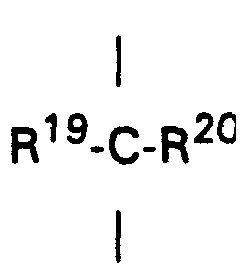
- = BR19 = AIR19, -Ge-, -Sn-, -O-, -S-, = SO, = SO2, = NR19, = CO, = PR19 oder = P(O)R19 ist, wobei R19, R20 und R21

gleich oder verschieden sind und ein Wasserstoffatom, ein Halogenatom, eine C1-C10-Alkylgruppe, eine C1-C10-Fluoralkylgruppe, eine C6-C10-Fluorarylgruppe, eine C6-C10-Arylgruppe, eine C1-C10-Alkoxygruppe, eine C2-C10-Alkenylgruppe, eine C7-C40-Arylalkylgruppe, eine C8-C40-Arylalkenylgruppe oder eine C7-C40-Alkylarylgruppe bedeuten oder R19 und R20 oder R19 und R21 jeweils mit den sie verbindenden Atomen einen Ring bilden, und - M2
- Silizium, Germanium oder Zinn ist, dadurch gekennzeichnet, daß der Restkatalysatorgehalt kleiner 100 ppm ist.


= CO, = PR19 oder = P(O)R19, wobei R19, R20 und R21
gleich oder verschieden sind und ein Wasserstoffatom, ein Halogenatom, eine C1-C10-Alkylgruppe, eine C1-C10-Fluoralkylgruppe, eine C6-C10-Arylgruppe, eine C1-C10-Alkoxygruppe, eine C2-C10-Alkenylgruppe, eine C7-C40-Arylalkylgruppe, eine C8-C40-Arylalkenylgruppe oder eine C7-C40-Alkylarylgruppe bedeuten, oder R19 und R20 oder R19 und R21 bilden jeweils zusammen mit den sie verbindenden Atomen einen Ring.


und
Isopropylen-(9-fluorenyl) (1-(3-methyl)cyclopentadienyl)-zirkondichlorid,
Butyl oder Neopentyl, oder Phenyl oder Benzyl. Besonders bevorzugt ist Methyl. n ist eine ganze Zahl von 0 bis 50, bevorzugt 5 bis 40.
Die Polymerisationsstoppung wird in einem dem Polymerisationsreaktor nachgelagerten Gefäß durch Zugabe eines Stoppers unter Rühren durchgeführt. Der Stopper ist eine chemische Verbindung, die mit dem Metallocen und/oder dem Aluminiumalkyl reagiert und damit diese(s) in eine unreaktive Form überführt. Bevorzugt werden in dieser Variante Stopper gewählt, die durch Reaktion mit dem Metallocen und/oder dem Aluminiumalkyl zu Verbindungen führen, die in wässrigen oder alkoholischen oder ketonischen Lösungen löslich sind und dadurch während des Fällprozesses vom Cycloolefincopolymer getrennt werden. Besonders bevorzugt werden Isopropanol, Methanol, Ethanol, tert.-Butanol als Stopper eingesetzt.
Bei einem Schmelzspinnverfahren wird das Polymer in einem Ein- oder Zweischneckenextruder oder einem Kolbenextruder aufgeschmolzen. Das Aufschmelzen im Kolbenextruder kann durch Beheizen des Zylinders erfolgen. Eine weitere Möglichkeit besteht darin, das Polymer gegen ein beheiztes Gitter zu pressen, wobei das Polymer aufschmilzt. Die Polymerschmelze durchströmt darauf einen Spinnkopf mit einem oder mehreren Spinndüsen. Die Faser, bzw. die Filamente, werden vorzugsweise bei erhöhter Abzugsgeschwindigkeit auf Spulen gewickelt.

Die Temperatur wurde auf 70 °C eingestellt und der Druck auf 2 bar (Überdruck) eingestellt.
| Lösungsmittel | M [%] |
| Toluol | + 0.1 |
| Cyclohexan | + 0.1 |
| Hexan | +/- < 0.1, d. h. 0 |
| Dichlormethan | + 0.8 |
| Chloroform | + 1.1 |
Gemäß Beispiel 11 wurde die Lösungsmittelfestigkeit in Toluol untersucht, wobei die Lagerzeit in Toluol 14 Tage betrug.
| Beispiel | T1 °C | T2 °C | T3 °C | Abzuggeschw. m/min | Düsendurchfluß g/min |
| 14 | 300 | 284 | 289 | 750 | 0,3 |
| 15 | 300 | 284 | 289 | 75 | 0,4 |
| 16 | 291 | 280 | 279 | 600 | 0,13 |
| 17 | 291 | 280 | 279 | 25 | 0,14 |
| Beispiel | Titer g/km | Reißfestigkeit MPa | Reißdehnung % | Modul GPa |
| 14 | 0,39 | 118 | 74 | 3,2 |
| 15 | 5,5 | 64 | 2,3 | 2,9 |
| 16 | 0,22 | 136 | 91 | 3,3 |
| 17 | 5,6 | 64 | 2,3 | 2,9 |
| Beispiel | Rohfaser aus Bsp. | Rolle 1 m/min | Rolle 2 m/min | Rolle 3 m/min | Verstreckverhältnis Rolle 3/Rolle 1 |
| 18 | 15 | 5 | 18,3 | 20,6 | 4,1 |
| 19 | 16 | 5 | 19,4 | 21,6 | 4,3 |
| 20 | 17 | 5 | 19,4 | 25,1 | 5,0 |
| Beispiel | Titer g/km | Reißfestigkeit MPa | Reißdehnung % | Modul GPA |
| 18 | 1,4 | 310 | 18 | 6,5 |
| 19 | 1,4 | 300 | 25 | 6,1 |
| 20 | 1,1 | 360 | 9 | 7,2 |
Claims (6)
- Verfahren zur Herstellung einer Faser aus Cycloolefincopolymer, wobei das Cycloolefincopolymer hergestellt wird durch Polymerisation von 30 bis 99,9 Gew.-%, bezogen auf die Gesamtmenge der Monomeren, mindestens eines symmetrischen, polycyclischen Olefins der Formeln I, II, III, IV, V oder VI
 worin R1, R2, R3, R4, R5, R6, R7 und R8 gleich oder verschieden sind und ein Wasserstoffatom, einen C6-C16-Aryl- oder einen C1-C8-Alkylrest bedeuten, wobei gleiche Reste in den verschiedenen Formeln eine unterschiedliche Bedeutung haben können,
0 bis 50 Gew.-%, bezogen auf die Gesamtmenge der Monomeren, eines Cycloolefins der Formel VIIworin n eine Zahl von 2 bis 10 ist, und
70 bis 0,1 Gew.-%, bezogen auf die Gesamtmenge der Monomeren, mindestens eines acyclischen Olefins der Formel VIIIworin R9, R10, R11 und R12 gleich oder verschieden sind und ein Wasserstoffatom oder einen C1-C8-Alkylrest bedeuten, bei Temperaturen von -78 bis 150°C und einem Druck von 0,01 bis 64 bar, in Gegenwart eines Katalysators, welcher aus einem Aluminoxan der Formel IX für den linearen Typ und/oder der Formel X
 für den cyclischen Typ, wobei in den Formeln IX und X die Reste R13 gleich oder verschieden sind und eine C1-C6-Alkylgruppe oder Phenyl oder Benzyl bedeuten und n eine ganze Zahl von 0 bis 50 ist, und einem Metallocen der Formel XI
 besteht, worin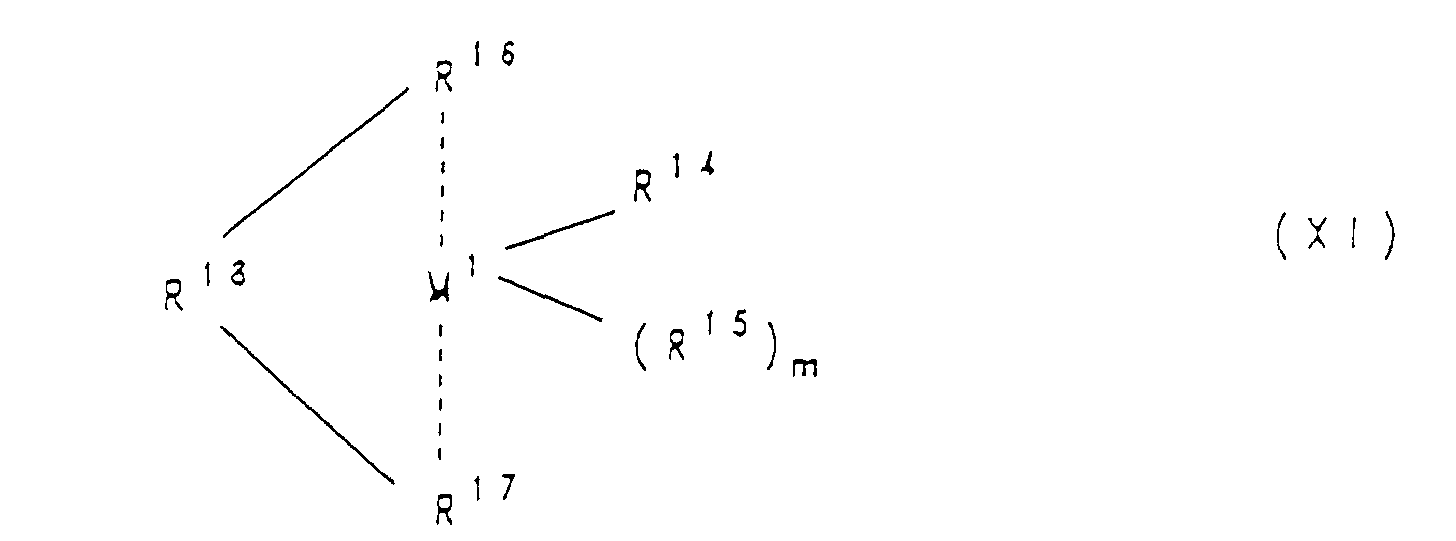
- M1
- Titan, Zirkon, Hafnium, Vanadium, Niob oder Tantal ist,
- R14 und R15
- gleich oder verschieden sind und ein Wasserstoffatom, ein Halogenatom, eine C1-C10-Alkylgruppe, eine C1-C10-Alkoxygruppe, eine C6-C10-Arylgruppe, eine C6-C10-Aryloxygruppe, eine C2-C10-Alkenylgruppe, eine C7-C40-Arylalkylgruppe, eine C7-C40-Alkylarylgruppe oder eine C8-C40-Arylalkenylgruppe bedeuten, m = 1 oder 2,
- R16 und R17
- gleich oder verschieden sind und einen ein- oder mehrkernigen Kohlenwasserstoffrest, welcher mit dem Zentralatom M1 eine Sandwichstruktur bilden kann, bedeuten,
- R18
- = BR19 = AIR19, -Ge-, -Sn-, -O-, -S-, = SO, = SO2, = NR19,

= CO, = PR19 oder = P(O)R19 ist, wobei R19, R20 und R21
gleich oder verschieden sind und ein Wasserstoffatom, ein Halogenatom, eine C1-C10-Alkylgruppe, eine C1-C10-Fluoralkylgruppe, eine C6-C10-Fluorarylgruppe, eine C6-C10-Arylgruppe, eine C1-C10-Alkoxygruppe, eine C2-C10-Alkenylgruppe, eine C7-C40-Arylalkylgruppe, eine C8-C40-Arylalkenylgruppe oder eine C7-C40-Alkylarylgruppe bedeuten oder R19 und R20 oder R19 und R21 jeweils mit den sie verbindenden Atomen einen Ring bilden, und - M2
- Silizium, Germanium oder Zinn ist,
- Verfahren zur Herstellung einer Faser nach Anspruch 1, wobei das Metallocen der Formel Xl zur Herstellung des CycloolefincopolymersIsopropylen (9-fluorenyl)(1-(3-ethyl)cyclopentadienyl)zirkondichlorid,lsopropylen-(9-fluorenyl)(1-(3-isopropyl)cyclopentadienyl)-zirkondichlorid,Isopropylen-(9-fluorenyl) (1-(3-methyl)cyclopentadienyl)-zirkondichlorid,Diphenylmethylen-(9-fluorenyl) (1-(3-methyl)cyclopentadienyl)-zirkondichlorid, Methylphenylmethylen-(9-fluorenyl)(1-(3-methyl)cyclopentadienyl)zirkondichlorid,Dimethylsilyl(9-fluorenyl)(1-(3-isopropyl)cyclopentadienyl)-zirkondichlorid,Dimethylsilyl-(9-fluorenyl)(1-(3-methyl)cyclopentadienyl)-zirkondichlorid,Diphenylsilyl-(9-fluorenyl)(1-(3-methyl)cyclopentadienyl)-zirkondichlorid,Diphenylmethylen-(9-fluorenyl)(1-(3-tert.-butyl)cyclopentadienyl)-zirkondichlorid, lsopropenyl(2,3,4,5-tetramethylcyclopentadienyl)-(1-(3-methyl)cyclopentadienyl)-zirkondichlorid,lsopropylen-(9-fluorenyf)(1-(3-tert.-butyl)cyclopentadienyl)-zirkondichlorid oder das entsprechende Hafniumdichlorid ist.
- Verfahren zur Herstellung einer Faser nach Anspruch 1 oder 2, wobei das Cycloolefincopolymer Norbornen oder Tetracyclododecen als polycyclisches Olefin enthält.
- Verfahren zur Herstellung einer Faser nach einem oder mehreren der Ansprüche 1 bis 3, wobei das Cycloolefincopolymer ein Copolymer aus Norbornen und Ethylen ist.
- Verfahren zur Herstellung einer Faser nach einem oder mehreren der Ansprüche 1 bis 4, wobei das Cycloolefincopolymer das symmetrische, polycyclische Olefin und das acyclische Olefin im Molverhältnis 1:1 enthält.
- Verfahren zur Herstellung einer Faser nach einem oder mehreren der Ansprüche 1 bis 5, wobei die Polymerisation in einem Alkan als Lösungsmittel durchgeführt wird und Partikelbildung auftritt.
Applications Claiming Priority (2)
| Application Number | Priority Date | Filing Date | Title |
|---|---|---|---|
| DE4304317 | 1993-02-12 | ||
| DE4304317 | 1993-02-12 |
Publications (2)
| Publication Number | Publication Date |
|---|---|
| EP0610847A1 EP0610847A1 (de) | 1994-08-17 |
| EP0610847B1 true EP0610847B1 (de) | 2001-05-02 |
Family
ID=6480354
Family Applications (1)
| Application Number | Title | Priority Date | Filing Date |
|---|---|---|---|
| EP94101800A Expired - Lifetime EP0610847B1 (de) | 1993-02-12 | 1994-02-07 | Fasern aus Cycloolefincopolymeren |
Country Status (7)
| Country | Link |
|---|---|
| US (2) | US6458919B1 (de) |
| EP (1) | EP0610847B1 (de) |
| JP (1) | JP3513202B2 (de) |
| KR (1) | KR940019893A (de) |
| CN (1) | CN1101053A (de) |
| DE (1) | DE59409736D1 (de) |
| TW (1) | TW274100B (de) |
Families Citing this family (12)
| Publication number | Priority date | Publication date | Assignee | Title |
|---|---|---|---|---|
| TW274100B (de) * | 1993-02-12 | 1996-04-11 | Hoechst Ag | |
| EP0786466B1 (de) | 1996-01-25 | 2003-04-16 | Tosoh Corporation | Verfahren zur Olefinpolymerisierung unter Verwendung eines Übergangsmetallkatalysators. |
| DE60034308T2 (de) * | 1999-10-08 | 2007-12-20 | Mitsui Chemicals, Inc. | Metallocene, ein Verfahren zur deren Herstellung, Olefinpolymerisationskatalysator, und ein Verfahren zur Herstellung von Polyolefinen |
| KR100786742B1 (ko) * | 1999-10-08 | 2007-12-18 | 미쓰이 가가쿠 가부시키가이샤 | 폴리올레핀 |
| US6912955B2 (en) * | 2003-08-21 | 2005-07-05 | Reeves Brothers, Inc. | Metal-backed printing blanket |
| US8450440B2 (en) | 2009-10-21 | 2013-05-28 | Mitsui Chemicals, Inc. | Method for purifying polymer and polymer |
| CN105637129B (zh) * | 2013-10-24 | 2018-08-10 | 日本瑞翁株式会社 | 由含有脂环结构的聚合物构成的纤维及其制造方法 |
| JP6534511B2 (ja) * | 2014-09-09 | 2019-06-26 | デクセリアルズ株式会社 | 共重合体及びその製造方法、並びにシート成形体 |
| CN108602928B (zh) | 2016-02-12 | 2022-01-28 | 埃克森美孚化学专利公司 | 环烯烃共聚物及其制备方法 |
| JP2017222934A (ja) * | 2016-06-13 | 2017-12-21 | 株式会社クラレ | 環状ポリオレフィン系樹脂を含む繊維および不織布 |
| US20200398201A1 (en) * | 2018-02-28 | 2020-12-24 | Zeon Corporation | Non-woven fabric and filter |
| WO2019168603A1 (en) | 2018-02-28 | 2019-09-06 | Exxonmobil Chemical Patents Inc. | Polyethylene and cyclic olefin copolymer blend compositions with oxygen barrier properties and articles made therefrom |
Family Cites Families (13)
| Publication number | Priority date | Publication date | Assignee | Title |
|---|---|---|---|---|
| US3891610A (en) * | 1969-11-06 | 1975-06-24 | Crown Zellerbach Corp | Polyolefin fibers and process of formation during polymerization |
| US4184987A (en) * | 1974-01-09 | 1980-01-22 | Standard Oil Company (Indiana) | Stabilizing additives for polyolefins |
| US3971767A (en) * | 1974-05-20 | 1976-07-27 | E. I. Du Pont De Nemours And Company | Olefin polymerization catalyst system and process for polymerization of olefins |
| DE3133101A1 (de) * | 1981-08-21 | 1983-03-10 | Hoechst Ag, 6000 Frankfurt | Verfahren zur entfernung von katalysatorresten aus polyolefinen |
| IL85097A (en) | 1987-01-30 | 1992-02-16 | Exxon Chemical Patents Inc | Catalysts based on derivatives of a bis(cyclopentadienyl)group ivb metal compound,their preparation and their use in polymerization processes |
| DE3726067A1 (de) | 1987-08-06 | 1989-02-16 | Hoechst Ag | Verfahren zur herstellung von 1-olefinpolymeren |
| DE3742934A1 (de) | 1987-12-18 | 1989-06-29 | Hoechst Ag | Verfahren zur herstellung einer chiralen, stereorigiden metallocen-verbindung |
| JPH072799B2 (ja) * | 1988-12-16 | 1995-01-18 | 住友化学工業株式会社 | 高立体規則性a―オレフィン重合体の製造方法 |
| DE3922546A1 (de) | 1989-07-08 | 1991-01-17 | Hoechst Ag | Verfahren zur herstellung von cycloolefinpolymeren |
| TW227005B (de) | 1990-11-14 | 1994-07-21 | Hoechst Ag | |
| GB9103527D0 (en) * | 1991-02-20 | 1991-04-10 | Exxon Chemical Patents Inc | Hp catalyst killer |
| DE59209354D1 (de) | 1991-03-09 | 1998-07-09 | Targor Gmbh | Verfahren zur Herstellung chemisch einheitlicher Cycloolefincopolymere |
| TW274100B (de) * | 1993-02-12 | 1996-04-11 | Hoechst Ag |
-
1994
- 1994-02-04 TW TW083100950A patent/TW274100B/zh active
- 1994-02-07 DE DE59409736T patent/DE59409736D1/de not_active Expired - Fee Related
- 1994-02-07 EP EP94101800A patent/EP0610847B1/de not_active Expired - Lifetime
- 1994-02-08 CN CN94101383A patent/CN1101053A/zh active Pending
- 1994-02-10 JP JP01654294A patent/JP3513202B2/ja not_active Expired - Fee Related
- 1994-02-12 KR KR1019940002501A patent/KR940019893A/ko not_active Withdrawn
-
1995
- 1995-06-01 US US08/456,373 patent/US6458919B1/en not_active Expired - Fee Related
-
2002
- 2002-05-21 US US10/152,301 patent/US6593452B2/en not_active Expired - Fee Related
Also Published As
| Publication number | Publication date |
|---|---|
| CN1101053A (zh) | 1995-04-05 |
| US6458919B1 (en) | 2002-10-01 |
| EP0610847A1 (de) | 1994-08-17 |
| TW274100B (de) | 1996-04-11 |
| US6593452B2 (en) | 2003-07-15 |
| KR940019893A (ko) | 1994-09-15 |
| DE59409736D1 (de) | 2001-06-07 |
| JP3513202B2 (ja) | 2004-03-31 |
| JPH06240511A (ja) | 1994-08-30 |
| US20030045656A1 (en) | 2003-03-06 |
Similar Documents
| Publication | Publication Date | Title |
|---|---|---|
| EP0683797B1 (de) | Verfahren zur herstellung von cycloolefincopolymeren mit niedriger schmelzeviskosität und niedriger optischer dämpfung | |
| EP0608760B1 (de) | Faserverstärktes Cycloolefincopolymer-Material, Verfahren zu seiner Herstellung und Formkörper aus dem Material | |
| EP0610814B1 (de) | Teilkristalline Cycloolefin-Copolymer-Folie | |
| EP0610851B1 (de) | Verfahren zur Herstellung von Cycloolefincopolymeren | |
| EP0485893B1 (de) | Massepolymerisation mit speziellen Metallocenkatalysatoren zur Herstellung von Cycloolefinpolymeren | |
| EP0501370B1 (de) | Verfahren zur Herstellung von Cycloolefin(co)polymeren mit enger Molekulargewichtsverteilung | |
| EP0503422B1 (de) | Verfahren zur Herstellung chemisch einheitlicher Cycloolefincopolymere | |
| EP0690078B1 (de) | Cycloolefinpolymere | |
| EP0946618B1 (de) | Cycloolefincopolymere, ihre verwendung und daraus hergestellte formkörper | |
| EP0566988B1 (de) | Polymerlegierungen aus Cycloolefinpolymeren und Polyolefinen | |
| DE69819550T2 (de) | Propylenpolymerisate für fasern und flächengebilde | |
| EP0610847B1 (de) | Fasern aus Cycloolefincopolymeren | |
| DE60214299T2 (de) | Schmelzgesponnene Fasern aus mit Metallocenen katalysierten statistischen Propylen-Alpha-Olefin-Copolymeren | |
| EP0560090B1 (de) | Cycloolefinblockcopolymere und Verfahren zu ihrer Herstellung | |
| EP0832924B1 (de) | Polyolefinformmasse zur Herstellung von Vliesen | |
| EP0946616B1 (de) | Verfahren zur herstellung eines cycloolefincopolymers | |
| DE4240784A1 (de) | Glasfaserverstärktes Cycloolefinpolymer-Material und Verfahren zu seiner Herstellung | |
| DE69617434T2 (de) | Polymerisation crystalliner copolymere aus olefinen und zyklischen olefinen | |
| EP0683798B1 (de) | Verfahren zur herstellung von cycloolefincopolymeren mit hoher reissfestigkeit und niedriger optischer dämpfung | |
| DE4213219A1 (de) | Polymerlegierungen aus Cycloolefinpolymeren und Polyolefinen | |
| DE19634894A1 (de) | Polyolefinformmasse zur Herstellung von Vliesen | |
| DE19538780A1 (de) | Monofilamente aus Cycloolefin-Copolymeren, Flächengebilde enthaltend diese Monofilamente und deren Verwendung |
Legal Events
| Date | Code | Title | Description |
|---|---|---|---|
| PUAI | Public reference made under article 153(3) epc to a published international application that has entered the european phase |
Free format text: ORIGINAL CODE: 0009012 |
|
| AK | Designated contracting states |
Kind code of ref document: A1 Designated state(s): DE FR GB IT NL |
|
| 17P | Request for examination filed |
Effective date: 19950217 |
|
| 17Q | First examination report despatched |
Effective date: 19951207 |
|
| RAP1 | Party data changed (applicant data changed or rights of an application transferred) |
Owner name: TICONA GMBH |
|
| RAP1 | Party data changed (applicant data changed or rights of an application transferred) |
Owner name: TICONA GMBH |
|
| GRAG | Despatch of communication of intention to grant |
Free format text: ORIGINAL CODE: EPIDOS AGRA |
|
| GRAG | Despatch of communication of intention to grant |
Free format text: ORIGINAL CODE: EPIDOS AGRA |
|
| GRAH | Despatch of communication of intention to grant a patent |
Free format text: ORIGINAL CODE: EPIDOS IGRA |
|
| GRAH | Despatch of communication of intention to grant a patent |
Free format text: ORIGINAL CODE: EPIDOS IGRA |
|
| GRAA | (expected) grant |
Free format text: ORIGINAL CODE: 0009210 |
|
| AK | Designated contracting states |
Kind code of ref document: B1 Designated state(s): DE FR GB IT NL |
|
| REF | Corresponds to: |
Ref document number: 59409736 Country of ref document: DE Date of ref document: 20010607 |
|
| ITF | It: translation for a ep patent filed | ||
| GBT | Gb: translation of ep patent filed (gb section 77(6)(a)/1977) |
Effective date: 20010724 |
|
| ET | Fr: translation filed | ||
| REG | Reference to a national code |
Ref country code: GB Ref legal event code: IF02 |
|
| PLBE | No opposition filed within time limit |
Free format text: ORIGINAL CODE: 0009261 |
|
| STAA | Information on the status of an ep patent application or granted ep patent |
Free format text: STATUS: NO OPPOSITION FILED WITHIN TIME LIMIT |
|
| 26N | No opposition filed | ||
| PGFP | Annual fee paid to national office [announced via postgrant information from national office to epo] |
Ref country code: DE Payment date: 20060214 Year of fee payment: 13 |
|
| PGFP | Annual fee paid to national office [announced via postgrant information from national office to epo] |
Ref country code: NL Payment date: 20060215 Year of fee payment: 13 |
|
| PGFP | Annual fee paid to national office [announced via postgrant information from national office to epo] |
Ref country code: FR Payment date: 20060216 Year of fee payment: 13 |
|
| PGFP | Annual fee paid to national office [announced via postgrant information from national office to epo] |
Ref country code: GB Payment date: 20060221 Year of fee payment: 13 |
|
| PGFP | Annual fee paid to national office [announced via postgrant information from national office to epo] |
Ref country code: IT Payment date: 20060228 Year of fee payment: 13 |
|
| GBPC | Gb: european patent ceased through non-payment of renewal fee |
Effective date: 20070207 |
|
| NLV4 | Nl: lapsed or anulled due to non-payment of the annual fee |
Effective date: 20070901 |
|
| REG | Reference to a national code |
Ref country code: FR Ref legal event code: ST Effective date: 20071030 |
|
| PG25 | Lapsed in a contracting state [announced via postgrant information from national office to epo] |
Ref country code: NL Free format text: LAPSE BECAUSE OF NON-PAYMENT OF DUE FEES Effective date: 20070901 Ref country code: DE Free format text: LAPSE BECAUSE OF NON-PAYMENT OF DUE FEES Effective date: 20070901 |
|
| PG25 | Lapsed in a contracting state [announced via postgrant information from national office to epo] |
Ref country code: GB Free format text: LAPSE BECAUSE OF NON-PAYMENT OF DUE FEES Effective date: 20070207 Ref country code: FR Free format text: LAPSE BECAUSE OF NON-PAYMENT OF DUE FEES Effective date: 20070228 |
|
| PG25 | Lapsed in a contracting state [announced via postgrant information from national office to epo] |
Ref country code: IT Free format text: LAPSE BECAUSE OF NON-PAYMENT OF DUE FEES Effective date: 20070207 |