EP0611110A2 - Kernmaterial für Instrument saite und Saite für Instrumente unter Verwendung desselben - Google Patents
Kernmaterial für Instrument saite und Saite für Instrumente unter Verwendung desselben Download PDFInfo
- Publication number
- EP0611110A2 EP0611110A2 EP94300835A EP94300835A EP0611110A2 EP 0611110 A2 EP0611110 A2 EP 0611110A2 EP 94300835 A EP94300835 A EP 94300835A EP 94300835 A EP94300835 A EP 94300835A EP 0611110 A2 EP0611110 A2 EP 0611110A2
- Authority
- EP
- European Patent Office
- Prior art keywords
- string
- core material
- instruments
- twist
- vinylidene fluoride
- Prior art date
- Legal status (The legal status is an assumption and is not a legal conclusion. Google has not performed a legal analysis and makes no representation as to the accuracy of the status listed.)
- Granted
Links
Images
Classifications
-
- G—PHYSICS
- G10—MUSICAL INSTRUMENTS; ACOUSTICS
- G10D—STRINGED MUSICAL INSTRUMENTS; WIND MUSICAL INSTRUMENTS; ACCORDIONS OR CONCERTINAS; PERCUSSION MUSICAL INSTRUMENTS; AEOLIAN HARPS; SINGING-FLAME MUSICAL INSTRUMENTS; MUSICAL INSTRUMENTS NOT OTHERWISE PROVIDED FOR
- G10D3/00—Details of, or accessories for, stringed musical instruments, e.g. slide-bars
- G10D3/10—Strings
-
- Y—GENERAL TAGGING OF NEW TECHNOLOGICAL DEVELOPMENTS; GENERAL TAGGING OF CROSS-SECTIONAL TECHNOLOGIES SPANNING OVER SEVERAL SECTIONS OF THE IPC; TECHNICAL SUBJECTS COVERED BY FORMER USPC CROSS-REFERENCE ART COLLECTIONS [XRACs] AND DIGESTS
- Y10—TECHNICAL SUBJECTS COVERED BY FORMER USPC
- Y10T—TECHNICAL SUBJECTS COVERED BY FORMER US CLASSIFICATION
- Y10T428/00—Stock material or miscellaneous articles
- Y10T428/29—Coated or structually defined flake, particle, cell, strand, strand portion, rod, filament, macroscopic fiber or mass thereof
- Y10T428/2913—Rod, strand, filament or fiber
Definitions
- the present invention relates to a core material of a string for instruments and a string for instruments using the same. More particularly, the present invention relates to a core material of a string for instruments, which is composed of a vinylidene fluoride resin and which can produce an excellent effect when used for a lower-pitched string of a violin or other instruments, and also relates to a string for instruments using such a core material.
- a string for instruments such as a violin is composed of a core material and a metal wire tightly wound around the core material. Strings for instruments known at present are classified into several kinds according to the core material, and a gut string and a nylon string are mainly used as a violin string.
- a gut string which produces an excellent timbre is disadvantageous in that it requires a long time for tuning, and in that since it is very sensitive to humidity, it is apt to become out of tune and is also easily broken.
- the guts of animals are used as a material of a gut string, there is a problem from the point of view of the protection of natural sources and the prevention of pollution to animals.
- a gut string expensive but also there is a fear of a shortage of materials of a gut string.
- a nylon string has the following defects. Since a nylon string has a water absorption property, a change of the material with the passage of time is rather large, so that the nylon string is apt to become out of tune with the elapse of time, and tuning is difficult. In addition, when a nylon string absorbs water, it is difficult to produce a clear sound. Furthermore, since the vibrational energy of a nylon string is small, the sound produced has a small volume and lacks a deep timbre, in other words, the sound is apt to be monotonous.
- the present inventors proposed a string for instruments which is composed of a monofilament of a vinylidene fluoride resin (Japanese Patent Application Laid-Open (KOKAI) No. 2-36958 (1990)). It had been confirmed as a result of careful analysis of complicated timbres of strings for instruments that the above-described monofilament which simultaneously satisfies various properties described in the Japanese KOKAI, are excellent as a higher-pitched string of a guitar.
- the string for instruments proposed in the above-described Japanese KOKAI is not originally intended for a violin and the like. It is difficult to produce a violin string by winding a metal wire around the string for instruments described in Japanese KOKAI because the metal wire slips during the winding process. Even if the metal wire is managed to be wound around the string, the timber produced from such a string is so unsatisfactory that the string cannot be used as a lower-pitched string of a violin nor a guitar.
- a core material of a string for instruments comprising a twist of at least two multifilaments composed of a vinylidene fluoride resin, which simultaneously possesses the following properties (a) to (e):
- a string for instruments comprising the core material as defined in the first aspect and a metal wire tightly wound around the core material.
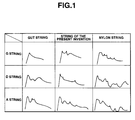
- Fig. 1 shows the envelopes of harmonic tones.
- a suitable vinylidene fluoride resin for use in the present invention are a vinylidene fluoride homopolymer and a copolymer of vinylidene fluoride and at least one other monomer which is copolymerizable with vinylidene fluoride.
- examples of other monomers are fluorine-containing olefins such as vinyl fluoride, ethylene chloride trifluoride, ethylene tetrafluoride and propylene hexafluoride.
- the content of vinylidene fluoride in a vinylidene fluoride copolymer should preferably be not less than 70 mol%, more preferably not less than 80 mol%.
- a vinylidene fluoride resin is usable not only singly but also as a mixture with a nucleating agent such as polyester plasticizers, phthalic acid plasticizers and flavanthrone, or a resin such as polymethylmethacrylate and polyethylacrylate which has a good compatibility with a vinylidene fluoride resin.
- a nucleating agent such as polyester plasticizers, phthalic acid plasticizers and flavanthrone, or a resin such as polymethylmethacrylate and polyethylacrylate which has a good compatibility with a vinylidene fluoride resin.
- Monofilaments which simultaneously possesses the following properties (1) to (6) are preferably used as the monofilaments which constitutes the multifilament used in the present invention:
- the dispersion of diameters may be measured in the following manner.
- a filament of 1 m long is cut at 10 points and the maximum diameter and the minimum diameter of each point are measured by a light microscope.
- the average of the maximum diameters and the average of the minimum diameters are further obtained from the respective measured values.
- a string has an appropriate diameter.
- a multifilament is made of monofilaments each of which has a diameter of 1 to 300 ⁇ m and a twist is made of at least two obtained multifilaments, it is possible to obtain a twist having a diameter required of a string for instruments of the present invention. It is also necessary for the stability of an interval that a string has an appropriate dispersion of diameters.
- monofilaments which satisfy the condition (2) it is possible to produce a core material of a string for instruments of the present invention which can greatly reduce the unevenness and nonuniformity in interval and facilitate tuning.
- the dispersion of diameters is preferably not more than 10%/m.
- the specific gravity is preferably 1.7 to 1.8.
- the specific gravity is a value measured at 20°C by using a gradient tube filled with zinc chloride and distilled water.
- the inherent viscosity (4) and the apparent viscosity (5) are necessary for the production of a core material of a string for instruments of the present invention. If the inherent viscosity is less than 0.85 dl/g, the creep characteristics may be deteriorated so much that it is difficult to produce a core material of a string for instruments which has a satisfactory mechanical strength. On the other hand, if it exceeds 1.6 dl/g, the viscosity becomes so high that it is difficult to produce a core material of a string for instruments. This is the same with the apparent viscosity.
- the inherent viscosity is preferably in the range of 0.85 to 1.1 dl/g.
- the apparent viscosity is preferably in the range of 12000 to 33000 poise.
- the birefringence of a filament has a relationship with a timbre. As the birefringence is larger, the timbre becomes clearer and the string produces a crystal or metallic sound. If the birefringence is less than 30 x 10 ⁇ 3, the sound becomes blurred. On the other hand, if the birefringence exceeds 50 x 10 ⁇ 3, the sound becomes so metallic as to makes the impression of a noisy sound.
- the birefringence is preferably in the range of 35 x 10 ⁇ 3 to 50 x 10 ⁇ 3, more preferably in the range of 40 x 10 ⁇ 3 to 48 x 10 ⁇ 3.
- a multifilament which is composed of 5 to 1000, more preferably 12 to 36 monofilaments and which has a fineness of 100 to 500 d.
- a multifilament is usable as it is, it is preferably to singly twist the multifilament and use as a piled yarn.
- the direction of twist may be either S twisting or Z twisting, and the number of twists may be 0.1 to 10/inch, preferably 0.5 to 3/inch.
- a core material of a string for instruments of the present invention is composed of a twist of at least two multifilaments, which simultaneously possesses the following properties (a) to (e) :
- the diameter (a) of the core material is necessary for the production of the required intervals as a string for instruments.
- the optimum diameter of a string for instruments is slightly different depending upon which tone the string is tuned. For example, in the case of a violin string, the optimum diameter of the A string is about 0.65 mm, that of the D string is about 0.68 mm, and that of the G string is about 0.77 mm.
- the adjustment of the diameter of a string for instruments is conducted by adjusting the thickness and the number of turns of a metal wire in the process of winding the metal wire around a core material, as will be described later. Since a core material of a string for instruments of the present invention has a diameter of 0.1 to 5 mm, as described above, the process of winding a metal wire is facilitated.
- the tensile strength and the elongation of the core material show the mechanical strength thereof.
- the values (b) and (c) are required of a core material which is suitable for a string for instruments.
- the tensile strength is preferably 50 to 100 kg/mm2, more preferably 75 to 85 kg/mm2.
- the elongation is preferably in the range of 10 to 30%.
- the creep elongation is more than 15%, when the core material is tightened, it lengthens with the elapse of time and the string therefore becomes out of tune.
- the creep elongation is preferably in the range of 2 to 6%.
- the Young's modulus influences what is called sound hardness. The larger the Young's modulus is, the sharper and the more crystal the sound becomes. If the Young's modulus is less than 200 kg/mm2, the timbre becomes blurred.
- the Young's modulus is preferably in the range of 400 to 600 kg/mm .
- the Young's modulus is obtained from the gradient of the straight line which combines the points of 0.1% and 3% of the elongation measured with the maximum load.
- a breaking strength of the twist of multifilaments is preferably 3.5 to 6.0 g/d.
- the direction of twist may be either S twisting or Z twisting.
- the multifilaments are twisted in the reverse direction to the direction of twist of the piled yarn and used as a folded and twisted yarn.
- the number of twist is 0.1 to 10/inch, preferably 0.5 to 5/inch.
- a method of producing a core material of a string for instruments of the present invention will now be explained.
- a core material of a string for instruments of the present invention is produced by a known method through a multifilament producing step, a stretching step and a twisting step.
- a vinylidene fluoride resin is melt-extruded from a nozzle in the form of monofilaments, which are treated by a converging agent, and the thus-obtained multifilament is taken up.
- the producing conditions may be selected as occasion demands.
- the nozzle temperature is 230 to 340°C, preferably 245 to 265°C
- the extruder output per hole of the nozzle is 0.005 to 3 g/min., preferably 0.1 to 1 g/min.
- the draft ratio is 1000 to 5000.
- the distance between the nozzle and the converging portion is 0.3 to 3 m, preferably 0.4 to 2 m.
- a stretching apparatus of a Nelson roller system is usable.
- Such a stretching apparatus is mainly composed of first to third rollers, two hot plates disposed between every two rollers, and a spindle.
- the stretch ratio at a first-stage stretch performed between the first and the second rollers is 1 to 5 : 1, preferably 1.1 to 2.0 : 1, and the stretch ratio at a second-stage stretch performed between the second and the third rollers is 0.9 to 2 : 1, preferably 0.95 to 1.2 : 1.
- the temperature of the first hot plate disposed between the first and the second rollers is 160 to 180°C, and the temperature of the second hot plate disposed between the second and the third rollers is 130 to 150°C.
- the take-up rate is 80 to 120 m/min., and the number of revolutions of the spindle is 3000 to 4000 rpm.
- a twister of a Nelson roller system may be used.
- the twisting step at least two spindles which have taken up multifilaments are prepared.
- the multifilaments are twisted in the reverse direction to the direction of twist of the piled yarn and used as a folded and twisted yarn.
- the twist taken up by a spindle is dried with heat, for example, at a temperature of 130 to 150°C for 0.5 to 2 hours for the purpose of twist setting and the obtained product is used as a core material of a string for instruments of the present invention.
- a string for instruments of the present invention is produced by tightly winding a fine metal wire around the above-described core material.
- the step of tightly winding the fine metal wire may be executed in the same way as in the production of a conventional string for instruments.
- a fine flat wire of phosphor bronze is preferably used and the number of turns may be selected as occasion demands.
- the thickness of the fine metal wire may bein the range of 0.05 to 0.1 mm.
- a string for instruments of the present invention is favorably usable as a string for a lower-pitched string of a viola, a cello, a contrabass and a guitar (fourth to sixth strings) as well as a violin.
- a string for instruments of the present invention does not require a long time for tuning, and since it is made of a vinylydene fluoride resin, it is free from problems such as that it becomes out of tune due to a change in humidity, or that it is easily broken.
- the envelope of harmonic tones resembles that of a gut string, which has an excellent timbre.
- the string produces a sound having a large volume and the rise time of a sound is short, it is favorable especially to play a solo, and the sound produced is not greatly influenced by the quality of the instrument or the technical skill of the player.
- a melt-extruder provided with a nozzle having a diameter of 2 mm, a thickness of 20 mm and 24 holes was used, and the pellet composed of a vinylidene fluoride homopolymer having an inherent viscosity of 1.0 dl/g and an apparent viscosity measured at a temperature of 290°C at a shear rate of 1/50 sec was 22000 poise was used.
- a pellet of a vinylidene fluoride homopolymer was melt-extruded under the conditions that the nozzle temperature was 255°C, the extruder output per one hole of the nozzle was 0.42 g/min. and the draft ratio was about 3500.
- the extruded product was then passed through a converging portion (an oil solution was used as a converging agent) disposed directly under the nozzle, and taken up at a take-up rate of 260 m/min. through a guide roll. The distance between the nozzle and the converging portion was 1 m.
- a heat mantle was disposed at the upper portion and an insulating mantle and a shielding equipment were disposed at a lower portion so as to shield the atmosphere from the outside and to insulate heat, thereby preventing the filaments being disturbed from the outside.
- the taken-up multifilament was stretched and single-twisted by a stretching apparatus of a Nelson roller system under the following conditions to obtain a piled yarn.
- the stretch ratio of a first-stage stretch performed between a first roller and a second roller 1.18 times
- the temperature of the first roller 100°C
- the temperature of a first hot plate disposed between the first roller and the second roller 170°C
- the temperature of a second hot plate disposed between the second roller and the third roller 140°C
- the take-up rate 100 m/min.
- the number of revolutions of the spindle 3500 rpm
- the piled yarns (multifilaments) were sampled and the properties thereof were measured. The results are shown in the following.
- the monofilaments constituting the piled yarn were also sampled and the properties thereof were measured. The results are shown in the following.
- Fineness 300 d(24 F)
- Direction of twist S twisting Number of twists: 0.9/inch
- Diameter 32 ⁇ m Dispersion of diameters: not more than 1.5%/m Specific gravity: 1.78 Birefringence: 38 x 10 ⁇ 3
- a core material composed of a folded and twisted yarn of six piled yarns was produced in the same way as in Example 1 except that six piled yarns (fineness of multifilament: 300 d (24 F)) were set in the twister.
- the results of the measurement of the properties of the core material are shown in the following. Diameter: 0.45 mm Elongation: 13%
- Young's modulus 305 kg/mm2
- Each string was set on the same violin, and after tuning, a sound was produced on an open string with a bow (without pressing the string against the fingerboard with a finger).
- the fundamental tone of the A string was 440 Hz, that of the D string was 294 Hz and that of the G string was 196 Hz.
- a microphone was disposed at a distance of 1.5 m from the violin and a recorder (DAT, manufactured by Sony Corporation) was connected to the microphone to record the sounds.
- the frequencies and the like of the recorded sounds were analyzed by an FFT analyzer (CF-350, manufactured by Ono Sokki K.K.). The results were as follows.
Landscapes
- Physics & Mathematics (AREA)
- Engineering & Computer Science (AREA)
- Acoustics & Sound (AREA)
- Multimedia (AREA)
- Stringed Musical Instruments (AREA)
- Yarns And Mechanical Finishing Of Yarns Or Ropes (AREA)
- Package Frames And Binding Bands (AREA)
- Sewing Machines And Sewing (AREA)
- Inks, Pencil-Leads, Or Crayons (AREA)
- Shaping By String And By Release Of Stress In Plastics And The Like (AREA)
- Materials For Medical Uses (AREA)
Applications Claiming Priority (3)
| Application Number | Priority Date | Filing Date | Title |
|---|---|---|---|
| JP47451/93 | 1993-02-12 | ||
| JP04745193A JP3290493B2 (ja) | 1993-02-12 | 1993-02-12 | 楽器用弦の芯材および当該芯材を用いた楽器用弦 |
| JP4745193 | 1993-02-12 |
Publications (3)
| Publication Number | Publication Date |
|---|---|
| EP0611110A2 true EP0611110A2 (de) | 1994-08-17 |
| EP0611110A3 EP0611110A3 (en) | 1996-05-01 |
| EP0611110B1 EP0611110B1 (de) | 2000-04-19 |
Family
ID=12775525
Family Applications (1)
| Application Number | Title | Priority Date | Filing Date |
|---|---|---|---|
| EP94300835A Expired - Lifetime EP0611110B1 (de) | 1993-02-12 | 1994-02-04 | Kernmaterial für Instrumentensaite und Saite für Instrumente unter Verwendung desselben |
Country Status (5)
| Country | Link |
|---|---|
| US (1) | US5427008A (de) |
| EP (1) | EP0611110B1 (de) |
| JP (1) | JP3290493B2 (de) |
| AT (1) | ATE191986T1 (de) |
| DE (1) | DE69423992T2 (de) |
Cited By (2)
| Publication number | Priority date | Publication date | Assignee | Title |
|---|---|---|---|---|
| WO2009039538A1 (de) * | 2007-09-25 | 2009-04-02 | Thomastik-Infeld Gesellschaft M.B.H. | Musiksaite |
| EP2099022A1 (de) * | 2008-03-07 | 2009-09-09 | Thomastik-Infeld Gesellschaft m.b.H. | Musiksaite |
Families Citing this family (7)
| Publication number | Priority date | Publication date | Assignee | Title |
|---|---|---|---|---|
| BE1006614A3 (fr) * | 1993-01-25 | 1994-11-03 | Solvay | Compositions polymeriques destinees a la fabrication de tuyaux pour le transport d'hydrocarbures et articles a base de ces compositions. |
| GB2303730B (en) * | 1995-07-18 | 2000-01-26 | Zyex Limited | Musical instrument strings |
| US5871496A (en) | 1996-03-20 | 1999-02-16 | Cardiothoracic Systems, Inc. | Surgical instrument for facilitating the detachment of an artery and the like |
| US6057498A (en) * | 1999-01-28 | 2000-05-02 | Barney; Jonathan A. | Vibratory string for musical instrument |
| US7589266B2 (en) * | 2006-08-21 | 2009-09-15 | Zuli Holdings, Ltd. | Musical instrument string |
| DE202006020374U1 (de) * | 2006-11-10 | 2008-07-10 | Gustav Pirazzi & Comp. Kg | Musiksaite |
| JP6575676B2 (ja) * | 2016-03-24 | 2019-09-18 | ヤマハ株式会社 | 擦弦楽器用弓 |
Family Cites Families (7)
| Publication number | Priority date | Publication date | Assignee | Title |
|---|---|---|---|---|
| JPS5519107A (en) * | 1978-07-27 | 1980-02-09 | Kureha Chemical Ind Co Ltd | Gut and its preparation |
| DE2914606B2 (de) * | 1979-04-11 | 1981-06-11 | Dynamit Nobel Ag, 5210 Troisdorf | Saite aus Kunststoff, Verfahren zu deren Herstellung und Verwendung einer Saite mit bestimmten Eigenschaften |
| AU7438181A (en) * | 1980-10-03 | 1982-04-08 | Dynamit Nobel Aktiengesellschaft | Plastics cord |
| JPS6028510A (ja) * | 1983-07-23 | 1985-02-13 | Kureha Chem Ind Co Ltd | フツ化ビニリデン系樹脂繊維およびその製造方法 |
| JPS6311996A (ja) * | 1986-03-24 | 1988-01-19 | 呉羽化学工業株式会社 | 楽器用弦 |
| US4833027A (en) * | 1986-03-24 | 1989-05-23 | Kureha Kagaku Kogyo Kabushiki Kaisha | String for a musical instrument |
| AT388462B (de) * | 1988-02-26 | 1989-06-26 | Thomastik & Mitarb | Musiksaite |
-
1993
- 1993-02-12 JP JP04745193A patent/JP3290493B2/ja not_active Expired - Lifetime
-
1994
- 1994-02-01 US US08/189,551 patent/US5427008A/en not_active Expired - Lifetime
- 1994-02-04 DE DE69423992T patent/DE69423992T2/de not_active Expired - Lifetime
- 1994-02-04 EP EP94300835A patent/EP0611110B1/de not_active Expired - Lifetime
- 1994-02-04 AT AT94300835T patent/ATE191986T1/de active
Cited By (3)
| Publication number | Priority date | Publication date | Assignee | Title |
|---|---|---|---|---|
| WO2009039538A1 (de) * | 2007-09-25 | 2009-04-02 | Thomastik-Infeld Gesellschaft M.B.H. | Musiksaite |
| US8283538B2 (en) | 2007-09-25 | 2012-10-09 | Thomastik-Infeld Gesellschaft M.B.H. | String of a musical instrument |
| EP2099022A1 (de) * | 2008-03-07 | 2009-09-09 | Thomastik-Infeld Gesellschaft m.b.H. | Musiksaite |
Also Published As
| Publication number | Publication date |
|---|---|
| US5427008A (en) | 1995-06-27 |
| JPH06242774A (ja) | 1994-09-02 |
| DE69423992T2 (de) | 2000-10-05 |
| JP3290493B2 (ja) | 2002-06-10 |
| ATE191986T1 (de) | 2000-05-15 |
| EP0611110B1 (de) | 2000-04-19 |
| DE69423992D1 (de) | 2000-05-25 |
| EP0611110A3 (en) | 1996-05-01 |
Similar Documents
| Publication | Publication Date | Title |
|---|---|---|
| EP0977170B1 (de) | Verbesserte Saiten für Musikinstrumente | |
| EP0611110B1 (de) | Kernmaterial für Instrumentensaite und Saite für Instrumente unter Verwendung desselben | |
| EP0593762A1 (de) | Saite für musikinstrumente | |
| US5587541A (en) | Musical instrument strings | |
| US4854213A (en) | Music string | |
| US4326444A (en) | Musical instrument string | |
| US2710557A (en) | Musical instrument strings | |
| US4833027A (en) | String for a musical instrument | |
| US4171660A (en) | Bridge or tailpiece for musical instrument | |
| US4395458A (en) | Graphite impregnated polyamide tennis strings | |
| US8283539B2 (en) | Musical instrument string with hyper elliptical wound cover wire | |
| WO2006086305A2 (en) | Method for coating wire for a musical instrument string, and coated string | |
| AT522781A4 (de) | Verfahren zur herstellung einer musiksaite | |
| Mania et al. | Investigation of modal behaviour of resonance spruce wood samples (Picea abies L.) | |
| Rasch et al. | String inharmonicity and piano tuning | |
| US5892166A (en) | Wound strings for musical instrument | |
| JPS6311996A (ja) | 楽器用弦 | |
| US4043555A (en) | Racquet string and method | |
| US4135429A (en) | Piano bass string | |
| US20110174134A1 (en) | Musical instrument string including synthetic spider silk | |
| Firth et al. | Harp Strings of the Eighteenth and Twentieth Centuries: An Acoustical Comparison | |
| Barbieri | Giordano Riccati on the diameters of strings and pipes | |
| ES2991742A1 (es) | Cuerda de instrumento musical y juego de cuerdas y procedimiento de fabricación correspondientes | |
| WO2024260977A1 (de) | Musiksaite | |
| DE3709636A1 (de) | Saite fuer ein musikinstrument |
Legal Events
| Date | Code | Title | Description |
|---|---|---|---|
| PUAI | Public reference made under article 153(3) epc to a published international application that has entered the european phase |
Free format text: ORIGINAL CODE: 0009012 |
|
| 17P | Request for examination filed |
Effective date: 19940214 |
|
| AK | Designated contracting states |
Kind code of ref document: A2 Designated state(s): AT DE FR |
|
| PUAL | Search report despatched |
Free format text: ORIGINAL CODE: 0009013 |
|
| AK | Designated contracting states |
Kind code of ref document: A3 Designated state(s): AT DE FR |
|
| GRAG | Despatch of communication of intention to grant |
Free format text: ORIGINAL CODE: EPIDOS AGRA |
|
| 17Q | First examination report despatched |
Effective date: 19990531 |
|
| GRAG | Despatch of communication of intention to grant |
Free format text: ORIGINAL CODE: EPIDOS AGRA |
|
| GRAG | Despatch of communication of intention to grant |
Free format text: ORIGINAL CODE: EPIDOS AGRA |
|
| GRAH | Despatch of communication of intention to grant a patent |
Free format text: ORIGINAL CODE: EPIDOS IGRA |
|
| GRAH | Despatch of communication of intention to grant a patent |
Free format text: ORIGINAL CODE: EPIDOS IGRA |
|
| GRAA | (expected) grant |
Free format text: ORIGINAL CODE: 0009210 |
|
| AK | Designated contracting states |
Kind code of ref document: B1 Designated state(s): AT DE FR |
|
| REF | Corresponds to: |
Ref document number: 191986 Country of ref document: AT Date of ref document: 20000515 Kind code of ref document: T |
|
| REF | Corresponds to: |
Ref document number: 69423992 Country of ref document: DE Date of ref document: 20000525 |
|
| ET | Fr: translation filed | ||
| PLBE | No opposition filed within time limit |
Free format text: ORIGINAL CODE: 0009261 |
|
| STAA | Information on the status of an ep patent application or granted ep patent |
Free format text: STATUS: NO OPPOSITION FILED WITHIN TIME LIMIT |
|
| 26N | No opposition filed | ||
| REG | Reference to a national code |
Ref country code: FR Ref legal event code: CD Ref country code: FR Ref legal event code: CA |
|
| PGFP | Annual fee paid to national office [announced via postgrant information from national office to epo] |
Ref country code: DE Payment date: 20130131 Year of fee payment: 20 Ref country code: FR Payment date: 20130301 Year of fee payment: 20 |
|
| PGFP | Annual fee paid to national office [announced via postgrant information from national office to epo] |
Ref country code: AT Payment date: 20130110 Year of fee payment: 20 |
|
| REG | Reference to a national code |
Ref country code: DE Ref legal event code: R071 Ref document number: 69423992 Country of ref document: DE |
|
| REG | Reference to a national code |
Ref country code: DE Ref legal event code: R071 Ref document number: 69423992 Country of ref document: DE |
|
| REG | Reference to a national code |
Ref country code: AT Ref legal event code: MK07 Ref document number: 191986 Country of ref document: AT Kind code of ref document: T Effective date: 20140204 |
|
| PG25 | Lapsed in a contracting state [announced via postgrant information from national office to epo] |
Ref country code: DE Free format text: LAPSE BECAUSE OF EXPIRATION OF PROTECTION Effective date: 20140205 |