EP0611183B1 - Verfahren zur Entfernung von Quecksilber aus Kohlenwasserstoffen mittels einem vorgeschwefeltem Katalysator - Google Patents
Verfahren zur Entfernung von Quecksilber aus Kohlenwasserstoffen mittels einem vorgeschwefeltem Katalysator Download PDFInfo
- Publication number
- EP0611183B1 EP0611183B1 EP94400194A EP94400194A EP0611183B1 EP 0611183 B1 EP0611183 B1 EP 0611183B1 EP 94400194 A EP94400194 A EP 94400194A EP 94400194 A EP94400194 A EP 94400194A EP 0611183 B1 EP0611183 B1 EP 0611183B1
- Authority
- EP
- European Patent Office
- Prior art keywords
- catalyst
- process according
- sulphur
- feedstock
- mercury
- Prior art date
- Legal status (The legal status is an assumption and is not a legal conclusion. Google has not performed a legal analysis and makes no representation as to the accuracy of the status listed.)
- Expired - Lifetime
Links
- 239000003054 catalyst Substances 0.000 title claims description 47
- QSHDDOUJBYECFT-UHFFFAOYSA-N mercury Chemical compound [Hg] QSHDDOUJBYECFT-UHFFFAOYSA-N 0.000 title claims description 44
- 229910052753 mercury Inorganic materials 0.000 title claims description 37
- 238000000034 method Methods 0.000 title claims description 33
- 230000008569 process Effects 0.000 title claims description 31
- 229930195733 hydrocarbon Natural products 0.000 title claims description 6
- 150000002430 hydrocarbons Chemical class 0.000 title claims description 6
- NINIDFKCEFEMDL-UHFFFAOYSA-N Sulfur Chemical compound [S] NINIDFKCEFEMDL-UHFFFAOYSA-N 0.000 claims description 42
- 229910052751 metal Inorganic materials 0.000 claims description 19
- 239000002184 metal Substances 0.000 claims description 19
- PXHVJJICTQNCMI-UHFFFAOYSA-N Nickel Chemical compound [Ni] PXHVJJICTQNCMI-UHFFFAOYSA-N 0.000 claims description 18
- 229910052785 arsenic Inorganic materials 0.000 claims description 18
- RQNWIZPPADIBDY-UHFFFAOYSA-N arsenic atom Chemical compound [As] RQNWIZPPADIBDY-UHFFFAOYSA-N 0.000 claims description 18
- KDLHZDBZIXYQEI-UHFFFAOYSA-N Palladium Chemical compound [Pd] KDLHZDBZIXYQEI-UHFFFAOYSA-N 0.000 claims description 16
- 239000001257 hydrogen Substances 0.000 claims description 13
- 229910052739 hydrogen Inorganic materials 0.000 claims description 13
- UFHFLCQGNIYNRP-UHFFFAOYSA-N Hydrogen Chemical compound [H][H] UFHFLCQGNIYNRP-UHFFFAOYSA-N 0.000 claims description 11
- XEEYBQQBJWHFJM-UHFFFAOYSA-N Iron Chemical compound [Fe] XEEYBQQBJWHFJM-UHFFFAOYSA-N 0.000 claims description 10
- 229910052759 nickel Inorganic materials 0.000 claims description 9
- 229910052763 palladium Inorganic materials 0.000 claims description 8
- 239000002243 precursor Substances 0.000 claims description 8
- 150000001875 compounds Chemical class 0.000 claims description 7
- UCKMPCXJQFINFW-UHFFFAOYSA-N Sulphide Chemical compound [S-2] UCKMPCXJQFINFW-UHFFFAOYSA-N 0.000 claims description 6
- 239000003795 chemical substances by application Substances 0.000 claims description 6
- 239000007788 liquid Substances 0.000 claims description 6
- 239000007789 gas Substances 0.000 claims description 5
- 229910052742 iron Inorganic materials 0.000 claims description 5
- 239000000725 suspension Substances 0.000 claims description 5
- OKTJSMMVPCPJKN-UHFFFAOYSA-N Carbon Chemical compound [C] OKTJSMMVPCPJKN-UHFFFAOYSA-N 0.000 claims description 4
- VYPSYNLAJGMNEJ-UHFFFAOYSA-N Silicium dioxide Chemical compound O=[Si]=O VYPSYNLAJGMNEJ-UHFFFAOYSA-N 0.000 claims description 4
- PNEYBMLMFCGWSK-UHFFFAOYSA-N aluminium oxide Inorganic materials [O-2].[O-2].[O-2].[Al+3].[Al+3] PNEYBMLMFCGWSK-UHFFFAOYSA-N 0.000 claims description 4
- 239000003638 chemical reducing agent Substances 0.000 claims description 4
- 229910017052 cobalt Inorganic materials 0.000 claims description 4
- 239000010941 cobalt Substances 0.000 claims description 4
- GUTLYIVDDKVIGB-UHFFFAOYSA-N cobalt atom Chemical compound [Co] GUTLYIVDDKVIGB-UHFFFAOYSA-N 0.000 claims description 4
- ZOKXTWBITQBERF-UHFFFAOYSA-N Molybdenum Chemical compound [Mo] ZOKXTWBITQBERF-UHFFFAOYSA-N 0.000 claims description 3
- 230000003197 catalytic effect Effects 0.000 claims description 3
- 229910052750 molybdenum Inorganic materials 0.000 claims description 3
- 239000011733 molybdenum Substances 0.000 claims description 3
- WFKWXMTUELFFGS-UHFFFAOYSA-N tungsten Chemical compound [W] WFKWXMTUELFFGS-UHFFFAOYSA-N 0.000 claims description 3
- 229910052721 tungsten Inorganic materials 0.000 claims description 3
- 239000010937 tungsten Substances 0.000 claims description 3
- 239000004215 Carbon black (E152) Substances 0.000 claims description 2
- VYZAMTAEIAYCRO-UHFFFAOYSA-N Chromium Chemical compound [Cr] VYZAMTAEIAYCRO-UHFFFAOYSA-N 0.000 claims description 2
- ZGSDJMADBJCNPN-UHFFFAOYSA-N [S-][NH3+] Chemical compound [S-][NH3+] ZGSDJMADBJCNPN-UHFFFAOYSA-N 0.000 claims description 2
- 239000004568 cement Substances 0.000 claims description 2
- 229910052804 chromium Inorganic materials 0.000 claims description 2
- 239000011651 chromium Substances 0.000 claims description 2
- 150000002431 hydrogen Chemical class 0.000 claims description 2
- 239000000377 silicon dioxide Substances 0.000 claims description 2
- XLYOFNOQVPJJNP-UHFFFAOYSA-N water Substances O XLYOFNOQVPJJNP-UHFFFAOYSA-N 0.000 claims description 2
- 239000010457 zeolite Substances 0.000 claims description 2
- 239000005864 Sulphur Substances 0.000 claims 12
- 230000014759 maintenance of location Effects 0.000 claims 3
- 150000002739 metals Chemical class 0.000 claims 3
- 238000005470 impregnation Methods 0.000 claims 2
- 229910000323 aluminium silicate Inorganic materials 0.000 claims 1
- 239000012018 catalyst precursor Substances 0.000 claims 1
- 230000008030 elimination Effects 0.000 claims 1
- 238000003379 elimination reaction Methods 0.000 claims 1
- 229920001021 polysulfide Polymers 0.000 claims 1
- 229910052717 sulfur Inorganic materials 0.000 description 19
- 239000011593 sulfur Substances 0.000 description 19
- 239000000243 solution Substances 0.000 description 7
- 238000009835 boiling Methods 0.000 description 6
- 239000000203 mixture Substances 0.000 description 5
- 239000011148 porous material Substances 0.000 description 5
- 230000009466 transformation Effects 0.000 description 5
- IJGRMHOSHXDMSA-UHFFFAOYSA-N Atomic nitrogen Chemical compound N#N IJGRMHOSHXDMSA-UHFFFAOYSA-N 0.000 description 4
- TZIHFWKZFHZASV-UHFFFAOYSA-N methyl formate Chemical compound COC=O TZIHFWKZFHZASV-UHFFFAOYSA-N 0.000 description 4
- 239000011324 bead Substances 0.000 description 3
- 230000000052 comparative effect Effects 0.000 description 3
- 239000000047 product Substances 0.000 description 3
- 230000009467 reduction Effects 0.000 description 3
- 239000007787 solid Substances 0.000 description 3
- RYGMFSIKBFXOCR-UHFFFAOYSA-N Copper Chemical compound [Cu] RYGMFSIKBFXOCR-UHFFFAOYSA-N 0.000 description 2
- OAKJQQAXSVQMHS-UHFFFAOYSA-N Hydrazine Chemical compound NN OAKJQQAXSVQMHS-UHFFFAOYSA-N 0.000 description 2
- 229910002651 NO3 Inorganic materials 0.000 description 2
- NHNBFGGVMKEFGY-UHFFFAOYSA-N Nitrate Chemical compound [O-][N+]([O-])=O NHNBFGGVMKEFGY-UHFFFAOYSA-N 0.000 description 2
- 229910052802 copper Inorganic materials 0.000 description 2
- 239000010949 copper Substances 0.000 description 2
- 239000010779 crude oil Substances 0.000 description 2
- 238000001514 detection method Methods 0.000 description 2
- 238000001035 drying Methods 0.000 description 2
- BDAGIHXWWSANSR-UHFFFAOYSA-N methanoic acid Natural products OC=O BDAGIHXWWSANSR-UHFFFAOYSA-N 0.000 description 2
- 229910052757 nitrogen Inorganic materials 0.000 description 2
- 238000002360 preparation method Methods 0.000 description 2
- 238000000746 purification Methods 0.000 description 2
- OSWFIVFLDKOXQC-UHFFFAOYSA-N 4-(3-methoxyphenyl)aniline Chemical compound COC1=CC=CC(C=2C=CC(N)=CC=2)=C1 OSWFIVFLDKOXQC-UHFFFAOYSA-N 0.000 description 1
- QPLDLSVMHZLSFG-UHFFFAOYSA-N Copper oxide Chemical compound [Cu]=O QPLDLSVMHZLSFG-UHFFFAOYSA-N 0.000 description 1
- 239000005751 Copper oxide Substances 0.000 description 1
- BQCADISMDOOEFD-UHFFFAOYSA-N Silver Chemical compound [Ag] BQCADISMDOOEFD-UHFFFAOYSA-N 0.000 description 1
- ATJFFYVFTNAWJD-UHFFFAOYSA-N Tin Chemical compound [Sn] ATJFFYVFTNAWJD-UHFFFAOYSA-N 0.000 description 1
- IKHGUXGNUITLKF-XPULMUKRSA-N acetaldehyde Chemical compound [14CH]([14CH3])=O IKHGUXGNUITLKF-XPULMUKRSA-N 0.000 description 1
- 238000001994 activation Methods 0.000 description 1
- 230000004913 activation Effects 0.000 description 1
- AZDRQVAHHNSJOQ-UHFFFAOYSA-N alumane Chemical group [AlH3] AZDRQVAHHNSJOQ-UHFFFAOYSA-N 0.000 description 1
- UYJXRRSPUVSSMN-UHFFFAOYSA-P ammonium sulfide Chemical compound [NH4+].[NH4+].[S-2] UYJXRRSPUVSSMN-UHFFFAOYSA-P 0.000 description 1
- 239000007864 aqueous solution Substances 0.000 description 1
- 230000001174 ascending effect Effects 0.000 description 1
- 230000008901 benefit Effects 0.000 description 1
- 239000006227 byproduct Substances 0.000 description 1
- 238000001816 cooling Methods 0.000 description 1
- 229910000431 copper oxide Inorganic materials 0.000 description 1
- XYUOGBDVXDNPHH-UHFFFAOYSA-N copper trihydrate Chemical compound O.O.O.[Cu] XYUOGBDVXDNPHH-UHFFFAOYSA-N 0.000 description 1
- OMZSGWSJDCOLKM-UHFFFAOYSA-N copper(II) sulfide Chemical compound [S-2].[Cu+2] OMZSGWSJDCOLKM-UHFFFAOYSA-N 0.000 description 1
- 238000003795 desorption Methods 0.000 description 1
- 230000037213 diet Effects 0.000 description 1
- 235000005911 diet Nutrition 0.000 description 1
- 239000002270 dispersing agent Substances 0.000 description 1
- 230000000694 effects Effects 0.000 description 1
- 230000003203 everyday effect Effects 0.000 description 1
- -1 for example Chemical compound 0.000 description 1
- 235000019253 formic acid Nutrition 0.000 description 1
- 238000005194 fractionation Methods 0.000 description 1
- 230000006872 improvement Effects 0.000 description 1
- 229910052500 inorganic mineral Inorganic materials 0.000 description 1
- 229910052945 inorganic sulfide Inorganic materials 0.000 description 1
- 238000009434 installation Methods 0.000 description 1
- 238000012423 maintenance Methods 0.000 description 1
- 238000004519 manufacturing process Methods 0.000 description 1
- 150000002736 metal compounds Chemical class 0.000 description 1
- 229910044991 metal oxide Inorganic materials 0.000 description 1
- 150000004706 metal oxides Chemical class 0.000 description 1
- 229910052976 metal sulfide Inorganic materials 0.000 description 1
- WSFSSNUMVMOOMR-NJFSPNSNSA-N methanone Chemical compound O=[14CH2] WSFSSNUMVMOOMR-NJFSPNSNSA-N 0.000 description 1
- 239000011707 mineral Substances 0.000 description 1
- 235000010755 mineral Nutrition 0.000 description 1
- 229910000480 nickel oxide Inorganic materials 0.000 description 1
- 150000008427 organic disulfides Chemical class 0.000 description 1
- 150000008116 organic polysulfides Chemical class 0.000 description 1
- 125000002524 organometallic group Chemical group 0.000 description 1
- GNRSAWUEBMWBQH-UHFFFAOYSA-N oxonickel Chemical compound [Ni]=O GNRSAWUEBMWBQH-UHFFFAOYSA-N 0.000 description 1
- 239000002574 poison Substances 0.000 description 1
- 231100000614 poison Toxicity 0.000 description 1
- 231100000572 poisoning Toxicity 0.000 description 1
- 230000000607 poisoning effect Effects 0.000 description 1
- JLKDVMWYMMLWTI-UHFFFAOYSA-M potassium iodate Chemical compound [K+].[O-]I(=O)=O JLKDVMWYMMLWTI-UHFFFAOYSA-M 0.000 description 1
- 239000001230 potassium iodate Substances 0.000 description 1
- 229940093930 potassium iodate Drugs 0.000 description 1
- 235000006666 potassium iodate Nutrition 0.000 description 1
- 239000010970 precious metal Substances 0.000 description 1
- 229910052709 silver Inorganic materials 0.000 description 1
- 239000004332 silver Substances 0.000 description 1
- 238000010408 sweeping Methods 0.000 description 1
- 238000007725 thermal activation Methods 0.000 description 1
- 125000000101 thioether group Chemical group 0.000 description 1
- 231100000331 toxic Toxicity 0.000 description 1
- 230000002588 toxic effect Effects 0.000 description 1
- 229910021654 trace metal Inorganic materials 0.000 description 1
- 238000011144 upstream manufacturing Methods 0.000 description 1
Images
Classifications
-
- C—CHEMISTRY; METALLURGY
- C10—PETROLEUM, GAS OR COKE INDUSTRIES; TECHNICAL GASES CONTAINING CARBON MONOXIDE; FUELS; LUBRICANTS; PEAT
- C10G—CRACKING HYDROCARBON OILS; PRODUCTION OF LIQUID HYDROCARBON MIXTURES, e.g. BY DESTRUCTIVE HYDROGENATION, OLIGOMERISATION, POLYMERISATION; RECOVERY OF HYDROCARBON OILS FROM OIL-SHALE, OIL-SAND, OR GASES; REFINING MIXTURES MAINLY CONSISTING OF HYDROCARBONS; REFORMING OF NAPHTHA; MINERAL WAXES
- C10G67/00—Treatment of hydrocarbon oils by at least one hydrotreatment process and at least one process for refining in the absence of hydrogen only
- C10G67/02—Treatment of hydrocarbon oils by at least one hydrotreatment process and at least one process for refining in the absence of hydrogen only plural serial stages only
- C10G67/06—Treatment of hydrocarbon oils by at least one hydrotreatment process and at least one process for refining in the absence of hydrogen only plural serial stages only including a sorption process as the refining step in the absence of hydrogen
-
- B—PERFORMING OPERATIONS; TRANSPORTING
- B01—PHYSICAL OR CHEMICAL PROCESSES OR APPARATUS IN GENERAL
- B01J—CHEMICAL OR PHYSICAL PROCESSES, e.g. CATALYSIS OR COLLOID CHEMISTRY; THEIR RELEVANT APPARATUS
- B01J37/00—Processes, in general, for preparing catalysts; Processes, in general, for activation of catalysts
- B01J37/20—Sulfiding
-
- C—CHEMISTRY; METALLURGY
- C10—PETROLEUM, GAS OR COKE INDUSTRIES; TECHNICAL GASES CONTAINING CARBON MONOXIDE; FUELS; LUBRICANTS; PEAT
- C10G—CRACKING HYDROCARBON OILS; PRODUCTION OF LIQUID HYDROCARBON MIXTURES, e.g. BY DESTRUCTIVE HYDROGENATION, OLIGOMERISATION, POLYMERISATION; RECOVERY OF HYDROCARBON OILS FROM OIL-SHALE, OIL-SAND, OR GASES; REFINING MIXTURES MAINLY CONSISTING OF HYDROCARBONS; REFORMING OF NAPHTHA; MINERAL WAXES
- C10G45/00—Refining of hydrocarbon oils using hydrogen or hydrogen-generating compounds
- C10G45/02—Refining of hydrocarbon oils using hydrogen or hydrogen-generating compounds to eliminate hetero atoms without changing the skeleton of the hydrocarbon involved and without cracking into lower boiling hydrocarbons; Hydrofinishing
- C10G45/04—Refining of hydrocarbon oils using hydrogen or hydrogen-generating compounds to eliminate hetero atoms without changing the skeleton of the hydrocarbon involved and without cracking into lower boiling hydrocarbons; Hydrofinishing characterised by the catalyst used
-
- B—PERFORMING OPERATIONS; TRANSPORTING
- B01—PHYSICAL OR CHEMICAL PROCESSES OR APPARATUS IN GENERAL
- B01J—CHEMICAL OR PHYSICAL PROCESSES, e.g. CATALYSIS OR COLLOID CHEMISTRY; THEIR RELEVANT APPARATUS
- B01J23/00—Catalysts comprising metals or metal oxides or hydroxides, not provided for in group B01J21/00
- B01J23/16—Catalysts comprising metals or metal oxides or hydroxides, not provided for in group B01J21/00 of arsenic, antimony, bismuth, vanadium, niobium, tantalum, polonium, chromium, molybdenum, tungsten, manganese, technetium or rhenium
- B01J23/24—Chromium, molybdenum or tungsten
-
- B—PERFORMING OPERATIONS; TRANSPORTING
- B01—PHYSICAL OR CHEMICAL PROCESSES OR APPARATUS IN GENERAL
- B01J—CHEMICAL OR PHYSICAL PROCESSES, e.g. CATALYSIS OR COLLOID CHEMISTRY; THEIR RELEVANT APPARATUS
- B01J23/00—Catalysts comprising metals or metal oxides or hydroxides, not provided for in group B01J21/00
- B01J23/38—Catalysts comprising metals or metal oxides or hydroxides, not provided for in group B01J21/00 of noble metals
- B01J23/40—Catalysts comprising metals or metal oxides or hydroxides, not provided for in group B01J21/00 of noble metals of the platinum group metals
- B01J23/44—Palladium
-
- B—PERFORMING OPERATIONS; TRANSPORTING
- B01—PHYSICAL OR CHEMICAL PROCESSES OR APPARATUS IN GENERAL
- B01J—CHEMICAL OR PHYSICAL PROCESSES, e.g. CATALYSIS OR COLLOID CHEMISTRY; THEIR RELEVANT APPARATUS
- B01J23/00—Catalysts comprising metals or metal oxides or hydroxides, not provided for in group B01J21/00
- B01J23/70—Catalysts comprising metals or metal oxides or hydroxides, not provided for in group B01J21/00 of the iron group metals or copper
- B01J23/74—Iron group metals
Definitions
- the present invention relates to the removal of mercury and possibly arsenic in hydrocarbons with a catalyst for transformation of compounds containing mercury to elemental mercury and a mass of capture of the mercury, said process allowing the capture of mercury with very high efficiency from the initial start-up period of the process.
- liquid condensates byproducts of gas production
- crude oils may contain many trace metal compounds and often in the form of organometallic complexes. These compounds metallic are very often poisons of catalysts used during the transformation of these cuts into products commercial.
- Mercury is particularly toxic to the activity of precious metals and more is a powerful corrosive against aluminum parts, seals and welds.
- Applicant's processes present good performances for the demercurization of liquid hydrocarbons serving as charges for various treatment processes.
- the Applicant's US Patent 4,911,825 clearly shows the advantage of capturing mercury in a process in two stages where the first stage consists in putting in contact the charge in the presence of hydrogen with a catalyst containing at least one metal from the group consisting of nickel, cobalt, iron and palladium.
- Mercury is not (or very little) captured by the catalyst but is captured, in the second step, by a mass containing sulfur or a metal sulfide, this metal possibly copper, iron, silver.
- Applicant's patent WO-90/10684 describes a process for removing mercury from hydrocarbons liquids.
- This invention relates to catalysts having the property of resisting sulfur poisoning (thioresistance). These new catalysts allow the mercury capture under conditions too severe for catalysts described in the prior art.
- This process is particularly useful for the purification of difficult loads such as, for example, diesel from a crude oil fractionation in which the content of sulfur is often between 0.4 and 1.0% by weight.
- mercury capture efficiency at the start of implementation of the demercurization process is weak in the first hundreds of hours of diet then increases. He was also discovered that the efficiency of mercury capture is less good for very low sulfur loads, for example less than 0.02% wt. In the latter case, it is necessary to increase the operating temperature of the reactor of several tens of degrees and / or the flow of hydrogen to allow sufficient capture of mercury.
- the present invention proposes to remedy these disadvantages.
- the object of the present invention is a method removal of mercury and possibly arsenic in which the catalyst for transformation of compounds containing mercury to elemental mercury is pretreated before being put in contact with the hydrocarbon charge to be purified.
- a mixture of the charge with hydrogen is brought into contact with a presulfurized catalyst containing at least one metal of the group formed by iron, nickel, cobalt, chromium, molybdenum, tungsten and palladium or at least 5% of the metal is in the state of sulfide and in general at most 50%, then the product obtained is brought into contact with a collection mass of elemental mercury containing sulfur or a sulfide of metal.
- the catalyst used in the composition of this invention consists of at least one metal M chosen from the group formed by iron, nickel, cobalt, molybdenum, tungsten and palladium and a support.
- Metal M must be find in sulfide form for at least 5% by weight of its all and at most, in general, 50%.
- the nickel or the association of nickel with palladium Preferably the nickel or the association of nickel with palladium.
- the solid mineral dispersant (support) can be chosen from the group formed by alumina, silica-aluminas, silica, zeolites, activated carbon, clays and aluminous cements. It will preferably have a large surface, a sufficient pore volume and an adequate average pore diameter.
- the BET surface should be greater than 50 m 2 / g and preferably between about 100 and 350 m 2 / g.
- the preparation of a solid (or catalytic precursor) containing at least one metal M in metallic form or in the form of supported metal oxide is sufficiently known to those skilled in the art not to be described in the context of the present invention.
- the content of metal M (calculated as oxide) in the catalyst is preferably at least 5% by weight and at most 60% by weight, and even more advantageously at most 40%, or even 30%.
- the case of palladium is particular, we can have at most 0.2% by weight of palladium (calculated as metal).
- the addition of sulfur can be done, off site, by impregnating the catalytic precursor either by ammonium sulphide and / or a colloidal suspension of sulfur in water either by an agent sulfur, i.e. sulfur and / or one or more compounds sulfur, in an organic solution.
- a reducing agent is by example, formaldehyde, acetaldehyde, hydrazine, methyl formate, formic acid, etc.
- the catalyst Before being brought into contact with the load to be treated, the catalyst is, if necessary, reduced by hydrogen or by a gas containing hydrogen at a temperature of 120 to 600 ° C and preferably from 140 to 400 ° C.
- the solid thus prepared, presulfurized then reduced constitutes the catalyst in its active form of the present invention.
- the mass of mercury capture that follows the catalyst in the process of the invention should have low solubility in the load to be treated and a strong affinity for mercury elementary.
- the assembly constituted by the catalyst and the mass of mercury capture can be implemented either in two reactors either in one.
- the catalyst and capture mass are arranged in two beds separated. In both configurations the collection mass is found after the catalyst.
- the report volume of catalyst at capture mass may vary between 1:10 and 5: 1.
- operating in a temperature range can range from 120 to 250 ° C, more preferably from 130 to 200 ° C or 130-200 ° C, preferably 140-190 ° C and even more preferably from 140 to 190 ° C.
- the pressures operating temperatures are preferably chosen from 1 to 40 bars and more advantageously from 5 to 35 bars.
- the mercury capture mass works below 220 ° C, more preferably below 180 ° C and more preferably below 150 ° C.
- the speeds spatial calculated with respect to the capture mass can be from 1 to 50 h-1 and more particularly from 1 to 30 h-1 (volume of liquid per volume of mass per hour).
- the hydrogen flow rate reported to the catalyst is understood by example between 1 and 500 volumes (gas under normal conditions) by volume of catalyst per hour.
- the gaseous or liquid charges to which the invention more particularly applies contain from 10 -3 to 5 milligrams of mercury per kilogram of charge (mg / kg or ppm) and possibly from 0 to 1000 milligrams of sulfur per kilogram of charge. They can also contain arsenic, generally from 0 to 5 mg / kg of load.
- Catalyst A Fifteen kilograms of a macroporous alumina support in the form of beads of 5 ⁇ 10 -3 mm in diameter and having a specific surface of 160 m 2 / g, a total pore volume of 1.05 cm 3 / g and a macroporous volume (diameter> 0.1 ⁇ m) of 0.4 cm 3 / g are impregnated with 20% by weight of nickel in the form of an aqueous nitrate solution. After drying at 120 ° C for 5 h and thermal activation at 450 ° C for 2 h under air sweep, beads containing 25.4% by weight of nickel oxide are obtained.
- Catalyst B Five kilograms of catalyst A are impregnated to dryness with a solution containing 175 g of DEODS diethanoldisulphide (including 74 g of sulfur) in 5150 cm 3 of a solution of methyl formate 15% in a white spirit. The catalyst thus prepared is activated at 150 ° C for 1 h.
- Capture mass Fifteen kilograms of the support used for the preparation of catalyst A are impregnated with 10% in weight of copper in the form of an aqueous solution of nitrate of copper trihydrate. After drying at 120 ° C for 5 h and activation thermal at 450 ° C for 2 h under air sweeping, beads containing 12.5% by weight of copper oxide. These marbles are then impregnated with a solution of 10% by weight of ammonium sulfide. The product is activated at 120 ° C for 2 h under a stream of nitrogen. This mass was used in the reactor II for all the examples below.
- the tests are carried out with two reactors in series: a reactor I in which the catalyst is placed (50 cm 3 ) and a reactor II, after reactor I, in which the capture mass (50 cm 3 ) is placed.
- the catalyst works in all the examples below at 180 ° C and the mass of mercury capture at 20 ° C.
- the flow is ascending in the two reactors.
- Catalyst A in reactor I was reduced to 400 ° C under a flow rate of 20 l / h of hydrogen at 2 bar of pressure for 4 h. Then, the reactor was cooled to the reaction temperature 180 ° C. A heavy condensate of liquefied gas with hydrogen is then passed over the catalyst and then over the collection mass. The charge flow rate is 400 cm 3 / h and that of hydrogen 3.5 l / h. The test is carried out under a pressure of 35 bars.
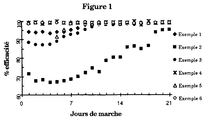
- the test was conducted for a period of 20.5 days. A process effluent sample was collected and analyzed every day. Capture results expressed in percent of efficiency are shown in Figure 1. Note that the efficiency uptake is high, however in the first two hundred hours of operation, the capture efficiency is slightly higher weak than at the end of the test. A small amount of arsenic (5 to 10 ⁇ g / kg) was detected during the first 72 hours.
- the first reactor was charged with 50 cm 3 of catalyst B, presulfurized as described above. All the other test conditions are identical to those indicated in Example 1 including the charge (condensate A).
- the results obtained in the presence of catalyst B showed a high capture efficiency from the start of the test and the maintenance of this efficiency throughout the duration of the test.
- the arsenic content remains below the detection limit ( ⁇ g / kg) throughout the test.
- Example 4 the first reactor was charged with 50 cm 3 of catalyst B. This time, the catalyst was reduced to 300 ° C. at a flow rate of 20 l / h of hydrogen at 2 bars of pressure for 6 h before cooling it to reaction temperature 180 ° C. Condensate B was used as the charge to be purified. The other operating conditions are the same as those of Example 1. The results of this test clearly show a marked improvement in the performance of the mercury capture according to the invention.
Landscapes
- Chemical & Material Sciences (AREA)
- Oil, Petroleum & Natural Gas (AREA)
- Engineering & Computer Science (AREA)
- Chemical Kinetics & Catalysis (AREA)
- Organic Chemistry (AREA)
- General Chemical & Material Sciences (AREA)
- Materials Engineering (AREA)
- Catalysts (AREA)
- Production Of Liquid Hydrocarbon Mixture For Refining Petroleum (AREA)
- Solid-Sorbent Or Filter-Aiding Compositions (AREA)
Claims (13)
- Verfahren zur Entfernung des Quecksilbers und ggf. Arsens aus einer kohlenwasserstoffhaltigen 0 bis 1000 mg Schwefel/kg umfassenden kohlenwasserstoffhaltigen Charge, bei dem die Charge in Anwesenheit von Wasserstoff mit einem Katalysator kontaktiert wird, der wenigstens ein Metall und einen Träger umfaßt, wonach das erhaltene Produkt mit einer Quecksilbereinfangmasse kontaktiert wird, die Schwefel oder ein metallisches Sulfid umfaßt, dadurch gekennzeichnet, daß der vorgeschwefelte Katalysator wenigstens ein Metall umfaßt, das aus der durch Eisen, Nickel, Kobalt, Molybdän, Wolfram, Chrom und Palladium gebildeten Gruppe gewählt ist, wobei wenigstens 5 Gew.-% dieses oder dieser Metalle im Sulfidzustand verbunden sind, daß der Katalysator in einer ersten Stufe durch Imprägnieren des Katalysatorvorläufers erhalten wird, welcher dieses oder diese Metalle auf dem Träger in metallischer und/oder oxidischer Form umfaßt, und zwar mit Hilfe einer wässrigen organischen Lösung oder einer wässrigen oder organischen Suspension, die einerseits wenigstens ein Reduktionsmittel und andererseits wenigstens ein sulfidisches Mittel umschließt, das gewählt ist aus der Gruppe, die gebildet wird durchwobei dieser imprägnierte Vorläufer dann in einer zweiten Stufe, thermisch behandelt wird,wenigstens ein organisches Polysulfid, ggf. im Gemisch mit elementarem Schwefel,wenigstens ein organisches Disulfid, ggf. im Gemisch mit elementarem Schwefel,wenigstens ein organisches Sulfid oder Mineral, ggf. im Gemisch mit elementarem Schwefel, undelementarem Schwefel,
und daß die Kontaktierung mit dem Katalysator bei einer Temperatur von 120 bis 250°C und einen Druck von 1 bis 40 Bar stattfindet und die Kontaktierung mit der Einfangmasse bei einer Temperatur unterhalb 220°C und einer Raumgeschwindigkeit von 1 bis 50h-1 stattfindet. - Verfahren nach Anspruch 1, dadurch gekennzeichnet, daß die Wasserstoffmenge bezogen auf den Katalysator zwischen 1 und 500 Volumenteilen Gas pro Volumenteilenkatalysator und Stunde umfaßt.
- Verfahren nach einem der vorhergehenden Ansprüche, dadurch gekennzeichnet, daß die Charge 0 bis 5 mg Arsen pro kg Charge umschließt.
- Verfahren nach einem der vorhergehenden Ansprüche, dadurch gekennzeichnet, daß das Volumenverhältnis des Katalysators zur Einfangmasse zwischen 1:10 und 5:1 liegt.
- Verfahren nach einem der vorhergehenden Ansprüche, dadurch gekennzeichnet, daß das Metall des Katalysators Nickel ist.
- Verfahren nach einem der vorhergehenden Ansprüche, dadurch gekennzeichnet, daß die Metalle des Katalysators Nickel und Palladium sind.
- Verfahren nach einem der vorhergehenden Ansprüche, dadurch gekennzeichnet, daß der Träger gewählt ist aus der Gruppe, die gebildet wird durch Aluminiumoxid, die Siliziumoxide-Aluminiumoxide, Siliziumoxide, die Zeolithe, Aktivkohlen, Tone und aluminiumoxidhaltige Zemente.
- Verfahren nach einem der vorhergehenden Ansprüche, dadurch gekennzeichnet, daß der Sulfidzustand erhalten wird durch Imprägnieren außerhalb des Reaktors des katalytischen Vorläufers mit Hilfe wenigstens einer Schwefel enthaltenden Flüssigkeit, die gewählt ist aus der Gruppe, die gebildet wird durch Ammoniumsulfid, eine kolloidale Suspension von Schwefel in Wasser, eine organische Schwefellösung, eine organische Lösung schwefelhaltiger Verbindunge(n).
- Verfahren nach einem der vorhergehenden Ansprüche, dadurch gekennzeichnet, daß die Charge 10-3 bis 5 mg Arsen pro kg Charge umschließt.
- Verfahren nach einem der vorhergehenden Ansprüche, dadurch gekennzeichnet, daß die Charge mit dem Katalysator bei einer Temperatur von 130-200°C kontaktiert wird.
- Verfahren nach einem der vorhergehenden Ansprüche, dadurch gekennzeichnet, daß der erhaltene Vorläufer unter Wasserstoff bei 120-600°C reduziert wird, bevor er mit der Charge kontaktiert wird.
- Verfahren nach einem der vorhergehenden Ansprüche, dadurch gekennzeichnet, daß der Vorläufer thermisch zwischen 100 und 200°C in der zweiten Stufe behandelt wird.
- Verfahren nach einem der vorhergehenden Ansprüche, dadurch gekennzeichnet, daß höchstens 50 Gew.-% dieses Metalls oder dieser Metalle des Katalysators im Sulfidzustand verbunden werden.
Applications Claiming Priority (2)
| Application Number | Priority Date | Filing Date | Title |
|---|---|---|---|
| FR9301443 | 1993-02-08 | ||
| FR9301443A FR2701270B1 (fr) | 1993-02-08 | 1993-02-08 | Procédé d'élimination du mercure dans les hydrocarbures par passage sur un catalyseur présulfuré. |
Publications (2)
| Publication Number | Publication Date |
|---|---|
| EP0611183A1 EP0611183A1 (de) | 1994-08-17 |
| EP0611183B1 true EP0611183B1 (de) | 1998-07-22 |
Family
ID=9443892
Family Applications (1)
| Application Number | Title | Priority Date | Filing Date |
|---|---|---|---|
| EP94400194A Expired - Lifetime EP0611183B1 (de) | 1993-02-08 | 1994-01-28 | Verfahren zur Entfernung von Quecksilber aus Kohlenwasserstoffen mittels einem vorgeschwefeltem Katalysator |
Country Status (7)
| Country | Link |
|---|---|
| US (1) | US5601701A (de) |
| EP (1) | EP0611183B1 (de) |
| JP (1) | JP3486757B2 (de) |
| KR (1) | KR100284222B1 (de) |
| DE (1) | DE69411775T2 (de) |
| FR (1) | FR2701270B1 (de) |
| MY (1) | MY110136A (de) |
Families Citing this family (30)
| Publication number | Priority date | Publication date | Assignee | Title |
|---|---|---|---|---|
| US6350372B1 (en) | 1999-05-17 | 2002-02-26 | Mobil Oil Corporation | Mercury removal in petroleum crude using H2S/C |
| FR2803597B1 (fr) * | 2000-01-07 | 2003-09-05 | Inst Francais Du Petrole | Procede de captation du mercure et d'arsenic d'une coupe d'hydrocarbures distillee |
| GB2365874B (en) * | 2000-06-29 | 2004-12-08 | Wcp Internat Ltd | Purifying hydrocarbons |
| WO2005042130A1 (en) * | 2003-10-31 | 2005-05-12 | Metal Alloy Reclaimers, Inc Ii | Process for reduction of inorganic contaminants from waste streams |
| US20100098602A1 (en) * | 2003-12-19 | 2010-04-22 | Opinder Kishan Bhan | Systems, methods, and catalysts for producing a crude product |
| US20070000808A1 (en) * | 2003-12-19 | 2007-01-04 | Bhan Opinder K | Method and catalyst for producing a crude product having selected properties |
| US7591941B2 (en) * | 2003-12-19 | 2009-09-22 | Shell Oil Company | Systems, methods, and catalysts for producing a crude product |
| US20070000810A1 (en) * | 2003-12-19 | 2007-01-04 | Bhan Opinder K | Method for producing a crude product with reduced tan |
| US7745369B2 (en) * | 2003-12-19 | 2010-06-29 | Shell Oil Company | Method and catalyst for producing a crude product with minimal hydrogen uptake |
| TWI415930B (zh) * | 2005-04-06 | 2013-11-21 | Shell Int Research | 減少液態含烴原料總酸值(tan)的方法 |
| JP2008535999A (ja) * | 2005-04-11 | 2008-09-04 | シエル・インターナシヨネイル・リサーチ・マーチヤツピイ・ベー・ウイ | 原油生成物を製造するためのシステム、方法及び触媒 |
| BRPI0609416A2 (pt) * | 2005-04-11 | 2011-10-11 | Shell Int Research | método para produzir um produto bruto |
| US20060231457A1 (en) * | 2005-04-11 | 2006-10-19 | Bhan Opinder K | Systems, methods, and catalysts for producing a crude product |
| US7918992B2 (en) | 2005-04-11 | 2011-04-05 | Shell Oil Company | Systems, methods, and catalysts for producing a crude product |
| JP5192653B2 (ja) * | 2006-03-31 | 2013-05-08 | 日本インスツルメンツ株式会社 | 水銀還元用触媒、水銀変換ユニットおよびこれを用いた排気ガス中の全水銀測定装置 |
| GB0611316D0 (en) * | 2006-06-09 | 2006-07-19 | Johnson Matthey Plc | Improvements in the removal of metals from fluid streams |
| WO2007149923A2 (en) * | 2006-06-22 | 2007-12-27 | Shell Oil Company | Method for producing a crude product with a long-life catalyst |
| US20080083655A1 (en) * | 2006-10-06 | 2008-04-10 | Bhan Opinder K | Methods of producing a crude product |
| US8741243B2 (en) * | 2007-05-14 | 2014-06-03 | Corning Incorporated | Sorbent bodies comprising activated carbon, processes for making them, and their use |
| US7998898B2 (en) * | 2007-10-26 | 2011-08-16 | Corning Incorporated | Sorbent comprising activated carbon, process for making same and use thereof |
| JP5291092B2 (ja) * | 2007-05-14 | 2013-09-18 | コーニング インコーポレイテッド | 活性炭を含む吸着体、それらの製造方法および利用 |
| JP2010537805A (ja) * | 2007-08-29 | 2010-12-09 | コーニング インコーポレイテッド | 流体流から毒性金属を除去するプロセス |
| CN101970614A (zh) * | 2008-03-10 | 2011-02-09 | 巴斯夫欧洲公司 | 从烃料流中脱除汞的方法 |
| US8124213B2 (en) * | 2008-05-30 | 2012-02-28 | Corning Incorporated | Flow-through sorbent comprising a metal sulfide |
| US20090297885A1 (en) * | 2008-05-30 | 2009-12-03 | Kishor Purushottam Gadkaree | Composite Comprising An Inorganic Substrate With A Coating Comprising Activated Carbon And Metal Sulfide |
| US8691722B2 (en) * | 2008-07-03 | 2014-04-08 | Corning Incorporated | Sorbent comprising activated carbon particles, sulfur and metal catalyst |
| US7901486B2 (en) * | 2008-10-02 | 2011-03-08 | Conocophillips Company | Removal of heavy metals from hydrocarbon gases |
| EP2451571A4 (de) | 2009-07-06 | 2016-11-16 | Mar Systems Inc | Mittel zur entfernung von kontaminanzien aus fluidströmen sowie herstellungs- und verwendungsverfahren dafür |
| KR101796792B1 (ko) * | 2011-02-09 | 2017-11-13 | 에스케이이노베이션 주식회사 | 촉매를 이용하여 수소화 처리 반응을 통해 황 및 수은이 포함된 탄화수소 원료로부터 이들을 동시에 제거하는 방법 |
| US9023196B2 (en) | 2013-03-14 | 2015-05-05 | Chevron U.S.A. Inc. | Process, method, and system for removing heavy metals from fluids |
Family Cites Families (10)
| Publication number | Priority date | Publication date | Assignee | Title |
|---|---|---|---|---|
| US4046674A (en) * | 1976-06-25 | 1977-09-06 | Union Oil Company Of California | Process for removing arsenic from hydrocarbons |
| US4338288A (en) * | 1978-09-14 | 1982-07-06 | Mobil Oil Corporation | Sorbent for removing metals from fluids |
| US4709118A (en) * | 1986-09-24 | 1987-11-24 | Mobil Oil Corporation | Removal of mercury from natural gas and liquid hydrocarbons utilizing downstream guard chabmer |
| US5053209A (en) * | 1988-01-09 | 1991-10-01 | Mobil Oil Corporation | Removal of mercury from natural gas and liquid hydrocarbons utilizing silver on alumina adsorbent |
| FR2628338B1 (fr) * | 1988-03-10 | 1991-01-04 | Inst Francais Du Petrole | Procede pour l'elimination du mercure dans les hydrocarbures |
| EP0357873B1 (de) * | 1988-08-10 | 1992-08-26 | Jgc Corporation | Verfahren zum Entfernen von Quecksilber aus Kohlenwasserstoffen |
| FR2644472B1 (fr) * | 1989-03-16 | 1991-06-21 | Inst Francais Du Petrole | Procede pour l'elimination du mercure et eventuellement d'arsenic dans les hydrocarbures |
| US5401392A (en) * | 1989-03-16 | 1995-03-28 | Institut Francais Du Petrole | Process for eliminating mercury and possibly arsenic in hydrocarbons |
| US5202301A (en) * | 1989-11-22 | 1993-04-13 | Calgon Carbon Corporation | Product/process/application for removal of mercury from liquid hydrocarbon |
| FR2664507B1 (fr) * | 1990-07-13 | 1995-04-14 | Eurecat Europ Retrait Catalys | Procede de pretraitement d'un catalyseur par un melange d'un agent soufre et d'un agent reducteur organique. |
-
1993
- 1993-02-08 FR FR9301443A patent/FR2701270B1/fr not_active Expired - Lifetime
-
1994
- 1994-01-28 EP EP94400194A patent/EP0611183B1/de not_active Expired - Lifetime
- 1994-01-28 DE DE69411775T patent/DE69411775T2/de not_active Expired - Lifetime
- 1994-02-08 US US08/193,590 patent/US5601701A/en not_active Expired - Lifetime
- 1994-02-08 MY MYPI94000285A patent/MY110136A/en unknown
- 1994-02-08 KR KR1019940002379A patent/KR100284222B1/ko not_active Expired - Lifetime
- 1994-02-08 JP JP01458694A patent/JP3486757B2/ja not_active Expired - Lifetime
Also Published As
| Publication number | Publication date |
|---|---|
| KR100284222B1 (ko) | 2001-05-02 |
| US5601701A (en) | 1997-02-11 |
| DE69411775T2 (de) | 1998-12-03 |
| FR2701270B1 (fr) | 1995-04-14 |
| EP0611183A1 (de) | 1994-08-17 |
| MY110136A (en) | 1998-02-28 |
| KR940019838A (ko) | 1994-09-15 |
| JPH06256773A (ja) | 1994-09-13 |
| DE69411775D1 (de) | 1998-08-27 |
| FR2701270A1 (fr) | 1994-08-12 |
| JP3486757B2 (ja) | 2004-01-13 |
Similar Documents
| Publication | Publication Date | Title |
|---|---|---|
| EP0611183B1 (de) | Verfahren zur Entfernung von Quecksilber aus Kohlenwasserstoffen mittels einem vorgeschwefeltem Katalysator | |
| EP1923452B1 (de) | Verfahren zur Tiefenentschwefelung von Krack-Benzinstoffen mit einem geringen Oktanzahlverlust | |
| EP0332526B1 (de) | Verfahren zur Entfernung von Quecksilber und möglichem Arsen aus Kohlenwasserstoffen | |
| EP0484234B1 (de) | Verfahren zur Beseitigung von Quecksilber und eventuell vorhandenem Arsen aus einem Fluidum in Gegenwart einer Absorptionsmasse für Quecksilber und Arsen | |
| EP0463044B1 (de) | Verfahren zur entfernung von quecksilber und gegebenenfalls arsen aus kohlenwasserstoffen | |
| FR2668388A1 (fr) | Procede de preparation d'une masse solide de captation de mercure. | |
| EP0570261B1 (de) | Verfahren zur Beseitigung von Quecksilber und Arsen aus einem Kohlenwasserstoffschnitt | |
| EP0599702B1 (de) | Verfahren zur Entfernung von Quecksilber und möglichen Arsen aus Kohlenwasserstoffen | |
| EP0611182B1 (de) | Verfahren zur Entfernung von Arsen aus Kohlenwasserstoffen mittels einem vorgeschwefeltem Absorbens | |
| EP1495795B1 (de) | Verfahren zur Entfernung von Schwefelverbindungen aus einem Gas durch Direktoxidation | |
| BE1012739A3 (fr) | Masse d'elimination d'arsenic et de mercure dans des hydrocarbures a base de nickel supporte. | |
| FR2673191A1 (fr) | Procede d'enlevement de mercure et/ou d'arsenic des charges des unites de desaromatisation de solvants. . | |
| FR2762004A1 (fr) | Procede pour l'elimination d'arsenic dans les charges hydrocarbonees liquides | |
| EP0169828B1 (de) | Verfahren zur Abtrennung von Carbonylsulfid aus flüssigen olefinischen Kohlenwasserstoffströmen | |
| FR2659977A1 (fr) | Procede pour enlever l'hydrure d'antimoine de charges d'hydrocarbures liquides. | |
| FR3130636A1 (fr) | Procede de rejuvenation de masses de captation de metaux lourds | |
| FR3130635A1 (fr) | Procede de captation de metaux lourds par co-alimentation d’un flux sulfurant | |
| FR2512830A1 (fr) | Procede d'adoucissement d'hydrocarbures | |
| BE905986R (fr) | Procede pour enlever le sulfure de carbonyle des charges d'hydrocarbures liquides. | |
| FR2808532A1 (fr) | Procede de captation de mercure et d'arsenic comprenant une evaporation puis une condensation de la charge hydrocarbonnee | |
| WO2013050668A1 (fr) | Mise en forme de masses de captation pour la purification d'une charge gaz ou liquide contenant des métaux lourds | |
| FR2806092A1 (fr) | Procede d'elimination d'arsenic en presence d'une masse d'absorption comprenant de l'oxyde de plomb partiellement presulfure | |
| FR2788452A1 (fr) | Masse de captation pour l'elimination d'arsenic dans les hydrocarbures | |
| FR2673192A1 (fr) | Procede pour l'elimination du mercure et eventuellement d'arsenic dans les charges des procedes catalytiques producteurs d'aromatiques. . | |
| LU85308A1 (fr) | Procede pour enlever le sulfure de carbonyle des charges d'hydrocarbures liquides |
Legal Events
| Date | Code | Title | Description |
|---|---|---|---|
| PUAI | Public reference made under article 153(3) epc to a published international application that has entered the european phase |
Free format text: ORIGINAL CODE: 0009012 |
|
| AK | Designated contracting states |
Kind code of ref document: A1 Designated state(s): DE FR GB NL |
|
| 17P | Request for examination filed |
Effective date: 19950217 |
|
| 17Q | First examination report despatched |
Effective date: 19961227 |
|
| GRAG | Despatch of communication of intention to grant |
Free format text: ORIGINAL CODE: EPIDOS AGRA |
|
| GRAG | Despatch of communication of intention to grant |
Free format text: ORIGINAL CODE: EPIDOS AGRA |
|
| GRAG | Despatch of communication of intention to grant |
Free format text: ORIGINAL CODE: EPIDOS AGRA |
|
| GRAH | Despatch of communication of intention to grant a patent |
Free format text: ORIGINAL CODE: EPIDOS IGRA |
|
| GRAH | Despatch of communication of intention to grant a patent |
Free format text: ORIGINAL CODE: EPIDOS IGRA |
|
| GRAA | (expected) grant |
Free format text: ORIGINAL CODE: 0009210 |
|
| AK | Designated contracting states |
Kind code of ref document: B1 Designated state(s): DE FR GB NL |
|
| GBT | Gb: translation of ep patent filed (gb section 77(6)(a)/1977) |
Effective date: 19980803 |
|
| REF | Corresponds to: |
Ref document number: 69411775 Country of ref document: DE Date of ref document: 19980827 |
|
| PLBE | No opposition filed within time limit |
Free format text: ORIGINAL CODE: 0009261 |
|
| STAA | Information on the status of an ep patent application or granted ep patent |
Free format text: STATUS: NO OPPOSITION FILED WITHIN TIME LIMIT |
|
| 26N | No opposition filed | ||
| PGFP | Annual fee paid to national office [announced via postgrant information from national office to epo] |
Ref country code: GB Payment date: 20001227 Year of fee payment: 8 |
|
| REG | Reference to a national code |
Ref country code: GB Ref legal event code: IF02 |
|
| PG25 | Lapsed in a contracting state [announced via postgrant information from national office to epo] |
Ref country code: GB Free format text: LAPSE BECAUSE OF NON-PAYMENT OF DUE FEES Effective date: 20020128 |
|
| GBPC | Gb: european patent ceased through non-payment of renewal fee |
Effective date: 20020128 |
|
| REG | Reference to a national code |
Ref country code: FR Ref legal event code: CD |
|
| REG | Reference to a national code |
Ref country code: DE Ref legal event code: R081 Ref document number: 69411775 Country of ref document: DE Owner name: IFP ENERGIES NOUVELLES, FR Free format text: FORMER OWNER: INSTITUT FRANCAIS DU PETROLE, RUEIL-MALMAISON, FR Effective date: 20110331 |
|
| PGFP | Annual fee paid to national office [announced via postgrant information from national office to epo] |
Ref country code: DE Payment date: 20130304 Year of fee payment: 20 Ref country code: FR Payment date: 20130222 Year of fee payment: 20 |
|
| PGFP | Annual fee paid to national office [announced via postgrant information from national office to epo] |
Ref country code: NL Payment date: 20130121 Year of fee payment: 20 |
|
| REG | Reference to a national code |
Ref country code: DE Ref legal event code: R071 Ref document number: 69411775 Country of ref document: DE |
|
| REG | Reference to a national code |
Ref country code: NL Ref legal event code: V4 Effective date: 20140128 |
|
| PG25 | Lapsed in a contracting state [announced via postgrant information from national office to epo] |
Ref country code: DE Free format text: LAPSE BECAUSE OF EXPIRATION OF PROTECTION Effective date: 20140129 |