EP0611221A1 - Kapazitiver Microsensor mit geringer Fremdkapazitanz und Herstellungsverfahren - Google Patents
Kapazitiver Microsensor mit geringer Fremdkapazitanz und Herstellungsverfahren Download PDFInfo
- Publication number
- EP0611221A1 EP0611221A1 EP94410006A EP94410006A EP0611221A1 EP 0611221 A1 EP0611221 A1 EP 0611221A1 EP 94410006 A EP94410006 A EP 94410006A EP 94410006 A EP94410006 A EP 94410006A EP 0611221 A1 EP0611221 A1 EP 0611221A1
- Authority
- EP
- European Patent Office
- Prior art keywords
- wafers
- silicon
- wafer
- strip
- insulating strip
- Prior art date
- Legal status (The legal status is an assumption and is not a legal conclusion. Google has not performed a legal analysis and makes no representation as to the accuracy of the status listed.)
- Granted
Links
- 238000004519 manufacturing process Methods 0.000 title claims description 15
- 230000003071 parasitic effect Effects 0.000 title description 7
- 235000012431 wafers Nutrition 0.000 claims abstract description 62
- XUIMIQQOPSSXEZ-UHFFFAOYSA-N Silicon Chemical compound [Si] XUIMIQQOPSSXEZ-UHFFFAOYSA-N 0.000 claims abstract description 34
- 229910052710 silicon Inorganic materials 0.000 claims abstract description 33
- 239000010703 silicon Substances 0.000 claims abstract description 33
- VYPSYNLAJGMNEJ-UHFFFAOYSA-N Silicium dioxide Chemical compound O=[Si]=O VYPSYNLAJGMNEJ-UHFFFAOYSA-N 0.000 claims abstract description 12
- 229910052814 silicon oxide Inorganic materials 0.000 claims abstract description 12
- 230000002093 peripheral effect Effects 0.000 claims abstract description 3
- 238000005530 etching Methods 0.000 claims description 11
- 230000003647 oxidation Effects 0.000 claims description 6
- 238000007254 oxidation reaction Methods 0.000 claims description 6
- 238000005520 cutting process Methods 0.000 claims description 4
- 230000001133 acceleration Effects 0.000 description 6
- 229910052581 Si3N4 Inorganic materials 0.000 description 5
- 239000011521 glass Substances 0.000 description 5
- 238000000034 method Methods 0.000 description 5
- HQVNEWCFYHHQES-UHFFFAOYSA-N silicon nitride Chemical compound N12[Si]34N5[Si]62N3[Si]51N64 HQVNEWCFYHHQES-UHFFFAOYSA-N 0.000 description 5
- 238000000926 separation method Methods 0.000 description 4
- 238000005259 measurement Methods 0.000 description 3
- 239000012528 membrane Substances 0.000 description 3
- 238000007796 conventional method Methods 0.000 description 2
- 230000008021 deposition Effects 0.000 description 2
- 238000009413 insulation Methods 0.000 description 2
- 229910021420 polycrystalline silicon Inorganic materials 0.000 description 2
- 239000004065 semiconductor Substances 0.000 description 2
- 239000000725 suspension Substances 0.000 description 2
- 238000000137 annealing Methods 0.000 description 1
- 230000000295 complement effect Effects 0.000 description 1
- 230000008094 contradictory effect Effects 0.000 description 1
- 238000004320 controlled atmosphere Methods 0.000 description 1
- 230000005684 electric field Effects 0.000 description 1
- 238000010438 heat treatment Methods 0.000 description 1
- 239000011810 insulating material Substances 0.000 description 1
- 239000012212 insulator Substances 0.000 description 1
- 238000002955 isolation Methods 0.000 description 1
- 230000000873 masking effect Effects 0.000 description 1
- 239000002184 metal Substances 0.000 description 1
- 238000012986 modification Methods 0.000 description 1
- 230000004048 modification Effects 0.000 description 1
- 230000001590 oxidative effect Effects 0.000 description 1
- 230000035515 penetration Effects 0.000 description 1
- 238000003466 welding Methods 0.000 description 1
Images


Classifications
-
- G—PHYSICS
- G01—MEASURING; TESTING
- G01P—MEASURING LINEAR OR ANGULAR SPEED, ACCELERATION, DECELERATION, OR SHOCK; INDICATING PRESENCE, ABSENCE, OR DIRECTION, OF MOVEMENT
- G01P15/00—Measuring acceleration; Measuring deceleration; Measuring shock, i.e. sudden change of acceleration
- G01P15/02—Measuring acceleration; Measuring deceleration; Measuring shock, i.e. sudden change of acceleration by making use of inertia forces using solid seismic masses
- G01P15/08—Measuring acceleration; Measuring deceleration; Measuring shock, i.e. sudden change of acceleration by making use of inertia forces using solid seismic masses with conversion into electric or magnetic values
- G01P15/125—Measuring acceleration; Measuring deceleration; Measuring shock, i.e. sudden change of acceleration by making use of inertia forces using solid seismic masses with conversion into electric or magnetic values by capacitive pick-up
-
- G—PHYSICS
- G01—MEASURING; TESTING
- G01D—MEASURING NOT SPECIALLY ADAPTED FOR A SPECIFIC VARIABLE; ARRANGEMENTS FOR MEASURING TWO OR MORE VARIABLES NOT COVERED IN A SINGLE OTHER SUBCLASS; TARIFF METERING APPARATUS; MEASURING OR TESTING NOT OTHERWISE PROVIDED FOR
- G01D5/00—Mechanical means for transferring the output of a sensing member; Means for converting the output of a sensing member to another variable where the form or nature of the sensing member does not constrain the means for converting; Transducers not specially adapted for a specific variable
- G01D5/12—Mechanical means for transferring the output of a sensing member; Means for converting the output of a sensing member to another variable where the form or nature of the sensing member does not constrain the means for converting; Transducers not specially adapted for a specific variable using electric or magnetic means
- G01D5/14—Mechanical means for transferring the output of a sensing member; Means for converting the output of a sensing member to another variable where the form or nature of the sensing member does not constrain the means for converting; Transducers not specially adapted for a specific variable using electric or magnetic means influencing the magnitude of a current or voltage
- G01D5/24—Mechanical means for transferring the output of a sensing member; Means for converting the output of a sensing member to another variable where the form or nature of the sensing member does not constrain the means for converting; Transducers not specially adapted for a specific variable using electric or magnetic means influencing the magnitude of a current or voltage by varying capacitance
- G01D5/241—Mechanical means for transferring the output of a sensing member; Means for converting the output of a sensing member to another variable where the form or nature of the sensing member does not constrain the means for converting; Transducers not specially adapted for a specific variable using electric or magnetic means influencing the magnitude of a current or voltage by varying capacitance by relative movement of capacitor electrodes
- G01D5/2417—Mechanical means for transferring the output of a sensing member; Means for converting the output of a sensing member to another variable where the form or nature of the sensing member does not constrain the means for converting; Transducers not specially adapted for a specific variable using electric or magnetic means influencing the magnitude of a current or voltage by varying capacitance by relative movement of capacitor electrodes by varying separation
-
- G—PHYSICS
- G01—MEASURING; TESTING
- G01L—MEASURING FORCE, STRESS, TORQUE, WORK, MECHANICAL POWER, MECHANICAL EFFICIENCY, OR FLUID PRESSURE
- G01L9/00—Measuring steady of quasi-steady pressure of fluid or fluent solid material by electric or magnetic pressure-sensitive elements; Transmitting or indicating the displacement of mechanical pressure-sensitive elements, used to measure the steady or quasi-steady pressure of a fluid or fluent solid material, by electric or magnetic means
- G01L9/0041—Transmitting or indicating the displacement of flexible diaphragms
- G01L9/0072—Transmitting or indicating the displacement of flexible diaphragms using variations in capacitance
- G01L9/0073—Transmitting or indicating the displacement of flexible diaphragms using variations in capacitance using a semiconductive diaphragm
-
- G—PHYSICS
- G01—MEASURING; TESTING
- G01P—MEASURING LINEAR OR ANGULAR SPEED, ACCELERATION, DECELERATION, OR SHOCK; INDICATING PRESENCE, ABSENCE, OR DIRECTION, OF MOVEMENT
- G01P15/00—Measuring acceleration; Measuring deceleration; Measuring shock, i.e. sudden change of acceleration
- G01P15/02—Measuring acceleration; Measuring deceleration; Measuring shock, i.e. sudden change of acceleration by making use of inertia forces using solid seismic masses
- G01P15/08—Measuring acceleration; Measuring deceleration; Measuring shock, i.e. sudden change of acceleration by making use of inertia forces using solid seismic masses with conversion into electric or magnetic values
- G01P2015/0805—Measuring acceleration; Measuring deceleration; Measuring shock, i.e. sudden change of acceleration by making use of inertia forces using solid seismic masses with conversion into electric or magnetic values being provided with a particular type of spring-mass-system for defining the displacement of a seismic mass due to an external acceleration
- G01P2015/0822—Measuring acceleration; Measuring deceleration; Measuring shock, i.e. sudden change of acceleration by making use of inertia forces using solid seismic masses with conversion into electric or magnetic values being provided with a particular type of spring-mass-system for defining the displacement of a seismic mass due to an external acceleration for defining out-of-plane movement of the mass
- G01P2015/0825—Measuring acceleration; Measuring deceleration; Measuring shock, i.e. sudden change of acceleration by making use of inertia forces using solid seismic masses with conversion into electric or magnetic values being provided with a particular type of spring-mass-system for defining the displacement of a seismic mass due to an external acceleration for defining out-of-plane movement of the mass for one single degree of freedom of movement of the mass
- G01P2015/0828—Measuring acceleration; Measuring deceleration; Measuring shock, i.e. sudden change of acceleration by making use of inertia forces using solid seismic masses with conversion into electric or magnetic values being provided with a particular type of spring-mass-system for defining the displacement of a seismic mass due to an external acceleration for defining out-of-plane movement of the mass for one single degree of freedom of movement of the mass the mass being of the paddle type being suspended at one of its longitudinal ends
Definitions
- the present invention relates to the field of capacitive silicon micro-sensors.
- Such micro-sensors can for example constitute pressure sensors, acceleration sensors, etc.
- micro-sensors In recent years, new types of silicon micro-sensors have been developed, taking advantage of the silicon etching techniques developed in the context of the manufacture of semiconductor electronic components.
- such micro-sensors consisted of an assembly of suitably engraved silicon wafers and thin glass slides serving as a sealed housing or insulating separation plates between silicon wafers, these glass slides possibly bearing various patterns. of metal electrodes.
- the sensor in Figure 1 is an acceleration sensor and the sensor in Figure 2 a pressure sensor.
- Each of these sensors comprises a central silicon wafer 1 sandwiched between external silicon wafers 2 and 3.
- the insulation between the wafers is provided by a first insulating strip 5, generally a layer of silicon oxide, between the pads 1 and 2 and a second insulating strip 6 between the pads 1 and 3.
- These insulating strips take the form of a frame disposed between adjacent pads, along the edges thereof. Oxide bands can be obtained by growth or deposition from one of the adjacent plates and then etching. Once the three plates are applied against each other, welding is carried out by annealing at a temperature of 900 to 1100 ° C.
- the extreme silicon wafers 2 and 3 define between themselves and with the frame part of the silicon wafer 1 a region in which is contained a controlled atmosphere, for example an atmosphere at very low pressure, called vacuum.
- FIG. 1 which schematically represents a sectional view of an accelerometer
- the central silicon wafer 1 is etched before assembly to include a frame and a central plate or counterweight 8 fixed to the frame by thin bars of suspension 9.
- a single bar appears in the schematic sectional view of FIG. 1.
- the external plates 2 and 3 define with the frame formed at the periphery of the central plate an empty space. Capacity variations are detected between the upper face of the counterweight and the silicon wafer 3 and possibly also between the lower face of the counterweight and the lower wafer 2.
- An electrostatic servo is also generally provided to hold the counterweight in place by applying a continuous electric field and it is then the error signal which gives an indication of the variation in capacity.
- FIG. 2 very schematically represents a structure constituting a pressure sensor.
- the lower plate 2 is etched to form a thin membrane there.
- the plate 1 is etched to form a stud 12 supported on this membrane.
- a silicon strip 13 extends between this stud and the frame of the wafer 1. Again, the space delimited by the upper wafer, the lower wafer and the frame of the central wafer defines an empty space. Variations in external pressure deform the membrane 11 and cause the tension of the strip 13 to vary. This change in voltage causes a variation in the resonance frequency of the capacitive resonator formed by the strip 13 and the facing surface of the wafer 3. From preferably, the internal face of the wafer 3 is etched to form a projecting strip opposite the strip 13.
- electrodes 21, 22 and 23 must be respectively integral with the plates 1, 2 and 3. In the case of FIG. 2, only the electrodes 21 and 23 will be necessary.
- the thickness of the frame 1 is in a manufacturing process simple the same as the thickness of the counterweight 8.
- the thickness of the insulating layers (oxide) 5 and 6 defines, on the one hand, the value of the interval between the counterweight and each of the facing faces, d on the other hand, the isolation between silicon wafers. This thickness must be small so that the active capacity (defined by the interval between the counterweight and the facing faces) is as large as possible. In contrast, this thickness must be as large as possible to limit the parasitic capacity.
- the aforementioned patent application proposes (as illustrated in its figure 4 taken up in attached figure 3) to deposit layers of polycrystalline silicon 16, 18 on the internal faces of the external plates, opposite the counterweight, to reduce the interval between the counterweight and the facing faces. It is thus possible to dissociate the abovementioned contradictory parameters.
- this process is relatively complex since it requires additional manufacturing steps comprising a deposition of polycrystalline silicon and an etching thereof on the internal faces.
- Another solution is proposed in this earlier patent application in relation to its figure in figure 24. It consists on the one hand of making the thickness of the counterweight and the thickness of the frame unequal, on the other hand of digging the external faces and fill them with an insulating glass at the contact points. Again, this is a complex process and the use of glass deposits is not without drawbacks.
- an object of the present invention is to provide a new capacitive micro-sensor structure in which the stray capacitances are reduced.
- Another object of the present invention is to provide such a structure in which variations in these capacities are avoided from one component to another and over time.
- the present invention provides a capacitive micro-sensor comprising a sandwich of three silicon wafers, the peripheral strip of the internal face of each external wafer being attached to a corresponding strip of the opposite face of the central wafer by the 'through an insulating strip.
- the insulating strip is a strip of silicon oxide which partially penetrates inside the external plates.
- the projecting height of the insulating strip is substantially half of its total thickness.
- the present invention also provides a method of manufacturing the aforementioned capacitive microsensor which consists in assembling three silicon wafers separated from each other, at least at their periphery, by an insulating strip, each of these wafers being initially part of a silicon wafer, individual devices being formed by cutting the wafer assembly, in which the insulating strip is formed by localized oxidation of the external wafers.
- the present invention also provides a method of manufacturing the aforementioned capacitive microsensor which consists in assembling three silicon wafers separated from each other, at least at their periphery, by an insulating strip, each of these wafers being initially part of a silicon wafer, individual devices being formed by cutting the wafer assembly, in which the insulating strip is formed by digging suitable regions of the outer wafers, oxidizing and etching the oxide outside the hollow regions.
- the thicknesses are not drawn to scale and are arbitrarily expanded to make the figures legible.
- the thicknesses of the silicon wafers are of the order of 300 to 500 micrometers while the thicknesses of the insulating layers are of the order of 2 to 4 micrometers.
- the lateral dimensions of each component may be of the order of 3 to 6 mm.
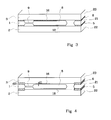
- Figure 4 shows a sectional view of a device according to the present invention.
- the insulation layers for separating the outer pads from the center pad are oxide layers which partially penetrate and partially protrude from the outer pads.
- their protruding thickness d1 delimits the interval between the counterweight and the external plates while their total thickness d2 determines the value of the parasitic capacities. It is therefore possible to limit the value of the stray capacitances without reducing the value of the interval active.
- Such a structure can be manufactured simply by various conventional methods using layers of silicon oxide.
- FIGS. 5A to 5E represent successive stages of manufacture using the conventional method designated in the semiconductor technique under the name "LOCOS". These FIGS. 5A to 5E represent an external silicon wafer. First, we will only describe the operations performed on the underside of this external section considered to be an upper section.
- FIG. 5A represents a bare section 30.
- the lower face of this wafer is coated with a thin layer of silicon nitride 31.
- this layer of silicon nitride has a thickness of a hundred nanometers and is deposited on a very thin layer of silicon oxide with a thickness of ten nanometers.
- the layer of silicon nitride 31 is etched to leave regions 32 in place.
- a thermal oxidation is carried out which occurs only in the openings made between the regions 32. This gives oxide regions 33 which penetrate a certain depth into the silicon wafer and make projection of a determined height.
- an etching is carried out to remove the silicon nitride.
- the etching of the silicon nitride can be followed by an etching of the silicon oxide to leave only a selected height of silicon oxide protruding.
- the projecting height is substantially equal to the penetration depth.
- the silicon oxide layer has a total thickness of the order of 2 micrometers, the projecting height will be of the order of 1 micrometer or less.
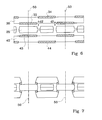
- FIG. 7 shows another mode of separation into elementary components.
- the regions 34 and 44 previously defined are used as an etching mask for the external silicon wafers 30 and 40. And these wafers are etched until reaching the oxide layers 33 and 43. C It is only after this etching of the external plates that a separation into elementary components is carried out by sawing along the lines 50.
- this second embodiment of the invention as in the first, there is the advantage of increase in the thickness of the insulating material for separating between inserts, but there is an additional advantage linked to the fact that sawing is not carried out along the edge of the device and is therefore not liable to cause chips silicon at the visible walls of the lateral oxide bands.
- the present invention is susceptible of numerous variants which will appear to those skilled in the art.
- the "LOCOS" process instead of using the "LOCOS" process to form the partially buried oxide regions 33, one could first perform an etching of the external silicon wafers, by providing hollows at the regions 33, then proceed to uniform oxidation and remove the silicon oxide by masking outside the hollow areas. We then obtain substantially the same result.
- the present invention is susceptible of numerous variants and modifications which will appear to those skilled in the art.
- an embodiment of the invention has been described in relation to a very schematic accelerometer.
- Many other accelerometer structures are known in the art and it will again be emphasized that the present invention also applies to structures of the pressure sensor type such as that illustrated in FIG. 2.
Landscapes
- Physics & Mathematics (AREA)
- General Physics & Mathematics (AREA)
- Engineering & Computer Science (AREA)
- Power Engineering (AREA)
- Pressure Sensors (AREA)
- Measuring Fluid Pressure (AREA)
Applications Claiming Priority (2)
| Application Number | Priority Date | Filing Date | Title |
|---|---|---|---|
| FR9301742 | 1993-02-10 | ||
| FR9301742A FR2701562B1 (fr) | 1993-02-10 | 1993-02-10 | Micro-capteur capacitif à faible capcité parasite et procédé de fabrication. |
Publications (2)
| Publication Number | Publication Date |
|---|---|
| EP0611221A1 true EP0611221A1 (de) | 1994-08-17 |
| EP0611221B1 EP0611221B1 (de) | 1998-05-06 |
Family
ID=9444115
Family Applications (1)
| Application Number | Title | Priority Date | Filing Date |
|---|---|---|---|
| EP94410006A Expired - Lifetime EP0611221B1 (de) | 1993-02-10 | 1994-02-08 | Kapazitiver Microsensor mit geringer Fremdkapazität und Herstellungsverfahren |
Country Status (3)
| Country | Link |
|---|---|
| EP (1) | EP0611221B1 (de) |
| DE (1) | DE69409991T2 (de) |
| FR (1) | FR2701562B1 (de) |
Cited By (5)
| Publication number | Priority date | Publication date | Assignee | Title |
|---|---|---|---|---|
| DE4439238A1 (de) * | 1994-11-03 | 1996-05-09 | Telefunken Microelectron | Kapazitiver Beschleunigungssensor |
| EP0777116A1 (de) * | 1995-12-01 | 1997-06-04 | Solartron Group Limited | Drucksensor mit druckempfindlichem Gehäuse |
| WO2006127813A3 (en) * | 2005-05-25 | 2007-01-18 | Northrop Grumman Corp | Methods for signal to noise improvement in bulk mems accelerometer chips and other mems devices |
| WO2006127814A3 (en) * | 2005-05-25 | 2007-04-12 | Northrop Grumman Corp | Method for optimizing direct wafer bond line width for reduction of parasitic capacitance in mems accelerometers |
| CN119470972A (zh) * | 2024-11-14 | 2025-02-18 | 华中科技大学 | 一种低寄生电容的mems加速度计及制备方法 |
Citations (3)
| Publication number | Priority date | Publication date | Assignee | Title |
|---|---|---|---|---|
| EP0059488A1 (de) * | 1978-07-21 | 1982-09-08 | Hitachi, Ltd. | Kapazitiver Druckwandler |
| EP0369352A1 (de) * | 1988-11-15 | 1990-05-23 | Hitachi, Ltd. | Kapazitiver Beschleunigungsmesser und Verfahren zu seiner Herstellung |
| EP0376631A1 (de) * | 1988-12-30 | 1990-07-04 | United Technologies Corporation | Kapazitiver Differenzdrucksensor mit Überdrucksicherung und Verfahren zur Überdrucksicherung eines kapazitiven Drucksensors |
-
1993
- 1993-02-10 FR FR9301742A patent/FR2701562B1/fr not_active Expired - Fee Related
-
1994
- 1994-02-08 DE DE69409991T patent/DE69409991T2/de not_active Expired - Fee Related
- 1994-02-08 EP EP94410006A patent/EP0611221B1/de not_active Expired - Lifetime
Patent Citations (3)
| Publication number | Priority date | Publication date | Assignee | Title |
|---|---|---|---|---|
| EP0059488A1 (de) * | 1978-07-21 | 1982-09-08 | Hitachi, Ltd. | Kapazitiver Druckwandler |
| EP0369352A1 (de) * | 1988-11-15 | 1990-05-23 | Hitachi, Ltd. | Kapazitiver Beschleunigungsmesser und Verfahren zu seiner Herstellung |
| EP0376631A1 (de) * | 1988-12-30 | 1990-07-04 | United Technologies Corporation | Kapazitiver Differenzdrucksensor mit Überdrucksicherung und Verfahren zur Überdrucksicherung eines kapazitiven Drucksensors |
Cited By (9)
| Publication number | Priority date | Publication date | Assignee | Title |
|---|---|---|---|---|
| DE4439238A1 (de) * | 1994-11-03 | 1996-05-09 | Telefunken Microelectron | Kapazitiver Beschleunigungssensor |
| US5623099A (en) * | 1994-11-03 | 1997-04-22 | Temic Telefunken Microelectronic Gmbh | Two-element semiconductor capacitive acceleration sensor |
| EP0777116A1 (de) * | 1995-12-01 | 1997-06-04 | Solartron Group Limited | Drucksensor mit druckempfindlichem Gehäuse |
| US5844141A (en) * | 1995-12-01 | 1998-12-01 | Solartron Group Limited | Pressure sensor having stress sensitive member |
| WO2006127813A3 (en) * | 2005-05-25 | 2007-01-18 | Northrop Grumman Corp | Methods for signal to noise improvement in bulk mems accelerometer chips and other mems devices |
| WO2006127814A3 (en) * | 2005-05-25 | 2007-04-12 | Northrop Grumman Corp | Method for optimizing direct wafer bond line width for reduction of parasitic capacitance in mems accelerometers |
| US8007166B2 (en) | 2005-05-25 | 2011-08-30 | Northrop Grumman Systems Corporation | Method for optimizing direct wafer bond line width for reduction of parasitic capacitance in MEMS accelerometers |
| US8579502B2 (en) | 2005-05-25 | 2013-11-12 | Northrop Grumman Corporation | Method for determining leak rate through a bond line of a MEMS device |
| CN119470972A (zh) * | 2024-11-14 | 2025-02-18 | 华中科技大学 | 一种低寄生电容的mems加速度计及制备方法 |
Also Published As
| Publication number | Publication date |
|---|---|
| FR2701562B1 (fr) | 1995-05-05 |
| FR2701562A1 (fr) | 1994-08-19 |
| DE69409991T2 (de) | 1998-12-24 |
| DE69409991D1 (de) | 1998-06-10 |
| EP0611221B1 (de) | 1998-05-06 |
Similar Documents
| Publication | Publication Date | Title |
|---|---|---|
| EP0557217B1 (de) | Kapazitiver Mikrosensor mit geringer parasitärer Kapazität und Verfahren zur dessen Herstellung | |
| EP0557219B1 (de) | Kapazitiver Mikrosensor mit reduzierter parasitärer Kapazität und Verfahren zur Herstellung | |
| EP0596456B1 (de) | Methode zur Herstellung eines integrierten kapazitiven Transduktors | |
| EP0605302B1 (de) | Herstellungsverfahren für Druckwandler mittels der Silicium auf Isolation Technologie sowie derart hergestellte Wandler | |
| US6973835B2 (en) | Pressure sensor | |
| EP0754953B1 (de) | Verfahren zur Herstellung einer Struktur mit einer mittels Anschlägen auf Abstand von einem Substrat gehaltenen Nutzschicht, sowie Verfahren zur Loslösung einer solchen Schicht | |
| EP0610806B1 (de) | Kapazitiver Absolutdrucksensor und Verfahren zur Herstellung einer Vielzahl solcher Sensoren | |
| EP0983609B1 (de) | Verfahren zur herstellung eines mikrosensors mit mikrogefertigtem silizium | |
| WO1999022212A1 (fr) | Structure munie de contacts electriques formes a travers le substrat de cette structure et procede d'obtention d'une telle structure | |
| EP0467811B1 (de) | Miniatur-Druckwandler | |
| EP0557216B1 (de) | Druckmikrosensor | |
| EP0611221B1 (de) | Kapazitiver Microsensor mit geringer Fremdkapazität und Herstellungsverfahren | |
| EP0639761A1 (de) | Kapazitiver Differenzdruckwandler | |
| EP0783676B1 (de) | Kapazitiver miniatursensor mit niedriger parasitärer kapazität | |
| EP0684479B1 (de) | Mikrobeschleunigungsmessaufnehmer mit temperaturkompensiertem Resonator | |
| EP0864094B1 (de) | Struktur mit einem isolierten teil in einem massiven substrat und verfahren zu deren erzeugung | |
| FR2738705A1 (fr) | Dispositif capteur electromecanique et procede de fabrication d'un tel dispositif | |
| EP0611222B1 (de) | Schnittverfahren für kapazitiven Microsensor | |
| EP0557220B1 (de) | Kapazitiver Mikrosensor mit seitlichem Schutz und Verfahren zu dessen Herstellung | |
| EP0613011A1 (de) | Aufbau eines Mikromessaufnehmers | |
| WO2002076881A1 (fr) | Procede de fabrication d'une structure a membrane micro-usinee | |
| FR3094789A1 (fr) | Procédé de fabrication d'un détecteur pyroélectrique |
Legal Events
| Date | Code | Title | Description |
|---|---|---|---|
| PUAI | Public reference made under article 153(3) epc to a published international application that has entered the european phase |
Free format text: ORIGINAL CODE: 0009012 |
|
| AK | Designated contracting states |
Kind code of ref document: A1 Designated state(s): CH DE FR GB IT LI |
|
| 17P | Request for examination filed |
Effective date: 19950124 |
|
| 17Q | First examination report despatched |
Effective date: 19960925 |
|
| GRAG | Despatch of communication of intention to grant |
Free format text: ORIGINAL CODE: EPIDOS AGRA |
|
| GRAG | Despatch of communication of intention to grant |
Free format text: ORIGINAL CODE: EPIDOS AGRA |
|
| GRAH | Despatch of communication of intention to grant a patent |
Free format text: ORIGINAL CODE: EPIDOS IGRA |
|
| GRAH | Despatch of communication of intention to grant a patent |
Free format text: ORIGINAL CODE: EPIDOS IGRA |
|
| GRAA | (expected) grant |
Free format text: ORIGINAL CODE: 0009210 |
|
| AK | Designated contracting states |
Kind code of ref document: B1 Designated state(s): CH DE FR GB IT LI |
|
| REG | Reference to a national code |
Ref country code: CH Ref legal event code: EP |
|
| REF | Corresponds to: |
Ref document number: 69409991 Country of ref document: DE Date of ref document: 19980610 |
|
| ITF | It: translation for a ep patent filed | ||
| GBT | Gb: translation of ep patent filed (gb section 77(6)(a)/1977) |
Effective date: 19980722 |
|
| REG | Reference to a national code |
Ref country code: CH Ref legal event code: NV Representative=s name: MOINAS SAVOYE & CRONIN |
|
| PLBE | No opposition filed within time limit |
Free format text: ORIGINAL CODE: 0009261 |
|
| STAA | Information on the status of an ep patent application or granted ep patent |
Free format text: STATUS: NO OPPOSITION FILED WITHIN TIME LIMIT |
|
| 26N | No opposition filed | ||
| REG | Reference to a national code |
Ref country code: GB Ref legal event code: IF02 |
|
| PGFP | Annual fee paid to national office [announced via postgrant information from national office to epo] |
Ref country code: GB Payment date: 20050202 Year of fee payment: 12 |
|
| PGFP | Annual fee paid to national office [announced via postgrant information from national office to epo] |
Ref country code: DE Payment date: 20050203 Year of fee payment: 12 |
|
| PG25 | Lapsed in a contracting state [announced via postgrant information from national office to epo] |
Ref country code: IT Free format text: LAPSE BECAUSE OF NON-PAYMENT OF DUE FEES;WARNING: LAPSES OF ITALIAN PATENTS WITH EFFECTIVE DATE BEFORE 2007 MAY HAVE OCCURRED AT ANY TIME BEFORE 2007. THE CORRECT EFFECTIVE DATE MAY BE DIFFERENT FROM THE ONE RECORDED. Effective date: 20050208 |
|
| PGFP | Annual fee paid to national office [announced via postgrant information from national office to epo] |
Ref country code: FR Payment date: 20050208 Year of fee payment: 12 |
|
| PGFP | Annual fee paid to national office [announced via postgrant information from national office to epo] |
Ref country code: CH Payment date: 20050216 Year of fee payment: 12 |
|
| PG25 | Lapsed in a contracting state [announced via postgrant information from national office to epo] |
Ref country code: GB Free format text: LAPSE BECAUSE OF NON-PAYMENT OF DUE FEES Effective date: 20060208 |
|
| PG25 | Lapsed in a contracting state [announced via postgrant information from national office to epo] |
Ref country code: LI Free format text: LAPSE BECAUSE OF NON-PAYMENT OF DUE FEES Effective date: 20060228 Ref country code: CH Free format text: LAPSE BECAUSE OF NON-PAYMENT OF DUE FEES Effective date: 20060228 |
|
| PG25 | Lapsed in a contracting state [announced via postgrant information from national office to epo] |
Ref country code: DE Free format text: LAPSE BECAUSE OF NON-PAYMENT OF DUE FEES Effective date: 20060901 |
|
| REG | Reference to a national code |
Ref country code: CH Ref legal event code: PL |
|
| GBPC | Gb: european patent ceased through non-payment of renewal fee |
Effective date: 20060208 |
|
| REG | Reference to a national code |
Ref country code: FR Ref legal event code: ST Effective date: 20061031 |
|
| PG25 | Lapsed in a contracting state [announced via postgrant information from national office to epo] |
Ref country code: FR Free format text: LAPSE BECAUSE OF NON-PAYMENT OF DUE FEES Effective date: 20060228 |