EP0611367B1 - Neue UV-härtbare Vernetzungsmitteln für Copolymerisation. - Google Patents
Neue UV-härtbare Vernetzungsmitteln für Copolymerisation. Download PDFInfo
- Publication number
- EP0611367B1 EP0611367B1 EP92924307A EP92924307A EP0611367B1 EP 0611367 B1 EP0611367 B1 EP 0611367B1 EP 92924307 A EP92924307 A EP 92924307A EP 92924307 A EP92924307 A EP 92924307A EP 0611367 B1 EP0611367 B1 EP 0611367B1
- Authority
- EP
- European Patent Office
- Prior art keywords
- vinyl
- composition according
- monomer
- meth
- group
- Prior art date
- Legal status (The legal status is an assumption and is not a legal conclusion. Google has not performed a legal analysis and makes no representation as to the accuracy of the status listed.)
- Expired - Lifetime
Links
- 239000003431 cross linking reagent Substances 0.000 title claims abstract description 31
- 238000007334 copolymerization reaction Methods 0.000 title description 4
- 239000000178 monomer Substances 0.000 claims abstract description 137
- 229920002554 vinyl polymer Polymers 0.000 claims abstract description 54
- 150000001875 compounds Chemical class 0.000 claims abstract description 50
- 125000000391 vinyl group Chemical group [H]C([*])=C([H])[H] 0.000 claims abstract description 43
- PPBRXRYQALVLMV-UHFFFAOYSA-N Styrene Chemical compound C=CC1=CC=CC=C1 PPBRXRYQALVLMV-UHFFFAOYSA-N 0.000 claims abstract description 39
- NIXOWILDQLNWCW-UHFFFAOYSA-N acrylic acid group Chemical group C(C=C)(=O)O NIXOWILDQLNWCW-UHFFFAOYSA-N 0.000 claims abstract description 33
- 239000000203 mixture Substances 0.000 claims description 153
- -1 alkyl radical Chemical group 0.000 claims description 102
- 239000000017 hydrogel Substances 0.000 claims description 91
- WHNWPMSKXPGLAX-UHFFFAOYSA-N N-Vinyl-2-pyrrolidone Chemical class C=CN1CCCC1=O WHNWPMSKXPGLAX-UHFFFAOYSA-N 0.000 claims description 64
- 229920001296 polysiloxane Polymers 0.000 claims description 63
- WOBHKFSMXKNTIM-UHFFFAOYSA-N Hydroxyethyl methacrylate Chemical group CC(=C)C(=O)OCCO WOBHKFSMXKNTIM-UHFFFAOYSA-N 0.000 claims description 35
- 125000004432 carbon atom Chemical group C* 0.000 claims description 26
- 229920000642 polymer Polymers 0.000 claims description 25
- 238000000034 method Methods 0.000 claims description 23
- 229910052760 oxygen Inorganic materials 0.000 claims description 22
- LFQSCWFLJHTTHZ-UHFFFAOYSA-N Ethanol Chemical compound CCO LFQSCWFLJHTTHZ-UHFFFAOYSA-N 0.000 claims description 20
- CERQOIWHTDAKMF-UHFFFAOYSA-M Methacrylate Chemical compound CC(=C)C([O-])=O CERQOIWHTDAKMF-UHFFFAOYSA-M 0.000 claims description 20
- HRPVXLWXLXDGHG-UHFFFAOYSA-N Acrylamide Chemical group NC(=O)C=C HRPVXLWXLXDGHG-UHFFFAOYSA-N 0.000 claims description 18
- RTZKZFJDLAIYFH-UHFFFAOYSA-N Diethyl ether Chemical compound CCOCC RTZKZFJDLAIYFH-UHFFFAOYSA-N 0.000 claims description 18
- NIXOWILDQLNWCW-UHFFFAOYSA-M acrylate group Chemical group C(C=C)(=O)[O-] NIXOWILDQLNWCW-UHFFFAOYSA-M 0.000 claims description 18
- 125000000217 alkyl group Chemical group 0.000 claims description 18
- JOYRKODLDBILNP-UHFFFAOYSA-N Ethyl urethane Chemical compound CCOC(N)=O JOYRKODLDBILNP-UHFFFAOYSA-N 0.000 claims description 16
- 125000003709 fluoroalkyl group Chemical group 0.000 claims description 16
- QYWKGACXENPUKU-UHFFFAOYSA-N 2-ethenoxycarbonyloxyethyl 2-methylprop-2-enoate Chemical group CC(=C)C(=O)OCCOC(=O)OC=C QYWKGACXENPUKU-UHFFFAOYSA-N 0.000 claims description 15
- 125000002496 methyl group Chemical group [H]C([H])([H])* 0.000 claims description 13
- 150000001252 acrylic acid derivatives Chemical class 0.000 claims description 12
- 229940088644 n,n-dimethylacrylamide Drugs 0.000 claims description 12
- YLGYACDQVQQZSW-UHFFFAOYSA-N n,n-dimethylprop-2-enamide Chemical compound CN(C)C(=O)C=C YLGYACDQVQQZSW-UHFFFAOYSA-N 0.000 claims description 11
- VAYTZRYEBVHVLE-UHFFFAOYSA-N 1,3-dioxol-2-one Chemical compound O=C1OC=CO1 VAYTZRYEBVHVLE-UHFFFAOYSA-N 0.000 claims description 10
- 239000004814 polyurethane Substances 0.000 claims description 10
- 229920002635 polyurethane Polymers 0.000 claims description 10
- QKPKBBFSFQAMIY-UHFFFAOYSA-N 2-ethenyl-4,4-dimethyl-1,3-oxazol-5-one Chemical group CC1(C)N=C(C=C)OC1=O QKPKBBFSFQAMIY-UHFFFAOYSA-N 0.000 claims description 9
- 229920001774 Perfluoroether Chemical group 0.000 claims description 9
- LVLANIHJQRZTPY-UHFFFAOYSA-N vinyl carbamate Chemical class NC(=O)OC=C LVLANIHJQRZTPY-UHFFFAOYSA-N 0.000 claims description 9
- 229920002818 (Hydroxyethyl)methacrylate Polymers 0.000 claims description 8
- DKPASKSLDVOUTM-UHFFFAOYSA-N 4-carbamoyloxybut-3-enyl 2-methylprop-2-enoate Chemical compound CC(=C)C(=O)OCCC=COC(N)=O DKPASKSLDVOUTM-UHFFFAOYSA-N 0.000 claims description 8
- KXDHJXZQYSOELW-UHFFFAOYSA-M Carbamate Chemical compound NC([O-])=O KXDHJXZQYSOELW-UHFFFAOYSA-M 0.000 claims description 8
- XSQUKJJJFZCRTK-UHFFFAOYSA-N Urea Chemical compound NC(N)=O XSQUKJJJFZCRTK-UHFFFAOYSA-N 0.000 claims description 8
- 150000003926 acrylamides Chemical class 0.000 claims description 8
- 229930195733 hydrocarbon Natural products 0.000 claims description 8
- 150000003254 radicals Chemical class 0.000 claims description 8
- BESKSSIEODQWBP-UHFFFAOYSA-N 3-tris(trimethylsilyloxy)silylpropyl 2-methylprop-2-enoate Chemical group CC(=C)C(=O)OCCC[Si](O[Si](C)(C)C)(O[Si](C)(C)C)O[Si](C)(C)C BESKSSIEODQWBP-UHFFFAOYSA-N 0.000 claims description 7
- VVQNEPGJFQJSBK-UHFFFAOYSA-N Methyl methacrylate Chemical compound COC(=O)C(C)=C VVQNEPGJFQJSBK-UHFFFAOYSA-N 0.000 claims description 7
- 239000004202 carbamide Substances 0.000 claims description 7
- 230000005855 radiation Effects 0.000 claims description 7
- 239000004215 Carbon black (E152) Substances 0.000 claims description 6
- 125000003118 aryl group Chemical group 0.000 claims description 6
- FXPHJTKVWZVEGA-UHFFFAOYSA-N ethenyl hydrogen carbonate Chemical group OC(=O)OC=C FXPHJTKVWZVEGA-UHFFFAOYSA-N 0.000 claims description 6
- 230000000379 polymerizing effect Effects 0.000 claims description 6
- MFHOHDGRQQDYNT-UHFFFAOYSA-N 2-[carbamoyl(ethenyl)amino]ethyl 2-methylprop-2-enoate Chemical compound CC(=C)C(=O)OCCN(C=C)C(N)=O MFHOHDGRQQDYNT-UHFFFAOYSA-N 0.000 claims description 5
- BVKZGUZCCUSVTD-UHFFFAOYSA-L Carbonate Chemical compound [O-]C([O-])=O BVKZGUZCCUSVTD-UHFFFAOYSA-L 0.000 claims description 5
- 239000005058 Isophorone diisocyanate Substances 0.000 claims description 5
- CERQOIWHTDAKMF-UHFFFAOYSA-N Methacrylic acid Chemical compound CC(=C)C(O)=O CERQOIWHTDAKMF-UHFFFAOYSA-N 0.000 claims description 5
- 150000001412 amines Chemical class 0.000 claims description 5
- 238000004132 cross linking Methods 0.000 claims description 5
- 150000002148 esters Chemical class 0.000 claims description 5
- NIMLQBUJDJZYEJ-UHFFFAOYSA-N isophorone diisocyanate Chemical compound CC1(C)CC(N=C=O)CC(C)(CN=C=O)C1 NIMLQBUJDJZYEJ-UHFFFAOYSA-N 0.000 claims description 5
- QRIMLDXJAPZHJE-UHFFFAOYSA-N 2,3-dihydroxypropyl 2-methylprop-2-enoate Chemical compound CC(=C)C(=O)OCC(O)CO QRIMLDXJAPZHJE-UHFFFAOYSA-N 0.000 claims description 4
- 125000002877 alkyl aryl group Chemical group 0.000 claims description 4
- 125000005119 alkyl cycloalkyl group Chemical group 0.000 claims description 4
- 150000001732 carboxylic acid derivatives Chemical class 0.000 claims description 4
- 125000000753 cycloalkyl group Chemical group 0.000 claims description 4
- 239000004205 dimethyl polysiloxane Substances 0.000 claims description 4
- 150000002170 ethers Chemical class 0.000 claims description 4
- 239000001257 hydrogen Substances 0.000 claims description 4
- 229910052739 hydrogen Inorganic materials 0.000 claims description 4
- 229920000435 poly(dimethylsiloxane) Polymers 0.000 claims description 4
- 229920001281 polyalkylene Polymers 0.000 claims description 4
- KPUWHANPEXNPJT-UHFFFAOYSA-N disiloxane Chemical class [SiH3]O[SiH3] KPUWHANPEXNPJT-UHFFFAOYSA-N 0.000 claims description 3
- 238000004519 manufacturing process Methods 0.000 claims description 3
- RQAKESSLMFZVMC-UHFFFAOYSA-N n-ethenylacetamide Chemical class CC(=O)NC=C RQAKESSLMFZVMC-UHFFFAOYSA-N 0.000 claims description 3
- ZQXSMRAEXCEDJD-UHFFFAOYSA-N n-ethenylformamide Chemical class C=CNC=O ZQXSMRAEXCEDJD-UHFFFAOYSA-N 0.000 claims description 3
- 229910052717 sulfur Inorganic materials 0.000 claims description 3
- NPPNUGUVBUJRAB-UHFFFAOYSA-N 2-[tert-butyl(dimethyl)silyl]oxyethyl ethenyl carbonate Chemical compound CC(C)(C)[Si](C)(C)OCCOC(=O)OC=C NPPNUGUVBUJRAB-UHFFFAOYSA-N 0.000 claims description 2
- LFPXMEFNGBINIR-UHFFFAOYSA-N 3,3,3-tris(trimethylsilyloxy)propylsilyl 2-methylprop-2-enoate Chemical compound C[Si](OC(CC[SiH2]OC(C(=C)C)=O)(O[Si](C)(C)C)O[Si](C)(C)C)(C)C LFPXMEFNGBINIR-UHFFFAOYSA-N 0.000 claims description 2
- UFHFLCQGNIYNRP-UHFFFAOYSA-N Hydrogen Chemical compound [H][H] UFHFLCQGNIYNRP-UHFFFAOYSA-N 0.000 claims description 2
- KYCSFMMJBAZMTE-UHFFFAOYSA-N [2-[methyl(trimethylsilyloxy)silyl]-2-phenylethyl] acetate Chemical compound C[Si](C)(C)O[SiH](C)C(COC(C)=O)C1=CC=CC=C1 KYCSFMMJBAZMTE-UHFFFAOYSA-N 0.000 claims description 2
- RZKKLXUEULTOGP-UHFFFAOYSA-N [dimethyl(trimethylsilyloxy)silyl]methyl 2-methylprop-2-enoate Chemical compound CC(=C)C(=O)OC[Si](C)(C)O[Si](C)(C)C RZKKLXUEULTOGP-UHFFFAOYSA-N 0.000 claims description 2
- YPMNWQTVWVHXIQ-UHFFFAOYSA-N [methyl-bis(trimethylsilyloxy)silyl]methyl 2-methylprop-2-enoate Chemical compound CC(=C)C(=O)OC[Si](C)(O[Si](C)(C)C)O[Si](C)(C)C YPMNWQTVWVHXIQ-UHFFFAOYSA-N 0.000 claims description 2
- 125000003158 alcohol group Chemical group 0.000 claims description 2
- 125000002947 alkylene group Chemical group 0.000 claims description 2
- 125000001951 carbamoylamino group Chemical group C(N)(=O)N* 0.000 claims description 2
- 150000004649 carbonic acid derivatives Chemical class 0.000 claims description 2
- 125000005442 diisocyanate group Chemical group 0.000 claims description 2
- KZJNAICCMJTRKF-UHFFFAOYSA-N ethenyl 2-trimethylsilylethyl carbonate Chemical compound C[Si](C)(C)CCOC(=O)OC=C KZJNAICCMJTRKF-UHFFFAOYSA-N 0.000 claims description 2
- RWEUKWCZWYHIQA-UHFFFAOYSA-N ethenyl 3-trimethylsilylpropyl carbonate Chemical compound C[Si](C)(C)CCCOC(=O)OC=C RWEUKWCZWYHIQA-UHFFFAOYSA-N 0.000 claims description 2
- NDXTZJDCEOXFOP-UHFFFAOYSA-N ethenyl 3-tris(trimethylsilyloxy)silylpropyl carbonate Chemical compound C[Si](C)(C)O[Si](O[Si](C)(C)C)(O[Si](C)(C)C)CCCOC(=O)OC=C NDXTZJDCEOXFOP-UHFFFAOYSA-N 0.000 claims description 2
- BHBDVHVTNOYHLK-UHFFFAOYSA-N ethenyl 3-tris(trimethylsilyloxy)silylpropylsulfanylformate Chemical compound C[Si](C)(C)O[Si](O[Si](C)(C)C)(O[Si](C)(C)C)CCCSC(=O)OC=C BHBDVHVTNOYHLK-UHFFFAOYSA-N 0.000 claims description 2
- ILHMPZFVDISGNP-UHFFFAOYSA-N ethenyl n-[3-tris(trimethylsilyloxy)silylpropyl]carbamate Chemical compound C[Si](C)(C)O[Si](O[Si](C)(C)C)(O[Si](C)(C)C)CCCNC(=O)OC=C ILHMPZFVDISGNP-UHFFFAOYSA-N 0.000 claims description 2
- KRAZQXAPJAYYJI-UHFFFAOYSA-N ethenyl trimethylsilylmethyl carbonate Chemical compound C[Si](C)(C)COC(=O)OC=C KRAZQXAPJAYYJI-UHFFFAOYSA-N 0.000 claims description 2
- 229910052736 halogen Chemical group 0.000 claims description 2
- 125000005843 halogen group Chemical group 0.000 claims description 2
- 230000000887 hydrating effect Effects 0.000 claims description 2
- 150000002430 hydrocarbons Chemical class 0.000 claims description 2
- 125000004435 hydrogen atom Chemical group [H]* 0.000 claims description 2
- IQPQWNKOIGAROB-UHFFFAOYSA-N isocyanate group Chemical group [N-]=C=O IQPQWNKOIGAROB-UHFFFAOYSA-N 0.000 claims description 2
- 125000004108 n-butyl group Chemical group [H]C([H])([H])C([H])([H])C([H])([H])C([H])([H])* 0.000 claims description 2
- 125000000962 organic group Chemical group 0.000 claims description 2
- 125000001997 phenyl group Chemical group [H]C1=C([H])C([H])=C(*)C([H])=C1[H] 0.000 claims description 2
- 229920000233 poly(alkylene oxides) Polymers 0.000 claims description 2
- 125000000446 sulfanediyl group Chemical group *S* 0.000 claims description 2
- UHUUYVZLXJHWDV-UHFFFAOYSA-N trimethyl(methylsilyloxy)silane Chemical compound C[SiH2]O[Si](C)(C)C UHUUYVZLXJHWDV-UHFFFAOYSA-N 0.000 claims description 2
- 235000013877 carbamide Nutrition 0.000 claims 4
- IEXLTAQAZBHNBB-UHFFFAOYSA-N 1-ethenyl-1-(4-ethenylphenyl)urea Chemical compound NC(=O)N(C=C)C1=CC=C(C=C)C=C1 IEXLTAQAZBHNBB-UHFFFAOYSA-N 0.000 claims 1
- OHLUUHNLEMFGTQ-UHFFFAOYSA-N N-methylacetamide Chemical class CNC(C)=O OHLUUHNLEMFGTQ-UHFFFAOYSA-N 0.000 claims 1
- 125000005910 alkyl carbonate group Chemical group 0.000 claims 1
- 125000005011 alkyl ether group Chemical group 0.000 claims 1
- 150000004657 carbamic acid derivatives Chemical class 0.000 claims 1
- ATHHXGZTWNVVOU-VQEHIDDOSA-N n-methylformamide Chemical class CN[13CH]=O ATHHXGZTWNVVOU-VQEHIDDOSA-N 0.000 claims 1
- 229920001480 hydrophilic copolymer Polymers 0.000 abstract description 2
- XLYOFNOQVPJJNP-UHFFFAOYSA-N water Substances O XLYOFNOQVPJJNP-UHFFFAOYSA-N 0.000 description 50
- 238000009472 formulation Methods 0.000 description 49
- 239000004971 Cross linker Substances 0.000 description 31
- HEDRZPFGACZZDS-UHFFFAOYSA-N Chloroform Chemical compound ClC(Cl)Cl HEDRZPFGACZZDS-UHFFFAOYSA-N 0.000 description 30
- 238000002360 preparation method Methods 0.000 description 21
- ZSIAUFGUXNUGDI-UHFFFAOYSA-N hexan-1-ol Chemical compound CCCCCCO ZSIAUFGUXNUGDI-UHFFFAOYSA-N 0.000 description 20
- 239000000463 material Substances 0.000 description 20
- QVGXLLKOCUKJST-UHFFFAOYSA-N atomic oxygen Chemical compound [O] QVGXLLKOCUKJST-UHFFFAOYSA-N 0.000 description 19
- 239000001301 oxygen Substances 0.000 description 19
- QIGBRXMKCJKVMJ-UHFFFAOYSA-N Hydroquinone Chemical compound OC1=CC=C(O)C=C1 QIGBRXMKCJKVMJ-UHFFFAOYSA-N 0.000 description 18
- 238000006243 chemical reaction Methods 0.000 description 17
- JUJWROOIHBZHMG-UHFFFAOYSA-N Pyridine Chemical compound C1=CC=NC=C1 JUJWROOIHBZHMG-UHFFFAOYSA-N 0.000 description 16
- CSNNHWWHGAXBCP-UHFFFAOYSA-L Magnesium sulfate Chemical compound [Mg+2].[O-][S+2]([O-])([O-])[O-] CSNNHWWHGAXBCP-UHFFFAOYSA-L 0.000 description 14
- 239000000047 product Substances 0.000 description 13
- MTHSVFCYNBDYFN-UHFFFAOYSA-N diethylene glycol Chemical compound OCCOCCO MTHSVFCYNBDYFN-UHFFFAOYSA-N 0.000 description 12
- 230000035699 permeability Effects 0.000 description 12
- 229940044192 2-hydroxyethyl methacrylate Drugs 0.000 description 10
- VYPSYNLAJGMNEJ-UHFFFAOYSA-N Silicium dioxide Chemical compound O=[Si]=O VYPSYNLAJGMNEJ-UHFFFAOYSA-N 0.000 description 10
- 238000006116 polymerization reaction Methods 0.000 description 10
- 239000000741 silica gel Substances 0.000 description 10
- 229910002027 silica gel Inorganic materials 0.000 description 10
- LYCAIKOWRPUZTN-UHFFFAOYSA-N Ethylene glycol Chemical compound OCCO LYCAIKOWRPUZTN-UHFFFAOYSA-N 0.000 description 9
- PQLFROTZSIMBKR-UHFFFAOYSA-N ethenyl carbonochloridate Chemical compound ClC(=O)OC=C PQLFROTZSIMBKR-UHFFFAOYSA-N 0.000 description 9
- STVZJERGLQHEKB-UHFFFAOYSA-N ethylene glycol dimethacrylate Substances CC(=C)C(=O)OCCOC(=O)C(C)=C STVZJERGLQHEKB-UHFFFAOYSA-N 0.000 description 9
- BQZJOQXSCSZQPS-UHFFFAOYSA-N 2-methoxy-1,2-diphenylethanone Chemical compound C=1C=CC=CC=1C(OC)C(=O)C1=CC=CC=C1 BQZJOQXSCSZQPS-UHFFFAOYSA-N 0.000 description 8
- DBCAQXHNJOFNGC-UHFFFAOYSA-N 4-bromo-1,1,1-trifluorobutane Chemical compound FC(F)(F)CCCBr DBCAQXHNJOFNGC-UHFFFAOYSA-N 0.000 description 8
- WARQUFORVQESFF-UHFFFAOYSA-N isocyanatoethene Chemical class C=CN=C=O WARQUFORVQESFF-UHFFFAOYSA-N 0.000 description 8
- UMJSCPRVCHMLSP-UHFFFAOYSA-N pyridine Natural products COC1=CC=CN=C1 UMJSCPRVCHMLSP-UHFFFAOYSA-N 0.000 description 8
- 238000010992 reflux Methods 0.000 description 8
- PEDCQBHIVMGVHV-UHFFFAOYSA-N Glycerine Chemical compound OCC(O)CO PEDCQBHIVMGVHV-UHFFFAOYSA-N 0.000 description 7
- 229920001577 copolymer Polymers 0.000 description 7
- 229910052943 magnesium sulfate Inorganic materials 0.000 description 7
- 235000019341 magnesium sulphate Nutrition 0.000 description 7
- YMWUJEATGCHHMB-UHFFFAOYSA-N Dichloromethane Chemical compound ClCCl YMWUJEATGCHHMB-UHFFFAOYSA-N 0.000 description 6
- ZMANZCXQSJIPKH-UHFFFAOYSA-N Triethylamine Chemical compound CCN(CC)CC ZMANZCXQSJIPKH-UHFFFAOYSA-N 0.000 description 6
- 238000001723 curing Methods 0.000 description 6
- 238000013007 heat curing Methods 0.000 description 6
- 239000004615 ingredient Substances 0.000 description 6
- 239000003999 initiator Substances 0.000 description 6
- 239000002904 solvent Substances 0.000 description 6
- 210000004369 blood Anatomy 0.000 description 5
- 239000008280 blood Substances 0.000 description 5
- 238000009835 boiling Methods 0.000 description 5
- 239000007795 chemical reaction product Substances 0.000 description 5
- 239000011521 glass Substances 0.000 description 5
- RBQRWNWVPQDTJJ-UHFFFAOYSA-N methacryloyloxyethyl isocyanate Chemical compound CC(=C)C(=O)OCCN=C=O RBQRWNWVPQDTJJ-UHFFFAOYSA-N 0.000 description 5
- HZAXFHJVJLSVMW-UHFFFAOYSA-N 2-Aminoethan-1-ol Chemical compound NCCO HZAXFHJVJLSVMW-UHFFFAOYSA-N 0.000 description 4
- XMLYCEVDHLAQEL-UHFFFAOYSA-N 2-hydroxy-2-methyl-1-phenylpropan-1-one Chemical compound CC(C)(O)C(=O)C1=CC=CC=C1 XMLYCEVDHLAQEL-UHFFFAOYSA-N 0.000 description 4
- RIWRBSMFKVOJMN-UHFFFAOYSA-N 2-methyl-1-phenylpropan-2-ol Chemical compound CC(C)(O)CC1=CC=CC=C1 RIWRBSMFKVOJMN-UHFFFAOYSA-N 0.000 description 4
- FUGYGGDSWSUORM-UHFFFAOYSA-N 4-hydroxystyrene Chemical compound OC1=CC=C(C=C)C=C1 FUGYGGDSWSUORM-UHFFFAOYSA-N 0.000 description 4
- 238000003848 UV Light-Curing Methods 0.000 description 4
- 239000003085 diluting agent Substances 0.000 description 4
- 239000012632 extractable Substances 0.000 description 4
- 238000000605 extraction Methods 0.000 description 4
- 230000008569 process Effects 0.000 description 4
- 239000011541 reaction mixture Substances 0.000 description 4
- 238000003786 synthesis reaction Methods 0.000 description 4
- MYRTYDVEIRVNKP-UHFFFAOYSA-N 1,2-Divinylbenzene Chemical compound C=CC1=CC=CC=C1C=C MYRTYDVEIRVNKP-UHFFFAOYSA-N 0.000 description 3
- WEVYAHXRMPXWCK-UHFFFAOYSA-N Acetonitrile Chemical compound CC#N WEVYAHXRMPXWCK-UHFFFAOYSA-N 0.000 description 3
- DNIAPMSPPWPWGF-UHFFFAOYSA-N Propylene glycol Chemical compound CC(O)CO DNIAPMSPPWPWGF-UHFFFAOYSA-N 0.000 description 3
- 230000000052 comparative effect Effects 0.000 description 3
- LOKCTEFSRHRXRJ-UHFFFAOYSA-I dipotassium trisodium dihydrogen phosphate hydrogen phosphate dichloride Chemical compound P(=O)(O)(O)[O-].[K+].P(=O)(O)([O-])[O-].[Na+].[Na+].[Cl-].[K+].[Cl-].[Na+] LOKCTEFSRHRXRJ-UHFFFAOYSA-I 0.000 description 3
- FAFWKDXOUWXCDP-UHFFFAOYSA-N ethenylurea Chemical compound NC(=O)NC=C FAFWKDXOUWXCDP-UHFFFAOYSA-N 0.000 description 3
- 235000011187 glycerol Nutrition 0.000 description 3
- 230000036571 hydration Effects 0.000 description 3
- 238000006703 hydration reaction Methods 0.000 description 3
- 230000002209 hydrophobic effect Effects 0.000 description 3
- VHRYZQNGTZXDNX-UHFFFAOYSA-N methacryloyl chloride Chemical compound CC(=C)C(Cl)=O VHRYZQNGTZXDNX-UHFFFAOYSA-N 0.000 description 3
- 230000003287 optical effect Effects 0.000 description 3
- 239000002953 phosphate buffered saline Substances 0.000 description 3
- 229920002338 polyhydroxyethylmethacrylate Polymers 0.000 description 3
- FBCQUCJYYPMKRO-UHFFFAOYSA-N prop-2-enyl 2-methylprop-2-enoate Chemical compound CC(=C)C(=O)OCC=C FBCQUCJYYPMKRO-UHFFFAOYSA-N 0.000 description 3
- 230000009257 reactivity Effects 0.000 description 3
- 210000001519 tissue Anatomy 0.000 description 3
- PUPZLCDOIYMWBV-UHFFFAOYSA-N (+/-)-1,3-Butanediol Chemical compound CC(O)CCO PUPZLCDOIYMWBV-UHFFFAOYSA-N 0.000 description 2
- ANVPMFOXHJVWBT-UHFFFAOYSA-N 2-[2-[2-[2-[2-[2-[2-[2-[2-(2-hydroxyethoxy)ethoxy]ethoxy]ethoxy]ethoxy]ethoxy]ethoxy]ethoxy]ethoxy]ethyl 2-methylprop-2-enoate Chemical compound CC(=C)C(=O)OCCOCCOCCOCCOCCOCCOCCOCCOCCOCCO ANVPMFOXHJVWBT-UHFFFAOYSA-N 0.000 description 2
- XSHISXQEKIKSGC-UHFFFAOYSA-N 2-aminoethyl 2-methylprop-2-enoate;hydron;chloride Chemical compound Cl.CC(=C)C(=O)OCCN XSHISXQEKIKSGC-UHFFFAOYSA-N 0.000 description 2
- OWJKJLOCIDNNGJ-UHFFFAOYSA-N 4-[[4-hydroxybutyl(dimethyl)silyl]oxy-dimethylsilyl]butan-1-ol Chemical compound OCCCC[Si](C)(C)O[Si](C)(C)CCCCO OWJKJLOCIDNNGJ-UHFFFAOYSA-N 0.000 description 2
- PLIKAWJENQZMHA-UHFFFAOYSA-N 4-aminophenol Chemical compound NC1=CC=C(O)C=C1 PLIKAWJENQZMHA-UHFFFAOYSA-N 0.000 description 2
- IQAGXMNEUYBTLG-UHFFFAOYSA-N 5-hydroxy-2-methylpent-2-enamide Chemical compound NC(=O)C(C)=CCCO IQAGXMNEUYBTLG-UHFFFAOYSA-N 0.000 description 2
- BAPJBEWLBFYGME-UHFFFAOYSA-N Methyl acrylate Chemical compound COC(=O)C=C BAPJBEWLBFYGME-UHFFFAOYSA-N 0.000 description 2
- ATHHXGZTWNVVOU-UHFFFAOYSA-N N-methylformamide Chemical compound CNC=O ATHHXGZTWNVVOU-UHFFFAOYSA-N 0.000 description 2
- 239000004372 Polyvinyl alcohol Substances 0.000 description 2
- PXIPVTKHYLBLMZ-UHFFFAOYSA-N Sodium azide Chemical compound [Na+].[N-]=[N+]=[N-] PXIPVTKHYLBLMZ-UHFFFAOYSA-N 0.000 description 2
- 238000007259 addition reaction Methods 0.000 description 2
- 150000005215 alkyl ethers Chemical class 0.000 description 2
- 230000015572 biosynthetic process Effects 0.000 description 2
- 239000007975 buffered saline Substances 0.000 description 2
- 238000005266 casting Methods 0.000 description 2
- 238000006482 condensation reaction Methods 0.000 description 2
- 210000004087 cornea Anatomy 0.000 description 2
- 238000004821 distillation Methods 0.000 description 2
- 230000000694 effects Effects 0.000 description 2
- AXBQZEBDCBCYAZ-UHFFFAOYSA-N ethenyl (4-ethenylphenyl) carbonate Chemical compound C=COC(=O)OC1=CC=C(C=C)C=C1 AXBQZEBDCBCYAZ-UHFFFAOYSA-N 0.000 description 2
- NYNPIIHFVAUZRG-UHFFFAOYSA-N ethenyl n-(2-hydroxyethyl)carbamate Chemical compound OCCNC(=O)OC=C NYNPIIHFVAUZRG-UHFFFAOYSA-N 0.000 description 2
- 229940093476 ethylene glycol Drugs 0.000 description 2
- 238000011156 evaluation Methods 0.000 description 2
- 239000012467 final product Substances 0.000 description 2
- 239000012530 fluid Substances 0.000 description 2
- 239000000499 gel Substances 0.000 description 2
- 210000003709 heart valve Anatomy 0.000 description 2
- 125000002887 hydroxy group Chemical group [H]O* 0.000 description 2
- WGCNASOHLSPBMP-UHFFFAOYSA-N hydroxyacetaldehyde Natural products OCC=O WGCNASOHLSPBMP-UHFFFAOYSA-N 0.000 description 2
- 239000012948 isocyanate Substances 0.000 description 2
- 210000004379 membrane Anatomy 0.000 description 2
- 239000012528 membrane Substances 0.000 description 2
- 210000004400 mucous membrane Anatomy 0.000 description 2
- BSCJIBOZTKGXQP-UHFFFAOYSA-N n-(2-hydroxyethyl)-2-methylprop-2-enamide Chemical compound CC(=C)C(=O)NCCO BSCJIBOZTKGXQP-UHFFFAOYSA-N 0.000 description 2
- 229920003023 plastic Polymers 0.000 description 2
- 239000004033 plastic Substances 0.000 description 2
- 229920002451 polyvinyl alcohol Polymers 0.000 description 2
- 239000000243 solution Substances 0.000 description 2
- 238000003756 stirring Methods 0.000 description 2
- 125000003011 styrenyl group Chemical group [H]\C(*)=C(/[H])C1=C([H])C([H])=C([H])C([H])=C1[H] 0.000 description 2
- 238000012360 testing method Methods 0.000 description 2
- PZOMYAHYQSDRPO-UHFFFAOYSA-N (4-methyl-3-oxopenta-1,4-dienyl)urea Chemical compound CC(=C)C(=O)C=CNC(N)=O PZOMYAHYQSDRPO-UHFFFAOYSA-N 0.000 description 1
- ZXHDVRATSGZISC-UHFFFAOYSA-N 1,2-bis(ethenoxy)ethane Chemical compound C=COCCOC=C ZXHDVRATSGZISC-UHFFFAOYSA-N 0.000 description 1
- BJELTSYBAHKXRW-UHFFFAOYSA-N 2,4,6-triallyloxy-1,3,5-triazine Chemical compound C=CCOC1=NC(OCC=C)=NC(OCC=C)=N1 BJELTSYBAHKXRW-UHFFFAOYSA-N 0.000 description 1
- NXHSMDISSSUSED-UHFFFAOYSA-N 2-(4-ethenylphenyl)ethenyl carbamate Chemical compound NC(=O)OC=CC1=CC=C(C=C)C=C1 NXHSMDISSSUSED-UHFFFAOYSA-N 0.000 description 1
- CXYOFCNPDRSKNE-UHFFFAOYSA-N 2-(4-ethenylphenyl)ethenylurea Chemical compound NC(=O)NC=CC1=CC=C(C=C)C=C1 CXYOFCNPDRSKNE-UHFFFAOYSA-N 0.000 description 1
- OGMADIBCHLQMIP-UHFFFAOYSA-N 2-aminoethanethiol;hydron;chloride Chemical compound Cl.NCCS OGMADIBCHLQMIP-UHFFFAOYSA-N 0.000 description 1
- GIOROLFDZOLVNT-UHFFFAOYSA-N 4-[4-(2-methylprop-2-enoyloxy)butylsilyloxysilyl]butyl 2-methylprop-2-enoate Chemical compound CC(=C)C(=O)OCCCC[SiH2]O[SiH2]CCCCOC(=O)C(C)=C GIOROLFDZOLVNT-UHFFFAOYSA-N 0.000 description 1
- BZABFDPKOQVXJF-UHFFFAOYSA-N 5-[[dimethyl-[4-(2-methylprop-2-enoyloxy)butyl]silyl]oxy-dimethylsilyl]-2-ethenoxypentanoic acid Chemical compound CC(=C)C(=O)OCCCC[Si](C)(C)O[Si](C)(C)CCCC(C(O)=O)OC=C BZABFDPKOQVXJF-UHFFFAOYSA-N 0.000 description 1
- 102000008186 Collagen Human genes 0.000 description 1
- 108010035532 Collagen Proteins 0.000 description 1
- FBPFZTCFMRRESA-FSIIMWSLSA-N D-Glucitol Natural products OC[C@H](O)[C@H](O)[C@@H](O)[C@H](O)CO FBPFZTCFMRRESA-FSIIMWSLSA-N 0.000 description 1
- FBPFZTCFMRRESA-KVTDHHQDSA-N D-Mannitol Chemical compound OC[C@@H](O)[C@@H](O)[C@H](O)[C@H](O)CO FBPFZTCFMRRESA-KVTDHHQDSA-N 0.000 description 1
- FBPFZTCFMRRESA-JGWLITMVSA-N D-glucitol Chemical compound OC[C@H](O)[C@@H](O)[C@H](O)[C@H](O)CO FBPFZTCFMRRESA-JGWLITMVSA-N 0.000 description 1
- 239000004641 Diallyl-phthalate Substances 0.000 description 1
- 239000005977 Ethylene Substances 0.000 description 1
- 229930195725 Mannitol Natural products 0.000 description 1
- 239000002202 Polyethylene glycol Substances 0.000 description 1
- BLRPTPMANUNPDV-UHFFFAOYSA-N Silane Chemical compound [SiH4] BLRPTPMANUNPDV-UHFFFAOYSA-N 0.000 description 1
- GSEJCLTVZPLZKY-UHFFFAOYSA-N Triethanolamine Chemical compound OCCN(CCO)CCO GSEJCLTVZPLZKY-UHFFFAOYSA-N 0.000 description 1
- DAKWPKUUDNSNPN-UHFFFAOYSA-N Trimethylolpropane triacrylate Chemical compound C=CC(=O)OCC(CC)(COC(=O)C=C)COC(=O)C=C DAKWPKUUDNSNPN-UHFFFAOYSA-N 0.000 description 1
- XTXRWKRVRITETP-UHFFFAOYSA-N Vinyl acetate Chemical compound CC(=O)OC=C XTXRWKRVRITETP-UHFFFAOYSA-N 0.000 description 1
- YTEISYFNYGDBRV-UHFFFAOYSA-N [(dimethyl-$l^{3}-silanyl)oxy-dimethylsilyl]oxy-dimethylsilicon Chemical compound C[Si](C)O[Si](C)(C)O[Si](C)C YTEISYFNYGDBRV-UHFFFAOYSA-N 0.000 description 1
- HFBMWMNUJJDEQZ-UHFFFAOYSA-N acryloyl chloride Chemical compound ClC(=O)C=C HFBMWMNUJJDEQZ-UHFFFAOYSA-N 0.000 description 1
- 230000002411 adverse Effects 0.000 description 1
- 125000004848 alkoxyethyl group Chemical group 0.000 description 1
- 150000001408 amides Chemical class 0.000 description 1
- 150000003863 ammonium salts Chemical class 0.000 description 1
- 230000002965 anti-thrombogenic effect Effects 0.000 description 1
- 239000012298 atmosphere Substances 0.000 description 1
- QUDWYFHPNIMBFC-UHFFFAOYSA-N bis(prop-2-enyl) benzene-1,2-dicarboxylate Chemical compound C=CCOC(=O)C1=CC=CC=C1C(=O)OCC=C QUDWYFHPNIMBFC-UHFFFAOYSA-N 0.000 description 1
- 239000007806 chemical reaction intermediate Substances 0.000 description 1
- 229920001436 collagen Polymers 0.000 description 1
- 239000002537 cosmetic Substances 0.000 description 1
- 230000003013 cytotoxicity Effects 0.000 description 1
- 231100000135 cytotoxicity Toxicity 0.000 description 1
- DTPCFIHYWYONMD-UHFFFAOYSA-N decaethylene glycol Chemical compound OCCOCCOCCOCCOCCOCCOCCOCCOCCOCCO DTPCFIHYWYONMD-UHFFFAOYSA-N 0.000 description 1
- 230000001419 dependent effect Effects 0.000 description 1
- 238000000151 deposition Methods 0.000 description 1
- 230000008021 deposition Effects 0.000 description 1
- 238000013461 design Methods 0.000 description 1
- 238000000502 dialysis Methods 0.000 description 1
- 150000005690 diesters Chemical class 0.000 description 1
- LEJBBGNFPAFPKQ-UHFFFAOYSA-N diethylene glycol diacrylate Substances C=CC(=O)OCCOCCOC(=O)C=C LEJBBGNFPAFPKQ-UHFFFAOYSA-N 0.000 description 1
- SZXQTJUDPRGNJN-UHFFFAOYSA-N dipropylene glycol Chemical compound OCCCOCCCO SZXQTJUDPRGNJN-UHFFFAOYSA-N 0.000 description 1
- 239000012153 distilled water Substances 0.000 description 1
- AFOSIXZFDONLBT-UHFFFAOYSA-N divinyl sulfone Chemical compound C=CS(=O)(=O)C=C AFOSIXZFDONLBT-UHFFFAOYSA-N 0.000 description 1
- 239000003480 eluent Substances 0.000 description 1
- 238000002481 ethanol extraction Methods 0.000 description 1
- FNHHZVLKGUWNNH-UHFFFAOYSA-N ethenyl 2-(2-methylprop-2-enoylamino)ethyl carbonate Chemical compound CC(=C)C(=O)NCCOC(=O)OC=C FNHHZVLKGUWNNH-UHFFFAOYSA-N 0.000 description 1
- GVLNAEFVISURFJ-UHFFFAOYSA-N ethenyl [4-(2-methylprop-2-enoylamino)phenyl] carbonate Chemical compound CC(=C)C(=O)NC1=CC=C(OC(=O)OC=C)C=C1 GVLNAEFVISURFJ-UHFFFAOYSA-N 0.000 description 1
- ZCNLHWOKZSPQAV-UHFFFAOYSA-N ethenyl carbonochloridate 2-hydroxyethyl 2-methylprop-2-enoate Chemical compound C(=C)OC(=O)Cl.C(C(=C)C)(=O)OCCO ZCNLHWOKZSPQAV-UHFFFAOYSA-N 0.000 description 1
- OVLTXIXURJJDHO-UHFFFAOYSA-N ethenyl hydrogen carbonate (2,2,3,3-tetrafluoro-4-hydroxybutyl) 2-methylprop-2-enoate Chemical compound C(OC=C)(O)=O.C(C(=C)C)(=O)OCC(C(CO)(F)F)(F)F OVLTXIXURJJDHO-UHFFFAOYSA-N 0.000 description 1
- AMDHKVJQJKJIEZ-UHFFFAOYSA-N ethenyl hydrogen carbonate;4-[[4-hydroxybutyl(dimethyl)silyl]oxy-dimethylsilyl]butan-1-ol Chemical compound OC(=O)OC=C.OCCCC[Si](C)(C)O[Si](C)(C)CCCCO AMDHKVJQJKJIEZ-UHFFFAOYSA-N 0.000 description 1
- 125000001033 ether group Chemical group 0.000 description 1
- 230000002349 favourable effect Effects 0.000 description 1
- VZCYOOQTPOCHFL-OWOJBTEDSA-L fumarate(2-) Chemical class [O-]C(=O)\C=C\C([O-])=O VZCYOOQTPOCHFL-OWOJBTEDSA-L 0.000 description 1
- 239000007789 gas Substances 0.000 description 1
- 125000003055 glycidyl group Chemical group C(C1CO1)* 0.000 description 1
- PYGSKMBEVAICCR-UHFFFAOYSA-N hexa-1,5-diene Chemical group C=CCCC=C PYGSKMBEVAICCR-UHFFFAOYSA-N 0.000 description 1
- XXMIOPMDWAUFGU-UHFFFAOYSA-N hexane-1,6-diol Chemical compound OCCCCCCO XXMIOPMDWAUFGU-UHFFFAOYSA-N 0.000 description 1
- 125000002768 hydroxyalkyl group Chemical group 0.000 description 1
- 239000007943 implant Substances 0.000 description 1
- 238000010348 incorporation Methods 0.000 description 1
- 239000003112 inhibitor Substances 0.000 description 1
- 238000002347 injection Methods 0.000 description 1
- 239000007924 injection Substances 0.000 description 1
- 238000007689 inspection Methods 0.000 description 1
- 239000000543 intermediate Substances 0.000 description 1
- 150000002513 isocyanates Chemical class 0.000 description 1
- 239000000594 mannitol Substances 0.000 description 1
- 235000010355 mannitol Nutrition 0.000 description 1
- 238000010002 mechanical finishing Methods 0.000 description 1
- 230000007246 mechanism Effects 0.000 description 1
- FQPSGWSUVKBHSU-UHFFFAOYSA-N methacrylamide Chemical compound CC(=C)C(N)=O FQPSGWSUVKBHSU-UHFFFAOYSA-N 0.000 description 1
- YDKNBNOOCSNPNS-UHFFFAOYSA-N methyl 1,3-benzoxazole-2-carboxylate Chemical compound C1=CC=C2OC(C(=O)OC)=NC2=C1 YDKNBNOOCSNPNS-UHFFFAOYSA-N 0.000 description 1
- 238000000465 moulding Methods 0.000 description 1
- WAUMXMQJIMQTJK-UHFFFAOYSA-N n,n'-dihydroxyocta-2,6-dienediamide Chemical compound ONC(=O)C=CCCC=CC(=O)NO WAUMXMQJIMQTJK-UHFFFAOYSA-N 0.000 description 1
- QRWZCJXEAOZAAW-UHFFFAOYSA-N n,n,2-trimethylprop-2-enamide Chemical compound CN(C)C(=O)C(C)=C QRWZCJXEAOZAAW-UHFFFAOYSA-N 0.000 description 1
- PNLUGRYDUHRLOF-UHFFFAOYSA-N n-ethenyl-n-methylacetamide Chemical compound C=CN(C)C(C)=O PNLUGRYDUHRLOF-UHFFFAOYSA-N 0.000 description 1
- GIPIDQABPPVVSH-UHFFFAOYSA-N n-methylacetamide Chemical compound [CH2]C(=O)NC GIPIDQABPPVVSH-UHFFFAOYSA-N 0.000 description 1
- 239000012299 nitrogen atmosphere Substances 0.000 description 1
- 238000000655 nuclear magnetic resonance spectrum Methods 0.000 description 1
- HMMGMWAXVFQUOA-UHFFFAOYSA-N octamethylcyclotetrasiloxane Chemical compound C[Si]1(C)O[Si](C)(C)O[Si](C)(C)O[Si](C)(C)O1 HMMGMWAXVFQUOA-UHFFFAOYSA-N 0.000 description 1
- 238000006053 organic reaction Methods 0.000 description 1
- 238000013021 overheating Methods 0.000 description 1
- 230000000704 physical effect Effects 0.000 description 1
- 229920001223 polyethylene glycol Polymers 0.000 description 1
- 229920005862 polyol Polymers 0.000 description 1
- 150000003077 polyols Chemical class 0.000 description 1
- 229920001451 polypropylene glycol Polymers 0.000 description 1
- 229920006264 polyurethane film Polymers 0.000 description 1
- 230000002035 prolonged effect Effects 0.000 description 1
- 238000009877 rendering Methods 0.000 description 1
- 238000004007 reversed phase HPLC Methods 0.000 description 1
- 229910000077 silane Inorganic materials 0.000 description 1
- 239000000600 sorbitol Substances 0.000 description 1
- 238000004528 spin coating Methods 0.000 description 1
- 238000009987 spinning Methods 0.000 description 1
- 230000001954 sterilising effect Effects 0.000 description 1
- 238000004659 sterilization and disinfection Methods 0.000 description 1
- 238000006467 substitution reaction Methods 0.000 description 1
- 238000001356 surgical procedure Methods 0.000 description 1
- BWSZXUOMATYHHI-UHFFFAOYSA-N tert-butyl octaneperoxoate Chemical compound CCCCCCCC(=O)OOC(C)(C)C BWSZXUOMATYHHI-UHFFFAOYSA-N 0.000 description 1
- ZIBGPFATKBEMQZ-UHFFFAOYSA-N triethylene glycol Chemical compound OCCOCCOCCO ZIBGPFATKBEMQZ-UHFFFAOYSA-N 0.000 description 1
- 238000009281 ultraviolet germicidal irradiation Methods 0.000 description 1
- 210000000626 ureter Anatomy 0.000 description 1
- 210000003932 urinary bladder Anatomy 0.000 description 1
- UIYCHXAGWOYNNA-UHFFFAOYSA-N vinyl sulfide Chemical group C=CSC=C UIYCHXAGWOYNNA-UHFFFAOYSA-N 0.000 description 1
- 239000003643 water by type Substances 0.000 description 1
- 238000003809 water extraction Methods 0.000 description 1
- 230000004580 weight loss Effects 0.000 description 1
- 238000009736 wetting Methods 0.000 description 1
Images

Classifications
-
- C—CHEMISTRY; METALLURGY
- C08—ORGANIC MACROMOLECULAR COMPOUNDS; THEIR PREPARATION OR CHEMICAL WORKING-UP; COMPOSITIONS BASED THEREON
- C08F—MACROMOLECULAR COMPOUNDS OBTAINED BY REACTIONS ONLY INVOLVING CARBON-TO-CARBON UNSATURATED BONDS
- C08F246/00—Copolymers in which the nature of only the monomers in minority is defined
-
- C—CHEMISTRY; METALLURGY
- C07—ORGANIC CHEMISTRY
- C07C—ACYCLIC OR CARBOCYCLIC COMPOUNDS
- C07C233/00—Carboxylic acid amides
- C07C233/01—Carboxylic acid amides having carbon atoms of carboxamide groups bound to hydrogen atoms or to acyclic carbon atoms
- C07C233/16—Carboxylic acid amides having carbon atoms of carboxamide groups bound to hydrogen atoms or to acyclic carbon atoms having the nitrogen atom of at least one of the carboxamide groups bound to a carbon atom of a hydrocarbon radical substituted by singly-bound oxygen atoms
- C07C233/17—Carboxylic acid amides having carbon atoms of carboxamide groups bound to hydrogen atoms or to acyclic carbon atoms having the nitrogen atom of at least one of the carboxamide groups bound to a carbon atom of a hydrocarbon radical substituted by singly-bound oxygen atoms with the substituted hydrocarbon radical bound to the nitrogen atom of the carboxamide group by an acyclic carbon atom
- C07C233/20—Carboxylic acid amides having carbon atoms of carboxamide groups bound to hydrogen atoms or to acyclic carbon atoms having the nitrogen atom of at least one of the carboxamide groups bound to a carbon atom of a hydrocarbon radical substituted by singly-bound oxygen atoms with the substituted hydrocarbon radical bound to the nitrogen atom of the carboxamide group by an acyclic carbon atom having the carbon atom of the carboxamide group bound to a carbon atom of an acyclic unsaturated carbon skeleton
-
- C—CHEMISTRY; METALLURGY
- C07—ORGANIC CHEMISTRY
- C07C—ACYCLIC OR CARBOCYCLIC COMPOUNDS
- C07C271/00—Derivatives of carbamic acids, i.e. compounds containing any of the groups, the nitrogen atom not being part of nitro or nitroso groups
- C07C271/06—Esters of carbamic acids
- C07C271/08—Esters of carbamic acids having oxygen atoms of carbamate groups bound to acyclic carbon atoms
- C07C271/10—Esters of carbamic acids having oxygen atoms of carbamate groups bound to acyclic carbon atoms with the nitrogen atoms of the carbamate groups bound to hydrogen atoms or to acyclic carbon atoms
- C07C271/12—Esters of carbamic acids having oxygen atoms of carbamate groups bound to acyclic carbon atoms with the nitrogen atoms of the carbamate groups bound to hydrogen atoms or to acyclic carbon atoms to hydrogen atoms or to carbon atoms of unsubstituted hydrocarbon radicals
-
- C—CHEMISTRY; METALLURGY
- C07—ORGANIC CHEMISTRY
- C07C—ACYCLIC OR CARBOCYCLIC COMPOUNDS
- C07C271/00—Derivatives of carbamic acids, i.e. compounds containing any of the groups, the nitrogen atom not being part of nitro or nitroso groups
- C07C271/06—Esters of carbamic acids
- C07C271/40—Esters of carbamic acids having oxygen atoms of carbamate groups bound to carbon atoms of six-membered aromatic rings
- C07C271/42—Esters of carbamic acids having oxygen atoms of carbamate groups bound to carbon atoms of six-membered aromatic rings with the nitrogen atoms of the carbamate groups bound to hydrogen atoms or to acyclic carbon atoms
- C07C271/44—Esters of carbamic acids having oxygen atoms of carbamate groups bound to carbon atoms of six-membered aromatic rings with the nitrogen atoms of the carbamate groups bound to hydrogen atoms or to acyclic carbon atoms to hydrogen atoms or to carbon atoms of unsubstituted hydrocarbon radicals
-
- C—CHEMISTRY; METALLURGY
- C07—ORGANIC CHEMISTRY
- C07C—ACYCLIC OR CARBOCYCLIC COMPOUNDS
- C07C275/00—Derivatives of urea, i.e. compounds containing any of the groups, the nitrogen atoms not being part of nitro or nitroso groups
- C07C275/46—Derivatives of urea, i.e. compounds containing any of the groups, the nitrogen atoms not being part of nitro or nitroso groups containing any of the groups, X being a hetero atom, Y being any atom, e.g. acylureas
- C07C275/48—Y being a hydrogen or a carbon atom
- C07C275/50—Y being a hydrogen or an acyclic carbon atom
-
- C—CHEMISTRY; METALLURGY
- C07—ORGANIC CHEMISTRY
- C07C—ACYCLIC OR CARBOCYCLIC COMPOUNDS
- C07C327/00—Thiocarboxylic acids
- C07C327/20—Esters of monothiocarboxylic acids
- C07C327/30—Esters of monothiocarboxylic acids having sulfur atoms of esterified thiocarboxyl groups bound to carbon atoms of hydrocarbon radicals substituted by nitrogen atoms, not being part of nitro or nitroso groups
-
- C—CHEMISTRY; METALLURGY
- C07—ORGANIC CHEMISTRY
- C07C—ACYCLIC OR CARBOCYCLIC COMPOUNDS
- C07C69/00—Esters of carboxylic acids; Esters of carbonic or haloformic acids
- C07C69/96—Esters of carbonic or haloformic acids
-
- C—CHEMISTRY; METALLURGY
- C07—ORGANIC CHEMISTRY
- C07F—ACYCLIC, CARBOCYCLIC OR HETEROCYCLIC COMPOUNDS CONTAINING ELEMENTS OTHER THAN CARBON, HYDROGEN, HALOGEN, OXYGEN, NITROGEN, SULFUR, SELENIUM OR TELLURIUM
- C07F7/00—Compounds containing elements of Groups 4 or 14 of the Periodic Table
- C07F7/02—Silicon compounds
- C07F7/08—Compounds having one or more C—Si linkages
- C07F7/0803—Compounds with Si-C or Si-Si linkages
-
- C—CHEMISTRY; METALLURGY
- C07—ORGANIC CHEMISTRY
- C07F—ACYCLIC, CARBOCYCLIC OR HETEROCYCLIC COMPOUNDS CONTAINING ELEMENTS OTHER THAN CARBON, HYDROGEN, HALOGEN, OXYGEN, NITROGEN, SULFUR, SELENIUM OR TELLURIUM
- C07F7/00—Compounds containing elements of Groups 4 or 14 of the Periodic Table
- C07F7/02—Silicon compounds
- C07F7/08—Compounds having one or more C—Si linkages
- C07F7/0834—Compounds having one or more O-Si linkage
- C07F7/0838—Compounds with one or more Si-O-Si sequences
-
- C—CHEMISTRY; METALLURGY
- C08—ORGANIC MACROMOLECULAR COMPOUNDS; THEIR PREPARATION OR CHEMICAL WORKING-UP; COMPOSITIONS BASED THEREON
- C08F—MACROMOLECULAR COMPOUNDS OBTAINED BY REACTIONS ONLY INVOLVING CARBON-TO-CARBON UNSATURATED BONDS
- C08F290/00—Macromolecular compounds obtained by polymerising monomers on to polymers modified by introduction of aliphatic unsaturated end or side groups
- C08F290/02—Macromolecular compounds obtained by polymerising monomers on to polymers modified by introduction of aliphatic unsaturated end or side groups on to polymers modified by introduction of unsaturated end groups
- C08F290/06—Polymers provided for in subclass C08G
- C08F290/068—Polysiloxanes
-
- G—PHYSICS
- G02—OPTICS
- G02B—OPTICAL ELEMENTS, SYSTEMS OR APPARATUS
- G02B1/00—Optical elements characterised by the material of which they are made; Optical coatings for optical elements
- G02B1/04—Optical elements characterised by the material of which they are made; Optical coatings for optical elements made of organic materials, e.g. plastics
- G02B1/041—Lenses
- G02B1/043—Contact lenses
Definitions
- This invention relates to a novel class of compounds which may be used as novel crosslinking compositions to prepare novel UV-curable hydrophilic copolymers suitable for use as articles in the biomedical field, especially contact lenses.
- crosslinkers In the field of crosslinked polymeric systems, initiators, and crosslinking compounds and compositions (crosslinkers) are often added to monomer mixes before polymerization. These crosslinkers facilitate formation of the desired polymer. In addition, crosslinkers can affect specific characteristics and mechanical properties of the resultant polymers.
- Crosslinkers which are similar in structure to the monomers being reacted are often added to monomer mixtures.
- a di(meth)acrylate or di(meth)acrylamide monomer would commonly be used as a crosslinker for a (meth)acrylate/(meth)acrylamide system.
- a vinyl-type crosslinker such as allyl methacrylate would ordinarily be used.
- non-acrylic vinyl-containing monomers are generally not reactive with the (meth)acrylate-containing monomers.
- N-vinyl pyrrolidone N-vinyl pyrrolidone
- MMA methyl methacrylate
- BME benzoin methyl ether
- Such a monomer mix may then be first subjected to UV irradiation to polymerize the methacrylate groups, followed by heat curing to polymerize the allyl- and vinyl-containing monomers.
- This polymerization scheme is relatively cumbersome and may lead to polymeric systems having poor yields or a resulting polymer of poor optical quality.
- such resulting polymers may not be true crosslinked copolymers but may be mere nonhomogeneous interpenetrating polymer networks.
- a crosslinker such as allyl methacrylate could be used to assist the polymerization of the NVP/methacrylate system; however, this would also require heat curing.
- Heat curing is not as desirable as UV curing since over-heating may adversely affect the desired properties of the end-product hydrogel.
- insufficient heat curing can result in a hydrogel which also fails to possess the desired end-result properties.
- polyvinyl typically di- or trivinyl monomers, most commonly the di- or tri(meth)acrylates of dihydric ethylene glycol, triethylene glycol, butylene glycol, hexane-1,6-diol, thio-diethylene glycol-diacrylate and methacrylate; neopentyl glycol diacrylate; trimethylolpropane triacrylate and the like; N,N'-dihydroxyethylenebisacrylamide and -bismethacrylamides; also diallyl compounds like diallyl phthalate and triallyl cyanurate; divinylbenzene; ethylene glycol divinyl ether; and the (meth)acrylate esters of polyols such as triethanolamine, glycerol, pentanerythritol, butylene glycol, mannitol, and sorbitol.
- illustrations include N,N-methylene-bis-(meth)acrylamide, sulfonated divinylbenzene, and divinylsulfone.
- reaction products of hydroxyalkyl (meth)acrylates with unsaturated isocyanates for example the reaction product of 2-hydroxyethyl methacrylate with 2-isocyanatoethyl methacrylate (IEM) as disclosed in U.S. Patent No. 4,954,587.
- crosslinking agents are the polyetherbisurethane-dimethacrylates as described in U.S. Patent No. 4,192,827, and those crosslinkers obtained by reaction of polyethylene glycol, polypropylene glycol and polytetramethylene glycol with 2-isocyanatoethyl methacrylate (IEM) or m-isopropenyl- ⁇ , ⁇ -dimethylbenzyl isocyanates (m-TMI), and polysiloxane-bisurethanedimethacrylates as described in U.S. Patent Nos. 4,486,577 and 4,605,712.
- IEM 2-isocyanatoethyl methacrylate
- m-TMI m-isopropenyl- ⁇ , ⁇ -dimethylbenzyl isocyanates
- polysiloxane-bisurethanedimethacrylates as described in U.S. Patent Nos. 4,486,577 and 4,605,712.
- crosslinking agents are the reaction products of polyvinyl alcohol, ethoxylated polyvinyl alcohol or of polyvinyl alcohol-co-ethylene with 0.1 to 10 mol % vinyl isocyanates like IEM or m-TMI.
- crosslinkers can be used to copolymerize vinyl and acrylic comonomers using only UV curing.
- NVP copolymerizes well with vinyl carbonates and vinyl carbamates. Specifically, NVP was shown to copolymerize with vinylene carbonate. The closeness of the reactivity ratios resulted in favorable random copolymerization. (See K. Hayashi and G. Smets, J. Polymer Science, Vol. 27, p. 275, (1958)). Further, it has been recently demonstrated that NVP can copolymerize with vinyl carbamates and carbonates with a UV sensitive initiator. (See U.S. Patent No. 5,070,215).
- crosslinked polymeric materials can be hydrated and retain their water content. It is found that the higher the water content within contact lenses made from these crosslinked hydrogel polymers, the greater is the oxygen permeability through the lens to the cornea.
- Oxygen permeability, wettability, material strength and stability are but a few of the factors which must be carefully balanced to achieve a useable end-result contact lens.
- oxygen permeability increases as the water content of a hydrogel increases. Since the cornea receives its oxygen supply exclusively from contact with the atmosphere, good oxygen permeability is a critical characteristic for any contact lens material.
- crosslinkers affect specific mechanical properties relating to the firmness of the hydrogel, such as modulus, and tear strength.
- modulus and tear strength.
- a hydrogel is a hydrated crosslinked polymeric system that contains water in an equilibrium state.
- the physical properties of hydrogels can vary widely and are mostly determined by their water content. Hydrogels may contain 10% to 90% water by weight and exhibit excellent biocompatibilty.
- hydrogels can be used as contact lenses, intraocular implants, membranes and other films, diaphragms, catheters, mouth guards, denture liners, tissue replacements, heart valves, intrauterine devices, ureter prostheses, etc.
- Commercial success for hydrogels has been found in the field of ophthamology, most particularly as contact lenses.
- hydrogels to make contact lenses has been known, since at least as early as Wichterle, et al., U.S. Patent No. 3,220,960 which discloses hydrogels involving a hydrated polymer of an hydroxyalkyl acrylate or methacrylate crosslinked with a corresponding diester.
- poly(2-hydroxyethyl methacrylate) also known as poly-HEMA
- Hydrogels such as 2-hydroxyethyl methacrylate with water contents of about 40% by weight, are often referred to as low water content hydrogels.
- NVP-vinyl pyrrolidone N-vinyl pyrrolidone
- MMA methyl methacrylate
- the water content of the NVP-MMA hydrogel systems can vary widely as a function of the ratio of NVP to MMA.
- most hydrogels derived from NVP and MMA which are of commercial interest have a water content in the 70% to 80% by weight range.
- Hydrogels containing N,N-dimethylacrylamide copolymers (DMA) are known to have similar properties. Hydrogels containing water weight percents in this range are often referred to as high water content hydrogels.
- High water-containing hydrogels have at times exhibited undesirable mechanical properties. For example, such hydrogels are not easily formed into hydrolytically stable lenses. Further such materials have at times exhibited tearing or other breakage as a result of poor tensile strength. What was needed was a highly oxygen permeable material that was durable and highly wettable. Wettability is important in that if the lens is not sufficiently wettable, it does not remain lubricated and therefore cannot be worn comfortably on the eye. The optimal contact lens would have not only excellent oxygen permeability, but also excellent tear fluid wettability.
- low water content hydrogels have acceptable properties for application as soft contact lenses.
- High water content hydrogels appear to have acceptable oxygen permeability suitable for use as extended wear lenses. Extended wear lenses are those worn without removal for periods of time longer than a day.
- high water content hydrogels are often not easily formed into stable lenses. Such high water-containing lenses have been reported to tear more easily, and may otherwise be more prone to damage.
- the most desirable lens would have oxygen transmissibility at least as high as that of lenses comprising the NVP-MMA system, while also having strength and mechanical properties similar to lenses made from the poly-HEMA hydrogels.
- Silicone-containing materials have been tried as viable contact lens materials and display very good oxygen permeability and durability. However, most silicone-containing materials are largely hydrophobic and therefore not sufficiently wettable. Further, it is believed that such hydrophobicity causes deposit problems, which may result in discomfort when wearing contact lenses made from these silicone-containing polymers. The optimum contact lens would have not only excellent oxygen permeability, but also excellent tear-fluid wettability.
- UV curable acrylic/vinyl- or styrene/vinyl- or acrylic/vinyl/styrene-crosslinked polymeric system is presently known.
- Such a UV-curable polymeric hydrogel system employing a crosslinker able to compatibilize groups of varying reactivities would be highly advantageous.
- novel compounds which can be used as crosslinking agents for UV-curable polymeric hydrogel systems which comprise at least one vinyl-containing monomer and acrylic-containing monomer and optionally at least one styrene-containing monomer.
- the novel compounds are able to polymerize hydrogel systems which contain in the monomer mix, both, at least one vinyl, and at least one of either a styrene or an acrylic group.
- the resulting, entirely UV-curable hydrogels derived from the monomeric mix therefore comprise at least one vinyl-containing monomer, at least one acrylic- or styrene-containing monomer, and a crosslinking agent from a novel class of compounds.
- the monomeric mix may comprise at least one vinyl-, at least one acrylic- and at least one styrene-containing monomer and the novel crosslinker.
- new compounds useful as new polymeric crosslinking agents, are suitable for use in the preparation of new hydrogel polymers which, in turn, may be used in the preparation of a wide range of various biomedical devices, such as contact lenses, surgical devices, heart valves, vessel substitutes, intrauterine devices, membranes and other films, diaphragms, catheters, mouth guards, denture liners, and intraocular devices.
- biomedical devices such as contact lenses, surgical devices, heart valves, vessel substitutes, intrauterine devices, membranes and other films, diaphragms, catheters, mouth guards, denture liners, and intraocular devices.
- the resulting new hydrogels are especially well-suited for the production of contact lenses.
- the present invention provides a composition prepared by polymerizing a vinyl-containing monomer, optionally a styrene-containing monomer, optionally an acrylic-containing monomer, and as a crosslinking agent a compound of this invention of formula (I).
- the present invention provides a composition prepared by polymerizing a monomer mix comprising a polysiloxane-containing monomer and a vinyl containing monomer, and as a crosslinking agent a compound of this invention of formula (I).
- a polysiloxane-containing monomer is a polyurethane-containing siloxane prepolymer.
- the present invention provides a hydrogel prepared by polymerizing a monomer mix comprising (i) methacryloxyethyl vinyl carbonate, N-vinyl pyrrolidone, and hydroxyethyl methacrylate; (ii) N-vinyl pyrrolidone, 2-vinyl-4,4-dimethyl-2-oxazoline-5-one, N,N-dimethyl acrylamide, and methacryloxyethyl vinyl carbonate; or (iii) ⁇ - ⁇ -Bis-(methacryloxyalkyl) polysiloxane, 3-methacryloxypropyl tris(trimethylsiloxy)silane, N-vinyl pyrrolidone, and methacryloxyethyl vinyl carbonate.
- the present invention also provides a method of making a hydrogel, comprising the steps of:
- Figures 1 and 2 depict the effect on modulus of polyurethane films prepared in Examples 48-57 below as the composition ratio of NVP to DMA is changed.
- Figure 3 depicts the effect on modulus of methacrylate-capped polysiloxane films prepared in Examples 58-61 below as the composition ratio of NVP to DMA is changed.
- the present invention is directed to new compounds useful as crosslinking agents which link monomers and prepolymers to form new copolymers which are particularly useful as biomedical materials, and are especially useful in contact lens applications.
- These new crosslinking agents can be used with a wide variety of monomers and prepolymers and can produce a wide variety of contact lens materials such as, for example, hard gas permeable lens materials; soft hydrogel lens materials, soft non-hydrogel lens materials, silicone-containing polymeric materials and non-silicone-containing polymeric materials.
- novel compounds of the present invention can be prepared by employing known organic reaction syntheses to combine the acrylic group and possibly styrene group from acrylic-containing and optionally styrene-containing monomers respectively with the vinyl group from vinyl-containing monomers, such as the preferred vinyl carbonates or vinyl carbamates.
- the compounds can be prepared by means of a condensation reaction of an alcohol or an amine which contains an acrylic or styrene group, with, for example vinyl chloroformate under mild reaction conditions (e.g. at ambient temperature or below).
- the compounds can also be prepared by an addition reaction of the same type of alcohol or amine metioned above, with vinyl isocyanate at lower temperatures (at or below 10 degrees C). Both types of reactions are further depicted by the following reaction schemes: wherein: R is a residue containing an acrylic or a styrene-containing group, or both; and X is NH, O or S.
- HEMA 2-hydroxyethyl methacrylate
- HEMAVc methacryloxyethyl vinyl carbonate
- One preferred example of an addition reaction used to produce a novel compound of this invention is the reaction of HEMA with vinyl isocyanate to form methacryloxyethyl vinyl carbamate.
- Compounds containing a urea group can be prepared by reacting an ammonium salt containing a styrene or methacrylate moiety, such as 2-aminoethyl methacrylate hydrochloride (Kodak) with vinyl isocyanate under basic conditions at ambient temperature or below.
- an ammonium salt containing a styrene or methacrylate moiety such as 2-aminoethyl methacrylate hydrochloride (Kodak)
- Kodak 2-aminoethyl methacrylate hydrochloride
- Vinyl isocyanate an intermediate useful in this invention, can be prepared by reacting acrylyl chloride with sodium azide at 10°C or below, followed by distillation of the product into a cold trap containing an inhibitor such as hydroquinone. (See G.B. Butler and S.B. Monroe, J. Macro. Sci., A5(6), 1063-1070 (1971)).
- hydrogels especially preferred are hydrogels, the specific polymers of which may be derived from monomers which may include acrylate, acrylamide, methacrylate, methacrylamide, styrene-containing monomers, dimethacrylate and dimethacrylamide monomers, vinyl amide-containing monomers, vinyl carbonate/carbamate/urea monomers, and (meth)acrylate/(meth) acrylamide-capped prepolymers. All of the above-mentioned monomers and prepolymers may further include polysiloxanes, polyfluorosiloxanes, polyfluoroethers, polyurethanes, and other groups.
- One preferred class of suitable silicone-containing monomers contemplated by the present invention are bulky polysiloxanylalkyl (meth)acrylic monomers represented by the formula (II): wherein:
- Examples of such bulky monomers include methacryloxypropyl tris(trimethylsiloxy)silane, pentamethyldisiloxanylmethylmethacrylate, tris(trimethylsiloxy)methacryloxy propylsilane, phenyltetramethyldisiloxanylethyl acetate, and methyldi(trimethylsiloxy)methacryloxymethyl silane.
- a further preferred class of silicone-containing prepolymers is a poly(organosiloxane) prepolymer represented by the formula (III): wherein:
- silicone-containing vinyl carbonate or vinyl carbamate monomers of formula (IV): wherein:
- Suitable silicone-containing organic radicals R Si include radicals having any of the following formulae: -(CH 2 ) n' Si[(CH 2 ) m' CH 3 ] 3 ; -(CH 2 ) n' Si[OSi(CH 2 ) m' CH 3 ] 3 ; and wherein:
- the silicone-containing vinyl carbonate or vinyl carbamate monomers specifically include: 1,3-bis[4-vinyloxycarbonyloxy)but-1-yl]tetramethyl-disiloxane; 3-(trimethylsilyl)propyl vinyl carbonate; 3-(vinyloxycarbonylthio)propyl[tris(trimethylsiloxy)silane]; 3-[tris(trimethylsiloxy)silyl] propyl vinyl carbamate; 3-[tris(trimethylsiloxy)silyl] propyl allyl carbamate; 3-[tris(trimethylsiloxy)silyl]propyl vinyl carbonate; t-butyldimethylsiloxyethyl vinyl carbonate; trimethylsilylethyl vinyl carbonate; trimethylsilylmethyl vinyl carbonate; and "V 2 D 25 ", represented by the following formula (V):
- a further preferred class of silicone-containing prepolymers are those monomers having the following schematic representations: (VI) E(*D*A"D*G) a *D*A"D*E'; or (VII) E(*D*G*D*A" a *D*G*D*E'; wherein
- the silicone-containing hydrogel contact lenses made from polyurethane hydrogel compositions comprising a urethane prepolymer, a polysiloxanylalkyl methacrylate, at least one acrylic-containing monomer, a vinyl-containing monomer and a compound of the present invention as a crosslinking agent.
- the urethane prepolymer is a methacrylate-based prepolymer of the general formula (X): wherein: R 16 is a diradical of a diisocyanate after removal of the isocyanate group, and is most preferably the diradical of isophorone diisocyanate, and m, p and a are the same as previously defined.
- the sum of m and a is 3 or 4, and more preferably, a is 1 and m is 3 or 4.
- p is at least 30.
- Monomer systems for hydrogel lenses often employ a hydrophilic monoolefinic monomer (i.e., a monoethylenically unsaturated monomer) and a polyolefinic (usually diolefinic) monomer (e.g., a polyethylenically unsaturated compound which functions as a crosslinking agent) in an amount sufficient to insolubilize the resulting hydrophilic hydrogel but insufficient to completely mask the hydrophobic properties of the hydrogel.
- a hydrophilic monoolefinic monomer i.e., a monoethylenically unsaturated monomer
- a polyolefinic (usually diolefinic) monomer e.g., a polyethylenically unsaturated compound which functions as a crosslinking agent
- Illustrative hydrophilic monomers include, for example, water soluble monoesters of (meth)acrylic acid with an alcohol having an esterifiable hydroxyl group and at least one additional hydroxyl group such as the mono- and poly-alkylene glycol monoesters of (meth)acrylic acid, e.g., ethylene glycol mono(meth)acrylate, diethylene glycol mono(meth)acrylate, propylene glycol mono(meth)acrylate, dipropylene glycol mono(meth)acrylate, and the like; the N-alkyl and N,N-dialkyl substituted (meth)acrylamides such as N-methyl (meth)acrylamide, N,N-dimethyl (meth)acrylamide, and the like; N-vinylpyrrolidone and the alkyl substituted N-vinyl pyrrolidones; N-vinyl-N-alkyl amides such as N-vinyl-N-methyl acetamide, N-viny
- Contemplated preferred acrylic-containing monomers identified in Formula I as "Aa ", and which in part comprise the novel compounds of the present invention, include the (meth)acrylates, (meth)acrylamides, alkyl(meth)acrylates, alkyl(meth)acrylamides, polysiloxyalkyl(meth)acrylates, polysiloxyalkyl(meth)acrylamides, fluoroalkyl(meth)acrylates, fluoroalkyl(meth)acrylamides, with the more preferred monomers being 2-hydroxyethylmethacrylate, glycerol methacrylate, hydroxyethyl methacrylamide, 2-methacrylamido ethanol, N,N-dimethyl acrylamide, N,N-dimethyl methylacrylamide, (meth)acrylic acid and derivatives thereof.
- the acrylic-containing monomers may further be a prepolymer end-capped with (meth)acrylate- or (meth)acrylamide-containing monomers, with the preferred prepolymers being polysiloxane-, polyalkylene ether-, or polyfluorinated ether-containing monomers and derivatives thereof, all of which may be linked through ester, carbonate, carbamate, urea or urethane linkages.
- the polysiloxane units in polysiloxane-containing prepolymers may further contain fluoroalkyl, fluoroether, alkyl ether or alcohol groups and derivatives thereof.
- V v The contemplated preferred vinyl-containing monomers present in the novel compounds and identified in Formula I as "V v ", include vinyl carbonate, alkyl vinyl carbonate, polysiloxane vinyl carbonate, fluoroalkyl vinyl carbonate, polysiloxanylalkyl-vinyl carbonate, fluoroalkyl vinyl carbonate monomers, and the corresponding carbamate and urea monomers such as vinyl urea, alkyl vinyl urea, polysiloxanylalkyl vinyl urea and fluoroalkyl vinyl urea monomers.
- the more preferred vinyl-containing monomers include N-vinylpyrrolidone, N-vinyl,N-methyl acetamide, N-vinyl,N-methyl formamide, N-vinyl acetamide, N-vinyl formamide, and 2-vinyl-4,4-dimethyl-2-oxazoline-5-one (VDMO) and derivatives thereof.
- the vinyl-containing monomer may be a prepolymer selected from vinyl carbonate-, vinyl carbamate-, and vinyl urea-capped prepolymers and may further comprise polysiloxanes, fluoroalkyl- or fluoroether-containing monomers, and more preferably may include a polyalkylene ether or polyfluorinated ether all of which may be linked through ester, carbonate, carbamate, urea or urethane linkages.
- the preferred polysiloxane-containing vinyl prepolymers may include an alkyl ether or an alcohol.
- the contemplated preferred styrene-containing monomers which may be present in the novel compounds and identified in Formula I as "S s ", include 4-vinylphenyl vinyl carbonate, 4-vinylphenylvinyl carbamate, or 4-vinylphenylvinyl urea and derivatives thereof. As shown by Formula I the novel compounds may comprise all three of an acrylic-, a styrene-, and a vinyl-containing group.
- the most preferred compounds of this invention are methacryloxyethyl vinyl carbonate, methacryloxyethyl vinyl carbamate, and methacryloxyethyl vinyl urea.
- Preferred novel hydrogel compositions of this invention comprise the novel compounds combined with at least one methacrylate-containing polyurethane-siloxane-containing monomer, and at least one (meth)acrylate or (meth)acrylamide-containing monomer and N-vinyl pyrrolidone.
- the polyurethane-siloxane-containing monomers may further comprise fluoroalkyl, fluoroether or alcohol-containing monomers.
- the preferred (meth)acrylates are alkyl methacrylate, 2-hydroxyethyl methacrylate, glycol methacrylate, polysiloxanylalkyl methacrylate and fluoroalkyl methacrylate, with (meth)acrylamide is N,N-dimethyl acrylamide being the most preferred.
- the most preferred bulky polysiloxanyl methacrylate is methacryloxypropyl tris(trimethylsiloxy)silane, (TRIS).
- One preferred hydrogel composition further includes 2-vinyl-4,4-dimethyl-2-oxazolin-5-one (VDMO).
- Yet another preferred novel hydrogel composition of this invention enabled by the novel compounds of the present invention comprises at least one (meth)acrylate- or (meth)acrylamide-capped polysiloxane-containing monomer, a vinyl-containing monomer which may preferably be comprised of carbonate, carbamate and urea-containing polysiloxyanyalkylvinyl monomers, or a carboxylic acid-containing vinyl carbonate, vinyl carbamate or vinyl urea, and the crosslinking composition.
- silicone-containing monomers contemplated by the present invention are urethane-containing prepolymers, and ethylenically terminated polysiloxane containing monomers, such as, most preferably ⁇ , ⁇ bis(methacryloxybutyl)polysiloxane (M 2 D 25 ).
- Another preferred hydrogel comprising the novel compounds further includes at least a (meth)acrylate-capped fluoroether-modified polysiloxane, a (meth)acrylate- or (meth)acrylamide-containing monomer and N-vinyl pyrrolidone (NVP).
- NDP N-vinyl pyrrolidone
- the new compounds of this invention will react with all known monomers useful in the field of contact lenses, such as, for example HEMA systems, fluoroalkyl containing compositions, silicone- and non-silicone-containing compositions, urethane-containing compositions and silcone-containing compositions.
- monomers useful in the field of contact lenses such as, for example HEMA systems, fluoroalkyl containing compositions, silicone- and non-silicone-containing compositions, urethane-containing compositions and silcone-containing compositions.
- the polymers of this invention can be formed into contact lenses by spincasting processes (such as those disclosed in U.S. Pat. Nos. 3,408,429 and 3,496,254), cast molding processes (U.S. Pat Nos. 4,084,459 and 4,197,266), combinations of methods thereof, or any other known method for making contact lenses.
- Polymerization may be conducted either in a spinning mold, or a stationary mold corresponding to a desired contact lens shape.
- the lens may be further subjected to mechanical finishing, as occasion demands.
- Polymerization may also be conducted in an appropriate mold or vessel to form buttons, plates or rods, which may then be processed (e.g., cut or polished via lathe or laser) to give a contact lens having a desired shape.
- the hydrogels of the present invention are oxygen transporting, hydrolytically stable, biologically inert, and transparent.
- the monomers and prepolymers employed in accordance with this invention are readily polymerized to form three dimensional networks which permit the transport of oxygen and are optically clear, strong and hydrophilic.
- the relative softness or hardness of the contact lenses fabricated from the resulting polymer of this invention can be varied by deceasing or increasing the molecular weight of the polysiloxane prepolymer end-capped with the activated unsaturated group or by varying the percent of the comonomer. Generally, as the ratio of polysiloxane units to end-cap units increases, the softness of the material increases.
- any known silicone-containing prepolymer may be used in the process of this invention to form the silicone hydrogels of this invention, as will be apparent to one skilled in the art.
- the monomers added to the monomer mix to create the monomeric mixture may be monomers or prepolymers.
- a “prepolymer” is a reaction intermediate polymer of medium molecular weight having polymerizable groups.
- silicon-containing monomers and “hydrophilic monomers” include prepolymers. Examples of such monomers may be found in United States Patent Nos. 4,136,250; 4,153,641; 4,740,533; 5,034,461; and 5,070,215.
- the appropriate amount of the crosslinker used is only dependent upon the desired properties of the resulting hydrogel, such as rigidity.
- concentration of the crosslinker does not exceed 20% by weight of the total monomeric mix, preferably ranges from about 0.001% to about 10%, most preferably ranges from about 0.01% to about 5%, and in each instance should be enough to impart desired properties upon the resulting hydrogel.
- an amount of crosslinking agent is added which enables the resulting polymeric hydrogel to absorb water in the range from about 5% to about 90% by weight, preferably from about 10% to about 80%, and most preferably from about 20% to about 75%.
- Preferred contact lenses formed using the novel compounds of the present invention as crosslinking agents are oxygen permeable, hydrolytically stable, biologically inert, transparent, and can be "hard” or “soft” within the limits of these terms as is understood in the field.
- One preferred non-silicone-containing contact lens composition comprises at least one methacrylate such as 2-hydroxymethacrylate or a methyl methacrylate, a vinyl-containing monomer such as N-vinyl pyrrolidone and a compound of the present invention as the crosslinking agents.
- Polymerization of the monomer mixtures comprising the compounds of this invention as the crosslinker may be performed in the presence of a diluent.
- the polymerization product will then be in the form of a gel. If the diluent is nonaqueous, the diluent must be removed from the gel and replaced with water through the use of extraction and hydration protocols well known to those skilled in the art.
- methyl (meth)acrylate includes both methyl acrylate and methyl methacrylate.
- N-alkyl (meth)acrylamide includes both N-alkyl acrylamide and N-alkyl methacrylamide.
- shaped article for use in biomedical applications or “biomedical devices” mean the materials disclosed herein have physicochemical properties rendering them suitable for prolonged contact with living tissue, blood and the mucous membranes. These properties are required for biomedical shaped articles as already disclosed. It is known that blood, for example, is readily and rapidly damaged when it comes into contact with artificial surfaces. The design of a synthetic surface which is antithrombogenic and nonhemolytic to blood is necessary for prostheses and devices used with blood.
- the polymers made from copolymerization with the compounds of the invention used as crosslinkers can be used to modify collagen to make blood vesels, urinary bladders surgical diagnostic devices and other such devices as disclosed in Kliment, U.S. Pat. No. 3,563,935. Also polymers can be used to make catheters as disclosed in Shephard U.S. Pat. No. 3,566,874. These polymers can be used as semipermeable sheets for dialysis, artificial dentures and all of such disclosures as set forth in Stoy, U.S. Pat. No. 3,607,848.
- polymers and copolymers disclosed herein can be boiled and/or autoclaved in water without being damaged whereby sterilization may be achieved.
- an article formed from the disclosed polymers and copolymers may be used in surgery where an article compatible with living tissue or with the mucous membranes may be used.
- the named product is prepared by following the same procedure as that described in Example 1, except that 32.2 g (0.25 mole) of 2-hydroxyethyl methacrylamide is used in place of the 2-hydroxyethyl methacrylate.
- the named product is prepared by following the same procedure as that described in Example 3, except that 32.2 g (0.25 mole) of 2-hydroxyethyl methacrylamide is used in place of the 2-hydroxyethyl methacrylate.
- 2-aminoethyl thiol hydrochloride Aldrich, 28.4 g or 0.25 mole
- hydroquinone 50 mg
- pyridine 21.8 g
- chloroform 300ml
- the mixture is then charged into a new clear similarly equipped round bottom flask along with 50 mg of hydroquinone.
- the contents are cooled to between 0 and 5 degrees C.
- vinyl chloroformate, 25.3 g (0.25 mole), triethylamine (0.25 mole) and 50 ml of chloroform are added into the flask at a rate such that the temperature is maintained between 0 and 5 degrees C.
- the contents are then allowed to warm to room temperature and kept stirred overnight.
- the reaction mixture is passed through a silica gel column, dried with magnesium sulfate and condensed.
- the final product is recovered by distilling the residue under reduced pressure.
- crosslinker is prepared by following the procedure as described in Example 1, except that 131.5 g (0.25 mole) ofdecaethylene glycol monomethacrylate (polysciences, Inc.) in the same stoichiometric amount is used to replace 2-hydroxyethyl methacrylate.
- crosslinker is prepared by following the same procedure as described in Example 3, except that decaethylene glycol monomethacrylate in the same stoichiometric amount is used to replace 2-hydroxyethyl methacrylate.
- the named compound is prepared by following the same procedure as that described in Example 7 except that 27.3 g (0.25 mole) 4-aminophenol is used to replace 2-amino ethanol in the reaction.
- the named product is prepared by following the procedure set forth in Example 12 except that 13.3 g (0.25 mole) of vinyl isocyanate is used to replace vinyl chloroformate.
- the contents are then stirred for another 4 hours and then passed through a silica gel column.
- the eluents are condensed and injected in 6-8 gram portions into a reverse phase high performance liquid chromatography unit (Waters), using acetonitrile as solvent. Three fractions are collected. The major (center) fraction from each injection is collected and condensed to give 1,3-bis(4-hydroxybutyl)tetramethyl disiloxane monovinyl carbonate.
- the monovinyl carbonate product (34.8 g or 0.1 mole) is charged into a flask as already described, along with 8.0 g of pyridine, 50mg of hydroquinone and 200ml of chloroform. The contents are cooled down to between 0 and 5 degrees C.
- the HEMA used in formulations (Examples) 17 and 18 contained 0.06% ethylene glycol dimethacrylate (EGDMA). In both of Examples 17 and 18, two films were cast. Formulations 17A and 18A were subjected to both a thermal heat cure followed by a UV cure. Formulations 17B and 18B were subjected to only UV curing. The HEMA used in formulations (Examples) 19 and 22 contained 0.15% EGDMA. The formulations were subjected to curing conditions comprising either only UV for one hour, or UV followed by a heat postcure at 120 degrees C for one additional hour. The UV initiator used was benzoin methyl ether (BME) or Darocure-1173 (EM Industries).
- BME benzoin methyl ether
- Darocure-1173 EM Industries
- HEMAVc as compared with traditional crosslinkers, such as EGDMA, the formulations from Examples 21 and 22 were further modified by adding increased concentrations of HEMAVc. All films cast were UV cured for one hour followed by standard extraction procedures as already described. The following properties were noted. Examples 23 24 25 26 27 28 29 30 HEMAVc Conc. 0.2 0.4 0.8 1.6 0.2 0.4 0.8 1.6 Film Properties %Extract 10.7 7.8 7.1 5.7 12.2 8.0 7.6 6.9 %Water 58.4 57.7 55.8 53.7 54.0 54.6 53.5 50.7 Modulus 17 22 38 60 29 42 53 87 Tear 3.2 3.0 2.3 2.5 2.1 1.6 1.5 1.6
- HEMAVc was used as the crosslinking agent in non-silicone-containing formulations containing both a hydrophilic methacrylate (HEMA) and a hydrophobic methacrylate (4-t-butyl-2-hydrxycyclohexyl methacrylate, or TBE) and NVP. All formulations were cured with UV and the resulting films were optically clear.
- HEMA hydrophilic methacrylate
- TBE hydrophobic methacrylate
- Example Formulation 31 32 33 34 35 36 HEMA 55 55 55 50 45 40 NVP 45 45 45 50 55 60 HEMAVc .3 .3 .3 .3 .3 DAROCURE .2 .2 .2 .2 .2 .2 GLYCERIN 20 20 20 20 20 20 20 20 TBE 5 10 15 15 20 20 20 Properties %Extract 6.8 4.9 5.9 5.2 8.1 8.1 %Water 69 63 59 67 64 64 Modulus 13 17 46 18 680 490 Tear 2.6 4.7 12.1 6.5 high high high
- a monomer mix for a polyurethane hydrogel containing the following components was prepared:
- the formulation containing HEMAVc as crosslinker exhibited improved characteristics such as lower extractables, higher water content and lower modulus without sacrificing much oxygenpermeability.
- a monomer mix was prepared, derived from the following IDS3H/TRIS/NVP/DMA/HEXANOL/DAROCUR 1173 ats the following weight ratios 25/25/35/15/40/0.2.
- Formulations "A” through “I” were established with “A” being the comparative control containing no crosslinker, "B” through “E” containing progressively increasing amounts of HEMAVc, and "F” through “I” containing progressively increasing amounts of EGDMA.
- the mixes were then cast into hydrogel films using procedures as earlier described.
- HEMA hydroxyethyl methacrylate
- EGDMA ethyleneglycol dimethacrylate
- NDP 1-vinyl-2-pyrrolidone
- EM Industries hydroxyethyl methacrylate vinylchloroformate
- hexanol 20 parts was prepared.
- This formulation was cast between two silane-treated glass plates and cured under UV radiation for 2 hours. After solvent (ethanol) extraction, the weight loss was 14.5%, which was accountable for the weight of the hexanol.
- the films after hydration contained 65% water, indicating excellent polymerization.
- HEMA/EGDMA/NVP/Benzoin methylether (BME)/t-butylperoxyoctoate (TBO) 71.85/0.15/28/0.75/0.1
- UV ultraviolet radiation
- TBO t-butylperoxyoctoate
- a monomer mix containing the following ingredients was prepared.
- This formulation was cured under UV radiation for 2 hours to form films, which were then extracted with ethanol, dried and boiled in water, followed by saturation in buffered saline at pH 7.4.
- the hydrogel films had a modulus value of 80 g/mm2, oxygen permeability of 98 in Dk units, and water content of 41%.
- the formulations can be processed into the hydrogel films of Example 10.
- the hydrogel films had a modulus value of 110 g/mm 2 .
- a polyurethane mix of the formulation as described in Examples 41 and 42 was filtered through a disposable filter into a clean vial. Under an inert nitrogen atmosphere, 60-90 microliters of the mix was injected onto a clean plastic mold half and then covered with a second plastic mold half. The molds were then compressed and cured for 90 minutes in the presence of UV light (4200 microwatts/cm 2 ). The molds were then opened mechanically and put into a beaker containing aqueous ethanol. The lenses were released from the molds within 1 hour, then extracted with ethanol for 48 hours, and boiled in distilled water for 4 hours. The resultant lenses were inspected for cosmetic quality, cytotoxicity and dimension. Lenses passing inspection were thermally disinfected in phosphate buffered saline prior to on-eye evaluation.
- the cast-molded polyurethane lenses described in Example 43 were evaluated on six to 10 patients. In each test, a poly(HEMA) control lens was worn on one eye and the test lens on the other eye. The lenses were analyzed after a minimum of one hour, and preferably 5 hours or longer for wettability and surface deposition study.
- the surface wettability rating scale was 0-4 with 0 representing no surface deposit and 4 representing multiple deposits of 0.5 mm diameter or larger.
- the results for the lenses of the formulation of Example 41 was 3.0 for wetting and 0.4 for deposits after 5 hours of wear. For lenses comprising 1 part VDMO (Example 42 formulation), the results showed a wettability rating of 3.3 and a deposit rating of 0.7 after 4 hours of wear.
- M 2 D 25 An ⁇ , ⁇ -Bis(methacryloxybutyl)polysiloxane (M 2 D 25 ) was prepared from the reaction of 1,3-Bis(4-methacryloxybutyl)disiloxane and 1,1,3,3,5,5-hexamethyl trisiloxane in molar ratio of 1:8.33. Thirteen parts of M 2 D 25 was combined with 47 parts of TRIS, 40 parts of NVP, and 0.1 part of HEMAVc was shaken and produced a clear solution. To this mixture was added 40 parts of hexanol and 0.2 parts of Darocure-1173. Twenty (20) parts of hexanol was added to the mixture along with 0.2 parts of BME.
- the resultant formulation was cast onto glass plates and cured under UV light for 2 hours.
- the films were extracted with solvent (ethanol) overnight, boiled in water for 4 hours, and then placed in buffered saline at pH 7.4. These films exhibited the following properties: water content - 23%; modulus 369 g/mm2; contact angle - 20 degrees; and oxygen permeability 114 in Dk units.
- a glass vial contained the above-listed ingredients in the following amounts: (13/47/30/10/0.1).
- the content was cast into hydrogel films according to the procedure described in Example 45.
- the resultant hydrogel films exhibited the following properties: water content - 24%; modulus 146 g/mm2; contact angle 25 degrees; and oxygen permeability 113 in Dk units.
- a formulation was prepared containing the same weight ratio as that in Example 46 immediately above, except that TRIS was replaced completely by an additional amount of M 2 D 25 (60/30/10/0.1).
- the resulting mixture was cast into hydrogel films according to the procedure described in Example 39
- the resultant films exhibited a modulus of 570 g/mm2 (which is about 1.5 times greater than the modulus displayed by the hydrogel films prepared as described in Example 14 which contained both M 2 D 25 and TRIS in the specified weight ratio of 13 to 47.
- Figure 1 depicts the resultant films of Examples 48-53 as shown in Table 1, with each film as one plotted point respectively.
- Table 1 Example 48 49 50 51 52 53 NVP/DMA ratio 40/0 38/2 35/5 30/10 20/20 0/40 % water 35 46 44 41 41 37 Modulus 430 281 150 80 79 63
- Figure 1 depicts the resultant film of Examples 54-57, with the modulus/composition relationship of each film plotted as one point respectively.
- silicone-containing hydrogel formulations were prepared and cast processed into hydrogel films by the procedure of Examples 48-53 The ingredients were:
Landscapes
- Chemical & Material Sciences (AREA)
- Organic Chemistry (AREA)
- Physics & Mathematics (AREA)
- Chemical Kinetics & Catalysis (AREA)
- Medicinal Chemistry (AREA)
- Polymers & Plastics (AREA)
- Health & Medical Sciences (AREA)
- General Physics & Mathematics (AREA)
- Optics & Photonics (AREA)
- Addition Polymer Or Copolymer, Post-Treatments, Or Chemical Modifications (AREA)
- Macromonomer-Based Addition Polymer (AREA)
- Eyeglasses (AREA)
- Organic Low-Molecular-Weight Compounds And Preparation Thereof (AREA)
- Materials For Medical Uses (AREA)
Claims (57)
- Eine Verbindung, die eine vinylhaltige Gruppe und eine acrylhaltige Gruppe umfaßt, worin die Acrylgruppe ausgewählt ist aus Polysiloxanylalkyl (meth) acrylaten, Polysiloxanylalkyl(meth)acrylamiden Fluoralkyl(meth)acrylaten, Fluoralkyl(meth)alkylamiden und mit (Meth)acrylaten oder (Meth)acrylamiden endverkappten Prepolymeren, mit der schematischen Darstellung:
 V eine vinylhaltige Gruppe bedeutet mit der Formel:
 A eine acrylhaltige Gruppe bedeutet mit der Formel:
 S eine styrolhaltige Gruppe bedeutet mit der Formel:worin
 R1 ein Alkylradikal ist, abgeleitet von substituierten und nichtsubstituierten Kohlenwasserstoffen, Polyalkylenoxid, Poly(perfluor)alkylenoxid, mit Dialkyl verkapptem Polydimethylsiloxan, mit Dialkyl verkapptem Polydimethylsiloxan, das mit Fluoralkyl- oder Fluoräther-Gruppen modifiziert ist,R2-R10unabhängig voneinander H oder Alkyl mit 1 bis 5 Kohlenstoffatomen sind,Q eine organische Gruppe ist, die aromatische Anteile mit 6 bis 30 Kohlenstoffatomen enthält,X, Y und Z unabhängig voneinander O, NH oder S sind,v 1 oder größer ist,a größer als oder gleich 1 ist, unds größer als oder gleich 0 ist.
 - Eine Verbindung nach Anspruch 1, in der die vinylhaltige Gruppe ausgewählt ist aus N-Vinylpyrrolidon-Derivaten, N-Vinyl-, N-Methylacetamid-Derivaten, N-Vinyl-, N-Methylformamid-Derivaten, N-Vinylacetamid-Derivaten, N-Vinylformamid-Derivaten, mit Vinylkarbonat verkappten Prepolymeren, mit Vinylkarbamat verkappten Prepolymeren und mit Vinylkarbamid verkappten Prepolymeren.
- Eine Verbindung nach Anspruch 1 oder Anspruch 2, in der die vinylhaltige Gruppe ein polysiloxanhaltiges Prepolymer ist.
- Eine Verbindung nach Anspruch 3, in der das polysiloxanhaltige Prepolymer eine polysiloxanhaltige Gruppe und eine zusätzliche Gruppe umfaßt, ausgewählt aus einer Fluoralkylgruppe, einer Fluorethergruppe, einer Alkylethergruppe, einer Alkoholgruppe, einem Polyalkylenether und einem polyfluorierten Äther
- Eine Verbindung nach Anspruch 4, in der besagte zusätzliche Gruppe durch Ester-, Karbonat-, Karbamat-, Karbamid- oder Urethan-Bindungen verbunden ist.
- Eine Verbindung nach Anspruch 3, in der besagtes polysiloxanhaltiges Prepolymer eine Alkylvinylkarbonat-, Polysiloxanalkylvinylkarbonat-, Fluoralkylvinylkarbonat-Gruppe oder Fluoralkylkarbamat-Gruppe umfaßt.
- Eine Verbindung nach irgendeinem vorhergehenden Anspruch, in der besagte styrolhaltige Gruppe ausgewählt ist aus 4-Vinylphenylvinylkarbonat, 4-Vinylphenylvinylkarbamat und 4-Vinylphenylvinylkarbamid.
- Die Verbindung Methacryloxyethylvinylkarbonat, Methacryloxyethylvinylkarbamat oder Methacryloxyethylvinylkarbamid.
- Eine Zusammensetzung, hergestellt durch Polymerisieren einer Monomermischung, die ein vinylhaltiges Monomer, wahlweise ein styrolhaltiges Monomer, wahlweise ein acrylhaltiges Monomer und als Vernetzungsmittel eine Verbindung nach irgendeinem vorhergehenden Anspruch umfaßt.
- Eine Zusammensetzung nach Anspruch 9, in der das acrylhaltige Monomer von einer (Meth)acrylatgruppe, einer Alkyl(meth)acrylatgruppe, einer Fluoralkyl(meth)acrylatgruppe oder einer (Meth)acrylamidgruppe gebildet ist.
- Eine Zusammensetzung nach Anspruch 9 oder Anspruch 10, in der das acrylhaltige Monomer ein 2-Hydroxyethylmethacrylat, Glycerinmethacrylat oder N,N-Dimethylacrylamid ist.
- Eine Zusammensetzung nach irgendeinem der Ansprüche 9-11, in der das vinylhaltige Monomer ausgewählt ist aus N-Vinylpyrrolidon, Alkylkarbonat, Alkylkarbamat, Fluoralkylvinylkarbonat und Fluoralkylvinylkarbamat.
- Eine Zusammensetzung nach irgendeinem der Ansprüche 9-12, in der das Vernetzungsmittel Methacryloxy-ethylvinylkarbonat, Methacryloxyethylvinylkarbamat oder Methacryloxyethylvinylkarbamid ist.
- Eine Zusammensetzung nach irgendeinem der Ansprüche 9-13, in der die Zusammensetzung entweder (i) Methylmethacrylat, N-Vinylpyrrolidon und Methacryloxyethylvinylkarbonat oder (ii) 2-Hydroxyethylmethacrylat, N-Vinylpyrrolidon und Methacryloxyethylvinylkarbonat umfaßt.
- Eine Zusammensetzung nach Anspruch 9, in der die Zusammensetzung N-Vinylpyrrolidon, das Vernetzungsmittel und ein acrylhaltiges Monomer umfaßt, weiter gebildet aus einem mit (Meth)acrylat verkapptem oder (Meth)acrylamid verkapptem Monomer.
- Eine Zusammensetzung nach Anspruch 15, in der das acrylhaltige Monomer ein Poly(organosiloxan)-Monomer ist, dargestellt durch die Formel:
 A eine aktivierte ungesättigte Gruppe ist,jedes R3-R6 voneinander unabhängig ausgewählt ist aus einem monovalenten Kohlenwasserstoffradikal oder einem halogensubstituierten monovalenten Kohlenwasserstoffradikal mit 1 bis 18 Kohlenstoffatomen, die Ätherbindungen zwischen Kohlenstoffatomen haben können,R7 ein zweiwertiges Kohlenwasserstoffradikal ist mit 1 bis 22 Kohlenstoffatomen undn 0 oder eine ganze Zahl größer als oder gleich 1 ist.
 - Eine Zusammensetzung nach Anspruch 16, in der das acrylhaltige Monomer ein Polyalkylenäther oder ein polyfluorierter Äther ist.
- Eine Zusammensetzung nach Anspruch 16 oder Anspruch 17, in der die Zusammensetzung weiter ein (Meth)acrylat-oder (Meth)acrylamid-Monomer umfaßt.
- Eine Zusammensetzung nach Anspruch 18, in der das (Meth)acrylat-Monomer ein Alkylmethacrylat-Monomer, ein Fluoralkylmethacrylat-Monomer oder ein Polysiloxanylalkylmethacrylat-Monomer ist.
- Eine Zusammensetzung nach Anspruch 19, in der das (Meth)acrylamid-Monomer N,N-Dimethylacrylamid ist.
- Eine Zusammensetzung nach irgendeinem der Ansprüche 15-20, in der die Vernetzungszusammensetzung Methacryloxyethylvinylkarbonat, Methacryloxyethyl-vinylkarbamat oder Methacryloxyethylvinylkarbamid ist.
- Eine Zusammensetzung nach irgendeinem der Ansprüche 9-21, in der besagte Zusammensetzung durch Ultraviolettbestrahlung oder Ultraviolettbestrahlung und Hitze aushärtbar ist.
- Eine aus der Zusammensetzung nach irgendeinem der Ansprüche 9-22 hergestellte biomedizinische Vorrichtung.
- Eine Kontaktlinse nach Anspruch 23.
- Eine Zusammensetzung, hergestellt durch Polymerisieren einer Monomermischung, die ein poly-siloxanhaltiges Monomer und ein vinylhaltiges Monomer und als Vernetzungsmittel eine Verbindung nach irgendeinem der Ansprüche 1-8 umfaßt.
- Eine Zusammensetzung nach Anspruch 25, in der das polysiloxanhaltige Monomer ein polyurethanhaltiges Siloxanprepolymer ist.
- Eine Zusammensetzung nach Anspruch 26, in der das polyurethanhaltige Siloxanprepolymer folgende schematische Darstellungen aufweist:
E(*D*A"*D*G)a*D*A"*D*E'
oder
E(*D*G*D*A")a*D*G*D*E',
worinD ein Alkyl-Diradikal, ein Alkylcycloalkyl-Diradikal, ein Cycloalkyl-Diradikal, ein Aryl-Diradikal oder ein Alkylaryl-Diradikal mit 6 bis 30 Kohlenstoffatomen bedeutet,G ein Alkyl-Diradikal, ein Cycloalkyl-Diradikal, ein Alkylcycloalkyl-Diradikal, ein Aryl-Diradikal oder ein Alkylaryl-Diradikal mit 1 bis 40 Kohlenstoffatomen bedeutet und das Äther-, Thio- oder Aminverbindungen in der Hauptkette enthalten kann,* eine Urethan- oder Ureidverbindung bedeutet,a ≥ 1 ist,A" ein zweiwertiges Polymerradikal bedeutet mit der Formel:worin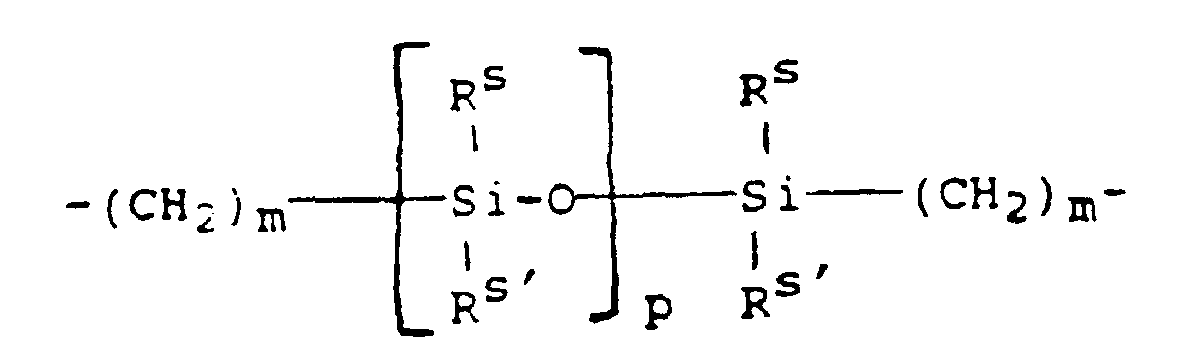 Rs und Rs' unabhängig voneinander eine Alkyl- oder fluorsubstituierte Alkylgruppe mit 1 bis 10 Kohlenstoffatomen bedeuten, die Ätherbindungen zwischen Kohlenstoffatomen enthalten kann,m ≥ 1 ist undp ein Anteilgewicht von 400 bis 10.000 vorsieht,E und E' unabhängig voneinander ein polymerisierbares, ungesättigtes, organisches Radikal bedeuten, dargestellt durch die Formel:worin
 R14 ein zweiwertiges Alkylenradikal mit 1 bis 10 Kohlenstoffatomen bedeutet,R12 H oder CH3 bedeutet,R13 H, ein (C1-C6) Alkylradikal oder eine -CO-Y-R15 Gruppe bedeutet, in der Y -O-, -S- oder -NH- ist und R15 ein Alkylradikal mit 1 bis 12 Kohlenstoffatomen ist,X -CO- oder -OCO- ist,Z -O- oder -NH- ist,Ar ein aromatisches Radikal mit 6 bis 30 Kohlenstoffatomen bedeutet,w 0 bis 6 ist,x 0 oder 1 ist,y 0 oder 1 ist undz 0 oder 1 ist.
 - Eine Zusammensetzung nach Anspruch 27, in der das Prepolymer dargestellt ist durch die Formel:

R16 ein Diradikal eines Diisocyanats nach Beseitigung der Isocyanatgruppe ist, und m, p und a wie in Anspruch 27 definiert sind. - Eine Zusammensetzung nach Anspruch 28, in der R16 das Diradikal von Isophorondiisocyanat ist.
- Eine Zusammensetzung nach irgendeinem der Ansprüche 25-29, in der die Zusammensetzung weiter ein mit (Meth)acrylat oder (Meth)acrylamid verkapptes hydrophiles Monomer umfaßt.
- Eine Zusammensetzung nach Anspruch 30, in der das mit (Meth)acrylat verkappte hydrophile Monomer ausgewählt ist aus Derivaten von Alkylmethacrylaten, 2-Hydroxyethylmethacrylat, Glycerinmethacrylat, Polysiloxanylalkylmethacrylat und Fluoralkylmethacrylat.
- Eine Zusammensetzung nach irgendeinem der Ansprüche 25-31, in der das polysiloxanhaltige Monomer weiter ein fluoralkylhaltiges Monomer, ein fluoräther-haltiges Monomer oder ein alkoholhaltiges Monomer umfaßt.
- Eine Zusammensetzung nach Anspruch 30 oder Anspruch 31, in der besagtes hydrophiles Monomer N,N-Dimethylacrylamid oder sein Derivat oder Methacrylsäure ist.
- Eine Zusammensetzung nach irgendeinem der Ansprüche 25-33, in der das polysiloxanhaltige Monomer ein voluminöses Polysiloxanylalkyl(meth)acryl-Monomer ist mit der Formel:
 X 0 oder NR ist,jedes R unabhängig voneinander Wasserstoff oder Methyl ist undjedes R1 unabhängig voneinander eine niedere Alkyl- oder Phenylgruppe ist, undf 1 oder 3 bis 10 ist.
 - Eine Zusammensetzung nach Anspruch 34, in der das voluminöse Polysiloxanylalkyl(meth)acrylat-Prepolymer ausgewählt ist aus Methacryloxypropyl-Tris (trimethylsiloxy)silan, Pentamethyldisiloxanylmethylmethacrylat, Tris(trimethylsiloxy)methacryloxypropylsilan, Phenyltetramethyldisiloxanylethylacetat und Methyldi(trimethylsiloxy)methacryloxymethylsilan.
- Eine Zusammensetzung nach irgendeinem der Ansprüche 25-35, in der das vinylhaltige Monomer 2-Vinyl-4,4-dimethyl-2-oxazolin-5-on ist.
- Eine Zusammensetzung nach irgendeinem der Ansprüche 25-36, in der das vinylhaltige Monomer ausgewählt ist aus Polysiloxanylalkylvinylkarbonaten, Polysiloxanylalkylvinylkarbamaten, Polysiloxanylalkylvinylkarbamiden, karbonsäurehaltigen Vinylkarbonaten, karbonsäurehaltigen Vinylkarbamaten und karbonsäurehaltigen Vinylkarbamiden.
- Eine Zusammensetzung nach irgendeinem der Ansprüche 25-36, in der das vinylhaltige Monomer ein vinylhaltiges Polysiloxanprepolymer ist.
- Eine Zusammensetzung nach Anspruch 38, in der das vinylhaltige Polysiloxanprepolymer ein silikonhaltiges Vinylkarbonat oder Vinylkarbamat ist, dargestellt durch die Formel:
 Y' -O-, -S- oder -NH- bedeutet,RSi ein silikonhaltiges organisches Radikal bedeutet mit der Formal:
-(CH2)n' Si [(CH2)m'CH3]3,
-(CH2)n' Si [OSI(CH2)m'CH3]3,


R10
bedeutet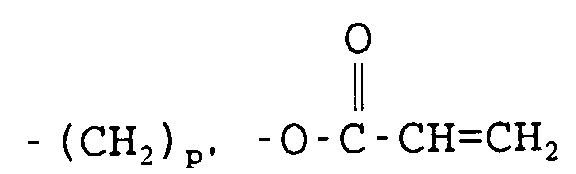 R11 ein Alkylradikal oder ein Fluoralkylradikal mit 1 bis 6 Kohlenstoffatomen bedeutet,e 1 bis 200 ist,n' 1, 2, 3 oder 4 ist, undm' 0, 1, 2, 3, 4 oder 5 ist.R8 Wasserstoff oder Methyl bedeutet,d 1, 2, 3 oder 4 ist, undq 0 oder 1 ist.
 - Eine Zusammensetzung nach Anspruch 39, in der das vinylhaltige Polysiloxanprepolymer ein silikonhaltiges Vinylkarbonat oder -karbamat ist, ausgewählt aus 1,3-Bis[4-vinyloxycarbonyloxy)but-1-yl] tetramethyldisiloxan, 3-(Trimethylsilyl)propylvinyl-Karbonat, 3-(Vinyloxycarbonylthio)propyl[tris(trimethylsiloxy)silan], 3-[Tris(trimethylsiloxy)silyl]propylvinyl-Karbamat, 3-[Tris(trimethylsiloxy)silyl]propylallylkarbamat, 3-[Tris(trimethylsiloxy)silyl]propylvinyl-Karbonat, t-Butyldimethylsiloxyethylvinyl-Karbonat, Trimethylsilylethylvinyl-Karbonat, Trimethylsilylmethylvinyl-Karbonat, und "V2D25" dargestellt ist durch die folgende Formel:

- Eine Zusammensetzung nach Anspruch 39, in der das vinylhaltige Polysiloxanprepolymer Urethan-, Karbamid-, Ester- oder Karbonatbindungen umfaßt.
- Eine Zusammensetzung nach Anspruch 39 oder Anspruch 41, in der das vinylhaltige Polysiloxanprepolymer eine fluoralkylhaltige Gruppe, eine fluorätherhaltige Gruppe oder eine alkoholhaltige Gruppe umfaßt.
- Eine Zusammensetzung nach irgendeinem der Ansprüche 25-42, in der das Vernetzungsmittel ausgewählt ist aus Methacryloxyethylvinylkarbonat, Methacryloxyethylvinylkarbamat und Methacryloxyethylvinylkarbamid.
- Eine Zusammensetzung nach Anspruch 25, in der die Zusammensetzung gebildet ist aus mit Methacrylat verkapptem Polysiloxan, einem Polysiloxanylalkylmethacrylat, N-Vinylpyrrolidon und besagtem Vernetzungsmittel und wahlweise N,N-Dimethylacrylamid und/oder 2-Vinyl-4,4-dimethyl-2-oxazolin-5-on.
- Eine Zusammensetzung nach Anspruch 25, in der die Zusammensetzung ein mit Fluoralkyl modifiziertes, mit Methacrylat verkapptes Polysiloxanprepolymer, eine fluoralkylmethacrylathaltige Gruppe, N-Vinylpyrrolidon und besagtes Vernetzungsmittel und wahlweise 2-Vinyl-4,4-dimethyl-2-oxazolin-5-on umfaßt.
- Eine Zusammensetzung nach Anspruch 25, in der die Zusammensetzung ein mit Methacrylat verkapptes, mit Fluoräther modifiziertes Polysiloxan, ein (meth)acrylatoder (meth) acrylamidhaltiges Monomer, N-Vinylpyrrolidon und besagtes Vernetzungsmittel umfaßt.
- Eine Zusammensetzung nach Anspruch 46, in der das (meth)acrylamidhaltige Monomer N,N-Dimethylacrylamid ist.
- Eine Zusammensetzung nach Anspruch 25, in der die Zusammensetzung ein mit Vinylkarbonat oder Vinylkarbamat verkapptes Polysiloxanprepolymer, ein Polysiloxyanylalkylvinylkarbonat- oder -karbamat-Monomer, N-Vinylpyrrolidon, ein acrylhaltiges Monomer und besagtes Vernetzungsmittel umfaßt.
- Eine Zusammensetzung nach Anspruch 48, in der das polysiloxanprepolymer weiter eine fluoralkylhaltige Gruppe, eine fluorätherhaltige Gruppe oder eine alkoholhaltige Gruppe umfaßt.
- Eine Zusammensetzung nach Anspruch 48 oder Anspruch 49, in der das acrylhaltige Monomer ausgewählt ist aus N,N-Dimethylacrylamid und Glycerinmethacrylat.
- Ein Hydrogel, hergestellt durch Polymerisieren einer Monomermischung, die (i) Methacryloxyethyl-vinylkarbonat, N-Vinylpyrrolidon und Hydroxyethyl-methacrylat, (ii) N-Vinylpyrrolidon, 2-Vinyl-4,4-dimethyl-2-oxazolin-5-on, N,N-Dimethylacrylamid und Methacryloxy-ethylvinylkarbonat oder (iii) α-ω-Bis(methacryloxyalkyl) polysiloxan, 3-Methacryloxypropyltris(trimethyl-siloxy)silan, N-Vinylpyrrolidon und Methacryloxyethylvinyl-karbonat umfaßt.
- Eine aus einer Zusammensetzung nach irgendeinem der Ansprüche 25-50 oder aus einem Hydrogel nach Anspruch 51 hergestellte biomedizinische Vorrichtung.
- Eine Kontaktlinse nach Anspruch 52.
- Eine Methode zum Herstellen eines Hydrogels, die die Schritte(a) Bildung einer Monomermischung, mittels Kombinieren eines acrylhaltigen Monomers, eines vinylhaltigen Monomers und wahlweise eines styrolhaltigen Monomers mit - als ein Vernetzungsmittel - einer Verbindung nach irgendeinem der Ansprüche 1-8,(b) Aushärten der Mischung aus Schritt (a), um ein Polymer zu bilden, und(c) Hydratisieren des in (b) hergestellten Polymers, um ein Hydrogel zu bilden, umfaßt.
- Eine Methode nach Anspruch 54, in der das Hydrogel UV aushärtbar ist.
- Eine Methode nach Anspruch 54 oder Anspruch 55, in der das Vernetzungsmittel Methacryloxyethylvinylkarbonat ist.
- Eine Methode nach Anspruch 56, in der das Hydrogel Methacryloxyethylvinylkarbonat und N-Vinyl-pyrrolidon und entweder (i) Hydroxyethylmethacrylat oder (ii) 2-Vinyl-4,4-dimethyl-2-oxazolin-5-on und N,N-Dimethyl-acrylamid oder (iii) α-ω-Bis(methacryloxyalkyl)polysiloxan und 3-Methacryloxypropyltris(trimethylsiloxy)silan umfaßt.
Applications Claiming Priority (7)
| Application Number | Priority Date | Filing Date | Title |
|---|---|---|---|
| US78807191A | 1991-11-05 | 1991-11-05 | |
| US88448192A | 1992-05-15 | 1992-05-15 | |
| US884481 | 1992-05-15 | ||
| US922452 | 1992-07-30 | ||
| US07/922,452 US5310779A (en) | 1991-11-05 | 1992-07-30 | UV curable crosslinking agents useful in copolymerization |
| PCT/US1992/009539 WO1993009084A1 (en) | 1991-11-05 | 1992-11-03 | Novel uv curable crosslinking agents useful in copolymerization |
| US788071 | 1997-01-23 |
Publications (2)
| Publication Number | Publication Date |
|---|---|
| EP0611367A1 EP0611367A1 (de) | 1994-08-24 |
| EP0611367B1 true EP0611367B1 (de) | 1997-06-25 |
Family
ID=27419849
Family Applications (1)
| Application Number | Title | Priority Date | Filing Date |
|---|---|---|---|
| EP92924307A Expired - Lifetime EP0611367B1 (de) | 1991-11-05 | 1992-11-03 | Neue UV-härtbare Vernetzungsmitteln für Copolymerisation. |
Country Status (12)
| Country | Link |
|---|---|
| US (3) | US5310779A (de) |
| EP (1) | EP0611367B1 (de) |
| JP (3) | JP3490436B2 (de) |
| KR (1) | KR100253617B1 (de) |
| AU (1) | AU664401B2 (de) |
| BR (1) | BR9206886A (de) |
| CA (1) | CA2121577C (de) |
| DE (1) | DE69220577T2 (de) |
| ES (1) | ES2104954T3 (de) |
| HK (1) | HK1001558A1 (de) |
| SG (1) | SG49093A1 (de) |
| WO (1) | WO1993009084A1 (de) |
Cited By (2)
| Publication number | Priority date | Publication date | Assignee | Title |
|---|---|---|---|---|
| EP2695003B1 (de) | 2011-04-01 | 2015-03-18 | Novartis AG | Zusammensetzung zur herstellung einer kontaktlinse |
| EP3834017B1 (de) * | 2018-08-10 | 2023-05-10 | Bausch & Lomb Incorporated | Ophthalmische vorrichtung mit hohem wassergehalt |
Families Citing this family (326)
| Publication number | Priority date | Publication date | Assignee | Title |
|---|---|---|---|---|
| US5034461A (en) | 1989-06-07 | 1991-07-23 | Bausch & Lomb Incorporated | Novel prepolymers useful in biomedical devices |
| US5310779A (en) * | 1991-11-05 | 1994-05-10 | Bausch & Lomb Incorporated | UV curable crosslinking agents useful in copolymerization |
| DE69211152T2 (de) * | 1991-11-05 | 1997-01-02 | Bausch & Lomb | Zusammensetzungen von benetzbaren siliconhydrogels und verfahren zu deren herstellung |
| US5321108A (en) * | 1993-02-12 | 1994-06-14 | Bausch & Lomb Incorporated | Fluorosilicone hydrogels |
| US5374662A (en) * | 1993-03-15 | 1994-12-20 | Bausch & Lomb Incorporated | Fumarate and fumaramide siloxane hydrogel compositions |
| EP0705296A4 (de) * | 1993-06-24 | 1996-07-03 | Sola Int Holdings | Telomerzusammensetzung |
| JP3377266B2 (ja) * | 1993-12-10 | 2003-02-17 | 株式会社メニコン | 軟質眼用レンズ材料 |
| AU1373195A (en) * | 1993-12-21 | 1995-07-10 | Bausch & Lomb Incorporated | Method for increasing hydrophilicity of contact lenses |
| DE4423303C2 (de) * | 1994-07-02 | 2000-05-31 | Woehlk Contact Linsen Gmbh | Hydrophile, vernetzte Copolymere auf der Basis von N-Vinylformamid, Verfahren zu ihrer Herstellung und ihre Verwendung |
| US5760100B1 (en) | 1994-09-06 | 2000-11-14 | Ciba Vision Corp | Extended wear ophthalmic lens |
| US7468398B2 (en) | 1994-09-06 | 2008-12-23 | Ciba Vision Corporation | Extended wear ophthalmic lens |
| US5824719A (en) * | 1995-06-07 | 1998-10-20 | Bausch & Lomb Incorporated | Polymer compositions for contact lenses |
| US5714557A (en) * | 1995-12-07 | 1998-02-03 | Bausch & Lomb Incorporated | Monomeric units useful for reducing the modulus of low water polymeric silicone compositions |
| BR9612119A (pt) * | 1995-12-07 | 1999-02-17 | Bausch & Lomb | Unidade monomérica composição de hidrogel lente de contato e método para produzir uma composição de hidrogel |
| US5919441A (en) * | 1996-04-01 | 1999-07-06 | Colgate-Palmolive Company | Cosmetic composition containing thickening agent of siloxane polymer with hydrogen-bonding groups |
| US5856646A (en) * | 1997-01-09 | 1999-01-05 | Allen-Bradley Company, Llc | Ergonomic palm operated soft touch control with multi-plane sensing pads |
| US6020445A (en) * | 1997-10-09 | 2000-02-01 | Johnson & Johnson Vision Products, Inc. | Silicone hydrogel polymers |
| US5962548A (en) * | 1998-03-02 | 1999-10-05 | Johnson & Johnson Vision Products, Inc. | Silicone hydrogel polymers |
| JP4087947B2 (ja) * | 1998-05-08 | 2008-05-21 | Hoyaヘルスケア株式会社 | ガス透過型ハードコンタクトレンズの製造方法 |
| WO2000002937A1 (en) * | 1998-07-08 | 2000-01-20 | Sunsoft Corporation | Interpenetrating polymer network hydrophilic hydrogels for contact lens |
| US6440571B1 (en) * | 1999-05-20 | 2002-08-27 | Bausch & Lomb Incorporated | Surface treatment of silicone medical devices with reactive hydrophilic polymers |
| HK1048331B (en) | 1999-07-27 | 2004-08-13 | Bausch & Lomb Incorporated | Contact lens material |
| AUPQ197799A0 (en) * | 1999-08-02 | 1999-08-26 | Commonwealth Scientific And Industrial Research Organisation | Hydrophilic biomedical compositions |
| US6488375B2 (en) | 1999-10-28 | 2002-12-03 | Ocular Sciences, Inc. | Tinted contact lens and method for making same |
| US7267846B2 (en) * | 1999-11-01 | 2007-09-11 | Praful Doshi | Tinted lenses and methods of manufacture |
| ATE315795T1 (de) | 1999-11-01 | 2006-02-15 | Praful Doshi | Getönte kontaktlinse aus kunststoff und verfahren zu deren herstellung |
| US6880932B2 (en) * | 1999-11-01 | 2005-04-19 | Praful Doshi | Tinted lenses and methods of manufacture |
| US7048375B2 (en) * | 1999-11-01 | 2006-05-23 | Praful Doshi | Tinted lenses and methods of manufacture |
| JP3929014B2 (ja) | 2000-02-24 | 2007-06-13 | Hoyaヘルスケア株式会社 | 側鎖にポリシロキサン構造を有するマクロマーからなるコンタクトレンズ材料 |
| US6414049B1 (en) * | 2000-03-22 | 2002-07-02 | Johnson & Johnson Vision Care, Inc. | Stable initiator system |
| CA2682118A1 (en) | 2000-03-24 | 2001-09-27 | Novartis Ag | Crosslinkable or polymerizable prepolymers |
| JP3344408B2 (ja) * | 2000-04-13 | 2002-11-11 | ダイソー株式会社 | 硬化性樹脂組成物 |
| US6881209B2 (en) * | 2000-05-25 | 2005-04-19 | Cook Incorporated | Medical device including unitary, continuous portion of varying durometer |
| JP2004512866A (ja) | 2000-09-19 | 2004-04-30 | ボシュ・アンド・ロム・インコーポレイテッド | ポリマーレンズコーティングを適用するための方法 |
| CA2426045A1 (en) * | 2000-10-24 | 2002-05-02 | Bausch & Lomb Incorporated | Prevention of bacterial attachment to biomaterials by cationic polysaccharides |
| US6805836B2 (en) | 2000-12-15 | 2004-10-19 | Bausch & Lomb Incorporated | Prevention of preservative uptake into biomaterials |
| WO2002049613A2 (en) | 2000-12-19 | 2002-06-27 | Bausch & Lomb Incorporated | Method for enhancing integrity of epithelium using retinoic acid |
| US6702983B2 (en) | 2001-05-15 | 2004-03-09 | Bausch & Lomb Incorporated | Low ionic strength method and composition for reducing bacterial attachment to biomaterials |
| US6815074B2 (en) | 2001-05-30 | 2004-11-09 | Novartis Ag | Polymeric materials for making contact lenses |
| US6528464B1 (en) | 2001-08-17 | 2003-03-04 | Bausch & Lomb Incorporated | Composition and method for inhibiting uptake of biguanide antimicrobials by hydrogels |
| US6891010B2 (en) * | 2001-10-29 | 2005-05-10 | Bausch & Lomb Incorporated | Silicone hydrogels based on vinyl carbonate endcapped fluorinated side chain polysiloxanes |
| US20030165015A1 (en) * | 2001-12-05 | 2003-09-04 | Ocular Sciences, Inc. | Coated contact lenses and methods for making same |
| US6936641B2 (en) * | 2002-06-25 | 2005-08-30 | Johnson & Johnson Vision Care, Inc. | Macromer forming catalysts |
| US20040075039A1 (en) * | 2002-08-16 | 2004-04-22 | Dubey Dharmesh K. | Molds for producing contact lenses |
| US6958169B2 (en) * | 2002-12-17 | 2005-10-25 | Bausch & Lomb Incorporated | Surface treatment of medical device |
| AU2003297323A1 (en) * | 2002-12-23 | 2004-07-22 | Bausch And Lomb Incorporated | Surface treatment utilizing microwave radiation |
| US7084188B2 (en) | 2003-12-05 | 2006-08-01 | Bausch & Lomb Incorporated | Surface modification of contact lenses |
| US7176268B2 (en) * | 2003-12-05 | 2007-02-13 | Bausch & Lomb Incorporated | Prepolymers for improved surface modification of contact lenses |
| US20050153055A1 (en) * | 2003-12-22 | 2005-07-14 | Bausch & Lomb Incorporated | Surface treatment utilizing supercritical fluid |
| WO2005073181A1 (en) * | 2004-01-28 | 2005-08-11 | Bausch & Lomb Incorporated | Vinylchloroformate-free synthesis of vinyl and allyl(thio)carbamates |
| US7411029B2 (en) * | 2004-06-25 | 2008-08-12 | Bausch & Lomb Incorporated | Prepolymers for improved surface modification of contact lenses |
| US9248614B2 (en) * | 2004-06-30 | 2016-02-02 | Novartis Ag | Method for lathing silicone hydrogel lenses |
| US20060051454A1 (en) * | 2004-08-26 | 2006-03-09 | Ansell Scott F | Molds for producing ophthalmic lenses |
| US20060067981A1 (en) * | 2004-09-29 | 2006-03-30 | Bausch & Lomb Incorporated | Contact lens with improved biocidal activity and related methods and materials |
| US8197841B2 (en) | 2004-12-22 | 2012-06-12 | Bausch & Lomb Incorporated | Polymerizable surfactants and their use as device forming comonomers |
| US20060130881A1 (en) * | 2004-12-21 | 2006-06-22 | Sanjay Rastogi | Method of cleaning optical tools for making contact lens molds using super-cooled fluids |
| WO2006069207A1 (en) * | 2004-12-22 | 2006-06-29 | Bausch & Lomb Incorporated | Pre-polymer extraction using a super-cooled fluid |
| EP1838748B1 (de) * | 2004-12-29 | 2009-03-11 | Bausch & Lomb Incorporated | Polysiloxanprepolymere für biomedizinische vorrichtungen |
| US20060142525A1 (en) * | 2004-12-29 | 2006-06-29 | Bausch & Lomb Incorporated | Hydrogel copolymers for biomedical devices |
| MX2007007805A (es) * | 2004-12-29 | 2007-09-14 | Bausch & Lomb | Prepolimeros de polisiloxano para dispositivos biomedicos. |
| WO2007002669A1 (en) * | 2005-06-28 | 2007-01-04 | Bausch & Lomb Incorporated | In-eye method of cleaning and/or disinfecting silicone hydrogel contact lenses |
| WO2007002343A2 (en) * | 2005-06-28 | 2007-01-04 | Bausch & Lomb Incorporated | Novel system for synthesis of device forming monomers |
| CA2618035A1 (en) * | 2005-08-10 | 2007-02-15 | Novartis Ag | Silicone hydrogels |
| US20070048349A1 (en) * | 2005-08-29 | 2007-03-01 | Bausch & Lomb Incorporated | Surface-modified medical devices and methods of making |
| US7390863B2 (en) * | 2005-08-30 | 2008-06-24 | Bausch & Lomb Incorporated | Polymeric materials having enhanced ion and water transport property and medical devices comprising same |
| US20070087113A1 (en) * | 2005-10-19 | 2007-04-19 | Bausch & Lomb Incorporated | Surface-modified medical devices and method of making |
| US20070092830A1 (en) * | 2005-10-24 | 2007-04-26 | Bausch & Lomb Incorporated | Polymeric radiation-absorbing materials and ophthalmic devices comprising same |
| US20070116741A1 (en) * | 2005-11-21 | 2007-05-24 | Bausch & Lomb Incorporated | Contact lenses with mucin affinity |
| US7988988B2 (en) * | 2005-11-21 | 2011-08-02 | Bausch & Lomb Incorporated | Contact lenses with mucin affinity |
| US20070120279A1 (en) * | 2005-11-29 | 2007-05-31 | Bausch & Lomb Incorporated | Method for coating lens material |
| US20070122540A1 (en) * | 2005-11-29 | 2007-05-31 | Bausch & Lomb Incorporated | Coatings on ophthalmic lenses |
| US20070123602A1 (en) * | 2005-11-29 | 2007-05-31 | Bausch & Lomb Incorporated | Use of thermal reversible associations for enhanced polymer interactions |
| US20070132125A1 (en) * | 2005-12-08 | 2007-06-14 | Bausch & Lomb Incorporated | Use of a super-cooled fluid in lens processing |
| US20070132119A1 (en) * | 2005-12-08 | 2007-06-14 | Bausch & Lomb Incorporated | Use of a super-cooled fluid in the manufacture of contact lenses |
| US20070132121A1 (en) * | 2005-12-08 | 2007-06-14 | Bausch & Lomb Incorporated | Method of cleaning molds using super-cooled fluids |
| US20070132120A1 (en) * | 2005-12-08 | 2007-06-14 | Bausch & Lomb Incorporated | Preferential release of an ophthalmic lens using a super-cooled fluid |
| US7544371B2 (en) * | 2005-12-20 | 2009-06-09 | Bausch + Lomb Incorporated | Drug delivery systems |
| US20070138668A1 (en) * | 2005-12-21 | 2007-06-21 | Yu-Chin Lai | Process for Extracting Biomedical Devices |
| US20070138669A1 (en) * | 2005-12-21 | 2007-06-21 | Yu-Chin Lai | Process for Casting and Extracting Biomedical Devices |
| US20070148244A1 (en) * | 2005-12-22 | 2007-06-28 | Kunzler Jay F | Drug delivery systems |
| US7727545B2 (en) * | 2006-02-22 | 2010-06-01 | Bausch & Lomb Incorporated | Polymeric fluorinated dioxole and medical devices comprising same |
| US7576159B2 (en) * | 2006-04-28 | 2009-08-18 | Bausch & Lomb Incorporated | Gas-permeable materials and medical devices |
| US20070264503A1 (en) * | 2006-05-11 | 2007-11-15 | Yu-Chin Lai | Polymers comprising polyhydric alcohols, medical devices modified with same, and method of making |
| US8231218B2 (en) | 2006-06-15 | 2012-07-31 | Coopervision International Holding Company, Lp | Wettable silicone hydrogel contact lenses and related compositions and methods |
| JP2008020918A (ja) * | 2006-06-15 | 2008-01-31 | Coopervision Internatl Holding Co Lp | 湿潤性シリコーンヒドロゲルコンタクトレンズ及び関連組成物及び方法 |
| US20080002146A1 (en) * | 2006-06-28 | 2008-01-03 | Stachowski Mark J | Biocompatible, surface modified materials |
| US20080003252A1 (en) * | 2006-06-30 | 2008-01-03 | Yu-Chin Lai | Functionalized hydrophilic macromonomers and medical devices incorporating same |
| US20080003259A1 (en) * | 2006-06-30 | 2008-01-03 | Salamone Joseph C | Modification of surfaces of polymeric articles by Michael addition reaction |
| US20080004410A1 (en) * | 2006-06-30 | 2008-01-03 | Yu-Chin Lai | Hydrophilic macromonomers having alpha,beta-conjugated carboxylic terminal group and medical devices incorporating same |
| US20080110770A1 (en) * | 2006-11-10 | 2008-05-15 | Bausch & Lomb Incorporated | Packaging solutions |
| JP5669396B2 (ja) | 2006-12-13 | 2015-02-12 | ノバルティス アーゲー | 化学線硬化性シリコーンヒドロゲルコポリマーおよびその使用 |
| US7625598B2 (en) * | 2006-12-15 | 2009-12-01 | Bausch & Lomb Incorporated | Silicone contact lenses with wrinkled surface |
| US20080142038A1 (en) * | 2006-12-15 | 2008-06-19 | Bausch & Lomb Incorporated | Surface treatment of medical devices |
| ATE491479T1 (de) | 2006-12-15 | 2011-01-15 | Bausch & Lomb | Oberflächenbehandlung biomedizinischer vorrichtungen |
| US20080141628A1 (en) * | 2006-12-15 | 2008-06-19 | Bausch & Lomb Incorporated | Packaging Solutions |
| US20080143955A1 (en) * | 2006-12-15 | 2008-06-19 | Bausch & Lomb Incorporated | Silicone Contact Lenses with Silicate Coating |
| US20080151181A1 (en) * | 2006-12-20 | 2008-06-26 | Bausch & Lomb Incorporated | Coatings and Solutions for Contact Lenses |
| US7832856B2 (en) * | 2006-12-20 | 2010-11-16 | Bausch & Lomb Incorporated | Coatings and solutions for contact lenses |
| US20080148689A1 (en) | 2006-12-20 | 2008-06-26 | Bausch & Lomb Incorporated | Packaging solutions |
| US20080206481A1 (en) * | 2007-02-26 | 2008-08-28 | Bausch & Lomb Incorporated | Silicone contact lenses with wrinkled surface |
| CN101663340B (zh) * | 2007-03-15 | 2011-11-30 | 帝斯曼知识产权资产管理有限公司 | 新型pdms-pvp嵌段共聚物 |
| US8071703B2 (en) | 2007-03-22 | 2011-12-06 | Novartis Ag | Silicone-containing prepolymers with dangling hydrophilic polymer chains |
| KR101482808B1 (ko) * | 2007-03-22 | 2015-01-14 | 노파르티스 아게 | 현수 폴리실록산-함유 중합체 사슬이 있는 예비중합체 |
| US7935770B2 (en) | 2007-07-03 | 2011-05-03 | Bausch & Lomb Incorporated | Surface active prepolymers with both fluorine-containing groups and hydrophilic groups |
| ES2793576T3 (es) * | 2007-07-10 | 2020-11-16 | Bausch & Lomb | Agentes de entrecruzamiento y su uso |
| ES2365290T3 (es) * | 2007-07-25 | 2011-09-28 | Alcon, Inc. | Materiales para dispositivo oftálmico de alto índice de refracción. |
| US8037415B1 (en) | 2007-09-21 | 2011-10-11 | United Services Automobile Association (Usaa) | Systems, methods, and computer readable media for managing a hosts file |
| WO2009045886A1 (en) * | 2007-10-03 | 2009-04-09 | Bausch & Lomb Incorporated | Novel polymerizable surface active monomers with both fluorine-containing groups and hydrophilic groups |
| US8490782B2 (en) | 2007-10-23 | 2013-07-23 | Bausch & Lomb Incorporated | Packaging solutions |
| US20090108479A1 (en) * | 2007-10-26 | 2009-04-30 | Bausch & Lomb Incorporated | Method for Making Biomedical Devices |
| US7884141B2 (en) * | 2007-11-14 | 2011-02-08 | Bausch & Lomb Incorporated | Biomedical devices |
| WO2009070443A1 (en) * | 2007-11-29 | 2009-06-04 | Bausch & Lomb Incorporated | Process for making biomedical devices |
| US8044111B2 (en) | 2007-11-30 | 2011-10-25 | Novartis Ag | Actinically-crosslinkable silicone-containing block copolymers |
| US7934830B2 (en) | 2007-12-03 | 2011-05-03 | Bausch & Lomb Incorporated | High water content silicone hydrogels |
| EP2232304B1 (de) | 2007-12-10 | 2012-04-04 | Novartis AG | Verfahren zur herstellung von silikonhydrogel-kontaktlinsen |
| US20090145091A1 (en) * | 2007-12-11 | 2009-06-11 | Richard Connolly | Method for treating ophthalmic lenses |
| WO2009079223A1 (en) | 2007-12-14 | 2009-06-25 | Bausch & Lomb Incorporated | Surface modified biomedical devices |
| WO2009079224A2 (en) * | 2007-12-14 | 2009-06-25 | Bausch & Lomb Incorporated | Surface modified biomedical devices |
| JP2011507563A (ja) * | 2007-12-14 | 2011-03-10 | ボーシュ アンド ローム インコーポレイティド | バイオメディカルデバイス |
| WO2009079559A1 (en) * | 2007-12-17 | 2009-06-25 | University Of Florida Research Foundation, Inc. | Dry eye treatment by puncta plugs |
| EP2597113A1 (de) | 2007-12-27 | 2013-05-29 | Bausch & Lomb Incorporated | Beschichtungslösungen mit segmentierten reaktiven Blockcopolymeren |
| WO2009085756A1 (en) | 2007-12-27 | 2009-07-09 | Bausch & Lomb Incorporated | Coating solutions comprising segmented interactive block copolymers |
| US20090168013A1 (en) * | 2007-12-27 | 2009-07-02 | Kunzler Jay F | Trimethylsilyl-Capped Polysiloxane Macromonomers Containing Polar Fluorinated Side-Chains |
| US20090171049A1 (en) * | 2007-12-27 | 2009-07-02 | Linhardt Jeffrey G | Segmented reactive block copolymers |
| US20090173045A1 (en) * | 2008-01-09 | 2009-07-09 | Yu-Chin Lai | Packaging Solutions |
| US7837934B2 (en) * | 2008-01-09 | 2010-11-23 | Bausch & Lomb Incorporated | Packaging solutions |
| US20090173643A1 (en) * | 2008-01-09 | 2009-07-09 | Yu-Chin Lai | Packaging Solutions |
| US8030423B2 (en) * | 2008-01-25 | 2011-10-04 | Salamone Joseph C | Multi-armed macromonomers |
| US20100069522A1 (en) * | 2008-03-17 | 2010-03-18 | Linhardt Jeffrey G | Lenses comprising amphiphilic multiblock copolymers |
| US7939579B1 (en) | 2008-07-09 | 2011-05-10 | Contamac Limited | Hydrogels and methods of manufacture |
| US8440738B2 (en) | 2008-07-09 | 2013-05-14 | Timothy Higgs | Silicone hydrogels and methods of manufacture |
| JP5748224B2 (ja) * | 2008-11-13 | 2015-07-15 | ノバルティス アーゲー | 化学結合した湿潤剤を有するシリコーンハイドロゲル材料 |
| RU2524946C2 (ru) * | 2008-11-13 | 2014-08-10 | Новартис Аг | Сополимеры полисилоксана с гидрофильными полимерными концевыми цепочками |
| US20100149482A1 (en) * | 2008-12-12 | 2010-06-17 | Ammon Jr Daniel M | Contact lens |
| US20100168851A1 (en) * | 2008-12-30 | 2010-07-01 | David Paul Vanderbilt | Surface Modified Biomedical Devices |
| WO2010077646A2 (en) * | 2008-12-30 | 2010-07-08 | Bausch & Lomb Incorporated | Method of applying renewable polymeric lens coating |
| US8534031B2 (en) | 2008-12-30 | 2013-09-17 | Bausch & Lomb Incorporated | Packaging solutions |
| WO2010077708A1 (en) | 2008-12-30 | 2010-07-08 | Bausch & Lomb Incorporated | Packaging solutions |
| WO2010077709A2 (en) | 2008-12-30 | 2010-07-08 | Bausch & Lomb Incorporated | Biomedical devices |
| US8454689B2 (en) * | 2008-12-30 | 2013-06-04 | Bausch & Lomb Incorporated | Brush copolymers |
| US8419792B2 (en) | 2008-12-30 | 2013-04-16 | Bausch & Lomb Incorporated | Brush copolymers |
| CA2760747C (en) * | 2009-05-22 | 2016-12-13 | Novartis Ag | Actinically-crosslinkable siloxane-containing copolymers |
| EP2432821B1 (de) * | 2009-05-22 | 2017-08-30 | Novartis AG | Aktinisch vernetzbare siloxan-haltige copolymere |
| US9285508B2 (en) | 2009-06-16 | 2016-03-15 | Bausch & Lomb Incorporated | Biomedical devices |
| US8043369B2 (en) | 2009-06-16 | 2011-10-25 | Bausch & Lomb Incorporated | Biomedical devices |
| US8083348B2 (en) | 2009-06-16 | 2011-12-27 | Bausch & Lomb Incorporated | Biomedical devices |
| US8133960B2 (en) * | 2009-06-16 | 2012-03-13 | Bausch & Lomb Incorporated | Biomedical devices |
| US20100315588A1 (en) | 2009-06-16 | 2010-12-16 | Bausch & Lomb Incorporated | Biomedical devices |
| MY158359A (en) * | 2009-09-15 | 2016-09-30 | Novartis Ag | Prepolymers suitable for making ultra-violet absorbing contact lenses |
| US8011517B2 (en) * | 2009-11-24 | 2011-09-06 | International Business Machines Corporation | Composite membranes with performance enhancing layers |
| US8353410B2 (en) * | 2009-11-24 | 2013-01-15 | International Business Machines Corporation | Polymeric films made from polyhedral oligomeric silsesquioxane (POSS) and a hydrophilic comonomer |
| DE102009058297A1 (de) | 2009-12-01 | 2011-06-09 | Fraunhofer-Gesellschaft zur Förderung der angewandten Forschung e.V. | N-Allylcarbamat-Verbindungen und deren Verwendung, insbesondere in strahlungshärtenden Beschichtungen |
| JP5720103B2 (ja) * | 2010-03-18 | 2015-05-20 | 東レ株式会社 | シリコーンハイドロゲル、眼用レンズおよびコンタクトレンズ |
| US8557940B2 (en) | 2010-07-30 | 2013-10-15 | Novartis Ag | Amphiphilic polysiloxane prepolymers and uses thereof |
| JP5852659B2 (ja) | 2010-10-06 | 2016-02-03 | ノバルティス アーゲー | 水処理可能なシリコーン含有プレポリマー及びその使用 |
| US8835525B2 (en) | 2010-10-06 | 2014-09-16 | Novartis Ag | Chain-extended polysiloxane crosslinkers with dangling hydrophilic polymer chains |
| CA2813469C (en) | 2010-10-06 | 2016-01-12 | Novartis Ag | Polymerizable chain-extended polysiloxanes with pendant hydrophilic groups |
| US8273914B1 (en) | 2011-06-27 | 2012-09-25 | Bausch & Lomb Incorporated | Process for preparing vinyl chloroformate |
| US8895104B2 (en) | 2011-07-01 | 2014-11-25 | International Business Machines Corporation | Thin film composite membranes embedded with molecular cage compounds |
| CN102382230B (zh) * | 2011-08-10 | 2013-03-20 | 浙江理工大学 | 一种含乙烯基的三硫代碳酸酯化合物及其制备方法和应用 |
| US9594188B2 (en) | 2011-12-06 | 2017-03-14 | University Of Florida Research Foundation, Inc. | UV blocker loaded contact lenses |
| CA2859195C (en) | 2011-12-14 | 2016-09-27 | Semprus Biosciences Corp. | Imbibing process for contact lens surface modification |
| US9000063B2 (en) | 2011-12-14 | 2015-04-07 | Semprus Biosciences Corporation | Multistep UV process to create surface modified contact lenses |
| WO2013090790A1 (en) | 2011-12-14 | 2013-06-20 | Semprus Biosciences Corp. | Silicone hydrogel contact lens modified using lanthanide or transition metal oxidants |
| US9120119B2 (en) | 2011-12-14 | 2015-09-01 | Semprus Biosciences Corporation | Redox processes for contact lens modification |
| CA2858730C (en) | 2011-12-14 | 2017-07-18 | Semprus Biosciences Corp. | Surface modified contact lenses |
| US8798332B2 (en) | 2012-05-15 | 2014-08-05 | Google Inc. | Contact lenses |
| US9523865B2 (en) | 2012-07-26 | 2016-12-20 | Verily Life Sciences Llc | Contact lenses with hybrid power sources |
| US9158133B1 (en) | 2012-07-26 | 2015-10-13 | Google Inc. | Contact lens employing optical signals for power and/or communication |
| US8857981B2 (en) | 2012-07-26 | 2014-10-14 | Google Inc. | Facilitation of contact lenses with capacitive sensors |
| US9298020B1 (en) | 2012-07-26 | 2016-03-29 | Verily Life Sciences Llc | Input system |
| US8919953B1 (en) | 2012-08-02 | 2014-12-30 | Google Inc. | Actuatable contact lenses |
| US9696564B1 (en) | 2012-08-21 | 2017-07-04 | Verily Life Sciences Llc | Contact lens with metal portion and polymer layer having indentations |
| US9111473B1 (en) | 2012-08-24 | 2015-08-18 | Google Inc. | Input system |
| US8820934B1 (en) | 2012-09-05 | 2014-09-02 | Google Inc. | Passive surface acoustic wave communication |
| US20140192315A1 (en) | 2012-09-07 | 2014-07-10 | Google Inc. | In-situ tear sample collection and testing using a contact lens |
| US9398868B1 (en) | 2012-09-11 | 2016-07-26 | Verily Life Sciences Llc | Cancellation of a baseline current signal via current subtraction within a linear relaxation oscillator-based current-to-frequency converter circuit |
| US10010270B2 (en) | 2012-09-17 | 2018-07-03 | Verily Life Sciences Llc | Sensing system |
| US9326710B1 (en) | 2012-09-20 | 2016-05-03 | Verily Life Sciences Llc | Contact lenses having sensors with adjustable sensitivity |
| US8960898B1 (en) | 2012-09-24 | 2015-02-24 | Google Inc. | Contact lens that restricts incoming light to the eye |
| US8870370B1 (en) | 2012-09-24 | 2014-10-28 | Google Inc. | Contact lens that facilitates antenna communication via sensor impedance modulation |
| US8979271B2 (en) | 2012-09-25 | 2015-03-17 | Google Inc. | Facilitation of temperature compensation for contact lens sensors and temperature sensing |
| US20140088372A1 (en) | 2012-09-25 | 2014-03-27 | Google Inc. | Information processing method |
| US8989834B2 (en) | 2012-09-25 | 2015-03-24 | Google Inc. | Wearable device |
| US8985763B1 (en) | 2012-09-26 | 2015-03-24 | Google Inc. | Contact lens having an uneven embedded substrate and method of manufacture |
| US8960899B2 (en) | 2012-09-26 | 2015-02-24 | Google Inc. | Assembling thin silicon chips on a contact lens |
| US8821811B2 (en) | 2012-09-26 | 2014-09-02 | Google Inc. | In-vitro contact lens testing |
| US9884180B1 (en) | 2012-09-26 | 2018-02-06 | Verily Life Sciences Llc | Power transducer for a retinal implant using a contact lens |
| US9063351B1 (en) | 2012-09-28 | 2015-06-23 | Google Inc. | Input detection system |
| US8965478B2 (en) | 2012-10-12 | 2015-02-24 | Google Inc. | Microelectrodes in an ophthalmic electrochemical sensor |
| US9176332B1 (en) | 2012-10-24 | 2015-11-03 | Google Inc. | Contact lens and method of manufacture to improve sensor sensitivity |
| US9757056B1 (en) | 2012-10-26 | 2017-09-12 | Verily Life Sciences Llc | Over-molding of sensor apparatus in eye-mountable device |
| US8967799B2 (en) | 2012-12-20 | 2015-03-03 | Bausch & Lomb Incorporated | Method of preparing water extractable silicon-containing biomedical devices |
| KR20150107844A (ko) | 2013-01-15 | 2015-09-23 | 메디? 압쌜믹 (씨와이) 리미티드 | 바이오아날로직 안내 렌즈 |
| US8874182B2 (en) | 2013-01-15 | 2014-10-28 | Google Inc. | Encapsulated electronics |
| US10441676B2 (en) | 2013-01-15 | 2019-10-15 | Medicem Institute s.r.o. | Light-adjustable hydrogel and bioanalogic intraocular lens |
| US9289954B2 (en) | 2013-01-17 | 2016-03-22 | Verily Life Sciences Llc | Method of ring-shaped structure placement in an eye-mountable device |
| US9636016B1 (en) | 2013-01-25 | 2017-05-02 | Verily Life Sciences Llc | Eye-mountable devices and methods for accurately placing a flexible ring containing electronics in eye-mountable devices |
| US20140209481A1 (en) | 2013-01-25 | 2014-07-31 | Google Inc. | Standby Biasing Of Electrochemical Sensor To Reduce Sensor Stabilization Time During Measurement |
| US9161712B2 (en) | 2013-03-26 | 2015-10-20 | Google Inc. | Systems and methods for encapsulating electronics in a mountable device |
| US9113829B2 (en) | 2013-03-27 | 2015-08-25 | Google Inc. | Systems and methods for encapsulating electronics in a mountable device |
| US20140371560A1 (en) | 2013-06-14 | 2014-12-18 | Google Inc. | Body-Mountable Devices and Methods for Embedding a Structure in a Body-Mountable Device |
| US9084561B2 (en) | 2013-06-17 | 2015-07-21 | Google Inc. | Symmetrically arranged sensor electrodes in an ophthalmic electrochemical sensor |
| US9948895B1 (en) | 2013-06-18 | 2018-04-17 | Verily Life Sciences Llc | Fully integrated pinhole camera for eye-mountable imaging system |
| US9685689B1 (en) | 2013-06-27 | 2017-06-20 | Verily Life Sciences Llc | Fabrication methods for bio-compatible devices |
| JP6183006B2 (ja) * | 2013-06-28 | 2017-08-23 | 東洋インキScホールディングス株式会社 | 光学的立体造形用樹脂組成物、及び立体造形物 |
| US9307901B1 (en) | 2013-06-28 | 2016-04-12 | Verily Life Sciences Llc | Methods for leaving a channel in a polymer layer using a cross-linked polymer plug |
| US9492118B1 (en) | 2013-06-28 | 2016-11-15 | Life Sciences Llc | Pre-treatment process for electrochemical amperometric sensor |
| US9028772B2 (en) | 2013-06-28 | 2015-05-12 | Google Inc. | Methods for forming a channel through a polymer layer using one or more photoresist layers |
| US9814387B2 (en) | 2013-06-28 | 2017-11-14 | Verily Life Sciences, LLC | Device identification |
| US9572522B2 (en) | 2013-12-20 | 2017-02-21 | Verily Life Sciences Llc | Tear fluid conductivity sensor |
| US9654674B1 (en) | 2013-12-20 | 2017-05-16 | Verily Life Sciences Llc | Image sensor with a plurality of light channels |
| US9366570B1 (en) | 2014-03-10 | 2016-06-14 | Verily Life Sciences Llc | Photodiode operable in photoconductive mode and photovoltaic mode |
| US9184698B1 (en) | 2014-03-11 | 2015-11-10 | Google Inc. | Reference frequency from ambient light signal |
| US9789655B1 (en) | 2014-03-14 | 2017-10-17 | Verily Life Sciences Llc | Methods for mold release of body-mountable devices including microelectronics |
| AU2015201321A1 (en) | 2014-03-31 | 2015-10-15 | Johnson & Johnson Vision Care, Inc. | Silicone acrylamide copolymer |
| GB201407397D0 (en) | 2014-04-28 | 2014-06-11 | Fujifilm Mfg Europe Bv | Curable compositions and membranes |
| JP6843047B2 (ja) | 2014-12-05 | 2021-03-17 | ユニバーシティ オブ フロリダ リサーチ ファンデーション インコーポレーティッド | 支持体として相変化物質を用いた3d印刷 |
| US11007705B2 (en) | 2015-02-13 | 2021-05-18 | University Of Florida Research Foundation, Inc. | High speed 3D printing system for wound and tissue replacement |
| US11390835B2 (en) | 2015-05-08 | 2022-07-19 | University Of Florida Research Foundation, Inc. | Growth media for three-dimensional cell culture |
| US10160854B1 (en) | 2015-08-03 | 2018-12-25 | Gl Chemtec Vision Inc. | Hydrogel materials |
| WO2017040981A1 (en) | 2015-09-03 | 2017-03-09 | University Of Florida Research Foundation, Inc. | Valve incorporating temporary phase change material |
| WO2017096263A1 (en) * | 2015-12-04 | 2017-06-08 | University Of Florida Research Foundation, Incorporated | Crosslinkable or functionalizable polymers for 3d printing of soft materials |
| EP3390498B1 (de) | 2015-12-15 | 2021-05-26 | Alcon Inc. | Hydrophilierte polydiorganosiloxanvinylvernetzer und verwendungen davon |
| EP3390497B1 (de) | 2015-12-15 | 2021-01-20 | Alcon Inc. | Polymerisierbare polysiloxane mit hydrophilen substituenten |
| WO2017103792A1 (en) | 2015-12-15 | 2017-06-22 | Novartis Ag | Amphiphilic branched polydiorganosiloxane macromers |
| AU2017283194A1 (en) * | 2016-06-23 | 2019-01-17 | Medicem Institute s.r.o. | Light-adjustable hydrogel and bioanalogic intraocular lens |
| US11021558B2 (en) | 2016-08-05 | 2021-06-01 | Johnson & Johnson Vision Care, Inc. | Polymer compositions containing grafted polymeric networks and processes for their preparation and use |
| US10919853B2 (en) | 2016-08-09 | 2021-02-16 | Gl Chemtec Vision Inc. | Cross-linking agent(s) |
| US11124644B2 (en) | 2016-09-01 | 2021-09-21 | University Of Florida Research Foundation, Inc. | Organic microgel system for 3D printing of silicone structures |
| WO2018055491A1 (en) | 2016-09-20 | 2018-03-29 | Novartis Ag | Process for producing contact lenses with durable lubricious coatings thereon |
| WO2018069815A1 (en) | 2016-10-11 | 2018-04-19 | Novartis Ag | Chain-extended polydimethylsiloxane vinylic crosslinkers and uses thereof |
| WO2018069816A1 (en) | 2016-10-11 | 2018-04-19 | Novartis Ag | Polymerizable polydimethylsiloxane-polyoxyalkylene block copolymers |
| WO2018224974A1 (en) | 2017-06-07 | 2018-12-13 | Novartis Ag | Method for producing silicone hydrogel contact lenses |
| WO2018224975A1 (en) | 2017-06-07 | 2018-12-13 | Novartis Ag | Silicone hydrogel contact lenses |
| EP4481478A3 (de) | 2017-06-07 | 2025-03-26 | Alcon Inc. | Silikonhydrogel-kontaktlinsen |
| EP3676082A1 (de) | 2017-08-29 | 2020-07-08 | Alcon Inc. | Giessverfahren zur herstellung von kontaktlinsen |
| CN117492228A (zh) | 2017-12-13 | 2024-02-02 | 爱尔康公司 | 周抛和月抛水梯度接触镜片 |
| HUE059157T2 (hu) | 2018-01-22 | 2022-10-28 | Alcon Inc | Formaöntéses eljárás UV-t elnyelõ kontaktlencse elõállítására |
| WO2019147425A1 (en) | 2018-01-26 | 2019-08-01 | Bausch & Lomb Incorporated | Method for end-capping a polysiloxane prepolymer |
| US10961341B2 (en) * | 2018-01-30 | 2021-03-30 | Johnson & Johnson Vision Care, Inc. | Ophthalmic devices derived from grafted polymeric networks and processes for their preparation and use |
| US11034789B2 (en) | 2018-01-30 | 2021-06-15 | Johnson & Johnson Vision Care, Inc. | Ophthalmic devices containing localized grafted networks and processes for their preparation and use |
| WO2019162881A1 (en) | 2018-02-26 | 2019-08-29 | Novartis Ag | Silicone hydrogel contact lenses |
| US11427685B2 (en) | 2018-03-28 | 2022-08-30 | Alcon Inc. | Method for making silicone hydrogel contact lenses |
| US11066530B2 (en) | 2018-05-01 | 2021-07-20 | Bausch & Lomb Incorporated | Ophthalmic devices containing UV blocker and methods for their preparation |
| WO2019221838A1 (en) * | 2018-05-15 | 2019-11-21 | Bausch & Lomb Incorporated | Water extractable ophthalmic devices |
| SG11202009913UA (en) | 2018-06-04 | 2020-12-30 | Alcon Inc | Method for making silicone hydrogel contact lenses |
| WO2019234593A1 (en) | 2018-06-04 | 2019-12-12 | Alcon Inc. | Method for producing silicone hydrogel contact lenses |
| MY202143A (en) | 2018-06-04 | 2024-04-05 | Alcon Inc | Method for producing silicone hydrogel contact lenses |
| EP3818401B1 (de) * | 2018-07-03 | 2024-10-30 | Bausch & Lomb Incorporated | Wasserextrahierbare ophthalmische vorrichtungen |
| US10816698B2 (en) | 2018-08-10 | 2020-10-27 | Bausch & Lomb Incorporated | High water content ophthalmic devices |
| JP7357056B2 (ja) * | 2018-08-10 | 2023-10-05 | ボシュ・アンド・ロム・インコーポレイテッド | 眼科用デバイス |
| WO2020100090A1 (en) | 2018-11-15 | 2020-05-22 | Alcon Inc. | Contact lens with phosphorylcholine-modified polyvinylalcohols therein |
| MY208061A (en) | 2018-12-03 | 2025-04-11 | Alcon Inc | Method for making coated silicone hydrogel contact lenses |
| WO2020115569A1 (en) | 2018-12-03 | 2020-06-11 | Alcon Inc. | Method for coated silicone hydrogel contact lenses |
| JP7492966B2 (ja) | 2019-01-29 | 2024-05-30 | ボシュ・アンド・ロム・インコーポレイテッド | コンタクトレンズのための包装溶液 |
| KR102793214B1 (ko) | 2019-01-30 | 2025-04-08 | 보오슈 앤드 롬 인코포레이팃드 | 가교화 중합체 망상구조물 및 이의 용도 |
| WO2020208576A1 (en) | 2019-04-10 | 2020-10-15 | Alcon Inc. | Method for producing coated contact lenses |
| US11673974B2 (en) | 2019-04-29 | 2023-06-13 | Bausch & Lomb Incorporated | Glycophospholipid polymeric network and use thereof |
| SG11202111035WA (en) | 2019-05-13 | 2021-11-29 | Alcon Inc | Method for producing photochromic contact lenses |
| MY206069A (en) | 2019-05-28 | 2024-11-27 | Alcon Inc | Pad transfer printing method for making colored contact lenses |
| WO2020240440A1 (en) | 2019-05-28 | 2020-12-03 | Alcon Inc. | Method for making opaque colored silicone hydrogel contact lenses |
| US11795320B2 (en) | 2019-09-20 | 2023-10-24 | Bausch + Lomb Ireland Limited | Grafted polymer and use thereof |
| HUE069794T2 (hu) | 2019-11-04 | 2025-04-28 | Alcon Inc | Eljárás különbözõ puhaságú felületekkel rendelkezõ kontaktlencsék elõállítására |
| KR20250007692A (ko) | 2019-12-16 | 2025-01-14 | 알콘 인코포레이티드 | 습윤성 실리콘 히드로겔 콘택트 렌즈 |
| WO2021181307A1 (en) | 2020-03-11 | 2021-09-16 | Alcon Inc. | Photochromic polydiorganosiloxane vinylic crosslinkers |
| JP7629024B2 (ja) | 2020-03-19 | 2025-02-12 | アルコン インク. | 埋込式コンタクトレンズ用の高屈折率シロキサンインサート材料 |
| JP7534430B2 (ja) | 2020-03-19 | 2024-08-14 | アルコン インク. | 埋込式シリコーンヒドロゲルコンタクトレンズ |
| EP4121801B1 (de) | 2020-03-19 | 2024-04-17 | Alcon Inc. | Einsatzmaterialien mit hoher sauerstoffdurchlässigkeit und hohem brechungsindex |
| WO2021186380A1 (en) | 2020-03-19 | 2021-09-23 | Alcon Inc. | Method for producing embedded or hybrid hydrogel contact lenses |
| EP4146461B1 (de) | 2020-05-07 | 2024-03-13 | Alcon Inc. | Verfahren zur herstellung von silikonhydrogel-kontaktlinsen |
| EP4158392A1 (de) | 2020-06-02 | 2023-04-05 | Alcon Inc. | Verfahren zur herstellung von photochromen kontaktlinsen |
| WO2022023966A1 (en) | 2020-07-28 | 2022-02-03 | Alcon Inc. | Contact lenses with softer lens surfaces |
| MX2023001636A (es) | 2020-08-10 | 2023-03-08 | Bausch & Lomb Ireland Ltd | Soluciones de envasado. |
| US11945181B2 (en) | 2020-10-28 | 2024-04-02 | Alcon Inc. | Method for making photochromic contact lenses |
| HUE069913T2 (hu) | 2020-11-04 | 2025-04-28 | Alcon Inc | Eljárás fotokróm kontaktlencsék elõállítására |
| EP4240578B1 (de) | 2020-11-04 | 2024-12-18 | Alcon Inc. | Verfahren zur herstellung photochromer kontaktlinsen |
| CN114763438B (zh) * | 2021-01-14 | 2023-08-11 | 万华化学集团股份有限公司 | 一种有机硅固化配方及固化方法和由其制备的硅橡胶 |
| US12351688B2 (en) | 2021-02-09 | 2025-07-08 | Alcon Inc. | Hydrophilized polydiorganosiloxane vinylic crosslinkers |
| CN117425554A (zh) | 2021-03-05 | 2024-01-19 | 博士伦爱尔兰有限公司 | 用于生产眼用装置的模具 |
| EP4304842B1 (de) | 2021-03-08 | 2026-05-06 | Alcon Inc. | Verfahren zur herstellung photofunktioneller kontaktlinsen |
| US12582742B2 (en) | 2021-03-11 | 2026-03-24 | Bausch + Lomb Ireland Limited | Packaging solutions |
| WO2022201013A1 (en) | 2021-03-23 | 2022-09-29 | Alcon Inc. | Polysiloxane vinylic crosslinkers with high refractive index |
| HUE071263T2 (hu) | 2021-03-24 | 2025-08-28 | Alcon Inc | Eljárás beágyazott hidrogél kontaktlencse elõállítására |
| US12360289B2 (en) | 2021-04-01 | 2025-07-15 | Alcon Inc. | Method for making embedded hydrogel contact lenses |
| US12194699B2 (en) | 2021-04-01 | 2025-01-14 | Alcon Inc. | Embedded hydrogel contact lenses |
| KR20230144634A (ko) | 2021-04-01 | 2023-10-16 | 알콘 인코포레이티드 | 광변색성 콘택트 렌즈의 제조 방법 |
| US12012238B2 (en) | 2021-05-26 | 2024-06-18 | Bausch + Lomb Ireland Limited | Packaging solutions |
| WO2022263994A1 (en) | 2021-06-14 | 2022-12-22 | Alcon Inc. | Multifocal diffractive silicone hydrogel contact lenses |
| US12405488B2 (en) | 2021-08-31 | 2025-09-02 | Bausch + Lomb Ireland Limited | Ophthalmic devices |
| US12552883B2 (en) | 2021-08-31 | 2026-02-17 | Bausch + Lomb Ireland Limited | Ophthalmic devices |
| US11912800B2 (en) | 2021-09-29 | 2024-02-27 | Johnson & Johnson Vision Care, Inc. | Amide-functionalized polymerization initiators and their use in the manufacture of ophthalmic lenses |
| WO2023089976A1 (ja) * | 2021-11-18 | 2023-05-25 | Dic株式会社 | 硬化性樹脂、硬化性樹脂組成物、及び、硬化物 |
| US20230159202A1 (en) | 2021-11-23 | 2023-05-25 | Bausch + Lomb Ireland Limited | Method for making a preservative-free packaged ophthalmic device product |
| US20230244000A1 (en) * | 2022-02-02 | 2023-08-03 | Bausch + Lomb Ireland Limited | Multifunctional crosslinking agents and ophthalmic devices formed therefrom |
| WO2023209569A1 (en) | 2022-04-26 | 2023-11-02 | Alcon Inc. | Method for making embedded hydrogel contact lenses |
| EP4514595A1 (de) | 2022-04-26 | 2025-03-05 | Alcon Inc. | Verfahren zur herstellung von eingebetteten hydrogel-kontaktlinsen |
| TW202406726A (zh) | 2022-04-28 | 2024-02-16 | 瑞士商愛爾康公司 | 用於製造uv吸收性和hevl吸收性眼科鏡片之方法 |
| US20230350100A1 (en) | 2022-04-29 | 2023-11-02 | Alcon Inc. | Method for making silicone hydrogel contact lenses |
| WO2023218324A1 (en) | 2022-05-09 | 2023-11-16 | Alcon Inc. | Method for making embedded hydrogel contact lenses |
| EP4529621A1 (de) | 2022-05-23 | 2025-04-02 | Alcon Inc. | Uv/hepl-filtrierende kontaktlinsen |
| TW202406713A (zh) | 2022-05-23 | 2024-02-16 | 瑞士商愛爾康公司 | 用於製造hevl過濾性接觸鏡片之方法 |
| EP4532187A1 (de) | 2022-05-25 | 2025-04-09 | Alcon Inc. | Verfahren zur herstellung von eingebetteten hydrogel-kontaktlinsen |
| JP2025525733A (ja) | 2022-08-17 | 2025-08-07 | アルコン インク. | ハイドロゲルコーティングをその上に有するコンタクトレンズ |
| US20240240047A1 (en) | 2023-01-04 | 2024-07-18 | Bausch + Lomb Ireland Limited | Biomedical devices having a surface coating |
| CN120418072A (zh) | 2023-02-02 | 2025-08-01 | 爱尔康公司 | 水梯度硅氧烷水凝胶隐形眼镜 |
| EP4673306A1 (de) | 2023-02-27 | 2026-01-07 | Alcon Inc. | Verfahren zur herstellung von benetzbaren silikonhydrogel-kontaktlinsen |
| US20240302569A1 (en) | 2023-03-08 | 2024-09-12 | Bausch + Lomb Ireland Limited | Contact lens containing deprotected ultraviolet blockers |
| WO2024194826A1 (en) | 2023-03-22 | 2024-09-26 | Alcon Inc. | Method for making embedded hydrogel contact lenses |
| US20240317943A1 (en) | 2023-03-22 | 2024-09-26 | Bausch + Lomb Ireland Limited | Silicone hydrogels |
| US20240317988A1 (en) | 2023-03-22 | 2024-09-26 | Bausch + Lomb Ireland Limited | Monofunctional silicone monomers and silicone hydrogels formed therefrom |
| EP4713720A2 (de) | 2023-05-18 | 2026-03-25 | Alcon Inc. | Hochenergetische ultraviolett absorbierende vinylische monomere |
| EP4713721A1 (de) | 2023-05-18 | 2026-03-25 | Alcon Inc. | Uv/hepl-filtrierende silikonhydrogel-kontaktlinsen |
| EP4720728A1 (de) | 2023-05-25 | 2026-04-08 | Alcon Inc. | Beschichtete silikonhydrogelkontaktlinsen und verfahren zur herstellung davon |
| US20240399686A1 (en) | 2023-06-01 | 2024-12-05 | Alcon Inc. | Method for making embedded hydrogel contact lenses |
| US20250040673A1 (en) | 2023-07-28 | 2025-02-06 | Bausch + Lomb Ireland Limited | Packaging solutions |
| CN121443681A (zh) | 2023-08-07 | 2026-01-30 | 爱尔康公司 | Uv/hevl过滤性硅氧烷水凝胶隐形眼镜 |
| US20250164823A1 (en) | 2023-11-20 | 2025-05-22 | Alcon Inc. | Embedded contact lens with a high refractive index insert therein |
| JP7687376B1 (ja) | 2023-12-05 | 2025-06-03 | 東洋紡株式会社 | 抗血栓性材料の製造方法 |
| US20250321364A1 (en) | 2024-04-15 | 2025-10-16 | Bausch + Lomb Ireland Limited | Surface modified ophthalmic devices |
| WO2025243221A1 (en) | 2024-05-22 | 2025-11-27 | Alcon Inc. | Reactive hevl-absorbing dyes |
| US20250361401A1 (en) | 2024-05-22 | 2025-11-27 | Alcon Inc. | Reactive dyes |
| US20250362530A1 (en) | 2024-05-22 | 2025-11-27 | Alcon Inc. | Method for making centrally colored contact lenses |
| US20260056350A1 (en) | 2024-08-20 | 2026-02-26 | Bausch + Lomb Ireland Limited | Contact lenses having cationic monomers or cationic polymers for releasing comfort agents |
| US20260078209A1 (en) | 2024-09-19 | 2026-03-19 | Bausch + Lomb Ireland Limited | Silicone hydrogel ink binder for contact lenses |
| US20260104598A1 (en) | 2024-10-15 | 2026-04-16 | Alcon Inc. | Composite contact lenses with ultrathin objects |
Family Cites Families (20)
| Publication number | Priority date | Publication date | Assignee | Title |
|---|---|---|---|---|
| US3220960A (en) * | 1960-12-21 | 1965-11-30 | Wichterle Otto | Cross-linked hydrophilic polymers and articles made therefrom |
| NL128305C (de) * | 1963-09-11 | |||
| DE1570359B2 (de) * | 1964-07-02 | 1970-12-10 | Ceskoslovenskä akademie v§d, Prag | Verfahren zur Herstellung von Kontaktlinsen |
| US3330664A (en) * | 1965-10-13 | 1967-07-11 | Eastman Kodak Co | Polymeric hardeners for gelatin |
| DE1669904A1 (de) * | 1966-06-18 | 1971-03-25 | Dynamit Nobel Ag | Formmassen auf der Basis von weichgemachtem Polyvinylchlorid oder Vinylchlorid-Copolymerisaten |
| US3607848A (en) * | 1967-08-07 | 1971-09-21 | Ceskoslovenska Akademie Ved | Method for preparing insoluble,cross-linked organic hydrogels comprising copolymers of glycol monoesters with diesters |
| US3566874A (en) * | 1968-08-13 | 1971-03-02 | Nat Patent Dev Corp | Catheter |
| US4197266A (en) * | 1974-05-06 | 1980-04-08 | Bausch & Lomb Incorporated | Method for forming optical lenses |
| US4192827A (en) * | 1974-06-27 | 1980-03-11 | Ciba-Geigy Corporation | Water-insoluble hydrophilic copolymers |
| US4084459A (en) * | 1977-03-07 | 1978-04-18 | Bausch & Lomb Incorporated | Method and apparatus for lens turning |
| US4136250A (en) * | 1977-07-20 | 1979-01-23 | Ciba-Geigy Corporation | Polysiloxane hydrogels |
| US4153641A (en) * | 1977-07-25 | 1979-05-08 | Bausch & Lomb Incorporated | Polysiloxane composition and contact lens |
| US4486577A (en) * | 1982-10-12 | 1984-12-04 | Ciba-Geigy Corporation | Strong, silicone containing polymers with high oxygen permeability |
| US4605712A (en) * | 1984-09-24 | 1986-08-12 | Ciba-Geigy Corporation | Unsaturated polysiloxanes and polymers thereof |
| US4740533A (en) * | 1987-07-28 | 1988-04-26 | Ciba-Geigy Corporation | Wettable, flexible, oxygen permeable, substantially non-swellable contact lens containing block copolymer polysiloxane-polyoxyalkylene backbone units, and use thereof |
| US4954587A (en) * | 1988-07-05 | 1990-09-04 | Ciba-Geigy Corporation | Dimethylacrylamide-copolymer hydrogels with high oxygen permeability |
| US4917266A (en) * | 1989-02-03 | 1990-04-17 | Super Sack Manufacturing Corporation | Discharge spout construction for collapsible receptacle |
| US5070215A (en) * | 1989-05-02 | 1991-12-03 | Bausch & Lomb Incorporated | Novel vinyl carbonate and vinyl carbamate contact lens material monomers |
| US5034461A (en) * | 1989-06-07 | 1991-07-23 | Bausch & Lomb Incorporated | Novel prepolymers useful in biomedical devices |
| US5310779A (en) * | 1991-11-05 | 1994-05-10 | Bausch & Lomb Incorporated | UV curable crosslinking agents useful in copolymerization |
-
1992
- 1992-07-30 US US07/922,452 patent/US5310779A/en not_active Expired - Lifetime
- 1992-11-03 CA CA002121577A patent/CA2121577C/en not_active Expired - Fee Related
- 1992-11-03 BR BR9206886A patent/BR9206886A/pt not_active IP Right Cessation
- 1992-11-03 EP EP92924307A patent/EP0611367B1/de not_active Expired - Lifetime
- 1992-11-03 HK HK98100501A patent/HK1001558A1/en not_active IP Right Cessation
- 1992-11-03 JP JP50872993A patent/JP3490436B2/ja not_active Expired - Fee Related
- 1992-11-03 WO PCT/US1992/009539 patent/WO1993009084A1/en not_active Ceased
- 1992-11-03 SG SG1996005967A patent/SG49093A1/en unknown
- 1992-11-03 ES ES92924307T patent/ES2104954T3/es not_active Expired - Lifetime
- 1992-11-03 DE DE69220577T patent/DE69220577T2/de not_active Expired - Lifetime
- 1992-11-03 KR KR1019940701482A patent/KR100253617B1/ko not_active Expired - Fee Related
- 1992-11-03 AU AU30664/92A patent/AU664401B2/en not_active Ceased
-
1994
- 1994-02-14 US US08/195,795 patent/US5449729A/en not_active Expired - Lifetime
- 1994-05-09 US US08/242,652 patent/US5512205A/en not_active Expired - Lifetime
-
2002
- 2002-08-09 JP JP2002233864A patent/JP2003176322A/ja not_active Withdrawn
- 2002-08-09 JP JP2002233863A patent/JP2003082032A/ja not_active Withdrawn
Cited By (2)
| Publication number | Priority date | Publication date | Assignee | Title |
|---|---|---|---|---|
| EP2695003B1 (de) | 2011-04-01 | 2015-03-18 | Novartis AG | Zusammensetzung zur herstellung einer kontaktlinse |
| EP3834017B1 (de) * | 2018-08-10 | 2023-05-10 | Bausch & Lomb Incorporated | Ophthalmische vorrichtung mit hohem wassergehalt |
Also Published As
| Publication number | Publication date |
|---|---|
| ES2104954T3 (es) | 1997-10-16 |
| JP3490436B2 (ja) | 2004-01-26 |
| WO1993009084A1 (en) | 1993-05-13 |
| AU664401B2 (en) | 1995-11-16 |
| US5449729A (en) | 1995-09-12 |
| EP0611367A1 (de) | 1994-08-24 |
| SG49093A1 (en) | 1998-05-18 |
| KR940702838A (ko) | 1994-09-17 |
| JPH07500865A (ja) | 1995-01-26 |
| CA2121577C (en) | 2000-06-20 |
| US5310779A (en) | 1994-05-10 |
| CA2121577A1 (en) | 1993-05-13 |
| DE69220577T2 (de) | 1997-12-18 |
| DE69220577D1 (de) | 1997-07-31 |
| JP2003082032A (ja) | 2003-03-19 |
| AU3066492A (en) | 1993-06-07 |
| US5512205A (en) | 1996-04-30 |
| HK1001558A1 (en) | 1998-06-26 |
| BR9206886A (pt) | 1995-04-11 |
| KR100253617B1 (ko) | 2000-04-15 |
| JP2003176322A (ja) | 2003-06-24 |
Similar Documents
| Publication | Publication Date | Title |
|---|---|---|
| EP0611367B1 (de) | Neue UV-härtbare Vernetzungsmitteln für Copolymerisation. | |
| HK1001558B (en) | Novel uv curable crosslinking agents useful in copolymerization | |
| EP0640221B1 (de) | Benetzbare polysiloxan hydrogele | |
| JP3354571B2 (ja) | ぬれ性のシリコーンヒドロゲル組成物およびその製造方法 | |
| KR100295147B1 (ko) | 플루오로실리콘히드로겔 | |
| US5420324A (en) | Fumaramide siloxane hydrogel compositions | |
| EP0611380B1 (de) | Zusammensetzungen von benetzbaren siliconhydrogelen und verfahren zu deren herstellung | |
| US5981675A (en) | Silicone-containing macromonomers and low water materials | |
| US5714557A (en) | Monomeric units useful for reducing the modulus of low water polymeric silicone compositions | |
| US5451617A (en) | Wettable silicone hydrogel compositions and methods for their manufacture | |
| US5336797A (en) | Siloxane macromonomers | |
| HK1001564B (en) | Wettable silicone hydrogel compositions and methods for their manufacture | |
| US8101698B2 (en) | Surface active prepolymers with both fluorine-containing groups and hydrophilic groups | |
| US8071704B2 (en) | Prepolymerizable surface active monomers with both fluorine-containing groups and hydrophilic groups | |
| US20090012250A1 (en) | Novel polymerizable surface active monomers with both fluorine-containing groups and hydrophilic groups |
Legal Events
| Date | Code | Title | Description |
|---|---|---|---|
| PUAI | Public reference made under article 153(3) epc to a published international application that has entered the european phase |
Free format text: ORIGINAL CODE: 0009012 |
|
| 17P | Request for examination filed |
Effective date: 19940505 |
|
| AK | Designated contracting states |
Kind code of ref document: A1 Designated state(s): BE DE ES FR GB GR IE IT NL SE |
|
| 17Q | First examination report despatched |
Effective date: 19951019 |
|
| GRAG | Despatch of communication of intention to grant |
Free format text: ORIGINAL CODE: EPIDOS AGRA |
|
| GRAH | Despatch of communication of intention to grant a patent |
Free format text: ORIGINAL CODE: EPIDOS IGRA |
|
| GRAH | Despatch of communication of intention to grant a patent |
Free format text: ORIGINAL CODE: EPIDOS IGRA |
|
| RAP1 | Party data changed (applicant data changed or rights of an application transferred) |
Owner name: BAUSCH & LOMB INCORPORATED |
|
| GRAA | (expected) grant |
Free format text: ORIGINAL CODE: 0009210 |
|
| ITF | It: translation for a ep patent filed | ||
| AK | Designated contracting states |
Kind code of ref document: B1 Designated state(s): BE DE ES FR GB GR IE IT NL SE |
|
| PG25 | Lapsed in a contracting state [announced via postgrant information from national office to epo] |
Ref country code: NL Free format text: LAPSE BECAUSE OF FAILURE TO SUBMIT A TRANSLATION OF THE DESCRIPTION OR TO PAY THE FEE WITHIN THE PRESCRIBED TIME-LIMIT Effective date: 19970625 Ref country code: GR Free format text: LAPSE BECAUSE OF FAILURE TO SUBMIT A TRANSLATION OF THE DESCRIPTION OR TO PAY THE FEE WITHIN THE PRESCRIBED TIME-LIMIT Effective date: 19970625 Ref country code: BE Effective date: 19970625 |
|
| REF | Corresponds to: |
Ref document number: 69220577 Country of ref document: DE Date of ref document: 19970731 |
|
| ET | Fr: translation filed | ||
| PG25 | Lapsed in a contracting state [announced via postgrant information from national office to epo] |
Ref country code: SE Effective date: 19970925 |
|
| REG | Reference to a national code |
Ref country code: ES Ref legal event code: FG2A Ref document number: 2104954 Country of ref document: ES Kind code of ref document: T3 |
|
| NLV1 | Nl: lapsed or annulled due to failure to fulfill the requirements of art. 29p and 29m of the patents act | ||
| PLBE | No opposition filed within time limit |
Free format text: ORIGINAL CODE: 0009261 |
|
| STAA | Information on the status of an ep patent application or granted ep patent |
Free format text: STATUS: NO OPPOSITION FILED WITHIN TIME LIMIT |
|
| 26N | No opposition filed | ||
| REG | Reference to a national code |
Ref country code: GB Ref legal event code: IF02 |
|
| PGFP | Annual fee paid to national office [announced via postgrant information from national office to epo] |
Ref country code: GB Payment date: 20051004 Year of fee payment: 14 |
|
| PGFP | Annual fee paid to national office [announced via postgrant information from national office to epo] |
Ref country code: IE Payment date: 20051026 Year of fee payment: 14 |
|
| PGFP | Annual fee paid to national office [announced via postgrant information from national office to epo] |
Ref country code: FR Payment date: 20051104 Year of fee payment: 14 |
|
| PGFP | Annual fee paid to national office [announced via postgrant information from national office to epo] |
Ref country code: ES Payment date: 20051123 Year of fee payment: 14 |
|
| PG25 | Lapsed in a contracting state [announced via postgrant information from national office to epo] |
Ref country code: IE Free format text: LAPSE BECAUSE OF NON-PAYMENT OF DUE FEES Effective date: 20061103 |
|
| PGFP | Annual fee paid to national office [announced via postgrant information from national office to epo] |
Ref country code: IT Payment date: 20061130 Year of fee payment: 15 |
|
| GBPC | Gb: european patent ceased through non-payment of renewal fee |
Effective date: 20061103 |
|
| REG | Reference to a national code |
Ref country code: FR Ref legal event code: ST Effective date: 20070731 |
|
| REG | Reference to a national code |
Ref country code: IE Ref legal event code: MM4A |
|
| PG25 | Lapsed in a contracting state [announced via postgrant information from national office to epo] |
Ref country code: GB Free format text: LAPSE BECAUSE OF NON-PAYMENT OF DUE FEES Effective date: 20061103 |
|
| REG | Reference to a national code |
Ref country code: ES Ref legal event code: FD2A Effective date: 20061104 |
|
| PG25 | Lapsed in a contracting state [announced via postgrant information from national office to epo] |
Ref country code: FR Free format text: LAPSE BECAUSE OF NON-PAYMENT OF DUE FEES Effective date: 20061130 Ref country code: ES Free format text: LAPSE BECAUSE OF NON-PAYMENT OF DUE FEES Effective date: 20061104 |
|
| PG25 | Lapsed in a contracting state [announced via postgrant information from national office to epo] |
Ref country code: IT Free format text: LAPSE BECAUSE OF NON-PAYMENT OF DUE FEES Effective date: 20071103 |
|
| PGFP | Annual fee paid to national office [announced via postgrant information from national office to epo] |
Ref country code: DE Payment date: 20091130 Year of fee payment: 18 |
|
| REG | Reference to a national code |
Ref country code: DE Ref legal event code: R119 Ref document number: 69220577 Country of ref document: DE Effective date: 20110601 Ref country code: DE Ref legal event code: R119 Ref document number: 69220577 Country of ref document: DE Effective date: 20110531 |
|
| PG25 | Lapsed in a contracting state [announced via postgrant information from national office to epo] |
Ref country code: DE Free format text: LAPSE BECAUSE OF NON-PAYMENT OF DUE FEES Effective date: 20110531 |