EP0612443B1 - Decharge a eclair au moyen d'impulsions laser ultracourtes - Google Patents
Decharge a eclair au moyen d'impulsions laser ultracourtes Download PDFInfo
- Publication number
- EP0612443B1 EP0612443B1 EP93900644A EP93900644A EP0612443B1 EP 0612443 B1 EP0612443 B1 EP 0612443B1 EP 93900644 A EP93900644 A EP 93900644A EP 93900644 A EP93900644 A EP 93900644A EP 0612443 B1 EP0612443 B1 EP 0612443B1
- Authority
- EP
- European Patent Office
- Prior art keywords
- pulses
- train
- atmosphere
- wavelength
- lightning
- Prior art date
- Legal status (The legal status is an assumption and is not a legal conclusion. Google has not performed a legal analysis and makes no representation as to the accuracy of the status listed.)
- Expired - Lifetime
Links
- 230000005611 electricity Effects 0.000 claims abstract description 6
- 230000015572 biosynthetic process Effects 0.000 claims abstract description 4
- 230000005684 electric field Effects 0.000 claims abstract 3
- 238000000034 method Methods 0.000 claims description 16
- 230000005855 radiation Effects 0.000 claims description 12
- 230000005540 biological transmission Effects 0.000 claims description 4
- 230000003287 optical effect Effects 0.000 claims description 4
- XLYOFNOQVPJJNP-UHFFFAOYSA-N water Substances O XLYOFNOQVPJJNP-UHFFFAOYSA-N 0.000 claims description 3
- 238000001228 spectrum Methods 0.000 claims description 2
- 230000001419 dependent effect Effects 0.000 claims 1
- 230000008020 evaporation Effects 0.000 claims 1
- 238000001704 evaporation Methods 0.000 claims 1
- IJGRMHOSHXDMSA-UHFFFAOYSA-N Atomic nitrogen Chemical compound N#N IJGRMHOSHXDMSA-UHFFFAOYSA-N 0.000 description 10
- 239000013078 crystal Substances 0.000 description 9
- QVGXLLKOCUKJST-UHFFFAOYSA-N atomic oxygen Chemical compound [O] QVGXLLKOCUKJST-UHFFFAOYSA-N 0.000 description 7
- 230000006835 compression Effects 0.000 description 7
- 238000007906 compression Methods 0.000 description 7
- 229910003460 diamond Inorganic materials 0.000 description 7
- 239000010432 diamond Substances 0.000 description 7
- 239000001301 oxygen Substances 0.000 description 7
- 229910052760 oxygen Inorganic materials 0.000 description 7
- 238000005259 measurement Methods 0.000 description 5
- 229910052757 nitrogen Inorganic materials 0.000 description 5
- 238000010586 diagram Methods 0.000 description 4
- 239000011521 glass Substances 0.000 description 4
- 150000002500 ions Chemical class 0.000 description 4
- 230000003321 amplification Effects 0.000 description 3
- 238000003199 nucleic acid amplification method Methods 0.000 description 3
- 230000001960 triggered effect Effects 0.000 description 3
- 235000015842 Hesperis Nutrition 0.000 description 2
- 235000012633 Iberis amara Nutrition 0.000 description 2
- 238000010521 absorption reaction Methods 0.000 description 2
- 230000003247 decreasing effect Effects 0.000 description 2
- 230000010287 polarization Effects 0.000 description 2
- 230000001902 propagating effect Effects 0.000 description 2
- 229910019142 PO4 Inorganic materials 0.000 description 1
- ZLMJMSJWJFRBEC-UHFFFAOYSA-N Potassium Chemical compound [K] ZLMJMSJWJFRBEC-UHFFFAOYSA-N 0.000 description 1
- 239000006096 absorbing agent Substances 0.000 description 1
- 230000015556 catabolic process Effects 0.000 description 1
- 230000001427 coherent effect Effects 0.000 description 1
- 239000004020 conductor Substances 0.000 description 1
- 229910052805 deuterium Inorganic materials 0.000 description 1
- 238000005516 engineering process Methods 0.000 description 1
- 230000005284 excitation Effects 0.000 description 1
- 238000010304 firing Methods 0.000 description 1
- 230000001939 inductive effect Effects 0.000 description 1
- NBIIXXVUZAFLBC-UHFFFAOYSA-K phosphate Chemical compound [O-]P([O-])([O-])=O NBIIXXVUZAFLBC-UHFFFAOYSA-K 0.000 description 1
- 239000010452 phosphate Substances 0.000 description 1
- PJNZPQUBCPKICU-UHFFFAOYSA-N phosphoric acid;potassium Chemical compound [K].OP(O)(O)=O PJNZPQUBCPKICU-UHFFFAOYSA-N 0.000 description 1
- 229910052700 potassium Inorganic materials 0.000 description 1
- 239000011591 potassium Substances 0.000 description 1
- 229910052594 sapphire Inorganic materials 0.000 description 1
- 239000010980 sapphire Substances 0.000 description 1
- 239000004065 semiconductor Substances 0.000 description 1
- 230000035945 sensitivity Effects 0.000 description 1
- 238000007493 shaping process Methods 0.000 description 1
- 239000012780 transparent material Substances 0.000 description 1
Images



Classifications
-
- H—ELECTRICITY
- H02—GENERATION; CONVERSION OR DISTRIBUTION OF ELECTRIC POWER
- H02G—INSTALLATION OF ELECTRIC CABLES OR LINES, OR OF COMBINED OPTICAL AND ELECTRIC CABLES OR LINES
- H02G13/00—Installations of lightning conductors; Fastening thereof to supporting structure
-
- H—ELECTRICITY
- H01—ELECTRIC ELEMENTS
- H01T—SPARK GAPS; OVERVOLTAGE ARRESTERS USING SPARK GAPS; SPARKING PLUGS; CORONA DEVICES; GENERATING IONS TO BE INTRODUCED INTO NON-ENCLOSED GASES
- H01T2/00—Spark gaps comprising auxiliary triggering means
-
- H—ELECTRICITY
- H02—GENERATION; CONVERSION OR DISTRIBUTION OF ELECTRIC POWER
- H02G—INSTALLATION OF ELECTRIC CABLES OR LINES, OR OF COMBINED OPTICAL AND ELECTRIC CABLES OR LINES
- H02G13/00—Installations of lightning conductors; Fastening thereof to supporting structure
- H02G13/20—Active discharge triggering
Definitions
- This invention is in the field of triggering lightning through radiation, particularly lasers, to enable protection of airports and rocket launch areas, and to prevent or reduce hail in agricultural areas.
- Lightning between ground and cloud can be triggered by inserting a conducting path to ground above the naturally-occurring space charge layer at a speed higher than the speed of space-charge ions. When this happens, space charge can no longer reduce the field at the tip of the conductor, so the enhanced fields at the tip can be large enough to initiate breakdown, with a resulting leader propagating from the ground to the cloud.
- a number of investigators have used this principle to trigger lightning by firing small rockets, pulling up grounded wires [M.M. Newman, J.R. Stahmann, J.D. Robb, E.A. Lewis, S.G. Martin, and S. V. Zinn. Triggered lightning at close range. J . Geophys. Res., 72, 1967].
- the success rate of this method is only about 50%.
- the speed of the rocket is not always sufficient to prevent formation of space charges that reduce the field between the cloud and the rocket.
- rockets cannot be fired continuously, as a laser can.
- US-A-4 017 767 discloses the use of a beam of pulses of coherent radiations at a single frequency to invite incipient lightning to discharge along the path of the beam.
- lightning is triggered by creating ionized oxygen and nitrogen plus electrons- an ionized channel-by a train of high energy femtosecond UV pulses, and simultaneously sending a train of laser pulses of longer wavelength and duration (e.g. visible) through the same path to maintain the conductivity of the channel for a time long enough for the lightning to occur (the longer wavelength second pulse detaches electrons captured either as O - / 2 or O - .
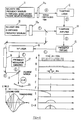
- This technique is shown in the diagram of Fig. 1 which illustrates ground-to-cloud lightning triggering using a laser beam carrying a femtosecond (fs) UV pulse (solid line) and a longer, visible laser pulse (dashed line).
- the femtosecond UV pulse is preferably prepared with a frequency modulation such that it is compressed as it propagates through the atmosphere. The purpose of the compression is to increase the peak intensity to compensate for losses incurred as the pulse propagates through the atmosphere.
- the arrangement of the present invention applies as well as to the internal discharge of electricity in a cloud (lightning in clouds).
- An intracloud discharge can be made if a conductive (ionized) channel is created between the base and top of the cloud with the same sequence of one or more femtosecond UV pulses and one or more long (nanosecond to microsecond) visible pulses.
- the above-mentioned pulses are to be preceded by a strong infra red, long laser pulse (such as is produced by a CO 2 laser) which evaporates the water droplets in the cloud.
- a beam carrying a fs UV laser pulse solid line
- two other beams a longer, visible laser pulse (dashed line) and a large CO 2 laser beam (dotted line).
- the optimum ultraviolet wavelength of the short duration laser pulse should be such that it takes no more than three or four photons to ionize the nitrogen and the oxygen in air.
- a wavelength of 248 nm is the preferred choice, because three photons for oxygen and four photons for nitrogen at that wavelength will ionize the nitrogen and oxygen, and because powerful and efficient lasers and laser amplifiers (KrF lasers) are commercially available at that wavelength.
- excimer lasers at 308 nm (XeCl) or 350 nm (XeF) may be used for four photon ionization of nitrogen and oxygen.
- the latter lasers require higher peak powers to reach the same level of ionization, but have the advantage of better atmospheric transmission characteristics.
- pulse duration Another consideration is the choice of pulse duration. For the same energy, a short pulse has a higher peak intensity I, hence will ionize air more efficiently (the three-photon ionization rate is proportional to I 3 , the four photon rate is proportional to I 4 ).
- pulse duration is short enough (of the order of 100 femtoseconds)
- pre-shape phase or frequency modulate
- the ionizing pulses so that the dispersive properties of air will produce pulse compression (hence peak power amplification).
- pulse phase or frequency modulation can be made for instance by propagating the pulse through diamond (in the case of radiation at 245 nm). This peak power amplification is needed to compensate the depletion of the beam by the ionization it creates.
- the pulse After passing through a phase modulator (which may, for example, be a thin diamond crystal), the pulse is frequency modulated so as to have a shorter wavelength at the beginning of the pulse than at the pulse tail.
- a phase modulator which may, for example, be a thin diamond crystal
- the pulse is frequency modulated so as to have a shorter wavelength at the beginning of the pulse than at the pulse tail.
- Figure 3 which, in accordance with an embodiment of the invention, shows a pulse being frequency modulated after passing through a nonlinear crystal (diamond for instance).
- the pulse front propagates slower than the pulse tail. If the pulse duration and modulation are chosen properly, a minimum pulse duration (hence largest peak intensity) is reached at the desired altitude (circa 100 m for triggering ground to cloud lightning).
- the electrons attach to the oxygen to create the negative ions O - / 2 and O - , which, as ions, have too small a mobility to contribute effectively to the conductivity of the channel.
- the solution to that in accordance with the invention is to irradiate the ionized channel with a laser pulse that will detach the charge (i.e. the electrons) from these negative ions.
- a preferred wavelength for this process is 530 nm, which is that of a frequency doubled Nd laser generally used to pump either a primary laser oscillator or amplifier.
- Such a flashlamp-pumped infrared laser source operates at a repetition rate typically between 1 and 50 Hz.
- the operation of such a laser is state of the art, and explained and described in the following article: A. Agnesi, J.C. Diels, P. DiTrapani, V. Kubecek, J. Marek, G. Reali, and C.Y. Yeh. "Passive feedback for stable short pulse generation", in Mourou Harris, Ippen and Zewail, editors, Picosecond Phenomena VII, pages 38-40, Springer-Verlag, Berlin, 1990.
- the infrared pulses produced by the above-described laser source are frequency doubled in a crystal 11a of potassium di-deuterium phosphate ("KDP") or potassium trihydrogen phosphate ("KTP"), in accordance with well known techniques used by several manufacturers of ND lasers, to convert the wavelength of 1.06 ⁇ m produced by the laser 11 to 530 nm, indicates as pulses "A", which pump synchronously a Ti:sapphire laser 12 producing a train of pulses B of 100 fs duration at the wavelength 744 nm, in any well known manner as is described and explained in the article by A. Schmidt in Optics Comm, August 1991.
- KDP potassium di-deuterium phosphate
- KTP potassium trihydrogen phosphate
- a second flashlamp-pumped, Q-switched (but not mode-locked) Nd laser 13 produces pulses which are frequency doubled via doubler 13a similar to 11a to the wavelength of 530 nm, to produce pulses C with a repetition rate typically between 1 and 100 Hz.
- Elements 13 and 13a may be provided through use of a "DCR-3" laser instrument that can be purchased from Quantaray-Spectra Physics).
- Pulses C pump a Ti:sapphire amplifier chain 14 to provide pulses D of energy greater than the energy in the pulses B produced by the fs Ti:sapphire laser 12.
- the amplified pulses D are each of 100fs duration and these pulses have the same repetition rate as the pulses C produced by the second Q-switched laser 13 with an energy of at least 1 mJ. They are thereafter converted to a wavelength of 248 nm by frequency tripling the pulses in a tripler 15 to produce pulses E each of 100fs duration and 10 ⁇ J energy at 248 nm, in any suitable well known manner, such as, for example, by using a combination of two crystals of KDP or one crystal of KDP and one crystal of barium-beta-borate ("BBO"). These crystals can be purchased for this purpose from several manufacturers, for instance Quantum Technology in Lake Mary, Florida.
- BBO barium-beta-borate
- the pulses E of each 100 fs duration and 10 ⁇ J energy at 248 nm are sent through a KrF excimer laser 16 for amplification (two passages or more), following a well known technique involving multiple passages, found in the brochure of the excimer laser manufacturer "Lambda Physik", provide pulses F having energy of approximately 30-30 mJ. Between passages, the pulses E are also sent through a frequency modulator 17 that will give the pulse the desired modulation of frequency (frequency decreasing monotonically with time during the pulse). Modulator 17 can be a suitable well known device such as a saturable absorber, as described in the publications: W. Dietel, J.J. Fontaine, and J.C. Diels.
- a pulse with a negative frequency sweep (higher frequency or shorter wavelength at the leading edge than at the trailing edge) is compressed as it propagates through most transparent materials such as glass or air. This has been demonstrated previously by compressing 5x pulses of 500 fs duration, at a wavelength of 620 nm, in 10 cm of glass.
- the compression is due to the fact that, as shown in FIG. 3, for the leading edge of the pulse (at a shorter wavelength), the index of refraction of the medium traversed is larger, hence the velocity slower than for the trailing edge.
- Standard tables of index of refraction versus frequency or wavelength show that 100 m of air at 248 nm will produce approximately the same slowing down of the leading edge - as compared to the trailing edge of the pulse - as 10 cm of glass at 620 nm.
- the preferred medium to produce the desired sweep of frequency at the wavelength of 248 nm is a crystal of diamond. This is based on measurements of modulation at different wavelengths extrapolated to the wavelength of interest (248 nm). These measurements are published in: M. Sheik-Bahae, A.A. Said, and E.W. VanStryland. "High sensitivity, single beam n 2 measurements.” Opt. Lett., 14, 1989. Other factors leading to the choice of diamond are based on measurements of nonlinear absorption, from which one can calculate the frequency modulation resulting from transmission through the diamond.
- the crystal of diamond 17 used for frequency modulation is preferably positioned to receive the output from the excimer amplifier (KrF) 16. Alternatively, it may be positioned between the first and second passage of the pulse to be amplified through this amplifier chain 14.
- the amplified, frequency-modulated femtosecond pulse G of about 200 fs duration produced by modulator 17 is combined with green pulses H from a pulse stretcher 18 via a dichroic beam splitter 19, that is transparent to 248 nm, and reflecting the green (530 nm) pulse produced by source 13 and doubler 13a.
- Pulse stretcher 18 extends the pulse C produced by 13a to form the stretched pulse H by splitting the 8 ns pulses C into a sequence of four successive pulses.
- the green pulses H can be derived from the Nd laser 13 used to pump the amplifier 14 as shown in Figure 4.
- the pulse stretcher 18 is essentially a combination of mirrors shown in Fig. 5.
- the pulse C is stretched into a sequence of pulses as shown in the left side of Fig. 5.
- a half wave plate N is used to turn the polarization of that beam at 45° with respect to the plane of the figure.
- the polarizer P splits the beam in two equal components 21, 22.
- the two components are retroreflected by mirrors M 1 and M 2 .
- Their polarization is rotated 90° after double passage through a quarter wave plate Q. As a result, they are redirected by the polarizing beam splitter P in another direction 23, through another half wave plate, rather than along the initial beam path.
- An alternative to the use of the laser 13 and pulse stretching, is to use an additional laser, preferably a Q-switched Nd laser with intracavity semiconductor to produce the long pulse, as discussed by: J. Schwartz, W. Weiler, and R.K. Chang. "Laser-pulse shaping using inducible absorption with controlled Q-switch time behavior.” IEEE J. of Quantum Electronics, QE-6:442-450, 1970.
- the two laser beams G and H are sent into the atmosphere via parabolic or spherical mirrors, generally indicated by the numeral 20, in any suitable well known manner.
Landscapes
- Lasers (AREA)
- Elimination Of Static Electricity (AREA)
Claims (9)
- Procédé pour permettre la décharge d'électricité ou de foudre dans l'atmosphère de manière à éviter la formation de charges d'espace qui pourraient réduire l'intensité de champs électriques dans l'atmosphère, comportant l'étape consistant à émettre dans l'atmosphère un faisceau d'impulsions de rayonnement provenant d'un laser, dans lequelcaractérisé en ce queun premier train d'impulsions (11) de rayonnement, ayant une longueur d'onde située dans la plage de l'ultraviolet, et ayant une durée suffisante pour créer un canal ionisé électriquement conducteur dans l'atmosphère, est émis le long du faisceau, etun deuxième train d'impulsions (13) de rayonnement, ayant une longueur d'onde plus longue que celle des premières impulsions, est émis simultanément le long du faisceau pour maintenir la conductivité électrique du canal suffisamment longtemps pour que de l'électricité ou de la foudre soit déchargée le long du faisceau.
- Procédé selon la revendication 1, comportant l'étape supplémentaire consistant à émettre le long du faisceau un troisième train d'impulsions (16) de rayonnement, ayant une longueur d'onde supérieure à la plage du visible et ayant une intensité et une durée suffisantes pour évaporer une proportion importante de toute gouttelette d'eau interceptée par le faisceau, les impulsions du troisième train précédant ou chevauchant l'émission des impulsions du premier train.
- Procédé selon la revendication 1 ou 2, dans lequel la fréquence de récurrence des impulsions des premier et deuxième trains est d'au moins 10 Hz.
- Procédé selon l'une quelconque des revendications précédentes, dans lequel les impulsions du premier train sont modulées en fréquence de manière à être comprimées lorsqu'elles passent à travers l'atmosphère.
- Procédé selon l'une quelconque des revendications précédentes, dans lequel la longueur d'onde des impulsions du deuxième train est dans la plage du visible.
- Procédé selon l'une quelconque des revendications précédentes, dans lequel la longueur d'onde de chaque impulsion du premier train est d'environ 248 nm, et sa durée est inférieure à 500 femtosecondes.
- Procédé selon la revendication 2, ou selon la revendication 2 et l'une quelconque des revendications dépendantes de celle-ci, dans lequel la fréquence de chaque impulsion du troisième train est située dans la plage de l'infrarouge.
- Dispositif pour permettre la décharge d'électricité ou de foudre dans l'atmosphère de manière à éviter la formation de charges d'espace qui pourraient réduire l'intensité de champs électriques dans l'atmosphère, comportant l'étape consistant à émettre dans l'atmosphère un faisceau d'impulsions de rayonnement provenant d'un laser, le dispositif comportantcaractérisé en ce qu'il comportedes moyens (11, 12, 14, 15, 16, 17, 20) pour émettre dans l'atmosphère un premier train d'impulsions de rayonnement provenant d'un laser, les impulsions ayant une longueur d'onde située dans le domaine de l'ultraviolet du spectre optique, et ayant une durée suffisamment longue pour créer un canal ionisé électriquement conducteur dans l'atmosphère, etdes moyens (13, 18, 19, 20) pour émettre un deuxième train d'impulsions de rayonnement le long du même faisceau, simultanément au premier train, les impulsions du deuxième train ayant une longueur d'onde plus longue que celle du premier train, de manière à maintenir la conductivité électrique du canal suffisamment longtemps pour que de l'électricité ou de la foudre soit déchargée le long du faisceau.
- Dispositif selon la revendication 8, comportant des moyens pour émettre le long du faisceau un troisième train d'impulsions de rayonnement ayant une longueur d'onde plus longue que celle du deuxième train, et pendant une période précédant ou chevauchant l'émission du premier train, de manière à entraíner une évaporation importante de toute gouttelette d'eau interceptée par le faisceau.
Applications Claiming Priority (3)
| Application Number | Priority Date | Filing Date | Title |
|---|---|---|---|
| US804268 | 1991-12-05 | ||
| US07/804,268 US5175664A (en) | 1991-12-05 | 1991-12-05 | Discharge of lightning with ultrashort laser pulses |
| PCT/US1992/010127 WO1993011594A1 (fr) | 1991-12-05 | 1992-11-30 | Decharge a eclair au moyen d'impulsions laser ultracourtes |
Publications (3)
| Publication Number | Publication Date |
|---|---|
| EP0612443A1 EP0612443A1 (fr) | 1994-08-31 |
| EP0612443A4 EP0612443A4 (fr) | 1994-10-12 |
| EP0612443B1 true EP0612443B1 (fr) | 1999-05-06 |
Family
ID=25188574
Family Applications (1)
| Application Number | Title | Priority Date | Filing Date |
|---|---|---|---|
| EP93900644A Expired - Lifetime EP0612443B1 (fr) | 1991-12-05 | 1992-11-30 | Decharge a eclair au moyen d'impulsions laser ultracourtes |
Country Status (6)
| Country | Link |
|---|---|
| US (1) | US5175664A (fr) |
| EP (1) | EP0612443B1 (fr) |
| JP (1) | JPH08501406A (fr) |
| AT (1) | ATE179840T1 (fr) |
| DE (1) | DE69229123T2 (fr) |
| WO (1) | WO1993011594A1 (fr) |
Families Citing this family (36)
| Publication number | Priority date | Publication date | Assignee | Title |
|---|---|---|---|---|
| JP2568006B2 (ja) * | 1990-08-23 | 1996-12-25 | インターナショナル・ビジネス・マシーンズ・コーポレイション | イオン化空気により対象物から電荷を放電させる方法及びそのための装置 |
| US5624592A (en) * | 1994-10-19 | 1997-04-29 | Cerberus Institute For Research And Development, Inc. | Microwave facilitated atmospheric energy projection system |
| US5786560A (en) * | 1995-03-31 | 1998-07-28 | Panasonic Technologies, Inc. | 3-dimensional micromachining with femtosecond laser pulses |
| US5563508A (en) * | 1995-03-31 | 1996-10-08 | Panasonic Technologies | Non-contact resistivity measurement apparatus and method using femtosecond laser pulses to create an electron flow |
| US5726855A (en) * | 1995-08-15 | 1998-03-10 | The Regents Of The University Of Michigan | Apparatus and method for enabling the creation of multiple extended conduction paths in the atmosphere |
| US5675103A (en) * | 1996-02-08 | 1997-10-07 | Herr; Jan Eric | Non-lethal tetanizing weapon |
| US5847863A (en) * | 1996-04-25 | 1998-12-08 | Imra America, Inc. | Hybrid short-pulse amplifiers with phase-mismatch compensated pulse stretchers and compressors |
| FR2750806B1 (fr) * | 1996-07-05 | 1998-09-11 | Commissariat Energie Atomique | Dispositif et procede de protection d'un site contre des impacts directs de la foudre |
| US5790303A (en) | 1997-01-23 | 1998-08-04 | Positive Light, Inc. | System for amplifying an optical pulse using a diode-pumped, Q-switched, intracavity-doubled laser to pump an optical amplifier |
| US6054694A (en) * | 1997-04-16 | 2000-04-25 | Cerberus Institute For Research And Development, Inc. | Microwave facilitated atmospheric energy projection system |
| US6111237A (en) * | 1998-04-24 | 2000-08-29 | Cerberus Institute For Research And Development, Inc. | Microwave facilitated atmospheric energy projection system |
| US6191386B1 (en) | 1999-04-22 | 2001-02-20 | The Ohio State University | Method and apparatus for initiating, directing and constricting electrical discharge arcs |
| US6546027B1 (en) * | 1999-12-01 | 2003-04-08 | Hoya Photonics, Inc. | Laser saturable absorber and passive negative feedback elements, and method of producing energy output therefrom |
| US8217304B2 (en) | 2001-03-29 | 2012-07-10 | Gsi Group Corporation | Methods and systems for thermal-based laser processing a multi-material device |
| US7723642B2 (en) | 1999-12-28 | 2010-05-25 | Gsi Group Corporation | Laser-based system for memory link processing with picosecond lasers |
| US6281471B1 (en) | 1999-12-28 | 2001-08-28 | Gsi Lumonics, Inc. | Energy-efficient, laser-based method and system for processing target material |
| US7838794B2 (en) | 1999-12-28 | 2010-11-23 | Gsi Group Corporation | Laser-based method and system for removing one or more target link structures |
| US7671295B2 (en) | 2000-01-10 | 2010-03-02 | Electro Scientific Industries, Inc. | Processing a memory link with a set of at least two laser pulses |
| US6887804B2 (en) | 2000-01-10 | 2005-05-03 | Electro Scientific Industries, Inc. | Passivation processing over a memory link |
| KR100850262B1 (ko) | 2000-01-10 | 2008-08-04 | 일렉트로 싸이언티픽 인더스트리이즈 인코포레이티드 | 초단 펄스 폭을 가진 레이저 펄스의 버스트로 메모리링크를 처리하기 위한 레이저 시스템 및 방법 |
| US6867419B2 (en) * | 2002-03-29 | 2005-03-15 | The Regents Of The University Of California | Laser driven compact ion accelerator |
| US7391557B1 (en) | 2003-03-28 | 2008-06-24 | Applied Photonics Worldwide, Inc. | Mobile terawatt femtosecond laser system (MTFLS) for long range spectral sensing and identification of bioaerosols and chemical agents in the atmosphere |
| US7903698B1 (en) | 2003-08-14 | 2011-03-08 | Applied Energetics, Inc | Controlled optical filament generation and energy propagation |
| US7356053B2 (en) * | 2003-10-06 | 2008-04-08 | Continuum Electro-Optics, Inc. | Mode-locked laser with variable pulse duration |
| DE102005003847A1 (de) * | 2005-01-26 | 2006-08-03 | Rainer Pfalz | Zweischneidiges Schwert |
| US8344338B2 (en) | 2005-05-09 | 2013-01-01 | Applied Energetics, Inc | Systems and methods for enhancing electrical discharge |
| US8009990B1 (en) * | 2005-06-02 | 2011-08-30 | Rockwell Collins, Inc. | Optical phased array |
| US7606496B1 (en) * | 2005-06-02 | 2009-10-20 | Rockwell Collins, Inc. | Communications and position location system and method |
| FR2887327B1 (fr) * | 2005-06-17 | 2007-08-24 | Thales Sa | Procede de protection antimissiles de vehicules et dispositif de mise en oeuvre |
| DE102005034613B3 (de) * | 2005-07-18 | 2007-03-29 | Deutsches Zentrum für Luft- und Raumfahrt e.V. | Abwehrvorrichtung gegen Flugkörper, Verfahren zur Abwehr gegen Flugkörper und Verwendung einer Laservorrichtung |
| EP2184826A1 (fr) | 2008-11-10 | 2010-05-12 | Nederlandse Organisatie voor toegepast- natuurwetenschappelijk onderzoek TNO | Procédé et système de protection contre la foudre à base de laser |
| FR2973598B1 (fr) | 2011-03-31 | 2014-01-03 | Indelec | Procede et installation de protection contre la foudre mettant en oeuvre un paratonnerre avec dispositif d'amorcage comportant une source de rayonnement electromagnetique |
| EP2803151A4 (fr) | 2012-01-09 | 2016-04-06 | Attochron Llc | Communication optique sans fil lasercom uspl-fso de point à point et de point à multipoint |
| US20140263830A1 (en) * | 2013-03-15 | 2014-09-18 | Alliant Techsystems Inc. | Launch lightning risk mitigation system and method |
| DE102014201752A1 (de) * | 2014-01-31 | 2015-08-06 | Siemens Aktiengesellschaft | Überspannungsschutz mit einer Funkenstrecke |
| US20170127507A1 (en) * | 2015-11-04 | 2017-05-04 | The Boeing Company | Defense mechanism against directed-energy systems based on laser induced atmospheric optical breakdown |
Family Cites Families (2)
| Publication number | Priority date | Publication date | Assignee | Title |
|---|---|---|---|---|
| FR1582805A (fr) * | 1968-02-07 | 1969-10-10 | ||
| US4017767A (en) * | 1973-12-10 | 1977-04-12 | Ball Leonard M | Laser lightning rod system |
-
1991
- 1991-12-05 US US07/804,268 patent/US5175664A/en not_active Expired - Lifetime
-
1992
- 1992-11-30 WO PCT/US1992/010127 patent/WO1993011594A1/fr not_active Ceased
- 1992-11-30 EP EP93900644A patent/EP0612443B1/fr not_active Expired - Lifetime
- 1992-11-30 AT AT93900644T patent/ATE179840T1/de not_active IP Right Cessation
- 1992-11-30 DE DE69229123T patent/DE69229123T2/de not_active Expired - Fee Related
- 1992-11-30 JP JP5510210A patent/JPH08501406A/ja active Pending
Also Published As
| Publication number | Publication date |
|---|---|
| DE69229123D1 (de) | 1999-06-10 |
| EP0612443A1 (fr) | 1994-08-31 |
| US5175664A (en) | 1992-12-29 |
| DE69229123T2 (de) | 1999-11-25 |
| WO1993011594A1 (fr) | 1993-06-10 |
| JPH08501406A (ja) | 1996-02-13 |
| ATE179840T1 (de) | 1999-05-15 |
| EP0612443A4 (fr) | 1994-10-12 |
Similar Documents
| Publication | Publication Date | Title |
|---|---|---|
| US5175664A (en) | Discharge of lightning with ultrashort laser pulses | |
| Pessot et al. | 1000 times expansion/compression of optical pulses for chirped pulse amplification | |
| Zhao et al. | Femtosecond ultraviolet laser pulse induced lightning discharges in gases | |
| Strickland et al. | Compression of amplified chirped optical pulses | |
| US5726855A (en) | Apparatus and method for enabling the creation of multiple extended conduction paths in the atmosphere | |
| Woodworth et al. | Laser triggering of a 500‐kV gas‐filled switch: A parametric study | |
| Von der Linde | Mode-locked lasers and ultrashort light pulses | |
| Reksten et al. | Active mode locking of a XeCl laser | |
| JP2895175B2 (ja) | パワーレーザパルス発生装置 | |
| US3783403A (en) | Double pulse laser | |
| Basov et al. | Production of powerful ultrashort light pulses in a neodymium glass laser | |
| Burneĭka et al. | Highly stable subpicosecond neodymium (Nd3+) glass laser with passive mode locking and negative feedback | |
| Fontana et al. | Generation of sequences of ultrashort pulses in erbium doped fibre single ring lasers | |
| US3422307A (en) | Electric arc device with a photoelectric starting electrode | |
| US3518436A (en) | Laser pulse generator using marx-bank pulser | |
| Margulis et al. | Active mode-locking of lasers using GaAs and GaP picosecond switches | |
| Richardson | Production of single subnanosecond multi-line 10.6 μm laser pulses by fast optical gating | |
| Gouveia-Neto et al. | Soliton evolution from noise bursts | |
| Gomes et al. | Thirty fold pulse compression of the pulses from a Q-switched and mode locked Nd: YAG laser | |
| Skeldon et al. | Implementation of pulse shaping on the OMEGA laser system | |
| Strickland et al. | Picosecond pulse amplification using pulse compression techniques | |
| RU2511721C1 (ru) | Способ инициирования высоковольтных разрядов в атмосфере | |
| Zhao et al. | Visualizing high-power laser beams in a high-voltage field | |
| Pacala et al. | Control of XeF laser output by pulse injecton | |
| Carman et al. | A self-driven laser oscillator for directly producing bandwidth-limited pulses of about 1 nsec |
Legal Events
| Date | Code | Title | Description |
|---|---|---|---|
| PUAI | Public reference made under article 153(3) epc to a published international application that has entered the european phase |
Free format text: ORIGINAL CODE: 0009012 |
|
| 17P | Request for examination filed |
Effective date: 19940606 |
|
| AK | Designated contracting states |
Kind code of ref document: A1 Designated state(s): AT BE CH DE DK ES FR GB GR IE IT LI LU MC NL PT SE |
|
| A4 | Supplementary search report drawn up and despatched |
Effective date: 19940823 |
|
| AK | Designated contracting states |
Kind code of ref document: A4 Designated state(s): AT BE CH DE DK ES FR GB GR IE IT LI LU MC NL PT SE |
|
| 17Q | First examination report despatched |
Effective date: 19951222 |
|
| GRAG | Despatch of communication of intention to grant |
Free format text: ORIGINAL CODE: EPIDOS AGRA |
|
| GRAG | Despatch of communication of intention to grant |
Free format text: ORIGINAL CODE: EPIDOS AGRA |
|
| GRAH | Despatch of communication of intention to grant a patent |
Free format text: ORIGINAL CODE: EPIDOS IGRA |
|
| GRAH | Despatch of communication of intention to grant a patent |
Free format text: ORIGINAL CODE: EPIDOS IGRA |
|
| GRAH | Despatch of communication of intention to grant a patent |
Free format text: ORIGINAL CODE: EPIDOS IGRA |
|
| GRAA | (expected) grant |
Free format text: ORIGINAL CODE: 0009210 |
|
| AK | Designated contracting states |
Kind code of ref document: B1 Designated state(s): AT BE CH DE DK ES FR GB GR IE IT LI LU MC NL PT SE |
|
| PG25 | Lapsed in a contracting state [announced via postgrant information from national office to epo] |
Ref country code: SE Free format text: THE PATENT HAS BEEN ANNULLED BY A DECISION OF A NATIONAL AUTHORITY Effective date: 19990506 Ref country code: NL Free format text: LAPSE BECAUSE OF FAILURE TO SUBMIT A TRANSLATION OF THE DESCRIPTION OR TO PAY THE FEE WITHIN THE PRESCRIBED TIME-LIMIT Effective date: 19990506 Ref country code: LI Free format text: LAPSE BECAUSE OF FAILURE TO SUBMIT A TRANSLATION OF THE DESCRIPTION OR TO PAY THE FEE WITHIN THE PRESCRIBED TIME-LIMIT Effective date: 19990506 Ref country code: IT Free format text: LAPSE BECAUSE OF FAILURE TO SUBMIT A TRANSLATION OF THE DESCRIPTION OR TO PAY THE FEE WITHIN THE PRE;WARNING: LAPSES OF ITALIAN PATENTS WITH EFFECTIVE DATE BEFORE 2007 MAY HAVE OCCURRED AT ANY TIME BEFORE 2007. THE CORRECT EFFECTIVE DATE MAY BE DIFFERENT FROM THE ONE RECORDED.SCRIBED TIME-LIMIT Effective date: 19990506 Ref country code: GR Free format text: LAPSE BECAUSE OF NON-PAYMENT OF DUE FEES Effective date: 19990506 Ref country code: ES Free format text: THE PATENT HAS BEEN ANNULLED BY A DECISION OF A NATIONAL AUTHORITY Effective date: 19990506 Ref country code: CH Free format text: LAPSE BECAUSE OF FAILURE TO SUBMIT A TRANSLATION OF THE DESCRIPTION OR TO PAY THE FEE WITHIN THE PRESCRIBED TIME-LIMIT Effective date: 19990506 Ref country code: BE Free format text: LAPSE BECAUSE OF FAILURE TO SUBMIT A TRANSLATION OF THE DESCRIPTION OR TO PAY THE FEE WITHIN THE PRESCRIBED TIME-LIMIT Effective date: 19990506 Ref country code: AT Free format text: LAPSE BECAUSE OF FAILURE TO SUBMIT A TRANSLATION OF THE DESCRIPTION OR TO PAY THE FEE WITHIN THE PRESCRIBED TIME-LIMIT Effective date: 19990506 |
|
| REF | Corresponds to: |
Ref document number: 179840 Country of ref document: AT Date of ref document: 19990515 Kind code of ref document: T |
|
| REG | Reference to a national code |
Ref country code: CH Ref legal event code: EP |
|
| REF | Corresponds to: |
Ref document number: 69229123 Country of ref document: DE Date of ref document: 19990610 |
|
| REG | Reference to a national code |
Ref country code: IE Ref legal event code: FG4D |
|
| PG25 | Lapsed in a contracting state [announced via postgrant information from national office to epo] |
Ref country code: PT Free format text: LAPSE BECAUSE OF FAILURE TO SUBMIT A TRANSLATION OF THE DESCRIPTION OR TO PAY THE FEE WITHIN THE PRESCRIBED TIME-LIMIT Effective date: 19990806 Ref country code: DK Free format text: LAPSE BECAUSE OF FAILURE TO SUBMIT A TRANSLATION OF THE DESCRIPTION OR TO PAY THE FEE WITHIN THE PRESCRIBED TIME-LIMIT Effective date: 19990806 |
|
| ET | Fr: translation filed | ||
| REG | Reference to a national code |
Ref country code: CH Ref legal event code: PL |
|
| PG25 | Lapsed in a contracting state [announced via postgrant information from national office to epo] |
Ref country code: LU Free format text: LAPSE BECAUSE OF NON-PAYMENT OF DUE FEES Effective date: 19991130 Ref country code: IE Free format text: LAPSE BECAUSE OF NON-PAYMENT OF DUE FEES Effective date: 19991130 |
|
| PLBE | No opposition filed within time limit |
Free format text: ORIGINAL CODE: 0009261 |
|
| STAA | Information on the status of an ep patent application or granted ep patent |
Free format text: STATUS: NO OPPOSITION FILED WITHIN TIME LIMIT |
|
| 26N | No opposition filed | ||
| PG25 | Lapsed in a contracting state [announced via postgrant information from national office to epo] |
Ref country code: MC Free format text: LAPSE BECAUSE OF NON-PAYMENT OF DUE FEES Effective date: 20000531 |
|
| REG | Reference to a national code |
Ref country code: IE Ref legal event code: MM4A |
|
| PGFP | Annual fee paid to national office [announced via postgrant information from national office to epo] |
Ref country code: GB Payment date: 20001113 Year of fee payment: 9 |
|
| PGFP | Annual fee paid to national office [announced via postgrant information from national office to epo] |
Ref country code: FR Payment date: 20001122 Year of fee payment: 9 |
|
| PGFP | Annual fee paid to national office [announced via postgrant information from national office to epo] |
Ref country code: DE Payment date: 20010120 Year of fee payment: 9 |
|
| PG25 | Lapsed in a contracting state [announced via postgrant information from national office to epo] |
Ref country code: GB Free format text: LAPSE BECAUSE OF NON-PAYMENT OF DUE FEES Effective date: 20011130 |
|
| REG | Reference to a national code |
Ref country code: GB Ref legal event code: IF02 |
|
| PG25 | Lapsed in a contracting state [announced via postgrant information from national office to epo] |
Ref country code: DE Free format text: LAPSE BECAUSE OF NON-PAYMENT OF DUE FEES Effective date: 20020702 |
|
| GBPC | Gb: european patent ceased through non-payment of renewal fee |
Effective date: 20011130 |
|
| PG25 | Lapsed in a contracting state [announced via postgrant information from national office to epo] |
Ref country code: FR Free format text: LAPSE BECAUSE OF NON-PAYMENT OF DUE FEES Effective date: 20020730 |
|
| REG | Reference to a national code |
Ref country code: FR Ref legal event code: ST |
|
| REG | Reference to a national code |
Ref country code: FR Ref legal event code: ST |