EP0612578A1 - Gegenstand, der ein bleifreies Weichlot mit verbesserten mechanischen Eigenschaften enthält - Google Patents
Gegenstand, der ein bleifreies Weichlot mit verbesserten mechanischen Eigenschaften enthält Download PDFInfo
- Publication number
- EP0612578A1 EP0612578A1 EP94300934A EP94300934A EP0612578A1 EP 0612578 A1 EP0612578 A1 EP 0612578A1 EP 94300934 A EP94300934 A EP 94300934A EP 94300934 A EP94300934 A EP 94300934A EP 0612578 A1 EP0612578 A1 EP 0612578A1
- Authority
- EP
- European Patent Office
- Prior art keywords
- composition
- alloy
- solder
- article
- remainder
- Prior art date
- Legal status (The legal status is an assumption and is not a legal conclusion. Google has not performed a legal analysis and makes no representation as to the accuracy of the status listed.)
- Withdrawn
Links
Images


Classifications
-
- B—PERFORMING OPERATIONS; TRANSPORTING
- B23—MACHINE TOOLS; METAL-WORKING NOT OTHERWISE PROVIDED FOR
- B23K—SOLDERING OR UNSOLDERING; WELDING; CLADDING OR PLATING BY SOLDERING OR WELDING; CUTTING BY APPLYING HEAT LOCALLY, e.g. FLAME CUTTING; WORKING BY LASER BEAM
- B23K1/00—Soldering, e.g. brazing, or unsoldering
-
- C—CHEMISTRY; METALLURGY
- C22—METALLURGY; FERROUS OR NON-FERROUS ALLOYS; TREATMENT OF ALLOYS OR NON-FERROUS METALS
- C22C—ALLOYS
- C22C13/00—Alloys based on tin
-
- B—PERFORMING OPERATIONS; TRANSPORTING
- B23—MACHINE TOOLS; METAL-WORKING NOT OTHERWISE PROVIDED FOR
- B23K—SOLDERING OR UNSOLDERING; WELDING; CLADDING OR PLATING BY SOLDERING OR WELDING; CUTTING BY APPLYING HEAT LOCALLY, e.g. FLAME CUTTING; WORKING BY LASER BEAM
- B23K35/00—Rods, electrodes, materials, or media, for use in soldering, welding, or cutting
- B23K35/22—Rods, electrodes, materials, or media, for use in soldering, welding, or cutting characterised by the composition or nature of the material
- B23K35/24—Selection of soldering or welding materials proper
- B23K35/26—Selection of soldering or welding materials proper with the principal constituent melting at less than 400°C
- B23K35/262—Sn as the principal constituent
Definitions
- This invention relates to an article comprising solder, more specifically Pb- free solder.
- Solder bonding is a critical step in many industrial processes, e.g., in semiconductor device manufacture.
- the currently most widely used solder probably is the eutectic Pb-Sn alloy.
- Pb lead
- the eutectic tin-silver (Sn-Ag) alloy is a known Pb-free solder, (see W. B. Hampshire, Electronic Materials Handbook Vol. 1, Packaging, ASM International, Metals Park, OH, 1989, p. 633) that has some advantageous characteristics, e.g., good ductility.
- the alloy also has some drawbacks, e.g., insufficient creep resistance especially for applications requiring high dimensional stability.
- the manufacturing yields and service lifetimes of microelectronic products often depend on the mechanical integrity of solder joints. While breaking is the most obvious problem, misalignment of a laser chip by mechanical creep and the resultant loss of information in the optical system is also a problem. It would be desirable to have available a Sn-Ag based solder composition that has improved mechanical strength and creep resistance while retaining the advantageous characteristics of the prior art Sn-Ag solder. This application discloses such compositions.
- this invention relates to Pb-free solder alloys based on a tin-silver-zinc (Sn-Ag-Zn) system. More particularly, the invention is embodied in an article that comprises an essentially Pb-free solder composition comprising at least 50% (typically at least 80%) by weight Sn, between 0.1 and 10% by weight Ag and an effective amount of Zn for increasing the ultimate tensile stress (UTS) and/or offset yield strength (YS) of the solder composition by at least 10% of an otherwise identical Zn-free comparison composition. In an exemplary preferred embodiment, the composition comprises 1% Zn, 3.5% Ag and 95.5% Sn.
- UTS ultimate tensile stress
- YS offset yield strength
- Zn-Ag binary alloys can produce a uniform and refined microstructure with very small precipitates, and result in significantly improved mechanical strength while maintaining substantially the same level of ductility as in a corresponding Zn-free alloy.
- the Zn addition typically also improves the character of the solidified alloy's surface by making it smoother.
- the added Zn typically combines with corrosion-resistant Ag3 Sn type precipitates, resulting in a relatively corrosion resistant solder.
- FIG. 1 illustrates the effect of Zn additions on the tensile properties of Sn-3.5 wt% Ag solder.
- FIG. 2 shows data on some mechanical properties of Sn-Ag-Zn alloys as a function of Zn content.
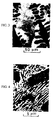
- FIGs. 3 and 4 are micrographs of the prior art Sn-3.5% Ag alloy.
- FIGs. 5 and 6 are micrographs of a sample of Sn-3.5% Ag-1% Zn alloy.
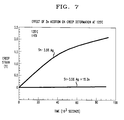
- FIG. 7 compares creep deformation in the Sn-3.5% Ag and Sn-3.5% Ag-1% Zn alloys.
- This invention is embodied in Pb-free solder alloys, based on a Sn- Ag-Zn system, which can have substantially improved microstructures and improved mechanical properties (including strength) over a binary Sn-Ag alloy.
- the improved strength of the alloy is believed to be a result of the addition of zinc (Zn), which can cause a uniform solidification structure and a pronounced refinement of the intermetallic precipitates in the solder alloy.
- Zn typically has been avoided as a solder alloying addition due to, inter alia, the susceptibility of Zn to corrosion.
- Sn-Ag based alloys need not result in significantly increased susceptibility to corrosion. This unexpected result is believed to be due to a tendency of the added Zn to combine with corrosion-resistant elements, such as Ag, within intermetallic phases.
- a solder alloy comprising a fine uniform dispersion of small precipitates in a matrix phase is likely to have good mechanical strength. Diffusion, especially at elevated temperatures, however, often leads to precipitate coarsening in, e.g., Pb-Sn solder, which decreases the mechanical strength of the solder by creating fewer, larger precipitates and allowing propagation of fatigue cracks along the coarsened, mechanically soft region.
- Desirable composition ranges for the Sn-Ag-Zn-containing alloys are: Ag in the range of 0.1-10%, preferably 1-6%, and even more preferably 2-5%, Zn in the range of 0.1-10%, preferably 0.2-6%, and even more preferably 0.5-3%, with the remainder of the alloy comprising Sn as the major component. All percentages herein are weight %.
- alloys according to the invention may also comprise Bi and/or In.
- the desirable amounts of these additions are: Bi in the range of 0.2-10%, preferably 0.5-6%, and In in the range of 0.2-10%, preferably 0.5-6%. Addition of Bi and/or In will typically lower the melting point.
- Alloys according to the invention optionally may comprise elements such as Cu or Au, added for various purposes such as raising the melting point, or improving wetting behavior on certain surfaces to be soldered.
- the desirable amounts of these optional constituents are: Cu in the range of 0.2-10%, preferably 0.5-6%, and Au in the range of 0.2-10%, preferably 0.5-6%. Minor amounts of other elements may also be added for a number of different reasons.
- the alloys of this invention may be prepared by a number of different ways known to those skilled in the art, e.g., by melting of a mixture of elemental or partially alloyed metals, preferably in an inert atmosphere.
- the alloys may also be prepared during deposition into thin or thick films by electrochemical processes such as electroplating, electroless plating and electrophoresis, chemical processes such as chemical vapor deposition, or physical vapor deposition such as evaporation or sputtering.
- compositions according to the invention may be shaped, by any appropriate method, into articles in the form of wires, ribbons, bars, performs, solder paste or cream containing alloy powder, suitable flux material, and other chemical constituents.
- Solder according to the invention can be used in the manufacture of articles (e.g., comprising a laser solder-bonded to a sub-mount) in conventional manner, e.g., by wave soldering, dip soldering, or reflow soldering of solder paste or deposited and patterned solder layer.
- a Sn-3.5 wt.% Ag binary alloy was prepared from pure Sn and Ag (99.9999% purity). The alloy was melted within a quartz tube having an inside diameter of 14 mm under argon atmosphere, held at 800°C for 8 hours, and furnace-cooled. The resulting ingot was swaged to 3.7 mm diameter, remelted within 4 mm diameter quartz tubes in an argon atmosphere at 300 °C for 5 minutes, and then cooled to room temperature. The thus produced rods were then machined into tensile specimens with a 0.5-inch gauge length and 0.120-inch gauge diameter. Room temperature tensile tests were performed at a strain rate of 3.33x10 ⁇ 3 sec ⁇ 1.
- the 0.2% offset yield strength (YS) of the alloy was approximately 7500 psi, the ultimate tensile strength (UTS) was approximately 8000 psi, and the elongation was approximately 37%.
- the melting temperature of the alloy was approximately 221°C.
- Example 2 An alloy with a composition of 91.5% Sn-3.5% Ag-1% Zn-4% Bi was prepared and tested in substantially the same manner as in Example 1.
- the mechanical properties were as follows: the YS was approximately 9500 psi, the UTS was approximately 11500 psi and the maximum elongation was approximately 41%.
- the melting point was approximately 205°C.
- An alloy with a composition of 87.5% Sn-3.5% Ag-1% Zn-8% Bi was prepared and tested in substantially the same manner as in Example 1.
- the melting point was approximately 198°C.
- compositions according to the invention typically is comparable to that of the Sn-3.5% Ag binary alloy, which is surprising, considering typically the significantly greater tensile strength of the former.
- the 95.5% Sn-3.5% Ag-1% Zn alloy exhibits a very different microstructure.
- the microstructure is substantially uniform, and has finely dispersed small (e.g., - .3 ⁇ m diameter) precipitate (Ag3Sn-type) particles.
- Ag3Sn-type finely dispersed small (e.g., - .3 ⁇ m diameter) precipitate (Ag3Sn-type) particles.
- EDXA energy dispersive x-ray analysis
- Differential scanning calorimetry (DSC) of the four alloys showed small melting point depressions in the ternary, zinc- containing alloys when compared to the binary Sn-3.5%Ag eutectic alloy's melting temperature of 221°C.
- the melting points of the 0.5, 1 and 2% Zn ternary alloys were, respectively, 1-2, 4 and 4°C lower than that of the eutectic binary alloy.
- Lower melting temperature is desirable when a more or less direct replacement for the Pb-Sn solder (e.g. melting point is approximately 183°C for the eutectic 40Pb-60Sn alloy) is considered. Higher melting temperature is desirable for higher service temperatures. Additional alloying additions may be made to further adjust the melting temperature of the Sn-Ag-Zn alloy as described in the Examples 4-6.
- the surface features of solidified binary Sn-Ag solder alloys are, typically undesirably, frequently rough and covered with large needle-like Ag3Sn precipitates.
- the microstructural refinement that occurs in the Zn-containing alloys also alleviates these surface roughness problems.
- the smoothness of the Zn-containing alloys can be dramatic when compared to the binary Sn-Ag alloy.
- FIG. 7 illustrates differences in compressive creep deformation between the prior art binary alloy and an exemplary ternary alloy according to the invention, at 125°C under approximately 1000 psi pressure (1 ksi).
- the addition of Zn dramatically reduces creep resistance.
- Even relatively small Zn additions e.g., 0.1%) can result in substantial desirable improvement in creep resistance, e.g., by at least 20%.
Landscapes
- Engineering & Computer Science (AREA)
- Mechanical Engineering (AREA)
- Chemical & Material Sciences (AREA)
- Materials Engineering (AREA)
- Metallurgy (AREA)
- Organic Chemistry (AREA)
- Electric Connection Of Electric Components To Printed Circuits (AREA)
- Contacts (AREA)
Applications Claiming Priority (2)
| Application Number | Priority Date | Filing Date | Title |
|---|---|---|---|
| US20508 | 1979-03-14 | ||
| US2050893A | 1993-02-22 | 1993-02-22 |
Publications (1)
| Publication Number | Publication Date |
|---|---|
| EP0612578A1 true EP0612578A1 (de) | 1994-08-31 |
Family
ID=21798995
Family Applications (1)
| Application Number | Title | Priority Date | Filing Date |
|---|---|---|---|
| EP94300934A Withdrawn EP0612578A1 (de) | 1993-02-22 | 1994-02-09 | Gegenstand, der ein bleifreies Weichlot mit verbesserten mechanischen Eigenschaften enthält |
Country Status (5)
| Country | Link |
|---|---|
| US (1) | US5762866A (de) |
| EP (1) | EP0612578A1 (de) |
| JP (1) | JP2599890B2 (de) |
| KR (1) | KR940019393A (de) |
| MX (1) | MX9401271A (de) |
Cited By (11)
| Publication number | Priority date | Publication date | Assignee | Title |
|---|---|---|---|---|
| EP0704272A1 (de) * | 1994-09-30 | 1996-04-03 | AT&T Corp. | Bleifreie Legierungen zum Weichlöten |
| WO1997047426A1 (en) * | 1996-06-12 | 1997-12-18 | International Business Machines Corporation | Lead-free, high tin ternary solder alloy of tin, silver, and indium |
| WO1998032886A1 (en) * | 1997-01-29 | 1998-07-30 | Alpha Fry Limited | Lead-free tin alloy |
| EP0882544A1 (de) * | 1997-06-04 | 1998-12-09 | MITSUI MINING & SMELTING CO., LTD. | Bleifreie Lotlegierung auf der Basis von Zinn und Silber |
| US5851482A (en) * | 1996-03-22 | 1998-12-22 | Korea Institute Of Machinery & Metals | Tin-bismuth based lead-free solder for copper and copper alloys |
| EP0976489A1 (de) * | 1996-12-17 | 2000-02-02 | Sony Corporation | Weichlötmaterial |
| US6184475B1 (en) * | 1994-09-29 | 2001-02-06 | Fujitsu Limited | Lead-free solder composition with Bi, In and Sn |
| CN1087994C (zh) * | 1995-09-29 | 2002-07-24 | 松下电器产业株式会社 | 无铅钎料合金 |
| US6649127B2 (en) | 1996-12-17 | 2003-11-18 | Sony Chemicals Corp | Lead-free solder material having good wettability |
| WO2004002674A1 (ja) * | 2002-07-01 | 2004-01-08 | Mitsui Mining & Smelting Co., Ltd. | スズ−銀系無鉛はんだ |
| DE10215572B4 (de) * | 2001-04-10 | 2011-03-24 | Murata Manufacturing Co., Ltd., Nagaokakyo | Elektrischer Anschluss und elektrisches Bauelement damit |
Families Citing this family (22)
| Publication number | Priority date | Publication date | Assignee | Title |
|---|---|---|---|---|
| KR0168964B1 (ko) * | 1995-06-30 | 1999-01-15 | 이형도 | 납땜성이 우수한 무연땜납 |
| JPH0970687A (ja) * | 1995-07-04 | 1997-03-18 | Toyota Central Res & Dev Lab Inc | 無鉛はんだ合金 |
| JPH0994687A (ja) * | 1995-09-29 | 1997-04-08 | Senju Metal Ind Co Ltd | 鉛フリーはんだ合金 |
| JP3220635B2 (ja) * | 1996-02-09 | 2001-10-22 | 松下電器産業株式会社 | はんだ合金及びクリームはんだ |
| JP3688429B2 (ja) | 1997-04-25 | 2005-08-31 | 株式会社東芝 | 電子部品実装用基板および電子部品実装基板 |
| JP4042263B2 (ja) * | 1999-07-06 | 2008-02-06 | ミツミ電機株式会社 | 回転ヘッドドラム装置の回転バランス調整機構 |
| JP2002273596A (ja) * | 2001-03-19 | 2002-09-25 | Mitsui Mining & Smelting Co Ltd | 錫−銀系ハンダ合金 |
| GB2380964B (en) | 2001-09-04 | 2005-01-12 | Multicore Solders Ltd | Lead-free solder paste |
| US6837947B2 (en) | 2002-01-15 | 2005-01-04 | National Cheng-Kung University | Lead-free solder |
| KR20030084236A (ko) * | 2002-04-25 | 2003-11-01 | 대한민국 (중소기업청) | 시효특성이 우수한 무연땜납 합금 |
| JP3991788B2 (ja) * | 2002-07-04 | 2007-10-17 | 日本電気株式会社 | はんだおよびそれを用いた実装品 |
| US20040155097A1 (en) * | 2003-02-04 | 2004-08-12 | Matsushita Electric Industrial Co., Ltd. | Soldering method and method for manufacturing component mounting board |
| US20060104855A1 (en) * | 2004-11-15 | 2006-05-18 | Metallic Resources, Inc. | Lead-free solder alloy |
| JP2007196289A (ja) * | 2005-12-27 | 2007-08-09 | Toshiba Corp | 電子部品用無鉛金属材料 |
| JP5166261B2 (ja) | 2006-06-30 | 2013-03-21 | 旭化成イーマテリアルズ株式会社 | 導電性フィラー |
| CN100411804C (zh) * | 2006-11-30 | 2008-08-20 | 天津大学 | 一种自适应无铅焊料成分制备焊料的方法 |
| KR100797161B1 (ko) * | 2007-05-25 | 2008-01-23 | 한국생산기술연구원 | 주석-은-구리-인듐의 4원계 무연솔더 조성물 |
| WO2009013210A1 (en) * | 2007-07-23 | 2009-01-29 | Henkel Limited | Solder flux |
| JP5322469B2 (ja) * | 2007-09-07 | 2013-10-23 | トゥクサン ハイ‐メタル シーオー エルティディ | 耐落下衝撃性に優れたはんだ合金、およびそれを用いたはんだボール、ならびにはんだ接合部 |
| CN101927410B (zh) * | 2010-09-16 | 2012-10-17 | 上海交通大学 | Sn-Ag-Zn-Bi-Cr无铅焊料 |
| CN101920406B (zh) * | 2010-09-16 | 2012-05-09 | 上海交通大学 | Sn-Ag-Zn-Cr共晶无铅焊料 |
| CN114932337B (zh) * | 2022-06-10 | 2025-07-11 | 上海大学 | 一种SnAgCuBiIn系无铅焊料合金、其设计方法及制备方法 |
Citations (6)
| Publication number | Priority date | Publication date | Assignee | Title |
|---|---|---|---|---|
| GB131299A (en) * | 1918-08-09 | 1900-01-01 | Laminoirs Et Cablerie Sa Des | Improvements in or relating to Aluminium Solders. |
| DE806820C (de) * | 1949-10-25 | 1951-06-18 | Rau Fa G | Weichlot |
| DE1080838B (de) * | 1958-01-13 | 1960-04-28 | Licentia Gmbh | Legierung zum Weichloeten |
| US4670217A (en) * | 1985-07-26 | 1987-06-02 | J. W. Harris Company | Solder composition |
| US4695428A (en) * | 1986-08-21 | 1987-09-22 | J. W. Harris Company | Solder composition |
| EP0499452A1 (de) * | 1991-02-13 | 1992-08-19 | Lancashire Fittings Limited | Bleifreies Weichlot zum Löten von rostfreien Stahl |
Family Cites Families (3)
| Publication number | Priority date | Publication date | Assignee | Title |
|---|---|---|---|---|
| US1437641A (en) * | 1919-09-11 | 1922-12-05 | Pfyffer | Solder for aluminum and its alloys |
| JPS529540B2 (de) * | 1973-09-19 | 1977-03-16 | ||
| JPH0649238A (ja) * | 1992-07-29 | 1994-02-22 | Kanegafuchi Chem Ind Co Ltd | プリプレグ及び電気用積層板 |
-
1994
- 1994-02-09 EP EP94300934A patent/EP0612578A1/de not_active Withdrawn
- 1994-02-18 MX MX9401271A patent/MX9401271A/es unknown
- 1994-02-21 JP JP6044685A patent/JP2599890B2/ja not_active Expired - Fee Related
- 1994-02-21 KR KR1019940003033A patent/KR940019393A/ko not_active Withdrawn
-
1995
- 1995-07-17 US US08/502,941 patent/US5762866A/en not_active Expired - Lifetime
Patent Citations (6)
| Publication number | Priority date | Publication date | Assignee | Title |
|---|---|---|---|---|
| GB131299A (en) * | 1918-08-09 | 1900-01-01 | Laminoirs Et Cablerie Sa Des | Improvements in or relating to Aluminium Solders. |
| DE806820C (de) * | 1949-10-25 | 1951-06-18 | Rau Fa G | Weichlot |
| DE1080838B (de) * | 1958-01-13 | 1960-04-28 | Licentia Gmbh | Legierung zum Weichloeten |
| US4670217A (en) * | 1985-07-26 | 1987-06-02 | J. W. Harris Company | Solder composition |
| US4695428A (en) * | 1986-08-21 | 1987-09-22 | J. W. Harris Company | Solder composition |
| EP0499452A1 (de) * | 1991-02-13 | 1992-08-19 | Lancashire Fittings Limited | Bleifreies Weichlot zum Löten von rostfreien Stahl |
Non-Patent Citations (2)
| Title |
|---|
| B. IRVING: "Host of New Lead-Free Solders Introduced", WELDING JOURNAL., vol. 71, no. 10, October 1992 (1992-10-01), MIAMI US, pages 47 - 49, XP000310155 * |
| M. MCCORMACK ET AL: "Progress in the Design of New Lead-Free Solder Alloys", JOM, vol. 45, no. 7, July 1993 (1993-07-01), WARRENDALE US, pages 36 - 40, XP000383232 * |
Cited By (18)
| Publication number | Priority date | Publication date | Assignee | Title |
|---|---|---|---|---|
| US6984254B2 (en) | 1994-09-29 | 2006-01-10 | Fujitsu Limited | Lead-free solder alloy and a manufacturing process of electric and electronic apparatuses using such a lead-free solder alloy |
| US6521176B2 (en) | 1994-09-29 | 2003-02-18 | Fujitsu Limited | Lead-free solder alloy and a manufacturing process of electric and electronic apparatuses using such a lead-free solder alloy |
| US6184475B1 (en) * | 1994-09-29 | 2001-02-06 | Fujitsu Limited | Lead-free solder composition with Bi, In and Sn |
| US5698160A (en) * | 1994-09-30 | 1997-12-16 | Lucent Technologies Inc. | Lead-free alloys for use in solder bonding |
| EP0704272A1 (de) * | 1994-09-30 | 1996-04-03 | AT&T Corp. | Bleifreie Legierungen zum Weichlöten |
| US6488888B2 (en) * | 1995-09-29 | 2002-12-03 | Matsushita Electric Industrial Co., Ltd. | Lead-free solder alloys |
| CN1087994C (zh) * | 1995-09-29 | 2002-07-24 | 松下电器产业株式会社 | 无铅钎料合金 |
| US5851482A (en) * | 1996-03-22 | 1998-12-22 | Korea Institute Of Machinery & Metals | Tin-bismuth based lead-free solder for copper and copper alloys |
| WO1997047426A1 (en) * | 1996-06-12 | 1997-12-18 | International Business Machines Corporation | Lead-free, high tin ternary solder alloy of tin, silver, and indium |
| US5874043A (en) * | 1996-06-12 | 1999-02-23 | International Business Machines Corporation | Lead-free, high tin ternary solder alloy of tin, silver, and indium |
| US6010060A (en) * | 1996-06-12 | 2000-01-04 | International Business Machines Corporation | Lead-free solder process |
| EP0976489A1 (de) * | 1996-12-17 | 2000-02-02 | Sony Corporation | Weichlötmaterial |
| US6649127B2 (en) | 1996-12-17 | 2003-11-18 | Sony Chemicals Corp | Lead-free solder material having good wettability |
| WO1998032886A1 (en) * | 1997-01-29 | 1998-07-30 | Alpha Fry Limited | Lead-free tin alloy |
| EP0882544A1 (de) * | 1997-06-04 | 1998-12-09 | MITSUI MINING & SMELTING CO., LTD. | Bleifreie Lotlegierung auf der Basis von Zinn und Silber |
| DE10215572B4 (de) * | 2001-04-10 | 2011-03-24 | Murata Manufacturing Co., Ltd., Nagaokakyo | Elektrischer Anschluss und elektrisches Bauelement damit |
| WO2004002674A1 (ja) * | 2002-07-01 | 2004-01-08 | Mitsui Mining & Smelting Co., Ltd. | スズ−銀系無鉛はんだ |
| EP1518635A4 (de) * | 2002-07-01 | 2005-12-21 | Mitsui Mining & Smelting Co | BLEIFREIES LOT AUF Sn-Ag-BASIS |
Also Published As
| Publication number | Publication date |
|---|---|
| KR940019393A (ko) | 1994-09-14 |
| JPH06238479A (ja) | 1994-08-30 |
| US5762866A (en) | 1998-06-09 |
| MX9401271A (es) | 1994-08-31 |
| JP2599890B2 (ja) | 1997-04-16 |
Similar Documents
| Publication | Publication Date | Title |
|---|---|---|
| US5762866A (en) | Article comprising a Pb-free solder having improved mechanical properties | |
| US5698160A (en) | Lead-free alloys for use in solder bonding | |
| US5538686A (en) | Article comprising a PB-free solder having improved mechanical properties | |
| EP0711629B1 (de) | Bleifreies niedrigschmelzendes Lot mit verbesserten mechanischen Eigenschaften und mit diesem Lot verbundene Gegenstände | |
| McCormack et al. | Improved mechanical properties in new, Pb-free solder alloys | |
| US6231691B1 (en) | Lead-free solder | |
| Kang et al. | Controlling Ag3Sn plate formation in near-ternary-eutectic Sn-Ag-Cu solder by minor Zn alloying | |
| US8157158B2 (en) | Modification of solder alloy compositions to suppress interfacial void formation in solder joints | |
| JPH10144718A (ja) | スズ基鉛フリーハンダワイヤー及びボール | |
| JP2017513713A (ja) | 亜鉛を主成分として、アルミニウムを合金化金属として含む鉛フリー共晶はんだ合金 | |
| Chuang et al. | Effects of Ce addition on the microstructure and mechanical properties of Sn-58Bi solder joints | |
| Tikale et al. | Performance and reliability of Al2O3 nanoparticles doped multicomponent Sn-3.0 Ag-0.5 Cu-Ni-Ge solder alloy | |
| KR100756134B1 (ko) | 솔더 및 그것을 사용한 실장품 | |
| US20040258556A1 (en) | Lead-free solder alloys and methods of making same | |
| Choi et al. | Effect of In addition on Sn-3.5 Ag solder and joint with Cu substrate | |
| McCormack et al. | The design of new, Pb-free solder alloys with improved properties | |
| JP7273049B2 (ja) | 電子用途のコスト効率の良い鉛フリーはんだ合金 | |
| JP2002307187A (ja) | 鉛フリーはんだ及びはんだ継手 | |
| KR100399338B1 (ko) | 표면실장용 복합솔더 및 그의 제조방법 | |
| KR100374173B1 (ko) | 아연의 산화가 방지되는 주석-아연계 무연 땜납 | |
| JP2599890C (de) | ||
| Noor et al. | Bi Based Interconnect Systems and Applications | |
| Billah et al. | EFFECT OF Al ADDITION ON THE THERMAL AND MECHANICAL BEHAVIOR OF Sn-9Zn EUTECTIC Pb-FREE SOLDER ALLOY | |
| Shazlin et al. | Evaluation of Alloying Additions on the Microstructure and IMC Formation of Sn-Ag-Cu Solder on Cu and Ni (P) Substrates | |
| Wong et al. | Interfacial Reaction of Lead-Free Solders with Lead-Free Finished Leadframes |
Legal Events
| Date | Code | Title | Description |
|---|---|---|---|
| PUAI | Public reference made under article 153(3) epc to a published international application that has entered the european phase |
Free format text: ORIGINAL CODE: 0009012 |
|
| AK | Designated contracting states |
Kind code of ref document: A1 Designated state(s): DE FR GB IT |
|
| 17P | Request for examination filed |
Effective date: 19950216 |
|
| 17Q | First examination report despatched |
Effective date: 19990818 |
|
| STAA | Information on the status of an ep patent application or granted ep patent |
Free format text: STATUS: THE APPLICATION IS DEEMED TO BE WITHDRAWN |
|
| 18D | Application deemed to be withdrawn |
Effective date: 20000815 |