EP0612817A1 - Reaktivfarbstoffblaumischungen mit verbesserter Metamerie - Google Patents
Reaktivfarbstoffblaumischungen mit verbesserter Metamerie Download PDFInfo
- Publication number
- EP0612817A1 EP0612817A1 EP94102042A EP94102042A EP0612817A1 EP 0612817 A1 EP0612817 A1 EP 0612817A1 EP 94102042 A EP94102042 A EP 94102042A EP 94102042 A EP94102042 A EP 94102042A EP 0612817 A1 EP0612817 A1 EP 0612817A1
- Authority
- EP
- European Patent Office
- Prior art keywords
- dye
- parts
- mixture
- teile
- liquor
- Prior art date
- Legal status (The legal status is an assumption and is not a legal conclusion. Google has not performed a legal analysis and makes no representation as to the accuracy of the status listed.)
- Withdrawn
Links
- 239000000203 mixture Substances 0.000 title claims abstract description 87
- 239000000985 reactive dye Substances 0.000 title claims abstract description 21
- 239000000975 dye Substances 0.000 claims abstract description 118
- WCVPFHNIEDFQBP-UHFFFAOYSA-N ClC(N=NC1=NN=NC=C1)=NN Chemical compound ClC(N=NC1=NN=NC=C1)=NN WCVPFHNIEDFQBP-UHFFFAOYSA-N 0.000 claims abstract description 5
- 238000004043 dyeing Methods 0.000 claims description 26
- 238000000034 method Methods 0.000 claims description 19
- 229920003043 Cellulose fiber Polymers 0.000 claims description 10
- 239000001045 blue dye Substances 0.000 claims description 7
- PXGOKWXKJXAPGV-UHFFFAOYSA-N Fluorine Chemical compound FF PXGOKWXKJXAPGV-UHFFFAOYSA-N 0.000 claims description 4
- 229920002678 cellulose Polymers 0.000 claims description 4
- 239000001913 cellulose Substances 0.000 claims description 4
- 239000000835 fiber Substances 0.000 claims description 4
- 229910052731 fluorine Inorganic materials 0.000 claims description 4
- 239000011737 fluorine Substances 0.000 claims description 4
- 239000000872 buffer Substances 0.000 claims description 3
- 239000002270 dispersing agent Substances 0.000 claims description 3
- 125000000129 anionic group Chemical group 0.000 claims description 2
- 230000003139 buffering effect Effects 0.000 claims description 2
- 239000003795 chemical substances by application Substances 0.000 claims description 2
- 229910017053 inorganic salt Inorganic materials 0.000 claims description 2
- 150000001875 compounds Chemical class 0.000 claims 3
- 239000004753 textile Substances 0.000 claims 1
- HEMHJVSKTPXQMS-UHFFFAOYSA-M Sodium hydroxide Chemical compound [OH-].[Na+] HEMHJVSKTPXQMS-UHFFFAOYSA-M 0.000 description 24
- CDBYLPFSWZWCQE-UHFFFAOYSA-L Sodium Carbonate Chemical compound [Na+].[Na+].[O-]C([O-])=O CDBYLPFSWZWCQE-UHFFFAOYSA-L 0.000 description 22
- 229920000742 Cotton Polymers 0.000 description 16
- FAPWRFPIFSIZLT-UHFFFAOYSA-M Sodium chloride Chemical compound [Na+].[Cl-] FAPWRFPIFSIZLT-UHFFFAOYSA-M 0.000 description 16
- XSQUKJJJFZCRTK-UHFFFAOYSA-N Urea Chemical compound NC(N)=O XSQUKJJJFZCRTK-UHFFFAOYSA-N 0.000 description 14
- 238000001035 drying Methods 0.000 description 10
- 235000002639 sodium chloride Nutrition 0.000 description 10
- 239000000080 wetting agent Substances 0.000 description 10
- 239000011780 sodium chloride Substances 0.000 description 9
- 238000010025 steaming Methods 0.000 description 9
- 239000000126 substance Substances 0.000 description 9
- 239000004744 fabric Substances 0.000 description 8
- 235000011121 sodium hydroxide Nutrition 0.000 description 8
- 238000009472 formulation Methods 0.000 description 7
- UIIMBOGNXHQVGW-UHFFFAOYSA-M Sodium bicarbonate Chemical compound [Na+].OC([O-])=O UIIMBOGNXHQVGW-UHFFFAOYSA-M 0.000 description 6
- 229920000728 polyester Polymers 0.000 description 6
- 239000002562 thickening agent Substances 0.000 description 6
- 0 *c1ccc(cc(cc2S(O)(=O)=O)S(O)(=O)=O)c2c1 Chemical compound *c1ccc(cc(cc2S(O)(=O)=O)S(O)(=O)=O)c2c1 0.000 description 4
- 238000010521 absorption reaction Methods 0.000 description 4
- 239000004202 carbamide Substances 0.000 description 4
- 239000000463 material Substances 0.000 description 4
- VMGAPWLDMVPYIA-HIDZBRGKSA-N n'-amino-n-iminomethanimidamide Chemical compound N\N=C\N=N VMGAPWLDMVPYIA-HIDZBRGKSA-N 0.000 description 4
- 230000007935 neutral effect Effects 0.000 description 4
- 230000009257 reactivity Effects 0.000 description 4
- BOLDJAUMGUJJKM-LSDHHAIUSA-N renifolin D Natural products CC(=C)[C@@H]1Cc2c(O)c(O)ccc2[C@H]1CC(=O)c3ccc(O)cc3O BOLDJAUMGUJJKM-LSDHHAIUSA-N 0.000 description 4
- -1 vinylsulfonyl Chemical group 0.000 description 4
- 238000005406 washing Methods 0.000 description 4
- ONMOULMPIIOVTQ-UHFFFAOYSA-M 3-Nitrobenzene sulphonate Chemical compound [O-][N+](=O)C1=CC=CC(S([O-])(=O)=O)=C1 ONMOULMPIIOVTQ-UHFFFAOYSA-M 0.000 description 3
- ONMOULMPIIOVTQ-UHFFFAOYSA-N 98-47-5 Chemical compound OS(=O)(=O)C1=CC=CC([N+]([O-])=O)=C1 ONMOULMPIIOVTQ-UHFFFAOYSA-N 0.000 description 3
- QTBSBXVTEAMEQO-UHFFFAOYSA-N Acetic acid Chemical compound CC(O)=O QTBSBXVTEAMEQO-UHFFFAOYSA-N 0.000 description 3
- PMZURENOXWZQFD-UHFFFAOYSA-L Sodium Sulfate Chemical compound [Na+].[Na+].[O-]S([O-])(=O)=O PMZURENOXWZQFD-UHFFFAOYSA-L 0.000 description 3
- 238000009835 boiling Methods 0.000 description 3
- 238000009981 jet dyeing Methods 0.000 description 3
- IEQIEDJGQAUEQZ-UHFFFAOYSA-N phthalocyanine Chemical compound N1C(N=C2C3=CC=CC=C3C(N=C3C4=CC=CC=C4C(=N4)N3)=N2)=C(C=CC=C2)C2=C1N=C1C2=CC=CC=C2C4=N1 IEQIEDJGQAUEQZ-UHFFFAOYSA-N 0.000 description 3
- 235000019353 potassium silicate Nutrition 0.000 description 3
- 235000017557 sodium bicarbonate Nutrition 0.000 description 3
- 229910000030 sodium bicarbonate Inorganic materials 0.000 description 3
- NTHWMYGWWRZVTN-UHFFFAOYSA-N sodium silicate Chemical compound [Na+].[Na+].[O-][Si]([O-])=O NTHWMYGWWRZVTN-UHFFFAOYSA-N 0.000 description 3
- 229910052938 sodium sulfate Inorganic materials 0.000 description 3
- 235000011152 sodium sulphate Nutrition 0.000 description 3
- XLYOFNOQVPJJNP-UHFFFAOYSA-N water Substances O XLYOFNOQVPJJNP-UHFFFAOYSA-N 0.000 description 3
- JYEUMXHLPRZUAT-UHFFFAOYSA-N 1,2,3-triazine Chemical compound C1=CN=NN=C1 JYEUMXHLPRZUAT-UHFFFAOYSA-N 0.000 description 2
- SGHZXLIDFTYFHQ-UHFFFAOYSA-L Brilliant Blue Chemical compound [Na+].[Na+].C=1C=C(C(=C2C=CC(C=C2)=[N+](CC)CC=2C=C(C=CC=2)S([O-])(=O)=O)C=2C(=CC=CC=2)S([O-])(=O)=O)C=CC=1N(CC)CC1=CC=CC(S([O-])(=O)=O)=C1 SGHZXLIDFTYFHQ-UHFFFAOYSA-L 0.000 description 2
- 239000004698 Polyethylene Substances 0.000 description 2
- 239000000654 additive Substances 0.000 description 2
- 230000000996 additive effect Effects 0.000 description 2
- 239000003513 alkali Substances 0.000 description 2
- PYKYMHQGRFAEBM-UHFFFAOYSA-N anthraquinone Natural products CCC(=O)c1c(O)c2C(=O)C3C(C=CC=C3O)C(=O)c2cc1CC(=O)OC PYKYMHQGRFAEBM-UHFFFAOYSA-N 0.000 description 2
- 150000004056 anthraquinones Chemical class 0.000 description 2
- 239000000987 azo dye Substances 0.000 description 2
- 239000003086 colorant Substances 0.000 description 2
- 238000004040 coloring Methods 0.000 description 2
- 239000001007 phthalocyanine dye Substances 0.000 description 2
- 229920000573 polyethylene Polymers 0.000 description 2
- 239000004627 regenerated cellulose Substances 0.000 description 2
- 229910000029 sodium carbonate Inorganic materials 0.000 description 2
- 238000010792 warming Methods 0.000 description 2
- 229920000297 Rayon Polymers 0.000 description 1
- 238000006243 chemical reaction Methods 0.000 description 1
- 238000009833 condensation Methods 0.000 description 1
- 230000005494 condensation Effects 0.000 description 1
- 238000009792 diffusion process Methods 0.000 description 1
- 230000000694 effects Effects 0.000 description 1
- 238000002474 experimental method Methods 0.000 description 1
- 239000002657 fibrous material Substances 0.000 description 1
- 238000010438 heat treatment Methods 0.000 description 1
- 238000005470 impregnation Methods 0.000 description 1
- 230000014759 maintenance of location Effects 0.000 description 1
- 238000004519 manufacturing process Methods 0.000 description 1
- MXFJRKYYYAKTIS-UHFFFAOYSA-N nitrobenzene;sulfuric acid Chemical compound OS(O)(=O)=O.[O-][N+](=O)C1=CC=CC=C1 MXFJRKYYYAKTIS-UHFFFAOYSA-N 0.000 description 1
- 150000003839 salts Chemical class 0.000 description 1
- 238000010186 staining Methods 0.000 description 1
- 230000007704 transition Effects 0.000 description 1
- 238000009970 yarn dyeing Methods 0.000 description 1
Classifications
-
- C—CHEMISTRY; METALLURGY
- C09—DYES; PAINTS; POLISHES; NATURAL RESINS; ADHESIVES; COMPOSITIONS NOT OTHERWISE PROVIDED FOR; APPLICATIONS OF MATERIALS NOT OTHERWISE PROVIDED FOR
- C09B—ORGANIC DYES OR CLOSELY-RELATED COMPOUNDS FOR PRODUCING DYES, e.g. PIGMENTS; MORDANTS; LAKES
- C09B67/00—Influencing the physical, e.g. the dyeing or printing properties of dyestuffs without chemical reactions, e.g. by treating with solvents grinding or grinding assistants, coating of pigments or dyes; Process features in the making of dyestuff preparations; Dyestuff preparations of a special physical nature, e.g. tablets, films
- C09B67/0033—Blends of pigments; Mixtured crystals; Solid solutions
-
- C—CHEMISTRY; METALLURGY
- C09—DYES; PAINTS; POLISHES; NATURAL RESINS; ADHESIVES; COMPOSITIONS NOT OTHERWISE PROVIDED FOR; APPLICATIONS OF MATERIALS NOT OTHERWISE PROVIDED FOR
- C09B—ORGANIC DYES OR CLOSELY-RELATED COMPOUNDS FOR PRODUCING DYES, e.g. PIGMENTS; MORDANTS; LAKES
- C09B47/00—Porphines; Azaporphines
- C09B47/04—Phthalocyanines abbreviation: Pc
-
- C—CHEMISTRY; METALLURGY
- C09—DYES; PAINTS; POLISHES; NATURAL RESINS; ADHESIVES; COMPOSITIONS NOT OTHERWISE PROVIDED FOR; APPLICATIONS OF MATERIALS NOT OTHERWISE PROVIDED FOR
- C09B—ORGANIC DYES OR CLOSELY-RELATED COMPOUNDS FOR PRODUCING DYES, e.g. PIGMENTS; MORDANTS; LAKES
- C09B50/00—Formazane dyes; Tetrazolium dyes
-
- C—CHEMISTRY; METALLURGY
- C09—DYES; PAINTS; POLISHES; NATURAL RESINS; ADHESIVES; COMPOSITIONS NOT OTHERWISE PROVIDED FOR; APPLICATIONS OF MATERIALS NOT OTHERWISE PROVIDED FOR
- C09B—ORGANIC DYES OR CLOSELY-RELATED COMPOUNDS FOR PRODUCING DYES, e.g. PIGMENTS; MORDANTS; LAKES
- C09B67/00—Influencing the physical, e.g. the dyeing or printing properties of dyestuffs without chemical reactions, e.g. by treating with solvents grinding or grinding assistants, coating of pigments or dyes; Process features in the making of dyestuff preparations; Dyestuff preparations of a special physical nature, e.g. tablets, films
- C09B67/0033—Blends of pigments; Mixtured crystals; Solid solutions
- C09B67/004—Mixtures of two or more reactive dyes
-
- C—CHEMISTRY; METALLURGY
- C09—DYES; PAINTS; POLISHES; NATURAL RESINS; ADHESIVES; COMPOSITIONS NOT OTHERWISE PROVIDED FOR; APPLICATIONS OF MATERIALS NOT OTHERWISE PROVIDED FOR
- C09B—ORGANIC DYES OR CLOSELY-RELATED COMPOUNDS FOR PRODUCING DYES, e.g. PIGMENTS; MORDANTS; LAKES
- C09B67/00—Influencing the physical, e.g. the dyeing or printing properties of dyestuffs without chemical reactions, e.g. by treating with solvents grinding or grinding assistants, coating of pigments or dyes; Process features in the making of dyestuff preparations; Dyestuff preparations of a special physical nature, e.g. tablets, films
- C09B67/0033—Blends of pigments; Mixtured crystals; Solid solutions
- C09B67/0041—Blends of pigments; Mixtured crystals; Solid solutions mixtures containing one azo dye
-
- C—CHEMISTRY; METALLURGY
- C09—DYES; PAINTS; POLISHES; NATURAL RESINS; ADHESIVES; COMPOSITIONS NOT OTHERWISE PROVIDED FOR; APPLICATIONS OF MATERIALS NOT OTHERWISE PROVIDED FOR
- C09B—ORGANIC DYES OR CLOSELY-RELATED COMPOUNDS FOR PRODUCING DYES, e.g. PIGMENTS; MORDANTS; LAKES
- C09B67/00—Influencing the physical, e.g. the dyeing or printing properties of dyestuffs without chemical reactions, e.g. by treating with solvents grinding or grinding assistants, coating of pigments or dyes; Process features in the making of dyestuff preparations; Dyestuff preparations of a special physical nature, e.g. tablets, films
- C09B67/0033—Blends of pigments; Mixtured crystals; Solid solutions
- C09B67/0041—Blends of pigments; Mixtured crystals; Solid solutions mixtures containing one azo dye
- C09B67/0042—Mixtures containing two reactive dyes one of them being an azo dye
-
- D—TEXTILES; PAPER
- D06—TREATMENT OF TEXTILES OR THE LIKE; LAUNDERING; FLEXIBLE MATERIALS NOT OTHERWISE PROVIDED FOR
- D06P—DYEING OR PRINTING TEXTILES; DYEING LEATHER, FURS OR SOLID MACROMOLECULAR SUBSTANCES IN ANY FORM
- D06P1/00—General processes of dyeing or printing textiles, or general processes of dyeing leather, furs, or solid macromolecular substances in any form, classified according to the dyes, pigments, or auxiliary substances employed
- D06P1/38—General processes of dyeing or printing textiles, or general processes of dyeing leather, furs, or solid macromolecular substances in any form, classified according to the dyes, pigments, or auxiliary substances employed using reactive dyes
-
- D—TEXTILES; PAPER
- D06—TREATMENT OF TEXTILES OR THE LIKE; LAUNDERING; FLEXIBLE MATERIALS NOT OTHERWISE PROVIDED FOR
- D06P—DYEING OR PRINTING TEXTILES; DYEING LEATHER, FURS OR SOLID MACROMOLECULAR SUBSTANCES IN ANY FORM
- D06P3/00—Special processes of dyeing or printing textiles, or dyeing leather, furs, or solid macromolecular substances in any form, classified according to the material treated
- D06P3/58—Material containing hydroxyl groups
- D06P3/60—Natural or regenerated cellulose
- D06P3/66—Natural or regenerated cellulose using reactive dyes
Definitions
- the invention relates to mixtures of reactive blue dyes which have a better metamerism than the individual components when dyeing cellulose or regenerated cellulose fibers.
- Metamerism is understood to mean the property of dyes that the colorings created with them have a more or less clear color difference when the lighting conditions change. In the case of blue dyes, this manifests itself in an undesirable red shift during the transition to evening light.
- the metamerism index (EI Stearns, American Dyestuff Reporter 53, 668 (1964)) was introduced in order to find out, for example when comparing shades of blue, the one which shows the smallest metamerism.
- Reactive dyes are used in the form of their individual components or in the form of mixtures of different dyes for dyeing cellulose fibers.
- US-A-4 338 093 relates to mixtures of reactive dyes which give the same hue but have a different reactivity.
- DE-A-3 718 397 describes mixtures of formazan reactive dyes.
- mixed fibers are to be dyed with a dye mixture which has a dye with two reactive groups and a dye with one reactive group.
- EP-A-224 224 describes a mixture of a triphendioxazine and an azo dye with a vinylsulfonyl grouping.
- DE-A-4 138 084 describes a yellow mixture of three azo dyes with vinylsulfonyl groups
- EP-A-478 503 relates to one Mixture of a dye with a triazine and a dye with two triazine groups.
- the fixing speeds of the individual components of the mixture should be as identical as possible or at least similar, in order to ensure that the dyes can be combined during the dyeing process and thus to achieve a "calm", level product appearance.
- reactive dyes have different reactivities and substantivities and thus different fixing speeds, then they are regarded as belonging to different dye ranges which have to be used according to different alkali and temperature conditions. A different reactivity and substantivity therefore causes a different pull-up behavior in the case of dye mixtures and thus pull-up of dye combinations during the fixation that is not the same tone.
- the reactivity of a reactive dye is determined in the first approximation by the chemical structure of its reactive group.
- chromophoric system present in each case has a strong influence. This is especially true in the case of the phthalocyanine chromophore.
- Suitable combination dyes for phthalocyanine reactive dyes must therefore be determined by expensive experiments. Due to the fact that reactive phthalocyanine dyes have a very different draw-up, diffusion and fixing behavior than conventional reactive dyes, there is a general prejudice to use phthalocyanine dyes for dyeing combination shades outside the blue / green range.
- Reactive dyes for dyeing cellulose fibers are used in particular for dyeing fashion colors with strong colors.
- the creation of dyeings of high levelness in the blue area, especially in brilliant blue, is of particular difficulty.
- the creation of level dyeings on the basis of a uniform reactive dye molecule is burdened with considerable technical problems by means of the dyes currently on the market, since cellulose fibers tend to pick up dye unevenly compared to the typical chromophores for creating blue dyeings such as formazan, triphendioxazine or phthalocyanine.
- a disadvantage of the known mixtures is that it has not hitherto been possible to improve the metametry of brilliant blue stains by varying a chromophore or by varying or combining different reactive dyes in one molecule.
- the invention is based on the object of providing reactive dye blue mixtures for the improved production of blue stains with the same tone and with reduced metametry, ie neutral evening color, which show an even fixation course.
- the dye mixture should show a surface level and reproducible dyeing behavior that is constant over time.
- the present invention relates to a reactive dye blue mixture of at least two reactive dyes, characterized in that it contains at least one vinylsulfonylphthalocyanine dye 1, a fluorine and / or chlorotriazinylformazan dye 2 and optionally a vinylsulfonyldisazo dye 3.
- the reactive blue dyes to be used according to the invention from the area of fluorine and chlorotriazinylformazan dyes show a similar behavior to the phthalocyanine vinylsulfonyl dyes to be used according to the invention when drawn up and fixed on cellulose fibers, especially when used in short liquor ratios.
- the dye mixtures according to the invention based on different reactive groups and different chromophores show a constant bath exhaustion during fixation without the nuance falling apart the coloring and without dependence on the individual reaction behavior of the reactive groups adhering to the individual chromophores.
- the mixtures according to the invention preferably contain dispersants, in particular 0.5 to 10 parts by weight of an organic, anionic dispersant, based on the mixture as a whole, and a dedusting agent, preferably 0.5 to 5 parts by weight, based on the total Mixture.
- the mixtures contain, based on the total dye content: Dye 1: 10 to 50, in particular 30 to 50% by weight Dye 2: 40 to 90, in particular 30 to 70% by weight Dye 3: 0 to 50, in particular 0 to 40% by weight Additional dyes or conventional auxiliaries can also be used.
- the dye mixtures according to the invention contain 1 to 50 parts of an inorganic salt such as, for example, table salt or sodium sulfate, per 100 parts of dye.
- the mixtures according to the invention preferably further contain a buffer, in particular an inorganic buffer with a buffering range between pH 6.5 to 7.5.
- the dye mixture can be used for dyeing according to the exhaust process as well as for pad-steaming and cold-dwell processes.
- Suitable materials are both pure cellulose fiber materials and their blends with polyester such as polyester / cotton, polyester / viscose, polyester / linen as well as blends of various cellulose fibers such as cotton / cellulose or cotton / linen.
- the main areas of application for the mixture are dyeing woven and knitted fabrics as well as terry towels.
- the mixtures according to the invention are suitable for dyeing by the exhaust process using the following procedure: Time (min) Temp. (° C) activities 10th 60 Dye additive 40 60 Salt addition in portions (50 g / l table salt) 70 60 Alkali additive (20 g / l soda) 90 80 Heating at 1 ° C / minute 120 80 To dye 130 50 Rinse warm 140 50 Drain and fill up 150 50 Rinse warm 160 50 Drain and fill up 170 80 Rinse hot 180 80 Drain and fill up 190 80 Rinse hot 200 80 Drain and fill up 215 95 Rinse hot 220 95 Warm rinse in the overflow 225 80 Warm rinse in the overflow 230 20th Rinse cold 240 20th Remove the dyed material.
- 100 parts of an aqueous dyeing liquor are mixed on a reel runner at 60 ° C. with 100 parts of a bleached cotton knitwear and 3 parts of a reactive dye mixture.
- the mixture consists of 50 parts of dye 1.1 and 50 parts of dye 2.1.
- the metamerism of the dyeing obtained is less than that of a dyeing obtained according to the same dyeing scheme, in which 3 parts of dye 1.1 and dye 2.1 were used in each case.
- 800 parts of an aqueous dyeing liquor are mixed with 100 parts of cotton knitwear and 40 parts of sodium chloride on a commercially available jet dyeing unit at 30 ° C.
- the mixture is heated to 60 ° C. in 15 minutes and 100 parts of a dye solution are added over a period of 45 minutes consisting of 3 parts of a mixture of 40 parts of the dye 1.1 and 60 parts of the dye 2.1.
- the liquor is then drained off, rinsed twice at 60 ° C. and twice at 80 ° C.
- the mixture is then soaped at the boil for 15 minutes and the wash liquor is drained. After cold rinsing, a clear blue color is obtained with improved metamerism properties.
- 100 parts of a bleached cotton knitwear are treated on a commercial jet dyeing machine with 800 parts of a 60 ° C warming dye liquor, which 40 parts of sodium chloride 20 parts of soda (anhydrous) 4 parts of the dye mixture consisting of 50 parts of the dye 1.1 25 parts of the dye 2.1 and 25 parts of the dye 2.2 contains.
- the bath is heated to 80 ° C. in 20 minutes and kept at this temperature for 60 minutes. After this time, the liquor is drained off and rinsed twice for 10 minutes with 800 parts of a 60 ° C. warm liquor and twice with 800 parts of a 80 ° C. warm liquor.
- the mixture is then heated to 95 ° C. with fresh liquor and extracted at the boil for 20 minutes. After draining the wash liquor, rinse cold.
- 100 parts of a bleached cotton fabric are treated on a commercial short-fleet jet dyeing machine with 500 parts of a 60 ° C warming dye liquor, which 30 parts of sodium sulfate (anhydrous) 10 parts of the dye mixture consisting of 50 parts of the dye 1.1 50 parts of dye 2.1 and 0.5 parts of the dye of the formula and 0.5 parts of the dye of the formula contains.
- the bath is heated to 80 ° C. in 20 minutes and kept at this temperature for 60 minutes. After this time, the liquor is drained off and rinsed twice for 10 minutes with 800 parts of a 60 ° C. warm liquor and twice with 800 parts of a 80 ° C. warm liquor.
- the mixture is then heated to 95 ° C. with fresh liquor and extracted at the boil for 20 minutes. After draining the wash liquor, rinse cold.
- 100 parts of a bleached cotton yarn are treated on a commercial yarn dyeing machine with a liquor circulation of 27 l / kg / minute with 750 parts of a 60 ° C. warm dye liquor, which 40 parts of sodium sulfate (anhydrous) 10 parts of soda (anhydrous) 5 parts of a dye mixture consisting of 30 parts of the dye 1.2 30 parts of the dye 2.1 such as 40 parts of the dye 3.2 contains.
- the bath is heated to 80 ° C. in 20 minutes and kept at this temperature for 60 minutes. After this time, the liquor is drained and rinsed twice with 750 parts of a 60 ° C warm liquor. Then it is made up with 750 parts of a fresh liquor at 60 ° C. and 0.5 parts of a 60% acetic acid is added and the mixture is heated to 80 ° C. After 10 minutes of treatment at this temperature, the liquor is drained off, rinsed twice at 50 ° C. and twice at 80 ° C. Then soaped at the boil for 15 minutes and rinsed cold.
- a deep blue color is obtained with neutral metameric properties.
- a boiled and bleached cotton knitted fabric 100 parts are impregnated with a liquor absorption of 65% with an aqueous dye liquor which contains 50 parts of a mixture consisting of 1000 parts 25 parts of the dye 1.2 50 parts of the dye 2.2 25 parts of the dye 3.1
- the impregnation liquor also contains 12 parts of soda anhydrous such as 8 parts of sodium hydroxide solution of the spec. Weight 1.356.
- the temperature of the padding liquor is 25 ° C.
- the fabric web impregnated with liquor is docked, wrapped in polyethylene film and lingered for 24 hours with slow rotation. It is then washed out on an eight-box continuous washing machine according to the following scheme: Rinse twice, rinse twice, extract twice while boiling, rinse warm, rinse cold.
- 1000 parts of a polyester fiber / cotton fine cord fabric consisting of 80 parts of cotton and 20 parts of polyester are impregnated with a liquor absorption of 75% with an aqueous dye liquor, which in 1000 parts 2 parts of a commercially available wetting agent 30 parts of a dye mixture consisting of 30 parts of the dye 1.1 33 parts of the dye 2.1 37 parts of dye 2.2 10 parts of a commercially available thickener such as 3 parts of m-nitrobenzene sulfate contains dissolved,
- the temperature of the fleet is 30 ° C.
- the web is then dried at 120 ° C for 1 minute and thermosolated at 220 ° C for 1 minute.
- the material web is then in the chemical block with a fixing solution, which in 1000 parts 250 parts table salt and 20 parts of sodium hydroxide solution spec. Weight 1.5 contains dissolved, impregnated.
- 100 parts of a desized and bleached cotton weave are impregnated with a water absorption of 65% with an aqueous dye liquor, which in 1000 parts 2 parts of a commercially available wetting agent, 40 parts of a mixture consisting of 25 parts of the dye 1.1 50 parts of the dye 2.1 25 parts of the dye 3.1 50 parts of water glass from the spec.
- Weight 1.5 such as 7.5 parts of sodium hydroxide solution of the spec. Weight 1.5 contains dissolved.
- the temperature of the fleet is 25 ° C.
- the fabric web impregnated with liquor is docked, packed with polyethylene film and lingered for 24 hours with slow rotation. It is then washed out on a box-type continuous washing machine according to the following scheme. Rinse twice, rinse twice, extract twice while boiling, rinse warm, rinse cold.
- 1000 parts of a desized and bleached cotton weave are impregnated with a water absorption of 65% with an aqueous dye liquor, which in 1000 parts 2 parts of a commercially available wetting agent 40 parts of a mixture consisting of 20 parts of the dye 1.1 10 parts of the dye 1.3 20 parts of the dye 2.1 50 parts of the dye 3.2 100 parts of urea 150 parts of water glass from the spec.
- Weight 1.5 such as 15 parts of sodium hydroxide solution spec. Weight 1.5 contains dissolved.
- the temperature of the fleet is 25 ° C.
- the fabric web impregnated with the liquor is docked on and lingers for 24 hours with slow rotation. It is then washed out on an eight-box continuous washing machine according to the following scheme: rinse twice cold, rinse twice warm, extract twice while boiling, rinse warm, rinse cold.
- a deep blue color is obtained with improved metamerism.
Landscapes
- Chemical & Material Sciences (AREA)
- Organic Chemistry (AREA)
- Chemical Kinetics & Catalysis (AREA)
- Engineering & Computer Science (AREA)
- Textile Engineering (AREA)
- Coloring (AREA)
Abstract
Eine Reaktivfarbstoffblaumischung mit verbesserter Metamerie enthält wenigstens einen Vinylsulfonyl-phthalocyaninfarbstoff, wenigstens einen Fluor- und/oder Chlortriazinylformazanfarbstoff und gegebenenfalls einen Vinylsulfonyldisazofarbstoff.
Description
- Die Erfindung betrifft Mischungen von Reaktivblaufarbstoffen, die beim Färben von Cellulose oder Celluloseregeneratfasern eine gegenüber den Einzelkomponenten verbesserte Metamerie besitzen.
- Unter Metamerie versteht man die Eigenschaft von Farbstoffen, daß damit erstellte Färbungen beim Wechsel von Beleuchtungsverhältnissen einen mehr oder weniger deutlichen Farbunterschied aufweisen. Bei Blaufarbstoffen äußert sich dies beim Übergang zu Abendlicht in einer unerwünschten Rotverschiebung. Zur quantitativen Kennzeichnung dieser unerwünschten Eigenschaft wurde der Metamerie-Index (E.I. Stearns, American Dyestuff Reporter 53, 668 (1964)) eingeführt, um beim Vergleich z.B. von Blaunuancen diejenige herauszufinden, welche die kleinste Metamerie zeigt. Bei Reaktiv-, Formazan-, Anthrachinon- und/oder Triphendioxazin-Farbstoffen auf Cellulose- und/oder Celluloseregeneratfasern führt diese Eigenschaft zu besonderen Problemen, weil Reaktivfarbstoffe auf Cellulosefasern insbesondere wegen ihrer Brillanz in anspruchsvollen hochmodischen Dessins eingesetzt werden. Ein Tonumschlag von blau nach violett einer blauen Färbung bzw. einer Kombinationsfärbung, die einen metameren Blaufarbstoff enthält, beim Wechsel von Tageslicht zur Glühlampe stellt somit eine starke Einschränkung der allgemeinen Anwendung des betreffenden Blaufarbstoffs dar. Bevorzugt sind daher sogenannte neutrale Blaufarbstoffe, welche bereits bei Tageslicht keinen Rotstich aufweisen und bei Lichtwechsel nur eine geringe Farbtonverschiebung, d.h. eine hohe Farbkonstanz zeigen.
- Reaktivfarbstoffe werden in Form ihrer Einzelkomponente oder in Form von Mischungen verschiedener Farbstoffe zum Färben von Cellulosefasern verwendet. US-A-4 338 093 bezieht sich auf Mischungen von Reaktivfarbstoffen, die den selben Farbton ergeben, aber eine unterschiedliche Reaktivität aufweisen. DE-A-3 718 397 beschreibt Mischungen von Formazanreaktivfarbstoffen. US-A-5 047 067 (= EP-A-318 023) beschreibt Mischungen von Reaktivfarbstoffen mit unterschiedlicher Reaktivgruppe, unterschiedlicher Substantivität, aber etwa dem gleichen Farbton, vorzugsweise eine Mischung aus einem Anthrachinon und einem Formazan; ebenso s. JP-A 01/043 568. Gemäß EP-A-113 251 sollen Mischfasern mit einer Farbstoffmischung gefärbt werden, die einen Farbstoff mit zwei Reaktivgruppen und einen Farbstoff mit einer Reaktivgruppe aufweist. EP-A-224 224 beschreibt eine Mischung aus einem Triphendioxazin und einem Azofarbstoff mit einer Vinylsulfonylgruppierung. DE-A-4 138 084 beschreibt eine Gelbmischung aus drei Azofarbstoffen mit Vinylsulfonylgruppen EP-A-478 503 bezieht sich auf eine Mischung eines Farbstoffes mit einer Triazin- und eines Farbstoffes mit zwei Triazingruppen. Bei den Mischungen sollen die Fixiergeschwindigkeiten der Einzelkomponenten der Mischung möglichst gleich oder zumindest ähnlich sein, um die Kombinierbarkeit der Farbstoffe während des Färbevorgangs zu gewährleisten und somit ein "ruhiges", egales Warenbild zu erreichen. Besitzen Reaktivfarbstoffe unterschiedliche Reaktivitäten und Substantivitäten und damit unterschiedliche Fixiergeschwindigkeiten, so werden sie als voneinander verschiedenen Farbstoffsortimenten zugehörig angesehen, die nach unterschiedlichen Alkali- und Temperaturbedingungen angewandt werden müssen. Eine unterschiedliche Reaktivität und Substantivität bedingt somit bei Farbstoffmischungen ein unterschiedliches Aufziehverhalten und damit nicht tongleiches Aufziehen von Farbstoffkombinationen während der Fixierung. Die Reaktivität eines Reaktivfarbstoffs wird in erster Näherung durch den chemischen Aufbau seiner Reaktivgruppe festgelegt. Jedoch besteht in jedem Fall ein starker Einfluß des jeweils vorliegenden chromophoren Systems. Dies gilt insbesondere im Fall des Phthalocyaninchromophors. Geeignete Kombinationsfarbstoffe für Phthalocyaninreaktivfarbstoffe müssen somit durch aufwendige Versuche ermittelt werden. Aufgrund des von den üblichen Reaktivfarbstoffen stark abweichenden Aufzieh-, Diffundier- und Fixierverhaltens der Reaktivphthalocyaninfarbstoffe besteht ein allgemeines Vorurteil, Phthalocyaninfarbstoffe zum Färben von Kombinationstönen außerhalb des Blau/Grünbereiches einzusetzen.
- Reaktivfarbstoffe zum Färben von Cellulosefasern dienen insbesondere zum Färben von farbstarken Modetönen. Hierbei ist von besonderem Schwierigkeitsgrad die Erstellung von Färbungen hoher Egalität im Blaubereich, insbesondere im Brillantblau. Die Erstellung egaler Färbungen auf Basis eines einheitlichen Reaktivfarbstoffmoleküls ist mittels der heute im Markt befindlichen Farbstoffe mit erheblichen technischen Problemen belastet, da Cellulosefasern gegenüber den typischen Chromophoren zur Erstellung von Blaufärbungen wie Formazan, Triphendioxazin bzw. Phthalocyanin zu einer unegalen Farbstoffaufnahme neigen.
- Bekannt sind zwar Blau-Mischungen aus Farbstoffen, die auf dem gleichen Chromophor beruhen, beispielsweise einem Triphendioxazinmolekül, welche sich nur durch Variation der Reaktivgruppen bzw. für den Farbton nicht relevanter Seitenketten unterscheiden, s. EP-A-485 336.
- Nachteilig an den bekannten Mischungen ist aber, daß es bisher nicht gelungen ist, durch Variation eines Chromophors oder durch Variation bzw. Kombination verschiedener Reaktivfarbstoffe in einem Molekül die Metametrie von Brillantblaufärbungen zu verbessern.
- Der Erfindung liegt die Aufgabe zugrunde, Reaktivfarbstoffblaumischungen zur verbesserter Erstellung tongleich aufziehender Blaufärbungen mit verringerter Metametrie, d.h. neutraler Abendfarbe bereitzustellen, die einen gleichmäßigen Fixierverlauf zeigen. Die Farbstoffmischung sollte ein im zeitlichen Verlauf nuancenkonstantes flächenegales und reproduzierbares Färbeverhalten zeigen.
- Die vorliegende Erfindung betrifft eine Reaktivfarbstoffblaumischung aus wenigstens zwei Reaktivfarbstoffen, dadurch gekennzeichnet, daß wenigstens ein Vinylsulfonylphthalocyaninfarbstoff 1, ein Fluor- und/oder Chlortriazinylformazanfarbstoff 2 und gegebenenfalls ein Vinylsulfonyldisazofarbstoff 3 enthalten ist.
- Überraschenderweise zeigen die erfindungsgemäß zu verwendenden Reaktivblaufarbstoffe aus dem Bereich der Fluor- und Chlor-triazinylformazanfarbstoffe im Aufziehen und Fixieren auf Cellulosefasern, besonders bei Anwendung aus kurzen Flottenverhältnissen, ein ähnliches Verhalten wie die erfindungsgemäß zu verwendenden Phthalocyaninvinylsulfonyl-Farbstoffe.
- Somit werden klare egale Blaufärbungen mit verringerter Metametrie erhalten, ohne daß das Färbegut während des Färbevorgangs eine sich verändernde Nuance durchläuft. Dadurch ist eine vorteilhafte Anwendbarkeit bei sich schwerer verlegenden Warenqualitäten und Faltenbildung in der Färbemaschine gegeben.
- Die erfindungsgemäßen Farbstoffmischungen auf Basis unterschiedlicher Reaktivgruppen und unterschiedlicher Chromophore zeigen während des Fixierens eine tonkonstante Baderschöpfung ohne Auseinanderfallen der Nuance der Färbung und ohne Abhängigkeit von dem inviduelen Reaktionsverhalten der an den einzelnen Chromophoren haftenden Reaktivgruppen.
- Besonders bevorzugte Farbstoffe 1 sind

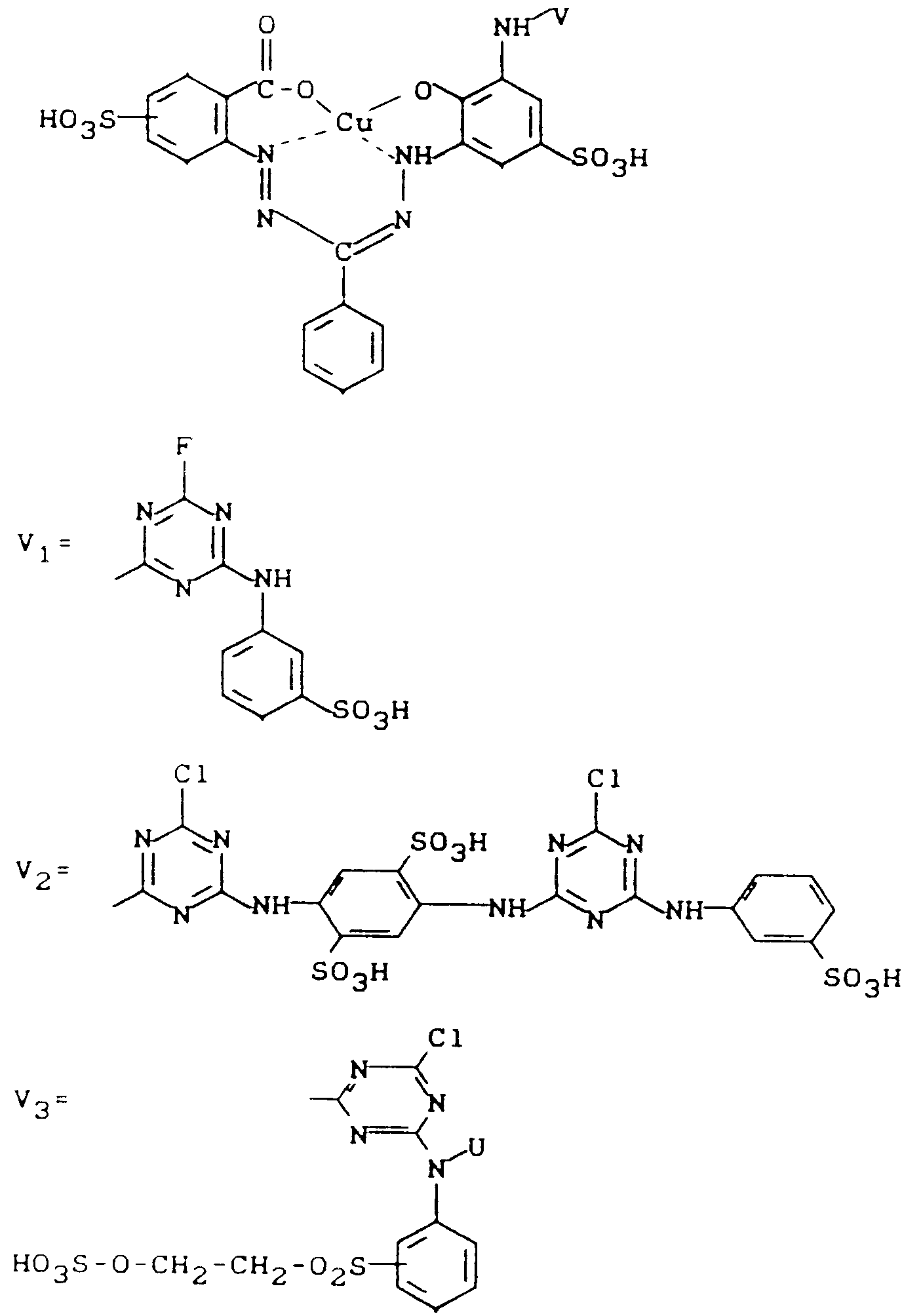
Besonders bevorzugte Farbstoffe 2 sind
worin V bedeutet:
worin U = H, CH₃ oder C₂H₅ bedeutet. Besonders bevorzugte Farbstoffe 3 sind
Zur besseren Handhabung enthalten die erfindungsgemäßen Mischungen vorzugsweise Dispergiermittel, insbesondere 0,5 bis 10 Gew.-Teile eine organischen, anionischen Dispergiermittels, bezogen auf die gesamte Mischung und ein Entstaubungsmittel, vorzugsweise 0,5 bis 5 Gew.-Teile, bezogen auf die gesamte Mischung. - Soweit nichts anderes angegeben, sind die im folgenden angegebenen Teile Gewichtsteile.
- Besonders bevorzugte Mischungen werden im folgenden angegeben, wobei in Farbstoff 1.1 im folgenden n = 1,3-1,8 und m = 1,5-2: Mischung 1: Farbstoffe 1.1, 2.1
Mischung 2: Farbstoffe 1.3, 2.2
Mischung 3: Farbstoffe 1.2, 2.2 und 3.1
Mischung 4: Farbstoffe 1.1, 2.1 und 2.2
Mischung 5: Farbstoffe 1.1, 2.1, 2.2 und 3.2
- In einer bevorzugten Ausführungsform enthalten die Mischungen, bezogen auf den gesamten Farbstoffgehalt:
Farbstoff 1: 10 bis 50, insbesondere 30 bis 50 Gew.-%
Farbstoff 2: 40 bis 90, insbesondere 30 bis 70 Gew.-%
Farbstoff 3: 0 bis 50, insbesondere 0 bis 40 Gew.-%
Zusätzlich können weitere Farbstoffe oder übliche Hilfsmittel eingesetzt werden. Insbesondere enthalten die erfindungsgemäßen Farbstoffmischungen pro 100 Teile Farbstoff 1 bis 50 Teile eines anorganischen Salzes wie beispielsweise Kochsalz oder Natriumsulfat. Die erfindungsgemäßen Mischungen enthalten weiterhin vorzugsweise einen Puffer, insbesondere einen anorganischen Puffer mit einem Pufferungsbereich zwischen pH 6,5 bis 7,5. - Die Farbstoffmischung kann sowohl zum Färben nach dem Auszieh-Verfahren als auch nach Klotz-Dämpf- und Kaltverweil-Verfahren verwendet werden. Geeignete Materialien sind sowohl reine Cellulosefasermaterialien als auch deren Mischungen mit Polyester wie Polyester/Baumwolle, Polyester/Viskose, Polyester/Leinen sowie Mischungen verschiedener Cellulosefasern wie Baumwolle/Zellwolle bzw. Baumwolle/Leinen. Die Haupteinsatzgebiete der Mischung sind das Färben von Baumwollweb- und Wirkware sowie Frottierware.
- Die erfindungsgemäßen Mischungen eignen sich zum Färben nach dem Ausziehverfahren nach folgender Verfahrensweise:
Zeit (Min) Temp. (°C) Maßnahmen 10 60 Farbstoffzusatz 40 60 Salzzusatz in Portionen (50 g/l Kochsalz) 70 60 Alkalizusatz (20 g/l Soda) 90 80 Aufheizen mit 1°C/Minute 120 80 Färben 130 50 Warm Spülen 140 50 Ablassen und Auffüllen 150 50 Warm Spülen 160 50 Ablassen und Auffüllen 170 80 Heiß Spülen 180 80 Ablassen und Auffüllen 190 80 Heiß Spülen 200 80 Ablassen und Auffüllen 215 95 Heiß Spülen 220 95 Warm Spülen im Überlauf 225 80 Warm Spülen im Überlauf 230 20 Kalt Spülen 240 20 Färbegut entnehmen. - Die erfindungsgemäßen Mischungen eignen sich zum Färben nach Klotzverfahren vorzugsweise nach folgenden Richtrezepturen:
A) Kaltverweil-Verfahren
Richtrezeptur: - 1) 1000 Teile Klotzflotte enthalten
1 - 80 Teile Farbstoff
50 - 100 Teile Wasserglas spez. Gew. 1,5
7,5- 15 Teile Natronlauge spez. Gew. 1,5
0 - 100 Teile Harnstoff
0 - 2 Teile Netzmittel
0 - 20 Teile Verdickungsmittel - 2) 1000 Teile Klotzflotte enthalten
1 - 80 Teile Farbstoff
8 - 20 Teile Soda
1 - 12 Teile Natronlauge spez. Gew. 1,5
0 - 100 Teile Harnstoff
0 - 2 Teile Netzmittel
0 - 2 Teile Verdickungsmittel - 100 Teile einer wässrigen Färbeflotte werden auf einer Haspelkufe bei 60°C mit 100 Teilen einer gebleichten Baumwollwirkware und 3 Teilen einer Reaktivfarbstoffmischung versetzt. Die Mischung besteht aus 50 Teilen des Farbstoffs 1.1 und 50 Teilen des Farbstoffs 2.1.
- Nachdem sich in einer Zeit von 15 Minuten die Farbstoffmischung gleichmäßig in der Flotte und auf der Baumwolle verteilt hat, werden über einen Zeitraum von 30 Minuten 50 Teile Natriumchlorid in die Färbeflotte gegeben und anschließend 10 Teile Soda im Abstand von 10 Minuten zu je 3 Portionen von je 1 Teil, 2 Teilen und 7 Teilen hinzugefügt. Anschließend wird in 30 Minuten auf 80°C erwärmt und 30 Minuten bei dieser Temperatur behandelt. Danach wird die Flotte abgelassen, zweimal bei 60°C und zweimal bei 80°C gespült. Anschließend wird 15 Minuten kochend extrahiert und die Waschflotte abgelassen. Nach dem kalt Spülen erhält man eine klare Blaufärbung mit guten Echtheitseigenschaften.
- Die Metamerie der erhaltenen Färbung ist geringer als die einer nach gleichem Färbschema erhaltenen Färbung, in der jeweils 3 Teile ausschließlich des Farbstoffs 1.1 bzw. Farbstoff 2.1 eingesetzt wurden.
- 800 Teile einer wäßrigen Färbeflotte werden auf einem handelsüblichen Jetfärbeaggregat bei 30°C mit 100 Teilen Baumwollwirkware und 40 Teilen Natriumchlorid versetzt.
- Nach 10 Minuten Behandeln bei dieser Temperatur wird in 15 Minuten auf 60°C erwärmt und über einen Zeitraum von 45 Minuten 100 Teile einer Farbstofflösung zugesetzt bestehend aus
3 Teile einer Mischung aus
40 Teile des Farbstoffs 1.1 sowie
60 Teile des Farbstoffs 2.1. - Anschließend wird über einen Zeitraum von 45 Minuten 10 Teile Soda wasserfrei gelöst in 100 Teilen Wasser zugegeben. Nach 15 Minuten wird in 20 Minuten auf 80°C erwärmt und 30 Minuten bei dieser Temperatur behandelt.
- Danach wird die Flotte abgelassen, zweimal bei 60°C und zweimal bei 80°C gespült. Anschließend wird 15 Minuten kochend geseift und die Waschflotte abgelassen. Nach dem kalt Spülen erhält man eine klare Blaufärbung mit verbesserten Metamerieeigenschaften.
- 100 Teile einer gebleichten Baumwollmaschenware werden auf einem handelsüblichen Jetfärbeaggregat mit 800 Teilen einer 60°C warmen Färbeflotte behandelt, welche
40 Teile Natriumchlorid
20 Teile Soda (wasserfrei)
4 Teile der Farbstoffmischung bestehend aus
50 Teile des Farbstoffs 1.1
25 Teile des Farbstoffs 2.1 und
25 Teile des Farbstoffs 2.2
enthält. - Das Bad wird in 20 Minuten auf 80°C erwärmt und 60 Minuten bei dieser Temperatur gehalten. Nach dieser Zeit wird die Flotte abgelassen und zweimal je 10 Minuten mit 800 Teilen einer 60°C warmen Flotte und zweimal mit 800 Teilen einer 80°C warmen Flotte gespült.
- Anschließend wird mit frischer Flotte auf 95°C erwärmt und 20 Minuten kochend extrahiert. Nach Ablassen der Waschflotte wird kalt gespült.
- Man erhält eine egale Blaufärbung mit verbesserten Metamerieeigenschaften.
- 100 Teile einer gebleichten Baumwollwebware werden auf einem handelsüblichen Kurzflottenjetfärbeaggregat mit 500 Teilen einer 60°C warmen Färbeflotte behandelt, welche
30 Teile Natriumsulfat (wasserfrei)
10 Teile der Farbstoffmischung bestehend aus
50 Teile des Farbstoffs 1.1
50 Teile des Farbstoffs 2.1 sowie
0,5 Teile des Farbstoffs der Formel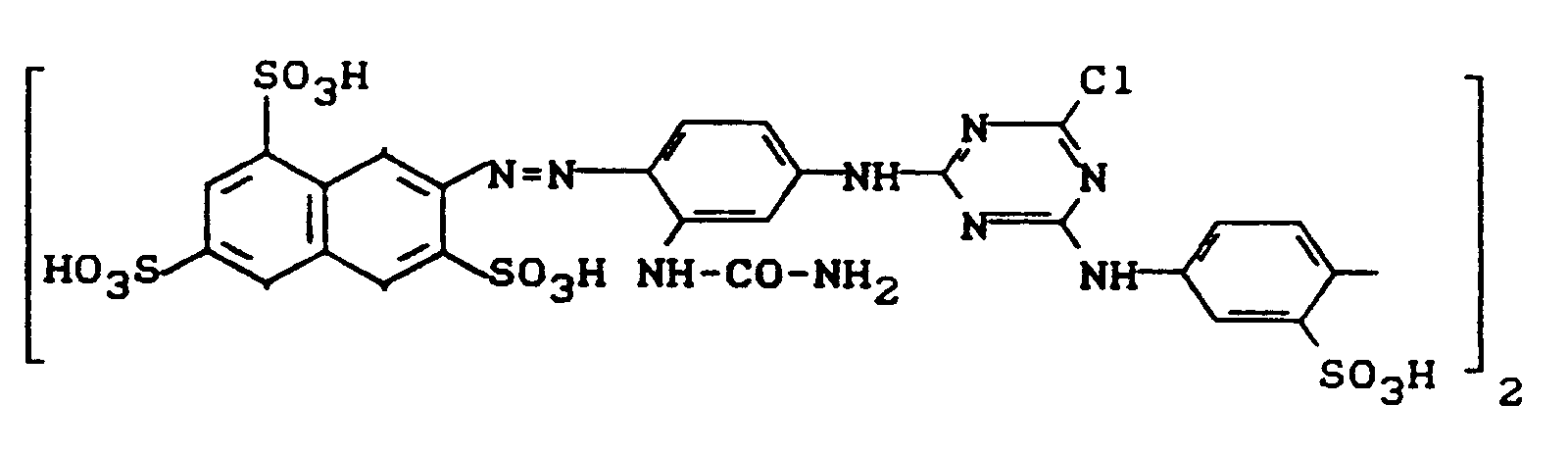
und
0,5 Teile des Farbstoffs der Formel
enthält. - Das Bad wird in 20 Minuten auf 80°C erwärmt und 60 Minuten bei dieser Temperatur gehalten. Nach dieser Zeit wird die Flotte abgelassen und zweimal je 10 Minuten mit 800 Teilen einer 60°C warmen Flotte und zweimal mit 800 Teilen einer 80°C warmen Flotte gespült.
- Anschließend wird mit frischer Flotte auf 95°C erwärmt und 20 Minuten kochend extrahiert. Nach Ablassen der Waschflotte wird kalt gespült.
- Man erhält eine egale Grünfärbung mit guten Echtheitseigenschaften.
- 100 Teile eines gebleichten Baumwollgarnes werden auf einem handelsüblichen Garnfärbeapparat bei einer Flottenumwälzung von 27 l/kg/Minute mit 750 Teilen einer 60°C warmen Färbeflotte behandelt, welche
40 Teile Natriumsulfat (wasserfrei)
10 Teile Soda (wasserfrei)
5 Teile einer Farbstoffmischung bestehend aus
30 Teilen des Farbstoffs 1.2
30 Teilen des Farbstoffs 2.1
sowie
40 Teilen des Farbstoffs 3.2
enthält. - Das Bad wird in 20 Minuten auf 80°C erwärmt und 60 Minuten bei dieser Temperatur gehalten. Nach dieser Zeit wird die Flotte abgelassen und zweimal mit 750 Teilen einer 60°C warmen Flotte gespült. Danach wird mit 750 Teilen einer 60°C warmen, frischen Flotte aufgefüllt und 0,5 Teile einer 60%igen Essigsäure zugesetzt und auf 80°C erwärmt. Nach 10 Minuten Behandeln bei dieser Temperatur wird die Flotte abgelassen, zweimal bei 50°C und zweimal bei 80°C gespült. Anschließend wird 15 Minuten kochend geseift und kalt gespült.
- Man erhält eine tiefe Blaufärbung mit neutralen Metamerieeigenschaften.
- 1000 Teile einer wäßrigen Färbeflotte werden bei 60°C mit 100 Teilen Baumwollwirkware und einer Kombination von drei Reaktivfarbstoffmischungen versetzt:
- Mischung 1 bestehend aus
- 40 Teilen Farbstoff der Formel 1.1 und
60 Teilen Farbstoff der Formel 2.1 - Mischung 2 bestehend aus
- 50 Teilen Farbstoff der Formel 4 und
50 Teilen Farbstoff der Formel 5 - Mischung 3 bestehend aus
- 50 Teilen Farbstoff der Formel 6 und
50 Teilen Farbstoff der Formel 7 - Man erhält eine Braunfärbung mit guten Echtheitseigenschaften.
- 100 Teile einer abgekochten und gebleichten Baumwollwirkware werden mit einer Flottenaufnahme von 65 % mit einer wässrigen Farbflotte imprägniert, welche in 1000 Teilen 50 Teile einer Mischung enthält, bestehend aus
25 Teilen des Farbstoffs 1.2
50 Teilen des Farbstoffs 2.2
25 Teilen des Farbstoffs 3.1
Die Imprägnierflotte enthält ferner
12 Teile Soda wasserfrei
sowie
8 Teile Natronlauge vom spez. Gew. 1,356. - Die Temperatur der Klotzflotte beträgt 25°C.
- Die mit Farbflotte imprägnierte Gewebebahn wird aufgedockt, in Polyethylenfolie eingepackt und bei langsamer Rotation 24 Stunden verweilt. Anschließend wird auf einer achtkästigen Kontinuebreitwaschmaschine nach folgendem Schema ausgewaschen:
Zweimal kalt spülen, zweimal warm spülen, zweimal kochend extrahieren, warm spülen, kalt spülen. - Man erhält eine flächenegale, endengleiche, tiefe Blaufärbung mit verbesserten Metamerieeigenschaften.
- 1000 Teile eines Polyesterfaser/Baumwoll-Feincordgewebes bestehend aus 80 Teilen Baumwolle und 20 Teilen Polyester werden mit einer Flottenaufnahme von 75 % mit einer wäßrigen Färbeflotte imprägniert, welche in 1000 Teilen
2 Teile eines handelsüblichen Netzmittels
30 Teile einer Farbstoffmischung bestehend aus
30 Teilen des Farbstoffs 1.1
33 Teilen des Farbstoffs 2.1
37 Teilen des Farbstoffs 2.2
10 Teile eines handelsüblichen Verdickungsmittels
sowie
3 Teile m-Nitrobenzolsulfat
gelöst enthält,
Die Temperatur der Flotte beträgt 30°C. - Die Warenbahn wird anschließend während 1 Minute bei 120°C getrocknet und 1 Minute bei 220°C thermosoliert. Die Warenbahn wird daraufhin im Chemikalienklotz mit einer Fixierlösung, welche in
1000 Teilen 250 Teile Kochsalz und
20 Teile Natronlauge vom spez. Gew. 1,5
gelöst enthält, imprägniert. - Nach dem Chemikalienklotz wird in einem handelsüblichen Dämpfer 1 Minute bei 103°C gedämpft. Nach dem wie beschrieben durchgeführten Nachwaschen und Spülen erhält man eine klare Blaufärbung mit neutraler Abendfarbe.
- 100 Teile einer entschlichteten und gebleichten Baumwollwebware werden mit einer Flottenaufnahme von 65 % mit einer wässrigen Farbflotte imprägniert, welche in 1000 Teilen
2 Teile eines handelsüblichen Netzmittels,
40 Teile einer Mischung bestehend aus
25 Teilen des Farbstoffs 1.1
50 Teilen des Farbstoffs 2.1
25 Teilen des Farbstoffs 3.1
50 Teile Wasserglas vom spez. Gew. 1,5
sowie
7,5 Teile Natronlauge vom spez. Gew. 1,5
gelöst enthält. - Die Temperatur der Flotte beträgt 25°C.
- Die mit Farbflotte imprägnierte Gewebebahn wird aufgedockt, mit Polyethylenfolie eingepackt und bei langsamer Rotation 24 Stunden verweilt. Anschließend wird auf einer acktkästigen Kontinuebreitwaschmaschine nach folgendem Schema ausgewaschen. Zweimal kalt spülen, zweimal warm spülen, zweimal kochend extrahieren, warm spülen, kalt spülen.
- Man erhält eine egale klare Blaufärbung mit verbesserter Metamerie.
- 1000 Teile einer entschlichteten und gebleichten Baumwollwebware werden mit einer Flottenaufnahme von 65 % mit einer wässrigen Farbflotte imprägniert, welche in 1000 Teilen
2 Teile eines handelsüblichen Netzmittels
40 Teile einer Mischung bestehend aus
20 Teilen des Farbstoffs 1.1
10 Teilen des Farbstoffs 1.3
20 Teilen des Farbstoffs 2.1
50 Teilen des Farbstoffs 3.2
100 Teilen Harnstoff
150 Teilen Wasserglas vom spez. Gew. 1,5
sowie
15 Teile Natronlauge vom spez. Gew. 1,5
gelöst enthält. - Die Temperatur der Flotte beträgt 25°C.
- Die mit Farbflotte imprägnierte Gewebebahn wird aufgedockt und bei langsamer Rotation 24 Stunden verweilt. Anschließend wird auf einer achtkästigen Kontinuebreitwaschmaschine nach folgendem Schema ausgewaschen: Zweimal kalt spülen, zweimal warm spülen, zweimal kochend extrahieren, warm spülen, kalt spülen.
- Man erhält eine tiefe Blaufärbung mit verbesserter Metamerie.
| Flottenaufnahme | 50 - 120 % |
| Klotzflottentemperatur | 20 - 30°C |
| Verweilzeit | 24 - 48 Stunden |
B) Einbad-Klotz-Dämpf-Verfahren mit Zwischentrocknen
Richtrezeptur:
1000 Teile Klotzflotte enthalten
1 - 80 Teile Farbstoff
1 - 4 Teile Netzmittel
5 - 20 Teile Verdickungsmittel
5 - 20 Teile Soda wasserfrei
0 - 100 Teile Harnstoff
3 - 5 Teile m-Nitrobenzolsulfonat
Verfahrensbedingungen:
| Klotzflottentemperatur | 20 - 30°C |
| Flottenaufnahme | 50 - 70 % |
| Trocknungszeit | 1 - 2 Minuten |
| Trocknungstemperatur | 120 - 140°C |
| Dämpftemperatur | 102 - 108°C |
| Dämpfzeit | 1 - 8 Minuten |
C) Einbad-Klotz-Dämpf-Verfahren ohne Zwischentrocknen
Richtrezeptur:
1000 Teile Klotzflotte enthalten
1 - 80 Teile Farbstoff
1 - 4 Teile Netzmittel
10 - 20 Teile Natriumbicarbonat
oder
10 - 20 Teile Natriumbicarbonat/Soda 50/50
3 - 5 Teile m-Nitrobenzolsulfonat
Verfahrensbedingungen:
| Klotzflottentemperatur | 20 - 30°C |
| Flottenaufnahme | 50 - 70 % |
| Dämpftemperatur | 102 - 108°C |
| Dämpfzeit | 1 - 8 Minuten |
D) Zweibad-Klotz-Dämpf-Verfahren mit Zwischentrocknen
Richtrezeptur:
1000 Teile Klotzflotte enthalten
1 - 80 Teile Farbstoff
1 - 4 Teile Netzmittel
5 - 20 Teile Verdickungsmittel
Chemikalienklotzflotte:
1000 Teile Chemikalienklotzflotte enthalten
250 Teile Kochsalz
20 - 40 Teile Soda wasserfrei
und/oder
20 Teile Natronlauge des spez. Gew. 1,5
Verfahrensbedingungen:
| Klotzflottentemperatur | 20 - 30°C |
| Flottenaufnahme | 50 - 70 % |
| Trocknungszeit | 1 - 2 Minuten |
| Trocknungstemperatur | 120 -140°C |
| Flottenaufnahme im Chemikalienklotz | 30 - 40 % |
| Dämpfzeit | 1 - 8 Minuten |
| Dämpftemperatur | 102 -108°C |
E) Zweibad-Klotz-Dämpf-Verfahren ohne Zwischentrocknung
Richtrezeptur:
1000 Teile Klotzflotte enthalten
1 - 80 Teile Farbstoff
1 - 40 Teile Netzmittel
Chemikalienklotzflotte:
1000 Teile Chemikalienklotzflotte enthalten
250 Teile Kochsalz
20 - 40 Teile Soda wasserfrei
und/oder
20 Teile Natronlauge des spez. Gew. 1,5
Verfahrensbedingungen:
| Klotzflottentemperatur | 20 - 30°C |
| Flottenaufnahme | 50 - 70 % |
| Flottenaufnahme im Chemikalienklotz | 20 - 50 % |
| Dämpfzeit | 1 - 8 Minuten |
| Dämpftemperatur | 102 -108°C |
F) Klotz-Kondensier-Verfahren
Richtrezeptur:
1000 Teile Klotzflotte enthalten
1 - 40 Teile Farbstoff
1 - 4 Teile Netzmittel
5 - 10 Teile Soda
und/oder
5 - 10 Teile Natriumbicarbonat
5 - 20 Teile Verdickungsmittel
3 - 5 Teile m-Nitrobenzolsulfonat
Verfahrensbedingungen:
| Klotzflottentemperatur | 20 - 30°C |
| Flottenaufnahme | 50 - 70 % |
| Trocknungstemperatur | 120 -140°C |
| Trocknungszeit | 1 Minute |
| Kondensiertemperatur | 140 - 160°C |
| Kondensierzeit | 1 Minute |


Bezogen auf 1000 Teile der Färbeflotte werden dabei eingesetzt:
Mischung 1: 0,55 Teile
Mischung 2: 0:66 Teile
Mischung 3: 0,66 Teile
Nachdem sich die Farbstoffmischung gleichmäßig in der Flotte und auf der Baumwolle verteilt hat, werden 50 Teile Natriumchlorid in die Färbeflotte gegeben und anschließend 20 Teile Natriumcarbonat hinzugefügt. Diese Färbeflotte wird bei lebhafter Flotten- und Warenbewegung innerhalb 20 Minuten auf 80°C erwärmt und bei dieser Temperatur 60 Minuten belassen. Danach wird die Flotte abgelassen, zweimal bei 50°C und zweimal bei 80°C gespült. Daraufhin wird mit frischer Flotte aufgefüllt und auf 98°C erwärmt. Nach 10 Minuten wird abgelassen und erneut 10 Minuten bei 98°C behandelt, Daraufhin wird abgelassen und kalt gespült.
Claims (9)
- Farbstoffmischung enthaltend wenigstens zwei Reaktivblaufarbstoffe, welche eine unterschiedliche Reaktivgruppe aufweisen, dadurch gekennzeichnet, daß wenigstens ein Vinylsulfonylphthalocyaninfarbstoff 1, wenigstens ein Fluor- und/oder Chlortriazinylformazanfarbstoff 2 und gegebenenfalls ein Vinylsulfonyldisazofarbstoff 3 enthalten ist.
- Farbstoffmischung gemäß Anspruch 1, dadurch gekennzeichnet, daß als Vinylsulfonylphthalocyanin 1 wenigstens eine der folgenden Verbindungen enthalten ist:

- Farbstoffmischung gemäß wenigstens einem der vorhergehenden Ansprüche, dadurch gekennzeichnet, daß als Fluor- und/oder Chlortriazinylformazanfarbstoff 2 wenigstens eine der folgenden Verbindungen enthalten ist:
- Farbstoffmischung gemäß wenigstens einem der vorhergehenden Ansprüche, dadurch gekennzeichnet, daß als Vinylsulfonyldisazofarbstoff 3 eine der folgenden Verbindungen enthalten ist.

- Farbmischung gemäß wenigstens einem der vorhergehenden Ansprüche, dadurch gekennzeichnet, daß die Mischung 10 bis 50 Gew.-% des Farbstoffs 1, 40 bis 90 Gew.-% des Farbstoffs 2 und 0 bis 50 Gew.-% des Farbstoffs 3 bezogen auf den gesamten Farbstoffgehalt enthält.
- Farbstoffmischung gemäß wenigstens einem der vorhergehenden Ansprüche, dadurch gekennzeichnet, daß pro Teile der Mischung 1 bis 50 Teile eines anorganischen Salzes und ein Puffer, der einen Pufferungsbereich zwischen pH 6,5 bis 7,5 ergibt, enthalten ist.
- Farbstoffmischung gemäß wenigstens einem der vorhergehenden Ansprüche, dadurch gekennzeichnet, daß die Mischung 0,5 bis 10 Gew.-Teile eines organischen, anionischen Dispergiermittels und 0 bis 5 Gew.-Teile eines Entstaubungsmittels, jeweils bezogen auf die gesamte Mischung, enthält.
- Verfahren zum Färben von Cellulosefasern und Cellulosemischfasern mit einer Mischung aus Reaktivfarbstoffen, dadurch gekennzeichnet, daß eine Mischung gemäß wenigstens einem der vorhergehenden Ansprüche verwendet wird.
- Textilien, die Fasern erhalten, welche mit einer Reaktivfarbstoffmischung gemäß wenigstens einem der vorhergehenden Ansprüche gefärbt worden sind.
Applications Claiming Priority (2)
| Application Number | Priority Date | Filing Date | Title |
|---|---|---|---|
| DE4305453 | 1993-02-23 | ||
| DE4305453A DE4305453A1 (de) | 1993-02-23 | 1993-02-23 | Reaktivfarbstoffblaumischungen mit verbesserter Metamerie |
Publications (1)
| Publication Number | Publication Date |
|---|---|
| EP0612817A1 true EP0612817A1 (de) | 1994-08-31 |
Family
ID=6481075
Family Applications (1)
| Application Number | Title | Priority Date | Filing Date |
|---|---|---|---|
| EP94102042A Withdrawn EP0612817A1 (de) | 1993-02-23 | 1994-02-10 | Reaktivfarbstoffblaumischungen mit verbesserter Metamerie |
Country Status (4)
| Country | Link |
|---|---|
| EP (1) | EP0612817A1 (de) |
| JP (1) | JPH07304988A (de) |
| KR (1) | KR940019812A (de) |
| DE (1) | DE4305453A1 (de) |
Cited By (2)
| Publication number | Priority date | Publication date | Assignee | Title |
|---|---|---|---|---|
| CN100467546C (zh) * | 2002-12-27 | 2009-03-11 | 上海染料化工八厂 | 藏青色染料组合物及其制备与应用 |
| CN103897431A (zh) * | 2014-03-21 | 2014-07-02 | 杭州钱江印染化工有限公司 | 一种tr混纺织物染黑色染料组合及使用方法 |
Families Citing this family (5)
| Publication number | Priority date | Publication date | Assignee | Title |
|---|---|---|---|---|
| DE19536222C2 (de) * | 1995-09-28 | 1998-08-27 | Dystar Textilfarben Gmbh & Co | Färbepräparationen von faserreaktiven Farbstoffen |
| JP3831941B2 (ja) * | 2001-03-07 | 2006-10-11 | セイコーエプソン株式会社 | インクセット並びにこれを用いた記録方法及び記録物 |
| US7205422B2 (en) * | 2004-12-30 | 2007-04-17 | Air Products And Chemicals, Inc. | Volatile metal β-ketoiminate and metal β-diiminate complexes |
| CN104650620B (zh) * | 2015-02-15 | 2016-07-13 | 江苏德美科化工有限公司 | 一种艳蓝色活性染料混合物及其应用 |
| TWI548704B (zh) * | 2015-05-08 | 2016-09-11 | 臺灣永光化學工業股份有限公司 | 高固著數位紡織印花墨水組成物 |
Citations (4)
| Publication number | Priority date | Publication date | Assignee | Title |
|---|---|---|---|---|
| EP0073267A1 (de) * | 1980-03-04 | 1983-03-09 | Sumitomo Chemical Company, Limited | Blaue, kupferhaltige Phthalocyanin-Reaktivfarbstoffe, Verfahren zu deren Herstellung und deren Verwendung zum Färben von Zellulosefasern |
| EP0113251A2 (de) * | 1982-12-23 | 1984-07-11 | Sumitomo Chemical Company, Limited | Verfahren zum Färben von Cellulosefaser und Stickstoffaser enthaltenden Mischfasermaterialien |
| EP0231837A2 (de) * | 1986-02-01 | 1987-08-12 | Hoechst Aktiengesellschaft | Verfahren zur Herstellung von wasserlöslichen Phthalocyaninfarbstoffen |
| EP0318023A2 (de) * | 1987-11-27 | 1989-05-31 | Hoechst Japan Limited | Reaktivfarbstoffe |
-
1993
- 1993-02-23 DE DE4305453A patent/DE4305453A1/de not_active Withdrawn
-
1994
- 1994-02-10 EP EP94102042A patent/EP0612817A1/de not_active Withdrawn
- 1994-02-17 JP JP6041739A patent/JPH07304988A/ja active Pending
- 1994-02-23 KR KR1019940003171A patent/KR940019812A/ko not_active Withdrawn
Patent Citations (5)
| Publication number | Priority date | Publication date | Assignee | Title |
|---|---|---|---|---|
| EP0073267A1 (de) * | 1980-03-04 | 1983-03-09 | Sumitomo Chemical Company, Limited | Blaue, kupferhaltige Phthalocyanin-Reaktivfarbstoffe, Verfahren zu deren Herstellung und deren Verwendung zum Färben von Zellulosefasern |
| EP0113251A2 (de) * | 1982-12-23 | 1984-07-11 | Sumitomo Chemical Company, Limited | Verfahren zum Färben von Cellulosefaser und Stickstoffaser enthaltenden Mischfasermaterialien |
| EP0231837A2 (de) * | 1986-02-01 | 1987-08-12 | Hoechst Aktiengesellschaft | Verfahren zur Herstellung von wasserlöslichen Phthalocyaninfarbstoffen |
| EP0318023A2 (de) * | 1987-11-27 | 1989-05-31 | Hoechst Japan Limited | Reaktivfarbstoffe |
| US5047067A (en) * | 1987-11-27 | 1991-09-10 | Hoechst Aktiengesellschaft | Reactive dyestuff composition for cellulose fibers: reactive dyes with similar hue but different reactive groups and substantivities |
Cited By (3)
| Publication number | Priority date | Publication date | Assignee | Title |
|---|---|---|---|---|
| CN100467546C (zh) * | 2002-12-27 | 2009-03-11 | 上海染料化工八厂 | 藏青色染料组合物及其制备与应用 |
| CN103897431A (zh) * | 2014-03-21 | 2014-07-02 | 杭州钱江印染化工有限公司 | 一种tr混纺织物染黑色染料组合及使用方法 |
| CN103897431B (zh) * | 2014-03-21 | 2016-05-25 | 杭州钱江印染化工有限公司 | 一种tr混纺织物染黑色染料组合及使用方法 |
Also Published As
| Publication number | Publication date |
|---|---|
| DE4305453A1 (de) | 1994-08-25 |
| KR940019812A (ko) | 1994-09-15 |
| JPH07304988A (ja) | 1995-11-21 |
Similar Documents
| Publication | Publication Date | Title |
|---|---|---|
| DE3314663C2 (de) | Verfahren zum Färben von Cellulosefasern oder Cellulosemischfasern nach der Ausschöpf-Färbemethode | |
| EP0545207B1 (de) | Reaktivfarbstoffmischung mit verbessertem Kombinationsverhalten | |
| DE3434818C2 (de) | Formazan-Verbindung, sie enthaltende Farbstoffzusammensetzung und Verfahren zum Färben von Cellulosefasern | |
| EP0582893B1 (de) | Reaktivfarbstoffmischung | |
| EP0742270B1 (de) | Phthalocyaninreaktivfarbstoffmischung | |
| EP0596323A2 (de) | Phthalocyaninreaktivfarbstoffmischung | |
| EP0546372B1 (de) | Reaktivfarbstoffmischungen | |
| DE4305453A1 (de) | Reaktivfarbstoffblaumischungen mit verbesserter Metamerie | |
| DE3881095T2 (de) | Färben und Bedrucken von Fasern. | |
| EP0613929A1 (de) | Reaktivfarbstoffgrünmischung mit verringertem Dichroismus | |
| DE4306717A1 (de) | Reaktivfarbstoffbrillantblaumischung | |
| EP0017172B1 (de) | Verfahren zum Färben von Cellulosefasern und von Cellulose/Polyester enthaltenden Fasermischungen mit Reaktivfarbstoffen | |
| DE2658061B1 (de) | Verfahren zum faerben von mischgeweben aus modifizierten polyesterfasern und wolle nach einem verweilprozess | |
| DE2440207C2 (de) | Ein Verfahren zum unterschiedlichen Einfärben von Polyamidfasern und polyamidf aserhaltigen Materialien | |
| DE2509173A1 (de) | Verfahren zur herstellung von effektgeweben | |
| EP0109029B1 (de) | Verfahren zum Färben von Textilgut aus modifizierten Polyesterfasern | |
| DE4443639A1 (de) | Phthalocyaninreaktivfarbstoffmischung | |
| DE2244524C2 (de) | Vigoureuxdruck auf Wollkammzug | |
| DE2108876C3 (de) | Verfahren zum einbadigen Färben von Mischungen aus Cellulose- und Polyamidfasern nach der Ausziehmethode | |
| DE3427806C2 (de) | ||
| DE1619491C (de) | Verfahren zum kontinuierlichen Färben von Viskosefasern mit Reaktivfarbstoffen | |
| DE2800600A1 (de) | Verfahren zum bedrucken von keratin/ polyester-faserflaechengebilden | |
| DE4305454A1 (de) | Klotzverfahren mit einer Phthalocyaninmischung | |
| AT262926B (de) | Verfahren zur Verstärkung der Wirkung von Carriern beim Färben von Polyesterfasern bzw. deren Mischgeweben | |
| DE3105906A1 (de) | Verfahren zum kontinuierlichen faerben von wollfasern |
Legal Events
| Date | Code | Title | Description |
|---|---|---|---|
| PUAI | Public reference made under article 153(3) epc to a published international application that has entered the european phase |
Free format text: ORIGINAL CODE: 0009012 |
|
| AK | Designated contracting states |
Kind code of ref document: A1 Designated state(s): CH DE FR GB LI |
|
| 17P | Request for examination filed |
Effective date: 19950117 |
|
| STAA | Information on the status of an ep patent application or granted ep patent |
Free format text: STATUS: THE APPLICATION HAS BEEN WITHDRAWN |
|
| 18W | Application withdrawn |
Withdrawal date: 19960412 |