EP0613632B1 - Appareil à épiler avec disques - Google Patents
Appareil à épiler avec disques Download PDFInfo
- Publication number
- EP0613632B1 EP0613632B1 EP94101633A EP94101633A EP0613632B1 EP 0613632 B1 EP0613632 B1 EP 0613632B1 EP 94101633 A EP94101633 A EP 94101633A EP 94101633 A EP94101633 A EP 94101633A EP 0613632 B1 EP0613632 B1 EP 0613632B1
- Authority
- EP
- European Patent Office
- Prior art keywords
- discs
- hub
- hair
- disc
- pair
- Prior art date
- Legal status (The legal status is an assumption and is not a legal conclusion. Google has not performed a legal analysis and makes no representation as to the accuracy of the status listed.)
- Expired - Lifetime
Links
- 210000004209 hair Anatomy 0.000 title claims description 74
- 208000002271 trichotillomania Diseases 0.000 claims description 39
- 230000000712 assembly Effects 0.000 claims description 37
- 238000000429 assembly Methods 0.000 claims description 37
- 230000002093 peripheral effect Effects 0.000 claims description 18
- 239000000463 material Substances 0.000 claims description 9
- 230000000295 complement effect Effects 0.000 claims description 5
- 239000002184 metal Substances 0.000 claims description 5
- 229910052751 metal Inorganic materials 0.000 claims description 5
- 238000000034 method Methods 0.000 description 7
- 230000015572 biosynthetic process Effects 0.000 description 5
- 238000010276 construction Methods 0.000 description 3
- 238000006073 displacement reaction Methods 0.000 description 3
- 238000012423 maintenance Methods 0.000 description 3
- 238000005452 bending Methods 0.000 description 2
- 230000035617 depilation Effects 0.000 description 2
- 230000002951 depilatory effect Effects 0.000 description 2
- 239000004033 plastic Substances 0.000 description 2
- 230000002441 reversible effect Effects 0.000 description 2
- 239000004677 Nylon Substances 0.000 description 1
- 230000000694 effects Effects 0.000 description 1
- 230000003779 hair growth Effects 0.000 description 1
- 238000007689 inspection Methods 0.000 description 1
- 230000000670 limiting effect Effects 0.000 description 1
- 150000002739 metals Chemical class 0.000 description 1
- 229920001778 nylon Polymers 0.000 description 1
- 230000001151 other effect Effects 0.000 description 1
- 229910001220 stainless steel Inorganic materials 0.000 description 1
- 239000010935 stainless steel Substances 0.000 description 1
Images

Classifications
-
- A—HUMAN NECESSITIES
- A45—HAND OR TRAVELLING ARTICLES
- A45D—HAIRDRESSING OR SHAVING EQUIPMENT; EQUIPMENT FOR COSMETICS OR COSMETIC TREATMENTS, e.g. FOR MANICURING OR PEDICURING
- A45D26/00—Hair-singeing apparatus; Apparatus for removing superfluous hair, e.g. tweezers
- A45D26/0023—Hair-singeing apparatus; Apparatus for removing superfluous hair, e.g. tweezers with rotating clamping elements
- A45D26/0028—Hair-singeing apparatus; Apparatus for removing superfluous hair, e.g. tweezers with rotating clamping elements with rotating discs or blades
Definitions
- the present invention relates to depilatory devices for removing body hair and, more particularly, to devices for removing unwanted body hair by uprooting the hair.
- Depilation can be effected in one of two basic processes.
- one process implemented by shavers of various types, strands of hair are cut, typically in the vicinity of the skin, leaving the roots intact and in place beneath the skin surface.
- the other basic process which will henceforth be referred to as 'hair removal', hair is removed without cutting the strands, typically by vigorously pulling the hair strands so as to uproot the hair and remove the entire hair, including the roots.
- Processes for the mechanical uprooting of hair generally involve grasping one or more strands of hair and vigorously pulling on the hair so as to remove the entire hair, including its roots. Care must be taken that the hair thus grasped and pulled is not inadvertently cut in the process. Care must also be taken to ensure that the pulling of hair occurs sufficiently quickly that the user does not sense an unacceptable amount of pain or discomfort. As may well be appreciated, everything else being equal, the quicker the pulling action, the less painful is the uprooting.
- the Philips device features a number of discs which are stacked on a rotatable assembly made up of three straight parallel shafts.
- the two end walls which touch the outer discs, which are different in construction from the intermediate discs, are angled so as to tilt one portion of each of the outer discs approximately perpendicular to the shafts.
- Each of the discs of the Philips device is made up of a metal portion and a complex integral plastic portion which includes a number of complicated protrusions and recessions designed to transfer the tilt of the outer discs to the intermediate discs. The tilt produces regions where adjoining discs alternately come together to form a temporary trap for the hair and move apart to release the uprooted hair.
- the Philips device appears to overcome several of the disadvantages of the previously known systems, the device displays at least three difficulties.
- the Philips design calls for the use of two different disc assemblies, which unnecessarily complicates the assembly and maintenance of the unit.
- Second, close inspection of the Philips disc assembly reveals that the assembly provides only one hair trap per rotation of each disc, which makes it necessary to use a relatively large number of rather closely-spaced discs.
- the Philips device is asymmetrical and operates properly only when the discs are rotated in one sense and not the other.
- a device for removing body hair as set out in claim 1.
- the hub further includes engagement means for engaging at least one adjoining hub so that rotational motion of one hub imparts rotational motion to at least one adjoining hub.
- the discs are made of a rigid material, such as metal, and the disc assemblies are all identical.
- the disc assemblies are symmetrical with respect to clockwise or counterclockwise rotation.
- the hubs are rotatably mounted on a fixed arcuate shaft and each hub includes engagement means for engaging at least one adjoining hub so that rotational motion of one hub imparts rotational motion to an adjoining hub.
- hubs are mounted on a rotatable substantially straight shaft and each hub includes engagement means for engaging the rotatable shaft so that rotational motion of the shaft imparts rotational motion to the hub.
- the present invention successfully addresses the shortcomings of the presently known configurations by providing a hair remover which overcomes the various disadvantages of presently known devices.
- the present invention discloses a novel hair removal device which includes disc assemblies which are designed to alternately form and undo a large number of relatively large hair traps for the efficient and relatively painless removal of body hair.
- the present invention is of a hair removal device which can be used to efficiently and relatively painlessly remove unwanted body hair by uprooting.
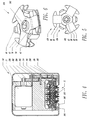
- Figure 1 illustrates a preferred embodiment of a hair remover according to the present invention.
- the hair remover is made up of two portions -- a housing 10 , or handle, which is manually grippable by the user, preferably using one hand; and a hair-plucking assembly 12 .
- Housing 10 may have any convenient shape and orientation.
- housing 10 is represented as a handle-like extension of hair-plucking assembly 12 . It will be apparent that housing 10 may also be oriented differently, for example, directly over hair-plucking assembly 12 (See, for example, Figure 4 described below).
- housing 10 serves both as a grippable handle and further serves to house a motor 14 , which may be of any suitable type, including, but not limited to, any of a large variety of miniature motors.
- Motor 14 may be operated by any convenient power source, such as house current and/or a battery (not shown), preferably a rechargeable battery.
- Housing 10 further contains a reduction gear system which serves to convert the rotational speed produced by motor 14 to the proper rotational speed of hair-plucking assembly 12 .
- Any suitable reduction gear system may be used.
- a motor shaft 16 is connected to, or is integrally formed with, a motor shaft gear 18 which meshes with, and serves to rotate, a larger reduction gear 20 mounted on a reduction gear shaft 22 .
- a drive gear 24 is also mounted on reduction gear shaft 22 which meshes with, and serves to rotate, a posterior hair-plucking assembly end member 26 which, in turn, serves to rotate the disc assemblies, as described below.
- the present invention is embodied in hair-plucking assembly 12 , one embodiment of which is illustrated in Figure 1, with details in Figures 2 and 3.
- Hair-plucking assembly 12 is made up of at least two disc assemblies 28 .
- the illustrative embodiment of Figure 1 includes nine disc assemblies 28 .
- Hair-plucking assembly 12 also preferably includes posterior hair-plucking assembly end member 26 which serves to transmit the rotational motion produced by motor 14 to hair-plucking assembly 12 and further serves as a pressure plate to support hair-plucking assembly 12 , and an anterior hair-plucking assembly end member 30 which serves as a bearing to allow hair-plucking assembly 12 to rotate smoothly throughout its length and further serves as a pressure plate to support hair-plucking assembly 12 .
- Posterior hair-plucking assembly end member 26 , anterior hair-plucking assembly end member 30 and each of disc assemblies 28 is each rotatably mounted on an arcuate shaft 32 , at least one of whose ends is firmly anchored in housing 10 .
- Arcuate shaft 32 may be made of any suitable material, including various rigid or flexible materials. When a flexible material is used, arcuate shaft 32 must be anchored at both of its ends in order to preserve its desired degree of curvature.
- arcuate shaft 32 is made of a rigid material, such as any of a number of suitable rigid metals.
- a rigid shaft reduces the 'give' or 'play' in the hair-plucking device and allows for the quick and relatively painless removal or hair.
- the curved portion of arcuate shaft 32 has a constant radius of curvature.
- the degree of curvature of arcuate shaft 32 is selected to meet a number of criteria. First, as will become more apparent below, the curvature must be such that disc assemblies 28 are caused to efficiently and smoothly form and undo traps for hair. Second, the curvature should preferably approximately match the natural curvature, or contours, of those portions of the body, e.g. legs, on which the device is to be used.
- Hair-plucking assembly 12 includes, primarily, a plurality of disc assemblies 28 .
- Figures 2 and 3 are plan and perspective views, respectively, of a typical disc assembly 28 , such as that used in Figure 1.
- Disc assembly 28 is made up of three elements -- a hub 34 , and a pair of discs 36 .
- the three elements may each be a separate entity, as described in more detail below, or any two or all three may be integrally formed to form two units or a single unit.
- Each of these elements may be made of any suitable material.
- each is made of a rigid material so as to reduce the 'give' in the system and reduce the level of discomfort during the hair plucking process, as described above in a different context.
- hub 34 is made of rigid plastic, such as nylon
- discs 36 are made of metal, such as stainless steel.
- discs 36 of each disc assembly 28 are identical.
- all discs 36 and all hubs 34 are identical, which facilitates the assembly and maintenance of a device according to the present invention.
- Each of discs 36 features at least one radially extending arm 38 which extends from its central portion.
- each disc features three radially extending arms 38 oriented 120° apart.
- Each arm 38 terminates in a flattened peripheral portion 40 .
- the construction of flattened peripheral portion 40 is such that when it is pressed against the corresponding flattering peripheral portion 40 of the complementary disc 36 a trap is formed which tends to grasp and hold any hair strands which happen to be located between the two peripheral portions 40 when the trap is closed.
- each arm 38 of discs 36 also includes angled leading walls 42 which are connected to flattened peripheral portions 40 which serve to funnel hair into the trap area so as to increase the quantity of hair which is grasped and uprooted each time the trap is set.
- angled leading walls 42 are also found on the trailing edge of each flattened peripheral portion 40 .
- disc assemblies 28 are preferably completely symmetrical with respect to rotation about arcuate shaft 32 such that disc assemblies 28 may be readily made to rotate either clockwise or counterclockwise.
- This feature increases the versatility of a device according to the present invention since a single device, equipped with a reversible motor or other means for reversing the rotational sense, can accommodate both right handed and left handed users.
- a reversal of rotational direction may be called for when a right-handed user wishes to use different stroke directions in treating a different part of the body without having to switch hands or rotate the device.
- each disc 36 features an opening, preferably substantially circular, which is sized and shaped to fit over a projection of hub 34 , which is described in more detail below.
- Hub 34 includes a central portion which includes, on both axially-directed faces of hub 34 , central projections 44 which are sized and shaped to accommodate the openings of discs 36 and to serve as support points to facilitate the tilting of hub 34 .
- the tolerances between central projections 44 of hub 34 and the central openings of discs 36 are such that discs 36 are not prevented from pivoting as described below in such a way that one portion of the opening of discs 36 is located near the juncture of central projection 44 and the body of hub 34 while the opposite portion of the opening is located along projection 44 at a position which is somewhat remote from the juncture of central projection 44 and the body of hub 34 .
- disc assembly 28 is made up not of two discrete discs 36 and a discrete hub 34 but rather the two discs 36 may be integrally formed with each other, or one or both of discs 36 may be integrally formed with hub 34 .
- the formation of the trap is achieved, at least partially, by the bending of one or both of discs 36 rather than as described above.
- the material of construction and/or the thickness of portions of disc assembly 28 must be used to allow disc or discs 36 to bend properly so as to form the traps.
- Hub 34 features shoulders 46 , one shoulder 46 per arm 38 of disc 36 .
- each features three arms 38 and hence hub 34 features three shoulders 46 .
- Shoulders 46 are sized and shaped such that the leading edge of each arm 38 abuts against a portion of one of shoulders 46 . In this way, a rotational motion of hub 34 transmits the same rotational motion to discs 36 .
- each arm 38 also abuts against a portion of one of shoulders 46 .
- disc assembly 28 is symmetrical with respect to rotation in either sense and rotational motion of hub 34 in either sense transmits the same rotational motion to discs 36 .
- axial protrusions 48 Extending from shoulders 46 of hub 34 is a pair of axial protrusions 48 , extending substantially axially in opposite senses. Each of axial protrusions 48 extends axially beyond the plane of arm 38 of the corresponding disc 36 such that, during that portion of the rotation of disc assemblies 28 when a particular set of axial protrusions 48 is located in the concave configuration produced by the curvature of arcuate shaft 32 (as best seen in the lower portion of Figure 1) axial protrusions 48 extend through the open spaces between adjacent arms 38 of discs 36 to touch the nearer disc 36 of an adjoining disc assembly 28 , thereby causing the adjoining disc assembly 28 to form a trap.
- hub 34 includes an edge 50 which lies between each pair of corresponding arms 38 of complementary discs 36 .
- Edge 50 is roughly perpendicular to arcuate shaft 32 and lies at a radial distance from the axis of arcuate shaft 32 which is significantly less than the radial distance of flattened peripheral portion 40 .
- the above-described geometry is such that whenever axial protrusions 48 of adjoining disc assembly or assemblies 28 press discs 36 together, a pair of arms 38 of complementary discs 36 pivot slightly toward each other about the corresponding edge 50 of hub 34 located between the pair of arms 38. This pivoting motion brings the pair of flattened peripheral portions 40 at the end of the pair of arms 38 together in parallel fashion to form a trap.
- edge 50 of hub 34 further includes a pinch plate which projects radially outwardly from edge 50 .
- the thickness of the pinch plate is smaller than that of edge 50 so that arms 38 of discs 36 are still able to pivot about edge 50 as described above.
- the pinch plate has a width which approximates, and preferably equals, that of flattened peripheral portion 40 and extends from edge 50 so as to be flush with flattened peripheral portion 40 .
- the pivoting or bending of arms 38 of discs 36 towards each other effects the creation of two traps -- one between one face of the pinch plate and one of flattened peripheral portions 40 of one of discs 36 , and the other between the other face of the pinch plate and the flattened peripheral portions 40 of the complementary disc 36 .
- a device according to the present invention further includes additional means for urging pairs of flattened peripheral portions 40 together, so as to prolong the time during which the pair of corresponding flattened peripheral portions 40 of discs 36 remain together to form a trap.
- FIG. 1 A variety of means for carrying out this function may be envisioned.
- One technique is shown in Figure 1 and involves anteriorly biasing arm 38 of the posterior-most disc 36 and simultaneously posteriorly biasing arm 38 of the anterior-most disc 36 .
- the arms 36 being biased are those located in the concave configuration produced by the curvature of arcuate shaft 32 , as can be seen in the lower portion of Figure 1.
- the biasing tends to remove any slack which might be present and which could cause arms 36 to prematurely separate, undoing the trap and prematurely releasing the trapped hair before it has been sufficiently displaced as to have been uprooted.
- biasing can be achieved, for example, as shown in Figure 1, through use of a mechanism which includes a biasing spring 52 mounted in housing 10 which eccentrically anteriorly urges a tilted pressure bearing 54 .
- Tilted pressure bearing 54 anteriorly urges a biasing rod 56 which is slidably mounted in posterior hair-plucking assembly end member 26 and which serves to anteriorly urge the posterior-most disc 36 .
- one biasing rod 56 is provided for each arm 38 of discs 36 .
- a similar mechanism can be implemented at the anterior end of hair-plucking assembly 12 with a second biasing spring 62 which eccentrically posteriorly urges a second tilted pressure bearing 64 .
- Second tilted pressure bearing 64 posteriorly urges a second biasing rod 66 which is slidably mounted in anterior hair-plucking assembly end member 30 which serves to posteriorly urge the anterior-most disc 36 .
- the rotation of disc assemblies 28 is preferably effected by transferring rotational motion from posterior hair-plucking assembly end member 26 , which is driven by motor 14 , to the posterior-most hub 34 , as by use of grooves in posterior hair-plucking assembly end member 26 which engage the posteriorly-directed axial protrusions 48 of posterior-most hub 34 so that rotational motion of posterior hair-plucking assembly end member 26 translates into rotational motion of posterior-most hub 34 and disc assembly 28 .
- rotation can be transmitted from posterior hair-plucking assembly end member 26 to the posterior-most hub 34 through engagement means including protrusions and recessions, as described below.
- a similar arrangement, preferably identical for ease of assembly, is also provided at the anterior end of hair-plucking assembly 12 .
- Hub 34 preferably features means for engaging an adjoining hub 34 so that rotational motion of one hub 34 imparts rotational motion to an adjoining hub 34 .
- hub 34 includes, in and around its central opening, a series of axial engagement protrusions 70 and recessions 72 for engaging corresponding protrusions 70 and recessions 72 of an adjoining hub 34 .
- Such engagement means ensures that adjoining hubs 34 are angularly offset from each other by the desired angles and assures that the adjoining disc assemblies 28 interact properly, as described herein.
- disc assemblies 28 feature discs 36 having three arms 38 and a hub 34 which is triangular in shape
- other configurations are possible and may, in some cases be desirable.
- discs having four arms and hubs which are roughly square in shape In such a configuration, it will be necessary to use a hub engagement means having four, rather than three, pairs of protrusions 70 and recessions 72 .
- Such a configuration would result in the formation of four traps per disc per rotation compared to three traps which are afforded with the embodiment of Figures 1-3.
- FIG. 4-6 Another embodiment of a hair remover according to the present invention is shown in Figures 4-6.
- the embodiment in question is similar to that shown in Figures 1-3 in most respects but includes a number of differences which are noteworthy.
- housing 110 is now shown as lying directly above hair-plucking assembly 12 rather than as extending sideways as in the previously described embodiment.
- the device of Figures 4-6 features disc assemblies 128 which are each rotated not by an adjoining assembly but by a straight drive shaft 100 connected to motor 14 through a suitable gear reduction system, which may include gears 200 , 202 , 204 , 206 , and 208 .
- each disc assembly 128 can be the same as those used in the basic embodiment of Figures 1-3.
- hubs 134 of this embodiment lack the engagement means which allow a hub to rotate, and be rotated, by its neighbor. Instead, each hub 134 features, about its center, means for engaging drive shaft 100 so that rotation of drive shaft 100 serves to rotate hub 134 .
- each hub 134 is equipped with a hexagonal opening 102 having internal walls which taper down from both faces of hub 134 to the midpoint of hub 134 .
- Such an arrangement allows hubs 134 to be tiltingly stacked side by side and makes it possible for drive shaft 100 to impart suitable rotational motion to each hub 134 .
- FIG. 4 One means is shown in Figure 4 and includes the use of tilted mounting walls on either side of the stack of disc assemblies 128 .
- the arrangement may further include a pair of biasing springs 104 which inwardly bias a pair of tilted pressure bearings 106 which, in turn, inwardly tilt disc assemblies 128 to form the desired traps.
Landscapes
- Brushes (AREA)
- Hair Curling (AREA)
- Cosmetics (AREA)
- Surgical Instruments (AREA)
Claims (19)
- Dispositif pour arracher les poils du corps, comprenant:(a) un boítier (10) pouvant être saisi manuellement; et(b) un ensemble d'épilation (12) monté à rotation au boitier (10), cet ensemble d'épilation (12) incluant au moins deux ensembles à disques (28), caractérisé en ce qu'un ensemble à disques (28) comporte:(i) une paire de disques complémentaires (36), chacun de ces disques (36) ayant au moins un bras radial (38) s'étendant dans un plan, ce bras (38) terminant en une partie aplatie périphérique (40) oui, lorsque pressée contre la partie (40) correspondante de l'autre disque (36), forme un piège pour le poil; et(ii) au moins un moyeu (34) pour monter l'un des disques de la paire de disques sur chacune de deux faces axiales du moyeu (34), ce moyeu (34) ayant au moins une épaule (46) pour contacter ledit au moins un bras (38) de chacun des disques (36) de la paire de disques en vue de communiquer un mouvement rotationnel à ladite paire de disques (36) par rotation du moyeu (34) autour de l'axe du moyeu (34), ce moyeu (34) ayant au moins une paire de projections (48) qui s'étendent axialement en sens opposés au-delà du plan dudit bras (38) de chacun des disques de ladite paire de disques (36) pour causer un ensemble à disques adjacent de former ce piège, ledit moyeu (34) ayant en outre une arête (50) sensiblement perpendiculaire à l'axe du moyeu (34) de sorte que les bras (38) de ladite au moins une paire de bras (38) de ces disques (36) soient pivotables autour de cette arête (50) en vue d'amener les parties périphériques aplaties correspondantes de ces disques (36) alternativement ensemble pour former un piège et à l'écart l'une de l'autre pour éjecter le poil arraché.
- Dispositif selon la revendication 1, dans lequel les disques (36) sont fabriqués en matériau rigide.
- Dispositif selon la revendication 2, dans lequel les disques (36) sont fabriqués en métal.
- Dispositif selon la revendication 1, dans lequel l'ensemble d'épilation (12) comporte une pluralité d'ensembles à disques (28) et dans lequel tous les ensembles à disques (28) sont identiques.
- Dispositif selon la revendication 1, dans lequel l'ensemble d'épilation (12) comporte une pluralité d'ensembles à disques (28) et dans lequel les ensembles à disques (28) sont symétriques par rapport à la rotation des ensembles à disques (28) dans la direction des aiguilles d'une montre ou dans la direction opposée au mouvement des aiguilles d'une montre.
- Dispositif selon la revendication 1, dans lequel l'ensemble d'épilation (12) comporte une pluralité d'ensembles à disques (28) et dans lequel les bras (38) de ces disques (36) comportent en outre une paroi avant inclinée (42) connectée aux parties périphériques aplaties (40) des disques (36) pour guider les poils dans le piège.
- Dispositif selon la revendication 1, dans lequel chacun des disques (36) est pourvu de trois bras (38) et le moyeu (34) a une forme triangulaire.
- Dispositif selon la revendication 1, dans lequel ledit au moins un moyeu (34) est monté à rotation sur une tige courbe fixe (32), cette tige courbe (32) ayant une partie convexe et une partie concave.
- Dispositif selon la revendication 1, dans lequel le moyeu (34) comporte en outre un moyen d'engagement (70, 72) pour engager au moins un moyeu adjacent (34) de sorte que le mouvement de rotation d'un moyeu communique un mouvement de rotation à au moins un moyeu adjacent, ce moyen d'engagement incluant au moins une projection axiale (70) et au moins un creux axial (72) sur chaque moyeu (34) pour engager des creux (72) et des projections (70) correspondants d'au moins un moyeu adjacent (34).
- Dispositif selon la revendication 8, comportant en outre un moyen de sollicitation (52) en vue de prolonger le temps pendant lequel ladite paire de parties périphériques aplaties correspondantes (40) des disques (36) restent ensemble pour former un piège.
- Dispositif selon la revendication 10, dans lequel l'ensemble d'épilation (12) comporte une pluralité d'ensembles à disques (28) et dans lequel le moyen de sollicitation (52) comporte l'action de contraindre antérieurement le bras (38) de l'un de ces disques (36) à proximité de la partie concave de la tige courbe (32) et l'action de contraindre postérieurement le bras (38) d'un autre de ces disques (36) à proximité de la partie concave de la tige courbe (32).
- Dispositif selon la revendication 1, dans lequel au moins un moyeu (134) est monté sur un arbre rotatif sensiblement droit (100).
- Dispositif selon la revendication 10, dans lequel l'ensemble d'épilation (12) comporte une pluralité d'ensembles à disques (128), et dans lequel chacun des moyeux (134) comporte des moyens d'engagement (102) pour engager l'arbre rotatif (100) de sorte que le mouvement de rotation de l'arbre (100) communique un mouvement de rotation au moyeu (134).
- Dispositif selon la revendication 12, dans lequel l'ensemble d'épilation (12) comporte une pluralité d'ensembles à disques (128), le dispositif comportant en outre un moyen d'inclinaison (104) pour incliner chaque paire de disques (36) l'un en contact avec l'autre pendant au moins une partie du mouvement de rotation de l'ensemble à disques (128) autour de l'arbre (100).
- Dispositif selon la revendication 14, dans lequel l'ensemble d'épilation (12) comporte une pluralité d'ensembles à disques (128), et dans lequel le moyen d'inclinaison est pourvu de parois d'extremité inclinées connectées audit boitier (10), chacune de ces parois d'extremité inclinant un ensemble à disques externe (128) vers le centre de l'arbre (100).
- Dispositif selon la revendication 1, dans lequel les disques de ladite paire de disques (36) sont connectés en permanence l'une à l'autre.
- Dispositif selon la revendication 1, dans lequel l'un des disques de ladite paire de disques (36) est connecté en permanence audit moyeu (34).
- Dispositif selon la revendication 1, dans lequel l'ensemble d'épilation (12) comporte une pluralité d'ensembles à disques (28) et dans lequel chaque disque de la paire de disques (36) est connecté en permanence audit moyeu (34).
- Dispositif selon la revendication 1, dans lequel les disques de la paire de disques (36) sont connectés en permanence l'un à l'autre et au moyeu (34).
Applications Claiming Priority (2)
| Application Number | Priority Date | Filing Date | Title |
|---|---|---|---|
| US08/016,895 US5281233A (en) | 1993-02-12 | 1993-02-12 | Disc assembly hair remover |
| US16895 | 1993-02-12 |
Publications (2)
| Publication Number | Publication Date |
|---|---|
| EP0613632A1 EP0613632A1 (fr) | 1994-09-07 |
| EP0613632B1 true EP0613632B1 (fr) | 1999-10-20 |
Family
ID=21779587
Family Applications (1)
| Application Number | Title | Priority Date | Filing Date |
|---|---|---|---|
| EP94101633A Expired - Lifetime EP0613632B1 (fr) | 1993-02-12 | 1994-02-03 | Appareil à épiler avec disques |
Country Status (4)
| Country | Link |
|---|---|
| US (1) | US5281233A (fr) |
| EP (1) | EP0613632B1 (fr) |
| DE (1) | DE69421203T2 (fr) |
| ES (1) | ES2139680T3 (fr) |
Cited By (1)
| Publication number | Priority date | Publication date | Assignee | Title |
|---|---|---|---|---|
| WO2012131416A1 (fr) | 2011-03-31 | 2012-10-04 | Epilady 2000 Llc | Dispositif et procédé pour enlever les poils |
Families Citing this family (44)
| Publication number | Priority date | Publication date | Assignee | Title |
|---|---|---|---|---|
| IL103073A (en) * | 1991-09-10 | 1995-11-27 | Philips Electronics Nv | Install a disc-type hair puller |
| DE19521585A1 (de) * | 1995-06-14 | 1996-12-19 | Braun Ag | Gerät zum Auszupfen von Haaren der menschlichen Haut |
| US6165182A (en) * | 1995-11-28 | 2000-12-26 | U.S. Philips Corporation | Depilation apparatus with vibration member |
| USD409333S (en) * | 1996-06-26 | 1999-05-04 | Calor S.A. | Depilatory device |
| EP0921744B1 (fr) | 1996-08-06 | 2002-06-12 | Braun GmbH | Cylindre rotatif pour appareil epilatoire |
| FR2758060B1 (fr) * | 1997-01-06 | 1999-03-05 | Seb Sa | Appareil a epiler a rouleau rotatif |
| FR2768313B1 (fr) * | 1997-09-16 | 1999-10-29 | Seb Sa | Appareil a epiler a rouleau rotatif equipe de dispositif anti-douleur |
| US6159222A (en) * | 1998-03-17 | 2000-12-12 | Soft Lines Ltd. | Device for hair removal |
| US6123713A (en) * | 1998-07-09 | 2000-09-26 | K.I.S. Ltd | Hair removal device with vibrating assembly |
| US6824546B1 (en) | 1998-07-09 | 2004-11-30 | Soft Lines, Ltd. | Hair removal device with disc and vibration assemblies |
| US5976157A (en) | 1998-07-09 | 1999-11-02 | K.I.S. Ltd. | Hair removal device with disc assembly |
| US6436106B2 (en) | 1998-07-09 | 2002-08-20 | Soft Lines, Ltd. | Hair removal device with disc, vibration, and light assemblies |
| US6585743B2 (en) * | 2000-06-09 | 2003-07-01 | Moshe Dolev | Hair depilating device utilizing mechanism to spirally align coupled-tweezer elements |
| WO2002026076A1 (fr) * | 2000-09-26 | 2002-04-04 | Soft Lines, Ltd. | Dispositif d'epilation dote d'un disque et de moyens de vibration |
| US6676670B1 (en) * | 2002-08-20 | 2004-01-13 | Moshe Dolev | Hair depilating device with improved plucking efficiency |
| US20040167481A1 (en) * | 2003-01-16 | 2004-08-26 | Conair Corporation | Hand-held buffing device |
| DE10318749A1 (de) * | 2003-04-25 | 2004-11-18 | Braun Gmbh | Epilationskopf für ein Epilationsgerät |
| US6824461B1 (en) * | 2003-05-19 | 2004-11-30 | Moshe Dolev | Hair depilating device and method for improved depilating coverage |
| IL159483A0 (en) * | 2003-12-21 | 2004-06-01 | Epilady 2000 Llc | Hair removal system |
| BRPI0506691A (pt) * | 2005-02-06 | 2007-05-02 | Laisheng Liu | depilador elétrico |
| US20070093853A1 (en) * | 2005-10-26 | 2007-04-26 | Epilady 2000, L.L.C | Multi-tweezer hair removal apparatus and method |
| WO2007118152A1 (fr) * | 2006-04-06 | 2007-10-18 | K.I.S. Ltd | Epilateur avec pinces glissantes |
| EP1857012A1 (fr) * | 2006-05-18 | 2007-11-21 | Faco S.A. | Epilateur monolithique |
| CN101224061B (zh) * | 2007-01-15 | 2011-02-09 | 游图明 | 具有降低疼痛感结构的拔毛器 |
| CN201073067Y (zh) * | 2007-03-21 | 2008-06-18 | 燕建斌 | 浮动夹片式电动拔毛器 |
| CN201079113Y (zh) * | 2007-07-03 | 2008-07-02 | 高永� | 一种电动拔毛器 |
| WO2009010815A1 (fr) * | 2007-07-18 | 2009-01-22 | Epilady 2000 L.L.C. | Tête d'épilateur pour attraper des poils et épilateur présentant une telle tête |
| WO2011135570A2 (fr) * | 2010-04-30 | 2011-11-03 | Liosonic Ltd. | Procédé et système d'épilation |
| USD676200S1 (en) | 2010-10-29 | 2013-02-12 | Forstar Limited | Cosmetic device |
| USD645204S1 (en) | 2010-11-19 | 2011-09-13 | Avner Platek | Hair removal device |
| US8551117B2 (en) | 2011-03-04 | 2013-10-08 | Soft Lines International, Ltd. | Handheld exfoliating device |
| USD678614S1 (en) | 2011-12-12 | 2013-03-19 | Soft Lines International, Ltd. | Skin removal device |
| USD681277S1 (en) | 2012-06-15 | 2013-04-30 | Soft Lines International, Ltd. | Cosmetic device |
| US9706827B2 (en) | 2012-09-17 | 2017-07-18 | Koninlijke Philips N.V. | Epilator with exposed tweezer portion |
| USD706487S1 (en) | 2012-10-02 | 2014-06-03 | Forstar Limited | Accessory for a cosmetic device |
| USD715493S1 (en) | 2012-10-19 | 2014-10-14 | Soft Lines International, Ltd. | Cosmetic device |
| USD715495S1 (en) | 2013-07-01 | 2014-10-14 | Soft Lines International, Ltd. | Attachment for cosmetic device |
| USD736999S1 (en) | 2014-02-25 | 2015-08-18 | Forstar Limited | Cosmetic sanding device |
| USD737519S1 (en) | 2014-04-17 | 2015-08-25 | Soft Lines International, Ltd. | Cartridge for cosmetic device |
| USD737518S1 (en) | 2014-04-17 | 2015-08-25 | Soft Lines International, Ltd. | Cartridge for cosmetic device |
| USD788980S1 (en) | 2015-07-29 | 2017-06-06 | Forstar Limited | Cosmetic abrasion device |
| US10045795B2 (en) | 2016-04-07 | 2018-08-14 | Soft Lines International, Ltd. | Handheld cosmetic device with pivoting head |
| EP3375320B1 (fr) | 2017-03-17 | 2019-11-20 | Epilady 2000 LLC | Dispositif et procédé d'épilation |
| EP3799764A1 (fr) * | 2019-10-01 | 2021-04-07 | Koninklijke Philips N.V. | Dispositif d'épilation |
Family Cites Families (10)
| Publication number | Priority date | Publication date | Assignee | Title |
|---|---|---|---|---|
| FR2639803B1 (fr) * | 1988-12-07 | 1991-02-15 | Demeester Jacques | Appareil a epiler |
| IL89290A (en) * | 1989-02-14 | 1992-08-18 | Dolev Moshe | Hair removal device |
| DE3930884A1 (de) * | 1989-09-15 | 1991-03-28 | Braun Ag | Geraet zum auszupfen von haaren |
| JP2992356B2 (ja) * | 1990-05-28 | 1999-12-20 | 松下電工株式会社 | 脱毛装置 |
| US5100413A (en) * | 1991-03-05 | 1992-03-31 | Moshe Dolev | Rotary head multi-tweezer hair removal device |
| US5112341A (en) * | 1991-03-05 | 1992-05-12 | Moshe Doley | Hair removal device with central multiple-tweezer element |
| FR2675671B1 (fr) * | 1991-04-25 | 1993-12-17 | Braun Ag | Appareil d'epilation. |
| US5197969A (en) * | 1991-05-13 | 1993-03-30 | U.S. Philips Corp. | Depilation apparatus with thrust cogs |
| ES2081554T3 (es) * | 1991-05-13 | 1996-03-16 | Philips Electronics Nv | Aparato de depilacion con dientes de empuje. |
| US5196021A (en) * | 1992-02-25 | 1993-03-23 | Perfect Lady Ltd. | Depilatory device |
-
1993
- 1993-02-12 US US08/016,895 patent/US5281233A/en not_active Expired - Lifetime
-
1994
- 1994-02-03 ES ES94101633T patent/ES2139680T3/es not_active Expired - Lifetime
- 1994-02-03 DE DE69421203T patent/DE69421203T2/de not_active Expired - Lifetime
- 1994-02-03 EP EP94101633A patent/EP0613632B1/fr not_active Expired - Lifetime
Cited By (1)
| Publication number | Priority date | Publication date | Assignee | Title |
|---|---|---|---|---|
| WO2012131416A1 (fr) | 2011-03-31 | 2012-10-04 | Epilady 2000 Llc | Dispositif et procédé pour enlever les poils |
Also Published As
| Publication number | Publication date |
|---|---|
| DE69421203D1 (de) | 1999-11-25 |
| ES2139680T3 (es) | 2000-02-16 |
| EP0613632A1 (fr) | 1994-09-07 |
| US5281233A (en) | 1994-01-25 |
| DE69421203T2 (de) | 2000-07-13 |
Similar Documents
| Publication | Publication Date | Title |
|---|---|---|
| EP0613632B1 (fr) | Appareil à épiler avec disques | |
| US6123713A (en) | Hair removal device with vibrating assembly | |
| US5976157A (en) | Hair removal device with disc assembly | |
| US6824546B1 (en) | Hair removal device with disc and vibration assemblies | |
| US6436106B2 (en) | Hair removal device with disc, vibration, and light assemblies | |
| US8366724B2 (en) | Hair removal system | |
| US4935024A (en) | Hair removal device | |
| US5794348A (en) | Clipper comb | |
| EP0342546A2 (fr) | Dispositif pour épiler | |
| IL129972A (en) | Hair removing device with rotary roller equipped with pain soothing device | |
| US20070239174A1 (en) | Epilator with Glide Tweezers | |
| US20080195118A1 (en) | Electrical Depilator | |
| ES2245988T3 (es) | Aparato para depilar con pinzas llevadas por una cadena. | |
| JP2878386B2 (ja) | 脱毛装置 | |
| WO2009056923A2 (fr) | Tête d'épilateur pour attraper des poils et épilateur facial avec une telle tête | |
| US5217469A (en) | Rotary head spring-loaded tweezer hair removal device | |
| JPH04348704A (ja) | 脱毛装置 | |
| EP3375320A1 (fr) | Dispositif et procédé d'épilation | |
| WO2002026076A1 (fr) | Dispositif d'epilation dote d'un disque et de moyens de vibration | |
| EP1994851A1 (fr) | Appareil d'épilation |
Legal Events
| Date | Code | Title | Description |
|---|---|---|---|
| PUAI | Public reference made under article 153(3) epc to a published international application that has entered the european phase |
Free format text: ORIGINAL CODE: 0009012 |
|
| AK | Designated contracting states |
Kind code of ref document: A1 Designated state(s): DE ES FR GB IT |
|
| 17P | Request for examination filed |
Effective date: 19950210 |
|
| 17Q | First examination report despatched |
Effective date: 19970516 |
|
| GRAG | Despatch of communication of intention to grant |
Free format text: ORIGINAL CODE: EPIDOS AGRA |
|
| GRAG | Despatch of communication of intention to grant |
Free format text: ORIGINAL CODE: EPIDOS AGRA |
|
| GRAH | Despatch of communication of intention to grant a patent |
Free format text: ORIGINAL CODE: EPIDOS IGRA |
|
| GRAH | Despatch of communication of intention to grant a patent |
Free format text: ORIGINAL CODE: EPIDOS IGRA |
|
| GRAA | (expected) grant |
Free format text: ORIGINAL CODE: 0009210 |
|
| AK | Designated contracting states |
Kind code of ref document: B1 Designated state(s): DE ES FR GB IT |
|
| REF | Corresponds to: |
Ref document number: 69421203 Country of ref document: DE Date of ref document: 19991125 |
|
| ITF | It: translation for a ep patent filed | ||
| REG | Reference to a national code |
Ref country code: ES Ref legal event code: FG2A Ref document number: 2139680 Country of ref document: ES Kind code of ref document: T3 |
|
| ET | Fr: translation filed | ||
| PLBE | No opposition filed within time limit |
Free format text: ORIGINAL CODE: 0009261 |
|
| STAA | Information on the status of an ep patent application or granted ep patent |
Free format text: STATUS: NO OPPOSITION FILED WITHIN TIME LIMIT |
|
| 26N | No opposition filed | ||
| REG | Reference to a national code |
Ref country code: GB Ref legal event code: IF02 |
|
| PGFP | Annual fee paid to national office [announced via postgrant information from national office to epo] |
Ref country code: IT Payment date: 20060228 Year of fee payment: 13 |
|
| PG25 | Lapsed in a contracting state [announced via postgrant information from national office to epo] |
Ref country code: IT Free format text: LAPSE BECAUSE OF NON-PAYMENT OF DUE FEES Effective date: 20070203 |
|
| PGFP | Annual fee paid to national office [announced via postgrant information from national office to epo] |
Ref country code: FR Payment date: 20110302 Year of fee payment: 18 Ref country code: DE Payment date: 20110218 Year of fee payment: 18 |
|
| PGFP | Annual fee paid to national office [announced via postgrant information from national office to epo] |
Ref country code: ES Payment date: 20110222 Year of fee payment: 18 Ref country code: GB Payment date: 20110217 Year of fee payment: 18 |
|
| GBPC | Gb: european patent ceased through non-payment of renewal fee |
Effective date: 20120203 |
|
| REG | Reference to a national code |
Ref country code: FR Ref legal event code: ST Effective date: 20121031 |
|
| REG | Reference to a national code |
Ref country code: DE Ref legal event code: R119 Ref document number: 69421203 Country of ref document: DE Effective date: 20120901 |
|
| PG25 | Lapsed in a contracting state [announced via postgrant information from national office to epo] |
Ref country code: FR Free format text: LAPSE BECAUSE OF NON-PAYMENT OF DUE FEES Effective date: 20120229 Ref country code: GB Free format text: LAPSE BECAUSE OF NON-PAYMENT OF DUE FEES Effective date: 20120203 |
|
| PG25 | Lapsed in a contracting state [announced via postgrant information from national office to epo] |
Ref country code: DE Free format text: LAPSE BECAUSE OF NON-PAYMENT OF DUE FEES Effective date: 20120901 |
|
| REG | Reference to a national code |
Ref country code: ES Ref legal event code: FD2A Effective date: 20130708 |
|
| PG25 | Lapsed in a contracting state [announced via postgrant information from national office to epo] |
Ref country code: ES Free format text: LAPSE BECAUSE OF NON-PAYMENT OF DUE FEES Effective date: 20120204 |