EP0614890A2 - Gegebenenfalls 2-substituierte 5-Chlorimidazole - Google Patents
Gegebenenfalls 2-substituierte 5-Chlorimidazole Download PDFInfo
- Publication number
- EP0614890A2 EP0614890A2 EP94103636A EP94103636A EP0614890A2 EP 0614890 A2 EP0614890 A2 EP 0614890A2 EP 94103636 A EP94103636 A EP 94103636A EP 94103636 A EP94103636 A EP 94103636A EP 0614890 A2 EP0614890 A2 EP 0614890A2
- Authority
- EP
- European Patent Office
- Prior art keywords
- group
- general formula
- substituted
- optionally
- stage
- Prior art date
- Legal status (The legal status is an assumption and is not a legal conclusion. Google has not performed a legal analysis and makes no representation as to the accuracy of the status listed.)
- Granted
Links
Classifications
-
- C—CHEMISTRY; METALLURGY
- C07—ORGANIC CHEMISTRY
- C07D—HETEROCYCLIC COMPOUNDS
- C07D233/00—Heterocyclic compounds containing 1,3-diazole or hydrogenated 1,3-diazole rings, not condensed with other rings
- C07D233/54—Heterocyclic compounds containing 1,3-diazole or hydrogenated 1,3-diazole rings, not condensed with other rings having two double bonds between ring members or between ring members and non-ring members
- C07D233/66—Heterocyclic compounds containing 1,3-diazole or hydrogenated 1,3-diazole rings, not condensed with other rings having two double bonds between ring members or between ring members and non-ring members with hetero atoms or with carbon atoms having three bonds to hetero atoms with at the most one bond to halogen, e.g. ester or nitrile radicals, directly attached to ring carbon atoms
- C07D233/68—Halogen atoms
Definitions
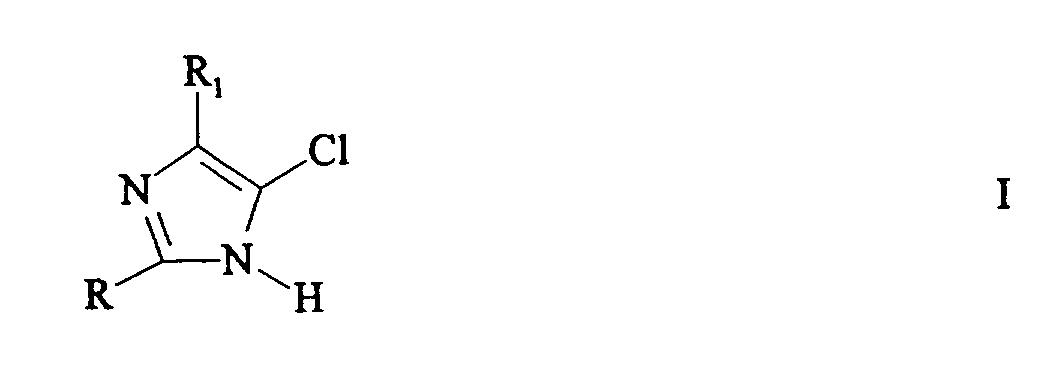
- the invention optionally includes 2-substituted 5-chloroimidazoles of the general formula wherein R is hydrogen, an alkyl group, an alkenyl group, a cycloalkyl group, a benzyl group, a phenyl group or an aryl group and R 1 is hydrogen, an alkyl group, a cycloalkyl group, a benzyl group, a phenyl group or an aryl group or for a group -C0 2 R 3 or - (CH 2 ) n -C0 2 R 3 , where n is a number between 1 and 4 and R 3 is an alkyl group.
- the optionally 2-substituted 5-chloroimidazoles of the general formula 1 or the optionally 2-substituted 5-chloroimidazole-4-carbaldehydes of the general formula 11 are important starting points for the production of blood pressure-lowering pharmaceuticals (US Pat. No. 4,355,040) or of herbicidal active compounds (DE-OS 2 804 435).
- Several ways are known for the preparation of the 2-substituted 5-chloroimidazole-4-carbaldehydes.
- US Pat. No. 4,355,040 discloses a 3-stage process in which, in a first stage, an amidine hydrochloride is ring-closed with dihydroxyacetone at a high NH 3 pressure, the imidazole alcohol is halogenated and is finally oxidized to the aldehyde.
- the object was achieved by providing the new, optionally 2-substituted 5-chloroimidazoles according to claim 1, a process for their preparation according to claim 2 and a process for the further conversion of the 5-chloroimidazole derivatives to the corresponding carbaldehydes according to claim 9.
- a glycine ester hydrohalide of the general formula is used in the first stage wherein R 1 has the meaning given, R 2 represents an alkyl group and X represents a halogen atom with an imidate of the general formula wherein R has the meaning given and R 4 represents an alkyl group in the presence of a base to the corresponding optionally 2-substituted 3,5-dihydroimidazol-4-one of the general formula where R and R 1 have the meaning given, implemented.
- alkenyl group is understood to mean a straight-chain or branched C 1 -C 6 alkenyl group, such as, for example, 1-propenyl, 2-propenyl, 1-butenyl, 2-butenyl, 3-butenyl, pentenyl and its isomers or hexenyl and its isomers.
- R the 2- or 3-butenyl group is preferred.
- Cyclopropyl, cyclobutyl, cyclopentyl or cyclohexyl groups may be mentioned as representatives of cycloalkyl groups.
- Both the benzyl and the phenyl group can contain substituents such as the alkyl groups mentioned, halogen atoms, nitro groups or amino groups.
- halogen expediently means chlorine, bromine or iodine, preferably chlorine.
- the procedure is such that the glycine ester hydrohalide of the general formula III is appropriately reacted with the imidate of the general formula IV in the presence of a base at a pH of 7 to 12, preferably 9 to 11.
- the glycine ester hydrohalides of the general formula III are commercially available stable compounds.
- Suitable bases are the alkali hydroxides, e.g. Sodium hydroxide or potassium hydroxide or alkali alcoholates, e.g. Sodium or potassium methylate, ethylate or - tert. butylate.
- the base is advantageously dissolved in a suitable solvent.
- Aliphatic alcohols such as methanol or ethanol are particularly suitable.
- the imidic acid ester is also advantageously added in the form of a solution in an inert solvent.
- aromatic solvents such as e.g. Toluene or chlorobenzene or the aliphatic alcohols mentioned are particularly good.
- the reaction participants react glycine ester hydrohalide, imidate and base in a stoichiometric ratio of 1: 1: 1.
- the reaction temperature suitably ranges from -20 ° C to 50 ° C, preferably 0 to 25 ° C.
- the corresponding 3,5-dihydroimidazolin-4-one of the general formula V can be isolated in a professional manner, generally by simple filtration, in yields of greater than 95%.
- the resulting reaction mixture is advantageously provided for the further conversion to the corresponding 5-chloroimidazole without isolation of the optionally 2-substituted 3,5-dihydroimidazolin-4-one (one-pot process).
- This first stage of the method according to the invention includes a step improvement in the known method according to R. Jacquier et al. Bull. Soc. Chim. France, 1971, 1040, which comprises reacting the free glycine ester with an ethyl imidate in the absence of a solvent to give the corresponding 3,5-dihydroimidazol-4-one.
- a disadvantage of this known method is that the free glycine ester is very unstable and must therefore be synthesized and isolated for each reaction. According to the known method, yields of only 30% to 48% could be obtained after a reaction time of 24 hours and longer.
- the 3,5-dihydroimidazol-4-one of the general formula V is chlorinated to the corresponding 5-chloroimidazole of the general formula I.
- the chlorination is expediently carried out using thionyl chloride or phosphorus oxychloride, advantageously in an excess of 10 to 300% of chlorinating agent at a reaction temperature in the range between 20 ° C. and 110 ° C.
- the chlorinating agent can simultaneously serve as a solvent, so that an additional solvent in the Rule is not necessary.
- Phosphorus oxychloride is preferably used as the chlorinating agent.
- the resulting optionally 2-substituted 5-chloroimidazole of the general formula 1 can be isolated in a professional manner, advantageously by extraction, in high purity from the reaction mixture.
- Preferred 2-substituted 5-chloroimidazoles of the general formula 1 are those in which R has the meaning of n-butyl, 2-butenyl or 3-butenyl.
- the starting compound for further conversion according to the invention to optionally 2-substituted 5-chloroimidazole-4-carbaldehyde of the general formula II is an optionally 2-substituted 5-chloroimidazole, in which R 1 is necessarily hydrogen.
- the molar ratio of the reactants if appropriate 2-substituted 5-chloroimidazole to phosphorus oxychloride to N, N-dimethylformamide, is expediently in the range between 1: 1: 1 and 1: 5: 5, preferably approximately 1: 3: 3.
- the reaction temperature is expediently between 50 and 130 ° C.
- the resulting optionally 2-substituted 5-chloroimidazole-4-carbaldehyde is isolated from the reaction mixture in a professional manner advantageously by extraction with a suitable solvent.
Landscapes
- Chemical & Material Sciences (AREA)
- Organic Chemistry (AREA)
- Nitrogen And Oxygen Or Sulfur-Condensed Heterocyclic Ring Systems (AREA)
- Plural Heterocyclic Compounds (AREA)
- Pharmaceuticals Containing Other Organic And Inorganic Compounds (AREA)
- Nitrogen Condensed Heterocyclic Rings (AREA)
- Agricultural Chemicals And Associated Chemicals (AREA)
- Low-Molecular Organic Synthesis Reactions Using Catalysts (AREA)
- Steroid Compounds (AREA)
Abstract
sind neue Zwischenprodukte zur Herstellung von blutdrucksenkenden Pharmazeutika oder von herbizidwirksamen Verbindungen.
beschrieben.
Description
- Die Erfindung beinhaltet gegebenenfalls 2-substituierte 5-Chlorimidazole der allgemeinen Formel

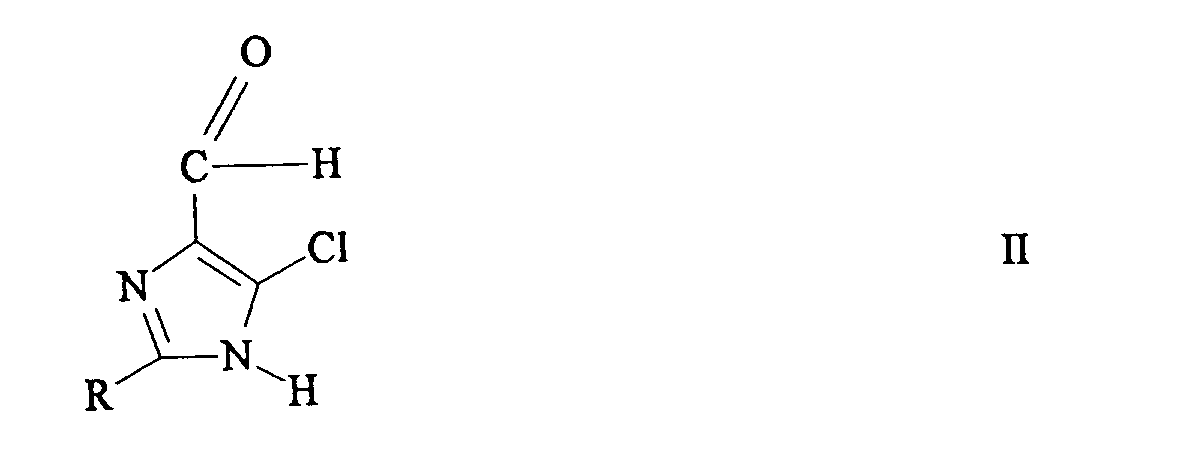
worin R Wasserstoff, eine Alkylgruppe, eine Alkenylgruppe, eine Cycloalkylgruppe, eine Benzylgruppe, eine Phenylgruppe oder eine Arylgruppe bedeutet und R1 Wasserstoff, eine Alkylgruppe, eine Cycloalkylgruppe, eine Benzylgruppe, eine Phenylgruppe oder eine Arylgruppe bedeutet oder für eine Gruppe -C02R3 oder -(CH2)n-C02R3 steht , worin n eine Zahl zwischen 1 und 4 ist und R3 für eine Alkylgruppe steht. - Die Erfindung beinhaltet des weiteren ein Verfahren zur Herstellung der gegebenenfalls 2-substituierten 5-Chlorimidazole sowie ein Verfahren zur Weiterumsetzung eines gegebenenfalls 2-substituierten 5-Chlorimidazolderivats mit R1 = Wasserstoff zu einem gegebenenfalls 2-substituierten 5-Chlorimidazol-4-carbal- dehyd der allgmeinen Formel
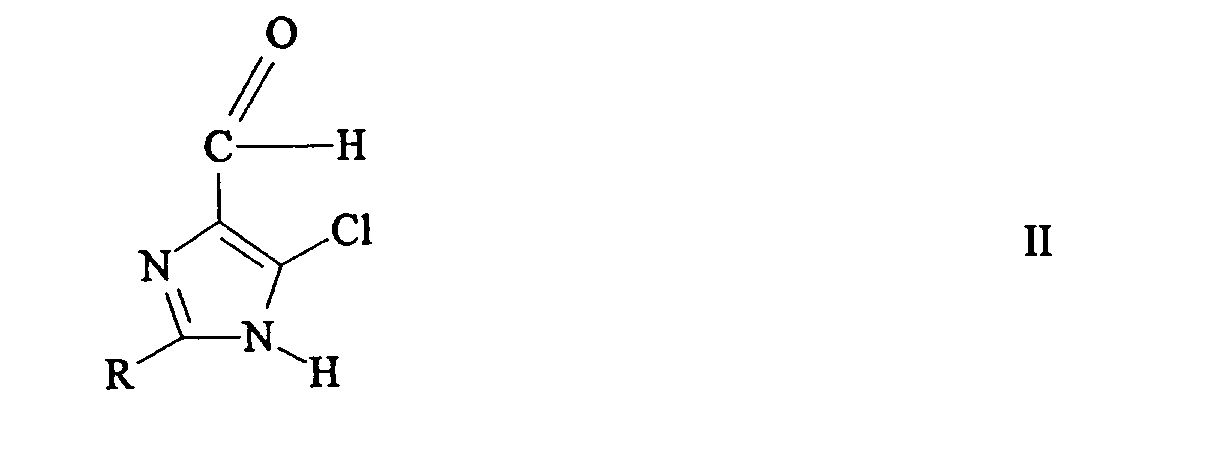
- Die gegebenenfalls 2-substituierten 5-Chlorimidazole der allgemeinen Formel 1 bzw. die gegebenenfalls 2- substituierten 5-Chlorimidazol-4-carbaldehyde der allgemeinen Formel 11 sind wichtige Ausgangspunkte zur Herstellung von blutdrucksenkenden Pharmazeutika (US-PS 4 355 040) oder von herbizid-wirksamen Verbindungen (DE-OS 2 804 435). Zur Herstellung der 2-substituierten 5-Chlorimidazol-4-carbaldehyde sind mehrere Wege bekannt.
- So beschreibt die US-PS 4 355 040 ein Verfahren, nach welchem 2-Amino-3,3-dichloracrylnitril mit einem Aldehyd zum entsprechenden Azomethinzwischenprodukt und weiter mit einem Halogenwasserstoff und Wasser zum 2-substituierten 5-Halogen-imidazol-4-carbaldehyd umgesetzt wird. Experimentielle Angaben fehlen in der genannten Patentschrift. Ein grosser Nachteil der Synthese besteht aber darin, dass das eingesetzte 2-Amino-3,3-dichloracrylnitril zunächst ausgehend von Dichloracetonitril durch dessen Umsetzung mit Blausäur/Natriumcyanid hergestellt werden muss. Die äusserst toxischen Reaktionsteilnehmer und die damit verbundenen sicherheitstechnischen Massnahmen, die bereits für die Bereitstellung des Ausgangsproduktes notwendig sind, machen das Gesamtverfahren indiustriell untauglich.
- Die US-PS 4 355 040 offenbart in einer weiteren Variante ein 3-Stufen Verfahren, worin in einer ersten Stufe ein Amidinhydrochlorid mit Dihydroxyaceton mit hohem NH3-Druck ringgeschlossen wird, der Imidazolalkohol halogeniert wird und schliesslich zum Aldehyd oxidiert wird.
- Es hat sich gezeigt, dass für die Ringschlussreaktion Drucke von über 20 bar notwendig sind.
- Die Oxidation des Alkohols funktioniert gemäss US-PS 4 355 040 in Gegenwart von Chromoxid.
- Es ist offensichtlich, dass eine Oxidation mit Schwermetalloxiden, die in der Regel nicht rezirkulierbar sind, nach heutigen ökologischen Gesichtspunkten nicht mehr verantwortbar ist.
- Es bestand folglich die Aufgabe, Verfahrenswege zu entwickeln, die die genannten Nachteile nicht aufweisen.
- Durch die Bereitstellung der neuen gegebenenfalls 2-substituierten 5-Chlorimidazole gemäss Anspruch 1, einem Verfahren zu deren Herstellung gemäss Anspruch 2 und einem Verfahren zur Weiterumsetzung der 5-Chlorimidazolderivate zu den entsprechenden Carbaldehyden gemäss Anspruch 9 konnte die Aufgabe gelöst werden.
- Zur Herstellung der erfindungsgemässen gegebenenfalls 2-substituierten 5-Chlorimidazole der allgemeinen Formel 1 wird in der ersten Stufe ein Glycinesterhydrohalogenid der allgemeinen Formel

worin R1 die genannte Bedeutung hat, R2 für eine Alkylgruppe steht und X für ein Halogenatom steht mit einem Imidsäureester der allgemeinen Formel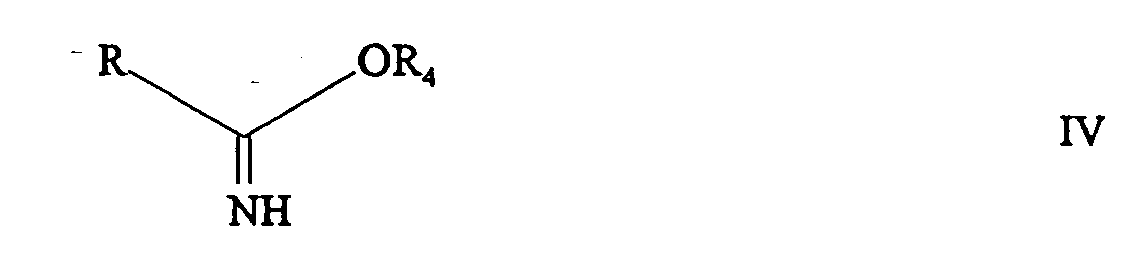
worin R die genannte Bedeutung hat und R4 eine Alkylgruppe bedeutet in Gegenwart einer Base zum entsprechenden gegebenenfalls 2-substituierten 3,5-Dihydroimidazol-4-on der allgemeinen Formel
worin R und R1 die genannte Bedeutung haben, umgesetzt. - In den allgemeinen Substituenten R, Ri, R2, R3 und R4 haben die angegebenen Gruppen folgende Bedeutung:
- Unter einer Alkylgruppe werden geradkettige oder verzweigte C1-C6-Alkylgruppen, wie z.B. Methyl-, Ethyl-, n-Propyl-, Isopropyl-, n-Butyl, sec. Butyl-, tert. Butyl-, Pentyl- oder Hexylgruppen verstanden. Bevorzugte Alkylgruppe ist eine der genannten C1-C4-Alkylgruppen. Bevorzugt für Substituent R ist die n-Butylgruppe.
- Unter einer Alkenylgruppe wird eine geradkettige oder verzweigte C1-C6-Alkenylgruppe, wie z.B. 1-Propenyl, 2-Propenyl, 1-Butenyl, 2-Butenyl, 3-Butenyl, Pentenyl und seine Isomeren oder Hexenyl und seine Isomeren, verstanden. Für R ist die 2- oder 3-Butenyl-Gruppe bevorzugt.
- Als Vertreter von Cycloalkylgruppen seien die Cyclopropyl-, die Cyclobutyl-, die Cyclopentyl- oder die Cyclohexylgruppe genannt.
- Sowohl die Benzyl- als auch die Phenylgruppe kann Substituenten, wie die genannten Alkylgruppen, Halogenatome, Nitrogruppen oder Aminogruppen, enthalten.
- Unter der Bezeichnung Halogen wird zweckmässig Chlor, Brom oder Jod, vorzugsweise Chlor, verstanden.
- Zweckmassig wird so vorgegangen, dass das Glycinesterhydrohalogenid der allgemeinen Formel 111 in Gegenwart einer Base zweckmässig bei einem pH-Wert von 7 bis 12, vorzugsweise von 9 bis 11, mit dem Imidsäureester der allgemeinen Formel IV reagiert wird.
- Die Glycinesterhydrohalogenide der allgemeinen Formel 111 sind im Handel erhältliche stabile Verbindungen.
- Geeignete Basen sind die Alkalihydroxide, wie z.B. Natriumhydroxid oder Kaliumhydroxid oder Alkalialkoholate, wie z.B. Natrium- oder Kaliummethylat, -ethylat oder - tert. butylat.
- Vorteilhaft liegt die Base in einem geeigneten Lösungsmittel gelöst vor. Besonders geeignet sind aliphatische Alkohole wie Methanol oder Ethanol. Der Imidsäureester wird zweckmässig ebenfalls in Form einer Lösung in einem inerten Lösungsmittel zugegeben. In der Regel eignen sich hierzu aromatische Lösungsmittel , wie z.B. Toluol oder Chlorbenzol oder die genannten aliphatischen Alkohole besonders gut. Von Vorteil erfolgt die Umsetzung der Reaktionsteilnehmer Glycinesterhydrohalogenid, Imidsäureester und Base im stöchiometrischen Verhältnis 1:1:1.
- Die Umsetzungstemperatur rangiert zweckmässig im Bereich von -20 °C bis 50 °C, vorzugsweise bei 0 bis 25°C.
- Nach einer Umsetzungszeit von wenigen Stunden kann das entsprechende 3,5-Dihydroimidazolin-4-on der allgemeinen Formel V auf fachmännische Weise, in der Regel durch einfache Filtration, in Ausbeuten von grösser als 95%, isoliert werden.
- Von Vorteil wird das resultierende Reaktionsgemisch ohne Isolierung des gegebenenfalls 2-substituierten 3,5-Dihydroimidazolin-4-ons für die Weiterumsetzung zum entsprechenden 5-Chlorimidazol bereitgestellt (Eintopfverfahren).
- Diese erste Stufe des erfindungsgemässen Verfahrens beinhaltet eine sprunghafte Verbesserung des bekannten Verfahrens nach R. Jacquier et al. Bull. Soc. Chim. France, 1971, 1040, welches die Umsetzung des freien Glycinesters mit einem Imidsäureethylester in Abwesenheit eines Lösungsmittels zum entsprechenden 3,5-Dihydroimidazol-4-on umfasst. Nachteilig bei diesem bekannten Verfahren ist, dass der freie Glycinester sehr instabil ist und daher für jede Umsetzung jeweils neu synthetisiert und isoliert werden muss. Gemäss dem bekannten Verfahren konnten nach einer Umsetzungszeit von 24 Std. und länger Ausbeuten von lediglich 30% bis 48% erhalten werden.
- In der zweiten Stufe wird das 3,5-Dihydroimidazol-4-on der allgemeinen Formel V zum entsprechenden 5-Chlorimidazol der allgemeinen Formel I chloriert.
- Zweckmässig erfolgt die Chlorierung mit Thionylchlorid oder Phosphoroxychlorid, vorteilhaft in einem Überschuss an Chlorierungsmittel von 10 bis 300% bei einer Reaktionstemperatur im Bereich zwischen 20 °C und 110°C. Das Chlorierungsmittel kann dabei Zugleich als Lösungsmittel dienen, so dass ein zusätzliches Lösungsmittel in der Regel nicht notwendig ist. Bevorzugt wird Phosphoroxychlorid als Chlorierungsmittel angewendet. Das resultierende gegebenenfalls 2-substituierte 5-Chlorimidazol der allgemeinen Formel 1 kann auf fachmännische Weise, vorteilhaft durch Extraktion, in hoher Reinheit aus dem Reaktionsgemisch isoliert werden.
- Bevorzugte 2-substituierte 5-Chlorimidazole der allgemeinen Formel 1 sind solche, worin R die Bedeutung von n-Butyl, 2-Butenyl oder 3-Butenyl hat.
- Ausgangsverbindung zur erfindungsgemässen Weiterumsetzung zum gegebenenfalls 2-substituierten 5-Chlorimidazol-4-carbaldehyd der allgemeinen Formel II ist ein gegebenenfalls 2-substituiertes 5-Chlorimidazol, worin R1 zwingend Wasserstoff bedeutet.
- Die Umsetzung zum gewünschten 5-Chlorimidazol-4-carbaldehyd der allgemeinen Formel II erfolgt erfindungsgemäss mit Phosphoroxychlorid in Gegenwart von N,N-Dimethylformamid.
- Zweckmässig liegt das Molverhältnis der Reaktanden gegebenenfalls 2-substituiertes 5-Chlorimidazol zu Phosphoroxychlorid zu N,N-Dimethylformamid im Bereich zwischen 1:1:1 und 1:5:5, bevorzugt bei ungefähr 1:3:3.
- Die Umsetzungstemperatur liegt zweckmässig zwischen 50 und 130°C.
- Gegebenenfalls kann in Gegenwart eines zusätzlichen inerten Lösungsmittels ,beim Eintopfverfahren vorteilhaft im Lösungsmittel der ersten Stufe, gearbeitet werden.
- Die Isolierung des resultierenden gegebenenfalls 2-substituierten 5-Chlorimidazol-4-carbaldehyds aus dem Reaktionsgemisch erfolgt auf fachmännische Weise vorteilhaft durch dessen Extraktion mit einem geeigneten Lösungsmittel.
- Zu einer Lösung von Natriumhydroxid 10,1 g (0,25 mol) in Methanol bei 0°C wurden 31,71 g (0,25 mol) Glycinmethylesterhydrochlorid zugegeben. Nach 15 Minuten wurden zur weissen Suspension 126,5 g einer 22,8%igen Lösung von Pentanimidsäuremethylester in Chlorbenzol während 5 Minuten zugetropft. Die hellgelbe Suspension wurde 4 Std. bei Raumtemperatur gerührt und mit Chlorbenzol (100 ml) verdünnt. Das Methanol wurde bei einer Temperatur von 26 ° C und einem Druck von 30 - 50 mbar abdestilliert,und die orange Suspension wurde mit Methylenchlorid (100 ml) verdünnt und anschliessend filtriert. Nach Entfernung des Lösungsmittels vom Filtrat wurden 34,08 g (97%) der Titelverbindung (Gehalt >95% nach GC und 'H-NMR) erhalten.
- 2-n-Butyl-3,5-dihydroimidazol-4-on (14,02 g, 0,1 mol) wurde portionenweise während 15 Minuten zu POCl3 (50 ml) bei 95°C gegeben. Die Lösung wurde 2 Std. bei 100°C erhitzt, gekühlt und auf 400 g Eis gegossen. Das Gemisch wurde mit 255 ml 30%iger Natronlauge auf pH 7 gestellt und dreimal mit je 500 ml Essigester extrahiert. Die vereinigten organischen Phasen wurden mit MgS04 getrocknet, filtriert und am Rotavapor eingeengt. Nach Reinigung des Rückstands mittels Säulenchromatographie wurde die Titelverbindung (5,52 g, 34,7%) in hoher Reinheit (>98% nach GC und 1H-NMR) erhalten. Smp. 85°-87°C
- 'H-NMR (CDCl3) 0 0,91 (3H, t, J = 7,5 Hz), 1,36 (2H, sextett, J = 7,5 Hz), 1,68 (2H, q, J = 7,5 Hz), 2,70 (2H, t, J = 7,5 Hz), 6,83 (1 H, s), 10,65 (1 H, br s).
- Zu einer auf 95 °C erwärmten Lösung von 2-n-Butyl-5-chlor-1 H-imidazol (1,60g, 10 mmol) in POCl3-(3,07g, 20 mmol) und Chlorbenzol (20 ml) wurde N,N-Dimethylformamid (1,46g, 20 mmol) zugetropft. Das Gemisch wurde während 3,5 Std. bei 98 °C gerührt. Danach wurden weitere Portionen von POCl3 (1,53 g, 10 mmol) und von N,N-Dimethylformamid (0,73 g, 10 mmol) zugetropft. Nach weiteren 2,5 Std. bei 98°C wurde das Gemisch gekühlt und auf Eis (40 g) gegossen. Nach 15 Minuten wurde das Gemsich mit 11 ml 30%iger Natronlauge auf pH 7 gestellt und dreimal mit je 100 ml Essigester extrahiert. Die vereinigten organischen Phasen wurden mit MgS04 getrocknet, filtriert und eingeengt. Die Titelverbindung wurde in einer Ausbeute von 1,3 g (70%) erhalten.
Claims (11)

worin R Wasserstoff, eine Alkylgruppe, eine Alkenylgruppe, eine Cycloalkylgruppe, eine Benzylgruppe, eine Phenylgruppe oder eine Arylgruppe bedeutet und R1 Wasserstoff, eine Alkylgruppe, eine Cycloalkylgruppe, eine Benzylgruppe, eine Phenylgruppe oder eine Arylgruppe bedeutet oder für eine Gruppe -C02R3 oder -(CH2)n-CO2R3 steht, worin n eine Zahl zwischen 1 und 4 bedeutet und R3 für eine Alkylgruppe steht.

worin R1 die in Anspruch 1 genannte Bedeutung hat, R2 ein Alkylgruppe bedeutet und X für ein Halogenatom steht mit einem Imidsäureester der allgemeinen Formel

worin R die in Anspruch 1 genannte Bedeutung hat und R4 eine Alkylgruppe bedeutet in Gegenwart einer Base zum entsprechenden 3,5-Dihydroimidazol-4-on der allgemeinen Formel

worin Rund R1 die in Anspruch 1 genannte Bedeutung haben, umgesetzt wird und in der zweiten Stufe zum Endprodukt chloriert wird.
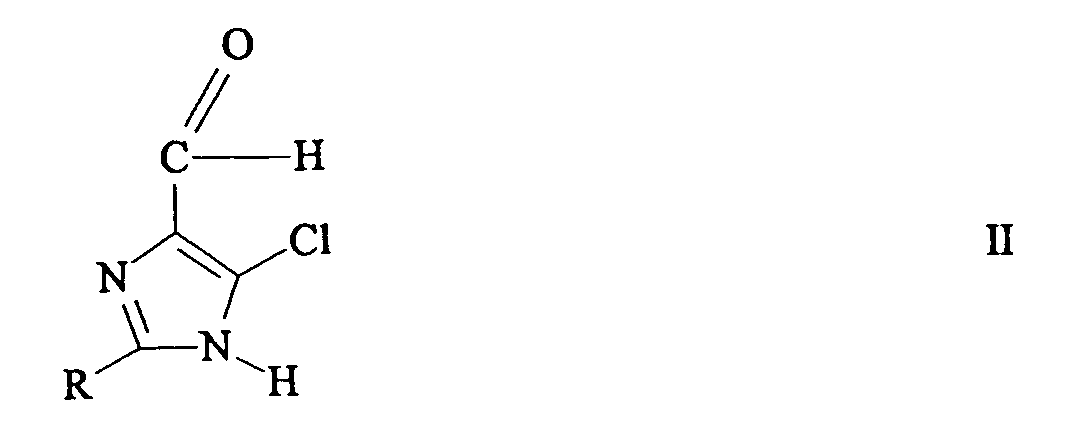
worin R Wasserstoff, eine Alkylgruppe, eine Alkenylgruppe, eine Cycloalkylgruppe, eine Benzylgruppe, eine Phenylgruppe oder eine Arylgruppe bedeutet, dadurch gekennzeichnet, dass ein gegebenenfalls 2-substituiertes 5-Chlorimidazol der allgemeinen Formel I, worin R1 Wasserstoff bedeutet, mit Phosphoroxychlorid in Gegenwart von N,N-Dimethylformamid umgesetzt wird.
Applications Claiming Priority (2)
| Application Number | Priority Date | Filing Date | Title |
|---|---|---|---|
| CH74893 | 1993-03-12 | ||
| CH748/93 | 1993-03-12 |
Publications (3)
| Publication Number | Publication Date |
|---|---|
| EP0614890A2 true EP0614890A2 (de) | 1994-09-14 |
| EP0614890A3 EP0614890A3 (de) | 1995-01-11 |
| EP0614890B1 EP0614890B1 (de) | 1997-09-03 |
Family
ID=4194282
Family Applications (2)
| Application Number | Title | Priority Date | Filing Date |
|---|---|---|---|
| EP94103636A Expired - Lifetime EP0614890B1 (de) | 1993-03-12 | 1994-03-09 | Verfahren zur Herstellung von gegebenfalls 2-substituierten 5-Chlorimidazolen |
| EP94103714A Expired - Lifetime EP0614891B1 (de) | 1993-03-12 | 1994-03-10 | Verfahren zur Herstellung von 2-substituierten 5-Chlorimidazol-4-carbaldehyden |
Family Applications After (1)
| Application Number | Title | Priority Date | Filing Date |
|---|---|---|---|
| EP94103714A Expired - Lifetime EP0614891B1 (de) | 1993-03-12 | 1994-03-10 | Verfahren zur Herstellung von 2-substituierten 5-Chlorimidazol-4-carbaldehyden |
Country Status (9)
| Country | Link |
|---|---|
| EP (2) | EP0614890B1 (de) |
| JP (1) | JP3716434B2 (de) |
| KR (1) | KR100362353B1 (de) |
| AT (2) | ATE157655T1 (de) |
| CA (2) | CA2473422C (de) |
| DE (2) | DE59403903D1 (de) |
| DK (2) | DK0614890T3 (de) |
| ES (2) | ES2108894T3 (de) |
| HU (2) | HU219708B (de) |
Cited By (1)
| Publication number | Priority date | Publication date | Assignee | Title |
|---|---|---|---|---|
| EP0743306A1 (de) * | 1995-05-17 | 1996-11-20 | Lonza A.G. | Verfahren zur Herstellung von gegebenenfalls 2-substituierten 5-Chlor-imidazol-4-carbaldehyden |
Families Citing this family (2)
| Publication number | Priority date | Publication date | Assignee | Title |
|---|---|---|---|---|
| JP4103149B2 (ja) * | 1996-01-05 | 2008-06-18 | ロンザ リミテッド | 2−置換5−クロロイミダゾール−4−カルブアルデヒドの製造方法 |
| KR101035559B1 (ko) * | 2009-06-02 | 2011-05-19 | 한국화학연구원 | 클로로이미다졸 유도체 또는 이의 약학적으로 허용가능한 염을 유효성분으로 포함하는 골다공증 또는 비만의 예방 또는 치료용 약학적 조성물 |
Family Cites Families (13)
| Publication number | Priority date | Publication date | Assignee | Title |
|---|---|---|---|---|
| US3409606A (en) * | 1965-12-30 | 1968-11-05 | American Cyanamid Co | Halogenated chloroimidazole compounds |
| IL53783A (en) * | 1977-02-03 | 1982-08-31 | American Cyanamid Co | Imidazo(1,5-d)-as-triazine-4 (3h)-(thi)one derivatives,their preparation and pharmaceutical compositions containing them |
| JPS5671074A (en) * | 1979-11-12 | 1981-06-13 | Takeda Chem Ind Ltd | 1,2-disubstituted-4-halogenoimidazole-5-acetic acid derivative |
| DE3145927A1 (de) * | 1981-11-20 | 1983-06-01 | Basf Ag, 6700 Ludwigshafen | 4(5)-methyl-5(4)-chlorimidazol und verfahren zu seiner herstellung |
| DE3330192A1 (de) * | 1983-08-20 | 1985-03-07 | Basf Ag, 6700 Ludwigshafen | 4-alkylimidazol-derivate, ihre herstellung und verwendung |
| JPS62238383A (ja) * | 1986-04-07 | 1987-10-19 | Chiyoda Kagaku Kenkyusho:Kk | 防食剤 |
| CA1334092C (en) * | 1986-07-11 | 1995-01-24 | David John Carini | Angiotensin ii receptor blocking imidazoles |
| JPH02262562A (ja) * | 1988-10-20 | 1990-10-25 | Ishihara Sangyo Kaisha Ltd | イミダゾール系化合物 |
| PT95899A (pt) * | 1989-11-17 | 1991-09-13 | Glaxo Group Ltd | Processo para a preparacao de derivados indole |
| JPH0426678A (ja) * | 1990-05-18 | 1992-01-29 | Nippon Synthetic Chem Ind Co Ltd:The | イミダゾール―4―クロロ―5―カルバルデヒド誘導体の製造法 |
| US5126342A (en) * | 1990-10-01 | 1992-06-30 | Merck & Co., Inc. | Imidazole angiotensin ii antagonists incorporating acidic functional groups |
| EP0505098A1 (de) * | 1991-03-19 | 1992-09-23 | Merck & Co. Inc. | Imidazolderivate mit funktionelle Säuregruppen als Angiotensin-II-Antagoniste |
| RU2103262C1 (ru) * | 1992-07-16 | 1998-01-27 | Лонца АГ Гампель/Валлис | Способ получения 2-замещенных 5-хлоримидазол-4-карбальдегидов |
-
1994
- 1994-03-09 DE DE59403903T patent/DE59403903D1/de not_active Expired - Lifetime
- 1994-03-09 DK DK94103636.0T patent/DK0614890T3/da active
- 1994-03-09 EP EP94103636A patent/EP0614890B1/de not_active Expired - Lifetime
- 1994-03-09 AT AT94103636T patent/ATE157655T1/de active
- 1994-03-09 ES ES94103636T patent/ES2108894T3/es not_active Expired - Lifetime
- 1994-03-10 DE DE59407547T patent/DE59407547D1/de not_active Expired - Lifetime
- 1994-03-10 AT AT94103714T patent/ATE175199T1/de active
- 1994-03-10 DK DK94103714T patent/DK0614891T3/da active
- 1994-03-10 ES ES94103714T patent/ES2127845T3/es not_active Expired - Lifetime
- 1994-03-10 EP EP94103714A patent/EP0614891B1/de not_active Expired - Lifetime
- 1994-03-11 HU HU9701565A patent/HU219708B/hu not_active IP Right Cessation
- 1994-03-11 HU HU9400736A patent/HU213387B/hu not_active IP Right Cessation
- 1994-03-11 KR KR1019940004757A patent/KR100362353B1/ko not_active Expired - Fee Related
- 1994-03-11 JP JP04081394A patent/JP3716434B2/ja not_active Expired - Fee Related
- 1994-03-14 CA CA002473422A patent/CA2473422C/en not_active Expired - Fee Related
- 1994-03-14 CA CA002117209A patent/CA2117209C/en not_active Expired - Fee Related
Cited By (3)
| Publication number | Priority date | Publication date | Assignee | Title |
|---|---|---|---|---|
| EP0743306A1 (de) * | 1995-05-17 | 1996-11-20 | Lonza A.G. | Verfahren zur Herstellung von gegebenenfalls 2-substituierten 5-Chlor-imidazol-4-carbaldehyden |
| US5684157A (en) * | 1995-05-17 | 1997-11-04 | Lonza Ltd. | Process for the preparation of optionally 2-substituted 5-chloroimidazole-4-carbaldehydes |
| US5698707A (en) * | 1995-05-17 | 1997-12-16 | Lonza Ltd. | Process for the preparation of optionally 2-substituted 5-chloroimidazole-4-carbaldehydes |
Also Published As
| Publication number | Publication date |
|---|---|
| ES2127845T3 (es) | 1999-05-01 |
| DK0614891T3 (da) | 1999-08-30 |
| CA2117209C (en) | 2005-05-31 |
| EP0614890A3 (de) | 1995-01-11 |
| HU9400736D0 (en) | 1994-06-28 |
| CA2117209A1 (en) | 1994-09-13 |
| ATE175199T1 (de) | 1999-01-15 |
| EP0614891A2 (de) | 1994-09-14 |
| JP3716434B2 (ja) | 2005-11-16 |
| JPH072789A (ja) | 1995-01-06 |
| HU9701565D0 (en) | 1997-11-28 |
| DE59403903D1 (de) | 1997-10-09 |
| HUT66633A (en) | 1994-12-28 |
| EP0614891B1 (de) | 1998-12-30 |
| KR100362353B1 (ko) | 2003-03-19 |
| CA2473422A1 (en) | 1994-09-13 |
| HU219708B (hu) | 2001-06-28 |
| DK0614890T3 (da) | 1997-10-13 |
| DE59407547D1 (de) | 1999-02-11 |
| CA2473422C (en) | 2007-05-22 |
| HU213387B (en) | 1997-05-28 |
| ATE157655T1 (de) | 1997-09-15 |
| EP0614891A3 (de) | 1995-05-03 |
| ES2108894T3 (es) | 1998-01-01 |
| EP0614890B1 (de) | 1997-09-03 |
Similar Documents
| Publication | Publication Date | Title |
|---|---|---|
| EP0463464B1 (de) | Verfahren zur Herstellung von 2-Chlor-5-methyl-pyridin | |
| EP0201030A2 (de) | Verfahren zur Herstellung von 1,3,5-Triazintrionen | |
| DE3514450A1 (de) | Verfahren zur herstellung von imidaten sowie neue arylsubstituierte imidate | |
| EP0341693B1 (de) | Verfahren zur Herstellung von O-substituierten Hydroxylaminen | |
| DE2650434A1 (de) | Verfahren zur herstellung von herbicid wirksamen anilinderivaten | |
| EP0124013B1 (de) | Verfahren zur Herstellung von Oxiranen | |
| EP0579212B1 (de) | Verfahren zur Herstellung von 2-substituierten 5-Chlorimidazol-4-carbaldehyden | |
| EP0187285B1 (de) | Verfahren zur Herstellung von substituierten Phenylhydrazinen | |
| EP0614891B1 (de) | Verfahren zur Herstellung von 2-substituierten 5-Chlorimidazol-4-carbaldehyden | |
| DE3209878A1 (de) | Verfahren zur herstellung von diphenylaethern | |
| EP0653422B1 (de) | Verfahren zur Herstellung von 2-substituierten 5-Chlorimidazol-4-carbaldehyden | |
| EP0048373A2 (de) | Verfahren zur Herstellung von Pyrazol | |
| EP0614892B1 (de) | Verfahren zur Herstellung von gegebenenfalls 2-substituierten 5-Chlorimidazol-4-carbaldehyden | |
| EP0782991B1 (de) | Verfahren zur Herstellung von 2-substituierten 5-Chlorimidazol-4-carbaldehyden | |
| DE2733181B2 (de) | Verfahren zur Herstellung von N-substituierten a -Ketocarbonsäureamiden | |
| EP0003562A1 (de) | Verfahren zur Herstellung von Hydroxyphenyläthern | |
| EP0743306B1 (de) | Verfahren zur Herstellung von gegebenenfalls 2-substituierten 5-Chlor-imidazol-4-carbaldehyden | |
| EP0245646B1 (de) | Verfahren zur Herstellung von 1-Aryl-5-amino-pyrazolen | |
| EP0089485B1 (de) | Verfahren zur Herstellung von 5-Chlor-1H-tetrazol-1-carbonsäureestern sowie Verfahren zur Herstellung der erforderlichen Dichlorisonitril-carbonsäureester | |
| EP0206147A2 (de) | Verfahren zur Herstellung von 4,4'-Dinitrodibenzylen | |
| EP0157225B1 (de) | Verfahren zur Herstellung von Benzimidazolyl,-Benzoxazolyl- und Benzthiazolyloxyphenoxypropionsäurederivaten | |
| EP0046193B1 (de) | 1-Hydroxypyrazol und Verfahren zu seiner Herstellung | |
| DE3237479A1 (de) | Verfahren zur herstellung von substituierten tetrahydropyrimidinonderivaten | |
| EP0110116B1 (de) | Verfahren zur Herstellung von Keten-O,N-acetalen | |
| EP0731094B1 (de) | Verfahren zur Herstellung von Pyrazolen |
Legal Events
| Date | Code | Title | Description |
|---|---|---|---|
| PUAI | Public reference made under article 153(3) epc to a published international application that has entered the european phase |
Free format text: ORIGINAL CODE: 0009012 |
|
| AK | Designated contracting states |
Kind code of ref document: A2 Designated state(s): AT BE CH DE DK ES FR GB IE IT LI NL SE |
|
| PUAL | Search report despatched |
Free format text: ORIGINAL CODE: 0009013 |
|
| AK | Designated contracting states |
Kind code of ref document: A3 Designated state(s): AT BE CH DE DK ES FR GB IE IT LI NL SE |
|
| 17P | Request for examination filed |
Effective date: 19950616 |
|
| 17Q | First examination report despatched |
Effective date: 19960315 |
|
| GRAG | Despatch of communication of intention to grant |
Free format text: ORIGINAL CODE: EPIDOS AGRA |
|
| RTI1 | Title (correction) | ||
| GRAH | Despatch of communication of intention to grant a patent |
Free format text: ORIGINAL CODE: EPIDOS IGRA |
|
| RAP1 | Party data changed (applicant data changed or rights of an application transferred) |
Owner name: LONZA AG |
|
| GRAH | Despatch of communication of intention to grant a patent |
Free format text: ORIGINAL CODE: EPIDOS IGRA |
|
| GRAA | (expected) grant |
Free format text: ORIGINAL CODE: 0009210 |
|
| AK | Designated contracting states |
Kind code of ref document: B1 Designated state(s): AT BE CH DE DK ES FR GB IE IT LI NL SE |
|
| REF | Corresponds to: |
Ref document number: 157655 Country of ref document: AT Date of ref document: 19970915 Kind code of ref document: T |
|
| REG | Reference to a national code |
Ref country code: CH Ref legal event code: EP |
|
| GBT | Gb: translation of ep patent filed (gb section 77(6)(a)/1977) |
Effective date: 19970905 |
|
| REF | Corresponds to: |
Ref document number: 59403903 Country of ref document: DE Date of ref document: 19971009 |
|
| REG | Reference to a national code |
Ref country code: DK Ref legal event code: T3 |
|
| ITF | It: translation for a ep patent filed | ||
| REG | Reference to a national code |
Ref country code: ES Ref legal event code: FG2A Ref document number: 2108894 Country of ref document: ES Kind code of ref document: T3 |
|
| ET | Fr: translation filed | ||
| RAP2 | Party data changed (patent owner data changed or rights of a patent transferred) |
Owner name: LONZA AG |
|
| REG | Reference to a national code |
Ref country code: IE Ref legal event code: FG4D Free format text: 76194 |
|
| NLT2 | Nl: modifications (of names), taken from the european patent patent bulletin |
Owner name: LONZA AG |
|
| PLBE | No opposition filed within time limit |
Free format text: ORIGINAL CODE: 0009261 |
|
| STAA | Information on the status of an ep patent application or granted ep patent |
Free format text: STATUS: NO OPPOSITION FILED WITHIN TIME LIMIT |
|
| 26N | No opposition filed | ||
| REG | Reference to a national code |
Ref country code: GB Ref legal event code: IF02 |
|
| PG25 | Lapsed in a contracting state [announced via postgrant information from national office to epo] |
Ref country code: IT Free format text: LAPSE BECAUSE OF NON-PAYMENT OF DUE FEES Effective date: 20090309 |
|
| PGFP | Annual fee paid to national office [announced via postgrant information from national office to epo] |
Ref country code: IE Payment date: 20110125 Year of fee payment: 18 Ref country code: DK Payment date: 20110126 Year of fee payment: 18 |
|
| PGFP | Annual fee paid to national office [announced via postgrant information from national office to epo] |
Ref country code: SE Payment date: 20110124 Year of fee payment: 18 Ref country code: CH Payment date: 20110222 Year of fee payment: 18 Ref country code: AT Payment date: 20110125 Year of fee payment: 18 Ref country code: FR Payment date: 20110210 Year of fee payment: 18 Ref country code: NL Payment date: 20110131 Year of fee payment: 18 |
|
| PGFP | Annual fee paid to national office [announced via postgrant information from national office to epo] |
Ref country code: BE Payment date: 20110125 Year of fee payment: 18 |
|
| PGFP | Annual fee paid to national office [announced via postgrant information from national office to epo] |
Ref country code: ES Payment date: 20110221 Year of fee payment: 18 Ref country code: GB Payment date: 20110127 Year of fee payment: 18 Ref country code: IT Payment date: 20110316 Year of fee payment: 18 Ref country code: DE Payment date: 20110125 Year of fee payment: 18 |
|
| PGRI | Patent reinstated in contracting state [announced from national office to epo] |
Ref country code: IT Effective date: 20110616 |
|
| BERE | Be: lapsed |
Owner name: *LONZA A.G. Effective date: 20120331 |
|
| REG | Reference to a national code |
Ref country code: NL Ref legal event code: V1 Effective date: 20121001 |
|
| REG | Reference to a national code |
Ref country code: SE Ref legal event code: EUG |
|
| PG25 | Lapsed in a contracting state [announced via postgrant information from national office to epo] |
Ref country code: SE Free format text: LAPSE BECAUSE OF NON-PAYMENT OF DUE FEES Effective date: 20120310 |
|
| REG | Reference to a national code |
Ref country code: CH Ref legal event code: PL |
|
| REG | Reference to a national code |
Ref country code: DK Ref legal event code: EBP |
|
| GBPC | Gb: european patent ceased through non-payment of renewal fee |
Effective date: 20120309 |
|
| REG | Reference to a national code |
Ref country code: AT Ref legal event code: MM01 Ref document number: 157655 Country of ref document: AT Kind code of ref document: T Effective date: 20120309 |
|
| REG | Reference to a national code |
Ref country code: FR Ref legal event code: ST Effective date: 20121130 |
|
| REG | Reference to a national code |
Ref country code: IE Ref legal event code: MM4A |
|
| PG25 | Lapsed in a contracting state [announced via postgrant information from national office to epo] |
Ref country code: IE Free format text: LAPSE BECAUSE OF NON-PAYMENT OF DUE FEES Effective date: 20120309 Ref country code: FR Free format text: LAPSE BECAUSE OF NON-PAYMENT OF DUE FEES Effective date: 20120402 Ref country code: BE Free format text: LAPSE BECAUSE OF NON-PAYMENT OF DUE FEES Effective date: 20120331 Ref country code: GB Free format text: LAPSE BECAUSE OF NON-PAYMENT OF DUE FEES Effective date: 20120309 Ref country code: CH Free format text: LAPSE BECAUSE OF NON-PAYMENT OF DUE FEES Effective date: 20120331 Ref country code: LI Free format text: LAPSE BECAUSE OF NON-PAYMENT OF DUE FEES Effective date: 20120331 Ref country code: AT Free format text: LAPSE BECAUSE OF NON-PAYMENT OF DUE FEES Effective date: 20120309 |
|
| REG | Reference to a national code |
Ref country code: DE Ref legal event code: R119 Ref document number: 59403903 Country of ref document: DE Effective date: 20121002 |
|
| PG25 | Lapsed in a contracting state [announced via postgrant information from national office to epo] |
Ref country code: IT Free format text: LAPSE BECAUSE OF NON-PAYMENT OF DUE FEES Effective date: 20120309 |
|
| PG25 | Lapsed in a contracting state [announced via postgrant information from national office to epo] |
Ref country code: NL Free format text: LAPSE BECAUSE OF NON-PAYMENT OF DUE FEES Effective date: 20121001 |
|
| PG25 | Lapsed in a contracting state [announced via postgrant information from national office to epo] |
Ref country code: DK Free format text: LAPSE BECAUSE OF NON-PAYMENT OF DUE FEES Effective date: 20120331 |
|
| REG | Reference to a national code |
Ref country code: ES Ref legal event code: FD2A Effective date: 20130710 |
|
| PG25 | Lapsed in a contracting state [announced via postgrant information from national office to epo] |
Ref country code: ES Free format text: LAPSE BECAUSE OF NON-PAYMENT OF DUE FEES Effective date: 20120310 |
|
| PG25 | Lapsed in a contracting state [announced via postgrant information from national office to epo] |
Ref country code: DE Free format text: LAPSE BECAUSE OF NON-PAYMENT OF DUE FEES Effective date: 20121002 |