EP0614962B1 - Compositions de faible viscosité à base de sel surbasique de métal du groupe II d'alkylphenol sulfuré, le groupe alkyl contenant 12 à 22 carbones - Google Patents
Compositions de faible viscosité à base de sel surbasique de métal du groupe II d'alkylphenol sulfuré, le groupe alkyl contenant 12 à 22 carbones Download PDFInfo
- Publication number
- EP0614962B1 EP0614962B1 EP94301751A EP94301751A EP0614962B1 EP 0614962 B1 EP0614962 B1 EP 0614962B1 EP 94301751 A EP94301751 A EP 94301751A EP 94301751 A EP94301751 A EP 94301751A EP 0614962 B1 EP0614962 B1 EP 0614962B1
- Authority
- EP
- European Patent Office
- Prior art keywords
- group
- metal
- alkylphenol
- composition
- carbon atoms
- Prior art date
- Legal status (The legal status is an assumption and is not a legal conclusion. Google has not performed a legal analysis and makes no representation as to the accuracy of the status listed.)
- Expired - Lifetime
Links
- 239000000203 mixture Substances 0.000 title claims description 171
- 229910052784 alkaline earth metal Inorganic materials 0.000 title claims description 121
- -1 calcium alkoxide Chemical class 0.000 claims description 89
- 125000004432 carbon atom Chemical group C* 0.000 claims description 72
- 238000006243 chemical reaction Methods 0.000 claims description 67
- XLYOFNOQVPJJNP-UHFFFAOYSA-N water Substances O XLYOFNOQVPJJNP-UHFFFAOYSA-N 0.000 claims description 48
- 150000001336 alkenes Chemical class 0.000 claims description 46
- CURLTUGMZLYLDI-UHFFFAOYSA-N Carbon dioxide Chemical compound O=C=O CURLTUGMZLYLDI-UHFFFAOYSA-N 0.000 claims description 43
- LYCAIKOWRPUZTN-UHFFFAOYSA-N ethylene glycol Natural products OCCO LYCAIKOWRPUZTN-UHFFFAOYSA-N 0.000 claims description 43
- JRZJOMJEPLMPRA-UHFFFAOYSA-N olefin Natural products CCCCCCCC=C JRZJOMJEPLMPRA-UHFFFAOYSA-N 0.000 claims description 35
- 238000000034 method Methods 0.000 claims description 34
- 125000000217 alkyl group Chemical group 0.000 claims description 33
- 239000010687 lubricating oil Substances 0.000 claims description 26
- 229910002092 carbon dioxide Inorganic materials 0.000 claims description 23
- WGCNASOHLSPBMP-UHFFFAOYSA-N hydroxyacetaldehyde Natural products OCC=O WGCNASOHLSPBMP-UHFFFAOYSA-N 0.000 claims description 22
- 230000007935 neutral effect Effects 0.000 claims description 22
- 229960002317 succinimide Drugs 0.000 claims description 22
- 229910052717 sulfur Inorganic materials 0.000 claims description 21
- 239000011593 sulfur Substances 0.000 claims description 21
- NINIDFKCEFEMDL-UHFFFAOYSA-N Sulfur Chemical compound [S] NINIDFKCEFEMDL-UHFFFAOYSA-N 0.000 claims description 20
- 239000001569 carbon dioxide Substances 0.000 claims description 20
- KZNICNPSHKQLFF-UHFFFAOYSA-N dihydromaleimide Natural products O=C1CCC(=O)N1 KZNICNPSHKQLFF-UHFFFAOYSA-N 0.000 claims description 20
- 150000004703 alkoxides Chemical class 0.000 claims description 17
- 229910052799 carbon Inorganic materials 0.000 claims description 17
- 239000003921 oil Substances 0.000 claims description 17
- 238000005987 sulfurization reaction Methods 0.000 claims description 16
- 239000011575 calcium Substances 0.000 claims description 15
- 229910052791 calcium Inorganic materials 0.000 claims description 15
- 239000003085 diluting agent Substances 0.000 claims description 15
- 238000010438 heat treatment Methods 0.000 claims description 15
- XLYOFNOQVPJJNP-UHFFFAOYSA-M hydroxide Chemical compound [OH-] XLYOFNOQVPJJNP-UHFFFAOYSA-M 0.000 claims description 15
- 150000001875 compounds Chemical class 0.000 claims description 14
- 229910052739 hydrogen Inorganic materials 0.000 claims description 14
- 239000001257 hydrogen Substances 0.000 claims description 14
- 150000004706 metal oxides Chemical class 0.000 claims description 14
- 125000002496 methyl group Chemical group [H]C([H])([H])* 0.000 claims description 14
- 229910000000 metal hydroxide Inorganic materials 0.000 claims description 13
- 238000002360 preparation method Methods 0.000 claims description 12
- 150000002431 hydrogen Chemical class 0.000 claims description 11
- 150000003839 salts Chemical class 0.000 claims description 11
- 125000001495 ethyl group Chemical group [H]C([H])([H])C([H])([H])* 0.000 claims description 10
- 239000004215 Carbon black (E152) Substances 0.000 claims description 8
- 230000000694 effects Effects 0.000 claims description 8
- 229930195733 hydrocarbon Natural products 0.000 claims description 8
- 150000002430 hydrocarbons Chemical class 0.000 claims description 8
- BDHFUVZGWQCTTF-UHFFFAOYSA-M sulfonate Chemical compound [O-]S(=O)=O BDHFUVZGWQCTTF-UHFFFAOYSA-M 0.000 claims description 8
- 230000001050 lubricating effect Effects 0.000 claims description 7
- AXCZMVOFGPJBDE-UHFFFAOYSA-L calcium dihydroxide Chemical compound [OH-].[OH-].[Ca+2] AXCZMVOFGPJBDE-UHFFFAOYSA-L 0.000 claims description 6
- 239000000920 calcium hydroxide Substances 0.000 claims description 6
- 229910001861 calcium hydroxide Inorganic materials 0.000 claims description 6
- BRPQOXSCLDDYGP-UHFFFAOYSA-N calcium oxide Chemical compound [O-2].[Ca+2] BRPQOXSCLDDYGP-UHFFFAOYSA-N 0.000 claims description 5
- 239000000292 calcium oxide Substances 0.000 claims description 5
- ODINCKMPIJJUCX-UHFFFAOYSA-N calcium oxide Inorganic materials [Ca]=O ODINCKMPIJJUCX-UHFFFAOYSA-N 0.000 claims description 5
- NAGJZTKCGNOGPW-UHFFFAOYSA-N dithiophosphoric acid Chemical compound OP(O)(S)=S NAGJZTKCGNOGPW-UHFFFAOYSA-N 0.000 claims description 5
- 125000003158 alcohol group Chemical group 0.000 claims description 4
- 239000003513 alkali Substances 0.000 claims description 4
- 150000001342 alkaline earth metals Chemical class 0.000 claims description 4
- UFHFLCQGNIYNRP-UHFFFAOYSA-N Hydrogen Chemical compound [H][H] UFHFLCQGNIYNRP-UHFFFAOYSA-N 0.000 claims description 2
- 239000003701 inert diluent Substances 0.000 claims description 2
- RTZKZFJDLAIYFH-UHFFFAOYSA-N Diethyl ether Chemical compound CCOCC RTZKZFJDLAIYFH-UHFFFAOYSA-N 0.000 description 48
- ISWSIDIOOBJBQZ-UHFFFAOYSA-N phenol group Chemical group C1(=CC=CC=C1)O ISWSIDIOOBJBQZ-UHFFFAOYSA-N 0.000 description 30
- 239000003054 catalyst Substances 0.000 description 24
- 239000000047 product Substances 0.000 description 18
- IJGRMHOSHXDMSA-UHFFFAOYSA-N Atomic nitrogen Chemical compound N#N IJGRMHOSHXDMSA-UHFFFAOYSA-N 0.000 description 16
- 239000000243 solution Substances 0.000 description 16
- OYPRJOBELJOOCE-UHFFFAOYSA-N Calcium Chemical compound [Ca] OYPRJOBELJOOCE-UHFFFAOYSA-N 0.000 description 13
- 229940014800 succinic anhydride Drugs 0.000 description 12
- 239000000654 additive Substances 0.000 description 11
- 238000005804 alkylation reaction Methods 0.000 description 11
- 230000029936 alkylation Effects 0.000 description 10
- 150000001721 carbon Chemical group 0.000 description 10
- MWKFXSUHUHTGQN-UHFFFAOYSA-N decan-1-ol Chemical compound CCCCCCCCCCO MWKFXSUHUHTGQN-UHFFFAOYSA-N 0.000 description 10
- FALRKNHUBBKYCC-UHFFFAOYSA-N 2-(chloromethyl)pyridine-3-carbonitrile Chemical class ClCC1=NC=CC=C1C#N FALRKNHUBBKYCC-UHFFFAOYSA-N 0.000 description 9
- FYYHWMGAXLPEAU-UHFFFAOYSA-N Magnesium Chemical compound [Mg] FYYHWMGAXLPEAU-UHFFFAOYSA-N 0.000 description 9
- 230000015572 biosynthetic process Effects 0.000 description 9
- 229910052749 magnesium Inorganic materials 0.000 description 9
- 239000011777 magnesium Substances 0.000 description 9
- 229920000098 polyolefin Polymers 0.000 description 9
- VYPSYNLAJGMNEJ-UHFFFAOYSA-N Silicium dioxide Chemical compound O=[Si]=O VYPSYNLAJGMNEJ-UHFFFAOYSA-N 0.000 description 8
- 239000000314 lubricant Substances 0.000 description 8
- 229910052757 nitrogen Inorganic materials 0.000 description 8
- 239000004711 α-olefin Substances 0.000 description 8
- LSNNMFCWUKXFEE-UHFFFAOYSA-M Bisulfite Chemical compound OS([O-])=O LSNNMFCWUKXFEE-UHFFFAOYSA-M 0.000 description 7
- 229910052788 barium Inorganic materials 0.000 description 7
- 239000002585 base Substances 0.000 description 7
- 239000003153 chemical reaction reagent Substances 0.000 description 7
- 238000009826 distribution Methods 0.000 description 7
- 125000001183 hydrocarbyl group Chemical group 0.000 description 7
- 229920000768 polyamine Polymers 0.000 description 7
- 229920005989 resin Polymers 0.000 description 7
- 239000011347 resin Substances 0.000 description 7
- KOFZTCSTGIWCQG-UHFFFAOYSA-N 1-bromotetradecane Chemical compound CCCCCCCCCCCCCCBr KOFZTCSTGIWCQG-UHFFFAOYSA-N 0.000 description 6
- YIWUKEYIRIRTPP-UHFFFAOYSA-N 2-ethylhexan-1-ol Chemical compound CCCCC(CC)CO YIWUKEYIRIRTPP-UHFFFAOYSA-N 0.000 description 6
- 239000002253 acid Substances 0.000 description 6
- 230000002378 acidificating effect Effects 0.000 description 6
- 125000003342 alkenyl group Chemical group 0.000 description 6
- 230000002152 alkylating effect Effects 0.000 description 6
- DSAJWYNOEDNPEQ-UHFFFAOYSA-N barium atom Chemical compound [Ba] DSAJWYNOEDNPEQ-UHFFFAOYSA-N 0.000 description 6
- 239000002270 dispersing agent Substances 0.000 description 6
- 229920001281 polyalkylene Polymers 0.000 description 6
- 239000000126 substance Substances 0.000 description 6
- ZPVFWPFBNIEHGJ-UHFFFAOYSA-N 2-octanone Chemical compound CCCCCCC(C)=O ZPVFWPFBNIEHGJ-UHFFFAOYSA-N 0.000 description 5
- 239000003599 detergent Substances 0.000 description 5
- 150000002148 esters Chemical class 0.000 description 5
- 238000009472 formulation Methods 0.000 description 5
- 239000000463 material Substances 0.000 description 5
- 150000003871 sulfonates Chemical class 0.000 description 5
- XEEYBQQBJWHFJM-UHFFFAOYSA-N Iron Chemical compound [Fe] XEEYBQQBJWHFJM-UHFFFAOYSA-N 0.000 description 4
- VQTUBCCKSQIDNK-UHFFFAOYSA-N Isobutene Chemical compound CC(C)=C VQTUBCCKSQIDNK-UHFFFAOYSA-N 0.000 description 4
- 239000005909 Kieselgur Substances 0.000 description 4
- 150000007513 acids Chemical class 0.000 description 4
- 125000003277 amino group Chemical group 0.000 description 4
- 125000003118 aryl group Chemical group 0.000 description 4
- 238000002485 combustion reaction Methods 0.000 description 4
- 239000003112 inhibitor Substances 0.000 description 4
- QSHDDOUJBYECFT-UHFFFAOYSA-N mercury Chemical compound [Hg] QSHDDOUJBYECFT-UHFFFAOYSA-N 0.000 description 4
- 229910052753 mercury Inorganic materials 0.000 description 4
- 229910052751 metal Inorganic materials 0.000 description 4
- 239000002184 metal Substances 0.000 description 4
- BWHMMNNQKKPAPP-UHFFFAOYSA-L potassium carbonate Chemical compound [K+].[K+].[O-]C([O-])=O BWHMMNNQKKPAPP-UHFFFAOYSA-L 0.000 description 4
- 230000009467 reduction Effects 0.000 description 4
- 239000002904 solvent Substances 0.000 description 4
- 238000003756 stirring Methods 0.000 description 4
- 229910052712 strontium Inorganic materials 0.000 description 4
- CIOAGBVUUVVLOB-UHFFFAOYSA-N strontium atom Chemical compound [Sr] CIOAGBVUUVVLOB-UHFFFAOYSA-N 0.000 description 4
- 125000001424 substituent group Chemical group 0.000 description 4
- 238000006467 substitution reaction Methods 0.000 description 4
- YZUPZGFPHUVJKC-UHFFFAOYSA-N 1-bromo-2-methoxyethane Chemical compound COCCBr YZUPZGFPHUVJKC-UHFFFAOYSA-N 0.000 description 3
- AFFLGGQVNFXPEV-UHFFFAOYSA-N 1-decene Chemical compound CCCCCCCCC=C AFFLGGQVNFXPEV-UHFFFAOYSA-N 0.000 description 3
- UHOVQNZJYSORNB-UHFFFAOYSA-N Benzene Chemical compound C1=CC=CC=C1 UHOVQNZJYSORNB-UHFFFAOYSA-N 0.000 description 3
- XDTMQSROBMDMFD-UHFFFAOYSA-N Cyclohexane Chemical compound C1CCCCC1 XDTMQSROBMDMFD-UHFFFAOYSA-N 0.000 description 3
- YMWUJEATGCHHMB-UHFFFAOYSA-N Dichloromethane Chemical compound ClCCl YMWUJEATGCHHMB-UHFFFAOYSA-N 0.000 description 3
- YXFVVABEGXRONW-UHFFFAOYSA-N Toluene Chemical compound CC1=CC=CC=C1 YXFVVABEGXRONW-UHFFFAOYSA-N 0.000 description 3
- 229920004890 Triton X-100 Polymers 0.000 description 3
- 239000013504 Triton X-100 Substances 0.000 description 3
- 230000000996 additive effect Effects 0.000 description 3
- 229910001860 alkaline earth metal hydroxide Inorganic materials 0.000 description 3
- 229910000287 alkaline earth metal oxide Inorganic materials 0.000 description 3
- 150000001412 amines Chemical class 0.000 description 3
- 239000012043 crude product Substances 0.000 description 3
- 125000002887 hydroxy group Chemical group [H]O* 0.000 description 3
- 150000002576 ketones Chemical class 0.000 description 3
- 239000007788 liquid Substances 0.000 description 3
- 239000002480 mineral oil Substances 0.000 description 3
- VLKZOEOYAKHREP-UHFFFAOYSA-N n-Hexane Chemical compound CCCCCC VLKZOEOYAKHREP-UHFFFAOYSA-N 0.000 description 3
- 210000003739 neck Anatomy 0.000 description 3
- 230000003647 oxidation Effects 0.000 description 3
- 238000007254 oxidation reaction Methods 0.000 description 3
- 150000002989 phenols Chemical class 0.000 description 3
- 230000000379 polymerizing effect Effects 0.000 description 3
- FAGUFWYHJQFNRV-UHFFFAOYSA-N tetraethylenepentamine Chemical compound NCCNCCNCCNCCN FAGUFWYHJQFNRV-UHFFFAOYSA-N 0.000 description 3
- 238000012546 transfer Methods 0.000 description 3
- GGQQNYXPYWCUHG-RMTFUQJTSA-N (3e,6e)-deca-3,6-diene Chemical compound CCC\C=C\C\C=C\CC GGQQNYXPYWCUHG-RMTFUQJTSA-N 0.000 description 2
- KBPLFHHGFOOTCA-UHFFFAOYSA-N 1-Octanol Chemical compound CCCCCCCCO KBPLFHHGFOOTCA-UHFFFAOYSA-N 0.000 description 2
- FKDLNJCXNILBEV-UHFFFAOYSA-N 10-methylicosan-10-ol Chemical compound CCCCCCCCCCC(C)(O)CCCCCCCCC FKDLNJCXNILBEV-UHFFFAOYSA-N 0.000 description 2
- JYZBOAIYBJANQS-UHFFFAOYSA-N 7-methylhenicosan-7-ol Chemical compound CCCCCCCCCCCCCCC(C)(O)CCCCCC JYZBOAIYBJANQS-UHFFFAOYSA-N 0.000 description 2
- CSCPPACGZOOCGX-UHFFFAOYSA-N Acetone Chemical compound CC(C)=O CSCPPACGZOOCGX-UHFFFAOYSA-N 0.000 description 2
- CPELXLSAUQHCOX-UHFFFAOYSA-M Bromide Chemical compound [Br-] CPELXLSAUQHCOX-UHFFFAOYSA-M 0.000 description 2
- OKTJSMMVPCPJKN-UHFFFAOYSA-N Carbon Chemical compound [C] OKTJSMMVPCPJKN-UHFFFAOYSA-N 0.000 description 2
- TWRXJAOTZQYOKJ-UHFFFAOYSA-L Magnesium chloride Chemical compound [Mg+2].[Cl-].[Cl-] TWRXJAOTZQYOKJ-UHFFFAOYSA-L 0.000 description 2
- CSNNHWWHGAXBCP-UHFFFAOYSA-L Magnesium sulfate Chemical compound [Mg+2].[O-][S+2]([O-])([O-])[O-] CSNNHWWHGAXBCP-UHFFFAOYSA-L 0.000 description 2
- 229920002367 Polyisobutene Polymers 0.000 description 2
- QQONPFPTGQHPMA-UHFFFAOYSA-N Propene Chemical compound CC=C QQONPFPTGQHPMA-UHFFFAOYSA-N 0.000 description 2
- 229910021604 Rhodium(III) chloride Inorganic materials 0.000 description 2
- 229920004897 Triton X-45 Polymers 0.000 description 2
- HCHKCACWOHOZIP-UHFFFAOYSA-N Zinc Chemical compound [Zn] HCHKCACWOHOZIP-UHFFFAOYSA-N 0.000 description 2
- 150000001341 alkaline earth metal compounds Chemical class 0.000 description 2
- 229910052782 aluminium Inorganic materials 0.000 description 2
- XAGFODPZIPBFFR-UHFFFAOYSA-N aluminium Chemical compound [Al] XAGFODPZIPBFFR-UHFFFAOYSA-N 0.000 description 2
- 239000003963 antioxidant agent Substances 0.000 description 2
- IWOUKMZUPDVPGQ-UHFFFAOYSA-N barium nitrate Chemical compound [Ba+2].[O-][N+]([O-])=O.[O-][N+]([O-])=O IWOUKMZUPDVPGQ-UHFFFAOYSA-N 0.000 description 2
- QVQLCTNNEUAWMS-UHFFFAOYSA-N barium oxide Chemical compound [Ba]=O QVQLCTNNEUAWMS-UHFFFAOYSA-N 0.000 description 2
- TZCXTZWJZNENPQ-UHFFFAOYSA-L barium sulfate Chemical compound [Ba+2].[O-]S([O-])(=O)=O TZCXTZWJZNENPQ-UHFFFAOYSA-L 0.000 description 2
- ZCCIPPOKBCJFDN-UHFFFAOYSA-N calcium nitrate Chemical compound [Ca+2].[O-][N+]([O-])=O.[O-][N+]([O-])=O ZCCIPPOKBCJFDN-UHFFFAOYSA-N 0.000 description 2
- 229920001429 chelating resin Polymers 0.000 description 2
- 239000007795 chemical reaction product Substances 0.000 description 2
- MVPPADPHJFYWMZ-UHFFFAOYSA-N chlorobenzene Chemical compound ClC1=CC=CC=C1 MVPPADPHJFYWMZ-UHFFFAOYSA-N 0.000 description 2
- 229920001577 copolymer Polymers 0.000 description 2
- 238000005260 corrosion Methods 0.000 description 2
- 230000007797 corrosion Effects 0.000 description 2
- PXJJSXABGXMUSU-UHFFFAOYSA-N disulfur dichloride Chemical compound ClSSCl PXJJSXABGXMUSU-UHFFFAOYSA-N 0.000 description 2
- 239000011888 foil Substances 0.000 description 2
- 238000010348 incorporation Methods 0.000 description 2
- 239000012442 inert solvent Substances 0.000 description 2
- 229910052742 iron Inorganic materials 0.000 description 2
- YIXJRHPUWRPCBB-UHFFFAOYSA-N magnesium nitrate Chemical compound [Mg+2].[O-][N+]([O-])=O.[O-][N+]([O-])=O YIXJRHPUWRPCBB-UHFFFAOYSA-N 0.000 description 2
- FPYJFEHAWHCUMM-UHFFFAOYSA-N maleic anhydride Chemical compound O=C1OC(=O)C=C1 FPYJFEHAWHCUMM-UHFFFAOYSA-N 0.000 description 2
- 238000004519 manufacturing process Methods 0.000 description 2
- 235000010446 mineral oil Nutrition 0.000 description 2
- 150000002762 monocarboxylic acid derivatives Chemical class 0.000 description 2
- 238000006386 neutralization reaction Methods 0.000 description 2
- 239000003208 petroleum Substances 0.000 description 2
- 229920000642 polymer Polymers 0.000 description 2
- 229910000027 potassium carbonate Inorganic materials 0.000 description 2
- YPFDHNVEDLHUCE-UHFFFAOYSA-N propane-1,3-diol Chemical compound OCCCO YPFDHNVEDLHUCE-UHFFFAOYSA-N 0.000 description 2
- 239000000376 reactant Substances 0.000 description 2
- 239000011541 reaction mixture Substances 0.000 description 2
- 238000010992 reflux Methods 0.000 description 2
- SONJTKJMTWTJCT-UHFFFAOYSA-K rhodium(iii) chloride Chemical compound [Cl-].[Cl-].[Cl-].[Rh+3] SONJTKJMTWTJCT-UHFFFAOYSA-K 0.000 description 2
- DHEQXMRUPNDRPG-UHFFFAOYSA-N strontium nitrate Chemical compound [Sr+2].[O-][N+]([O-])=O.[O-][N+]([O-])=O DHEQXMRUPNDRPG-UHFFFAOYSA-N 0.000 description 2
- IATRAKWUXMZMIY-UHFFFAOYSA-N strontium oxide Chemical compound [O-2].[Sr+2] IATRAKWUXMZMIY-UHFFFAOYSA-N 0.000 description 2
- KDYFGRWQOYBRFD-UHFFFAOYSA-N succinic acid Chemical compound OC(=O)CCC(O)=O KDYFGRWQOYBRFD-UHFFFAOYSA-N 0.000 description 2
- 239000013638 trimer Substances 0.000 description 2
- XFNJVJPLKCPIBV-UHFFFAOYSA-N trimethylenediamine Chemical compound NCCCN XFNJVJPLKCPIBV-UHFFFAOYSA-N 0.000 description 2
- 229910052725 zinc Inorganic materials 0.000 description 2
- 239000011701 zinc Substances 0.000 description 2
- WJECKFZULSWXPN-UHFFFAOYSA-N 1,2-didodecylbenzene Chemical compound CCCCCCCCCCCCC1=CC=CC=C1CCCCCCCCCCCC WJECKFZULSWXPN-UHFFFAOYSA-N 0.000 description 1
- 239000005968 1-Decanol Substances 0.000 description 1
- BHKKSKOHRFHHIN-MRVPVSSYSA-N 1-[[2-[(1R)-1-aminoethyl]-4-chlorophenyl]methyl]-2-sulfanylidene-5H-pyrrolo[3,2-d]pyrimidin-4-one Chemical compound N[C@H](C)C1=C(CN2C(NC(C3=C2C=CN3)=O)=S)C=CC(=C1)Cl BHKKSKOHRFHHIN-MRVPVSSYSA-N 0.000 description 1
- VILCJCGEZXAXTO-UHFFFAOYSA-N 2,2,2-tetramine Chemical compound NCCNCCNCCN VILCJCGEZXAXTO-UHFFFAOYSA-N 0.000 description 1
- CETWDUZRCINIHU-UHFFFAOYSA-N 2-heptanol Chemical compound CCCCCC(C)O CETWDUZRCINIHU-UHFFFAOYSA-N 0.000 description 1
- ZAXCZCOUDLENMH-UHFFFAOYSA-N 3,3,3-tetramine Chemical compound NCCCNCCCNCCCN ZAXCZCOUDLENMH-UHFFFAOYSA-N 0.000 description 1
- YAXXOCZAXKLLCV-UHFFFAOYSA-N 3-dodecyloxolane-2,5-dione Chemical class CCCCCCCCCCCCC1CC(=O)OC1=O YAXXOCZAXKLLCV-UHFFFAOYSA-N 0.000 description 1
- CSDQQAQKBAQLLE-UHFFFAOYSA-N 4-(4-chlorophenyl)-4,5,6,7-tetrahydrothieno[3,2-c]pyridine Chemical compound C1=CC(Cl)=CC=C1C1C(C=CS2)=C2CCN1 CSDQQAQKBAQLLE-UHFFFAOYSA-N 0.000 description 1
- NTDQQZYCCIDJRK-UHFFFAOYSA-N 4-octylphenol Chemical class CCCCCCCCC1=CC=C(O)C=C1 NTDQQZYCCIDJRK-UHFFFAOYSA-N 0.000 description 1
- ZCYVEMRRCGMTRW-UHFFFAOYSA-N 7553-56-2 Chemical compound [I] ZCYVEMRRCGMTRW-UHFFFAOYSA-N 0.000 description 1
- 0 C*(C)c(cc1)ccc1O Chemical compound C*(C)c(cc1)ccc1O 0.000 description 1
- UXVMQQNJUSDDNG-UHFFFAOYSA-L Calcium chloride Chemical compound [Cl-].[Cl-].[Ca+2] UXVMQQNJUSDDNG-UHFFFAOYSA-L 0.000 description 1
- RPNUMPOLZDHAAY-UHFFFAOYSA-N Diethylenetriamine Chemical compound NCCNCCN RPNUMPOLZDHAAY-UHFFFAOYSA-N 0.000 description 1
- PIICEJLVQHRZGT-UHFFFAOYSA-N Ethylenediamine Chemical compound NCCN PIICEJLVQHRZGT-UHFFFAOYSA-N 0.000 description 1
- OFOBLEOULBTSOW-UHFFFAOYSA-N Malonic acid Chemical compound OC(=O)CC(O)=O OFOBLEOULBTSOW-UHFFFAOYSA-N 0.000 description 1
- OAICVXFJPJFONN-UHFFFAOYSA-N Phosphorus Chemical compound [P] OAICVXFJPJFONN-UHFFFAOYSA-N 0.000 description 1
- ZGLFRTJDWWKIAK-UHFFFAOYSA-M [2-[(2-methylpropan-2-yl)oxy]-2-oxoethyl]-triphenylphosphanium;bromide Chemical compound [Br-].C=1C=CC=CC=1[P+](C=1C=CC=CC=1)(CC(=O)OC(C)(C)C)C1=CC=CC=C1 ZGLFRTJDWWKIAK-UHFFFAOYSA-M 0.000 description 1
- AOZDHFFNBZAHJF-UHFFFAOYSA-N [3-hexanoyloxy-2,2-bis(hexanoyloxymethyl)propyl] hexanoate Chemical compound CCCCCC(=O)OCC(COC(=O)CCCCC)(COC(=O)CCCCC)COC(=O)CCCCC AOZDHFFNBZAHJF-UHFFFAOYSA-N 0.000 description 1
- JNVCSEDACVAATK-UHFFFAOYSA-L [Ca+2].[S-]SSS[S-] Chemical compound [Ca+2].[S-]SSS[S-] JNVCSEDACVAATK-UHFFFAOYSA-L 0.000 description 1
- 238000009825 accumulation Methods 0.000 description 1
- WNLRTRBMVRJNCN-UHFFFAOYSA-L adipate(2-) Chemical compound [O-]C(=O)CCCCC([O-])=O WNLRTRBMVRJNCN-UHFFFAOYSA-L 0.000 description 1
- 125000001931 aliphatic group Chemical group 0.000 description 1
- 150000001338 aliphatic hydrocarbons Chemical class 0.000 description 1
- 150000001447 alkali salts Chemical class 0.000 description 1
- 150000004996 alkyl benzenes Chemical class 0.000 description 1
- 125000002947 alkylene group Chemical group 0.000 description 1
- 150000008064 anhydrides Chemical class 0.000 description 1
- 230000003078 antioxidant effect Effects 0.000 description 1
- 239000007864 aqueous solution Substances 0.000 description 1
- JENCOQNWECEFQI-UHFFFAOYSA-N azanide;barium(2+) Chemical compound [NH2-].[NH2-].[Ba+2] JENCOQNWECEFQI-UHFFFAOYSA-N 0.000 description 1
- NKQIMNKPSDEDMO-UHFFFAOYSA-L barium bromide Chemical compound [Br-].[Br-].[Ba+2] NKQIMNKPSDEDMO-UHFFFAOYSA-L 0.000 description 1
- 229910001620 barium bromide Inorganic materials 0.000 description 1
- WDIHJSXYQDMJHN-UHFFFAOYSA-L barium chloride Chemical compound [Cl-].[Cl-].[Ba+2] WDIHJSXYQDMJHN-UHFFFAOYSA-L 0.000 description 1
- 229910001626 barium chloride Inorganic materials 0.000 description 1
- RQPZNWPYLFFXCP-UHFFFAOYSA-L barium dihydroxide Chemical compound [OH-].[OH-].[Ba+2] RQPZNWPYLFFXCP-UHFFFAOYSA-L 0.000 description 1
- 229910001863 barium hydroxide Inorganic materials 0.000 description 1
- CJDPJFRMHVXWPT-UHFFFAOYSA-N barium sulfide Chemical compound [S-2].[Ba+2] CJDPJFRMHVXWPT-UHFFFAOYSA-N 0.000 description 1
- XBJJRSFLZVLCSE-UHFFFAOYSA-N barium(2+);diborate Chemical compound [Ba+2].[Ba+2].[Ba+2].[O-]B([O-])[O-].[O-]B([O-])[O-] XBJJRSFLZVLCSE-UHFFFAOYSA-N 0.000 description 1
- UCVMQZHZWWEPRC-UHFFFAOYSA-L barium(2+);hydrogen carbonate Chemical compound [Ba+2].OC([O-])=O.OC([O-])=O UCVMQZHZWWEPRC-UHFFFAOYSA-L 0.000 description 1
- 239000002199 base oil Substances 0.000 description 1
- 230000009286 beneficial effect Effects 0.000 description 1
- 150000001555 benzenes Chemical class 0.000 description 1
- OTBHHUPVCYLGQO-UHFFFAOYSA-N bis(3-aminopropyl)amine Chemical compound NCCCNCCCN OTBHHUPVCYLGQO-UHFFFAOYSA-N 0.000 description 1
- 125000001246 bromo group Chemical group Br* 0.000 description 1
- WERYXYBDKMZEQL-UHFFFAOYSA-N butane-1,4-diol Chemical compound OCCCCO WERYXYBDKMZEQL-UHFFFAOYSA-N 0.000 description 1
- 125000000484 butyl group Chemical group [H]C([*])([H])C([H])([H])C([H])([H])C([H])([H])[H] 0.000 description 1
- 229910052793 cadmium Inorganic materials 0.000 description 1
- BDOSMKKIYDKNTQ-UHFFFAOYSA-N cadmium atom Chemical compound [Cd] BDOSMKKIYDKNTQ-UHFFFAOYSA-N 0.000 description 1
- NKWPZUCBCARRDP-UHFFFAOYSA-L calcium bicarbonate Chemical compound [Ca+2].OC([O-])=O.OC([O-])=O NKWPZUCBCARRDP-UHFFFAOYSA-L 0.000 description 1
- 229910000020 calcium bicarbonate Inorganic materials 0.000 description 1
- 239000001110 calcium chloride Substances 0.000 description 1
- 229910001628 calcium chloride Inorganic materials 0.000 description 1
- 159000000007 calcium salts Chemical class 0.000 description 1
- JGIATAMCQXIDNZ-UHFFFAOYSA-N calcium sulfide Chemical compound [Ca]=S JGIATAMCQXIDNZ-UHFFFAOYSA-N 0.000 description 1
- BWKDLDWUVLGWFC-UHFFFAOYSA-N calcium;azanide Chemical compound [NH2-].[NH2-].[Ca+2] BWKDLDWUVLGWFC-UHFFFAOYSA-N 0.000 description 1
- 150000001768 cations Chemical class 0.000 description 1
- 125000001309 chloro group Chemical group Cl* 0.000 description 1
- 230000000052 comparative effect Effects 0.000 description 1
- 239000012141 concentrate Substances 0.000 description 1
- 125000000753 cycloalkyl group Chemical group 0.000 description 1
- 230000003247 decreasing effect Effects 0.000 description 1
- GHKVUVOPHDYRJC-UHFFFAOYSA-N didodecyl hexanedioate Chemical compound CCCCCCCCCCCCOC(=O)CCCCC(=O)OCCCCCCCCCCCC GHKVUVOPHDYRJC-UHFFFAOYSA-N 0.000 description 1
- 150000001993 dienes Chemical class 0.000 description 1
- 238000001914 filtration Methods 0.000 description 1
- 238000011010 flushing procedure Methods 0.000 description 1
- 239000006260 foam Substances 0.000 description 1
- 239000000446 fuel Substances 0.000 description 1
- 239000011521 glass Substances 0.000 description 1
- 239000011491 glass wool Substances 0.000 description 1
- 229910052736 halogen Inorganic materials 0.000 description 1
- 150000002367 halogens Chemical group 0.000 description 1
- 125000004051 hexyl group Chemical group [H]C([H])([H])C([H])([H])C([H])([H])C([H])([H])C([H])([H])C([H])([H])* 0.000 description 1
- 125000004435 hydrogen atom Chemical group [H]* 0.000 description 1
- 230000007062 hydrolysis Effects 0.000 description 1
- 238000006460 hydrolysis reaction Methods 0.000 description 1
- 230000003301 hydrolyzing effect Effects 0.000 description 1
- 150000004679 hydroxides Chemical class 0.000 description 1
- 239000005457 ice water Substances 0.000 description 1
- 238000011065 in-situ storage Methods 0.000 description 1
- 238000011534 incubation Methods 0.000 description 1
- 229910052740 iodine Inorganic materials 0.000 description 1
- 239000011630 iodine Substances 0.000 description 1
- JEIPFZHSYJVQDO-UHFFFAOYSA-N iron(III) oxide Inorganic materials O=[Fe]O[Fe]=O JEIPFZHSYJVQDO-UHFFFAOYSA-N 0.000 description 1
- 125000000959 isobutyl group Chemical group [H]C([H])([H])C([H])(C([H])([H])[H])C([H])([H])* 0.000 description 1
- 125000004491 isohexyl group Chemical group C(CCC(C)C)* 0.000 description 1
- 238000006317 isomerization reaction Methods 0.000 description 1
- 239000004922 lacquer Substances 0.000 description 1
- QWDJLDTYWNBUKE-UHFFFAOYSA-L magnesium bicarbonate Chemical compound [Mg+2].OC([O-])=O.OC([O-])=O QWDJLDTYWNBUKE-UHFFFAOYSA-L 0.000 description 1
- 239000002370 magnesium bicarbonate Substances 0.000 description 1
- 229910000022 magnesium bicarbonate Inorganic materials 0.000 description 1
- 235000014824 magnesium bicarbonate Nutrition 0.000 description 1
- 229910001629 magnesium chloride Inorganic materials 0.000 description 1
- VTHJTEIRLNZDEV-UHFFFAOYSA-L magnesium dihydroxide Chemical compound [OH-].[OH-].[Mg+2] VTHJTEIRLNZDEV-UHFFFAOYSA-L 0.000 description 1
- 239000000347 magnesium hydroxide Substances 0.000 description 1
- 229910001862 magnesium hydroxide Inorganic materials 0.000 description 1
- 239000000395 magnesium oxide Substances 0.000 description 1
- CPLXHLVBOLITMK-UHFFFAOYSA-N magnesium oxide Inorganic materials [Mg]=O CPLXHLVBOLITMK-UHFFFAOYSA-N 0.000 description 1
- OJXAKZMMWGESHM-UHFFFAOYSA-L magnesium sulfanide Chemical compound [Mg++].[SH-].[SH-] OJXAKZMMWGESHM-UHFFFAOYSA-L 0.000 description 1
- 229910052943 magnesium sulfate Inorganic materials 0.000 description 1
- 235000019341 magnesium sulphate Nutrition 0.000 description 1
- PKMBLJNMKINMSK-UHFFFAOYSA-N magnesium;azanide Chemical compound [NH2-].[NH2-].[Mg+2] PKMBLJNMKINMSK-UHFFFAOYSA-N 0.000 description 1
- AAJBNRZDTJPMTJ-UHFFFAOYSA-L magnesium;dinitrite Chemical compound [Mg+2].[O-]N=O.[O-]N=O AAJBNRZDTJPMTJ-UHFFFAOYSA-L 0.000 description 1
- AXZKOIWUVFPNLO-UHFFFAOYSA-N magnesium;oxygen(2-) Chemical compound [O-2].[Mg+2] AXZKOIWUVFPNLO-UHFFFAOYSA-N 0.000 description 1
- 238000010907 mechanical stirring Methods 0.000 description 1
- 150000002734 metacrylic acid derivatives Chemical class 0.000 description 1
- 239000006078 metal deactivator Substances 0.000 description 1
- 150000004692 metal hydroxides Chemical class 0.000 description 1
- 229910044991 metal oxide Inorganic materials 0.000 description 1
- 150000002739 metals Chemical class 0.000 description 1
- 238000005649 metathesis reaction Methods 0.000 description 1
- 230000004048 modification Effects 0.000 description 1
- 238000012986 modification Methods 0.000 description 1
- 150000005673 monoalkenes Chemical class 0.000 description 1
- 239000010707 multi-grade lubricating oil Substances 0.000 description 1
- LSHROXHEILXKHM-UHFFFAOYSA-N n'-[2-[2-[2-(2-aminoethylamino)ethylamino]ethylamino]ethyl]ethane-1,2-diamine Chemical compound NCCNCCNCCNCCNCCN LSHROXHEILXKHM-UHFFFAOYSA-N 0.000 description 1
- 239000012299 nitrogen atmosphere Substances 0.000 description 1
- 125000002347 octyl group Chemical group [H]C([*])([H])C([H])([H])C([H])([H])C([H])([H])C([H])([H])C([H])([H])C([H])([H])C([H])([H])[H] 0.000 description 1
- 229910052698 phosphorus Inorganic materials 0.000 description 1
- 239000011574 phosphorus Substances 0.000 description 1
- 229920005862 polyol Polymers 0.000 description 1
- 150000003077 polyols Chemical class 0.000 description 1
- 239000005077 polysulfide Substances 0.000 description 1
- 229920001021 polysulfide Polymers 0.000 description 1
- 150000008117 polysulfides Polymers 0.000 description 1
- AOHJOMMDDJHIJH-UHFFFAOYSA-N propylenediamine Chemical compound CC(N)CN AOHJOMMDDJHIJH-UHFFFAOYSA-N 0.000 description 1
- 230000000717 retained effect Effects 0.000 description 1
- 125000002914 sec-butyl group Chemical group [H]C([H])([H])C([H])([H])C([H])(*)C([H])([H])[H] 0.000 description 1
- 239000000741 silica gel Substances 0.000 description 1
- 229910002027 silica gel Inorganic materials 0.000 description 1
- 239000010802 sludge Substances 0.000 description 1
- 239000007787 solid Substances 0.000 description 1
- UUCCCPNEFXQJEL-UHFFFAOYSA-L strontium dihydroxide Chemical compound [OH-].[OH-].[Sr+2] UUCCCPNEFXQJEL-UHFFFAOYSA-L 0.000 description 1
- 229910001866 strontium hydroxide Inorganic materials 0.000 description 1
- YWMYPVCADAAQCE-UHFFFAOYSA-N strontium;azanide Chemical compound [NH2-].[NH2-].[Sr+2] YWMYPVCADAAQCE-UHFFFAOYSA-N 0.000 description 1
- WJMMDJOFTZAHHS-UHFFFAOYSA-L strontium;carbonic acid;carbonate Chemical compound [Sr+2].OC([O-])=O.OC([O-])=O WJMMDJOFTZAHHS-UHFFFAOYSA-L 0.000 description 1
- HOWFTCIROIVKLW-UHFFFAOYSA-L strontium;dinitrite Chemical compound [Sr+2].[O-]N=O.[O-]N=O HOWFTCIROIVKLW-UHFFFAOYSA-L 0.000 description 1
- ZEGFMFQPWDMMEP-UHFFFAOYSA-N strontium;sulfide Chemical compound [S-2].[Sr+2] ZEGFMFQPWDMMEP-UHFFFAOYSA-N 0.000 description 1
- KDYFGRWQOYBRFD-UHFFFAOYSA-L succinate(2-) Chemical compound [O-]C(=O)CCC([O-])=O KDYFGRWQOYBRFD-UHFFFAOYSA-L 0.000 description 1
- 239000001384 succinic acid Substances 0.000 description 1
- RINCXYDBBGOEEQ-UHFFFAOYSA-N succinic anhydride Chemical class O=C1CCC(=O)O1 RINCXYDBBGOEEQ-UHFFFAOYSA-N 0.000 description 1
- 238000003786 synthesis reaction Methods 0.000 description 1
- 238000012360 testing method Methods 0.000 description 1
- AGGKEGLBGGJEBZ-UHFFFAOYSA-N tetramethylenedisulfotetramine Chemical compound C1N(S2(=O)=O)CN3S(=O)(=O)N1CN2C3 AGGKEGLBGGJEBZ-UHFFFAOYSA-N 0.000 description 1
- VLCLHFYFMCKBRP-UHFFFAOYSA-N tricalcium;diborate Chemical compound [Ca+2].[Ca+2].[Ca+2].[O-]B([O-])[O-].[O-]B([O-])[O-] VLCLHFYFMCKBRP-UHFFFAOYSA-N 0.000 description 1
- 125000000391 vinyl group Chemical group [H]C([*])=C([H])[H] 0.000 description 1
- 229920002554 vinyl polymer Polymers 0.000 description 1
Images

Classifications
-
- C—CHEMISTRY; METALLURGY
- C10—PETROLEUM, GAS OR COKE INDUSTRIES; TECHNICAL GASES CONTAINING CARBON MONOXIDE; FUELS; LUBRICANTS; PEAT
- C10M—LUBRICATING COMPOSITIONS; USE OF CHEMICAL SUBSTANCES EITHER ALONE OR AS LUBRICATING INGREDIENTS IN A LUBRICATING COMPOSITION
- C10M159/00—Lubricating compositions characterised by the additive being of unknown or incompletely defined constitution
- C10M159/12—Reaction products
- C10M159/20—Reaction mixtures having an excess of neutralising base, e.g. so-called overbasic or highly basic products
- C10M159/22—Reaction mixtures having an excess of neutralising base, e.g. so-called overbasic or highly basic products containing phenol radicals
-
- C—CHEMISTRY; METALLURGY
- C10—PETROLEUM, GAS OR COKE INDUSTRIES; TECHNICAL GASES CONTAINING CARBON MONOXIDE; FUELS; LUBRICANTS; PEAT
- C10M—LUBRICATING COMPOSITIONS; USE OF CHEMICAL SUBSTANCES EITHER ALONE OR AS LUBRICATING INGREDIENTS IN A LUBRICATING COMPOSITION
- C10M129/00—Lubricating compositions characterised by the additive being an organic non-macromolecular compound containing oxygen
- C10M129/86—Lubricating compositions characterised by the additive being an organic non-macromolecular compound containing oxygen having a carbon chain of 30 or more atoms
- C10M129/95—Esters
-
- C—CHEMISTRY; METALLURGY
- C10—PETROLEUM, GAS OR COKE INDUSTRIES; TECHNICAL GASES CONTAINING CARBON MONOXIDE; FUELS; LUBRICANTS; PEAT
- C10M—LUBRICATING COMPOSITIONS; USE OF CHEMICAL SUBSTANCES EITHER ALONE OR AS LUBRICATING INGREDIENTS IN A LUBRICATING COMPOSITION
- C10M133/00—Lubricating compositions characterised by the additive being an organic non-macromolecular compound containing nitrogen
- C10M133/52—Lubricating compositions characterised by the additive being an organic non-macromolecular compound containing nitrogen having a carbon chain of 30 or more atoms
- C10M133/56—Amides; Imides
-
- C—CHEMISTRY; METALLURGY
- C10—PETROLEUM, GAS OR COKE INDUSTRIES; TECHNICAL GASES CONTAINING CARBON MONOXIDE; FUELS; LUBRICANTS; PEAT
- C10M—LUBRICATING COMPOSITIONS; USE OF CHEMICAL SUBSTANCES EITHER ALONE OR AS LUBRICATING INGREDIENTS IN A LUBRICATING COMPOSITION
- C10M135/00—Lubricating compositions characterised by the additive being an organic non-macromolecular compound containing sulfur, selenium or tellurium
- C10M135/08—Lubricating compositions characterised by the additive being an organic non-macromolecular compound containing sulfur, selenium or tellurium containing a sulfur-to-oxygen bond
- C10M135/10—Sulfonic acids or derivatives thereof
-
- C—CHEMISTRY; METALLURGY
- C10—PETROLEUM, GAS OR COKE INDUSTRIES; TECHNICAL GASES CONTAINING CARBON MONOXIDE; FUELS; LUBRICANTS; PEAT
- C10M—LUBRICATING COMPOSITIONS; USE OF CHEMICAL SUBSTANCES EITHER ALONE OR AS LUBRICATING INGREDIENTS IN A LUBRICATING COMPOSITION
- C10M137/00—Lubricating compositions characterised by the additive being an organic non-macromolecular compound containing phosphorus
- C10M137/02—Lubricating compositions characterised by the additive being an organic non-macromolecular compound containing phosphorus having no phosphorus-to-carbon bond
- C10M137/04—Phosphate esters
- C10M137/10—Thio derivatives
-
- C—CHEMISTRY; METALLURGY
- C10—PETROLEUM, GAS OR COKE INDUSTRIES; TECHNICAL GASES CONTAINING CARBON MONOXIDE; FUELS; LUBRICANTS; PEAT
- C10M—LUBRICATING COMPOSITIONS; USE OF CHEMICAL SUBSTANCES EITHER ALONE OR AS LUBRICATING INGREDIENTS IN A LUBRICATING COMPOSITION
- C10M159/00—Lubricating compositions characterised by the additive being of unknown or incompletely defined constitution
- C10M159/12—Reaction products
- C10M159/20—Reaction mixtures having an excess of neutralising base, e.g. so-called overbasic or highly basic products
- C10M159/24—Reaction mixtures having an excess of neutralising base, e.g. so-called overbasic or highly basic products containing sulfonic radicals
-
- C—CHEMISTRY; METALLURGY
- C10—PETROLEUM, GAS OR COKE INDUSTRIES; TECHNICAL GASES CONTAINING CARBON MONOXIDE; FUELS; LUBRICANTS; PEAT
- C10M—LUBRICATING COMPOSITIONS; USE OF CHEMICAL SUBSTANCES EITHER ALONE OR AS LUBRICATING INGREDIENTS IN A LUBRICATING COMPOSITION
- C10M163/00—Lubricating compositions characterised by the additive being a mixture of a compound of unknown or incompletely defined constitution and a non-macromolecular compound, each of these compounds being essential
-
- C—CHEMISTRY; METALLURGY
- C10—PETROLEUM, GAS OR COKE INDUSTRIES; TECHNICAL GASES CONTAINING CARBON MONOXIDE; FUELS; LUBRICANTS; PEAT
- C10M—LUBRICATING COMPOSITIONS; USE OF CHEMICAL SUBSTANCES EITHER ALONE OR AS LUBRICATING INGREDIENTS IN A LUBRICATING COMPOSITION
- C10M167/00—Lubricating compositions characterised by the additive being a mixture of a macromolecular compound, a non-macromolecular compound and a compound of unknown or incompletely defined constitution, each of these compounds being essential
-
- C—CHEMISTRY; METALLURGY
- C10—PETROLEUM, GAS OR COKE INDUSTRIES; TECHNICAL GASES CONTAINING CARBON MONOXIDE; FUELS; LUBRICANTS; PEAT
- C10M—LUBRICATING COMPOSITIONS; USE OF CHEMICAL SUBSTANCES EITHER ALONE OR AS LUBRICATING INGREDIENTS IN A LUBRICATING COMPOSITION
- C10M2205/00—Organic macromolecular hydrocarbon compounds or fractions, whether or not modified by oxidation as ingredients in lubricant compositions
-
- C—CHEMISTRY; METALLURGY
- C10—PETROLEUM, GAS OR COKE INDUSTRIES; TECHNICAL GASES CONTAINING CARBON MONOXIDE; FUELS; LUBRICANTS; PEAT
- C10M—LUBRICATING COMPOSITIONS; USE OF CHEMICAL SUBSTANCES EITHER ALONE OR AS LUBRICATING INGREDIENTS IN A LUBRICATING COMPOSITION
- C10M2205/00—Organic macromolecular hydrocarbon compounds or fractions, whether or not modified by oxidation as ingredients in lubricant compositions
- C10M2205/06—Organic macromolecular hydrocarbon compounds or fractions, whether or not modified by oxidation as ingredients in lubricant compositions containing conjugated dienes
-
- C—CHEMISTRY; METALLURGY
- C10—PETROLEUM, GAS OR COKE INDUSTRIES; TECHNICAL GASES CONTAINING CARBON MONOXIDE; FUELS; LUBRICANTS; PEAT
- C10M—LUBRICATING COMPOSITIONS; USE OF CHEMICAL SUBSTANCES EITHER ALONE OR AS LUBRICATING INGREDIENTS IN A LUBRICATING COMPOSITION
- C10M2207/00—Organic non-macromolecular hydrocarbon compounds containing hydrogen, carbon and oxygen as ingredients in lubricant compositions
- C10M2207/02—Hydroxy compounds
- C10M2207/023—Hydroxy compounds having hydroxy groups bound to carbon atoms of six-membered aromatic rings
- C10M2207/028—Overbased salts thereof
-
- C—CHEMISTRY; METALLURGY
- C10—PETROLEUM, GAS OR COKE INDUSTRIES; TECHNICAL GASES CONTAINING CARBON MONOXIDE; FUELS; LUBRICANTS; PEAT
- C10M—LUBRICATING COMPOSITIONS; USE OF CHEMICAL SUBSTANCES EITHER ALONE OR AS LUBRICATING INGREDIENTS IN A LUBRICATING COMPOSITION
- C10M2207/00—Organic non-macromolecular hydrocarbon compounds containing hydrogen, carbon and oxygen as ingredients in lubricant compositions
- C10M2207/26—Overbased carboxylic acid salts
- C10M2207/262—Overbased carboxylic acid salts derived from hydroxy substituted aromatic acids, e.g. salicylates
-
- C—CHEMISTRY; METALLURGY
- C10—PETROLEUM, GAS OR COKE INDUSTRIES; TECHNICAL GASES CONTAINING CARBON MONOXIDE; FUELS; LUBRICANTS; PEAT
- C10M—LUBRICATING COMPOSITIONS; USE OF CHEMICAL SUBSTANCES EITHER ALONE OR AS LUBRICATING INGREDIENTS IN A LUBRICATING COMPOSITION
- C10M2207/00—Organic non-macromolecular hydrocarbon compounds containing hydrogen, carbon and oxygen as ingredients in lubricant compositions
- C10M2207/28—Esters
- C10M2207/282—Esters of (cyclo)aliphatic oolycarboxylic acids
-
- C—CHEMISTRY; METALLURGY
- C10—PETROLEUM, GAS OR COKE INDUSTRIES; TECHNICAL GASES CONTAINING CARBON MONOXIDE; FUELS; LUBRICANTS; PEAT
- C10M—LUBRICATING COMPOSITIONS; USE OF CHEMICAL SUBSTANCES EITHER ALONE OR AS LUBRICATING INGREDIENTS IN A LUBRICATING COMPOSITION
- C10M2207/00—Organic non-macromolecular hydrocarbon compounds containing hydrogen, carbon and oxygen as ingredients in lubricant compositions
- C10M2207/28—Esters
- C10M2207/34—Esters having a hydrocarbon substituent of thirty or more carbon atoms, e.g. substituted succinic acid derivatives
-
- C—CHEMISTRY; METALLURGY
- C10—PETROLEUM, GAS OR COKE INDUSTRIES; TECHNICAL GASES CONTAINING CARBON MONOXIDE; FUELS; LUBRICANTS; PEAT
- C10M—LUBRICATING COMPOSITIONS; USE OF CHEMICAL SUBSTANCES EITHER ALONE OR AS LUBRICATING INGREDIENTS IN A LUBRICATING COMPOSITION
- C10M2209/00—Organic macromolecular compounds containing oxygen as ingredients in lubricant compositions
- C10M2209/02—Macromolecular compounds obtained by reactions only involving carbon-to-carbon unsaturated bonds
- C10M2209/08—Macromolecular compounds obtained by reactions only involving carbon-to-carbon unsaturated bonds containing monomers having an unsaturated radical bound to a carboxyl radical, e.g. acrylate type
- C10M2209/084—Acrylate; Methacrylate
-
- C—CHEMISTRY; METALLURGY
- C10—PETROLEUM, GAS OR COKE INDUSTRIES; TECHNICAL GASES CONTAINING CARBON MONOXIDE; FUELS; LUBRICANTS; PEAT
- C10M—LUBRICATING COMPOSITIONS; USE OF CHEMICAL SUBSTANCES EITHER ALONE OR AS LUBRICATING INGREDIENTS IN A LUBRICATING COMPOSITION
- C10M2215/00—Organic non-macromolecular compounds containing nitrogen as ingredients in lubricant Compositions
- C10M2215/02—Amines, e.g. polyalkylene polyamines; Quaternary amines
- C10M2215/04—Amines, e.g. polyalkylene polyamines; Quaternary amines having amino groups bound to acyclic or cycloaliphatic carbon atoms
-
- C—CHEMISTRY; METALLURGY
- C10—PETROLEUM, GAS OR COKE INDUSTRIES; TECHNICAL GASES CONTAINING CARBON MONOXIDE; FUELS; LUBRICANTS; PEAT
- C10M—LUBRICATING COMPOSITIONS; USE OF CHEMICAL SUBSTANCES EITHER ALONE OR AS LUBRICATING INGREDIENTS IN A LUBRICATING COMPOSITION
- C10M2215/00—Organic non-macromolecular compounds containing nitrogen as ingredients in lubricant Compositions
- C10M2215/086—Imides [having hydrocarbon substituents containing less than thirty carbon atoms]
-
- C—CHEMISTRY; METALLURGY
- C10—PETROLEUM, GAS OR COKE INDUSTRIES; TECHNICAL GASES CONTAINING CARBON MONOXIDE; FUELS; LUBRICANTS; PEAT
- C10M—LUBRICATING COMPOSITIONS; USE OF CHEMICAL SUBSTANCES EITHER ALONE OR AS LUBRICATING INGREDIENTS IN A LUBRICATING COMPOSITION
- C10M2215/00—Organic non-macromolecular compounds containing nitrogen as ingredients in lubricant Compositions
- C10M2215/24—Organic non-macromolecular compounds containing nitrogen as ingredients in lubricant Compositions having hydrocarbon substituents containing thirty or more carbon atoms, e.g. nitrogen derivatives of substituted succinic acid
- C10M2215/26—Amines
-
- C—CHEMISTRY; METALLURGY
- C10—PETROLEUM, GAS OR COKE INDUSTRIES; TECHNICAL GASES CONTAINING CARBON MONOXIDE; FUELS; LUBRICANTS; PEAT
- C10M—LUBRICATING COMPOSITIONS; USE OF CHEMICAL SUBSTANCES EITHER ALONE OR AS LUBRICATING INGREDIENTS IN A LUBRICATING COMPOSITION
- C10M2215/00—Organic non-macromolecular compounds containing nitrogen as ingredients in lubricant Compositions
- C10M2215/24—Organic non-macromolecular compounds containing nitrogen as ingredients in lubricant Compositions having hydrocarbon substituents containing thirty or more carbon atoms, e.g. nitrogen derivatives of substituted succinic acid
- C10M2215/28—Amides; Imides
-
- C—CHEMISTRY; METALLURGY
- C10—PETROLEUM, GAS OR COKE INDUSTRIES; TECHNICAL GASES CONTAINING CARBON MONOXIDE; FUELS; LUBRICANTS; PEAT
- C10M—LUBRICATING COMPOSITIONS; USE OF CHEMICAL SUBSTANCES EITHER ALONE OR AS LUBRICATING INGREDIENTS IN A LUBRICATING COMPOSITION
- C10M2217/00—Organic macromolecular compounds containing nitrogen as ingredients in lubricant compositions
- C10M2217/04—Macromolecular compounds from nitrogen-containing monomers obtained otherwise than by reactions only involving carbon-to-carbon unsaturated bonds
- C10M2217/046—Polyamines, i.e. macromoleculars obtained by condensation of more than eleven amine monomers
-
- C—CHEMISTRY; METALLURGY
- C10—PETROLEUM, GAS OR COKE INDUSTRIES; TECHNICAL GASES CONTAINING CARBON MONOXIDE; FUELS; LUBRICANTS; PEAT
- C10M—LUBRICATING COMPOSITIONS; USE OF CHEMICAL SUBSTANCES EITHER ALONE OR AS LUBRICATING INGREDIENTS IN A LUBRICATING COMPOSITION
- C10M2217/00—Organic macromolecular compounds containing nitrogen as ingredients in lubricant compositions
- C10M2217/06—Macromolecular compounds obtained by functionalisation op polymers with a nitrogen containing compound
-
- C—CHEMISTRY; METALLURGY
- C10—PETROLEUM, GAS OR COKE INDUSTRIES; TECHNICAL GASES CONTAINING CARBON MONOXIDE; FUELS; LUBRICANTS; PEAT
- C10M—LUBRICATING COMPOSITIONS; USE OF CHEMICAL SUBSTANCES EITHER ALONE OR AS LUBRICATING INGREDIENTS IN A LUBRICATING COMPOSITION
- C10M2219/00—Organic non-macromolecular compounds containing sulfur, selenium or tellurium as ingredients in lubricant compositions
- C10M2219/04—Organic non-macromolecular compounds containing sulfur, selenium or tellurium as ingredients in lubricant compositions containing sulfur-to-oxygen bonds, i.e. sulfones, sulfoxides
- C10M2219/044—Sulfonic acids, Derivatives thereof, e.g. neutral salts
-
- C—CHEMISTRY; METALLURGY
- C10—PETROLEUM, GAS OR COKE INDUSTRIES; TECHNICAL GASES CONTAINING CARBON MONOXIDE; FUELS; LUBRICANTS; PEAT
- C10M—LUBRICATING COMPOSITIONS; USE OF CHEMICAL SUBSTANCES EITHER ALONE OR AS LUBRICATING INGREDIENTS IN A LUBRICATING COMPOSITION
- C10M2219/00—Organic non-macromolecular compounds containing sulfur, selenium or tellurium as ingredients in lubricant compositions
- C10M2219/04—Organic non-macromolecular compounds containing sulfur, selenium or tellurium as ingredients in lubricant compositions containing sulfur-to-oxygen bonds, i.e. sulfones, sulfoxides
- C10M2219/046—Overbased sulfonic acid salts
-
- C—CHEMISTRY; METALLURGY
- C10—PETROLEUM, GAS OR COKE INDUSTRIES; TECHNICAL GASES CONTAINING CARBON MONOXIDE; FUELS; LUBRICANTS; PEAT
- C10M—LUBRICATING COMPOSITIONS; USE OF CHEMICAL SUBSTANCES EITHER ALONE OR AS LUBRICATING INGREDIENTS IN A LUBRICATING COMPOSITION
- C10M2219/00—Organic non-macromolecular compounds containing sulfur, selenium or tellurium as ingredients in lubricant compositions
- C10M2219/08—Thiols; Sulfides; Polysulfides; Mercaptals
- C10M2219/082—Thiols; Sulfides; Polysulfides; Mercaptals containing sulfur atoms bound to acyclic or cycloaliphatic carbon atoms
- C10M2219/087—Thiols; Sulfides; Polysulfides; Mercaptals containing sulfur atoms bound to acyclic or cycloaliphatic carbon atoms containing hydroxy groups; Derivatives thereof, e.g. sulfurised phenols
-
- C—CHEMISTRY; METALLURGY
- C10—PETROLEUM, GAS OR COKE INDUSTRIES; TECHNICAL GASES CONTAINING CARBON MONOXIDE; FUELS; LUBRICANTS; PEAT
- C10M—LUBRICATING COMPOSITIONS; USE OF CHEMICAL SUBSTANCES EITHER ALONE OR AS LUBRICATING INGREDIENTS IN A LUBRICATING COMPOSITION
- C10M2219/00—Organic non-macromolecular compounds containing sulfur, selenium or tellurium as ingredients in lubricant compositions
- C10M2219/08—Thiols; Sulfides; Polysulfides; Mercaptals
- C10M2219/082—Thiols; Sulfides; Polysulfides; Mercaptals containing sulfur atoms bound to acyclic or cycloaliphatic carbon atoms
- C10M2219/087—Thiols; Sulfides; Polysulfides; Mercaptals containing sulfur atoms bound to acyclic or cycloaliphatic carbon atoms containing hydroxy groups; Derivatives thereof, e.g. sulfurised phenols
- C10M2219/088—Neutral salts
-
- C—CHEMISTRY; METALLURGY
- C10—PETROLEUM, GAS OR COKE INDUSTRIES; TECHNICAL GASES CONTAINING CARBON MONOXIDE; FUELS; LUBRICANTS; PEAT
- C10M—LUBRICATING COMPOSITIONS; USE OF CHEMICAL SUBSTANCES EITHER ALONE OR AS LUBRICATING INGREDIENTS IN A LUBRICATING COMPOSITION
- C10M2219/00—Organic non-macromolecular compounds containing sulfur, selenium or tellurium as ingredients in lubricant compositions
- C10M2219/08—Thiols; Sulfides; Polysulfides; Mercaptals
- C10M2219/082—Thiols; Sulfides; Polysulfides; Mercaptals containing sulfur atoms bound to acyclic or cycloaliphatic carbon atoms
- C10M2219/087—Thiols; Sulfides; Polysulfides; Mercaptals containing sulfur atoms bound to acyclic or cycloaliphatic carbon atoms containing hydroxy groups; Derivatives thereof, e.g. sulfurised phenols
- C10M2219/089—Overbased salts
-
- C—CHEMISTRY; METALLURGY
- C10—PETROLEUM, GAS OR COKE INDUSTRIES; TECHNICAL GASES CONTAINING CARBON MONOXIDE; FUELS; LUBRICANTS; PEAT
- C10M—LUBRICATING COMPOSITIONS; USE OF CHEMICAL SUBSTANCES EITHER ALONE OR AS LUBRICATING INGREDIENTS IN A LUBRICATING COMPOSITION
- C10M2223/00—Organic non-macromolecular compounds containing phosphorus as ingredients in lubricant compositions
- C10M2223/02—Organic non-macromolecular compounds containing phosphorus as ingredients in lubricant compositions having no phosphorus-to-carbon bonds
- C10M2223/04—Phosphate esters
- C10M2223/045—Metal containing thio derivatives
-
- C—CHEMISTRY; METALLURGY
- C10—PETROLEUM, GAS OR COKE INDUSTRIES; TECHNICAL GASES CONTAINING CARBON MONOXIDE; FUELS; LUBRICANTS; PEAT
- C10N—INDEXING SCHEME ASSOCIATED WITH SUBCLASS C10M RELATING TO LUBRICATING COMPOSITIONS
- C10N2010/00—Metal present as such or in compounds
- C10N2010/04—Groups 2 or 12
Definitions
- This invention is directed to Group II metal overbased sulfurized alkylphenate compositions and, in particular, to Group II metal overbased sulfurized alkylphenate compositions derived from alkylphenols enriched in substantially straight chain C 12 to C 22 alkyl substituents attached to the phenol ring in a "middle" position.
- Group II metal overbased sulfurized alkylphenate compositions have been found to be highly effective detergent/dispersants for use in lubricating oils. Furthermore, these additives are excellent oxidation and corrosion inhibitors and, by virtue of their alkalinity reserve, have the ability to neutralize acidic combustion and oxidation products. Such acidic products form during engine operation, particularly when operated on high sulfur containing fuels, and tend to accumulate in the lubricating oil.
- the ability of Group II metal overbased sulfurized alkylphenate compositions to neutralize such acidic products can be directly measured by determining the total base number (TBN) of the composition. Higher TBNs reflect a greater capacity for these compositions to neutralize acids generated during engine operation.
- Group II metal overbased sulfurized alkylphenate compositions are well known in the art and is described in detail in, for example, U.S. Patent Nos. 3,178,368; 3,367,867; and 4,744,921, each of which is incorporated herein by reference in its entirety.
- a suitable diluent e.g., a lubricating oil
- the sulfurized product is then optionally treated with carbon dioxide to provide for the Group II metal overbased sulfurized alkylphenate composition.
- Such Group II metal overbased sulfurized alkylphenate compositions are additive compositions which are used to prepare a fully formulated lubricant composition suitable for use in an internal combustion engine.
- the additive composition is prepared as a concentrate and is then shipped to a point where it is used to prepare fully formulated lubricant compositions by combining requisite amounts of several additive compositions, including a Group II metal overbased sulfurized alkylphenate composition, to a base stock.
- the Group II metal overbased sulfurized alkylphenate composition is preferably prepared to contain as little diluent as possible. Additionally, in order to achieve the maximum amount of acid neutralization possible, the Group II metal overbased sulfurized alkylphenate composition is preferably prepared to contain as high a TBN as possible. However, because of viscosity considerations, these constraints cannot be totally satisfied and a balancing of the TBN and the amount of diluent employed with the viscosity of the Group II metal overbased sulfurized alkylphenate composition is required.
- the viscosity of the composition is increased.
- increasing the TBN of the Group II metal overbased sulfurized alkylphenate compositions by using incremental amounts of alkaline earth metal oxide and/or hydroxide and/or alkoxide optionally in the presence of carbon dioxide is accompanied by increases in the viscosity of the composition.
- the viscosity of the composition becomes too great, the composition becomes difficult to use in formulation procedures primarily because of handling problems. When this occurs, the viscosity of the composition must be reduced and this can be accomplished either during its manufacture by reducing the amount of carbon dioxide and alkaline earth metal oxide, hydroxide or alkoxide employed or after its manufacture by adding additional diluent.
- Group II metal overbased sulfurized alkylphenate compositions produced in the prior art are reported to possess TBNs of up to about 350 or more
- commercial Group II metal overbased sulfurized alkylphenate compositions typically have a TBN of less than about 300, and more typically less than about 275, so as to ensure that the composition possesses acceptable viscosity.
- This invention is directed to the novel and unexpected discovery that Group II metal overbased sulfurized alkylphenate compositions derived from alkylphenols having a substantially straight chain C 12 to C 22 alkyl substituent attached to the phenol ring in a "middle" position possess low viscosity at high TBNs.
- this invention is directed to Group II metal overbased sulfurized alkylphenate compositions derived from alkylphenols enriched in alkylphenols of formula I: wherein the -CRR'R'' alkyl substituent is substantially straight chain and further wherein R'' is hydrogen, methyl or ethyl, and R and R' are alkyl groups of at least 3 carbon atoms such that the sum of the number of carbon atoms in R, R' and R'' is from 11 to 21 and the difference between R and R' is no more than 3 carbon atoms; and n is from 1 to 2.
- R'' is hydrogen or methyl
- the Group II metal overbased sulfurized alkylphenate composition is overbased with carbon dioxide and calcium oxide, calcium hydroxide or calcium alkoxide having from 1 to 6 carbon atoms.
- this invention is directed to a lubricating oil composition
- a lubricating oil composition comprising:
- this invention is directed to a method for the preparation of a Group II metal overbased sulfurized alkylphenate composition
- a method for the preparation of a Group II metal overbased sulfurized alkylphenate composition comprises reacting in an inert diluent an alkylphenol, a Group II metal oxide, hydroxide or C 1 -C 6 alkoxide, sulfur, a C 2 -C 4 alkylene glycol, an alkanol of at least 8 carbon atoms and a compound selected from the group consisting of an oil-soluble Group II metal neutral or overbased hydrocarbyl sulfonate, an alkenyl succinimide and mixtures thereof followed by reaction with carbon dioxide wherein said alkylphenol is enriched in alkylphenols of formula I: wherein the -CRR'R'' alkyl substituent is substantially straight chain and further wherein R'' is hydrogen, methyl or ethyl, and R and R' are alkyl groups of at least 3 carbon atoms such that the sum
- this invention is directed to a method for the preparation of Group II metal overbased sulfurized alkylphenate compositions which method comprises:
- the methods of this invention further comprise the addition of a sulfurization catalyst prior to the sulfurization step.
- the sulfurization catalyst is employed at a concentration of from about 0.5 to about 10 weight percent based on the weight of the alkylphenol.
- the substantially straight chain C 12 to C 22 alkylphenol enriched in middle attachment is derived from a substantially straight chain middle olefin.
- the substantially straight chain olefin employed is a mixture of middle olefins a majority of which mixture comprises one or more C 12 to C 22 middle olefins.
- one commercial source of substantially straight chain olefins suitable for use in this invention is a mixture of C 18 to C 24 alpha olefins wherein the C 18 to C 22 components comprise about 94 weight percent of the olefin mixture.
- This alpha olefin mixture can then be isomerized, as described below, to provide for isomerized olefins with a portion of the unsaturation at a carbon atom which corresponds to a middle position when alkylated to phenol.
- FIGURE 1 illustrates the correlation of viscosity at a temperature of 100°C of the Group II metal overbased sulfurized alkylphenate composition with the alkylphenol used to prepare this composition as it relates both to carbon number of the alkyl group as well as whether the alkyl group is attached via an end (terminal), skewed or middle attachment.
- this invention is directed to the discovery that low viscosity Group II metal overbased sulfurized alkylphenate compositions can be prepared from alkylphenols enriched in substantially straight chain C 12 to C 22 alkyl substituents attached to the phenol ring in a middle position.
- Group II metal means calcium, barium, magnesium, and strontium.
- the Group II metal is selected from the group consisting of calcium, magnesium, barium, and mixtures thereof. Most preferably, the Group II metal is calcium.
- Total Base Number refers to the amount of base equivalent to milligrams of KOH in 1 gram of sample. Thus, higher TBN numbers reflect more alkaline products and therefore a greater alkalinity reserve.
- TBN of an overbased sulfurized Group II metal phenate can be readily determined by ASTM test number D2896.
- substantially straight chain refers to alkyl groups, olefins, and alkanols (i.e., ROH where R is alkyl) wherein at least 80 number percent of the carbon atoms in the alkyl groups, olefins, and alkanols are either primary (-CH 3 ) or secondary (>CH 2 ) carbon atoms.
- alkyl groups and alkanols containing some trisubstituted and/or tetra-substituted carbon atoms will nevertheless be "substantially straight chain” if a sufficient number of the remaining carbon atoms are primary (-CH 3 ) or secondary (>CH 2 ) such that at least 80 number percent of the total carbon atoms in the alkyl or alkanol are primary or secondary [e.g., the alkanol 1-methylhexan-1-ol (i.e., is substantially straight chain because six of the seven carbon atoms (or 86 number percent) present in this alkanol are primary or secondary carbon atoms].
- vinyl and vinylidine olefins are substantially straight chain if a sufficient number of the carbon atoms in these olefins are primary or secondary such that at least 80 number percent of the total carbon atoms in these olefins are primary (-CH 3 ) or secondary (>CH 2 ) [e.g., the vinylidine olefin is substantially straight chain because eight of the ten carbon atoms (or 80 number percent) present in this olefin are either >CH 2 or -CH 3 groups].
- the alkylphenols of Formula I are sometimes referred to herein as "substantially straight chain alkylphenols" and this refers merely to the fact that the -CRR'R'' alkyl substituent on the alkylphenol is substantially straight chain.
- substantially straight chain alkyl substituents on alkylphenols can be prepared by alkylating phenol with a substantially straight chain olefin or alkanol.
- middle attachment refers to alkylphenols of the formula: wherein R'' is hydrogen, methyl or ethyl, and R and R' are alkyl groups of at least 3 carbon atoms and the difference in the number of carbon atoms between R and R' is no more than 3, and n is 1 or 2. In the case of C 12 to C 22 alkylphenols, the sum of R, R' and R'' is from 11 to 21 carbon atoms.
- end (or terminal) attachment refers to alkylphenols of the formula: wherein R is hydrogen or an alkyl group of no more than 2 carbon atoms, R'' is hydrogen, methyl or ethyl, and R' is an alkyl group, and n is from 1 to 2. In the case of C 12 to C 22 alkyl groups, the sum of the number of carbon atoms in R, R' and R'' is from 11 to 21.
- skewed attachment refers to alkylphenols of the formula: wherein R'' is hydrogen, methyl or ethyl, and R and R' are alkyl groups of at least 3 carbon atoms and further wherein the number of carbon atoms in R' is at least 4 greater than the number of carbon atoms in R; and n is from 1 to 2. In the case of C 12 to C 22 alkylphenols, the sum of R, R' and R'' is from 11 to 21 carbon atoms.
- enriched in middle attachment means that the number distribution of alkyl groups attached to the phenol ring via middle attachment in the Group II metal overbased sulfurized alkylphenate composition is greater than that which would be achieved via a statistical distribution.
- alkyl group is a linear C 16 group attached at different points to the phenol and R'' is hydrogen
- a statistical distribution of alkyl substituents as set forth in formula I would be as follows:
- the amount of middle attachment of the alkyl group to the phenol ring is at least 5% more than a statistical distribution and more preferably at least 7.5% more than a statistical distribution.
- alkyl substituent of the alkylphenols of Formula I have, by definition, middle attachment.
- enriched in alkylphenols of formula I means "enriched in middle attachment”.
- Group II metal overbased sulfurized alkylphenate compositions refer to compositions comprising a diluent (e.g., lubricating oil) and a highly alkaline sulfurized alkylphenate wherein the alkalinity is provided by carbon dioxide and a Group II metal base in excess of that required for neutralization of the sulfurized alkylphenol.
- a diluent e.g., lubricating oil
- a highly alkaline sulfurized alkylphenate wherein the alkalinity is provided by carbon dioxide and a Group II metal base in excess of that required for neutralization of the sulfurized alkylphenol.
- inventions refer to Group II metal overbased sulfurized alkylphenate compositions which do not contain alkylphenol enriched in alkylphenols of Formula I above.
- the Group II metal overbased sulfurized alkylphenate compositions described herein can be prepared by reacting in an inert hydrocarbon diluent appropriate amounts of sulfur, alkylphenol, a Group II metal oxide, hydroxide or C 1 -C 6 alkoxide followed by carbonation with CO 2 .
- the reaction system will also contain a C 2 -C 4 alkylene glycol (such as 1,3-propylene glycol, 1,4-butylene glycol, ethylene glycol, etc., but preferably the C 2 -C 4 alkylene glycol is ethylene glycol), a high molecular weight alkanol, i.e., an alkanol of at least 8 carbon atoms, and a compound selected from the group consisting of a Group II metal neutral or overbased hydrocarbyl sulfonate, an alkenyl succinimide and mixtures thereof.
- a C 2 -C 4 alkylene glycol such as 1,3-propylene glycol, 1,4-butylene glycol, ethylene glycol, etc., but preferably the C 2 -C 4 alkylene glycol is ethylene glycol
- a high molecular weight alkanol i.e., an alkanol of at least 8 carbon atoms
- the reaction can also optionally employ a sulfurization catalyst which catalyzes the sulfur incorporation onto the alkylphenol.
- a sulfurization catalyst which catalyzes the sulfur incorporation onto the alkylphenol.
- Suitable sulfurization catalysts are disclosed in U.S. Patent No. 4,744,921 which is incorporated herein by reference in its entirety.
- sulfur is generally employed at from about 1.5 to 4 moles per mole of the alkylphenol in the reaction system; preferably at from about 2 to 4 moles per mole of the alkylphenol and even more preferably at from about 2 to 3 moles per mole of alkylphenol. All allotropic forms of sulfur can be used.
- sulfur monochloride may be employed in place of sulfur.
- sulfur monochloride is considered equivalent to sulfur.
- the sulfur may be employed either as molten sulfur or as a solid.
- the Group II metal oxide, hydroxide or C 1 -C 6 alkoxide used to prepare the Group II metal overbased sulfurized alkylphenate compositions of this invention includes the oxides, hydroxides and alkoxides of calcium, strontium, magnesium or barium. However, calcium, barium and magnesium are preferred whereas calcium is most preferred.
- the Group II metal oxide, hydroxide, or C 1 -C 6 alkoxide is employed at a molar charge of from about 1.5 to about 4 per mole of alkylphenol; although preferably at from greater than 2 to 4; and even more preferably from greater than 2 to 3 per mole of alkylphenol.
- Carbon dioxide is employed in the reaction system in conjunction with the Group II metal oxide, hydroxide or C 1 -C 6 alkoxide to form overbased products and is generally employed from about 1 to about 3 moles per mole of alkylphenol, although preferably from about 2 to about 3 moles per mole of alkylphenol charged to the reaction system.
- the amount of CO 2 incorporated into the Group II metal overbased sulfurized alkylphenate provides for a CO 2 to calcium weight ratio from between about 0.65:1 to about 0.73:1.
- a sulfurization catalyst When a sulfurization catalyst is employed, it is typically employed at from about 0.5 to 10 weight percent to the alkylphenol in the reaction system and preferably at from about 1 to 2 weight percent.
- the sulfurization catalyst is added to the reaction mixture as a liquid. This can be accomplished by dissolving the sulfurization catalyst in molten sulfur or in the alkylphenol as a premix to the reaction.
- the alkylphenol employed in this invention comprises substantially straight chain alkyl substituents of from 12 to 22 carbon atoms which are enriched in middle attachment to the phenol ring as represented by the alkylphenols of formula I: wherein the -CRR'R'' alkyl substituent is substantially straight chain and further wherein R'' is hydrogen, methyl or ethyl, and R and R' are alkyl groups of at least 3 carbon atoms such that the sum of the number of carbon atoms in R, R' and R'' is from 11 to 21 and the difference between R and R' is no more than 3 carbon atoms, and n is from 1 to 2.
- the substantially straight chain C 12 to C 22 alkyl substituent of the alkylphenol enriched in middle attachment is derived from a substantially straight chain internal olefin or alkanol having its unsaturation or alcohol substituent at a carbon atom corresponding to a middle position in the alkyl substituent.
- Suitable substantially straight chain middle olefin or alkanol mixtures are commercially available or can be prepared by art recognized procedures. For example, incubation of a substantially straight chain alpha olefin over acidic alkylation catalysts, metal catalysts, and the like, will result in isomerization of the double bond to an internal carbon atom and an enhancement of the amount of internal olefins having their unsaturation at a carbon atom corresponding to a middle position in the alkyl substituent.
- acidic alkylation catalysts examples include Amberlyst 15 sulfonic acid resin catalyst and Amberlyst 36 sulfonic acid resin catalyst (both of which are available from Rohm & Haas, Philadelphia, PA); and examples of metal catalysts include rhodium trichloride, iron pentacarbonyl, and the like.
- metal catalysts include rhodium trichloride, iron pentacarbonyl, and the like.
- Other methods for preparing internal olefins include those disclosed in U.S. Patent No. 5,087,793, which is incorporated herein by reference in its entirety.
- reaction (1) specific substantially straight chain alkanols can be prepared by art recognized procedures as illustrated in reaction (1) below: wherein R 1 and R 2 are alkyl groups such that the alkanol 4 is substantially straight chain and X is a halogen (e.g., chloro or bromo).
- the reaction is well documented in the art and involves reaction of ketone 1 with Grinard reagent 2 under suitable reaction conditions to provide for intermediate 3 which upon hydrolysis yields alkanol 4 .
- Alkanol 4 can be used directly in the alkylation of phenol. Alternatively, in the presence of an acid, alkanol 4 will lose water resulting in the formation of a substantially straight chain olefin.
- the resulting substantially straight chain alkanol or olefin has its alcohol substituent or its unsaturation at a carbon atom corresponding to a middle position (e.g.,
- the alkylphenols of formula I above are then prepared by reacting an appropriate substantially straight chain olefin (or alkanol) or olefin (or alkanol) mixture with phenol in the presence of an alkylating catalyst at a temperature of from about 60°C to 200°C, preferably 110°C to 180°C and more preferably from 120°C to 145°C either neat or in an essentially inert solvent at atmospheric pressure using methods which favor the formation of middle attachment.
- One method for favoring the formation of middle attachment is the use of a trisubstituted olefin (e.g., a vinylidene olefin) or a tertiary alkanol (i.e., an alkanol which contains its -OH substituent at an otherwise tertiary carbon atom, e.g., wherein the unsaturation or -OH substituent is on a carbon atom which would translate to a middle position on the alkyl substituent of the alkylphenol and wherein the olefin or alkanol contains few or no other tertiary carbon atoms. Under these conditions, almost all of the alkyl substituent in the resulting alkylphenol is attached to the phenol at the tertiary carbon atom site.
- a trisubstituted olefin e.g., a vinylidene olefin
- a tertiary alkanol i.e., an
- the method for favoring formation of middle attachment includes the use of an olefin (or alkanol) having its unsaturation (or -OH substituent) at a carbon atom which would translate to a middle position on the alkyl substituent of the alkylphenol combined with the use of alkylating conditions which favor middle attachment.
- the alkylating conditions are manipulated so as to provide alkyl groups on the alkylphenols which are enriched in middle attachments.
- Suitable reaction conditions for the formation of middle attachment include use of lower reaction temperatures and/or the use of lower amounts of alkylation catalyst and/or lower charge mole ratios of phenol to olefin, and the like.
- a preferred catalyst for alkylating the phenol with the appropriate substantially straight chain olefin or alkanol is a sulfonic acid resin catalyst such as Amberlyst 15® or Amberlyst 36® both of which are commercially available from Rohm and Hass, Philadelphia, Pennsylvania.
- a sulfonic acid resin catalyst such as Amberlyst 15® or Amberlyst 36® both of which are commercially available from Rohm and Hass, Philadelphia, Pennsylvania.
- molar ratio of reactants may be used.
- molar excess of phenol can be employed, e.g., 2-2.5 equivalents of phenol for each equivalent of olefin or alkanol with unreacted phenol recycled. The latter process maximizes monoalkylphenol.
- inert solvents examples include benzene, toluene, chlorobenzene and Chevron 250 thinner (available from Chevron U.S.A., Inc., San Francisco, CA) which is a mixture of aromatics, paraffins and naphthenes.
- the resulting alkylated product is a mixture of monoalkylated and dialkylated phenols.
- the resulting monoalkylphenols are either ortho alkylphenols of the formula: or para-alkylphenols of the formula: whereas the dialkylphenols are typically 2,4-dialkylated 2,6-dialkylated phenols.
- any phenols formed are essentially inert products since these products are not able to be sulfurized and subsequently overbased.
- the reaction to prepare the Group II metal overbased sulfurized alkylphenates of this invention also employs a C 2 -C 4 alkylene glycol, preferably ethylene glycol, a high molecular weight alkanol (generally C 8 to C 16 , e.g., decyl alcohol) and a compound selected from the group consisting of Group II metal neutral or overbased hydrocarbyl sulfonates and alkenyl succinimides.
- a C 2 -C 4 alkylene glycol preferably ethylene glycol
- a high molecular weight alkanol generally C 8 to C 16 , e.g., decyl alcohol
- a compound selected from the group consisting of Group II metal neutral or overbased hydrocarbyl sulfonates and alkenyl succinimides e.g., decyl alcohol
- the C 2 -C 4 alkylene glycol is generally employed at a molar charge of about 1 to 4 per mole of alkylphenol, although preferably this molar charge is from about 1.8 to 3.
- 2-ethylhexanol may be employed in conjunction with the C 2 -C 4 alkylene glycol at weight ratios such as 80% by weight 2-ethylhexanol and 20% by weight ethylene glycol.
- the high molecular weight alkanol is employed at a molar charge of from about 0.5 to 5 per mole of alkylphenol, although preferably from about 0.5 to 4 and even more preferably from 1 to 2.
- Suitable alkanols of at least 8 carbon atoms include 1-octanol, 1-decanol (decyl alcohol), 2-ethylhexanol, and the like.
- the Group II metal neutral or overbased hydrocarbyl sulfonates may be either natural or synthetic hydrocarbyl sulfonates such as petroleum sulfonate, synthetically alkylated aromatic sulfonates, or aliphatic sulfonates such as those derived from polyisobutylene. These sulfonates are well-known in the art.
- the hydrocarbyl group must have a sufficient number of carbon atoms to render the sulfonate molecule oil soluble.
- the hydrocarbyl portion has at least 20 carbon atoms and may be aromatic or aliphatic, but is usually alkylaromatic. Most preferred for use are calcium, magnesium or barium sulfonates which are aromatic in character.
- Certain sulfonates are typically prepared by sulfonating a petroleum fraction having aromatic groups, usually mono- or diakylbenzene groups, and then forming the metal salt of the sulfonic acid material.
- Other feedstocks used for preparing these sulfonates included synthetically alkylated benzenes and aliphatic hydrocarbons prepared by polymerizing a mono- or diolefin, for example, a polyisobutenyl group prepared by polymerizing isobutene.
- the metallic salts are formed directly or by metathesis using well-known procedures to provide for a neutral hydrocarbyl sulfonate having a TBN of no more than about 25.
- the sulfonates are then overbased to yield products having Total Base Numbers up to about 400 or more by addition of an excess of a Group II metal hydroxide or oxide and optionally carbon dioxide.
- Calcium hydroxide or oxide is the most commonly used material to produce the basic overbased sulfonates. All of these materials are well-known in the art.
- the Group II metal neutral or overbased hydrocarbyl sulfonate is employed at from about 1 to 20 weight percent to the alkylphenol, although preferably from about 1 to 10 weight percent.
- the Group II metal neutral or overbased hydrocarbyl sulfonate described above are also employed in lubricating oil formulations in conjunction with the Group II metal overbased sulfurized alkylphenates; especially in marine crankcase formulations.
- alkenyl succinimide may be employed.
- Alkenyl succinimides are well-known in the art.
- the alkenyl succinimides are the reaction product of a polyolefin polymer-substituted succinic anhydride with an amine, preferably a polyalkylene polyamine.
- the polyolefin polymer-substituted succinic anhydrides are obtained by reaction of a polyolefin polymer or a derivative thereof with maleic anhydride.
- the succinic anhydride thus obtained is reacted with the amine compound.
- the preparation of the alkenyl succinimides has been described many times in the art.
- alkenyl substituted succinic anhydride yields the corresponding alkyl derivative.
- the alkyl succinimides are intended to be included within the scope of the term "alkenyl succinimide".
- a product comprising predominantly mono- or bis-succinimide can be prepared by controlling the molar ratios of the reactants. Thus, for example, if one mole of amine is reacted with one mole of the alkenyl or alkyl substituted succinic anhydride, a predominantly mono-succinimide product will be prepared. If two moles of the succinic anhydride are reacted per mole of polyamine, a bis-succinimide will be prepared.
- the alkenyl group of the alkenyl succinic anhydride is derived from an alkene, preferably polyisobutene, and is obtained by polymerizing an alkene (e.g., isobutene) to provide for a polyalkene which can vary widely in its compositions.
- the average number of carbon atoms in the polyalkene and hence the alkenyl substituent of the succinic anhydride can range from 30 or less to 250 or more, with a resulting number average molecular weight of about 400 or less to 3,000 or more.
- the average number of carbon atoms per polyalkene molecule will range from about 50 to about 100 with the polyalkenes having a number average molecular weight of about 600 to about 1,500.
- the average number of carbon atoms in the polyalkene molecule ranges from about 60 to about 90 and the number average molecular weight ranges from about 800 to 1,300.
- the polyalkene is reacted with maleic anhydride according to well-known procedures to yield the polyalkenyl substituted succinic anhydride which is referred to herein as the alkenyl substituted succinic anhydride.
- each alkylene radical of the polyalkylene polyamine usually has up to about 8 carbon atoms.
- the number of alkylene radicals can range up to about 8.
- the alkylene radical is exemplified by ethylene, propylene, butylene, trimethylene, tetramethylene, pentamethylene, hexamethylene, octamethylene, etc.
- the number of amino groups generally, but not necessarily, is one greater than the number of alkylene radicals present in the amine, i.e., if a polyalkylene polyamine contains 3 alkylene radicals, it will usually contain 4 amino radicals.
- the number of amino radicals can range up to about 9.
- the alkylene radical contains from about 2 to about 4 carbon atoms and all amine groups are primary or secondary. In this case, the number of amine groups exceeds the number of alkylene groups by 1.
- the polyalkylene polyamine contains from 3 to 5 amine groups.
- polyalkylene polyamines include ethylenediamine, diethylenetriamine, triethylenetetramine, propylenediamine, tripropylenetetramine, tetraethylenepentamine, trimethylenediamine, pentaethylenehexamine, tri(hexamethylene)tetramine, di(trimethylene)triamine), etc.
- the amount of alkenyl succinimide used is from about 1 to 20 weight percent to the alkylphenol, although preferably from about 1 to 10 weight percent.
- reaction to prepare Group II metal over-based sulfurized alkylphenate compositions described herein can be conducted by the following steps:
- step (a) the alkylphenol, the high molecular weight alkanol, and the oil-soluble Group II metal neutral or overbased hydrocarbyl sulfonate and/or alkenyl succinimide are combined into the diluent oil at from about 20°C to about 35°C and preferably at about 25°C.
- the Group II metal oxide, hydroxide or C 1 -C 6 alkoxide is added at a temperature of between about 40°C and 85°C and preferably at a temperature of about 65°C.
- heating is preferably continued to remove at least 15% of the theoretical water from the reaction system at a temperature of from about 120°C to about 150°C.
- the term "theoretical water” refers to the amount of any water which was added to the reaction and which has not been previously removed plus any water which should be formed based on the stoichiometry of the reaction and which also has not been previously removed.
- at least 15 to 25% of the theoretical water is removed and more preferably about 19% of the theoretical water is removed.
- step (d) sulfurization is preferably effected at a temperature of from about 120°C to 185°C and more preferably at about 150°C. Also, in step (d), the addition of alkylene glycol is likewise preferably conducted at from about 120°C to 185°C and more preferably at about 150°C.
- Step (e) involves removal of a portion of the theoretical water from the system.
- water is generally removed from the system until at least approximately 30% of the theoretical water is removed and preferably between 30% and 55% or more of the theoretical water is removed from the system, and even more preferably, about 45% of the theoretical water is removed.
- the term "theoretical water” refers to the amount of any water added to the reaction and which has not been previously removed plus any water which should be formed based on the stoichiometry of the reaction and which also has not been previously removed.
- Step (f) is preferably conducted at about 175°C and during this step, between about 35 and 65% of the theoretical water is preferably removed and, more preferably, about 53%.
- the term "theoretical water” refers to the amount of any water added to the reaction and which has not been previously removed plus any water which should be formed based on the stoichiometry of the reaction and which also has not been previously removed.
- Step (h) involves heating the system under reduced pressures at a temperature and pressure sufficient to remove from the system a portion of the water, C 2 -C 4 alkylene glycol and the alkanol of at least 8 carbon atoms.
- the temperature to remove a portion of the water, C 2 -C 4 alkylene glycol and unreacted carbon dioxide is a function of pressure. That is lower temperatures require lower pressures to effect removal from the system of a portion of water, C 2 -C 4 alkylene glycol and the alkanol of at least 8 carbon atoms. All that is required is a sufficiently high temperature and a sufficiently low pressure to effect removal.
- Step (h) is generally continued until approximately all of the water, at least about 75% of the C 2 -C 4 alkylene glycol, and at least about 75% of the alkanol of at least 8 carbon atoms are removed.
- step (h) is continued until no additional C 2 -C 4 alkylene glycol and/or alkanol of at least 8 carbon atoms is removed, i.e., distills in the overhead condenser.
- the inert hydrocarbon diluent employed in this method is generally lubricating oil.
- Suitable lubricating oil diluent include solvent refined 100N, i.e., Cit-Con 100N, and hydrotreated 100N, i.e., RLOP 100N, etc.
- a demulsifier such as Triton X-45 and Triton X-100 may synergistically enhance the hydrolytic stability of the Group II metal overbased sulfurized alkylphenate.
- Triton X-45 and Triton X-100 are nonionic detergents useful as demulsifiers and are available from Rohm and Haas (Philadelphia, Pennsylvania). These demulsifiers are ethoxylated p-octylphenols. Other suitable demulsifiers include Igepal CO-610 available from GAF Corporation (New York, New York). In one embodiment, the demulsifier and sulfurization catalyst are combined.
- aqueous solution contains calcium polysulfide and Triton X-100.
- Triton X-100 Such a product is sold by Chevron Chemical Company (San Francisco, California) under the trade name of ORTHORIX®.
- Demulsifiers are generally added at from 0.1 to 1 weight percent to the alkylphenol, preferably at from 0.1 to 0.5 weight percent.
- the Group II metal overbased sulfurized alkylphenate compositions of this invention have low viscosity at high TBN and can be used either by themselves or in combination with conventional Group II metal overbased sulfurized alkylphenate compositions to lower the viscosity of such conventional phenate compositions while maintaining high TBN provided that the amount of middle attachment in the combined composition for the substantially straight chain C 12 to C 22 components of the alkyl groups on the phenate is greater than a statistical distribution.
- the combinations are typically prepared in situ by employing a substantially straight chain olefin or alkanol reagent which contains C 12 to C 22 components and components outside the range of C 12 to C 22 so that upon alkylation of phenol under conditions to provide enriched middle attachment, the resulting alkylphenol and subsequently the resulting Group II metal overbased sulfurized alkylphenate composition contains a fraction within the scope of the claimed invention and a fraction outside the scope of the claimed invention (i.e., a conventional phenate).
- a commercial olefin mixture is employed which mixture comprises substantially straight chain C 18 to C 24 alpha olefins wherein the C 18 , C 20 and C 22 components comprise about 94 weight percent of the olefin mixture.
- Such an olefin mixture is sold by Chevron Chemical Company, San Ramon, CA as a C 20 to C 24 olefin mixture and this mixture can be isomerized in the manner described above to enrich in the amount of unsaturation in the olefin which provides for middle attachment of the alkyl group to the phenol.
- such combinations can be prepared by combining a conventional Group II metal overbased sulfurized alkylphenate composition with a Group II metal overbased sulfurized alkylphenate composition of this invention.
- the oil-soluble, Group II metal overbased sulfurized alkylphenates produced herein, either alone or in combination with a conventional oil-soluble, Group II metal overbased sulfurized alkylphenate, are useful lubricating oil additives imparting detergency and dispersancy properties to the lubricating oil as well as providing an alkalinity reserve in the oil.
- the total amount of the oil-soluble, Group II metal overbased sulfurized alkylphenate ranges from about 0.5 to 40 weight percent of the total lubricant composition although preferably from about 1 to 25 weight percent of the total lubricant composition.
- Such lubricating oil compositions are useful in diesel engines, gasoline engines as well as in marine engines.
- the Group II metal overbased sulfurized alkylphenols of this invention are preferably combined into a based stock with other additives to provide for a fully formulated lubricant composition.
- a composition preferably comprises:
- alkenyl succinimides employed in this composition act as dispersants in the lubricant compositions and include the alkenyl succinimides described above as well as those set forth in U.S. Patent Nos. 4,612,132 and 4,234,435, both of which are incorporated by reference.
- Alkenyl succinates are also described in the art and are prepared from the alkenyl succinic anhydrides described above by conversion of the anhydride to an ester either directly or through the succinic acid.
- the alkenyl succinimide or succinate is present in an amount of from about 1 to about 20 weight percent and preferably, from about 1 to about 10 weight percent.
- Group II metal salts of dihydrocarbyl dithiophosphoric acids exhibit wear, antioxidant and thermal stability properties.
- Group II metal salts of phosphorodithioic acids have been described previously. See, for example, U.S. Patent No. 3,390,080, columns 6 and 7, wherein these compounds and their preparation are described generally. This patent is incorporated herein by reference in its entirety.
- Suitable Group II metal salts of the dihydrocarbyl dithiophosphoric acids useful in the lubricating oil compositions of this invention contain from about 4 to about 12 carbon atoms in each of the hydrocarbyl radicals and may be the same or different and may be aromatic, alkyl or cycloalkyl.
- Preferred hydrocarbyl groups are alkyl groups containing from 4 to 8 carbon atoms and are represented by butyl, isobutyl, sec-butyl, hexyl, isohexyl, octyl, 2-ethylhexyl, and the like.
- the metals suitable for forming these salts include barium, calcium, strontium, zinc and cadmium of which zinc is preferred.
- the Group II metal salt of dihydrocarbyl dithiophosphoric acid has the following formula: wherein R 4 and R 5 each independently represent hydrocarbyl radicals as described above; and M represents a Group II metal cation as described above.
- the dithiophosphoric salt is present in the lubricating oil composition of this invention in an amount effective to inhibit engine wear and oxidation.
- the amounts preferably range from about 0.1 to about 4 weight percent based on the weight of the total composition and preferably from about 0.2 to about 2.5 weight percent.
- the final lubricating oil composition will ordinarily contain from 0.025 to 0.25 weight percent phosphorus and preferably from about 0.05 to about 0.15 weight percent.
- the neutral or overbased alkali or alkaline earth metal hydrocarbyl sulfonate or mixtures thereof are employed as detergents and dispersants and include the hydrocarbyl sulfonates described above. Additionally, when the hydrocarbyl sulfonate is an overbased sulfonate, it also imparts alkaline reserve to the lubricant composition.
- oil-soluble, Group II metal overbased sulfurized alkylphenates are often used in conjunction with an oil-soluble, Group II metal neutral or overbased hydrocarbyl sulfonate as described above.
- amount of oil-soluble, Group II metal neutral or overbased hydrocarbyl sulfonate ranges from about 0.5 to about 20 weight percent based on the total weight of the lubricant composition.
- Such lubricating oil compositions employ a finished lubricating oil which may be single or multi-grade.
- Multigrade lubricating oils are prepared by adding viscosity index (VI) improvers.
- Typical viscosity index improvers are polyalkyl methacrylates, ethylene, propylene copolymers, styrene-diene copolymers, and the like.
- So-called decorated VI improvers having both viscosity index and dispersant properties are also suitable for use in the formulations of this invention.
- the lubricating oil used in such compositions may be mineral oils or synthetic oils of viscosity suitable for use in the crankcase of an internal combustion engine such as gasoline engines and diesel engines which include marine engines.
- Crankcase lubricating oils ordinarily have a viscosity of about 1300 cSt at 0°F (-18°C) to 24 cSt at 210°F (99°C).
- the lubricating oils may be derived from synthetic or natural sources.
- Mineral oil for use as the base oil in this invention includes paraffinic, naphthenic and other oils that are ordinarily used in lubricating oil compositions. Synthetic oils include both hydrocarbon synthetic oils and synthetic esters.
- Useful synthetic hydrocarbon oils include liquid polymers of alpha-olefins having the proper viscosity. Especially useful are the hydrogenated liquid oligomers of C 6 to C 12 alpha-olefins such as 1-decene trimer. Likewise, alkyl benzenes of proper viscosity such as didodecyl benzene, can be used.
- Useful synthetic esters include the esters of both monocarboxylic acid and polycarboxylic acids as well as monohydroxy alkanols and polyols.
- Typical examples are didodecyl adipate, pentaerythritol tetracaproate, di-2-ethylhexl adipate, dilaurylsebacate and the like.
- Complex esters prepared from mixtures of mono and dicarboxylic acid and mono and dihydroxy alkanols can also be used.
- Blends of hydrocarbon oils with synthetic oils are also useful. For example, blends of 10 to 25 weight percent hydrogenated 1-decene trimer with 75 to 90 weight percent 150 SUS (100°F) (28.5 cSt and 38°C) mineral oil gives an excellent lubricating oil base.
- additives which may be present in the formulation include rust inhibitors, foam inhibitors, corrosion inhibitors, metal deactivators, pour point depressants, antioxidants, and a variety of other well-known additives.
- One of the four necks of the flask was then set up with a claison adapter fitted with a thermometer and a condenser with a nitrogen stream attached to the condenser.
- Two of the other necks were connected to 250 and 500 milliliter, oven-dried, addition funnels.
- the fourth neck was fitted with a mechanical stirrer.
- the 500 milliliter addition funnel was fitted with a septum containing a large diameter needle in the center. The system was then flushed with nitrogen. After flushing, diethyl ether was transferred to the 500 ml addition funnel. Transfer was effected through the needle fitted in the septum of the 500 ml addition funnel by use of a commercially available needle transfer apparatus (from Aldrich Chemical Company, Milwaukee, Wisconsin).
- n-tetradecyl bromide 100 grams of a 95% solution -- available from Aldrich Chemical Company, Milwaukee, Wisconsin
- n-tetradecyl bromide 100 grams of a 95% solution -- available from Aldrich Chemical Company, Milwaukee, Wisconsin
- About 5 mls of the n-tetradecyl bromide in the 250 ml addition funnel was added to the reaction system along with about 25 ml of the diethyl ether from the 500 ml addition funnel and the system heated to reflux to initiate reaction.
- the remainder of the n-tetradecyl bromide was carefully added to ensure continued controlled reaction between the magnesium and the n-tetradecyl bromide. Control was maintained, in part, by the addition of approximately 5 ml of diethyl ether from the 500 ml addition funnel for each ml of n-tetradecyl bromide from the 250 ml addition funnel.
- diethyl ether was charged to the 500 ml addition funnel as required by the needle transfer technique described above. In all, about 950 ml of diethyl ether was employed.
- diethyl ether addition funnel containing about 200 ml of unadded diethyl ether, was removed from the round bottom flask and the addition hole stoppered. Afterwards, the reaction system was continued to be heated at reflux for approximately 10 minutes and then cooled to about 10°C in an ice bath to provide for the Grinard reagent, i.e., n-C 14 H 29 MgBr as a diethyl ether solution.
- n-hexyl methyl ketone [C 6 H 13 C(O)CH 3 -- 2-octanone, available from Aldrich Chemical Company, Milwaukee, Wisconsin] was added to the 500 ml addition funnel containing 200 ml of diethyl ether (described above). The addition funnel was then returned to the 4-neck round bottom flask and the flask removed from the ice bath. The n-hexyl methyl ketone was added rather quickly to the C 14 H 29 MgBr/diethyl ether solution and the temperature of the reaction system increased to about 20°C over a ten minute period. The reaction temperature was maintained at approximately 20°C throughout the remainder of the reaction by immersing the round bottom flask into about 1 inch of an ice water bath. Addition was completed in about 85 minutes.
- reaction system was removed from the ice bath and allowed to warm to room temperature where it was stirred overnight.
- the reaction was then stopped by pouring the reaction solution onto about 1 liter of cracked ice in a 2 liter beaker while stirring with an air-driven mechanical stirring rod.
- about 500 ml of cracked ice could be used.
- the diethyl ether was then removed by stripping at a temperature of about 60°C and a pressure of about 10 centimeter of mercury.
- Approximately, 200 milliliters of cyclohexane was then added to azeotrope off any water by stripping at a temperature of about 80°C and a pressure of about 5 centimeter of mercury (6 ⁇ 7 kPa).
- the resulting product was again dissolved in cyclohexane, dried over anhydrous potassium carbonate and the cyclohexane removed by stripping to provide for 105 grams of the title compound (7-methyl-n-heneicosan-7-ol).
- alkanols could also be prepared by the methods set forth above.
- Such alkanols are used in the preparation of alkylphenols by alkylation of phenol with the alkanol or an olefin.
- Such alkylation is typically accomplished by use of an acidic alkylation catalyst (e.g., AmberlystTM 15 or AmberlystTM 36 sulfonic acid resin both of which are commercially available from Rohm & Haas, Philadelphia, PA).
- an acidic alkylation catalyst e.g., AmberlystTM 15 or AmberlystTM 36 sulfonic acid resin both of which are commercially available from Rohm & Haas, Philadelphia, PA.
- Examples 4-9 below illustrate alkylation of phenol using either commercially available alkanols or olefins or the alkanols prepared in Examples 1-3 above.
- Example 4 Preparation of Alkylphenol Derived from 10-Methyl-Eicosan-10-ol (Alkanol of Example 3)
- the reaction system was refluxed for approximately 5 hours at about 120°C while collecting water in the Dean-Stark trap. At this point, approximately 39 milliliters of water had collected and was then removed. Alternatively, the water could be pulled off the Dean-Stark trap as it formed to prevent accumulation of water in the trap.
- the reaction was then brought to room temperature and maintained there overnight. Tlc on silica gel plates (60 volume percent hexane; 20 volume percent acetone; and 20 volume percent methylene chloride) indicated the reaction was complete. Accordingly, the reaction solution was filtered at 70°C through a celite pad to remove the AmberlystTM resin.
- the solvent was then stripped at 100°C and at a pressure of about 50 mm of Hg (6 ⁇ 7 kPa); then at 100°C and at a pressure of about 1-2 mm of Hg (0 ⁇ 13-0 ⁇ 27 kPa); then at 125°C and at a pressure of about 1-2 mm of Hg (0 ⁇ 13-0 ⁇ 27 kPa); and then for 5 minutes at 170°C and a pressure of about 1-2 mm of Hg to afford 567 grams of alkylphenol having an average hydroxyl number of 144; a viscosity of about 9.29 cSt at 100°C and 148 cSt at 40°C; about 98 weight percent monoalkylation which was about 20 percent ortho substitution and about 80 percent para substitution.
- Example 10 Preparation of an Overbased Alkylphenate Composition from the Alkylphenol of Example 6
- This example illustrates the preparation of an alkylphenate composition obtained from the alkylphenol of Example 6.
- the following components were combined into a reaction flask:
- the reaction system was then dehydrated at about 160°C for 60 minutes and then at about 170°C for another 60 minutes. At this time, the reaction mixture was carbonated at about 175°C with 29 grams (0.66 moles) carbon dioxide via a sparge tube over a 70 minute period.
- reaction was then stripped at 185°C and about 0.1 cm of Hg (0 ⁇ 13 kPa) to remove approximately 58 grams of additional distillates.
- Example 10 was prepared from the alkylphenol of Example 6; the phenate of Example 11 was prepared from the alkylphenol of Example 5; the phenate of Example 12 was prepared from the alkylphenol of Example 7; the phenate of Example 13 was prepared from the alkylphenol of Example 4; the phenate of Example 14 was prepared from the alkylphenol of Example 8; and the phenate of Example 15 was prepared from the alkylphenol of Example 9 respectively.
- the viscosity at iso-TBN values for the different phenates set forth in Table II are graphically set forth in Figure 1 which illustrates the correlation of viscosity at a temperature of 100°C of the Group II metal overbased sulfurized alkylphenate composition with the alkylphenol used to prepare this composition as it relates both to carbon number of the alkyl group as well as whether the alkyl group is attached via an end, skewed or middle attachment.
- Group II metal overbased sulfurized alkylphenate compositions prepared in a manner similar to that set forth in Examples 10-15 above but which employed an alkylphenol derived from propylene tetramer generally have higher viscosities at iso-TBN as compared to the Group II metal overbased sulfurized alkylphenate compositions of this invention.
- the temperature of the system was rapidly brought to 90°C and at 90°C, 57.7 grams of Ca(OH) 2 and 16.6 grams of sulfur were added.
- the system was then heated to about 150°C and 33.5 grams of ethylene glycol was added dropwise via a constant addition funnel over a 35 minute period.
- the reaction was dehydrated for 60 minutes at 160°C then for another 60 minutes at 170°C.
- the reaction was then brought to 175°C and carbonated with 29 grams of carbon dioxide at a rate of 24 grams per hours. After carbonation was completed, the reaction was stirred for 10 minutes.
- the reaction system was stripped for 15 minutes at 185°C and 27 mm of Hg (3 ⁇ 6 kPa).
- This example illustrates an alternative procedure for alkylating phenol. Specifically, in this example, 1,129.5 grams of phenol and 115.4 grams of Amberlyst 15 (a sulfonic acid resin) were combined into a 5 liter, 4-necked round bottom flask fitted with a stirrer, thermometer, Dean Stark trap/condenser and a nitrogen flow. The flask was then heated to about 130°C under nitrogen for about 30 minutes.
- Amberlyst 15 a sulfonic acid resin
- the olefin mixture produced above was then heated at about 130°C to render the composition homogeneous and then the olefin composition was added to the reaction system via a dropping funnel over a 3 minute period while maintaining a nitrogen atmosphere.
- the round bottom flask was wrapped in three layers consisting of an internal layer of aluminum foil, a middle layer of glass wool and an outer layer of aluminum foil.
- the reaction solution was then heated to about 140°C over a 10 minute period.
- the reaction solution was maintained at about 140°C while stirring under nitrogen for about 14 hours.
- the heat source was then removed and the reaction stirred for overnight.
- the next morning the reaction solution was heated to about 80°C over about a 20 minute period and then stirred for 10 minutes. At this point, the reaction solution was filtered through a fritted glass buchner funnel which was rinsed with about 75 mls of Chevron 225 thinner (available from Chevron U.S.A., Inc., San Francisco, CA).
- the product was heated at 165°C at a pressure of less than about 2.5 mm of Hg (0 ⁇ 33 kPa) for 1 hour to provide for an alkylphenol having a hydroxyl number of 136 (average of two runs).
- Group II metal sulfurized alkylphenate compositions within the scope of this invention could be prepared merely by substituting one or more reagents for the reagents set forth in these examples.
- other alkaline earth metal compounds can be used to overbase the phenate compositions of this invention include the barium-containing compounds such as barium hydroxide, barium oxide, barium sulfide, barium bicarbonate, barium hydride, barium amide, barium chloride, barium bromide, barium nitrate, barium sulfate, barium borate, etc.; the calcium-containing compounds such as calcium oxide, calcium sulfide, calcium bicarbonate, calcium hydride, calcium amide, calcium chloride, calcium nitrate, calcium borate, etc.; the strontium-containing compounds such as strontium hydroxide, strontium oxide, strontium sulfide, strontium bicarbonate, strontium amide, strontium n
- the corresponding basic salts of the above-described compounds are also intended; however, it should be understood that the alkaline earth metal compounds are not equivalent for the purposes of this invention, because under certain conditions some are more effective or desirable than others.
- the calcium salts are presently preferred, particularly calcium oxide, calcium hydroxide and mixtures thereof.
Landscapes
- Chemical & Material Sciences (AREA)
- Chemical Kinetics & Catalysis (AREA)
- General Chemical & Material Sciences (AREA)
- Oil, Petroleum & Natural Gas (AREA)
- Organic Chemistry (AREA)
- Lubricants (AREA)
- Organic Low-Molecular-Weight Compounds And Preparation Thereof (AREA)
Claims (14)
- Composition d'alkylphénate sulfuré surbasique de métal du Groupe II, dérivée d'alkylphénols enrichis en alkylphénols de formule I :dans laquelle le substituant alkyle -CRR'R" est essentiellement à chaíne droite et, en outre, dans laquelle R" représente l'hydrogène, un groupe méthyle ou éthyle, et chacun des groupes R et R' représente, indépendamment, un groupe alkyle d'au moins 3 atomes de carbone de telle sorte que la somme des nombres d'atomes de carbone dans R, R' et R" ait une valeur de 11 à 21 (inclus) et la différence entre R et R' soit non supérieure à 3 atomes de carbone, et n soit égal à 1 ou 2.
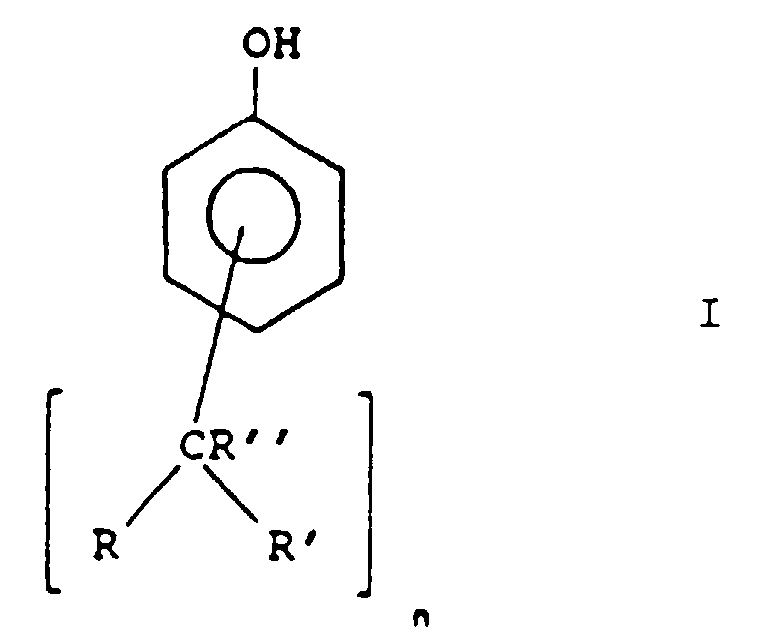
- Composition d'alkylphénate sulfuré surbasique de métal du Groupe II suivant la revendication 1, dans laquelle R" représente l'hydrogène ou un groupe méthyle.
- Composition d'alkylphénate sulfuré surbasique de métal du Groupe II suivant la revendication 2, dans laquelle R" représente un groupe méthyle.
- Composition d'alkylphénate sulfuré surbasique de métal du Groupe II suivant l'une quelconque des revendications précédentes, dans laquelle la composition d'alkylphénate sulfuré surbasique de métal du Groupe II est rendue surbasique avec du dioxyde de carbone et de l'oxyde de calcium, de l'hydroxyde de calcium ou un alcoolate de calcium ayant 1 à 6 atomes de carbone.
- Composition d'alkylphénate sulfuré surbasique de métal du Groupe II suivant l'une quelconque des revendications précédentes, dans laquelle n est égal à 1.
- Composition d'huile lubrifiante comprenant :dans laquelle la quantité totale des compositions d'alkylphénates sulfurés surbasiques de métal du Groupe II de (b) et (c), lorsque cette dernière est présente, représente 0,5 à 40 % en poids de la composition d'huile lubrifiante.(a) une huile de viscosité propre à la lubrification ;(b) une composition d'alkylphénate sulfuré surbasique de métal du Groupe II suivant l'une quelconque des revendications précédentes ; et(c) facultativement, une composition d'alkylphénate sulfuré surbasique de métal du Groupe II autre que celle spécifiée en (b) ci-dessus,
- Composition d'huile lubrifiante suivant la revendication 6, qui comprend en outre :(a) environ 1 à 20 % en poids, sur la base du poids de la composition lubrifiante, d'un alcénylsuccinimide ou alcénylsuccinate ou d'un de leurs mélanges ;(b) environ 0,1 à environ 4 % en poids, sur la base du poids de la composition d'huile lubrifiante, d'un sel de métal du Groupe II d'un acide dihydrocarbyldithiophosphorique ;(c) environ 0,3 à environ 10 % en poids, sur la base du poids de la composition lubrifiante, d'un hydrocarbylsulfonate de métal alcalin ou alcalino-terreux neutre ou surbasique ou d'un de leurs mélanges.
- Composition d'huile lubrifiante suivant la revendication 7, comprenant environ 1 à environ 25 % en poids, sur la base du poids de la composition lubrifiante, de la composition d'alkylphénate sulfuré surbasique de métal du Groupe II.
- Procédé pour la préparation d'une composition d'alkylphénate sulfuré surbasique de métal du Groupe II, procédé qui comprend la réaction, dans un diluant inerte :puis une réaction avec le dioxyde de carbone ;(a) d'un alkylphénol ;(b) de soufre ;(c) d'un oxyde, hydroxyde ou alcoolate en C1 à C6 d'un métal du Groupe II ;(d) d'un alkylène-glycol en C2 à C4 ;(e) d'un alcanol ayant au moins 8 atomes de carbone ; et(f) d'un composé choisi dans le groupe consistant en un hydrocarbylsulfonate de métal du Groupe II neutre ou surbasique, soluble dans l'huile, un alcénylsuccinimide et un de leurs mélanges ;
dans lequel ledit alkylphénol est enrichi en alkylphénols de formule I répondant à la définition suivant la revendication 1. - Procédé pour la préparation d'une composition d'alkylphénate sulfuré surbasique de métal du Groupe II suivant la revendication 9, procédé qui comprend :(a) l'association dans un diluant hydrocarboné inerte :l'alcénylsuccinimide ou l'hydrocarbylsulfonate de métal du Groupe II neutre ou surbasique, soluble dans l'huile, étant utilisé en une quantité d'environ 1 à 20 % en poids par rapport à l'alkylphénol, et l'alcanol ayant au moins 8 atomes de carbone étant utilisé en un rapport molaire de cet alcanol à l'alkylphénol d'environ 0,5 à environ 5 ;(i) d'un alkylphénol enrichi en alkylphénols de formule I répondant à la définition suivant la revendication 1 ci-dessus ;(ii) d'un alcanol ayant au moins 8 atomes de carbone ;(iii) d'un composé choisi dans le groupe consistant en un hydrocarbylsulfonate de métal du Groupe II neutre ou surbasique, soluble dans l'huile, un alcénylsuccinimide et un de leurs mélanges ;(b) le chauffage du système à une température comprise dans l'intervalle d'environ 50°C à environ 155°C ;(c) l'incorporation au système réactionnel d'un oxyde, hydroxyde ou alcoolate en C1 à C6 de métal du Groupe II tout en maintenant une température comprise dans l'intervalle de 50°C à environ 185°C, puis l'élimination d'au moins environ 15 % de la quantité d'eau théorique présente dans la composition, l'oxyde, hydroxyde ou alcoolate en C1 à C6 de métal du Groupe II étant utilisé en un rapport molaire de ce composé à l'alkylphénol d'environ 1 à environ 4 ;(d) l'incorporation au système réactionnel de soufre à une température suffisante pour provoquer la sulfuration de l'alkylphénol, avec ensuite addition à une température comprise dans l'intervalle d'environ 120°C à environ 185°C d'un alkylène-glycol en C2 à C4 ; le soufre étant utilisé en un rapport molaire du soufre à l'alkylphénol d'environ 1 à environ 4, et l'alkylène-glycol en C2 à C4 étant utilisé en un rapport molaire de cet alkylène-glycol à l'alkylphénol d'environ 1 à environ 4 ;(e) un chauffage à une température suffisante pour provoquer l'élimination d'au moins une partie de l'eau présente dans le système ;(f) le chauffage du système à une température comprise dans l'intervalle d'environ 150°C à environ 195°C ;(g) l'incorporation au système réactionnel de dioxyde de carbone, le dioxyde de carbone étant utilisé en une charge molaire par rapport à l'alkylphénol d'environ 1 à 3 ; et(h) le chauffage du système sous pression réduite à une température et une pression suffisantes pour éliminer au moins une partie de l'eau, de l'alkylène-glycol en C2 à C4 et de l'alcanol ayant au moins 8 atomes de carbone.
- Procédé suivant la revendication 9 ou 10, dans lequel l'alkylphénol de formule I est dérivé d'une oléfine ou d'un alcanol essentiellement à chaíne droite, dont l'insaturation ou le substituant alcool est situé à un atome de carbone correspondant à une position moyenne.
- Procédé suivant la revendication 11, dans lequel l'oléfine ou l'alcanol essentiellement à chaíne droite consiste en un mélange d'oléfines et/ou d'alcanols, la plus grande partie du mélange étant constituée de plus d'une oléfine ou de plus d'un alcanol en C12 à C22.
- Procédé suivant la revendication 12, dans lequel le mélange consiste en un mélange d'oléfines en C18 à C24, la plus grande partie du mélange étant formée de constituants en C18 à C22.
- Procédé suivant l'une quelconque ou plusieurs des revendications 9 à 13, dans lequel n est égal à un.
Applications Claiming Priority (2)
| Application Number | Priority Date | Filing Date | Title |
|---|---|---|---|
| US30580 | 1993-03-12 | ||
| US08/030,580 US5320762A (en) | 1993-03-12 | 1993-03-12 | Low viscosity Group II metal overbased sulfurized C12 to C22 alkylphenate compositions |
Publications (2)
| Publication Number | Publication Date |
|---|---|
| EP0614962A1 EP0614962A1 (fr) | 1994-09-14 |
| EP0614962B1 true EP0614962B1 (fr) | 1999-01-13 |
Family
ID=21854883
Family Applications (1)
| Application Number | Title | Priority Date | Filing Date |
|---|---|---|---|
| EP94301751A Expired - Lifetime EP0614962B1 (fr) | 1993-03-12 | 1994-03-11 | Compositions de faible viscosité à base de sel surbasique de métal du groupe II d'alkylphenol sulfuré, le groupe alkyl contenant 12 à 22 carbones |
Country Status (6)
| Country | Link |
|---|---|
| US (1) | US5320762A (fr) |
| EP (1) | EP0614962B1 (fr) |
| JP (1) | JPH0748586A (fr) |
| CA (1) | CA2117217A1 (fr) |
| DE (1) | DE69415840T2 (fr) |
| SG (1) | SG49868A1 (fr) |
Families Citing this family (26)
| Publication number | Priority date | Publication date | Assignee | Title |
|---|---|---|---|---|
| JPH0748586B2 (ja) * | 1992-04-24 | 1995-05-24 | 東芝ケミカル株式会社 | 多層プリント配線板の製造方法 |
| DE69531043T2 (de) * | 1994-12-28 | 2003-12-04 | Chevron Oronite Co. Llc, San Ramon | Überbasische alkyloxybenzolsulfonate als detergentien |
| FR2731427B1 (fr) * | 1995-03-08 | 1997-05-30 | Chevron Chem Sa | Alkylaryl-sulfonates lineaires isomerises, utiles comme additifs pour huiles lubrifiantes et hydocarbures alkylaryliques correspondants |
| US5726133A (en) * | 1996-02-27 | 1998-03-10 | Exxon Research And Engineering Company | Low ash natural gas engine oil and additive system |
| US5759966A (en) * | 1996-10-01 | 1998-06-02 | Chevron Chemical Company | High overbased metal sulfurized alkyphenates |
| JPH1161164A (ja) * | 1997-06-12 | 1999-03-05 | Tonen Corp | 金属フェネートからなる摩擦低減剤およびそれを含有する潤滑油組成物 |
| US6670513B1 (en) * | 1999-12-03 | 2003-12-30 | Chevron Oronite Company, Llc | Process for producing alkylated hydroxyl-containing aromatic compounds |
| US7405185B2 (en) * | 2003-09-26 | 2008-07-29 | Chevron Oronite Company Llc | Process for making Group II metal overbased sulfurized alkylphenols |
| US20050124510A1 (en) * | 2003-12-09 | 2005-06-09 | Costello Michael T. | Low sediment friction modifiers |
| US7435709B2 (en) * | 2005-09-01 | 2008-10-14 | Chevron Oronite Company Llc | Linear alkylphenol derived detergent substantially free of endocrine disruptive chemicals |
| US8399388B2 (en) * | 2009-07-01 | 2013-03-19 | Chevron Oronite Company Llc | Low temperature performance lubricating oil detergents and method of making the same |
| US8580717B2 (en) * | 2009-11-24 | 2013-11-12 | Chevron Oronite Company Llc | Process for making an overbased, sulfurized salt of an alkylated hydroxyaromatic compound |
| US8778856B2 (en) * | 2009-12-02 | 2014-07-15 | Chevron Oronite Company Llc | Low temperature performance lubricating oil detergents and method of making the same |
| SG10201708953UA (en) | 2011-12-16 | 2017-12-28 | Chevron Oronite Co | Diesel engine oils |
| EP2682451B1 (fr) | 2012-07-06 | 2015-11-18 | Infineum International Limited | Modification de détergent |
| US9434906B2 (en) | 2013-03-25 | 2016-09-06 | Chevron Oronite Company, Llc | Marine diesel engine lubricating oil compositions |
| WO2016131929A1 (fr) | 2015-02-18 | 2016-08-25 | Chevron Oronite Technology B.V. | Composition d'huile de moteur à piston fourreau à carburant marin de distillat à faible teneur en soufre |
| EP3199612A1 (fr) * | 2016-01-26 | 2017-08-02 | Infineum International Limited | Détergents de métaux |
| SG11201900769RA (en) | 2016-08-29 | 2019-02-27 | Chevron Oronite Tech Bv | Marine diesel cylinder lubricant oil compositions |
| WO2018069460A1 (fr) | 2016-10-12 | 2018-04-19 | Chevron Oronite Technology B.V. | Compositions d'huile lubrifiante pour moteur diesel marin |
| KR102826749B1 (ko) * | 2022-02-21 | 2025-06-27 | 에프톤 케미칼 코포레이션 | 높은 파라-위치 선택성을 갖는 폴리알파올레핀 페놀 |
| CN119546732A (zh) | 2022-07-14 | 2025-02-28 | 雪佛龙奥伦耐有限责任公司 | 船用柴油机气缸润滑油组合物 |
| KR20250039395A (ko) | 2022-07-14 | 2025-03-20 | 셰브런 오로나이트 컴퍼니 엘엘씨 | 선박용 디젤 엔진 윤활유 조성물 |
| CN120202280A (zh) | 2022-10-17 | 2025-06-24 | 雪佛龙奥伦耐有限责任公司 | 船用润滑油组合物 |
| KR20250156766A (ko) | 2023-03-08 | 2025-11-03 | 셰브런 오로나이트 컴퍼니 엘엘씨 | 미래 연료를 실현하는 선박용 윤활유 |
| WO2026055111A1 (fr) | 2024-09-05 | 2026-03-12 | Chevron Oronite Company Llc | Lubrifiants marins pour moteurs à ammoniac à faible teneur en zddp |
Family Cites Families (41)
| Publication number | Priority date | Publication date | Assignee | Title |
|---|---|---|---|---|
| DE1248643B (de) * | 1959-03-30 | 1967-08-31 | The Lubrizol Corporation, Cleveland, Ohio (V. St. A.) | Verfahren zur Herstellung von öllöslichen aeylierten Aminen |
| US3169987A (en) * | 1960-12-30 | 1965-02-16 | Universal Oil Prod Co | Alkaryl sulfonate production via n-olefin isomerization |
| US3178368A (en) * | 1962-05-15 | 1965-04-13 | California Research Corp | Process for basic sulfurized metal phenates |
| US3349141A (en) * | 1964-01-20 | 1967-10-24 | Chevron Res | Detergent alkylate composition of secondary phenyl-substituted n-alkanes |
| US3576896A (en) * | 1964-02-28 | 1971-04-27 | Lummus Co | Alkylation of aromatic hydrocarbons |
| GB1126482A (en) * | 1964-09-25 | 1968-09-05 | British Petroleum Co | Separation of straight chain hydrocarbons from mixtures |
| US3367867A (en) * | 1966-01-04 | 1968-02-06 | Chevron Res | Low-foaming overbased phenates |
| US3483262A (en) * | 1966-05-26 | 1969-12-09 | Monsanto Co | Process for the manufacture of aromatic substituted alkanes |
| US3390082A (en) * | 1967-09-19 | 1968-06-25 | Lubrizol Corp | Lubricants containing metal-free dispersants and inhibitors |
| US3647899A (en) * | 1969-06-11 | 1972-03-07 | Chevron Res | Linear alkylbenzene compositions |
| BE759855A (fr) * | 1969-12-11 | 1971-06-04 | Inst Francais Du Petrole | Procede d'alcoylation des hydrocarbures aromatiques |
| US3705202A (en) * | 1971-05-12 | 1972-12-05 | Universal Oil Prod Co | Alkylation of aromatics with olefins |
| US3775325A (en) * | 1972-05-30 | 1973-11-27 | Continental Oil Co | Preparation of synthetic hydrocarbon lubricating compositions |
| IT1038893B (it) * | 1975-06-11 | 1979-11-30 | Liquichimica Spa | Processo per la preparazione di alchilbenzoli |
| IT1050321B (it) * | 1975-12-05 | 1981-03-10 | Liquichimica Robassomero Spa | Additivo per olii lubrificanti |
| FR2416942A1 (fr) * | 1978-02-08 | 1979-09-07 | Orogil | Procede de preparation de detergents-dispersants de haute alcalinite pour huiles lubrifiantes |
| FR2429831A2 (fr) * | 1978-06-26 | 1980-01-25 | Orogil | Nouveau procede de preparation de detergents-dispersants de haute alcalinite pour huiles lubrifiantes |
| US4328111A (en) * | 1978-11-20 | 1982-05-04 | Standard Oil Company (Indiana) | Modified overbased sulfonates and phenates |
| US4234435A (en) * | 1979-02-23 | 1980-11-18 | The Lubrizol Corporation | Novel carboxylic acid acylating agents, derivatives thereof, concentrate and lubricant compositions containing the same, and processes for their preparation |
| US4358628A (en) * | 1981-06-26 | 1982-11-09 | Shell Oil Company | Alkylation of benzene compounds with detergent range olefins |
| US4597879A (en) * | 1982-01-28 | 1986-07-01 | Lion Corporation | Micellar slug for oil recovery |
| US4435301A (en) * | 1982-04-19 | 1984-03-06 | Standard Oil Company, (Indiana) | Preparation of overbased magnesium phenates |
| DE3379663D1 (en) * | 1982-05-14 | 1989-05-24 | Exxon Research Engineering Co | Lubricating oil additives |
| JPS5915185A (ja) * | 1982-07-19 | 1984-01-26 | ライオン株式会社 | 石油回収用ミセル溶液 |
| US4612132A (en) * | 1984-07-20 | 1986-09-16 | Chevron Research Company | Modified succinimides |
| US4608184A (en) * | 1985-07-12 | 1986-08-26 | Amoco Corporation | Phenate process and composition improvement |
| US4865754A (en) * | 1986-01-14 | 1989-09-12 | Amoco Corporation | Lubricant overbased phenate detergent with improved water tolerance |
| US4664824A (en) * | 1986-01-14 | 1987-05-12 | Amoco Corporation | Phenate product and process |
| US4971710A (en) * | 1986-10-21 | 1990-11-20 | Chevron Research Company | Methods for preparing, Group II metal overbased sulfurized alkylphenols |
| US4744921A (en) * | 1986-10-21 | 1988-05-17 | Chevron Research Company | Methods for preparing, group II metal overbased sulfurized alkylphenols |
| US5024773A (en) * | 1986-10-21 | 1991-06-18 | Chevron Research Company | Methods for preparing, group II metal overbased sulfurized alkylphenols |
| EP0327585A1 (fr) * | 1986-10-24 | 1989-08-16 | Exxon Research And Engineering Company | Alkylphenols et leurs derives, obtenus par alkylation phenolique de distillats de petrole de craquage |
| DE3707409A1 (de) * | 1987-03-07 | 1988-09-15 | Henkel Kgaa | Verfahren zur fleckentfernung von textilien |
| EP0335674A3 (fr) * | 1988-03-30 | 1991-06-26 | Yoshitomi Pharmaceutical Industries, Ltd. | Procédé sélectif pour la préparation de composés phénoliques 2,4- ou 3,6-di-substitués |
| US4856589A (en) * | 1988-08-30 | 1989-08-15 | Shell Oil Company | Gas flooding with dilute surfactant solutions |
| WO1990003354A1 (fr) * | 1988-09-27 | 1990-04-05 | Mitsubishi Monsanto Chemical Company | Procede de production d'olefines internes |
| ATE106442T1 (de) * | 1989-02-25 | 1994-06-15 | Bp Chemicals Additives | Verfahren zur herstellung eines zusatzkonzentrats für schmieröle. |
| US4929584A (en) * | 1989-03-30 | 1990-05-29 | Shell Oil Company | Alkylation of Benzene compounds with detergent range olefins |
| JPH0739586B2 (ja) * | 1989-06-23 | 1995-05-01 | コスモ石油株式会社 | 過塩基性硫化アルカリ土類金属フェネート型清浄剤の製法 |
| US4973411A (en) * | 1989-09-15 | 1990-11-27 | Texaco Inc. | Process for the preparation of sulfurized overbased phenate detergents |
| US5223163A (en) * | 1992-03-18 | 1993-06-29 | Mobil Oil Corporation | Metal phenates |
-
1993
- 1993-03-12 US US08/030,580 patent/US5320762A/en not_active Expired - Fee Related
-
1994
- 1994-03-08 CA CA002117217A patent/CA2117217A1/fr not_active Abandoned
- 1994-03-11 SG SG1996007879A patent/SG49868A1/en unknown
- 1994-03-11 JP JP6041538A patent/JPH0748586A/ja active Pending
- 1994-03-11 DE DE69415840T patent/DE69415840T2/de not_active Expired - Fee Related
- 1994-03-11 EP EP94301751A patent/EP0614962B1/fr not_active Expired - Lifetime
Also Published As
| Publication number | Publication date |
|---|---|
| CA2117217A1 (fr) | 1994-09-13 |
| SG49868A1 (en) | 1998-06-15 |
| US5320762A (en) | 1994-06-14 |
| EP0614962A1 (fr) | 1994-09-14 |
| DE69415840D1 (de) | 1999-02-25 |
| JPH0748586A (ja) | 1995-02-21 |
| DE69415840T2 (de) | 2000-01-13 |
Similar Documents
| Publication | Publication Date | Title |
|---|---|---|
| EP0614962B1 (fr) | Compositions de faible viscosité à base de sel surbasique de métal du groupe II d'alkylphenol sulfuré, le groupe alkyl contenant 12 à 22 carbones | |
| US5318710A (en) | Low viscosity Group II metal overbased sulfurized C16 to C22 alkylphenate compositions | |
| US5320763A (en) | Low viscosity group II metal overbased sulfurized C10 to C16 alkylphenate compositions | |
| US4744921A (en) | Methods for preparing, group II metal overbased sulfurized alkylphenols | |
| EP0708171B1 (fr) | Sels métalliques surbasiques utiles comme additifs pour des carburants et des lubrifiants | |
| US5024773A (en) | Methods for preparing, group II metal overbased sulfurized alkylphenols | |
| EP0217591B1 (fr) | Catéchols monoalcoylés en C18 à C24 normalement liquides | |
| US5415792A (en) | Overbased alkylated alkyl salicylates | |
| US4629578A (en) | Succinimide complexes of borated alkyl catechols and lubricating oil compositions containing same | |
| GB2163162A (en) | Normally liquid c14 to c18 monoalkyl catechols | |
| US4629577A (en) | Method for improving fuel economy of internal combustion engines | |
| AU674573B2 (en) | Lubricating oil compositions for railroad diesel engines | |
| EP0206748B1 (fr) | Additif pour huile lubrifiante et composition lubrifiante contenant ceux-ci | |
| US4971710A (en) | Methods for preparing, Group II metal overbased sulfurized alkylphenols | |
| EP0259974B1 (fr) | Alkyl phénols soufrés surbasés et leur utilisation comme additifs pour des huiles lubrifiantes | |
| US4548723A (en) | Ortho-carboxy phenylphenone lubricating oil additives | |
| US4550197A (en) | Overbased ortho-carboxy phenylphenone lubricating oil additives | |
| US20020091069A1 (en) | Overbased alkyl oxy benzene sulfonates as detergents | |
| CA2213373A1 (fr) | Alkylphenates sulfures metalliques, hautement surbasiques | |
| CA2232342A1 (fr) | Sulfonates de magnesium superbasiques | |
| GB2108147A (en) | Anti-wear additives | |
| JPH0313278B2 (fr) | ||
| JPH0260718B2 (fr) | ||
| MXPA98003036A (es) | Sulfonatos de magnesio sobre-basados |
Legal Events
| Date | Code | Title | Description |
|---|---|---|---|
| PUAI | Public reference made under article 153(3) epc to a published international application that has entered the european phase |
Free format text: ORIGINAL CODE: 0009012 |
|
| AK | Designated contracting states |
Kind code of ref document: A1 Designated state(s): BE DE FR GB |
|
| 17P | Request for examination filed |
Effective date: 19950309 |
|
| RAP1 | Party data changed (applicant data changed or rights of an application transferred) |
Owner name: CHEVRON CHEMICAL COMPANY |
|
| GRAG | Despatch of communication of intention to grant |
Free format text: ORIGINAL CODE: EPIDOS AGRA |
|
| 17Q | First examination report despatched |
Effective date: 19980113 |
|
| GRAG | Despatch of communication of intention to grant |
Free format text: ORIGINAL CODE: EPIDOS AGRA |
|
| GRAG | Despatch of communication of intention to grant |
Free format text: ORIGINAL CODE: EPIDOS AGRA |
|
| GRAH | Despatch of communication of intention to grant a patent |
Free format text: ORIGINAL CODE: EPIDOS IGRA |
|
| RAP1 | Party data changed (applicant data changed or rights of an application transferred) |
Owner name: CHEVRON CHEMICAL COMPANY LLC |
|
| GRAH | Despatch of communication of intention to grant a patent |
Free format text: ORIGINAL CODE: EPIDOS IGRA |
|
| GRAA | (expected) grant |
Free format text: ORIGINAL CODE: 0009210 |
|
| AK | Designated contracting states |
Kind code of ref document: B1 Designated state(s): BE DE FR GB |
|
| PG25 | Lapsed in a contracting state [announced via postgrant information from national office to epo] |
Ref country code: BE Free format text: LAPSE BECAUSE OF FAILURE TO SUBMIT A TRANSLATION OF THE DESCRIPTION OR TO PAY THE FEE WITHIN THE PRESCRIBED TIME-LIMIT Effective date: 19990113 |
|
| REF | Corresponds to: |
Ref document number: 69415840 Country of ref document: DE Date of ref document: 19990225 |
|
| ET | Fr: translation filed | ||
| PLBE | No opposition filed within time limit |
Free format text: ORIGINAL CODE: 0009261 |
|
| STAA | Information on the status of an ep patent application or granted ep patent |
Free format text: STATUS: NO OPPOSITION FILED WITHIN TIME LIMIT |
|
| 26N | No opposition filed | ||
| REG | Reference to a national code |
Ref country code: GB Ref legal event code: IF02 |
|
| PGFP | Annual fee paid to national office [announced via postgrant information from national office to epo] |
Ref country code: GB Payment date: 20030204 Year of fee payment: 10 |
|
| PGFP | Annual fee paid to national office [announced via postgrant information from national office to epo] |
Ref country code: FR Payment date: 20030303 Year of fee payment: 10 |
|
| PGFP | Annual fee paid to national office [announced via postgrant information from national office to epo] |
Ref country code: DE Payment date: 20030331 Year of fee payment: 10 |
|
| PG25 | Lapsed in a contracting state [announced via postgrant information from national office to epo] |
Ref country code: GB Free format text: LAPSE BECAUSE OF NON-PAYMENT OF DUE FEES Effective date: 20040311 |
|
| PG25 | Lapsed in a contracting state [announced via postgrant information from national office to epo] |
Ref country code: DE Free format text: LAPSE BECAUSE OF NON-PAYMENT OF DUE FEES Effective date: 20041001 |
|
| GBPC | Gb: european patent ceased through non-payment of renewal fee |
Effective date: 20040311 |
|
| PG25 | Lapsed in a contracting state [announced via postgrant information from national office to epo] |
Ref country code: FR Free format text: LAPSE BECAUSE OF NON-PAYMENT OF DUE FEES Effective date: 20041130 |
|
| REG | Reference to a national code |
Ref country code: FR Ref legal event code: ST |