EP0615981B1 - Geträgertes Katalysatorsystem, seine Herstellung und seine Verwendung zur Polymerisation von Olefinen - Google Patents
Geträgertes Katalysatorsystem, seine Herstellung und seine Verwendung zur Polymerisation von Olefinen Download PDFInfo
- Publication number
- EP0615981B1 EP0615981B1 EP94101797A EP94101797A EP0615981B1 EP 0615981 B1 EP0615981 B1 EP 0615981B1 EP 94101797 A EP94101797 A EP 94101797A EP 94101797 A EP94101797 A EP 94101797A EP 0615981 B1 EP0615981 B1 EP 0615981B1
- Authority
- EP
- European Patent Office
- Prior art keywords
- zirconium dichloride
- fluorenyl
- bis
- cyclopentadienyl
- dimethylsilylbis
- Prior art date
- Legal status (The legal status is an assumption and is not a legal conclusion. Google has not performed a legal analysis and makes no representation as to the accuracy of the status listed.)
- Expired - Lifetime
Links
- 0 CCC(*)C(C)C(*)(*)CC(C1)C(CC)C(*)(*)C1C=C Chemical compound CCC(*)C(C)C(*)(*)CC(C1)C(CC)C(*)(*)C1C=C 0.000 description 2
Classifications
-
- C—CHEMISTRY; METALLURGY
- C08—ORGANIC MACROMOLECULAR COMPOUNDS; THEIR PREPARATION OR CHEMICAL WORKING-UP; COMPOSITIONS BASED THEREON
- C08F—MACROMOLECULAR COMPOUNDS OBTAINED BY REACTIONS ONLY INVOLVING CARBON-TO-CARBON UNSATURATED BONDS
- C08F10/00—Homopolymers and copolymers of unsaturated aliphatic hydrocarbons having only one carbon-to-carbon double bond
-
- C—CHEMISTRY; METALLURGY
- C08—ORGANIC MACROMOLECULAR COMPOUNDS; THEIR PREPARATION OR CHEMICAL WORKING-UP; COMPOSITIONS BASED THEREON
- C08F—MACROMOLECULAR COMPOUNDS OBTAINED BY REACTIONS ONLY INVOLVING CARBON-TO-CARBON UNSATURATED BONDS
- C08F4/00—Polymerisation catalysts
- C08F4/42—Metals; Metal hydrides; Metallo-organic compounds; Use thereof as catalyst precursors
- C08F4/44—Metals; Metal hydrides; Metallo-organic compounds; Use thereof as catalyst precursors selected from light metals, zinc, cadmium, mercury, copper, silver, gold, boron, gallium, indium, thallium, rare earths or actinides
- C08F4/60—Metals; Metal hydrides; Metallo-organic compounds; Use thereof as catalyst precursors selected from light metals, zinc, cadmium, mercury, copper, silver, gold, boron, gallium, indium, thallium, rare earths or actinides together with refractory metals, iron group metals, platinum group metals, manganese, rhenium technetium or compounds thereof
- C08F4/62—Refractory metals or compounds thereof
- C08F4/64—Titanium, zirconium, hafnium or compounds thereof
- C08F4/659—Component covered by group C08F4/64 containing a transition metal-carbon bond
- C08F4/65912—Component covered by group C08F4/64 containing a transition metal-carbon bond in combination with an organoaluminium compound
-
- C—CHEMISTRY; METALLURGY
- C08—ORGANIC MACROMOLECULAR COMPOUNDS; THEIR PREPARATION OR CHEMICAL WORKING-UP; COMPOSITIONS BASED THEREON
- C08F—MACROMOLECULAR COMPOUNDS OBTAINED BY REACTIONS ONLY INVOLVING CARBON-TO-CARBON UNSATURATED BONDS
- C08F4/00—Polymerisation catalysts
- C08F4/42—Metals; Metal hydrides; Metallo-organic compounds; Use thereof as catalyst precursors
- C08F4/44—Metals; Metal hydrides; Metallo-organic compounds; Use thereof as catalyst precursors selected from light metals, zinc, cadmium, mercury, copper, silver, gold, boron, gallium, indium, thallium, rare earths or actinides
- C08F4/60—Metals; Metal hydrides; Metallo-organic compounds; Use thereof as catalyst precursors selected from light metals, zinc, cadmium, mercury, copper, silver, gold, boron, gallium, indium, thallium, rare earths or actinides together with refractory metals, iron group metals, platinum group metals, manganese, rhenium technetium or compounds thereof
- C08F4/62—Refractory metals or compounds thereof
- C08F4/64—Titanium, zirconium, hafnium or compounds thereof
- C08F4/659—Component covered by group C08F4/64 containing a transition metal-carbon bond
- C08F4/65916—Component covered by group C08F4/64 containing a transition metal-carbon bond supported on a carrier, e.g. silica, MgCl2, polymer
-
- C—CHEMISTRY; METALLURGY
- C08—ORGANIC MACROMOLECULAR COMPOUNDS; THEIR PREPARATION OR CHEMICAL WORKING-UP; COMPOSITIONS BASED THEREON
- C08F—MACROMOLECULAR COMPOUNDS OBTAINED BY REACTIONS ONLY INVOLVING CARBON-TO-CARBON UNSATURATED BONDS
- C08F4/00—Polymerisation catalysts
- C08F4/42—Metals; Metal hydrides; Metallo-organic compounds; Use thereof as catalyst precursors
- C08F4/44—Metals; Metal hydrides; Metallo-organic compounds; Use thereof as catalyst precursors selected from light metals, zinc, cadmium, mercury, copper, silver, gold, boron, gallium, indium, thallium, rare earths or actinides
- C08F4/60—Metals; Metal hydrides; Metallo-organic compounds; Use thereof as catalyst precursors selected from light metals, zinc, cadmium, mercury, copper, silver, gold, boron, gallium, indium, thallium, rare earths or actinides together with refractory metals, iron group metals, platinum group metals, manganese, rhenium technetium or compounds thereof
- C08F4/62—Refractory metals or compounds thereof
- C08F4/64—Titanium, zirconium, hafnium or compounds thereof
- C08F4/659—Component covered by group C08F4/64 containing a transition metal-carbon bond
- C08F4/6592—Component covered by group C08F4/64 containing a transition metal-carbon bond containing at least one cyclopentadienyl ring, condensed or not, e.g. an indenyl or a fluorenyl ring
- C08F4/65922—Component covered by group C08F4/64 containing a transition metal-carbon bond containing at least one cyclopentadienyl ring, condensed or not, e.g. an indenyl or a fluorenyl ring containing at least two cyclopentadienyl rings, fused or not
-
- Y—GENERAL TAGGING OF NEW TECHNOLOGICAL DEVELOPMENTS; GENERAL TAGGING OF CROSS-SECTIONAL TECHNOLOGIES SPANNING OVER SEVERAL SECTIONS OF THE IPC; TECHNICAL SUBJECTS COVERED BY FORMER USPC CROSS-REFERENCE ART COLLECTIONS [XRACs] AND DIGESTS
- Y10—TECHNICAL SUBJECTS COVERED BY FORMER USPC
- Y10S—TECHNICAL SUBJECTS COVERED BY FORMER USPC CROSS-REFERENCE ART COLLECTIONS [XRACs] AND DIGESTS
- Y10S502/00—Catalyst, solid sorbent, or support therefor: product or process of making
- Y10S502/522—Radiant or wave energy activated
-
- Y—GENERAL TAGGING OF NEW TECHNOLOGICAL DEVELOPMENTS; GENERAL TAGGING OF CROSS-SECTIONAL TECHNOLOGIES SPANNING OVER SEVERAL SECTIONS OF THE IPC; TECHNICAL SUBJECTS COVERED BY FORMER USPC CROSS-REFERENCE ART COLLECTIONS [XRACs] AND DIGESTS
- Y10—TECHNICAL SUBJECTS COVERED BY FORMER USPC
- Y10S—TECHNICAL SUBJECTS COVERED BY FORMER USPC CROSS-REFERENCE ART COLLECTIONS [XRACs] AND DIGESTS
- Y10S526/00—Synthetic resins or natural rubbers -- part of the class 520 series
- Y10S526/943—Polymerization with metallocene catalysts
Definitions
- the present invention relates to a supported (heterogeneous) Catalyst system, its manufacture using microwaves and its use for the polymerization of olefins.
- EP-A-553 757 is a catalyst system for olefin polymerization or Copolymerization consisting of at least one metallocene as Transition metal compound and at least one aluminoxane compound, known.
- a catalyst system for olefin polymerization or Copolymerization consisting of at least one metallocene as Transition metal compound and at least one aluminoxane compound, known.
- the catalyst system In the presence of the catalyst system at a temperature of -60 to 200 ° C at a pressure of 0.5 to 100 bar in solution, in suspension or an olefin polymer is produced in the gas phase.
- a catalyst for olefin polymerization which from the reaction product one in aliphatic and aromatic Hydrocarbon-insoluble aluminoxane with at least one metallocene consists.
- a supported polymerization catalyst is known from EP-A-563 917, which can be produced by reacting the reaction product, formed from a Aluminoxane and at least one metallocene with a microporous polymeric carrier.
- EP-A-578 838 discloses a supported polymerization catalyst system known, consisting of the reaction product of a supported Organoaluminium compound and a metallocene catalyst component. On catalyst systems supported in this way can be used in polymerization processes for the production of polyethylene, polypropylene or cycloolefin copolymers be used.
- GB-A-1 530 445 describes the use of microwave radiation for Fixation of a Ziegler catalyst on a carrier is known.
- the cycloolefin copolymers which during the Polymerization largely remain in solution, depends on the quality of the Separation of the supported metallocene catalyst system from the Polymer solution through a filtration step crucial from the stability the fixation of cocatalyst and catalyst on the support.
- a metallocene or an aluminum alkyl are fixed on the carrier, the lower the residual catalyst or residual cocatalyst content in the filtered cycloolefin copolymer solution.
- the task was to create a supported catalyst system with a more stable catalyst and / or cocatalyst fixation and thus with a provide better service life.
- a Catalyst system which has a carrier, at least contains a catalyst and at least one cocatalyst, thereby characterized in that the fixation of the catalyst on the support under exposure to microwaves.
- the catalyst is combined with a supported catalyst Suspending agent brought into contact under the influence of microwaves.
- the catalyst with the Cocatalyst contacted by that in a suspending agent suspended support material covered with the cocatalyst with an in an inert solvent dissolved catalyst compound is brought together.
- the catalyst with the Cocatalyst contacted by that in a suspending agent suspended support material covered with the cocatalyst with an in brought together in a solid form present catalyst compound becomes.
- the catalyst with the Cocatalyst contacted by the in an inert Solvent dissolved catalyst with the solid with the Co-catalyst supported material is brought together so that a Suspension arises.
- the preparation of the support material covered with the cocatalyst can such as in European patent application EP-A-578 838 described. But this is already in this first step also a microwave treatment analogous to the procedure described here possible. This treatment can also be omitted without any noticeable deterioration of the wear is noticeable if the Microwave treatment is intensified during the catalyst fixation.
- the support material coated with the cocatalyst can be in the form of 1-40% by weight, preferably as a 5-20% by weight suspension in an aliphatic, inert suspending agents such as n-decane, hexane, heptane or 2 diesel oil be used.
- Inert solvents come in as solvents for the catalyst Consider the no or only weakly microwave-active bands in the Have the waveband of the microwave device used (klystron), for example toluene, hexane, heptane and dichloromethane.
- the reaction between catalyst and supported cocatalyst can with intensive mixing of the components, e.g. by stirring together a molar Al / Zr ratio between 100/1 and 10000/1, preferred between 100/1 and 3000/1, under inert conditions, i.e. under Nitrogen or argon atmosphere.
- the catalyst can first be brought into contact with the support material covered with the cocatalyst with stirring at a relatively low temperature between -80 ° C and + 30 ° C, preferably at -10 ° C to -40 ° C.
- the homogeneous suspension resulting from the stirring can then be irradiated with microwaves at a temperature between -20 ° and + 120 ° C, preferably between 15 ° and 100 ° C. Radiation is associated with heating of the reaction suspension.
- the temperature gradient up to a defined final temperature at which the system can be maintained over a variable period of time is set via the microwave power. The duration of the irradiation and the associated heating depends on the microwave power and the amount of substance.
- the microwave apparatus includes the possibility of irradiation of defined, stirred batches under inert gas conditions as well as the irradiation of continuously pumped suspensions.
- the frequency of the microwaves can be in the range from 0.4 GHz to 24 GHz, preferably 0.4 to 2.5 GHz and in particular approximately 433 MHz, approximately 915 MHz and approximately 2.45 GHz.
- Pulsed microwave radiation is preferably used.
- aluminum alkyls, in particular methylaluminum alkyl, and metallocenes absorb microwaves. This means that, in the case of support under radiation with microwaves, energy can be transferred specifically to the connections to be carried. The excited compounds to be carried also distribute this energy to the environment in the form of heat. This ensures a good fixation.
- a temperature can be measured in the carrier medium (solvent), which correlates with the radiated and absorbed power.
- the temperature of the medium can be used to describe the carrier tests.
- the coupled radiation power also depends on the concentrations of the excitable components of the catalyst system to be supported.
- Suitable carrier materials are, for example, silica gels, aluminum oxides, solid aluminoxane or other inorganic carrier materials such as, for example, magnesium chloride or oxides, which have been produced by flame-pyrolysis by burning element halides in an oxyhydrogen gas flame or can be prepared as silica gels in certain particle size distributions and particle shapes.
- a suitable carrier material is also a partially crystalline or crosslinked polyolefin powder in finely divided form which is insoluble under the reaction conditions.
- the quality of the fixation of the catalyst system can be determined by test so-called standing tests. You can do different tests be applied. Test polymerizations are also very informative of propylene.
- the supported catalyst systems are under Reaction conditions maintained, where they were inert instead of propylene Hydrocarbons come into contact. After certain periods catalyst samples are then taken and a test polymerization fed. Thus, a time-dependent change in the Catalyst system can be determined and evaluated.
- the supernatant solution can e.g. by Filtration or decanting can be separated.
- the filtrate of the Reaction suspension depends on the previously used catalyst colored.
- the remaining solid is 1- to 5-fold with an inert Suspension agents such as toluene, n-decane, hexane, diesel oil and dichloromethane to remove soluble components in the formed carrier Catalyst system, especially for removing unreacted and thus soluble metallocene.
- the supported catalyst system so produced can e.g. in a vacuum or dried in an inert gas stream as a powder or with a solvent again resuspended and as a suspension in an inert Suspending agents such as e.g. Hexane, heptane, diesel in it Polymerization system be metered.
- an inert Suspending agents such as e.g. Hexane, heptane, diesel in it Polymerization system be metered.
- Polyethylene and polypropylene are preferred.
- the supported catalyst systems according to the invention can be used for the synthesis of cycloolefin copolymers.
- Cycloolefin copolymers which are obtained by polymerizing at least one polycyclic olefin of the formula I, II, III or IV, preferably a cycloolefin of the formula I or III, are particularly preferred, wherein R 1 , R 2 , R 3 , R 4 , R 5 , R 6 , R 7 and R 8 are the same or different and represent a hydrogen atom or a C 1 -C 8 alkyl radical or a C 1 -C 16 aryl radical , where the same radicals in the different formulas can have different meanings, optionally also a monocyclic olefin of the formula V wherein n is a number from 2 to 10, and an acyclic 1-olefin of the formula VI, wherein R 9 , R 10 , R 11 and R 12 are the same or different and represent a hydrogen atom or a C
- copolymers of polycyclic olefins of the formula I and II manufactured.
- the polycyclic olefin (I to IV) is used in an amount of 0.1 to 99.9 % By weight, the monocyclic olefin (V) in an amount of 0 to 99.9 % By weight and the acyclic 1-olefin (VI) in an amount of 0.1 to 99.9 % By weight, based in each case on the total amount of the monomers, used.
- the supported catalyst systems according to the invention contain a Catalyst system which as at least one aluminoxane Contains cocatalyst and at least one metallocene as a catalyst.
- the metallocenes can, as in e.g. EP-A-355 682 will.
- Chiral metallocenes are used in the preparation of the invention Catalyst system preferably used as a racemate. Be used but can also be the pure R or S shape. In the case of manufacturing highly tactical polyolefins should be the meso form of the metallocenes Use separated. As the central atom of the metallocenes Zircon and hafnium are preferred, zircon is particularly preferred.
- the cocatalyst is preferably an aluminoxane which preferably has the formula VII for the linear type and / or formula VIII for the cyclic type, wherein in the formulas VII and VIII R 13 denotes a C 1 -C 6 -alkyl group, preferably methyl, ethyl or isobutyl, butyl or neopentyl, or phenyl or benzyl, particularly preferably methyl, n is an integer from 2 to 50, preferably 5 to 40.
- R 13 denotes a C 1 -C 6 -alkyl group, preferably methyl, ethyl or isobutyl, butyl or neopentyl, or phenyl or benzyl, particularly preferably methyl, n is an integer from 2 to 50, preferably 5 to 40.
- R 13 denotes a C 1 -C 6 -alkyl group, preferably methyl, ethyl or isobuty
- the polymerization is carried out in a known manner in solution, in suspension, in the liquid cycloolefin monomer or cycloolefin monomer mixture or in the gas phase, continuously or batchwise, in one or more stages at a temperature of -78 to 150 ° C., preferably -20 to 80 ° C. .
- the pressure is 0.5 to 64 bar and is obtained either by the gaseous olefins or with the aid of inert gas.
- concentrations of the catalysts and cocatalysts used and the detailed experimental conditions for carrying out the polymerisation reaction are described, for example, in European patent application EP-A-336 128, which is hereby expressly incorporated by reference.
- the advantage of the method according to the invention over the prior art Technique is that it fixes the catalyst and / or of the cocatalyst by irradiation with microwaves into one targeted excitation of the components of the catalyst system that comes results in a priority heating of the reacting components.
- the usual supply of energy by heat for example by a heat bath, but essentially the solvent is heated, which leads to a relatively low effectiveness of the delivery process.
- very pure and very transparent cycloolefin copolymers manufacture the optical parts and elements in the field of Power optics, light conduction and optical information storage can be processed.
- MAO on SiO 2 type B
- MAO on SiO 2 type B
- the radiation power is regulated so that the suspension is kept at this temperature for one hour (250W, clocked). It is then filtered and the red solid is washed three times with 50 ml of toluene. Analysis of the yellow filtrate shows a zirconium content of 0.7 mg (corresponds to 5 mg rac-dimethylsilyl-bis-1- (4,6-isopropyl-2-methylindenyl) zirconium dichloride). The solid is dried in vacuo. 4.7 g of free-flowing, light red, supported catalyst with a content of 19.8 mg of zirconocene per gram of catalyst are obtained.
- the preparation of the supported catalyst is repeated analogously to Example 1, with the difference that 65 mg (0.15 mmol) of isopropyl- (9 ⁇ fluorenyl) -cyclopentadienylzirconium dichloride is dissolved in 40 ml of toluene and the suspension is 3.9 g of "MAO on SiO 2 , Type B "can be added dropwise in 60 ml of toluene.
- the analysis of the light red filtrate shows a zirconium content of 0.9 mg (corresponds to 4.3 mg Isopropyl (9-fluorenyl) cyclopentadienyl zirconium dichloride). 3 g of free-flowing, violet, supported catalyst with a content of 20 mg of zirconocene per gram of catalyst are obtained.
- the catalyst prepared according to Example 2 was resuspended in hexane-moist form in 20 ml of hexane.
- the polymerization was carried out analogously to Example 5.
- the heat of the reaction did not remain constant after the polymerization temperature had reached 70 ° C., ie there was a drop in activity and the associated change in the temperature in the cooling circuit of the reactor. Therefore, only an average catalyst activity could be calculated.
- the result was 250 g of very fine-grain polypropylene powder.
- the reactor showed thin deposits on the inner wall and stirrer.
- the (average) catalyst activity was thus 76 kg PP / g metallocene x h.
- the catalyst prepared according to Example 2 was resuspended in hexane-moist form in 20 ml of hexane.
- the polymerization was carried out analogously to Example 5, with the exception that the polymerization lasts three hours at 70 ° C.
- the reaction's heat tone did not remain constant after the polymerization temperature had reached 70 ° C., ie there was a drop in activity and the associated change in the temperature in the cooling circuit of the reactor. Therefore, only an average catalyst activity could be calculated.
- the result was 340 g of polypropylene powder.
- the reactor showed small deposits on the inner wall and stirrer.
- the (average) catalyst activity was thus 30 kg PP / g metallocene x h.
- VZ 275 cm 3 / g
- Mp 139 ° C
- MFI 230/5 6.5 dg / min;
- a clean and dry 1.5 l polymerization reactor with stirrer was flushed first with nitrogen and then with ethylene.
- the reactor was charged with 600 ml of a toluene solution of norbornene (411 g of norbornene and 86 ml of toluene).
- the solution was mixed with 2 ml of a 20% by weight toluene solution of tri (n-butyl) aluminum.
- the temperature in the reactor was then set to 70 ° C. and the ethylene pressure to 6 bar.
- 210 mg of the catalyst powder prepared according to Example 3 were suspended in 10 ml of dry hexane in a 25 ml Schlenk vessel.
- This suspension was added to the reactor via a lock and the ethylene pressure was kept constant for 60 minutes by adding ethylene at 6 bar.
- the ethylene uptake was continuously monitored using a Brooks mass flow meter. The ethylene uptake was almost constant over the duration of the polymerization 9 l / h (standard liter / hour).
- the polymerization was stopped after 60 minutes by adding 100 ml of a water-moist (saturated at room temperature) toluene.
- the contents of the reactor were then filtered over a 31-nutsche heated to 70 ° C. with an inserted filter layer T5500 from Seitz, with a positive pressure in the nutsche of 2.5 bar within 4 minutes. A clear solution was obtained.
- the solution was then precipitated in 5 l of acetone and washed with 3 l of acetone.
- the precipitated powder was dried at 100 ° C. and 0.2 bar for 15 hours. A total of 51.4 g of norbornene-ethylene copolymer was obtained.
- the glass transition temperature was 154 ° C. and the viscosity number (solution viscosity) was 180 ml / g.
- Example 10 The procedure was analogous to Example 10, with the exception that the entire hexane-moist filter residue, which is obtained with a catalyst preparation according to Example 4, was resuspended in 10 ml of dry hexane and then used in the polymerization.
- the ethylene uptake at the start of the polymerization was 9.3 l / h, but fell noticeably to 6.7 l / h over 60 minutes.
- the filtration carried out under the same conditions as in Example 9 continued for 18 minutes. 44.6 g of product were obtained.
- the glass transition temperature was 152 ° C and the viscosity number was 169 ml / g.
- Example 3 1g of the dried catalyst from Example 3 is in 50ml hexane for the Polymerization suspended.
- the polymerization is carried out analogously to Example 5.
- the result was 600 g of coarse-grained polypropylene powder.
- the reactor showed no deposits on the inner wall or stirrer.
- the catalyst activity was thus 30kg PP / g metallocene x h.
- the hexane-moist filter residue of the catalyst system is produced according to Example 4 is suspended in 50 ml of hexane for the polymerization.
- the polymerization is carried out analogously to Example 5. This resulted in 250 g fine-grain polypropylene powder.
- the reactor showed deposits on the inner wall and stirrer.
- the catalyst activity was thus 60kg PP / g metallocene x h.
- the hexane-moist filter residue of the catalyst system is produced according to Example 4 is absolute in 100ml and saturated with inert gas Toluene suspended.
- the suspension is under protective gas for three hours heated to 80 ° C. After cooling to room temperature, a G3 frit filtered. The filtrate is colored red.
- the filter residue is with Washed hexane and then in 50ml hexane for the polymerization suspended.
- the polymerization is carried out analogously to Example 5. The result was no polypropylene powder.
Landscapes
- Chemical & Material Sciences (AREA)
- Health & Medical Sciences (AREA)
- Chemical Kinetics & Catalysis (AREA)
- Medicinal Chemistry (AREA)
- Polymers & Plastics (AREA)
- Organic Chemistry (AREA)
- Transition And Organic Metals Composition Catalysts For Addition Polymerization (AREA)
Description
Die durch das Rühren entstehende homogene Suspension kann anschließend bei einer Temperatur zwischen -20° und + 120°C, bevorzugt zwischen 15° und 100°C, mit Mikrowellen bestrahlt werden. Mit der Bestrahlung ist eine Erwärmung der Reaktions-Suspension verbunden. Der Temperaturgradient bis zu einer definierten Endtemperatur, bei der das System über einen variablen Zeitraum gehalten werden kann, wird über die Mikrowellenleistung eingestellt.
Die Bestrahlungsdauer und die damit verbundene Erwärmung ist abhängig von der Mikrowellenleistung und der Substanzmenge. Sie wird beispielsweise so gewählt, daß eine Endtemperatur von 50° - 120°C, bevorzugt 70 - 100°C nicht überschritten wird und diese innerhalb einer Stunde, bevorzugt innerhalb weniger Minuten erreicht wird. Die Umsetzung von Katalysator und geträgertem Cokatalysator erfolgt während der Bestrahlung bei einer Reaktionszeit zwischen 5 und 120 Minuten, bevorzugt 10 - 80 Minuten. Die Mikrowellenapparatur beinhaltet sowohl die Möglichkeit der Bestrahlung von definierten, gerührten Chargen unter Inertgasbedingungen als auch der Bestrahlung von kontinuierlich geförderten Suspensionen.
In Versuchen, bei denen veschiedene Kohlenwasserstoff-Lösungen mit Mikrowellen behandelt wurden, konnte eindeutig nachgewiesen werden, daß im Gegensatz zu reinen Kohlenwasserstoffen beispielsweise Aluminiumalkyle, insbesondere Methylaluminiumalkyl, und Metallocene Mikrowellen absorbieren. Das bedeutet, daß im Falle der Trägerung unter Bestrahlung mit Mikrowellen Energie gezielt auf die zu trägernden Verbindungen übertragen werden kann. Die angeregten zu trägernden Verbindungen verteilen diese Energie in Form von Wärme auch an die Umgebung. Dadurch wird eine gute Fixierung erreicht. Im Trägerungsmedium (Lösungsmittel) kann eine Temperatur gemessen werden, die mit der eingestrahlten und absorbierten Leistung korreliert. Dadurch kann die Temperatur des Mediums zur Beschreibung der Trägerversuche herangezogen werden. Die eingekoppelte Strahlungsleistung hängt auch von den Konzentrationen der anregbaren Komponenten des zu trägernden Katalysatorsystems ab.
Ein geeignetes Trägermaterial ist auch ein teilkristallines oder vernetztes, unter Reaktionsbedingungen unlösliches Polyolefinpulver in feinverteilter Form.

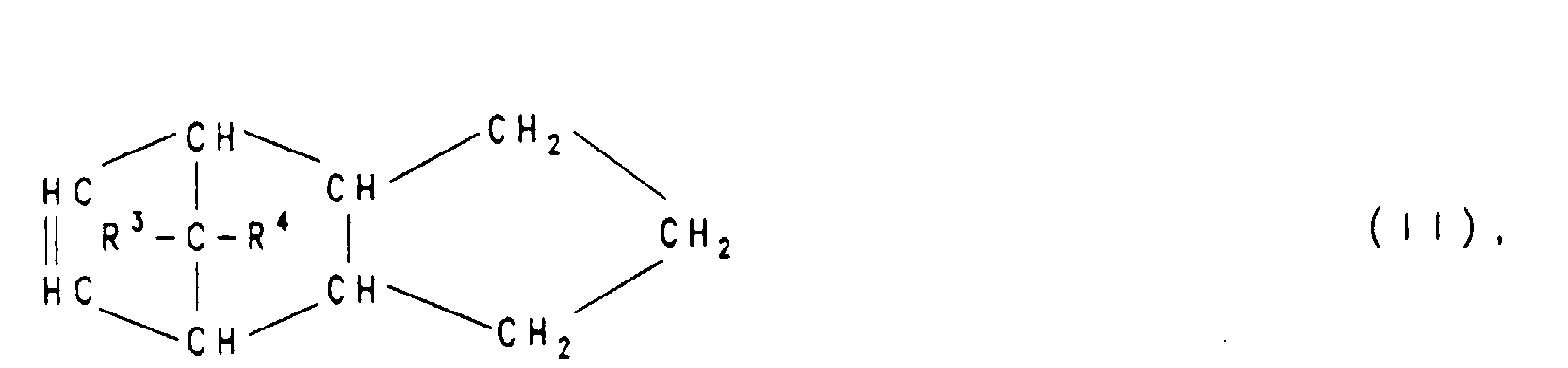


gegebenenfalls auch einem monocyclischen Olefin der Formel V

einem acyclischen 1-Olefins der Formel VI,

Bevorzugt sind Ethylen, Propylen, Buten, Hexen, Octen oder Styrol. Besonders bevorzugt ist Ethen. Darüber hinaus können auch Diene eingesetzt werden.
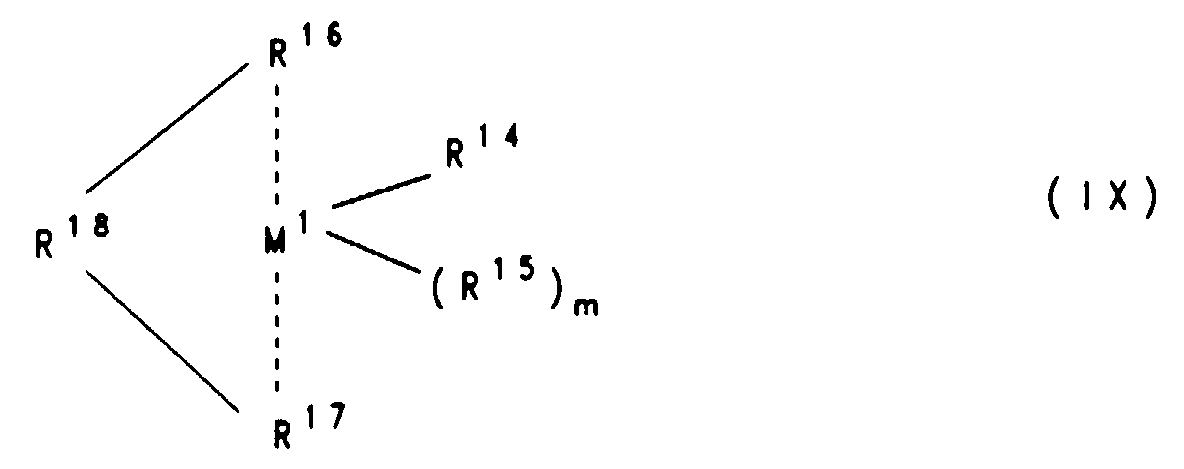

R18 ist vorzugsweise =CR19R20, =SiR19R20, =Ger19R20, -O-, -S-, = SO, =PR19 oder =P(O)R19, worin R19 und R20 bevorzugt eine C1-C10-, vorzugsweise C1-C4-Alkylgruppe oder eine C6-C10-Arylgruppe ist.


Die Konzentrationen der eingesetzten Katalysatoren und Cokatalysatoren und die detaillierten experimentellen Bedingungen zur Durchführung der Polymerisatonsreaktion sind beispielsweise in der europäischen Patentanmeldung EP-A-336 128 beschrieben, auf die hiermit ausdrücklich Bezug genommen wird.
- VZ =
- Viskositätszahl in cm3/g
- Mw =
- Molmassengewichtsmittel in g/mol (ermittelt durch Gelpermeationschromatographie)
- Mw/Mn =
- Molmassendispersität
- Schmp. =
- Schmelzpunkt in °C (ermittelt mit DSC, 20°C/min Aufheiz-/Abkühlgeschwindigkeit)
- II =
- Isotaktischer Index (II = mm + 1/2 mr, ermittelt durch 13C-NMR-Spektroskopie)
- MFI/(230/5) =
- Schmelzindex, gemessen nach DIN 53735; in dg/min
- SD =
- Polymerschüttdichte in g/dm3.
Isopropyl-(9-fluorenyl)-cyclopentadienyl-zirkondichlorid). Man erhält 3g frei fließenden, violetten, geträgerten Katalysator mit einen Gehalt von 20mg Zirkonocen pro Gramm Katalysator.
Polymerisation:
Parallel dazu wurde ein trockener 16-dm3-Reaktor zunächst mit Stickstoff und anschließend mit Propylen gespült und mit 10 dm3 flüssigem Propylen befüllt.
Dann wurden 3 cm3 Triisobutylaluminium (pur, 12 mmol) mit 30 ml Hexan verdünnt, in den Reaktor gegeben und der Ansatz bei 30°C 15 Minuten gerührt.
Anschließend wurde die vorbereitete Katalysator-Suspension in den Reaktor gegeben, durch Wärmezufuhr auf die Polymerisationstemperatur von 70°C aufgeheizt (4°C/min) und das Polymerisationssystem 1 h durch Kühlung bei 70°C gehalten. Bei dem Polymerisationsversuch bleibt die Wärmetönung der Reaktion nach dem Erreichen der Polymerisationstemperatur von 70°C konstant, d.h. es ist kein Aktivitätsabfall und die damit verbundene Änderung der Temperatur im Kühlkreislauf des Reaktors zu verzeichnen. Gestoppt wurde die Polymerisation durch Zusatz von 20 ml Isopropanol. Das überschüssige Monomer wurde abgegast, das Polymer im Vakuum getrocknet. Es resultierten 720g Polypropylen-Pulver. Der Reaktor zeigte keine Beläge an Innenwand oder Rührer.
Die Katalysatoraktivität betrug somit 37kg PP/g Metallocen x h.
VZ = 311 cm3/g; Schmp. = 140°C; MFI 230/5 = 7,5 dg/min;
Die Polymerisation erfolgt analog zu Beispiel 5, wobei abweichend davon die Polymerisation 2 Stunden dauert. Bei dem Polymerisationsversuch bleibt die Wärmetönung der Reaktion nach dem Erreichen der Polymerisationstemperatur von 70°C konstant, d.h. es ist kein Aktivitätsabfall und die damit verbundene Änderung der Temperatur im Kühlkreislauf des Reaktors zu verzeichnen.
Es resultierten 1600g Polypropylen-Pulver. Der Reaktor zeigte keine Beläge an Innenwand oder Rührer.
Die Katalysatoraktivität betrug somit 34,5 kg PP/g Metallocen x h.
VZ = 341 cm3/g; Schmp. = 141 °C; Mw = 330000 g/mol; Mw/Mn = 2,8; MFI 230/5 = 5,5 dg/min; SD = 350 g/dm3
Die Polymerisation erfolgt analog zu Beispiel 5, wobei abweichend davon die Polymerisation 3 Stunden dauert. Bei dem Polymerisationsversuch bleibt die Wärmetönung der Reaktion nach dem Erreichen der Polymerisationstemperatur von 70°C konstant, d.h. es ist kein Aktivitätsabfall und die damit verbundene Änderung der Temperatur im Kühlkreislauf des Reaktors zu verzeichnen.
Es resultierten 1150g Polypropylen-Pulver. Der Reaktor zeigte keine Beläge an Innenwand oder Rührer.
Die Katalysatoraktivität betrug somit 33kg PP/g Metallocen x h.
VZ = 281 cm3/g; Schmp. = 141°C; MFI 230/5 = 5,5 dg/min;SD = 370 g/dm3
Die Polymerisation erfolgte analog zu Beispiel 5. Während des Polymerisationsversuchs blieb die Wärmetönung der Reaktion nach dem Erreichen der Polymerisationstemperatur von 70°C nicht konstant, d.h. es ist ein Aktivitätsabfall und die damit verbundene Änderung der Temperatur im Kühlkreislauf des Reaktors zu verzeichnen. Deshalb konnte nur eine mittlere Katalysatoraktivität berechnet werden. Es resultierten 250g sehr feinkörniges Polypropylen-Pulver. Der Reaktor zeigte dünne Beläge an Innenwand und Rührer.
Die (mittlere) Katalysatoraktivität betrug somit 76kg PP/g Metallocen x h.
VZ = 324 cm3/g; Schmp. = 143°C; Mw = 431000 g/mol; Mw/Mn = 2,6; MFI 230/5 = 3,5 dg/min; SD = 110 g/dm3
Die Polymerisation erfolgte analog zu Beispiel 5, wobei abweichend davon die Polymerisation drei Stunden dauert bei 70°C. Während des Polymerisationsversuchs blieb die Wärmetönung der Reaktion nach dem Erreichen der Polymerisationstemperatur von 70°C nicht konstant, d.h. es ist ein Aktivitätsabfall und die damit verbundene Änderung der Temperatur im Kühlkreislauf des Reaktors zu verzeichnen. Deshalb konnte nur eine mittlere Katalysatoraktivität berechnet werden.
Es resultierten 340g Polypropylen-Pulver. Der Reaktor zeigte in geringem Umfang Beläge an Innenwand und Rührer.
Die (mittlere) Katalysatoraktivität betrug somit 30kg PP/g Metallocen x h.
VZ = 275 cm3/g; Schmp. = 139°C; MFI 230/5 = 6,5 dg/min;
Die Lösung wurde mit 2 ml einer 20 Gew %-igen toluolischen Lösung von Tri(n-butyl)aluminium versetzt. Anschließend wurde die Temperatur im Reaktor auf 70 °C und der Ethylendruck auf 6 bar eingestellt. In einem 25 ml-Schlenkgefäß wurden 210 mg des Katalysatorpulvers hergestellt nach Beispiel 3 in 10 ml trockenem Hexan suspendiert. Diese Suspension wurde über eine Schleuse in den Reaktor gegeben und der Ethylendruck wurde durch Nachdosieren von Ethylen bei 6 bar 60 Minuten konstant gehalten. Die Ethylenaufnahme wurde mittels eines Massenflußmessers der Firma Brooks kontinuierlich verfolgt. Die Ethylenaufnahme betrug über die Dauer der Polymerisation nahezu konstant 9 l/h (Normliter/Stunde).
Die Polymerisation wurde nach 60 Minuten durch Zugabe von 100 ml eines wasserfeuchten (gesättigt bei Raumtemperatur) Toluols gestoppt. Der Reaktorinhalt wurde dann über eine auf 70 °C beheizte 31-Nutsche mit einer eingelegten Filterschicht T5500 der Firma Seitz, bei einem Überdruck in der Nutsche von 2,5 bar innerhalb von 4 Minuten filtriert. Es wurde eine klare Lösung erhalten. Anschließend wurde die Lösung in 5 l Aceton gefällt und mit 3 l Aceton gewaschen. Das ausgefällte Pulver wurde bei 100 °C und 0,2 bar 15 Stunden getrocknet.
Es wurden insgesamt 51,4 g Norbornen-Ethylen-Copolymer erhalten. Die Glastemperatur betrug 154 °C und die Viskositätszahl (Lösungsviskosität) war 180 ml/g.
Die Filtration durchgeführt unter den gleichen Bedingungen wie in Beispiel 9 dauerte 18 Minuten an.
Es wurden 44,6 g Produkt erhalten. Die Glastemperatur betrug 152 °C und die Viskositätszahl war 169 ml/g.
Claims (16)
- Geträgertes Katalysatorsystem, welches einen Träger, mindestens ein Metallocen als Katalysator und mindestens ein Aluminoxan als Cokatalysator enthält, erhältlich durch Fixierung des Katalysators auf dem Träger unter Einwirkung von Mikrowellen, wobei der Katalysator mit einem geträgerten Cokatalysator in einer Suspensionslösung unter Einwirkung von Mikrowellen in Kontakt gebracht wird.
- Geträgertes Katalysatorsystem gemäß Anspruch 1,verwendet wird.wobei als MetallocenBiscyclopentadienylzirkondichloridBiscyclopentadienylzirkondimethylBiscyclopentadienylzirkondiphenylBiscyclopentadienylzirkondibenzylBiscyclopentadienylzirkonbistrimethylsilylBis(methylcyclopentadienyl)zirkondichloridBis(1,2-dimethylcyclopentadienyl)zirkondichloridBis(1,3-dimethylcyclopentadienyl)zirkondichloridBis(1,2,4-trimethylcyclopentadienyl)zirkondichloridBis(pentamethylcyclopentadienyl)zirkondichloridBis(ethylcyclopentadienyl)zirkondichloridBis(propylcyclopentadienyl)zirkondichloridBis(butylcyclopentadienyl)zirkondichloridBisfluorenylzirkondichloridBisindenylzirkondichloridDiphenylmethylen(9-fluorenyl)(cyclopentadienyl)zirkondichloridDiphenylmethylen(9-fluorenyl)(cyclopentadienyl)hafniumdichloridDimethylsilyl-bis-(cyclopentadienyl)-zirkondichloridDimethylsilyl(9-fluorenyl)(cyclopentadienyl)zirkondichloridDimethylsilyl(9-fluorenyl)(cyclopentadienyl)hafniumdichloridIsopropyliden(9-fluorenyl)(cyclopentadienyl)zirkondichloridIsopropyliden(9-fluorenyl)(cyclopentadienyl)hafniumdichloridDimethylsilyl-bis-(9-fluorenyl)-zirkondichloridDimethylsilyl-bis-1-tetrahydroindenylzirkondichloridDimethylsilyl-bis-1-(2-methyl-tetrahydroindenyl)-zirkondichloridDimethylsilyl-bis-1-(2,3,5-trimethyl-cyclopentadienyl)-zirkondichloridDimethylsilyl-bis-1-(2,3-dimethyl-cyclopentadienyl)-zirkondichloridDimethylsilyl-bis-1-indenylzirkondichloridDimethylsilyl-bis-1-indenylzirkondimethylDimethylgermyl-bis-1-indenylzirkondichloridDimethylsilyl-bis-1-(2-methyl-indenyl)-zirkondichloridDimethylsilyl-bis-1-(2-methyl-4-isopropylindenyl)-zirkondichloridPhenylmethylsilyl-bis-1-(2-methyl-indenyl)-zirkondichloridDimethylsilyl-bis-1-(2-methyl-4-ethylindenyl)-zirkondichloridEthylen-bis-1-(4,7-dimethyl-indenyl)-zirkondichloridPhenyl(methyl)silyl-bis-1-indenylzirkondichloridPhenyl(vinyl)silyl-bis-1-indenylzirkondichloridDiphenylsilyl-bis-1-indenylzirkondichloridDimethylsilyl-bis-1-(2-methyl-4-tertiärbutylindenyl)-zirkondichloridMethylphenylsilyl-bis-1-(2-methyl-4-isopropylindenyl)-zirkondichloridDimethylsilyl-bis-1-(2-ethyl-4-methylindenyl)-zirkondichloridDimethylsilyl-bis-1-(2,4-dimethylindenyl)-zirkondichloridDimethylsilyl-bis-1-(2-methyl-4-ethylindenyl)-zirkondimethylDimethylsilyl-bis-1-(2-methyl-4,6-diisopropylindenyl)-zirkondichloridDimethylsilyl-bis-1-(2,4,6-trimethylindenyl)-zirkondichloridMethylphenylsilyl-bis-1-(2-methyl-4,6-diisopropylindenyl)-zirkondichlorid1,2-Ethandiyl-bis-1-(2-methyl-4,6-diisopropylindenyl)-zirkondichloridDimethylsilyl-bis-1-(2-methyl-4,5-benzoindenyl)-zirkondichloridDimethylsilyl-bis-1-(2-methyl-4-phenylindenyl)-zirkondichloridEthylen-bis-(1-indenyl)-zirkondichloridEthylen-bis-1-(4,5,6,7-tetrahydroindenyl)-zirkondichloridEthylen-bis-(1-indenyl)-hafniumdichloridDimethylsilyl-bis-1-(4,5-benzoindenyl)-zirkondichloridIsopropyl-(cyclopentadienyl)(1-indenyl)-zirkondichloridIsopropyl-(3-methylcyclopentadienyl)(1-indenyl)-zirkondichloridDimethylsilyl-(cyclopentadienyl)(1-indenyl)-zirkondichloridDimethylsilyl-bis-(3-methylcyclopentadienyl)-zirkondichloridDimethylsilyl-bis-(2,4-dimethylcyclopentadienyl)-zirkondichloridMethylethylen-bis-(1-indenyl)-zirkondichloridMethylphenylcarbyl(9-fluorenyl)(cyclopentadienyl)zirkondichloridDiphenylsilyl(9-fluorenyl)(cyclopentadienyl)zirkondichloridDimethylsilyl(9-(2,7-di-tert.butylfluorenyl))(cyclopentadienyl)-zirkondichloridDiphenylcarbyl(9-(2,7-di-tert.butylfluorenyl))(cyclopentadienyl) zirkondichloridIsopropyl(9-(2,7-di-tert.butylfluorenyl))(cyclopentadienyl)zirkondichloridIsopropyl(9-fluorenyl)(1-(3-methylcyclopentadienyl))zirkondichloridIsopropyl(9-fluorenyl)(1-(3-isopropylcyclopentadienyl))zirkondichloridDimethylsilyl(9-fluorenyl)(1-(3-methylcyclopentadienyl))zirkondichloridDimethylsilyl(9-fluorenyl)(1-(3-isopropylcyclopentadienyl))zirkondichloridIsopropyl(9-fluorenyl)(1-indenyl)zirkondichlorid oderDimethylsilyl(9-fluorenyl)(1-indenyl)zirkondichlorid
- Geträgertes Katalysatorsystem gemäß Anspruch 1 oder 2, wobei der Cokatalysator ein Aluminoxan der Formel VIIfür den linearen Typ und/oder der Formel VIII
 für den cyclischen Typ ist, wobei in den Formeln VII und VIII R13 eine C1-C6-Alkylgruppe, vorzugsweise Methyl, Ethyl oder Isobutyl, Butyl oder Neopentyl, oder Phenyl oder Benzyl, besonders bevorzugt Methyl bedeutet, n ist eine ganze Zahl von 2 bis 50, bevorzugt 5 bis 40.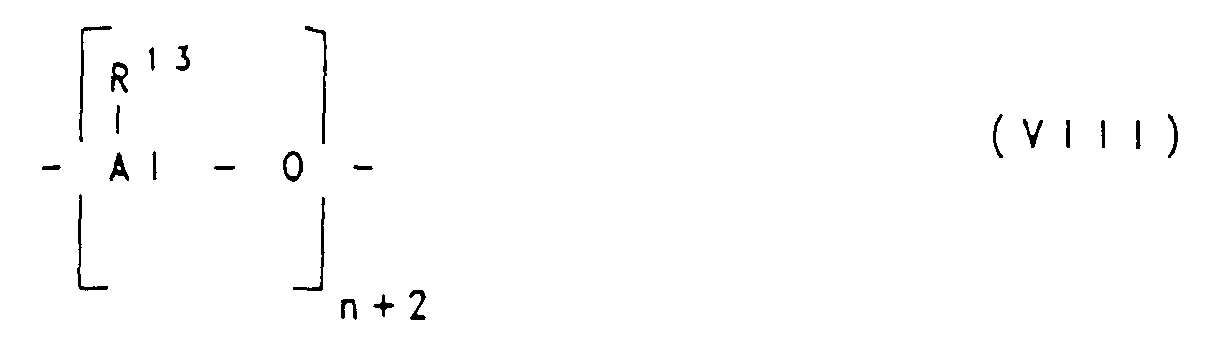
- Verfahren zur Herstellung eines geträgerten Katalysatorsystems, welches einen Träger, mindestens einen Katalysator und mindestens einen Cokatalysator enthält, wobei die Fixierung des Katalysators auf dem Träger unter Einwirkung von Mikrowellen erfolgt und wobei der Katalysator mit einem geträgerten Cokatalysator in einer Suspensionslösung unter Einwirkung von Mikrowellen in Kontakt gebracht wird.
- Verfahren nach Anspruch 4, wobei auch die Fixierung des Cokatalysators auf das Trägermaterial unter der Einwirkung von Mikrowellen erfolgt.
- Verfahren nach Anspruch 4, wobei als Suspensionsmittel n-Decan, Hexan, Heptan oder hydriertes Dieselöl eingesetzt werden.
- Verfahren nach Anspruch 4, wobei als Lösungsmittel für den Katalysator inerte Lösungsmittel, die keine oder nur schwache mikrowellenaktive Banden im Wellenlängenbereich des eingesetzten Mikrowellengerätes aufweisen, wie beispielsweise Toluol, Hexan, Heptan und Dichlormethan verwendet werden.
- Verfahren nach mindestens einem der Ansprüche 4 bis 7, wobei der Katalysator zunächst bei einer relativ niedrigen Temperatur zwischen -80°C und + 30°C, bevorzugt bei -10°C bis -40°C, mit dem mit dem Cokatalysator belegten Trägermaterial unter Rühren in Kontakt gebracht wird.
- Verfahren nach Anspruch 8, wobei die durch das Rühren entstehende homogene Suspension anschließend bei einer Temperatur zwischen -20° und +120°C, bevorzugt zwischen 15° bis 100°C, mit Mikrowellen bestrahlt wird.
- Verfahren nach Anspruch 4, wobei die Frequenz der Mikrowellenstrahlung im Bereich von 0,4 GHz und 24 GHz, bevorzugt 0,4 bis 2,5 GHz und insbesondere bei ca. 433 MHz, ca. 915 MHz und ca. 2,45 GHz liegt.
- Verfahren nach Anspruch 10, wobei eine gepulste Mikrowellenstrahlung verwendet wird.
- Verfahren nach Anspruch 4, wobei als Trägermaterial Silikagele, Aluminiumoxide, festes Aluminoxan oder andere anorganische Trägermaterialien, wie z.B. Magnesiumchlorid oder Oxide, die flammenpyrolytisch durch Verbrennung von Element-Halogeniden in einer Knallgas-Flamme erzeugt wurden, oder als Kieselgele in bestimmten Korngrößen-Verteilungen und Kornformen herstellbar sind oder teilkristallines oder vernetztes, unter den Reaktionsbedingungen unlösliches Polyolefinpulver in feinverteilter Form.
- Verfahren nach Anspruch 9, wobei nach Ablauf der Reaktionszeit die überstehende Lösung z.B. durch Filtration oder Dekantieren abgetrennt wird und der zurückbleibende Feststoff mit einem inerten Suspensionsmittel wie Toluol, n-Decan, Hexan, hydriertes Dieselöl und Dichlormethan gewaschen wird.
- Verfahren nach Anspruch 13, wobei anschließend der zurückbleibende Feststoff getrocknet als Pulver oder noch mit Lösungsmittel behaftet wieder resuspendiert und als Suspension in einem inerten Suspensionsmittel wie z.B. Hexan, Heptan, hydriertes Dieselöl in ein Polymerisationssystem eindosiert wird.
- Verwendung des geträgerten Katalysatorsystems nach mindestens einem der Ansprüche 1 bis 3 zur Synthese von Polyolefinen.
- Verwendung des geträgerten Katalysatorsystems nach Anspruch 15, wobei das Polyolefin hergestellt wird aus mindestens einem polycyclischen Olefin der Formel I, II, III oder IV,

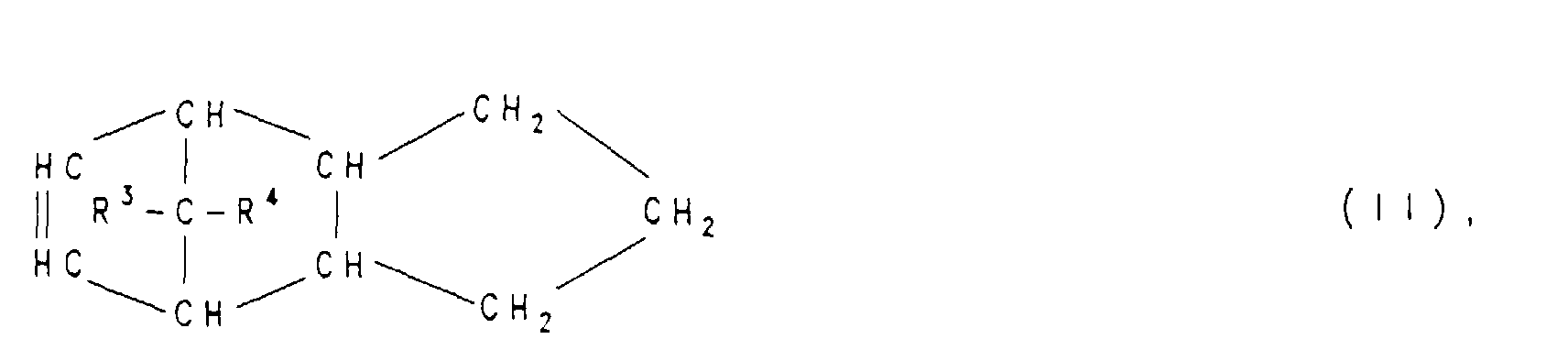
 worin R1, R2, R3, R4, R5, R6, R7 und R8 gleich oder verschieden sind und ein Wasserstoffatom oder einen C1-C8-Alkylrest oder einen C1-C16-Arylrest bedeuten, wobei gleiche Reste in den verschiedenen Formeln eine unterschiedliche Bedeutung haben können,
gegebenenfalls einem monocyclischen Olefin der Formel Vworin n eine Zahl von 2 bis 10 ist, und
einem acyclischen 1-Olefins der Formel VI,worin R9, R10, R11 und R12 gleich oder verschieden sind und ein Wasserstoffatom oder einen C1-C8-Alkylrest, der auch eine Doppelbindung enthalten kann, oder einen C6-C16-Arylrest bedeuten.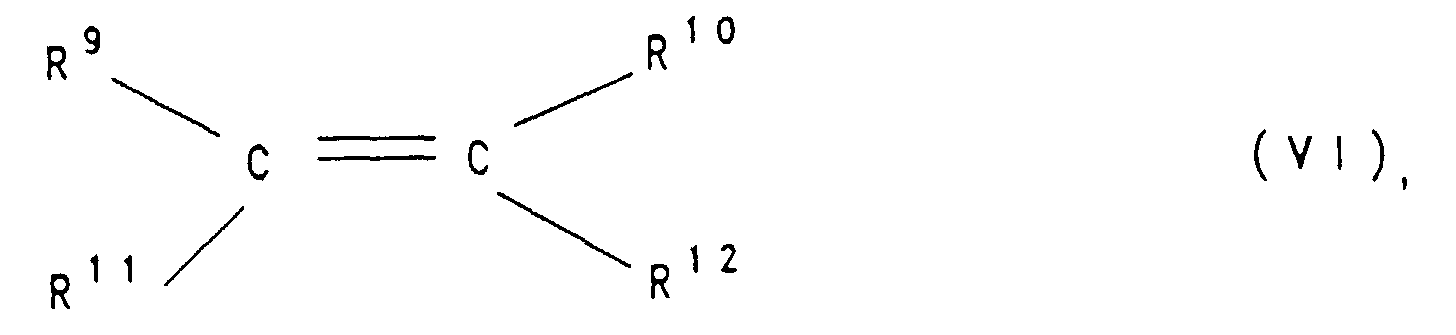
Applications Claiming Priority (2)
| Application Number | Priority Date | Filing Date | Title |
|---|---|---|---|
| DE4304286 | 1993-02-12 | ||
| DE4304286 | 1993-02-12 |
Publications (3)
| Publication Number | Publication Date |
|---|---|
| EP0615981A2 EP0615981A2 (de) | 1994-09-21 |
| EP0615981A3 EP0615981A3 (de) | 1994-11-17 |
| EP0615981B1 true EP0615981B1 (de) | 1998-05-06 |
Family
ID=6480336
Family Applications (1)
| Application Number | Title | Priority Date | Filing Date |
|---|---|---|---|
| EP94101797A Expired - Lifetime EP0615981B1 (de) | 1993-02-12 | 1994-02-07 | Geträgertes Katalysatorsystem, seine Herstellung und seine Verwendung zur Polymerisation von Olefinen |
Country Status (7)
| Country | Link |
|---|---|
| US (1) | US5719095A (de) |
| EP (1) | EP0615981B1 (de) |
| JP (1) | JP3425794B2 (de) |
| KR (1) | KR100312665B1 (de) |
| CN (1) | CN1053673C (de) |
| DE (1) | DE59405876D1 (de) |
| TW (1) | TW298593B (de) |
Cited By (18)
| Publication number | Priority date | Publication date | Assignee | Title |
|---|---|---|---|---|
| WO1999061486A1 (en) | 1998-05-29 | 1999-12-02 | Univation Technologies Llc | Catalyst delivery method and catalyst feeder |
| WO2004046214A2 (en) | 2002-10-15 | 2004-06-03 | Exxonmobil Chemical Patents Inc. | Multiple catalyst system for olefin polymerization and polymers produced therefrom |
| WO2005113622A1 (en) | 2004-04-15 | 2005-12-01 | Exxonmobil Chemical Patents Inc. | Multiple catalyst and reactor system for olefin polymerization and polymers produced therefrom |
| WO2006049699A1 (en) | 2004-10-29 | 2006-05-11 | Exxonmobil Chemical Patents Inc | Catalyst compound containing divalent tridentate ligand |
| EP1803747A1 (de) | 2005-12-30 | 2007-07-04 | Borealis Technology Oy | Oberflächemodifizierte Polymerisationskatalysatoren zur Herstellung von Polyolefinfilmen mit niedrigem Gelgehalt |
| WO2010071798A1 (en) | 2008-12-18 | 2010-06-24 | Univation Technologies, Llc | Method for seed bed treatment for a polymerization reaction |
| US7858707B2 (en) | 2005-09-15 | 2010-12-28 | Dow Global Technologies Inc. | Catalytic olefin block copolymers via polymerizable shuttling agent |
| WO2011048527A1 (en) | 2009-10-19 | 2011-04-28 | Sasol Technology (Pty) Limited | Oligomerisation of olefinic compounds with reduced polymer formation |
| WO2012074709A1 (en) | 2010-11-30 | 2012-06-07 | Univation Technologies, Llc | Processes for the polymerization of olefins with extracted metal carboxylate salts |
| WO2012074710A1 (en) | 2010-11-30 | 2012-06-07 | Univation Technologies, Llc. | Catalyst composition having improved flow characteristics and methods of making and using the same |
| WO2012158260A1 (en) | 2011-05-13 | 2012-11-22 | Univation Technologies, Llc | Spray-dried catalyst compositions and polymerization processes employing the same |
| WO2014109832A1 (en) | 2013-01-14 | 2014-07-17 | Univation Technologies, Llc | Methods for preparing catalyst systems with increased productivity |
| WO2014120494A1 (en) | 2013-01-30 | 2014-08-07 | Univation Technologies, Llc | Processes for making catalyst compositions having improved flow |
| WO2015153082A1 (en) | 2014-04-02 | 2015-10-08 | Univation Technologies, Llc | Continuity compositions and methods of making and using the same |
| WO2016145179A1 (en) | 2015-03-10 | 2016-09-15 | Univation Technologies, Llc | Spray dried catalyst compositions, methods for preparation and use in olefin polymerization processes |
| WO2016172110A1 (en) | 2015-04-20 | 2016-10-27 | Univation Technologies, Llc | Bridged bi-aromatic ligands and transition metal compounds prepared therefrom |
| WO2016172097A1 (en) | 2015-04-20 | 2016-10-27 | Univation Technologies, Llc | Bridged bi-aromatic ligands and olefin polymerization catalysts prepared therefrom |
| WO2016176135A1 (en) | 2015-04-27 | 2016-11-03 | Univation Technologies, Llc | Supported catalyst compositions having improved flow properties and preparation thereof |
Families Citing this family (53)
| Publication number | Priority date | Publication date | Assignee | Title |
|---|---|---|---|---|
| US6143686A (en) * | 1994-08-03 | 2000-11-07 | Exxon Chemical Patents, Inc. | Supported ionic catalyst compositions |
| US6043180A (en) * | 1994-11-17 | 2000-03-28 | The Dow Chemical Company | Supported catalyst component, supported catalyst, their preparation, and addition polymerization process |
| US6506866B2 (en) * | 1994-11-17 | 2003-01-14 | Dow Global Technologies Inc. | Ethylene copolymer compositions |
| CZ293261B6 (cs) * | 1994-11-17 | 2004-03-17 | The Dow Chemical Company | Nanesená katalytická komponenta, nanesený katalyzátor, způsob jejich přípravy a jejich použití |
| KR100405780B1 (ko) * | 1996-04-22 | 2004-03-30 | 닛뽕폴리올레핀가부시키가이샤 | 폴리올레핀제조용촉매및폴리올레핀의제조방법 |
| JPH10120716A (ja) * | 1996-08-27 | 1998-05-12 | Mitsui Chem Inc | 予備重合固体状触媒、その調製方法およびオレフィンの不均一系重合方法 |
| US5968864A (en) * | 1996-12-20 | 1999-10-19 | Fina Technology, Inc. | Catalyst efficiency for supported metallocene catalyst |
| US6562918B1 (en) * | 1999-02-04 | 2003-05-13 | Idemitsu Petrochemical Co., Ltd. | Olefin polymerization catalyst, method for producing the same and method for producing olefinic polymer |
| BRPI0508173B1 (pt) | 2004-03-17 | 2016-03-15 | Dow Global Technologies Inc | copolímeros em multibloco, polímero, copolímero, um derivado funcional, mistura homogênea de polímero, processo para a preparação de um copolímero em multibloco contendo propileno e processo para preparar um copolímero em multibloco contendo 4-metil-1-penteno |
| EP2221329B1 (de) | 2004-03-17 | 2014-11-26 | Dow Global Technologies LLC | Katalysatorzusammensetzung mit einem Ketten-Übertragungsreagens zur Herstellung von Ethylen-Multiblockcopolymeren |
| CN1934150A (zh) | 2004-03-17 | 2007-03-21 | 陶氏环球技术公司 | 用于形成乙烯共聚物的包括穿梭剂的催化剂组合物 |
| WO2005109099A1 (ja) * | 2004-05-07 | 2005-11-17 | Hitachi Chemical Dupont Microsystems Ltd. | ポジ型感光性樹脂組成物、パターンの製造方法及び電子部品 |
| JP5188178B2 (ja) | 2004-06-16 | 2013-04-24 | ダウ グローバル テクノロジーズ エルエルシー | 重合調整剤を選択するための技術 |
| JP2008509277A (ja) | 2004-08-09 | 2008-03-27 | ダウ グローバル テクノロジーズ インコーポレイティド | ポリマーの製造のための担持ビス(ヒドロキシアリールアリールオキシ)触媒 |
| US8536268B2 (en) | 2004-12-21 | 2013-09-17 | Dow Global Technologies Llc | Polypropylene-based adhesive compositions |
| BRPI0609849B1 (pt) | 2005-03-17 | 2017-05-09 | Dow Global Technologies Inc | copolímero multibloco, processo de solução contínuo para preparar um copolímero multibloco, derivado funcionalizado, mistura polimérica homogênea e polímero |
| EP3424966B1 (de) | 2005-03-17 | 2020-05-27 | Dow Global Technologies Llc | Katalysatorzusammensetzung mit transportwirkstoff zur taktischen/ataktischen multiblock-copolymer-formierung |
| US9410009B2 (en) | 2005-03-17 | 2016-08-09 | Dow Global Technologies Llc | Catalyst composition comprising shuttling agent for tactic/ atactic multi-block copolymer formation |
| EP1721913A1 (de) * | 2005-05-09 | 2006-11-15 | Total Petrochemicals Research Feluy | Herstellung von Katalysatorspezien mittels Mikrowellen |
| AR058448A1 (es) | 2005-09-15 | 2008-02-06 | Dow Global Technologies Inc | Control de arquitectura del polimero y distribucoin de peso molecular va el agente de transferencia multi- centrado |
| US8153243B2 (en) | 2005-12-09 | 2012-04-10 | Dow Global Technologies Llc | Interpolymers suitable for multilayer films |
| AU2006329980A1 (en) | 2005-12-16 | 2007-07-05 | Dow Global Technologies Inc. | Polydentate heteroatom ligand containing metal complexes, catalysts and methods of making and using the same |
| EP2024402B2 (de) | 2006-05-17 | 2023-01-25 | Dow Global Technologies LLC | Hochtemperatur-polymerisierungsverfahren mit einer lösung |
| US7879748B2 (en) * | 2006-08-09 | 2011-02-01 | Umicore Ag & Co. Kg | Method for producing a catalyst and the catalyst made therefrom |
| WO2008109628A1 (en) | 2007-03-07 | 2008-09-12 | Dow Global Technologies Inc. | Tethered supported transition metal complex |
| ITMI20070878A1 (it) | 2007-05-02 | 2008-11-03 | Dow Global Technologies Inc | Processo per la polimerizzazine di polimeri tattici con l'uso di catalizzatori chirali |
| ITMI20070877A1 (it) | 2007-05-02 | 2008-11-03 | Dow Global Technologies Inc | Processo per la produzione di copolimeri a blocchi multipli con l'utilizzo di solventi polari |
| TW200932762A (en) | 2007-10-22 | 2009-08-01 | Univation Tech Llc | Polyethylene compositions having improved properties |
| ES2435568T3 (es) | 2007-11-19 | 2013-12-20 | Dow Global Technologies Llc | Copolímeros de propileno-alfa-olefina con ramificación de cadena larga |
| WO2010102163A2 (en) | 2009-03-06 | 2010-09-10 | Dow Global Technologies Inc. | Catalysts, processes for making catalysts, processes for making polyolefin compositions and polyolefin compositions |
| WO2011016992A2 (en) | 2009-07-29 | 2011-02-10 | Dow Global Technologies Inc. | Polymeric chain transfer/shuttling agents |
| EP3243846B1 (de) | 2009-07-29 | 2021-01-06 | Dow Global Technologies LLC | Mehrendige kettenübertragungsreagenzien und deren verwendung zur herstellung von blockcopolymeren |
| WO2011050565A1 (zh) | 2009-10-26 | 2011-05-05 | 中国石油化工股份有限公司 | 负载型非茂金属催化剂、其制备方法及其应用 |
| JP5523572B2 (ja) | 2009-10-26 | 2014-06-18 | 中国石油化工股▲ふん▼有限公司 | 担持型非メタロセン触媒、その製造方法およびその使用 |
| EP2500364B1 (de) | 2009-11-13 | 2020-03-04 | China Petroleum & Chemical Corporation | Geträgerter nicht-metallocen-katalysator, verfahren zu seiner herstellung und anwendung |
| US8952113B2 (en) | 2009-11-13 | 2015-02-10 | China Petroleum & Chemical Corp. | Supported nonmetallocene catalyst, preparation and use thereof |
| RU2430116C1 (ru) * | 2010-01-29 | 2011-09-27 | Закрытое Акционерное Общество "Сибур Холдинг" | Способ полимеризации и сополимеризации олефиновых олигомеров |
| RU2424055C1 (ru) * | 2010-03-16 | 2011-07-20 | Закрытое Акционерное Общество "Сибур Холдинг" | Способ получения каталитической системы полимеризации олефинов |
| RU2658602C2 (ru) | 2013-08-29 | 2018-06-22 | Юнифай Гмбх Унд Ко. Кг | Поддержание аудиосвязи в перегруженном канале связи |
| US10069965B2 (en) | 2013-08-29 | 2018-09-04 | Unify Gmbh & Co. Kg | Maintaining audio communication in a congested communication channel |
| EP3356374B1 (de) | 2015-09-30 | 2025-09-24 | Dow Global Technologies LLC | Zwei- oder mehrendige kompositionen geeignet für revesible kettenübertragung und verfahren zur deren hertellung |
| EP4435013A3 (de) | 2016-09-30 | 2024-12-25 | Dow Global Technologies LLC | Verfahren zur herstellung von mehr- oder doppelköpfigen zusammensetzungen für kettenübertragung |
| TWI756272B (zh) | 2016-09-30 | 2022-03-01 | 美商陶氏全球科技有限責任公司 | 適用於鏈梭移之封端多頭或雙頭組合物及其製備方法 |
| TW201840572A (zh) | 2016-09-30 | 2018-11-16 | 美商陶氏全球科技有限責任公司 | 適用於鏈梭移之多頭或雙頭組合物及其製備方法 |
| CN110498873A (zh) * | 2018-05-17 | 2019-11-26 | 中国石油天然气股份有限公司 | 一种烷基铝氧烷的预处理方法、茂金属催化剂的制备方法及烯烃聚合方法 |
| CA3125275A1 (en) | 2018-12-28 | 2020-07-02 | Dow Global Technologies Llc | Curable compositions comprising unsaturated polyolefins |
| US12180314B2 (en) | 2018-12-28 | 2024-12-31 | Dow Global Technologies Llc | Curable compositions comprising unsaturated polyolefins |
| KR102916971B1 (ko) | 2018-12-28 | 2026-01-23 | 다우 글로벌 테크놀로지스 엘엘씨 | 텔레켈릭 폴리올레핀 및 이의 제조 방법 |
| CN113498414A (zh) | 2018-12-28 | 2021-10-12 | 陶氏环球技术有限责任公司 | 包括遥爪聚烯烃的可固化组合物 |
| CN113412264B (zh) | 2018-12-28 | 2024-06-25 | 陶氏环球技术有限责任公司 | 有机金属链转移剂 |
| EP4448593A1 (de) | 2021-12-16 | 2024-10-23 | Chevron Phillips Chemical Company Lp | Modifikationen von sulfatierten bentoniten und verwendungen davon in metallocenkatalysatorsystemen zur olefinpolymerisierung |
| CN115650286B (zh) * | 2022-10-24 | 2024-06-21 | 浙江大学 | 一种rGO/MXene/TiO2/Fe2C多级异质结构多孔微球吸波材料的制备方法 |
| CN117586439B (zh) * | 2024-01-17 | 2024-03-26 | 营口风光新材料股份有限公司 | 一种复合型茂金属催化剂及其制备方法与应用 |
Citations (4)
| Publication number | Priority date | Publication date | Assignee | Title |
|---|---|---|---|---|
| EP0553757A1 (de) * | 1992-01-27 | 1993-08-04 | Hoechst Aktiengesellschaft | Katalysator und Verfahren zur Polymerisation und copolymerisation von Olefinen |
| EP0557718A1 (de) * | 1992-01-24 | 1993-09-01 | Hoechst Aktiengesellschaft | Katalysator für die Olefinpolymerisation, Verfahren zu seiner Herstellung und seine Verwendung |
| EP0563917A1 (de) * | 1992-04-01 | 1993-10-06 | Hoechst Aktiengesellschaft | Katalysator für die Olefinpolymerisation, Verfahren zu seiner Herstellung und seine Verwendung |
| EP0578838A1 (de) * | 1992-04-29 | 1994-01-19 | Hoechst Aktiengesellschaft | Katalysator für die Olefinpolymerisation, Verfahren zu seiner Herstellung und seine Verwendung |
Family Cites Families (8)
| Publication number | Priority date | Publication date | Assignee | Title |
|---|---|---|---|---|
| GB1530445A (en) * | 1976-01-09 | 1978-11-01 | British Petroleum Co | Polymerisation catalyst |
| US4564647A (en) * | 1983-11-14 | 1986-01-14 | Idemitsu Kosan Company Limited | Process for the production of polyethylene compositions |
| EP0314797B1 (de) * | 1987-04-20 | 1997-07-02 | Mitsui Petrochemical Industries, Ltd. | Olefin-polymerisationskatalysator und verfahren zum polymerisieren von olefin |
| JP2538595B2 (ja) * | 1987-05-13 | 1996-09-25 | 三井石油化学工業株式会社 | オレフイン重合用固体触媒 |
| FR2659337B1 (fr) * | 1990-03-12 | 1992-06-05 | Bp Chemicals Snc | Procede de preparation d'un catalyseur a base de zirconium, de titane et/ou de vanadium supporte sur du chlorure de magnesium, et utilisation du catalyseur dans la polymerisation des olefines. |
| EP0516458B2 (de) * | 1991-05-31 | 2007-12-19 | Mitsui Chemicals, Inc. | Fester Katalysatorbestandteil, Katalysator und Verfahren für Olefinpolymerisation |
| DE4121368A1 (de) * | 1991-06-28 | 1993-01-07 | Hoechst Ag | Katalysator und verfahren zur herstellung von hochmolekularen polyolefinen |
| TW369545B (en) * | 1993-02-12 | 1999-09-11 | Hoechst Ag | Process for preparing cycloolefin copolymers |
-
1994
- 1994-02-04 TW TW083100946A patent/TW298593B/zh active
- 1994-02-07 EP EP94101797A patent/EP0615981B1/de not_active Expired - Lifetime
- 1994-02-07 DE DE59405876T patent/DE59405876D1/de not_active Expired - Fee Related
- 1994-02-08 CN CN94101358A patent/CN1053673C/zh not_active Expired - Fee Related
- 1994-02-10 JP JP01652694A patent/JP3425794B2/ja not_active Expired - Fee Related
- 1994-02-10 US US08/196,285 patent/US5719095A/en not_active Expired - Fee Related
- 1994-02-12 KR KR1019940002491A patent/KR100312665B1/ko not_active Expired - Fee Related
Patent Citations (4)
| Publication number | Priority date | Publication date | Assignee | Title |
|---|---|---|---|---|
| EP0557718A1 (de) * | 1992-01-24 | 1993-09-01 | Hoechst Aktiengesellschaft | Katalysator für die Olefinpolymerisation, Verfahren zu seiner Herstellung und seine Verwendung |
| EP0553757A1 (de) * | 1992-01-27 | 1993-08-04 | Hoechst Aktiengesellschaft | Katalysator und Verfahren zur Polymerisation und copolymerisation von Olefinen |
| EP0563917A1 (de) * | 1992-04-01 | 1993-10-06 | Hoechst Aktiengesellschaft | Katalysator für die Olefinpolymerisation, Verfahren zu seiner Herstellung und seine Verwendung |
| EP0578838A1 (de) * | 1992-04-29 | 1994-01-19 | Hoechst Aktiengesellschaft | Katalysator für die Olefinpolymerisation, Verfahren zu seiner Herstellung und seine Verwendung |
Cited By (19)
| Publication number | Priority date | Publication date | Assignee | Title |
|---|---|---|---|---|
| WO1999061486A1 (en) | 1998-05-29 | 1999-12-02 | Univation Technologies Llc | Catalyst delivery method and catalyst feeder |
| WO2004046214A2 (en) | 2002-10-15 | 2004-06-03 | Exxonmobil Chemical Patents Inc. | Multiple catalyst system for olefin polymerization and polymers produced therefrom |
| WO2005113622A1 (en) | 2004-04-15 | 2005-12-01 | Exxonmobil Chemical Patents Inc. | Multiple catalyst and reactor system for olefin polymerization and polymers produced therefrom |
| WO2006049699A1 (en) | 2004-10-29 | 2006-05-11 | Exxonmobil Chemical Patents Inc | Catalyst compound containing divalent tridentate ligand |
| US8415434B2 (en) | 2005-09-15 | 2013-04-09 | Dow Global Technologies Llc | Catalytic olefin block copolymers via polymerizable shuttling agent |
| US7858707B2 (en) | 2005-09-15 | 2010-12-28 | Dow Global Technologies Inc. | Catalytic olefin block copolymers via polymerizable shuttling agent |
| EP1803747A1 (de) | 2005-12-30 | 2007-07-04 | Borealis Technology Oy | Oberflächemodifizierte Polymerisationskatalysatoren zur Herstellung von Polyolefinfilmen mit niedrigem Gelgehalt |
| WO2010071798A1 (en) | 2008-12-18 | 2010-06-24 | Univation Technologies, Llc | Method for seed bed treatment for a polymerization reaction |
| WO2011048527A1 (en) | 2009-10-19 | 2011-04-28 | Sasol Technology (Pty) Limited | Oligomerisation of olefinic compounds with reduced polymer formation |
| WO2012074709A1 (en) | 2010-11-30 | 2012-06-07 | Univation Technologies, Llc | Processes for the polymerization of olefins with extracted metal carboxylate salts |
| WO2012074710A1 (en) | 2010-11-30 | 2012-06-07 | Univation Technologies, Llc. | Catalyst composition having improved flow characteristics and methods of making and using the same |
| WO2012158260A1 (en) | 2011-05-13 | 2012-11-22 | Univation Technologies, Llc | Spray-dried catalyst compositions and polymerization processes employing the same |
| WO2014109832A1 (en) | 2013-01-14 | 2014-07-17 | Univation Technologies, Llc | Methods for preparing catalyst systems with increased productivity |
| WO2014120494A1 (en) | 2013-01-30 | 2014-08-07 | Univation Technologies, Llc | Processes for making catalyst compositions having improved flow |
| WO2015153082A1 (en) | 2014-04-02 | 2015-10-08 | Univation Technologies, Llc | Continuity compositions and methods of making and using the same |
| WO2016145179A1 (en) | 2015-03-10 | 2016-09-15 | Univation Technologies, Llc | Spray dried catalyst compositions, methods for preparation and use in olefin polymerization processes |
| WO2016172110A1 (en) | 2015-04-20 | 2016-10-27 | Univation Technologies, Llc | Bridged bi-aromatic ligands and transition metal compounds prepared therefrom |
| WO2016172097A1 (en) | 2015-04-20 | 2016-10-27 | Univation Technologies, Llc | Bridged bi-aromatic ligands and olefin polymerization catalysts prepared therefrom |
| WO2016176135A1 (en) | 2015-04-27 | 2016-11-03 | Univation Technologies, Llc | Supported catalyst compositions having improved flow properties and preparation thereof |
Also Published As
| Publication number | Publication date |
|---|---|
| CN1096517A (zh) | 1994-12-21 |
| DE59405876D1 (de) | 1998-06-10 |
| CN1053673C (zh) | 2000-06-21 |
| JPH072920A (ja) | 1995-01-06 |
| US5719095A (en) | 1998-02-17 |
| EP0615981A3 (de) | 1994-11-17 |
| EP0615981A2 (de) | 1994-09-21 |
| TW298593B (de) | 1997-02-21 |
| JP3425794B2 (ja) | 2003-07-14 |
| KR100312665B1 (ko) | 2001-12-28 |
Similar Documents
| Publication | Publication Date | Title |
|---|---|---|
| EP0615981A2 (de) | Geträgertes Katalysatorsystem, seine Herstellung und seine Verwendung zur Polymerisation von Olefinen | |
| EP0563917B1 (de) | Katalysator für die Olefinpolymerisation, Verfahren zu seiner Herstellung und seine Verwendung | |
| DE69700490T2 (de) | Olefinpolymerisation | |
| DE69307472T2 (de) | Verfahren zur Herstellung von Alpha-Olefinpolymeren | |
| EP0571882B1 (de) | Verfahren zur Herstellung von Polyolefinwachsen | |
| EP1188763B1 (de) | Metallocenverbindung und ihre Verwendung in Olefin-Polymerisation | |
| EP0824113B1 (de) | Geträgertes Katalysatorsystem, Verfahren zu seiner Herstellung und seine Verwendung zur Polymerisation von Olefinen | |
| EP0776913B1 (de) | Hochmolekulare Copolymere | |
| EP0700937B1 (de) | Verfahren zur Herstellung von Ethylenpolymeren | |
| EP0516019B1 (de) | Verfahren zur Herstellung von syndiotaktischen Polyolefinen mit breiter Molmassenverteilung | |
| DE69600892T2 (de) | Katalysatoren für Olefinpolymerisation und Verfahren zur Herstellung von damit erhaltenen Olefinpolymeren | |
| EP1290038B1 (de) | Auf calciniertes hydrotalcit geträgerter katalysatorfeststoff zur olefinpolymerisation | |
| EP0610852B1 (de) | Verfahren zur Herstellung von Cycloolefincopolymeren | |
| DE68919156T2 (de) | Verfahren zur Herstellung grosser symmetrischer Polymerteilchen. | |
| DE69316271T2 (de) | Verfahren zur Herstellung von Alpha-Olefinpolymeren | |
| EP0553757B1 (de) | Katalysator und Verfahren zur Polymerisation und Copolymerisation von Olefinen | |
| EP0687682A1 (de) | Übergangsmetallverbindungen | |
| DE19527652A1 (de) | Metallocenverbindung | |
| EP0839824B1 (de) | Metallocene mit teilhydrierten pi-Liganden | |
| EP0523416B1 (de) | Katalysator und Verfahren zur Herstellung von hochmolekularen Polyolefinen | |
| EP1000092B1 (de) | Katalysatoren auf basis von fulven-metallkomplexen | |
| DE69924977T2 (de) | Träger für olefinpolymerisationskatalysatoren enthaltend eine aluminiumoxyverbindung und katalysatorbestandteil | |
| DE19758306B4 (de) | Katalysator für die Polyolefinsynthese | |
| DE60220714T2 (de) | Geträgerter polymerisationskatalysator enthaltend agglomeriertes pyrogenes siliciumdioxyd | |
| EP0889059B1 (de) | Katalysatorsystem auf Basis von Monoazadien-Metallkomplexen |
Legal Events
| Date | Code | Title | Description |
|---|---|---|---|
| PUAI | Public reference made under article 153(3) epc to a published international application that has entered the european phase |
Free format text: ORIGINAL CODE: 0009012 |
|
| AK | Designated contracting states |
Kind code of ref document: A2 Designated state(s): DE FR GB IT NL |
|
| PUAL | Search report despatched |
Free format text: ORIGINAL CODE: 0009013 |
|
| AK | Designated contracting states |
Kind code of ref document: A3 Designated state(s): DE FR GB IT NL |
|
| 17P | Request for examination filed |
Effective date: 19950517 |
|
| 17Q | First examination report despatched |
Effective date: 19951227 |
|
| GRAG | Despatch of communication of intention to grant |
Free format text: ORIGINAL CODE: EPIDOS AGRA |
|
| GRAG | Despatch of communication of intention to grant |
Free format text: ORIGINAL CODE: EPIDOS AGRA |
|
| GRAH | Despatch of communication of intention to grant a patent |
Free format text: ORIGINAL CODE: EPIDOS IGRA |
|
| GRAH | Despatch of communication of intention to grant a patent |
Free format text: ORIGINAL CODE: EPIDOS IGRA |
|
| RAP1 | Party data changed (applicant data changed or rights of an application transferred) |
Owner name: TARGOR GMBH |
|
| GRAA | (expected) grant |
Free format text: ORIGINAL CODE: 0009210 |
|
| AK | Designated contracting states |
Kind code of ref document: B1 Designated state(s): DE FR GB IT NL |
|
| GBT | Gb: translation of ep patent filed (gb section 77(6)(a)/1977) |
Effective date: 19980518 |
|
| REF | Corresponds to: |
Ref document number: 59405876 Country of ref document: DE Date of ref document: 19980610 |
|
| ITF | It: translation for a ep patent filed | ||
| ET | Fr: translation filed | ||
| PLBE | No opposition filed within time limit |
Free format text: ORIGINAL CODE: 0009261 |
|
| 26N | No opposition filed | ||
| PGFP | Annual fee paid to national office [announced via postgrant information from national office to epo] |
Ref country code: NL Payment date: 20010131 Year of fee payment: 8 |
|
| REG | Reference to a national code |
Ref country code: GB Ref legal event code: IF02 |
|
| PG25 | Lapsed in a contracting state [announced via postgrant information from national office to epo] |
Ref country code: NL Free format text: LAPSE BECAUSE OF NON-PAYMENT OF DUE FEES Effective date: 20020901 |
|
| NLV4 | Nl: lapsed or anulled due to non-payment of the annual fee |
Effective date: 20020901 |
|
| PGFP | Annual fee paid to national office [announced via postgrant information from national office to epo] |
Ref country code: IT Payment date: 20080228 Year of fee payment: 15 Ref country code: GB Payment date: 20080227 Year of fee payment: 15 Ref country code: DE Payment date: 20080304 Year of fee payment: 15 |
|
| PGFP | Annual fee paid to national office [announced via postgrant information from national office to epo] |
Ref country code: FR Payment date: 20080218 Year of fee payment: 15 |
|
| GBPC | Gb: european patent ceased through non-payment of renewal fee |
Effective date: 20090207 |
|
| REG | Reference to a national code |
Ref country code: FR Ref legal event code: ST Effective date: 20091030 |
|
| PG25 | Lapsed in a contracting state [announced via postgrant information from national office to epo] |
Ref country code: DE Free format text: LAPSE BECAUSE OF NON-PAYMENT OF DUE FEES Effective date: 20090901 |
|
| PG25 | Lapsed in a contracting state [announced via postgrant information from national office to epo] |
Ref country code: GB Free format text: LAPSE BECAUSE OF NON-PAYMENT OF DUE FEES Effective date: 20090207 Ref country code: FR Free format text: LAPSE BECAUSE OF NON-PAYMENT OF DUE FEES Effective date: 20090302 |
|
| PG25 | Lapsed in a contracting state [announced via postgrant information from national office to epo] |
Ref country code: IT Free format text: LAPSE BECAUSE OF NON-PAYMENT OF DUE FEES Effective date: 20090207 |