EP0618145A1 - Papiersäcke - Google Patents
Papiersäcke Download PDFInfo
- Publication number
- EP0618145A1 EP0618145A1 EP94301924A EP94301924A EP0618145A1 EP 0618145 A1 EP0618145 A1 EP 0618145A1 EP 94301924 A EP94301924 A EP 94301924A EP 94301924 A EP94301924 A EP 94301924A EP 0618145 A1 EP0618145 A1 EP 0618145A1
- Authority
- EP
- European Patent Office
- Prior art keywords
- trapezium
- sack
- folds
- shaped
- flaps
- Prior art date
- Legal status (The legal status is an assumption and is not a legal conclusion. Google has not performed a legal analysis and makes no representation as to the accuracy of the status listed.)
- Withdrawn
Links
- 239000000853 adhesive Substances 0.000 claims abstract description 16
- 230000001070 adhesive effect Effects 0.000 claims abstract description 16
- 235000013312 flour Nutrition 0.000 abstract description 14
- 239000012634 fragment Substances 0.000 abstract description 2
- 239000008187 granular material Substances 0.000 abstract description 2
- 239000011236 particulate material Substances 0.000 abstract description 2
- 238000011109 contamination Methods 0.000 abstract 1
- 102100027368 Histone H1.3 Human genes 0.000 description 1
- 101001009450 Homo sapiens Histone H1.3 Proteins 0.000 description 1
- 241000826860 Trapezium Species 0.000 description 1
- 238000006243 chemical reaction Methods 0.000 description 1
Images

Classifications
-
- B—PERFORMING OPERATIONS; TRANSPORTING
- B65—CONVEYING; PACKING; STORING; HANDLING THIN OR FILAMENTARY MATERIAL
- B65D—CONTAINERS FOR STORAGE OR TRANSPORT OF ARTICLES OR MATERIALS, e.g. BAGS, BARRELS, BOTTLES, BOXES, CANS, CARTONS, CRATES, DRUMS, JARS, TANKS, HOPPERS, FORWARDING CONTAINERS; ACCESSORIES, CLOSURES, OR FITTINGS THEREFOR; PACKAGING ELEMENTS; PACKAGES
- B65D31/00—Bags or like containers made of paper and having structural provision for thickness of contents
- B65D31/04—Bags or like containers made of paper and having structural provision for thickness of contents with multiple walls
-
- B—PERFORMING OPERATIONS; TRANSPORTING
- B65—CONVEYING; PACKING; STORING; HANDLING THIN OR FILAMENTARY MATERIAL
- B65D—CONTAINERS FOR STORAGE OR TRANSPORT OF ARTICLES OR MATERIALS, e.g. BAGS, BARRELS, BOTTLES, BOXES, CANS, CARTONS, CRATES, DRUMS, JARS, TANKS, HOPPERS, FORWARDING CONTAINERS; ACCESSORIES, CLOSURES, OR FITTINGS THEREFOR; PACKAGING ELEMENTS; PACKAGES
- B65D31/00—Bags or like containers made of paper and having structural provision for thickness of contents
- B65D31/08—Bags or like containers made of paper and having structural provision for thickness of contents with block bottoms
Definitions
- This invention relates to multi-wall paper sacks - a multi-wall paper sack being defined for the purposes of this specification as one having one or more walls.
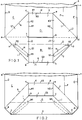
- the sack embodying the invention is a two-sided sack, made accordingly from a two-sided paper tube A, one side B of which (the "face”, see Fig. 4) is joined directly to the other side C thereof (the "reverse side” or “seamed side", see Figs. 1 - 3) along two side edge folds D and E.
- Figs. 1 - 3 show the seam F of the reverse, or seamed, side C.
- the paper tube A is actually double walled, that is, formed by two separate paper tubes, one slightly smaller than, and inside, the other, but these two separate tubes are not shown as such.
- the drawings depict the double-walled tube A as if it were a single-walled tube.
- the bottom of the tube A is cut straight across with a "flush” cut, that is, with the bottom edges of the inner and outer tubes flush with each other and with the bottom edge G of the face B flush with the bottom edge H of the reverse side C.
- Conventional paper sack-making machinery (not shown) is used to open-out and fold the paper tube A into the conventional, intermediate form shown in Fig. 1, with two mutually identical, trapezium-shaped flaps J and K.
- the trapezium-shaped flap J is formed (wholly out of a part of the face B) by a trapezium-shaped panel J1, the edges of which extend between points a-b-c-d-g-h-a, and two halves J2 and J3 (those extending between points a-b-h-a and between points d-c-g-d) of two respective triangular panels L1 and L2, defined by points a-b-h-f-a and by points d-c-g-e-d respectively.
- the trapezium-shaped flap K is formed (wholly out of a part of the reverse side C) by a trapezium-shaped panel K1, the edges of which extend between points a-f-e-d-g-h-a, and two halves K2 and K3 (those extending between points a-f-h-a and between points d-e-g-d) of the aforesaid two respective triangular panels L1 and L2.
- the bases a-h-g-d of the two trapezium-shaped flaps J, K are closely adjacent each other.
- panels L1 and L2 adjoin panel J1 along 45° folds i and j respectively and adjoin panel K1 along corresponding 45° folds k and I respectively.
- the top of the tube A is shown in Figs. 1 and 2 as torn off from point m on side edge fold D to point n on side edge fold E. In Figs. 3 and 4 somewhat more is shown torn off between corresponding points m' and n'.
- the two flaps J and K are mutually co-planar and could, unless inhibited, be pivoted about an axis a-h-g-d relative to the part of the tube A that extends up to points m and n from the aforesaid axis a-h-g-d.
- no such pivoting has any chance of occurring in the sack-making machinery as the sack tube proceeds through the successive folding steps described herein.
- edge portions G1-3, H1-3 border a rectangular area, defined by points b-c-g-e-f-h-b, which is actually an inside surface portion Bi of face B and an inside surface portion Ci of reverse side C and is in close contact with the flour when the sack is used; no adhesive must contact the flour, as mentioned earlier.
- the next step is to fold flap J upwardly on fold O, as shown in Fig. 2.
- This brings adhesive strips L and M into effective adhering contact with those parts of triangular panels L1 and L2 which are on the far side of fold O.
- Bottom edge portion G3 is thereby brought closer to bottom edge portion H3, an aperture P being defined by the rectangle defined by points b-c-e-f-b.
- next fold line Q is below bottom edge portion G3 but above points a and d as seen in Fig. 2. It will be observed that the inner ends M1, N1 of adhesive strips M and N project slightly across the fold line Q.
- Figs. 3 and 4 illustrate the sack preform, if it may be called that by this stage, after the flaps J and K have been folded downwardly on fold Q and after a rectangular, fully pasted (i.e. adhesive-coated) paper sheet, or "end label", R has been applied over flap K.
- the 45° folds i and k cross over at point q, whilst the 45° folds j and 1 cross over similarly at point r.
- points a, q, r and d are in alignment with each other.
- the label R is made to have a length q-r (that is, equal to the distance between points q and r) and a width equal to the distance between fold Q and edge portion H3, and is positioned accordingly to just touch points q and r and to be flush with fold Q and edge portion H3.
- the fold Q is in the opposite direction to the fold 0.
- Fig. 4 shows edge portions of flap K and label R projecting just below fold O.
- the only exposed adhesive is on side edge portions R1 and R2 of label R, projecting to the sides of flap K. There is no adhesive on flap K.
- the final step in forming the pasted bottom on the sack is to fold these projecting edge portions around fold O and stick down the side edge label portions R1 and R2.
- Fig. 4 shows the final positions thereof in chain-dot lines, immediately above fold O. Given that the only adhesive is on portions R1, R2, it will be appreciated that a gap exists, or can be easily opened up, along edge portion H3 between points e and f, as shown at S, where one can insert one's hand and pull the edge portions open again to the state shown in full lines in Figs. 3 and 4, allowing the flour to be poured out of outlet aperture P.
- the paper tube A from which the sack is made, is double-walled, so that the sack is also double-walled, the invention may be embodied in a single-walled paper sack or even a paper sack having three, or more, walls.
Landscapes
- Engineering & Computer Science (AREA)
- Mechanical Engineering (AREA)
- Bag Frames (AREA)
Applications Claiming Priority (2)
| Application Number | Priority Date | Filing Date | Title |
|---|---|---|---|
| GB9305556A GB2276141B (en) | 1993-03-18 | 1993-03-18 | Paper sacks |
| GB9305556 | 1993-03-18 |
Publications (1)
| Publication Number | Publication Date |
|---|---|
| EP0618145A1 true EP0618145A1 (de) | 1994-10-05 |
Family
ID=10732265
Family Applications (1)
| Application Number | Title | Priority Date | Filing Date |
|---|---|---|---|
| EP94301924A Withdrawn EP0618145A1 (de) | 1993-03-18 | 1994-03-17 | Papiersäcke |
Country Status (2)
| Country | Link |
|---|---|
| EP (1) | EP0618145A1 (de) |
| GB (1) | GB2276141B (de) |
Citations (2)
| Publication number | Priority date | Publication date | Assignee | Title |
|---|---|---|---|---|
| GB880250A (en) * | 1959-08-17 | 1961-10-18 | Paper Sacks Ltd | Improvements in and relating to multi-ply paper bags or sacks |
| FR2228680A1 (de) * | 1973-05-10 | 1974-12-06 | Windmoeller & Hoelscher |
-
1993
- 1993-03-18 GB GB9305556A patent/GB2276141B/en not_active Expired - Fee Related
-
1994
- 1994-03-17 EP EP94301924A patent/EP0618145A1/de not_active Withdrawn
Patent Citations (2)
| Publication number | Priority date | Publication date | Assignee | Title |
|---|---|---|---|---|
| GB880250A (en) * | 1959-08-17 | 1961-10-18 | Paper Sacks Ltd | Improvements in and relating to multi-ply paper bags or sacks |
| FR2228680A1 (de) * | 1973-05-10 | 1974-12-06 | Windmoeller & Hoelscher |
Also Published As
| Publication number | Publication date |
|---|---|
| GB9305556D0 (en) | 1993-05-05 |
| GB2276141A (en) | 1994-09-21 |
| GB2276141B (en) | 1996-07-31 |
Similar Documents
| Publication | Publication Date | Title |
|---|---|---|
| US5392589A (en) | Method of constructing a container with unitary spout pull tab | |
| US4953708A (en) | Flexible package with pour spout and handle | |
| US5505374A (en) | Flip-top reclosable carton and method of making the same | |
| US4480752A (en) | Pinch closure bags with opening feature and method of manufacturing them | |
| US4196030A (en) | Method of making extruded construction for bags | |
| JP3068851B2 (ja) | 再閉鎖可能な粒体用板紙箱 | |
| US2836343A (en) | Tear strip means for opening cartons and the like | |
| US4691858A (en) | Milk carton blank and milk carton with pour spout | |
| US20100142858A1 (en) | Plastic bag with pour spout and slide closure | |
| US2903175A (en) | Folding box | |
| US5163756A (en) | Bag construction with auxiliary flap | |
| US5678755A (en) | Paperboard carton having a pour spout and blank for forming the same | |
| CA2522517A1 (en) | Package having reclosable pour spout and method of forming same | |
| MX2010011301A (es) | Estructuras de bolsa y metodos para ensamblar la misma. | |
| US3561669A (en) | Composite leakproof carton | |
| US3478868A (en) | Sterilizable containers | |
| US4989735A (en) | Dispensing carton | |
| AU2002360132A1 (en) | Resealable flexible package | |
| US5680986A (en) | Carton with pour spout formed by liner | |
| US4674129A (en) | Packaging bag with selectively secured reinforcing layer | |
| CA1171823A (en) | Easy open carton | |
| US4301925A (en) | Bag with opening and reclosing feature | |
| JPS60158039A (ja) | 保護シール及び開封ストリップを有する容器及び該容器のための素材 | |
| GB2045723A (en) | Sealed-end carton with reclosable pouring opening | |
| US12415650B2 (en) | Folded laminate blank and a pack formed therefrom |
Legal Events
| Date | Code | Title | Description |
|---|---|---|---|
| PUAI | Public reference made under article 153(3) epc to a published international application that has entered the european phase |
Free format text: ORIGINAL CODE: 0009012 |
|
| AK | Designated contracting states |
Kind code of ref document: A1 Designated state(s): DE FR GB IT SE |
|
| STAA | Information on the status of an ep patent application or granted ep patent |
Free format text: STATUS: THE APPLICATION IS DEEMED TO BE WITHDRAWN |
|
| 18D | Application deemed to be withdrawn |
Effective date: 19950406 |