EP0618304A1 - Nitrierter nichtrostender Stahl - Google Patents
Nitrierter nichtrostender Stahl Download PDFInfo
- Publication number
- EP0618304A1 EP0618304A1 EP93302930A EP93302930A EP0618304A1 EP 0618304 A1 EP0618304 A1 EP 0618304A1 EP 93302930 A EP93302930 A EP 93302930A EP 93302930 A EP93302930 A EP 93302930A EP 0618304 A1 EP0618304 A1 EP 0618304A1
- Authority
- EP
- European Patent Office
- Prior art keywords
- stainless steel
- nitrided
- layer
- nitriding
- atoms
- Prior art date
- Legal status (The legal status is an assumption and is not a legal conclusion. Google has not performed a legal analysis and makes no representation as to the accuracy of the status listed.)
- Granted
Links
- 229910001220 stainless steel Inorganic materials 0.000 title claims abstract description 50
- 239000010935 stainless steel Substances 0.000 title claims abstract description 50
- 239000010410 layer Substances 0.000 claims abstract description 67
- 229910000963 austenitic stainless steel Inorganic materials 0.000 claims abstract description 33
- 125000004433 nitrogen atom Chemical group N* 0.000 claims abstract description 32
- -1 chrome nitride Chemical class 0.000 claims abstract description 26
- 239000002344 surface layer Substances 0.000 claims abstract description 14
- VYZAMTAEIAYCRO-UHFFFAOYSA-N Chromium Chemical compound [Cr] VYZAMTAEIAYCRO-UHFFFAOYSA-N 0.000 claims description 25
- ZOKXTWBITQBERF-UHFFFAOYSA-N Molybdenum Chemical compound [Mo] ZOKXTWBITQBERF-UHFFFAOYSA-N 0.000 claims description 5
- 229910052750 molybdenum Inorganic materials 0.000 claims description 5
- 239000011733 molybdenum Substances 0.000 claims description 5
- 238000005260 corrosion Methods 0.000 abstract description 37
- 230000008021 deposition Effects 0.000 abstract description 9
- 230000008859 change Effects 0.000 abstract description 5
- 230000003746 surface roughness Effects 0.000 abstract description 5
- 238000007730 finishing process Methods 0.000 abstract description 2
- 238000005121 nitriding Methods 0.000 description 53
- 238000011282 treatment Methods 0.000 description 38
- 230000007797 corrosion Effects 0.000 description 31
- 239000007789 gas Substances 0.000 description 30
- PXHVJJICTQNCMI-UHFFFAOYSA-N Nickel Chemical compound [Ni] PXHVJJICTQNCMI-UHFFFAOYSA-N 0.000 description 20
- 238000000034 method Methods 0.000 description 19
- 230000000052 comparative effect Effects 0.000 description 18
- 238000010306 acid treatment Methods 0.000 description 16
- 239000002253 acid Substances 0.000 description 15
- 239000000463 material Substances 0.000 description 13
- KRHYYFGTRYWZRS-UHFFFAOYSA-M Fluoride anion Chemical compound [F-] KRHYYFGTRYWZRS-UHFFFAOYSA-M 0.000 description 10
- 229910052759 nickel Inorganic materials 0.000 description 10
- 238000000151 deposition Methods 0.000 description 9
- 238000002441 X-ray diffraction Methods 0.000 description 8
- GRYLNZFGIOXLOG-UHFFFAOYSA-N Nitric acid Chemical compound O[N+]([O-])=O GRYLNZFGIOXLOG-UHFFFAOYSA-N 0.000 description 7
- 125000004429 atom Chemical group 0.000 description 7
- 229910017604 nitric acid Inorganic materials 0.000 description 7
- 239000000523 sample Substances 0.000 description 7
- 239000007788 liquid Substances 0.000 description 6
- 230000035515 penetration Effects 0.000 description 5
- 238000004458 analytical method Methods 0.000 description 4
- 230000007423 decrease Effects 0.000 description 4
- 238000010438 heat treatment Methods 0.000 description 4
- 230000035699 permeability Effects 0.000 description 4
- 239000007787 solid Substances 0.000 description 4
- JEIPFZHSYJVQDO-UHFFFAOYSA-N iron(III) oxide Inorganic materials O=[Fe]O[Fe]=O JEIPFZHSYJVQDO-UHFFFAOYSA-N 0.000 description 3
- 238000005259 measurement Methods 0.000 description 3
- 238000007747 plating Methods 0.000 description 3
- 238000012545 processing Methods 0.000 description 3
- 238000004833 X-ray photoelectron spectroscopy Methods 0.000 description 2
- 230000006866 deterioration Effects 0.000 description 2
- 230000002542 deteriorative effect Effects 0.000 description 2
- 238000003682 fluorination reaction Methods 0.000 description 2
- 150000002222 fluorine compounds Chemical class 0.000 description 2
- 239000011261 inert gas Substances 0.000 description 2
- 229910001105 martensitic stainless steel Inorganic materials 0.000 description 2
- 238000010791 quenching Methods 0.000 description 2
- 230000000171 quenching effect Effects 0.000 description 2
- 150000003839 salts Chemical class 0.000 description 2
- 239000000126 substance Substances 0.000 description 2
- 238000012360 testing method Methods 0.000 description 2
- OKTJSMMVPCPJKN-UHFFFAOYSA-N Carbon Chemical compound [C] OKTJSMMVPCPJKN-UHFFFAOYSA-N 0.000 description 1
- XPDWGBQVDMORPB-UHFFFAOYSA-N Fluoroform Chemical compound FC(F)F XPDWGBQVDMORPB-UHFFFAOYSA-N 0.000 description 1
- 229910003296 Ni-Mo Inorganic materials 0.000 description 1
- 241000221535 Pucciniales Species 0.000 description 1
- 229910004014 SiF4 Inorganic materials 0.000 description 1
- 150000007513 acids Chemical class 0.000 description 1
- 230000015572 biosynthetic process Effects 0.000 description 1
- 229910052799 carbon Inorganic materials 0.000 description 1
- 238000004140 cleaning Methods 0.000 description 1
- 238000010273 cold forging Methods 0.000 description 1
- 150000001875 compounds Chemical class 0.000 description 1
- 230000007547 defect Effects 0.000 description 1
- 230000007812 deficiency Effects 0.000 description 1
- 238000009792 diffusion process Methods 0.000 description 1
- 238000007598 dipping method Methods 0.000 description 1
- 230000000694 effects Effects 0.000 description 1
- WMIYKQLTONQJES-UHFFFAOYSA-N hexafluoroethane Chemical compound FC(F)(F)C(F)(F)F WMIYKQLTONQJES-UHFFFAOYSA-N 0.000 description 1
- 230000006872 improvement Effects 0.000 description 1
- 239000004615 ingredient Substances 0.000 description 1
- XEEYBQQBJWHFJM-UHFFFAOYSA-N iron Substances [Fe] XEEYBQQBJWHFJM-UHFFFAOYSA-N 0.000 description 1
- 229910001337 iron nitride Inorganic materials 0.000 description 1
- 230000005389 magnetism Effects 0.000 description 1
- 238000004519 manufacturing process Methods 0.000 description 1
- 230000007246 mechanism Effects 0.000 description 1
- 239000000203 mixture Substances 0.000 description 1
- 150000004767 nitrides Chemical class 0.000 description 1
- 230000008520 organization Effects 0.000 description 1
- 230000000149 penetrating effect Effects 0.000 description 1
- 230000010287 polarization Effects 0.000 description 1
- 238000005498 polishing Methods 0.000 description 1
- 239000002994 raw material Substances 0.000 description 1
- 238000011160 research Methods 0.000 description 1
- ABTOQLMXBSRXSM-UHFFFAOYSA-N silicon tetrafluoride Chemical compound F[Si](F)(F)F ABTOQLMXBSRXSM-UHFFFAOYSA-N 0.000 description 1
- 239000002356 single layer Substances 0.000 description 1
- 239000006104 solid solution Substances 0.000 description 1
- 239000007921 spray Substances 0.000 description 1
- 238000009628 steelmaking Methods 0.000 description 1
- 238000005482 strain hardening Methods 0.000 description 1
- SFZCNBIFKDRMGX-UHFFFAOYSA-N sulfur hexafluoride Chemical compound FS(F)(F)(F)(F)F SFZCNBIFKDRMGX-UHFFFAOYSA-N 0.000 description 1
- NXHILIPIEUBEPD-UHFFFAOYSA-H tungsten hexafluoride Chemical compound F[W](F)(F)(F)(F)F NXHILIPIEUBEPD-UHFFFAOYSA-H 0.000 description 1
- XLYOFNOQVPJJNP-UHFFFAOYSA-N water Substances O XLYOFNOQVPJJNP-UHFFFAOYSA-N 0.000 description 1
Images




Classifications
-
- C—CHEMISTRY; METALLURGY
- C23—COATING METALLIC MATERIAL; COATING MATERIAL WITH METALLIC MATERIAL; CHEMICAL SURFACE TREATMENT; DIFFUSION TREATMENT OF METALLIC MATERIAL; COATING BY VACUUM EVAPORATION, BY SPUTTERING, BY ION IMPLANTATION OR BY CHEMICAL VAPOUR DEPOSITION, IN GENERAL; INHIBITING CORROSION OF METALLIC MATERIAL OR INCRUSTATION IN GENERAL
- C23C—COATING METALLIC MATERIAL; COATING MATERIAL WITH METALLIC MATERIAL; SURFACE TREATMENT OF METALLIC MATERIAL BY DIFFUSION INTO THE SURFACE, BY CHEMICAL CONVERSION OR SUBSTITUTION; COATING BY VACUUM EVAPORATION, BY SPUTTERING, BY ION IMPLANTATION OR BY CHEMICAL VAPOUR DEPOSITION, IN GENERAL
- C23C8/00—Solid state diffusion of only non-metal elements into metallic material surfaces; Chemical surface treatment of metallic material by reaction of the surface with a reactive gas, leaving reaction products of surface material in the coating, e.g. conversion coatings, passivation of metals
- C23C8/06—Solid state diffusion of only non-metal elements into metallic material surfaces; Chemical surface treatment of metallic material by reaction of the surface with a reactive gas, leaving reaction products of surface material in the coating, e.g. conversion coatings, passivation of metals using gases
- C23C8/08—Solid state diffusion of only non-metal elements into metallic material surfaces; Chemical surface treatment of metallic material by reaction of the surface with a reactive gas, leaving reaction products of surface material in the coating, e.g. conversion coatings, passivation of metals using gases only one element being applied
- C23C8/24—Nitriding
- C23C8/26—Nitriding of ferrous surfaces
Definitions
- This invention relates to nitrided stainless steel products superior both in anti-corrosion property and surface hardness.
- austenitic stainless steel products such as screws have been widely employed because of their superiority in not only corrosion resistance, but also toughness, workability, heat resistance and non-magnetic property and the like.
- austenitic stainless steel products have excellent anti-corrosion property, as mentioned above, they do not have quenching hardenability so that they are not suitable for such usage as requires high surface hardness.
- Nitriding temperature is usually set around 550 to 570 °C, and around 480°C at the lowest in these nitriding treatments.
- the base material of stainless steel products of the present invention comprises austenitic stainless steel wherein a portion of the surface layer at least is composed of a nitrided hard layer being in accord with the following (A) and (B):
- the nitrided hard layer contains 2 to 5% N by weight N atoms.
- N atoms can penetrate the base phase ( ⁇ phase) of austenitic stainless steel without depositing solid soluble chrome nitride (CrN) or iron nitride and then that corrosion resistance does not deteriorate by limiting the amount of the above penetration (amount of content) within 2 to 12%, and further a nitrided hard layer having superior surface hardness can be formed by the above penetration of N atoms.
- stainless steel product of the present invention contains substantially no crystalline chrome nitride as the above mentioned and that the amount of N atoms contained in the austenitic stainless steel phase can be identified by ESCA (Electron Spectroscopy for Chemical Analysis) or EPMA (Electron Probe Micro Analyzer).
- ESCA Electrode Spectroscopy for Chemical Analysis
- EPMA Electro Probe Micro Analyzer
- Nitrided stainless steel products of the present invention can be obtained by nitriding austenitic stainless steel itself as a raw material, or nitriding an austenitic stainless steel product which is formed into a defined shape.
- austenitic stainless steel materials a variety of austenitic stainless steel varied in elements and ingredients can be available in accordance with the characteristic required such as corrosion resistance, processing hardenability, heat resistance, machinability, non-magnetic property and the like, based upon 18-8 austenitic stainless steel as mentioned above.
- Cr-Ni-Mo austenitic stainless steel containing not less than 22% chrome is suitable.
- austenitic stainless steel having chrome less than 22% but molybdenum not less than 1.5% is suitable.
- the nitriding treatment for the above austenitic stainless steel or its formed products (these are called as stainless steel products) is performed in the following method. That is, prior to nitriding treatment, fluoriding treatment is performed to promote the penetration of N atoms in nitriding treatment.
- fluoride-containing gases to fluoride fluorine compound gas such as NF3, BF3, CF4, HF, SF6, C2F6, WF6, CHF3, or SiF4 are used independently or in combination.
- fluorine compound gas with F in its molecule can be used as the above-mentioned fluorine- or fluoride-containing gas.
- This fluorine- or fluoride-containing gas can be used independently, but generally is diluted by inert gas such as N2 gas for the treatment.
- concentration of the fluorine- or fluoride-containing gas itself in such a diluted gas should amount to, for example, 10,000 to 100,000ppm, preferably 20,000 to 70,000ppm, more preferably 30,000 to 50,000ppm.
- NF3 is the best among the above compound gases. This is because NF3 has chemical stability and is easy to treat since it is in a state of gas at normal temperature.
- a fluorine- or fluoride-containing gas atmosphere is prepared at the above-mentioned concentration, wherein the above stainless steel product is held in a heated condition.
- stainless steel product itself is heated up to the temperature of 300 to 550 °C.
- the holding time of the above-mentioned stainless steel product in a fluorine- or fluoride-containing gas atmosphere may appropriately be selected depending on geometry, dimension and the like, generally within the range of ten or so minutes to several hours or scores of minutes.
- Such a fluoriding treatment allows "N" atoms to penetrate into the surface layer of stainless steel products. Though its mechanism has not been proven at present yet, it can be understood as follows on the whole.
- a passive layer coat is formed, which inhibits penetration or diffusion of N atoms as a function of nitriding, on the surface of the above stainless steel product. Therefore, according to the prior method, N atoms could not penetrate thereto due to the presence of passive layer coat (oxidized layer) unless temperature for nitriding treatment is set at high temperature. As a result, crystalline chrome nitride is deposited in the surface hard layer.
- fluoriding treatment is performed under fluorine- or fluoride- containing gas atmosphere prior to the nitriding treatment in the present invention.
- the passive coat layer Upon holding the stainless steel product having an oxidized layer in a fluorine- or fluoride-containing gas atmosphere like the above with heating, the passive coat layer is converted to a fluorinated layer. Since "N" atoms for nitrization penetrate more readily into the fluorinated layer than into the passive coat layer, the surface of the above stainless steel product is formed on the suitable condition for penetration of "N" atoms by the above-mentioned fluorination.
- nitriding gas composing a nitriding atmosphere is a simple gas composed of NH3 only, or a mixed gas (for example, NH3, CO and CO2) composed of carbon source gas (for example, RX gas) with a mixed gas composed of NH3 .
- a mixed gas for example, NH3, CO and CO2
- carbon source gas for example, RX gas
- the above-mentioned simple gas or gas mixture is used by mixing an inert gas such as N2.
- H2 gas is further added to those gases .
- the above-mentioned fluorinated stainless steel product is held with heating.
- a heating condition is set at a temperature not more than 450 °C, which is greatly lower than that in the prior method.
- the preferable temperature is between 370 and 420°C.
- crystalline CrN is formed in a nitrided hard layer and concentration of active chrome in the base phase decreases, and then as a result anti-corrosion property of stainless steel deteriorates.
- nitriding treatment at not more than 420°C is preferable because superior anti-corrosion property is realized as same degree as that of austenitic stainless steel itself and also, a nitrided hard layer greatly superior in hardness can be formed on the surface of stainless steel products.
- nitriding treatment at not more than 370 °C only realizes a nitrided hard layer not more than 10 ⁇ m in depth, even if nitriding treatment time is set at 24 hours, which is of little industrial value and not practical.
- the above nitriding treatment time is set within the range of 10 to 20 hours.
- nitriding treatment a close nitriding layer of about 20 to 40 ⁇ m, (consisting of entirely single layer) is formed uniformly on the surface of the above-mentioned stainless steel product.
- dimensional change and surface roughness are hardly caused on austenitic stainless steel products. That is, in the prior method, the frame of a stainless steel product may be expanded and then dimensional change may be caused due to deposition of crystalline chrome nitride and the like, and also surface roughness may be deteriorated so that it requires a great amount of cost for final finishing, and furthermore, it is difficult for the technique to be applied to precision machines.
- the nitrided hard layer in the present invention contains substantially no crystalline chrome nitride and is composed of close organization, so that dimensional change or deterioration of surface roughness may not be caused and as a result it does not require the final processing for finishing.
- the crystalline chrome nitride is not contained in this nitrided hard layer while "N" atoms is contained in austenitic phase of base phase ( ⁇ phase) at the rate of 2 to 12%. Therefore, the stainless steel products in which the nitriding treatment is given (that is to say, the nitrided stainless steel products) has corrosion resistance property as high as the austenitic stainless steel in which the nitriding treatment is not given and furthermore, the surface hardness is greatly improved thanks to the presence of the above nitrided hard layer. The superior the corrosion resistance property of such nitrided stainless steel products is, the lower the processing hardness is or the more precisely the surface condition before being nitrided is polished.
- the nitrided stainless steel products obtained in the above method have corrosion resistance property as same as the austenitic stainless steel before being nitrided, besides the surface hardness is greatly improved and still moreover it becomes non-magnetic.
- the non-magnetic property is deteriorated, which originally belongs to austenitic stainless steel itself, by deposition of crystalline chrome nitride and then the nitrided hard layer takes on the character of magnetic property.
- the nitrided hard layer in the present invention contains substantially no crystalline chrome nitride, the non-magnetic property is maintained. Therefore, it is suitable for the usage which requires non-magnetic property such as products in relation to computer.
- an oxidized layer may be caused on the surface of nitrided stainless steel products by the above nitriding treatment.
- the corrosion resistance of the nitrided hard layer deteriorates due to the presence of the oxidized scale. Therefore, the oxidized layer can be removed by the above strong mixed acid treatment and prevents the corrosion resistance property from deteriorating.
- the corrosion resistance property of austenitic stainless steel is caused by the production of a passive layer (an oxidized layer) based upon the solid solution chrome in the base phase.
- the passive layer is produced at the early stage and also strengthened by the above strong mixed acid treatment so that the improvement of corrosion resistance can be seen.
- strong mixed acids mixed acid containing HNO3 such as mixed acid composed of HNO3-HF, mixed acid composed of HNO3-HCl or the like can be applied.
- the concentration of HNO3 of these strong mixed acid should be set at 10 to 20%, 1 to 10% for HF, and 5 to 25% for HCl. Water accounts for the remaining part of strong mixed acid.
- the above treatment should be performed by dipping the stainless steel products in the above strong mixed acid liquid for 20 to 60 minutes with controlling the liquid temperature of strong mixed acid within 20 to 50°C.
- the top surface layer occupying 20 to 30% of total nitrided layer is removed by such a strong mixed acid treatment, the surface hardness of remaining parts is still high, wherein the adequate rigidity is maintained. In this case, the nitrided hard layer remained becomes a complete non-magnetic substance by removing the top surface phase. Even though the nitrided hard layer of the top surface layer may have slight magnetic property according to the case, stainless steel products come to show magnetic permeability as same as austenitic stainless steel (base material) because the top surface layer having magnetic property can be removed by the above strong mixed acid treatment.
- the above top surface layer may rust more or less compared with the other parts.
- the internal layer wherein N atoms is relatively few (N atoms: 2 to 5 %), appears to the outside by removing the top surface layer.
- This layer has adequate hardness, which is only slightly lower than the above top surface layer, and furthermore, has less rusting characteristic. Therefore, it is suitable for such usage as requires sufficient hardness and complete anti-rust property.
- nitriding gas (NH3 25vol% + N2 60vol% + CO 5vol% + CO2 5vol%) was introduced into the furnace and the inside of the furnace was maintained at 410°C for 24 hours for nitriding and was withdrawn.
- SUS304 plate hardening was Hv of 880
- SUS316 plate hardening was Hv of 1050
- SUS310 plate was Hv of 1120.
- SUS304 plate was 18 ⁇ m
- SUS316 plate was 20 ⁇ m
- SUS310 plate was 18 ⁇ m.
- the temperature for nitriding of EXAMPLE 1 was changed to 440°C and the treatment time was changed to 12 hours.
- the other conditions were the same as EXAMPLE 1.
- the each surface hardness for all three was not less than Hv of 1100 and each thickness was 23 ⁇ m for SUS304 plate, 25 ⁇ m for SUS316 plate and 20 ⁇ m for SUS310 plate respectively.
- the temperature for nitriding of EXAMPLE 1 was changed to 380°C and the treatment time was changed to 15 hours.
- the other conditions were the same as EXAMPLE 1.
- the each surface hardness for all three was not less than Hv of 950 and the each thickness was 15 ⁇ m for SUS304 plate, 15 ⁇ m for SUS316 plate and 12 ⁇ m for SUS310 plate respectively.
- Each plate was fluorided at 400°C and then charged into the same muffle as used in EXAMPLE 1 by using the same gas for nitriding as EXAMPLE 1, and then was nitrided at 550°C for 5 hours and finally withdrawn.
- Each surface hardness was Hv of 1280, Hv of 1280 and Hv of 1300 respectively in order, meanwhile each thickness of hard layer was 30 to 35 ⁇ m.
- samples obtained by the above EXAMPLE 1 to 3 were dipped into strong mixed acid liquid containing 5%HF-18%HNO3 for 60 minutes and then withdrawn for checking.
- the top surface layer (3 to 6 ⁇ m) in the nitrided hard layer of each sample was removed.
- COMPARATIVE EXAMPLE 1 the same treatment was performed. As a result, a total nitrided hard layer was removed.
- Fig. 3 EXAMPLE 1
- Fig. 4 COMPARATIVE EXAMPLE 1
- curve (I) represents an X-ray diffraction method of EXAMPLE 1
- curve (II) an X-ray diffraction method of SUS316 (SUS316 materials without nitriding treatment)
- curve (III) an X-ray diffraction method of COMPARATIVE EXAMPLE 1.
- ⁇ n represents ⁇ phase (base phase) containing N atoms by nitriding.
- curve (I) and (II) In comparison of curve (I) and (II), ⁇ n phase (base phase) of curve (I) is slipped against the left side (low angle side) of ⁇ -Fe phase (base phase) of corresponding curve (II), wherein lattice is distorted by an increase of lattice constant, so that surface hardness in samples of EXAMPLES can be improved.
- curve (III) of COMPARATIVE EXAMPLES plenty of crystalline chrome nitride peaks such as CrN can be seen, which decreases corrosion resistance of this nitrided layer.
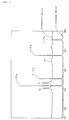
- each sample of EXAMPLE 1 and COMPARATIVE EXAMPLE 1 (each of them is SUS316 without acid treatment) obtained in the above method was given anodic polarization test (in accordance with JIS G 0579). The results are shown in Fig. 5.
- Socket screws (M6) formed by cold forging from each wire rod made of SUS304 (chrome: 18%, nickel: 9%), SUS316 (Chrome: 18%, nickel: 12%, molybdenum: 2.5%), SUS310 (chrome: 25%, nickel: 20%) and a hardened SUS309 material (chrome: 22%, nickel: 12%) by work hardening were subjected to fluoriding and nitriding treatment under the same procedure and conditions as same as EXAMPLE 1.
- Each surface hardness of nitrided samples was Hv of 1100 to 1150 and the depth of the whole nitrided hard layer was 18 to 20 ⁇ m. Next, these were subjected to shot blast so as to remove the oxidized scale attached thereon and then subjected to SST examination. Each rusted within 72 hours.
- Non-magnetic stainless steel bar (chrome: 18%, nickel: 12%, Mn: 1.5%), to which a small amount of N atoms were added by steel-making process, and SUS316 bar were fluorided and nitrided in the same procedure and conditions as EXAMPLE 1.
- SUS316 bar were fluorided and nitrided in the same procedure and conditions as EXAMPLE 1.
- nitrided articles obtained was dipped into strong mixed acid liquid of 10%HF-15%HNO3 at the temperature of 40°C for 30 minutes and finally withdrawn.
- each magnetic permeability ( ⁇ ) of these was measured. It is found out that each of them does not have magnetism by nitriding treatment as follows: Non-magnetic stainless bar SUS316 bar magnetic permeability ( ⁇ ) surface hardness (Hv) magnetic permeability ( ⁇ ) surface hardness (Hv) before nitriding 1.001 480 1.002 240 after nitriding 1.015 1210 1.050 1120 after acid cleaning 1.001 990 1.002 920
- nitrided stainless steel product in the present invention contains substantially no crystalline chrome nitride in the nitrided hard layer forming the surface layer
- solid soluble chrome in austenitic stainless steel (base phase) is not consumed by deposition of crystalline chrome nitride, compared with nitrided stainless steel products containing crystalline chrome nitride in its nitrided hard layer. Therefore, passive layer coat (oxidized coat), which is formed by the function of crystalline chrome in the base phase, can be produced enough, so that it becomes to have excellent corrosion property as same as that of the above base phase.
- stainless steel products in the present invention can have the same excellent hardness as those formed by nitrided hard layer made of crystalline chrome nitride because said stainless steel products contain N atoms at 2 to 12% in the base phase of the surface layer, which has penetrated thereto.
Landscapes
- Chemical & Material Sciences (AREA)
- Chemical Kinetics & Catalysis (AREA)
- Engineering & Computer Science (AREA)
- Materials Engineering (AREA)
- Mechanical Engineering (AREA)
- Metallurgy (AREA)
- Organic Chemistry (AREA)
- Solid-Phase Diffusion Into Metallic Material Surfaces (AREA)
- Catalysts (AREA)
- Organic Low-Molecular-Weight Compounds And Preparation Thereof (AREA)
- Glass Compositions (AREA)
- Chemical Vapour Deposition (AREA)
Applications Claiming Priority (2)
| Application Number | Priority Date | Filing Date | Title |
|---|---|---|---|
| JP40234/93 | 1993-03-01 | ||
| JP04023493A JP3174422B2 (ja) | 1993-03-01 | 1993-03-01 | ステンレス窒化品 |
Publications (2)
| Publication Number | Publication Date |
|---|---|
| EP0618304A1 true EP0618304A1 (de) | 1994-10-05 |
| EP0618304B1 EP0618304B1 (de) | 1999-02-24 |
Family
ID=12575038
Family Applications (1)
| Application Number | Title | Priority Date | Filing Date |
|---|---|---|---|
| EP93302930A Revoked EP0618304B1 (de) | 1993-03-01 | 1993-04-15 | Nitrierter nichtrostender Stahl |
Country Status (6)
| Country | Link |
|---|---|
| EP (1) | EP0618304B1 (de) |
| JP (1) | JP3174422B2 (de) |
| CN (1) | CN1039353C (de) |
| AT (1) | ATE176933T1 (de) |
| DE (1) | DE69323617T2 (de) |
| TW (1) | TW231313B (de) |
Families Citing this family (14)
| Publication number | Priority date | Publication date | Assignee | Title |
|---|---|---|---|---|
| JP3396336B2 (ja) * | 1995-05-23 | 2003-04-14 | エア・ウォーター株式会社 | 鋼材の窒化方法 |
| JP2005281731A (ja) * | 2004-03-26 | 2005-10-13 | Sony Corp | オーステナイト系ステンレス鋼の製造方法、はんだ溶解槽及び自動はんだ付け装置 |
| CN100350069C (zh) * | 2004-06-16 | 2007-11-21 | 哈尔滨汽轮机厂有限责任公司 | 汽轮机、燃汽轮机不锈钢类零件的氮化方法 |
| JP5217244B2 (ja) * | 2007-05-22 | 2013-06-19 | 日産自動車株式会社 | 非水系二次電池 |
| KR100902169B1 (ko) * | 2007-07-24 | 2009-06-10 | 쳉-시엔 리우 | 마르텐사이트계 스테인레스 표면경도 강화방법 |
| CN101649441B (zh) * | 2008-08-12 | 2011-07-27 | 贵州红林机械有限公司 | 奥氏体不锈钢材料的渗氮工艺方法 |
| KR20110104631A (ko) * | 2010-03-17 | 2011-09-23 | 동아대학교 산학협력단 | 고내식성 및 고경도 컬러 오스테나이트계 스테인리스강재 및 그 제조방법 |
| CN103952660B (zh) * | 2014-05-16 | 2017-04-12 | 中国科学院宁波材料技术与工程研究所 | 具有氮化物膜的复合材料及其制法和应用 |
| JP6543962B2 (ja) * | 2015-03-02 | 2019-07-17 | 日本製鉄株式会社 | オーステナイト系ステンレス鋼板とその製造方法 |
| JP6516238B2 (ja) * | 2015-03-30 | 2019-05-22 | 日鉄ステンレス株式会社 | オーステナイト系ステンレス鋼及びその製造法 |
| CN107557723A (zh) * | 2017-08-04 | 2018-01-09 | 上海德舒赫金属制品有限公司 | 提高模具钢抗疲劳能力的处理方法 |
| KR102922098B1 (ko) * | 2019-12-06 | 2026-02-03 | 스웨이지락 캄파니 | 자가-부동태화 금속의 화학적 활성화 |
| CN112831639B (zh) * | 2020-12-31 | 2022-11-11 | 武汉科技大学 | 一种屈服强度≥700MPa奥氏体不锈钢的生产方法 |
| CN117721393A (zh) * | 2023-10-31 | 2024-03-19 | 北京酷捷科技有限公司 | 一种氟化不锈钢复合材料及其制备方法和应用 |
Citations (3)
| Publication number | Priority date | Publication date | Assignee | Title |
|---|---|---|---|---|
| EP0408168A1 (de) * | 1989-07-10 | 1991-01-16 | Daidousanso Co., Ltd. | Verfahren zur Vorbehandlung von metallischen Werkstücken und zur Nitrierhärtung von Stahl |
| EP0511409A1 (de) * | 1990-11-20 | 1992-11-04 | Daido Hoxan Inc. | Herstellung von einer rotierenden motorwelle |
| EP0515701A1 (de) * | 1990-11-20 | 1992-12-02 | Daido Hoxan Inc. | Verfahren zur herstellung einer kurbelwelle |
Family Cites Families (1)
| Publication number | Priority date | Publication date | Assignee | Title |
|---|---|---|---|---|
| JPH089766B2 (ja) * | 1989-07-10 | 1996-01-31 | 大同ほくさん株式会社 | 鋼の窒化方法 |
-
1993
- 1993-03-01 JP JP04023493A patent/JP3174422B2/ja not_active Expired - Fee Related
- 1993-03-20 TW TW082102067A patent/TW231313B/zh not_active IP Right Cessation
- 1993-04-15 EP EP93302930A patent/EP0618304B1/de not_active Revoked
- 1993-04-15 AT AT93302930T patent/ATE176933T1/de not_active IP Right Cessation
- 1993-04-15 DE DE69323617T patent/DE69323617T2/de not_active Revoked
- 1993-05-03 CN CN93106554A patent/CN1039353C/zh not_active Expired - Fee Related
Patent Citations (3)
| Publication number | Priority date | Publication date | Assignee | Title |
|---|---|---|---|---|
| EP0408168A1 (de) * | 1989-07-10 | 1991-01-16 | Daidousanso Co., Ltd. | Verfahren zur Vorbehandlung von metallischen Werkstücken und zur Nitrierhärtung von Stahl |
| EP0511409A1 (de) * | 1990-11-20 | 1992-11-04 | Daido Hoxan Inc. | Herstellung von einer rotierenden motorwelle |
| EP0515701A1 (de) * | 1990-11-20 | 1992-12-02 | Daido Hoxan Inc. | Verfahren zur herstellung einer kurbelwelle |
Also Published As
| Publication number | Publication date |
|---|---|
| DE69323617D1 (de) | 1999-04-01 |
| DE69323617T2 (de) | 1999-07-22 |
| CN1091780A (zh) | 1994-09-07 |
| JP3174422B2 (ja) | 2001-06-11 |
| JPH06256927A (ja) | 1994-09-13 |
| EP0618304B1 (de) | 1999-02-24 |
| TW231313B (de) | 1994-10-01 |
| ATE176933T1 (de) | 1999-03-15 |
| CN1039353C (zh) | 1998-07-29 |
Similar Documents
| Publication | Publication Date | Title |
|---|---|---|
| EP0588458B1 (de) | Methode zum Nitrieren von rostfreiem austenitischen Stahl | |
| EP0618304A1 (de) | Nitrierter nichtrostender Stahl | |
| US5556483A (en) | Method of carburizing austenitic metal | |
| US5792282A (en) | Method of carburizing austenitic stainless steel and austenitic stainless steel products obtained thereby | |
| US5593510A (en) | Method of carburizing austenitic metal | |
| US6238490B1 (en) | Process for the treatment of austenitic stainless steel articles | |
| EP0408168B1 (de) | Verfahren zur Vorbehandlung von metallischen Werkstücken und zur Nitrierhärtung von Stahl | |
| EP3118346B1 (de) | Nitrierungsverfahren und herstellungsverfahren für nitrierte komponente | |
| CN1160774A (zh) | 奥氏体不锈钢之渗碳方法及由其制得之奥氏体不锈钢制品 | |
| US5403409A (en) | Nitrided stainless steel products | |
| KR101892531B1 (ko) | 철계 금속의 질화방법 | |
| KR102004723B1 (ko) | 플라즈마 이온 질화 처리의 물리적 성질의 예측방법. | |
| BR0206051B1 (pt) | processo para o tratamento térmico de peças a serem trabalhadas feitas de aço resistente ao calor. | |
| JP3005952B2 (ja) | オーステナイト系金属に対する浸炭処理方法およびそれによって得られたオーステナイト系金属製品 | |
| Hradil et al. | Gas nitriding with deep cryogenic treatment of high-speed steel | |
| KR100289286B1 (ko) | 스테인레스 질화제품 | |
| EP0778357A1 (de) | Verfahren zum nitrieren von stahl mit hervorragender pressbarkeit und pressprodukte | |
| JP3288166B2 (ja) | マイクロシャフト | |
| JP3326425B2 (ja) | ステンレス品の窒化方法 | |
| JP3248772B2 (ja) | 耐食性食器類 | |
| JP3248773B2 (ja) | 耐食性装飾品類 | |
| JP3200227B2 (ja) | 耐食性留め金具 | |
| Prochazka et al. | Modification of surface structure by diffusion processes | |
| WO2026042643A1 (ja) | 鋼、鋼部品および鋼の製造方法 | |
| JPH07197999A (ja) | 動力伝達チェーン用部材 |
Legal Events
| Date | Code | Title | Description |
|---|---|---|---|
| PUAI | Public reference made under article 153(3) epc to a published international application that has entered the european phase |
Free format text: ORIGINAL CODE: 0009012 |
|
| AK | Designated contracting states |
Kind code of ref document: A1 Designated state(s): AT CH DE DK ES FR GB IT LI NL SE |
|
| 17P | Request for examination filed |
Effective date: 19950320 |
|
| RAP1 | Party data changed (applicant data changed or rights of an application transferred) |
Owner name: MINATO, TERUO Owner name: DAIDO HOXAN INC. |
|
| 17Q | First examination report despatched |
Effective date: 19970327 |
|
| GRAG | Despatch of communication of intention to grant |
Free format text: ORIGINAL CODE: EPIDOS AGRA |
|
| GRAG | Despatch of communication of intention to grant |
Free format text: ORIGINAL CODE: EPIDOS AGRA |
|
| GRAH | Despatch of communication of intention to grant a patent |
Free format text: ORIGINAL CODE: EPIDOS IGRA |
|
| RAP1 | Party data changed (applicant data changed or rights of an application transferred) |
Owner name: DAIDO HOXAN INC. |
|
| RIN1 | Information on inventor provided before grant (corrected) |
Inventor name: MINATO, TERUO Inventor name: HAYASHIDA, TADASHI Inventor name: KITANO, KENZO Inventor name: SENBOKUYA, HARUO Inventor name: TAHARA, MASAAKI |
|
| GRAH | Despatch of communication of intention to grant a patent |
Free format text: ORIGINAL CODE: EPIDOS IGRA |
|
| GRAA | (expected) grant |
Free format text: ORIGINAL CODE: 0009210 |
|
| AK | Designated contracting states |
Kind code of ref document: B1 Designated state(s): AT CH DE DK ES FR GB IT LI NL SE |
|
| PG25 | Lapsed in a contracting state [announced via postgrant information from national office to epo] |
Ref country code: IT Free format text: LAPSE BECAUSE OF FAILURE TO SUBMIT A TRANSLATION OF THE DESCRIPTION OR TO PAY THE FEE WITHIN THE PRE;WARNING: LAPSES OF ITALIAN PATENTS WITH EFFECTIVE DATE BEFORE 2007 MAY HAVE OCCURRED AT ANY TIME BEFORE 2007. THE CORRECT EFFECTIVE DATE MAY BE DIFFERENT FROM THE ONE RECORDED.SCRIBED TIME-LIMIT Effective date: 19990224 |
|
| REF | Corresponds to: |
Ref document number: 176933 Country of ref document: AT Date of ref document: 19990315 Kind code of ref document: T |
|
| REG | Reference to a national code |
Ref country code: CH Ref legal event code: EP |
|
| REF | Corresponds to: |
Ref document number: 69323617 Country of ref document: DE Date of ref document: 19990401 |
|
| PGFP | Annual fee paid to national office [announced via postgrant information from national office to epo] |
Ref country code: AT Payment date: 19990415 Year of fee payment: 7 |
|
| ET | Fr: translation filed | ||
| PG25 | Lapsed in a contracting state [announced via postgrant information from national office to epo] |
Ref country code: DK Free format text: LAPSE BECAUSE OF FAILURE TO SUBMIT A TRANSLATION OF THE DESCRIPTION OR TO PAY THE FEE WITHIN THE PRESCRIBED TIME-LIMIT Effective date: 19990524 |
|
| PG25 | Lapsed in a contracting state [announced via postgrant information from national office to epo] |
Ref country code: ES Free format text: LAPSE BECAUSE OF FAILURE TO SUBMIT A TRANSLATION OF THE DESCRIPTION OR TO PAY THE FEE WITHIN THE PRESCRIBED TIME-LIMIT Effective date: 19990525 |
|
| REG | Reference to a national code |
Ref country code: CH Ref legal event code: NV Representative=s name: BOVARD AG PATENTANWAELTE |
|
| PLBQ | Unpublished change to opponent data |
Free format text: ORIGINAL CODE: EPIDOS OPPO |
|
| PLBI | Opposition filed |
Free format text: ORIGINAL CODE: 0009260 |
|
| 26 | Opposition filed |
Opponent name: FRAGEMA - G.I.E. Effective date: 19991102 |
|
| NLR1 | Nl: opposition has been filed with the epo |
Opponent name: FRAGEMA - G.I.E. |
|
| PLBF | Reply of patent proprietor to notice(s) of opposition |
Free format text: ORIGINAL CODE: EPIDOS OBSO |
|
| PG25 | Lapsed in a contracting state [announced via postgrant information from national office to epo] |
Ref country code: AT Free format text: LAPSE BECAUSE OF NON-PAYMENT OF DUE FEES Effective date: 20000415 |
|
| REG | Reference to a national code |
Ref country code: CH Ref legal event code: PFA Free format text: DAIDO HOXAN INC. TRANSFER- AIR WATER INC. |
|
| PGFP | Annual fee paid to national office [announced via postgrant information from national office to epo] |
Ref country code: DE Payment date: 20010409 Year of fee payment: 9 |
|
| NLT1 | Nl: modifications of names registered in virtue of documents presented to the patent office pursuant to art. 16 a, paragraph 1 |
Owner name: AIR WATER INC. |
|
| REG | Reference to a national code |
Ref country code: FR Ref legal event code: CD |
|
| REG | Reference to a national code |
Ref country code: GB Ref legal event code: IF02 |
|
| PLAB | Opposition data, opponent's data or that of the opponent's representative modified |
Free format text: ORIGINAL CODE: 0009299OPPO |
|
| PLBQ | Unpublished change to opponent data |
Free format text: ORIGINAL CODE: EPIDOS OPPO |
|
| RDAH | Patent revoked |
Free format text: ORIGINAL CODE: EPIDOS REVO |
|
| PGFP | Annual fee paid to national office [announced via postgrant information from national office to epo] |
Ref country code: SE Payment date: 20020405 Year of fee payment: 10 |
|
| PGFP | Annual fee paid to national office [announced via postgrant information from national office to epo] |
Ref country code: GB Payment date: 20020410 Year of fee payment: 10 Ref country code: FR Payment date: 20020410 Year of fee payment: 10 |
|
| R26 | Opposition filed (corrected) |
Opponent name: FRAGEMA - G.I.E. Effective date: 19991102 |
|
| PGFP | Annual fee paid to national office [announced via postgrant information from national office to epo] |
Ref country code: CH Payment date: 20020412 Year of fee payment: 10 |
|
| PGFP | Annual fee paid to national office [announced via postgrant information from national office to epo] |
Ref country code: NL Payment date: 20020426 Year of fee payment: 10 |
|
| NLR1 | Nl: opposition has been filed with the epo |
Opponent name: FRAGEMA - G.I.E. |
|
| RDAG | Patent revoked |
Free format text: ORIGINAL CODE: 0009271 |
|
| STAA | Information on the status of an ep patent application or granted ep patent |
Free format text: STATUS: PATENT REVOKED |
|
| 27W | Patent revoked |
Effective date: 20020308 |
|
| GBPR | Gb: patent revoked under art. 102 of the ep convention designating the uk as contracting state |
Free format text: 20020308 |
|
| REG | Reference to a national code |
Ref country code: CH Ref legal event code: PL |
|
| NLR2 | Nl: decision of opposition | ||
| NLR1 | Nl: opposition has been filed with the epo |
Opponent name: FRAGEMA - G.I.E. |
|
| PLAB | Opposition data, opponent's data or that of the opponent's representative modified |
Free format text: ORIGINAL CODE: 0009299OPPO |