EP0619066A1 - Procédé de greffage et ensemble pour préparer un greffon ou un porte-greffe - Google Patents
Procédé de greffage et ensemble pour préparer un greffon ou un porte-greffe Download PDFInfo
- Publication number
- EP0619066A1 EP0619066A1 EP94105248A EP94105248A EP0619066A1 EP 0619066 A1 EP0619066 A1 EP 0619066A1 EP 94105248 A EP94105248 A EP 94105248A EP 94105248 A EP94105248 A EP 94105248A EP 0619066 A1 EP0619066 A1 EP 0619066A1
- Authority
- EP
- European Patent Office
- Prior art keywords
- scion
- stock
- end portion
- conical
- cutting
- Prior art date
- Legal status (The legal status is an assumption and is not a legal conclusion. Google has not performed a legal analysis and makes no representation as to the accuracy of the status listed.)
- Granted
Links
Images







Classifications
-
- A—HUMAN NECESSITIES
- A01—AGRICULTURE; FORESTRY; ANIMAL HUSBANDRY; HUNTING; TRAPPING; FISHING
- A01G—HORTICULTURE; CULTIVATION OF VEGETABLES, FLOWERS, RICE, FRUIT, VINES, HOPS OR SEAWEED; FORESTRY; WATERING
- A01G2/00—Vegetative propagation
- A01G2/30—Grafting
-
- A—HUMAN NECESSITIES
- A01—AGRICULTURE; FORESTRY; ANIMAL HUSBANDRY; HUNTING; TRAPPING; FISHING
- A01G—HORTICULTURE; CULTIVATION OF VEGETABLES, FLOWERS, RICE, FRUIT, VINES, HOPS OR SEAWEED; FORESTRY; WATERING
- A01G17/00—Cultivation of hops, vines, fruit trees, or like trees
- A01G17/005—Cultivation methods
-
- A—HUMAN NECESSITIES
- A01—AGRICULTURE; FORESTRY; ANIMAL HUSBANDRY; HUNTING; TRAPPING; FISHING
- A01G—HORTICULTURE; CULTIVATION OF VEGETABLES, FLOWERS, RICE, FRUIT, VINES, HOPS OR SEAWEED; FORESTRY; WATERING
- A01G2/00—Vegetative propagation
- A01G2/30—Grafting
- A01G2/32—Automatic apparatus therefor
-
- A—HUMAN NECESSITIES
- A01—AGRICULTURE; FORESTRY; ANIMAL HUSBANDRY; HUNTING; TRAPPING; FISHING
- A01G—HORTICULTURE; CULTIVATION OF VEGETABLES, FLOWERS, RICE, FRUIT, VINES, HOPS OR SEAWEED; FORESTRY; WATERING
- A01G2/00—Vegetative propagation
- A01G2/30—Grafting
- A01G2/35—Cutting; Inserting
-
- A—HUMAN NECESSITIES
- A01—AGRICULTURE; FORESTRY; ANIMAL HUSBANDRY; HUNTING; TRAPPING; FISHING
- A01G—HORTICULTURE; CULTIVATION OF VEGETABLES, FLOWERS, RICE, FRUIT, VINES, HOPS OR SEAWEED; FORESTRY; WATERING
- A01G7/00—Botany in general
- A01G7/06—Treatment of growing trees or plants, e.g. for preventing decay of wood, for tingeing flowers or wood, for prolonging the life of plants
-
- A—HUMAN NECESSITIES
- A01—AGRICULTURE; FORESTRY; ANIMAL HUSBANDRY; HUNTING; TRAPPING; FISHING
- A01G—HORTICULTURE; CULTIVATION OF VEGETABLES, FLOWERS, RICE, FRUIT, VINES, HOPS OR SEAWEED; FORESTRY; WATERING
- A01G3/00—Cutting implements specially adapted for horticultural purposes; Delimbing standing trees
- A01G2003/005—Removing buds
-
- Y—GENERAL TAGGING OF NEW TECHNOLOGICAL DEVELOPMENTS; GENERAL TAGGING OF CROSS-SECTIONAL TECHNOLOGIES SPANNING OVER SEVERAL SECTIONS OF THE IPC; TECHNICAL SUBJECTS COVERED BY FORMER USPC CROSS-REFERENCE ART COLLECTIONS [XRACs] AND DIGESTS
- Y10—TECHNICAL SUBJECTS COVERED BY FORMER USPC
- Y10S—TECHNICAL SUBJECTS COVERED BY FORMER USPC CROSS-REFERENCE ART COLLECTIONS [XRACs] AND DIGESTS
- Y10S47/00—Plant husbandry
- Y10S47/03—Propagation of plant by cuttings
Definitions
- This invention relates to a grafting method and apparatus for initing a lower end portion of a scion to an upper end portion of a stock.
- Grafting is a plant growing method which produces a new individual plant by uniting a scion having the affinity relative to a stock to the stock in order to improve the acclimation, noxious insect-resistant, flowerability, and fructifiability.
- grafting there have been splice, saddle, and cleft grafting methods, etc.
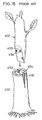
- a lower end portion of a scion 451 is cut up into a wedge-like form by the use of a knife or the like and a corresponding wedge-like slit 453 is formed at an upper end partion of a stack 452.
- the united portion is gripped by an auxiliary fixing device such as a clip.
- This cleft grafting method of inserting the lower end portion of the scion 451 cut up into the wedge-like form into the slit 453 of the stack 452 has suffered the following problems: 1) a skill is required to unite the scion 451 to the stock 452 in a proper state; and 2) it is difficult to automate the grafting operation. More specifically, initing surfaces of the scion 451 and the stock 452 consist of a pair of flat surfaces each, and only parts of vessels 454 and sieve tubes 455 constituting the vascular bundles are exposed at opposite initing surfaces. Accordingly, it is difficult to position and inite the vessels 454 and sieve tubes 455 of the scion 451 to those of the stock 452 accurately.
- a grafting method of the invention comprises the steps of forming a conical projection on either a lower end portion of a scion or an upper end portion of a stock; forming a conical recess on either a lower end portion of a scion or an upper end portion of a stock; and joining the conical projection in the conical recess to unite the scion to the stock.
- the included angle of the conical projection is identical to the included angle of the conical recess.
- the conical projection is formed by inserting either the lower end portion of a scion or the upper end portion of a stock in a conical hole formed in a die and provided with a cutting blade along a generatrix of the conical hole; and cutting either the lower end portion of a scion or the upper end portion of a stock by vibrating the cutting blade ultrasonically while rendering a relative rotation between the cutting blade and the scion or stock.
- either one of a lower end portion of a scion and an upper end portion of a stock is cut up into a conical projection, and a conical recess corresponding to the conical projection is formed at the other.
- the scion and the stock are united to each other by fitting the conical projection into the conical recess. Accordingly, the scion and the stock can be positioned automatically and united sealably. Also, the scion and the stock can be united in a proper state to thereby obtain an excellent adhesion, and be grown in a well-balanced manner.
- the included angle of the conical projection is identical to the included angle of the conical recess. Accordingly, the conical projection can be slid along the inner surface of the conical recess to the deepest point of the conical recess easily.
- the conical projection is formed by the cutting blade driven at an ultrasonically high speed.
- the conical projection is cut without giving an excessive cutting force to the scion or stock. Accordingly, a smooth cutting surface can be provided on the conical projection.
- the present invention is directed to a grafting apparatus comprising holding means for holding either a scion or a stock; cutting means including: a die member having a conical hole into which either a scion or a stock is inserted; and a cutting blade member arranged along a generatrix of the conical hole; and relative movement means for rendering a relative movement between the holding means and the cutting means to cut either a lower end portion of a scion or an upper end portion of a stock into a conical projection by a relative movement between the holding means and the cutting means.
- the relative movement means may be constructed by a main frame member; a support frame for fixedly supporting the cutting means; a moving unit attached to the main frame member for moving the support frame in a vertical direction; a support table for supporting the holding means; a rotating unit attached to the main frame member for rotating the support table about an axis of the die member.
- the relative movement means may be constructed by a main frame member; a rotating unit for rotating the cutting means about an axis of the die member; a support frame for supporting the cutting means and the rotating unit; a moving unit attached to the main frame member for moving the support frame in a vertical direction; and a support table attached to the main frame member for supporting the holding means.
- the holding means includes: a support table having a positioning hole through which either a scion or a stock is inserted; a pair of grip members opposed at the positioning hole, each member being pivotable and having a gripping portion at the positioning hole when the pair of grip members are made in contact with each other; and biasing means for biasing the pair of grip members so as to come into contact with each other.
- the cutting blade member is arranged along a generatrix of the conical hole formed in the die member. Either a scion or a stock is held by the holding member, and is relatively rotated with respect to the cutting blade member and moved down relatively with respect to the die member.
- This construction is very simple and assuredly produces a conical projection having a smooth surface.
- the cutting blade member is moved upward and downward at an ultrasonic high speed, which ensures a more smooth cutting surface.
- the holding means gripping a scion is rotated while the assembly of the die member, cutting blade member, and ultrasonic drive device is held stationary. This machining will need a reduced energy.
- the holding means gripping a scion is held stationary while the assembly of the die member, cutting blade member, and ultrasonic drive device is rotated. This machining will facilitate the handling of scions and enhance the automatization of grafting.
- the holding means is provided with the pair of grip members. Accordingly, the scion or stock can be gripped by the grip members in a proper state. This simplifies gripping operation of the scion or stock.
- Fig. 1 shows a grafting apparatus according to the invention.
- This grafting apparatus is provided with a scion transport assembly 1, a scion machining assembly 2, a stock transport assembly 3, and a stock machining assembly 4.
- the scion transport assembly 1 holds a scion formed by cutting off a lower end portion of a seedling of a watermelon, tomato, egg plant or the like, and transports the same to positions where it is machined and united to a stock.
- the scion machining assembly 2 machines a lower end of the scion to form a projected portion which is united to the stock.
- the stock transport assembly 3 holds a stock formed by cutting off an upper end portion of a seedling having the affinity with the scion and transports the same to positions where it is machined and united to the scion.
- the stock machining assembly 4 machines an upper end portion of the stock and forms a hole into which the projected lower end portion of the scion is inserted.
- the scion transport assembly 1 includes a slide block 6, left and right slide bars 7, a screw feed mechanism 8, a scion holder 9, and a scion elevating mechanism 10.
- the slide block 6 and the slide bars 7 are supported slidably on a base 5.
- the screw feed mechanism 8 screw-feeds the slide block 6 and the slide bars 7.
- the scion holder 9 is mounted at a leading end of the slide bar 7.
- the scion elevating mechanism 10 moves the scion holder 9 upward and downward.
- the screw feed mechanism 8 includes a screw shaft 11 which is spirally fitted into a tapped hole formed in the slide block 6 and is supported rotatably by front and rear support blocks 5a, 5b provided upstanding on the base 5, and a drive motor 12 for drivingly rotating the screw shaft 11.
- the screw feed mechanism 8 screw-feeds the slide block 6 and the slide bars 7 by rotating the screw shaft 11 by means of the drive motor 12, and thereby the rear-located slide block 6 as indicated by solid lines in Fig. 2 and the scion holder 9 are moved forward as indicated by phantom lines in Fig. 2.
- the scion holder 9 is slidably moved to a position where the scion machining assembly 2 is installed and then to a further forward position where the scion is united to the stock.
- the scion elevating mechanism 10 includes a rack gear 14, a rotatable shaft 15, and a drive motor 16 as shown in Fig. 3.
- the rack gear 14 is supported movably upward and downward on a guide member 13 mounted on a leading end of the slide bars 7.
- the rotatable shaft 15 includes a pinion 15a meshable with the rack gear 14.
- the drive motor 16 drivingly rotates the rotatable shaft 15.
- the scion elevating mechanism 10 moves the rack gear 14 upward and downward by rotating the rotatable shaft 15 and pinion 15a by the driving force of the drive motor 16 to thereby move the scion holder 9 provided integrally with the rack gear 14 from an upper standby position to lower machining position and uniting position.
- the scion holder 9 includes a support portion 17 provided integrally with the rack gear 14, a pair of finger plates 18 supported pivotally on the support portion 17, and an unillustrated drive device provided in the support portion 17.
- This drive device may be an air cylinder, push-pull solenoid, or the like.
- the finger plates 18 are driven openably and closably by the drive device, and thereby grips 19 provided on inner surfaces of leading ends thereof are moved pivotally between a released position where the grips 19 are spaced apart and a gripped position where a stem of the scion 20 is gripped by the grips 19 as shown in Fig. 4.
- the scion machining assembly 2 includes a turntable 22 which is rotated at about 30 rpm by a drive motor 21, and a taper die member 23 provided projectingly at an upper center portion of the turntable 22. On a circumferential surface of the taper die member 23 is formed a slanting surface 24 along which a cutting blade 25 is provided. The cutting blade 25 is moved upward and downward along the slanting surface 24 about 115 times per second by about 2 mm by a cutting blade driving mechanism 26 including, for example, a reciprocating motor.
- an insertion hole 27 into which the scion is inserted.
- the insert ion hole 27 consists of a cylindrical upper hole 27a and a conical lower hole 27b which is in communication with a lower end of the upper hole 27a and is tapered downward. A portion of the insertion hole 27 is exposed to a lateral end portion of the slanting surface 24 to thereby form an opening 28 extending along a generatrix of the conical lower hole 27b.
- the stock transport assembly 3 includes a guide member 30 mounted on a base 29, a slide member 31 supported slidably by the guide member 30, a screw shaft 32 for screw-feeding the slide member 31, and a screw feed mechanism 34 including, for example, a drive motor 33 for rotating the screw shaft 32.
- the screw feed mechanism 34 causes a stock holder 35 mounted at a leading end of the slide member 31 to move slidably from a backward located stock mounting position to an install position of the stock machining assembly 4 and to a uniting position located forward.
- the stock holder 35 includes a pair of finger plates 36 constructed similar to the scion holder 9 as shown in Fig. 6, and an unillustrated drive device for driving these finger plates 36 openably and closably.
- a stem of a stock 38 is gripped by grips 37 provided at inner surfaces of leading ends of the finger plates 36.
- the stock machining assembly 4 includes a drill 40 having a cutter 39, and a drill elevating mechanism 41 for moving the drill 40 upward and downward.
- a machining portion 42 formed into a conical shape having the same angle as the projected portion 28 of the scion 20 to be machined by the scion machining assembly 2.
- the drill is rotated at a high speed, e.g., 45000 rpm.
- the grafting method according to the invention is implemented as follows using the grafting apparatus thus constructed.
- the finger plates 18 of the scion holder 9 are caused to grip the stem of the scion 20 which is formed by cutting off the lower end portion of an appropriately grown seedling used as a scion such as an egg plant.
- the screw feed mechanism 8 of the scion transport assembly 1 is driven to move the scion holder 9 forward.
- the driving of the screw feed mechanism 8 is stopped to position the scion 20.
- the scion holder 9 and the scion 20 are moved downward by the scion elevating mechanism 10, and the lower end portion of the scion 20 is inserted into the insertion hole 27 of the taper die member 23 and is cut up into the conical form which is tapered downward.
- the cutting blade 25 is moved upward and downward by the cutting blade drive mechanism 26 and the turntable 22 is rotated by the drive motor 21, to thereby insert and move the lower end portion of the scion 20 downward into the insertion hole 27.
- the scion holder 9 and the scion 20 are caused to move upward by the scion elevating mechanism 10 so as to pull the lower end portion of the scion 20 out of the insertion hole 27. Thereafter, the scion holder 9 and the scion 20 are transported further forward to the uniting position where the scion 20 is united to the stock 38 by the screw feed mechanism 8.
- the positioning of the scion holder 9 and the scion 20 at the uniting position may be done in accordance with an output signal of a sensor for detecting the position of the scion holder 9, or may be done using a stopper provided at the screw feed mechanism 8.
- the stock 38 formed by cutting the upper portion of a proper seedling having the affinity with the scion 20 is held by the finger plates 36 of the stock holder 35. Thereafter, the stock holder 35 is transported forward by the screw feed mechanism 34 of the stock transport assembly 3 up to the position where the sensor is disposed. The stock 38 held by the stock holder 35 is moved below the position where the stock machining assembly 4 is installed so as to be positioned.
- the drill 40 and the cutter 39 are moved downward by the drill elevating mechanism 41 while the cutter 39 is drivingly rotated by the drill 40. Consequently, the machining portion 42 of the cutter 39 is pressed against an upper end face of the stock 38 and the conical recessed hole 44 tapered downward is formed at the upper end portion of the stock 38 (see Fig. 8).
- the unillustrated sensor detects that the cutter 39 has moved down to a specified position and the formation of the recessed hole 44 has been completed, the drill 40 and the cutter 39 are moved upward away from the stock 38 by the drill elevating mechanism 41. Thereafter, the stock holder 35 and the stock 38 are transported further forward to the uniting position by the screw feed mechanism 34.
- the scion holder 9 and the scion 20 are moved downward by the scion elevating mechanism 10 so as to insert the projected portion 43 of the scion 20 into the recessed hole 44 of the stock 38.
- the scion 20 and the stock 38 are connected with each other as shown in Fig. 9 to produce a grafted seedling.
- the finger plates 18 of the scion holder 9 and the finger plates 36 of the stock holder 35 are caused to pivot to the respective released positions, and the scion 20 and the stock 38 are released from the gripped states thereof.
- the grafted seedling is transferred onto an unillustrated transport means including a belt conveyor and discharged.
- the lower end portion of the scion 20 is cut up into a tapered shape to form the projected portion 43 and the conical recessed hole 44 corresponding to the projected portion 43 is formed at the upper end portion of the stock 38.
- the scion 20 and the stock 38 are united by inserting the projected portion 43 into the recessed hole 44. Accordingly, the scion 20 and the stock 38 can be united in a proper state and an excellent adhesion is obtainable.
- vessels 45 and sieve tubes 46 are allowed to be exposed entirely over the circumferential surfaces of the projected portion 43 and the recessed hole 44.
- the vessels 45 and the sieve tubes 46 of the scion 20 and the stock 38 can be positioned easily and properly when the projected portion 43 of the scion 20 and the recessed hole 44 of the stock 38 are united.
- the conical surfaces constituting the projected portion 43 and the recessed hole 44 serve as guiding surfaces which allow the projected portion 43 and the recessed hole 44 to be positioned automatically.
- the projected portion 43 is inserted into the deepest part of the recessed hole 44 easily, so that the scion 20 and the stock 38 can be united sealably.
- the scion 20 and the stock 38 can be united without requiring a cumbersome operation including the gripping of the upper end portion of the stock 38 with an auxiliary fixing device such as a clip after the insertion of the scion 20.
- an auxiliary fixing device such as a clip after the insertion of the scion 20.
- the cuticle of the scion 20 is cut off entirely over the circumferential surface of the projected portion 43 lest the cuticle should be fitted into the recessed hole 44 of the stock 38.
- the lower end portion of the scion 20 is cut up in a state where it is inserted into the insertion hole 27 of the taper die member 23 to be positioned. Accordingly, even a seedling having a thin and soft stem such as a watermelon seedling can have a lower end portion thereof shaped up into a conical form corresponding to the lower portion of the insertion hole 27 while preventing the shape of the projected portion 43 from being disfigured.
- the lower end portion of the scion 20 is cut up by rotating the taper die member 23 and the cutting blade 25 together with the turntable 22 while moving the cutting blade 25 upward and downward along the slanting surface 25 formed on the taper die member 23 by the cutting blade driving mechanism 26.
- the outer circumferential portion 20a can be cut smoothly and properly while obviating the likelihood that the lower end portion of the scion 20 is smashed by the cutting blade 25.
- the projected portion 43 formed at the lower end portion of the scion 20 may not be shaped up into a perfect conical form, but may be a pyramid form approximate to the conical form or a frustum form. Further, it may not be necessary to set the angle of the conical form constituting the projected portion 43 of the scion 20 equal to the angle of the conical hole constituting the recessed hole 44 of the stock 38. These two angles may differ slightly, so that the projected portion 43 and the recessed hole 44 are sealably connected by deforming at least one of the both when the projected portion 43 is fitted into the recessed hole 44.
- the drill 40 is rotated at the high speed of ten thousands per minute as mentioned above, which generates a suction to suck up waste chips produced when the stock 38 are being machined. Accordingly, no waste chips remain in the recessed hole 44 of the stock 38 and a desired recess can be formed in the stock 38. Thus, there can be reliably prevented an occurrence that sealability between the scion 20 and the stock 38 is deteriorated due to the existence of waste chips between the projected portion 43 of the scion 20 and the recessed hole 44 of the stock 38.
- the grafting method may be implemented as follows. The projected portion is cut up manually using a knife or the like and the recessed hole is formed using a drill or the like. Then, the scion and the stock are united manually.
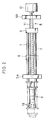
- the scion machining assembly 200 is provided with a holding device 201, a first drive device 202, a die member 204, a cutting blade 205, an ultrasonic drive device 206, and a second drive device 207.
- the holding device 201 holds a seedling to be grafted or a scion formed by cutting off a lower end portion of seedling such as watermelon, tomato, and egg plant.
- the first drive device 202 is adapted for driving the holding device 201.
- the die member 204 is formed with an insertion hole 203 into which a lower end portion of a seedling is inserted.
- the insertion hole 203 is in the form of an inverted cone.
- the cutting blade 205 extends along an inner surface of the insertion hole 203.
- the ultrasonic drive device 206 includes an ultrasonic drive device adapted for vibrating the cutting blade 205 upward and downward at an ultrasonic frequency.
- the second drive device 207 is adapted for moving the die member 204, the cutting blade 205, and the ultrasonic drive device 206 upward and downward.
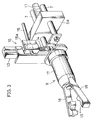
- the holding device 201 for holding the seedling includes a stationary table 210, a support table 212, and a pair of grip members 214, 215 provided on the support table 212.
- the stationary table 210 is fixedly secured to a main frame 209 of the grafting apparatus by way of a support member 208.
- the support table 212 is rotatably supported on the stationary table 210 by means of roller bearings 211 provided on the stationary table 210.
- the support table 212 includes a doughnut-like outer portion 216 and a center portion 217. At a center of the center portion 217 is formed a circular positioning hole 218 into which the seedling is to be inserted.
- the grip members 214, 215 are disposed opposing to each other at the positioning hole 218. Each of the grip members 214, 215 is pivotally supported on the center portion 217 at an intermediate portion of the grip member by a pivot pin 219 fixedly attached on the center portion 217.
- the grip members 214, 215 have gripping portions 220 for gripping the seedling at their respective positions of inner walls corresponding to the positioning hole 218.
- the respective gripping portion 220 is in the form of a hemicycle and attached with a rubber sheet.
- the grip members 214, 215 are forcibly made in contact with each other on the inner walls by springs 221.
- One end of the spring 221 is attached on an outer end of the grip member 214 while the other end of the spring 221 is attached on the support table 212.
- the respective gripping portions 220 of the grip members 214, 215 define a gripping hole above the positioning hole 218.
- the grip member 214 is provided with a knob 222 for manual opening on an outer end portion thereof.
- the grip member 215 has an inner extension portion 223 extending beyond the pivotal portion 219 of the grip member 214.
- the first drive device 202 includes a drive motor 225 and a roller 226.
- the drive motor 225 is mounted on the main frame 209 by way of a bracket 224, and the roller 226 is mounted on an output shaft of the drive motor 225.
- the roller 226 comes into frictional contact with an outer circumferential surface of the support table 212 to thereby transmit the driving force of the drive motor 225 to the support table 212.
- the support table 212 is rotated about the positioning hole 218 at a rotating speed of about 1 to 10 rpm.
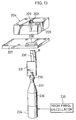
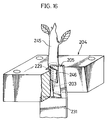
- the die member 204 is in the form of a block, as shown in Fig. 13.
- the die member 204 is associated with a block 241 of the second drive device 207 to be described later by way of a die member supporting member 227.
- the die member 204 is formed with the inverted conical insertion hole 203. A stem of the seedling is inserted into the insertion hole 203 from above.
- the die member 204 is formed with a slot 228 extending to the insertion hole 203. There is defined an opening 229 at an intersecting portion between the insertion hole 203 and the slot 228.
- the slot 228 is adapted for positioning the cutting blade 205.
- the die member supporting member 227 is formed with a waste discharge passage 230 in a position corresponding to the slot 228.
- the cutting blade 205 has an attachment portion 231 and a cutting portion 232.
- the attachment portion 231 is fixedly attached to a leading end portion of the ultrasonic drive device 6.
- the cutting portion 232 is inclined with respect to a general vertical edge of the attachment portion 231 ⁇ degree corresponding to a generatrix of the inverted conical insertion hole 203 so that a cutting edge of the cutting portion 232 projects into the opening 229 parallel with the generatrix of the inverted conical insertion hole 203.
- the ultrasonic drive device 206 includes a high frequency oscillator 233, an ultrasonic vibrator 234, a cone portion 236, and a horn portion 237.
- the ultrasonic vibrator 234 is vibrated by electric energy supplied by a high frequency oscillator 233.
- the cone portion 236 and the horn portion 237 amplify the vibration generated by the ultrasonic vibrator 234 and transmit the amplified vibration to the leading portion 235 to which the attachment portion of the cutting blade 205 is fixedly attached. Thereby, the cutting blade 205 is moved upward and downward by about 30 ⁇ m at a specified ultrasonic frequency, e.g., a frequency of about 20 to 40 kHz.
- the second drive device 207 includes, as shown in Fig. 10, a drive shaft 240, the block 241, an unillustrated guide member for guiding a vertical movement of the block 241, and a drive motor 242.
- the drive shaft 240 is a screw shaft rotatably supported by upper and lower support brackets 238, 239 fixedly attached on the main frame 209.
- the block 241 is formed with a threaded hole with which the drive shaft 240 is meshed.
- the drive motor 242 is mounted on an upper surface of the upper support bracket 238.
- the die member supporting member 227 is connected to the block 241 by way of a connecting member 243.
- the ultrasonic drive device 206 is connected to the block 241 by way of a support member 244. Accordingly, the die member 204 and the ultrasonic drive device 206 are integrally moved upward and downward by rotating the drive shaft 240 with the drive motor 242.
- the grafting is carried out as follows using the grafting apparatus provided with the scion machining assembly 200.
- the grip member 214 is pivoted clockwise about the pivot pin 219 against the spring 221 by gripping the knob 222 with a hand. Consequently, the gripping portion 220 of the grip member 214 is moved away from the positioning hole 218 of the support table 212.
- the pivotal movement of the grip member 214 causes the inner extension portion 223 of the grip member 215 to pivot clockwise about the pivot pin 219 of the grip member 215 against the spring 221, consequently moving the gripping portion 220 of the grip member 215 away from the positioning hole 218.
- a stem of a scion 245 formed by cutting off a lower end portion of an appropriately grown seedling. e.g., egg plant.
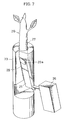
- the grip members 14 and 15 are returned into the initial state by the resilient force of the springs 221. Consequently, as shown in Fig. 15, the scion 245 is gripped by the gripping portions 220 of the grip members 214 and 215.
- the drive shaft 240 is rotated forward by the drive motor 242 of the second drive device 207.
- the forward rotation of the drive shaft 240 causes the block 241 to move upward, and to move the die member 204 and the ultrasonic drive device 206 upward. Consequently, the lower end portion of the scion 245 comes into the insertion hole 203 of the die member 204. Accordingly, the lower end portion of the scion 245 will be cut into an inverted conical shape.
- the lower end portion of the scion 245 is inserted into the inverted conical insertion hole 203 by moving the block 241 upward by the second drive device 207.
- an outer circumferential surface 246 of the lower end portion of the scion 245 is cut by the inclined cutting edge of the cutting blade 205 at the opening 229. Consequently, the lower end portion of the scion 245 is cut into the inverted conical shape corresponding to the inverted conical insertion hole 203.
- the lower end portion of the scion 245 is cut into an inverted conical shape by moving the cutting blade 205 upward and downward at the specified ultrasonic frequency along the opening 229 formed in the die member 204 with the ultrasonic drive device 6 while rotating the scion 245 with the support table 212. Accordingly, a smooth cutting surface can be provided to the scion 245 rapidly without causing the cutting blade 205 to smash the lower end portion of the scion 245.
- the lower end portion of the scion 245 is cut by the cutting blade 205 driven at an ultrasonic frequency, the lower end portion of the scion 245 can be smoothly cut without giving an excessive cutting shock to the scion 245. Therefore, a smooth cutting surface can be given to the scion 245 while keeping the cut portion or gripped portion of the scion 245 from being smashed by the cutting blade 205.
- the movement range of the cutting blade 205 can be set to be smaller than the size of a plant cell (50 to 100 ⁇ m), for example, at about 30 ⁇ m. Accordingly, there is no likelihood that the cutting blade 205 harms plant cells during the cutting operation.
- the support table 212 is formed with the positioning hole 218 for positioning the lower end portion of the scion 245.
- the grip members 214 and 215 are pivotally provided on the support table 212 opposing to each other, and biased by the springs 221 so as to come into contact with each other above the positioning hole 218 to define the grip hole. Accordingly, the scion 245 can be gripped properly and rapidly.
- the grip members 214, 215 are forcibly rotated clockwise against the resilient force of the springs 221 to move their respective gripping portions 220 away from each other.
- the lower end portion of the scion 245 is inserted into the positioning hole 218 and be then set in an appropriate position. Thereafter, the opening state of the grip members 214, 215 is released.
- the grip members 214, 215 are rotated counterclockwise by the springs 221 and the respective gripping portions 220 consequently come closer to each other to grip a stem portion of the scion 245 at a suitable pressure.
- the support table 212 of the holding device 201 is rotated by the first drive device 202 to thereby rotate the scion 245 to form the inverted conical cutting surface.
- Fig. 17 shows a third scion machining assembly 300 provided in the grafting apparatus.
- the scion machining assembly 300 is provided with a holding device 301, a first drive device 302, a die member 304, a cutting blade 305, an ultrasonic drive device 306, and a second drive device 307.
- the die member 304 is formed with an insertion hole 303 into which a lower end portion of a seedling is inserted.
- the insertion hole 303 is in the form of an inverted cone.
- the cutting blade 305 extends along an inner surface of the insertion hole 303.
- the cutting blade 305 is vibrated upward and downward at an ultrasonic frequency by an ultrasonic drive device 306.
- the holding device 301 is constructed by a support table 312 and a pair of grip members 314, 315.
- the support table 312 is fixedly secured to a main frame 309 of the grafting apparatus by way of a support member 308.
- the support table 312 is formed with a circular positioning hole 318 at a center thereof.
- the pair of grip members 314, 315 is provided with a gripping mechanism similar to the second scion machining assembly 200.
- the support table 312 is not required to be rotatably supported on the support member 308. Also, there is not provided a drive mechanism for rotating the holding device 301. Accordingly, the support table 312 carrying the pair of grip member 314, 315 is stationary.
- the die member 304, cutting blade 305, and ultrasonic drive device 306 are integrally supported by a support cylinder 343.
- the support cylinder 343 is rotatably supported by a support frame 344. Between the support cylinder 343 and the support frame 344 is provided ball bearings 346 to enable the support cylinder to rotate about an axis of the insertion hole 303 of the die member 304.
- the support frame 344 further carries the first drive device 302.
- the first drive device 302 comprises a drive motor 324, a drive gear 325, and a driven gear 326.
- the driven gear 326 is integrally connected with the support cylinder 343.
- Driving the drive motor 324 rotates the drive gear 325, and the driven gear 326, and then rotates the support cylinder 343.
- the rotation of the support cylinder 343 integrally rotates the die member 304 with respect to the holding device 301.
- the support frame 344 is fixedly attached to a block 341 of a second drive device 307.
- the second drive device 307 includes a drive shaft 340, the block 341, an unillustrated guide member for guiding a vertical movement of the block 341, and a drive motor 342.
- the drive shaft 340 is a screw shaft rotatably supported by upper and lower support brackets 338, 339 fixedly attached on the main frame 309.
- the block 341 is formed with a threaded hole with which the drive shaft 340 is meshed.
- the drive motor 342 is mounted on an upper surface of the upper support bracket 338.
- the support frame 344 is moved upward and downward by rotating the drive shaft 340 with the drive motor 342. This construction is identical to that of the second scion machining assembly 200.
- a scion is produced in a similar way to the second scion machining assembly 200. Specifically, a stem of a scion is inserted into the positioning hole 318, and gripped by the pair of grip members 314, 315. Subsequently, the drive shaft 340 is rotated forward by the drive motor 342 of the second drive device 307. The forward rotation of the drive shaft 340 causes the block 341 to move upward, and to move the support frame 344 carrying the support cylinder 343 and the first drive device 302 upward until the lower end portion of the scion comes into the insertion hole 303 of the die member 304 provided in the support cylinder 343.
- the support cylinder 343 carrying the die member 304 and ultrasonic drive device 306 is rotated by the first drive device 302 while the cutting blade 305 is being vibrated upward and downward at a specified ultrasonic frequency by the ultrasonic drive device 306 and the lower end portion of the scion 345 is being inserted into the inverted conical insertion hole 303 by moving the support frame 344 upward by the second drive device 307, so that an outer circumferential surface of the lower end portion of the scion is cut by the inclined cutting edge of the cutting blade 305. Consequently, the lower end portion of the scion is smoothly cut into an inverted conical shape.
- the scion In the third scion machining assembly, the scion is held in a stationary state while the cutting blade is rotated. This will facilitate handling of scions and assure an improved automatization of grafting.
Landscapes
- Life Sciences & Earth Sciences (AREA)
- Botany (AREA)
- Environmental Sciences (AREA)
- Developmental Biology & Embryology (AREA)
- Ecology (AREA)
- Biodiversity & Conservation Biology (AREA)
- Forests & Forestry (AREA)
- Engineering & Computer Science (AREA)
- Wood Science & Technology (AREA)
- Cultivation Of Plants (AREA)
- Perforating, Stamping-Out Or Severing By Means Other Than Cutting (AREA)
- Processing Of Stones Or Stones Resemblance Materials (AREA)
- Apparatuses For Bulk Treatment Of Fruits And Vegetables And Apparatuses For Preparing Feeds (AREA)
Applications Claiming Priority (2)
| Application Number | Priority Date | Filing Date | Title |
|---|---|---|---|
| JP79745/93 | 1993-04-06 | ||
| JP5079745A JP2918188B2 (ja) | 1993-04-06 | 1993-04-06 | 接木方法および接木装置 |
Publications (2)
| Publication Number | Publication Date |
|---|---|
| EP0619066A1 true EP0619066A1 (fr) | 1994-10-12 |
| EP0619066B1 EP0619066B1 (fr) | 1996-02-14 |
Family
ID=13698769
Family Applications (1)
| Application Number | Title | Priority Date | Filing Date |
|---|---|---|---|
| EP94105248A Expired - Lifetime EP0619066B1 (fr) | 1993-04-06 | 1994-04-05 | Procédé de greffage et ensemble pour préparer un greffon ou un porte-greffe |
Country Status (4)
| Country | Link |
|---|---|
| EP (1) | EP0619066B1 (fr) |
| JP (1) | JP2918188B2 (fr) |
| KR (1) | KR940023346A (fr) |
| AU (1) | AU674048B2 (fr) |
Cited By (11)
| Publication number | Priority date | Publication date | Assignee | Title |
|---|---|---|---|---|
| ES2187355A1 (es) * | 2001-06-27 | 2003-06-01 | Invest Y Desarrollos Automatiz | Maquina de injertar y pinza de injertar correspondiente. |
| CN103704029A (zh) * | 2013-12-23 | 2014-04-09 | 广西大学 | 一种茄果类蔬菜嫁接育苗的方法 |
| CN105850525A (zh) * | 2016-05-06 | 2016-08-17 | 山西省农业科学院隰县农业试验站 | 一种核桃插皮舌接接穗切削机 |
| CN109716948A (zh) * | 2019-03-14 | 2019-05-07 | 山东安信种苗股份有限公司 | 一种嫁接砧木处理系统 |
| CN109804795A (zh) * | 2019-03-22 | 2019-05-28 | 山东安信种苗股份有限公司 | 一种双工位自动嫁接机 |
| CN110447406A (zh) * | 2019-06-13 | 2019-11-15 | 徐悦阳 | 一种嫁接固定装置以及嫁接方法 |
| CN111567246A (zh) * | 2020-05-20 | 2020-08-25 | 北京都润生态环境工程有限公司 | 一种在园林苗木繁育中嫁接秋紫白蜡的方法 |
| CN113853968A (zh) * | 2021-11-24 | 2021-12-31 | 张秋茹 | 一种农艺用嫁接装置 |
| CN114402827A (zh) * | 2022-01-29 | 2022-04-29 | 张掖市黄河农林牧科技有限公司 | 一种文冠果嫁接固定装置 |
| CN116508517A (zh) * | 2023-05-12 | 2023-08-01 | 铜仁学院 | 一种用于地果靠接愈合增粗藤蔓的培育装置及方法 |
| CN117136736A (zh) * | 2023-10-07 | 2023-12-01 | 宁波市农业科学研究院 | 一种西瓜快速嫁接设备及方法 |
Families Citing this family (1)
| Publication number | Priority date | Publication date | Assignee | Title |
|---|---|---|---|---|
| CN110089288B (zh) * | 2019-05-22 | 2021-01-12 | 梁一坤 | 一种快速嫁接装置 |
Citations (8)
| Publication number | Priority date | Publication date | Assignee | Title |
|---|---|---|---|---|
| DE291094C (fr) * | ||||
| US3004522A (en) * | 1959-08-11 | 1961-10-17 | Minitone Inc | Battery operated pencil sharpener |
| FR1328248A (fr) * | 1962-07-09 | 1963-05-24 | Greffage et surgreffage par cône ou pyramide | |
| FR2391640A1 (fr) * | 1977-05-23 | 1978-12-22 | Uk I Vinogradarstv | Installation pour le greffage de boutures |
| FR2419669A1 (fr) * | 1978-03-13 | 1979-10-12 | Sarazin Paolo | Procede de greffage de plantes, en particulier de ceps de vigne, et dispositif pour executer la greffe |
| SU1423049A1 (ru) * | 1986-01-16 | 1988-09-15 | Н. А. Сидоров | Способ прививки плодовых деревьев с помощью соединительного элемента |
| EP0532064A2 (fr) * | 1989-01-19 | 1993-03-17 | Kabushiki Kaisha Komatsu Seisakusho | Appareil de greffage de plantes immatures |
| JPH0568432A (ja) * | 1991-09-12 | 1993-03-23 | Kagome Co Ltd | ナス科作物の接ぎ木方法 |
-
1993
- 1993-04-06 JP JP5079745A patent/JP2918188B2/ja not_active Expired - Fee Related
-
1994
- 1994-03-21 AU AU57949/94A patent/AU674048B2/en not_active Ceased
- 1994-04-04 KR KR1019940007044A patent/KR940023346A/ko not_active Ceased
- 1994-04-05 EP EP94105248A patent/EP0619066B1/fr not_active Expired - Lifetime
Patent Citations (8)
| Publication number | Priority date | Publication date | Assignee | Title |
|---|---|---|---|---|
| DE291094C (fr) * | ||||
| US3004522A (en) * | 1959-08-11 | 1961-10-17 | Minitone Inc | Battery operated pencil sharpener |
| FR1328248A (fr) * | 1962-07-09 | 1963-05-24 | Greffage et surgreffage par cône ou pyramide | |
| FR2391640A1 (fr) * | 1977-05-23 | 1978-12-22 | Uk I Vinogradarstv | Installation pour le greffage de boutures |
| FR2419669A1 (fr) * | 1978-03-13 | 1979-10-12 | Sarazin Paolo | Procede de greffage de plantes, en particulier de ceps de vigne, et dispositif pour executer la greffe |
| SU1423049A1 (ru) * | 1986-01-16 | 1988-09-15 | Н. А. Сидоров | Способ прививки плодовых деревьев с помощью соединительного элемента |
| EP0532064A2 (fr) * | 1989-01-19 | 1993-03-17 | Kabushiki Kaisha Komatsu Seisakusho | Appareil de greffage de plantes immatures |
| JPH0568432A (ja) * | 1991-09-12 | 1993-03-23 | Kagome Co Ltd | ナス科作物の接ぎ木方法 |
Non-Patent Citations (2)
| Title |
|---|
| PATENT ABSTRACTS OF JAPAN vol. 17, no. 382 (C - 1085) 19 July 1993 (1993-07-19) * |
| SOVIET PATENTS ABSTRACTS Section PQ Week 8911, 26 April 1989 Derwent World Patents Index; Class P13, AN 89-083981 * |
Cited By (14)
| Publication number | Priority date | Publication date | Assignee | Title |
|---|---|---|---|---|
| ES2187355A1 (es) * | 2001-06-27 | 2003-06-01 | Invest Y Desarrollos Automatiz | Maquina de injertar y pinza de injertar correspondiente. |
| CN103704029A (zh) * | 2013-12-23 | 2014-04-09 | 广西大学 | 一种茄果类蔬菜嫁接育苗的方法 |
| CN103704029B (zh) * | 2013-12-23 | 2016-02-10 | 广西大学 | 一种茄果类蔬菜嫁接育苗的方法 |
| CN105850525A (zh) * | 2016-05-06 | 2016-08-17 | 山西省农业科学院隰县农业试验站 | 一种核桃插皮舌接接穗切削机 |
| CN109716948A (zh) * | 2019-03-14 | 2019-05-07 | 山东安信种苗股份有限公司 | 一种嫁接砧木处理系统 |
| CN109716948B (zh) * | 2019-03-14 | 2024-03-01 | 山东安信种苗股份有限公司 | 一种嫁接砧木处理系统 |
| CN109804795B (zh) * | 2019-03-22 | 2023-12-08 | 山东安信种苗股份有限公司 | 一种双工位自动嫁接机 |
| CN109804795A (zh) * | 2019-03-22 | 2019-05-28 | 山东安信种苗股份有限公司 | 一种双工位自动嫁接机 |
| CN110447406A (zh) * | 2019-06-13 | 2019-11-15 | 徐悦阳 | 一种嫁接固定装置以及嫁接方法 |
| CN111567246A (zh) * | 2020-05-20 | 2020-08-25 | 北京都润生态环境工程有限公司 | 一种在园林苗木繁育中嫁接秋紫白蜡的方法 |
| CN113853968A (zh) * | 2021-11-24 | 2021-12-31 | 张秋茹 | 一种农艺用嫁接装置 |
| CN114402827A (zh) * | 2022-01-29 | 2022-04-29 | 张掖市黄河农林牧科技有限公司 | 一种文冠果嫁接固定装置 |
| CN116508517A (zh) * | 2023-05-12 | 2023-08-01 | 铜仁学院 | 一种用于地果靠接愈合增粗藤蔓的培育装置及方法 |
| CN117136736A (zh) * | 2023-10-07 | 2023-12-01 | 宁波市农业科学研究院 | 一种西瓜快速嫁接设备及方法 |
Also Published As
| Publication number | Publication date |
|---|---|
| KR940023346A (ko) | 1994-11-17 |
| JP2918188B2 (ja) | 1999-07-12 |
| AU674048B2 (en) | 1996-12-05 |
| EP0619066B1 (fr) | 1996-02-14 |
| AU5794994A (en) | 1994-10-13 |
| JPH0787843A (ja) | 1995-04-04 |
Similar Documents
| Publication | Publication Date | Title |
|---|---|---|
| US5524386A (en) | Method and apparatus for uniting a scion to a stock | |
| EP0619066B1 (fr) | Procédé de greffage et ensemble pour préparer un greffon ou un porte-greffe | |
| JPH06339327A (ja) | 接木方法 | |
| KR20080031940A (ko) | 시트 절단 장치 및 절단 방법 | |
| EP0896864A3 (fr) | Méthode ainsi que dispositif pour la coupe longitudinale d'une nappe, ainsi qu'appareil à refendre et rainurer comportant ce dispositif | |
| JP2014073090A (ja) | 接木用台木処理装置およびそれを用いる接木装置 | |
| JP2014073091A (ja) | 接木用クリップ装着装置およびそれを用いる接木装置 | |
| JP3171670B2 (ja) | ボール供給装置 | |
| JP2014073093A (ja) | 接木用クリップ装着装置およびそれを用いる接木装置 | |
| US20230263100A1 (en) | Method of Stem Grafting and an Apparatus for Performing the Method | |
| EP1839842A3 (fr) | Machine à ébarber les bouteilles et procédé | |
| CN115319254A (zh) | 焊接机 | |
| JP2003165123A (ja) | 短円柱状樹脂材のバリ除去装置及びバリ除去方法 | |
| CN214868464U (zh) | 一种端子旋转换向自动供料装置 | |
| CN115741917B (zh) | 将竹筒破开为多个竹片的破竹机 | |
| JP5381046B2 (ja) | 半導体ウェーハのスクライブ装置、およびそれを備えたスクライブシステム | |
| CN212223463U (zh) | 一种纸托成型机的翻转机构 | |
| CN107350880A (zh) | 一种cnc自动取料装置 | |
| JPH08216303A (ja) | ログペーパー切断装置 | |
| CN218193190U (zh) | 适于切割长条型材的切割设备 | |
| JP2000109035A (ja) | ラベルマガジンおよびそのラベル押え爪 | |
| JP3805218B2 (ja) | 接木装置 | |
| CN221474180U (zh) | 一种全自动喇叭组装机 | |
| CN211072084U (zh) | 一种自动化倒角装置 | |
| KR200386898Y1 (ko) | 휴대용 면취기 |
Legal Events
| Date | Code | Title | Description |
|---|---|---|---|
| PUAI | Public reference made under article 153(3) epc to a published international application that has entered the european phase |
Free format text: ORIGINAL CODE: 0009012 |
|
| AK | Designated contracting states |
Kind code of ref document: A1 Designated state(s): FR GB NL |
|
| 17P | Request for examination filed |
Effective date: 19941020 |
|
| 17Q | First examination report despatched |
Effective date: 19941205 |
|
| GRAA | (expected) grant |
Free format text: ORIGINAL CODE: 0009210 |
|
| AK | Designated contracting states |
Kind code of ref document: B1 Designated state(s): FR GB NL |
|
| ET | Fr: translation filed | ||
| PLBE | No opposition filed within time limit |
Free format text: ORIGINAL CODE: 0009261 |
|
| STAA | Information on the status of an ep patent application or granted ep patent |
Free format text: STATUS: NO OPPOSITION FILED WITHIN TIME LIMIT |
|
| 26N | No opposition filed | ||
| REG | Reference to a national code |
Ref country code: GB Ref legal event code: IF02 |
|
| PGFP | Annual fee paid to national office [announced via postgrant information from national office to epo] |
Ref country code: GB Payment date: 20050321 Year of fee payment: 12 |
|
| PGFP | Annual fee paid to national office [announced via postgrant information from national office to epo] |
Ref country code: NL Payment date: 20050418 Year of fee payment: 12 |
|
| PGFP | Annual fee paid to national office [announced via postgrant information from national office to epo] |
Ref country code: FR Payment date: 20050419 Year of fee payment: 12 |
|
| PG25 | Lapsed in a contracting state [announced via postgrant information from national office to epo] |
Ref country code: GB Free format text: LAPSE BECAUSE OF NON-PAYMENT OF DUE FEES Effective date: 20060405 |
|
| PG25 | Lapsed in a contracting state [announced via postgrant information from national office to epo] |
Ref country code: NL Free format text: LAPSE BECAUSE OF NON-PAYMENT OF DUE FEES Effective date: 20061101 |
|
| GBPC | Gb: european patent ceased through non-payment of renewal fee |
Effective date: 20060405 |
|
| NLV4 | Nl: lapsed or anulled due to non-payment of the annual fee |
Effective date: 20061101 |
|
| REG | Reference to a national code |
Ref country code: FR Ref legal event code: ST Effective date: 20061230 |
|
| PG25 | Lapsed in a contracting state [announced via postgrant information from national office to epo] |
Ref country code: FR Free format text: LAPSE BECAUSE OF NON-PAYMENT OF DUE FEES Effective date: 20060502 |