EP0619080A2 - Pâtes ou tortillas contenant de l'amidon de type AEDU ou DUH - Google Patents
Pâtes ou tortillas contenant de l'amidon de type AEDU ou DUH Download PDFInfo
- Publication number
- EP0619080A2 EP0619080A2 EP94102945A EP94102945A EP0619080A2 EP 0619080 A2 EP0619080 A2 EP 0619080A2 EP 94102945 A EP94102945 A EP 94102945A EP 94102945 A EP94102945 A EP 94102945A EP 0619080 A2 EP0619080 A2 EP 0619080A2
- Authority
- EP
- European Patent Office
- Prior art keywords
- starch
- product
- aedu
- pasta
- dough
- Prior art date
- Legal status (The legal status is an assumption and is not a legal conclusion. Google has not performed a legal analysis and makes no representation as to the accuracy of the status listed.)
- Granted
Links
- 229920002472 Starch Polymers 0.000 title claims abstract description 120
- 235000019698 starch Nutrition 0.000 title claims abstract description 120
- 239000008107 starch Substances 0.000 title claims abstract description 110
- 235000015927 pasta Nutrition 0.000 title claims abstract description 59
- 235000012184 tortilla Nutrition 0.000 title claims abstract description 37
- 239000000203 mixture Substances 0.000 claims abstract description 32
- 239000000463 material Substances 0.000 claims abstract description 13
- 235000013312 flour Nutrition 0.000 claims description 46
- 235000002017 Zea mays subsp mays Nutrition 0.000 claims description 37
- 240000008042 Zea mays Species 0.000 claims description 34
- 235000012149 noodles Nutrition 0.000 claims description 34
- XLYOFNOQVPJJNP-UHFFFAOYSA-N water Substances O XLYOFNOQVPJJNP-UHFFFAOYSA-N 0.000 claims description 25
- 238000000034 method Methods 0.000 claims description 19
- 235000016383 Zea mays subsp huehuetenangensis Nutrition 0.000 claims description 18
- 235000009973 maize Nutrition 0.000 claims description 18
- 238000010411 cooking Methods 0.000 claims description 11
- 241000209140 Triticum Species 0.000 claims description 6
- 235000021307 Triticum Nutrition 0.000 claims description 6
- 238000009835 boiling Methods 0.000 claims description 5
- 235000013305 food Nutrition 0.000 abstract description 13
- 235000013611 frozen food Nutrition 0.000 abstract description 3
- 229920000856 Amylose Polymers 0.000 description 48
- 229920002261 Corn starch Polymers 0.000 description 33
- 239000008120 corn starch Substances 0.000 description 32
- 241000196324 Embryophyta Species 0.000 description 23
- 238000009472 formulation Methods 0.000 description 20
- 235000015067 sauces Nutrition 0.000 description 18
- 108090000623 proteins and genes Proteins 0.000 description 17
- 235000005824 Zea mays ssp. parviglumis Nutrition 0.000 description 16
- 235000005822 corn Nutrition 0.000 description 16
- 235000007264 Triticum durum Nutrition 0.000 description 13
- 241000209143 Triticum turgidum subsp. durum Species 0.000 description 12
- 235000013601 eggs Nutrition 0.000 description 12
- 239000004606 Fillers/Extenders Substances 0.000 description 9
- 210000000349 chromosome Anatomy 0.000 description 9
- 238000010438 heat treatment Methods 0.000 description 8
- 239000004615 ingredient Substances 0.000 description 7
- 229920000642 polymer Polymers 0.000 description 7
- 241000227653 Lycopersicon Species 0.000 description 5
- 235000007688 Lycopersicon esculentum Nutrition 0.000 description 5
- 235000013351 cheese Nutrition 0.000 description 5
- 239000000796 flavoring agent Substances 0.000 description 5
- 235000019634 flavors Nutrition 0.000 description 5
- ZCYVEMRRCGMTRW-UHFFFAOYSA-N 7553-56-2 Chemical compound [I] ZCYVEMRRCGMTRW-UHFFFAOYSA-N 0.000 description 4
- WQZGKKKJIJFFOK-GASJEMHNSA-N Glucose Natural products OC[C@H]1OC(O)[C@H](O)[C@@H](O)[C@@H]1O WQZGKKKJIJFFOK-GASJEMHNSA-N 0.000 description 4
- 241000718541 Tetragastris balsamifera Species 0.000 description 4
- WQZGKKKJIJFFOK-DVKNGEFBSA-N alpha-D-glucose Chemical compound OC[C@H]1O[C@H](O)[C@H](O)[C@@H](O)[C@@H]1O WQZGKKKJIJFFOK-DVKNGEFBSA-N 0.000 description 4
- 229920001222 biopolymer Polymers 0.000 description 4
- 238000009395 breeding Methods 0.000 description 4
- 230000001488 breeding effect Effects 0.000 description 4
- 238000011049 filling Methods 0.000 description 4
- 238000007710 freezing Methods 0.000 description 4
- 230000008014 freezing Effects 0.000 description 4
- 239000011630 iodine Substances 0.000 description 4
- 229910052740 iodine Inorganic materials 0.000 description 4
- 238000012545 processing Methods 0.000 description 4
- 238000003303 reheating Methods 0.000 description 4
- 229920001685 Amylomaize Polymers 0.000 description 3
- 239000004278 EU approved seasoning Substances 0.000 description 3
- 108090000790 Enzymes Proteins 0.000 description 3
- 102000004190 Enzymes Human genes 0.000 description 3
- 235000007340 Hordeum vulgare Nutrition 0.000 description 3
- 240000005979 Hordeum vulgare Species 0.000 description 3
- OKKJLVBELUTLKV-UHFFFAOYSA-N Methanol Chemical compound OC OKKJLVBELUTLKV-UHFFFAOYSA-N 0.000 description 3
- HEMHJVSKTPXQMS-UHFFFAOYSA-M Sodium hydroxide Chemical compound [OH-].[Na+] HEMHJVSKTPXQMS-UHFFFAOYSA-M 0.000 description 3
- 241000482268 Zea mays subsp. mays Species 0.000 description 3
- 235000011194 food seasoning agent Nutrition 0.000 description 3
- 235000010610 frozen noodles Nutrition 0.000 description 3
- 235000013372 meat Nutrition 0.000 description 3
- 239000000178 monomer Substances 0.000 description 3
- 150000003839 salts Chemical class 0.000 description 3
- UIIMBOGNXHQVGW-UHFFFAOYSA-M sodium bicarbonate Substances [Na+].OC([O-])=O UIIMBOGNXHQVGW-UHFFFAOYSA-M 0.000 description 3
- 238000003860 storage Methods 0.000 description 3
- 238000012360 testing method Methods 0.000 description 3
- 102220533703 Histone-lysine N-methyltransferase SUV39H1_W64A_mutation Human genes 0.000 description 2
- 108010028688 Isoamylase Proteins 0.000 description 2
- 240000007594 Oryza sativa Species 0.000 description 2
- 235000007164 Oryza sativa Nutrition 0.000 description 2
- 108700005079 Recessive Genes Proteins 0.000 description 2
- 102000052708 Recessive Genes Human genes 0.000 description 2
- FAPWRFPIFSIZLT-UHFFFAOYSA-M Sodium chloride Chemical compound [Na+].[Cl-] FAPWRFPIFSIZLT-UHFFFAOYSA-M 0.000 description 2
- 240000006394 Sorghum bicolor Species 0.000 description 2
- 235000011684 Sorghum saccharatum Nutrition 0.000 description 2
- 239000002253 acid Substances 0.000 description 2
- 239000000654 additive Substances 0.000 description 2
- 230000000996 additive effect Effects 0.000 description 2
- 235000015278 beef Nutrition 0.000 description 2
- 230000015572 biosynthetic process Effects 0.000 description 2
- 239000004464 cereal grain Substances 0.000 description 2
- 238000004040 coloring Methods 0.000 description 2
- 239000002285 corn oil Substances 0.000 description 2
- 235000005687 corn oil Nutrition 0.000 description 2
- 238000009402 cross-breeding Methods 0.000 description 2
- 238000011161 development Methods 0.000 description 2
- 238000001035 drying Methods 0.000 description 2
- 239000007788 liquid Substances 0.000 description 2
- 238000003801 milling Methods 0.000 description 2
- 238000002156 mixing Methods 0.000 description 2
- 239000004033 plastic Substances 0.000 description 2
- 235000013324 preserved food Nutrition 0.000 description 2
- 235000009566 rice Nutrition 0.000 description 2
- 238000007493 shaping process Methods 0.000 description 2
- 235000017557 sodium bicarbonate Nutrition 0.000 description 2
- 229910000030 sodium bicarbonate Inorganic materials 0.000 description 2
- 239000007787 solid Substances 0.000 description 2
- 230000005945 translocation Effects 0.000 description 2
- QCVGEOXPDFCNHA-UHFFFAOYSA-N 5,5-dimethyl-2,4-dioxo-1,3-oxazolidine-3-carboxamide Chemical compound CC1(C)OC(=O)N(C(N)=O)C1=O QCVGEOXPDFCNHA-UHFFFAOYSA-N 0.000 description 1
- 229920000945 Amylopectin Polymers 0.000 description 1
- 108010000912 Egg Proteins Proteins 0.000 description 1
- 102000002322 Egg Proteins Human genes 0.000 description 1
- 229920000881 Modified starch Polymers 0.000 description 1
- 239000004368 Modified starch Substances 0.000 description 1
- 240000000359 Triticum dicoccon Species 0.000 description 1
- 244000098345 Triticum durum Species 0.000 description 1
- DHKHKXVYLBGOIT-UHFFFAOYSA-N acetaldehyde Diethyl Acetal Natural products CCOC(C)OCC DHKHKXVYLBGOIT-UHFFFAOYSA-N 0.000 description 1
- 125000002777 acetyl group Chemical class [H]C([H])([H])C(*)=O 0.000 description 1
- 238000007792 addition Methods 0.000 description 1
- 230000002411 adverse Effects 0.000 description 1
- XAGFODPZIPBFFR-UHFFFAOYSA-N aluminium Chemical compound [Al] XAGFODPZIPBFFR-UHFFFAOYSA-N 0.000 description 1
- 229910052782 aluminium Inorganic materials 0.000 description 1
- 238000004458 analytical method Methods 0.000 description 1
- 238000003556 assay Methods 0.000 description 1
- 238000009924 canning Methods 0.000 description 1
- 210000004027 cell Anatomy 0.000 description 1
- 238000007385 chemical modification Methods 0.000 description 1
- -1 coloring Substances 0.000 description 1
- 239000006071 cream Substances 0.000 description 1
- 230000001419 dependent effect Effects 0.000 description 1
- 238000009826 distribution Methods 0.000 description 1
- 230000000694 effects Effects 0.000 description 1
- 235000014103 egg white Nutrition 0.000 description 1
- 210000000969 egg white Anatomy 0.000 description 1
- 230000007717 exclusion Effects 0.000 description 1
- 238000000605 extraction Methods 0.000 description 1
- 238000001125 extrusion Methods 0.000 description 1
- 235000010855 food raising agent Nutrition 0.000 description 1
- 235000021456 frozen pasta Nutrition 0.000 description 1
- 238000004128 high performance liquid chromatography Methods 0.000 description 1
- 229910052500 inorganic mineral Inorganic materials 0.000 description 1
- PNDPGZBMCMUPRI-UHFFFAOYSA-N iodine Chemical compound II PNDPGZBMCMUPRI-UHFFFAOYSA-N 0.000 description 1
- 235000012054 meals Nutrition 0.000 description 1
- 238000013508 migration Methods 0.000 description 1
- 230000005012 migration Effects 0.000 description 1
- 239000011707 mineral Substances 0.000 description 1
- 235000010755 mineral Nutrition 0.000 description 1
- 238000012986 modification Methods 0.000 description 1
- 230000004048 modification Effects 0.000 description 1
- 235000019426 modified starch Nutrition 0.000 description 1
- 239000003921 oil Substances 0.000 description 1
- 235000019198 oils Nutrition 0.000 description 1
- 235000012771 pancakes Nutrition 0.000 description 1
- 239000003755 preservative agent Substances 0.000 description 1
- 230000002250 progressing effect Effects 0.000 description 1
- 235000021067 refined food Nutrition 0.000 description 1
- 238000010992 reflux Methods 0.000 description 1
- 230000001105 regulatory effect Effects 0.000 description 1
- 238000005070 sampling Methods 0.000 description 1
- 238000001542 size-exclusion chromatography Methods 0.000 description 1
- 239000002002 slurry Substances 0.000 description 1
- 239000011780 sodium chloride Substances 0.000 description 1
- 239000000126 substance Substances 0.000 description 1
- 235000013311 vegetables Nutrition 0.000 description 1
- 235000013343 vitamin Nutrition 0.000 description 1
- 239000011782 vitamin Substances 0.000 description 1
- 229940088594 vitamin Drugs 0.000 description 1
- 229930003231 vitamin Natural products 0.000 description 1
- 238000010792 warming Methods 0.000 description 1
Images
Classifications
-
- A—HUMAN NECESSITIES
- A23—FOODS OR FOODSTUFFS; TREATMENT THEREOF, NOT COVERED BY OTHER CLASSES
- A23L—FOODS, FOODSTUFFS OR NON-ALCOHOLIC BEVERAGES, NOT OTHERWISE PROVIDED FOR; PREPARATION OR TREATMENT THEREOF
- A23L7/00—Cereal-derived products; Malt products; Preparation or treatment thereof
- A23L7/10—Cereal-derived products
- A23L7/109—Types of pasta, e.g. macaroni or noodles
- A23L7/111—Semi-moist pasta, i.e. containing about 20% of moist; Moist packaged or frozen pasta; Pasta fried or pre-fried in a non-aqueous frying medium, e.g. oil; Packaged pasta to be cooked directly in the package
-
- A—HUMAN NECESSITIES
- A21—BAKING; EDIBLE DOUGHS
- A21D—TREATMENT OF FLOUR OR DOUGH FOR BAKING, e.g. BY ADDITION OF MATERIALS; BAKING; BAKERY PRODUCTS
- A21D13/00—Finished or partly finished bakery products
- A21D13/40—Products characterised by the type, form or use
- A21D13/42—Tortillas
-
- A—HUMAN NECESSITIES
- A21—BAKING; EDIBLE DOUGHS
- A21D—TREATMENT OF FLOUR OR DOUGH FOR BAKING, e.g. BY ADDITION OF MATERIALS; BAKING; BAKERY PRODUCTS
- A21D2/00—Treatment of flour or dough by adding materials thereto before or during baking
- A21D2/08—Treatment of flour or dough by adding materials thereto before or during baking by adding organic substances
- A21D2/14—Organic oxygen compounds
- A21D2/18—Carbohydrates
- A21D2/186—Starches; Derivatives thereof
-
- A—HUMAN NECESSITIES
- A23—FOODS OR FOODSTUFFS; TREATMENT THEREOF, NOT COVERED BY OTHER CLASSES
- A23L—FOODS, FOODSTUFFS OR NON-ALCOHOLIC BEVERAGES, NOT OTHERWISE PROVIDED FOR; PREPARATION OR TREATMENT THEREOF
- A23L29/00—Foods or foodstuffs containing additives; Preparation or treatment thereof
- A23L29/20—Foods or foodstuffs containing additives; Preparation or treatment thereof containing gelling or thickening agents
- A23L29/206—Foods or foodstuffs containing additives; Preparation or treatment thereof containing gelling or thickening agents of vegetable origin
- A23L29/212—Starch; Modified starch; Starch derivatives, e.g. esters or ethers
-
- A—HUMAN NECESSITIES
- A23—FOODS OR FOODSTUFFS; TREATMENT THEREOF, NOT COVERED BY OTHER CLASSES
- A23L—FOODS, FOODSTUFFS OR NON-ALCOHOLIC BEVERAGES, NOT OTHERWISE PROVIDED FOR; PREPARATION OR TREATMENT THEREOF
- A23L7/00—Cereal-derived products; Malt products; Preparation or treatment thereof
- A23L7/10—Cereal-derived products
- A23L7/109—Types of pasta, e.g. macaroni or noodles
Definitions
- This invention relates to food and, more particularly, to an improved formulation and process for making pasta products such as spaghetti, macaroni and noodles.
- Pasta products are conventionally made by forming a paste or dough from flour and water, shaping the dough into a ribbon, cylinder, conduit or some other shape and then cooking the shaped dough. This shaping can be done by using conventional equipment such as extrusion with an extruder equipped with the appropriate die. If an egg is added to the dough and the dough formed into a ribbon, the finished product is typically referred to as a noodle or egg noodle. Optionally, other ingredients are also added to the dough such as flavoring or coloring. The fresh raw pasta is cooked, generally in boiling water, and then the cooked pasta product is drained before human consumption. Alternatively, the shaped dough is dried and sold to the consumer. Typically, the cooked product is consumed with a tomato-based sauce, a cream-based sauce or an oil-based sauce. Pasta products differ from other farinaceous products primarily by the fact that no leavening agent is added to the dough.
- Pasta products are used in prepared and processed foods such as canned foods, frozen foods and chilled foods and by food service operations where the pasta product is subjected to extended periods of time on a steam table or other warming device. All of these processes require that the pasta be able to withstand less than ideal conditions for extended periods of time.
- pasta tends to become tacky and gummy and lose its structure after extended periods on the steam table.
- a solution has been to cook only small quantities of pasta and throw it out when its texture deteriorates.
- the pasta is generally cooked, combined with meat and sauce, and then frozen so that it need only be heated in a microwave oven, a conventional oven, or by boiling in a bag. Due to the faster heating rate of the pasta compared to the meat or sauce, the pasta tends to become soft and gummy and lose its structure upon reheating.
- a solution in the retort field suggested by U.S. Patent No. 4,590,084 is the use of a high amylose corn starch, i.e. starch extracted from maize which is homogeneous in the recessive amylose extender gene, in conjunction with flour. It has been found, in some instances, that the use of a high amylose corn starch, aeae corn starch, produces a pasta product with a grainy mouth feel and a raw starch taste. This is because starch obtained from high amylose corn requires a high temperature and pressure to be thoroughly gelatinized or "cooked-out.”
- a pasta product formulated in accordance with the present invention has good texture and mouth feel even after being frozen and reheated. It has also been found that pasta products made in accordance with the present invention have good texture and mouth feel even after prolonged periods of storage on a steam table or the like. It has also been found that, upon heating in a microwave oven, the pasta product allows for neither loss of moisture nor the migration of water into the pasta product thereby preserving the al dente texture of the pasta product. This makes the pasta product made in accordance with the present invention especially well-suited for use in microwave food products.
- the present invention works well in tortillas after they have been made, frozen and reheated in a microwave.
- an improved pasta product and/or tortilla product is made from a dough comprising a flour component and water, to which is added an effective amount of a novel starch selected from the group consisting of amylose extender dull ( aedu ) starch, dull horny ( duh ) starch and mixtures thereof, the amount being effective to improve the texture of the product.
- a novel starch selected from the group consisting of amylose extender dull ( aedu ) starch, dull horny ( duh ) starch and mixtures thereof, the amount being effective to improve the texture of the product.
- the amount of novel starch used in the dough is preferably about 5% to about 50% by weight based on the combined weight of the flour component and the novel starch, i.e. total weight of farinaceous material in the dough. More preferably, the amount of novel starch used in the dough formulation is about 10% to about 40% by weight of farinaceous material.
- novel starch in an amount of about 15% to about 25% by weight of farinaceous material in the dough.
- novel starches are used alone, i.e. just aedu starch or just duh starch, in the proposed amounts, e.g. 5-50%, 10-40% and 15-25%, or combined as a mixture to give a total amount of 5-50%, 10-40%, 15-25%.
- the percentages of novel starch used are dependent upon the total amount of flour component and novel starch used to form the dough.
- the novel starch of the present invention replaces a portion of the flour so as to provide improved texture to the pasta product or the tortilla.
- the preferred amount of flour replaced in the formulation is about 5% to about 50% by weight. More preferred is to use about 10% to about 40% by weight, and best results are achieved with about 15% to about 25% by weight.
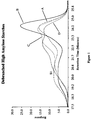
- Figure 1 illustrates the portions of the debranched sample of aedu corn starch, duh corn starch, aeae corn starch 50% apparent amylose, and aeae corn starch 70% apparent amylose as separated by size exclusion chromatography.
- the aedu starch employed in this invention may be obtained from a starch bearing plant with an amylose extender dull ( aedu ) homozygous genotype.
- the term aedu starch means not only starch obtained from a starch bearing plant that has an aedu homozygous genotype aeaedudu but also translocations, inversions and other variants that contain or that can be described as containing the aedu genotype.
- the amylose extender, ae gene had been available only as a recessive gene.
- U.S. Patent No. 5,004,864 discloses the discovery of a dominant amylose extender, AE , gene. Those of skill in the art will recognize that the dominant amylose extender gene may be used to obtain aedu starch.
- Any plant source which produces edible starch and which can be crossbred to produce a plant having an aedu homozygous genotype may be used. It has been found that maize and barley have the mutant amylose extender ( ae ) gene while the dull ( du ) gene is obtained from cereal grains such as maize, rice, barley and sorghum. Maize is the preferred plant source. The ae gene is reported to be located on chromosome 5 of the maize chromosomes. See “Development Genetics," Volume 5, 1984, pages 1-24. The dull gene is reported to be located on chromosome 10 of the maize chromosomes.
- a plant of an ae mutant is crossed with a plant having a du mutant and thereafter inbred to obtain a plant homozygous in aedu .
- standard breeding techniques are used to obtain hybrid vigor.
- Hybrids are preferred because of their high starch yield compared to inbred lines.
- seed corn is different from the corn harvested for food. The method of crossbreeding plants and of obtaining specific genotypes in the offspring as well as breeding to obtain hybrid vigor is conventional.
- aedu starch in food is disclosed in U.S. Patent No. 4,790,997 issued December 13, 1988.
- the aedu starch is taught as an additive to canned foods to act as a thin-thick starch additive. It is surprising and unexpected that aedu starch improves the texture of a pasta product or tortilla.
- duh starch employed in this invention may be obtained from a starch bearing plant with a dull horny ( duh ) homozygous genotype.
- duh starch means not only starch obtained from a starch bearing plant that has a duh homozygous genotype duduhh but also translocations, inversions and other variants that contain or that can be described as containing the duh genotype.
- Any plant source which produces edible starch and which can be crossbred to produce a plant having a duh homozygous genotype may be used.
- maize has the mutant horny ( h ) gene while the dull ( du ) gene is present in cereal grains such as maize, rice, barley and sorghum.
- Maize is the preferred plant source.
- the waxy gene is reported to be located on chromosome 9 of the maize chromosomes. See "Development Genetics," Volume 5, 1984, pages 1-24.
- the dull gene is reported to be located on chromosome 10 of the maize chromosomes while the horny gene is reported to be located on chromosome 3 in maize.
- a plant of a h mutant is crossed with a plant having a du mutant and thereafter inbred to obtain a plant homozygous in duh .
- standard breeding techniques are used to obtain hybrid vigor.
- Hybrids are preferred because of their high starch yield compared to inbred lines.
- seed corn is different from the corn harvested for food. The method of crossbreeding plants and of obtaining specific genotypes in the offspring as well as breeding to obtain hybrid vigor is conventional.
- duh starch in food is taught in U.S. Patent No. 4,774,328 issued September 27, 1988. In that patent, duh starch is taught as a canning starch in an acid environment. It is surprising and unexpected that duh starch improves the texture of a pasta product or tortilla.
- Extraction of duh starch or the aedu starch from the plant is well known and, in the case of maize, typically entails a milling process, either dry or wet. Milling techniques to extract the starch from the plant are conventional.
- the novel starch is preferably added in granular (native) form or is physically modified such as in a ground form like flour, meal or grits.
- the starch can also be a lightly chemically modified starch so long as the chemical modification does not interfere with the function of the starch in the pasta or tortilla. Good results have been obtained with the starch in either granular or flour form.
- the flour component is preferably flour and includes such flours as all-purpose flour, conventional high amylose flour and durum wheat flour. Good results have been obtained with durum wheat flour.
- the preferred flour component is corn masa.
- a dough is formed comprising the flour component, water, and an effective amount of the novel starch.
- a whole egg or egg white can be added to the dough.
- the dry components are first mixed together until they are uniformly dispersed and then the water and/or egg component is added to the dry mix; or all ingredients are mixed together to form a uniform dough.
- the amount of water and/or egg used to form the dough will vary depending on the pasta manufacturer. Generally, the amount of water used is up to about 30% by weight of farinaceous material in the dough. Egg is used in an amount up to about 70% by weight based on the weight of farinaceous material in the dough. Instead of whole egg, it is possible to use a combination of water and powdered egg. It is noted that when whole egg is used, the whole egg provides liquid to the dough.
- ingredients can be added to the dough such as flavorings, seasonings, coloring, vitamins, minerals, vegetable solids or puree and preservatives.
- the dough is shaped in any known conventional way into known conventional or unconventional shapes such as rods for spaghetti, conduits for macaroni, ribbons for noodles and pancakes for tortillas.
- the dough is cooked or dried.
- Dough shaped into a tortilla product is cooked while dough shaped into a pasta product is either dried or cooked. Drying and cooking of the shaped dough is done in any conventional manner. Typically, drying is conducted at room temperature. Cooking is done in a conventional manner using conventional equipment, in the case of a pasta product, for example, in a pot of salted boiling water for 20 minutes. After cooking, the pasta product is preferably drained and cooled.
- a tortilla product is typically cooked on a comal for about 0.5 minutes or in a gas fired oven.
- the dough is cooked for about five minutes and then cooled before mixing with sauce.
- the mixture of pasta product and sauce is then placed in a can or package for retorting.
- Such cooking is conventionally referred to as parboiling. It has been found upon heating the retorted pasta product made in accordance with the present invention that the pasta product maintains an al dente or firm texture even after heating.
- the dough is cooked for about 20 minutes and then cooled before mixing with sauce and placing in a package for freezing. It has been found upon heating the frozen pasta product made in accordance with the present invention that the pasta product maintains an al dente or firm texture even after heating. It has also been found that the pasta product made in accordance with the present invention is able to withstand the adverse condition of a steam table longer than conventional pasta formulations.
- This example illustrates making a pasta product in accordance with the present invention and comparing it to pasta made only with durum wheat flour, a mix of durum wheat flour and granular common corn starch, and a mix of durum wheat flour and conventional high amylose corn starch, 50% amylose.
- durum wheat flour In order to prepare the various pasta products, a control containing 454.00 grams of durum wheat flour and 300.00 grams of whole egg was used. In order to test the various mixes containing common corn starch, conventional high amylose corn starch, aedu corn starch and duh corn starch, a portion of the durum wheat flour was replaced with the different corn starches in amounts ranging from 10% to 50%. Table 1 below details each of the specific formulations employed.
- the common starch was a conventional common corn starch having an apparent amylose content of about 28% and a gelatinization temperature of about 70°C.
- the high amylose starch was a conventional high amylose corn starch having an apparent amylose content of about 50% and a gelatinization temperature of about 80°C.
- high amylose starch is aeae starch.
- the aedu starch was obtained from maize being homozygous in aedu and had an apparent amylose content of about 50% and a gelatinization temperature of about 70°C while the duh starch was also obtained from maize being homozygous in duh and having an apparent amylose content of about 35% and a gelatinization temperature of about 70°C.
- durum wheat flour 454.00 grams of durum wheat flour or 454.00 grams of a mixture of starch and durum wheat flour were placed into a bowl and a well was formed in the center.
- samples were mixed uniformly and then the well was formed in the center.
- 300.00 grams of egg were added and mixed slowly with a fork until moist to obtain a rough dough.
- the dough was then removed from the bowl and kneaded by hand on a tabletop surface until a uniform texture and color was achieved.
- the pasta dough was then formed into a dough ball and the dough ball was cut into thirds using a knife and was passed through a Deluxe Atlas Pasta Queen machine.
- the knob selector was regulated with each pass, starting at level one and progressing to level six. During the first pass the dough was folded in thirds, slightly dusted, and run through until a smooth dough sheet resulted. The dough sheet was then run through the machine at successively fine, higher settings. After the fifth level the dough sheet was cut in half with a knife and each was run through the sixth level. The dough sheets were slightly dusted with durum wheat flour and run through eleven 1/4" pasta blades to form the final noodle product. The pasta noodles were then separated and air dried, overnight, at room temperature. The pasta was then cooked by adding it to boiling water containing 0.50 grams of salt for 20 minutes. At the end of the cooking the pasta was drained and rinsed with cold water and tested by a taste panel consisting of five (5) panelists.
- Table 2 Sample Texture Flavor aedu, 10% tough, hard, rubbery good, better than control (BTC) aedu, 15% tough, hard, rubbery good, BTC aedu, 20% al dente, BTC appealing, lighter than control aedu, 25% al dente, BTC appealing, softer yellow than control aedu, 35% tender, soft good aedu, 50% soft, mushy good duh, 10% tough good, BTC duh, 15% tough appealing duh, 20% al dente good, BTC duh, 25% tender good, BTC duh, 35% softer than control good duh, 50% soft, mushy good common, 25% mushy gritty aeae, 50% tough starchy aeae, 50% tough starchy aeae, 50% tough starchy aeae, 50% tough starchy
- This example illustrates first cooking noodles made in accordance with Example 1 above, freezing the noodles with an alfredo sauce and then reheating the noodles and alfredo sauce in a microwave oven.
- the noodles were made in accordance with Example 1 above with the following starch formulations: 25% by weight aedu starch, 35% by weight aedu starch, 25% by weight duh starch and 35% by weight duh starch.
- Each set of noodles was cooked for 20 minutes in salted water as described in Example 1 above.
- 170.0 grams of noodles were mixed with 63.75 grams of a conventional alfredo sauce and the mixture was placed in a plastic bag and frozen at 0°C for 14 days.
- the bags of frozen noodles and alfredo sauce were heated in a microwave oven set at high power (750 watts) for four minutes.
- the noodles were tested by a taste panel that found them to be al dente with nice, firm texture and excellent mouth feel and flavor.
- This example illustrates first cooking noodles made in accordance with Example 1 above, freezing the noodles with a tomato-based sauce, i.e. an acid environment, and then reheating the noodles and tomato sauce in a microwave oven.
- a tomato-based sauce i.e. an acid environment
- the noodles were made in accordance with Example 1 above with the following starch formulations: 15% by weight aedu starch, 20% by weight aedu starch, 25% by weight aedu starch, 15% by weight duh starch, 20% by weight duh starch and 25% by weight duh starch.
- Each set of noodles was cooked for 20 minutes in salted water as described in Example 1 above.
- 100.0 grams of noodles were mixed with 90.0 grams of a conventional tomato sauce and the mixture was placed in a plastic bag and frozen at 0°C for 14 days.
- the bags of frozen noodles and tomato sauce were heated in a microwave oven set at high power (750 watts) for 2.5 minutes.
- the noodles were tested by a taste panel that found them to be al dente with nice, firm texture and excellent mouth feel and flavor.
- This example illustrates the differences between starch obtained from maize which is of the aedu genotype and duh genotype compared to conventional high amylose corn starch, aeae genotype, and common corn starch.
- Starch may be characterized as a polymer made from alpha-D-glucose monomers.
- the polymer is formed through biosynthesis in plants and, hence, is more accurately referred to as a biopolymer.
- Acetal linkages form the bonds between the monomers and there are, to date, only two known covalent bonds formed between the monomers during biosynthesis, alpha 1-4 and alpha 1-6.
- the alpha 1-6 linkage has been referred to as being a branch point for the polymer.
- amylose content as determined by an assay with iodine, i.e. apparent amylose content.
- Amylose was defined as an alpha-D-glucose polymer containing only alpha 1-4 linkages.
- Wary starch was considered to contain no measurable amylose but only amylopectin which had been defined as a polymer of alpha-D-glucose containing both alpha 1-4 and alpha 1-6 linkages.
- Common corn starch was reported to have an apparent amylose content of 27%.
- the common corn starch, aeae (50%) and aeae (70%), are conventional products.
- the aeae (50%) was a conventional high amylose corn starch having an apparent amylose content of about 50%.
- the aeae (70%) was a conventional high amylose corn starch having an apparent amylose content of about 70%.
- the gelatinization temperature is a mean value determined from a random sampling of product.
- the gelatinization temperature was measured using a scanning calorimeter manufactured by Mettler Model No. 300 using a 30% solid starch sample in sealed aluminum pans following the procedure outlined in the owner's manual for that model.
- the 99% confidence interval for the gelatinization temperature for the common starch was 68.7 to 72.7.
- the 99% confidence interval for the gelatinization temperature for the aeae (50%) and aeae (70%) respectively was 72.8 to 84.4 and 83.1 to 90.8. Both the aeae (50%) and aeae (70%) were grown in native maize.
- the gelatinization temperatures for both the duh starch and the aedu starch were averages taken for two samples of each starch.
- One sample was grown in an Ohio 43 dent corn background which was homozygous for aedu genotype while the other was from a dent corn background of W64A which was homozygous for aedu genotype.
- Both samples of duh starch were obtained from a dent corn hybrid of W64A and Ohio 43.
- Another method for characterizing the biopolymer is to analyze that portion of the polymer that is made up of only alpha 1-4 linked alpha-D-glucose. Such an analysis is done by subjecting the starch to an enzyme which hydrolyzes all alpha 1-6 linkages but has no effect on the alpha 1-4 linkages. Isoamylase is such an enzyme.
- Figure 1 illustrates the molecular weight distribution of aedu starch, duh starch, aeae (50%) and aeae (70%) after the starch has been debranched by the enzyme.
- the duh and aedu starches had a portion with a larger molecular weight than either the aeae (50%) or aeae (70%).
- the aedu and duh starches had two distinct peaks while aeae (50%) and aeae (70%) did not.
- Table 5 below lists the various molecular weights for the S1 sample: Table 5 Sample Apparent Amylose(%) % Area S1 Av. M.W. Av. D.P. aedu 47.0 45.1 170,353 1051 duh 33.3 31.1 176,921 1092 aeae (50%) 50.9 30.4 119,112 735 aeae (70%) 65.5 33.9 120,264 742 These data were developed using multiple samples on a statistical basis.
- the starches were first defatted by refluxing with an 85% methanol/water solution for 20 hours.
- the percent of apparent amylose for tables 4 and 5 was determined by using standard colorimetric iodine procedures wherein the starch is first gelatinized with sodium hydroxide and then reacted with an iodine solution and the resulting sample is measured using a spectrophotometer in a 1 cm cell at 600 nm against a blank of 2% iodine solution.
- Each starch sample was debranched by subjecting a slurry of gelatinized starch to isoamylase for a period of twenty hours under conventional conditions so as to fully hydrolyze all of the alpha 1-6 linkages.
- the poly-alpha-1-4-D-glucose was collected and subjected to high performance liquid chromatography using a size exclusion medium, specifically UltrahydrogelTM Linear.
- the HPLC-SEC was run in a conventional manner using conventional equipment to obtain the graphs shown in Figure 1 and to obtain the results reported in Table 5 above.
- graph A is the aedu corn starch
- graph B is the duh corn starch
- graph C is the aeae corn starch
- graph D is the aeae corn starch, 70% apparent amylose. Comparing the gelatinization temperatures and the graphs in Figure 1, it is apparent that the biopolymers of these four starches are different and that the iodine test for apparent amylose has no relationship to the chemical structure of the biopolymer.
- This example illustrates the difference between a corn tortilla made in accordance with the present invention and one with a conventional formulation.
- the following formulations were used: Table 6 Ingredients Present Invention (% by Weight) Conventional (% by Weight) 1 2 3 Masa 40.20 40.20 40.20 50.20 duh, granular 10.00 - - - aedu, granular - 10.00 - - aedu, flour - - 10.00 - Corn oil 2.50 2.50 2.50 2.50 Water 47.31 47.31 47.31 47.31 47.31 47.31
- the masa was conventional corn masa.
- the duh and aedu starches were obtained from corn and were in either the granular or flour form as indicated.
- the corn oil was conventional and warm water was in the formulation.
- a filling of browned, ground beef and seasonings was prepared and each tortilla was filled, sprinkled with grated cheese and placed in a freezer at 0°C for at least two weeks. After two weeks at 0°C, the frozen filled tortillas were heated in a microwave oven set at high (750 watts) for three minutes and taste tested by a panel of six testers.
- the tortilla of the present invention remained pliable and did not become soggy or mushy upon heating in the microwave.
- the filled tortillas made from the conventional formulation became soggy and mushy on the bottom and brittle and cracked where the shell was not in contact with the filling or the cheese.
- This example illustrates making lasagna noodles in accordance with the present invention and compares the noodles made in accordance with the present invention to lasagna noodles made from a conventional formulation.
- the following formulations were used: Table 7 Ingredient Present Invention (% by weight) Conventional (% by weight) 1 2 Wheat, flour 40.00 40.00 60.00 duh, granular 20.00 - - aedu, granular - 20.00 - Water 40.00 40.00 40.00
- Example 2 Using the same procedure as outlined in Example 1, about 45 grams of a dough was formed and lasagna noodles were cut from the dough. Once the noodles were formed, they were all frozen at 0°C for seven days. Using the frozen noodles and a conventional meat sauce and cheese, a lasagna was made using each of the three separate sets of noodles and then cooked in a conventional oven in a conventional manner.
- Durum wheat flour was used in the formulation while the duh and aedu starches were obtained from corn. The duh and aedu starches were in granular form.
- the cooked lasagna was tested by a taste panel and the taste panel preferred the lasagna made in accordance with the present invention to the lasagna made with conventional noodles.
- the taste panel found that the noodles made in accordance with the present invention were al dente while the conventional noodles were soft and overcooked.
- This example illustrates making a flour tortilla in accordance with the present invention and compares the flour tortilla made in accordance with the present invention to a flour tortilla made with a conventional formulation.
- the following formulation was used to make the flour tortillas: Table 8 Ingredient Present Invention (% by weight) Conventional (% by weight) 1 2 Wheat, flour 62.65 62.65 72.65 duh, granular 10.00 - - aedu, granular - 10.00 - Baking soda 1.71 1.71 1.71 Salt, NaCl 0.68 0.68 0.68 Water 24.96 24.96 24.96 24.96
- the dry components were first mixed in a Hobart mixer and then the liquid components were added and a dough was made. Tortillas were formed using 45g dough balls which were pressed into tortillas and then cooked on each side for 30 seconds using a comal.
- the wheat flour was conventional wheat flour and the baking soda and salt were also from conventional sources.
- the duh and aedu starches were from corn and in the granular form. Warm water was used in the formulation.
- a filling of browned, ground beef and seasonings was prepared and each tortilla was filled, sprinkled with grated cheese and placed in a freezer at 0°C for at least two weeks. After two weeks at 0°C, the frozen, filled tortillas were heated in a microwave oven set at high (750 watts) for 3 minutes and taste tested by a panel of six testers.
- the tortilla of the present invention remained pliable and did not become soggy or mushy upon heating.
- the filled tortillas made from the conventional formulation became soggy and mushy on the bottom and brittle and cracked where the shell was not in contact with the filling or the cheese.
Landscapes
- Life Sciences & Earth Sciences (AREA)
- Engineering & Computer Science (AREA)
- Food Science & Technology (AREA)
- Health & Medical Sciences (AREA)
- Chemical & Material Sciences (AREA)
- Nutrition Science (AREA)
- Polymers & Plastics (AREA)
- Molecular Biology (AREA)
- Dispersion Chemistry (AREA)
- Noodles (AREA)
Applications Claiming Priority (2)
| Application Number | Priority Date | Filing Date | Title |
|---|---|---|---|
| US08/045,556 US5397586A (en) | 1993-04-09 | 1993-04-09 | Pasta products |
| US45556 | 1993-04-09 |
Publications (3)
| Publication Number | Publication Date |
|---|---|
| EP0619080A2 true EP0619080A2 (fr) | 1994-10-12 |
| EP0619080A3 EP0619080A3 (fr) | 1995-05-24 |
| EP0619080B1 EP0619080B1 (fr) | 1998-05-27 |
Family
ID=21938596
Family Applications (1)
| Application Number | Title | Priority Date | Filing Date |
|---|---|---|---|
| EP94102945A Expired - Lifetime EP0619080B1 (fr) | 1993-04-09 | 1994-02-26 | Pâtes ou tortillas contenant de l'amidon de type AEDU ou DUH |
Country Status (5)
| Country | Link |
|---|---|
| US (1) | US5397586A (fr) |
| EP (1) | EP0619080B1 (fr) |
| AU (1) | AU655734B2 (fr) |
| CA (1) | CA2115410C (fr) |
| DE (1) | DE69410517D1 (fr) |
Families Citing this family (10)
| Publication number | Priority date | Publication date | Assignee | Title |
|---|---|---|---|---|
| US5924706A (en) * | 1997-07-10 | 1999-07-20 | Roller Cerby Skate Corporation | Skate boot construction |
| US5928693A (en) * | 1997-11-14 | 1999-07-27 | Cerestar Holding B.V. | Clear coat composition for potato products and method of making |
| US6217918B1 (en) | 1998-05-08 | 2001-04-17 | Bestfoods | Microwavable pasta in a bowl |
| US6175105B1 (en) | 1998-10-02 | 2001-01-16 | Bestfoods | Container for microwave cooking of food products containing liquids |
| USD426427S (en) * | 1998-10-02 | 2000-06-13 | Bestfoods | Bowl |
| US6830767B2 (en) | 2000-05-27 | 2004-12-14 | The Procter & Gamble Co. | Method for constrain-frying snack pieces having intact surface features |
| US6572910B2 (en) | 2000-05-27 | 2003-06-03 | The Procter & Gamble Co. | Process for making tortilla chips with controlled surface bubbling |
| US20040091596A1 (en) * | 2002-11-13 | 2004-05-13 | Steve Schellhaass | Food product and method of manufacture |
| US20060246188A1 (en) * | 2005-04-27 | 2006-11-02 | Conagra Grocery Products Company, A Delaware Corporation | Method for preparing tomato sauce using convective heating and sauce and pasta products produced thereby |
| CN103169018A (zh) * | 2011-12-22 | 2013-06-26 | 日清富滋株式会社 | 冷冻烹调过的面食类的制造方法 |
Family Cites Families (8)
| Publication number | Priority date | Publication date | Assignee | Title |
|---|---|---|---|---|
| US4575460A (en) * | 1983-10-25 | 1986-03-11 | Fejer Megyei Gabonaforgalmi Es Malomipari Vallalat | Process for preparing farinaceous pasta products |
| US4590084A (en) * | 1984-02-08 | 1986-05-20 | National Starch And Chemical Corporation | Retorted paste products containing high amylose starch |
| US4740997A (en) * | 1985-08-05 | 1988-04-26 | Hayes Microcomputer Products, Inc. | Band clock offset phase locked loop |
| US4774328A (en) * | 1987-07-02 | 1988-09-27 | American Maize-Products Company | Starch of the duh genotype and products produced therefrom |
| US4790997A (en) * | 1987-07-02 | 1988-12-13 | American Maize-Products Company | Food stuffs containing starch of an amylose extender dull genotype |
| US5004864A (en) * | 1988-11-28 | 1991-04-02 | Iowa State University Research Foundation, Inc. | Dominant amylose-extender mutant of maize |
| US5164215A (en) * | 1989-08-11 | 1992-11-17 | Furcsik Susan L | Batter starch for deep fat fried food |
| US5120562A (en) * | 1989-08-11 | 1992-06-09 | American Maize-Products Company | Aedu batter starch for deep fat fried food |
-
1993
- 1993-04-09 US US08/045,556 patent/US5397586A/en not_active Expired - Fee Related
-
1994
- 1994-02-10 CA CA002115410A patent/CA2115410C/fr not_active Expired - Fee Related
- 1994-02-14 AU AU55099/94A patent/AU655734B2/en not_active Ceased
- 1994-02-26 DE DE69410517T patent/DE69410517D1/de not_active Expired - Lifetime
- 1994-02-26 EP EP94102945A patent/EP0619080B1/fr not_active Expired - Lifetime
Also Published As
| Publication number | Publication date |
|---|---|
| EP0619080A3 (fr) | 1995-05-24 |
| EP0619080B1 (fr) | 1998-05-27 |
| CA2115410A1 (fr) | 1994-10-10 |
| AU655734B2 (en) | 1995-01-05 |
| US5397586A (en) | 1995-03-14 |
| DE69410517D1 (de) | 1998-07-02 |
| CA2115410C (fr) | 1999-02-16 |
| AU5509994A (en) | 1994-10-13 |
Similar Documents
| Publication | Publication Date | Title |
|---|---|---|
| AU657443B2 (en) | Food compositions including resistant starch | |
| Kadan et al. | Texture and other physicochemical properties of whole rice bread | |
| US4526800A (en) | Cereal snackfoods and compositions and methods for making the same | |
| EP0987949B1 (fr) | Sous-produit cerealier broye constituant un additif pour la farine et la pate | |
| EP0531743B1 (fr) | Pâte alimentaire gelée | |
| EP0154039B1 (fr) | Pâte ayant une teneur élevée en amidon d'amylose pour produits cuisinés | |
| KR20080002682A (ko) | 전립 함유 복합 식품의 제조 | |
| CN1832689B (zh) | 米粉组合物 | |
| US5759607A (en) | Use of propylene glycol aliginate to improve the texture of cooked pasta and pasta-like foods | |
| HU222376B1 (hu) | Gyorsan rehidratálódni képes, dehidratált élelmiszertermék és eljárás előállítására | |
| EP0619080B1 (fr) | Pâtes ou tortillas contenant de l'amidon de type AEDU ou DUH | |
| JP2022078983A (ja) | 電子レンジ対応冷凍包餡食品及びその方法 | |
| US6042867A (en) | Flour blends for breads, cakes, or noodles, and foods prepared from the flour blends | |
| CA2243051A1 (fr) | Methode de prevention de la retrogradation de l'amidon dans les pates | |
| KR101139861B1 (ko) | 빵류 및 그 제조법 | |
| US6139894A (en) | Flour blends for deep fried foods, steamed Chinese manju, dough sheets, okonomi-yaki, and takoyaki | |
| China et al. | Functional and pasting properties of wheat and cooking banana flour blends and their utilization in cookies production | |
| JP7337074B2 (ja) | パスタ類の製造方法 | |
| WO2024204672A1 (fr) | Procédé de production de farine de céréales traitée thermiquement | |
| EP0369175B1 (fr) | Utilisation d'une protéine fonctionnelle pour la préparation d'un produit réfrigéré | |
| US6277421B1 (en) | Food product comprising masa flavored flour | |
| KR101723074B1 (ko) | 파보일드라이스 고형물의 제조방법 | |
| JPH0436140A (ja) | 電子レンジ加熱用の調理パンのバンズ | |
| Alhusaini | Modification of rice flour and its potential use in the food industry | |
| KR20240007803A (ko) | 무 분말이 함유된 다이어트용 쌀국수 용기면의 제조방법 |
Legal Events
| Date | Code | Title | Description |
|---|---|---|---|
| PUAI | Public reference made under article 153(3) epc to a published international application that has entered the european phase |
Free format text: ORIGINAL CODE: 0009012 |
|
| AK | Designated contracting states |
Kind code of ref document: A2 Designated state(s): DE FR GB IT |
|
| 17P | Request for examination filed |
Effective date: 19940906 |
|
| PUAL | Search report despatched |
Free format text: ORIGINAL CODE: 0009013 |
|
| AK | Designated contracting states |
Kind code of ref document: A3 Designated state(s): DE FR GB IT |
|
| 17Q | First examination report despatched |
Effective date: 19960703 |
|
| GRAG | Despatch of communication of intention to grant |
Free format text: ORIGINAL CODE: EPIDOS AGRA |
|
| GRAG | Despatch of communication of intention to grant |
Free format text: ORIGINAL CODE: EPIDOS AGRA |
|
| RAP1 | Party data changed (applicant data changed or rights of an application transferred) |
Owner name: CERESTAR USA, INC. |
|
| GRAG | Despatch of communication of intention to grant |
Free format text: ORIGINAL CODE: EPIDOS AGRA |
|
| GRAH | Despatch of communication of intention to grant a patent |
Free format text: ORIGINAL CODE: EPIDOS IGRA |
|
| GRAH | Despatch of communication of intention to grant a patent |
Free format text: ORIGINAL CODE: EPIDOS IGRA |
|
| GRAH | Despatch of communication of intention to grant a patent |
Free format text: ORIGINAL CODE: EPIDOS IGRA |
|
| GRAA | (expected) grant |
Free format text: ORIGINAL CODE: 0009210 |
|
| AK | Designated contracting states |
Kind code of ref document: B1 Designated state(s): DE FR GB IT |
|
| PG25 | Lapsed in a contracting state [announced via postgrant information from national office to epo] |
Ref country code: IT Free format text: LAPSE BECAUSE OF FAILURE TO SUBMIT A TRANSLATION OF THE DESCRIPTION OR TO PAY THE FEE WITHIN THE PRE;WARNING: LAPSES OF ITALIAN PATENTS WITH EFFECTIVE DATE BEFORE 2007 MAY HAVE OCCURRED AT ANY TIME BEFORE 2007. THE CORRECT EFFECTIVE DATE MAY BE DIFFERENT FROM THE ONE RECORDED.SCRIBED TIME-LIMIT Effective date: 19980527 Ref country code: FR Free format text: LAPSE BECAUSE OF FAILURE TO SUBMIT A TRANSLATION OF THE DESCRIPTION OR TO PAY THE FEE WITHIN THE PRESCRIBED TIME-LIMIT Effective date: 19980527 |
|
| REF | Corresponds to: |
Ref document number: 69410517 Country of ref document: DE Date of ref document: 19980702 |
|
| PG25 | Lapsed in a contracting state [announced via postgrant information from national office to epo] |
Ref country code: DE Free format text: LAPSE BECAUSE OF FAILURE TO SUBMIT A TRANSLATION OF THE DESCRIPTION OR TO PAY THE FEE WITHIN THE PRESCRIBED TIME-LIMIT Effective date: 19980828 |
|
| EN | Fr: translation not filed | ||
| PG25 | Lapsed in a contracting state [announced via postgrant information from national office to epo] |
Ref country code: GB Free format text: LAPSE BECAUSE OF NON-PAYMENT OF DUE FEES Effective date: 19990226 |
|
| PLBE | No opposition filed within time limit |
Free format text: ORIGINAL CODE: 0009261 |
|
| STAA | Information on the status of an ep patent application or granted ep patent |
Free format text: STATUS: NO OPPOSITION FILED WITHIN TIME LIMIT |
|
| 26N | No opposition filed | ||
| GBPC | Gb: european patent ceased through non-payment of renewal fee |
Effective date: 19990226 |