EP0619280A2 - Polymetalosilazane, procédé de sa fabrication, céramique à base de nitrure de silicium et procédé de sa fabrication - Google Patents
Polymetalosilazane, procédé de sa fabrication, céramique à base de nitrure de silicium et procédé de sa fabrication Download PDFInfo
- Publication number
- EP0619280A2 EP0619280A2 EP94302464A EP94302464A EP0619280A2 EP 0619280 A2 EP0619280 A2 EP 0619280A2 EP 94302464 A EP94302464 A EP 94302464A EP 94302464 A EP94302464 A EP 94302464A EP 0619280 A2 EP0619280 A2 EP 0619280A2
- Authority
- EP
- European Patent Office
- Prior art keywords
- group
- solvent
- metal
- polymetalosilazane
- set forth
- Prior art date
- Legal status (The legal status is an assumption and is not a legal conclusion. Google has not performed a legal analysis and makes no representation as to the accuracy of the status listed.)
- Granted
Links
Images



Classifications
-
- D—TEXTILES; PAPER
- D01—NATURAL OR MAN-MADE THREADS OR FIBRES; SPINNING
- D01F—CHEMICAL FEATURES IN THE MANUFACTURE OF ARTIFICIAL FILAMENTS, THREADS, FIBRES, BRISTLES OR RIBBONS; APPARATUS SPECIALLY ADAPTED FOR THE MANUFACTURE OF CARBON FILAMENTS
- D01F9/00—Artificial filaments or the like of other substances; Manufacture thereof; Apparatus specially adapted for the manufacture of carbon filaments
- D01F9/08—Artificial filaments or the like of other substances; Manufacture thereof; Apparatus specially adapted for the manufacture of carbon filaments of inorganic material
- D01F9/10—Artificial filaments or the like of other substances; Manufacture thereof; Apparatus specially adapted for the manufacture of carbon filaments of inorganic material by decomposition of organic substances
-
- C—CHEMISTRY; METALLURGY
- C04—CEMENTS; CONCRETE; ARTIFICIAL STONE; CERAMICS; REFRACTORIES
- C04B—LIME, MAGNESIA; SLAG; CEMENTS; COMPOSITIONS THEREOF, e.g. MORTARS, CONCRETE OR LIKE BUILDING MATERIALS; ARTIFICIAL STONE; CERAMICS; REFRACTORIES; TREATMENT OF NATURAL STONE
- C04B35/00—Shaped ceramic products characterised by their composition; Ceramics compositions; Processing powders of inorganic compounds preparatory to the manufacturing of ceramic products
- C04B35/515—Shaped ceramic products characterised by their composition; Ceramics compositions; Processing powders of inorganic compounds preparatory to the manufacturing of ceramic products based on non-oxide ceramics
- C04B35/58—Shaped ceramic products characterised by their composition; Ceramics compositions; Processing powders of inorganic compounds preparatory to the manufacturing of ceramic products based on non-oxide ceramics based on borides, nitrides, i.e. nitrides, oxynitrides, carbonitrides or oxycarbonitrides or silicides
- C04B35/584—Shaped ceramic products characterised by their composition; Ceramics compositions; Processing powders of inorganic compounds preparatory to the manufacturing of ceramic products based on non-oxide ceramics based on borides, nitrides, i.e. nitrides, oxynitrides, carbonitrides or oxycarbonitrides or silicides based on silicon nitride
- C04B35/589—Shaped ceramic products characterised by their composition; Ceramics compositions; Processing powders of inorganic compounds preparatory to the manufacturing of ceramic products based on non-oxide ceramics based on borides, nitrides, i.e. nitrides, oxynitrides, carbonitrides or oxycarbonitrides or silicides based on silicon nitride obtained from Si-containing polymer precursors or organosilicon monomers
-
- C—CHEMISTRY; METALLURGY
- C08—ORGANIC MACROMOLECULAR COMPOUNDS; THEIR PREPARATION OR CHEMICAL WORKING-UP; COMPOSITIONS BASED THEREON
- C08G—MACROMOLECULAR COMPOUNDS OBTAINED OTHERWISE THAN BY REACTIONS ONLY INVOLVING UNSATURATED CARBON-TO-CARBON BONDS
- C08G77/00—Macromolecular compounds obtained by reactions forming a linkage containing silicon with or without sulfur, nitrogen, oxygen or carbon in the main chain of the macromolecule
- C08G77/60—Macromolecular compounds obtained by reactions forming a linkage containing silicon with or without sulfur, nitrogen, oxygen or carbon in the main chain of the macromolecule in which all the silicon atoms are connected by linkages other than oxygen atoms
- C08G77/62—Nitrogen atoms
-
- C—CHEMISTRY; METALLURGY
- C08—ORGANIC MACROMOLECULAR COMPOUNDS; THEIR PREPARATION OR CHEMICAL WORKING-UP; COMPOSITIONS BASED THEREON
- C08G—MACROMOLECULAR COMPOUNDS OBTAINED OTHERWISE THAN BY REACTIONS ONLY INVOLVING UNSATURATED CARBON-TO-CARBON BONDS
- C08G79/00—Macromolecular compounds obtained by reactions forming a linkage containing atoms other than silicon, sulfur, nitrogen, oxygen, and carbon with or without the latter elements in the main chain of the macromolecule
Definitions
- This invention relates to a low oxygen content polymetalosilazane and to a process of producing same.
- the present invention also pertains to a metal-containing silicon nitride ceramic and to a process of preparing same.
- Ceramic fibers have been attracting much attention for their favorable properties such as high mechanical strengths and resistance to heat and chemicals and will find use for a variety of applications as reinforcing materials for various composite articles such as engine parts, fan blades and aircraft structures.
- US-A-4,886,860 discloses a process of preparing a polymetalosilazane wherein a polysilazane having a number molecular weight of 100-50,000 and having a skeleton consisting essentially of units of the following general formula: wherein R1, R2 and R3 is independently selected from hydrogen, an alkyl group, an alkenyl group, a cycloalkyl group, an aryl group, a group other than the above-mentioned groups in which the atom bonded directly to the silicon atom is a carbon atom, an alkylsilyl group, an alkylamino group and an alkoxy group is reacted with a metal alkoxide of the formula: M(OR4) n wherein M is a metal selected from those of groups IIA and III through V of the Periodic Table, R4 is hydrogen, an alkyl having 1-20 carbon atoms or an aryl and n is the valence of the metal M with the proviso that at least
- the polymetalosilazane obtained by the above method unavoidably contains oxygen derived from the metal alkoxide.
- the oxygen introduced into the polymer is converted into SiO gas during the calcining stage so that small pores or gaps are apt to be formed in the ceramic product, which adversely affects the mechanical strengths and heat resistance of the ceramic.
- US-A-4,730,026 discloses a polymetalosilazane which is obtained by reacting a silazane with an oxygen-free metal compound such as an alkyl metal or a metal halide and in which the silazane is cross-linked with, for example, -MR- linkages. a ceramic body obtained therefrom.
- the polymetalosilazane obtained using the oxygen free metal compound gives a ceramic having a low oxygen content.
- the above method is not practical and requires much costs because the metal compound is dangerous.
- a silicon nitride ceramic containing Si, N, at least one metal M which is selected from those of the groups IIa, IIIa, IIIb, IVa IVb, Va and Vb of the Periodic Table, O and C in amounts providing the following atomic ratios: N/Si : 0.05 to 3, M/Si : 0.05 to 3, O/M : 1 or less, and C/Si : 1 or less said ceramic being amorphous when calcined at 1,600°C for 10 hours in the atmosphere of an inert gas and having a three-point bending strength of at least 2 MPa.
- the present invention provides a silicon nitride ceramic fiber containing Si, N, at least one metal M which is selected from those of the groups IIa, IIIa, IIIb, IVa IVb, Va and Vb of the Periodic Table, O and C in amounts providing the following atomic ratios: N/Si : 0.05 to 3, M/Si : 0.05 to 3, O/M : 1 or less, and C/Si : 1 or less said ceramic fiber being amorphous when calcined at 1,500°C for 1 hour in the atmosphere of an inert gas and having a tensile strength of at least 100 kg/mm2.
- the present inention provides a process of producing a silicon nitride ceramic, comprising the steps of: reacting a polysilazane with a metal alkoxide of the formula: M(OR3) n wherein M is as defined above, R3 is hydrogen, an alkyl group having 1-20 carbon atoms or an aryl group and n is the valence of the metal M with the proviso that at least one of the n number of the R3 is the alkyl group or aryl group, in the presence of a silicon compound represented by the following general formula: wherein R4, R5, R6 and R7, independently from each other, represent hydrogen, a hydrocarbyl group, a substituted hydrocarbyl group, an alkylsilyl group, an alkylamino group, an alkoxy group, -SR8 where R8 represents hydrogen or an alkyl group or -SR9R10R11 where R9, R10 and R11, independently from each other, represent hydrogen or an alky
- the present invention also provides a process of producing a polymetalosilazane, comprising reacting a polysilazane with a metal alkoxide of the formula: M(OR3) n wherein M is as defined above, R3 is hydrogen, an alkyl group having 1-20 carbon atoms or an aryl group and n is the valence of the metal M with the proviso that at least one of the n number of the R3 is the alkyl group or aryl group, in the presence of a silicon compound represented by the following general formula: wherein R4, R5, R6 and R7, independently from each other, represent hydrogen, a hydrocarbyl group, a substituted hydrocarbyl group, an alkylsilyl group, an alkylamino group, an alkoxy group, -SR8 where R8 represents hydrogen or an alkyl group or -SR9R10R11 where R9, R10 and R11, independently from each other, represent hydrogen or an alkyl group.
- M is as defined
- the present invention provides a polymetalosilazane obtained by the above method.
- the ceramic according to the present invention contains Si, N and at least one metal M. It is important that the amount of Si, N and M should be such as to provide the following atomic ratios: N/Si : 0.05 to 3, M/Si : 0.05 to 3, O/M : 1 or less, and C/Si : 1 or less.
- N/Si 0.05 to 3
- M/Si 0.05 to 3
- O/M 1 or less
- a proportion of the metal M below the above specified range causes reduction of the mechanical strengths and heat resistance of the ceramics. Too large an amount of the metal M in excess of the above specified range is disadvantage because the substance is no longer a ceramic.
- Preferred atomic ratios are as follows: N/Si : 0.05 to 2 M/Si : 0.05 to 1 O/M : 0.5 or less C/Si : 0.2 or less
- the metal M is preferably at least one element selected from those of the groups IIa, IIIa, IIIb, IVa IVb, Va and Vb of the Periodic Table.
- suitable metals are Be, Mg, Ca, Sr, Ba, Sc, Y, lanthanoid elements, actinoid elements, B, Al, Ga, In, Tl, Ti, Zr, Hf, Ge, Sn, Pb, V, Nb, Ta, As, Sb, and Bi. Above all, Y, B, Al, Ti and Zr are especially preferred.
- the ceramic according to the present invention is characterized by high mechanical strengths and high heat resistance.
- the three-point bending strength thereof is at least 2 MPa.
- the tensile strength is at least 100 kgf/mm2.
- the shaped ceramic bodies retains their amorphous state and high mechanical strength even after being subjected to a high temperature.
- a ceramic plate according to the present invention remains amorphous even when heated at 1,600°C for 10 hours in the atmosphere of an inert gas and a ceramic fiber of the present invention remains amorphous when heated at 1,500°C for 1 hour.
- the presence of the metal in the ceramic serves to prevent the formation of crystals so that the ceramic remains amorphous even when subjected to such a high temperature as to be favorable for the formation of crystals.
- the formation of crystals in the amorphous ceramic bodies adversely affect the mechanical strengths and heat resistance thereof.
- the fact that the ceramic has low oxygen and carbon contents means that the preceramic polymer from which the ceramic has been prepared, too, has low oxygen and carbon contents. Since the oxygen and carbon contained in the preceramic polymer are converted into SiO, CO and CO2 gases when heated at a temperature of 1,200°C, fine pores or gaps are apt to be formed in the ceramic body obtained by calcination thereof.
- the polymetalosilazane is produced by reacting a polysilazane with a metal alkoxide of the formula (II): M(OR3) n (II) wherein M is as defined above, R3 is hydrogen, an alkyl group having 1-20 carbon atoms or an aryl group and n is the valence of the metal M with the proviso that at least one of the n number of the R3 is the alkyl group or aryl group, in the presence of a silicon compound represented by the following general formula (III): wherein R4, R5, R6 and R7, independently from each other, represent hydrogen, a hydrocarbyl group, a substituted hydrocarbyl group, an alkylsilyl group, an alkylamino group, an alkoxy group, -SR8 where R8 represents hydrogen or an alkyl group or -SR9R10R11 where R9, R10 and R11, independently from each other, represent hydrogen or an alkyl group.
- the polysilazane preferably has a number average molecular weight of 100-500,000 and a main skeletal structure containing the followinq recurrinq unit (I): wherein R1 and R2, independently from each other, represent hydrogen, a hydrocarbyl group, a substituted hydrocarbyl group, an alkylsilyl group, an alkylamino group or an alkoxy group,
- the hydrocarbyl group of R1, R2, R4, R5, R6 and R7 is an alkyl, alkenyl, an aryl, a cycloalkyl or aralkyl.
- substituents R1 and R2 of the polysilazane of the formula (I) include hydrogen, an alkyl group having 1-5 carbon atoms, an alkenyl group having 2-6 carbon atoms, a cycloalkyl group having 5-7 carbon atoms, an aryl group, an alkylsilyl group having 1-4 carbon atoms, an alkyl amino group having 1-5 carbon atoms and an alkoxy group having 1-5 carbon atoms.
- substituent R3 of the metal alkoxide of the formula (II) examples include hydrogen, a methyl group, a n-propyl group, an i-propyl group, a n-butyl group, an i-butyl group, a t-butyl group, a phenyl group, a benzyl group and a tolyl group.
- the amount of the metal alkoxide relative to the polysilazane is preferably such as to provide an atomic ratio M/Si of 0.001-60, more preferably 0.01-5, most preferably 0.05-2.5.
- suitable silicon compound of the formula (III) examples include alkyl silazanes such as trimethylsilylamine ((CH3)3SiNH2), trimethyldimethylsilylamine ((CH3)3SiN(CH3)2) and dimethylsilylamine ((CH3)2SiHNH2); alkyldisilazanes such as hexamethyldisilazane ((CH3)3SiNHSi(CH3)3), heptamethyldisilazane ((CH3)3SiNCH3Si(CH3)3) and tetramethyldisilazane ((CH3)2SiHNHSiH(CH3)2); alkylhalosilanes such as trimethylchlorosilane ((CH3)3SiCl), dichlorosilane (SiH2Cl2), dimethyldichlorosilane ((CH3)2SiCl2), monomethylchlorosilane ((CH3)SiHCl2), trimethylbromosilane
- the alkyl groups of the silicon compounds are suitably lower alkyl groups such as a methyl group.
- the silicon compound (III) is preferably used in an amount of at least 1 mole per mole of the polysilazane (I), more preferably in an amount of at least n (which equals the valence of the metal M of the metal alkoxide) moles per mole of the metal alkoxide (II).
- the reaction for the formation of the polymetalosilazane is preferably performed using an inert solvent such as an aromatic hydrocarbon, an aliphatic hydrocarbon, an alicyclic hydrocarbon, a halogenated hydrocarbon, an aliphatic ether or an alicyclic ether.
- an inert solvent such as an aromatic hydrocarbon, an aliphatic hydrocarbon, an alicyclic hydrocarbon, a halogenated hydrocarbon, an aliphatic ether or an alicyclic ether.
- suitable solvents are benzene, toluene, xylene, methylene chloride, chloroform, n-hexane, ethyl ether and tetrahydrofuran.
- the reaction is preferably performed at a temperature of not higher than 400°C for reasons of preventing the formation of a gel by the decomposition of the polymetalosilazane.
- the reaction is generally performed at ambient pressure for 30 minutes to 24 hours. A reaction time longer than 24 hours can increase the molecular weight of the polymetalosilazane.
- the reaction be performed in the atmosphere of an inert gas such as nitrogen or argon.
- the unreacted metal alkoxide can be separated from the polymetalosilazane product by vacuum distillation or liquid chromatography.
- an alcohol is produced together with the polymetalosilazane as follows:
- the thus produced alcohol R3OH readily reacts with the raw material polysilazane or the polymetalosilazane to cleave the skeletal chain thereof with the simultaneous introduction of alkoxide groups -OR3 into the cleaved cites, for example, as follows:
- the presence of the silicon compound of the formula (III) can effectively prevent the cleavage of the polysilazane and polymetalosilazane polymer chains and the introduction of the oxygen (as Si-O-R3) into the polymetalosilazane.
- the polymetalosilazane thus obtained by the process of the present invention is substantially free of Si-O bonds.
- the polymetalosilazane has a number average molecular weight of 200-500,000, more preferably 400-300,000 and an M/Si atomic ratio of 0.001-3, more preferably 0.01-2.0. Since the polymetalosilazane is generally soluble in a solvent, it is easy to obtain a shaped ceramic body such as a plate, block, cylinder, pipe or fiber. Further, the polymetalosilazane does not need an infusiblization treatment such as oxidation, so that it is possible to obtain a ceramic product having a low oxygen content.
- the preceramic polymetalosilazane is shaped into a desired form and calcined to obtain a shaped ceramic body.
- an additive such as a hardening agent or ceramic powder may be mixed with the preceramic polymer.
- suitable hardening agent include organic amines such as alkylamines and alkylene diamines; acid anhydrides such as oxalic anhydride and malonic anhydride; isocyanates such as alkylisocyanates and dimethylsilyldiisocyanate; thiols such as butane dithiol and benzene dithiol; imides such as malonimide and succinimide; metal alkoxides such as alkoxides of metals of groups IIa and III-V of the Periodic Table; and metal halides such as those of iron, cobalt, nickel, copper, silver, gold, mercury, zinc, ruthenium, paradium, indium, titanium, hafnium, zirconium,
- the preceramic polymer is dissolved in a suitable solvent such as a hydrocarbon, a halogenated hydrocarbon or an ether and the solution is filled in a mold cavity. The solution is then heated under atmospheric pressure or under a reduced pressure to remove the solvent, thereby to form a shaped body.
- a suitable solvent such as a hydrocarbon, a halogenated hydrocarbon or an ether
- the preceramic polymer in the form a solid is directly filled in a mold cavity and heated from room temperature to a temperature of 400°C at maximum at a pressure of up to 10 atm.
- the polymer is directly filled in a mold cavity and heated from room temperature to a temperature of 400°C at maximum under a reduced pressure or at a pressure of up to 10 atm.
- the molding of the preceramic polymer may be performed in the atmosphere of an inert gas such as nitrogen or argon, a reducing gas such as ammonia, hydrogen, methylamine or hydrazine, an oxidizing gas such as air, oxygen or ozone, or a mixed gas thereof.
- an inert gas such as nitrogen or argon
- a reducing gas such as ammonia, hydrogen, methylamine or hydrazine
- an oxidizing gas such as air, oxygen or ozone, or a mixed gas thereof.
- a mold releasing agent such as a silicone-based agent or a grease may be applied to the inside surface of the mold.
- the preceramic polymer according to the present invention may be shaped into fibers by spinning through a nozzle.
- the polymer is dissolved in a suitable solvent and the solution is concentrated in vacuo until a suitable viscosity is reached.
- the amount of the polymetalosilazane in the solution is not critical as long as the solution can exhibit a suitable spinnability. Generally, however, a concentration of 50-98 % by weight gives good results. Optimum concentration varies with the number average molecular weight, molecular weight distribution and molecular structure of the polymetalosilazane.
- the spinning solution is desirably subjected to defoaming, filtration and other treatments for the removal of gels and foreign matters which will adversely affect the spinnability.
- the spinning is advantageously effected by a dry spinning method.
- centrifugal or blow spinning methods can be adopted.
- dry spinning the solution is discharged through a spinning nozzle to a cylinder and the spun fibers are continuously wound around a roll.
- the nozzle diameter, spinning speed and winding speed vary with the property of the spinning solution and with the intended diameter of the spun fibers.
- a nozzle diameter of 0.035-0.5 mm, preferably 0.05-0.3 mm and a winding speed of 30-5000 m/minute, preferably 60-2500 m/minute are generally used.
- the inside of the cylinder into which the fibers are discharged from the spinning nozzle can be maintained in any desired atmosphere such as air. It is, however, preferable to maintain the inside of the cylinder in a dried air atmosphere, an ammoniacal atmosphere or an inert gas atmosphere for the purpose of controlling the infusiblization and solidification of the spun fibers.
- the spinning solution is generally maintained at a temperature of 10°-300°C and the temperature within the cylinder is generally held at a temperature of 20-300°C.
- the polymetalosilazane may also be shaped into a film by coating a solution thereof onto a surface of a metal or a ceramic and, then, drying the coating by evaporation of the solvent.
- the thus obtained shaped body of the polymetalosilazane is then pyrolyzed or calcined at temperatures of 400-1,800°C to form a ceramic body.
- the pyrolysis is preferably carried out in the atmosphere of an inert gas such as described above, a reducing gas such as described above or a mixture thereof, or under vacuum.
- a heating rate of 20°C/minute or less, more preferably 5°C/minute or less is used for the heating of the shaped body from 400°C to 1,800°C.
- the pyrolysis is further continued at that temperature for 48 hours or less. If desired, pyrolysis is performed under pressure using a hot press.
- the ceramic body obtained by the pyrolysis may be impregnated with a solution of the polymetalosilazane and calcined again. It is advisable to maintain the pyrolysis temperature not higher than 1,800°C for avoiding the formation of crystals.
- the elementary analysis was performed with ICP (inductive coupled plasma emission spectroscope) for the determination of Si and M, a nitrogen-oxygen simultaneous analyzer (EM6A-2800 manufactured by Horiba Inc.) for N and O and a carbon-hydrogen-nitrogen simultaneous analyzer (CHN Rapid Analyzer manufactured by Helaus Inc.).
- ICP inductive coupled plasma emission spectroscope
- E6A-2800 nitrogen-oxygen simultaneous analyzer
- CHN Rapid Analyzer manufactured by Helaus Inc.
- the crystalophase of ceramics was determined by the X-ray diffraction analysis. Before analysis, the sample was ground into particles having a particle size of in the range of 10-100 ⁇ m and the ground powder was heated at 1,600°C for 10 hours in the atmosphere of nitrogen.
- the three-point bending strength was measured with a universal tester with a spun of 10 mm and a load applying speed of 1 mm/minute.
- the sample had a sectional area of 4-7 mm2.
- the tensile strength was measured with an autograph (AG-2000C manufactured by Shimadzu Seisakusho Ltd.)
- the polymethyl(hydro)silazane thus obtained was found to have a number-average molecular weight of 1,060.
- the infrared spectrum of this polymer (solvent: dry o-xylene; concentration of the polymethyl(hydro)silazane: 43.2 g/ liter) is shown in Fig. 14.
- the cryoscopic method using dry benzene as a solvent revealed that the polyborosilazane had a number-average molecular weight of 1,550.
- the infrared spectrum of this polymer (solvent: dry benzene) is shown in Fig. 16.
- the elementary analysis of the polymer gave the following results (in terms of % by weight): Si: 43.9, N: 24.7, C: 9.8, O: 10.6, H: 6.8, B: 4.2
- the cryoscopic method using dry benzene as a solvent revealed that the polyborosilazane had a number-average molecular weight of 1,350.
- the infrared spectrum of this polymer (solvent: dry benzene) is shown in Fig. 17.
- the elementary analysis of the polymer gave the following results (in terms of % by weight): Si: 34.5, N: 19.8, C: 25.5, O: 11.5, H: 5.5, B: 3.2
- the cryoscopic method using dry benzene as a solvent revealed that the polyzirconosilazane had a number-average molecular weight of 1,750.
- the infrared spectrum of this polymer (solvent: dry benzene) is shown in Fig. 23.
- the elementary analysis of the polymer gave the following results (in terms of % by weight): Si: 28.0, N: 13.5, C: 27.5, O: 9.0, H: 5.4, Zr: 14.6
- the cryoscopic method using dry benzene as a solvent revealed that the polyborosilazane had a number-average molecular weight of 1,810.
- the infrared spectrum of this polymer (solvent: dry benzene) is shown in Fig. 1.
- No absorption peak based on Si-O is observed at 1,100 cm ⁇ 1.
- the elementary analysis of the polymer gave the following results (in terms of % by weight): Si: 46.3, N: 28.3, C: 9.6, O: 3.8, H: 7.5, B: 4.5
- Part of the thus obtained polyborosilazane was dissolved in toluene and the solution was adjusted to a predetermined concentration. The solution was then poured into a mold cavity of a mold formed of a tetrafluoroethylene. Then the solvent was removed at 200°C under a nitrogen stream to obtain a transparent shaped mass having a size of 20 mm ⁇ x 10 mm. This was heated to 1,000°C in the atmosphere of ammonia at a heating rate of 1°C/min and then to 1,600°C in a nitrogen atmosphere at a heating rate of 10°C/min, and further maintained at that temperature for 10 hours, thereby obtaining white, disk-like ceramic body.
- polyborosilazane Another part of the polyborosilazane obtained above was processed to obtain ceramic fibers.
- the polyborosilazane was dissolved in xylene and the solvent was removed in vacuo. The removal of the solvent was stopped when the solution had desired spinnability.
- the resultant solution was charged in a defoaming vessel of a dry-spinning device and maintained in quiescent state at 60°C for about 2 hours to effect defoaming.
- the solution was injected at 30°C through a nozzle having a nozzle diameter of 0.1 mm into a cylinder maintained at 130°C under ambient dry air, and the spun fiber was taken up at a speed of 300 m/min on a bobbin, thereby obtaining a fiber having an average diameter of 12 ⁇ m.
- this fiber was heated from room temperature to 1,000°C at a heating rate of 1°C/min in an ammoniacal atmosphere and then to 1,600°C at a heating rate of 10°C/min in a nitrogen atmosphere and maintained at 1,600°C for 1 hour to effect pyrolysis, thereby obtaining ceramic fiber.
- This fiber was found to have a tensile strength of 130-450 kgf/mm2 (average: 200 kgf/mm2.
- Elementary analysis of the ceramic fiber gave the following results (in terms of % by weight): Si: 50.0, N: 38.1, C: 1.5, O: 5.4, B: 5.0
- Part of the thus obtained polyborosilazane was dissolved in toluene and the solution was adjusted to a predetermined concentration. The solution was then poured into a mold cavity of a mold formed of a tetrafluoroethylene. Then the solvent was removed at 200°C under a nitrogen stream to obtain a transparent shaped mass having a size of 20 mm ⁇ x 10 mm. This was heated to 1,000°C in the atmosphere of ammonia at a heating rate of 1°C/min and then to 1,600°C in a nitrogen atmosphere at a heating rate of 10°C/min, and further maintained at that temperature for 10 hours, thereby obtaining white, disk-like ceramic body.
- Part of the thus obtained polyborosilazane was dissolved in toluene and the solution was adjusted to a predetermined concentration. The solution was then poured into a mold cavity of a mold formed of a tetrafluoroethylene. Then the solvent was removed at 200°C under a nitrogen stream to obtain a transparent shaped mass having a size of 20 mm ⁇ x 10 mm. This was heated to 1,000°C in the atmosphere of ammonia at a heating rate of 1°C/min and then to 1,600°C in a nitrogen atmosphere at a heating rate of 10°C/min, and further maintained at that temperature for 10 hours, thereby obtaining white, disk-like ceramic body.
- Part of the thus obtained polyborosilazane was dissolved in toluene and the solution was adjusted to a predetermined concentration. The solution was then poured into a mold cavity of a mold formed of a tetrafluoroethylene. Then the solvent was removed at 200°C under a nitrogen stream to obtain a transparent shaped mass having a size of 20 mm ⁇ x 10 mm. This was heated to 1,000°C in the atmosphere of ammonia at a heating rate of 1°C/min and then to 1,600°C in a nitrogen atmosphere at a heating rate of 10°C/min, and further maintained at that temperature for 10 hours, thereby obtaining white, disk-like ceramic body.
- Part of the thus obtained polyborosilazane was dissolved in toluene and the solution was adjusted to a predetermined concentration. The solution was then poured into a mold cavity of a mold formed of a tetrafluoroethylene. Then the solvent was removed at 200°C under a nitrogen stream to obtain a transparent shaped mass having a size of 20 mm ⁇ x 10 mm. This was heated to 1,000°C in the atmosphere of ammonia at a heating rate of 1°C/min and then to 1,600°C in a nitrogen atmosphere at a heating rate of 10°C/min, and further maintained at that temperature for 10 hours, thereby obtaining white, disk-like ceramic body.
- polyborosilazane Another part of the polyborosilazane obtained above was processed to obtain ceramic fibers.
- the polyborosilazane was dissolved in xylene and the solvent was removed in vacuo. The removal of the solvent was stopped when the solution had desired spinnability.
- the resultant solution was charged in a defoaming vessel of a dry-spinning device and maintained in quiescent state at 60°C for about 2 hours to effect defoaming.
- the solution was injected at 30°C through a nozzle having a nozzle diameter of 0.1 mm into a cylinder maintained at 130°C under ambient dry air, and the spun fiber was taken up at a speed of 300 m/min on a bobbin, thereby obtaining a fiber having an average diameter of 12 ⁇ m.
- this fiber was heated from room temperature to 1,000°C at a heating rate of 1°C/min in an ammoniacal atmosphere and then to 1,600 °C at a heating rate of 10°C/min in a nitrogen atmosphere and maintained at 1,600°C for 1 hour to effect pyrolysis, thereby obtaining ceramic fiber.
- This fiber was found to have a tensile strength of 100-390 kgf/mm2 (average: 180 kgf/mm2.
- Elementary analysis of the ceramic fiber gave the following results (in terms of % by weight): Si: 48.0, N: 37.6, C: 7.5, O: 6.9, B: 5.0
- the cryoscopic method using dry benzene as a solvent revealed that the polyhydrotitanosilazane had a number-average molecular weight of 2,100.
- the infrared spectrum of this polymer (solvent: dry benzene) is shown in Fig. 6.
- Part of the thus obtained polyhydrotitanosilazane was dissolved in toluene and the solution was adjusted to a predetermined concentration. The solution was then poured into a mold cavity of a mold formed of a tetrafluoroethylene. Then the solvent was removed at 200°C under a nitrogen stream to obtain a transparent shaped mass having a size of 20 mm ⁇ x 10 mm. This was heated to 1,000°C in the atmosphere of ammonia at a heating rate of 1°C/min and then to 1,600°C in a hydrogen atmosphere at a heating rate of 10°C/min, and further maintained at that temperature for 10 hours, thereby obtaining white, disk-like ceramic body.
- Another part of the polyhydrotitanosilazane obtained above was processed to obtain ceramic fibers.
- the polyhydrotitanosilazane was dissolved in xylene and the solvent was removed in vacuo. The removal of the solvent was stopped when the solution had desired spinnability.
- the resultant solution was charged in a defoaming vessel of a dry-spinning device and maintained in quiescent state at 60°C for about 2 hours to effect defoaming.
- the solution was injected at 30°C through a nozzle having a nozzle diameter of 0.1 mm into a cylinder maintained at 130°C under ambient dry air, and the spun fiber was taken up at a speed of 300 m/min on a bobbin, thereby obtaining a fiber having an average diameter of 12 ⁇ m.
- this fiber was heated from room temperature to 1,000°C at a heating rate of 1°C/min in an ammoniacal atmosphere and then to 1,600 °C at a heating rate of 10°C/min in a nitrogen atmosphere and maintained at 1,600°C for 1 hour to effect pyrolysis, thereby obtaining ceramic fiber.
- This fiber was found to have a tensile strength of 100-250 kgf/mm2 (average: 130 kgf/mm2.
- Elementary analysis of the ceramic fiber gave the following results (in terms of % by weight): Si: 48.5, N: 37.1, C: 1.5, O: 5.4, Ti: 11.0
- Part of the thus obtained polytitanosilazane was dissolved in toluene and the solution was adjusted to a predetermined concentration. The solution was then poured into a mold cavity of a mold formed of a tetrafluoroethylene. Then the solvent was removed at 200°C under a nitrogen stream to obtain a transparent shaped mass having a size of 20 mm ⁇ x 10 mm. This was heated to 1,000°C in the atmosphere of ammonia at a heating rate of 1°C/min and then to 1,600°C in a nitrogen atmosphere at a heating rate of 10°C/min, and further maintained at that temperature for 10 hours, thereby obtaining white, disk-like ceramic body.
- Another part of the polytitanosilazane obtained above was processed to obtain ceramic fibers.
- the polyborosilazane was dissolved in xylene and the solvent was removed in vacuo. The removal of the solvent was stopped when the solution had desired spinnability.
- the resultant solution was charged in a defoaming vessel of a dry-spinning device and maintained in quiescent state at 60°C for about 2 hours to effect defoaming.
- the solution was injected at 30°C through a nozzle having a nozzle diameter of 0.1 mm into a cylinder maintained at 130°C under ambient dry air, and the spun fiber was taken up at a speed of 300 m/min on a bobbin, thereby obtaining a fiber having an average diameter of 12 ⁇ m.
- this fiber was heated from room temperature to 1,000°C at a heating rate of 1°C/min in an ammoniacal atmosphere and then to 1,600 °C at a heating rate of 10°C/min in a nitrogen atmosphere and maintained at 1,600°C for 1 hour to effect pyrolysis, thereby obtaining ceramic fiber.
- This fiber was found to have a tensile strength of 130-280 kgf/mm2 (average: 160 kgf/mm2.
- Elementary analysis of the ceramic fiber gave the following results (in terms of % by weight): Si: 46.5, N: 35.1, C: 3.5, O: 5.0, Ti: 7.0
- the mixture was then reacted at 80°C for 2 hours under reflux in the atmosphere of argon so that the colorless reaction mixture was turned light yellow. After completion of the reaction, the solvent was removed in vacuo to obtain polyhydroaluminosilazane with a yield of 92 % by weight.
- the cryoscopic method using dry benzene as a solvent revealed that the polyhydroaluminosilazane had a number-average molecular weight of 2,150.
- the infrared spectrum of this polymer (solvent: dry benzene) is shown in Fig. 8.
- the elementary analysis of the polymer gave the following results (in terms of % by weight): Si: 51.1, N: 25.6, C: 8.5, O: 2.9, H: 7.0, Al: 4.9
- Part of the thus obtained polyhydroaluminosilazane was dissolved in toluene and the solution was adjusted to a predetermined concentration. The solution was then poured into a mold cavity of a mold formed of a tetrafluoroethylene. Then the solvent was removed at 200°C under a nitrogen stream to obtain a transparent shaped mass having a size of 20 mm ⁇ x 10 mm. This was heated to 1,000°C in the atmosphere of ammonia at a heating rate of 1°C/min and then to 1,600°C in a nitrogen atmosphere at a heating rate of 10°C/min, and further maintained at that temperature for 10 hours, thereby obtaining white, disk-like ceramic body.
- the mixture was refluxed at a temperature of 130° for 48 hours with stirring in the atmosphere of nitrogen, whereupon the colorless reaction mixture was turned light yellow. After completion of the reaction, the solvent was removed in vacuo to obtain light yellow solids with a yield of 88 % by weight.
- the cryoscopic method using dry benzene as a solvent revealed that the polyaluminosilazane had a number-average molecular weight of 1,920.
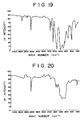
- the infrared spectrum of this polymer (solvent: dry benzene) is shown in Fig. 9. There are absorption peaks based on NH (3,350 cm ⁇ 1) and based on Si-H (2,170 cm ⁇ 1). No peak based on SiO (1,100 cm ⁇ 1) was observed.
- the elementary analysis of the polymer gave the following results (in terms of % by weight): Si: 41.7, N: 20.5, C: 24.2, O: 2.8, H: 6.1, Al: 4.7
- Part of the thus obtained polyaluminonosilazane was dissolved in toluene and the solution was adjusted to a predetermined concentration. The solution was then poured into a mold cavity of a mold formed of a tetrafluoroethylene. Then the solvent was removed at 200°C under a nitrogen stream to obtain a transparent shaped mass having a size of 20 mm ⁇ x 10 mm. This was heated to 1,000°C in the atmosphere of ammonia at a heating rate of 1°C/min and then to 1,600°C in a nitrogen atmosphere at a heating rate of 10°C/min, and further maintained at that temperature for 10 hours, thereby obtaining white, disk-like ceramic body.
- the cryoscopic method using dry benzene as a solvent revealed that the polyzirconosilazane had a number-average molecular weight of 2,440.
- the infrared spectrum of this polymer (solvent: dry benzene) is shown in Fig. 10.
- the elementary analysis of the polymer gave the following results (in terms of % by weight): Si: 40.8, N: 21.5, C: 8.5, O: 3.3, H: 6.8, Zr: 19.1
- Part of the thus obtained polyzirconosilazane was dissolved in toluene and the solution was adjusted to a predetermined concentration. The solution was then poured into a mold cavity of a mold formed of a tetrafluoroethylene. Then the solvent was removed at 200°C under a nitrogen stream to obtain a transparent shaped mass having a size of 20 mm ⁇ x 10 mm. This was heated to 1,000°C in the atmosphere of ammonia at a heating rate of 1°C/min and then to 1,600°C in a nitrogen atmosphere at a heating rate of 10°C/min, and further maintained at that temperature for 10 hours, thereby obtaining white, disk-like ceramic body.
- the cryoscopic method using dry benzene as a solvent revealed that the polyzirconosilazane had a number-average molecular weight of 2,000.
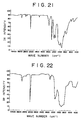
- the infrared spectrum of this polymer (solvent: dry benzene) is shown in Fig. 11. There are absorption peaks based on (CH3)2CH- (at 1,360 and 1,340 cm ⁇ 1) and peaks based on (C-O)Zr (at 1,170 and 1,000 cm ⁇ 1) in addition to a peak based on NH (3,380 cm ⁇ 1) and a peak based on Si-H (2,120 cm ⁇ 1).
- the elementary analysis of the polymer gave the following results (in terms of % by weight): Si: 33.0, N: 18.1, C: 25.5, O: 2.1, H: 6.1, Zr: 15.2
- Part of the thus obtained polyzirconosilazane was dissolved in toluene and the solution was adjusted to a predetermined concentration. The solution was then poured into a mold cavity of a mold formed of a tetrafluoroethylene. Then the solvent was removed at 200°C under a nitrogen stream to obtain a transparent shaped mass having a size of 20 mm ⁇ x 10 mm. This was heated to 1,000°C in the atmosphere of ammonia at a heating rate of 1°C/min and then to 1,600°C in an nitrogen atmosphere at a heating rate of 10°C/min, and further maintained at that temperature for 10 hours, thereby obtaining white, disk-like ceramic body.
Landscapes
- Chemical & Material Sciences (AREA)
- Engineering & Computer Science (AREA)
- Chemical Kinetics & Catalysis (AREA)
- Organic Chemistry (AREA)
- Health & Medical Sciences (AREA)
- Medicinal Chemistry (AREA)
- Polymers & Plastics (AREA)
- Ceramic Engineering (AREA)
- Textile Engineering (AREA)
- Manufacturing & Machinery (AREA)
- General Chemical & Material Sciences (AREA)
- Materials Engineering (AREA)
- Structural Engineering (AREA)
- Silicon Polymers (AREA)
- Ceramic Products (AREA)
- Polymers With Sulfur, Phosphorus Or Metals In The Main Chain (AREA)
Applications Claiming Priority (2)
| Application Number | Priority Date | Filing Date | Title |
|---|---|---|---|
| JP106194/93 | 1993-04-08 | ||
| JP10619493A JP3448611B2 (ja) | 1993-04-08 | 1993-04-08 | 低酸素ポリメタロシラザン及びその製造方法 |
Publications (3)
| Publication Number | Publication Date |
|---|---|
| EP0619280A2 true EP0619280A2 (fr) | 1994-10-12 |
| EP0619280A3 EP0619280A3 (fr) | 1995-11-29 |
| EP0619280B1 EP0619280B1 (fr) | 1998-11-11 |
Family
ID=14427378
Family Applications (1)
| Application Number | Title | Priority Date | Filing Date |
|---|---|---|---|
| EP94302464A Expired - Lifetime EP0619280B1 (fr) | 1993-04-08 | 1994-04-07 | Procédé de fabrication de la Polymetalosilazane et de céramique à base de nitrure de silicium |
Country Status (4)
| Country | Link |
|---|---|
| US (1) | US5436398A (fr) |
| EP (1) | EP0619280B1 (fr) |
| JP (1) | JP3448611B2 (fr) |
| DE (1) | DE69414445T2 (fr) |
Cited By (1)
| Publication number | Priority date | Publication date | Assignee | Title |
|---|---|---|---|---|
| EP0759414A3 (fr) * | 1995-08-18 | 1997-06-04 | Bayer Ag | Fibres céramiques dans le système silicium-bore-nitrogène-carbone |
Families Citing this family (13)
| Publication number | Priority date | Publication date | Assignee | Title |
|---|---|---|---|---|
| EP0939148B1 (fr) * | 1995-03-03 | 2001-12-05 | Twaron Products B.V. | Procédé de filature par centrifugation de solutions se prêtant à cette technique |
| KR100362834B1 (ko) | 2000-05-02 | 2002-11-29 | 삼성전자 주식회사 | 반도체 장치의 산화막 형성 방법 및 이에 의하여 제조된 반도체 장치 |
| US7053005B2 (en) * | 2000-05-02 | 2006-05-30 | Samsung Electronics Co., Ltd. | Method of forming a silicon oxide layer in a semiconductor manufacturing process |
| US6479405B2 (en) * | 2000-10-12 | 2002-11-12 | Samsung Electronics Co., Ltd. | Method of forming silicon oxide layer in semiconductor manufacturing process using spin-on glass composition and isolation method using the same method |
| US20060004169A1 (en) * | 2003-01-10 | 2006-01-05 | Sherwood Walter J Jr | Ceramic-forming polymer material |
| KR100499171B1 (ko) * | 2003-07-21 | 2005-07-01 | 삼성전자주식회사 | 스핀온글래스에 의한 산화실리콘막의 형성방법 |
| US7192891B2 (en) | 2003-08-01 | 2007-03-20 | Samsung Electronics, Co., Ltd. | Method for forming a silicon oxide layer using spin-on glass |
| JP4965953B2 (ja) * | 2006-09-29 | 2012-07-04 | 株式会社東芝 | ポリシラザンまたはポリシラザン溶液の取り扱い方法、ポリシラザン溶液、半導体装置の製造方法 |
| FR2954318B1 (fr) | 2009-12-17 | 2012-02-17 | Univ Claude Bernard Lyon | Polymetallosilazane pour la preparation de nanocomposites a proprietes decoratives, pouvant se presenter sous la forme d'objets massifs |
| EP3057925B1 (fr) | 2013-10-15 | 2019-11-27 | United Technologies Corporation | Procédé de fabrication d'un polymère précéramique pour céramique contenant un borure métallique |
| CN115216017B (zh) * | 2021-04-21 | 2023-09-15 | 中国科学院化学研究所 | 一种烷氧基聚硅氮烷的制备方法及其应用 |
| CN114956794B (zh) * | 2022-06-16 | 2023-01-31 | 宁夏合元碳素有限公司 | 一种耐侵蚀岩棉炉衬材料及其制备方法 |
| CN118724604A (zh) * | 2024-06-13 | 2024-10-01 | 苏州东杏表面技术有限公司 | 一种碳陶复合材料及其制备方法与应用 |
Family Cites Families (7)
| Publication number | Priority date | Publication date | Assignee | Title |
|---|---|---|---|---|
| US4730026A (en) * | 1986-09-30 | 1988-03-08 | E. I. Du Pont De Nemours And Company | Cross-linked organosilazane polymers |
| US5032551A (en) * | 1988-03-05 | 1991-07-16 | Toa Nenryo Kogyo Kabushiki Kaisha | Silicon nitride based ceramic fibers, process of preparing same and composite material containing same |
| US4886860A (en) * | 1988-03-23 | 1989-12-12 | Toa Nenryo Kogyo Kabushiki Kaisha | Polymetalosilazane and process for preparing same |
| US5030744A (en) * | 1989-03-23 | 1991-07-09 | Tonen Corporation | Polyborosilazane and process for producing same |
| US5128286A (en) * | 1989-06-20 | 1992-07-07 | Tonen Corporation | Boron-containing, silicon nitride-based ceramic shaped body |
| JPH0662776B2 (ja) * | 1989-08-24 | 1994-08-17 | 信越化学工業株式会社 | ポリチタノカルボシラザン重合体及び該重合体を用いたセラミックスの製造方法 |
| JPH0615619B2 (ja) * | 1989-12-20 | 1994-03-02 | 信越化学工業株式会社 | ハフニウム含有シラザン重合体の製造方法及び該重合体を用いたセラミックスの製造方法 |
-
1993
- 1993-04-08 JP JP10619493A patent/JP3448611B2/ja not_active Expired - Lifetime
-
1994
- 1994-04-06 US US08/223,866 patent/US5436398A/en not_active Expired - Lifetime
- 1994-04-07 EP EP94302464A patent/EP0619280B1/fr not_active Expired - Lifetime
- 1994-04-07 DE DE69414445T patent/DE69414445T2/de not_active Expired - Lifetime
Cited By (1)
| Publication number | Priority date | Publication date | Assignee | Title |
|---|---|---|---|---|
| EP0759414A3 (fr) * | 1995-08-18 | 1997-06-04 | Bayer Ag | Fibres céramiques dans le système silicium-bore-nitrogène-carbone |
Also Published As
| Publication number | Publication date |
|---|---|
| US5436398A (en) | 1995-07-25 |
| JPH06293833A (ja) | 1994-10-21 |
| EP0619280B1 (fr) | 1998-11-11 |
| DE69414445T2 (de) | 1999-06-10 |
| DE69414445D1 (de) | 1998-12-17 |
| JP3448611B2 (ja) | 2003-09-22 |
| EP0619280A3 (fr) | 1995-11-29 |
Similar Documents
| Publication | Publication Date | Title |
|---|---|---|
| US5008422A (en) | Polysilazanes and related compositions, processes and uses | |
| EP0153008B1 (fr) | Polymères d'organosilazane formant des matières céramiques | |
| CA1246281A (fr) | Preparation de polymeres de metallo(disilyl) silazane; produits derives | |
| US4720532A (en) | Organopolysilazane precursors to silicon nitride-rich mixed SiC/Si3 N4 | |
| US4689252A (en) | Polysilazane composition which can crosslink in the presence of a metal compound catalyzing a hydrosilylation reaction | |
| EP0259366B1 (fr) | Polysilazanes et compositions connexes, procedes et utilisations | |
| US5436398A (en) | Polymetalosilazane, process of producing same, silicon nitride based ceramic, and process of preparing same | |
| JP2507714B2 (ja) | 新規ポリチタノシラザン及びその製造方法 | |
| Weinmann et al. | Boron‐modified polysilylcarbodi‐imides as precursors for Si–B–C–N ceramics: Synthesis, plastic‐forming and high‐temperature behavior | |
| EP0404503B1 (fr) | Procédé de fabrication d'un corps façonné en céramique à base de nitrure de silicium contenant du bore | |
| US4656300A (en) | Process for a thermal treatment of a polysilazane containing .tbd.SiH groups and .tbd.Si--NH-- groups | |
| US5268496A (en) | Process for the preparation of polysilazanes | |
| US5171736A (en) | Preceramic organosilicon-boron polymers | |
| US4886860A (en) | Polymetalosilazane and process for preparing same | |
| JP2651464B2 (ja) | 改質ポリシラザン、その製造方法及びその用途 | |
| US5010158A (en) | Process for preparing polysiloxazane compositions and the products formed thereby | |
| CA1281477C (fr) | Methode de conversion de si-h a teneur de polysiloxanes en polymeres preceramiques en materiaux ceramiques nouveau genre et utiles | |
| US4861844A (en) | Cationic catalysis process for the treatment of a polysilazane containing on average at least two .tbd.SiH groups per molecule | |
| US4948763A (en) | Preparation of hollow ceramic fibers | |
| US5246738A (en) | Hydridosiloxanes as precursors to ceramic products | |
| US5319121A (en) | Hydridosiloxanes as precursors to ceramic products | |
| KR940007325B1 (ko) | 폴리실라메틸레노실란 중합체의 제조방법 | |
| US4694060A (en) | Process for the treatment of polyorganosilazanes and/or of polyorgano(disilyl)silazanes by means of a treatment of polyorganosilazanes with a catalyst system comprising an ionic inorganic salt and a complexing compound | |
| EP0662463A2 (fr) | Poudre composite contenant de l'yttrium, corps fritté composite, et méthode de préparation | |
| US5026809A (en) | Lewis base adducts of decarborane for forming new preceramic polymers, using as binders, forming shaped bodies and forming fibers |
Legal Events
| Date | Code | Title | Description |
|---|---|---|---|
| PUAI | Public reference made under article 153(3) epc to a published international application that has entered the european phase |
Free format text: ORIGINAL CODE: 0009012 |
|
| AK | Designated contracting states |
Kind code of ref document: A2 Designated state(s): DE FR GB |
|
| 17P | Request for examination filed |
Effective date: 19950807 |
|
| PUAL | Search report despatched |
Free format text: ORIGINAL CODE: 0009013 |
|
| AK | Designated contracting states |
Kind code of ref document: A3 Designated state(s): DE FR GB |
|
| 17Q | First examination report despatched |
Effective date: 19970326 |
|
| GRAG | Despatch of communication of intention to grant |
Free format text: ORIGINAL CODE: EPIDOS AGRA |
|
| GRAG | Despatch of communication of intention to grant |
Free format text: ORIGINAL CODE: EPIDOS AGRA |
|
| GRAH | Despatch of communication of intention to grant a patent |
Free format text: ORIGINAL CODE: EPIDOS IGRA |
|
| GRAH | Despatch of communication of intention to grant a patent |
Free format text: ORIGINAL CODE: EPIDOS IGRA |
|
| GRAA | (expected) grant |
Free format text: ORIGINAL CODE: 0009210 |
|
| AK | Designated contracting states |
Kind code of ref document: B1 Designated state(s): DE FR GB |
|
| REF | Corresponds to: |
Ref document number: 69414445 Country of ref document: DE Date of ref document: 19981217 |
|
| ET | Fr: translation filed | ||
| PLBE | No opposition filed within time limit |
Free format text: ORIGINAL CODE: 0009261 |
|
| STAA | Information on the status of an ep patent application or granted ep patent |
Free format text: STATUS: NO OPPOSITION FILED WITHIN TIME LIMIT |
|
| 26N | No opposition filed | ||
| REG | Reference to a national code |
Ref country code: GB Ref legal event code: 732E |
|
| REG | Reference to a national code |
Ref country code: GB Ref legal event code: IF02 |
|
| REG | Reference to a national code |
Ref country code: FR Ref legal event code: TP |
|
| REG | Reference to a national code |
Ref country code: GB Ref legal event code: 732E |
|
| REG | Reference to a national code |
Ref country code: FR Ref legal event code: TP |
|
| REG | Reference to a national code |
Ref country code: GB Ref legal event code: 732E |
|
| REG | Reference to a national code |
Ref country code: FR Ref legal event code: TP |
|
| REG | Reference to a national code |
Ref country code: FR Ref legal event code: ST Effective date: 20061230 |
|
| PG25 | Lapsed in a contracting state [announced via postgrant information from national office to epo] |
Ref country code: FR Free format text: LAPSE BECAUSE OF NON-PAYMENT OF DUE FEES Effective date: 20060502 |
|
| REG | Reference to a national code |
Ref country code: FR Ref legal event code: D3 |
|
| PGRI | Patent reinstated in contracting state [announced from national office to epo] |
Ref country code: FR Effective date: 20100720 |
|
| PGFP | Annual fee paid to national office [announced via postgrant information from national office to epo] |
Ref country code: GB Payment date: 20130403 Year of fee payment: 20 Ref country code: DE Payment date: 20130403 Year of fee payment: 20 |
|
| PGFP | Annual fee paid to national office [announced via postgrant information from national office to epo] |
Ref country code: FR Payment date: 20130625 Year of fee payment: 20 |
|
| REG | Reference to a national code |
Ref country code: DE Ref legal event code: R071 Ref document number: 69414445 Country of ref document: DE |
|
| REG | Reference to a national code |
Ref country code: GB Ref legal event code: PE20 Expiry date: 20140406 |
|
| PG25 | Lapsed in a contracting state [announced via postgrant information from national office to epo] |
Ref country code: GB Free format text: LAPSE BECAUSE OF EXPIRATION OF PROTECTION Effective date: 20140406 |
|
| PG25 | Lapsed in a contracting state [announced via postgrant information from national office to epo] |
Ref country code: DE Free format text: LAPSE BECAUSE OF EXPIRATION OF PROTECTION Effective date: 20140408 |