EP0619404A2 - Dachplatte mit Solarbatterien und Dachstruktur mit Solarbatterien - Google Patents
Dachplatte mit Solarbatterien und Dachstruktur mit Solarbatterien Download PDFInfo
- Publication number
- EP0619404A2 EP0619404A2 EP94302272A EP94302272A EP0619404A2 EP 0619404 A2 EP0619404 A2 EP 0619404A2 EP 94302272 A EP94302272 A EP 94302272A EP 94302272 A EP94302272 A EP 94302272A EP 0619404 A2 EP0619404 A2 EP 0619404A2
- Authority
- EP
- European Patent Office
- Prior art keywords
- frame
- solar battery
- gutter
- roof
- support rails
- Prior art date
- Legal status (The legal status is an assumption and is not a legal conclusion. Google has not performed a legal analysis and makes no representation as to the accuracy of the status listed.)
- Granted
Links
Images




Classifications
-
- H—ELECTRICITY
- H02—GENERATION; CONVERSION OR DISTRIBUTION OF ELECTRIC POWER
- H02S—GENERATION OF ELECTRIC POWER BY CONVERSION OF INFRARED RADIATION, VISIBLE LIGHT OR ULTRAVIOLET LIGHT, e.g. USING PHOTOVOLTAIC [PV] MODULES
- H02S20/00—Supporting structures for PV modules
- H02S20/20—Supporting structures directly fixed to an immovable object
- H02S20/22—Supporting structures directly fixed to an immovable object specially adapted for buildings
- H02S20/23—Supporting structures directly fixed to an immovable object specially adapted for buildings specially adapted for roof structures
-
- F—MECHANICAL ENGINEERING; LIGHTING; HEATING; WEAPONS; BLASTING
- F24—HEATING; RANGES; VENTILATING
- F24S—SOLAR HEAT COLLECTORS; SOLAR HEAT SYSTEMS
- F24S20/00—Solar heat collectors specially adapted for particular uses or environments
- F24S20/60—Solar heat collectors integrated in fixed constructions, e.g. in buildings
- F24S20/67—Solar heat collectors integrated in fixed constructions, e.g. in buildings in the form of roof constructions
-
- F—MECHANICAL ENGINEERING; LIGHTING; HEATING; WEAPONS; BLASTING
- F24—HEATING; RANGES; VENTILATING
- F24S—SOLAR HEAT COLLECTORS; SOLAR HEAT SYSTEMS
- F24S25/00—Arrangement of stationary mountings or supports for solar heat collector modules
- F24S25/20—Peripheral frames for modules
-
- F—MECHANICAL ENGINEERING; LIGHTING; HEATING; WEAPONS; BLASTING
- F24—HEATING; RANGES; VENTILATING
- F24S—SOLAR HEAT COLLECTORS; SOLAR HEAT SYSTEMS
- F24S25/00—Arrangement of stationary mountings or supports for solar heat collector modules
- F24S25/30—Arrangement of stationary mountings or supports for solar heat collector modules using elongate rigid mounting elements extending substantially along the supporting surface, e.g. for covering buildings with solar heat collectors
- F24S25/33—Arrangement of stationary mountings or supports for solar heat collector modules using elongate rigid mounting elements extending substantially along the supporting surface, e.g. for covering buildings with solar heat collectors forming substantially planar assemblies, e.g. of coplanar or stacked profiles
- F24S25/35—Arrangement of stationary mountings or supports for solar heat collector modules using elongate rigid mounting elements extending substantially along the supporting surface, e.g. for covering buildings with solar heat collectors forming substantially planar assemblies, e.g. of coplanar or stacked profiles by means of profiles with a cross-section defining separate supporting portions for adjacent modules
-
- F—MECHANICAL ENGINEERING; LIGHTING; HEATING; WEAPONS; BLASTING
- F24—HEATING; RANGES; VENTILATING
- F24S—SOLAR HEAT COLLECTORS; SOLAR HEAT SYSTEMS
- F24S25/00—Arrangement of stationary mountings or supports for solar heat collector modules
- F24S25/60—Fixation means, e.g. fasteners, specially adapted for supporting solar heat collector modules
- F24S25/61—Fixation means, e.g. fasteners, specially adapted for supporting solar heat collector modules for fixing to the ground or to building structures
-
- F—MECHANICAL ENGINEERING; LIGHTING; HEATING; WEAPONS; BLASTING
- F24—HEATING; RANGES; VENTILATING
- F24S—SOLAR HEAT COLLECTORS; SOLAR HEAT SYSTEMS
- F24S25/00—Arrangement of stationary mountings or supports for solar heat collector modules
- F24S25/60—Fixation means, e.g. fasteners, specially adapted for supporting solar heat collector modules
- F24S25/67—Fixation means, e.g. fasteners, specially adapted for supporting solar heat collector modules for coupling adjacent modules or their peripheral frames
-
- F—MECHANICAL ENGINEERING; LIGHTING; HEATING; WEAPONS; BLASTING
- F24—HEATING; RANGES; VENTILATING
- F24S—SOLAR HEAT COLLECTORS; SOLAR HEAT SYSTEMS
- F24S40/00—Safety or protection arrangements of solar heat collectors; Preventing malfunction of solar heat collectors
- F24S40/40—Preventing corrosion; Protecting against dirt or contamination
- F24S40/44—Draining rainwater or condensation
-
- H—ELECTRICITY
- H02—GENERATION; CONVERSION OR DISTRIBUTION OF ELECTRIC POWER
- H02S—GENERATION OF ELECTRIC POWER BY CONVERSION OF INFRARED RADIATION, VISIBLE LIGHT OR ULTRAVIOLET LIGHT, e.g. USING PHOTOVOLTAIC [PV] MODULES
- H02S30/00—Structural details of PV modules other than those related to light conversion
- H02S30/10—Frame structures
-
- F—MECHANICAL ENGINEERING; LIGHTING; HEATING; WEAPONS; BLASTING
- F24—HEATING; RANGES; VENTILATING
- F24S—SOLAR HEAT COLLECTORS; SOLAR HEAT SYSTEMS
- F24S20/00—Solar heat collectors specially adapted for particular uses or environments
- F24S2020/10—Solar modules layout; Modular arrangements
- F24S2020/12—Coplanar arrangements with frame overlapping portions
-
- Y—GENERAL TAGGING OF NEW TECHNOLOGICAL DEVELOPMENTS; GENERAL TAGGING OF CROSS-SECTIONAL TECHNOLOGIES SPANNING OVER SEVERAL SECTIONS OF THE IPC; TECHNICAL SUBJECTS COVERED BY FORMER USPC CROSS-REFERENCE ART COLLECTIONS [XRACs] AND DIGESTS
- Y02—TECHNOLOGIES OR APPLICATIONS FOR MITIGATION OR ADAPTATION AGAINST CLIMATE CHANGE
- Y02A—TECHNOLOGIES FOR ADAPTATION TO CLIMATE CHANGE
- Y02A30/00—Adapting or protecting infrastructure or their operation
- Y02A30/60—Planning or developing urban green infrastructure
-
- Y—GENERAL TAGGING OF NEW TECHNOLOGICAL DEVELOPMENTS; GENERAL TAGGING OF CROSS-SECTIONAL TECHNOLOGIES SPANNING OVER SEVERAL SECTIONS OF THE IPC; TECHNICAL SUBJECTS COVERED BY FORMER USPC CROSS-REFERENCE ART COLLECTIONS [XRACs] AND DIGESTS
- Y02—TECHNOLOGIES OR APPLICATIONS FOR MITIGATION OR ADAPTATION AGAINST CLIMATE CHANGE
- Y02B—CLIMATE CHANGE MITIGATION TECHNOLOGIES RELATED TO BUILDINGS, e.g. HOUSING, HOUSE APPLIANCES OR RELATED END-USER APPLICATIONS
- Y02B10/00—Integration of renewable energy sources in buildings
- Y02B10/10—Photovoltaic [PV]
-
- Y—GENERAL TAGGING OF NEW TECHNOLOGICAL DEVELOPMENTS; GENERAL TAGGING OF CROSS-SECTIONAL TECHNOLOGIES SPANNING OVER SEVERAL SECTIONS OF THE IPC; TECHNICAL SUBJECTS COVERED BY FORMER USPC CROSS-REFERENCE ART COLLECTIONS [XRACs] AND DIGESTS
- Y02—TECHNOLOGIES OR APPLICATIONS FOR MITIGATION OR ADAPTATION AGAINST CLIMATE CHANGE
- Y02B—CLIMATE CHANGE MITIGATION TECHNOLOGIES RELATED TO BUILDINGS, e.g. HOUSING, HOUSE APPLIANCES OR RELATED END-USER APPLICATIONS
- Y02B10/00—Integration of renewable energy sources in buildings
- Y02B10/20—Solar thermal
-
- Y—GENERAL TAGGING OF NEW TECHNOLOGICAL DEVELOPMENTS; GENERAL TAGGING OF CROSS-SECTIONAL TECHNOLOGIES SPANNING OVER SEVERAL SECTIONS OF THE IPC; TECHNICAL SUBJECTS COVERED BY FORMER USPC CROSS-REFERENCE ART COLLECTIONS [XRACs] AND DIGESTS
- Y02—TECHNOLOGIES OR APPLICATIONS FOR MITIGATION OR ADAPTATION AGAINST CLIMATE CHANGE
- Y02E—REDUCTION OF GREENHOUSE GAS [GHG] EMISSIONS, RELATED TO ENERGY GENERATION, TRANSMISSION OR DISTRIBUTION
- Y02E10/00—Energy generation through renewable energy sources
- Y02E10/40—Solar thermal energy, e.g. solar towers
- Y02E10/44—Heat exchange systems
-
- Y—GENERAL TAGGING OF NEW TECHNOLOGICAL DEVELOPMENTS; GENERAL TAGGING OF CROSS-SECTIONAL TECHNOLOGIES SPANNING OVER SEVERAL SECTIONS OF THE IPC; TECHNICAL SUBJECTS COVERED BY FORMER USPC CROSS-REFERENCE ART COLLECTIONS [XRACs] AND DIGESTS
- Y02—TECHNOLOGIES OR APPLICATIONS FOR MITIGATION OR ADAPTATION AGAINST CLIMATE CHANGE
- Y02E—REDUCTION OF GREENHOUSE GAS [GHG] EMISSIONS, RELATED TO ENERGY GENERATION, TRANSMISSION OR DISTRIBUTION
- Y02E10/00—Energy generation through renewable energy sources
- Y02E10/40—Solar thermal energy, e.g. solar towers
- Y02E10/47—Mountings or tracking
-
- Y—GENERAL TAGGING OF NEW TECHNOLOGICAL DEVELOPMENTS; GENERAL TAGGING OF CROSS-SECTIONAL TECHNOLOGIES SPANNING OVER SEVERAL SECTIONS OF THE IPC; TECHNICAL SUBJECTS COVERED BY FORMER USPC CROSS-REFERENCE ART COLLECTIONS [XRACs] AND DIGESTS
- Y02—TECHNOLOGIES OR APPLICATIONS FOR MITIGATION OR ADAPTATION AGAINST CLIMATE CHANGE
- Y02E—REDUCTION OF GREENHOUSE GAS [GHG] EMISSIONS, RELATED TO ENERGY GENERATION, TRANSMISSION OR DISTRIBUTION
- Y02E10/00—Energy generation through renewable energy sources
- Y02E10/50—Photovoltaic [PV] energy
-
- Y—GENERAL TAGGING OF NEW TECHNOLOGICAL DEVELOPMENTS; GENERAL TAGGING OF CROSS-SECTIONAL TECHNOLOGIES SPANNING OVER SEVERAL SECTIONS OF THE IPC; TECHNICAL SUBJECTS COVERED BY FORMER USPC CROSS-REFERENCE ART COLLECTIONS [XRACs] AND DIGESTS
- Y02—TECHNOLOGIES OR APPLICATIONS FOR MITIGATION OR ADAPTATION AGAINST CLIMATE CHANGE
- Y02P—CLIMATE CHANGE MITIGATION TECHNOLOGIES IN THE PRODUCTION OR PROCESSING OF GOODS
- Y02P80/00—Climate change mitigation technologies for sector-wide applications
- Y02P80/20—Climate change mitigation technologies for sector-wide applications using renewable energy
-
- Y—GENERAL TAGGING OF NEW TECHNOLOGICAL DEVELOPMENTS; GENERAL TAGGING OF CROSS-SECTIONAL TECHNOLOGIES SPANNING OVER SEVERAL SECTIONS OF THE IPC; TECHNICAL SUBJECTS COVERED BY FORMER USPC CROSS-REFERENCE ART COLLECTIONS [XRACs] AND DIGESTS
- Y10—TECHNICAL SUBJECTS COVERED BY FORMER USPC
- Y10S—TECHNICAL SUBJECTS COVERED BY FORMER USPC CROSS-REFERENCE ART COLLECTIONS [XRACs] AND DIGESTS
- Y10S136/00—Batteries: thermoelectric and photoelectric
- Y10S136/291—Applications
Definitions
- This invention relates to roof panels with solar batteries and roof structures with solar batteries, these roof panels and structure being capable of application to roof portions of houses and like buildings.
- the general way of installing solar batteries on the roof is a base securement system, in which panel-like solar batteries are secured to an available roof via an exclusive base.
- the present invention has been completed in view of the above circumstances, and its object is to provide a roof panel with solar batteries and a roof structure with solar batteries, which permit improvement of the water blocking between adjacent solar batteries which are made integral with the roof panel.
- the solar batteries that are used are supported with respective frames, which are collectively supported on support rails extending in the direction of roof inclination such that rainwater falling onto the surfaces of the solar batteries and support rails can be led toward the roof eaves for draining.
- rainwater which may enter the space between the solar battery and the frame thereof, the space between each frame and each support rail and the space between adjacent frames, can be received to be drained toward the eaves of the roof.
- a roof panel with solar batteries which comprises a base panel disposed along the roof inclination from the ridge to the eaves and a plurality of solar battery panels disposed over the base panel; the solar battery panels each including a solar battery in the form of a rectangular disk and a frame mounted around the solar battery; a plurality of parallel gutter-like support rails being secured to the upper surface of the base panel such that they extend in the direction of roof inclination; the frames each being supported such as to be accommodated inside associated ones of the support rails.
- the solar battery panels which are arranged in rows extending in the direction of roof inclination are supported via their frames on the support rails which extend in the direction of roof inclination.
- seam portions of adjacent solar batteries which are arranged side by side in the horizontal direction i.e., the direction perpendicular to the direction of roof inclination
- support rails It is thus possible to ensure water blocking without need of any special rainwater blocking structure for the seam portions.
- the support rails are gutter-like, rainwater falling on the support rails can be readily drained.
- each support rail has a two-stage structure including a gutter section capable of accommodating an associated portion of each frame and a cylindrical section formed under and integral with the gutter section; and each frame is supported such that it is accommodated in associated ones of the gutter sections.
- each support rail has a two-stage structure including a gutter section and a cylindrical section
- each frame accommodated in associated gutter sections, rainwater flows through the gutter sections, and if it overflows over the gutter sections, it can be received by the cylindrical sections.
- the frame includes four cylindrical frame members, two of which are an upper and a lower frame member mounted on parallel two of the four edges of the solar battery, and the other two of which are a left and a right vertical frame member mounted on the other two of the four edges; and the left and right vertical frame members are supported such that they are accommodated inside associate gutter-like support rails, at least the inner space in the lower frame member being communicated with the inside of the associated gutter-like support rails.
- the frame has an extension extending from its eves side portion and covering the top of a ridge side portion of the frame of the eaves side adjacent solar battery panel; and the extension has an edge substantially aligned to the eaves side edge of a ridge side portion of the frame of the eaves side adjacent solar battery panel.
- the extension covers the ridge side frame of the eaves side solar battery frame, it is difficult for rainwater to enter between the two solar battery panels.
- a solar battery panel which has improved properties of draining and blocking of water.
- the extension has an edge which is substantially aligned to the eaves side edge of a ridge side portion of the frame of the eaves side adjacent solar battery panel, the eaves side frame portion that is covered by the extension is not exposed at the surface. It is thus possible to obtain improved appearance.
- support rails are provided in pairs each in correspondence to facing sides of adjacent solar battery panels in a direction perpendicular to the direction of roof inclination, a seal member being provided between adjacent side vertical walls of the gutter sections of the paired adjacent support rails, another seal member being provided such that it strides the upper ends of the two adjacent side vertical walls.
- the support rails for supporting the both sides of the solar battery panel may be used those which support only a single side.
- the same support frame may be utilized for the ends of the solar battery panel row (without adjacent solar battery panel in the direction perpendicular to the direction of roof inclination) and also intermediate points (with adjacent solar battery panel) thereof. With this arrangement, it is possible to ensure water blocking between two support rails.
- a predetermined space serving as a ventilating layer is formed between the back surface of each solar panel and the base panel, the ventilating layer being open to the outside at its eaves and ridge side edges.
- Fig. 1 is a sectional view showing an embodiment of the invention applied to the house roof structure extending from the ridge to the eaves.
- reference numeral 1 designates a rectangular roof panel with solar batteries according to the invention.
- the roof panel 1 is disposed such that its longitudinal direction is from the ridge M to the eaves N, and it constitutes a roof Y.
- the roof panel 1 with solar batteries comprises a rectangular base panel 2 with a panel sheet 2b thereof disposed on a plurality of core members 2b assembled in longitudinal and transversal directions and a plurality of solar battery panels 3 provided on the base panel 2.
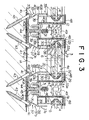
- Each solar battery panel 3 as shown in Figs. 2 to 5, comprises a rectangular panel-shaped solar battery 4, which has a large number of solar battery cells provided in a transparent plate, grading channel members 5 detachably fitted on the four edges of the solar battery 4, and a frame of the solar battery panel 3, which is detachably mounted around the grading channel members 5 and consists of four frame members, i.e., an upper and lower frame member 6 and 7 and a pair of, i.e., left and right side, vertical frame members 8.
- Each grading channel member 5 is a channel-shaped member, in which an edge of the solar battery 4 is fitted. It is made of a material having a certain elasticity, and it integrally has a substantially flat inner wall portion 9, side wall portions 10 extending from the opposite width direction edges of the inner wall portion 10 substantially at right angles thereto, a head portion 11 having a frust-conical sectional profile and terminating in the side wall portions 10, and a pair of tongue portions integrally extending from the inner surfaces of the side wall portions 10 toward each other (i.e., in the width direction).
- the inner wall portion 9 of the grading channel member 5 has a central engagement notch 5a extending in the longitudinal direction.
- the inner wall portion 9 has ribs 9a extending from its opposite width direction edges and extending slight outward with respect to the side wall portions 10.
- the head portion 11 has ribs lla slightly extending outward from its opposite width direction edges. With these ribs, engagement grooves 5b are formed in the opposite sides (i.e., upper and lower sides in the Figure) of the grading channel member 5 such that they extend in the longitudinal direction thereof.
- the grading channel member 5 is fitted on the solar battery 4 by fitting its engagement notch on the corresponding edge of the solar battery 4 until the edge thereof is in contact with the inner surface of the head portion 11. In this state, the surfaces of the inner wall portion 9 defining the engagement notch 5a is held pushed against and in close contact with the edge of the solar battery 4. In addition, the tongues 12 are elastically deformed by the inserted edge of the solar battery 4, and their edges are in close contact with the solar battery edge.
- the frame members 6 to 8 are mounted on the grading channel members 5 fitted on the edges of the solar battery 4 and form a frame thereof.
- These frame members are of three different kinds, i.e., the upper and lower frame members 6 and 7 which are mounted on opposite sides of the solar battery 4 and the vertical frame members 8 mounted on the other opposite sides.
- the solar battery 3 is disposed such that the upper frame member 6 is directed toward the ridge M, the lower frame member 7 is directed toward the eaves N and the vertical frame members 8 extend in the direction of inclination of the roof Y.
- These frame members 6 to 8 my be fabricated by extrusion molding aluminum or the like.
- the upper and lower frame members 6 and 7, as shown in Fig. 2, have basically the same structure.
- the inner wall 14 has an opening 18 which extends in the longitudinal direction.
- the frame member is cylindrical having a substantially rectangular sectional profile, with an outside cavity 19 defined by the outer, inner, upper and lower walls 13 to 16.
- the lower wall 16 has an integral projection 20 extending perpendicularly from its edge toward the upper wall 15.
- the edge of the inner wall 14 adjacent the opening 18 has a short engagement projection 21, which extends toward the partitioning wall 17 and is tightly fitted in the corresponding engagement groove 5b of the grading channel member 5.
- the partitioning wall 17 is parallel to the outer and inner walls 13 and 14, and the inner side of the partitioning wall 17, i.e., the inner surface thereof facing the outer wall 13, has an integral bolt hole piece 22.
- the edge thereof on the side of the opening 18 is formed with a rectangular notch 23.
- the upper and lower frame members 6 and 7 are different from each other in that in the upper frame member 6 the outer wall 13 has an integral contact portion 24 having an L-shaped sectional profile, whereas in the lower frame member 7 the lower wall 16 has an integral extension 25 extending outward to a greater extent than that of the upper frame member 6.
- the contact portion 24 extends in the longitudinal direction from the end of the outer wall 13 nearer the lower wall 16. Its end portion is provided with a seal member 22 applied thereto.
- the extension 25 has an inclined portion 25a extending from the upper wall 15 in a slightly upwardly inclined direction and a portion extending from the inclined portion 25a in a direction parallel to the upper wall 15. Its lower surface is set such as to be slightly above the upper surface of the lower wall 16.
- Adjacent solar battery panels 3 are arranged with their upper walls 15 set upward such that the outer wall 13 of the lower one of them abuts the inner wall 14 of the upper one of them via the intervening seal member 26. In this state, the extension 25 of the lower frame member 7 of the upper one of them covers the upper wall 15 of the upper frame member 6 of the lower one of them.
- the extension 25 has a length such that its end coincides with the end of the upper wall 15 of the upper frame member 6 in its state covering the upper wall 15 of the upper frame 6 of the lower solar battery panel 3 as noted above.
- the gap between the two is set such that no rainwater will rise by the capillary phenomenon and enter between the adjacent solar battery panels 3.
- the upper and lower frame members 6 and 7 as noted above, are mounted on the solar battery 4 via the respective grading channel members 5 by disposing the upper wall 15 on the surface side of the solar battery 4, inserting the head portion 11 of each grading channel member 5 in each opening 18 and engaging the upper and lower engagement projections 21 in the respective upper and lower engagement grooves 5b.
- the vertical frame member 8 integrally has an outer and an inner wall 27 and 28, which are parallel and face each other, an upper and a lower wall 29 and 30, which are parallel and face each other, and a securement portion 31 extending outward from the lower edge of the outer wall 27.
- the inner wall 28 has an opening 32 extending in the longitudinal direction.
- the frame member thus is cylindrical in shape having a rectangular sectional profile.
- the lower wall 30 is located on the inner side of the lower edge of the outer and inner walls 27 and 28, and the opening 32 noted above is formed in the inner wall 28 between the lower and upper walls 30 and 29.
- the edge of the inner wall 28 adjacent the opening 32 has a short engagement projection 34, which extends toward the outer wall 27 and is tightly engaged in the corresponding engagement groove 5b of the grading channel member 5.
- Each edge of the inner wall 28 has a rectangular notch 35.
- the vertical frame member 8 as described above, is mounted on the solar battery 4 via the grading channel member 5 by disposing the upper wall 29 on the surface side of the solar battery 4, inserting the head portion 11 of the grading channel 5 in the opening 32 and engaging the upper and lower engagement projections 34 in the upper and lower engagement grooves 5b.
- the opening 32 of the vertical frame member 8 is closed by the head portion 11 of the grading channel member 5, and an upper cavity 33a is formed inside the inner wall 28.
- the opposite ends of the upper and lower frame members 6 and 7 enters the inside of the vertical frame members 8 with the engagement of the notches 23 and 25, and the outer walls 29 of the vertical frame members 8 cover the outer walls 29 of the upper and lower frame members 6 and 7.
- the frame members 6 to 8 are finally mounted on the four edges of the solar battery 4 via the grading channel members 5 by screwing bolts 36, which penetrate the outer walls 27 of the vertical frame members 8, through the bolt hole pieces 22 of the upper and lower frame members 6 and 7. In this way, the solar battery panel 3 is assembled.
- Fig. 4 shows the solar battery panel 3 in its assembled state.
- Fig. 5 shows it in a disassembled state.
- the opposite ends of the upper and lower frame members 6 and 7 are fitted in the inside of the vertical frame members 8 with the engagement of the notches 23 and 35.
- the inner cavities 19b of the upper and lower frame members 6 and 7 and the upper cavities 33a of the vertical frame members 8 are communicated with one another.
- the surfaces of the upper walls 15 and 29 of the frame members 6 to 8 are at a somewhat higher level than the surface of the solar battery 4.
- the surface of the entirety of the solar battery panel 3 has a rectangular recess 4a corresponding to the solar battery 4.
- a plurality of solar battery panels 3, having the construction as described above, are arranged (for instance two panels transversally and five panels longitudinally) over and secured to the upper surface of a face plate 2b of the base panel 2. However, they are not directly secured to the face plate 2b, but are secured to gutter-like support rails 37 which are secured to the face plate 2b.
- the support rail 37 has a vertically two-stage structure, comprising a gutter-like frame 38 having a substantially U-shaped sectional profile and open at the top and a plate-like support 39 formed within the frame 38, the support 30 being common to an upper gutter section 37a and a lower cylindrical section 37b.
- the gutter-like frame 38 has a pair of, i.e., left and right, vertical walls 40.
- one of the vertical walls 40 extends basically substantially upright although it has a slight bent profile 40a formed on the inner side in the width direction and bent in a fashion like a crankshaft profile.
- the other vertical wall 40 is an inclined wall 40b inclined toward the inner side.
- the vertical wall 40 with the bent profile 40a is referred to as outer vertical wall 40A, and that with the inclined portion 40b as inner vertical wall 40B.
- the inclined portion 40b of the inner vertical wall 40B has a longitudinally extending integral securement piece 41 at right angles to the inclined portion 40b. The end of the securement piece 41 is located on the extension of the inner vertical wall 40 in the gutter section 37a.
- These support rails 37 are arranged in pairs of them at a predetermined interval on and secured to the face plate 2b of the base panel 2 with asphalt roofing 42 applied thereto such that their longitudinal direction is in the longitudinal direction of the base panel 2 and that the paired vertical frame members 8 of each solar battery panel 3 are accommodated in their corresponding gutter sections 37a.
- the pair of support rails 37 are parallel such that their inner vertical walls 40B face each other.
- Core members 2a extending in the longitudinal direction of the base panel 2 are secured to the underside of the face plate 2b, on which the support rails 37 are supported.
- the support rails 37 are secured to the base panel 2 by driving wooden bolts 43 passed through the securement pieces 41.
- the asphalt roofing 42 is secured to the face plate 2b by double side adhesive tapes 44, which are applied to portions of the face plate 2b that support the support rails 37.
- All the solar battery panels 3 which are arranged in the longitudinal direction of the base panel 2 are collectively secured to the base panel by the pairs of support rails 37. In each zone where adjacent solar battery panels 3 face each other in the width direction (other than the direction of roof inclination), two support rails 37 are secured in close proximity of each other.
- a plurality of solar battery panels 3 are secured to the paired support rails 37 with their upper frame member 6 on the side of the ridge M, with their lower frame member 7 on the side of the eaves N and with their vertical frame members 8 supported on the supports 39 of the gutter sections 37a.
- each vertical frame member 8 under upper cavity 33a of each vertical frame member 8 is formed lower cavity 33b, which is defined by the outer and inner walls 27 and 28, lower wall 30 and support 38.
- the upper and lower cavities 33a and 33b of the vertical frame member 8 are communicated with the inside of the gutter section 37a of the support rail 37, that is, the inner cavities 10b of the upper and lower frame members 6 and 7 are communicated with the inside of the gutter sections 37a of the paired support rails 37 via the upper cavities 33a of the vertical frame members 8.
- Adjacent ones of the solar battery panels 3, which are secured to the pair support rails 37 (i.e., arranged in the longitudinal direction of the base panel 2) are abutted against each other via the intervening seal member 26 noted above.
- the extension 25 of the lower frame member 7 of the solar battery panel 3, which is disposed as roof Y on the side of the ridge M covers the upper wall 15 of the upper frame member 6 of the solar battery panel 3 on the side of the eaves N.
- the end of the extension 25 coincides with the end of the upper wall 15.
- a reinforcement member 48 is secured thereto.
- ventilating layers 1A are formed between the solar battery panels 3 and the base panel 2. These ventilating layers 1A are defined by the frame members 6 to 8 and support rails 37.
- the roof panel 1 with solar batteries as above is secured as house roof Y to beams (not shown) such that it extends from the ridge M of the eaves M with the upper frame member 6 of each secured solar battery panel 3 directed toward the ridge M.
- the ridge M as shown in Fig. 6, comprises a ridge beam 50, each coupling beam 51, each upper beam 52, each ventilating structure support 53, each ventilating structure 54, etc.
- a ridge water blocking member 55 is disposed between the upper frame member 6 of the solar battery panel 3 closest to the ridge M and the ventilating structure support 53.
- the gap between the lower edge of the ridge water blocking member 55 and the upper frame member 6 is closed by a seal member 56 of urethane or like material.
- the ventilating layers 1A of the roof panel 1 have their end on the side of the ridge M communicated with the inside of the ventilating structure 54 and thence to the outside of the house.
- the eaves N has a coupling beam 60 and a gutter 61.
- a predetermined space is provided between the solar battery panel 3 closest to the eaves N and the inner or outer end thereof.
- An eaves panel 62 is disposed to entirely cover this space.
- An eaves water blocking plate 63 is provided on the eaves panel 62.
- the eaves panel 62 is secured to the parallel support rails 37 extending in the longitudinal direction.
- a lower eaves water blocking plate 65 is on a portion of the top surface of the base panel 2 corresponding to the lower end of the eaves N.
- the water blocking plates 63 and 64 are bent to be of a greater inclination than the inclination of the roof Y such that an opening 65 defined by them extends in the gutter 61.
- the opening 65 is closed by a perforated ventilating member 66.
- the ventilating layers 1A of the roof panel 1 face the ventilating member 66 at their end on the side of the eaves N and are communicated with the outside of the house through numerous pores of the perforated ventilating member 66.
- the gutter 61 is provided on the eaves N via brackets 67 and 68 mounted on the coupling beam 60 and a hanging member 69.
- roof structure is an embodiment of the invention
- a plurality of solar battery panels 3 are supported on the gutter-like support rails 7, and seam zones of adjacent solar battery panels 3 arranged side by side in the horizontal direction are supported by the support rails 37.
- the seam zones thus can provide water blocking without need of any special water blocking structure.
- the lower frame member 7 since the end of the extension 25 of the lower frame member 7 coincides with the end (i.e., inner end) of the upper frame member 6 of the adjacent lower solar battery panel 3, the lower frame member 7 is not exposed on the surface. It is thus possible to obtain improvement of the appearance.
- the rainwater entering the upper cavities 33a of the vertical frame members 8, is led in the downward inclined direction and through the continuous upper cavities 33a in the adjacent solar battery panel 3 on the side of the eaves N to eventually reach the top surface of the eaves water blocking plate 63 and thence flow down into the gutter 61, or it falls at intermediate positions into the inside of gutter sections 37a of support rails 37 to flow down to the eaves N and enter the gutter 61 through the pores of the ventilating member 66.
- Rainwater flowing along the support rail 37 flows over the gasket 49. If rainwater enters gutter section 37 of the support rail 37 through between gasket 49 and vertical frame member 8, it flows along the gutter section 37a down to the eaves N and falls into the gutter 61 through the ventilating pores of the ventilating member 66.
- Rainwater flowing along the gutter section 37a may leak down through the portions of the support 39 that are penetrated by self-tapping bolts 70.
- the support rail 37 has the two-stage structure comprising the gutter section 37b and the lower cylindrical section 37b, the leaking rainwater is received in the lower cylindrical section 37b and does not further leak down but completely flows down along the cylindrical section 37b into the gutter 61. It is thus possible to completely prevent leakage of rainwater.
- the support rails 37 are arranged parallel such that every two of them are disposed in back-to-back arrangement in each zone, in which adjacent solar battery panels 3 face each other in the direction perpendicular to the direction of roof inclination, only one of these back-to-back arrangement support rails (on the side of the inner vertical wall 40B) may be used for the support, that is, it is possible to use the same kind of support frames at the end of the horizontal solar battery arrangement (without adjacent solar battery in the direction of roof inclination) and also at intermediate positions of the flow (with adjacent solar battery).
- the two back-to-back arrangement support rails 37 are arranged such that the seal members 45 and 46 are clamped between their outer vertical walls 40A and that the seal member 47 is mounted such as to stride the upper ends of the two outer vertical walls 40A, it is possible to ensure the water blocking between the two support rails 37.
- the ventilating member 66 which serves as an inlet of air to the ventilating layers 1A, can also serve the function of a spacer for maintaining a constant space between the upper and lower eaves water blocking members 63 and 64.
- the solar battery panel 3 in this embodiment has the recess 4a in its surface in correspondence to the solar battery 4, at the time of the snowfall the recess 4a may serve to collect a certain amount of snow and provide a snow blocking effect.
Landscapes
- Engineering & Computer Science (AREA)
- Chemical & Material Sciences (AREA)
- Mechanical Engineering (AREA)
- Sustainable Development (AREA)
- Sustainable Energy (AREA)
- Thermal Sciences (AREA)
- Physics & Mathematics (AREA)
- Combustion & Propulsion (AREA)
- Life Sciences & Earth Sciences (AREA)
- General Engineering & Computer Science (AREA)
- Architecture (AREA)
- Civil Engineering (AREA)
- Structural Engineering (AREA)
- Photovoltaic Devices (AREA)
- Roof Covering Using Slabs Or Stiff Sheets (AREA)
Applications Claiming Priority (9)
| Application Number | Priority Date | Filing Date | Title |
|---|---|---|---|
| JP8225093 | 1993-04-08 | ||
| JP82251/93 | 1993-04-08 | ||
| JP8224993 | 1993-04-08 | ||
| JP82250/93 | 1993-04-08 | ||
| JP82249/93 | 1993-04-08 | ||
| JP5082250A JPH06294184A (ja) | 1993-04-08 | 1993-04-08 | 太陽電池付き屋根パネル |
| JP08225193A JP3352752B2 (ja) | 1993-04-08 | 1993-04-08 | 太陽電池付き屋根パネル |
| JP8225193 | 1993-04-08 | ||
| JP08224993A JP3298695B2 (ja) | 1993-04-08 | 1993-04-08 | 太陽電池を備えた屋根構造 |
Publications (3)
| Publication Number | Publication Date |
|---|---|
| EP0619404A2 true EP0619404A2 (de) | 1994-10-12 |
| EP0619404A3 EP0619404A3 (de) | 1995-06-07 |
| EP0619404B1 EP0619404B1 (de) | 2000-08-02 |
Family
ID=27303858
Family Applications (1)
| Application Number | Title | Priority Date | Filing Date |
|---|---|---|---|
| EP94302272A Expired - Lifetime EP0619404B1 (de) | 1993-04-08 | 1994-03-29 | Dachplatte mit Solarbatterien und Dachstruktur mit Solarbatterien |
Country Status (7)
| Country | Link |
|---|---|
| US (1) | US5509973A (de) |
| EP (1) | EP0619404B1 (de) |
| AU (1) | AU684742B2 (de) |
| CA (1) | CA2120650C (de) |
| DE (1) | DE69425393T2 (de) |
| FI (1) | FI941639A7 (de) |
| NO (1) | NO305613B1 (de) |
Cited By (6)
| Publication number | Priority date | Publication date | Assignee | Title |
|---|---|---|---|---|
| EP0905795A3 (de) * | 1997-09-24 | 1999-09-22 | Matsushita Electric Works, Ltd. | Befestigungsvorrichtung zur Installation von plattenförmigen Solarbatteriemodulen auf einem Dach |
| WO2000002256A1 (de) * | 1998-07-03 | 2000-01-13 | Enecolo Ag | Aus profilen gebildeter rahmen für plattenartige elemente, anordnung von mehreren solchen rahmen |
| FR2915230A1 (fr) * | 2007-04-20 | 2008-10-24 | Imphy Alloys Sa | Bati support d'un panneau tel que panneau photoelectrique et paroi exterieure d'un batiment comportant de tels batis |
| FR2949799A1 (fr) * | 2009-09-04 | 2011-03-11 | Gauthier Solar Systeme | Dispositif d'integration de panneaux solaires photovoltaiques a double joint assurant une parfaite etancheite sur toiture neuve ou existante et ce quelque soit la pente. |
| FR2976007A1 (fr) * | 2011-05-31 | 2012-12-07 | All Star Corp Ltd | Dispositif de couverture modulaire |
| EP2530404A3 (de) * | 2011-05-31 | 2014-06-11 | All Star Corporation Limited | Modulare Abdeckvorrichtung |
Families Citing this family (24)
| Publication number | Priority date | Publication date | Assignee | Title |
|---|---|---|---|---|
| JP3396568B2 (ja) * | 1995-11-14 | 2003-04-14 | ミサワホーム株式会社 | シート状太陽電池の取付構造 |
| US5647915A (en) * | 1996-06-13 | 1997-07-15 | Zukerman; Charles | Solar energy panel |
| NO20000899A (no) * | 2000-02-23 | 2001-04-09 | Soerveggen As | Bygningskonstruksjon |
| US6799398B1 (en) * | 2002-06-18 | 2004-10-05 | Skytech Systems, Inc. | Modular system for securing flat panels to a curved support structure |
| JP4315665B2 (ja) * | 2002-10-30 | 2009-08-19 | シャープ株式会社 | 太陽電池モジュールの端面封止部材及びそれを用いた太陽電池モジュール |
| US8141306B2 (en) * | 2004-10-22 | 2012-03-27 | Kyocera Corporation | Solar battery module device and method of installing the same |
| EP1860705B1 (de) | 2005-03-18 | 2016-10-26 | Kyocera Corporation | Solarzellenmodul und solarzellengruppe |
| US8273980B2 (en) * | 2005-09-30 | 2012-09-25 | General Electric Company | Photovoltaic roof ridge cap and installation method |
| US20080035140A1 (en) * | 2006-05-26 | 2008-02-14 | Bp Corporation North America Inc. | Solar Roof Tile |
| DE102007020151A1 (de) * | 2007-04-26 | 2008-10-30 | C.M.S. Gmbh | Solarmodul für Schrägdach |
| KR20100024989A (ko) * | 2007-06-19 | 2010-03-08 | 비피 코포레이션 노쓰 아메리카 인코포레이티드 | 태양열 패널을 장착시키기 위한 프레임을 구비하는 태양열 모듈 |
| FR2926098B1 (fr) * | 2008-01-04 | 2010-02-19 | Photowatt Internat | Element modulaire avec module photovoltaique. |
| US8832938B2 (en) * | 2008-03-27 | 2014-09-16 | Panelclaw, Inc. | Ground mounted solar module integration system |
| US8748733B2 (en) * | 2008-03-27 | 2014-06-10 | Panelclaw, Inc. | Solar module integration system |
| KR100921658B1 (ko) * | 2008-10-06 | 2009-10-15 | 한국철강 주식회사 | 태양전지 모듈 |
| US20120060434A1 (en) * | 2010-09-13 | 2012-03-15 | Certain Teed Corporation | Photovoltaic modules |
| US20120073630A1 (en) * | 2010-09-28 | 2012-03-29 | Perfect Source Technology Corp. | Rectangular protective frame for solar cell module |
| CA2739766C (en) | 2011-05-10 | 2016-08-23 | Robert Richardson | Roof solar panel for conventional sloping roof and shingle integration |
| US9052123B2 (en) | 2011-07-11 | 2015-06-09 | Panelclaw Group, Inc. | Solar module integration system with thermal compensation |
| US20140299177A1 (en) * | 2013-04-08 | 2014-10-09 | Xiaolin Sha | Integrated roof solar power system |
| US9294032B2 (en) | 2013-11-08 | 2016-03-22 | Robert Richardson | Modular roof solar panel for conventional roof and roofing integration |
| US11575343B2 (en) * | 2013-12-13 | 2023-02-07 | Quick Mount PV | Waterproofing mounting system for attaching solar modules to a roof |
| CN208874502U (zh) * | 2018-04-13 | 2019-05-17 | 广东汉能薄膜太阳能有限公司 | 一种太阳能发电瓦 |
| CN116054694A (zh) * | 2023-02-15 | 2023-05-02 | 天合光能股份有限公司 | 光伏型材、光伏屋面瓦组件和光伏屋顶安装系统 |
Family Cites Families (11)
| Publication number | Priority date | Publication date | Assignee | Title |
|---|---|---|---|---|
| DE2712532A1 (de) * | 1977-03-22 | 1978-09-28 | Pantherm Gmbh | Solarheizungsbausatz |
| GB2000860B (en) * | 1977-07-06 | 1982-08-04 | Showa Aluminium Co Ltd | Solar collector |
| FR2465315A1 (fr) * | 1979-09-10 | 1981-03-20 | Radiotechnique Compelec | Panneau generateur photovoltaique assurant l'etancheite aux intemperies d'une toiture par pose directe sur la charpente |
| JPS59175169A (ja) * | 1983-03-24 | 1984-10-03 | Fuji Electric Co Ltd | 太陽電池パネルの雨仕舞構造 |
| US4636577A (en) * | 1983-08-29 | 1987-01-13 | Thomas & Betts Corporation | Solar panel module and support therefor |
| US4677248A (en) * | 1985-09-13 | 1987-06-30 | Lacey Thomas G | Apparatus for mounting solar cells |
| US4936063A (en) * | 1989-05-19 | 1990-06-26 | Humphrey John B | Frame flanges for mounting photovoltaic modules direct to roof structural framing |
| JPH0467349A (ja) * | 1990-07-02 | 1992-03-03 | Tokin Corp | フレキシブル磁気ディスク用負圧パッドおよび製造方法 |
| US5092939A (en) * | 1990-11-30 | 1992-03-03 | United Solar Systems Corporation | Photovoltaic roof and method of making same |
| US5164020A (en) * | 1991-05-24 | 1992-11-17 | Solarex Corporation | Solar panel |
| US5338369A (en) * | 1993-02-16 | 1994-08-16 | Rawlings Lyle K | Roof-integratable photovolatic modules |
-
1994
- 1994-03-29 EP EP94302272A patent/EP0619404B1/de not_active Expired - Lifetime
- 1994-03-29 DE DE69425393T patent/DE69425393T2/de not_active Expired - Fee Related
- 1994-03-31 AU AU59244/94A patent/AU684742B2/en not_active Ceased
- 1994-04-06 US US08/223,507 patent/US5509973A/en not_active Expired - Fee Related
- 1994-04-06 CA CA002120650A patent/CA2120650C/en not_active Expired - Fee Related
- 1994-04-07 NO NO941263A patent/NO305613B1/no not_active IP Right Cessation
- 1994-04-08 FI FI941639A patent/FI941639A7/fi unknown
Cited By (12)
| Publication number | Priority date | Publication date | Assignee | Title |
|---|---|---|---|---|
| EP0905795A3 (de) * | 1997-09-24 | 1999-09-22 | Matsushita Electric Works, Ltd. | Befestigungsvorrichtung zur Installation von plattenförmigen Solarbatteriemodulen auf einem Dach |
| US6105317A (en) * | 1997-09-24 | 2000-08-22 | Matsushita Electric Works, Ltd. | Mounting system for installing an array of solar battery modules of a panel-like configuration on a roof |
| WO2000002256A1 (de) * | 1998-07-03 | 2000-01-13 | Enecolo Ag | Aus profilen gebildeter rahmen für plattenartige elemente, anordnung von mehreren solchen rahmen |
| FR2915230A1 (fr) * | 2007-04-20 | 2008-10-24 | Imphy Alloys Sa | Bati support d'un panneau tel que panneau photoelectrique et paroi exterieure d'un batiment comportant de tels batis |
| WO2008145903A1 (fr) | 2007-04-20 | 2008-12-04 | Arcelormittal - Stainless And Nickel Alloys | Bâti support d'un panneau tel que panneau photoélectrique et paroi extérieure d'un bâtiment comportant de tels bâtis |
| EA016444B1 (ru) * | 2007-04-20 | 2012-05-30 | Арселормитталь-Стейнлесс Энд Никель Эллойз | Опорный каркас фотоэлектрической панели и наружная стена здания с такими каркасами |
| EA016444B9 (ru) * | 2007-04-20 | 2012-07-30 | Арселормитталь-Стейнлесс Энд Никель Эллойз | Опорный каркас фотоэлектрической панели и наружная стена здания с такими каркасами |
| AU2008257227B2 (en) * | 2007-04-20 | 2013-05-02 | Arcelormittal - Stainless And Nickel Alloys | Bearing frame for a panel photoelectric such as a photoelectric panel and building external wall including such panel |
| US8549800B2 (en) | 2007-04-20 | 2013-10-08 | Aperam Alloys Imphy | Bearing frame for a panel such as a photoelectric panel and building external wall including such frames |
| FR2949799A1 (fr) * | 2009-09-04 | 2011-03-11 | Gauthier Solar Systeme | Dispositif d'integration de panneaux solaires photovoltaiques a double joint assurant une parfaite etancheite sur toiture neuve ou existante et ce quelque soit la pente. |
| FR2976007A1 (fr) * | 2011-05-31 | 2012-12-07 | All Star Corp Ltd | Dispositif de couverture modulaire |
| EP2530404A3 (de) * | 2011-05-31 | 2014-06-11 | All Star Corporation Limited | Modulare Abdeckvorrichtung |
Also Published As
| Publication number | Publication date |
|---|---|
| DE69425393T2 (de) | 2000-12-28 |
| NO941263D0 (no) | 1994-04-07 |
| FI941639A7 (fi) | 1994-10-09 |
| US5509973A (en) | 1996-04-23 |
| AU684742B2 (en) | 1998-01-08 |
| NO941263L (no) | 1994-10-10 |
| DE69425393D1 (de) | 2000-09-07 |
| EP0619404B1 (de) | 2000-08-02 |
| AU5924494A (en) | 1994-10-13 |
| NO305613B1 (no) | 1999-06-28 |
| FI941639A0 (fi) | 1994-04-08 |
| EP0619404A3 (de) | 1995-06-07 |
| CA2120650A1 (en) | 1994-10-09 |
| CA2120650C (en) | 2003-11-25 |
Similar Documents
| Publication | Publication Date | Title |
|---|---|---|
| EP0619404B1 (de) | Dachplatte mit Solarbatterien und Dachstruktur mit Solarbatterien | |
| KR100697499B1 (ko) | 솔라패널용 프레임시스템 | |
| US5524401A (en) | Roof with solar battery | |
| US4936063A (en) | Frame flanges for mounting photovoltaic modules direct to roof structural framing | |
| KR102260055B1 (ko) | 배수 기능이 구비된 천장 일체형 태양광 발전 지붕 구조 | |
| US8341900B2 (en) | Structure for mounting on a building wall frames for holding panels such as photovoltaic panels | |
| US8181402B2 (en) | Building-integrated photovoltaic power unit | |
| US4506484A (en) | Panel wall system | |
| US20100287852A1 (en) | Modular elements for building roofs | |
| US4212291A (en) | Batten for mounting a unitary solar collector panel | |
| GB2476342A (en) | Method for securing a solar panel supporting rail to a roof using a clip | |
| US4463534A (en) | Greenhouse structures and methods for their construction | |
| EP2072708B1 (de) | Paneelstruktur für Dächer und Ähnliches | |
| GB2236792A (en) | Extruded glazing bar system on wooden support structure | |
| US11047133B1 (en) | Modular rooftop with variable slope panels | |
| JPH06294184A (ja) | 太陽電池付き屋根パネル | |
| JP3352752B2 (ja) | 太陽電池付き屋根パネル | |
| JPH09252657A (ja) | 温室などの透光板の取付構造 | |
| JP2587133Y2 (ja) | 太陽電池付き屋根パネル | |
| JP3308890B2 (ja) | 縦葺き外装構造及び縦葺き外装構造を用いた集熱方法 | |
| JP3298695B2 (ja) | 太陽電池を備えた屋根構造 | |
| JP3108289B2 (ja) | 太陽電池屋根 | |
| JP2001279821A (ja) | アーチ状屋根を備えた組立建物 | |
| JPH05239896A (ja) | 太陽電池付き屋根 | |
| EP4136962B1 (de) | Ein gewächshaus |
Legal Events
| Date | Code | Title | Description |
|---|---|---|---|
| PUAI | Public reference made under article 153(3) epc to a published international application that has entered the european phase |
Free format text: ORIGINAL CODE: 0009012 |
|
| AK | Designated contracting states |
Kind code of ref document: A2 Designated state(s): CH DE FR GB LI SE |
|
| PUAL | Search report despatched |
Free format text: ORIGINAL CODE: 0009013 |
|
| AK | Designated contracting states |
Kind code of ref document: A3 Designated state(s): CH DE FR GB LI SE |
|
| 17P | Request for examination filed |
Effective date: 19951124 |
|
| 17Q | First examination report despatched |
Effective date: 19980318 |
|
| GRAG | Despatch of communication of intention to grant |
Free format text: ORIGINAL CODE: EPIDOS AGRA |
|
| GRAG | Despatch of communication of intention to grant |
Free format text: ORIGINAL CODE: EPIDOS AGRA |
|
| GRAH | Despatch of communication of intention to grant a patent |
Free format text: ORIGINAL CODE: EPIDOS IGRA |
|
| GRAH | Despatch of communication of intention to grant a patent |
Free format text: ORIGINAL CODE: EPIDOS IGRA |
|
| GRAA | (expected) grant |
Free format text: ORIGINAL CODE: 0009210 |
|
| AK | Designated contracting states |
Kind code of ref document: B1 Designated state(s): CH DE FR GB LI SE |
|
| REG | Reference to a national code |
Ref country code: CH Ref legal event code: EP |
|
| ET | Fr: translation filed | ||
| REF | Corresponds to: |
Ref document number: 69425393 Country of ref document: DE Date of ref document: 20000907 |
|
| REG | Reference to a national code |
Ref country code: CH Ref legal event code: NV Representative=s name: R. A. EGLI & CO. PATENTANWAELTE |
|
| PGFP | Annual fee paid to national office [announced via postgrant information from national office to epo] |
Ref country code: SE Payment date: 20010327 Year of fee payment: 8 Ref country code: CH Payment date: 20010327 Year of fee payment: 8 |
|
| PLBE | No opposition filed within time limit |
Free format text: ORIGINAL CODE: 0009261 |
|
| STAA | Information on the status of an ep patent application or granted ep patent |
Free format text: STATUS: NO OPPOSITION FILED WITHIN TIME LIMIT |
|
| 26N | No opposition filed | ||
| REG | Reference to a national code |
Ref country code: GB Ref legal event code: IF02 |
|
| PG25 | Lapsed in a contracting state [announced via postgrant information from national office to epo] |
Ref country code: SE Free format text: LAPSE BECAUSE OF NON-PAYMENT OF DUE FEES Effective date: 20020330 |
|
| PG25 | Lapsed in a contracting state [announced via postgrant information from national office to epo] |
Ref country code: LI Free format text: LAPSE BECAUSE OF NON-PAYMENT OF DUE FEES Effective date: 20020331 Ref country code: CH Free format text: LAPSE BECAUSE OF NON-PAYMENT OF DUE FEES Effective date: 20020331 |
|
| EUG | Se: european patent has lapsed |
Ref document number: 94302272.3 |
|
| REG | Reference to a national code |
Ref country code: CH Ref legal event code: PL |
|
| PGFP | Annual fee paid to national office [announced via postgrant information from national office to epo] |
Ref country code: FR Payment date: 20030310 Year of fee payment: 10 |
|
| PGFP | Annual fee paid to national office [announced via postgrant information from national office to epo] |
Ref country code: GB Payment date: 20030326 Year of fee payment: 10 |
|
| PGFP | Annual fee paid to national office [announced via postgrant information from national office to epo] |
Ref country code: DE Payment date: 20030409 Year of fee payment: 10 |
|
| PG25 | Lapsed in a contracting state [announced via postgrant information from national office to epo] |
Ref country code: GB Free format text: LAPSE BECAUSE OF NON-PAYMENT OF DUE FEES Effective date: 20040329 |
|
| PG25 | Lapsed in a contracting state [announced via postgrant information from national office to epo] |
Ref country code: DE Free format text: LAPSE BECAUSE OF NON-PAYMENT OF DUE FEES Effective date: 20041001 |
|
| GBPC | Gb: european patent ceased through non-payment of renewal fee |
Effective date: 20040329 |
|
| PG25 | Lapsed in a contracting state [announced via postgrant information from national office to epo] |
Ref country code: FR Free format text: LAPSE BECAUSE OF NON-PAYMENT OF DUE FEES Effective date: 20041130 |
|
| REG | Reference to a national code |
Ref country code: FR Ref legal event code: ST |