EP0619683A2 - Installation de communication à commande programmée - Google Patents
Installation de communication à commande programmée Download PDFInfo
- Publication number
- EP0619683A2 EP0619683A2 EP94101656A EP94101656A EP0619683A2 EP 0619683 A2 EP0619683 A2 EP 0619683A2 EP 94101656 A EP94101656 A EP 94101656A EP 94101656 A EP94101656 A EP 94101656A EP 0619683 A2 EP0619683 A2 EP 0619683A2
- Authority
- EP
- European Patent Office
- Prior art keywords
- incentive
- messages
- incentives
- program module
- communication system
- Prior art date
- Legal status (The legal status is an assumption and is not a legal conclusion. Google has not performed a legal analysis and makes no representation as to the accuracy of the status listed.)
- Granted
Links
Images



Classifications
-
- H—ELECTRICITY
- H04—ELECTRIC COMMUNICATION TECHNIQUE
- H04Q—SELECTING
- H04Q3/00—Selecting arrangements
- H04Q3/42—Circuit arrangements for indirect selecting controlled by common circuits, e.g. register controller, marker
- H04Q3/54—Circuit arrangements for indirect selecting controlled by common circuits, e.g. register controller, marker in which the logic circuitry controlling the exchange is centralised
- H04Q3/545—Circuit arrangements for indirect selecting controlled by common circuits, e.g. register controller, marker in which the logic circuitry controlling the exchange is centralised using a stored program
Definitions
- Program-controlled communication systems are used to connect end devices to one another and to connect these end devices to communication networks, in particular public networks.
- devices with a wide range of performance features can be connected to a communication system, e.g. Analog and digital telephones, facsimile machines, teletext and on-screen text stations, personal computers, etc.
- a communication system e.g. Analog and digital telephones, facsimile machines, teletext and on-screen text stations, personal computers, etc.
- a communication system consists of a large number of functional units, in particular switching functional units and a programmable digital processing system that controls and monitors these functional units.
- the information received also called incentives because of its stimulating effect on the processing system, is temporarily stored until it is processed by the processing system. Since the incentives to be processed are of different urgency, the value of the incentives received is used to determine the order of processing. For this purpose, a value in the form of a priority value is assigned from the outset in the processing system to every incoming incentive. The highest priority incentive, which is determined on the basis of the assigned priority values, is then always taken from the temporarily stored incentives.
- a high-priority incentive protection program module notes incoming incentives in individually assigned incentive memories.
- a low-priority arbitration program module selects one of the incentive memories and causes Finding an incentive to process the program module designated by this incentive. After the respective program module has been completely processed, the next incentive memory is selected.
- connection between the communication system and the terminal devices is supplemented by a c / d wire connection, which is used exclusively for the transmission of signaling information.
- the a / b wire connection for the useful signal transmission is thereby relieved of superimposed signaling information. It is also provided that polling information about the c / d wire connection can be queried from the communication system.
- the object of the present invention is to provide a program-controlled communication system to which both end devices which transmit incentives as well as end devices whose signaling information has to be queried can be connected, with equal rights being achieved among the end devices during processing of the signaling information and the time to be provided by the processing device for the signaling processing is to be reduced.
- the digital processing system is equipped with a multitasking operating system, which coordinates the multitude of individual tasks that are typical for a communication system and have to be completed at the same time. Since high response speeds are often required in a communication system, a so-called real-time operating system is provided as the operating system.
- the main task of this operating system is, depending on the incentives or messages that have been queried or formed internally in the processing system, the system processor, which is the actual executing unit of the digital processing system, corresponding processing instructions intended to react to the incentives or messages, assign.
- Such incentives which for example each have the form of an '8-bit word', are emitted by the first terminals when an operator triggers a function (for example the time display) by pressing a button.
- a function for example the time display
- the terminal device With each triggered function, the terminal device provides an incentive to the communication system at a point in time determined by the terminal device itself, the functions being assigned different incentives in the form of different binary combinations of the '8-bit words'.
- these incentives are transmitted via the a / b core connection for the first terminals.
- Another way of transmitting signaling information is intended for second devices.
- a message is formed which, unlike an incentive, has a length of one or more eight-bit words. These messages are stored in the terminal until they can be transmitted to the communication system on demand.
- Each incentive or message is considered in the communication system as a requirement to select a processing rule designated by the incentive or message.
- a variety of processing instructions are available in the digital processing system, which are stored in the system memory as respective program modules. Since each program module serves to implement a certain task, it is referred to as a "task" when it is processed by the system processor. Due to the fact that the processing of program modules essentially has to be stimulated by incentives (or messages), the operating system is assigned an event-controlled behavior.
- incentives and messages already mentioned, transmitted by the connected terminals, the various switching technology units, such as. B. in the line units, in the switching network, etc., ie within the communication system, incentives generated.
- each "task” can provide incentives, so-called internal incentives, which in turn can be used to execute another program module.
- the program modules identified by incentives and messages can basically be divided into three different categories with regard to their meaning.
- the first category includes those program modules for the processing of which there are tight time constraints that must be met in any case.
- the second category includes those program modules whose processing is time-distributable because there is a little more time available. This second category essentially includes the program modules designated by the incentives and messages for the signaling between the terminals.
- the third category is the time-uncritical program modules, the processing of which is necessary but not subject to any time constraints.
- a communication subsystem notes each program module of the first and third category, identified by an internal or incoming incentive or query, in a process list, which represents a kind of waiting list for the program modules that are ready to run.
- An allocation subsystem determines the one with the highest from the program modules noted in the process list Priority and then assigns this to the system processor for execution.
- a program module assigned to the system processor remains assigned until it is either completely processed or until the allocation subsystem in the process list determines a higher priority program module than the program module currently being processed. In the latter case, the processing of the currently "running" program module is temporarily interrupted, the program module remaining noted in the process list as ready to run.
- the allocation subsystem then assigns the newly determined program module to the system processor for execution.
- the communication system designed according to the invention provides a terminal signaling ariter, which can be designed as a circuit arrangement.
- This terminal signaling ariter hereinafter simply called arbiter for simplicity, can be functionally divided into an interrogation device and a sliding memory.
- the interrogation device serves to interrogate the second terminals cycle by cycle with regard to messages to be transmitted. In each cycle, all second end devices are addressed in a fixed order. If a terminal device that holds a message is recognized, this message, which, as already mentioned, can consist of several '8-bit words', is put into the shift memory, which is also referred to as "FIFO memory" can be saved.
- the interrogation device waits until the sliding memory again has a sufficient number of free storage spaces by reading out one or more messages and then stores a (single) message from the queried terminal in the sliding memory.
- the communication subsystem notes an incentive protection program module in the process list as ready to run.
- the incentive assurance program module can also be ready to run on the basis of a periodically arriving real-time incentive. Due to its assigned priority value, the incentive assurance program module generally belongs to the first category.
- the incentive assurance program module has the task of noting the program modules designated by the incoming incentives, depending on the origin of the incentives, in individually assigned incentive memories for the transmitting terminals.
- These incentive memories represent individual waiting lists, which are usually organized according to the "FIFO principle".
- the incentive protection program module also has the task of forwarding information that is directed to the first terminals.
- the program module can form information that is to be sent to one or more terminals.
- the incentive protection program module is processed, the information stored there is taken from the individually assigned information output memories and forwarded to the relevant end devices.
- the arbiter is provided with an output shift memory into which the output information formed when a program module is executed is written. Further details on the arbiter are explained in more detail in connection with an exemplary embodiment.
- the incentive assurance program module Before the incentive assurance program module has been completely processed, it triggers an internal incentive which designates an arbitration program module, provided that the arbitration program module is not noted in the process list. With its priority value, the arbitration program module is at the lower end of the second category, so it has a relatively low priority.
- the arbitration program module which can only be processed by the system processor if no higher priority program module is noted in the process list, has the task of reading out the messages temporarily stored in the arbiter's shift memory and the incentives stored in the incentive memories.
- the messages stored during a respective query cycle are read out one after the other and then from each of the incentive memories, if provided there is an incentive at all, just an incentive taken. This procedure ensures that all end devices, regardless of whether they belong to the first or second type, are treated equally.
- the order can also be interchanged, so that the incentive memories are read out first and only then the messages from the sliding memory.
- An internal incentive is triggered by the arbitration program module for each read-out incentive or message, by means of which the program modules designated by the read-out incentives and messages are noted in the process list as ready for execution. These program modules belong to the second category and their priority values lie between the priority value of the incentive assurance program module and that of the arbitration program module.
- An essential aspect in a communication system implemented according to the invention is the uniform distribution of the processing power available for signaling treatment among the connected terminals. Due to the priority structures explained above, only one program module of the second category can be noted in the process list as ready to run. Because of its relatively low priority, the arbitration program module can only run if no program module of the second category is noted in the process list as ready to run. As soon as the arbitration program module triggers an internal incentive for a program module of the second category, the course of the arbitration program module is interrupted, since then an opposite of the arbitration program module higher priority program module is noted in the process list as ready to run.
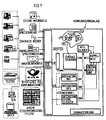
- a communication system of medium complexity is shown schematically. A large number of end devices can be connected to the communication system, only a few being indicated to symbolize different embodiments.
- the communication system itself basically consists of individual, interconnected modular units. Essential to mention are a main distributor as an interface device to the connected end devices, and a line unit with different interface modules that convert the different signaling carrier formats from the end devices to a format used uniformly within the communication system via an a / b wire connection.
- Another essential unit is the switching network, which connects the connection paths between the terminals with each other and / or the terminals and connected telecommunication networks.
- DTMF multi-frequency dialing method
- IWV pulse dialing method
- All modular units are connected to a central controller, which consists of a digital processing system that monitors the functions of the individual units and stimulates them to perform their specific functions and receives data from them.
- a central controller which consists of a digital processing system that monitors the functions of the individual units and stimulates them to perform their specific functions and receives data from them.
- the central control consists of a system processor UP, z. B. type SAB 8088, a system memory SSP, in which data and program modules are stored. Furthermore, the central controller contains a decoder device DEC for selecting individual addresses and an interrupt control unit ICU for processing interrupt requests. These units are connected to each other via a data and address bus connected, via which the central controller is connected to the other modules described above.
- a terminal signaling arbiter A is shown schematically in FIG.
- This device called arbiter in the following, is designed as a circuit arrangement in the form of a module and essentially has three functional units.
- An interrogation device ABF which cyclically polls the second terminals for messages one after the other via the c / d wire connection. Between two queries of one and the same terminal, all other terminals of the second type are accordingly queried.
- the arbiter A also has a sliding memory SS, which is designed as a 'FIFO memory' and z. B. has a capacity of 20 '8-bit words'. Messages are read into this sliding memory SS via the c / d wire connection and these messages are read out from the central control via the data bus DB.
- the arbiter A also has an output shift memory ASS, which is also in the form of a 'FIFO memory' and z. B. serves to accommodate two messages. The messages are written into the output shift memory ASS by the central controller via the data bus and transmitted to the terminals EN via the c / d wire connection, to which these messages are directed.
- the Arbiter A is a largely independent functional unit that does not have to be monitored or controlled by the central control. Due to the limited storage capacity in the sliding memory SS, it is not possible to buffer any number of messages. The interrogator ABF only switches to polling the next end device if a recognized message could be completely stored in the sliding memory SS. If there is not enough free memory space in the sliding memory to store a retrieved message, the system will wait until the central controller takes messages from the sliding memory SS via the data bus DB.
- the central control system can store messages in the output slide memory ASS until the output slide memory ASS is filled.
- the arbiter A transmits the messages stored in the output shift memory ASS to the second terminals EN, for which the relevant messages are provided.
- Arbiter A can be preceded by a plurality of concentrators KON, which are e.g. operate eight EN devices each.
- FIG. 3 A flowchart is shown in FIG. 3, by means of which the essential programming steps that are carried out by the operating system can be understood.
- the process list managed by the operating system BS has at least one program module noted (as ready for execution), the one with the highest priority is determined by the noted program modules.
- the system processor UP is then set to the address in the system memory SSP at which the relevant program module is stored is.
- the determined program module is then executed. This execution can be stopped or interrupted. When the execution is finished, the note identifying this program module is deleted in the process list and the assignment sequence described above is run through again. If the execution has been interrupted, the last processed address of the program module is saved in order to be available for continued processing at the interrupted point.
- An interruption can be caused by a direct incentive from a terminal, a real-time clock, e.g. B. a 66 ms timing or by any other incoming information in the form of an incentive.
- a direct incentive from a terminal, a real-time clock, e.g. B. a 66 ms timing or by any other incoming information in the form of an incentive.
- the incentive protection program module AN is noted in the process list as ready for execution.
- the program module designated by the incentive is noted directly in the process list. Then the allocation sequence is run through again.
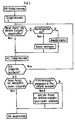
- FIG. 4 A flowchart is shown in FIG. 4, by means of which the essential programming steps in the incentive assurance program module can be understood.
- a terminal index relating to the first terminals is preset to 1.
- a message memory assigned to the terminal device which is designated by this terminal device index, is queried in that incentives can be received by this terminal device.
- incentives are checked with regard to their fill level of an individually associated incentive memory for the terminal concerned. If the incentive memory is full, a defense response is initiated, which will not be discussed further here. If the incentive memory is still ready for recording, the incentive in the message memory is entered.
- the terminal index is then incremented, i.e. H. increased by 1 and it is checked whether all the first end devices have already been treated. If this is not the case, the message memory associated with the terminal index currently valid is queried in an analogous manner and an incentive is entered in the associated incentive memory. If available, partial information is taken from the assigned information output memory and transmitted to the terminal.
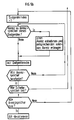
- FIG. 5 shows a flow chart with which the essential programming steps in the arbitration program module can be followed.
- the flow chart begins with the initialization of the arbitration program module, which is only run through when the arbitration program module has ended, that is to say has not been interrupted.
- the shift memory SS of the arbiter A is checked for readable messages. In the event that messages are contained, a single message is taken from the sliding memory. In accordance with this message, an internal incentive is triggered with which a program module assigned to the message is designated. If necessary, several internal incentives can also be triggered based on the message extracted.
- a separating word is inserted in the shift memory SS at the end of each query cycle, so that it can be seen from which message a new cycle begins.
- a message is removed again and an internal incentive is triggered in a similar manner. If the message extracted was the last of the cycle, the incentives received from the first end devices are processed.
Landscapes
- Engineering & Computer Science (AREA)
- Computer Networks & Wireless Communication (AREA)
- Computer And Data Communications (AREA)
- Small-Scale Networks (AREA)
- Circuits Of Receivers In General (AREA)
- Communication Control (AREA)
- Information Transfer Between Computers (AREA)
Applications Claiming Priority (2)
| Application Number | Priority Date | Filing Date | Title |
|---|---|---|---|
| DE4306018A DE4306018A1 (de) | 1993-02-26 | 1993-02-26 | Programmgesteuerte Kommunikationsanlage |
| DE4306018 | 1993-02-26 |
Publications (3)
| Publication Number | Publication Date |
|---|---|
| EP0619683A2 true EP0619683A2 (fr) | 1994-10-12 |
| EP0619683A3 EP0619683A3 (en) | 1996-11-27 |
| EP0619683B1 EP0619683B1 (fr) | 2001-12-05 |
Family
ID=6481438
Family Applications (1)
| Application Number | Title | Priority Date | Filing Date |
|---|---|---|---|
| EP94101656A Expired - Lifetime EP0619683B1 (fr) | 1993-02-26 | 1994-02-03 | Installation de communication à commande programmée |
Country Status (3)
| Country | Link |
|---|---|
| EP (1) | EP0619683B1 (fr) |
| AT (1) | ATE210360T1 (fr) |
| DE (2) | DE4306018A1 (fr) |
Cited By (1)
| Publication number | Priority date | Publication date | Assignee | Title |
|---|---|---|---|---|
| EP0868095A3 (fr) * | 1997-03-25 | 2000-07-05 | Siemens Aktiengesellschaft | Système et procédé pour la commande de la distribution d'information de retour par un systène de communications |
Family Cites Families (3)
| Publication number | Priority date | Publication date | Assignee | Title |
|---|---|---|---|---|
| DE3827493C2 (de) * | 1988-08-12 | 1995-08-03 | Siemens Ag | Verfahren und Anordnung zur Realisierung von Datenverbindungen in einer Kommunikationsvermittlungsanlage |
| DE59010123D1 (de) * | 1990-08-31 | 1996-03-21 | Siemens Ag | Programmgesteuerte Kommunikationsanlage bzw. Vermittlungseinrichtung |
| DE59209847D1 (de) * | 1991-12-17 | 2000-08-17 | Siemens Ag | Programmgesteuerte Kommunikationsanlage |
-
1993
- 1993-02-26 DE DE4306018A patent/DE4306018A1/de not_active Withdrawn
-
1994
- 1994-02-03 EP EP94101656A patent/EP0619683B1/fr not_active Expired - Lifetime
- 1994-02-03 DE DE59409986T patent/DE59409986D1/de not_active Expired - Fee Related
- 1994-02-03 AT AT94101656T patent/ATE210360T1/de not_active IP Right Cessation
Cited By (1)
| Publication number | Priority date | Publication date | Assignee | Title |
|---|---|---|---|---|
| EP0868095A3 (fr) * | 1997-03-25 | 2000-07-05 | Siemens Aktiengesellschaft | Système et procédé pour la commande de la distribution d'information de retour par un systène de communications |
Also Published As
| Publication number | Publication date |
|---|---|
| ATE210360T1 (de) | 2001-12-15 |
| EP0619683B1 (fr) | 2001-12-05 |
| DE4306018A1 (de) | 1994-09-01 |
| EP0619683A3 (en) | 1996-11-27 |
| DE59409986D1 (de) | 2002-01-17 |
Similar Documents
| Publication | Publication Date | Title |
|---|---|---|
| DE3856370T2 (de) | Vermittlungssystem und Verfahren zur Konstruktion davon | |
| EP0520083B1 (fr) | Protection de la consistance des données dans un système de télécommunications numériques | |
| EP0446589A2 (fr) | Commutateur ATM avec capacité de duplication | |
| CH656275A5 (de) | Verfahren und schaltungsanordnung zum uebertragen von datensignalen zwischen datensignalsendern und datensignalempfaengern. | |
| EP0306693B1 (fr) | Système de communication numérique à structure modulaire | |
| EP0184706B1 (fr) | Montage d'interface | |
| EP0517268B1 (fr) | Méthode pour répartir la charge dans des systèmes de communication | |
| CH653783A5 (de) | Steuereinrichtung, insbesondere fuer fernsprechvermittlungsanlagen. | |
| EP0472775B1 (fr) | Système de communication avec commande programmée, en particulier central de communication | |
| DE1275088B (de) | Schaltungsanordnung fuer rechnergesteuerte Speichervermittlungsanlagen | |
| EP0466948A1 (fr) | Système de communication avec un système multiprocesseur servant comme contrôle central | |
| EP0619683B1 (fr) | Installation de communication à commande programmée | |
| DE60013023T2 (de) | Methode und Einheit zum Steuern der Ausgabe-Ordnung von temporär gespeicherten Daten oder Objekten | |
| DE69303924T2 (de) | Hochdurchsatzdatenanbieter | |
| EP0547413B1 (fr) | Centre de communication à commande programmée | |
| DE1462400B2 (de) | Speichersystem für Datenverarbeitungsanlagen in Fernmelde-, insbesondere programmgesteuerten Fernsprechvermittlungsanlagen | |
| DE2743637C2 (de) | Elektronisch gesteuertes Fernsprechsystem mit einem Kundendatenspeicher für die Speicherung mehrerer verschiedener Teilnehmerstellen und periferen Geräten individueller Informationen | |
| CH656274A5 (de) | Schaltungsanordnung zum uebertragen von datensignalen zwischen jeweils zwei datenendgeraeten einer datenuebertragungsanlage. | |
| DE1280338B (de) | Schaltungsanordnung mit einer gemeinsamen Steuerschaltung zur Steuerung von Fernmelde-, insbesondere Fernsprechvermittlungsanlagen | |
| DE4414929C1 (de) | Kommunikationsanlage | |
| DE2542102A1 (de) | Datenverarbeitende anlage | |
| EP0213374B1 (fr) | Montage pour centraux de télécommunications, en particulier pour centraux téléphoniques, comportant des joints d'exploration qui sont contrôlés cycliquement sur des dispositifs d'interrogation d'information | |
| DE2848163A1 (de) | Datenspeichersystem | |
| DE2658912B2 (de) | Schaltungsanordnung für eine zentralgesteuerte Fernmelde-, insbesondere Femsprechvermittlungsanlage | |
| EP0212272B1 (fr) | Montage pour centraux de télécommunication, en particulier pour centraux téléphoniques, comportant des points d'exploration qui sont contrôlés cycliquement par des dispositifs d'interrogation d'informations |
Legal Events
| Date | Code | Title | Description |
|---|---|---|---|
| PUAI | Public reference made under article 153(3) epc to a published international application that has entered the european phase |
Free format text: ORIGINAL CODE: 0009012 |
|
| AK | Designated contracting states |
Kind code of ref document: A2 Designated state(s): AT BE CH DE FR GB IT LI |
|
| PUAL | Search report despatched |
Free format text: ORIGINAL CODE: 0009013 |
|
| AK | Designated contracting states |
Kind code of ref document: A3 Designated state(s): AT BE CH DE FR GB IT LI |
|
| 17P | Request for examination filed |
Effective date: 19970520 |
|
| GRAG | Despatch of communication of intention to grant |
Free format text: ORIGINAL CODE: EPIDOS AGRA |
|
| GRAG | Despatch of communication of intention to grant |
Free format text: ORIGINAL CODE: EPIDOS AGRA |
|
| GRAH | Despatch of communication of intention to grant a patent |
Free format text: ORIGINAL CODE: EPIDOS IGRA |
|
| 17Q | First examination report despatched |
Effective date: 20010515 |
|
| GRAH | Despatch of communication of intention to grant a patent |
Free format text: ORIGINAL CODE: EPIDOS IGRA |
|
| GRAA | (expected) grant |
Free format text: ORIGINAL CODE: 0009210 |
|
| AK | Designated contracting states |
Kind code of ref document: B1 Designated state(s): AT BE CH DE FR GB IT LI |
|
| REF | Corresponds to: |
Ref document number: 210360 Country of ref document: AT Date of ref document: 20011215 Kind code of ref document: T |
|
| REG | Reference to a national code |
Ref country code: CH Ref legal event code: NV Representative=s name: SIEMENS SCHWEIZ AG Ref country code: CH Ref legal event code: EP |
|
| REG | Reference to a national code |
Ref country code: GB Ref legal event code: IF02 |
|
| REF | Corresponds to: |
Ref document number: 59409986 Country of ref document: DE Date of ref document: 20020117 |
|
| PGFP | Annual fee paid to national office [announced via postgrant information from national office to epo] |
Ref country code: AT Payment date: 20020123 Year of fee payment: 9 |
|
| PGFP | Annual fee paid to national office [announced via postgrant information from national office to epo] |
Ref country code: BE Payment date: 20020225 Year of fee payment: 9 |
|
| GBT | Gb: translation of ep patent filed (gb section 77(6)(a)/1977) |
Effective date: 20020208 |
|
| PGFP | Annual fee paid to national office [announced via postgrant information from national office to epo] |
Ref country code: CH Payment date: 20020514 Year of fee payment: 9 |
|
| ET | Fr: translation filed | ||
| PLBE | No opposition filed within time limit |
Free format text: ORIGINAL CODE: 0009261 |
|
| STAA | Information on the status of an ep patent application or granted ep patent |
Free format text: STATUS: NO OPPOSITION FILED WITHIN TIME LIMIT |
|
| 26N | No opposition filed | ||
| PG25 | Lapsed in a contracting state [announced via postgrant information from national office to epo] |
Ref country code: AT Free format text: LAPSE BECAUSE OF NON-PAYMENT OF DUE FEES Effective date: 20030203 |
|
| PG25 | Lapsed in a contracting state [announced via postgrant information from national office to epo] |
Ref country code: LI Free format text: LAPSE BECAUSE OF NON-PAYMENT OF DUE FEES Effective date: 20030228 Ref country code: CH Free format text: LAPSE BECAUSE OF NON-PAYMENT OF DUE FEES Effective date: 20030228 Ref country code: BE Free format text: LAPSE BECAUSE OF NON-PAYMENT OF DUE FEES Effective date: 20030228 |
|
| REG | Reference to a national code |
Ref country code: CH Ref legal event code: PL |
|
| PGFP | Annual fee paid to national office [announced via postgrant information from national office to epo] |
Ref country code: GB Payment date: 20060209 Year of fee payment: 13 |
|
| PGFP | Annual fee paid to national office [announced via postgrant information from national office to epo] |
Ref country code: FR Payment date: 20060220 Year of fee payment: 13 |
|
| PGFP | Annual fee paid to national office [announced via postgrant information from national office to epo] |
Ref country code: IT Payment date: 20060228 Year of fee payment: 13 |
|
| PGFP | Annual fee paid to national office [announced via postgrant information from national office to epo] |
Ref country code: DE Payment date: 20060424 Year of fee payment: 13 |
|
| GBPC | Gb: european patent ceased through non-payment of renewal fee |
Effective date: 20070203 |
|
| REG | Reference to a national code |
Ref country code: FR Ref legal event code: ST Effective date: 20071030 |
|
| PG25 | Lapsed in a contracting state [announced via postgrant information from national office to epo] |
Ref country code: DE Free format text: LAPSE BECAUSE OF NON-PAYMENT OF DUE FEES Effective date: 20070901 |
|
| PG25 | Lapsed in a contracting state [announced via postgrant information from national office to epo] |
Ref country code: GB Free format text: LAPSE BECAUSE OF NON-PAYMENT OF DUE FEES Effective date: 20070203 Ref country code: FR Free format text: LAPSE BECAUSE OF NON-PAYMENT OF DUE FEES Effective date: 20070228 |
|
| PG25 | Lapsed in a contracting state [announced via postgrant information from national office to epo] |
Ref country code: IT Free format text: LAPSE BECAUSE OF NON-PAYMENT OF DUE FEES Effective date: 20070203 |