EP0620270A2 - Reinigungsmittelzusammensetzungen - Google Patents
Reinigungsmittelzusammensetzungen Download PDFInfo
- Publication number
- EP0620270A2 EP0620270A2 EP94302519A EP94302519A EP0620270A2 EP 0620270 A2 EP0620270 A2 EP 0620270A2 EP 94302519 A EP94302519 A EP 94302519A EP 94302519 A EP94302519 A EP 94302519A EP 0620270 A2 EP0620270 A2 EP 0620270A2
- Authority
- EP
- European Patent Office
- Prior art keywords
- polar solvent
- phase
- composition
- amphiphile
- surfactant
- Prior art date
- Legal status (The legal status is an assumption and is not a legal conclusion. Google has not performed a legal analysis and makes no representation as to the accuracy of the status listed.)
- Withdrawn
Links
Images

Classifications
-
- C—CHEMISTRY; METALLURGY
- C11—ANIMAL OR VEGETABLE OILS, FATS, FATTY SUBSTANCES OR WAXES; FATTY ACIDS THEREFROM; DETERGENTS; CANDLES
- C11D—DETERGENT COMPOSITIONS; USE OF SINGLE SUBSTANCES AS DETERGENTS; SOAP OR SOAP-MAKING; RESIN SOAPS; RECOVERY OF GLYCEROL
- C11D17/00—Detergent materials or soaps characterised by their shape or physical properties
- C11D17/0008—Detergent materials or soaps characterised by their shape or physical properties aqueous liquid non soap compositions
- C11D17/0017—Multi-phase liquid compositions
-
- C—CHEMISTRY; METALLURGY
- C11—ANIMAL OR VEGETABLE OILS, FATS, FATTY SUBSTANCES OR WAXES; FATTY ACIDS THEREFROM; DETERGENTS; CANDLES
- C11D—DETERGENT COMPOSITIONS; USE OF SINGLE SUBSTANCES AS DETERGENTS; SOAP OR SOAP-MAKING; RESIN SOAPS; RECOVERY OF GLYCEROL
- C11D3/00—Other compounding ingredients of detergent compositions covered in group C11D1/00
- C11D3/43—Solvents
-
- C—CHEMISTRY; METALLURGY
- C11—ANIMAL OR VEGETABLE OILS, FATS, FATTY SUBSTANCES OR WAXES; FATTY ACIDS THEREFROM; DETERGENTS; CANDLES
- C11D—DETERGENT COMPOSITIONS; USE OF SINGLE SUBSTANCES AS DETERGENTS; SOAP OR SOAP-MAKING; RESIN SOAPS; RECOVERY OF GLYCEROL
- C11D7/00—Compositions of detergents based essentially on non-surface-active compounds
- C11D7/50—Solvents
- C11D7/5004—Organic solvents
- C11D7/5022—Organic solvents containing oxygen
-
- C—CHEMISTRY; METALLURGY
- C23—COATING METALLIC MATERIAL; COATING MATERIAL WITH METALLIC MATERIAL; CHEMICAL SURFACE TREATMENT; DIFFUSION TREATMENT OF METALLIC MATERIAL; COATING BY VACUUM EVAPORATION, BY SPUTTERING, BY ION IMPLANTATION OR BY CHEMICAL VAPOUR DEPOSITION, IN GENERAL; INHIBITING CORROSION OF METALLIC MATERIAL OR INCRUSTATION IN GENERAL
- C23G—CLEANING OR DE-GREASING OF METALLIC MATERIAL BY CHEMICAL METHODS OTHER THAN ELECTROLYSIS
- C23G5/00—Cleaning or de-greasing metallic material by other methods; Apparatus for cleaning or de-greasing metallic material with organic solvents
- C23G5/06—Cleaning or de-greasing metallic material by other methods; Apparatus for cleaning or de-greasing metallic material with organic solvents using emulsions
-
- C—CHEMISTRY; METALLURGY
- C11—ANIMAL OR VEGETABLE OILS, FATS, FATTY SUBSTANCES OR WAXES; FATTY ACIDS THEREFROM; DETERGENTS; CANDLES
- C11D—DETERGENT COMPOSITIONS; USE OF SINGLE SUBSTANCES AS DETERGENTS; SOAP OR SOAP-MAKING; RESIN SOAPS; RECOVERY OF GLYCEROL
- C11D7/00—Compositions of detergents based essentially on non-surface-active compounds
- C11D7/22—Organic compounds
- C11D7/24—Hydrocarbons
-
- C—CHEMISTRY; METALLURGY
- C11—ANIMAL OR VEGETABLE OILS, FATS, FATTY SUBSTANCES OR WAXES; FATTY ACIDS THEREFROM; DETERGENTS; CANDLES
- C11D—DETERGENT COMPOSITIONS; USE OF SINGLE SUBSTANCES AS DETERGENTS; SOAP OR SOAP-MAKING; RESIN SOAPS; RECOVERY OF GLYCEROL
- C11D7/00—Compositions of detergents based essentially on non-surface-active compounds
- C11D7/22—Organic compounds
- C11D7/26—Organic compounds containing oxygen
- C11D7/263—Ethers
-
- C—CHEMISTRY; METALLURGY
- C11—ANIMAL OR VEGETABLE OILS, FATS, FATTY SUBSTANCES OR WAXES; FATTY ACIDS THEREFROM; DETERGENTS; CANDLES
- C11D—DETERGENT COMPOSITIONS; USE OF SINGLE SUBSTANCES AS DETERGENTS; SOAP OR SOAP-MAKING; RESIN SOAPS; RECOVERY OF GLYCEROL
- C11D7/00—Compositions of detergents based essentially on non-surface-active compounds
- C11D7/22—Organic compounds
- C11D7/26—Organic compounds containing oxygen
- C11D7/266—Esters or carbonates
Definitions
- the present invention relates to an aqueous, cleaning composition which is optionally surfactant-free and is useful for the removal of grease or tar without any mechanical action.
- the instant compositions comprise three liquid phases which merge together in the vicinity of a tricritical point to form one continuum, wherein each of the three phases essentially contain a polar solvent, a non-polar solvent or a weakly polar solvent and a water soluble or water dispersible low molecular weight amphiphile.
- Liquid aqueous synthetic organic detergent compositions have long been employed for human hair shampoos and as dishwashing detergents for hand washing of dishes (as distinguished from automatic dishwashing, machine washing of dishes). Liquid detergent compositions have also been employed as hard surface cleaners, as in pine oil liquids, for cleaning floors and walls. More recently, they have proved successful as laundry detergents too, apparently because they are convenient to use, are instantly soluble in wash water, and may be employed in "pre-spotting" applications to facilitate removal of soils and stains from laundry upon subsequent washing. Liquid detergent compositions have comprised anionic, cationic and nonionic surface active agents, builders and adjuvants including, as adjuvants, lipophilic materials which can act as solvents for lipophilic soils and stains. The various liquid aqueous synthetic organic detergent compositions mentioned above serve to emulsify lipophilic materials including oily soils in aqueous media, such as wash water, by forming micellar dispersions and emulsions.
- a cleaning action can be regarded as a more-or-less complex process resulting in the removal of soils from a given surface.
- the driving forces generally involved in this process are mechanical energy (friction, attrition, sonification, etc.), solvation by a liquid, thermal agitation, soil-solvent interfacial tension reduction, chemical modifications (caustic, acidic, oxidative, reductive, hydrolysis, assisted or not by catalysts or enzymes), soil or soil residual suspension (e.g. in micellar solutions), and so on.
- auxiliary cleaning agents especially surfactants
- surfactants are generally required to get rid of hydrophobic soils.
- the success of the cleaning mechanism is based on the reduction of the water/oil interfacial tension.
- the generally admitted theory is that the oily soil is easily dispersed or even solubilized in the composition because of the low interfacial tension existing between the composition and the oil.
- microemulsions Although emulsification is a mechanism of soil removal, it has been recently discovered how to make microemulsions which are much more effective than ordinary emulsions in removing lipophilic materials from substrates.
- microemulsions are described in British Patent Specification No. 2,190,681 and U.S. Patent Applications Serial Nos. 06/866,029, 07/085,902, 07/120,250 and 07/267,872 most of which relates to acidic microemulsions useful for cleaning hard surface items such as bathtubs and sinks, which microemulsions are especially effective in removing soap scum and lime scale from them.
- microemulsions may be essentially neutral and as such are also thought to be effective for microemulsifying lipophilic soils from substrates.
- U.S. Patent Application Serial No. 07/313,664 there is described a light duty microemulsion liquid detergent composition which is useful for washing dishes and removing greasy deposits from them in both neat and diluted forms.
- Such compositions include complexes of anionic and cationic detergents as surface active components of the microemulsions.
- the various microemulsions referred to include a lipophile which may be a hydrocarbon, a surfactant which may be an anionic and/or a nonionic detergent(s), a co-surfactant which may be a poly-lower alkylene glycol lower alkyl ether, e.g. tripropylene glycol monomethyl ether, and water.
- a lipophile which may be a hydrocarbon
- a surfactant which may be an anionic and/or a nonionic detergent(s)
- a co-surfactant which may be a poly-lower alkylene glycol lower alkyl ether, e.g. tripropylene glycol monomethyl ether, and water.
- aqueous cleaning compositions which are optionally surfactant-free, provide increased grease and tar removal capabilities without mechanical action as compared to the water-based microemulsions.
- Such water-based microemulsions all contain a surfactant as compared to the preferred surfactant-free compositions of the instant invention.
- surfactants are not essential. Moreover, it is not absolutely essential to be right at a tricritical point to obtain surface tensions much lower than those currently achieved with today's cleaning systems.
- Kohnstamm raised the theoretical possibility of a critical point "of the second order" in a ternary liquid mixture, a point at which three co-existing fluid phases merge and become identical, Kohnstamm (Ph.). Handbuch der physik, 1926, Vol. 10, Kap. 4. Thermodynamik der Gemische, pp. 270-271, H. Geiger and K. Scheel (SPRINGER, BERLIN). Kohnstamm also stressed the extreme difficulty to find such a point.
- the aqueous cleaning near tricritical point compositions of the instant invention are applicable for use in concentrated household care products and personal care products.
- the near tricritical point compositions of the instant invention comprise harmless ingredients.
- the instant near tricritical point compositions permit the preparation of super concentrated cleaning or conditioning liquid products which are optionally surfactant-free.
- a near tricritical point cleaning composition suitable at room temperature or colder or at a higher temperature for pre-treating and cleaning materials soiled with a lipophilic soil, comprises a polar solvent such as water, a water soluble or dispersible low molecular weight amphiphile, and a non-polar solvent, or weakly polar solvent wherein the three phases have merged into one continuum at the tricritical point.
- the invention also relates to processes for treating items and materials soiled with soils such as lipophilic soil, with compositions of this invention, to loosen and to remove without mechanical action such soil by applying to the locus of such soil on such material a soil loosening or removing amount of the tricritical point compositions of the instant invention.
- the instant aqueous cleaning composition exists at or in the direct vicinity of the tricritical point which is the terminus of three lines of critical points.
- the tricritical point is a thermodynamical point at which all three co-existing phases become identical simultaneously.
- the interfacial tension between the merging phases of the polar solvent (water) and the low molecular weight amphiphile is substantially zero
- the interfacial tension between the merging phases of the low molecular weight amphiphile and non-polar solvent (oil) or a weakly polar solvent is substantially zero
- the interfacial tension between the polar solvent and the non-polar or weakly polar solvent is substantially zero.
- the cleaning mechanism of the cleaning compositions of the instant invention is based on the reduction of the polar solvent/non-polar solvent interfacial tension as it approaches the value of zero.
- compositions of the instant invention have a phase inversion temperature (PIT) of about 0 to about 80°C, more preferably about 15 to about 40°C.
- the phase inversion temperature is the temperature at which there is an equal affinity of the low molecular weight amphiphile for water and for oil. It is the temperature at which the partition of the low molecular weight amphiphile between the water rich phase and the non-polar solvent phase or weakly polar solvent phase equals unity. That is, the weight fraction of the low molecular weight amphiphile in the water rich phase is equal to the weight fraction of the low molecular weight amphiphile in the non-polar solvent phase.
- % of additive wherein the weight fraction of the water is equal to (1-g) (1-a) (1-e) and a is about 0.1 to about 0.9, more preferably about 0.3 to about 0.7, g is about 0.1 to about 0.6, more preferably about 0.2 to about 0.4, and e is about 0 to about 0.5, more preferably about 0.05 to about 0.25, wherein the additive is a water soluble additive, a polar co-solvent or an electrolyte.
- the additives are water soluble molecules (electrolytes or organics) that are able to modify the structure of water so as to strengthen or disrupt the solvent structure. Addition of such chemicals will therefore modify the solubility of uncharged organic ingredients in water and. among others, of amphiphilic molecules.
- the above chemicals are divided into two classes: Salting-out (or kosmotropic) agents reinforce the structure of water and make it less available to hydrate organic molecules. (Salting-out and -in agents are also referred to as lyotropes and hydrotropes, respectively.) Salting-in (or chaotropic) agents, on the other hand, disorder the structure of water, thereby creating an effect comparable to "holes.” As a consequence they increase the solubility of polar organic molecules in water.
- lyotropic agents make water more incompatible with both oil and amphiphile. The result is a decrease of the PIT and an increase of the supertricritical character.
- the amount of low molecular weight amphiphile needed to "congregate" water and oil generally increases in the presence of salting-out agents.
- Hydrotropic agents have the opposite effects.
- the instant invention relates to an aqueous near tricritical point composition having an apparent viscosity at 102 sec ⁇ 1 of about 1 to about 1,000 cps, more preferably about 1 to about 100 cps, and a surface tension of about 10 to about 35 mN/m, which comprises approximately by weight 15 to 85 wt % of a polar solvent; 15 to 55 wt % of a non-polar solvent or a weakly polar solvent, and about 5 to about 60 wt % of water soluble or water dispersible low molecular weight amphiphile.
- an object of the instant invention to provide an aqueous tricritical point cleaning composition which is useful in a cleaning operation without or with a minimum of mechanical action for the removal of grease and tar and especially for the penetration of the near tricritical composition into a porous surface thereby destroying the adhesion of soil to the substrate.
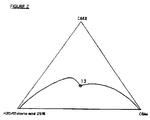
- Figures 1 through 2 illustrate phase diagrams for the aqueous tricritical point compositions C and D of Example I.
- the present invention relates to an aqueous near tricritical point composition having an apparent viscosity at 102 sec ⁇ 1 and 25°C of about 0.2 to about 1,000 cps, more preferably about 1 to about 100 cps, and a surface tension of about 10 to about 35 mN/m, which comprises approximately by weight:
- aqueous near tricritical point compositions of the instant invention can be used as a basic formulation for the production of both commercial and industrial applications by the incorporation of selective ingredients in the tricritical point composition.
- Typical compositions which can be formed for a variety of applications are oral compositions, cosmetics, hand creams, facial creams, eye shadows, lipsticks, metal polish agents, fabric cleaners, shampoos, floor cleaners, cleaning pastes, tile cleaners, bath tub cleaners, bleach compositions, ointments, oven cleaners, stain removers, fabric softeners, bleach pre-spotters, dishwashing prespotters, automatic dishwashing compositions, laundry pre-spotters, pharmaceutical compositions, coal slurries, oil drilling muds, and cleaning pre-spotters and graffiti or paint removers, mildew cleaner for grouts, flux removers for printed circuit boards, engine cleaners and degreasers, deinking compositions for printing machines and shoreline cleaners for shorelines contaminated by spilled crude oil as well as any composition
- the present invention relates to a liquid cleaning composition which is optionally surfactant-free having a surface tension of about 10 to about 35 mN/m at 25°C deriving from three co-existing liquid phases which are almost chemically identical to each other and the three co-existing liquid phases have merged together into one continuum to form the composition, wherein the first phase has the most polar solvent, the second phase has the most water soluble or water dispersible amphiphile and the third phase has the most non-polar solvent or weakly polar solvent and the interfacial tension between said first phase and said second phase is 0 to about 1 ⁇ 10 ⁇ 3 mN/m and the interfacial tension between the second phase and the third phase is 0 to about 1 ⁇ 10 ⁇ 3 mN/m, and the interfacial tension between the first phase and the third phase is 0 to about 1 ⁇ 10 ⁇ 3 mN/m.
- the polar solvent is water at a concentration of about 15 to about 85 wt %
- the low molecular weight amphiphile is an organic compound having a water insoluble hydrophobic portion which has a partial Hansen polar parameter and hydrogen bonding parameter, both of which are less than about 5 (MPa) 1/2 , and a water soluble hydrophilic portion which has a partial Hansen hydrogen bonding solubility parameter greater than about 10 (MPa) 1/2
- the amphiphile is present at a concentration of about 5 to about 60 wt %
- the non-polar solvent or weakly polar solvent has a Hansen dispersion solubility parameter greater than about 10 (MPa) 1/2 and a Hansen hydrogen bonding solubility parameter of less than about 15(MPa) 1/2 , and is present at a concentration of about 15 to about 55 wt %.
- the main characteristic of the polar solvent is that preferably it has the ability to form hydrogen bonding with the low molecular weight amphiphile.
- the polar solvent preferably has a dielectric constant of higher than 35.
- other polar solvents suitable for use in the instant composition are formamide, glycerol, glycol and hydrogen peroxide and mixtures thereof.
- the aforementioned polar solvents can be mixed with water to form a mixed polar solvent system.
- the concentration of the polar solvent such as water in the near tricritical point composition is about 15 to 55 wt %, more preferably about 20 to about 40 wt %.
- the organic non-polar or weakly polar solvent component of the present aqueous near tricritical point compositions includes solvents for the soils, is lipophilic, and is a suitable oil such as a non-polar oil which is preferably an aliphatic hydrocarbon of about 5 to about 25 carbon atoms and preferably has the formula C n H 2n+2 , wherein n is 5 to 25, more preferably 6 to 16.
- a non-polar oil which is preferably an aliphatic hydrocarbon of about 5 to about 25 carbon atoms and preferably has the formula C n H 2n+2 , wherein n is 5 to 25, more preferably 6 to 16.
- Such an aliphatic hydrocarbon is desirably a normal paraffin or an isoparaffin and, of these, those which are saturated and of 6 to 16 carbon atoms are preferred, with isoparaffins of 8 to 18 carbon atoms being also preferred.
- the most preferred aliphatic hydrocarbon solvent is decane.
- the non-polar solvent or weakly polar solvent preferably has a Hansen dispersion solubility parameter at 25°C of at least 10 (MPa) 1/2 , more preferably at least about 14.8 (MPa) 1/2 , a Hansen polar solubility parameter of less than about 10 (MPa) 1/2 and a Hansen hydrogen bonding solubility parameter of less than about 15 (MPa) 1/2 .
- important parameters to be considered are the length and configuration of the hydrophobic chain, the polar character of the molecule as well as its molar volume.
- the non-polar solvent or weakly polar solvent which at 25°C is preferably less than 5 wt % soluble in water, may be selected from the group consisting essentially of alkanes and cycloalkanes having about 5 to about 25 carbon atoms, more preferably about 6 to about 16 carbon atoms; aryl alkyls having about 12 to 24 carbon atoms; terpenes having about 10 to about 40 carbon atoms, more preferably about 10 to about 30 carbon atoms; and esters having the formula: wherein R and R1 are alkyl groups having together about 7 to about 24 carbon atoms, more preferably about 8 to about 20 carbon atoms.
- non-polar solvents or weakly polar solvents are hexadecane, tetradecane. phenyl hexane, decylacetate, 2-undecanone, limonene. diethylene glycol monohexyl ether, disopropyl adipate, cetyl lactate and dioctyl malate, and mixtures thereof.
- the concentration of the non-polar solvent or weakly polar solvent in the near tricritical point composition is preferably about 15 to about 55 wt %, more preferably about 25 to about 40 wt %.
- the concentration of the low molecular weight amphiphile in the near tricritical point composition is preferably about 5 to about 60 wt %, more preferably about 15 to about 40 wt %.
- the low molecular weight amphiphile of the instant composition is a molecule composed of at least two parts which is capable of bonding or at least having an affinity with the polar solvent and the non-polar solvent. Increasing the molecular weight of the low molecular weight amphiphile increases its water/oil coupling ability which means less low molecular weight amphiphile is needed to couple the polar solvent and the non-polar solvent or weakly polar solvent. At least one part is essentially hydrophobic, with a Hansen partial polar and hydrogen bonding solubility parameters less than 5 (MPa) 1/2 . At least one part is essentially water soluble, with Hansen partial hydrogen bonding solubility parameter eaual or greater than 10 (MPa) 1/2 .
- the low molecular weight amphiphilic molecule (amphiphile) must be cut according to the following rules:
- the hydrophobic parts should not contain any nitrogen or oxygen atoms; the hydrophilic parts generally contain the hetero-atoms including the carbon atoms directly attached to an oxygen or nitrogen atom.
- This table shows the solubility parameters for different groups.
- the first series of eight groups can be used as the hydrophilic part of an amphiphile molecule, as the hydrogen bonding solubility parameter is always greater than 10.
- the last group of three groups can be used as the hydrophobic part of an amphiphile, as their polar and hydrogen bonding solubility parameters are below 1.
- the group of two in the middle (esters and ketones) cannot be used as a significant contribution to an amphiphile molecule. It is noteworthy that amphiphiles can contain ketone or ester functions, but these functions do not contribute directly to the amphiphile performance.
- d d is the Hansen dispersion solubility parameter as measured at room temperature
- d p is the Hansen polar solubility parameter as measured at room temperature
- d H is the Hansen hydrogen bonding solubility parameter as measured at room temperature.
- preferred low molecular weight amphiphiles which are preferably present at a concentration of about 5 to about 60 wt %, more preferably about 15 to about 40 wt %, are selected from the group consisting essentially of polyoxyethylene derivatives having the formula: C x H 2x+1 - O - (CH2CH2 - O -) y - H wherein x and/or y is 1 to 6, more preferably 1 to 6, polyols having 4 to 8 carbon atoms, polyamines having 5 to 7 carbon atoms, polyamides having 5 to 7 carbon atoms, alkanols having 2 to 4 carbon atoms and alkylene glycol alkyl ethers having the formula: wherein R'' is an alkylene group
- the molecular weight of the low molecular weight amphiphile is about 76 to about 300, more preferably about 100 to about 250.
- Especially preferred low molecular weight amphiphiles are propylene glycol n-butyl ether. tripropylene glycol n-butyl ether, propylene glycol t-butyl ether, propylene glycol methyl ether, hexanediol, diethylene glycol monobutyl ether, triethylene glycol monohexyl ether and tetraethylene glycol monohexylether and mixtures thereof such as propylene glycol n-butyl ether and propylene glycol methyl ether in a ratio of about 2:1 to about 1.5:1.
- the near tricritical point compositions formed from the previously described low molecular weight amphiphiles are surfactant free because these previously described low molecular weight amphiphiles are not classified as surfactants.
- near tricritical point compositions can be optionally formed from a polar solvent, a non-polar or weakly polar solvent and a surfactant on a mixture of a low molecular weight amphiphile and surfactant, when the surfactant is employed without a low molecular weight amphiphile, the surfactant is present in the composition at a concentration of about 5.0 to about 25.0 wt. percent.
- concentration of the surfactant is about 0.1 to about 25 weight percent and the concentration of the low molecular weight amphiphile is about 5 to about 60 wt. percent.
- the surfactants that are employed in the instant invention are selected from the group consisting of nonionics, anionics, amine oxides, cationics and amphoteric surfactants and mixtures thereof.
- the surfactant When the surfactant is used alone and without a low molecular weight amphiphile the surfactant must preferably have an HLB of about 7 to 14. It is to be understood that surfactants are a subset of the set of amphiphiles.
- the low molecular weight amphiphiles do not form aggregates at an interface for example, the interface of oil and water, but rather the low molecular weight amphiphile is evenly distributed throughout the solution.
- a surfactant is prone to concentrate at the interfaces between different phases (air/liquid; liquid/liquid; liquid/solid) thereby forming aggregates at the interface and decreasing the interfacial tension between the above coexisting phases.
- a surfactant will form aggregates at an oil/liquid interface and the surfactant will not be evenly distributed throughout the solution.
- compositions can also optionally include besides the polar solvent, the non-polar or weakly polar solvent and the water dispersible amphiphile, a water soluble acid at a concentration of about 0.1 to 15.0 wt. percent, more preferably about 1 to 10 wt. percent.
- the active acidic component of the near tricritical point composition can optionally be a carboxylic acid which is strong enough to lower the pH of the near tricritical point composition to the range of one to four.
- carboxylic acids can perform this function, but those which have been found effective to remove soap scum and lime scale from bathroom surfaces, while still not destabilizing the composition, are polycarboxylic acids, and of these the dicarboxylic acids are preferred.
- dicarboxylic acids group which includes those of 2 to 10 carbon atoms, from oxalic acid through sebacic acid, suberic, azelaic and sebacic acids are of lower solubilities and therefore are not as useful in the present near tricritical point composition as the other dibasic aliphatic fatty acids, all of which are preferably saturated and straight chained.
- Oxalic and malonic acids although useful as reducing agents too, may be too strong for delicate hard surface cleanings.
- Preferred such dibasic acids are those of the middle portion of the 2 to 10 carbon atom acid range, succinic glutaric. adipic and pimelic acids, especially the first three thereof, which inevitably are available commercially, in mixture.
- the diacids, after being incorporated in the invented near tricritical point composition may be partially neutralized to produce the desired pH in the near tricritical point composition for greatest functional effectiveness. with safety.
- Phosphoric acid is one of the additional acids that helps to protect acid-sensitive surfaces being cleaned with the present compositions. Being a tribasic acid, it too may be partially neutralized to obtain a composition pH in the desired range. For example, it may be partially neutralized to the biphosphate, e.g., NaH2PO4, or NH4H2PO4.
- Phosphonic acid the other of the two additional acids for protecting acid-sensitive surfaces from the dissolving action of the dicarboxylic acids of the present compositions, apparently exists only theoretically, but its derivatives are stable and are useful in the practice of the present invention.
- the phosphonic acids are of the structure: wherein Y is any suitable substituent, but preferably Y is alkylamino or N-substituted alkylamino.
- a preferred phosphonic acid component of the present compositions is aminotris-(methylenephosphonic) acid, which is of the formula N(CH2PH2O3).
- phosphonic acids ethylenediamine tetra-(methylenephosphonic) acid, hexamethylenediamine tetra-(methylenephosphonic) acid, and diethylenetriamine penta-(methylenephosphonic) acid.
- Such class of compounds may be described as aminoalkylenephosphonic acids containing in the ranges of 1 to 3 amino nitrogens, 3 or 4 lower alkylenephosphonic acid groups in which the lower alkylene is of 1 or 2 carbon atoms, and 0 to 2 alkylene groups of 2 to 6 carbon atoms each, which alkylene(s) is/are present and join amino nitrogens when a plurality of such amino nitrogens is present in the aminoalkylene phosphonic acid.
- aminoalkylenephosphonic acids which also may be partially neutralized at the desired pH of the near tricritical point composition, are of desired stabilizing and protecting effect in the invented cleaner, especially when present with phosphoric acid, preventing harmful attacks on European enamel surfaces by the diacid(s) components of the cleaner.
- the phosphorus acid salts if present, will be mono-salts of each of the phosphoric and/or phosphonic acid groups present.
- glutaric acid or a partially neutralized salt or ionized form thereof is highly preferred, because it performs effectively and has no significantly detrimental negative properties, but in some instances other acids capable of converting calcium and magnesium higher fatty acid soaps to acidic or partially neutralized form to assist in removing them from hard surfaces which they are staining (in the form of soap scum) may also be employed (when detrimental properties thereof, if any, are tolerable).
- Such acids will include those which do not form water insoluble calcium salts.
- acetic acid, succinic acid, prooionic acid and citric acid may be utilized in some circumstances.
- citric acid is a sequestering acid and tends to remove calcium from calcium carbonate in the grout employed between adjacent ceramic tiles, which is detrimental to its use, and the other mentioned acids are often unsatisfactory because of unacceptable odors and/or because they result in human nasal and/or respiratory irritation.
- glutaric acid is preferably utilized as such soap scum attacking acid.
- partially neutralized glutaric acid it is meant also to include such products resulting from partially acidifying glutaric acid salts (glutarates) of from directly incorporating the partially neutralized glutarates of desired pH with the other components of the cleaner.
- the instant composition can optionally contain about 0.1 to about 15 wt %, more preferably about 1 to about 5 wt % of a water soluble chaotropic additive which can be hydrotropic or kosmotropic.
- a hydrotropic agent weakens (salting-in effect) the structure of the water thereby making the water an improved solvent for the amphiphile, whereas a kosmotropic (Iyotropic) agent strengthens (salting-out effect) the structure of the water thereby making water less of a solvent for the amphiphile.
- Typical hydrotropic agents are acetic acid, ethanol, isopropanol, sodium benzoate, sodium toluene sulfonate, sodium xylene sulfonate, ethylene glycol, propylene glycol, metal salts of iodide, metal salts of thiocyanates, metal salts of perchlorates, guanidimium salts.
- the use of the chaotropic additive can change the weight percentage of the polar solvent, amphiphile and non-polar solvent needed to form the near tricritical point composition.
- adjuvant materials for dental, dishwashing, laundering and other detergency applications may include: foam enhancing agents such as lauric or myristic acid diethanolamide; foam suppressing agents (when desired) such as silicones, higher fatty acids and higher fatty acid soaps; preservatives and antioxidants such as formalin and 2,6-ditert-butyl-p-cresol; pH adjusting agents such as sulfuric acid and sodium hydroxide: perfumes; and colorants (dyes and pigments).
- the aqueous near tricritical point compositions can be used in forming cleaning compositions containing enzymes and/or bleachants such as fabric detergent compositions or automatic dishwashing compositions which can contain bleachants, at least one enzyme, and a suitable phosphate or non-phosphate builder system.
- enzymes and/or bleachants such as fabric detergent compositions or automatic dishwashing compositions which can contain bleachants, at least one enzyme, and a suitable phosphate or non-phosphate builder system.
- a typical cleaning composition comprises: H2O 19.24% N a Benzoate 1.0% Triethylene glycol 32.5% hexylether Heptylacetate 35.44% Nonylacetate 11.81%
- Figures 1-2 are phase diagrams of compositions C and D of example 1, wherein 13 designates the tricritical point compositions.
- the composition at point 23 marked by an "x" on Figure 1 comprises 56.25 wt. % of a 5% Na benzoate solution in water, 25 wt. % of triethyleneglycol monohexyl ether and 18.15 wt. % of oil (mixture of heptylacetate/nonylacetate 3:1 ratio).
- compositions of the invention are relatively simple because they tend to form spontaneously with little need for the addition of energy to promote transformation of the tricritical state.
- mixing will normally be undertaken and it has been found desirable, but not compulsory, to first mix the amphiphile and water together, followed by admixing of the non-polar solvent or weakly solvent component. It is not usually necessary to employ heat and most mixings are preferably carried out at about 20-25°C or higher.
- the invented near tricritical point compositions may be applied to such surfaces by pouring onto them, by application with a cloth or sponge, or by various other contacting means, but it is preferred to apply them, depending on their viscosity, in the form of a spray by spraying them onto the substrate from a hand- or finger-pressure operated sprayer or squeeze bottle.
- Such application may be applied onto hard surfaces such as dishes, walls or floors from which lipophilic (usually greasy or oily) soil is to be removed, or may be applied onto fabrics such as laundry which has previously been stained with lipophilic soils such as motor oil.
- the invented compositions may be used as detergents and as such may be employed in the same manner in which liquid detergents are normally utilized in dishwashing, floor and wall cleaning, and laundering, but it is preferred that they are employed as pre-spotting agents too, in which applications they are found to be extremely useful in loosening the adhesions of lipophilic soils to substrates, thereby promoting much easier cleaning with application of more of the same invented detergent compositions or by applications of different commercial detergent compositions in liquid, bar or particulate forms.
- compositions A through G were made by first forming with mixing at room temperature a solution of the amphiphile and the water or the water and additive. To this solution at room temperature was added with mixing the non-polar solvent(oil) or weakly polar solvent to form the near tricritical point compositions A through G. The apparent viscosity measurements were made at 25°C on a Carrimed. The surface tension measurements were carried out at 25°C on a Lauda.
- the invention extends to a liquid cleaning composition having a surface tension of about 10 to 35 mN/m and incorporating at least a polar solvent, a water soluble or water dispersible low molecular weight amphiphile and a non-polar or weakly polar solvent and deriving from three co-existing liquid phases which are almost chemically identical to each other and said three co-existing liquid phases are in such a state that a minute variation of said state is able to convert them all into one single phase according to a reversible equilibrium, or to make them merging together into one continuum to form said composition wherein the first phrase is the most abounding with the polar solvent, the second phase is the most abounding with the water soluble or water dispersible low molecular weight amphiphile and the third phase is the most abounding with the non-polar solvent or weakly polar solvent and the interfacial tension between said first phase and said second phase is 0 to about 1 ⁇ 10 ⁇ 3 mN/m, and the interfa
- the polar solvent may be water at a concentration of about 15 to about 85 wt %
- the amphiphile may be an organic compound having a water insoluble hydrophobic portion which has a partial polar parameter and hydrogen bonding parameter, both of which are less than about 5 (MPa) 1/2 , and a water soluble hydrophilic portion which has a partial hydrogen bonding solubility parameter greater than about 10 (MPa) 1/2
- said amphiphile may be present at a concentration of about 5 to about 60 wt %
- said non-polar solvent or weakly polar solvent may have a dispersion solubility parameter greater than about 10 (MPa) 1/2 and a hydrogen bonding solubility parameter of less than about 15 (MPa) 1/2
- said non-polar solvent or weakly polar solvent may be present at a concentration of about 15 to about 55 wt %.
- the said low molecular weight amphiphile may be selected from the group consisting essentially of alkylene glycol alkyl ethers, polyoxyethylene derivatives having the formula: C x H 2x+1 - O - (CH2CH2 - O -) y - H wherein x or y is 1 to 6, polyols having about 4 to about 8 carbon atoms, polyamines having about 5 to about 7 carbon atoms, polyamides having about 5 to about 7 carbon atoms, and alkanols having about 2 to about 4 carbon atoms.
- the said non-polar solvent or weakly polar solvent may be selected from the group consisting of alkanes and cycloalkanes having about 5 to about 25 carbon atoms, aryl alkanes having about 12 to about 24 carbon atoms, aliphatic and aromatic oils having about 6 to about 14 carbons atoms, terpenes having about 10 to about 40 carbon atoms, and esters having the formula: wherein R and R1 are alkyl groups having together about 7 to about 24 carbon atoms.
- the said non-polar solvent or weakly polar solvent may be an aliphatic hydrocarbon having 6 to 16 carbon atoms and may be present in the composition at a concentration of 15 to 55 wt %.
- the said polar solvent may be water and may be present in the composition at a concentration of 15 to 85 wt %.
- the said composition may be sprayable by a hand operated pump sprayer.
- a composition according to the invention may contain at least one solid particle and/or immiscible liquid.
- the said non-polar solvent or weakly polar solvent may be an aliphatic hydrocarbon having about 6 to about 16 carbon atoms.
- the said low molecular weight amphiphile may be triethylene glycol monohexyl ether.
- a liquid cleaning composition having a surface tension of about 10 to 35 mN/m and incorporating at least a polar solvent, a water soluble or water dispersible surfactant and a non-polar or weakly polar solvent and deriving from three co-existing liquid phases which are almost chemically identical to each other and said three co-existing liquid phases which are almost chemically identical to each other and said three coexisting liquid phases are in such a state that a minute variation of said state is able to convert them all into one single phase according to a reversible equilibrium, or to make them merging together into one continuum to form said composition, wherein the first phase is the most abounding with the polar solvent, the second phase is the most abounding with the water soluble or water dispersible surfactant and the third phase is the most abounding with the non-polar solvent or weakly polar solvent, and the interfacial tension between said first phase and said second phase is 0 to about 1 ⁇ 10 ⁇ 3
- composition may contain a surfactant and the said surfactant is preferably an anionic surfactant.
- a liquid cleaning composition having a surface tension of about 10 to 35 mN/m and incorporating at least a polar solvent, a water soluble or water dispersible low molecular weight amphiphile a non-polar or weakly polar solvent and a water soluble acid and deriving from three co-existing liquid phases which are almost chemically identical to each other and said three co-existing liquid phases are in such a state that a minute variation of said state is able to convert them all into one single phase according to a reversible equilibrium, or to make them merging together into one continuum to form said composition, wherein the first phase is the most abounding with the polar solvent, the second phase is the most abounding with the water soluble or water dispersible low molecular weight amphiphile and the third phase is the most abounding with the non-polar solvent or weakly polar solvent and the water soluble acid is contained within the first phase the second phase and the third phase and the interfacial
- the invention also extends to a process for treating materials soiled with soils to loosen or remove the soil which comprises applying to the locus of such soil on such material a soil loosening or removing amount of a composition in accordance with the present invention.
- composition may be applied as a pre-treatment to material soiled with hard-to-remove soil at the locus thereof on the material, after which application the soil is removed by application of water.
- the composition may be applied as a pre-treatment onto dishes having deposits thereon before hand washing or such dishes in dishwater containing a dishwashing detergent composition.
- the composition may be applied as a pre-spotting treatment onto laundry soiled with oily or greasy soils at the loci of such soils before washing of the laundry in wash water containing a laundry detergent composition.
- the composition may be sprayed on a lipophilic soil on the surface, on which it remains as a surface adherent liquid until the soil is absorbed by it.
Landscapes
- Chemical & Material Sciences (AREA)
- Organic Chemistry (AREA)
- Engineering & Computer Science (AREA)
- Chemical Kinetics & Catalysis (AREA)
- Oil, Petroleum & Natural Gas (AREA)
- Wood Science & Technology (AREA)
- Life Sciences & Earth Sciences (AREA)
- Health & Medical Sciences (AREA)
- Emergency Medicine (AREA)
- General Chemical & Material Sciences (AREA)
- Materials Engineering (AREA)
- Mechanical Engineering (AREA)
- Metallurgy (AREA)
- Detergent Compositions (AREA)
Applications Claiming Priority (2)
| Application Number | Priority Date | Filing Date | Title |
|---|---|---|---|
| US4507193A | 1993-04-12 | 1993-04-12 | |
| US45071 | 2002-01-15 |
Publications (2)
| Publication Number | Publication Date |
|---|---|
| EP0620270A2 true EP0620270A2 (de) | 1994-10-19 |
| EP0620270A3 EP0620270A3 (de) | 1995-07-26 |
Family
ID=21935842
Family Applications (1)
| Application Number | Title | Priority Date | Filing Date |
|---|---|---|---|
| EP94302519A Withdrawn EP0620270A3 (de) | 1993-04-12 | 1994-04-11 | Reinigungsmittelzusammensetzungen. |
Country Status (14)
| Country | Link |
|---|---|
| EP (1) | EP0620270A3 (de) |
| JP (1) | JPH06306400A (de) |
| AU (1) | AU671895B2 (de) |
| BR (1) | BR9401459A (de) |
| CA (1) | CA2120115A1 (de) |
| FI (1) | FI941663A7 (de) |
| GR (1) | GR1002010B (de) |
| HU (1) | HU216324B (de) |
| NO (1) | NO306733B1 (de) |
| NZ (1) | NZ260144A (de) |
| PL (1) | PL175122B1 (de) |
| PT (1) | PT101485A (de) |
| TW (1) | TW299349B (de) |
| ZA (1) | ZA942052B (de) |
Cited By (22)
| Publication number | Priority date | Publication date | Assignee | Title |
|---|---|---|---|---|
| US5597507A (en) * | 1994-03-31 | 1997-01-28 | Lever Brothers Company, Division Of Conopco, Inc. | Microemulsion detergent composition containing specific ethoxylated alcohol based surfactant system |
| WO1997015653A1 (en) * | 1995-10-25 | 1997-05-01 | Colgate-Palmolive Company | Gelled near tricritical point compositions |
| WO1997016264A1 (en) * | 1995-11-03 | 1997-05-09 | The University Of North Carolina At Chapel Hill | Novel cleaning process using carbon dioxide as a solvent and employing molecularly engineered surfactants |
| WO1997019164A1 (en) * | 1995-11-17 | 1997-05-29 | Colgate-Palmolive Company | Near tricritical point compositions |
| WO1998001527A1 (en) * | 1996-07-05 | 1998-01-15 | Colgate-Palmolive Company | Near tricritical point compositions containing bleach and/or biostatic agent |
| EP0847752B1 (de) * | 1996-11-26 | 2001-06-27 | L'oreal | Abriebfeste topische Zusammensetzung enthaltend eine Fluorsilikon-Verbindung |
| WO2002044314A1 (de) * | 2000-12-02 | 2002-06-06 | Henkel Kommanditgesellschaft Auf Aktien | Mehrphasiges wasch- und reinigungsmittel mit bleiche |
| US6541435B2 (en) | 2000-12-07 | 2003-04-01 | 3M Innovative Properties Company | Engine cleaner composition |
| WO2003033805A1 (en) * | 2001-10-12 | 2003-04-24 | Unilever N.V. | Non-toxic cleaning composition |
| WO2003033637A1 (en) * | 2001-10-12 | 2003-04-24 | Unilever N.V. | Cleaning compositon with an immiscible liquid system |
| WO2003044147A1 (en) * | 2001-11-19 | 2003-05-30 | Unilever N.V. | Improved washing system |
| WO2003060049A3 (de) * | 2002-01-21 | 2004-03-25 | Basf Ag | Alkylglykolalkoxylate oder -diglykolalkoxylate, ihre mischungen mit tensiden und ihre verwendung |
| EP1433476A3 (de) * | 2002-12-27 | 2004-11-10 | Kao Corporation | Hautreinigungszusammensetzung |
| US6830630B2 (en) | 2000-12-07 | 2004-12-14 | 3M Innovative Properties Company | Method of cleaning an internal combustion engine |
| EP1764426A1 (de) * | 2005-09-15 | 2007-03-21 | Delmet - Dissosidazione Elettronica Metalli S.r.l. | Verfahren, Vorrichtung und säurehaltige Gelslösung zum Beizen der metallischen Artikeln, insbesondere Fässer für Nahrungsmittel |
| US7371716B2 (en) | 2002-04-26 | 2008-05-13 | Basf Aktiengesellschaft | C10-alkanolalkoxylate mixtures and the use thereof |
| US7419552B2 (en) | 2002-04-26 | 2008-09-02 | Basf Aktiengesellschaft | C10-alkanol alkoxylates and the use thereof |
| US20100069509A1 (en) * | 2006-12-14 | 2010-03-18 | Basf Se | Nonionic emulsifiers for emulsion concentrates for spontaneous emulsification |
| WO2010070088A1 (de) | 2008-12-18 | 2010-06-24 | Basf Se | Tensidgemisch enthaltend verzweigte kurzkettige sowie verzweigte langkettige komponenten |
| WO2011003904A1 (de) | 2009-07-10 | 2011-01-13 | Basf Se | Tensidgemisch mit kurz- und langkettigen komponenten |
| US9381450B2 (en) | 2008-12-18 | 2016-07-05 | Akzo Nobel N.V. | Defoamer composition comprising alkoxylated 2-propylheptanol |
| WO2017036977A1 (en) * | 2015-08-28 | 2017-03-09 | Technische Universiteit Eindhoven | Process for cleaning contaminated plastic material for recycling |
Families Citing this family (29)
| Publication number | Priority date | Publication date | Assignee | Title |
|---|---|---|---|---|
| TW539918B (en) | 1997-05-27 | 2003-07-01 | Tokyo Electron Ltd | Removal of photoresist and photoresist residue from semiconductors using supercritical carbon dioxide process |
| US6306564B1 (en) | 1997-05-27 | 2001-10-23 | Tokyo Electron Limited | Removal of resist or residue from semiconductors using supercritical carbon dioxide |
| US6500605B1 (en) | 1997-05-27 | 2002-12-31 | Tokyo Electron Limited | Removal of photoresist and residue from substrate using supercritical carbon dioxide process |
| US6277753B1 (en) | 1998-09-28 | 2001-08-21 | Supercritical Systems Inc. | Removal of CMP residue from semiconductors using supercritical carbon dioxide process |
| US6748960B1 (en) | 1999-11-02 | 2004-06-15 | Tokyo Electron Limited | Apparatus for supercritical processing of multiple workpieces |
| KR100744888B1 (ko) | 1999-11-02 | 2007-08-01 | 동경 엘렉트론 주식회사 | 소재를 초임계 처리하기 위한 장치 및 방법 |
| US6890853B2 (en) | 2000-04-25 | 2005-05-10 | Tokyo Electron Limited | Method of depositing metal film and metal deposition cluster tool including supercritical drying/cleaning module |
| AU2001290171A1 (en) | 2000-07-26 | 2002-02-05 | Tokyo Electron Limited | High pressure processing chamber for semiconductor substrate |
| DE60129477T2 (de) * | 2000-08-04 | 2008-02-14 | James E. Cedar Hill McClung | Verfahren zur herstellung einer zusammensetzung sowie diese zusammensetzung, als auch die verwendung dieser zur entfernung oder aufloesung einer verunreinigung aus einer umgebung |
| US6924086B1 (en) | 2002-02-15 | 2005-08-02 | Tokyo Electron Limited | Developing photoresist with supercritical fluid and developer |
| JP2006508521A (ja) | 2002-02-15 | 2006-03-09 | 東京エレクトロン株式会社 | 溶剤浴と超臨界co2を用いたレジストの乾燥 |
| US7387868B2 (en) | 2002-03-04 | 2008-06-17 | Tokyo Electron Limited | Treatment of a dielectric layer using supercritical CO2 |
| CN1296771C (zh) | 2002-03-04 | 2007-01-24 | 东京毅力科创株式会社 | 在晶片处理中低电介质材料的钝化方法 |
| US7169540B2 (en) | 2002-04-12 | 2007-01-30 | Tokyo Electron Limited | Method of treatment of porous dielectric films to reduce damage during cleaning |
| US7098181B2 (en) | 2002-05-22 | 2006-08-29 | Kao Corporation | Liquid detergent composition |
| DE602004020010D1 (de) | 2003-04-08 | 2009-04-30 | Kao Corp | Flüssiges Reinigungsmittel |
| US7163380B2 (en) | 2003-07-29 | 2007-01-16 | Tokyo Electron Limited | Control of fluid flow in the processing of an object with a fluid |
| US7250374B2 (en) | 2004-06-30 | 2007-07-31 | Tokyo Electron Limited | System and method for processing a substrate using supercritical carbon dioxide processing |
| US7307019B2 (en) | 2004-09-29 | 2007-12-11 | Tokyo Electron Limited | Method for supercritical carbon dioxide processing of fluoro-carbon films |
| US7491036B2 (en) | 2004-11-12 | 2009-02-17 | Tokyo Electron Limited | Method and system for cooling a pump |
| US7434590B2 (en) | 2004-12-22 | 2008-10-14 | Tokyo Electron Limited | Method and apparatus for clamping a substrate in a high pressure processing system |
| US7140393B2 (en) | 2004-12-22 | 2006-11-28 | Tokyo Electron Limited | Non-contact shuttle valve for flow diversion in high pressure systems |
| US7435447B2 (en) | 2005-02-15 | 2008-10-14 | Tokyo Electron Limited | Method and system for determining flow conditions in a high pressure processing system |
| US7291565B2 (en) | 2005-02-15 | 2007-11-06 | Tokyo Electron Limited | Method and system for treating a substrate with a high pressure fluid using fluorosilicic acid |
| US7550075B2 (en) | 2005-03-23 | 2009-06-23 | Tokyo Electron Ltd. | Removal of contaminants from a fluid |
| US7399708B2 (en) | 2005-03-30 | 2008-07-15 | Tokyo Electron Limited | Method of treating a composite spin-on glass/anti-reflective material prior to cleaning |
| US7442636B2 (en) | 2005-03-30 | 2008-10-28 | Tokyo Electron Limited | Method of inhibiting copper corrosion during supercritical CO2 cleaning |
| US7789971B2 (en) | 2005-05-13 | 2010-09-07 | Tokyo Electron Limited | Treatment of substrate using functionalizing agent in supercritical carbon dioxide |
| US7524383B2 (en) | 2005-05-25 | 2009-04-28 | Tokyo Electron Limited | Method and system for passivating a processing chamber |
Family Cites Families (9)
| Publication number | Priority date | Publication date | Assignee | Title |
|---|---|---|---|---|
| DE3168593D1 (en) * | 1980-05-27 | 1985-03-14 | Procter & Gamble | Liquid detergent compositions |
| US4362638A (en) * | 1980-07-28 | 1982-12-07 | S. C. Johnson & Son, Inc. | Gelled laundry pre-spotter |
| US4414128A (en) * | 1981-06-08 | 1983-11-08 | The Procter & Gamble Company | Liquid detergent compositions |
| CA1178160A (en) * | 1981-09-10 | 1984-11-20 | Donald B. Compton | Liquid hard-surface cleaner |
| DE3469036D1 (en) * | 1983-08-11 | 1988-03-03 | Procter & Gamble | Fabric cleaning compositions for clay-based stains |
| GB8409055D0 (en) * | 1984-04-07 | 1984-05-16 | Procter & Gamble | Cleaning compositions |
| CA1283511C (en) * | 1986-09-02 | 1991-04-30 | Colgate-Palmolive | Laundry pre-spotter composition providing improved oily soil removal |
| EP0330379A3 (de) * | 1988-02-26 | 1990-04-18 | The British Petroleum Company p.l.c. | Reinigungsmittel |
| CA2119646A1 (en) * | 1991-09-24 | 1993-04-01 | Felipe A. Donate | Semi-aqueous cleaning process and solvent compositions |
-
1994
- 1994-03-21 AU AU57940/94A patent/AU671895B2/en not_active Ceased
- 1994-03-21 NZ NZ260144A patent/NZ260144A/en unknown
- 1994-03-23 ZA ZA952052A patent/ZA942052B/xx unknown
- 1994-03-24 TW TW083102557A patent/TW299349B/zh active
- 1994-03-28 CA CA002120115A patent/CA2120115A1/en not_active Abandoned
- 1994-04-05 PT PT101485A patent/PT101485A/pt not_active Application Discontinuation
- 1994-04-08 GR GR940100169A patent/GR1002010B/el unknown
- 1994-04-11 EP EP94302519A patent/EP0620270A3/de not_active Withdrawn
- 1994-04-11 BR BR9401459A patent/BR9401459A/pt not_active Application Discontinuation
- 1994-04-11 FI FI941663A patent/FI941663A7/fi not_active Application Discontinuation
- 1994-04-11 HU HU9401027A patent/HU216324B/hu not_active IP Right Cessation
- 1994-04-11 NO NO941296A patent/NO306733B1/no unknown
- 1994-04-12 JP JP6073380A patent/JPH06306400A/ja active Pending
- 1994-04-12 PL PL94302977A patent/PL175122B1/pl unknown
Cited By (34)
| Publication number | Priority date | Publication date | Assignee | Title |
|---|---|---|---|---|
| US5597507A (en) * | 1994-03-31 | 1997-01-28 | Lever Brothers Company, Division Of Conopco, Inc. | Microemulsion detergent composition containing specific ethoxylated alcohol based surfactant system |
| WO1997015653A1 (en) * | 1995-10-25 | 1997-05-01 | Colgate-Palmolive Company | Gelled near tricritical point compositions |
| US6224774B1 (en) | 1995-11-03 | 2001-05-01 | The University Of North Carolina At Chapel Hill | Method of entraining solid particulates in carbon dioxide fluids |
| US5783082A (en) * | 1995-11-03 | 1998-07-21 | University Of North Carolina | Cleaning process using carbon dioxide as a solvent and employing molecularly engineered surfactants |
| US5866005A (en) * | 1995-11-03 | 1999-02-02 | The University Of North Carolina At Chapel Hill | Cleaning process using carbon dioxide as a solvent and employing molecularly engineered surfactants |
| US5944996A (en) * | 1995-11-03 | 1999-08-31 | The University Of North Carolina At Chapel Hill | Cleaning process using carbon dioxide as a solvent and employing molecularly engineered surfactants |
| WO1997016264A1 (en) * | 1995-11-03 | 1997-05-09 | The University Of North Carolina At Chapel Hill | Novel cleaning process using carbon dioxide as a solvent and employing molecularly engineered surfactants |
| WO1997019164A1 (en) * | 1995-11-17 | 1997-05-29 | Colgate-Palmolive Company | Near tricritical point compositions |
| AU707810B2 (en) * | 1995-11-17 | 1999-07-22 | Colgate-Palmolive Company, The | Near tricritical point compositions |
| WO1998001527A1 (en) * | 1996-07-05 | 1998-01-15 | Colgate-Palmolive Company | Near tricritical point compositions containing bleach and/or biostatic agent |
| EP0847752B1 (de) * | 1996-11-26 | 2001-06-27 | L'oreal | Abriebfeste topische Zusammensetzung enthaltend eine Fluorsilikon-Verbindung |
| WO2002044314A1 (de) * | 2000-12-02 | 2002-06-06 | Henkel Kommanditgesellschaft Auf Aktien | Mehrphasiges wasch- und reinigungsmittel mit bleiche |
| US6541435B2 (en) | 2000-12-07 | 2003-04-01 | 3M Innovative Properties Company | Engine cleaner composition |
| US6830630B2 (en) | 2000-12-07 | 2004-12-14 | 3M Innovative Properties Company | Method of cleaning an internal combustion engine |
| US6706678B2 (en) | 2001-10-12 | 2004-03-16 | Unilever Home & Personal Care Usa, Division Of Conopco, Inc. | Non-toxic cleaning composition |
| WO2003033637A1 (en) * | 2001-10-12 | 2003-04-24 | Unilever N.V. | Cleaning compositon with an immiscible liquid system |
| US6727218B2 (en) | 2001-10-12 | 2004-04-27 | Unilever Home & Personal Care Usa, Division Of Conopco, Inc. | Delivery of benefit agents |
| WO2003033805A1 (en) * | 2001-10-12 | 2003-04-24 | Unilever N.V. | Non-toxic cleaning composition |
| WO2003044147A1 (en) * | 2001-11-19 | 2003-05-30 | Unilever N.V. | Improved washing system |
| US6881714B2 (en) | 2001-11-19 | 2005-04-19 | Unilever Home & Personal Care Usa, A Division Of Conopco, Inc. | Washing system |
| WO2003060049A3 (de) * | 2002-01-21 | 2004-03-25 | Basf Ag | Alkylglykolalkoxylate oder -diglykolalkoxylate, ihre mischungen mit tensiden und ihre verwendung |
| CN100529038C (zh) * | 2002-01-21 | 2009-08-19 | 巴斯福股份公司 | 烷基甘醇烷氧基化物或烷基二甘醇烷氧基化物,它们与表面活性剂的混合物以及它们的用途 |
| AU2003205637B2 (en) * | 2002-01-21 | 2008-04-03 | Basf Aktiengesellschaft | Alkylglycol alkoxylates or alkyldiglycol alkoxylates, mixtures thereof with tensides and their use |
| AU2003205637B8 (en) * | 2002-01-21 | 2008-04-17 | Basf Aktiengesellschaft | Alkylglycol alkoxylates or alkyldiglycol alkoxylates, mixtures thereof with tensides and their use |
| US7371716B2 (en) | 2002-04-26 | 2008-05-13 | Basf Aktiengesellschaft | C10-alkanolalkoxylate mixtures and the use thereof |
| US7419552B2 (en) | 2002-04-26 | 2008-09-02 | Basf Aktiengesellschaft | C10-alkanol alkoxylates and the use thereof |
| EP1433476A3 (de) * | 2002-12-27 | 2004-11-10 | Kao Corporation | Hautreinigungszusammensetzung |
| CN100344271C (zh) * | 2002-12-27 | 2007-10-24 | 花王株式会社 | 皮肤清洁剂组合物 |
| EP1764426A1 (de) * | 2005-09-15 | 2007-03-21 | Delmet - Dissosidazione Elettronica Metalli S.r.l. | Verfahren, Vorrichtung und säurehaltige Gelslösung zum Beizen der metallischen Artikeln, insbesondere Fässer für Nahrungsmittel |
| US20100069509A1 (en) * | 2006-12-14 | 2010-03-18 | Basf Se | Nonionic emulsifiers for emulsion concentrates for spontaneous emulsification |
| WO2010070088A1 (de) | 2008-12-18 | 2010-06-24 | Basf Se | Tensidgemisch enthaltend verzweigte kurzkettige sowie verzweigte langkettige komponenten |
| US9381450B2 (en) | 2008-12-18 | 2016-07-05 | Akzo Nobel N.V. | Defoamer composition comprising alkoxylated 2-propylheptanol |
| WO2011003904A1 (de) | 2009-07-10 | 2011-01-13 | Basf Se | Tensidgemisch mit kurz- und langkettigen komponenten |
| WO2017036977A1 (en) * | 2015-08-28 | 2017-03-09 | Technische Universiteit Eindhoven | Process for cleaning contaminated plastic material for recycling |
Also Published As
| Publication number | Publication date |
|---|---|
| PL175122B1 (pl) | 1998-11-30 |
| NO941296D0 (no) | 1994-04-11 |
| HU9401027D0 (en) | 1994-07-28 |
| FI941663L (fi) | 1994-10-13 |
| FI941663A0 (fi) | 1994-04-11 |
| AU5794094A (en) | 1994-10-13 |
| TW299349B (de) | 1997-03-01 |
| JPH06306400A (ja) | 1994-11-01 |
| NZ260144A (en) | 1995-10-26 |
| HU216324B (hu) | 1999-06-28 |
| AU671895B2 (en) | 1996-09-12 |
| FI941663A7 (fi) | 1994-10-13 |
| EP0620270A3 (de) | 1995-07-26 |
| GR1002010B (en) | 1995-10-30 |
| NO306733B1 (no) | 1999-12-13 |
| ZA942052B (en) | 1995-09-26 |
| PT101485A (pt) | 1995-03-01 |
| CA2120115A1 (en) | 1994-10-13 |
| BR9401459A (pt) | 1994-10-25 |
| NO941296L (no) | 1994-10-13 |
| HUT69075A (en) | 1995-08-28 |
Similar Documents
| Publication | Publication Date | Title |
|---|---|---|
| AU671895B2 (en) | Tricritical point composition | |
| US5585034A (en) | Gelled near tricritical point compositions | |
| US5527486A (en) | Near tricritical point compositions | |
| US5643861A (en) | Near tricritical point compositions containing a bleach and/or a disinfecting agent | |
| US5665268A (en) | Near tricritical point compositions | |
| US5962391A (en) | Near tricritical point compositions containing bleach and or biostatic agent | |
| US5409630A (en) | Thickened stable acidic microemulsion cleaning composition | |
| US5472629A (en) | Thickened acid microemulsion composition | |
| US5750487A (en) | Tricritical point compositions | |
| EP0384715A2 (de) | Flüssige Mikroemulsion-Feinwaschmittelzusammensetzung | |
| US5374372A (en) | Nonaqueous liquid crystal compositions | |
| CN1060108A (zh) | 稳定的消毒去污微滴乳状液组合物 | |
| US5958852A (en) | Liquid crystal compositions containing alpha hydroxy aliphatic acid | |
| EP0885290B1 (de) | Flüssigkristall-reinigungsmittel | |
| US5527485A (en) | Near tricritical point compositions | |
| US5435936A (en) | Nonaqueous liquid microemulsion compositions | |
| PT89679B (pt) | Processo para a preparacao de um produto aperfeicoado de limpeza, acido, destinado a superficies duras | |
| US11326127B2 (en) | Foamable cleaning composition comprising an alkoxylated anionic/nonionic surfactant mixture | |
| JPH07305100A (ja) | 酸性ミクロエマルジョン組成物 | |
| WO1995006102A1 (en) | Nonaqueous liquid microemulsion compositions | |
| WO1998001527A1 (en) | Near tricritical point compositions containing bleach and/or biostatic agent | |
| CN1354232A (zh) | 溶剂型洗衣预洁剂及其制造方法 | |
| MXPA94004665A (en) | Composition in microemulsion ac | |
| TH8715B (th) | สารผสมไมโครอิมัลชันชนิดเสถียรที่ใช้ทำความสะอาด |
Legal Events
| Date | Code | Title | Description |
|---|---|---|---|
| PUAI | Public reference made under article 153(3) epc to a published international application that has entered the european phase |
Free format text: ORIGINAL CODE: 0009012 |
|
| 17P | Request for examination filed |
Effective date: 19940422 |
|
| AK | Designated contracting states |
Kind code of ref document: A2 Designated state(s): AT BE CH DE DK ES FR GB IE IT LI LU NL SE |
|
| PUAL | Search report despatched |
Free format text: ORIGINAL CODE: 0009013 |
|
| AK | Designated contracting states |
Kind code of ref document: A3 Designated state(s): AT BE CH DE DK ES FR GB IE IT LI LU NL SE |
|
| 17Q | First examination report despatched |
Effective date: 19981105 |
|
| GRAG | Despatch of communication of intention to grant |
Free format text: ORIGINAL CODE: EPIDOS AGRA |
|
| GRAG | Despatch of communication of intention to grant |
Free format text: ORIGINAL CODE: EPIDOS AGRA |
|
| GRAH | Despatch of communication of intention to grant a patent |
Free format text: ORIGINAL CODE: EPIDOS IGRA |
|
| STAA | Information on the status of an ep patent application or granted ep patent |
Free format text: STATUS: THE APPLICATION IS DEEMED TO BE WITHDRAWN |
|
| 18D | Application deemed to be withdrawn |
Effective date: 20010426 |