EP0620604A2 - Ensemble à plateau comportant des cellules acide-plomb de type étanche et véhicule automobile utilisant un tel ensemble à plateau de cellules - Google Patents
Ensemble à plateau comportant des cellules acide-plomb de type étanche et véhicule automobile utilisant un tel ensemble à plateau de cellules Download PDFInfo
- Publication number
- EP0620604A2 EP0620604A2 EP94302332A EP94302332A EP0620604A2 EP 0620604 A2 EP0620604 A2 EP 0620604A2 EP 94302332 A EP94302332 A EP 94302332A EP 94302332 A EP94302332 A EP 94302332A EP 0620604 A2 EP0620604 A2 EP 0620604A2
- Authority
- EP
- European Patent Office
- Prior art keywords
- cell
- tray
- cells
- acid
- tray assembly
- Prior art date
- Legal status (The legal status is an assumption and is not a legal conclusion. Google has not performed a legal analysis and makes no representation as to the accuracy of the status listed.)
- Granted
Links
Images


Classifications
-
- B—PERFORMING OPERATIONS; TRANSPORTING
- B66—HOISTING; LIFTING; HAULING
- B66F—HOISTING, LIFTING, HAULING OR PUSHING, NOT OTHERWISE PROVIDED FOR, e.g. DEVICES WHICH APPLY A LIFTING OR PUSHING FORCE DIRECTLY TO THE SURFACE OF A LOAD
- B66F9/00—Devices for lifting or lowering bulky or heavy goods for loading or unloading purposes
- B66F9/06—Devices for lifting or lowering bulky or heavy goods for loading or unloading purposes movable, with their loads, on wheels or the like, e.g. fork-lift trucks
- B66F9/075—Constructional features or details
- B66F9/07513—Details concerning the chassis
- B66F9/07531—Battery compartments
-
- B—PERFORMING OPERATIONS; TRANSPORTING
- B60—VEHICLES IN GENERAL
- B60K—ARRANGEMENT OR MOUNTING OF PROPULSION UNITS OR OF TRANSMISSIONS IN VEHICLES; ARRANGEMENT OR MOUNTING OF PLURAL DIVERSE PRIME-MOVERS IN VEHICLES; AUXILIARY DRIVES FOR VEHICLES; INSTRUMENTATION OR DASHBOARDS FOR VEHICLES; ARRANGEMENTS IN CONNECTION WITH COOLING, AIR INTAKE, GAS EXHAUST OR FUEL SUPPLY OF PROPULSION UNITS IN VEHICLES
- B60K1/00—Arrangement or mounting of electrical propulsion units
- B60K1/04—Arrangement or mounting of electrical propulsion units of the electric storage means for propulsion
-
- H—ELECTRICITY
- H01—ELECTRIC ELEMENTS
- H01M—PROCESSES OR MEANS, e.g. BATTERIES, FOR THE DIRECT CONVERSION OF CHEMICAL ENERGY INTO ELECTRICAL ENERGY
- H01M50/00—Constructional details or processes of manufacture of the non-active parts of electrochemical cells other than fuel cells, e.g. hybrid cells
- H01M50/20—Mountings; Secondary casings or frames; Racks, modules or packs; Suspension devices; Shock absorbers; Transport or carrying devices; Holders
- H01M50/204—Racks, modules or packs for multiple batteries or multiple cells
- H01M50/207—Racks, modules or packs for multiple batteries or multiple cells characterised by their shape
- H01M50/209—Racks, modules or packs for multiple batteries or multiple cells characterised by their shape adapted for prismatic or rectangular cells
-
- H—ELECTRICITY
- H01—ELECTRIC ELEMENTS
- H01M—PROCESSES OR MEANS, e.g. BATTERIES, FOR THE DIRECT CONVERSION OF CHEMICAL ENERGY INTO ELECTRICAL ENERGY
- H01M50/00—Constructional details or processes of manufacture of the non-active parts of electrochemical cells other than fuel cells, e.g. hybrid cells
- H01M50/20—Mountings; Secondary casings or frames; Racks, modules or packs; Suspension devices; Shock absorbers; Transport or carrying devices; Holders
- H01M50/271—Lids or covers for the racks or secondary casings
-
- Y—GENERAL TAGGING OF NEW TECHNOLOGICAL DEVELOPMENTS; GENERAL TAGGING OF CROSS-SECTIONAL TECHNOLOGIES SPANNING OVER SEVERAL SECTIONS OF THE IPC; TECHNICAL SUBJECTS COVERED BY FORMER USPC CROSS-REFERENCE ART COLLECTIONS [XRACs] AND DIGESTS
- Y02—TECHNOLOGIES OR APPLICATIONS FOR MITIGATION OR ADAPTATION AGAINST CLIMATE CHANGE
- Y02E—REDUCTION OF GREENHOUSE GAS [GHG] EMISSIONS, RELATED TO ENERGY GENERATION, TRANSMISSION OR DISTRIBUTION
- Y02E60/00—Enabling technologies; Technologies with a potential or indirect contribution to GHG emissions mitigation
- Y02E60/10—Energy storage using batteries
Definitions
- This invention relates to lead-acid cells and batteries and, more particularly, to a cell tray assembly for sealed, maintenance-free, lead-acid cells used in motive power applications.
- Sealed lead-acid technology thus offers substantial benefits by eliminating maintenance (e.g., cell watering), expense (e.g., acid purchases), environmental (e.g., expensive waste treatment systems and air-borne acid mist) and safety (e.g., acid burns) concerns.
- maintenance e.g., cell watering
- expense e.g., acid purchases
- environmental e.g., expensive waste treatment systems and air-borne acid mist
- safety e.g., acid burns
- sealed lead-acid cells and batteries are widely used in commerce today for various applications that have widely differing requirements.
- the sealed lead-acid batteries provide stand-by power in the event of a power failure.
- stationary batteries are maintained at a full state-of-charge and in a ready-to-use condition, typically by floating at a constant preset voltage.
- Stationary batteries are used for stand-by or operational power in a wide variety of applications, including, by way of illustration, telecommunications, utilities, for emergency lighting in commercial buildings, as stand-by power for cable television systems, and in uninterruptible power supplies.
- Uninterruptible power supplies are systems that back-up computers and communications networks. Sealed lead-acid batteries may comprise the power source.
- the uninterruptible power source allows for the orderly shut-down of computers when there is a sudden interruption in the primary cycle source, such as during a power outage, and provides back-up power for communications networks.
- the uninterruptible power supply also will accommodate short, or intermittent, losses in power. When there is a power interruption, the batteries in the uninterruptible power system can be subject to rapid discharge.
- sealed lead-acid cells and batteries Another potential application for sealed lead-acid cells and batteries is a variety of motive power applications in which an array of cells or batteries provides the motive power for vehicles ranging from Class 1 to Class 3 trucks, various automated guided vehicles, mining vehicles and also railroad locomotives.
- the physical space available for the motive power source in Class 1 and 2 trucks is often limited. Indeed, the space for the motive power source is often confined so that a maximum space is defined. Still further, in the case of the Class 3 electric hand trucks (often termed "pallet jacks"), there is a height limitation requirement. Accordingly, for safety and practical operational reasons, it is very highly desirable that the operator of the pallet jack be able to see the end of the truck forks. This requirement thus dictates a practical upper limit for the height of the motive power source since the power source is almost always positioned between the operator and the forks.
- Sealed lead-acid cells and batteries in motive power applications would offer substantial advantages over the use of flooded lead-acid batteries. Sealed lead-acid cells and batteries thus allow opportunity charging (i.e., charging for short periods of time when the vehicle is not in service) while such charging could not be satisfactorily used with flooded lead-acid batteries. Sealed lead-acid cells and batteries typically offer a more durable product, due to less shedding of active material and for other reasons. Sealed lead-acid cells and batteries offer improved performance for cold storage applications and the like in comparison to that of flooded lead-acid batteries. Cell watering, periodically needed in the maintenance of flooded lead-acid batteries, is difficult to carry out in some applications because the battery is relatively inaccessible. Indeed, the overall expenses for maintaining flooded lead-acid batteries for their useful service life can be substantial.
- sealed lead-acid cells have only made slight penetration into this market because of the inability to match the performance characteristics of conventional, flooded batteries for such motive power applications.
- Lead-acid cells and batteries in which the electrolyte is present in gelled form are also promoted for this type of application, but this type of battery likewise has made little penetration due to unsatisfactory performance.
- a more specific object provides a cell tray assembly that may be utilized in spark-proof and explosion-proof designs.
- a further object lies in the provision of a sealed lead-acid cell tray assembly which allows, when desired, the ability to maximize the motive power performance from given space requirements in comparison to other sealed lead-acid configurations.
- Yet another object of the present invention provides a cell tray assembly which facilitates the dissipation of the heat generated during service.
- Another object of the present invention is to provide a cell tray assembly that may be used in existing motive power applications without the need to modify the area allotted for the motive power source, i.e., the cell tray assembly of this invention may be used interchangeably with existing motive power sources.
- a still further object of this invention provides a sealed lead-acid tray assembly which minimizes the opportunity for accidental shorting and the like.
- the present invention provides a sealed lead-acid cell tray assembly for powering a vehicle characterized by the ability to provide a vastly superior cycle life under regimes requiring relatively deep depths of discharge.
- the tray assembly comprises a tray base and upstanding tray side walls that are connected to the base.
- the base and the side walls are dimensionally configured to provide a cell enclosure area having the ability to accept at least six sealed lead-acid cells in a horizontal position.
- the tray assembly is provided with cell-receiving members that are positioned above the base and are attached to the upstanding side walls. These cell-receiving members divide at least part of the cell enclosure area into cell compartments, each of which is capable of accepting at least one sealed lead-acid cell in a horizontal position.
- tray covers are provided so as to limit access to the cells for safety and other reasons.
- the tray assembly is desirably made of a heat conductive material such as steel so as to facilitate heat dissipation resulting from use.
- the tray covers are desirably provided with vent holes; and, in certain of the preferred embodiments, vent means are provided within the tray assembly itself.
- the tray assembly of the present invention also provides the ability to include a charger so as to facilitate charging operations. Further, in the preferred embodiments, the tray assembly includes restraints so that the sealed lead-acid cells are adequately held against undesired movement.
- FIGURE 1 shows one embodiment of the sealed lead-acid cell tray assembly of the present invention (shown generally at 10) which comprises a tray base 12, upstanding side walls 14 connected to the tray base and defining a cell enclosure area 16 which can accept at least six cells positioned horizontally as will be more fully described.
- cell-receiving members 18 are positioned above the tray base 12 and attached to the upstanding side walls 14 to divide at least part of the cell enclosure area 16 into cell compartmente each capablo of accepting at least one sealed lead-acid cell in the horizontal position.
- the cell-receiving members 16 also function to impart rigidity and durability to the cell tray assembly.
- the tray assembly is dimensionally configured to allow space for a conventional charger 20.
- Suitable chargers are well known in the art and will allow recharging by simply plugging into any 15-amp, 120-volt AC outlet.
- FIGURE 1 will generally be used for applications such as pallet jacks. In other applications, the size of the required charging equipment makes inclusion in the cell tray assembly usually impractical.
- the cell tray assembly 10 is provided with tray covers 22 attached to upstanding side walls 14.
- tray covers 33 limit access to the cealed load-acid cells 24 and also add rigidity and strength to the cell tray assembly.
- lifting ears shown generally at 26, and illustrated as being a part of tray covers 22 This lifting aid allows the cell tray assembly to be more readily moved and placed in position, a feature often desired because the weight of the assembly can range from 460 pounds (e.g., for a 12-volt configuration) to about 1175 pounds or even more (e.g., for a 24-volt configuration). Thirty-six (or more) volt configurations can be even heavier.
- the particular shape of the lifting aid when used, can be varied as desired. Also, while shown as being an integral part of the tray cover, the lifting aid may be separate, or may be part of, or attached to, any other part of the cell tray assembly. Forming the lifting aid as a part of the tray cover simplifies assembly and allows optimization of material costs, i.e., only the tray covers need be strong enough to carry the entire weight of the assembly while the rest of the cell tray assembly components need less strength.
- the more preferred embodiment also includes tray assembly top 28 to provide rigidity and durability.
- tray assembly top 28 When the cell tray assembly includes a charger 20, access is provided by hinged cover 30. Cables 32 are provided for connecting the positive and negative termination of the cell configuration to the vehicle when placed in service. Suitable cables are well known and may be used.
- the tray assembly preferably includes restraints for holding the sealed lead-acid cells in the proper position (i.e., preventing movement out of the cell compartments).
- the tray cover 22 includes restraint members 34.
- the inside end 36 of each restraint member 34 is dimensioned to abut the shoulder 38 of the sealed lead-acid cell 24 when cell 24 is in its proper position in the tray assembly.
- cell-receiving members 18 and tray covers 22 are dimensioned to eliminate any possibility of contact of the positive and negative terminals 40 and 42 of the sealed lead-acid cells 24 with either the cell-receiving members 18 or the tray cover 22.
- Cell-receiving members 18 are thus dimensioned to terminate short of the end of the cells 24 (FIGURE 1) by about one inch or so.
- Tray cover 22 (FIG. 2) is dimensioned to provide a space of one inch from the end of the cells 24. If desired, and as shown in FIG. 2, the tray cover 22 may be dimensioned to provide a larger space than required for safety reasons, if desired to, for example, provide outside dimensions for the tray assembly that better fit the space available in a particular application.
- each tray cover 22 include a pair of restraint members 34 so that the cells will be firmly held in position against horizontal movement in the tray compartments.
- the restraint function on one end of the cells becomes unnecessary when the tray assembly is configured to allow space for a charger.
- the tray assembly is dimensioned to allow space for the charger in a force-fit type of relationship; and, as shown in FIGURE 1, a spacer plate 44 separates the cell enclosure area 16 from the charger. Spacer plate 44 thus holds one end of the cells 24 in position.
- the spacer plate 44 may itself be held in position by any means desirable, such as by welding to the tray base 12 and side walls 14.
- the tray cover shown in FIG. 2 is a particularly desirable means of satisfying the restraint function since that restraint function is built into the cover so that only a single component is required.
- the restraint function could be accomplished by a separate component; or, indeed, the restraint function can be satisfied by any other means desired so long as the cells are held in the appropriate position.
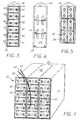
- FIG. 3 shows more particularly the positioning of the cell-receiving members dividing the cell enclosure area into multi-story, cell compartments.
- cell-receiving members 18 divide the cell enclosure area, shown generally by arrow 16, into cell compartments 46.
- each cell compartment 46 is dimensionally configured to accept two sealed lead-acid cells 24.
- the cells 24 are positioned such that the internal plates are parallel to the tray base 12.
- sealed lead-acid cells made in accordance with the aforementioned Szymborski et al. '730 patent. Cells of this type are commercially available. However, any other sealed lead-acid cells may be used in the present invention.
- the cells 24 are positioned within the tray assembly as desired to provide the requisite voltage. Most typically, the six cell embodiment shown will be positioned so as to provide a 12-volt motive power source, by alternating the position of the positive and negative terminals of adjacent cells, 40 and 42 respectively, as shown in FIG. 3. Since sealed lead-acid cells may be used in any attitude or position, the cells may be positioned as needed to provide the desired voltage for the intended application.
- the electrical connections between adjacent cells can be made using any desired connectors suitable for this purpose. Many suitable connectors are known. The use of epoxy-coated bolts and copper connectors are known and have been used. Burned-on connectors, as are employed with flooded lead-acid batteries, may also be used, if desired.
- the cell compartments 46 should be sized so as to accommodate no more than two cells. Indeed, in accordance with one aspect of the present invention, when cells having relatively high capacities are used, it is preferred to size the cell compartments to accommodate just a single cell. In such a configuration, each sealed lead-acid cell is essentially surrounded in a steel or other heat conductive material so that the dissipation of heat generated in service is facilitated; and proper compression is provided.
- stacking more than two cells on top of each other in the configuration shown in FIG. 3 could well cause problems in service.
- the bottom cell could well perform far differently from the top-positioned cell because of the weight of the stack. Such differences in performance could also adversely affect the useful service life.
- the appropriate compression is maintained in the cell tray assembly of the present invention by suitably sizing the cell compartments in relation to the cell dimensions and by the weight of the cell when the cell compartment is sized to hold two cells.
- Oversizing the cell compartments would result in under-compression for at least some of the cells (e.g., the top-positioned cell in the stack). Such under-compression results in a loss of contact between the plates and separators and less than expected capacity.
- access to the cells is limited. This is achieved (as shown in FIGURES 1, 3 and 4) by bolting the tray cover 22 to the side walls 14 with bolts 48 via holes 50 in the tray covers 22 that line up with weld nuts 52 in the side walls 14. Other means of attaching the tray cover to the side walls may be utilized as desired.
- one aspect of the preferred embodiment of this invention provides openings 54 designed to provide venting for heat dissipation purposes, release of any gas expelled from the cells 24, and allow access to the cell terminals without removal of the cover while the cells are positioned in the tray assembly.
- the tray covers 22 may be over-sized in comparison to the area defined by the tray base, side walls and top. In this fashion, the cell tray assembly 10 can be sized to provide a better fit in the vehicle space designed for the power source.
- FIG. 5 shows an embodiment in which the cell tray assembly is identical to that shown in the embodiment of FIGS. 1-4, except that the cells 24 are positioned in the cell compartments 46 on their side. In this position, the individual plates of the sealed lead-acid cells 24 are generally perpendicular to the tray base 12. This embodiment retains the considerable advantages attained by positioning the cells horizontally, so as to accommodate differing space requirements, and allows two-cell compartments without stacking.
- proper compression is obtained by suitably sizing the width of the cell compartments 46.
- the width of the cell compartment 46 will provide proper compression when sized to be about 0.030 inch or so greater than the width of the cells.
- restraint bars 56 are provided. Each restraint bar 56 is attached by suitable means to the upstanding side walls by any desirable means, such as by bolts 58. Base member 60 of restraint bar 56 is designed to abut the shoulder 38 of the cell 24 so as to hold the cells in the desired position.
- the tray assembly may be readily designed to provide a suitable power source for a variety of motive power applications which may require up to 36 volts or even more.
- FIG. 7 illustrates an alternative embodiment of the tray assembly of the present invention in which a 36-volt motive power source is provided.
- the cell tray assembly shown generally at 10 includes 18 sealed lead-acid cells 24 positioned horizontally in three stacks.
- each cell stack is separated by an air channel 62 and the top of the tray assembly 28 is optionally provided with venting slots 64. While optional, these venting aids are particularly desirable and are preferred for configurations of this type.
- the positive and negative terminals 40 and 42 are electrically connected by connectors 66. Cables 68 and 70, respectively, connect the positive and negative termination of the cell assembly to the vehicle.
- FIGS. 8-10 Another aspect of the present invention provides a sealed lead-acid cell tray assembly in which the cells are positioned in a back-to-back location in the tray assembly.
- a tray assembly is provided in which individual cells 24 are positioned in a back-to-back configuration (as best seen in FIG. 10) in the tray assembly shown generally at 10.
- Spacer plate 44 serves to restrain one end of the cells 24 from undesired movement.
- FIG. 8 shows the front of the tray assembly 10 in which the individual cells are connected with connectors 66.
- the positive termination of the cell assembly is electrically connected to the vehicle to be powered via cable 68.
- air channels 62 are provided to separate the individual cell stacks.
- the tray assembly of this embodiment is provided with a means to facilitate the connection of the forwardly-positioned cells to the rearwardly-positioned cells.
- channels 72 are attached to the tray base 12 and are dimensioned to accept cable 74 which connects the negative terminal 42 in the front cell 24 with the positive terminal 40 in rearwardly positioned cell 24.
- the negative termination is then connected via cable 70 to the vehicle.
- this embodiment minimizes the internal resistance by the connections provided. More particularly, the embodiment shown requires a minimum length of cable to connect the negative terminal in the front set of cells to the positive terminal in the rearwardly positioned set of cells.
- any suitable materials can be used to construct the tray assembly. Because of the weight requirements involved, it is desirable to use, as illustrative examples, hot rolled steel or commercial quality mild rolled steel.
- the tray base, side walls, cover and cell-receiving members can be 0.012 inch thick, while the tray covers are 0.019 inch thick.
- the components may be coated with a liquid epoxy or powdered epoxy material. Suitable epoxy materials are well known and have been used in this field for similar purposes.
- the cell tray assembly utilizes a minimum number of components, designed in a way to facilitate assembly.
- one L-shaped member can be stamped to provide an opening through which the charger can be inserted after the cell tray assembly has been fully assembled.
- the cell tray assembly of the present invention offers sufficient versatility so that a wide variety of motive power applications may be satisfied.
- the cell tray assembly may thus be configured to satisfy applications requiring anywhere from 12-volts up to 48-Volts, or even up to 72-volts or more.
- the cell tray assembly of this invention can be designed to satisfy explosion-proof (EX) and spark-proof (EE) applications, as those requirements are set forth in Underwriters Laboratories standard UL-583. More particularly, to satisfy the criteria for an EE application, all that is required would be to add a masonite, or other insulation, layer to the inward side of the tray cover, as well as an expanded metal mesh over the tray cover vent openings to keep foreign objects out, and perhaps a locking device on the tray cover. To satisfy the design intention for an EX application, all that is required is a fuse box (i.e., switch) that can disconnect the cables when the tray cover is removed.
- EX explosion-proof
- EE spark-proof
- the present invention may be used as the power source for any motive-powered vehicle.
- Illustrative examples include automobiles, vans and the like.
- Class 1-3 trucks embody particularly useful applications for the present invention.
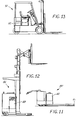
- FIG. 11 shows an illustrative pallet jack shown generally at 80 with one embodiment of the tray assembly 10 of the present invention in position as is shown at 82. While seemingly unlimited as to the height dimension, it is generally required, or at least found highly desirable, for this type of application to take the height into consideration. More particularly, it will be generally useful to insure that the height of the battery will not prevent the operator of the truck 80 from seeing the end of the forks 84.
- FIG. 12 shows a Class 2 narrow aisle truck.
- the illustrative truck shown generally at 86 thus includes the tray assembly 10 in position, as is shown generally at 88.
- space limitations are present both as to height and the footprint.
- FIG. 13 shows the use of the present invention with an illustrative Class 1 rider truck.
- the tray assembly in the truck shown generally at 90 is positioned in the compartment shown generally at 92. Again, as is typical of this application, there are space limitations for the motive power source.
- the present invention thus provides a sealed lead-acid tray assembly that can satisfy the deep discharge cycling requirements of motive power applications. It is believed that the enhanced cycle life provided will allow sealed lead-acid batteries to at least meet the performance benefits now achieved using conventional, flooded lead-acid batteries in motive power applications. The enhanced performance obtained using the present invention is truly remarkable.
Landscapes
- Engineering & Computer Science (AREA)
- Chemical & Material Sciences (AREA)
- Transportation (AREA)
- General Chemical & Material Sciences (AREA)
- Electrochemistry (AREA)
- Chemical Kinetics & Catalysis (AREA)
- Mechanical Engineering (AREA)
- Structural Engineering (AREA)
- Combustion & Propulsion (AREA)
- Civil Engineering (AREA)
- Life Sciences & Earth Sciences (AREA)
- Geology (AREA)
- Battery Mounting, Suspending (AREA)
- Sealing Battery Cases Or Jackets (AREA)
Applications Claiming Priority (2)
| Application Number | Priority Date | Filing Date | Title |
|---|---|---|---|
| US4168793A | 1993-04-01 | 1993-04-01 | |
| US41687 | 1993-04-01 |
Publications (3)
| Publication Number | Publication Date |
|---|---|
| EP0620604A2 true EP0620604A2 (fr) | 1994-10-19 |
| EP0620604A3 EP0620604A3 (fr) | 1995-03-22 |
| EP0620604B1 EP0620604B1 (fr) | 2001-05-23 |
Family
ID=21917806
Family Applications (1)
| Application Number | Title | Priority Date | Filing Date |
|---|---|---|---|
| EP94302332A Expired - Lifetime EP0620604B1 (fr) | 1993-04-01 | 1994-03-31 | Ensemble à plateau comportant des cellules acide-plomb de type étanche et véhicule automobile utilisant un tel ensemble à plateau de cellules |
Country Status (6)
| Country | Link |
|---|---|
| US (1) | US5441123A (fr) |
| EP (1) | EP0620604B1 (fr) |
| JP (1) | JP3007526B2 (fr) |
| AU (1) | AU662858B2 (fr) |
| CA (1) | CA2120441C (fr) |
| DE (1) | DE69427248T2 (fr) |
Cited By (9)
| Publication number | Priority date | Publication date | Assignee | Title |
|---|---|---|---|---|
| EP0662725A1 (fr) * | 1994-01-06 | 1995-07-12 | Gnb Industrial Battery Company | Ensemble à plateau comportant des cellules acide-plomb de type étanche et véhicule automobile utilisant un tel ensemble à plateau de cellules |
| FR2730718A1 (fr) * | 1995-02-17 | 1996-08-23 | Fenwick Linde | Chariot de manutention alimente par batteries |
| EP1047139A1 (fr) * | 1999-04-23 | 2000-10-25 | Oldham France S.A. | Source d'alimentation en courant continu pour véhicule à moteur électrique |
| EP2261167B1 (fr) * | 2009-06-12 | 2013-01-23 | Jungheinrich Aktiengesellschaft | Chariot de manutention doté d'une unité de batterie |
| EP2700611A1 (fr) * | 2012-08-21 | 2014-02-26 | STILL GmbH | Cadre d'adaptateur pour batterie de traction et chariot de manutention avec batterie de traction |
| US11056727B2 (en) | 2017-07-13 | 2021-07-06 | Econtrols, Llc | Modular lithium-ion battery system for fork lifts |
| CN113443588A (zh) * | 2021-08-30 | 2021-09-28 | 浙江高成绿能科技有限公司 | 一种用于电动叉车的燃料电池双电堆封装结构 |
| US12230828B2 (en) | 2021-06-04 | 2025-02-18 | Ethium, Llc | Lithium-ion battery charging system for fork lifts |
| US12266953B1 (en) | 2020-08-17 | 2025-04-01 | Econtrols, Llc | Dual chemistry rechargeable battery system for use in electric APU-equipped commercial trucks |
Families Citing this family (53)
| Publication number | Priority date | Publication date | Assignee | Title |
|---|---|---|---|---|
| JP3350314B2 (ja) * | 1995-09-29 | 2002-11-25 | 富士重工業株式会社 | ハイブリッド自動車の駆動装置 |
| US5747965A (en) * | 1996-03-12 | 1998-05-05 | La-Z-Boy Incorporated | Battery pack for powered motion furniture |
| US5876873A (en) | 1997-01-21 | 1999-03-02 | Gnb Technologies, Inc. | Sealed lead-acid cells and batteries having internal and external restraint for accommodating plate growth |
| US6012544A (en) * | 1997-10-24 | 2000-01-11 | Grove U.S. L.L.C. | Aerial work platform with removably attachable support structure for auxiliary power plant |
| GB2331054B (en) * | 1997-11-06 | 2001-08-08 | Lansing Linde Ltd | Industrial truck with a battery block |
| US6109380A (en) * | 1998-04-13 | 2000-08-29 | Ford Global Technologies, Inc. | Electric vehicle vertical wall construction battery tray |
| US5985482A (en) * | 1998-04-28 | 1999-11-16 | Gnb Technologies, Inc. | Snap-on battery heat shield |
| US6494279B1 (en) * | 1998-06-11 | 2002-12-17 | Gnb Technologies, Inc. | Battery enclosure system for motive power in hazardous service environments |
| US6641951B1 (en) * | 1998-09-21 | 2003-11-04 | Douglas Battery Manufacturing Company | Battery cell tray assembly and sytem |
| US6162559A (en) * | 1998-09-21 | 2000-12-19 | Douglas Battery Manufacturing Company | Compressed battery system for motive power applications |
| US6153335A (en) * | 1998-09-25 | 2000-11-28 | Douglas Battery Manufacturing Company | Battery cell construction including fiberous mat separator |
| US6194100B1 (en) | 1998-09-28 | 2001-02-27 | Douglas Battery Manufacturing Co. | Method for making valve-regulated lead acid battery with vacuum draw down |
| WO2000030190A1 (fr) | 1998-11-17 | 2000-05-25 | C & D Technologies, Inc. | Systeme de support pour batterie plomb-acide a encombrement fixe et capacite pouvant etre selectionnee, pourvu de plaques horizontales |
| US6410185B1 (en) * | 1999-02-15 | 2002-06-25 | Sony Corporation | Battery device for loading on moving body |
| FR2790870B1 (fr) * | 1999-03-11 | 2001-06-01 | Oldham France Sa | Coffre pour ensemble de batteries d'accumulateurs electriques |
| US6719150B2 (en) * | 2001-05-30 | 2004-04-13 | Kim Manufacturing Company | Battery rack and system |
| US20030003350A1 (en) * | 2001-07-02 | 2003-01-02 | C&D Charter Holdings, Inc. | Horizontal tray insert and tray assembly for motive-power applications |
| US7740142B2 (en) * | 2001-11-20 | 2010-06-22 | Concorde Battery Corporation | Battery construction for mounting a shelved rack |
| US6811197B1 (en) | 2002-11-14 | 2004-11-02 | Ford Global Technologies, Llc | Housing assembly for electrical energy storage device |
| US20050281002A1 (en) * | 2004-06-18 | 2005-12-22 | Miller Russell L | Battery storage system |
| US7548429B2 (en) * | 2004-06-18 | 2009-06-16 | Douglas Battery Manufacturing Company | Battery storage system |
| US7374004B2 (en) * | 2005-06-02 | 2008-05-20 | Crown Equipment Corporation | Industrial vehicle with shaped battery |
| US7838142B2 (en) * | 2006-02-09 | 2010-11-23 | Scheucher Karl F | Scalable intelligent power supply system and method |
| DE102006017889A1 (de) * | 2006-04-13 | 2007-10-25 | Linde Material Handling Gmbh | Flurförderzeug mit einer Batterie und Verfahren zum Betrieb eines Flurförderzeugs mit einer Batterie |
| DE102006030770A1 (de) * | 2006-06-30 | 2008-01-24 | Jungheinrich Ag | Batterieblock für ein Flurförderzeug |
| US7808362B2 (en) * | 2007-08-13 | 2010-10-05 | Littlefuse, Inc. | Moderately hazardous environment fuse |
| US8674803B2 (en) | 2007-08-13 | 2014-03-18 | Littelfuse, Inc. | Moderately hazardous environment fuse |
| JP2009212059A (ja) * | 2008-03-06 | 2009-09-17 | Toshiba Corp | 電動軽車両のバッテリ装置 |
| US9099730B2 (en) * | 2010-01-21 | 2015-08-04 | C&D Technologies, Inc. | Storage battery having molded-in terminal |
| US8765297B2 (en) | 2011-01-04 | 2014-07-01 | Exide Technologies | Advanced graphite additive for enhanced cycle-life of lead-acid batteries |
| KR101925163B1 (ko) | 2011-05-16 | 2018-12-04 | 히다찌 겐끼 가부시키가이샤 | 건설 기계 |
| JP5325261B2 (ja) * | 2011-05-16 | 2013-10-23 | 日立建機株式会社 | 建設機械 |
| US9108497B2 (en) * | 2011-06-13 | 2015-08-18 | Albert W. Harrison, III | Structural enclosure for packaging power electronics for vehicle battery modules and methods of servicing and manufacturing vehicles using same |
| CN103889833B (zh) * | 2011-10-28 | 2016-11-23 | 川崎重工业株式会社 | 跨乘式电动车辆 |
| US10014520B2 (en) | 2012-10-31 | 2018-07-03 | Exide Technologies Gmbh | Composition that enhances deep cycle performance of valve-regulated lead-acid batteries filled with gel electrolyte |
| JP5981881B2 (ja) * | 2013-05-31 | 2016-08-31 | 古河電池株式会社 | 蓄電池システム |
| JP2015084285A (ja) * | 2013-10-25 | 2015-04-30 | 新神戸電機株式会社 | 移動体搭載用の組電池 |
| EP3174132B1 (fr) * | 2015-11-30 | 2018-07-25 | HOPPECKE Batterien GmbH & Co. KG. | Batterie de propulsion |
| CN105459782A (zh) * | 2015-12-18 | 2016-04-06 | 力帆实业(集团)股份有限公司 | 一种车辆及其蓄电池安装支架 |
| DE102018000135A1 (de) * | 2018-01-10 | 2019-07-11 | Voltabox Ag | Energieversorgungseinheit für Luftfahrtbodengeräte und Flurförderzeuge |
| DE102018100912B4 (de) | 2018-01-17 | 2020-12-10 | Stöcklin Logistik Ag | Batteriestromversorgung für ein in einem explosionsgefährdeten Bereich eingesetztes Flurförderfahrzeug und Flurförderfahrzeug |
| CN208150887U (zh) * | 2018-04-19 | 2018-11-27 | 浙江中力机械有限公司 | 一种全自动搬运车及其车架 |
| CN208856869U (zh) * | 2018-04-19 | 2019-05-14 | 浙江中力机械有限公司 | 一种搬运车 |
| US10730728B1 (en) | 2019-04-17 | 2020-08-04 | Zhejiang E-P Equipment Co., Ltd. | Removable plug-in modules for material handling vehicles |
| KR20210063939A (ko) * | 2019-11-25 | 2021-06-02 | 주식회사 엘지에너지솔루션 | 배터리 모듈 |
| CN114523833B (zh) * | 2020-11-23 | 2024-04-02 | 上海汽车集团股份有限公司 | 汽车的电池框固定装置及汽车 |
| CN215642451U (zh) | 2021-06-25 | 2022-01-25 | 浙江中力机械股份有限公司 | 手柄头及具有其的搬运车 |
| CN215364722U (zh) | 2021-06-26 | 2021-12-31 | 浙江中力机械股份有限公司 | 一种搬运车 |
| CN216133771U (zh) | 2021-06-26 | 2022-03-25 | 浙江中力机械股份有限公司 | 一种手柄关节座以及搬运车控制手柄 |
| CN215626593U (zh) | 2021-08-30 | 2022-01-25 | 浙江中力机械股份有限公司 | 一种电池结构以及搬运车 |
| EP4156368A1 (fr) * | 2021-09-24 | 2023-03-29 | HOPPECKE Batterien GmbH & Co. KG. | Système composé d'une aide à l'empilage et d'une pluralité de batteries agm |
| CN114290886B (zh) * | 2021-12-31 | 2024-05-17 | 蜂巢能源科技(无锡)有限公司 | 一种车用电池的排布方法、装置及电子设备 |
| AU2025220753A1 (en) * | 2024-08-28 | 2026-03-19 | The Raymond Corporation | Sealed modular battery enclosure for a material handling vehicle |
Family Cites Families (31)
| Publication number | Priority date | Publication date | Assignee | Title |
|---|---|---|---|---|
| FR629425A (fr) * | 1926-04-30 | 1927-11-09 | Batterie de piles électriques | |
| US2132793A (en) * | 1934-06-13 | 1938-10-11 | Usl Battery Corp | Storage battery construction |
| US2548558A (en) * | 1947-01-15 | 1951-04-10 | Willard Storage Battery Co | Storage battery |
| CA628855A (en) * | 1957-05-25 | 1961-10-10 | A. Herold Rodolphe | Method of and device for assembling and mounting electrical storage batteries |
| US3275092A (en) * | 1964-05-05 | 1966-09-27 | Allis Chalmers Mfg Co | Electric truck battery compartment |
| US3708028A (en) * | 1970-12-21 | 1973-01-02 | Boyertown Auto Body Works | Electrically driven vehicles |
| US3989544A (en) * | 1973-08-22 | 1976-11-02 | Santo Charles P | Quick disconnect battery |
| US4074785A (en) * | 1976-04-05 | 1978-02-21 | Towmotor Corporation | Battery enclosure |
| US4033424A (en) * | 1976-04-09 | 1977-07-05 | Towmotor Corporation | Article hold-down device |
| GB1578335A (en) * | 1976-05-08 | 1980-11-05 | Lucas Industries Ltd | Battery packs |
| US4129194A (en) * | 1977-07-28 | 1978-12-12 | Eaton Corporation | Hold-down device for storage batteries |
| JPS55125718A (en) * | 1979-03-22 | 1980-09-27 | Mitsumi Electric Co Ltd | Push button type tuner |
| US4275131A (en) * | 1979-10-02 | 1981-06-23 | General Battery Corporation | Electric storage battery container |
| US4401730A (en) * | 1980-10-03 | 1983-08-30 | Gnb Batteries Inc. | Sealed deep cycle lead acid battery |
| JPS5819462U (ja) * | 1981-07-29 | 1983-02-05 | 日本電池株式会社 | ペ−スト式鉛蓄電池群 |
| JPS5823597A (ja) * | 1981-08-03 | 1983-02-12 | Takeda Kikai Seisakusho:Kk | プレス機などの駆動装置 |
| US4429761A (en) * | 1981-08-17 | 1984-02-07 | Clark Equipment Company | Seat and control lever interlock |
| US4477542A (en) * | 1983-12-12 | 1984-10-16 | Braswell Richard R | Quick release storage battery closure assembly |
| US4582767A (en) * | 1984-03-13 | 1986-04-15 | Sanyo Electric Co., Ltd. | Lead storage battery |
| JPH0135408Y2 (fr) * | 1984-12-26 | 1989-10-27 | ||
| JPS6319754A (ja) * | 1986-07-11 | 1988-01-27 | Nec Corp | シ−ル形据置蓄電池の設置方式 |
| EP0281710B1 (fr) * | 1987-03-12 | 1992-05-13 | Yuasa Battery Co., Ltd. | Disposition de batteries étanches |
| US4928227A (en) * | 1987-11-02 | 1990-05-22 | Ford Motor Company | Method for controlling a motor vehicle powertrain |
| US4957829A (en) * | 1989-06-26 | 1990-09-18 | At&T Bell Laboratories | Modular battery plant system assembly comprising multiple unit cell modules |
| US5015545A (en) * | 1990-01-03 | 1991-05-14 | General Motors Corporation | Method and apparatus for cooling an array of rechargeable batteries |
| US5140744A (en) * | 1990-06-06 | 1992-08-25 | Miller Robert D | Modular multicell battery and rack |
| JP3084734B2 (ja) * | 1990-09-25 | 2000-09-04 | 日産自動車株式会社 | 電気自動車用パネル構造電池 |
| DE4117539A1 (de) * | 1991-05-29 | 1992-12-03 | Standard Elektrik Lorenz Ag | Halterung fuer batterien |
| JPH04358950A (ja) * | 1991-05-31 | 1992-12-11 | Honda Motor Co Ltd | 電動式車両 |
| US5851695A (en) * | 1992-02-10 | 1998-12-22 | C & D Technologies, Inc. | Recombinant lead-acid cell and long life battery |
| US5304434A (en) * | 1992-06-15 | 1994-04-19 | Gnb Industrial Battery Co. | Modular cabinet for large-sized sealed lead-acid cells |
-
1994
- 1994-03-31 DE DE69427248T patent/DE69427248T2/de not_active Expired - Lifetime
- 1994-03-31 CA CA002120441A patent/CA2120441C/fr not_active Expired - Lifetime
- 1994-03-31 AU AU59233/94A patent/AU662858B2/en not_active Expired
- 1994-03-31 EP EP94302332A patent/EP0620604B1/fr not_active Expired - Lifetime
- 1994-04-01 JP JP6065055A patent/JP3007526B2/ja not_active Expired - Fee Related
-
1995
- 1995-02-15 US US08/389,558 patent/US5441123A/en not_active Expired - Lifetime
Cited By (12)
| Publication number | Priority date | Publication date | Assignee | Title |
|---|---|---|---|---|
| EP0662725A1 (fr) * | 1994-01-06 | 1995-07-12 | Gnb Industrial Battery Company | Ensemble à plateau comportant des cellules acide-plomb de type étanche et véhicule automobile utilisant un tel ensemble à plateau de cellules |
| FR2730718A1 (fr) * | 1995-02-17 | 1996-08-23 | Fenwick Linde | Chariot de manutention alimente par batteries |
| EP1047139A1 (fr) * | 1999-04-23 | 2000-10-25 | Oldham France S.A. | Source d'alimentation en courant continu pour véhicule à moteur électrique |
| FR2792776A1 (fr) * | 1999-04-23 | 2000-10-27 | Oldham France Sa | Source d'alimentation en courant continu pour vehicule automoteur electrique |
| US6406812B1 (en) | 1999-04-23 | 2002-06-18 | Oldham France S.A. | Continuous current supply for electrical automotive vehicle |
| EP2261167B1 (fr) * | 2009-06-12 | 2013-01-23 | Jungheinrich Aktiengesellschaft | Chariot de manutention doté d'une unité de batterie |
| EP2700611A1 (fr) * | 2012-08-21 | 2014-02-26 | STILL GmbH | Cadre d'adaptateur pour batterie de traction et chariot de manutention avec batterie de traction |
| US11056727B2 (en) | 2017-07-13 | 2021-07-06 | Econtrols, Llc | Modular lithium-ion battery system for fork lifts |
| US12266953B1 (en) | 2020-08-17 | 2025-04-01 | Econtrols, Llc | Dual chemistry rechargeable battery system for use in electric APU-equipped commercial trucks |
| US12230828B2 (en) | 2021-06-04 | 2025-02-18 | Ethium, Llc | Lithium-ion battery charging system for fork lifts |
| CN113443588A (zh) * | 2021-08-30 | 2021-09-28 | 浙江高成绿能科技有限公司 | 一种用于电动叉车的燃料电池双电堆封装结构 |
| CN113443588B (zh) * | 2021-08-30 | 2022-03-11 | 浙江高成绿能科技有限公司 | 一种用于电动叉车的燃料电池双电堆封装结构 |
Also Published As
| Publication number | Publication date |
|---|---|
| DE69427248D1 (de) | 2001-06-28 |
| AU5923394A (en) | 1994-10-06 |
| EP0620604A3 (fr) | 1995-03-22 |
| DE69427248T2 (de) | 2001-09-13 |
| AU662858B2 (en) | 1995-09-14 |
| US5441123A (en) | 1995-08-15 |
| JP3007526B2 (ja) | 2000-02-07 |
| CA2120441C (fr) | 2005-04-12 |
| EP0620604B1 (fr) | 2001-05-23 |
| JPH0757709A (ja) | 1995-03-03 |
| CA2120441A1 (fr) | 1994-10-02 |
Similar Documents
| Publication | Publication Date | Title |
|---|---|---|
| US5441123A (en) | Sealed lead-acid cell tray assembly and motive powered vehicle using such cell tray assembly | |
| EP0794882B1 (fr) | Ensemble de plateaux porte-elements pour vehicule automobile | |
| US5981101A (en) | Modular cell tray assembly for sealed lead-acid cells | |
| US6406812B1 (en) | Continuous current supply for electrical automotive vehicle | |
| EP1834365B1 (fr) | Processus pour la preparation d'un module de batterie secondaire | |
| US6326103B1 (en) | Sealed storage battery and modular system therefor | |
| US6023146A (en) | Battery system electrical connection apparatus and method | |
| US5304434A (en) | Modular cabinet for large-sized sealed lead-acid cells | |
| KR20190122407A (ko) | 버스바를 구비한 배터리 모듈 및 배터리 팩 | |
| US7014946B2 (en) | Modular rack battery system | |
| CN110114932B (zh) | 电池模块以及包括电池模块的电池组和车辆 | |
| WO2007080456A2 (fr) | Pile electrochimique destinee a des vehicules electriques hybrides | |
| EP3930103A1 (fr) | Connecteur, unité de gestion de batterie et bloc-batterie | |
| US20260045568A1 (en) | Modular battery | |
| US10118504B2 (en) | Battery system housing with fastener | |
| EP4096001A1 (fr) | Bloc-batterie, dispositif de stockage d'énergie et véhicule | |
| CA2474582C (fr) | Systeme de pile a bati modulaire | |
| US20230307771A1 (en) | Traction battery pack electronics support plate and electronics support method | |
| EP3792990B1 (fr) | Bloc-batterie | |
| EP4564587A1 (fr) | Bâti de batterie | |
| US20260135263A1 (en) | Battery rack | |
| KR20250170335A (ko) | 배터리 팩 및 이를 포함하는 자동차 | |
| KR20250118631A (ko) | 커넥터, 이를 포함하는 배터리 조립체 및 배터리 모듈 |
Legal Events
| Date | Code | Title | Description |
|---|---|---|---|
| PUAI | Public reference made under article 153(3) epc to a published international application that has entered the european phase |
Free format text: ORIGINAL CODE: 0009012 |
|
| AK | Designated contracting states |
Kind code of ref document: A2 Designated state(s): DE FR GB IT |
|
| PUAL | Search report despatched |
Free format text: ORIGINAL CODE: 0009013 |
|
| AK | Designated contracting states |
Kind code of ref document: A3 Designated state(s): DE FR GB IT |
|
| 17P | Request for examination filed |
Effective date: 19950811 |
|
| 17Q | First examination report despatched |
Effective date: 19960930 |
|
| GRAG | Despatch of communication of intention to grant |
Free format text: ORIGINAL CODE: EPIDOS AGRA |
|
| GRAG | Despatch of communication of intention to grant |
Free format text: ORIGINAL CODE: EPIDOS AGRA |
|
| GRAH | Despatch of communication of intention to grant a patent |
Free format text: ORIGINAL CODE: EPIDOS IGRA |
|
| GRAH | Despatch of communication of intention to grant a patent |
Free format text: ORIGINAL CODE: EPIDOS IGRA |
|
| GRAA | (expected) grant |
Free format text: ORIGINAL CODE: 0009210 |
|
| AK | Designated contracting states |
Kind code of ref document: B1 Designated state(s): DE FR GB IT |
|
| REF | Corresponds to: |
Ref document number: 69427248 Country of ref document: DE Date of ref document: 20010628 |
|
| ITF | It: translation for a ep patent filed | ||
| ET | Fr: translation filed | ||
| REG | Reference to a national code |
Ref country code: GB Ref legal event code: IF02 |
|
| PLBE | No opposition filed within time limit |
Free format text: ORIGINAL CODE: 0009261 |
|
| STAA | Information on the status of an ep patent application or granted ep patent |
Free format text: STATUS: NO OPPOSITION FILED WITHIN TIME LIMIT |
|
| 26N | No opposition filed | ||
| PGFP | Annual fee paid to national office [announced via postgrant information from national office to epo] |
Ref country code: IT Payment date: 20070526 Year of fee payment: 14 |
|
| PG25 | Lapsed in a contracting state [announced via postgrant information from national office to epo] |
Ref country code: IT Free format text: LAPSE BECAUSE OF NON-PAYMENT OF DUE FEES Effective date: 20080331 |
|
| PGFP | Annual fee paid to national office [announced via postgrant information from national office to epo] |
Ref country code: FR Payment date: 20130325 Year of fee payment: 20 Ref country code: GB Payment date: 20130327 Year of fee payment: 20 Ref country code: DE Payment date: 20130327 Year of fee payment: 20 |
|
| REG | Reference to a national code |
Ref country code: DE Ref legal event code: R071 Ref document number: 69427248 Country of ref document: DE |
|
| REG | Reference to a national code |
Ref country code: GB Ref legal event code: PE20 Expiry date: 20140330 |
|
| PG25 | Lapsed in a contracting state [announced via postgrant information from national office to epo] |
Ref country code: GB Free format text: LAPSE BECAUSE OF EXPIRATION OF PROTECTION Effective date: 20140330 |
|
| PG25 | Lapsed in a contracting state [announced via postgrant information from national office to epo] |
Ref country code: DE Free format text: LAPSE BECAUSE OF EXPIRATION OF PROTECTION Effective date: 20140401 |