EP0621288A2 - Procédé de préparation de polyéthylène - Google Patents
Procédé de préparation de polyéthylène Download PDFInfo
- Publication number
- EP0621288A2 EP0621288A2 EP94106227A EP94106227A EP0621288A2 EP 0621288 A2 EP0621288 A2 EP 0621288A2 EP 94106227 A EP94106227 A EP 94106227A EP 94106227 A EP94106227 A EP 94106227A EP 0621288 A2 EP0621288 A2 EP 0621288A2
- Authority
- EP
- European Patent Office
- Prior art keywords
- mixture
- catalyst
- reactor
- cocatalyst
- solvent
- Prior art date
- Legal status (The legal status is an assumption and is not a legal conclusion. Google has not performed a legal analysis and makes no representation as to the accuracy of the status listed.)
- Withdrawn
Links
- -1 polyethylene Polymers 0.000 title claims abstract description 33
- 239000004698 Polyethylene Substances 0.000 title claims abstract description 28
- 229920000573 polyethylene Polymers 0.000 title claims abstract description 28
- 238000000034 method Methods 0.000 title claims description 52
- 239000000203 mixture Substances 0.000 claims abstract description 52
- 239000003054 catalyst Substances 0.000 claims abstract description 50
- 239000002904 solvent Substances 0.000 claims abstract description 28
- VGGSQFUCUMXWEO-UHFFFAOYSA-N Ethene Chemical compound C=C VGGSQFUCUMXWEO-UHFFFAOYSA-N 0.000 claims abstract description 18
- 239000005977 Ethylene Substances 0.000 claims abstract description 18
- 238000004519 manufacturing process Methods 0.000 claims abstract description 10
- 239000001257 hydrogen Substances 0.000 claims description 12
- 229910052739 hydrogen Inorganic materials 0.000 claims description 12
- UFHFLCQGNIYNRP-UHFFFAOYSA-N Hydrogen Chemical compound [H][H] UFHFLCQGNIYNRP-UHFFFAOYSA-N 0.000 claims description 10
- KWKAKUADMBZCLK-UHFFFAOYSA-N 1-octene Chemical group CCCCCCC=C KWKAKUADMBZCLK-UHFFFAOYSA-N 0.000 claims description 8
- 238000006243 chemical reaction Methods 0.000 claims description 8
- VLKZOEOYAKHREP-UHFFFAOYSA-N n-Hexane Chemical group CCCCCC VLKZOEOYAKHREP-UHFFFAOYSA-N 0.000 claims description 8
- RTAQQCXQSZGOHL-UHFFFAOYSA-N Titanium Chemical compound [Ti] RTAQQCXQSZGOHL-UHFFFAOYSA-N 0.000 claims description 5
- TVMXDCGIABBOFY-UHFFFAOYSA-N n-Octanol Natural products CCCCCCCC TVMXDCGIABBOFY-UHFFFAOYSA-N 0.000 claims description 5
- 229910052719 titanium Inorganic materials 0.000 claims description 5
- 239000010936 titanium Substances 0.000 claims description 5
- XJDNKRIXUMDJCW-UHFFFAOYSA-J titanium tetrachloride Chemical compound Cl[Ti](Cl)(Cl)Cl XJDNKRIXUMDJCW-UHFFFAOYSA-J 0.000 claims description 5
- VOITXYVAKOUIBA-UHFFFAOYSA-N triethylaluminium Chemical group CC[Al](CC)CC VOITXYVAKOUIBA-UHFFFAOYSA-N 0.000 claims description 5
- 229910052720 vanadium Inorganic materials 0.000 claims description 5
- 239000000155 melt Substances 0.000 claims description 4
- JBIQAPKSNFTACH-UHFFFAOYSA-K vanadium oxytrichloride Chemical compound Cl[V](Cl)(Cl)=O JBIQAPKSNFTACH-UHFFFAOYSA-K 0.000 claims description 4
- LEONUFNNVUYDNQ-UHFFFAOYSA-N vanadium atom Chemical compound [V] LEONUFNNVUYDNQ-UHFFFAOYSA-N 0.000 claims description 3
- WKBOTKDWSSQWDR-UHFFFAOYSA-N Bromine atom Chemical group [Br] WKBOTKDWSSQWDR-UHFFFAOYSA-N 0.000 claims description 2
- 125000000217 alkyl group Chemical group 0.000 claims description 2
- GDTBXPJZTBHREO-UHFFFAOYSA-N bromine Chemical group BrBr GDTBXPJZTBHREO-UHFFFAOYSA-N 0.000 claims description 2
- 229910052794 bromium Inorganic materials 0.000 claims description 2
- 239000000460 chlorine Substances 0.000 claims description 2
- 229910052801 chlorine Inorganic materials 0.000 claims description 2
- 125000001309 chloro group Chemical group Cl* 0.000 claims description 2
- 229930195733 hydrocarbon Natural products 0.000 claims description 2
- 150000002430 hydrocarbons Chemical class 0.000 claims description 2
- 239000011555 saturated liquid Substances 0.000 claims description 2
- 239000004215 Carbon black (E152) Substances 0.000 claims 1
- 239000000178 monomer Substances 0.000 description 17
- 239000011347 resin Substances 0.000 description 14
- 229920005989 resin Polymers 0.000 description 14
- 229920000642 polymer Polymers 0.000 description 8
- 239000000243 solution Substances 0.000 description 4
- 238000000071 blow moulding Methods 0.000 description 3
- 238000009826 distribution Methods 0.000 description 3
- OFBQJSOFQDEBGM-UHFFFAOYSA-N n-pentane Natural products CCCCC OFBQJSOFQDEBGM-UHFFFAOYSA-N 0.000 description 3
- 239000007787 solid Substances 0.000 description 3
- VXNZUUAINFGPBY-UHFFFAOYSA-N 1-Butene Chemical compound CCC=C VXNZUUAINFGPBY-UHFFFAOYSA-N 0.000 description 2
- ZGEGCLOFRBLKSE-UHFFFAOYSA-N 1-Heptene Chemical compound CCCCCC=C ZGEGCLOFRBLKSE-UHFFFAOYSA-N 0.000 description 2
- AFFLGGQVNFXPEV-UHFFFAOYSA-N 1-decene Chemical compound CCCCCCCCC=C AFFLGGQVNFXPEV-UHFFFAOYSA-N 0.000 description 2
- LIKMAJRDDDTEIG-UHFFFAOYSA-N 1-hexene Chemical compound CCCCC=C LIKMAJRDDDTEIG-UHFFFAOYSA-N 0.000 description 2
- JRZJOMJEPLMPRA-UHFFFAOYSA-N 1-nonene Chemical compound CCCCCCCC=C JRZJOMJEPLMPRA-UHFFFAOYSA-N 0.000 description 2
- IJGRMHOSHXDMSA-UHFFFAOYSA-N Atomic nitrogen Chemical compound N#N IJGRMHOSHXDMSA-UHFFFAOYSA-N 0.000 description 2
- IMNFDUFMRHMDMM-UHFFFAOYSA-N N-Heptane Chemical compound CCCCCCC IMNFDUFMRHMDMM-UHFFFAOYSA-N 0.000 description 2
- QQONPFPTGQHPMA-UHFFFAOYSA-N Propene Chemical compound CC=C QQONPFPTGQHPMA-UHFFFAOYSA-N 0.000 description 2
- 230000000052 comparative effect Effects 0.000 description 2
- DIOQZVSQGTUSAI-UHFFFAOYSA-N decane Chemical compound CCCCCCCCCC DIOQZVSQGTUSAI-UHFFFAOYSA-N 0.000 description 2
- SNRUBQQJIBEYMU-UHFFFAOYSA-N dodecane Chemical compound CCCCCCCCCCCC SNRUBQQJIBEYMU-UHFFFAOYSA-N 0.000 description 2
- 150000002431 hydrogen Chemical class 0.000 description 2
- 238000005259 measurement Methods 0.000 description 2
- BKIMMITUMNQMOS-UHFFFAOYSA-N nonane Chemical compound CCCCCCCCC BKIMMITUMNQMOS-UHFFFAOYSA-N 0.000 description 2
- 238000004806 packaging method and process Methods 0.000 description 2
- YWAKXRMUMFPDSH-UHFFFAOYSA-N pentene Chemical compound CCCC=C YWAKXRMUMFPDSH-UHFFFAOYSA-N 0.000 description 2
- 230000000704 physical effect Effects 0.000 description 2
- 229920013716 polyethylene resin Polymers 0.000 description 2
- 229910021552 Vanadium(IV) chloride Inorganic materials 0.000 description 1
- 230000015572 biosynthetic process Effects 0.000 description 1
- 239000001273 butane Substances 0.000 description 1
- 150000001805 chlorine compounds Chemical class 0.000 description 1
- ZHXZNKNQUHUIGN-UHFFFAOYSA-N chloro hypochlorite;vanadium Chemical compound [V].ClOCl ZHXZNKNQUHUIGN-UHFFFAOYSA-N 0.000 description 1
- 230000001684 chronic effect Effects 0.000 description 1
- 238000000354 decomposition reaction Methods 0.000 description 1
- 238000002474 experimental method Methods 0.000 description 1
- 239000007789 gas Substances 0.000 description 1
- 239000013628 high molecular weight specie Substances 0.000 description 1
- 239000004615 ingredient Substances 0.000 description 1
- 238000002347 injection Methods 0.000 description 1
- 239000007924 injection Substances 0.000 description 1
- 238000001746 injection moulding Methods 0.000 description 1
- IJDNQMDRQITEOD-UHFFFAOYSA-N n-butane Chemical compound CCCC IJDNQMDRQITEOD-UHFFFAOYSA-N 0.000 description 1
- 229910052757 nitrogen Inorganic materials 0.000 description 1
- 239000002685 polymerization catalyst Substances 0.000 description 1
- 230000001376 precipitating effect Effects 0.000 description 1
- 238000010926 purge Methods 0.000 description 1
- 230000035484 reaction time Effects 0.000 description 1
- 238000011084 recovery Methods 0.000 description 1
- 230000035945 sensitivity Effects 0.000 description 1
- YONPGGFAJWQGJC-UHFFFAOYSA-K titanium(iii) chloride Chemical compound Cl[Ti](Cl)Cl YONPGGFAJWQGJC-UHFFFAOYSA-K 0.000 description 1
- SQBBHCOIQXKPHL-UHFFFAOYSA-N tributylalumane Chemical compound CCCC[Al](CCCC)CCCC SQBBHCOIQXKPHL-UHFFFAOYSA-N 0.000 description 1
- ORYGRKHDLWYTKX-UHFFFAOYSA-N trihexylalumane Chemical compound CCCCCC[Al](CCCCCC)CCCCCC ORYGRKHDLWYTKX-UHFFFAOYSA-N 0.000 description 1
- LFXVBWRMVZPLFK-UHFFFAOYSA-N trioctylalumane Chemical compound CCCCCCCC[Al](CCCCCCCC)CCCCCCCC LFXVBWRMVZPLFK-UHFFFAOYSA-N 0.000 description 1
- JTJFQBNJBPPZRI-UHFFFAOYSA-J vanadium tetrachloride Chemical compound Cl[V](Cl)(Cl)Cl JTJFQBNJBPPZRI-UHFFFAOYSA-J 0.000 description 1
Images




Classifications
-
- C—CHEMISTRY; METALLURGY
- C08—ORGANIC MACROMOLECULAR COMPOUNDS; THEIR PREPARATION OR CHEMICAL WORKING-UP; COMPOSITIONS BASED THEREON
- C08F—MACROMOLECULAR COMPOUNDS OBTAINED BY REACTIONS ONLY INVOLVING CARBON-TO-CARBON UNSATURATED BONDS
- C08F10/00—Homopolymers and copolymers of unsaturated aliphatic hydrocarbons having only one carbon-to-carbon double bond
- C08F10/02—Ethene
Definitions
- This invention relates to a process wherein a catalyst, a cocatalyst, a solvent, a monomer, a comonomer and hydrogen are added to a reactor to make polyethylene.
- a catalyst, a cocatalyst, a solvent, a monomer, a comonomer and hydrogen are added to a reactor to make polyethylene.
- the catalyst and cocatalyst are kept separate until they are added to the reactor.
- the catalyst and cocatalyst are typically premixed in a small solvent stream (S1) outside of the reactor.
- S1 and S2 which contains the remaining solvent, the monomer, and other reaction ingredients, are then separately added to a continuously stirred reactor.
- S1 and S2 which contains the remaining solvent, the monomer, and other reaction ingredients
- the catalyst and cocatalyst mix tees would periodically plug up with solids. A plant shutdown was required several times a year to clean them. This pluggage was caused by activated catalyst solids precipitating out onto the walls of the piping system.
- polyethylene resin produced by the process of this invention also has a broader molecular weight distribution due to the formation of higher molecular weight polymers which were not present in product made by the previous process. These higher molecular weight polymers are expected to improve the melt strength of the product, which is an important property in blown film, blow molding and other applications.
- Figure 1 is an illustration of a prior art method of making polyethylene.
- Figure 2 is an illustration of the method of this invention for making polyethylene.
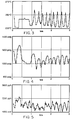
- Figure 3 is a graph showing reactor temperature versus time in hours (hrs) for a polyethylene production run according to the prior art.
- Figure 4 is a graph showing the extruder nose pressure versus time in hours (hrs) for a polyethylene production run according to the prior art.
- Figure 5 is a graph showing the recycle monomer flow rate in pounds per hour (pph) versus time in hours (hrs) for a polyethylene production run according to the prior art.
- Figure 6 is a graph showing reactor temperature versus time for the method of this invention.
- Figure 7 is a graph showing the extruder nose pressure versus time for the method of this invention.
- Figure 8 is a graph showing the recycle monomer flow rate versus time for the method of this invention.
- Figure 9 is a graph showing the viscosity in poise versus shear rate in 1/sec for resins produced according to the method of this invention (A) and according to the prior art method (B).
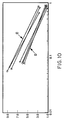
- Figure 10 is a graph of recoverable compliance in square cm/dyne 1 X 10 ⁇ 5 versus shear rate in 1/sec for resins produced according to the method of this invention.
- Figure 1 which illustrates a prior art method of making polyethylene, solvent, monomer, comonomer, and hydrogen are fed through line 1 into reactor 2.
- Solvent is fed through line 3, catalyst through line 4, and cocatalyst through line 5, into reactor 2.
- Product leaves reactor 2 through line 6.
- solvent, monomer, comonomer, and hydrogen enter reactor 7 through line 8.
- Catalyst is added in line 9, solvent in line 10, and cocatalyst in line 11.
- Product exits reactor 7 through line 12.
- the process of this invention is applicable to high pressure solution processes for producing linear polyethylene. These processes involve the mixing of a catalyst, cocatalyst, a solvent, liquefied ethylene under pressure, and optional other monomers. A description of one such process can be found in U.S. Patent 4,704,376, herein incorporated by reference.
- a solvent for the ethylene and for the polyethylene product is required.
- Saturated liquid hydrocarbons from C4 to C12 such as butane, pentane, hexane, heptane, octane, nonane, decane, or dodecane, or mixtures thereof, are suitable as solvents.
- the preferred solvent is normal hexane as it has been found to work well in the process of this invention.
- About 50 to about 95 wt% of the total composition weight can be solvent.
- a cocatalyst which reacts with and activates the catalyst, is also required.
- cocatalysts include triethylaluminum, tributylaluminum, trihexylaluminum, trioctylaluminum, triisopropylaluminum, and mixtures of the above.
- Cocatalysts have the formula R3Al, where R is alkyl from C2 to C20, and triethylaluminum is particularly preferred.
- a second class of cocatalysts of general formula R2AlX where X is chlorine, bromine or -OSiR3 could also be used.
- the preferred cocatalyst is triethylaluminum.
- About 1 to about 50 ppm (by weight) of a cocatalyst can be included based on total composition weight.
- ⁇ -alkenes are preferably included to reduce the density of the polyethylene and increase its impact strength.
- ⁇ -alkenes include 1-propene, 1-butene, 1-pentene, 1-hexene, 1-heptene, 1-octene, 1-nonene, and 1-decene.
- the preferred ⁇ -alkene is 1-octene as it has been found to work well.
- About 2 to about 50 wt% of the ethylene present in the composition can be substituted by the other monomer.
- hydrogen can be omitted from the reacting composition, it is normally and desirably present to control and reduce the molecular weight by acting as a chain terminator. About 2 to about 500 ppm (by weight) hydrogen can be included based on the total composition weight.
- While the catalyst and the cocatalyst can be added to either S1 or S2, it is preferable to add the catalyst to S2 and the cocatalyst to the S1.
- S2 would contain the solvent, ethylene, optional comonomers, hydrogen, and the catalyst
- S1 would contain solvent and the cocatalyst.
- the two mixtures are then combined in a reactor.
- the components can be added to two different reactors and the output of those two reactors can be combined in a third reactor. If that reaction scheme is used, the catalyst and cocatalyst are kept separate before they are added to each reactor.
- the various reactor combinations and the operating conditions of these reactors are well-known in the art.
- the pressure in the reactor should be about 1200 to about 3400 psi as, at lower pressures, ethylene gas may come out of solution and higher pressures are unnecessary.
- the reactor temperature should be about 130 to about 300°C. At lower temperatures the polyethylene may come out of solution and at higher temperatures decomposition could occur.
- the reaction time is about 30 to about 100 seconds; shorter times and longer times may result in undesirable properties.
- the product of the reaction is a linear polyethylene which generally has a density of about 0.90 to about 0.97 g/cc and a melt index of 0.20 to about 300 g. per 10 minutes.
- This polyethylene has a broader molecular weight distribution (MWD) than polyethylene made by the prior process, as indicated by its viscosity.
- MWD molecular weight distribution
- a higher viscosity at a low shear rate demonstrates the presence of higher molecular weight species in the product of this invention. These higher molecular weight species enhance the melt flow characteristics that are important in blown film bubble stability and blow molding swell properties.
- the product can be used to cast films for application as sanitary overwraps, to blow films which are used in food packaging, as injection resins which are also used in food packaging, and for other applications.
- Stream S1 consisting of 2000 pph of solvent, 9.8 pph of cocatalyst and 6.58 pph of catalyst, was added to the reactor at 60°C as illustrated in Figure 1.
- Stream S2 consisting of 80,000 pph of liquified ethylene, 210,000 pph of solvent, and 4.29 pph hydrogen at 60°C, was added to the reactor.
- the stirred reactor had 750 gallons of volume and was operated at 250°C and 2700 psig. Reactor hold-up time was about 60 seconds and about 43,000 pph of polymer was produced. Total catalyst and cocatalyst demand was 16.38 pph.
- the low-shear viscosity and elasticity (recoverable compliance) were obtained from a Rheometrics Stress Rheometer (RSR) at 160°C.
- RSR Rheometrics Stress Rheometer
- the lower melt temperature was required in order to achieve good measurement sensitivity, since the normal procedure was optimized for fractional melt resins.
- the following test parameters were used:
- Figures 3, 4 and 5 give the results of this experiment.
- Figure 3 shows the temperature of reactor
- Figure 4 shows the exterior nose pressure of extruder
- Figure 5 shows the recycle monomer flow rate.
- Figure 3 shows that the temperature within the reactor fluctuated over 20°C during the reaction. Neither the temperature, the nose pressure, nor the recycle monomer flow rate was steady, which indicates that the polyethylene produced was not of a uniform composition.
- Example 1 was repeated, except that only cocatalyst was mixed in stream S1 going to the reactor and the catalyst was mixed into stream S2. Flow rates, temperatures and compositions were the same as in Example 1. The amount of polymer produced was 41,500 pph. Required cocatalyst flow to maintain the reactor temperature of 250°C was 5.80 pph. Required catalyst flow was 4.09 pph. Total catalyst and cocatalyst was 9.89 pph. The lower catalyst and cocatalyst demand in Example 2 demonstrates the higher catalyst productivity using the method of this invention. Reactor temperature, extruder nose pressure and unreacted recycled monomer were again monitored and are illustrated in Figures 6, 7 and 8, respectively.
- Examples 1 and 2 illustrated the differences in reactor temperature, extruder nose pressure and unreacted recycled monomer between the prior art method and the method of this invention. As the data show, reactor temperature, extruder nose pressure and recycled monomer in Example 2 became steady as compared to the unsteady state in Example 1. The method of this invention clearly eliminated variation in reactor operation.
- Examples 1 and 2 were repeated in lots of 185,000 pounds of polymer produced.
- 3 lots were prepared, and for the prior art process 4 lots were produced.
- Figure 10 shows that polyethylene produced according to the process of this invention (C) had a higher recoverable compliance (higher viscosity) at lower shear rates than polyethylene produced according to the prior process (D), which demonstrates the presence of higher molecular weight species.
- Stream S1 consisting of 2000 pph of solvent, 7.56 pph of catalyst and 7.71 pph of cocatalyst at 62°C, was added to the reactor.
- Stream S2 consisting of 18,000 pph of liquified ethylene, 150,000 pph of solvent, 8000 pph of octene-1 and 15.3 pph of hydrogen at 62°C, was added to the reactor.
- the stirred reactor had 750 gallons of volume and was operated at 145°C and 2600 psig. Reactor hold-up time was 96 seconds and about 20,000 pph of polymer was produced.
- Example 5 was repeated, except only cocatalyst was added to Stream S1 going to the reactor and catalyst was added to Stream S2 before it entered the reactor. Flow rates, temperature and compositions were the same as Example 5 and the amount of polymer produced was the same. Required cocatalyst flow to maintain the reactor temperature was 3.74 pph. Required catalyst flow was 3.04 pph.
- the reactor temperature in Examples 1 and 2 was 250°C.
- the reactor temperature in Examples 7 and 8 was 145°C. This illustrates that the method of this invention is capable of working over a wide range of reactor temperatures.
- Example 5 Total catalyst and cocatalyst in Example 5 was 15.27 pph.
- Total catalyst and cocatalyst in Example 6 was 6.78 pph.
- the lower catalyst and cocatalyst demand in Example 6 demonstrates the higher catalyst productivity using the method of this invention.
Landscapes
- Chemical & Material Sciences (AREA)
- Health & Medical Sciences (AREA)
- Chemical Kinetics & Catalysis (AREA)
- Medicinal Chemistry (AREA)
- Polymers & Plastics (AREA)
- Organic Chemistry (AREA)
- Addition Polymer Or Copolymer, Post-Treatments, Or Chemical Modifications (AREA)
- Transition And Organic Metals Composition Catalysts For Addition Polymerization (AREA)
Applications Claiming Priority (2)
| Application Number | Priority Date | Filing Date | Title |
|---|---|---|---|
| US51147 | 1993-04-22 | ||
| US08/051,147 US5444133A (en) | 1993-04-22 | 1993-04-22 | Process for producing polyethylene |
Publications (2)
| Publication Number | Publication Date |
|---|---|
| EP0621288A2 true EP0621288A2 (fr) | 1994-10-26 |
| EP0621288A3 EP0621288A3 (fr) | 1995-05-24 |
Family
ID=21969628
Family Applications (1)
| Application Number | Title | Priority Date | Filing Date |
|---|---|---|---|
| EP94106227A Withdrawn EP0621288A3 (fr) | 1993-04-22 | 1994-04-21 | Procédé de préparation de polyéthylène. |
Country Status (4)
| Country | Link |
|---|---|
| US (1) | US5444133A (fr) |
| EP (1) | EP0621288A3 (fr) |
| CN (1) | CN1093717A (fr) |
| CA (1) | CA2119620A1 (fr) |
Cited By (1)
| Publication number | Priority date | Publication date | Assignee | Title |
|---|---|---|---|---|
| WO2003031378A1 (fr) * | 2001-10-06 | 2003-04-17 | Oxeno Olefinchemie Gmbh | Procede pour produire du 1-octene par telomerisation par reduction |
Families Citing this family (1)
| Publication number | Priority date | Publication date | Assignee | Title |
|---|---|---|---|---|
| EP0779837B1 (fr) | 1994-09-08 | 2001-08-01 | Mobil Oil Corporation | Modulation catalytique de la repartition du poids moleculaire d'une resine large/bimodale dans un simple reacteur |
Family Cites Families (11)
| Publication number | Priority date | Publication date | Assignee | Title |
|---|---|---|---|---|
| US3491073A (en) * | 1965-08-13 | 1970-01-20 | Dow Chemical Co | Process for the polymerization of olefins |
| BE786661A (fr) * | 1971-07-27 | 1973-01-24 | Nat Petro Chem | Procede de production de copolymeres ethylene/butene-1 et d'homopolymeres d'ethylene |
| US4246383A (en) * | 1979-06-25 | 1981-01-20 | The Dow Chemical Company | Process for polymerizing olefins in the presence of a catalyst prepared from an organomagnesium component which does not reduce TiCl4 |
| DE3227746A1 (de) * | 1982-07-24 | 1984-01-26 | Basf Ag, 6700 Ludwigshafen | Verfahren zur herstellung von polymerisaten des ethylens |
| US4440869A (en) * | 1982-09-30 | 1984-04-03 | Conoco Inc. | Olefin polymerization catalyst |
| US4525468A (en) * | 1982-09-30 | 1985-06-25 | E. I. Du Pont De Nemours And Company | Olefin polymerization catalyst |
| US4603183A (en) * | 1983-08-18 | 1986-07-29 | E. I. Du Pont De Nemours & Co. | Hydrocarbon soluble catalyst supports and resultant polymerization catalysts |
| US4537869A (en) * | 1984-11-19 | 1985-08-27 | Phillips Petroleum Company | Tetravalent titanium treated calcined vanadium catalyst with trialkylaluminum cocatalyst |
| NL8600045A (nl) * | 1986-01-11 | 1987-08-03 | Stamicarbon | Katalysatorsysteem voor hoge temperatuur (co)polymerisatie van etheen. |
| US4831000A (en) * | 1988-01-15 | 1989-05-16 | Mobil Oil Corporatiion | Catalyst composition for preparing high density or linear low density olefin polymers of controlled molecular weight distribution |
| JP2814310B2 (ja) * | 1990-12-27 | 1998-10-22 | 日本石油株式会社 | ポリオレフィンの製造方法 |
-
1993
- 1993-04-22 US US08/051,147 patent/US5444133A/en not_active Expired - Fee Related
-
1994
- 1994-03-22 CA CA002119620A patent/CA2119620A1/fr not_active Abandoned
- 1994-04-21 EP EP94106227A patent/EP0621288A3/fr not_active Withdrawn
- 1994-04-22 CN CN94104687.7A patent/CN1093717A/zh active Pending
Cited By (2)
| Publication number | Priority date | Publication date | Assignee | Title |
|---|---|---|---|---|
| WO2003031378A1 (fr) * | 2001-10-06 | 2003-04-17 | Oxeno Olefinchemie Gmbh | Procede pour produire du 1-octene par telomerisation par reduction |
| US7115790B2 (en) | 2001-10-06 | 2006-10-03 | Oxeno Olefinchemie Gmbh | Method for the production of 1-octene by reductive telomerisation |
Also Published As
| Publication number | Publication date |
|---|---|
| CN1093717A (zh) | 1994-10-19 |
| EP0621288A3 (fr) | 1995-05-24 |
| US5444133A (en) | 1995-08-22 |
| CA2119620A1 (fr) | 1994-10-23 |
Similar Documents
| Publication | Publication Date | Title |
|---|---|---|
| JP4373508B2 (ja) | 幅広い分子量分布を有するポリエチレンの製造 | |
| EP0231102B1 (fr) | Composition de catalyseur pour polymérisation d'oléfines | |
| EP1611171B1 (fr) | Catalyseurs a base de chrome dans une huile minerale pour la production de polyethylene | |
| US4859749A (en) | Process for the preparation of a polyolefin with a wide molecular mass distribution | |
| EP0527221A1 (fr) | Procede de preparation de polyolefines presentant une repartition bimodale du poids moleculaire. | |
| WO1994026794A1 (fr) | Polypropylene a haut point de fusion, son processus de fabrication en continu et articles moules associes | |
| US5844054A (en) | Process control in the presence of chromium based catalysts | |
| EP1927628B1 (fr) | Composition de résine de propylène | |
| EP0606303B1 (fr) | Controle d'un procede de polymerisation en solution de l'ethylene | |
| US4297445A (en) | Continuous production of olefin block copolymers | |
| EP0949280B1 (fr) | Traitement de chauffage des catalysateurs de Ziegler-Natta pour augmenter l' activité dans le processus de polymérisation en solution | |
| US5444133A (en) | Process for producing polyethylene | |
| US4334041A (en) | Two-phase ethylene-propylene block copolymerization process | |
| GB2087409A (en) | Propylene polymerization process | |
| GB2081726A (en) | Block copolymerization process | |
| EP3519445B1 (fr) | Procédé de polymérisation | |
| US12479984B2 (en) | Processes for producing polyethylene containing recycled polymeric material | |
| US6518376B2 (en) | Ethylene polymers | |
| US4284739A (en) | Block copolymerization process | |
| EP0792296B1 (fr) | Procede pour la preparation d'un copolymere semblable a du caoutchouc | |
| US3437646A (en) | Reaction process | |
| EP1902079B1 (fr) | Procede permettant de retrecir la distribution des ramifications des chaines courtes dans les produits et polymerisations de l'ethylene en deux etapes | |
| US20010021754A1 (en) | Injection molding resin | |
| KR19990077483A (ko) | 소량의알루미늄및마그네슘지글러-나타용액촉매 | |
| US6214960B1 (en) | Shaped products manufactured from composition consisting essentially of ethylene homopolymer |
Legal Events
| Date | Code | Title | Description |
|---|---|---|---|
| PUAI | Public reference made under article 153(3) epc to a published international application that has entered the european phase |
Free format text: ORIGINAL CODE: 0009012 |
|
| AK | Designated contracting states |
Kind code of ref document: A2 Designated state(s): AT BE DE FR GB IT LU NL |
|
| PUAL | Search report despatched |
Free format text: ORIGINAL CODE: 0009013 |
|
| AK | Designated contracting states |
Kind code of ref document: A3 Designated state(s): AT BE DE FR GB IT LU NL |
|
| STAA | Information on the status of an ep patent application or granted ep patent |
Free format text: STATUS: THE APPLICATION IS DEEMED TO BE WITHDRAWN |
|
| 18D | Application deemed to be withdrawn |
Effective date: 19951125 |