EP0621723A2 - Verfahren zur Korrektur von Halbtonpunktbilddaten und Bildverarbeitungsgerät das diese Korrektur verwendet - Google Patents
Verfahren zur Korrektur von Halbtonpunktbilddaten und Bildverarbeitungsgerät das diese Korrektur verwendet Download PDFInfo
- Publication number
- EP0621723A2 EP0621723A2 EP94106078A EP94106078A EP0621723A2 EP 0621723 A2 EP0621723 A2 EP 0621723A2 EP 94106078 A EP94106078 A EP 94106078A EP 94106078 A EP94106078 A EP 94106078A EP 0621723 A2 EP0621723 A2 EP 0621723A2
- Authority
- EP
- European Patent Office
- Prior art keywords
- halftone dot
- image data
- data
- continuous tone
- image
- Prior art date
- Legal status (The legal status is an assumption and is not a legal conclusion. Google has not performed a legal analysis and makes no representation as to the accuracy of the status listed.)
- Granted
Links
Images

Classifications
-
- H—ELECTRICITY
- H04—ELECTRIC COMMUNICATION TECHNIQUE
- H04N—PICTORIAL COMMUNICATION, e.g. TELEVISION
- H04N1/00—Scanning, transmission or reproduction of documents or the like, e.g. facsimile transmission; Details thereof
- H04N1/40—Picture signal circuits
- H04N1/407—Control or modification of tonal gradation or of extreme levels, e.g. background level
-
- H—ELECTRICITY
- H04—ELECTRIC COMMUNICATION TECHNIQUE
- H04N—PICTORIAL COMMUNICATION, e.g. TELEVISION
- H04N1/00—Scanning, transmission or reproduction of documents or the like, e.g. facsimile transmission; Details thereof
- H04N1/40—Picture signal circuits
- H04N1/405—Halftoning, i.e. converting the picture signal of a continuous-tone original into a corresponding signal showing only two levels
- H04N1/4055—Halftoning, i.e. converting the picture signal of a continuous-tone original into a corresponding signal showing only two levels producing a clustered dots or a size modulated halftone pattern
-
- H—ELECTRICITY
- H04—ELECTRIC COMMUNICATION TECHNIQUE
- H04N—PICTORIAL COMMUNICATION, e.g. TELEVISION
- H04N1/00—Scanning, transmission or reproduction of documents or the like, e.g. facsimile transmission; Details thereof
- H04N1/40—Picture signal circuits
- H04N1/407—Control or modification of tonal gradation or of extreme levels, e.g. background level
- H04N1/4076—Control or modification of tonal gradation or of extreme levels, e.g. background level dependent on references outside the picture
- H04N1/4078—Control or modification of tonal gradation or of extreme levels, e.g. background level dependent on references outside the picture using gradational references, e.g. grey-scale test pattern analysis
Definitions
- the present invention relates to a method of correcting halftone dot image data in order to prevent tone jump from occurring in a halftone dot image which is generated under desired output conditions from the halftone dot image data that are converted from continuous tone image data, and an image processing apparatus capable of correcting such halftone dot image data.
- image reading and recording apparatus for electrically processing image information of a color original and making a film with a view to increasing the efficiency of processing steps and improving the quality of images.
- image reading and recording apparatus more specifically, the image information recorded on the original is photoelectrically read and converted into image data, which are subjected to various forms of image processing such as sharpness enhancement, tone adjustment, color correction, and the like. Thereafter, a laser beam modulated by the processed image data is scanned over a film to make an original film.
- the image on an original film thus produced is recorded on a printed material normally by reversing the negative film into a positive film, producing a press plate from the positive film, and printing the image with the press plate.
- a continuous tone image such as a photographic image is usually outputted onto a recording medium such as an original film, a printed material, or the like as follows: Continuous tone image data obtained from a photographic image or the like are first converted into halftone dot image data, and then a halftone dot image is recorded on a recording medium based on the halftone dot image data.
- the halftone dot image has its continuous tone expressed by pixels so as to achieve a halftone dot area percentage depending on the continuous tone of the image data.
- a halftone dot image 2 having a halftone dot area percentage of 50 % is produced by blackening pixels 6 in regions 4a, 4b.
- the regions 4a, 4b are held in contact with each other at a point 8.
- the laser beam spots that form those pixels 6 which are positioned adjacent to the point 8 overlap each other when the image 2 is formed. Consequently, the halftone dot area percentage of 50 % cannot be obtained because the point 8 is widened.
- no accurate halftone dot area percentage can be achieved in various processes following the process of generating the original film with the image reading and recording apparatus.
- FIGS. 5A through 5D of the accompanying drawings show the relationship between continuous tone image data and the halftone dot area percentage on an original film in the process of generating the original film, the relationship between the halftone dot area percentage on the original film and the halftone dot area percentage on a positive film in the process of reversing the negative film into the positive film, the relationship between the halftone dot area percentage on the positive film and the halftone dot area percentage on a press plate in the process of producing the press plate, and the relationship between the halftone dot area percentage on the press plate and the halftone dot area percentage on a printed material in the process of printing a halftone dot image on the printed material, respectively.
- FIG. 5E of the accompanying drawings illustrates the relationship between the continuous tone image data and the halftone dot area percentage on the printed material based on the accumulation of the relationships shown in FIGS. 5A through 5D.
- the halftone dot area percentage of output data in each of the above processes and the desired halftone dot area percentage of input data tend to differ from each other depending on output conditions as to whether image data are to be outputted using a laser beam, whether a negative film is to be reversed into a positive film, whether a press plate is to be produced, whether image data are to be printed using ink, and how a screen ruling, a screen angle, and a halftone dot shape are to be set. If the output image data vary greatly from the input image data, then the continuous tone is apt to become discontinuous before and after an area where the output image data differ from the input image data.
- an image processing apparatus for converting continuous tone image data into halftone dot image data and generating a halftone dot image from the halftone dot image data, comprising continuous tone correction data memory means for storing continuous tone correction data corresponding to given output conditions, continuous tone image data correcting means for correcting continuous tone image data based on the continuous tone correction data, and converting means for converting the corrected continuous tone image data into halftone dot image data.
- the image processing apparatus may also have threshold data memory means for storing threshold data corrected depending on given output conditions, and converting means for converting continuous tone image data into halftone dot image data based on the threshold data.
- the given output conditions may include at least one of a type of a recording medium on which the halftone dot image is to be outputted, an exposure condition for the halftone dot image, a printing condition for the halftone dot image, a halftone dot shape for the halftone dot image, a screen ruling for the halftone dot image, and a screen angle for the halftone dot image.
- the above object can also be accomplished by a method of correcting halftone dot image data in converting continuous tone image data into halftone dot image data and generating a halftone dot image from the halftone dot image data under given output conditions, comprising the steps of correcting continuous tone image data based on continuous tone correction data produced for generating a halftone dot image having a given halftone dot area percentage under given output conditions, converting the corrected continuous tone image data into halftone dot image data, and generating a halftone dot image based on the halftone dot image data.
- the above object can further be achieved by a method of correcting halftone dot image data in converting continuous tone image data into halftone dot image data and generating a halftone dot image from the halftone dot image data under given output conditions, comprising the steps of converting continuous tone image data into halftone dot image data based on threshold data produced for generating a halftone dot image having a given halftone dot area percentage under given output conditions, and generating a halftone dot image based on the halftone dot image data.
- continuous tone correction data produced for allowing a halftone dot image produced under desired output conditions to have a desired halftone dot area percentage are stored in the continuous tone correction data memory means.
- the corrected continuous tone image data are converted into halftone dot image data, which are then outputted as a halftone dot image.
- the continuous tone correction data are established under various output conditions including the type of a recording medium on which the halftone dot image is to be outputted, the exposure condition for the halftone dot image, the printing condition for the halftone dot image, the halftone dot shape for the halftone dot image, the screen ruling for the halftone dot image, and the screen angle for the halftone dot image, then it is possible to produce a high-quality halftone dot image free of tone jump.
- threshold data produced for allowing a halftone dot image produced under desired output conditions to have a desired halftone dot area percentage are stored in the continuous tone correction data memory means, and supplied continuous tone image data are converted into halftone dot image data by the converting means based on the threshold data, after which the halftone dot image data are outputted as a halftone dot image.
- a halftone test image is produced from test data under desired output conditions, and the halftone dot area percentage of the produced halftone test image is measured. Then, correction data are determined for correcting the measured halftone dot area percentage into a halftone dot area percentage corresponding to the test data, and halftone dot image data are generated from continuous tone image data based on the correction data. Inasmuch as the correction data are established depending on the desired output conditions, it is possible to produce a high-quality halftone dot image free of tone jump from the halftone dot image data.
- the principles of the present invention are particularly useful when embodied in the generation of a printed material on which there is recorded a halftone dot image that is generated from a continuous tone image recorded on an original film.
- a continuous tone image recorded on an original film is read and processed by an image reading and recording apparatus 10, which outputs a halftone dot image on a negative film. If necessary, the negative film is reversed into a positive film as an original film with the halftone dot image thereon by a reversing apparatus 12. The halftone dot image on the positive film is then recorded on a press plate by a press plate generating apparatus 14. Using the generated press plate, a printed material with a halftone dot image recorded thereon is produced by a press 16.
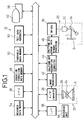
- FIG. 1 shows the image reading and recording apparatus 10 in detailed block form.
- the image reading and recording apparatus 10 includes an image reader 20 for reading an original film F on which a continuous tone image is recorded, and an image recorder 22 for recording a halftone dot image on an original film G.
- the image reader 20 the image information on the original film F is read in a main scanning direction by a charge-coupled device (CCD) 26 through a condensing optical system 24 while the original film F is being fed in an auxiliary scanning direction.
- the read image information is supplied from the CCD 26 to an analog-to-digital (A/D) converter 28.
- A/D analog-to-digital
- a laser diode 32 is energized by a drive signal which is supplied from a driver 30 based on halftone dot image data (described later on), and a laser beam L emitted by the laser diode 32 is applied in a main scanning direction to the original film G through a scanning optical system 34 while the original film G is being fed in an auxiliary scanning direction, thereby recording a halftone dot image on the original film G.
- the image reading and recording apparatus 10 has a central processing unit (CPU) 36 which controls the overall operation of the image reading and recording apparatus 10.
- the image reading and recording apparatus 10 also includes a keyboard 38 for entering data, a cathode-ray tube (CRT) display 40 for displaying data, the A/D converter 28, an image processor 42 for processing continuous tone image data from the A/D converter 28, a halftone dot continuous tone corrector (continuous tone image data correcting means) 44 for correcting the continuous tone image data in order to correct the continuous tone of the outputted halftone dot image, a halftone dot image data binary processor (converting means) 46 for converting the continuous tone image data into binary halftone dot image data, and the driver 30.
- CPU central processing unit
- the image reading and recording apparatus 10 further has a continuous tone correction data memory 48 for storing continuous tone correction data for correcting the continuous tone image data, a threshold data memory 50 for storing threshold data to convert the continuous tone image data into binary data, a test data generator 52 for generating test data to produce the continuous tone correction data, a measured data memory 54 for storing measured data produced by measuring a halftone dot test image generated on the basis of the test data, and an interface 58 for introducing a signal from a measuring unit 56 which measures the halftone dot area percentage of the halftone dot test image.
- These components of the image reading and recording apparatus 10 are connected to the CPU 36 by a bus.
- the CPU 36 functions as a continuous tone correction data selecting means or a threshold data selecting means.
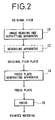
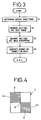
- the operator of the image reading and recording apparatus 10 determines, in a step S1, output conditions as to what process, apparatus, and recording medium are to be used to record a halftone dot image, and the screen ruling, screen angle, and halftone dot shape of a final image output. It is assumed here that a halftone dot image is to be recorded on a recording sheet with ink or the like using the reversing apparatus 12, the press plate generating apparatus 14, and the press 16 in the process shown in FIG. 2.
- the operator operates the keyboard 38 to instruct the CPU 36 to output test data.
- the CPU 36 controls the test data generator 52 to output test data to the halftone dot image data binary processor 46.
- test data should preferably be such data that the level of an image signal varies continuously or discretely at given intervals in the overall range of optical densities. For example, if continuous tone image data have 256 tones ranging from 0 to 255, then the test data generator 52 can generate the following test data: 0 8 16 24 32 40 48 56 64 72 80 88 96 104 112 120 128 136 144 152 160 168 176 184 192 200 208 216 224 232 240 248
- the halftone dot image data binary processor 46 generates halftone dot test data by comparing the magnitudes of the threshold data from the threshold data memory 50 and the test data from the test data generator 52, and supplies the generated halftone dot test data to the driver 30. Based on the supplied halftone dot test data, the driver 30 energizes the laser diode 32, which emits a laser beam L to record a halftone dot test image on the original film G through the scanning optical system 34. The original film G with the halftone dot test image recorded thereon is then reversed into a positive film by the reversing apparatus 12. From the positive film, the press plate generating apparatus 14 produces a press plate, which is set in the press 16 to print a final halftone dot test image on a recording sheet with ink in a step S2.
- the halftone dot area percentage of the halftone dot test image printed in the step S2 is measured by the measuring unit 56, and the measured data are stored in the measured data memory 54 through the interface 58 in a step S3.
- the measured data may have characteristics as shown in FIG. 5E, for example.
- the CPU 36 determines continuous tone correction data for correcting the halftone dot area percentage produced in the step S3 into a halftone dot area percentage corresponding to the test data, and stores the continuous tone correction data in the continuous tone correction data memory 48 in a step S4.
- the continuous tone correction data may be such data as indicated by the broken lines in FIG. 5E because they are intended to correct the variation or fluctuation of the measured data as indicated by the solid line in FIG. 5E.
- Such continuous tone correction data may be produced for each of a plurality of sets of output conditions desired by the operator, and stored in the continuous tone correction data memory 48.
- a printed material with a halftone dot image recorded thereon is produced from an original film F with a desired continuous tone image recorded thereon.
- the image information on the original film F is read by the image reader 20, and then converted into digital data by the A/D converter 28. Thereafter, the digital image data are transferred to the image processor 42, which processes the supplied image data for sharpness enhancement, continuous tone adjustment, color correction, and the like. Then, the processed image data are transferred to the halftone dot continuous tone corrector 44.
- the CPU 36 selects continuous tone correction data corresponding to the preset output conditions from the continuous tone correction data memory 48, and supplies the selected continuous tone correction data to the halftone dot continuous tone corrector 44.
- the halftone dot continuous tone corrector 44 then corrects the continuous tone image data based on the supplied continuous tone correction data, and sends the corrected continuous tone image data to the halftone dot image data binary processor 46.
- the CPU 36 also selects threshold data corresponding to the given halftone dot shape from the threshold data memory 50, and supplies the selected threshold data to the halftone dot image data binary processor 46.
- the halftone dot image data binary processor 46 compares the magnitudes of the corrected continuous tone image data and the threshold data, and supplies the result of comparison as halftone dot image data to the driver 30.
- the driver 30 supplies a drive signal based on the supplied halftone dot image data to the laser diode 32.
- the laser diode 32 emits a laser beam L that is applied through the scanning optical system 34 to an original film G for thereby recording a halftone dot image thereon.
- the halftone dot image recorded on the original film G is recorded as a halftone dot image on a printed material by the reversing apparatus 12, the press plate generating apparatus 14, and the press 16. Since the halftone dot image on the printed material has been corrected by the selected continuous tone correction data, the halftone dot area percentage of the halftone dot image does not vary greatly in a region containing close continuous tone image data levels, and hence the halftone dot image is free of tone jump which would otherwise be caused by large variations in the halftone dot area percentage. As a result, the printed halftone dot image is of high quality.
- the continuous tone image data may be corrected by the halftone dot image data binary processor 46 rather than by the halftone dot continuous tone corrector 44.
- a halftone dot test image generated on the basis of test data is read by the measuring unit 56, and threshold correction data which have the same characteristics as the characteristics indicated by the solid line in FIG. 5E are generated from the measured data which are supplied from the measuring unit 56.
- the threshold data stored in the threshold data memory 50 are multiplied by the threshold correction data thus generated, producing new threshold data that are then stored in the threshold data memory 50.
- the processed continuous tone image data are not supplied to the halftone dot continuous tone corrector 44, but compared with the threshold data corrected by the halftone dot image data binary processor 46, thereby producing corrected halftone dot image data
- continuous tone correction data are generated so as to eliminate tone jump in a halftone dot image recorded on a printed material in the above embodiment
- the present invention is also applicable to an arrangement for generating continuous tone correction data in order to eliminate tone jump in an image on an original film or a press plate.
Landscapes
- Engineering & Computer Science (AREA)
- Multimedia (AREA)
- Signal Processing (AREA)
- Facsimile Image Signal Circuits (AREA)
- Image Processing (AREA)
Priority Applications (1)
| Application Number | Priority Date | Filing Date | Title |
|---|---|---|---|
| EP98104838A EP0859506B1 (de) | 1993-04-19 | 1994-04-19 | Verfahren zur Korrektur von Halbtonpunktbilddaten und dieses anwendendes Bildverarbeitungsgerät |
Applications Claiming Priority (2)
| Application Number | Priority Date | Filing Date | Title |
|---|---|---|---|
| JP09114493A JP3241157B2 (ja) | 1993-04-19 | 1993-04-19 | 網点画像データ補正方法および補正機能を有する画像処理装置 |
| JP91144/93 | 1993-04-19 |
Related Child Applications (1)
| Application Number | Title | Priority Date | Filing Date |
|---|---|---|---|
| EP98104838A Division EP0859506B1 (de) | 1993-04-19 | 1994-04-19 | Verfahren zur Korrektur von Halbtonpunktbilddaten und dieses anwendendes Bildverarbeitungsgerät |
Publications (3)
| Publication Number | Publication Date |
|---|---|
| EP0621723A2 true EP0621723A2 (de) | 1994-10-26 |
| EP0621723A3 EP0621723A3 (de) | 1995-01-18 |
| EP0621723B1 EP0621723B1 (de) | 1999-01-20 |
Family
ID=14018336
Family Applications (2)
| Application Number | Title | Priority Date | Filing Date |
|---|---|---|---|
| EP94106078A Expired - Lifetime EP0621723B1 (de) | 1993-04-19 | 1994-04-19 | Verfahren zur Korrektur von Halbtonpunktbilddaten und Bildverarbeitungsgerät das diese Korrektur verwendet |
| EP98104838A Expired - Lifetime EP0859506B1 (de) | 1993-04-19 | 1994-04-19 | Verfahren zur Korrektur von Halbtonpunktbilddaten und dieses anwendendes Bildverarbeitungsgerät |
Family Applications After (1)
| Application Number | Title | Priority Date | Filing Date |
|---|---|---|---|
| EP98104838A Expired - Lifetime EP0859506B1 (de) | 1993-04-19 | 1994-04-19 | Verfahren zur Korrektur von Halbtonpunktbilddaten und dieses anwendendes Bildverarbeitungsgerät |
Country Status (4)
| Country | Link |
|---|---|
| US (1) | US6724498B1 (de) |
| EP (2) | EP0621723B1 (de) |
| JP (1) | JP3241157B2 (de) |
| DE (2) | DE69416029T2 (de) |
Cited By (8)
| Publication number | Priority date | Publication date | Assignee | Title |
|---|---|---|---|---|
| US5734801A (en) * | 1994-12-28 | 1998-03-31 | Fuji Photo Film Co., Ltd. | Method of and apparatus for producing color proof |
| EP0734149A3 (de) * | 1995-03-24 | 1998-07-15 | Fuji Photo Film Co., Ltd. | Bilddatenverarbeitungsverfahren |
| EP0859508A3 (de) * | 1997-02-13 | 1998-09-30 | Fujitsu Limited | Halbtondarstellung unter Berücksichtigung der Bild- und Druckereigenschaften |
| EP0828378A3 (de) * | 1996-09-05 | 1999-07-21 | Adobe Systems, Inc. | Schwellenmatrix mit mehrfachen Tiefen |
| WO1999057886A1 (en) * | 1998-04-30 | 1999-11-11 | Hitachi Koki Imaging Solutions, Inc. | Halftone image reproduction with automatic gamma correction |
| US6072588A (en) * | 1996-04-02 | 2000-06-06 | Fuji Photo Film Co., Ltd. | Method of generating proof data and method of generating proof |
| CN1300647C (zh) * | 2002-04-09 | 2007-02-14 | 三星电子株式会社 | 图像形成设备 |
| EP1895761A3 (de) * | 2006-09-01 | 2010-05-12 | Samsung Electronics Co., Ltd. | Vorrichtung zur Erzeugung eines elektrophotographischen Bildes und Rasterkorrekturverfahren dafür |
Families Citing this family (20)
| Publication number | Priority date | Publication date | Assignee | Title |
|---|---|---|---|---|
| JPH09130605A (ja) * | 1995-10-31 | 1997-05-16 | Fuji Photo Film Co Ltd | 網点画像出力方法およびその装置 |
| JP3708222B2 (ja) | 1996-06-12 | 2005-10-19 | 富士写真フイルム株式会社 | 階調補正画像データ作成方法、階調補正網%データ作成方法、階調補正閾値データ作成方法および画像出力装置 |
| JP3791635B2 (ja) * | 1996-10-22 | 2006-06-28 | 富士写真フイルム株式会社 | 画像再生方法、画像再生装置、画像処理方法および画像処理装置 |
| DE60009696T2 (de) | 2000-07-27 | 2005-03-17 | Hewlett-Packard Co. (N.D.Ges.D.Staates Delaware), Palo Alto | Dynamische Erstellung einer linearisierten Halbton-Matrix |
| US6930810B1 (en) * | 2000-11-28 | 2005-08-16 | Kabushiki Kaisha Toshiba | Correction table forming method and image forming apparatus |
| US7092128B2 (en) | 2002-05-30 | 2006-08-15 | Xerox Corporation | Application of glossmarks for graphics enhancement |
| US7180635B2 (en) | 2002-05-30 | 2007-02-20 | Xerox Corporation | Halftone image gloss control for glossmarks |
| US7148999B2 (en) | 2002-06-27 | 2006-12-12 | Xerox Corporation | Variable glossmark |
| US7126721B2 (en) | 2002-06-27 | 2006-10-24 | Xerox Corporation | Protecting printed items intended for public exchange with glossmarks |
| US7193751B2 (en) | 2002-12-12 | 2007-03-20 | Xerox Corporation | Tag control for runtime glossmarks |
| DE10325621B4 (de) * | 2003-06-06 | 2006-02-16 | Heidelberger Druckmaschinen Ag | Verfahren zur Grauwertkorrektur für binäre Bilddaten |
| US7352493B2 (en) | 2003-12-12 | 2008-04-01 | Xerox Corporation | Enhancement of glossmark images at low and high densities |
| US7382495B2 (en) | 2003-12-12 | 2008-06-03 | Xerox Corporation | Reduction of differential gloss |
| US7301675B2 (en) | 2004-06-29 | 2007-11-27 | Xerox Corporation | Glossmark images with clear toner |
| US7304770B2 (en) | 2004-08-30 | 2007-12-04 | Xerox Corporation | Reduction of differential gloss with halftoned clear toner |
| US7391537B2 (en) | 2004-09-28 | 2008-06-24 | Xerox Corporation | User interface for differential gloss images |
| US7324241B2 (en) | 2004-09-29 | 2008-01-29 | Xerox Corporation | Variable data differential gloss images |
| US8090141B2 (en) | 2006-01-31 | 2012-01-03 | Xerox Corporation | System and method to automatically establish preferred area for image-wise watermark |
| US8059312B2 (en) | 2007-02-08 | 2011-11-15 | Brother Kogyo Kabushiki Kaisha | Calibration data creating device |
| GB201505350D0 (en) * | 2015-03-27 | 2015-05-13 | Imetafilm Ltd | Calibration and validation of motion pictures scans |
Family Cites Families (19)
| Publication number | Priority date | Publication date | Assignee | Title |
|---|---|---|---|---|
| US4051536A (en) * | 1975-03-14 | 1977-09-27 | Xerox Corporation | Electronic halftone imaging system |
| JPS56152373A (en) | 1980-04-24 | 1981-11-25 | Fuji Photo Film Co Ltd | Laser recording device |
| DE3313392A1 (de) * | 1982-04-14 | 1983-10-20 | Fuji Photo Film Co., Ltd., Minami Ashigara, Kanagawa | Verfahren und vorrichtung zur digitalen farbkorrektur |
| US4586089A (en) * | 1982-08-18 | 1986-04-29 | Matsushita Electric Industrial Co., Ltd. | Image processor |
| JPS60197071A (ja) | 1984-03-21 | 1985-10-05 | Fuji Xerox Co Ltd | デイジタル記録装置 |
| JPS62199170A (ja) | 1986-02-27 | 1987-09-02 | Konishiroku Photo Ind Co Ltd | 網点画の濃度階調補正方法 |
| JPS6342575A (ja) * | 1986-08-08 | 1988-02-23 | Dainippon Screen Mfg Co Ltd | 階調変換方法およびその装置 |
| EP0258740B1 (de) * | 1986-09-02 | 1995-07-19 | Fuji Photo Film Co., Ltd. | Verfahren und Vorrichtung zur Bildverarbeitung mit Gradationskorrektur des Bildsignals |
| JPS6444681A (en) * | 1987-08-12 | 1989-02-17 | Fuji Photo Film Co Ltd | Dot screen forming method |
| EP0334518B1 (de) | 1988-03-10 | 1997-10-15 | Canon Kabushiki Kaisha | Bilderzeugungsgerät |
| JP2578947B2 (ja) * | 1988-10-13 | 1997-02-05 | 富士写真フイルム株式会社 | 網点データ作成方法 |
| US5278672A (en) * | 1989-01-20 | 1994-01-11 | Fuji Photo Film Co., Ltd. | Image signal processing apparatus |
| JP2648206B2 (ja) | 1989-04-12 | 1997-08-27 | 富士写真フイルム株式会社 | 画像入出力装置における出力値補正テーブル設定方法 |
| JPH03129971A (ja) | 1989-10-16 | 1991-06-03 | Canon Inc | 画像読取装置 |
| JP2598723B2 (ja) * | 1990-06-28 | 1997-04-09 | 大日本スクリーン製造株式会社 | 網点画像作成装置 |
| US5260806A (en) * | 1990-08-29 | 1993-11-09 | E. I. Du Pont De Nemours And Company | Process for controlling tone reproduction |
| US5170257B1 (en) * | 1990-10-02 | 1995-02-07 | Southwest Software Inc | Method and apparatus for calibrating halftone output from an image-setting device |
| US5309246A (en) * | 1991-09-18 | 1994-05-03 | Eastman Kodak Company | Technique for generating additional colors in a halftone color image through use of overlaid primary colored halftone dots of varying size |
| JP3129971B2 (ja) | 1996-08-14 | 2001-01-31 | サンケン電気株式会社 | トランスレス型三相コンバータ装置 |
-
1993
- 1993-04-19 JP JP09114493A patent/JP3241157B2/ja not_active Expired - Lifetime
-
1994
- 1994-04-18 US US08/229,347 patent/US6724498B1/en not_active Expired - Lifetime
- 1994-04-19 DE DE69416029T patent/DE69416029T2/de not_active Expired - Lifetime
- 1994-04-19 DE DE69431968T patent/DE69431968T2/de not_active Expired - Lifetime
- 1994-04-19 EP EP94106078A patent/EP0621723B1/de not_active Expired - Lifetime
- 1994-04-19 EP EP98104838A patent/EP0859506B1/de not_active Expired - Lifetime
Cited By (11)
| Publication number | Priority date | Publication date | Assignee | Title |
|---|---|---|---|---|
| US5734801A (en) * | 1994-12-28 | 1998-03-31 | Fuji Photo Film Co., Ltd. | Method of and apparatus for producing color proof |
| EP0734149A3 (de) * | 1995-03-24 | 1998-07-15 | Fuji Photo Film Co., Ltd. | Bilddatenverarbeitungsverfahren |
| US6072588A (en) * | 1996-04-02 | 2000-06-06 | Fuji Photo Film Co., Ltd. | Method of generating proof data and method of generating proof |
| EP0828378A3 (de) * | 1996-09-05 | 1999-07-21 | Adobe Systems, Inc. | Schwellenmatrix mit mehrfachen Tiefen |
| EP0859508A3 (de) * | 1997-02-13 | 1998-09-30 | Fujitsu Limited | Halbtondarstellung unter Berücksichtigung der Bild- und Druckereigenschaften |
| US6002842A (en) * | 1997-02-13 | 1999-12-14 | Fujitsu Limited | Halftone representation taking into account characteristics of image and printer |
| WO1999057886A1 (en) * | 1998-04-30 | 1999-11-11 | Hitachi Koki Imaging Solutions, Inc. | Halftone image reproduction with automatic gamma correction |
| US6185005B1 (en) | 1998-04-30 | 2001-02-06 | Hitachi Koki Imaging Solutions, Inc. | Half tone image enhancement for printers |
| CN1300647C (zh) * | 2002-04-09 | 2007-02-14 | 三星电子株式会社 | 图像形成设备 |
| EP1895761A3 (de) * | 2006-09-01 | 2010-05-12 | Samsung Electronics Co., Ltd. | Vorrichtung zur Erzeugung eines elektrophotographischen Bildes und Rasterkorrekturverfahren dafür |
| US8014032B2 (en) | 2006-09-01 | 2011-09-06 | Samsung Electronics Co., Ltd. | Electrophotographic image forming apparatus and halftoning correction method thereof |
Also Published As
| Publication number | Publication date |
|---|---|
| DE69416029D1 (de) | 1999-03-04 |
| EP0621723B1 (de) | 1999-01-20 |
| DE69416029T2 (de) | 1999-05-27 |
| EP0859506A1 (de) | 1998-08-19 |
| JP3241157B2 (ja) | 2001-12-25 |
| EP0859506B1 (de) | 2003-01-02 |
| DE69431968T2 (de) | 2003-04-30 |
| US6724498B1 (en) | 2004-04-20 |
| EP0621723A3 (de) | 1995-01-18 |
| JPH06303429A (ja) | 1994-10-28 |
| DE69431968D1 (de) | 2003-02-06 |
Similar Documents
| Publication | Publication Date | Title |
|---|---|---|
| EP0859506B1 (de) | Verfahren zur Korrektur von Halbtonpunktbilddaten und dieses anwendendes Bildverarbeitungsgerät | |
| US5513016A (en) | Method and apparatus for processing image signal | |
| US5050223A (en) | Method of and apparatus for processing image signal | |
| US6421146B1 (en) | Apparatus and method for shading correction in image scanning system | |
| US6717601B2 (en) | Printing apparatus with dot-gain compensation using spatial filter | |
| US5134503A (en) | Image processing apparatus | |
| JPH07274000A (ja) | 書類スキャナーにおける自動オフセット並びにゲイン制御 | |
| EP0715450B1 (de) | Einstellung der Tonwiedergabe in einem Fehlerdiffusionsprozess | |
| US6204930B1 (en) | Method of generating gradation-corrected image data, method of generating gradation-corrected halftone dot percentage data, method of generating gradation-corrected threshold data, image output apparatus, and method of calculating amount of exposure | |
| EP0604329A2 (de) | Verfahren zum Auswählen von Ausgangspegeln für mehrstufige Halbtone in Gegenwert einer instabilen Anzeigevorrichtung | |
| US5748341A (en) | Method of and apparatus for determining whether an original is present in a readout region | |
| JP2718448B2 (ja) | 画像処理データの設定方法 | |
| US6788831B1 (en) | Image reading apparatus | |
| US20060203290A1 (en) | Method and apparatus for image processing | |
| JP3488509B2 (ja) | 画像データ処理装置 | |
| US6753119B2 (en) | Method of and apparatus for generating proof image | |
| US6801338B1 (en) | Image data binary coding method | |
| JP2658237B2 (ja) | 画像読み取り装置 | |
| JP3124604B2 (ja) | 画像処理装置 | |
| JP3157870B2 (ja) | 画像処理方式 | |
| JP3076698B2 (ja) | 画像読取装置 | |
| JP2667288B2 (ja) | 画像信号判定装置 | |
| JPS63204375A (ja) | 中間調画像生成方法 | |
| JPH0514715A (ja) | 画像読取り装置 | |
| JPH07336543A (ja) | 画像信号2値化処理装置および方法 |
Legal Events
| Date | Code | Title | Description |
|---|---|---|---|
| PUAI | Public reference made under article 153(3) epc to a published international application that has entered the european phase |
Free format text: ORIGINAL CODE: 0009012 |
|
| AK | Designated contracting states |
Kind code of ref document: A2 Designated state(s): DE FR GB |
|
| PUAL | Search report despatched |
Free format text: ORIGINAL CODE: 0009013 |
|
| AK | Designated contracting states |
Kind code of ref document: A3 Designated state(s): DE FR GB |
|
| 17P | Request for examination filed |
Effective date: 19950626 |
|
| 17Q | First examination report despatched |
Effective date: 19970509 |
|
| GRAG | Despatch of communication of intention to grant |
Free format text: ORIGINAL CODE: EPIDOS AGRA |
|
| GRAG | Despatch of communication of intention to grant |
Free format text: ORIGINAL CODE: EPIDOS AGRA |
|
| GRAH | Despatch of communication of intention to grant a patent |
Free format text: ORIGINAL CODE: EPIDOS IGRA |
|
| GRAH | Despatch of communication of intention to grant a patent |
Free format text: ORIGINAL CODE: EPIDOS IGRA |
|
| GRAA | (expected) grant |
Free format text: ORIGINAL CODE: 0009210 |
|
| AK | Designated contracting states |
Kind code of ref document: B1 Designated state(s): DE FR GB |
|
| REF | Corresponds to: |
Ref document number: 69416029 Country of ref document: DE Date of ref document: 19990304 |
|
| PG25 | Lapsed in a contracting state [announced via postgrant information from national office to epo] |
Ref country code: DE Free format text: LAPSE BECAUSE OF FAILURE TO SUBMIT A TRANSLATION OF THE DESCRIPTION OR TO PAY THE FEE WITHIN THE PRESCRIBED TIME-LIMIT Effective date: 19990421 |
|
| ET | Fr: translation filed | ||
| PLBE | No opposition filed within time limit |
Free format text: ORIGINAL CODE: 0009261 |
|
| STAA | Information on the status of an ep patent application or granted ep patent |
Free format text: STATUS: NO OPPOSITION FILED WITHIN TIME LIMIT |
|
| 26N | No opposition filed | ||
| REG | Reference to a national code |
Ref country code: GB Ref legal event code: IF02 |
|
| REG | Reference to a national code |
Ref country code: GB Ref legal event code: 732E |
|
| REG | Reference to a national code |
Ref country code: FR Ref legal event code: TP Ref country code: FR Ref legal event code: CD |
|
| PGFP | Annual fee paid to national office [announced via postgrant information from national office to epo] |
Ref country code: DE Payment date: 20130508 Year of fee payment: 20 Ref country code: GB Payment date: 20130417 Year of fee payment: 20 |
|
| PGFP | Annual fee paid to national office [announced via postgrant information from national office to epo] |
Ref country code: FR Payment date: 20130625 Year of fee payment: 20 |
|
| REG | Reference to a national code |
Ref country code: DE Ref legal event code: R071 Ref document number: 69416029 Country of ref document: DE |
|
| REG | Reference to a national code |
Ref country code: DE Ref legal event code: R071 Ref document number: 69416029 Country of ref document: DE |
|
| REG | Reference to a national code |
Ref country code: GB Ref legal event code: PE20 Expiry date: 20140418 |
|
| PG25 | Lapsed in a contracting state [announced via postgrant information from national office to epo] |
Ref country code: GB Free format text: LAPSE BECAUSE OF EXPIRATION OF PROTECTION Effective date: 20140418 |
|
| PG25 | Lapsed in a contracting state [announced via postgrant information from national office to epo] |
Ref country code: DE Free format text: LAPSE BECAUSE OF EXPIRATION OF PROTECTION Effective date: 20140423 |