EP0622045B1 - Absorbierender Gegenstand zur Entfernung von nichtwässrigen Flüssigkeiten und Verfahren zur Herstellung - Google Patents
Absorbierender Gegenstand zur Entfernung von nichtwässrigen Flüssigkeiten und Verfahren zur Herstellung Download PDFInfo
- Publication number
- EP0622045B1 EP0622045B1 EP19940303029 EP94303029A EP0622045B1 EP 0622045 B1 EP0622045 B1 EP 0622045B1 EP 19940303029 EP19940303029 EP 19940303029 EP 94303029 A EP94303029 A EP 94303029A EP 0622045 B1 EP0622045 B1 EP 0622045B1
- Authority
- EP
- European Patent Office
- Prior art keywords
- peat moss
- absorbent article
- board
- moss material
- absorbent
- Prior art date
- Legal status (The legal status is an assumption and is not a legal conclusion. Google has not performed a legal analysis and makes no representation as to the accuracy of the status listed.)
- Expired - Lifetime
Links
Images


Classifications
-
- A—HUMAN NECESSITIES
- A47—FURNITURE; DOMESTIC ARTICLES OR APPLIANCES; COFFEE MILLS; SPICE MILLS; SUCTION CLEANERS IN GENERAL
- A47L—DOMESTIC WASHING OR CLEANING; SUCTION CLEANERS IN GENERAL
- A47L13/00—Implements for cleaning floors, carpets, furniture, walls, or wall coverings
- A47L13/10—Scrubbing; Scouring; Cleaning; Polishing
- A47L13/16—Cloths; Pads; Sponges
-
- Y—GENERAL TAGGING OF NEW TECHNOLOGICAL DEVELOPMENTS; GENERAL TAGGING OF CROSS-SECTIONAL TECHNOLOGIES SPANNING OVER SEVERAL SECTIONS OF THE IPC; TECHNICAL SUBJECTS COVERED BY FORMER USPC CROSS-REFERENCE ART COLLECTIONS [XRACs] AND DIGESTS
- Y10—TECHNICAL SUBJECTS COVERED BY FORMER USPC
- Y10T—TECHNICAL SUBJECTS COVERED BY FORMER US CLASSIFICATION
- Y10T428/00—Stock material or miscellaneous articles
- Y10T428/24—Structurally defined web or sheet [e.g., overall dimension, etc.]
-
- Y—GENERAL TAGGING OF NEW TECHNOLOGICAL DEVELOPMENTS; GENERAL TAGGING OF CROSS-SECTIONAL TECHNOLOGIES SPANNING OVER SEVERAL SECTIONS OF THE IPC; TECHNICAL SUBJECTS COVERED BY FORMER USPC CROSS-REFERENCE ART COLLECTIONS [XRACs] AND DIGESTS
- Y10—TECHNICAL SUBJECTS COVERED BY FORMER USPC
- Y10T—TECHNICAL SUBJECTS COVERED BY FORMER US CLASSIFICATION
- Y10T428/00—Stock material or miscellaneous articles
- Y10T428/31504—Composite [nonstructural laminate]
Definitions
- the invention relates to the general field of spill management and, more particularly, to a novel absorbent article utilizing peat moss material for collecting non-aqueous liquids such as oil-based products.
- the invention also extends to a method for manufacturing the absorbent article.
- peat moss material for use as an absorbent medium in structures for absorbing aqueous solutions.
- the remarkable fluid absorption properties of peat moss material have been turned to use in the field of sanitary, disposable absorbent products such as sanitary napkins, tampons, diapers, adult briefs, urinary pads, wound dressings and the like, to provide highly efficient absorbent components which can be made relatively thin for better fit, comfort and discretion, while being sufficiently absorbent to prevent overflow leakage of body exudate and garment staining.
- Peat moss material can be formed in a highly cohesive, structurally integral board by any one of the methods disclosed in the above-identified prior art.
- the absorbent material is more convenient to handle and it can be directly processed in high speed automatic equipment for assembling disposable absorbent products.
- the method developed by the industry for manufacturing a structurally integral peat moss board which is specifically adapted for sanitary usage, comprises the following steps.
- Raw peat moss, in particulate form, is classified by wet screening in order to retain only the particles which are the most absorbent.
- the screened fraction is diluted with water to form a slurry having a pumpable consistency which is sheeted on a Fourdrinier wire and dewatered by the sequential application of vacuum and heat.
- the thus formed board is calendered at high pressure to increase its density primarily for the purpose of enhancing its drying power, i.e. the ability of the absorbent medium to continuously pull and wick fluid away from adjacent materials such that virtually all the fluid is collected in the peat moss core.
- the aqueous slurry is treated with a wetting agent (hereinafter "wetting agent” shall be construed to encompass any substance which imparts hydrophilicity or enhances the hydrophilicity of the peat moss material), such as a surfactant, to provide the peat moss board with a strong affinity for water.
- a wetting agent hereinafter "wetting agent” shall be construed to encompass any substance which imparts hydrophilicity or enhances the hydrophilicity of the peat moss material), such as a surfactant, to provide the peat moss board with a strong affinity for water.
- the wetting agent is added to the peat moss slurry at the vacuum dewatering stage by spraying or by any other appropriate deposition method.
- the pressure differential established across the Fourdrinier wire to extract dilution water constitutes the agency which causes the wetting agent to penetrate deeply in the peat moss slurry.
- the prior art also recognizes the efficiency of peat moss material to absorb non-aqueous liquids such as a variety of chemical products and specifically oil-based materials.
- the waste management industry has been using peat moss as an absorbent medium for the removal of non-aqueous, liquid pollutants, for many years.
- peat moss as an absorbent medium for the removal of non-aqueous, liquid pollutants, for many years.
- dried particulate peat moss packaged into liquid permeable pouches is delivered to the contaminated area and placed in contact with the liquid spill to absorb the pollutant.
- the absorbent pads have the ability to float on water and can be used for recovering non-aqueous, liquid pollutants floating on a body of water, such as an oil slick on sea surface for example.
- particulate peat moss material has the ability to collect and trap many times its own weight of oil-based products and a variety of other chemicals, the configuration of the absorbent pads made from this material is not well suited for the recovery of large scale spills.
- Granular peat moss material has virtually no structural integrity, and when it is loaded into a flexible containment pouch, the resulting absorbent pad assumes the shape of a bag, i.e. a bulbous round body in which the ratio outer surface/volume is relatively low. As a result, the liquid take-up rate is low which requires a longer residence time of the absorbent pad in the spill in order to reach the saturation level.
- a primary objective when designing an absorbent pad for spill management purposes should be to attain the broadest possible outer surface in order to increase the contact surface with the liquid pollutant and therefore to enhance the liquid take-up rate.
- a suitable shape would be a sheet-like or a board-like configuration which is characterized by a broad outer surface and little thickness.
- Fr-A-1 595 406 discloses an absorbant article for collecting mineral oils
- the aborbant article comprises peat moss material and may be held in an envelope to aid recovery of the absorbant article.
- An absorbant article having structural integrity is not disclosed.
- An object of the invention is to provide an absorbent article for collecting non-aqueous liquids, such as oil based products and a variety of other chemicals, utilizing peat moss material as an absorbent medium, which is relatively inexpensive and simple to produce and which has a comparatively broad exterior surface providing a high fluid take-up rate.
- An underlying object of the invention is an absorbent article having the above stated properties and which is also buoyant, thereby being capable of recovering liquids floating on a body of water.
- Another object of the invention is a method for manufacturing the aforementioned absorbent article.
- peat moss material formed into a hydrophobic, structurally integral board (hereinafter, the term "board” is intended to encompass sheet-shaped objects which: are not necessarily rigid, such as a flexible mat) provides an absorbent article suitable for recovering a large variety of non-aqueous liquids, which is relatively simple and inexpensive to mass produce and it is characterized by an exceptional absorbent capacity and a high liquid take-up rate.
- board is intended to encompass sheet-shaped objects which: are not necessarily rigid, such as a flexible mat
- a significant advantage of the invention over the prior art resides in that the peat moss board does not require a discrete, confining structure, such as the liquid-permeable pouch used in traditional absorbent pads. This results into a cost-effective, environmentally sound absorbent article.
- the density of the peat moss board also influences its strength and resistance characteristics. Therefore, a very low density board, albeit having a very high absorption capacity, is not necessarily desirable because it may be subject to structural failures in operation, especially when the board becomes saturated with liquid.
- the inventive approach to increase the resistance of the peat moss board without significantly adding to its density is to use a laminated form of construction by bonding to the peat moss material one or more thin layers having a relatively high tensile strength.
- the laminated peat moss board comprises an absorbent core of peat moss material sandwiched between thin layers of fibrous material such as Kraft wood pulp.
- the overall density of the structure is in the range from about 0.02 grams per cubic centimeter (g/cc) to about 0.20 g/cc (all density measurements provided in this specification are effected on samples at 12% moisture level). More preferably, the density is in the range from about 0.05 g/cc to about 0.15 g/cc. Most preferably, the density of the board is in the range from about 0.05 g/cc to about 0.10 g/cc.
- a critical aspect of the invention is the ability of the peat moss board to shed water while being capable of absorbing non-aqueous liquids, such as oil-based products.
- non-aqueous liquids such as oil-based products.
- Such selective absorption properties allow to provide an absorbent article which can be successfully used for recovering a non-aqueous liquid present into an environment containing a significant amount of water, for example an oil slick floating on sea surface.
- the low density of the peat moss board confers buoyancy to the absorbent article allowing same to float on the water surface exactly where the non-aqueous liquid is located.
- the water repellency of the peat moss board prevents undesirable saturation of the absorbent article with water, thereby maintaining the absorbent medium active for capturing the non-aqueous liquid.
- the peat moss board in accordance with the invention will be described as hydrophobic with reference to its ability to prevent ingress of water within the absorbent medium.
- This terminology takes into account only the general behaviour of the peat moss board and does not imply that each of its constituents has no affinity for water.
- the peat moss board is not perfectly hydrophobic since the reinforcing Kraft pulp layers are capable of some water absorption which, however, is minimal and can be disregarded in practice.
- the hydrophobicity of the peat moss board can be perfected by treating the Kraft wood pulp layers with a suitable water repelling agent.
- the invention also extends to a method for manufacturing the absorbant article of the present invention, the method comprising the steps of:
- raw peat moss material is formed into an aqueous slurry having a pumpable consistency and it is subjected to a classification procedure to eliminate from the peat moss slurry particles having a size substantially smaller than 210 microns and particles having a size substantially larger than 2000 microns, in order to retain only the particles which are the most absorbent.
- the peat moss slurry is classified by flowing the slurry through a set of screens having the desired mesh size.
- the slurry is then delivered on a Fourdrinier wire and dewatered by the sequential application of vacuum and heat to form the absorbent article.
- the article may be calendered at a very low pressure solely for the purpose of stabilizing its calliper. Intense calendering is to be avoided because it would have the effect of increasing the density of the peat moss material which adversely affects its absorption capacity.
- a co-forming process may be used which consists of progressively building on the Fourdrinier wire a stratified slurry by successive deposition of water suspension strata corresponding to each layer of the final product.
- the structure of an absorbent article constructed in accordance with the present invention which can be used for recovering non-aqueous liquids is illustrated in Figure 1.
- the absorbent article designated comprehensively by the reference numeral 10, has a laminated structure and it is in a form of a relatively flat board comprising a central absorbent core 12 containing primarily peat moss material.
- the core 12 is confined between reinforcing layers 14 and 16 of fibrous material.
- the purpose of the reinforcing layers 14 and 16 is to strengthen the absorbent core 12, thereby providing a unitized absorbent structure capable of maintaining its integrity even when saturated with liquid.
- Kraft wood pulp material has been found highly satisfactory for manufacturing the reinforcing layers 14 and 16. It is also possible to use cotton linters or ground wood in admixture with or in substitution to the Kraft wood pulp material.
- the apparatus designated comprehensively by the reference numeral 18 comprises an endless, fluid-pervious Fourdrinier wire 20 which is mounted on rollers 22 to provide a horizontally extending run 24 which is continuously advanced forward to support and convey a slurry of peat moss material and Kraft wood pulp through various processing stations.
- Headboxes 26, 28 and 30 arranged in a spaced apart relationship along the path of travel of the wire 20, are provided to lay on the wire 20 slurry in sheeted form.
- the headbox trio deposits on the wire 20 three layers of slurry in a superposed relationship to form a laminated web. More specifically, the central headbox 28 lays a slurry of peat moss and the headboxes 26 and 30 deliver slurry of fibrous material such as Kraft wood pulp or any other suitable substance.
- the peat moss slurry, before being supplied to the headbox 28 is refined at a screening station illustrated schematically in Figure 2 and identified by the reference numeral 32.
- the screening station 32 is of a well-known construction and does not require a detailed description herein.
- a vacuum slot 34 Downstream of the headboxes 26, 28 and 30 is provided a vacuum slot 34 which is in fluid communication with a vacuum pump (not shown in the drawings) in order to create suction beneath the wire 20 for dewatering the slurry thereon.
- the next processing station is a dryer 36 whose purpose is to elevate the temperature of the slurry to evaporate water therefrom.
- the dryer is of a well-known construction and does not require a detailed description herein.
- a calendaring station 38 Downstream of the dryer 36 is provided a calendaring station 38 which slightly compresses the dried product in order to stabilize its calliper.
- the operation of the apparatus 18 is as follows.
- the starting peat moss harvested from the bog should have a relatively high absorbent capacity.
- Peat moss capable of absorbing and retaining at least about 25 and preferably about 50 times its weight in water has been found satisfactory.
- the starting peat moss is wet classified at the screening station 32 to remove the extremely fine material, commonly referred to as fines, and large pieces of material including roots, branches and the like which do not contribute significantly to the absorbency of the peat moss material.
- the classification is carried out such that anything that remains on a number 10 mesh screen (2000 microns) is discarded and anything that passes through a number 70 mesh screen (210 microns) is also discarded.
- anything that remains on a number 14 mesh screen (1410 microns) is discarded and anything that passes through a number 100 mesh screen (149 microns) is discarded.
- the peat moss material is classified by a well-known wet screening process which consists of forming an aqueous slurry of the peat moss material and flowing the slurry through successive screens to extract from the slurry the fines and the excessively large particles.
- the screened fraction of the peat moss material is then diluted with water to render the slurry more manageable.
- a fibrous component may be added at this stage to the slurry.
- the fibrous component may include such materials as Kraft wood pulp, mechanical wood pulp, cotton linters or jute, among others.
- mechanical wood pulp is meant to include ground wood pulp, thermo-mechanical pulp and refiner wood pulp. Ground wood pulp is essentially trees and branches which have been debarked, cleaned and ground into particulate matter. Refiner wood pulp differs from ground wood pulp only in that the grinding step utilizes a refiner, i.e.
- Thermo-mechanical wood pulp is similar to refiner pulp with the exception that the wood particles are heated in the refiner, usually with steam, to aid in separating the wood fibers.
- the common characteristic of these mechanical pulps is that no attempt has been made to separate the fibers by chemical means although they may later, after being reduced to fine particulate matter, be subjected to a desired chemical treatment, such as bleaching.
- such mechanical pulp when used in the peat moss slurry, such mechanical pulp has a Canadian Standard Freeness (TAPPI TEST METHOD T-227) of from about 60 to 750 and preferably from about 400 to 600.
- Canadian Standard Freeness TAPPI TEST METHOD T-227
- the Kraft wood pulp also usable in combination with the peat moss, is essentially chemically treated, long fibred wood pulp such as sulfite and sulfate wood pulps.
- the fibrous component may also include a natural or synthetic textile fiber such as rayon, polyester, nylon, acrylic or the like, having a length of from about 0.6 centimeters to about 1.9 centimeters, preferably about 1.3 centimeters and a denier of from about 1.0 to 5.0, present in an amount from 2 to 20% by weight of the absorbent core 12, preferably from 4% to 8%.
- a natural or synthetic textile fiber such as rayon, polyester, nylon, acrylic or the like, having a length of from about 0.6 centimeters to about 1.9 centimeters, preferably about 1.3 centimeters and a denier of from about 1.0 to 5.0, present in an amount from 2 to 20% by weight of the absorbent core 12, preferably from 4% to 8%.
- the slurry from the headboxes 26, 28 and 30 is sheeted onto the wire 20 and dewatered by the vacuum slot 34.
- a conditioning agent may be added to the slurry at this stage, such as a colouring agent, a water-repelling agent (for the purpose of this specification "water-repelling agent” should be construed to include any substance that procures hydrophobicity or enhances the hydrophobicity of the material to which it is applied) an adhesive or others.
- the selected conditioning agent may be applied to the slurry upstream of the vacuum slot 34 by spraying, coating or otherwise. The pressure differential established by the vacuum slot 34 causes the conditioning agent to penetrate within the peat moss and Kraft wood pulp compositions for an in-depth treatment.
- the treatment of the slurry with water-repelling agent is particularly desirable in order to render the Kraft wood pulp layers hydrophobic.
- Various types of water-repelling agents can be used for the treatment. It is within the reach of the person skilled in the art to select the specific agent most suitable for the intended application.
- the product After initial dewatering, the product is conveyed to the drier 36 for further dewatering by the application of heat.
- the thus formed board is slightly compressed at the calendaring station 38 for stabilizing the calliper of the board.
- the calendaring of the laminated peat moss board is conducted at pressure levels significantly lower than the pressure developed when the peat moss board is intended for sanitary usage, where drying power should be enhanced by increasing the density of the absorbent medium.
- a lower density is desired in order to increase the absorbent capacity of the peat moss board.
- the calendaring pressure in the process according to the invention is about one tenth of the pressure which would be normally applied if the peat moss board was intended for sanitary applications.
- the continuous peat moss board is cut (this operation is not shown in the drawings) to form discrete absorbent articles having the desired size and shape.
- the cutting pattern is selected in such a way as to minimize waste. Square or rectangular shapes have been found satisfactory in this regard.
- a slurry of Kraft wood pulp having a consistency of about 0.2% by weight of solids is first laid down on the wire 20 from the headbox 26.
- the slurry flow rate is selected to deliver on the wire 20, 15 grams of solids per square meter.
- the Kraft slurry passes under the headbox 28 which delivers on top of the Kraft layer a slurry of peat moss material having the following composition by weight of solids:
- the consistency of the peat moss slurry is set at 0.5% by weight of solids.
- the flow rate of the peat moss slurry is selected to deliver 300 grams per square meter of solids on the wire 20.
- a final Kraft wood pulp slurry layer is laid from the headbox 30 on the peat moss slurry. This final layer is identical in terms of consistency, flow rate and composition to the bottom Kraft wood pulp layer previously deposited.
- the laminated slurry is passed over the vacuum slot 34 to extract water under the influence of a pressure differential established across the slurry.
- Precise regulation of the residence time of the slurry over the vacuum slot and the vacuum intensity is critical for accurate density control of the final product. Generally, decreased vacuum and increased speed will result in a less dense product. Conversely, increased vacuum and decreased speed will produce a denser product.
- the speed of the wire 20 is set at 28.96 meters per minute.
- the vacuum slot 34 is constituted by a set of 6 elongated orifices which are parallel and are oriented transversely to the direction of travel of the wire 20. Each orifice has a width of 25.4 centimeters. Collectively, the orifices provide an interval of about 3 seconds during which the slurry is exposed to vacuum.
- the intensity of the vacuum ranges from about 200 to about 315 millimetres of mercury.
- the dewatered product is then dried in the dryer 36 by subjecting the product to a temperature above 100°C in order to evaporate residual moisture.
- the high temperature treatment is desirable because it has been found to enhance the hydrophobicity of the peat moss material.
- the dried product is calendared at the calendaring station 38 to control its calliper.
- a calendaring pressure of approximately 275 kilograms per linear meter is used.
- the resulting laminated peat moss board has a density of 0.077 g/cc.
- the calendaring pressure applied on the peat moss board is dependent on the characteristics of the calendaring equipment that is being employed. In other words, different calendaring stations may develop exactly the same pressure at the nip, thus conditioning the calendared material in the same way, although the pressure reading in kilograms per linear meter is different for each station.
- the calendaring station that has been used to slightly compress the peat moss board has the following characteristics:
- the calendaring operation enables the operator to control the density of the final product.
- this control lever is seldom used because it can only increase the density of the peat moss board which adversely affects its absorption capacity. Therefore, in practice, the calendaring station is set at the minimum pressure which will be sufficient to stabilize the calliper of the peat moss board.
- a critical parameter of the process in accordance with the invention is that no attempt has been made to enhance the hydrophilicity of the peat moss board. This is contrary to conventional processes for the manufacture of peat moss boards, specifically designed for sanitary usage, where the absorbent medium must be capable of absorbing aqueous solutions.
- the preservation of the natural hydrophobicity of the peat moss material is an important characteristic of this invention which allows to produce an absorbent article capable of selective fluid absorption.
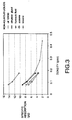
- the following table considered in conjunction with the graph of Figure 3, illustrates the relationship between the density of the laminated peat moss board and its absorbent capacity for various non-aqueous liquids.
- the table also provides a qualitative measure of the ability of the peat moss board to retain liquid absorbed in its structure.
- the various samples of peat moss boards considered in the comparative test have identical compositions, and weight and differ solely by their density. These samples have been produced by following the steps of the process set forth above, except that for samples B,C D and E the calendaring pressure has been progressively increased in order to achieve a higher density. It should be appreciated that some of these samples, the most denser for instance, are not necessarily considered to be useful in practice due to their poor absorbency characteristics, and their purpose is only to illustrate the relationship between the density of the peat moss board and its absorbent capacity.
- the absorbent capacity test is used to determine the maximum amount of test liquid that a sample can pick-up.
- the test procedure comprises the following steps:
- the retentivity is defined as the ability of a sample to hold test fluid.
- the test procedure comprises the following steps.
- the graphical representation of the data given in the table clearly illustrates a definite correlation between the density of the peat moss board and its absorbent capacity for the various non-aqueous liquids that are being used in the experiment. More particularly, it is apparent that by decreasing the density of the peat moss board, the absorbent capacity increases approximately in an exponential fashion. Accordingly, even a small density decrease can yield significant gains in absorption capacity. This is particularly true for density values below 0.2 g/cc.
- the results of the liquid retentivity test reported in the table demonstrate that the density of the peat moss board does not significantly affect its liquid retentivity. Rather, the ability of the peat moss board to prevent absorbed liquid from escaping the absorbent medium is largely dependent upon the nature of the liquid.
- the peat moss board has a higher retentive power in connection with acetone and toluene than with regard to motor oil (viscosity grade 10 W 30), ethylene glycol and hydraulic fluid.
- the absorbent article in accordance with the invention is directly contacted with the liquid, such as by depositing the peat moss board in the spill, until the absorbent article is fully soaked with liquid.
- the spent absorbent article is then removed and treated in accordance with the applicable waste management techniques and regulations.
- the buoyancy and the ability of the absorbent article to block the penetration of water within the absorbent medium is advantageous for recovery operations conducted in an environment where large amounts of water are present, such as for example oil floating on sea surface.
Landscapes
- Absorbent Articles And Supports Therefor (AREA)
- Solid-Sorbent Or Filter-Aiding Compositions (AREA)
- Cultivation Of Plants (AREA)
- Treatment Of Liquids With Adsorbents In General (AREA)
- Orthopedics, Nursing, And Contraception (AREA)
- Laminated Bodies (AREA)
Claims (10)
- Absorbierender Gegenstand zum Sammeln einer nichtwäßrigen Flüssigkeit, umfassend eine hydrophobe, strukturell beständige Platte geringer Dichte aus Torfmoosmaterial, die eine Affinität für die nicht-wäßrige Flüssigkeit zeigt, wobei die Platte aus Torfmoosmaterial befähigt ist, die nichtwäßrige Flüssigkeit unter Kapillardruckwirkung zu absorbieren, wobei das Torfmoosmaterial mit einer Verstärkungschicht verbunden ist.
- Absorbierender Gegenstand nach Anspruch 1, wobei die Platte aus Torfmoosmaterial oleophil und zur Absorption von Produkten auf Ölbasis befähigt ist.
- Absorbierender Gegenstand nach Anspruch 1 oder 2, wobei die Platte aus Torfmoosmaterial eine Dichte im Bereich von 0,02 bis 0,20 g/cm3, vorzugsweise von 0,05 bis 0,15 g/cm3 und insbesondere von 0,05 bis 0,10 g/cm3 aufweist.
- Absorbierender Gegenstand nach Anspruch 1 bis 3, wobei die Verstärkungsschicht eine äußere Oberfläche des absorbierenden Gegenstands bildet, um den strukturellen Zusammenhalt des absorbierenden Gegenstands zu verstärken.
- Absorbierender Gegenstand nach Anspruch 4, wobei die Platte aus Torfmoosmaterial eine abosorbierende Schicht aus Torfmoosmaterial umfaßt, die mit dem Verstärkungsmaterial in einer Seite-an-Seite-Anordnung verbunden ist, wobei die Verstärkungsschicht aus einem faserigen Material gefertigt ist.
- Absorbierender Gegenstand nach Anspruch 4 oder 5, wobei die Platte aus Torfmoosmaterial ein Paar von Verstärkungsschichten aus faserigem Material, die im Abstand voneinander angeordnet sind, umfaßt, wobei das Torfmoosmaterial zwischen den Verstärkungsschichten aus faserigem Material angebracht ist.
- Absorbierender Gegenstand nach Anspruch 5 oder 6, wobei das faserige Material Kraft-Zellstoff-Fasern, Baumwoll-Linters, Holzschliff oder ein Gemisch davon umfaßt.
- Absorbierender Gegenstand nach einem der Ansprüche 1 bis 7, wobei die Platte aus Torfmoosmaterial ein wasserabstoßendes Mittel umfaßt.
- Absorbierender Gegenstand nach einem der Ansprüche 1 bis 8 zum Gewinnen einer auf einem Wasserkörper schwimmenden Flüssigkeit auf Ölbasis, wobei der absorbierende Gegenstand eine strukturell beständige und schwimmfähige Platte aus Torfmoosmaterial umfaßt, wobei die Platte aus Torfmoosmaterial hydrophob und oleophil ist, wobei dann, wenn die Platte aus Torfmoosmaterial auf dem Wasserkörper in Kontakt mit der Flüssigkeit auf Ölbasis schwimmt, die Platte aus Torfmoosmaterial selektiv die Flüssigkeit auf Ölbasis ohne Aufnahme einer signifikanten Wassermenge absorbiert.
- Verfahren zur Herstellung des absorbierenden Gegenstands nach einem der Ansprüche 1 bis 9, wobei das Verfahren folgende Stufen umfaßt:a) das Bilden einer flüssigen Suspension von Torfmoosmaterial;b) das schichtförmige Aufbringen dieser Suspension auf, eine verstärkende Schicht; undc) das Extrahieren von Fluidisierungsmedium aus der Suspension unter Bildung einer Platte aus Torfmoosmaterial von geringer Dichte,wobei das Verfahren ohne Konditionierung des Torfmoosmaterials mit einem Netzmittel beendet wird, um die natürliche hydrophobe Beschaffenheit des Torfmoosmaterials mit dem Ziel zu erhalten, das Eindringen von Wasser in den Gegenstand zu verhindern.
Applications Claiming Priority (2)
| Application Number | Priority Date | Filing Date | Title |
|---|---|---|---|
| US08/054,448 US6040032A (en) | 1993-04-28 | 1993-04-28 | Absorbent article for collecting non-aqueous liquids and a method for manufacturing the absorbent article |
| US54448 | 1993-04-28 |
Publications (2)
| Publication Number | Publication Date |
|---|---|
| EP0622045A1 EP0622045A1 (de) | 1994-11-02 |
| EP0622045B1 true EP0622045B1 (de) | 1997-07-09 |
Family
ID=21991132
Family Applications (1)
| Application Number | Title | Priority Date | Filing Date |
|---|---|---|---|
| EP19940303029 Expired - Lifetime EP0622045B1 (de) | 1993-04-28 | 1994-04-27 | Absorbierender Gegenstand zur Entfernung von nichtwässrigen Flüssigkeiten und Verfahren zur Herstellung |
Country Status (10)
| Country | Link |
|---|---|
| US (1) | US6040032A (de) |
| EP (1) | EP0622045B1 (de) |
| AT (1) | ATE155023T1 (de) |
| AU (1) | AU670183B2 (de) |
| BR (1) | BR9401628A (de) |
| CA (1) | CA2122419C (de) |
| DE (1) | DE69404076T2 (de) |
| DK (1) | DK0622045T3 (de) |
| ES (1) | ES2105518T3 (de) |
| GR (1) | GR1002551B (de) |
Cited By (1)
| Publication number | Priority date | Publication date | Assignee | Title |
|---|---|---|---|---|
| WO2000029506A1 (en) * | 1998-10-30 | 2000-05-25 | Biolan Oy | Oil absorption device and its production |
Families Citing this family (4)
| Publication number | Priority date | Publication date | Assignee | Title |
|---|---|---|---|---|
| US7527738B2 (en) * | 2003-10-21 | 2009-05-05 | Kinectrics Inc. | Method and apparatus for oil spill containment |
| US7497947B2 (en) * | 2004-04-14 | 2009-03-03 | Embro Corporation | Devices for water treatment |
| AU2012304640A1 (en) | 2011-09-07 | 2014-03-13 | Embro Corporation | Use of moss to reduce disinfection by-products in water treated with disinfectants |
| US9795809B2 (en) | 2013-12-23 | 2017-10-24 | Embro Corporation | Use of moss to improve dental health |
Family Cites Families (21)
| Publication number | Priority date | Publication date | Assignee | Title |
|---|---|---|---|---|
| CA387763A (en) * | 1940-04-02 | Dominion Oxygen Company | Blowpipe | |
| DE1255050B (de) * | 1963-10-03 | 1967-11-23 | Teerchemie Ascalia G M B H | Verfahren zur Herstellung eines zum Entfernen von OElfilmen auf Wasser- oder anderen Oberflaechen dienenden Mittels |
| CH495472A (fr) * | 1967-12-21 | 1970-08-31 | Schaeffer Jean Rene | Procédé de récupération d'huiles minérales, notamment de pétrole à la surface de l'eau |
| DE1961427A1 (de) * | 1969-12-08 | 1971-07-15 | Hans Gubela | Stoff zum Aufsaugen und Binden von OEl,Benzin,Fett oder dergleichen chemischen Mitteln sowie Behaeltnisse |
| US3562153A (en) * | 1970-02-05 | 1971-02-09 | Cabot Corp | Oil absorbent compositions |
| CA982951A (en) * | 1971-04-30 | 1976-02-03 | Rayburn H. Whorton | Removal of oil pollutants from bodies of water |
| CA939905A (en) * | 1971-06-28 | 1974-01-15 | Research Council Of Alberta | Seedling container |
| US3791990A (en) * | 1972-01-03 | 1974-02-12 | Fischer Holdings | Oil absorbent |
| US4107051A (en) * | 1977-03-04 | 1978-08-15 | David J. Bucheck | Oil sorbing mat |
| CA1133833A (en) * | 1979-06-15 | 1982-10-19 | Seaclean Inc. | Method and apparatus for dealing with oil spills |
| CA1163570A (en) * | 1979-10-10 | 1984-03-13 | Alfred F. Crotti | Removal of oil from water |
| SE431617B (sv) * | 1980-08-05 | 1984-02-20 | Eriksson Hans | Sett att bortsanera vetska |
| CA1208569A (en) * | 1982-09-14 | 1986-07-29 | Gordon R. Golding | Method and apparatus for removal and recovery of oil |
| DE3302414A1 (de) * | 1983-01-26 | 1984-07-26 | Johannes 2964 Wiesmoor Heyen | Verfahren zur beseitigung von oel auf dem wasser |
| DE3305223A1 (de) * | 1983-02-16 | 1984-08-16 | Johannes 2964 Wiesmoor Heyen | Verfahren zum aufsaugen von oel durch aufsaugmatten |
| US4497712A (en) * | 1983-10-14 | 1985-02-05 | Geotech Development Corporation | Absorbent pillow |
| US4747960A (en) * | 1985-05-17 | 1988-05-31 | Freeman Clarence S | Water absorbent packet |
| US4784773A (en) * | 1987-07-27 | 1988-11-15 | Sandberg Frank H | Petroleum product absorbtion method and apparatus |
| US5009790A (en) * | 1990-08-20 | 1991-04-23 | Damcosur S.A. De C.V. | Method for absorbing liquids using dealginate kelp |
| JPH04193388A (ja) * | 1990-11-27 | 1992-07-13 | Katsura Roller Seisakusho:Kk | 油性廃液吸着材 |
| NZ242994A (en) * | 1991-07-19 | 1995-06-27 | Johnson & Johnson Inc | Absorbent structure - peat moss reservoir layer has a basis weight of from 100g/m2 to 300g/m2 |
-
1993
- 1993-04-28 US US08/054,448 patent/US6040032A/en not_active Expired - Fee Related
-
1994
- 1994-04-12 GR GR940100179A patent/GR1002551B/el not_active IP Right Cessation
- 1994-04-21 AU AU60630/94A patent/AU670183B2/en not_active Ceased
- 1994-04-27 EP EP19940303029 patent/EP0622045B1/de not_active Expired - Lifetime
- 1994-04-27 DK DK94303029T patent/DK0622045T3/da active
- 1994-04-27 BR BR9401628A patent/BR9401628A/pt not_active Application Discontinuation
- 1994-04-27 AT AT94303029T patent/ATE155023T1/de not_active IP Right Cessation
- 1994-04-27 DE DE69404076T patent/DE69404076T2/de not_active Expired - Fee Related
- 1994-04-27 ES ES94303029T patent/ES2105518T3/es not_active Expired - Lifetime
- 1994-04-28 CA CA 2122419 patent/CA2122419C/en not_active Expired - Fee Related
Cited By (1)
| Publication number | Priority date | Publication date | Assignee | Title |
|---|---|---|---|---|
| WO2000029506A1 (en) * | 1998-10-30 | 2000-05-25 | Biolan Oy | Oil absorption device and its production |
Also Published As
| Publication number | Publication date |
|---|---|
| CA2122419C (en) | 2004-04-06 |
| ES2105518T3 (es) | 1997-10-16 |
| EP0622045A1 (de) | 1994-11-02 |
| US6040032A (en) | 2000-03-21 |
| DE69404076T2 (de) | 1997-11-06 |
| GR1002551B (el) | 1997-01-28 |
| CA2122419A1 (en) | 1994-10-29 |
| DE69404076D1 (de) | 1997-08-14 |
| DK0622045T3 (da) | 1997-09-15 |
| BR9401628A (pt) | 1995-03-07 |
| ATE155023T1 (de) | 1997-07-15 |
| AU670183B2 (en) | 1996-07-04 |
| AU6063094A (en) | 1994-11-03 |
Similar Documents
| Publication | Publication Date | Title |
|---|---|---|
| US4223677A (en) | Absorbent fibrous structure and disposable diaper including same | |
| US6533898B2 (en) | Softened comminution pulp | |
| JPH08511067A (ja) | 液体移動材料 | |
| SK281520B6 (sk) | Absorpčný výrobok a spôsob jeho výroby | |
| CA2070266A1 (en) | Process for making a hydraulically needled superabsorbent composite material | |
| CA2107154C (en) | Sphagnum moss composition for the production of sheeted absorbent and method for evaluating the potential of sphagnum moss material for absorbing liquid | |
| NZ197753A (en) | Peat moss/wood pulp body-fluid-absorbent board | |
| EP0779066A1 (de) | Sphagnum Moss enthaltende flüssigkeitsabsorbierende Artikel und Verfahren zu deren Herstellung | |
| EP0622045B1 (de) | Absorbierender Gegenstand zur Entfernung von nichtwässrigen Flüssigkeiten und Verfahren zur Herstellung | |
| EP0595927B1 (de) | Verfahren zum einheitlichen herstellen einer absorbierenden anordnung mit einer transfer- und einer speicherschicht | |
| EP0104905A2 (de) | Verfahren zur Herstellung von einer kalenderten Platte auf Basis von Torf | |
| EP0546588B1 (de) | Verfahren zur Herstellung einer Platte auf Basis von Turf, die eine vorherbestimmte Dichte besitzt | |
| US20060144532A1 (en) | Mercerization process of pulp to produce high porous material | |
| AU667694B2 (en) | Method and apparatus for applying a conditioning agent to a fibrous material and the resulting product thereof | |
| EP4079275A1 (de) | Absorbierende hygiene-produkte mit pflanzenmaterialbasiertem topsheet mit löchern | |
| Yadav et al. | Fluff pulp from straw of Pennisetum glaucum for hygiene applications | |
| CA2057656C (en) | Method for manufacturing a peat moss board having a predetermined density and the resulting product thereof | |
| GB2096902A (en) | Sanitary pads | |
| JPH08126662A (ja) | シート状吸収材を製造するためのみずごけ組成物、並びにみずごけ材料が液体を吸収する潜在力を評価する方法 | |
| HK1012543B (en) | Sphagnum moss composition and method for the production of sheeted absorbent |
Legal Events
| Date | Code | Title | Description |
|---|---|---|---|
| PUAI | Public reference made under article 153(3) epc to a published international application that has entered the european phase |
Free format text: ORIGINAL CODE: 0009012 |
|
| AK | Designated contracting states |
Kind code of ref document: A1 Designated state(s): AT BE CH DE DK ES FR GB IE IT LI LU MC NL PT SE |
|
| 17P | Request for examination filed |
Effective date: 19950410 |
|
| 17Q | First examination report despatched |
Effective date: 19960403 |
|
| GRAG | Despatch of communication of intention to grant |
Free format text: ORIGINAL CODE: EPIDOS AGRA |
|
| GRAH | Despatch of communication of intention to grant a patent |
Free format text: ORIGINAL CODE: EPIDOS IGRA |
|
| GRAH | Despatch of communication of intention to grant a patent |
Free format text: ORIGINAL CODE: EPIDOS IGRA |
|
| GRAA | (expected) grant |
Free format text: ORIGINAL CODE: 0009210 |
|
| AK | Designated contracting states |
Kind code of ref document: B1 Designated state(s): AT BE CH DE DK ES FR GB IE IT LI LU MC NL PT SE |
|
| REF | Corresponds to: |
Ref document number: 155023 Country of ref document: AT Date of ref document: 19970715 Kind code of ref document: T |
|
| REG | Reference to a national code |
Ref country code: CH Ref legal event code: NV Representative=s name: E. BLUM & CO. PATENTANWAELTE Ref country code: CH Ref legal event code: EP |
|
| REF | Corresponds to: |
Ref document number: 69404076 Country of ref document: DE Date of ref document: 19970814 |
|
| ITF | It: translation for a ep patent filed | ||
| ET | Fr: translation filed | ||
| REG | Reference to a national code |
Ref country code: DK Ref legal event code: T3 |
|
| REG | Reference to a national code |
Ref country code: ES Ref legal event code: FG2A Ref document number: 2105518 Country of ref document: ES Kind code of ref document: T3 |
|
| REG | Reference to a national code |
Ref country code: PT Ref legal event code: SC4A Free format text: AVAILABILITY OF NATIONAL TRANSLATION Effective date: 19970717 |
|
| PLBE | No opposition filed within time limit |
Free format text: ORIGINAL CODE: 0009261 |
|
| STAA | Information on the status of an ep patent application or granted ep patent |
Free format text: STATUS: NO OPPOSITION FILED WITHIN TIME LIMIT |
|
| 26N | No opposition filed | ||
| REG | Reference to a national code |
Ref country code: GB Ref legal event code: IF02 |
|
| PGFP | Annual fee paid to national office [announced via postgrant information from national office to epo] |
Ref country code: LU Payment date: 20060427 Year of fee payment: 13 Ref country code: CH Payment date: 20060427 Year of fee payment: 13 |
|
| PGFP | Annual fee paid to national office [announced via postgrant information from national office to epo] |
Ref country code: MC Payment date: 20070328 Year of fee payment: 14 |
|
| PGFP | Annual fee paid to national office [announced via postgrant information from national office to epo] |
Ref country code: NL Payment date: 20070403 Year of fee payment: 14 |
|
| PGFP | Annual fee paid to national office [announced via postgrant information from national office to epo] |
Ref country code: SE Payment date: 20070404 Year of fee payment: 14 |
|
| PGFP | Annual fee paid to national office [announced via postgrant information from national office to epo] |
Ref country code: IE Payment date: 20070412 Year of fee payment: 14 |
|
| PGFP | Annual fee paid to national office [announced via postgrant information from national office to epo] |
Ref country code: DK Payment date: 20070416 Year of fee payment: 14 |
|
| PGFP | Annual fee paid to national office [announced via postgrant information from national office to epo] |
Ref country code: PT Payment date: 20070426 Year of fee payment: 14 |
|
| PGFP | Annual fee paid to national office [announced via postgrant information from national office to epo] |
Ref country code: BE Payment date: 20070615 Year of fee payment: 14 |
|
| REG | Reference to a national code |
Ref country code: CH Ref legal event code: PFA Owner name: JOHNSON & JOHNSON INC. Free format text: JOHNSON & JOHNSON INC.#2155 BOULEVARD PIE IX#MONTREAL, QUEBEC H1V 2E4 (CA) -TRANSFER TO- JOHNSON & JOHNSON INC.#2155 BOULEVARD PIE IX#MONTREAL, QUEBEC H1V 2E4 (CA) |
|
| REG | Reference to a national code |
Ref country code: CH Ref legal event code: PL |
|
| PG25 | Lapsed in a contracting state [announced via postgrant information from national office to epo] |
Ref country code: LI Free format text: LAPSE BECAUSE OF NON-PAYMENT OF DUE FEES Effective date: 20070430 Ref country code: CH Free format text: LAPSE BECAUSE OF NON-PAYMENT OF DUE FEES Effective date: 20070430 |
|
| BERE | Be: lapsed |
Owner name: *JOHNSON & JOHNSON INC. Effective date: 20080430 |
|
| REG | Reference to a national code |
Ref country code: PT Ref legal event code: MM4A Free format text: LAPSE DUE TO NON-PAYMENT OF FEES Effective date: 20081027 |
|
| PG25 | Lapsed in a contracting state [announced via postgrant information from national office to epo] |
Ref country code: MC Free format text: LAPSE BECAUSE OF NON-PAYMENT OF DUE FEES Effective date: 20080430 |
|
| REG | Reference to a national code |
Ref country code: DK Ref legal event code: EBP |
|
| EUG | Se: european patent has lapsed | ||
| NLV4 | Nl: lapsed or anulled due to non-payment of the annual fee |
Effective date: 20081101 |
|
| PG25 | Lapsed in a contracting state [announced via postgrant information from national office to epo] |
Ref country code: PT Free format text: LAPSE BECAUSE OF NON-PAYMENT OF DUE FEES Effective date: 20081027 Ref country code: NL Free format text: LAPSE BECAUSE OF NON-PAYMENT OF DUE FEES Effective date: 20081101 |
|
| REG | Reference to a national code |
Ref country code: IE Ref legal event code: MM4A |
|
| PG25 | Lapsed in a contracting state [announced via postgrant information from national office to epo] |
Ref country code: BE Free format text: LAPSE BECAUSE OF NON-PAYMENT OF DUE FEES Effective date: 20080430 |
|
| PG25 | Lapsed in a contracting state [announced via postgrant information from national office to epo] |
Ref country code: IE Free format text: LAPSE BECAUSE OF NON-PAYMENT OF DUE FEES Effective date: 20080428 Ref country code: DK Free format text: LAPSE BECAUSE OF NON-PAYMENT OF DUE FEES Effective date: 20080430 |
|
| PG25 | Lapsed in a contracting state [announced via postgrant information from national office to epo] |
Ref country code: LU Free format text: LAPSE BECAUSE OF NON-PAYMENT OF DUE FEES Effective date: 20070427 |
|
| PGFP | Annual fee paid to national office [announced via postgrant information from national office to epo] |
Ref country code: DE Payment date: 20090428 Year of fee payment: 16 |
|
| PGFP | Annual fee paid to national office [announced via postgrant information from national office to epo] |
Ref country code: GB Payment date: 20100325 Year of fee payment: 17 |
|
| PG25 | Lapsed in a contracting state [announced via postgrant information from national office to epo] |
Ref country code: SE Free format text: LAPSE BECAUSE OF NON-PAYMENT OF DUE FEES Effective date: 20080428 |
|
| PGFP | Annual fee paid to national office [announced via postgrant information from national office to epo] |
Ref country code: FR Payment date: 20100521 Year of fee payment: 17 Ref country code: ES Payment date: 20100505 Year of fee payment: 17 |
|
| PGFP | Annual fee paid to national office [announced via postgrant information from national office to epo] |
Ref country code: IT Payment date: 20100421 Year of fee payment: 17 Ref country code: AT Payment date: 20100413 Year of fee payment: 17 |
|
| PG25 | Lapsed in a contracting state [announced via postgrant information from national office to epo] |
Ref country code: DE Free format text: LAPSE BECAUSE OF NON-PAYMENT OF DUE FEES Effective date: 20101103 |
|
| GBPC | Gb: european patent ceased through non-payment of renewal fee |
Effective date: 20110427 |
|
| REG | Reference to a national code |
Ref country code: AT Ref legal event code: MM01 Ref document number: 155023 Country of ref document: AT Kind code of ref document: T Effective date: 20110427 |
|
| REG | Reference to a national code |
Ref country code: FR Ref legal event code: ST Effective date: 20111230 |
|
| PG25 | Lapsed in a contracting state [announced via postgrant information from national office to epo] |
Ref country code: FR Free format text: LAPSE BECAUSE OF NON-PAYMENT OF DUE FEES Effective date: 20110502 |
|
| PG25 | Lapsed in a contracting state [announced via postgrant information from national office to epo] |
Ref country code: IT Free format text: LAPSE BECAUSE OF NON-PAYMENT OF DUE FEES Effective date: 20110427 Ref country code: AT Free format text: LAPSE BECAUSE OF NON-PAYMENT OF DUE FEES Effective date: 20110427 Ref country code: GB Free format text: LAPSE BECAUSE OF NON-PAYMENT OF DUE FEES Effective date: 20110427 |
|
| REG | Reference to a national code |
Ref country code: ES Ref legal event code: FD2A Effective date: 20120604 |
|
| PG25 | Lapsed in a contracting state [announced via postgrant information from national office to epo] |
Ref country code: ES Free format text: LAPSE BECAUSE OF NON-PAYMENT OF DUE FEES Effective date: 20110428 |