EP0622061B1 - Composant fémoral pour prothèse de hanche - Google Patents
Composant fémoral pour prothèse de hanche Download PDFInfo
- Publication number
- EP0622061B1 EP0622061B1 EP94106778A EP94106778A EP0622061B1 EP 0622061 B1 EP0622061 B1 EP 0622061B1 EP 94106778 A EP94106778 A EP 94106778A EP 94106778 A EP94106778 A EP 94106778A EP 0622061 B1 EP0622061 B1 EP 0622061B1
- Authority
- EP
- European Patent Office
- Prior art keywords
- femoral component
- cross
- section
- proximal
- circular arc
- Prior art date
- Legal status (The legal status is an assumption and is not a legal conclusion. Google has not performed a legal analysis and makes no representation as to the accuracy of the status listed.)
- Expired - Lifetime
Links
Images


Classifications
-
- A—HUMAN NECESSITIES
- A61—MEDICAL OR VETERINARY SCIENCE; HYGIENE
- A61F—FILTERS IMPLANTABLE INTO BLOOD VESSELS; PROSTHESES; DEVICES PROVIDING PATENCY TO, OR PREVENTING COLLAPSING OF, TUBULAR STRUCTURES OF THE BODY, e.g. STENTS; ORTHOPAEDIC, NURSING OR CONTRACEPTIVE DEVICES; FOMENTATION; TREATMENT OR PROTECTION OF EYES OR EARS; BANDAGES, DRESSINGS OR ABSORBENT PADS; FIRST-AID KITS
- A61F2/00—Filters implantable into blood vessels; Prostheses, i.e. artificial substitutes or replacements for parts of the body; Appliances for connecting them with the body; Devices providing patency to, or preventing collapsing of, tubular structures of the body, e.g. stents
- A61F2/02—Prostheses implantable into the body
- A61F2/30—Joints
- A61F2/32—Joints for the hip
- A61F2/36—Femoral heads ; Femoral endoprostheses
- A61F2/3662—Femoral shafts
-
- A—HUMAN NECESSITIES
- A61—MEDICAL OR VETERINARY SCIENCE; HYGIENE
- A61B—DIAGNOSIS; SURGERY; IDENTIFICATION
- A61B17/00—Surgical instruments, devices or methods
- A61B17/16—Instruments for performing osteoclasis; Drills or chisels for bones; Trepans
- A61B17/17—Guides or aligning means for drills, mills, pins or wires
- A61B17/1739—Guides or aligning means for drills, mills, pins or wires specially adapted for particular parts of the body
- A61B17/1742—Guides or aligning means for drills, mills, pins or wires specially adapted for particular parts of the body for the hip
- A61B17/175—Guides or aligning means for drills, mills, pins or wires specially adapted for particular parts of the body for the hip for preparing the femur for hip prosthesis insertion
-
- A—HUMAN NECESSITIES
- A61—MEDICAL OR VETERINARY SCIENCE; HYGIENE
- A61F—FILTERS IMPLANTABLE INTO BLOOD VESSELS; PROSTHESES; DEVICES PROVIDING PATENCY TO, OR PREVENTING COLLAPSING OF, TUBULAR STRUCTURES OF THE BODY, e.g. STENTS; ORTHOPAEDIC, NURSING OR CONTRACEPTIVE DEVICES; FOMENTATION; TREATMENT OR PROTECTION OF EYES OR EARS; BANDAGES, DRESSINGS OR ABSORBENT PADS; FIRST-AID KITS
- A61F2/00—Filters implantable into blood vessels; Prostheses, i.e. artificial substitutes or replacements for parts of the body; Appliances for connecting them with the body; Devices providing patency to, or preventing collapsing of, tubular structures of the body, e.g. stents
- A61F2/02—Prostheses implantable into the body
- A61F2/30—Joints
- A61F2/3094—Designing or manufacturing processes
- A61F2/30942—Designing or manufacturing processes for designing or making customized prostheses, e.g. using templates, CT or NMR scans, finite-element analysis or CAD-CAM techniques
-
- A—HUMAN NECESSITIES
- A61—MEDICAL OR VETERINARY SCIENCE; HYGIENE
- A61B—DIAGNOSIS; SURGERY; IDENTIFICATION
- A61B17/00—Surgical instruments, devices or methods
- A61B17/16—Instruments for performing osteoclasis; Drills or chisels for bones; Trepans
- A61B17/1659—Surgical rasps, files, planes, or scrapers
-
- A—HUMAN NECESSITIES
- A61—MEDICAL OR VETERINARY SCIENCE; HYGIENE
- A61F—FILTERS IMPLANTABLE INTO BLOOD VESSELS; PROSTHESES; DEVICES PROVIDING PATENCY TO, OR PREVENTING COLLAPSING OF, TUBULAR STRUCTURES OF THE BODY, e.g. STENTS; ORTHOPAEDIC, NURSING OR CONTRACEPTIVE DEVICES; FOMENTATION; TREATMENT OR PROTECTION OF EYES OR EARS; BANDAGES, DRESSINGS OR ABSORBENT PADS; FIRST-AID KITS
- A61F2/00—Filters implantable into blood vessels; Prostheses, i.e. artificial substitutes or replacements for parts of the body; Appliances for connecting them with the body; Devices providing patency to, or preventing collapsing of, tubular structures of the body, e.g. stents
- A61F2/02—Prostheses implantable into the body
- A61F2/30—Joints
- A61F2/32—Joints for the hip
- A61F2/36—Femoral heads ; Femoral endoprostheses
-
- A—HUMAN NECESSITIES
- A61—MEDICAL OR VETERINARY SCIENCE; HYGIENE
- A61F—FILTERS IMPLANTABLE INTO BLOOD VESSELS; PROSTHESES; DEVICES PROVIDING PATENCY TO, OR PREVENTING COLLAPSING OF, TUBULAR STRUCTURES OF THE BODY, e.g. STENTS; ORTHOPAEDIC, NURSING OR CONTRACEPTIVE DEVICES; FOMENTATION; TREATMENT OR PROTECTION OF EYES OR EARS; BANDAGES, DRESSINGS OR ABSORBENT PADS; FIRST-AID KITS
- A61F2/00—Filters implantable into blood vessels; Prostheses, i.e. artificial substitutes or replacements for parts of the body; Appliances for connecting them with the body; Devices providing patency to, or preventing collapsing of, tubular structures of the body, e.g. stents
- A61F2/02—Prostheses implantable into the body
- A61F2/30—Joints
- A61F2/32—Joints for the hip
- A61F2/36—Femoral heads ; Femoral endoprostheses
- A61F2/3662—Femoral shafts
- A61F2/367—Proximal or metaphyseal parts of shafts
-
- A—HUMAN NECESSITIES
- A61—MEDICAL OR VETERINARY SCIENCE; HYGIENE
- A61F—FILTERS IMPLANTABLE INTO BLOOD VESSELS; PROSTHESES; DEVICES PROVIDING PATENCY TO, OR PREVENTING COLLAPSING OF, TUBULAR STRUCTURES OF THE BODY, e.g. STENTS; ORTHOPAEDIC, NURSING OR CONTRACEPTIVE DEVICES; FOMENTATION; TREATMENT OR PROTECTION OF EYES OR EARS; BANDAGES, DRESSINGS OR ABSORBENT PADS; FIRST-AID KITS
- A61F2/00—Filters implantable into blood vessels; Prostheses, i.e. artificial substitutes or replacements for parts of the body; Appliances for connecting them with the body; Devices providing patency to, or preventing collapsing of, tubular structures of the body, e.g. stents
- A61F2/02—Prostheses implantable into the body
- A61F2/30—Joints
- A61F2/32—Joints for the hip
- A61F2/36—Femoral heads ; Femoral endoprostheses
- A61F2/3662—Femoral shafts
- A61F2/3672—Intermediate parts of shafts
-
- A—HUMAN NECESSITIES
- A61—MEDICAL OR VETERINARY SCIENCE; HYGIENE
- A61F—FILTERS IMPLANTABLE INTO BLOOD VESSELS; PROSTHESES; DEVICES PROVIDING PATENCY TO, OR PREVENTING COLLAPSING OF, TUBULAR STRUCTURES OF THE BODY, e.g. STENTS; ORTHOPAEDIC, NURSING OR CONTRACEPTIVE DEVICES; FOMENTATION; TREATMENT OR PROTECTION OF EYES OR EARS; BANDAGES, DRESSINGS OR ABSORBENT PADS; FIRST-AID KITS
- A61F2/00—Filters implantable into blood vessels; Prostheses, i.e. artificial substitutes or replacements for parts of the body; Appliances for connecting them with the body; Devices providing patency to, or preventing collapsing of, tubular structures of the body, e.g. stents
- A61F2/02—Prostheses implantable into the body
- A61F2/30—Joints
- A61F2/32—Joints for the hip
- A61F2/36—Femoral heads ; Femoral endoprostheses
- A61F2/3662—Femoral shafts
- A61F2/3676—Distal or diaphyseal parts of shafts
-
- A—HUMAN NECESSITIES
- A61—MEDICAL OR VETERINARY SCIENCE; HYGIENE
- A61F—FILTERS IMPLANTABLE INTO BLOOD VESSELS; PROSTHESES; DEVICES PROVIDING PATENCY TO, OR PREVENTING COLLAPSING OF, TUBULAR STRUCTURES OF THE BODY, e.g. STENTS; ORTHOPAEDIC, NURSING OR CONTRACEPTIVE DEVICES; FOMENTATION; TREATMENT OR PROTECTION OF EYES OR EARS; BANDAGES, DRESSINGS OR ABSORBENT PADS; FIRST-AID KITS
- A61F2/00—Filters implantable into blood vessels; Prostheses, i.e. artificial substitutes or replacements for parts of the body; Appliances for connecting them with the body; Devices providing patency to, or preventing collapsing of, tubular structures of the body, e.g. stents
- A61F2/02—Prostheses implantable into the body
- A61F2/30—Joints
- A61F2002/30001—Additional features of subject-matter classified in A61F2/28, A61F2/30 and subgroups thereof
- A61F2002/30108—Shapes
- A61F2002/3011—Cross-sections or two-dimensional shapes
- A61F2002/30112—Rounded shapes, e.g. with rounded corners
-
- A—HUMAN NECESSITIES
- A61—MEDICAL OR VETERINARY SCIENCE; HYGIENE
- A61F—FILTERS IMPLANTABLE INTO BLOOD VESSELS; PROSTHESES; DEVICES PROVIDING PATENCY TO, OR PREVENTING COLLAPSING OF, TUBULAR STRUCTURES OF THE BODY, e.g. STENTS; ORTHOPAEDIC, NURSING OR CONTRACEPTIVE DEVICES; FOMENTATION; TREATMENT OR PROTECTION OF EYES OR EARS; BANDAGES, DRESSINGS OR ABSORBENT PADS; FIRST-AID KITS
- A61F2/00—Filters implantable into blood vessels; Prostheses, i.e. artificial substitutes or replacements for parts of the body; Appliances for connecting them with the body; Devices providing patency to, or preventing collapsing of, tubular structures of the body, e.g. stents
- A61F2/02—Prostheses implantable into the body
- A61F2/30—Joints
- A61F2002/30001—Additional features of subject-matter classified in A61F2/28, A61F2/30 and subgroups thereof
- A61F2002/30108—Shapes
- A61F2002/3011—Cross-sections or two-dimensional shapes
- A61F2002/30112—Rounded shapes, e.g. with rounded corners
- A61F2002/30113—Rounded shapes, e.g. with rounded corners circular
-
- A—HUMAN NECESSITIES
- A61—MEDICAL OR VETERINARY SCIENCE; HYGIENE
- A61F—FILTERS IMPLANTABLE INTO BLOOD VESSELS; PROSTHESES; DEVICES PROVIDING PATENCY TO, OR PREVENTING COLLAPSING OF, TUBULAR STRUCTURES OF THE BODY, e.g. STENTS; ORTHOPAEDIC, NURSING OR CONTRACEPTIVE DEVICES; FOMENTATION; TREATMENT OR PROTECTION OF EYES OR EARS; BANDAGES, DRESSINGS OR ABSORBENT PADS; FIRST-AID KITS
- A61F2/00—Filters implantable into blood vessels; Prostheses, i.e. artificial substitutes or replacements for parts of the body; Appliances for connecting them with the body; Devices providing patency to, or preventing collapsing of, tubular structures of the body, e.g. stents
- A61F2/02—Prostheses implantable into the body
- A61F2/30—Joints
- A61F2002/30001—Additional features of subject-matter classified in A61F2/28, A61F2/30 and subgroups thereof
- A61F2002/30108—Shapes
- A61F2002/3011—Cross-sections or two-dimensional shapes
- A61F2002/30138—Convex polygonal shapes
-
- A—HUMAN NECESSITIES
- A61—MEDICAL OR VETERINARY SCIENCE; HYGIENE
- A61F—FILTERS IMPLANTABLE INTO BLOOD VESSELS; PROSTHESES; DEVICES PROVIDING PATENCY TO, OR PREVENTING COLLAPSING OF, TUBULAR STRUCTURES OF THE BODY, e.g. STENTS; ORTHOPAEDIC, NURSING OR CONTRACEPTIVE DEVICES; FOMENTATION; TREATMENT OR PROTECTION OF EYES OR EARS; BANDAGES, DRESSINGS OR ABSORBENT PADS; FIRST-AID KITS
- A61F2/00—Filters implantable into blood vessels; Prostheses, i.e. artificial substitutes or replacements for parts of the body; Appliances for connecting them with the body; Devices providing patency to, or preventing collapsing of, tubular structures of the body, e.g. stents
- A61F2/02—Prostheses implantable into the body
- A61F2/30—Joints
- A61F2002/30001—Additional features of subject-matter classified in A61F2/28, A61F2/30 and subgroups thereof
- A61F2002/30108—Shapes
- A61F2002/30199—Three-dimensional shapes
- A61F2002/30205—Three-dimensional shapes conical
-
- A—HUMAN NECESSITIES
- A61—MEDICAL OR VETERINARY SCIENCE; HYGIENE
- A61F—FILTERS IMPLANTABLE INTO BLOOD VESSELS; PROSTHESES; DEVICES PROVIDING PATENCY TO, OR PREVENTING COLLAPSING OF, TUBULAR STRUCTURES OF THE BODY, e.g. STENTS; ORTHOPAEDIC, NURSING OR CONTRACEPTIVE DEVICES; FOMENTATION; TREATMENT OR PROTECTION OF EYES OR EARS; BANDAGES, DRESSINGS OR ABSORBENT PADS; FIRST-AID KITS
- A61F2/00—Filters implantable into blood vessels; Prostheses, i.e. artificial substitutes or replacements for parts of the body; Appliances for connecting them with the body; Devices providing patency to, or preventing collapsing of, tubular structures of the body, e.g. stents
- A61F2/02—Prostheses implantable into the body
- A61F2/30—Joints
- A61F2/3094—Designing or manufacturing processes
- A61F2/30942—Designing or manufacturing processes for designing or making customized prostheses, e.g. using templates, CT or NMR scans, finite-element analysis or CAD-CAM techniques
- A61F2002/30943—Designing or manufacturing processes for designing or making customized prostheses, e.g. using templates, CT or NMR scans, finite-element analysis or CAD-CAM techniques using mathematical models
-
- A—HUMAN NECESSITIES
- A61—MEDICAL OR VETERINARY SCIENCE; HYGIENE
- A61F—FILTERS IMPLANTABLE INTO BLOOD VESSELS; PROSTHESES; DEVICES PROVIDING PATENCY TO, OR PREVENTING COLLAPSING OF, TUBULAR STRUCTURES OF THE BODY, e.g. STENTS; ORTHOPAEDIC, NURSING OR CONTRACEPTIVE DEVICES; FOMENTATION; TREATMENT OR PROTECTION OF EYES OR EARS; BANDAGES, DRESSINGS OR ABSORBENT PADS; FIRST-AID KITS
- A61F2/00—Filters implantable into blood vessels; Prostheses, i.e. artificial substitutes or replacements for parts of the body; Appliances for connecting them with the body; Devices providing patency to, or preventing collapsing of, tubular structures of the body, e.g. stents
- A61F2/02—Prostheses implantable into the body
- A61F2/30—Joints
- A61F2/3094—Designing or manufacturing processes
- A61F2/30942—Designing or manufacturing processes for designing or making customized prostheses, e.g. using templates, CT or NMR scans, finite-element analysis or CAD-CAM techniques
- A61F2002/30952—Designing or manufacturing processes for designing or making customized prostheses, e.g. using templates, CT or NMR scans, finite-element analysis or CAD-CAM techniques using CAD-CAM techniques or NC-techniques
-
- A—HUMAN NECESSITIES
- A61—MEDICAL OR VETERINARY SCIENCE; HYGIENE
- A61F—FILTERS IMPLANTABLE INTO BLOOD VESSELS; PROSTHESES; DEVICES PROVIDING PATENCY TO, OR PREVENTING COLLAPSING OF, TUBULAR STRUCTURES OF THE BODY, e.g. STENTS; ORTHOPAEDIC, NURSING OR CONTRACEPTIVE DEVICES; FOMENTATION; TREATMENT OR PROTECTION OF EYES OR EARS; BANDAGES, DRESSINGS OR ABSORBENT PADS; FIRST-AID KITS
- A61F2/00—Filters implantable into blood vessels; Prostheses, i.e. artificial substitutes or replacements for parts of the body; Appliances for connecting them with the body; Devices providing patency to, or preventing collapsing of, tubular structures of the body, e.g. stents
- A61F2/02—Prostheses implantable into the body
- A61F2/30—Joints
- A61F2/32—Joints for the hip
- A61F2/36—Femoral heads ; Femoral endoprostheses
- A61F2/3609—Femoral heads or necks; Connections of endoprosthetic heads or necks to endoprosthetic femoral shafts
- A61F2002/3625—Necks
-
- A—HUMAN NECESSITIES
- A61—MEDICAL OR VETERINARY SCIENCE; HYGIENE
- A61F—FILTERS IMPLANTABLE INTO BLOOD VESSELS; PROSTHESES; DEVICES PROVIDING PATENCY TO, OR PREVENTING COLLAPSING OF, TUBULAR STRUCTURES OF THE BODY, e.g. STENTS; ORTHOPAEDIC, NURSING OR CONTRACEPTIVE DEVICES; FOMENTATION; TREATMENT OR PROTECTION OF EYES OR EARS; BANDAGES, DRESSINGS OR ABSORBENT PADS; FIRST-AID KITS
- A61F2/00—Filters implantable into blood vessels; Prostheses, i.e. artificial substitutes or replacements for parts of the body; Appliances for connecting them with the body; Devices providing patency to, or preventing collapsing of, tubular structures of the body, e.g. stents
- A61F2/02—Prostheses implantable into the body
- A61F2/30—Joints
- A61F2/32—Joints for the hip
- A61F2/36—Femoral heads ; Femoral endoprostheses
- A61F2/3609—Femoral heads or necks; Connections of endoprosthetic heads or necks to endoprosthetic femoral shafts
- A61F2002/365—Connections of heads to necks
-
- A—HUMAN NECESSITIES
- A61—MEDICAL OR VETERINARY SCIENCE; HYGIENE
- A61F—FILTERS IMPLANTABLE INTO BLOOD VESSELS; PROSTHESES; DEVICES PROVIDING PATENCY TO, OR PREVENTING COLLAPSING OF, TUBULAR STRUCTURES OF THE BODY, e.g. STENTS; ORTHOPAEDIC, NURSING OR CONTRACEPTIVE DEVICES; FOMENTATION; TREATMENT OR PROTECTION OF EYES OR EARS; BANDAGES, DRESSINGS OR ABSORBENT PADS; FIRST-AID KITS
- A61F2230/00—Geometry of prostheses classified in groups A61F2/00 - A61F2/26 or A61F2/82 or A61F9/00 or A61F11/00 or subgroups thereof
- A61F2230/0002—Two-dimensional shapes, e.g. cross-sections
- A61F2230/0004—Rounded shapes, e.g. with rounded corners
-
- A—HUMAN NECESSITIES
- A61—MEDICAL OR VETERINARY SCIENCE; HYGIENE
- A61F—FILTERS IMPLANTABLE INTO BLOOD VESSELS; PROSTHESES; DEVICES PROVIDING PATENCY TO, OR PREVENTING COLLAPSING OF, TUBULAR STRUCTURES OF THE BODY, e.g. STENTS; ORTHOPAEDIC, NURSING OR CONTRACEPTIVE DEVICES; FOMENTATION; TREATMENT OR PROTECTION OF EYES OR EARS; BANDAGES, DRESSINGS OR ABSORBENT PADS; FIRST-AID KITS
- A61F2230/00—Geometry of prostheses classified in groups A61F2/00 - A61F2/26 or A61F2/82 or A61F9/00 or A61F11/00 or subgroups thereof
- A61F2230/0002—Two-dimensional shapes, e.g. cross-sections
- A61F2230/0004—Rounded shapes, e.g. with rounded corners
- A61F2230/0006—Rounded shapes, e.g. with rounded corners circular
-
- A—HUMAN NECESSITIES
- A61—MEDICAL OR VETERINARY SCIENCE; HYGIENE
- A61F—FILTERS IMPLANTABLE INTO BLOOD VESSELS; PROSTHESES; DEVICES PROVIDING PATENCY TO, OR PREVENTING COLLAPSING OF, TUBULAR STRUCTURES OF THE BODY, e.g. STENTS; ORTHOPAEDIC, NURSING OR CONTRACEPTIVE DEVICES; FOMENTATION; TREATMENT OR PROTECTION OF EYES OR EARS; BANDAGES, DRESSINGS OR ABSORBENT PADS; FIRST-AID KITS
- A61F2230/00—Geometry of prostheses classified in groups A61F2/00 - A61F2/26 or A61F2/82 or A61F9/00 or A61F11/00 or subgroups thereof
- A61F2230/0002—Two-dimensional shapes, e.g. cross-sections
- A61F2230/0017—Angular shapes
-
- A—HUMAN NECESSITIES
- A61—MEDICAL OR VETERINARY SCIENCE; HYGIENE
- A61F—FILTERS IMPLANTABLE INTO BLOOD VESSELS; PROSTHESES; DEVICES PROVIDING PATENCY TO, OR PREVENTING COLLAPSING OF, TUBULAR STRUCTURES OF THE BODY, e.g. STENTS; ORTHOPAEDIC, NURSING OR CONTRACEPTIVE DEVICES; FOMENTATION; TREATMENT OR PROTECTION OF EYES OR EARS; BANDAGES, DRESSINGS OR ABSORBENT PADS; FIRST-AID KITS
- A61F2230/00—Geometry of prostheses classified in groups A61F2/00 - A61F2/26 or A61F2/82 or A61F9/00 or A61F11/00 or subgroups thereof
- A61F2230/0063—Three-dimensional shapes
- A61F2230/0067—Three-dimensional shapes conical
Definitions
- the present invention relates to a femoral component for a hip prosthesis to be used in total hip arthroplasty. More specifically, it relates to a femoral component having a shape which provides a better fit with the femoral medullary canal.
- a ball on the proximal end of the stem cooperates with a prosthetic socket implanted in a prepared natural acetabulum and thereby provides for articulation between the femur and the acetabulum after the femoral head has been resected and the proximal femur cleared of cancellous bone proximally and fatty tissue distally.
- fixation be attained between the stem and healthy bone bed.
- a polymethylmethacrylate cement can act as a bone between the implant and the interstices of the prepared bone bed.
- press fit relies on the dimensional difference between the implant and prepared bone bed for stability.
- a third fixation method provides a 3-dimensional texture on the implant's surface that, when used in a "line to line” or slightly undersized prepared bone bed, allows for bony ingrowth texture.
- U.S. Patent 4,589,883 teaches a proximal portion which is elliptical in cross-section with its major and minor axes twisted along the proximal direction.
- U.S. Patent 4,589,883 teaches a proximal portion which is elliptical in cross-section with its major and minor axes twisted along the proximal direction.
- Patent 4,435,854 (now Reissue Patent 32,471) relates to a hip joint prosthesis having a stem which, in its proximal region, has a curvature in the anterior-posterior plane with a center of curvature anteriorly and, in its distal region, includes a shank having a curvature in the opposite direction in the anterior-posterior plane, i.e. at its center of curvature posteriorly.
- This design supposedly reduces the tendency of the shank to turn within the medullary canal.
- U.S. Patent 5,002,580 relates to a femoral component designed to provide a non-uniform interference press fit with the intramedullary canal. With this design, the femoral canal is prepared in such a manner that the prosthesis has line-to-line contact with cortical bone on the lateral side and produces an interference fit with the softer cancellous bone on the medal side of the femur.
- U.S. Patent 4,813,983 relates to a femoral component for a hip prosthesis including a proximal portion with an asymmetric contour defining an anterior side which forms an acute angle with a lateral side and the posterior side approaches the anterior side in a direction of the medal side. Furthermore, the medial side is arcuate in shape while the other sides include linear edges in cross-section.
- WO-A-9408534 pertains to a femur pin of a hip-joint endoprosthesis wherein the cross-section of the femur pin twists from proximal to distal in such a way that the transverse-oval cross-section in the proximal region turns to a sagittal-oval cross-section in the distal region.
- a femoral prosthesis can be broadly characterized as also having straight or curved stems.
- Straight prostheses are left/right interchangeable and are less technically demanding to implant than curved stem prostheses.
- curved stem prostheses while being somewhat more demanding for the surgeon to implant, provide the advantage of an improved fit within the prepared femoral canal.
- the design of the present invention possesses a unique geometry which provides the superior proximal fit afforded by a curved stem prosthesis, but can utilize the proven canal preparation techniques employed in the implantation of straight stem prostheses.
- the prostheses of the present invention can be broken into three regions and can be described geometrically as a distal parabolic section, a conical mid-stem section and a proximal geometry which medially and anteriorly conforms to the anatomy of a natural femoral medullary canal, and posteriorly and laterally fills the space created by a guided chisel used to groove the trochanteric bed.
- the improved proximal fit is accomplished in the present invention by having a direct relationship between the prosthesis shape and the shape of the instruments used to prepare the femur.
- This relationship uses known mathematical techniques to generate surfaces of the proximal prosthesis from the chisel profile and sectional radii of the reamer. This allows the surgeon to prepare the proximal femur knowing that he will have excellent proximal fit, especially posteriorly and laterally.
- a femoral component for a hip prosthesis which has a distal portion defining a central longitudinal axis.
- the femoral component has a proximal portion shaped in a manner wherein a cross-section taken perpendicular to the central axis has a medial, posterior, lateral and anterior side.
- the medial side is formed as a first circular arc having a center located within the cross-section.
- the comer of the cross-section formed by the posterior and lateral sides is formed as a second circular arc with a center on the central axis.
- the anterior side is substantially arcuate and convex in form and is tangent to the first circular arc at the point of intersection therewith.
- the posterior side is also substantially arcuate, but concave in form and is tangent to both the first and second circular arcs.
- a generally arcuate portion connects the second circular arc with the anterior side, the connection being made at connecting points on the second circular arc and the anterior side such that the arcuate portion forms a tangent with the second circular arc and the anterior side at the connection point.
- the substantially arcuate anterior side of each cross-section of the proximal portion is an arc of a circle having its center on a line extending through the center of said second circular arc, which line is also perpendicular to a line containing the central axis on both the centers of said first and second circular arcs.
- the radii of the arcs is related to the radii of the reamer which will be used by the surgeon to prepare the canal.
- each cross-section is an arc of a circle having its center on a line extending through the center of the first circular arc and perpendicular to the plane containing the central axis and the centers of the first and second circular arcs.
- the lateral side of the femoral component in the proximal area diverges away from the central axis on moving from proximal to distal parallel to the central axis.
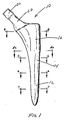
- the prosthesis 10 can be broken into a distal region 12, a mid-stem region 14 and a proximal region 16.
- Distal region 12 can be described geometrically as distal parabolic section
- mid-stem region 14 and the proximal generally conical region 16 conform medially and anteriorly to the anatomy, and posteriorly and laterally fills the space created by a shaped chisel (not shown).
- a central axis 18 extends through prosthesis 10 and generally coincides with the axis of the proximal femur.
- Prosthesis 10 is provided with lateral flare F at the juncture of the proximal portion 16 and section 14, allowing for additional stress transfer to the cortex in this region.
- distal section 12 is formed as a parabola. The intent of this shape is to afford excellent fit in a large range of femurs, most notably in the anterior-posterior dimension and also improves the stress transfer to the bone pedestal often formed in this region.
- a rigid reamer of predetermined shape may be used to shape the canal.
- Such reamers matching the distal and midshaft stem shape are shown in FIGS. 8 and 9.
- the reamer profile generally mimics the entire distal and midshaft shape of the femur canal, based on cadaveric studies.
- Reamers are currently available and presently used in medullary canal preparation such as that shown in Howmedica Inc. 1993 Catalog as part number 6059-0-510, however, these reamers are not based on the entire size and shape of the medullary canal based on studies of typical femurs.
- the reamer of the present invention is shaped to match approximately the lateral half of the proximal face of the implant in the area of the greater trochanter. This allows for an opening in which to more easily introduce a broach (not shown) which is used to shape the proximal femur.
- a medial curvature R is defined between points A and B, meeting the reamer shape at point B.
- the reamer 26 is shaped to coincide with the distal/midshaft implant shape from point B to the parabolic tip C, and laterally to point D.
- the parabola extends 3 cm, at which point it is blended into a conic of radius E.
- the basic shape of the stem and reamer were derived from a cadaveric study in which a population of femurs were x-rayed and sectioned and the dimensions of proximal metaphysis and the medullary canal were measured and entered into a computer data base.
- Several reamer shapes were developed for bone groups of similar dimensions. Further iterative fitting of each group generated an average stem shape for approximately the proximal two thirds of the stem.
- the geometric relationships of the proximal stem cross-sections of the present invention were developed from the these studies and closely match the recorded cadaveric data.
- a kit is provided with approximately ten reamers and ten matching stems which correspond to ten size groups which cover the vast majority of all the femurs in the population of hips surveyed.
- the distal portion 12 of each stem in the kit is shaped like the corresponding reamer and thus is in the form of a parabaloid having a central axis corresponding to the measured central axis.
- the paraboloid forms a pointed distal tip.
- proximal lateral face of component 10 is defined as line F-G and diverges outwardly from axis 18. This allows for greater femur to implant contact laterally when compared to the medial-lateral dimension of the osteotomy window. Between points D and F a transitional flare occurs, blending the proximal geometry to the distal reamer shape.
- the preferred trunnion 20 and neck 22 make an angle H of approximately 45° to the axis 18. The trunnion allows for attachment of modular femoral heads of differing diameters and offsets. The neck is enlarged at point A providing a pseudo collar to resist subsidence.
- the osteotomy is made at an angle J of 30° from a perpendicular to the axis 18. This angle retains calcar bone stock, thereby enhancing rotational stability and stress transfer. Neck strength is also improved over a similar 45° osteotomy as the length of neck 22 is effectively shorter.
- prosthesis 10 shown in the figures is the same as the shape of the reamer used to prepare the distal canal, being identical from point L anteriorly and around the distal tip to point M posteriorly.
- Analysis of femurs through planar x-ray films and 3-D computer representations has defined the proximal anterior radius P between points K and L for several implant sizes.
- the analysis also dictates proximal posterior radius Q, between points N and M, blending the reamer shape into the posterior aspect area. Note that radii P and Q necessitate left and right (i.e. anatomic) implants.
- the cross-section is defined as a transverse cut at the medal aspect of the osteotomy, perpendicular to axis 18.
- Points S, T, U and V are defined as the points where the A-P and M-L profiles (FIGS. 2 and 3) bisect the plane of FIG. 4. Lines S-T and U-V are at 90° to one another. This angle does not change throughout proximal portion 16.
- a radius X is defined at point B, where the medial curvature R intersects the distal reamer shape. Radius X also exists at the identical location on the reamer. Radius X is constant proximal to point B, and has its center point directly lateral to point S.
- the anterior radius Y is defined as an arc tangent to circle 26 of radius X, through point V and tangent to a second circle 30 of radius X, mirrored through line U-V.
- a circle 28 of radius Z is placed at the intersection of lines S-T and U-V.
- the value of radius Z is that of the distance between point in and line S-T. This radius is mirrored in a circle 32 through line AA-BB, which is parallel to line U-V and through the center of circle 26.
- the lateral shape of FIG. 4 is formed by polynomial splines DD and EE.
- Splines represent arcs of constantly changing radius defined in 2 or 3 dimensional space.
- Spline generation is available in several computer aided design (CAD) systems. These splines or arcs blend smoothly into radii Y and Z respectively.
- the spines also have zero slope at point T, i.e. they are parallel to line U-V.
- Posterior radius CC is now constructed similar to radius Y using circles 28 and 32, and point AA. Note that radius Y is convex and radius CC is concave. The concavity allows for preservation of the proximal femur's posterior cortex. In viewing the implant down axis 18, FIG.
- FIGS. 4A and 5 show this transition. Note the decrease in lengths of lines S-T and U-V, the decrease in the center to center dimension of circles 26 and 30, and the increased lateral conformity of the sections to circle 28. The transition to a circular section is essentially complete at FIG. 6. A section identical in location on the reamer produces a like size view. FIG. 7 describes a diameter smaller than and arranged coaxially to FIG. 6.
- FIGS. 6 and 7 are cross-sections through the distal stem region 12. Since this region is parabolic in shape, the cross-sections are generally circular.
Landscapes
- Health & Medical Sciences (AREA)
- Orthopedic Medicine & Surgery (AREA)
- Life Sciences & Earth Sciences (AREA)
- Engineering & Computer Science (AREA)
- Veterinary Medicine (AREA)
- Public Health (AREA)
- General Health & Medical Sciences (AREA)
- Oral & Maxillofacial Surgery (AREA)
- Animal Behavior & Ethology (AREA)
- Biomedical Technology (AREA)
- Heart & Thoracic Surgery (AREA)
- Cardiology (AREA)
- Vascular Medicine (AREA)
- Transplantation (AREA)
- Surgery (AREA)
- Dentistry (AREA)
- Nuclear Medicine, Radiotherapy & Molecular Imaging (AREA)
- Medical Informatics (AREA)
- Molecular Biology (AREA)
- Physics & Mathematics (AREA)
- Manufacturing & Machinery (AREA)
- Geometry (AREA)
- Prostheses (AREA)
- Surgical Instruments (AREA)
Claims (6)
- Composant fémoral (10) pour une prothèse de la hanche comportant : une partie distale (12) définissant un axe longitudinal central (18) du composant, destinée à être disposée à l'intérieur d'un canal intramédulaire du fémur, une partie mi-tige (14), et une partie proximale (16) possédant une section transversale (4) perpendiculaire à l'axe central (18) définissant des côtés médial (AA-BB), postérieur (U-AA), latéral (U-V) et antérieur (V-BB), caractérisé en ce que :a) ledit côté médial (AA-BB) de ladite partie proximale (16) possède la forme d'un premier arc circulaire (AA-BB) ayant un centre situé à l'intérieur de ladite section transversale (4), un arrondi de ladite section transversale, formé par lesdites surfaces postérieure (U-AA) et latérale (U-V), possédant la forme d'un second arc circulaire (U-T) ayant un centre situé sur ledit axe central (18) ;b) ledit côté antérieur (V-BB) de ladite partie proximale (16) est un arc (Y) d'un cercle ayant son centre qui est situé sur un premier plan (U-V) passant par ledit axe central (18) et perpendiculaire à un deuxième plan (T-S) contenant ledit axe central (18) et lesdits deux centres desdits premier (AA-BB) et second (U-T) arcs circulaires et qui est convexe en termes de forme et tangent audit premier arc circulaire (AA-BB) au niveau du point d'intersection (BB) avec celui-ci ;c) ledit côté Postérieur (U-AA) de ladite partie proximale (16) est un arc d'un cercle ayant son centre situé sur un troisième plan (AA-BB) Passant par le centre dudit premier arc circulaire (AA-BB) et perpendiculaire audit deuxième plan (S-T) contenant ledit axe central (18) et lesdits deux centres desdits premier (AA-BB) et second (U-T) arcs circulaires et qui est concave en termes de forme et tangent auxdits premier (AA-BB) et second (U-T) arcs circulaires, et une partie (DD) généralement arquée relie ledit second arc circulaire (U-T) et ladite surface antérieure (V-BB), la jonction entre ledit second arc circulaire (U-T) et ladite surface antérieure (V-BB) s'effectuant au niveau d'un point de jonction sur chacun dudit second arc circulaire (T) et de ladite surface antérieure (V) et ladite partie arquée (DD) formant une tangente avec au niveau desdits points de jonction ; etd) ledit composant fémoral (10) ayant une section transversale qui diminue graduellement à partir de la partie proximale (16) vers la partie distale (12) tandis que ledit deuxième plan (T-S) conserve la même orientation.
- Composant fémoral (10) selon la revendication 1, dans lequel une face latérale (G-F) dudit composant fémoral (10), formée par ladite surface latérale (U-V) de ladite section transversale (4), diverge à partir dudit axe central (18) lorsqu'on se déplace d'une manière distale le long de ce-lui-ci.
- Composant fémoral (10) selon la revendication 1, dans lequel ladite tige distale (12) possède une surface extérieure sous la forme d'une surface de révolution générée en faisant tourner une section transversale parabolique autour dudit axe longitudinal central (18).
- Composant fémoral (10) selon la revendication 3, comportant en outre une région mi-tige (14) ayant une surface extérieure formée généralement d'une manière conique s,étendant à partir de ladite partie distale (12) vers ladite partie proximale (16).
- Kit pour l'implantation du composant fémoral prothétique (10) dans un fémur humain comportant :un alésoir ayant une forme conique de rayon maximal dans la région intermédiaire dudit fémur, ladite forme conique mimant d'une manière générale la forme distale et intermédiaire d'une population de canaux fémoraux ;un composant fémoral (10) selon l'une quelconque des revendications 1 à 4.
- Kit selon la revendication 5, dans lequel ledit composant fémoral (10) possède un profil antérieur, au niveau de chaque section transversale, le long de sensiblement toute la partie proximale (16), qui est généré par un arc convexe tangent à ladite forme circulaire de la partie médiale.
Applications Claiming Priority (2)
| Application Number | Priority Date | Filing Date | Title |
|---|---|---|---|
| US08/055,426 US5358534A (en) | 1993-04-29 | 1993-04-29 | Femoral component for a hip prosthesis |
| US55426 | 1993-04-29 |
Publications (2)
| Publication Number | Publication Date |
|---|---|
| EP0622061A1 EP0622061A1 (fr) | 1994-11-02 |
| EP0622061B1 true EP0622061B1 (fr) | 2000-06-28 |
Family
ID=21997716
Family Applications (1)
| Application Number | Title | Priority Date | Filing Date |
|---|---|---|---|
| EP94106778A Expired - Lifetime EP0622061B1 (fr) | 1993-04-29 | 1994-04-29 | Composant fémoral pour prothèse de hanche |
Country Status (10)
| Country | Link |
|---|---|
| US (1) | US5358534A (fr) |
| EP (1) | EP0622061B1 (fr) |
| JP (1) | JPH07124187A (fr) |
| KR (1) | KR940023451A (fr) |
| AT (1) | ATE194065T1 (fr) |
| AU (1) | AU675114B2 (fr) |
| CA (1) | CA2122076A1 (fr) |
| DE (2) | DE69425015T2 (fr) |
| IL (1) | IL109477A (fr) |
| ZA (1) | ZA942839B (fr) |
Families Citing this family (23)
| Publication number | Priority date | Publication date | Assignee | Title |
|---|---|---|---|---|
| US5776204A (en) * | 1996-05-24 | 1998-07-07 | Howmedica Inc. | Asymmetric hip stem |
| EP0962199A1 (fr) * | 1998-06-04 | 1999-12-08 | Sulzer Orthopädie AG | Prothèse de tige |
| US8114163B2 (en) | 2000-04-10 | 2012-02-14 | Biomet Manufacturing Corp. | Method and apparatus for adjusting height and angle for a radial head |
| US8920509B2 (en) | 2000-04-10 | 2014-12-30 | Biomet Manufacturing, Llc | Modular radial head prosthesis |
| US8535382B2 (en) | 2000-04-10 | 2013-09-17 | Biomet Manufacturing, Llc | Modular radial head prostheses |
| DE10036986A1 (de) * | 2000-07-29 | 2002-02-07 | Klaus Draenert | Schenkelhalserhaltende Prothese |
| FR2815536B1 (fr) * | 2000-10-25 | 2003-07-04 | Marc Anzalone | Tige femorale anatomique cimentee |
| FR2846874B1 (fr) * | 2002-11-13 | 2005-11-11 | Euros Sa | Prothese de hanche |
| US7060102B2 (en) * | 2004-01-21 | 2006-06-13 | Thompson Matthew T | Femoral implant for hip arthroplasty |
| KR100566584B1 (ko) * | 2004-05-28 | 2006-03-30 | 주식회사 코렌텍 | 인공 고관절용 대퇴스템 및 상기 대퇴스템의 경부 가공방법 |
| US20050273109A1 (en) * | 2004-06-02 | 2005-12-08 | Minnesota Scientific, Inc. | Computer controlled reaming device |
| US8961516B2 (en) | 2005-05-18 | 2015-02-24 | Sonoma Orthopedic Products, Inc. | Straight intramedullary fracture fixation devices and methods |
| US9060820B2 (en) | 2005-05-18 | 2015-06-23 | Sonoma Orthopedic Products, Inc. | Segmented intramedullary fracture fixation devices and methods |
| US7846162B2 (en) | 2005-05-18 | 2010-12-07 | Sonoma Orthopedic Products, Inc. | Minimally invasive actuable bone fixation devices |
| CA2670263A1 (fr) | 2006-11-22 | 2008-05-29 | Sonoma Orthopedic Products, Inc. | Dispositif, outils et procedes de fixation de fracture |
| US20080200990A1 (en) * | 2007-02-16 | 2008-08-21 | Mctighe Timothy | Tissue sparing implant |
| EP2299917A1 (fr) | 2008-06-10 | 2011-03-30 | Sonoma Orthopedic Products, Inc. | Dispositif de fixation de fracture, outils et procédés afférents |
| AU2009296243A1 (en) | 2008-09-26 | 2010-04-01 | Sonoma Orthopedic Products, Inc. | Bone fixation device, tools and methods |
| US20140257510A1 (en) | 2013-03-05 | 2014-09-11 | Howmedica Osteonics Corp. | Anatomic monolithic hip implant system |
| US9770278B2 (en) | 2014-01-17 | 2017-09-26 | Arthrex, Inc. | Dual tip guide wire |
| US9814499B2 (en) | 2014-09-30 | 2017-11-14 | Arthrex, Inc. | Intramedullary fracture fixation devices and methods |
| US20170079800A1 (en) * | 2015-09-22 | 2017-03-23 | Michael Messieh | Hybrid Femoral Component Design for a Hip Prosthesis and Method of Stem Insertion |
| CN112618111B (zh) * | 2020-12-14 | 2021-09-21 | 徐州医科大学 | 基于叶脉骨架结构的股骨柄假体设计方法 |
Family Cites Families (17)
| Publication number | Priority date | Publication date | Assignee | Title |
|---|---|---|---|---|
| US3965490A (en) * | 1974-11-14 | 1976-06-29 | Howmedica, Inc. | Femoral insert for hip joint prosthesis |
| DE3015690A1 (de) * | 1980-04-24 | 1981-10-29 | Waldemar Link (Gmbh & Co), 2000 Hamburg | Hueftgelenkprothese mit einem in den markkanal des oberschenkelknochens einzusetzenden schaft |
| US4752296A (en) * | 1983-05-06 | 1988-06-21 | Buechel Frederick F | Prosthesis with interlocking fixation and providing reduction of stress shielding |
| US4589883A (en) * | 1983-06-06 | 1986-05-20 | Pfizer Hospital Products Group, Inc. | Femoral hip prosthesis |
| CH668549A5 (de) * | 1985-11-14 | 1989-01-13 | Sulzer Ag | Geradschaft fuer eine femurkopfprothese. |
| FR2618667A1 (fr) * | 1987-07-30 | 1989-02-03 | Verola Jean | Tige femorale auto-bloquante pour prothese de hanche |
| US4813963A (en) * | 1987-08-24 | 1989-03-21 | Zimmer, Inc. | Femoral component for a hip prosthesis |
| NL8702626A (nl) * | 1987-11-03 | 1989-06-01 | Orthopaedic Tech Bv | Werkwijze voor het vormgeven van een geometrie van een endoprothese, een femurkopprothese, een acetabulumprothese, een werkwijze voor het in een botstuk brengen van een femurkopprothese en een instrument voor het plaatsen van een acetabulumprothese. |
| JPH0292352A (ja) * | 1988-09-29 | 1990-04-03 | Aisin Seiki Co Ltd | 股関節用人工骨頭 |
| US5002580A (en) * | 1988-10-07 | 1991-03-26 | Pfizer Hospital Products Group, Inc. | Prosthetic device and method of implantation |
| AT393215B (de) * | 1989-03-16 | 1991-09-10 | Boehler Gmbh | Knochenimplantat |
| GB8921008D0 (en) * | 1989-09-15 | 1989-11-01 | Walker Peter S | Skeletal implants |
| FR2662932B1 (fr) * | 1990-06-07 | 1997-09-05 | Denis Godeau | Prothese femorale. |
| FR2666737B1 (fr) * | 1990-09-18 | 1992-12-18 | Medinov Sa | Ensemble prothetique de la hanche. |
| US5181930A (en) * | 1991-04-10 | 1993-01-26 | Pfizer Hospital Products Group, Inc. | Composite orthopedic implant |
| DE4221442A1 (de) * | 1992-06-30 | 1994-01-05 | Keramed Medizintechnik Gmbh | Metallischer Schaft einer zementierbaren Hüftgelenksendoprothese |
| DE4234351A1 (de) * | 1992-10-12 | 1994-05-11 | Draenert Klaus | Stiel einer Femurkomponente einer Hüftgelenksendoprothese |
-
1993
- 1993-04-29 US US08/055,426 patent/US5358534A/en not_active Expired - Lifetime
-
1994
- 1994-04-25 CA CA002122076A patent/CA2122076A1/fr not_active Abandoned
- 1994-04-25 ZA ZA942839A patent/ZA942839B/xx unknown
- 1994-04-28 AU AU60775/94A patent/AU675114B2/en not_active Ceased
- 1994-04-28 KR KR1019940009143A patent/KR940023451A/ko not_active Abandoned
- 1994-04-28 IL IL109477A patent/IL109477A/en not_active IP Right Cessation
- 1994-04-29 DE DE69425015T patent/DE69425015T2/de not_active Expired - Fee Related
- 1994-04-29 DE DE9407171U patent/DE9407171U1/de not_active Expired - Lifetime
- 1994-04-29 AT AT94106778T patent/ATE194065T1/de not_active IP Right Cessation
- 1994-04-29 EP EP94106778A patent/EP0622061B1/fr not_active Expired - Lifetime
- 1994-05-02 JP JP6093523A patent/JPH07124187A/ja active Pending
Also Published As
| Publication number | Publication date |
|---|---|
| DE9407171U1 (de) | 1994-09-29 |
| ZA942839B (en) | 1995-02-17 |
| ATE194065T1 (de) | 2000-07-15 |
| IL109477A (en) | 1998-02-08 |
| EP0622061A1 (fr) | 1994-11-02 |
| CA2122076A1 (fr) | 1994-10-30 |
| KR940023451A (ko) | 1994-11-17 |
| AU6077594A (en) | 1994-11-03 |
| US5358534A (en) | 1994-10-25 |
| JPH07124187A (ja) | 1995-05-16 |
| AU675114B2 (en) | 1997-01-23 |
| IL109477A0 (en) | 1994-07-31 |
| DE69425015D1 (de) | 2000-08-03 |
| DE69425015T2 (de) | 2001-03-08 |
Similar Documents
| Publication | Publication Date | Title |
|---|---|---|
| AU675114B2 (en) | Femoral component for a hip prosthesis | |
| US11957363B2 (en) | Surgical technique and instrumentation for minimal incision hip arthroplasty surgery | |
| US5888210A (en) | Stem of a femoral component of a hip joint endoprosthesis | |
| US5290315A (en) | Oblong acetabular cup | |
| US6702822B1 (en) | Method and apparatus for fitting a prosthesis to a bone | |
| US6139584A (en) | Proximal femoral sleeve for a revision hip prosthesis | |
| EP0985385B1 (fr) | Prothèse implantable ayant des extensibles coopérant avec os | |
| US10405982B2 (en) | Partial joint resurfacing implant,instrumentation, and method | |
| CA1291597C (fr) | Implant coxal a longue tige | |
| CA2730564C (fr) | Prothese de tete de femur | |
| US7494509B1 (en) | Method and apparatus for providing a short-stemmed hip prosthesis | |
| CA2942523A1 (fr) | Tige femorale de la hanche | |
| Team | The science of simplicity |
Legal Events
| Date | Code | Title | Description |
|---|---|---|---|
| PUAI | Public reference made under article 153(3) epc to a published international application that has entered the european phase |
Free format text: ORIGINAL CODE: 0009012 |
|
| AK | Designated contracting states |
Kind code of ref document: A1 Designated state(s): AT BE CH DE DK ES FR GB GR IE IT LI LU NL PT SE |
|
| 17P | Request for examination filed |
Effective date: 19950427 |
|
| 17Q | First examination report despatched |
Effective date: 19970304 |
|
| GRAG | Despatch of communication of intention to grant |
Free format text: ORIGINAL CODE: EPIDOS AGRA |
|
| RAP1 | Party data changed (applicant data changed or rights of an application transferred) |
Owner name: HUNGERFORD, DAVID S. Owner name: HEDLEY, ANTHONY K. Owner name: STRYKER TECHNOLOGIES CORPORATION |
|
| GRAG | Despatch of communication of intention to grant |
Free format text: ORIGINAL CODE: EPIDOS AGRA |
|
| GRAH | Despatch of communication of intention to grant a patent |
Free format text: ORIGINAL CODE: EPIDOS IGRA |
|
| GRAH | Despatch of communication of intention to grant a patent |
Free format text: ORIGINAL CODE: EPIDOS IGRA |
|
| GRAA | (expected) grant |
Free format text: ORIGINAL CODE: 0009210 |
|
| AK | Designated contracting states |
Kind code of ref document: B1 Designated state(s): AT BE CH DE DK ES FR GB GR IE IT LI LU NL PT SE |
|
| PG25 | Lapsed in a contracting state [announced via postgrant information from national office to epo] |
Ref country code: NL Free format text: LAPSE BECAUSE OF FAILURE TO SUBMIT A TRANSLATION OF THE DESCRIPTION OR TO PAY THE FEE WITHIN THE PRESCRIBED TIME-LIMIT Effective date: 20000628 Ref country code: GR Free format text: LAPSE BECAUSE OF NON-PAYMENT OF DUE FEES Effective date: 20000628 Ref country code: ES Free format text: THE PATENT HAS BEEN ANNULLED BY A DECISION OF A NATIONAL AUTHORITY Effective date: 20000628 Ref country code: BE Free format text: LAPSE BECAUSE OF FAILURE TO SUBMIT A TRANSLATION OF THE DESCRIPTION OR TO PAY THE FEE WITHIN THE PRESCRIBED TIME-LIMIT Effective date: 20000628 Ref country code: AT Free format text: LAPSE BECAUSE OF FAILURE TO SUBMIT A TRANSLATION OF THE DESCRIPTION OR TO PAY THE FEE WITHIN THE PRESCRIBED TIME-LIMIT Effective date: 20000628 |
|
| REF | Corresponds to: |
Ref document number: 194065 Country of ref document: AT Date of ref document: 20000715 Kind code of ref document: T |
|
| ITF | It: translation for a ep patent filed | ||
| REG | Reference to a national code |
Ref country code: CH Ref legal event code: EP |
|
| REG | Reference to a national code |
Ref country code: IE Ref legal event code: FG4D |
|
| ET | Fr: translation filed | ||
| REF | Corresponds to: |
Ref document number: 69425015 Country of ref document: DE Date of ref document: 20000803 |
|
| PG25 | Lapsed in a contracting state [announced via postgrant information from national office to epo] |
Ref country code: SE Free format text: LAPSE BECAUSE OF FAILURE TO SUBMIT A TRANSLATION OF THE DESCRIPTION OR TO PAY THE FEE WITHIN THE PRESCRIBED TIME-LIMIT Effective date: 20000928 Ref country code: PT Free format text: LAPSE BECAUSE OF FAILURE TO SUBMIT A TRANSLATION OF THE DESCRIPTION OR TO PAY THE FEE WITHIN THE PRESCRIBED TIME-LIMIT Effective date: 20000928 Ref country code: DK Free format text: LAPSE BECAUSE OF FAILURE TO SUBMIT A TRANSLATION OF THE DESCRIPTION OR TO PAY THE FEE WITHIN THE PRESCRIBED TIME-LIMIT Effective date: 20000928 |
|
| REG | Reference to a national code |
Ref country code: CH Ref legal event code: NV Representative=s name: KIRKER & CIE SA |
|
| NLV1 | Nl: lapsed or annulled due to failure to fulfill the requirements of art. 29p and 29m of the patents act | ||
| PLBE | No opposition filed within time limit |
Free format text: ORIGINAL CODE: 0009261 |
|
| STAA | Information on the status of an ep patent application or granted ep patent |
Free format text: STATUS: NO OPPOSITION FILED WITHIN TIME LIMIT |
|
| PG25 | Lapsed in a contracting state [announced via postgrant information from national office to epo] |
Ref country code: LU Free format text: LAPSE BECAUSE OF NON-PAYMENT OF DUE FEES Effective date: 20010429 |
|
| PG25 | Lapsed in a contracting state [announced via postgrant information from national office to epo] |
Ref country code: IE Free format text: LAPSE BECAUSE OF NON-PAYMENT OF DUE FEES Effective date: 20010430 |
|
| 26N | No opposition filed | ||
| REG | Reference to a national code |
Ref country code: GB Ref legal event code: IF02 |
|
| REG | Reference to a national code |
Ref country code: IE Ref legal event code: MM4A |
|
| PGFP | Annual fee paid to national office [announced via postgrant information from national office to epo] |
Ref country code: GB Payment date: 20030313 Year of fee payment: 10 |
|
| PGFP | Annual fee paid to national office [announced via postgrant information from national office to epo] |
Ref country code: FR Payment date: 20030403 Year of fee payment: 10 |
|
| PGFP | Annual fee paid to national office [announced via postgrant information from national office to epo] |
Ref country code: DE Payment date: 20030430 Year of fee payment: 10 |
|
| PGFP | Annual fee paid to national office [announced via postgrant information from national office to epo] |
Ref country code: CH Payment date: 20030605 Year of fee payment: 10 |
|
| PG25 | Lapsed in a contracting state [announced via postgrant information from national office to epo] |
Ref country code: GB Free format text: LAPSE BECAUSE OF NON-PAYMENT OF DUE FEES Effective date: 20040429 |
|
| PG25 | Lapsed in a contracting state [announced via postgrant information from national office to epo] |
Ref country code: LI Free format text: LAPSE BECAUSE OF NON-PAYMENT OF DUE FEES Effective date: 20040430 Ref country code: CH Free format text: LAPSE BECAUSE OF NON-PAYMENT OF DUE FEES Effective date: 20040430 |
|
| PG25 | Lapsed in a contracting state [announced via postgrant information from national office to epo] |
Ref country code: DE Free format text: LAPSE BECAUSE OF NON-PAYMENT OF DUE FEES Effective date: 20041103 |
|
| REG | Reference to a national code |
Ref country code: CH Ref legal event code: PL |
|
| GBPC | Gb: european patent ceased through non-payment of renewal fee |
Effective date: 20040429 |
|
| PG25 | Lapsed in a contracting state [announced via postgrant information from national office to epo] |
Ref country code: FR Free format text: LAPSE BECAUSE OF NON-PAYMENT OF DUE FEES Effective date: 20041231 |
|
| REG | Reference to a national code |
Ref country code: FR Ref legal event code: ST |
|
| PG25 | Lapsed in a contracting state [announced via postgrant information from national office to epo] |
Ref country code: IT Free format text: LAPSE BECAUSE OF NON-PAYMENT OF DUE FEES Effective date: 20050429 |