EP0622833A1 - Porteur adhésif pour wafer et procédé de fabrication de dispositifs à semi-conducteur l'utilisant - Google Patents
Porteur adhésif pour wafer et procédé de fabrication de dispositifs à semi-conducteur l'utilisant Download PDFInfo
- Publication number
- EP0622833A1 EP0622833A1 EP94106663A EP94106663A EP0622833A1 EP 0622833 A1 EP0622833 A1 EP 0622833A1 EP 94106663 A EP94106663 A EP 94106663A EP 94106663 A EP94106663 A EP 94106663A EP 0622833 A1 EP0622833 A1 EP 0622833A1
- Authority
- EP
- European Patent Office
- Prior art keywords
- radiation
- chips
- adhesive layer
- wafer
- radiation curable
- Prior art date
- Legal status (The legal status is an assumption and is not a legal conclusion. Google has not performed a legal analysis and makes no representation as to the accuracy of the status listed.)
- Granted
Links
Images
Classifications
-
- H—ELECTRICITY
- H10—SEMICONDUCTOR DEVICES; ELECTRIC SOLID-STATE DEVICES NOT OTHERWISE PROVIDED FOR
- H10W—GENERIC PACKAGES, INTERCONNECTIONS, CONNECTORS OR OTHER CONSTRUCTIONAL DETAILS OF DEVICES COVERED BY CLASS H10
- H10W70/00—Package substrates; Interposers; Redistribution layers [RDL]
- H10W70/40—Leadframes
- H10W70/411—Chip-supporting parts, e.g. die pads
- H10W70/415—Leadframe inner leads serving as die pads
-
- C—CHEMISTRY; METALLURGY
- C08—ORGANIC MACROMOLECULAR COMPOUNDS; THEIR PREPARATION OR CHEMICAL WORKING-UP; COMPOSITIONS BASED THEREON
- C08F—MACROMOLECULAR COMPOUNDS OBTAINED BY REACTIONS ONLY INVOLVING CARBON-TO-CARBON UNSATURATED BONDS
- C08F220/00—Copolymers of compounds having one or more unsaturated aliphatic radicals, each having only one carbon-to-carbon double bond, and only one being terminated by only one carboxyl radical or a salt, anhydride ester, amide, imide or nitrile thereof
- C08F220/02—Monocarboxylic acids having less than ten carbon atoms; Derivatives thereof
- C08F220/10—Esters
- C08F220/12—Esters of monohydric alcohols or phenols
-
- C—CHEMISTRY; METALLURGY
- C09—DYES; PAINTS; POLISHES; NATURAL RESINS; ADHESIVES; COMPOSITIONS NOT OTHERWISE PROVIDED FOR; APPLICATIONS OF MATERIALS NOT OTHERWISE PROVIDED FOR
- C09J—ADHESIVES; NON-MECHANICAL ASPECTS OF ADHESIVE PROCESSES IN GENERAL; ADHESIVE PROCESSES NOT PROVIDED FOR ELSEWHERE; USE OF MATERIALS AS ADHESIVES
- C09J133/00—Adhesives based on homopolymers or copolymers of compounds having one or more unsaturated aliphatic radicals, each having only one carbon-to-carbon double bond, and at least one being terminated by only one carboxyl radical, or of salts, anhydrides, esters, amides, imides, or nitriles thereof; Adhesives based on derivatives of such polymers
- C09J133/04—Homopolymers or copolymers of esters
- C09J133/06—Homopolymers or copolymers of esters of esters containing only carbon, hydrogen and oxygen, the oxygen atom being present only as part of the carboxyl radical
- C09J133/062—Copolymers with monomers not covered by C09J133/06
- C09J133/064—Copolymers with monomers not covered by C09J133/06 containing anhydride, COOH or COOM groups, with M being metal or onium-cation
-
- C—CHEMISTRY; METALLURGY
- C09—DYES; PAINTS; POLISHES; NATURAL RESINS; ADHESIVES; COMPOSITIONS NOT OTHERWISE PROVIDED FOR; APPLICATIONS OF MATERIALS NOT OTHERWISE PROVIDED FOR
- C09J—ADHESIVES; NON-MECHANICAL ASPECTS OF ADHESIVE PROCESSES IN GENERAL; ADHESIVE PROCESSES NOT PROVIDED FOR ELSEWHERE; USE OF MATERIALS AS ADHESIVES
- C09J7/00—Adhesives in the form of films or foils
- C09J7/20—Adhesives in the form of films or foils characterised by their carriers
- C09J7/22—Plastics; Metallised plastics
-
- C—CHEMISTRY; METALLURGY
- C09—DYES; PAINTS; POLISHES; NATURAL RESINS; ADHESIVES; COMPOSITIONS NOT OTHERWISE PROVIDED FOR; APPLICATIONS OF MATERIALS NOT OTHERWISE PROVIDED FOR
- C09J—ADHESIVES; NON-MECHANICAL ASPECTS OF ADHESIVE PROCESSES IN GENERAL; ADHESIVE PROCESSES NOT PROVIDED FOR ELSEWHERE; USE OF MATERIALS AS ADHESIVES
- C09J7/00—Adhesives in the form of films or foils
- C09J7/30—Adhesives in the form of films or foils characterised by the adhesive composition
- C09J7/38—Pressure-sensitive adhesives [PSA]
-
- H—ELECTRICITY
- H10—SEMICONDUCTOR DEVICES; ELECTRIC SOLID-STATE DEVICES NOT OTHERWISE PROVIDED FOR
- H10P—GENERIC PROCESSES OR APPARATUS FOR THE MANUFACTURE OR TREATMENT OF DEVICES COVERED BY CLASS H10
- H10P72/00—Handling or holding of wafers, substrates or devices during manufacture or treatment thereof
- H10P72/70—Handling or holding of wafers, substrates or devices during manufacture or treatment thereof for supporting or gripping
- H10P72/74—Handling or holding of wafers, substrates or devices during manufacture or treatment thereof for supporting or gripping using temporarily an auxiliary support
-
- H—ELECTRICITY
- H10—SEMICONDUCTOR DEVICES; ELECTRIC SOLID-STATE DEVICES NOT OTHERWISE PROVIDED FOR
- H10P—GENERIC PROCESSES OR APPARATUS FOR THE MANUFACTURE OR TREATMENT OF DEVICES COVERED BY CLASS H10
- H10P72/00—Handling or holding of wafers, substrates or devices during manufacture or treatment thereof
- H10P72/70—Handling or holding of wafers, substrates or devices during manufacture or treatment thereof for supporting or gripping
- H10P72/74—Handling or holding of wafers, substrates or devices during manufacture or treatment thereof for supporting or gripping using temporarily an auxiliary support
- H10P72/7402—Wafer tapes, e.g. grinding or dicing support tapes
-
- H—ELECTRICITY
- H10—SEMICONDUCTOR DEVICES; ELECTRIC SOLID-STATE DEVICES NOT OTHERWISE PROVIDED FOR
- H10W—GENERIC PACKAGES, INTERCONNECTIONS, CONNECTORS OR OTHER CONSTRUCTIONAL DETAILS OF DEVICES COVERED BY CLASS H10
- H10W74/00—Encapsulations, e.g. protective coatings
- H10W74/40—Encapsulations, e.g. protective coatings characterised by their materials
- H10W74/47—Encapsulations, e.g. protective coatings characterised by their materials comprising organic materials, e.g. plastics or resins
-
- H—ELECTRICITY
- H10—SEMICONDUCTOR DEVICES; ELECTRIC SOLID-STATE DEVICES NOT OTHERWISE PROVIDED FOR
- H10P—GENERIC PROCESSES OR APPARATUS FOR THE MANUFACTURE OR TREATMENT OF DEVICES COVERED BY CLASS H10
- H10P72/00—Handling or holding of wafers, substrates or devices during manufacture or treatment thereof
- H10P72/70—Handling or holding of wafers, substrates or devices during manufacture or treatment thereof for supporting or gripping
- H10P72/74—Handling or holding of wafers, substrates or devices during manufacture or treatment thereof for supporting or gripping using temporarily an auxiliary support
- H10P72/7412—Handling or holding of wafers, substrates or devices during manufacture or treatment thereof for supporting or gripping using temporarily an auxiliary support the auxiliary support including means facilitating the separation of a device or wafer from the auxiliary support
- H10P72/7414—Handling or holding of wafers, substrates or devices during manufacture or treatment thereof for supporting or gripping using temporarily an auxiliary support the auxiliary support including means facilitating the separation of a device or wafer from the auxiliary support the auxiliary support including means facilitating the selective separation of some of a plurality of devices from the auxiliary support
-
- H—ELECTRICITY
- H10—SEMICONDUCTOR DEVICES; ELECTRIC SOLID-STATE DEVICES NOT OTHERWISE PROVIDED FOR
- H10P—GENERIC PROCESSES OR APPARATUS FOR THE MANUFACTURE OR TREATMENT OF DEVICES COVERED BY CLASS H10
- H10P72/00—Handling or holding of wafers, substrates or devices during manufacture or treatment thereof
- H10P72/70—Handling or holding of wafers, substrates or devices during manufacture or treatment thereof for supporting or gripping
- H10P72/74—Handling or holding of wafers, substrates or devices during manufacture or treatment thereof for supporting or gripping using temporarily an auxiliary support
- H10P72/7416—Handling or holding of wafers, substrates or devices during manufacture or treatment thereof for supporting or gripping using temporarily an auxiliary support used during dicing or grinding
-
- H—ELECTRICITY
- H10—SEMICONDUCTOR DEVICES; ELECTRIC SOLID-STATE DEVICES NOT OTHERWISE PROVIDED FOR
- H10W—GENERIC PACKAGES, INTERCONNECTIONS, CONNECTORS OR OTHER CONSTRUCTIONAL DETAILS OF DEVICES COVERED BY CLASS H10
- H10W72/00—Interconnections or connectors in packages
- H10W72/071—Connecting or disconnecting
- H10W72/073—Connecting or disconnecting of die-attach connectors
- H10W72/07351—Connecting or disconnecting of die-attach connectors characterised by changes in properties of the die-attach connectors during connecting
- H10W72/07352—Connecting or disconnecting of die-attach connectors characterised by changes in properties of the die-attach connectors during connecting changes in structures or sizes
-
- H—ELECTRICITY
- H10—SEMICONDUCTOR DEVICES; ELECTRIC SOLID-STATE DEVICES NOT OTHERWISE PROVIDED FOR
- H10W—GENERIC PACKAGES, INTERCONNECTIONS, CONNECTORS OR OTHER CONSTRUCTIONAL DETAILS OF DEVICES COVERED BY CLASS H10
- H10W72/00—Interconnections or connectors in packages
- H10W72/30—Die-attach connectors
- H10W72/321—Structures or relative sizes of die-attach connectors
-
- H—ELECTRICITY
- H10—SEMICONDUCTOR DEVICES; ELECTRIC SOLID-STATE DEVICES NOT OTHERWISE PROVIDED FOR
- H10W—GENERIC PACKAGES, INTERCONNECTIONS, CONNECTORS OR OTHER CONSTRUCTIONAL DETAILS OF DEVICES COVERED BY CLASS H10
- H10W72/00—Interconnections or connectors in packages
- H10W72/851—Dispositions of multiple connectors or interconnections
- H10W72/853—On the same surface
- H10W72/865—Die-attach connectors and bond wires
-
- H—ELECTRICITY
- H10—SEMICONDUCTOR DEVICES; ELECTRIC SOLID-STATE DEVICES NOT OTHERWISE PROVIDED FOR
- H10W—GENERIC PACKAGES, INTERCONNECTIONS, CONNECTORS OR OTHER CONSTRUCTIONAL DETAILS OF DEVICES COVERED BY CLASS H10
- H10W72/00—Interconnections or connectors in packages
- H10W72/851—Dispositions of multiple connectors or interconnections
- H10W72/874—On different surfaces
- H10W72/884—Die-attach connectors and bond wires
-
- H—ELECTRICITY
- H10—SEMICONDUCTOR DEVICES; ELECTRIC SOLID-STATE DEVICES NOT OTHERWISE PROVIDED FOR
- H10W—GENERIC PACKAGES, INTERCONNECTIONS, CONNECTORS OR OTHER CONSTRUCTIONAL DETAILS OF DEVICES COVERED BY CLASS H10
- H10W74/00—Encapsulations, e.g. protective coatings
-
- H—ELECTRICITY
- H10—SEMICONDUCTOR DEVICES; ELECTRIC SOLID-STATE DEVICES NOT OTHERWISE PROVIDED FOR
- H10W—GENERIC PACKAGES, INTERCONNECTIONS, CONNECTORS OR OTHER CONSTRUCTIONAL DETAILS OF DEVICES COVERED BY CLASS H10
- H10W74/00—Encapsulations, e.g. protective coatings
- H10W74/10—Encapsulations, e.g. protective coatings characterised by their shape or disposition
-
- H—ELECTRICITY
- H10—SEMICONDUCTOR DEVICES; ELECTRIC SOLID-STATE DEVICES NOT OTHERWISE PROVIDED FOR
- H10W—GENERIC PACKAGES, INTERCONNECTIONS, CONNECTORS OR OTHER CONSTRUCTIONAL DETAILS OF DEVICES COVERED BY CLASS H10
- H10W90/00—Package configurations
- H10W90/701—Package configurations characterised by the relative positions of pads or connectors relative to package parts
- H10W90/731—Package configurations characterised by the relative positions of pads or connectors relative to package parts of die-attach connectors
- H10W90/736—Package configurations characterised by the relative positions of pads or connectors relative to package parts of die-attach connectors between a chip and a stacked lead frame, conducting package substrate or heat sink
-
- H—ELECTRICITY
- H10—SEMICONDUCTOR DEVICES; ELECTRIC SOLID-STATE DEVICES NOT OTHERWISE PROVIDED FOR
- H10W—GENERIC PACKAGES, INTERCONNECTIONS, CONNECTORS OR OTHER CONSTRUCTIONAL DETAILS OF DEVICES COVERED BY CLASS H10
- H10W90/00—Package configurations
- H10W90/701—Package configurations characterised by the relative positions of pads or connectors relative to package parts
- H10W90/751—Package configurations characterised by the relative positions of pads or connectors relative to package parts of bond wires
- H10W90/756—Package configurations characterised by the relative positions of pads or connectors relative to package parts of bond wires between a chip and a stacked lead frame, conducting package substrate or heat sink
Definitions
- the present invention relates to an adhesive sheet for a semiconductor wafer (referred to as "wafer” hereinafter) and a process for preparing a semiconductor device using this adhesive sheet. More particularly, the invention relates to an adhesive sheet which is used for applying and fixing thereon a wafer having been subjected to wafer processing in order to dice the wafer into element chips - (referred to as "chips” hereinafter) in a process for preparing a semiconductor device having such a structure that the back surfaces of the chips are partially or wholly in contact with a package molding resin (sealing resin), and the invention also relates to a process for preparing a semiconductor device using this adhesive sheet.
- wafer semiconductor wafer
- the invention also relates to a process for preparing a semiconductor device using this adhesive sheet.
- LOC Lead On Chip
- plural inner leads of a semiconductor device lead frame (referred to as “lead frame” hereinafter) are fixed onto a surface of a chip, on which a circuit has been formed, by way of insulating tapes which electrically insulate the inner leads from the chip, and the inner leads are electrically connected with the chip by a bonding wire.
- the semiconductor device is sealed with a molding resin, and the back surface of the chip is in contact with the molding resin.
- the LOC structure has various advantages as described above, but this structure involves problems which must be solved because it is entirely different from structures of conventional packages.
- One of problems which must be solved is lowering of reliability caused by separation between the chips and the molding resin, occurrence of package cracks, etc.
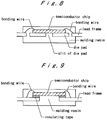
- Fig. 8 shows a semiconductor device having such a structure that a die pad has a slit.
- Fig. 9 shows a semiconductor device having a COL (Chip On Lead) structure.
- the invasion routes of moisture into the IC package are broadly classified as follows:
- soldering is conducted generally by means of IR reflowing in which heating is effected by infrared rays or vapor reflowing in which an inert liquid is vaporized and the IC package is exposed to the vapor of high temperature since both reflowing methods are suitable for mass production.
- IR reflowing the former method, the IC package is exposed to a high temperature of 240 to 250 °C, whereby the moisture which has invaded inside of the IC package as described above is explosively expanded by the high temperature during the reflowing operation, and thereby water vapor pressure is applied onto the interface between the epoxy resin and the lead frame to bring about interfacial separation therebetween. As a result, package cracks take place.
- the package cracks caused by the IR reflowing are often observed even when the package is allowed to stand at an ordinary temperature for about 168 hours, though it depends on the shape of the lead frame in the package, the surface area of the chips, etc.
- the adhesion strength is largely influenced by cleanliness of the adherend surface.
- the adhesion strength is very sensitive even to a foreign substance having an angstrom level thickness remaining on the adherend surface so as to decrease the adhesion strength, whereby invasion of moisture or retention thereof within the package is easily made, and finally the package cracks are brought about.
- semiconductor wafers of silicon, gallium-arsenide, etc. are usually produced in relatively large diameter, and the wafers are diced into chips, which are then transferred to the subsequent mounting stage.
- the semiconductor wafers are subjected to such operations as dicing, rinsing, drying and irradiation of radiation rays to cure the radiation curing adhesive layer of an adhesive sheet in a state that the semiconductor wafers are adhered to the adhesive sheet.
- an expansion operation of the adhesive sheet is carried out if necessary, and thereafter operations of picking up the chips and mounting the chips are carried out.
- Adhesive sheets which are intended for use in the processing stages of wafers, from the dicing stage up to the pick-up stage, are desired to have an adhesion force sufficient to retain wafers and/or chips thereon in the course from the dicing stage up to the expanding stage, but in the pick-up stage, they are desired to only retain an adhesion force of such an extent that no adhesive remains on the picked-up wafer chips.
- adhesive sheets for applying wafers thereon those described in for example Japanese Patent Publication No. 56112/1989 have been generally used, and they can be used without any problem in preparing semiconductor devices of conventional type.
- the present invention has been made in the light of the foregoing techniques in the prior art, and it is an object of the present invention to provide an adhesive sheet for wafer (referred to as "adhesive sheet for wafer” hereinafter) which is used in preparing a semiconductor device having such a structure that the back surfaces of chips are partially or wholly in contact with a molding resin and which can prevent occurrence of package cracks thereby to enhance reliability of the semiconductor device. It is another object of the present invention to provide a process for preparing a semiconductor device using this adhesive sheet.
- the adhesive sheet for wafer is an adhesive sheet comprising a substrate film and a radiation curable adhesive layer formed thereon, said adhesive sheet being used in a process for preparing a semiconductor device comprising the steps of adhering a back surface of a wafer, a front surface of which has been formed a circuit, onto the radiation curable adhesive layer, dicing the wafer into chips, irradiating the radiation curable adhesive layer with radiation to cure said adhesive layer, expanding the adhesive sheet if necessary to make the chips apart from each other, then picking up the chips, mounting the chips on a lead frame, bonding, and molding (sealing) to give such a structure that the back surfaces of the chips are partially or wholly in contact with a package molding resin, wherein the radiation curable adhesive layer comprises 100 parts by weight of an acrylic adhesive composed of a copolymer of an acrylic ester and an OH group-containing polymerizable monomer and 50 - 200 parts by weight of a radiation polymerizable compound having two or more unsaturated bonds, and
- the process for preparing a semiconductor device uses an adhesive sheet for wafer comprising a substrate film and a radiation curable ahdesive layer provided thereon which comprises 100 parts by weight of an acrylic adhesive composed of a copolymer of an acrylic ester and an OH group-containing polymerizable monomer and 50 - 200 parts by weight of a radiation polymerizable compound having two or more unsaturated bonds and has an elastic modulus of not less than 1 ⁇ 109 dyn/cm2 after curing by irradiation with radiation, and the process comprises the steps of adhering a back surface of a wafer, a front surface of which has been formed a circuit, onto the radiation curable adhesive layer, dicing the wafer into chips, irradiating the radiation curable adhesive layer with radiation to cure said adhesive layer, expanding the adhesive sheet if necessary to make the chips apart from each other, then picking up the chips, mounting the chips on a lead frame, bonding, and molding (sealing) to give such a structure
- 20 to 80% by weight of a radiation polymerizable compound having two or more unsaturated bonds are those having four or more unsaturated bonds.
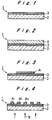
- Fig. 1 is a schematic sectional view of an adhesive sheet for wafer according to the present invention.
- Fig. 2 is a schematic sectional view of another adhesive sheet for wafer according to the present invention.
- Fig. 3 is an illustration showing a state where a wafer is applied onto an adhesive sheet for wafer.
- Fig. 4 is an illustration showing a state where a wafer is diced into chips, an adhesive sheet is expanded and the sheet is irradiated with radiation.
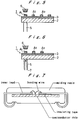
- Fig. 5 is an illustration showing another pick-up stage of chips.
- Fig. 6 is an illustration showing another pick-up stage of chips.
- Fig. 7 is a sectional view of a semiconductor device having a LOC structure.
- Fig. 8 is a sectional view of a semiconductor device having such a structure that a die pad has a slit.
- Fig. 9 is a sectional view of a semiconductor device having a COL (Chip On Lead) structure.
- the adhesive sheet for wafer 1 of the present invention comprises a substrate film 2 and a radiation curable adhesive layer 3 provided thereon.
- the adhesive sheet 1 is used in preparing a semiconductor device having such a structure that the back surfaces of chips are partially or wholly in contact with a molding resin.
- This process comprises the steps of adhering a wafer A which has been subjected to wafer processing onto the radiation curable adhesive layer 3, dicing the wafer in this state into plural chips, rinsing, drying, irradiating the radiation curable adhesive layer 3 of the adhesive sheet 1 with radiation to cure the adhesive layer so as to decrease the adhesion force of the layer, expanding the adhesive sheet if necessary to make the chips apart from each other, then picking up the chips from the radiation curable adhesive layer 3, mounting the picked chips on a given support substrate, for example, a lead frame, and finally molding with a resin.
- the adhesive sheet for wafer 1 of the invention comprises the substrate film 2 and the radiation curable adhesive layer 3 provided on the surface of the substrate film. Before the use of this adhesive sheet, it is preferred to temporarily apply a release sheet 4 onto the radiation curable adhesive layer 3 to protect the adhesive layer 3, as shown in Fig. 2.
- the adhesive sheet for wafer 1 of the invention may be shaped into any form such as tape-like, label-like or other form.
- Suitable as the substrate film 2 are materials which are excellent in water resistance and heat resistance, and on this view, synthetic resin films are particularly suitable.
- the adhesive sheet for wafer of the invention is irradiated with radiation such as electron beam (EB) or ultraviolet light (UV), and the substrate film 2 is not required to be transparent when the adhesive sheet is subjected to EB irradiation but must be transparent even though colored when the adhesive sheet is subjected to UV irradiation.
- radiation such as electron beam (EB) or ultraviolet light (UV)
- the substrate film 2 are films of synthetic resins such as polyethylene, polypropylene, polyvinyl chloride, polyethylene terephthalate, polybutylene terephthalate, polybutene, polybutadiene, polyurethane, polymethylpentene, ethylene/vinyl acetate copolymer, ethylene/(meth)acrylic acid copolymer, ethylene/methyl (meth)acrylate copolymer, ethylene/ethyl (meth)acrylate copolymer, etc.
- a laminate of these films is also employable.
- the thickness of the substrate film 2 is usually in the range of about 10 to 300 ⁇ m, preferably 50 to 200 ⁇ m.
- a synthetic resin film having extensibility in the lengthwise direction and the crosswise direction such as a film of polyvinyl chloride or a film of polyethylene conventionally used, is preferably used as the substrate film.
- the adhesive sheet for wafer 1 of the present invention comprises the substrate film 2 described above and a radiation curable adhesive layer 3 formed on the substrate film 2.
- the radiation curable adhesive layer 3 has an elastic modulus of not less than 1 ⁇ 109 dyn/cm2, - preferably 1 ⁇ 109 to 1 ⁇ 1010 dyn/cm2, after curing by irradiation with radiation.
- the elastic modulus mentioned herein is determined in the following manner. That is, a small specimen of an adhesive which forms the adhesive layer 3 having a length of 50 mm, a width of 4 mm and a thickness of 0.2 mm is prepared. The specimen is placed under a high-pressure mercury lamp of 80 W/cm and irradiated with radiation for 1 second to cure it. After curing, the specimen is measured on the elastic modulus at 3.5 Hz by means of a viscoelasticity measuring device (Rheovibron DDV-II-EP, produced by Orientic K.K.) to obtain a graph of elastic modulus, and from the graph a value at 25 °C is sought as the elastic modulus of the adhesive layer.
- the radiation curable adhesive layer 3 formed on the substrate film 2 comprises an adhesive and a radiation polymerizable compound.
- Suitable as the adhesive are acrylic adhesives composed of a copolymer of an acrylic ester and an OH group-containing polymerizable monomer.
- the acrylic adhesives are copolymers containing repeating units derived from acrylic esters and repeating units derived from OH group-containing polymerizable monomers as its principal constituent units.
- the OH group-containing polymerizable monomer units are contained in the copolymer in an amount of 0.5 to 30 % by mol, preferably 8 to 30 % by mol, more preferably 20 to 30 % by mol.
- acrylic esters suitably used include acrylic esters of alkyl alcohols having 1 to 10 carbon atoms and methacrylic esters of alkyl alcohols having 1 to 10 carbon atoms.
- OH group-containing monomers examples include 2-hydroxyethyl acrylate, 2-hydroxyethyl methacrylate, hydroxypropyl acrylate and hydroxypropyl methacrylate. Of these, 2-hydroxyethyl acrylate and 2-hydroxyethyl methacrylate are preferred.
- the copolymer obtained by copolymerizing these monomers has a molecular weight of 1.0 ⁇ 105 to 10.0 ⁇ 105, preferably 4.0 ⁇ 105 to 8.0 ⁇ 105.
- the acrylic adhesives may contain other constituent units such as those derived from vinyl acetate, acrylonitrile, vinyl alkyl ether, etc., provided that the object of the present invention is not marred.
- the adhesion force and the cohesion force of the acrylic adhesives can be optionally determined by the use of a crosslinking agent.
- the crosslinking agents include polyvalent isocyanate compounds, polyvalent epoxy compounds, polyvalent aziridine compounds and chelate compounds.
- the polyvalent isocyanate compounds include tolylene diisocyanate, diphenylmethane diisocyanate, hexamethylene diisocyanate, isophorone diisocyanate and adducts thereof.
- Concrete examples of the polyvalent epoxy compounds include ethylene glycol diglycidyl ether and diglycidyl terephthalate.
- polyvalent aziridine compounds include tris-2,4,6-(1-aziridinyl)-1,3,5-triazine, tris[1-(2-methyl)-aziridinyl]phosphine oxide and hexa[1-(2-methyl)-azlridinyl]triphosphatriazine.
- chelate compounds include ethyl acetoacetate aluminum diisopropylate and aluminum tris(ethylacetoacetate).
- the radiation polymerizable compound for the radiation curable adhesive layer 3 there can be widely used low-molecular weight compounds having at least two photopolymerizable carbon-carbon double bonds in the molecule capable of forming a three-dimensional network upon light irradiation, as described in for example Japanese Patent Laid-Open Publications No. 196956/1985 and No. 223139/1985.
- low-molecular weight compounds include trimethylolpropane triacrylate, tetramethylolmethane tetraacrylate, pentaerythritol triacrylate, pentaerythritol tetraacrylate, dipentaerythritol monohydroxypentaacrylate, dipentaerythritol hexaacrylate, 1,4-butylene glycol diacrylate, 1,6-hexanediol diacrylate, polyethylene glycol diacrylate and commercially available oligoester acrylates.
- urethane acrylate oligomers are also employable as the radiation polymerizable compound.
- the urethane acrylate oligomers may be prepared by reacting polyester or polyether type polyol compounds with polyvalent isocyanate compounds, for example, 2,4-tolylene diisocyante, 2,6-tolylene diisocyante, 1,3-xylene diisocyanate, 1,4-xylylene diisocyanate and diphenylmethane-4,4-diisocyanate, to obtain isocyanate urethane prepolymers which are then reacted with acrylates or methacylates having a hydroxyl group, for example, 2-hydroxyethyl acrylate, 2-hydroxyethyl methacrylate, 2-hydroxypropyl acrylate, 2-hydroxypropyl methacrylate, polyethylene glycol acrylate and polyethylene glycol methacrylate.
- polyvalent isocyanate compounds for example, 2,4-tolylene diisocyan
- urethane acrylate oligomers those having a molecular weight of 3,000 to 30,000, preferably 3,000 to 10,000, more preferably 4,000 to 8,000, are particularly preferably used because the adhesive containing these urethane acrylate oligomers does not adhere to the back surface of the chips in the pick-up stage of the chips even if the back surface of the wafer is rough.
- the urethane acrylate oligomers preferably have at least two carbon-carbon double bonds, more preferably two carbon-carbon double bonds (namely 2-functional).
- the obtained adhesive sheet has a sufficiently high adhesion force before irradiation with radiation, but after the irradiation the adhesion force of the sheet decreases to such a level that no adhesive remains on the back surfaces of the chips in the pick-up stage of the chips.
- a plurality of the radiation polymerizable compounds in combination.
- the radiation polymerizable compound having four or more unsaturated bonds include pentaerythritol tetraacrylate, 1,6-bis(glyceryl urethane)hexane tetramethacrylate (1), bis(glyceryl urethane)isophorone tetramethacrylate (2), and bis(glyceryl urethane)toluene tetramethacrylate (3).
- the radiation curable adhesive layer is sufficiently cured by irradiation with radiation and the cohesion force of the adhesive does not decrease.
- the radiation polymerizable compounds having two or more unsaturated bonds are used in combination with each other wherein 20 to 80 % by weight, preferably 30 to 70 % by weight of those having four or more unsaturated bonds and 20 to 60 % by weight, preferably 30 to 50 % by weight of those having six or more unsaturated bonds are present in the total amount of the radiation polymerizable compounds having two or more unsaturated bonds.
- Examples of combinations of the radiation polymerizable compounds particularly preferably used are given below, but combinations employable in the present invention are in no way limited to those examples.
- the radiation polymerizable compound is used usually in an amount of 50 to 200 parts by weight, preferably 50 to 150 parts by weight, particularly preferably 70 to 120 parts by weight, based on 100 parts by weight of the acrylic adhesive.
- the adhesive sheet containing the acrylic adhesive and the radiation polymerizable compound in such proportions has high initial adhesion force, and moreover, the initial adhesion force greatly decreases after irradiation with radiation and hence the chips can readily be picked up from the adhesive sheet.
- the amount of the radiation polymerizable compound is less than 50 parts by weight, a large amount of the adhesive may adhere to the back surfaces of the chips after the compound is cured by irradiation with radiation, whereby package crackings occur when the package is sealed with a resin.
- the amount of the radiation polymerizable compound is larger than 200 parts by weight, the cohesion force of the adhesive lowers to induce another problem (i.e., separation of the adhesive sheet from the frame), though occurrence of the package crack can be inhibited.
- the adhesive sheet for wafer 1 comprising the substrate film 2 and the radiation curable adhesive layer 3 as described above has a sufficient adhesion force to the adherend before irradiation with radiation but is markedly decreased in the adhesion force after the irradiation with radiation. More specifically, before irradiation with radiation, the adhesive sheet has an adhesion force of, for example, not less than 200 g/25 mm to a stainless steel having been subjected to mirror surface treatment, but the adhesion force decreases to not more than 20 g/25 mm after irradiation with radiation.
- the radiation curable adhesive layer 3 may contain, if necessary, a radiation color developable compound (compound which develops color upon irradiation), in addition to the above-mentioned adhesive and radiation polymerizable compound.
- a radiation color developable compound compound which develops color upon irradiation
- the adhesive sheet is colored after irradiated with radiation, whereby the detection accuracy is enhanced at the time of detecting chips by means of a photosensor and a possible failure in operation to pick up the chips is prevented. Further, there can be obtained such an advantage that whether the adhesive sheet has been irradiated with radiation or not can be immediately confirmed visually.
- the radiation color developable compounds are compounds which are colorless or pale-colored before irradiation but develop color upon irradiation, and preferred examples of such compounds are leuco dyes.
- leuco dyes are those conventionally used, such as triphenylmethane type, fluoran type, phenothiazine type, auramine type and spiropyrane type dyes.
- dyes include 3-[N-(p-tolylamino)]-7-anilinofluoran, 3-[N-(p-tolyl)-N-methylamino]-7-anilinofluoran, 3-[N-(p-tolyl)-N-ethylamino]-7-anilinofluoran, 3-diethylamino-6-methyl-7-anilinofluoran, crystal violet lactone, 4,4',4''-trisdimethylaminotriphenylmethanol and 4,4',4''-trisdimethylaminotriphenylmethane.
- Developers preferably used in combination with the above-mentioned leuco dyes are those conventionally used, such as initial polymers of phenol-formalin resin, aromatic carboxylic acid derivatives and electron acceptors, e.g., activated clay.
- initial polymers of phenol-formalin resin aromatic carboxylic acid derivatives
- electron acceptors e.g., activated clay.
- various known color formers can also be used in combination therewith.
- the radiation color developable compound may be incorporated into the radiation curable adhesive layer in the form of a solution in an organic solvent or in the form of fine particles.
- the amount of the compound to be incorporated into the radiation curable adhesive layer is usually in the range of 0.01 to 10 % by weight, preferably 0.5 to 5 % by weight. If the amount thereof exceeds 10 % by weight, the radiation with which the adhesive sheet is irradiated is too much absorbed by the compound, and hence the radiation curing adhesive layer sometimes is cured insufficiently. On the other hand, if the amount of the compound is less than 0.01 % by weight, the adhesive sheet is not sufficiently colored at the time of irradiation, and hence a failure in operation to pick up the chips easily occurs.
- the radiation curable adhesive layer 3 may contain a powder of a light scattering inorganic compound, in addition to the aforementioned adhesive and radiation polymerizable compound.
- the adhesion force of the adhesive layer sufficiently decreases even at the portions corresponding to the greyed or blackened portions of the wafer surface by irradiation of radiation such as ultraviolet light, and hence no adhesive remains on the back surfaces of the chips during the pick-up stage of the chips, while the adhesive layer has a sufficient adhesion force before irradiation.
- the light scattering inorganic compounds referred to above are such compounds as capable of irregularly reflecting radiation such as ultraviolet light (UV) or electron beam (EB) when the compounds are irradiated with such radiation.
- Concrete examples of the light scattering inorganic compound powder include silica powder, alumina-powder, silica alumina powder, and mica powder.
- the light scattering inorganic compounds those which almost perfectly reflect such radiation as mentioned above are preferably employed, but those which absorb the radiation to a certain extent are also employable.
- the light scattering inorganic compound preferably is in the form of powder, and has a particle diameter of 1 to 100 ⁇ m, preferably about 1 to 20 ⁇ m.
- the light scattering inorganic compound is desirably used in an amount of 0.1 to 10 % by weight, preferably 1 to 4 % by weight. If the light scattering inorganic compound is used in the radiation curable adhesive layer in an amount exceeding 10 % by weight, the adhesion force of the radiation curable adhesive layer sometimes decreases.
- the adhesive layer is not sufficiently decreased in the adhesion force after irradiation in the portions of the adhesive layer corresponding to the greyed or blackened portions of the wafer surface, and hence, the adhesive may adhere to and remain on the back surfaces of the chips in the pick-up stage of the chips.
- the adhesive sheet comprising the radiation curable adhesive layer which contains the light scattering inorganic compound powder
- the adhesive sheet 1 of the present invention has the radiation curable adhesive layer 3, and when this radiation curable adhesive layer 3 is irradiated with radiation, the radiation polymerizable compound contained in the adhesive layer 3 is cured to decrease the adhesion force of the adhesive layer.
- the wafer surface sometimes has portions greyed or blackened for some reason or other.
- the radiation curable adhesive layer 3 is irradiated with radiation, the radiation passes through the radiation curable adhesion layer 3 to reach the wafer surface.
- the wafer surface has greyed or blackened portions, the radiation is absorbed by those portions and is not reflected. Therefore, the radiation which is to be utilized to cure the radiation curable adhesive layer 3 is absorbed by the portions corresponding to the greyed or blackened portions of the wafer surface, and hence the curing of the radiation curable adhesive layer 3 becomes insufficient and the adhesion force of the adhesive layer does not sufficiently decrease. Accordingly, it is considered that the adhesive adheres to and remains on the back surfaces of the chips in the pick-up stage of the chips.
- the radiation curable adhesive layer 3 when the light scattering inorganic compound powder is incorporated into the radiation curable adhesive layer 3, the radiation is irregularly reflected by the compound and is altered in its direction before reaching the wafer surface. On that account, even if greyed or blackened portions are present on the wafer surface, the irregularly reflected radiation sufficiently permeates into the upper region of portions of the adhesive layer corresponding to the greyed or blackened portions of the wafer surface and accordingly the corresponding portions of the adhesive layer are cured sufficiently.
- the curing of the adhesive layer does not become insufficient at its portions corresponding to the greyed or blackened portions of the wafer surface and accordingly no adhesive adheres to and remains on the back surfaces of the chips in the pick-up stage of the chips.
- abrasive grains may be dispersed in the substrate film.
- the abrasive grains have a grain diameter of 0.5 to 100 ⁇ m, preferably 1 to 50 ⁇ m, and a Mohs hardness of 6 to 10, preferably 7 to 10.
- Concrete examples of the abrasive grains include green carborundum, artificial corundum, optical emery, white alundum, boron carbide, chromium(III) oxide, cerium oxide and diamond powder. These abrasive grains preferably are colorless or white-colored.
- the abrasive grains are used in an amount of 0.5 to 70 % by weight, preferably 5 to 50 % by weight, in the substrate film 2. Use of the abrasive grains is particularly preferred when a dicing blade is used in such a manner that the blade reaches up to the substrate film 2 passing through the wafer.
- the abrasive grains By incorporating the abrasive grains into the substrate film, even if the dicing blade comes into the substrate film and the adhesive sticks to the blade, the adhesive can be easily removed owing to the abrasion effect of the abrasive grains.
- the above-mentioned adhesive layer may contain an UV curing initiator when the adhesive layer is cured by UV irradiation, in order to shorten the polymerization curing time by UV irradiation and to minimize the UV irradiation dose.
- UV curing initiators include benzoin, benzoin methyl ether, benzoin ethyl ether, benzoin isopropyl ether, benzyldiphenyl sulfide, tetramethylthiuram monosulfide, azobisisobutyronitrile, dibenzyl, diacetyl and ⁇ -chloroanthraquinone.
- a release sheet 4 is provided on the adhesive sheet 1 as shown in Fig. 2, the release sheet 4 is first removed, and the adhesive sheet 1 is placed so that the radiation curable adhesive layer 3 looks upward.
- a wafer A which is to be diced is applied, as shown in Fig. 3.
- the wafer A is then subjected in this state to operations of dicing, and if necessary, rinsing and drying. In that case, the wafer chips will not fall off from the adhesive sheet 1 during each operation of dicing, rinsing and drying because the wafer chips are sufficiently adhered to and held on the adhesive sheet 1 by means of the radiation curable adhesive layer 3.
- the wafer chips are picked up from the adhesive sheet and mounted on a support substrate, for example, a lead frame.
- the radiation curable adhesive layer 3 of the adhesive sheet 1 is irradiated with an ionizing radiation B such as ultraviolet light (UV) or electron beam (EB) to polymerize and cure the radiation polymerizable compound contained in the radiation curable adhesive layer 3.
- an ionizing radiation B such as ultraviolet light (UV) or electron beam (EB) to polymerize and cure the radiation polymerizable compound contained in the radiation curable adhesive layer 3.
- UV ultraviolet light
- EB electron beam
- the irradiation to the adhesive sheet 1 is preferably effected from the free side of the substrate film 2 on which the radiation curable adhesive layer 3 is not provided. Accordingly, as mentioned previously, the substrate film 2 requires having light transmission properties when UV is used as the radiation, but the substrate film 2 does not always require having light transmission properties when EB is used as the radiation.
- the radiation curable adhesive layer 3 on which the wafer chips A1, A2 ... are provided are irradiated with radiation to decrease the adhesion force of the radiation curable adhesive layer 3, followed by expanding the adhesive sheet in a predetermined ratio, if necessary.
- the expansion of the adhesive sheet distances between the chips are widened, whereby the chips can be easily picked up from the adhesive sheet.
- Subsequent procedures can be effected according to a conventional manner. As shown in Fig. 5, each of the chips A1, A2 ... to be picked up is pushed up from the lower side of the substrate film 2 by means of a pushing rod 5, picked up by means of, for example, a suction collet 6, and then mounted on a support substrate, for example, a lead frame. By picking up the wafer chips A1, A2 ... in this manner, the chips can be easily picked up, and the obtained chips are of good quality without any contamination.
- the irradiation with radiation may also be conducted at a pick-up station.
- the apparatus can be simplified and moreover the time required for the pick-up operation can be shortened.
- the chips obtained as above are mounted on a given support substrate such as a lead frame and then subjected to bonding operation and sealing operation with a molding resin according to a conventional manner.
- the thus prepared semiconductor device may have such a structure that the back surfaces of the chips are partially or wholly in contact with the molding resin as shown in Figs. 7 to 9. According to the process of the present invention, a semiconductor device free from occurrence of package cracks can be obtained, and hence the reliability can be enhanced.
- the adhesive sheet for wafer of the present invention is used in preparing a semiconductor device having such a structure that the back surfaces of the chips are partially or wholly in contact with a molding resin, typically a LOC structure.
- a wafer which has been subjected to wafer processing is adhered onto the adhesive sheet, and the wafer is diced into chips.
- a semiconductor device having the above-mentioned structure is manufactured.
- the semiconductor device manufactured according to the process of the present invention is free from occurrence of package cracks, and hence the reliability of the manufactured article can be enhanced.
- An adhesive small specimen having a length of 50 mm, a width of 4 mm and a thickness of 0.2 mm is prepared from a radiation curable adhesive.
- the specimen is placed under a high-pressure mercury lamp of 80 W/cm and irradiated with radiation for 1 second to cure it. After curing, the specimen is measured on the elastic modulus at 3.5 Hz by means of a viscoelasticity measuring device (Rheovibron DDV-II-EP, produced by Orientic K.K.) to obtain a graph of elastic modulus, and from the graph a value at 25 °C is sought as the elastic modulus of the adhesive.
- wafer chips are picked up from an adhesive sheet which has been irradiated with radiation.
- the chips are mounted on a lead frame, then subjected to bonding, and sealed with a molding resin (ortho-cresol type epoxy resin) under a high pressure.
- the molding resin is thermally set at 175 °C over 5 hours to prepare a package containing the chips.
- the package is then allowed to stand for 504 hours in an atmosphere of 85 °C and 85 %RH. Thereafter, the package is subjected to IR reflowing (time required: 1 minute) three times, and the sealed resin is inspected on the crack occurrence by means of scanning acomostic tomography (SAT).
- SAT scanning acomostic tomography
- an acrylic adhesive copolymer of hydroxyethyl acrylate and butyl acrylate, content of hydroxyethyl acrylate: 9 % by weight (9.8 % by mol)
- 70 parts by weight of a 2-functional urethane acrylate oligomer having a molecular weight of about 6,000 available from Dainichiseika Color & Chemicals Co., Ltd.
- 30 parts by weight of a 4-functional polyester oligomer and 10 parts by weight of an aromatic isocyanate available from Toyo Ink Co., Ltd.
- the radiation curable adhesive was measured on the elastic modulus. The result is set forth in Table 1.
- the above-prepared radiation curable adhesive was applied in an amount of 10 g/m2 to form a radiation curable adhesive layer.
- a PET film of 38 ⁇ m in thickness which had been treated with silicone was laminated as a release sheet, to prepare an adhesive sheet for wafer.
- Example 1 The procedure of Example 1 was repeated except for using 30 parts by weight of a 6-functional polyester acrylate oligomer (available from Nippon Kayaku Co., Ltd.) instead of 30 parts by weight of the 4-functional polyester oligomer.
- the results are set forth in Table 1.
- Example 1 The procedure of Example 1 was repeated except for using an acrylic adhesive (copolymer of hydroxyethyl acrylate and butyl acrylate, content of hydroxyethyl acrylate 25 weight % (26.9 % by mol)) instead of the acrylic adhesive used in Example 1.
- an acrylic adhesive copolymer of hydroxyethyl acrylate and butyl acrylate, content of hydroxyethyl acrylate 25 weight % (26.9 % by mol)
- an acrylic adhesive copolymer of hydroxyethyl acrylate and butyl acrylate, content of hydroxyethyl acrylate: 25 % by weight (26.9 % by mol)
- 70 parts by weight of a 2-functional urethane acrylate oligomer having a molecular weight of about 6,000 available from Dainichiseika Color & Chemicals Co., Ltd.
- 30 parts by weight of a 6-functional polyester oligomer available from Nippon Kayaku Co., Ltd.
- 10 parts by weight of an aromatic isocryanate available from Toyo Ink Co., Ltd.
- the radiation curable adhesive was measured on the elastic modulus. The result is set forth in Table 1.
- Example 1 was repeated except for using the radiation curable adhesive instead of the radiation curable adhesive used in Example 1.
- Example 1 The procedure of Example 1 was repeated except for using a copolymer of acrylic acid and butyl acrylate (content of acrylic acid: 9 % by weight) as an acrylic adhesive in an amount of 100 parts by weight.
- the results are set forth in Table 1.
- Example 1 Elastic Modulus Rate of Package Crack Occurrence Example 1 3.8 ⁇ 109 0 % Example 2 6.3 ⁇ 109 0 % Example 3 4.0 x 10⁹ 0 % Example 4 6.5 x 10⁹ 0 % Comp.Ex. 1 5.6 ⁇ 109 4 % Comp.Ex. 2 8.7 ⁇ 107 67 %
Landscapes
- Chemical & Material Sciences (AREA)
- Organic Chemistry (AREA)
- Health & Medical Sciences (AREA)
- Chemical Kinetics & Catalysis (AREA)
- Medicinal Chemistry (AREA)
- Polymers & Plastics (AREA)
- Adhesives Or Adhesive Processes (AREA)
- Dicing (AREA)
- Die Bonding (AREA)
- Adhesive Tapes (AREA)
- Lead Frames For Integrated Circuits (AREA)
Applications Claiming Priority (4)
| Application Number | Priority Date | Filing Date | Title |
|---|---|---|---|
| JP10276193 | 1993-04-28 | ||
| JP102761/93 | 1993-04-28 | ||
| JP62610/94 | 1994-03-31 | ||
| JP06261094A JP3410202B2 (ja) | 1993-04-28 | 1994-03-31 | ウェハ貼着用粘着シートおよびこれを用いた半導体装置の製造方法 |
Publications (2)
| Publication Number | Publication Date |
|---|---|
| EP0622833A1 true EP0622833A1 (fr) | 1994-11-02 |
| EP0622833B1 EP0622833B1 (fr) | 1999-03-31 |
Family
ID=26403656
Family Applications (1)
| Application Number | Title | Priority Date | Filing Date |
|---|---|---|---|
| EP94106663A Expired - Lifetime EP0622833B1 (fr) | 1993-04-28 | 1994-04-28 | Porteur adhésif pour wafer et procédé de fabrication de dispositifs à semi-conducteur l'utilisant |
Country Status (9)
| Country | Link |
|---|---|
| US (1) | US6297076B1 (fr) |
| EP (1) | EP0622833B1 (fr) |
| JP (1) | JP3410202B2 (fr) |
| KR (1) | KR100284989B1 (fr) |
| CN (1) | CN1090220C (fr) |
| CA (1) | CA2122278C (fr) |
| DE (1) | DE69417463T2 (fr) |
| MY (1) | MY115305A (fr) |
| TW (1) | TW245825B (fr) |
Cited By (26)
| Publication number | Priority date | Publication date | Assignee | Title |
|---|---|---|---|---|
| DE19520238A1 (de) * | 1995-06-02 | 1996-12-12 | Beiersdorf Ag | Dicing-Tape |
| US5882956A (en) * | 1996-01-22 | 1999-03-16 | Texas Instruments Japan Ltd. | Process for producing semiconductor device |
| US5976691A (en) * | 1996-12-19 | 1999-11-02 | Lintec Corporation | Process for producing chip and pressure sensitive adhesive sheet for said process |
| US6007920A (en) * | 1996-01-22 | 1999-12-28 | Texas Instruments Japan, Ltd. | Wafer dicing/bonding sheet and process for producing semiconductor device |
| EP0976802A1 (fr) * | 1998-07-27 | 2000-02-02 | Nitto Denko Corporation | Feuille adhésive sensible à la pression durcissable par UV |
| EP0866494A4 (fr) * | 1995-12-04 | 2000-03-22 | Hitachi Ltd | Procede pour traiter des tranches de semi-conducteur, procede pour fabriquer une carte a circuit imprime et support |
| WO2000022060A1 (fr) * | 1998-10-09 | 2000-04-20 | Minnesota Mining And Manufacturing Company | Connecteur a fibres optiques utilisant un adhesif colore photodurcissable |
| US6235387B1 (en) | 1998-03-30 | 2001-05-22 | 3M Innovative Properties Company | Semiconductor wafer processing tapes |
| US6312800B1 (en) | 1997-02-10 | 2001-11-06 | Lintec Corporation | Pressure sensitive adhesive sheet for producing a chip |
| WO2002006413A1 (fr) * | 2000-07-13 | 2002-01-24 | 3M Innovative Properties Company | Feuille adhesive a voile faible |
| US6465330B1 (en) | 1998-08-18 | 2002-10-15 | Lintec Corporation | Method for grinding a wafer back |
| EP1336647A3 (fr) * | 2002-02-14 | 2004-01-02 | Nitto Denko Corporation | Feuille adhésive pour plaquette à circuit imprimé flexible et procédé pour monter des composants électroniques sur une plaquette à circuit imprimé flexible |
| US6706355B2 (en) * | 2000-06-14 | 2004-03-16 | Avery Dennison Corporation | Protective coating for color filters |
| US6759121B2 (en) | 2000-07-13 | 2004-07-06 | 3M Innovative Properties Company | Clear adhesive sheet |
| US6793762B1 (en) | 1998-06-02 | 2004-09-21 | Lintec Corporation | Method of using a pressure sensitive adhesive sheet |
| KR100507584B1 (ko) * | 1996-10-08 | 2005-08-10 | 히다치 가세고교 가부시끼가이샤 | 반도체 장치, 반도체칩 탑재용 기판, 이들의 제조법,접착제, 및 양면 접착 필름 |
| SG129280A1 (en) * | 2003-03-11 | 2007-02-26 | Disco Corp | Method of dividing a semiconductor wafer |
| DE102005055769A1 (de) * | 2005-11-21 | 2007-05-24 | Tesa Ag | Verfahren zur temporären Fixierung eines polymeren Schichtmaterials auf rauen Oberflächen |
| EP1942166A1 (fr) * | 2007-01-05 | 2008-07-09 | Nitto Denko Corporation | Feuille adhésive pour le traitement de substrats semi-conducteurs |
| EP2161739A4 (fr) * | 2007-06-22 | 2010-08-25 | Sumitomo Bakelite Co | Film adhesif et dispositif semiconducteur obtenu au moyen dudit film |
| TWI450799B (zh) * | 2010-03-26 | 2014-09-01 | 東洋橡膠工業股份有限公司 | Polishing pad and manufacturing method thereof, and manufacturing method of semiconductor device |
| US9683149B2 (en) | 2010-07-27 | 2017-06-20 | Zephyros, Inc. | Oriented structural adhesives |
| US9884962B2 (en) | 2010-03-26 | 2018-02-06 | Sika Technology Ag | Shape memory material based on a structural adhesive |
| US10577522B2 (en) | 2013-07-26 | 2020-03-03 | Zephyros, Inc. | Thermosetting adhesive films including a fibrous carrier |
| US20230017084A1 (en) * | 2019-12-17 | 2023-01-19 | Kulicke & Soffa Netherlands B.V. | Adhesive tapes for receiving discrete components |
| US12211730B2 (en) | 2019-02-15 | 2025-01-28 | Kulicke & Soffa Netherlands B.V. | Dynamic release tapes for assembly of discrete components |
Families Citing this family (33)
| Publication number | Priority date | Publication date | Assignee | Title |
|---|---|---|---|---|
| JP3661444B2 (ja) | 1998-10-28 | 2005-06-15 | 株式会社ルネサステクノロジ | 半導体装置、半導体ウエハ、半導体モジュールおよび半導体装置の製造方法 |
| JP4544658B2 (ja) * | 1999-02-02 | 2010-09-15 | 日東電工株式会社 | 半導体ウエハ保護用粘着シート及び半導体ウエハの研削方法 |
| MY140714A (en) * | 1999-07-08 | 2010-01-15 | Sunstar Engineering Inc | Underfilling material for semiconductor package |
| JP4230080B2 (ja) * | 2000-02-18 | 2009-02-25 | リンテック株式会社 | ウエハ貼着用粘着シート |
| KR100351705B1 (ko) * | 2000-06-27 | 2002-09-11 | 한솔제지주식회사 | 다이싱테이프용 감광성 점착 조성물 |
| TW497236B (en) * | 2001-08-27 | 2002-08-01 | Chipmos Technologies Inc | A soc packaging process |
| US20030092246A1 (en) * | 2001-10-11 | 2003-05-15 | Wanat Stanley F. | Assembly system for stationing semiconductor wafer suitable for processing and process for manufacturing semiconductor wafer |
| JP2003234359A (ja) * | 2002-02-08 | 2003-08-22 | Hitachi Ltd | 半導体装置の製造方法 |
| JP4189156B2 (ja) * | 2002-02-22 | 2008-12-03 | 株式会社トクヤマ | チップ貼設シート |
| KR101121495B1 (ko) * | 2003-05-12 | 2012-03-15 | 가부시키가이샤 토쿄 세이미쯔 | 판상부재의 분할방법 및 분할장치 |
| FR2857502B1 (fr) * | 2003-07-10 | 2006-02-24 | Soitec Silicon On Insulator | Substrats pour systemes contraints |
| JP2005051018A (ja) * | 2003-07-28 | 2005-02-24 | Sanyo Electric Co Ltd | 半導体装置及びその製造方法 |
| DE10340409B4 (de) * | 2003-09-02 | 2007-05-24 | Fraunhofer-Gesellschaft zur Förderung der angewandten Forschung e.V. | Trägerwafer und Verfahren zum Bearbeiten eines Halbleiterwafers unter Verwendung eines Trägerwafers |
| US20050249945A1 (en) * | 2004-05-10 | 2005-11-10 | Wen Kun Yang | Manufacturing tool for wafer level package and method of placing dies |
| JP2006152141A (ja) * | 2004-11-30 | 2006-06-15 | Furukawa Electric Co Ltd:The | 粘着テープ |
| JP5047556B2 (ja) * | 2006-07-26 | 2012-10-10 | リンテック株式会社 | 光学機能性フィルム貼合用粘着剤、粘着剤付き光学機能性フィルム及びその製造方法 |
| JP4553400B2 (ja) * | 2008-02-18 | 2010-09-29 | 日東電工株式会社 | ダイシング・ダイボンドフィルム |
| JP4318743B1 (ja) * | 2008-10-07 | 2009-08-26 | 昭和高分子株式会社 | 紫外線硬化型再剥離性粘着剤組成物及びこれを用いた粘着シート |
| JP2011023396A (ja) * | 2009-07-13 | 2011-02-03 | Nitto Denko Corp | 表面保護シート |
| JP5687897B2 (ja) * | 2010-12-28 | 2015-03-25 | 日東電工株式会社 | 放射線硬化型粘着剤組成物及び粘着シート |
| JP2012227232A (ja) * | 2011-04-15 | 2012-11-15 | Denki Kagaku Kogyo Kk | 加工用粘着シート及びそれを用いた板状材料の製造方法 |
| US20160272849A1 (en) * | 2013-03-29 | 2016-09-22 | Sekisui Plastics Co., Ltd. | Temporary fixing material |
| JP6063796B2 (ja) * | 2013-03-29 | 2017-01-18 | 積水化成品工業株式会社 | 帯電防止シート |
| JP6334223B2 (ja) * | 2014-03-26 | 2018-05-30 | リンテック株式会社 | 粘着シート |
| CN104312456B (zh) * | 2014-10-28 | 2016-03-30 | 成都纳硕科技有限公司 | 一种木质板材用紫外光固化胶及其制备方法 |
| KR102335109B1 (ko) | 2014-12-15 | 2021-12-03 | 삼성전자 주식회사 | 미세 패턴 형성 방법 및 이를 이용한 집적회로 소자의 제조 방법 |
| JP6626254B2 (ja) * | 2015-02-03 | 2019-12-25 | 株式会社テセック | 半導体デバイス測定方法 |
| KR102546307B1 (ko) | 2015-12-02 | 2023-06-21 | 삼성전자주식회사 | 발광 소자 및 이를 포함하는 표시 장치 |
| JP6917166B2 (ja) * | 2017-03-15 | 2021-08-11 | マクセルホールディングス株式会社 | ダイシング用粘着テープ、ダイシング用粘着テープの製造方法、および半導体チップの製造方法 |
| JP7035720B2 (ja) * | 2018-03-29 | 2022-03-15 | 住友ベークライト株式会社 | 半導体基板加工用粘着テープ |
| DE102022100661A1 (de) | 2022-01-12 | 2023-07-13 | Forschungsverbund Berlin E.V. | Verfahren und Vorrichtung zum Herstellen einer Halbleiterstruktur |
| CN115229671B (zh) * | 2022-08-24 | 2024-08-06 | 关勒铭(湖州)晶体材料科技有限公司 | 一种基于固结磨料的新型红宝石高效研磨工艺 |
| CN117630316B (zh) * | 2023-12-14 | 2025-01-14 | 池州市千润宇信息技术有限公司 | 一种污水检测系统 |
Citations (6)
| Publication number | Priority date | Publication date | Assignee | Title |
|---|---|---|---|---|
| GB2221470A (en) * | 1985-12-27 | 1990-02-07 | Fsk Kk | Adhesive sheet for semiconductor wafer processing |
| JPH0246125A (ja) * | 1988-08-08 | 1990-02-15 | Sumitomo Electric Ind Ltd | 電力ケーブルの接続部 |
| EP0359373A2 (fr) * | 1988-07-21 | 1990-03-21 | LINTEC Corporation | Ruban adhésif et son utilisation |
| US4968559A (en) * | 1985-02-14 | 1990-11-06 | Bando Chemical Industries. Ltd. | Pressure sensitive adhesive film with barrier layer |
| EP0439258A2 (fr) * | 1990-01-12 | 1991-07-31 | Asahi Denka Kogyo Kabushiki Kaisha | Composition adhésive sensible à la pression à base d'un matériau sensible aux radiations actiniques |
| JPH05206267A (ja) * | 1992-01-29 | 1993-08-13 | Fujitsu Ltd | 半導体装置の製造方法 |
Family Cites Families (8)
| Publication number | Priority date | Publication date | Assignee | Title |
|---|---|---|---|---|
| US4296542A (en) * | 1980-07-11 | 1981-10-27 | Presco, Inc. | Control of small parts in a manufacturing operation |
| US5187007A (en) * | 1985-12-27 | 1993-02-16 | Lintec Corporation | Adhesive sheets |
| DE3639266A1 (de) * | 1985-12-27 | 1987-07-02 | Fsk K K | Haftfolie |
| EP0255396B1 (fr) * | 1986-08-01 | 1992-05-13 | LINTEC Corporation | Papiers adhésifs pour copier |
| US5149586A (en) * | 1987-07-08 | 1992-09-22 | Furukawa Electric Co., Ltd. | Radiation-curable adhesive tape |
| DE3850451T2 (de) * | 1987-07-08 | 1995-03-09 | Furukawa Electric Co Ltd | Strahlungsvernetzbare Klebestreifen. |
| US5281473A (en) * | 1987-07-08 | 1994-01-25 | Furakawa Electric Co., Ltd. | Radiation-curable adhesive tape |
| MY103125A (en) * | 1987-07-24 | 1993-04-30 | Lintec Corp | Cover tape for sealing chip-holding parts of carrier tape |
-
1994
- 1994-03-31 JP JP06261094A patent/JP3410202B2/ja not_active Expired - Fee Related
- 1994-04-12 TW TW083103205A patent/TW245825B/zh not_active IP Right Cessation
- 1994-04-16 MY MYPI94000915A patent/MY115305A/en unknown
- 1994-04-27 CA CA002122278A patent/CA2122278C/fr not_active Expired - Fee Related
- 1994-04-28 DE DE69417463T patent/DE69417463T2/de not_active Expired - Fee Related
- 1994-04-28 US US08/234,073 patent/US6297076B1/en not_active Expired - Lifetime
- 1994-04-28 CN CN94104848A patent/CN1090220C/zh not_active Expired - Lifetime
- 1994-04-28 EP EP94106663A patent/EP0622833B1/fr not_active Expired - Lifetime
- 1994-04-28 KR KR1019940009081A patent/KR100284989B1/ko not_active Expired - Lifetime
Patent Citations (6)
| Publication number | Priority date | Publication date | Assignee | Title |
|---|---|---|---|---|
| US4968559A (en) * | 1985-02-14 | 1990-11-06 | Bando Chemical Industries. Ltd. | Pressure sensitive adhesive film with barrier layer |
| GB2221470A (en) * | 1985-12-27 | 1990-02-07 | Fsk Kk | Adhesive sheet for semiconductor wafer processing |
| EP0359373A2 (fr) * | 1988-07-21 | 1990-03-21 | LINTEC Corporation | Ruban adhésif et son utilisation |
| JPH0246125A (ja) * | 1988-08-08 | 1990-02-15 | Sumitomo Electric Ind Ltd | 電力ケーブルの接続部 |
| EP0439258A2 (fr) * | 1990-01-12 | 1991-07-31 | Asahi Denka Kogyo Kabushiki Kaisha | Composition adhésive sensible à la pression à base d'un matériau sensible aux radiations actiniques |
| JPH05206267A (ja) * | 1992-01-29 | 1993-08-13 | Fujitsu Ltd | 半導体装置の製造方法 |
Non-Patent Citations (2)
| Title |
|---|
| PATENT ABSTRACTS OF JAPAN vol. 14, no. 210 (E - 0922) 27 April 1990 (1990-04-27) * |
| PATENT ABSTRACTS OF JAPAN vol. 17, no. 640 (E - 1465) 26 November 1993 (1993-11-26) * |
Cited By (43)
| Publication number | Priority date | Publication date | Assignee | Title |
|---|---|---|---|---|
| DE19520238A1 (de) * | 1995-06-02 | 1996-12-12 | Beiersdorf Ag | Dicing-Tape |
| DE19520238C2 (de) * | 1995-06-02 | 1998-01-15 | Beiersdorf Ag | Selbstklebeband |
| US6573158B2 (en) | 1995-12-04 | 2003-06-03 | Hitachi, Ltd. | Methods of processing semiconductor wafer and producing IC card, and carrier |
| US6342434B1 (en) | 1995-12-04 | 2002-01-29 | Hitachi, Ltd. | Methods of processing semiconductor wafer, and producing IC card, and carrier |
| EP0866494A4 (fr) * | 1995-12-04 | 2000-03-22 | Hitachi Ltd | Procede pour traiter des tranches de semi-conducteur, procede pour fabriquer une carte a circuit imprime et support |
| US6589855B2 (en) | 1995-12-04 | 2003-07-08 | Hitachi, Ltd. | Methods of processing semiconductor wafer and producing IC card, and carrier |
| US5882956A (en) * | 1996-01-22 | 1999-03-16 | Texas Instruments Japan Ltd. | Process for producing semiconductor device |
| EP0786802A3 (fr) * | 1996-01-22 | 1999-06-09 | Texas Instruments Japan Ltd. | Feuille de découpage de plaquettes semi-conductrices ou d'assemblage et procédé pour la fabrication d'un dispositif semi-conducteur |
| US6007920A (en) * | 1996-01-22 | 1999-12-28 | Texas Instruments Japan, Ltd. | Wafer dicing/bonding sheet and process for producing semiconductor device |
| KR100507584B1 (ko) * | 1996-10-08 | 2005-08-10 | 히다치 가세고교 가부시끼가이샤 | 반도체 장치, 반도체칩 탑재용 기판, 이들의 제조법,접착제, 및 양면 접착 필름 |
| US6225194B1 (en) | 1996-12-19 | 2001-05-01 | Lintec Corporation | Process for producing chip and pressure sensitive adhesive sheet for said process |
| US5976691A (en) * | 1996-12-19 | 1999-11-02 | Lintec Corporation | Process for producing chip and pressure sensitive adhesive sheet for said process |
| US6702910B2 (en) | 1997-02-10 | 2004-03-09 | Lintec Corporation | Process for producing a chip |
| US6312800B1 (en) | 1997-02-10 | 2001-11-06 | Lintec Corporation | Pressure sensitive adhesive sheet for producing a chip |
| US6235387B1 (en) | 1998-03-30 | 2001-05-22 | 3M Innovative Properties Company | Semiconductor wafer processing tapes |
| US6478918B2 (en) | 1998-03-30 | 2002-11-12 | 3M Innovative Properties Company | Semiconductor wafer processing tapes |
| US6793762B1 (en) | 1998-06-02 | 2004-09-21 | Lintec Corporation | Method of using a pressure sensitive adhesive sheet |
| US6331080B1 (en) | 1998-07-15 | 2001-12-18 | 3M Innovative Properties Company | Optical fiber connector using colored photocurable adhesive |
| EP0976802A1 (fr) * | 1998-07-27 | 2000-02-02 | Nitto Denko Corporation | Feuille adhésive sensible à la pression durcissable par UV |
| US6258426B1 (en) | 1998-07-27 | 2001-07-10 | Nitto Denko Corporation | Ultraviolet curing pressure-sensitive adhesive sheet |
| US6465330B1 (en) | 1998-08-18 | 2002-10-15 | Lintec Corporation | Method for grinding a wafer back |
| WO2000022060A1 (fr) * | 1998-10-09 | 2000-04-20 | Minnesota Mining And Manufacturing Company | Connecteur a fibres optiques utilisant un adhesif colore photodurcissable |
| US6706355B2 (en) * | 2000-06-14 | 2004-03-16 | Avery Dennison Corporation | Protective coating for color filters |
| US6759121B2 (en) | 2000-07-13 | 2004-07-06 | 3M Innovative Properties Company | Clear adhesive sheet |
| WO2002006413A1 (fr) * | 2000-07-13 | 2002-01-24 | 3M Innovative Properties Company | Feuille adhesive a voile faible |
| US6472065B1 (en) | 2000-07-13 | 2002-10-29 | 3M Innovative Properties Company | Clear adhesive sheet |
| EP1336647A3 (fr) * | 2002-02-14 | 2004-01-02 | Nitto Denko Corporation | Feuille adhésive pour plaquette à circuit imprimé flexible et procédé pour monter des composants électroniques sur une plaquette à circuit imprimé flexible |
| SG129280A1 (en) * | 2003-03-11 | 2007-02-26 | Disco Corp | Method of dividing a semiconductor wafer |
| DE102005055769A1 (de) * | 2005-11-21 | 2007-05-24 | Tesa Ag | Verfahren zur temporären Fixierung eines polymeren Schichtmaterials auf rauen Oberflächen |
| EP1942166A1 (fr) * | 2007-01-05 | 2008-07-09 | Nitto Denko Corporation | Feuille adhésive pour le traitement de substrats semi-conducteurs |
| US7943235B2 (en) | 2007-01-05 | 2011-05-17 | Nitto Denko Corporation | Adhesive sheet for processing semiconductor substrates |
| TWI414578B (zh) * | 2007-01-05 | 2013-11-11 | 日東電工股份有限公司 | 半導體基板加工用黏著片材 |
| EP2161739A4 (fr) * | 2007-06-22 | 2010-08-25 | Sumitomo Bakelite Co | Film adhesif et dispositif semiconducteur obtenu au moyen dudit film |
| TWI450799B (zh) * | 2010-03-26 | 2014-09-01 | 東洋橡膠工業股份有限公司 | Polishing pad and manufacturing method thereof, and manufacturing method of semiconductor device |
| US9884962B2 (en) | 2010-03-26 | 2018-02-06 | Sika Technology Ag | Shape memory material based on a structural adhesive |
| US9683149B2 (en) | 2010-07-27 | 2017-06-20 | Zephyros, Inc. | Oriented structural adhesives |
| US10577522B2 (en) | 2013-07-26 | 2020-03-03 | Zephyros, Inc. | Thermosetting adhesive films including a fibrous carrier |
| US10577523B2 (en) | 2013-07-26 | 2020-03-03 | Zephyros, Inc. | Relating to thermosetting adhesive films |
| US11873428B2 (en) | 2013-07-26 | 2024-01-16 | Zephyros, Inc. | Thermosetting adhesive films |
| US12211730B2 (en) | 2019-02-15 | 2025-01-28 | Kulicke & Soffa Netherlands B.V. | Dynamic release tapes for assembly of discrete components |
| US12550675B2 (en) | 2019-02-15 | 2026-02-10 | Kulicke & Soffa Netherlands B.V. | Dynamic release tapes for assembly of discrete components |
| US20230017084A1 (en) * | 2019-12-17 | 2023-01-19 | Kulicke & Soffa Netherlands B.V. | Adhesive tapes for receiving discrete components |
| US12266558B2 (en) * | 2019-12-17 | 2025-04-01 | Kulicke & Soffa Netherlands B.V. | Adhesive tapes for receiving discrete components |
Also Published As
| Publication number | Publication date |
|---|---|
| JP3410202B2 (ja) | 2003-05-26 |
| EP0622833B1 (fr) | 1999-03-31 |
| JPH07135189A (ja) | 1995-05-23 |
| CA2122278A1 (fr) | 1994-10-29 |
| US6297076B1 (en) | 2001-10-02 |
| KR100284989B1 (ko) | 2001-03-15 |
| TW245825B (fr) | 1995-04-21 |
| CN1101367A (zh) | 1995-04-12 |
| CN1090220C (zh) | 2002-09-04 |
| MY115305A (en) | 2003-05-31 |
| DE69417463D1 (de) | 1999-05-06 |
| CA2122278C (fr) | 2005-04-12 |
| DE69417463T2 (de) | 1999-08-19 |
Similar Documents
| Publication | Publication Date | Title |
|---|---|---|
| US6297076B1 (en) | Process for preparing a semiconductor wafer | |
| KR100655035B1 (ko) | 반도체 장치의 제조방법 | |
| EP1070347B1 (fr) | Bandes pour fabrication de tranches de semi-conducteurs | |
| KR100520333B1 (ko) | 칩의제조방법및그제조를위한점착시트 | |
| KR101375397B1 (ko) | 점착 시트 | |
| JP2601956B2 (ja) | 再剥離型粘着性ポリマー | |
| EP1883106A2 (fr) | Procédé pour travailler un objet | |
| JPH05211234A (ja) | ウェハ貼着用粘着シートおよびウェハダイシング方法 | |
| EP1650790B1 (fr) | Feuille auto-adhesive durcissable pour decoupage en puces/fixation de puces, et procede de fabrication de dispositif a semiconducteur | |
| JPH0745557A (ja) | ウェハ貼着用粘着シート | |
| US20040147120A1 (en) | Process for the back-surface grinding of wafers | |
| US7105226B2 (en) | Pressure sensitive adhesive double coated sheet and method of use thereof | |
| JP3299601B2 (ja) | ウェハ貼着用粘着シート | |
| JP2703467B2 (ja) | ウェハ貼着用粘着シート用基材およびウェハ貼着用粘着シート | |
| JP3073239B2 (ja) | ウェハ貼着用粘着シート | |
| JP2545170B2 (ja) | ウェハ貼着用粘着シ―トおよびウェハダイシング方法 | |
| JP2728333B2 (ja) | ウェハ貼着用粘着シートおよびチップのピックアップ方法 | |
| JP3209544B2 (ja) | ウェハ貼着用粘着シート | |
| JP3523947B2 (ja) | ウェハ貼着用粘着シートおよびこれを用いた半導体装置の製造方法並びにその半導体装置 | |
| JPH0536828A (ja) | ウエハダイシング方法および該方法に用いる放射線照射装置 | |
| HK1035261B (en) | Method for producing semiconductor device |
Legal Events
| Date | Code | Title | Description |
|---|---|---|---|
| PUAI | Public reference made under article 153(3) epc to a published international application that has entered the european phase |
Free format text: ORIGINAL CODE: 0009012 |
|
| AK | Designated contracting states |
Kind code of ref document: A1 Designated state(s): DE FR GB IT NL |
|
| 17P | Request for examination filed |
Effective date: 19950424 |
|
| 17Q | First examination report despatched |
Effective date: 19960826 |
|
| GRAG | Despatch of communication of intention to grant |
Free format text: ORIGINAL CODE: EPIDOS AGRA |
|
| GRAG | Despatch of communication of intention to grant |
Free format text: ORIGINAL CODE: EPIDOS AGRA |
|
| GRAH | Despatch of communication of intention to grant a patent |
Free format text: ORIGINAL CODE: EPIDOS IGRA |
|
| GRAH | Despatch of communication of intention to grant a patent |
Free format text: ORIGINAL CODE: EPIDOS IGRA |
|
| GRAA | (expected) grant |
Free format text: ORIGINAL CODE: 0009210 |
|
| AK | Designated contracting states |
Kind code of ref document: B1 Designated state(s): DE FR GB IT NL |
|
| ITF | It: translation for a ep patent filed | ||
| REF | Corresponds to: |
Ref document number: 69417463 Country of ref document: DE Date of ref document: 19990506 |
|
| ET | Fr: translation filed | ||
| PLBE | No opposition filed within time limit |
Free format text: ORIGINAL CODE: 0009261 |
|
| STAA | Information on the status of an ep patent application or granted ep patent |
Free format text: STATUS: NO OPPOSITION FILED WITHIN TIME LIMIT |
|
| 26N | No opposition filed | ||
| REG | Reference to a national code |
Ref country code: GB Ref legal event code: IF02 |
|
| PGFP | Annual fee paid to national office [announced via postgrant information from national office to epo] |
Ref country code: NL Payment date: 20070415 Year of fee payment: 14 |
|
| PGFP | Annual fee paid to national office [announced via postgrant information from national office to epo] |
Ref country code: DE Payment date: 20070426 Year of fee payment: 14 |
|
| PGFP | Annual fee paid to national office [announced via postgrant information from national office to epo] |
Ref country code: GB Payment date: 20070425 Year of fee payment: 14 |
|
| PGFP | Annual fee paid to national office [announced via postgrant information from national office to epo] |
Ref country code: IT Payment date: 20070601 Year of fee payment: 14 |
|
| PGFP | Annual fee paid to national office [announced via postgrant information from national office to epo] |
Ref country code: FR Payment date: 20070411 Year of fee payment: 14 |
|
| GBPC | Gb: european patent ceased through non-payment of renewal fee |
Effective date: 20080428 |
|
| NLV4 | Nl: lapsed or anulled due to non-payment of the annual fee |
Effective date: 20081101 |
|
| PG25 | Lapsed in a contracting state [announced via postgrant information from national office to epo] |
Ref country code: NL Free format text: LAPSE BECAUSE OF NON-PAYMENT OF DUE FEES Effective date: 20081101 Ref country code: DE Free format text: LAPSE BECAUSE OF NON-PAYMENT OF DUE FEES Effective date: 20081101 |
|
| REG | Reference to a national code |
Ref country code: FR Ref legal event code: ST Effective date: 20081231 |
|
| PG25 | Lapsed in a contracting state [announced via postgrant information from national office to epo] |
Ref country code: FR Free format text: LAPSE BECAUSE OF NON-PAYMENT OF DUE FEES Effective date: 20080430 |
|
| PG25 | Lapsed in a contracting state [announced via postgrant information from national office to epo] |
Ref country code: GB Free format text: LAPSE BECAUSE OF NON-PAYMENT OF DUE FEES Effective date: 20080428 |
|
| PG25 | Lapsed in a contracting state [announced via postgrant information from national office to epo] |
Ref country code: IT Free format text: LAPSE BECAUSE OF NON-PAYMENT OF DUE FEES Effective date: 20080428 |