EP0623491A1 - Produit stratifié destiné notamment à réaliser des éléments d'habillage intérieur de carroserie - Google Patents
Produit stratifié destiné notamment à réaliser des éléments d'habillage intérieur de carroserie Download PDFInfo
- Publication number
- EP0623491A1 EP0623491A1 EP94490023A EP94490023A EP0623491A1 EP 0623491 A1 EP0623491 A1 EP 0623491A1 EP 94490023 A EP94490023 A EP 94490023A EP 94490023 A EP94490023 A EP 94490023A EP 0623491 A1 EP0623491 A1 EP 0623491A1
- Authority
- EP
- European Patent Office
- Prior art keywords
- core
- product according
- laminate product
- skin
- product
- Prior art date
- Legal status (The legal status is an assumption and is not a legal conclusion. Google has not performed a legal analysis and makes no representation as to the accuracy of the status listed.)
- Granted
Links
- 239000000463 material Substances 0.000 claims abstract description 20
- 238000010521 absorption reaction Methods 0.000 claims description 15
- 230000035939 shock Effects 0.000 claims description 12
- 238000004519 manufacturing process Methods 0.000 claims description 9
- 239000000203 mixture Substances 0.000 claims description 6
- -1 polypropylene Polymers 0.000 claims description 5
- 239000004743 Polypropylene Substances 0.000 claims description 3
- 230000002745 absorbent Effects 0.000 claims description 3
- 239000002250 absorbent Substances 0.000 claims description 3
- 229920000098 polyolefin Polymers 0.000 claims description 3
- 229920001155 polypropylene Polymers 0.000 claims description 3
- 230000003014 reinforcing effect Effects 0.000 claims description 3
- 239000012815 thermoplastic material Substances 0.000 claims description 3
- 238000000034 method Methods 0.000 description 5
- 239000004033 plastic Substances 0.000 description 3
- 229920003023 plastic Polymers 0.000 description 3
- 239000004793 Polystyrene Substances 0.000 description 2
- 229920005830 Polyurethane Foam Polymers 0.000 description 2
- 239000011111 cardboard Substances 0.000 description 2
- 238000009826 distribution Methods 0.000 description 2
- 239000003365 glass fiber Substances 0.000 description 2
- 239000000123 paper Substances 0.000 description 2
- 229920002223 polystyrene Polymers 0.000 description 2
- 229920002635 polyurethane Polymers 0.000 description 2
- 239000004814 polyurethane Substances 0.000 description 2
- 239000011496 polyurethane foam Substances 0.000 description 2
- 239000004753 textile Substances 0.000 description 2
- 239000006096 absorbing agent Substances 0.000 description 1
- 238000004026 adhesive bonding Methods 0.000 description 1
- 239000011324 bead Substances 0.000 description 1
- 238000000151 deposition Methods 0.000 description 1
- 230000008021 deposition Effects 0.000 description 1
- 230000000694 effects Effects 0.000 description 1
- 239000004794 expanded polystyrene Substances 0.000 description 1
- 239000000835 fiber Substances 0.000 description 1
- 239000006260 foam Substances 0.000 description 1
- 239000011521 glass Substances 0.000 description 1
- 230000012447 hatching Effects 0.000 description 1
- 230000004048 modification Effects 0.000 description 1
- 238000012986 modification Methods 0.000 description 1
- 238000000465 moulding Methods 0.000 description 1
- 239000004745 nonwoven fabric Substances 0.000 description 1
- 239000002985 plastic film Substances 0.000 description 1
- 229920001084 poly(chloroprene) Polymers 0.000 description 1
- 229920006327 polystyrene foam Polymers 0.000 description 1
- 239000004800 polyvinyl chloride Substances 0.000 description 1
- 229920000915 polyvinyl chloride Polymers 0.000 description 1
- 230000001681 protective effect Effects 0.000 description 1
- 239000011347 resin Substances 0.000 description 1
- 229920005989 resin Polymers 0.000 description 1
- 229920003031 santoprene Polymers 0.000 description 1
- 238000003856 thermoforming Methods 0.000 description 1
- 229920001169 thermoplastic Polymers 0.000 description 1
- 229920001187 thermosetting polymer Polymers 0.000 description 1
- 239000004416 thermosoftening plastic Substances 0.000 description 1
- 239000002759 woven fabric Substances 0.000 description 1
Images

Classifications
-
- B—PERFORMING OPERATIONS; TRANSPORTING
- B32—LAYERED PRODUCTS
- B32B—LAYERED PRODUCTS, i.e. PRODUCTS BUILT-UP OF STRATA OF FLAT OR NON-FLAT, e.g. CELLULAR OR HONEYCOMB, FORM
- B32B5/00—Layered products characterised by the non- homogeneity or physical structure, i.e. comprising a fibrous, filamentary, particulate or foam layer; Layered products characterised by having a layer differing constitutionally or physically in different parts
- B32B5/14—Layered products characterised by the non- homogeneity or physical structure, i.e. comprising a fibrous, filamentary, particulate or foam layer; Layered products characterised by having a layer differing constitutionally or physically in different parts characterised by a layer differing constitutionally or physically in different parts, e.g. denser near its faces
- B32B5/145—Variation across the thickness of the layer
-
- B—PERFORMING OPERATIONS; TRANSPORTING
- B32—LAYERED PRODUCTS
- B32B—LAYERED PRODUCTS, i.e. PRODUCTS BUILT-UP OF STRATA OF FLAT OR NON-FLAT, e.g. CELLULAR OR HONEYCOMB, FORM
- B32B5/00—Layered products characterised by the non- homogeneity or physical structure, i.e. comprising a fibrous, filamentary, particulate or foam layer; Layered products characterised by having a layer differing constitutionally or physically in different parts
- B32B5/14—Layered products characterised by the non- homogeneity or physical structure, i.e. comprising a fibrous, filamentary, particulate or foam layer; Layered products characterised by having a layer differing constitutionally or physically in different parts characterised by a layer differing constitutionally or physically in different parts, e.g. denser near its faces
-
- B—PERFORMING OPERATIONS; TRANSPORTING
- B32—LAYERED PRODUCTS
- B32B—LAYERED PRODUCTS, i.e. PRODUCTS BUILT-UP OF STRATA OF FLAT OR NON-FLAT, e.g. CELLULAR OR HONEYCOMB, FORM
- B32B27/00—Layered products comprising a layer of synthetic resin
- B32B27/14—Layered products comprising a layer of synthetic resin next to a particulate layer
-
- B—PERFORMING OPERATIONS; TRANSPORTING
- B32—LAYERED PRODUCTS
- B32B—LAYERED PRODUCTS, i.e. PRODUCTS BUILT-UP OF STRATA OF FLAT OR NON-FLAT, e.g. CELLULAR OR HONEYCOMB, FORM
- B32B5/00—Layered products characterised by the non- homogeneity or physical structure, i.e. comprising a fibrous, filamentary, particulate or foam layer; Layered products characterised by having a layer differing constitutionally or physically in different parts
- B32B5/14—Layered products characterised by the non- homogeneity or physical structure, i.e. comprising a fibrous, filamentary, particulate or foam layer; Layered products characterised by having a layer differing constitutionally or physically in different parts characterised by a layer differing constitutionally or physically in different parts, e.g. denser near its faces
- B32B5/142—Variation across the area of the layer
-
- B—PERFORMING OPERATIONS; TRANSPORTING
- B32—LAYERED PRODUCTS
- B32B—LAYERED PRODUCTS, i.e. PRODUCTS BUILT-UP OF STRATA OF FLAT OR NON-FLAT, e.g. CELLULAR OR HONEYCOMB, FORM
- B32B5/00—Layered products characterised by the non- homogeneity or physical structure, i.e. comprising a fibrous, filamentary, particulate or foam layer; Layered products characterised by having a layer differing constitutionally or physically in different parts
- B32B5/16—Layered products characterised by the non- homogeneity or physical structure, i.e. comprising a fibrous, filamentary, particulate or foam layer; Layered products characterised by having a layer differing constitutionally or physically in different parts characterised by features of a layer formed of particles, e.g. chips, powder or granules
-
- B—PERFORMING OPERATIONS; TRANSPORTING
- B60—VEHICLES IN GENERAL
- B60R—VEHICLES, VEHICLE FITTINGS, OR VEHICLE PARTS, NOT OTHERWISE PROVIDED FOR
- B60R13/00—Elements for body-finishing, identifying, or decorating; Arrangements or adaptations for advertising purposes
- B60R13/02—Internal Trim mouldings ; Internal Ledges; Wall liners for passenger compartments; Roof liners
-
- B—PERFORMING OPERATIONS; TRANSPORTING
- B60—VEHICLES IN GENERAL
- B60R—VEHICLES, VEHICLE FITTINGS, OR VEHICLE PARTS, NOT OTHERWISE PROVIDED FOR
- B60R21/00—Arrangements or fittings on vehicles for protecting or preventing injuries to occupants or pedestrians in case of accidents or other traffic risks
- B60R21/02—Occupant safety arrangements or fittings, e.g. crash pads
- B60R21/04—Padded linings for the vehicle interior ; Energy absorbing structures associated with padded or non-padded linings
-
- B—PERFORMING OPERATIONS; TRANSPORTING
- B32—LAYERED PRODUCTS
- B32B—LAYERED PRODUCTS, i.e. PRODUCTS BUILT-UP OF STRATA OF FLAT OR NON-FLAT, e.g. CELLULAR OR HONEYCOMB, FORM
- B32B2605/00—Vehicles
- B32B2605/003—Interior finishings
-
- B—PERFORMING OPERATIONS; TRANSPORTING
- B32—LAYERED PRODUCTS
- B32B—LAYERED PRODUCTS, i.e. PRODUCTS BUILT-UP OF STRATA OF FLAT OR NON-FLAT, e.g. CELLULAR OR HONEYCOMB, FORM
- B32B2605/00—Vehicles
- B32B2605/08—Cars
Definitions
- the invention relates to a laminate product, intended in particular to produce interior trim elements for bodywork, such as door panels and / or dashboards, consisting of a core covered by a skin.
- these interior trim elements of the bodywork are generally made of two main components, and in particular by a sheet of thermoplastic or textile material, usually called “skin", constituting the outer trim surface of the interior element of the vehicle body, and an insert of various rigid material mechanically supporting the assembly.
- thermosetting resin such as for example polyurethane foam
- this core is integrated inside the bumper which constitutes an external protective shell for the expanded material.
- the object of the present invention is to provide a laminated product, intended in particular to produce interior trim elements for vehicle bodywork, such as door panels and / or dashboards, which overcomes the drawbacks of currently known products. , having satisfactory properties of rigidity and / or absorption of external mechanical stresses, such as impacts.
- Another object of the present invention is to provide a laminated product, intended in particular to produce trim elements for making doors and / or dashboards, which makes it possible to increase the safety of the persons present in the vehicle.
- Another object of the present invention is to provide a laminated product, intended in particular to produce interior trim elements for the body, which makes it possible to manufacture laminated products, which can be recycled, which increases the usability.
- Another object of the present invention is to provide a laminated product, intended in particular to produce interior trim elements for bodywork, which offers enhanced aesthetic and comfort qualities for users.
- the laminated product intended to produce interior trim elements for the bodywork such as a door panel or a dashboard, consisting of a core covered at least partially by at least one skin
- the core is made from at least one expanded absorbent mono-component material allowing rigidity and shock absorption characteristics and in that the core has density variations in the thickness of the core, localized, in order to impart a gradient of absorption of mechanical stresses to said product.
- the present invention finds a particular, but not exclusive, application to the manufacture of door panels and / or dashboards and / or any other interior trim elements of a vehicle body.
- the present invention relates to a laminate product, intended to produce interior trim elements for a vehicle body, such as by example of door panels and / or dashboards.
- the present invention will apply to any type of object, which has a core covered at least partially by a skin and which, depending on their application, must have sufficient properties of rigidity and absorption of external mechanical stresses such as shocks.
- a core 2 is produced from at least one expanded absorbent mono-component material having rigidity and absorption characteristics of external mechanical stresses, such as in particular shocks.
- This core 2 is preferably made of a light material, such as for example from a mixture of polystyrene-polyoxyphenylene in proportions adapted according to the application and the desired result.
- a mixture of preferably polystyrene and polyoxyphenylene of a lower density and, if not, when it is desired to obtain a laminated product 1 which has higher rigidity characteristics, a higher density will be used.
- the laminated product 1 comprises a core 2 which has localized density variations with a view to imparting a gradient of absorption of external mechanical stresses and in particular of shocks.
- FIG. 1 it is possible to produce a laminated product 1 which has localized zones 3 in which the density of the material constituting the core 2 has been modified, in order to confer , in these said zones, to the laminated product 1 properties of rigidity and resistance to increased external mechanical stresses.
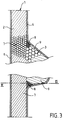
- FIG. 3 shows the distribution of zones 3, located at 7, 8, 9 whose density is different, and in particular, a core 2 having variations in densities d1, d2, d3 different, in the 'thickness of the core, that is to say according to a section of the product III-III going from one skin 6 outside towards the other, in the respective respective zones 7-9.
- a first density d1 is provided, throughout the product, to impart a certain rigidity to the latter.
- a second density d2, less than d1 is provided in zone 9, in particular facing the driver and / or the passenger in the case of vehicle application.
- the core 2 from material consisting of a mixture of polyolefins or any other plastic material such as for example polypropylene which has characteristics and properties. adapted.
- reinforcing elements 4 such as for example fibers, are included in the core 2.
- At least partially at least one of the faces 5 of the core 2 is covered with a layer of an elastomeric thermoplastic material, such as for example santoprene, neoprene, polyvinyl chloride, polyurethane, polyolefins or any other thermoplastic material which can be injected, in order to constitute a skin 6.
- an elastomeric thermoplastic material such as for example santoprene, neoprene, polyvinyl chloride, polyurethane, polyolefins or any other thermoplastic material which can be injected, in order to constitute a skin 6.
- This skin 6 can also be constituted by other elements such as a sheet of a textile material, cardboard, paper which is available by gluing by thermo-sheathing in a single operation on the core 2 of the laminated product 1 in order to give it an aesthetic and pleasant appearance required for such applications.
- this laminated structure comprises for example decorative elements in order to constitute in particular distinctive patterns or signs.
- the present invention will find a particular application in the manufacture of interior trim elements for vehicle bodywork since in this field, we find the constraints described above.
Landscapes
- Engineering & Computer Science (AREA)
- Mechanical Engineering (AREA)
- Life Sciences & Earth Sciences (AREA)
- Wood Science & Technology (AREA)
- Vehicle Interior And Exterior Ornaments, Soundproofing, And Insulation (AREA)
- Glass Compositions (AREA)
- Chemical Vapour Deposition (AREA)
- Laminated Bodies (AREA)
Abstract
Description
- L'invention est relative à un produit stratifié, destiné notamment à réaliser des éléments d'habillage intérieur de carrosserie, tels que des panneaux de portières et/ou des tableaux de bord, constitué par une âme recouverte par une peau.
- Il faut noter que, bien que cette invention ait été conçue pour réaliser des pièces dans le domaine de l'automobile, elle pourra néanmoins s'appliquer dans tous les domaines ou secteurs de l'activité dans lesquels on doit utiliser des produits stratifiés constitués par une âme recouverte par une peau.
- Actuellement, ces éléments d'habillage intérieur de carrosserie sont en général réalisés en deux composants principaux, et notamment par une feuille de matière thermoplastique ou textile habituellement, appelée "peau", constituant la face externe d'habillage de l'élément intérieur de la carosserie de véhicule, et un insert en matière variée rigide supportant mécaniquement l'ensemble.
- Il est utilisé aujourd'hui de nombreux processus de fabrication pour combiner ces deux éléments tels que par exemple le collage ou le thermoformage... Parfois, un espace limité par l'insert et la peau est rempli de mousse ou de résine thermodurcissable, telle que par exemple de la mousse de polyuréthane, pour réaliser une surface d'aspect agréable au toucher.
- De telles techniques ne permettent pas d'obtenir des éléments d'habillage qui en pratique présentent des caractéristiques d'esthétique et d'absorption des contraintes mécaniques externes, telles que les chocs, selon un gradient d'absorption recherchés.
- Pour remédier à ces inconvénients, on a pensé d'utiliser, à l'intérieur des pare-chocs, des blocs de polypropylène expansé pour constituer un noyau d'absorption de chocs.
- Dans ce cas, ce noyau est intégré à l'intérieur du pare-choc qui constitue une coquille de protection extérieure de la matière expansée.
- Il est également connu de réaliser des panneaux de portes moulés en mousse de polystyrène armée de fibres de verre et imprégné de polyuréthane. Pour ce faire, on réalise un sandwich à partir de mats de fibres de verre, recouverts d'une feuille de plastique, un textile tissé ou non-tissé, une feuille de papier, un carton ou analogue, entre lesquels on place une couche de billes de polystyrène pré-expansé.
- Toutefois, en pratique, ces techniques ne permettent pas d'obtenir un produit stratifié dont l'âme présente des caractéristiques de rigidité localisées et d'absorption des chocs assurant un gradient d'absorption.
- Il faut également noter que de telles techniques ne permettant pas non plus de remédier aux inconvénients inhérents à la fabrication en série d'éléments d'habillage d'intérieur de carrosserie, qui doivent présenter une peau conférant aux produits un aspect esthétique et agréable, tout en coopérant avec l'âme afin de ne pas nuire à la rigidité d'ensemble du produit.
- Le but de la présente invention est de proposer un produit stratifié, destiné notamment à réaliser des éléments d'habillage intérieur de carrosserie de véhicule, tels que des panneaux de portières et/ou des tableaux de bord, qui remédie aux inconvénients des produits actuellement connus, en présentant des propriétés satisfaisantes de rigidité et/ou d'absorption des contraintes mécaniques externes, telles que les chocs.
- Un autre but de la présente invention est de proposer un produit stratifié, destiné notamment à réaliser des éléments d'habillage pour la confection de portières et/ou de tableaux de bord, qui permette d'accroître la sécurité des personnes présentes dans le véhicule.
- Un autre but de la présente invntion est de proposer un produit stratifié, destiné notamment à réaliser des éléments d'habillage d'intérieur de carrosserie, qui permette de fabriquer des produits stratifiés, pouvant être recyclés, ce qui accroît les capacités d'utilisation.
- Un autre but de la présente invention est de proposer un produit stratifié, destiné notamment à réaliser des éléments d'habillage d'intérieur de carrosserie, qui offre des qualités d'esthétique et de confort accrues pour les utilisateurs.
- D'autres buts et avantages de la présente invention apparaîtront au cours de la description qui va suivre qui n'est donnée qu'à titre indicatif et qui n'a pas pour but de la limiter.
- Selon l'invention, le produit stratifié, destiné à réaliser des éléments d'habillage d'intérieur de carrosserie, tels qu'un panneau de portière ou un tableau de bord, constitué par une âme recouverte au moins partiellement par au moins une peau est caractérisé en ce que l'âme est réalisée à partir d'au moins un matériau mono-composant absorbant expansé permettant des caractéristiques de rigidité et d'absorption des chocs et en ce que l'âme présente des variations de densité dans l'épaisseur de l'âme, localisées, en vue de conférer un gradient d'absorption des contraintes mécaniques audit produit.
- Comme nous l'avons également évoqué ci-dessus, la présente invention trouve une application particulière, mais non exclusive, à la fabrication de panneaux de portières et/ou de tableaux de bord et/ou de tous autres éléments d'habillage intérieur d'une carrosserie de véhicule.
- La présente invention sera mieux comprise à la lecture de la description suivante accompagnée des dessins en annexe parmi lesquels :
- la figure 1 est une vue schématique partielle en coupe d'un produit stratifié conforme à l'invention,
- la figure 2 est une vue schématique partielle en coupe d'un produit stratifié, conforme à l'invention, dans lequel l'âme présente des éléments de renforcement,
- la figure 3 est une vue schématique partielle en coupe d'un produit stratifié, conforme à la présente invention, illustrant plus particulièrement la répartition du matériau expansé.
- La présente invention vise un produit stratifié, destiné à réaliser des éléments d'habillage intérieur d'une carrosserie de véhicule, tels que par exemple des panneaux de portières et/ou des tableaux de bord.
- Bien que plus particulièrement développée dans le cadre de l'industrie automobile, la présente invention s'appliquera à tout type d'objet, qui présente une âme recouverte au moins partiellement par une peau et qui, en fonction de leur application, doive présenter des propriétés suffisantes de rigidité et d'absorption de contraintes mécaniques externes telles que des chocs.
- En se référant aux figures 1 et 2, on voit un produit stratifié 1 conforme à l'invention réalisé à partir d'un procédé de fabrication qui met en oeuvre des techniques classiques de plasturgie.
- Pour cela, on réalise une âme 2 à partir d'au moins un matériau mono-composant absorbant expansé présentant des caractéristiques de rigidité et d'absorption des contraintes mécaniques externes, telles que notamment des chocs.
- Par matériau mono-composant, on comprend une âme formée par une même matière mais dont la densité n'est pas nécessairement constante, non seulement dans sa localisation mais dans l'épaisseur de l'âme.
- Cette âme 2 est réalisée de préférence en un matériau allégé, tel que par exemple à patir d'un mélange de polystyrène-polyoxyphénylène dans des proportions adaptées en fonction de l'application et du résultat recherchés.
- A titre d'exemple, on pourra utiliser un mélange de polystyrène et de polyoxyphénylène d'un type connu sous la dénomination commerciale "Caril" de la Société "Shell" qui présente une densité comprise entre 20 à 300 g/l. Bien entendu, en fonction de cette densité, on obtiendra une rigidité et des propriétés d'absorption des contraintes mécaniques externes du produit stratifié 1 variable.
- C'est ainsi que lorsque l'on désire fabriquer un produit stratifié 1 qui présente des propriétés d'élasticité supérieures et adaptées pour certaines des applications, on utilisera de préférence un mélange de polystyrène et de polyoxyphénylène d'une densité plus faible et, dans le cas contraire, lorsque l'on désire obtenir un produit stratifié 1 qui présente des caractéristiques de rigidité plus élevées, on utilisera une densité plus élevée.
- Selon l'invention, le produit stratifié 1 comporte une âme 2 qui présente des variations de densité localisées en vue de conférer un gradient d'absorption des contraintes mécaniques externes et notamment des chocs.
- C'est ainsi, comme le montre la figure 1 notamment, que l'on peut réaliser un produit stratifié 1 qui présente des zones 3 localisées dans lesquelles l'on a modifié la densité du matériau constitutif de l'âme 2, afin de conférer, dans cesdites zones, au produit stratifié 1 des propriétés de rigidité et de résistance aux contraintes mécaniques externes accrues.
- On peut également prévoir, dans une variante, des zones 3 qui présentent une surépaisseur du matériau constitutif de l'âme avec ou sans modification de sa densité.
- A titre d'exemple, la figure 3 montre la répartition de zones 3, localisées en 7, 8, 9 dont la densité est différente, et en particulier, une âme 2 présentant des variations de densités d₁, d₂, d₃ différentes, dans l'épaisseur de l'âme, c'est-à-dire selon une coupe du produit III-III allant d'une peau 6 extérieure vers l'autre, dans les différentes zones respectives 7-9.
- Par exemple, dans la zone 7, on prévoit une première densité d₁, tout au long du produit, pour conférer une certaine rigidité à ce dernier. En superposition, pour favoriser l'absorption des chocs, on prévoit une seconde densité d₂, inférieure à d₁, dans la zone 9, notamment en regard du conducteur ou/et du passager dans le cas d'application véhicule.
- Enfin, accessoirement, pour accroître la résistance et la liaison entre les zones 7 et 9, on peut prévoir une zone 8 de "raccordement" de densité d₃, supérieure à d₁ et à d₂.
- Sur la figure 3, on a schématisé partiellement par une variation du diamètre des billes du matériau mono-composant expansé, la variation de densité d₁, d₂, d₃ puis sur l'ensemble de la figure par une variation de hachures. Cette variation peut être obtenue par dépôts successifs de la matière, dans des densités différentes, dudit matériau mono-composant.
- En outre, cela permet d'accroître la sécurité des personnes qui se trouvent dans le véhicule, notamment en cas de chocs violents, puisque ces zones 3 vont constituer des amortisseurs aux contraintes générées par ces chocs externes.
- Il faut également noter que l'on pourrait, dans des variantes de réalisation, réaliser l'âme 2 à partir de matériau constitué par un mélange de polyoléfines ou de tout autre matériau plastique tel que par exemple du polypropylène qui présente des caractéristiques et des propriétés adaptées.
- Afin d'accroître la rigidité et la résistance de ce produit stratifié 1, dans une forme de réalisation, telle qu'illustrée à la figure 2, on inclut dans l'âme 2 des éléments de renforcement 4, tels que par exemple des fibres de verre, des éléments grillagés métalliques ou plastiques, ou de la mousse de polyuréthane ou des inclusions diverses.
- L'on recouvre ensuite au moins partiellement au moins l'une des faces 5 de l'âme 2 par une couche d'un matériau thermoplastique élastomère, tel que par exemple du santoprène, du néoprène, du polychlorure de vinyle, du polyuréthane, des polyoléfines ou tous autres matériaux thermoplastiques pouvant être injectés, afin de constituer une peau 6.
- Cette peau 6 peut être également constituée par d'autres éléments tels qu'une feuille d'un matériau textile, carton, papier que l'on dispose par collage par thermo-gainage en une seule opération sur l'âme 2 du produit stratifié 1 afin de conférer à celui-ci un aspect esthétique et agréable requis pour de telles applications.
- Dans ces conditions, il est également envisageable, pour augmenter l'aspect esthétique du produit, selon la présente invention, que cette structure stratifiée comporte par exemple des éléments décoratifs en vue de constituer notamment des motifs ou des signes distinctifs.
- On peut également prévoir, en fonction des besoins l'inclusion par des techniques de surmoulage, de pièces rapportées diverses.
- Bien entendu, il est également envisageable d'utiliser, en fonction des besoins, des matériaux appropriés qui présentent des caractéristiques mécaniques de résistance et de souplesse déterminées ainsi que des compatibilités autorisant la fabrication d'un produit stratifié 1 présentant les propriétés recherchées.
- C'est ainsi, que la présente invention trouvera une application particulière dans la fabrication d'éléments d'habillage intérieur de carrosserie de véhicule puisque dans ce domaine, on retrouve les contraintes décrites ci-dessus.
- Naturellement, d'autres mises en oeuvre de la présente invention à la portée de l'homme de l'art auraient pu être envisagées sans pour autant sortir du cadre de la présente demande.
Claims (8)
- Produit stratifié (1), destiné notament à réaliser des éléments d'habillage d'intérieur de carrosserie d'un véhicule tels qu'un panneau de portière ou d'un tableau de bord, constitué par une âme (2) recouverte au moins partiellement par au moins une peau (6), caractérisé en ce que l'âme (2) est réalisée à partir d'au moins un matériau absorbant mono-composant expansé permettant des caractéristiques de rigidité et d'absorption des chocs, et en ce que l'âme (2) présente des variations de densité dans l'épaisseur de l'âme, localisées, en vue de conférer un gradient d'absorption des contraintes mécaniques audit produit.
- Produit stratifié selon la revendication 1, caractérisé en ce que l'âme (2) est constituée par un mélange de polystyrène-polyoxyphénylène dans des proportions adaptées.
- Produit stratifié selon la revendication 1, caractérisé en ce que l'âme (2) est constituée par un mélange de polyoléfines.
- Produit stratifié selon la revendication 1, caractérisé en ce que l'âme (2) est constituée par du polypropylène expansé.
- Produit stratifié selon la revendication 1, caractérisé en ce que la peau (6) est réalisée dans un matériau thermoplastique.
- Produit stratifié selon la revendication 1, caractérisé en ce que l'âme (2) comporte des éléments de renforcement (4).
- Produit stratifié selon la revendication 1, caractérisé en ce que l'âme (2) comporte des inclusions.
- Application du produit stratifié selon l'une quelconque des revendications 2 à 7 à la confection d'éléments d'habillage intérieur d'une carrosserie d'un véhicule tels que notamment des tableaux de bord et/ou des panneaux de portière.
Applications Claiming Priority (2)
| Application Number | Priority Date | Filing Date | Title |
|---|---|---|---|
| FR9305474A FR2704804B1 (fr) | 1993-05-03 | 1993-05-03 | Produit stratifié destiné notamment à réaliser des éléments d'habillage intérieur de carrosserie. |
| FR9305474 | 1993-05-03 |
Publications (2)
| Publication Number | Publication Date |
|---|---|
| EP0623491A1 true EP0623491A1 (fr) | 1994-11-09 |
| EP0623491B1 EP0623491B1 (fr) | 1999-11-03 |
Family
ID=9446872
Family Applications (1)
| Application Number | Title | Priority Date | Filing Date |
|---|---|---|---|
| EP94490023A Expired - Lifetime EP0623491B1 (fr) | 1993-05-03 | 1994-05-03 | Produit stratifié destiné notamment à réaliser des éléments d'habillage intérieur de carroserie |
Country Status (5)
| Country | Link |
|---|---|
| EP (1) | EP0623491B1 (fr) |
| AT (1) | ATE186257T1 (fr) |
| DE (2) | DE69421443T2 (fr) |
| ES (1) | ES2065310T1 (fr) |
| FR (1) | FR2704804B1 (fr) |
Cited By (9)
| Publication number | Priority date | Publication date | Assignee | Title |
|---|---|---|---|---|
| EP0710578A3 (fr) * | 1994-11-03 | 1996-05-15 | Kunststoffwerk Katzbach GmbH | Elément d'habillage, en particulier panneau d'habillage pour une porte, pour un véhicule automobile |
| EP0781647A1 (fr) * | 1995-12-27 | 1997-07-02 | Kaneka Corporation | Feuille stratifiée en mousse et article moulé pour la garniture intérieure d'automobile |
| US6428652B1 (en) | 1999-02-26 | 2002-08-06 | Wacker Polymer Systems Gmbh & Co. Kg | Process for laminating textile sheet materials onto moldable foam or onto foamed moldings |
| WO2004069514A3 (fr) * | 2003-02-04 | 2004-10-07 | Johnson Contr Interiors Gmbh | Produit alveolaire, notamment element d'equipement pour l'habitacle d'un vehicule, et procede de fabrication associe |
| WO2008074563A3 (fr) * | 2006-12-16 | 2008-11-20 | Benecke Kaliko Ag | Film thermoplastique présentant une feuille de recouvrement expansée |
| WO2009047487A1 (fr) * | 2007-10-08 | 2009-04-16 | Gurit (Uk) Ltd. | Article stratifié composite et sa fabrication |
| WO2009047483A1 (fr) * | 2007-10-08 | 2009-04-16 | Gurit (Uk) Ltd. | Article stratifié composite et sa fabrication |
| FR3035840A1 (fr) * | 2015-05-06 | 2016-11-11 | Peugeot Citroen Automobiles Sa | Panneau de protection avec billes rigides pour carrosserie de vehicule automobile |
| FR3036075A1 (fr) * | 2015-05-11 | 2016-11-18 | Peugeot Citroen Automobiles Sa | Panneau de protection pour carrosserie de vehicule automobile avec billes deformables |
Citations (7)
| Publication number | Priority date | Publication date | Assignee | Title |
|---|---|---|---|---|
| GB1168067A (en) * | 1967-08-17 | 1969-10-22 | Ford Motor Co | Vehicle Interior Body Crash Pad |
| DE2434175A1 (de) * | 1973-07-16 | 1975-02-06 | Toyo Tire & Rubber Co | Verbundmaterial, insbesondere fuer innenteile von automobilen |
| WO1980001892A1 (fr) * | 1979-03-05 | 1980-09-18 | Int Harvester Co | Structure laminee a fine pellicule externe renforcee par des mousses polymeres |
| DE3220856A1 (de) * | 1981-06-04 | 1982-12-23 | Basf Ag, 6700 Ludwigshafen | Verfahren zur herstellung von schaumstoffen |
| DE3712926A1 (de) * | 1987-04-16 | 1988-11-03 | Audi Ag | Verbund, insbesondere schalttafel fuer kraftfahrzeuge, sowie verfahren zu seiner herstellung |
| US4808469A (en) * | 1985-05-09 | 1989-02-28 | Maurice Hiles | Energy absorbing polyurethane composite article |
| DE4008173A1 (de) * | 1990-03-15 | 1991-09-19 | Philippine Tech Kunststoff | Verkleidungselement und verfahren zu seiner herstellung |
-
1993
- 1993-05-03 FR FR9305474A patent/FR2704804B1/fr not_active Expired - Fee Related
-
1994
- 1994-05-03 DE DE69421443T patent/DE69421443T2/de not_active Expired - Fee Related
- 1994-05-03 ES ES94490023T patent/ES2065310T1/es active Pending
- 1994-05-03 EP EP94490023A patent/EP0623491B1/fr not_active Expired - Lifetime
- 1994-05-03 DE DE0623491T patent/DE623491T1/de active Pending
- 1994-05-03 AT AT94490023T patent/ATE186257T1/de not_active IP Right Cessation
Patent Citations (7)
| Publication number | Priority date | Publication date | Assignee | Title |
|---|---|---|---|---|
| GB1168067A (en) * | 1967-08-17 | 1969-10-22 | Ford Motor Co | Vehicle Interior Body Crash Pad |
| DE2434175A1 (de) * | 1973-07-16 | 1975-02-06 | Toyo Tire & Rubber Co | Verbundmaterial, insbesondere fuer innenteile von automobilen |
| WO1980001892A1 (fr) * | 1979-03-05 | 1980-09-18 | Int Harvester Co | Structure laminee a fine pellicule externe renforcee par des mousses polymeres |
| DE3220856A1 (de) * | 1981-06-04 | 1982-12-23 | Basf Ag, 6700 Ludwigshafen | Verfahren zur herstellung von schaumstoffen |
| US4808469A (en) * | 1985-05-09 | 1989-02-28 | Maurice Hiles | Energy absorbing polyurethane composite article |
| DE3712926A1 (de) * | 1987-04-16 | 1988-11-03 | Audi Ag | Verbund, insbesondere schalttafel fuer kraftfahrzeuge, sowie verfahren zu seiner herstellung |
| DE4008173A1 (de) * | 1990-03-15 | 1991-09-19 | Philippine Tech Kunststoff | Verkleidungselement und verfahren zu seiner herstellung |
Cited By (14)
| Publication number | Priority date | Publication date | Assignee | Title |
|---|---|---|---|---|
| EP0710578A3 (fr) * | 1994-11-03 | 1996-05-15 | Kunststoffwerk Katzbach GmbH | Elément d'habillage, en particulier panneau d'habillage pour une porte, pour un véhicule automobile |
| EP0781647A1 (fr) * | 1995-12-27 | 1997-07-02 | Kaneka Corporation | Feuille stratifiée en mousse et article moulé pour la garniture intérieure d'automobile |
| US6428652B1 (en) | 1999-02-26 | 2002-08-06 | Wacker Polymer Systems Gmbh & Co. Kg | Process for laminating textile sheet materials onto moldable foam or onto foamed moldings |
| US6841025B2 (en) | 1999-02-26 | 2005-01-11 | Wacker Polymer Systems Gmbh & Co. Kg | Process for laminating textile sheet materials onto moldable particle foam or onto foamed moldings |
| WO2004069514A3 (fr) * | 2003-02-04 | 2004-10-07 | Johnson Contr Interiors Gmbh | Produit alveolaire, notamment element d'equipement pour l'habitacle d'un vehicule, et procede de fabrication associe |
| US8613994B2 (en) | 2006-12-16 | 2013-12-24 | Benecke-Kaliko Ag | Thermoplastic foil arrangement having a foamed cover layer |
| WO2008074563A3 (fr) * | 2006-12-16 | 2008-11-20 | Benecke Kaliko Ag | Film thermoplastique présentant une feuille de recouvrement expansée |
| WO2009047487A1 (fr) * | 2007-10-08 | 2009-04-16 | Gurit (Uk) Ltd. | Article stratifié composite et sa fabrication |
| CN101842230A (zh) * | 2007-10-08 | 2010-09-22 | 古瑞特(英国)有限公司 | 复合材料层压制品和其制造 |
| US8465832B2 (en) | 2007-10-08 | 2013-06-18 | Gurit (Uk) Ltd. | Composite laminated article and manufacture thereof |
| WO2009047483A1 (fr) * | 2007-10-08 | 2009-04-16 | Gurit (Uk) Ltd. | Article stratifié composite et sa fabrication |
| EP3192651A1 (fr) * | 2007-10-08 | 2017-07-19 | Gurit (UK) Ltd | Article stratifié composite et sa fabrication |
| FR3035840A1 (fr) * | 2015-05-06 | 2016-11-11 | Peugeot Citroen Automobiles Sa | Panneau de protection avec billes rigides pour carrosserie de vehicule automobile |
| FR3036075A1 (fr) * | 2015-05-11 | 2016-11-18 | Peugeot Citroen Automobiles Sa | Panneau de protection pour carrosserie de vehicule automobile avec billes deformables |
Also Published As
| Publication number | Publication date |
|---|---|
| DE623491T1 (de) | 1995-07-13 |
| DE69421443D1 (de) | 1999-12-09 |
| ES2065310T1 (es) | 1995-02-16 |
| FR2704804A1 (fr) | 1994-11-10 |
| DE69421443T2 (de) | 2000-06-15 |
| FR2704804B1 (fr) | 1995-08-18 |
| ATE186257T1 (de) | 1999-11-15 |
| EP0623491B1 (fr) | 1999-11-03 |
Similar Documents
| Publication | Publication Date | Title |
|---|---|---|
| JP6563440B2 (ja) | 成型防音構成部品およびその製造方法 | |
| US5900300A (en) | High modulus and stiffness polymer foam/GMT composites | |
| JP2005512143A (ja) | 多密度音響減衰積層体およびその製造方法 | |
| US6713150B2 (en) | Acoustically effective rear parcel shelf | |
| EP2674274B1 (fr) | Elément de garnissage et procédé de fabrication associé | |
| EP0623491B1 (fr) | Produit stratifié destiné notamment à réaliser des éléments d'habillage intérieur de carroserie | |
| JP2010076756A (ja) | 自動車用の薄膜を有する防音アセンブリ、および関連する自動車 | |
| FR3036647A1 (fr) | Materiau composite destine a la fabrication d'un element de renforcement pour la construction legere, procede de fabrication ainsi qu'element obtenu | |
| US10569500B2 (en) | Method for producing an automotive equipment part and associated part | |
| EP0589116B1 (fr) | Procédé de fabrication d'un objet multicouche par moulage, objet obtenu et application à la fabrication de tableaux de bord et/ou d'éléments d'habillage d'une carrosserie de véhicule | |
| US4983442A (en) | Composite article and method of making same | |
| EP2674270B1 (fr) | Elément de garnissage présentant une face d'aspect formée en partie par un matériau ligneux | |
| JP5313914B2 (ja) | 発泡カバーシートを備える熱可塑性フィルム | |
| FR3028817A1 (fr) | Piece automobile d'ecrantage acoustique et son procede de fabrication | |
| EP3043347A1 (fr) | Panneau d'habillage insonorisant, et aéronef | |
| EP1654140B1 (fr) | Panneau de vehicule a couche de renfort | |
| JP7684836B2 (ja) | 吸音材、その吸音材を備えた乗物用外装品、及び吸音材の製造方法 | |
| EP0687831B1 (fr) | Absorbeur d'énergie perfectionné pour véhicule automobile terrestre | |
| DE102020110433B3 (de) | Vollumschließende Motor- oder Aggregate-Kapsel eines Kraftfahrzeugs mit einer Luftpolsterfolie | |
| EP1365055B1 (fr) | Renfort fibreux à fonction de barrière pour la réalisation de pièces composites et pièces composites en faisant application | |
| JP4798948B2 (ja) | 自動車内装材 | |
| FR2804363A1 (fr) | Piece structurelle en matiere plastique, munie d'un corps de base en une mousse rigide | |
| JP2007112374A (ja) | 車両用内装材 | |
| EP3429835B1 (fr) | Procédé de réalisation d'un panneau de garnissage intérieur de véhicule automobile | |
| EP1461195A2 (fr) | Complexe fibreux a face decoree pour la realisation de pieces composites et pieces composites en faisant application |
Legal Events
| Date | Code | Title | Description |
|---|---|---|---|
| PUAI | Public reference made under article 153(3) epc to a published international application that has entered the european phase |
Free format text: ORIGINAL CODE: 0009012 |
|
| AK | Designated contracting states |
Kind code of ref document: A1 Designated state(s): AT BE DE ES FR GB IT LU NL SE |
|
| 17P | Request for examination filed |
Effective date: 19940922 |
|
| ITCL | It: translation for ep claims filed |
Representative=s name: BUGNION S.P.A. |
|
| GBC | Gb: translation of claims filed (gb section 78(7)/1977) | ||
| REG | Reference to a national code |
Ref country code: ES Ref legal event code: BA2A Ref document number: 2065310 Country of ref document: ES Kind code of ref document: T1 |
|
| DET | De: translation of patent claims | ||
| 17Q | First examination report despatched |
Effective date: 19961210 |
|
| GRAG | Despatch of communication of intention to grant |
Free format text: ORIGINAL CODE: EPIDOS AGRA |
|
| GRAG | Despatch of communication of intention to grant |
Free format text: ORIGINAL CODE: EPIDOS AGRA |
|
| GRAH | Despatch of communication of intention to grant a patent |
Free format text: ORIGINAL CODE: EPIDOS IGRA |
|
| RAP1 | Party data changed (applicant data changed or rights of an application transferred) |
Owner name: PLASTIC OMNIUM AUTO INTERIEUR |
|
| GRAH | Despatch of communication of intention to grant a patent |
Free format text: ORIGINAL CODE: EPIDOS IGRA |
|
| GRAA | (expected) grant |
Free format text: ORIGINAL CODE: 0009210 |
|
| AK | Designated contracting states |
Kind code of ref document: B1 Designated state(s): AT BE DE ES FR GB IT LU NL SE |
|
| PG25 | Lapsed in a contracting state [announced via postgrant information from national office to epo] |
Ref country code: SE Free format text: THE PATENT HAS BEEN ANNULLED BY A DECISION OF A NATIONAL AUTHORITY Effective date: 19991103 Ref country code: NL Free format text: LAPSE BECAUSE OF FAILURE TO SUBMIT A TRANSLATION OF THE DESCRIPTION OR TO PAY THE FEE WITHIN THE PRESCRIBED TIME-LIMIT Effective date: 19991103 Ref country code: IT Free format text: LAPSE BECAUSE OF FAILURE TO SUBMIT A TRANSLATION OF THE DESCRIPTION OR TO PAY THE FEE WITHIN THE PRESCRIBED TIME-LIMIT;WARNING: LAPSES OF ITALIAN PATENTS WITH EFFECTIVE DATE BEFORE 2007 MAY HAVE OCCURRED AT ANY TIME BEFORE 2007. THE CORRECT EFFECTIVE DATE MAY BE DIFFERENT FROM THE ONE RECORDED. Effective date: 19991103 Ref country code: GB Free format text: LAPSE BECAUSE OF FAILURE TO SUBMIT A TRANSLATION OF THE DESCRIPTION OR TO PAY THE FEE WITHIN THE PRESCRIBED TIME-LIMIT Effective date: 19991103 Ref country code: AT Free format text: LAPSE BECAUSE OF FAILURE TO SUBMIT A TRANSLATION OF THE DESCRIPTION OR TO PAY THE FEE WITHIN THE PRESCRIBED TIME-LIMIT Effective date: 19991103 |
|
| REF | Corresponds to: |
Ref document number: 186257 Country of ref document: AT Date of ref document: 19991115 Kind code of ref document: T |
|
| REF | Corresponds to: |
Ref document number: 69421443 Country of ref document: DE Date of ref document: 19991209 |
|
| NLV1 | Nl: lapsed or annulled due to failure to fulfill the requirements of art. 29p and 29m of the patents act | ||
| GBV | Gb: ep patent (uk) treated as always having been void in accordance with gb section 77(7)/1977 [no translation filed] |
Effective date: 19991103 |
|
| PG25 | Lapsed in a contracting state [announced via postgrant information from national office to epo] |
Ref country code: LU Free format text: LAPSE BECAUSE OF NON-PAYMENT OF DUE FEES Effective date: 20000503 |
|
| PG25 | Lapsed in a contracting state [announced via postgrant information from national office to epo] |
Ref country code: ES Free format text: LAPSE BECAUSE OF FAILURE TO SUBMIT A TRANSLATION OF THE DESCRIPTION OR TO PAY THE FEE WITHIN THE PRESCRIBED TIME-LIMIT Effective date: 20000518 |
|
| PG25 | Lapsed in a contracting state [announced via postgrant information from national office to epo] |
Ref country code: BE Free format text: LAPSE BECAUSE OF NON-PAYMENT OF DUE FEES Effective date: 20000531 |
|
| PLBE | No opposition filed within time limit |
Free format text: ORIGINAL CODE: 0009261 |
|
| STAA | Information on the status of an ep patent application or granted ep patent |
Free format text: STATUS: NO OPPOSITION FILED WITHIN TIME LIMIT |
|
| 26N | No opposition filed | ||
| BERE | Be: lapsed |
Owner name: PLASTIC OMNIUM AUTO INTERIEUR Effective date: 20000531 |
|
| PGFP | Annual fee paid to national office [announced via postgrant information from national office to epo] |
Ref country code: FR Payment date: 20030512 Year of fee payment: 10 |
|
| PGFP | Annual fee paid to national office [announced via postgrant information from national office to epo] |
Ref country code: DE Payment date: 20030514 Year of fee payment: 10 |
|
| PG25 | Lapsed in a contracting state [announced via postgrant information from national office to epo] |
Ref country code: DE Free format text: LAPSE BECAUSE OF NON-PAYMENT OF DUE FEES Effective date: 20041201 |
|
| PG25 | Lapsed in a contracting state [announced via postgrant information from national office to epo] |
Ref country code: FR Free format text: LAPSE BECAUSE OF NON-PAYMENT OF DUE FEES Effective date: 20050131 |
|
| REG | Reference to a national code |
Ref country code: FR Ref legal event code: ST |