EP0623626B1 - Déprotection automatisée des groupes allyle appliqués à la synthèse en phase solide - Google Patents
Déprotection automatisée des groupes allyle appliqués à la synthèse en phase solide Download PDFInfo
- Publication number
- EP0623626B1 EP0623626B1 EP94104977A EP94104977A EP0623626B1 EP 0623626 B1 EP0623626 B1 EP 0623626B1 EP 94104977 A EP94104977 A EP 94104977A EP 94104977 A EP94104977 A EP 94104977A EP 0623626 B1 EP0623626 B1 EP 0623626B1
- Authority
- EP
- European Patent Office
- Prior art keywords
- allyl
- amino acid
- acid
- catalyst
- protected
- Prior art date
- Legal status (The legal status is an assumption and is not a legal conclusion. Google has not performed a legal analysis and makes no representation as to the accuracy of the status listed.)
- Expired - Lifetime
Links
- 125000003903 2-propenyl group Chemical group [H]C([*])([H])C([H])=C([H])[H] 0.000 title claims description 127
- 238000010511 deprotection reaction Methods 0.000 title description 94
- 238000010532 solid phase synthesis reaction Methods 0.000 title description 9
- 108090000765 processed proteins & peptides Proteins 0.000 claims description 168
- SJRJJKPEHAURKC-UHFFFAOYSA-N N-Methylmorpholine Chemical compound CN1CCOCC1 SJRJJKPEHAURKC-UHFFFAOYSA-N 0.000 claims description 99
- 239000003054 catalyst Substances 0.000 claims description 83
- QTBSBXVTEAMEQO-UHFFFAOYSA-N Acetic acid Chemical compound CC(O)=O QTBSBXVTEAMEQO-UHFFFAOYSA-N 0.000 claims description 80
- 238000000034 method Methods 0.000 claims description 74
- 229940024606 amino acid Drugs 0.000 claims description 60
- -1 tert-amyloxycarbonyl Chemical group 0.000 claims description 60
- HEDRZPFGACZZDS-UHFFFAOYSA-N Chloroform Chemical group ClC(Cl)Cl HEDRZPFGACZZDS-UHFFFAOYSA-N 0.000 claims description 56
- 150000001413 amino acids Chemical class 0.000 claims description 55
- 235000001014 amino acid Nutrition 0.000 claims description 54
- 239000002904 solvent Substances 0.000 claims description 49
- YNAVUWVOSKDBBP-UHFFFAOYSA-N Morpholine Chemical compound C1COCCN1 YNAVUWVOSKDBBP-UHFFFAOYSA-N 0.000 claims description 36
- 125000000524 functional group Chemical group 0.000 claims description 34
- NFHFRUOZVGFOOS-UHFFFAOYSA-N palladium;triphenylphosphane Chemical group [Pd].C1=CC=CC=C1P(C=1C=CC=CC=1)C1=CC=CC=C1.C1=CC=CC=C1P(C=1C=CC=CC=1)C1=CC=CC=C1.C1=CC=CC=C1P(C=1C=CC=CC=1)C1=CC=CC=C1.C1=CC=CC=C1P(C=1C=CC=CC=1)C1=CC=CC=C1 NFHFRUOZVGFOOS-UHFFFAOYSA-N 0.000 claims description 33
- 150000003862 amino acid derivatives Chemical class 0.000 claims description 32
- 125000006239 protecting group Chemical group 0.000 claims description 31
- 239000007787 solid Substances 0.000 claims description 26
- YMWUJEATGCHHMB-UHFFFAOYSA-N Dichloromethane Chemical compound ClCCl YMWUJEATGCHHMB-UHFFFAOYSA-N 0.000 claims description 24
- 239000000203 mixture Substances 0.000 claims description 21
- 150000007524 organic acids Chemical class 0.000 claims description 18
- UHOVQNZJYSORNB-UHFFFAOYSA-N Benzene Chemical compound C1=CC=CC=C1 UHOVQNZJYSORNB-UHFFFAOYSA-N 0.000 claims description 15
- 125000000539 amino acid group Chemical group 0.000 claims description 15
- 239000004793 Polystyrene Substances 0.000 claims description 13
- 125000000999 tert-butyl group Chemical group [H]C([H])([H])C(*)(C([H])([H])[H])C([H])([H])[H] 0.000 claims description 13
- KDXKERNSBIXSRK-YFKPBYRVSA-N L-lysine Chemical compound NCCCC[C@H](N)C(O)=O KDXKERNSBIXSRK-YFKPBYRVSA-N 0.000 claims description 12
- KDXKERNSBIXSRK-UHFFFAOYSA-N Lysine Natural products NCCCCC(N)C(O)=O KDXKERNSBIXSRK-UHFFFAOYSA-N 0.000 claims description 12
- 150000001875 compounds Chemical class 0.000 claims description 12
- 229920002223 polystyrene Polymers 0.000 claims description 12
- AFBPFSWMIHJQDM-UHFFFAOYSA-N N-methylaniline Chemical compound CNC1=CC=CC=C1 AFBPFSWMIHJQDM-UHFFFAOYSA-N 0.000 claims description 10
- 239000002253 acid Substances 0.000 claims description 10
- XBDQKXXYIPTUBI-UHFFFAOYSA-N dimethylselenoniopropionate Natural products CCC(O)=O XBDQKXXYIPTUBI-UHFFFAOYSA-N 0.000 claims description 10
- BDAGIHXWWSANSR-UHFFFAOYSA-N methanoic acid Natural products OC=O BDAGIHXWWSANSR-UHFFFAOYSA-N 0.000 claims description 10
- CKLJMWTZIZZHCS-REOHCLBHSA-N L-aspartic acid Chemical compound OC(=O)[C@@H](N)CC(O)=O CKLJMWTZIZZHCS-REOHCLBHSA-N 0.000 claims description 9
- 239000004472 Lysine Substances 0.000 claims description 9
- 239000004698 Polyethylene Substances 0.000 claims description 9
- 239000011261 inert gas Substances 0.000 claims description 9
- 235000018977 lysine Nutrition 0.000 claims description 9
- 229920000573 polyethylene Polymers 0.000 claims description 9
- WHUUTDBJXJRKMK-UHFFFAOYSA-N Glutamic acid Natural products OC(=O)C(N)CCC(O)=O WHUUTDBJXJRKMK-UHFFFAOYSA-N 0.000 claims description 7
- AHLPHDHHMVZTML-BYPYZUCNSA-N L-Ornithine Chemical compound NCCC[C@H](N)C(O)=O AHLPHDHHMVZTML-BYPYZUCNSA-N 0.000 claims description 7
- DCXYFEDJOCDNAF-REOHCLBHSA-N L-asparagine Chemical compound OC(=O)[C@@H](N)CC(N)=O DCXYFEDJOCDNAF-REOHCLBHSA-N 0.000 claims description 7
- WHUUTDBJXJRKMK-VKHMYHEASA-N L-glutamic acid Chemical compound OC(=O)[C@@H](N)CCC(O)=O WHUUTDBJXJRKMK-VKHMYHEASA-N 0.000 claims description 7
- ZDXPYRJPNDTMRX-VKHMYHEASA-N L-glutamine Chemical compound OC(=O)[C@@H](N)CCC(N)=O ZDXPYRJPNDTMRX-VKHMYHEASA-N 0.000 claims description 7
- OUYCCCASQSFEME-QMMMGPOBSA-N L-tyrosine Chemical compound OC(=O)[C@@H](N)CC1=CC=C(O)C=C1 OUYCCCASQSFEME-QMMMGPOBSA-N 0.000 claims description 7
- AHLPHDHHMVZTML-UHFFFAOYSA-N Orn-delta-NH2 Natural products NCCCC(N)C(O)=O AHLPHDHHMVZTML-UHFFFAOYSA-N 0.000 claims description 7
- UTJLXEIPEHZYQJ-UHFFFAOYSA-N Ornithine Natural products OC(=O)C(C)CCCN UTJLXEIPEHZYQJ-UHFFFAOYSA-N 0.000 claims description 7
- 235000003704 aspartic acid Nutrition 0.000 claims description 7
- OQFSQFPPLPISGP-UHFFFAOYSA-N beta-carboxyaspartic acid Natural products OC(=O)C(N)C(C(O)=O)C(O)=O OQFSQFPPLPISGP-UHFFFAOYSA-N 0.000 claims description 7
- 229960003104 ornithine Drugs 0.000 claims description 7
- 125000005931 tert-butyloxycarbonyl group Chemical group [H]C([H])([H])C(OC(*)=O)(C([H])([H])[H])C([H])([H])[H] 0.000 claims description 7
- ATYUCXIJDKHOPX-UHFFFAOYSA-N 5-[4-[(9h-fluoren-9-ylmethoxycarbonylamino)methyl]-3,5-dimethoxyphenoxy]pentanoic acid Chemical compound COC1=CC(OCCCCC(O)=O)=CC(OC)=C1CNC(=O)OCC1C2=CC=CC=C2C2=CC=CC=C21 ATYUCXIJDKHOPX-UHFFFAOYSA-N 0.000 claims description 6
- FFEARJCKVFRZRR-BYPYZUCNSA-N L-methionine Chemical compound CSCC[C@H](N)C(O)=O FFEARJCKVFRZRR-BYPYZUCNSA-N 0.000 claims description 6
- AYFVYJQAPQTCCC-GBXIJSLDSA-N L-threonine Chemical compound C[C@@H](O)[C@H](N)C(O)=O AYFVYJQAPQTCCC-GBXIJSLDSA-N 0.000 claims description 6
- 229960005261 aspartic acid Drugs 0.000 claims description 6
- BADXJIPKFRBFOT-UHFFFAOYSA-N dimedone Chemical group CC1(C)CC(=O)CC(=O)C1 BADXJIPKFRBFOT-UHFFFAOYSA-N 0.000 claims description 6
- 235000013922 glutamic acid Nutrition 0.000 claims description 6
- 239000004220 glutamic acid Substances 0.000 claims description 6
- 235000006109 methionine Nutrition 0.000 claims description 6
- 229930182817 methionine Natural products 0.000 claims description 6
- MTCFGRXMJLQNBG-REOHCLBHSA-N (2S)-2-Amino-3-hydroxypropansäure Chemical compound OC[C@H](N)C(O)=O MTCFGRXMJLQNBG-REOHCLBHSA-N 0.000 claims description 5
- OSWFIVFLDKOXQC-UHFFFAOYSA-N 4-(3-methoxyphenyl)aniline Chemical compound COC1=CC=CC(C=2C=CC(N)=CC=2)=C1 OSWFIVFLDKOXQC-UHFFFAOYSA-N 0.000 claims description 5
- DCXYFEDJOCDNAF-UHFFFAOYSA-N Asparagine Natural products OC(=O)C(N)CC(N)=O DCXYFEDJOCDNAF-UHFFFAOYSA-N 0.000 claims description 5
- XUJNEKJLAYXESH-REOHCLBHSA-N L-Cysteine Chemical compound SC[C@H](N)C(O)=O XUJNEKJLAYXESH-REOHCLBHSA-N 0.000 claims description 5
- HNDVDQJCIGZPNO-YFKPBYRVSA-N L-histidine Chemical compound OC(=O)[C@@H](N)CC1=CN=CN1 HNDVDQJCIGZPNO-YFKPBYRVSA-N 0.000 claims description 5
- MTCFGRXMJLQNBG-UHFFFAOYSA-N Serine Natural products OCC(N)C(O)=O MTCFGRXMJLQNBG-UHFFFAOYSA-N 0.000 claims description 5
- AYFVYJQAPQTCCC-UHFFFAOYSA-N Threonine Natural products CC(O)C(N)C(O)=O AYFVYJQAPQTCCC-UHFFFAOYSA-N 0.000 claims description 5
- 239000004473 Threonine Substances 0.000 claims description 5
- 125000003295 alanine group Chemical class N[C@@H](C)C(=O)* 0.000 claims description 5
- 229960001230 asparagine Drugs 0.000 claims description 5
- 235000009582 asparagine Nutrition 0.000 claims description 5
- XUJNEKJLAYXESH-UHFFFAOYSA-N cysteine Natural products SCC(N)C(O)=O XUJNEKJLAYXESH-UHFFFAOYSA-N 0.000 claims description 5
- 229960002433 cysteine Drugs 0.000 claims description 5
- 235000018417 cysteine Nutrition 0.000 claims description 5
- 235000019253 formic acid Nutrition 0.000 claims description 5
- ZDXPYRJPNDTMRX-UHFFFAOYSA-N glutamine Natural products OC(=O)C(N)CCC(N)=O ZDXPYRJPNDTMRX-UHFFFAOYSA-N 0.000 claims description 5
- 235000004554 glutamine Nutrition 0.000 claims description 5
- 229920000578 graft copolymer Polymers 0.000 claims description 5
- HNDVDQJCIGZPNO-UHFFFAOYSA-N histidine Natural products OC(=O)C(N)CC1=CN=CN1 HNDVDQJCIGZPNO-UHFFFAOYSA-N 0.000 claims description 5
- 229960002885 histidine Drugs 0.000 claims description 5
- 235000014304 histidine Nutrition 0.000 claims description 5
- 235000019260 propionic acid Nutrition 0.000 claims description 5
- IUVKMZGDUIUOCP-BTNSXGMBSA-N quinbolone Chemical compound O([C@H]1CC[C@H]2[C@H]3[C@@H]([C@]4(C=CC(=O)C=C4CC3)C)CC[C@@]21C)C1=CCCC1 IUVKMZGDUIUOCP-BTNSXGMBSA-N 0.000 claims description 5
- 229960001153 serine Drugs 0.000 claims description 5
- 229960002898 threonine Drugs 0.000 claims description 5
- 229960004441 tyrosine Drugs 0.000 claims description 5
- OUYCCCASQSFEME-UHFFFAOYSA-N tyrosine Natural products OC(=O)C(N)CC1=CC=C(O)C=C1 OUYCCCASQSFEME-UHFFFAOYSA-N 0.000 claims description 5
- 239000004475 Arginine Substances 0.000 claims description 4
- DHMQDGOQFOQNFH-UHFFFAOYSA-N Glycine Chemical compound NCC(O)=O DHMQDGOQFOQNFH-UHFFFAOYSA-N 0.000 claims description 4
- ODKSFYDXXFIFQN-BYPYZUCNSA-P L-argininium(2+) Chemical compound NC(=[NH2+])NCCC[C@H]([NH3+])C(O)=O ODKSFYDXXFIFQN-BYPYZUCNSA-P 0.000 claims description 4
- 235000011054 acetic acid Nutrition 0.000 claims description 4
- 229960003121 arginine Drugs 0.000 claims description 4
- ODKSFYDXXFIFQN-UHFFFAOYSA-N arginine Natural products OC(=O)C(N)CCCNC(N)=N ODKSFYDXXFIFQN-UHFFFAOYSA-N 0.000 claims description 4
- 235000009697 arginine Nutrition 0.000 claims description 4
- QIVBCDIJIAJPQS-VIFPVBQESA-N L-tryptophane Chemical compound C1=CC=C2C(C[C@H](N)C(O)=O)=CNC2=C1 QIVBCDIJIAJPQS-VIFPVBQESA-N 0.000 claims description 3
- QIVBCDIJIAJPQS-UHFFFAOYSA-N Tryptophan Natural products C1=CC=C2C(CC(N)C(O)=O)=CNC2=C1 QIVBCDIJIAJPQS-UHFFFAOYSA-N 0.000 claims description 3
- VWXOLNCZENQWFV-UHFFFAOYSA-N 5-[[1-(9h-fluoren-9-ylmethoxycarbonylamino)-9h-xanthen-2-yl]oxy]pentanoic acid Chemical compound C12=CC=CC=C2C2=CC=CC=C2C1COC(=O)NC1=C2CC3=CC=CC=C3OC2=CC=C1OCCCCC(=O)O VWXOLNCZENQWFV-UHFFFAOYSA-N 0.000 claims description 2
- 239000004471 Glycine Substances 0.000 claims description 2
- ONIBWKKTOPOVIA-BYPYZUCNSA-N L-Proline Chemical compound OC(=O)[C@@H]1CCCN1 ONIBWKKTOPOVIA-BYPYZUCNSA-N 0.000 claims description 2
- AGPKZVBTJJNPAG-WHFBIAKZSA-N L-isoleucine Chemical compound CC[C@H](C)[C@H](N)C(O)=O AGPKZVBTJJNPAG-WHFBIAKZSA-N 0.000 claims description 2
- ROHFNLRQFUQHCH-YFKPBYRVSA-N L-leucine Chemical compound CC(C)C[C@H](N)C(O)=O ROHFNLRQFUQHCH-YFKPBYRVSA-N 0.000 claims description 2
- KZSNJWFQEVHDMF-BYPYZUCNSA-N L-valine Chemical compound CC(C)[C@H](N)C(O)=O KZSNJWFQEVHDMF-BYPYZUCNSA-N 0.000 claims description 2
- ROHFNLRQFUQHCH-UHFFFAOYSA-N Leucine Natural products CC(C)CC(N)C(O)=O ROHFNLRQFUQHCH-UHFFFAOYSA-N 0.000 claims description 2
- ONIBWKKTOPOVIA-UHFFFAOYSA-N Proline Natural products OC(=O)C1CCCN1 ONIBWKKTOPOVIA-UHFFFAOYSA-N 0.000 claims description 2
- KZSNJWFQEVHDMF-UHFFFAOYSA-N Valine Natural products CC(C)C(N)C(O)=O KZSNJWFQEVHDMF-UHFFFAOYSA-N 0.000 claims description 2
- AGPKZVBTJJNPAG-UHFFFAOYSA-N isoleucine Natural products CCC(C)C(N)C(O)=O AGPKZVBTJJNPAG-UHFFFAOYSA-N 0.000 claims description 2
- 229960000310 isoleucine Drugs 0.000 claims description 2
- 235000014705 isoleucine Nutrition 0.000 claims description 2
- 229960003136 leucine Drugs 0.000 claims description 2
- 235000005772 leucine Nutrition 0.000 claims description 2
- 229960002429 proline Drugs 0.000 claims description 2
- 239000004474 valine Substances 0.000 claims description 2
- 229960004295 valine Drugs 0.000 claims description 2
- 229960002989 glutamic acid Drugs 0.000 claims 3
- 229960002743 glutamine Drugs 0.000 claims 3
- 229960003646 lysine Drugs 0.000 claims 3
- 229960004452 methionine Drugs 0.000 claims 3
- 150000001483 arginine derivatives Chemical class 0.000 claims 2
- 229960002449 glycine Drugs 0.000 claims 1
- 229960004799 tryptophan Drugs 0.000 claims 1
- 102000004196 processed proteins & peptides Human genes 0.000 description 62
- 238000003786 synthesis reaction Methods 0.000 description 48
- 239000000243 solution Substances 0.000 description 42
- ZMXDDKWLCZADIW-UHFFFAOYSA-N N,N-Dimethylformamide Chemical compound CN(C)C=O ZMXDDKWLCZADIW-UHFFFAOYSA-N 0.000 description 41
- 230000015572 biosynthetic process Effects 0.000 description 38
- 238000010647 peptide synthesis reaction Methods 0.000 description 30
- 229920005989 resin Polymers 0.000 description 29
- 239000011347 resin Substances 0.000 description 29
- 102000001189 Cyclic Peptides Human genes 0.000 description 23
- 108010069514 Cyclic Peptides Proteins 0.000 description 23
- KDLHZDBZIXYQEI-UHFFFAOYSA-N Palladium Chemical compound [Pd] KDLHZDBZIXYQEI-UHFFFAOYSA-N 0.000 description 23
- WYURNTSHIVDZCO-UHFFFAOYSA-N Tetrahydrofuran Chemical compound C1CCOC1 WYURNTSHIVDZCO-UHFFFAOYSA-N 0.000 description 20
- IAZDPXIOMUYVGZ-UHFFFAOYSA-N Dimethylsulphoxide Chemical compound CS(C)=O IAZDPXIOMUYVGZ-UHFFFAOYSA-N 0.000 description 17
- 239000000370 acceptor Substances 0.000 description 17
- 238000003776 cleavage reaction Methods 0.000 description 16
- 125000003088 (fluoren-9-ylmethoxy)carbonyl group Chemical group 0.000 description 15
- 229910004373 HOAc Inorganic materials 0.000 description 15
- 238000006243 chemical reaction Methods 0.000 description 15
- 230000007017 scission Effects 0.000 description 15
- VEXZGXHMUGYJMC-UHFFFAOYSA-N Hydrochloric acid Chemical compound Cl VEXZGXHMUGYJMC-UHFFFAOYSA-N 0.000 description 14
- 238000004128 high performance liquid chromatography Methods 0.000 description 12
- 239000007790 solid phase Substances 0.000 description 12
- 229960000583 acetic acid Drugs 0.000 description 11
- JGFZNNIVVJXRND-UHFFFAOYSA-N N,N-Diisopropylethylamine (DIPEA) Chemical compound CCN(C(C)C)C(C)C JGFZNNIVVJXRND-UHFFFAOYSA-N 0.000 description 10
- 238000002360 preparation method Methods 0.000 description 10
- YLQBMQCUIZJEEH-UHFFFAOYSA-N tetrahydrofuran Natural products C=1C=COC=1 YLQBMQCUIZJEEH-UHFFFAOYSA-N 0.000 description 10
- 230000000890 antigenic effect Effects 0.000 description 9
- 229910052763 palladium Inorganic materials 0.000 description 9
- 239000003153 chemical reaction reagent Substances 0.000 description 8
- 238000004458 analytical method Methods 0.000 description 7
- 239000006227 byproduct Substances 0.000 description 7
- 238000007363 ring formation reaction Methods 0.000 description 7
- DTQVDTLACAAQTR-UHFFFAOYSA-N Trifluoroacetic acid Chemical compound OC(=O)C(F)(F)F DTQVDTLACAAQTR-UHFFFAOYSA-N 0.000 description 6
- 125000000746 allylic group Chemical group 0.000 description 6
- 125000003178 carboxy group Chemical group [H]OC(*)=O 0.000 description 6
- 230000004048 modification Effects 0.000 description 6
- 238000012986 modification Methods 0.000 description 6
- 125000002524 organometallic group Chemical group 0.000 description 6
- ASOKPJOREAFHNY-UHFFFAOYSA-N 1-Hydroxybenzotriazole Chemical compound C1=CC=C2N(O)N=NC2=C1 ASOKPJOREAFHNY-UHFFFAOYSA-N 0.000 description 5
- LMBWSYZSUOEYSN-UHFFFAOYSA-N diethyldithiocarbamic acid Chemical compound CCN(CC)C(S)=S LMBWSYZSUOEYSN-UHFFFAOYSA-N 0.000 description 5
- 229950004394 ditiocarb Drugs 0.000 description 5
- NPZTUJOABDZTLV-UHFFFAOYSA-N hydroxybenzotriazole Substances O=C1C=CC=C2NNN=C12 NPZTUJOABDZTLV-UHFFFAOYSA-N 0.000 description 5
- 238000009448 modified atmosphere packaging Methods 0.000 description 5
- 235000019837 monoammonium phosphate Nutrition 0.000 description 5
- 239000000126 substance Substances 0.000 description 5
- RTZKZFJDLAIYFH-UHFFFAOYSA-N Diethyl ether Chemical compound CCOCC RTZKZFJDLAIYFH-UHFFFAOYSA-N 0.000 description 4
- 102400000243 Leu-enkephalin Human genes 0.000 description 4
- 108010022337 Leucine Enkephalin Proteins 0.000 description 4
- 102100027378 Prothrombin Human genes 0.000 description 4
- 108010094028 Prothrombin Proteins 0.000 description 4
- 125000003275 alpha amino acid group Chemical group 0.000 description 4
- 125000005647 linker group Chemical group 0.000 description 4
- 239000011159 matrix material Substances 0.000 description 4
- 230000003647 oxidation Effects 0.000 description 4
- 238000007254 oxidation reaction Methods 0.000 description 4
- 229920001184 polypeptide Polymers 0.000 description 4
- 239000000047 product Substances 0.000 description 4
- 235000018102 proteins Nutrition 0.000 description 4
- 102000004169 proteins and genes Human genes 0.000 description 4
- 108090000623 proteins and genes Proteins 0.000 description 4
- 229940039716 prothrombin Drugs 0.000 description 4
- 239000002462 tachykinin receptor antagonist Substances 0.000 description 4
- NQPDZGIKBAWPEJ-UHFFFAOYSA-N valeric acid Chemical compound CCCCC(O)=O NQPDZGIKBAWPEJ-UHFFFAOYSA-N 0.000 description 4
- OKTJSMMVPCPJKN-UHFFFAOYSA-N Carbon Chemical group [C] OKTJSMMVPCPJKN-UHFFFAOYSA-N 0.000 description 3
- 108091034117 Oligonucleotide Proteins 0.000 description 3
- 229920000361 Poly(styrene)-block-poly(ethylene glycol) Polymers 0.000 description 3
- 239000002202 Polyethylene glycol Substances 0.000 description 3
- JLCPHMBAVCMARE-UHFFFAOYSA-N [3-[[3-[[3-[[3-[[3-[[3-[[3-[[3-[[3-[[3-[[3-[[5-(2-amino-6-oxo-1H-purin-9-yl)-3-[[3-[[3-[[3-[[3-[[3-[[5-(2-amino-6-oxo-1H-purin-9-yl)-3-[[5-(2-amino-6-oxo-1H-purin-9-yl)-3-hydroxyoxolan-2-yl]methoxy-hydroxyphosphoryl]oxyoxolan-2-yl]methoxy-hydroxyphosphoryl]oxy-5-(5-methyl-2,4-dioxopyrimidin-1-yl)oxolan-2-yl]methoxy-hydroxyphosphoryl]oxy-5-(6-aminopurin-9-yl)oxolan-2-yl]methoxy-hydroxyphosphoryl]oxy-5-(6-aminopurin-9-yl)oxolan-2-yl]methoxy-hydroxyphosphoryl]oxy-5-(6-aminopurin-9-yl)oxolan-2-yl]methoxy-hydroxyphosphoryl]oxy-5-(6-aminopurin-9-yl)oxolan-2-yl]methoxy-hydroxyphosphoryl]oxyoxolan-2-yl]methoxy-hydroxyphosphoryl]oxy-5-(5-methyl-2,4-dioxopyrimidin-1-yl)oxolan-2-yl]methoxy-hydroxyphosphoryl]oxy-5-(4-amino-2-oxopyrimidin-1-yl)oxolan-2-yl]methoxy-hydroxyphosphoryl]oxy-5-(5-methyl-2,4-dioxopyrimidin-1-yl)oxolan-2-yl]methoxy-hydroxyphosphoryl]oxy-5-(5-methyl-2,4-dioxopyrimidin-1-yl)oxolan-2-yl]methoxy-hydroxyphosphoryl]oxy-5-(6-aminopurin-9-yl)oxolan-2-yl]methoxy-hydroxyphosphoryl]oxy-5-(6-aminopurin-9-yl)oxolan-2-yl]methoxy-hydroxyphosphoryl]oxy-5-(4-amino-2-oxopyrimidin-1-yl)oxolan-2-yl]methoxy-hydroxyphosphoryl]oxy-5-(4-amino-2-oxopyrimidin-1-yl)oxolan-2-yl]methoxy-hydroxyphosphoryl]oxy-5-(4-amino-2-oxopyrimidin-1-yl)oxolan-2-yl]methoxy-hydroxyphosphoryl]oxy-5-(6-aminopurin-9-yl)oxolan-2-yl]methoxy-hydroxyphosphoryl]oxy-5-(4-amino-2-oxopyrimidin-1-yl)oxolan-2-yl]methyl [5-(6-aminopurin-9-yl)-2-(hydroxymethyl)oxolan-3-yl] hydrogen phosphate Polymers Cc1cn(C2CC(OP(O)(=O)OCC3OC(CC3OP(O)(=O)OCC3OC(CC3O)n3cnc4c3nc(N)[nH]c4=O)n3cnc4c3nc(N)[nH]c4=O)C(COP(O)(=O)OC3CC(OC3COP(O)(=O)OC3CC(OC3COP(O)(=O)OC3CC(OC3COP(O)(=O)OC3CC(OC3COP(O)(=O)OC3CC(OC3COP(O)(=O)OC3CC(OC3COP(O)(=O)OC3CC(OC3COP(O)(=O)OC3CC(OC3COP(O)(=O)OC3CC(OC3COP(O)(=O)OC3CC(OC3COP(O)(=O)OC3CC(OC3COP(O)(=O)OC3CC(OC3COP(O)(=O)OC3CC(OC3COP(O)(=O)OC3CC(OC3COP(O)(=O)OC3CC(OC3COP(O)(=O)OC3CC(OC3COP(O)(=O)OC3CC(OC3CO)n3cnc4c(N)ncnc34)n3ccc(N)nc3=O)n3cnc4c(N)ncnc34)n3ccc(N)nc3=O)n3ccc(N)nc3=O)n3ccc(N)nc3=O)n3cnc4c(N)ncnc34)n3cnc4c(N)ncnc34)n3cc(C)c(=O)[nH]c3=O)n3cc(C)c(=O)[nH]c3=O)n3ccc(N)nc3=O)n3cc(C)c(=O)[nH]c3=O)n3cnc4c3nc(N)[nH]c4=O)n3cnc4c(N)ncnc34)n3cnc4c(N)ncnc34)n3cnc4c(N)ncnc34)n3cnc4c(N)ncnc34)O2)c(=O)[nH]c1=O JLCPHMBAVCMARE-UHFFFAOYSA-N 0.000 description 3
- 150000001412 amines Chemical class 0.000 description 3
- 125000003277 amino group Chemical group 0.000 description 3
- URLZCHNOLZSCCA-UHFFFAOYSA-N leu-enkephalin Chemical compound C=1C=C(O)C=CC=1CC(N)C(=O)NCC(=O)NCC(=O)NC(C(=O)NC(CC(C)C)C(O)=O)CC1=CC=CC=C1 URLZCHNOLZSCCA-UHFFFAOYSA-N 0.000 description 3
- 229910052757 nitrogen Inorganic materials 0.000 description 3
- 229920001223 polyethylene glycol Polymers 0.000 description 3
- 238000007086 side reaction Methods 0.000 description 3
- 125000001424 substituent group Chemical group 0.000 description 3
- DBGVGMSCBYYSLD-UHFFFAOYSA-N tributylstannane Chemical compound CCCC[SnH](CCCC)CCCC DBGVGMSCBYYSLD-UHFFFAOYSA-N 0.000 description 3
- 239000003643 water by type Substances 0.000 description 3
- CYPYTURSJDMMMP-WVCUSYJESA-N (1e,4e)-1,5-diphenylpenta-1,4-dien-3-one;palladium Chemical compound [Pd].[Pd].C=1C=CC=CC=1\C=C\C(=O)\C=C\C1=CC=CC=C1.C=1C=CC=CC=1\C=C\C(=O)\C=C\C1=CC=CC=C1.C=1C=CC=CC=1\C=C\C(=O)\C=C\C1=CC=CC=C1 CYPYTURSJDMMMP-WVCUSYJESA-N 0.000 description 2
- DOTGZROJTAUYFQ-OWOJBTEDSA-N (e)-4-bromobut-2-enoic acid Chemical compound OC(=O)\C=C\CBr DOTGZROJTAUYFQ-OWOJBTEDSA-N 0.000 description 2
- VVJKKWFAADXIJK-UHFFFAOYSA-N Allylamine Chemical compound NCC=C VVJKKWFAADXIJK-UHFFFAOYSA-N 0.000 description 2
- XKRFYHLGVUSROY-UHFFFAOYSA-N Argon Chemical compound [Ar] XKRFYHLGVUSROY-UHFFFAOYSA-N 0.000 description 2
- QNAYBMKLOCPYGJ-REOHCLBHSA-N L-alanine Chemical compound C[C@H](N)C(O)=O QNAYBMKLOCPYGJ-REOHCLBHSA-N 0.000 description 2
- NQRYJNQNLNOLGT-UHFFFAOYSA-N Piperidine Chemical compound C1CCNCC1 NQRYJNQNLNOLGT-UHFFFAOYSA-N 0.000 description 2
- VYPSYNLAJGMNEJ-UHFFFAOYSA-N Silicium dioxide Chemical compound O=[Si]=O VYPSYNLAJGMNEJ-UHFFFAOYSA-N 0.000 description 2
- 230000004913 activation Effects 0.000 description 2
- 235000004279 alanine Nutrition 0.000 description 2
- 238000005804 alkylation reaction Methods 0.000 description 2
- 125000004202 aminomethyl group Chemical group [H]N([H])C([H])([H])* 0.000 description 2
- RDOXTESZEPMUJZ-UHFFFAOYSA-N anisole Chemical compound COC1=CC=CC=C1 RDOXTESZEPMUJZ-UHFFFAOYSA-N 0.000 description 2
- 238000013459 approach Methods 0.000 description 2
- 239000007864 aqueous solution Substances 0.000 description 2
- 230000002051 biphasic effect Effects 0.000 description 2
- 230000005587 bubbling Effects 0.000 description 2
- HQABUPZFAYXKJW-UHFFFAOYSA-N butan-1-amine Chemical compound CCCCN HQABUPZFAYXKJW-UHFFFAOYSA-N 0.000 description 2
- 210000004899 c-terminal region Anatomy 0.000 description 2
- 229910052799 carbon Inorganic materials 0.000 description 2
- 239000000356 contaminant Substances 0.000 description 2
- 230000008878 coupling Effects 0.000 description 2
- 238000010168 coupling process Methods 0.000 description 2
- 238000005859 coupling reaction Methods 0.000 description 2
- 125000004122 cyclic group Chemical group 0.000 description 2
- 239000007789 gas Substances 0.000 description 2
- 125000002795 guanidino group Chemical group C(N)(=N)N* 0.000 description 2
- 239000001257 hydrogen Substances 0.000 description 2
- 229910052739 hydrogen Inorganic materials 0.000 description 2
- 125000004435 hydrogen atom Chemical class [H]* 0.000 description 2
- 239000007791 liquid phase Substances 0.000 description 2
- 125000003588 lysine group Chemical group [H]N([H])C([H])([H])C([H])([H])C([H])([H])C([H])([H])C([H])(N([H])[H])C(*)=O 0.000 description 2
- 238000004519 manufacturing process Methods 0.000 description 2
- SHDMMLFAFLZUEV-UHFFFAOYSA-N n-methyl-1,1-diphenylmethanamine Chemical compound C=1C=CC=CC=1C(NC)C1=CC=CC=C1 SHDMMLFAFLZUEV-UHFFFAOYSA-N 0.000 description 2
- XYFCBTPGUUZFHI-UHFFFAOYSA-O phosphonium Chemical compound [PH4+] XYFCBTPGUUZFHI-UHFFFAOYSA-O 0.000 description 2
- BASFCYQUMIYNBI-UHFFFAOYSA-N platinum Chemical compound [Pt] BASFCYQUMIYNBI-UHFFFAOYSA-N 0.000 description 2
- 125000002924 primary amino group Chemical group [H]N([H])* 0.000 description 2
- 230000008569 process Effects 0.000 description 2
- 125000003396 thiol group Chemical group [H]S* 0.000 description 2
- RIOQSEWOXXDEQQ-UHFFFAOYSA-N triphenylphosphine Chemical compound C1=CC=CC=C1P(C=1C=CC=CC=1)C1=CC=CC=C1 RIOQSEWOXXDEQQ-UHFFFAOYSA-N 0.000 description 2
- 125000005500 uronium group Chemical group 0.000 description 2
- 229940005605 valeric acid Drugs 0.000 description 2
- 238000005406 washing Methods 0.000 description 2
- BMJRTKDVFXYEFS-XIFFEERXSA-N (2s)-2,6-bis(9h-fluoren-9-ylmethoxycarbonylamino)hexanoic acid Chemical compound C12=CC=CC=C2C2=CC=CC=C2C1COC(=O)N[C@H](C(=O)O)CCCCNC(=O)OCC1C2=CC=CC=C2C2=CC=CC=C21 BMJRTKDVFXYEFS-XIFFEERXSA-N 0.000 description 1
- FBNFRRNBFASDKS-IBGZPJMESA-N (2s)-2-(9h-fluoren-9-ylmethoxycarbonylamino)-4-oxo-4-prop-2-enoxybutanoic acid Chemical compound C1=CC=C2C(COC(=O)N[C@@H](CC(=O)OCC=C)C(=O)O)C3=CC=CC=C3C2=C1 FBNFRRNBFASDKS-IBGZPJMESA-N 0.000 description 1
- OJBNDXHENJDCBA-QFIPXVFZSA-N (2s)-2-(9h-fluoren-9-ylmethoxycarbonylamino)-6-(prop-2-enoxycarbonylamino)hexanoic acid Chemical compound C1=CC=C2C(COC(=O)N[C@@H](CCCCNC(=O)OCC=C)C(=O)O)C3=CC=CC=C3C2=C1 OJBNDXHENJDCBA-QFIPXVFZSA-N 0.000 description 1
- UMRUUWFGLGNQLI-QFIPXVFZSA-N (2s)-2-(9h-fluoren-9-ylmethoxycarbonylamino)-6-[(2-methylpropan-2-yl)oxycarbonylamino]hexanoic acid Chemical compound C1=CC=C2C(COC(=O)N[C@@H](CCCCNC(=O)OC(C)(C)C)C(O)=O)C3=CC=CC=C3C2=C1 UMRUUWFGLGNQLI-QFIPXVFZSA-N 0.000 description 1
- KSDTXRUIZMTBNV-INIZCTEOSA-N (2s)-2-(9h-fluoren-9-ylmethoxycarbonylamino)butanedioic acid Chemical compound C1=CC=C2C(COC(=O)N[C@@H](CC(=O)O)C(O)=O)C3=CC=CC=C3C2=C1 KSDTXRUIZMTBNV-INIZCTEOSA-N 0.000 description 1
- ZJMVIWUCCRKNHY-IBGZPJMESA-N (3s)-3-(9h-fluoren-9-ylmethoxycarbonylamino)-4-oxo-4-prop-2-enoxybutanoic acid Chemical compound C1=CC=C2C(COC(=O)N[C@@H](CC(=O)O)C(=O)OCC=C)C3=CC=CC=C3C2=C1 ZJMVIWUCCRKNHY-IBGZPJMESA-N 0.000 description 1
- VVSASNKOFCZVES-UHFFFAOYSA-N 1,3-dimethyl-1,3-diazinane-2,4,6-trione Chemical compound CN1C(=O)CC(=O)N(C)C1=O VVSASNKOFCZVES-UHFFFAOYSA-N 0.000 description 1
- WEVYAHXRMPXWCK-UHFFFAOYSA-N Acetonitrile Chemical compound CC#N WEVYAHXRMPXWCK-UHFFFAOYSA-N 0.000 description 1
- QGZKDVFQNNGYKY-UHFFFAOYSA-N Ammonia Chemical compound N QGZKDVFQNNGYKY-UHFFFAOYSA-N 0.000 description 1
- CKLJMWTZIZZHCS-UHFFFAOYSA-N Aspartic acid Chemical compound OC(=O)C(N)CC(O)=O CKLJMWTZIZZHCS-UHFFFAOYSA-N 0.000 description 1
- 101000800130 Bos taurus Thyroglobulin Proteins 0.000 description 1
- 108091003079 Bovine Serum Albumin Proteins 0.000 description 1
- 125000000041 C6-C10 aryl group Chemical group 0.000 description 1
- 229920000742 Cotton Polymers 0.000 description 1
- 102000002068 Glycopeptides Human genes 0.000 description 1
- 108010015899 Glycopeptides Proteins 0.000 description 1
- DGAQECJNVWCQMB-PUAWFVPOSA-M Ilexoside XXIX Chemical compound C[C@@H]1CC[C@@]2(CC[C@@]3(C(=CC[C@H]4[C@]3(CC[C@@H]5[C@@]4(CC[C@@H](C5(C)C)OS(=O)(=O)[O-])C)C)[C@@H]2[C@]1(C)O)C)C(=O)O[C@H]6[C@@H]([C@H]([C@@H]([C@H](O6)CO)O)O)O.[Na+] DGAQECJNVWCQMB-PUAWFVPOSA-M 0.000 description 1
- FBVSXKMMQOZUNU-NSHDSACASA-N N2,N6-Bis{[(2-methyl-2-propanyl)oxy]carbonyl}lysine Chemical compound CC(C)(C)OC(=O)NCCCC[C@@H](C(O)=O)NC(=O)OC(C)(C)C FBVSXKMMQOZUNU-NSHDSACASA-N 0.000 description 1
- 206010067482 No adverse event Diseases 0.000 description 1
- 229910019142 PO4 Inorganic materials 0.000 description 1
- 102000007079 Peptide Fragments Human genes 0.000 description 1
- 108010033276 Peptide Fragments Proteins 0.000 description 1
- 229910006069 SO3H Inorganic materials 0.000 description 1
- 102000009843 Thyroglobulin Human genes 0.000 description 1
- 230000002378 acidificating effect Effects 0.000 description 1
- 230000023445 activated T cell autonomous cell death Effects 0.000 description 1
- 230000006978 adaptation Effects 0.000 description 1
- 230000002411 adverse Effects 0.000 description 1
- 125000003158 alcohol group Chemical group 0.000 description 1
- 125000000217 alkyl group Chemical group 0.000 description 1
- 125000003368 amide group Chemical group 0.000 description 1
- 150000001408 amides Chemical group 0.000 description 1
- 229940093740 amino acid and derivative Drugs 0.000 description 1
- 238000004873 anchoring Methods 0.000 description 1
- 239000000427 antigen Substances 0.000 description 1
- 102000036639 antigens Human genes 0.000 description 1
- 108091007433 antigens Proteins 0.000 description 1
- 229910052786 argon Inorganic materials 0.000 description 1
- 230000004071 biological effect Effects 0.000 description 1
- 229940098773 bovine serum albumin Drugs 0.000 description 1
- 125000004432 carbon atom Chemical group C* 0.000 description 1
- 150000001732 carboxylic acid derivatives Chemical group 0.000 description 1
- 230000003197 catalytic effect Effects 0.000 description 1
- 238000006555 catalytic reaction Methods 0.000 description 1
- 229920002678 cellulose Polymers 0.000 description 1
- 239000001913 cellulose Substances 0.000 description 1
- 239000003795 chemical substances by application Substances 0.000 description 1
- 238000010276 construction Methods 0.000 description 1
- 238000003795 desorption Methods 0.000 description 1
- 238000011161 development Methods 0.000 description 1
- 238000010586 diagram Methods 0.000 description 1
- 239000006185 dispersion Substances 0.000 description 1
- 239000003814 drug Substances 0.000 description 1
- 230000000694 effects Effects 0.000 description 1
- 239000000284 extract Substances 0.000 description 1
- 239000000706 filtrate Substances 0.000 description 1
- 239000012362 glacial acetic acid Substances 0.000 description 1
- 229940093915 gynecological organic acid Drugs 0.000 description 1
- 239000012456 homogeneous solution Substances 0.000 description 1
- 238000007327 hydrogenolysis reaction Methods 0.000 description 1
- 125000002887 hydroxy group Chemical group [H]O* 0.000 description 1
- 125000002883 imidazolyl group Chemical group 0.000 description 1
- 238000011065 in-situ storage Methods 0.000 description 1
- 238000010348 incorporation Methods 0.000 description 1
- 238000011534 incubation Methods 0.000 description 1
- 239000002198 insoluble material Substances 0.000 description 1
- 108010045069 keyhole-limpet hemocyanin Proteins 0.000 description 1
- 150000003951 lactams Chemical class 0.000 description 1
- 238000004949 mass spectrometry Methods 0.000 description 1
- 238000001819 mass spectrum Methods 0.000 description 1
- 239000000463 material Substances 0.000 description 1
- 230000001404 mediated effect Effects 0.000 description 1
- 239000012528 membrane Substances 0.000 description 1
- 239000002207 metabolite Substances 0.000 description 1
- 229910021645 metal ion Inorganic materials 0.000 description 1
- UZKWTJUDCOPSNM-UHFFFAOYSA-N methoxybenzene Substances CCCCOC=C UZKWTJUDCOPSNM-UHFFFAOYSA-N 0.000 description 1
- CMWYAOXYQATXSI-UHFFFAOYSA-N n,n-dimethylformamide;piperidine Chemical compound CN(C)C=O.C1CCNCC1 CMWYAOXYQATXSI-UHFFFAOYSA-N 0.000 description 1
- 230000006855 networking Effects 0.000 description 1
- 230000007935 neutral effect Effects 0.000 description 1
- FEMOMIGRRWSMCU-UHFFFAOYSA-N ninhydrin Chemical compound C1=CC=C2C(=O)C(O)(O)C(=O)C2=C1 FEMOMIGRRWSMCU-UHFFFAOYSA-N 0.000 description 1
- 125000004433 nitrogen atom Chemical group N* 0.000 description 1
- 108020004707 nucleic acids Proteins 0.000 description 1
- 150000007523 nucleic acids Chemical class 0.000 description 1
- 102000039446 nucleic acids Human genes 0.000 description 1
- 230000000269 nucleophilic effect Effects 0.000 description 1
- 239000002777 nucleoside Substances 0.000 description 1
- 150000003833 nucleoside derivatives Chemical class 0.000 description 1
- 235000016709 nutrition Nutrition 0.000 description 1
- 230000035764 nutrition Effects 0.000 description 1
- 235000005985 organic acids Nutrition 0.000 description 1
- 125000004430 oxygen atom Chemical group O* 0.000 description 1
- 150000002941 palladium compounds Chemical class 0.000 description 1
- 239000000123 paper Substances 0.000 description 1
- 125000000538 pentafluorophenyl group Chemical group FC1=C(F)C(F)=C(*)C(F)=C1F 0.000 description 1
- 239000012071 phase Substances 0.000 description 1
- ISWSIDIOOBJBQZ-UHFFFAOYSA-N phenol group Chemical group C1(=CC=CC=C1)O ISWSIDIOOBJBQZ-UHFFFAOYSA-N 0.000 description 1
- LSMAIBOZUPTNBR-UHFFFAOYSA-N phosphanium;iodide Chemical compound [PH4+].[I-] LSMAIBOZUPTNBR-UHFFFAOYSA-N 0.000 description 1
- 235000021317 phosphate Nutrition 0.000 description 1
- 150000003013 phosphoric acid derivatives Chemical class 0.000 description 1
- 230000035479 physiological effects, processes and functions Effects 0.000 description 1
- 229910052697 platinum Inorganic materials 0.000 description 1
- 229920005990 polystyrene resin Polymers 0.000 description 1
- 239000005373 porous glass Substances 0.000 description 1
- 239000002244 precipitate Substances 0.000 description 1
- 238000000746 purification Methods 0.000 description 1
- 239000002516 radical scavenger Substances 0.000 description 1
- 238000011160 research Methods 0.000 description 1
- 239000011369 resultant mixture Substances 0.000 description 1
- 238000010916 retrosynthetic analysis Methods 0.000 description 1
- FZHAPNGMFPVSLP-UHFFFAOYSA-N silanamine Chemical class [SiH3]N FZHAPNGMFPVSLP-UHFFFAOYSA-N 0.000 description 1
- 239000000377 silicon dioxide Substances 0.000 description 1
- 229910052708 sodium Inorganic materials 0.000 description 1
- 239000011734 sodium Substances 0.000 description 1
- 239000011949 solid catalyst Substances 0.000 description 1
- 230000007928 solubilization Effects 0.000 description 1
- 238000005063 solubilization Methods 0.000 description 1
- 125000006850 spacer group Chemical group 0.000 description 1
- 241000894007 species Species 0.000 description 1
- 238000010561 standard procedure Methods 0.000 description 1
- 125000000547 substituted alkyl group Chemical group 0.000 description 1
- 125000003107 substituted aryl group Chemical group 0.000 description 1
- 125000000020 sulfo group Chemical group O=S(=O)([*])O[H] 0.000 description 1
- 229910052717 sulfur Inorganic materials 0.000 description 1
- 125000004434 sulfur atom Chemical group 0.000 description 1
- 239000006228 supernatant Substances 0.000 description 1
- 230000001629 suppression Effects 0.000 description 1
- 238000001308 synthesis method Methods 0.000 description 1
- 230000002194 synthesizing effect Effects 0.000 description 1
- 150000003512 tertiary amines Chemical group 0.000 description 1
- WROMPOXWARCANT-UHFFFAOYSA-N tfa trifluoroacetic acid Chemical compound OC(=O)C(F)(F)F.OC(=O)C(F)(F)F WROMPOXWARCANT-UHFFFAOYSA-N 0.000 description 1
- 230000001225 therapeutic effect Effects 0.000 description 1
- 150000003568 thioethers Chemical group 0.000 description 1
- 229960002175 thyroglobulin Drugs 0.000 description 1
- 150000003668 tyrosines Chemical class 0.000 description 1
- 230000004143 urea cycle Effects 0.000 description 1
- DGVVWUTYPXICAM-UHFFFAOYSA-N β‐Mercaptoethanol Chemical compound OCCS DGVVWUTYPXICAM-UHFFFAOYSA-N 0.000 description 1
Images



Classifications
-
- C—CHEMISTRY; METALLURGY
- C07—ORGANIC CHEMISTRY
- C07K—PEPTIDES
- C07K1/00—General methods for the preparation of peptides, i.e. processes for the organic chemical preparation of peptides or proteins of any length
- C07K1/12—General methods for the preparation of peptides, i.e. processes for the organic chemical preparation of peptides or proteins of any length by hydrolysis, i.e. solvolysis in general
- C07K1/122—Hydrolysis with acids different from HF
-
- B—PERFORMING OPERATIONS; TRANSPORTING
- B01—PHYSICAL OR CHEMICAL PROCESSES OR APPARATUS IN GENERAL
- B01J—CHEMICAL OR PHYSICAL PROCESSES, e.g. CATALYSIS OR COLLOID CHEMISTRY; THEIR RELEVANT APPARATUS
- B01J19/00—Chemical, physical or physico-chemical processes in general; Their relevant apparatus
- B01J19/0046—Sequential or parallel reactions, e.g. for the synthesis of polypeptides or polynucleotides; Apparatus and devices for combinatorial chemistry or for making molecular arrays
-
- B—PERFORMING OPERATIONS; TRANSPORTING
- B01—PHYSICAL OR CHEMICAL PROCESSES OR APPARATUS IN GENERAL
- B01J—CHEMICAL OR PHYSICAL PROCESSES, e.g. CATALYSIS OR COLLOID CHEMISTRY; THEIR RELEVANT APPARATUS
- B01J23/00—Catalysts comprising metals or metal oxides or hydroxides, not provided for in group B01J21/00
- B01J23/38—Catalysts comprising metals or metal oxides or hydroxides, not provided for in group B01J21/00 of noble metals
- B01J23/40—Catalysts comprising metals or metal oxides or hydroxides, not provided for in group B01J21/00 of noble metals of the platinum group metals
- B01J23/44—Palladium
-
- B—PERFORMING OPERATIONS; TRANSPORTING
- B01—PHYSICAL OR CHEMICAL PROCESSES OR APPARATUS IN GENERAL
- B01J—CHEMICAL OR PHYSICAL PROCESSES, e.g. CATALYSIS OR COLLOID CHEMISTRY; THEIR RELEVANT APPARATUS
- B01J31/00—Catalysts comprising hydrides, coordination complexes or organic compounds
- B01J31/02—Catalysts comprising hydrides, coordination complexes or organic compounds containing organic compounds or metal hydrides
- B01J31/0234—Nitrogen-, phosphorus-, arsenic- or antimony-containing compounds
- B01J31/0235—Nitrogen containing compounds
- B01J31/0237—Amines
-
- B—PERFORMING OPERATIONS; TRANSPORTING
- B01—PHYSICAL OR CHEMICAL PROCESSES OR APPARATUS IN GENERAL
- B01J—CHEMICAL OR PHYSICAL PROCESSES, e.g. CATALYSIS OR COLLOID CHEMISTRY; THEIR RELEVANT APPARATUS
- B01J31/00—Catalysts comprising hydrides, coordination complexes or organic compounds
- B01J31/16—Catalysts comprising hydrides, coordination complexes or organic compounds containing coordination complexes
- B01J31/24—Phosphines, i.e. phosphorus bonded to only carbon atoms, or to both carbon and hydrogen atoms, including e.g. sp2-hybridised phosphorus compounds such as phosphabenzene, phosphole or anionic phospholide ligands
- B01J31/2404—Cyclic ligands, including e.g. non-condensed polycyclic ligands, the phosphine-P atom being a ring member or a substituent on the ring
-
- C—CHEMISTRY; METALLURGY
- C07—ORGANIC CHEMISTRY
- C07K—PEPTIDES
- C07K1/00—General methods for the preparation of peptides, i.e. processes for the organic chemical preparation of peptides or proteins of any length
- C07K1/12—General methods for the preparation of peptides, i.e. processes for the organic chemical preparation of peptides or proteins of any length by hydrolysis, i.e. solvolysis in general
-
- B—PERFORMING OPERATIONS; TRANSPORTING
- B01—PHYSICAL OR CHEMICAL PROCESSES OR APPARATUS IN GENERAL
- B01J—CHEMICAL OR PHYSICAL PROCESSES, e.g. CATALYSIS OR COLLOID CHEMISTRY; THEIR RELEVANT APPARATUS
- B01J2219/00—Chemical, physical or physico-chemical processes in general; Their relevant apparatus
- B01J2219/00274—Sequential or parallel reactions; Apparatus and devices for combinatorial chemistry or for making arrays; Chemical library technology
- B01J2219/00277—Apparatus
- B01J2219/00279—Features relating to reactor vessels
- B01J2219/00281—Individual reactor vessels
- B01J2219/00286—Reactor vessels with top and bottom openings
-
- B—PERFORMING OPERATIONS; TRANSPORTING
- B01—PHYSICAL OR CHEMICAL PROCESSES OR APPARATUS IN GENERAL
- B01J—CHEMICAL OR PHYSICAL PROCESSES, e.g. CATALYSIS OR COLLOID CHEMISTRY; THEIR RELEVANT APPARATUS
- B01J2219/00—Chemical, physical or physico-chemical processes in general; Their relevant apparatus
- B01J2219/00274—Sequential or parallel reactions; Apparatus and devices for combinatorial chemistry or for making arrays; Chemical library technology
- B01J2219/00277—Apparatus
- B01J2219/00497—Features relating to the solid phase supports
- B01J2219/005—Beads
-
- B—PERFORMING OPERATIONS; TRANSPORTING
- B01—PHYSICAL OR CHEMICAL PROCESSES OR APPARATUS IN GENERAL
- B01J—CHEMICAL OR PHYSICAL PROCESSES, e.g. CATALYSIS OR COLLOID CHEMISTRY; THEIR RELEVANT APPARATUS
- B01J2219/00—Chemical, physical or physico-chemical processes in general; Their relevant apparatus
- B01J2219/00274—Sequential or parallel reactions; Apparatus and devices for combinatorial chemistry or for making arrays; Chemical library technology
- B01J2219/00583—Features relative to the processes being carried out
- B01J2219/0059—Sequential processes
-
- B—PERFORMING OPERATIONS; TRANSPORTING
- B01—PHYSICAL OR CHEMICAL PROCESSES OR APPARATUS IN GENERAL
- B01J—CHEMICAL OR PHYSICAL PROCESSES, e.g. CATALYSIS OR COLLOID CHEMISTRY; THEIR RELEVANT APPARATUS
- B01J2219/00—Chemical, physical or physico-chemical processes in general; Their relevant apparatus
- B01J2219/00274—Sequential or parallel reactions; Apparatus and devices for combinatorial chemistry or for making arrays; Chemical library technology
- B01J2219/00583—Features relative to the processes being carried out
- B01J2219/00596—Solid-phase processes
-
- B—PERFORMING OPERATIONS; TRANSPORTING
- B01—PHYSICAL OR CHEMICAL PROCESSES OR APPARATUS IN GENERAL
- B01J—CHEMICAL OR PHYSICAL PROCESSES, e.g. CATALYSIS OR COLLOID CHEMISTRY; THEIR RELEVANT APPARATUS
- B01J2219/00—Chemical, physical or physico-chemical processes in general; Their relevant apparatus
- B01J2219/00274—Sequential or parallel reactions; Apparatus and devices for combinatorial chemistry or for making arrays; Chemical library technology
- B01J2219/0068—Means for controlling the apparatus of the process
- B01J2219/00686—Automatic
-
- B—PERFORMING OPERATIONS; TRANSPORTING
- B01—PHYSICAL OR CHEMICAL PROCESSES OR APPARATUS IN GENERAL
- B01J—CHEMICAL OR PHYSICAL PROCESSES, e.g. CATALYSIS OR COLLOID CHEMISTRY; THEIR RELEVANT APPARATUS
- B01J2219/00—Chemical, physical or physico-chemical processes in general; Their relevant apparatus
- B01J2219/00274—Sequential or parallel reactions; Apparatus and devices for combinatorial chemistry or for making arrays; Chemical library technology
- B01J2219/00718—Type of compounds synthesised
- B01J2219/0072—Organic compounds
- B01J2219/00725—Peptides
-
- B—PERFORMING OPERATIONS; TRANSPORTING
- B01—PHYSICAL OR CHEMICAL PROCESSES OR APPARATUS IN GENERAL
- B01J—CHEMICAL OR PHYSICAL PROCESSES, e.g. CATALYSIS OR COLLOID CHEMISTRY; THEIR RELEVANT APPARATUS
- B01J2231/00—Catalytic reactions performed with catalysts classified in B01J31/00
- B01J2231/60—Reduction reactions, e.g. hydrogenation
-
- B—PERFORMING OPERATIONS; TRANSPORTING
- B01—PHYSICAL OR CHEMICAL PROCESSES OR APPARATUS IN GENERAL
- B01J—CHEMICAL OR PHYSICAL PROCESSES, e.g. CATALYSIS OR COLLOID CHEMISTRY; THEIR RELEVANT APPARATUS
- B01J2531/00—Additional information regarding catalytic systems classified in B01J31/00
- B01J2531/80—Complexes comprising metals of Group VIII as the central metal
- B01J2531/82—Metals of the platinum group
- B01J2531/824—Palladium
-
- B—PERFORMING OPERATIONS; TRANSPORTING
- B01—PHYSICAL OR CHEMICAL PROCESSES OR APPARATUS IN GENERAL
- B01J—CHEMICAL OR PHYSICAL PROCESSES, e.g. CATALYSIS OR COLLOID CHEMISTRY; THEIR RELEVANT APPARATUS
- B01J31/00—Catalysts comprising hydrides, coordination complexes or organic compounds
- B01J31/02—Catalysts comprising hydrides, coordination complexes or organic compounds containing organic compounds or metal hydrides
- B01J31/04—Catalysts comprising hydrides, coordination complexes or organic compounds containing organic compounds or metal hydrides containing carboxylic acids or their salts
-
- C—CHEMISTRY; METALLURGY
- C40—COMBINATORIAL TECHNOLOGY
- C40B—COMBINATORIAL CHEMISTRY; LIBRARIES, e.g. CHEMICAL LIBRARIES
- C40B40/00—Libraries per se, e.g. arrays, mixtures
- C40B40/04—Libraries containing only organic compounds
- C40B40/10—Libraries containing peptides or polypeptides, or derivatives thereof
-
- C—CHEMISTRY; METALLURGY
- C40—COMBINATORIAL TECHNOLOGY
- C40B—COMBINATORIAL CHEMISTRY; LIBRARIES, e.g. CHEMICAL LIBRARIES
- C40B60/00—Apparatus specially adapted for use in combinatorial chemistry or with libraries
- C40B60/14—Apparatus specially adapted for use in combinatorial chemistry or with libraries for creating libraries
-
- Y—GENERAL TAGGING OF NEW TECHNOLOGICAL DEVELOPMENTS; GENERAL TAGGING OF CROSS-SECTIONAL TECHNOLOGIES SPANNING OVER SEVERAL SECTIONS OF THE IPC; TECHNICAL SUBJECTS COVERED BY FORMER USPC CROSS-REFERENCE ART COLLECTIONS [XRACs] AND DIGESTS
- Y02—TECHNOLOGIES OR APPLICATIONS FOR MITIGATION OR ADAPTATION AGAINST CLIMATE CHANGE
- Y02P—CLIMATE CHANGE MITIGATION TECHNOLOGIES IN THE PRODUCTION OR PROCESSING OF GOODS
- Y02P20/00—Technologies relating to chemical industry
- Y02P20/50—Improvements relating to the production of bulk chemicals
- Y02P20/55—Design of synthesis routes, e.g. reducing the use of auxiliary or protecting groups
Definitions
- the present invention relates to a method for removing an allyl protecting group from an allyl-protected derivative of a biologically relevant amino acid.
- the method includes the steps of providing a soluble organometallic catalyst said catalyst being provided under inert atmosphere in a solvent comprising an organic acid and an acceptor contacting said catalyst with the allyl-protected amino acid derivative, and incubating the allyl-protected amino acid derivative with said catalyst for a sufficient period of time for the allyl protecting group to be catalytically removed from the amino acid derivative, such that an allyl-deprotected amino acid derivative is obtained. Thereafter, the allyl-deprotected amino acid derivative is separated from the catalyst.
- the allyl deprotection method of the present invention is suitable for use on an instrument for automated peptide synthesis. This is in large part due to the discovery, reported herein, of conditions under which the organometallic catalyst is soluble. It is particularly important to achieve homogeneous liquid phase conditions in automated solid phase peptide synthesis reactions, in order to avoid fouling of the solid phase support or introducing back-pressure in the reaction vessel or column of an automated instrument.
- the soluble organometallic catalyst is an organopalladium catalyst.
- an organopalladium (0) catalyst is used. Tetrakistriphenylphosphine palladium (0) is particularly preferred.
- the present organometallic catalyst is provided in a solvent which includes an organic acid and an acceptor. Suitable organic acids include formic acid, acetic acid, propionic acid and the like. Acetic acid has been shown to be a suitable organic acid for purposes of the present invention. Suitable acceptors include morpholine, N-methylmorpholine, dimedone, N-methylaniline, N,N'-dimethylbarbituic acid. N-methylmorpholine has been shown to be particularly a suitable acceptor.
- the present organic acid and acceptor can be advantageously included within a chloroform, methylene chloride or benzene solvent.
- the present catalyst is provided and contacted with the allyl-protected amino acid derivative under an inert atmosphere.
- the allyl deprotection incubation is also carried out under an inert atmosphere. Satisfactory allyl deprotection results have been obtained when a soluble tetrakistriphenylphosphine palladium (0) catalyst is provided under an inert atmosphere in a chloroform solvent further including about 5% acetic acid and about 2.5% N-methylmorpholine.
- the automatable allyl deprotection method disclosed herein may be employed for the deprotection of an allyl-protected derivative of a biologically relevant amino acid that is attached to a solid support.
- the method is suitable for use with polyethylene glycol-polystyrene graft copolymer supports or polystyrene supports.
- the allyl-protected derivative of a biologically relevant amino acid may be attached to the solid support through a heterobifunctional handle or linker, such as 5-(4-(9-fluorenylmethyloxycarbonyl)aminomethyl-3,5-dimethoxyphenoxy)valeric acid, 5-[(9-fluorenylmethyloxycarbonyl)aminoxanthen-2-oxy] valeric acid or p-alkoxybenzyl alcohol.
- the allyl-protected derivative of a biologically relevant amino acid may be present in a synthesized peptide formed of biologically relevant amino acid residues linked together by peptide bonds.
- Allyl deprotection of such a synthesized peptide may be carried out either before or after cleavage of the peptide from a support.
- the present automatable allyl deprotection method may be used most advantageously in the automated preparation of cyclic peptides, including head-to-tail cyclic peptides, branched peptides and multiple antigenic peptides. Allyl deprotection can be carried out according to the present method irrespective of whether the allyl protective group is present on an alpha carbon functional group or a side-chain functional group of the allyl-protected amino acid derivative.
- the present invention relates to a method of preparing a soluble organopalladium catalyst.
- the present method includes the steps of providing a solid organopalladium compound, such as tetrakistriphenyl-phosphine palladium (0), providing a solvent comprising an organic acid and an acceptor in which inert conditions have been established by contacting the solvent with a source of inert gas, and combining the solid organopalladium compound with the solvent under an atmosphere of inert gas, such that a mixture is formed.
- a solid organopalladium compound such as tetrakistriphenyl-phosphine palladium (0)
- a solvent comprising an organic acid and an acceptor in which inert conditions have been established by contacting the solvent with a source of inert gas, and combining the solid organopalladium compound with the solvent under an atmosphere of inert gas, such that a mixture is formed.
- This mixture is incubated and maintained under an atmosphere of inert gas for a sufficient period of time for the solid organo palladium compound to be dissolved in the solvent, thereby forming a soluble organopalladium catalyst.
- the resulting soluble catalyst is well-suited for use in automated peptide synthetic procedures wherein an allyl-protected derivative of a biologically relevant amino acid is used, including the synthesis of cyclic peptides, branched peptides and multiple antigenic peptides.
- the present catalyst preparation method may be carried out on an instrument for automated peptide synthesis.
- the invention disclosed herein relates to a soluble organometallic catalyst composition.
- the composition includes an organopalladium compound, such as tetrakistriphenylphosphine palladium (0), dissolved under an inert atmosphere in a solvent having therein an organic acid and an acceptor.
- the solvent is a chloroform solvent having therein acetic acid and N-methylmorpholine.
- the present soluble catalyst represents a significant advance in the art, in that it makes possible the automation of many desired peptide synthetic procedures, including the synthesis of cyclic peptides, branched peptides and multiple antigenic peptides.
- allyl protection is highly desirable even in the synthesis of linear peptides, in that the allyl group provides an additional degree of orthogonality when used in conjunction with other widely-used amino acid protecting groups, such as tert -butyloxycarbonyl groups and 9-fluorenylmethyloxy carbonyl groups.
- allyl protection chemistry can now be viewed as an alternative strategy to tert -butyloxycarbonyl and 9-fluorenyl-methyloxycarbonyl chemistries for the temporary protection of alpha amino groups during the linear elongation of synthetic peptides.
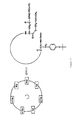
- Figure 1 is a flow diagram of an automated peptide synthesizer configured for automated allyl deprotection according to the present invention.
- Figure 2 includes high-pressure liquid chromatography (HPLC) chromatogram tracings comparing manual allyl deprotection of model peptides on a polyethylene glycol-polystyrene graft (PEG-PS) support with manual allyl deprotection on a polystyrene (PS) support.
- HPLC high-pressure liquid chromatography
- Figure 3 schematically illustrates the retrosynthetic analysis of tachykinin antagonist peptide.
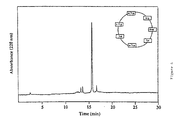
- Figure 4 includes the HPLC chromatogram tracing of a crude model cyclic peptide (inset) directly after cleavage from a PEG-PS support.
- Figure 5 schematically illustrates a general strategy for the preparation of a branched peptide.
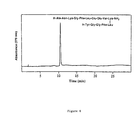
- Figure 6 includes the HPLC chromatogram tracing of a crude branched peptide (inset) directly after cleavage from the support.
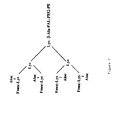
- Figure 7 schematically depicts a PEG-PS resin having bound thereto a multiple antigenic peptide (MAP) core suitable for the production of a two epitope MAP.
- MAP multiple antigenic peptide
- the present invention capitalizes upon the discovery, noted above, of conditions under which an organometallic catalyst, such as an organopalladium catalyst, for allyl deprotection is soluble.
- an organometallic catalyst such as an organopalladium catalyst
- the present disclosure of methods of preparing and using a soluble organopalladium catalyst, as well as of the soluble catalyst composition represent a significant expansion of the breadth of synthetic chemistries suitable for automation. Manual syntheses are, of course, also greatly simplified by the availability of the present soluble catalyst for allyl deprotection.
- Allyl protection chemistry is recognized as a desirable tool for use in the synthesis of many complex or labile peptides, but has long been underutilized due to the level of technical expertise required as well as the difficulties of introducing insoluble substances to peptide synthetic reactions and thereafter separating solid byproducts from the desired product. Allyl protection in solid phase peptide synthesis and reagents therefor are disclosed in U.S.S.N. 07/715,297.
- Allyl protecting groups have the general chemical structure wherein X denotes the site of attachment of the protecting group to a biologically relevant amino acid or derivative thereof, and R 1 , R 2 , R 3 , R 4 , and R 5 are independently selected from the group consisting of: hydrogen, C 1 - C 8 linear or branched alkyl groups, C 6 - C 10 aryl groups, C 1 - C 8 linear or branched substituted alkyl groups, and C 6 - C 10 substituted aryl groups.
- the small size of the allyl core structure makes allyl protection desirable in syntheses where steric hinderance is of concern.
- R 1 , R 2 , R 3 , R 4 , and R 5 substituents, e.g., hydrogen, are preferred for R 1 , R 2 , R 3 , R 4 , and R 5 .
- Allyl groups are desirable for the protection of amino acid side-chains, but can also be used to protect alpha carboxy and amino substituents.
- allyl groups can be used for the temporary protection of alpha amino functional groups during the synthesis of a desired peptide.
- X denotes the site of attachment of the allyl protecting group to a biologically relevant amino acid or a derivative thereof.
- the amino acids of biological relevance include amino acids naturally occurring in biological systems, e.g., the twenty amino acids found in natural peptides and proteins. That is, alanine, arginine, asparagine, aspartic acid, cysteine, glutamine, glutamic acid, glycine, histidine, isoleucine, leucine, lysine, methionine, phenylanine, proline, serine, threonine, tryptophan, tyrosine and valine are considered biologically relevant amino acids.
- the present term additionally encompasses amino acid metabolites, e.g., ornithine, which is a component of the urea cycle. Although not so used in natural systems, ornithine may be included in the sequence of a synthesized peptide and subsequently converted into arginine. Both the L- and D-configurations of the foregoing amino acids are encompassed within the present term, although in the following text, the L-configuration is intended unless otherwise specified. Amino acids that are not found in nature but have biological relevance, e.g., that have biological activity, are also included within the present term. Each of the foregoing are abbreviated and designated herein according to the rules of the IUPAC-IUB Commission of Biochemical Nomenclature, set forth in 247 J. BIOL. CHEM. 997-983 (1972),
- amino acids bear side-chain substituents, referred to as functional groups, for which allyl protection may be desirable during peptide synthesis.
- functional groups for which allyl protection may be desirable during peptide synthesis.
- the acidic (carboxyl) side-chain functional groups of aspartic acid and glutamic acid, as well as the hydroxyl side-chain functional groups of serine and threonine, along with the phenolic side chain functional group of tyrosine can be protected by allyl groups.
- the immediate site of attachment of the allyl group to the amino acid (X) is an oxygen atom.
- Allyl protecting groups may similarly depend from a nitrogen atom present in the basic (amino) side-chain functional groups of lysine and ornithine, the amido side-chain functional groups of asparagine and glutamine, the imidazole side-chain functional group of histidine, and the guanidino side-chain functional group of arginine.
- allyl protecting groups can be attached to a sulfur atom present in the sulfhydryl side-chain functional group of cysteine or the thioether side-chain functional group of methionine.
- the foregoing side-chain functional groups can be derivatized with further substitutents of the type found in biological systems, or with substituents that do not occur naturally but are otherwise of interest.
- amino acid side-chain functional groups can be sulfated, glycosylated, phosphorylated, iodinated, alkylated, or lipidated.
- the present allyl protected derivatives of biologically relevant amino acids are derivatives suitable for solid-phase peptide synthesis.
- amino acid derivatives in which one or more functional groups e.g., the amino substituent of the alpha carbon, referred to herein as the N ⁇ functional group
- one or more functional groups e.g., the amino substituent of the alpha carbon, referred to herein as the N ⁇ functional group
- the N ⁇ functional group other than the group protected by an allyl substituent
- tert -butyl, tert -butyloxycarbonyl, tert -amyloxycarbonyl, adamantanyl-oxycarbonyl, 9-fluorenylmethyloxycarbonyl, 2-(3,5-dimethoxyphenyl)-2-propyloxycarbonyl, dithiasuccinoyl, biphenylylisopropyl-oxycarbonyl, 2,2,5,7,8-pentamethyl-chroman-6-sulfonyl or phenylisopropyloxycarbonyl groups are representative of such temporary protecting groups.
- the temporary protecting group is one which remains stably attached to the amino acid derivative under a first set of conditions, disclosed herein, used to remove the allyl group, yet which is smoothly released from the amino acid derivative by exposure to a second set of conditions under which the allyl group remains stably attached to the amino acid derivative.
- This mutual exclusivity of deprotection conditions is referred to as orthogonality.
- allyl protecting groups are orthogonal to tert -butyloxycarbonyl groups and to 9-fluorenylmethyloxycarbonyl groups. Of these, 9-fluorenylmethyloxycarbonyl groups are preferred.
- the present amino acid derivatives can be attached to a solid support, e.g., a support for solid-phase peptide synthesis.
- Suitable supports include resins, membranes, porous glass, silica, polydimethylacrylamides, cotton, paper, polystyrenes and polyethylene glycolpolystrene graft copolymers.
- polyethylene glycol-polystyrene graft copolymer supports of the type disclosed by U.S.S.N. 07/576,634.
- Amino acid derivatives are typically attached to the support by covalent bonds. This covalent linkage may be direct or indirect.
- an amino acid derivative for solid-phase peptide synthesis may be indirectly linked to the support through a heterobifunctional linking group, also referred to as a handle.
- the handle serves to enhance steric accessibility of the support-bound amino acid derivative for peptide-synthesis reactions, and is smoothly cleavable upon completion of synthesis.
- the allyl protecting group can be included within the handle, if employed for the protection of an alpha carboxylic acid substituent during peptide synthesis.
- Suitable handles or linkers include 5-(4-(9-fluorenylmethyloxycarbonyl)aminomethyl-3,5-dimethoxyphenoxy)valeric acid, 5-[(9-fluorenylmethyloxycarbonyl aminoxanthen-2-oxy] valeric acid and p-alkoxybenzyl alcohol.
- the handles described in U.S.S.N. 07/576,232 and U.S.S.N. 07/576,233 are also suitable.
- the present allyl-protected derivative of a biologically relevant amino acid can be present in a synthesized peptide formed of biologically relevant amino acid residues linked together by peptide bonds.
- the peptide synthesis techniques by which such a peptide is formed are well-known. The techniques described herein provide one representative example of the many synthesis methods and combinations and variations thereof that are available.
- the present peptide can either be attached to a solid support, or may be soluble. In most instances, it is expected that the peptide will be attached to a solid support.
- the peptide may be a linear peptide in which peptide bonds link the alpha carbon atoms of a series of amino acid residues, with one terminal amino acid residue having a carboxyl substituent of the alpha carbon (the C ⁇ carboxyl group) either free in solution or linked covalently to a solid support, optionally through a handle as described above.
- the other terminal amino acid residue of such a linear peptide has an N ⁇ functional group that is either free in solution or protected by a suitable temporary protecting group, such as an allyl group or one of the conventional groups described above. Allyl deprotection of an allyl-protected amino acid derivative present in such a peptide can free the side-chain functional group thereof.
- the allyl protecting group can be present on either the terminal N ⁇ functional group or the C ⁇ functional group.
- the present peptide can be a branched peptide in which at least one additional series of amino acid residues linked together by peptide bonds depends from the side-chain functional group of at least one amino acid residue present in the chain of contiguous peptide bonds originating from the first, support-bound amino acid residue.
- peptide branches may depend from both the N ⁇ and side-chain (epsilon, N ⁇ ) functional groups of lysine.
- multiply branched structures may be formed from a matrix of lysine residues linked together by peptide bonds at both the N ⁇ and N ⁇ sites. Such multiply branched structures are described below as multiple antigenic peptides.
- the present peptide can be a cyclic peptide, by which is meant that, e.g., one or both termini of a chain of amino acid residues linked together by peptide bonds may participate in peptide bonds with other amino acid residues in the same peptide.
- Cyclic peptides can also be formed in which two side-chain functional groups of amino acid substituents present in the same peptide are linked in a peptide bond.
- Such looped structures can be formed between the side-chains of aspartic or glutamic acid and lysine or ornithine.
- a stem-and-loop peptide structure can be formed in which the side-chain functional group of one amino acid residue is linked to a terminal N ⁇ or C ⁇ functional group.
- a head-to-tail cyclic peptide is one in which the terminal carboxy and amino groups have been joined together.
- a head-to-tail cyclic peptide can be attached to a solid support at the site of a side-chain functional group, e.g., at the side-chain carboxyl group of aspartic acid.
- allyl deprotection may precede, follow or otherwise be used in conjunction with procedures for forming cyclic or branched peptide structures, including multiple antigenic peptides.
- the present invention capitalizes upon the discovery of conditions under which the catalyst employed for allyl group removal is soluble.
- the present catalyst is an organopalladium catalyst, preferably an organopalladium (0) catalyst.
- Tetrakistriphenylphosphine palladium (0) [Pd(PPh 3 ) 4 ] is the preferred catalyst of the present invention. In previously known methods, this catalyst has been used as a suspended solid. Conditions are now described which are suitable for use in peptide synthesis reactions, and under which the preferred catalyst is soluble. Thus, the present invention makes possible the automation of peptide syntheses in which allyl deprotection is required or desired.
- the present catalyst can be dissolved in a solvent in which an organic acid and a suitable acceptor are additionally present.
- suitable acceptors include chloroform, methylene chloride and benzene. Of these, chloroform (CHCl 3 ) is preferred. Dimedone, N-methylaniline, N,N'-dimethylbarbituic acid, morpholine or N-methylmorpholine can be used as acceptors; morpholine and N-methylmorpholine are preferred.
- N-methylmorpholine is particularly preferred in that it has been shown to function as an acceptor without undesired interference with 9-fluorenylmethyloxycarbonyl protection chemistry.
- allyl chemistry can be made fully orthogonal to 9-fluorenylmethyloxycarbonyl chemistry.
- N-methylmorpholine is particularly preferred in that it does not exhibit undesired tendencies to act as an base rather than as a acceptor or scavenger for allyl radicals during catalysis.
- Any suitable organic acid miscible in the present solvent can be used in the present invention.
- Foric acid, acetic acid and propionic acid can be used; of these, acetic acid (HOAc) has been shown to be particularly suitable.
- tetrakistriphenylphosphine palladium (0) is dissolved in a solvent comprising acetic acid and N-methylmorpholine in chloroform.
- Acetic acid may be present in this solvent at a concentration between about 3% and about 7%, preferably between about 4% and about 6%, and most preferably at about 5%.
- N-methylmorpholine may be present therein at a concentration between about 1% and about 4%, preferably between about 2% and about 3%, and most preferably at about 2.5%.
- the present catalyst is dissolved in a chloroform solvent further including about 5% acetic acid and about 2.5% N-methylmorpholine.
- the soluble organopalladium catalyst of the present invention can be used under normal atmospheric conditions, but is preferably used under an atmosphere of inert gas.
- Inert conditions are preferably established in the solvent by, e.g., bubbling argon (Ar) gas therethrough prior to contacting the solvent with solid tetrakistriphenylphosphine palladium (0). Inert conditions are thereafter maintained throughout the use of the soluble catalyst for allyl deprotection. Any inert gas can be used to establish an atmosphere of inert gas for the present soluble catalyst.
- a sufficient amount of solid organopalladium catalyst is dissolved in the solvent described herein to provide the desired level and rate of allyl deprotection.
- the proper amount of catalyst will depend on the desired volume and final concentration of soluble catalyst needed for a particular deprotection reaction.
- the particular type, volume and concentration of allyl-protected amino acid derivative to be deprotected will also influence the amount of solid catalyst to be dissolved in the present solvent.
- Appropriate levels of catalyst for a particular deprotection reaction can be determined through no more than routine experimentation.
- the desired quantity of the soluble organopalladium catalyst of the present invention is calculated as a number of chemical equivalents in excess of the chemical equivalents of allyl protecting groups sought to be removed (deprotected). This practice is followed in the investigative studies and Representative Example set forth below.
- Tsuji and Trost subsequently developed improved reaction conditions for palladium catalyzed allylic deprotection, whereupon the potential of the allyl (Al) protecting group in organic syntheses was recognized.
- Hayakawa et al extended the Aloc and allyl group strategy for protection of internucleotide bonds and nucleoside bases in solution- and solid-phase synthesis of nucleic acids.
- Simultaneous deprotection of the allyl protected phosphates and Aloc protected amine oligomers was accomplished with a mixture of tris(dibenzylideneacetone)dipalladium(0), triphenylphosphine and a large excess of butylamine and formic acid in tetrahydrofuran (THF) at 50°C for 0.5-1 h.
- THF tetrahydrofuran
- Guibé et al investigated the selective cleavage of Aloc and allyl groups for the ⁇ -amino and side-chain functions respectively of the biologically relevant amino acids. Dangles et al . (1987), 52 J. ORG. CHEM. 4984-4993; Guibé et al . (1986), 27 TETRAHEDRON LETT. 2365-2368; Merzouk and Guibé (1992), 33 TETRAHEDRON LETT. 477-480.
- Kunz and Birr introduced the use of 4-bromocrotonic acid coupled to aminomethyl polystyrene resin as an allylic anchor. Kunz and Dombo (1988), 27 ANGEW. CHEM. INT. ED. ENGL. 711-713; Kunz et al . (1988), in PEPTIDES 1988: PROCEEDINGS OF THE TWENTIETH EUROPEAN PEPTIDE SYMPOSIUM 154-156 (Jung and Bayer, eds.); Becker et al .
- Kunz reported the use of N ⁇ -terminal 9-fluorenylmethyloxycarbonyl(Fmoc) groups in combination with C-terminal allyl esters as an alternative method for the preparation of O-glycopeptides in solution. Ciommer and Kunz (1991), SYNLETT. 593-595; Friedrich-Bochnistschek et al . (1989), 54 J. ORG. CHEM. 751-756.
- Blankemeyer-Menge and Frank described the synthesis of several protected peptide fragments on cellulose disks containing 4-(4'-methoxytrityloxy)-but-2-enyloxhexanoic acid as an allylic anchor. Blankemeyer-Menge and Frank (1988), 29 TETRAHEDRON LETT. 5871-5874. Deprotection of the allyl ester linkage was achieved by treatment with Pd(PPh 3 ) 4 in dry THF followed by the addition of a solution of 1-hydroxybenzotriazole (HOBt) in THF. In order to avoid cleavage of the Fmoc group, HOBt was used as a acceptor rather than morpholine.
- HOBt 1-hydroxybenzotriazole
- Guibé and Loffet used 4-trityloxy-but-( Z )-2-enyloxyacetic acid coupled to aminomethyl polystyrene as an allylic handle.
- DMSO dimethylsulfoxide
- Albericio et al . reported the preparation of "head-to-tail" cyclic peptides, side-chain lactam peptides, glyco- and sulfo-peptides and branched peptides via a three-dimensional orthogonal solid-phase strategy involving the use of Fmoc, t Bu and allyl protecting groups.
- Albericio et al . (1993) in PEPTIDES 1992: PROCEEDINGS OF THE TWENTY-SECOND EUROPEAN PEPTIDE SYMPOSIUM, (Schneider and Eberle, eds.); Kates et al . (1993), 34 TETRAHEDRON LETT. 1549-1552.
- Trquelak and Bannwarth using allyl chemistry to prepare head-to-tail cyclic peptides. Trnovaak and Bannwarth (1992), 32 TETRAHEDRON LETT. 4557-4660.
- PEG-PS polyethylene glycol-polystyrene
- PEG-PS supports each have a defined and reproducible structure that comprises 20 to 70 weight-percent of polyethylene glycol. These supports swell appreciably in a range of solvents which are optimal for the stepwise assembly of peptide chains. PEG-PS supports have been used in either batchwise flow reactors or continuous-flow reactors with negligible back-pressure.
- Fmoc-Lys(Aloc)-OH, Fmoc-Asp(OAl)-OH and Fmoc-Asp-OAl were each prepared according to previously published procedures. Lyttle and Hudson (1992), in PEPTIDES - CHEMISTRY AND BIOLOGY: PROCEEDINGS OF THE TWELFTH AMERICAN PEPTIDE SYMPOSIUM 583-584 (Smith and Rivier, eds.); Belshaw et al . (1990), 20 SYN. COMM. 3157-3160). The rest of the Fmoc-amino acids and all other peptide synthesis reagents were obtained from Millipore Corporation.
- t Bu was used for the protection of the side chain functional moieties of Asp, Glu, Thr, and Tyr; tert -butyloxycarbonyl (Boc) was used for Lys; and 2,2,5,7,8-pentamethylchroman-6-sulfonyl (Pmc) was used for Arg.
- the side chains of Asn, Gln, Trp were unprotected. All solvents were HPLC grade or of equivalent purity, and were used without further purification.
- Peptide Synthesis Standard Chain Elongation. Continuous flow solid-phase synthesis was carried out automatically using a Millipore 9050 PlusTM PepSynthesizer of the type shown in Figure 1. Syntheses were carried out on an Fmoc-PAL-PEG-PS support (0.27 mmol Fmoc/g resin) unless otherwise indicated. The support was prepared according to a known procedure. Barany et al . (1993) in PEPTIDES 1992: PROCEEDINGS OF THE TWENTY-SECOND EUROPEAN PEPTIDE SYMPOSIUM, (Schneider and Eberle, eds.). The flow rate of the unit pump was set at 5.0 mL/min.
- Protected amino acid residues were added to the resin according to the following protocol: Fmoc group deprotection with 2% 1,8-diazobicyclo[5,4,0]-undec-7-ene (DBU) and 2% piperidine in N,N-dimethylformamide (DMF) for 7 min, followed by DMF washing for 12 min, followed by amino acid coupling for 30 min, followed by DMF washing for 8 min more.
- DBU 1,8-diazobicyclo[5,4,0]-undec-7-ene
- DMF N,N-dimethylformamide
- Mass Spectrometry Mass spectra were recorded on a Waters prototype matrix assisted laser desorption (LD-MS) time-of-flight instrument.
- LD-MS matrix assisted laser desorption
- HPLC HPLC was carried out on a Waters apparatus with two 600 model solvent delivery systems, a Wisp 712 model automatic injector, a 490 model programmable wavelength UV detector or a 994 model programmable photodiode array detector and a 860 Networking Computer to control system operation and collect data.
- the HPLC analytical columns employed herein were Delta Pak C 18 (3.9 x 150 mm, 5 ⁇ m) 100 ⁇ columns.
- Solution A for reverse-phase analysis was 0.1% trifluoroacetic acid (TFA) in H 2 O and Solution B was 0.1% TFA in CH 3 CN.
- TFA trifluoroacetic acid
- Standard allyl deprotection uses a solid palladium catalyst suspended in an appropriate solvent and maintained in an inert atmosphere. This approach is not feasible when applied to a batch and continuous-flow peptide synthesizer, due to problems encountered with the delivery of the insoluble palladium catalyst to the reaction vessel. For example, the complete removal of undesired, solid by-products arising largely from the palladium catalyst must be completely removed at the conclusion of the allyl deprotection step.
- Each of these considerations posed challenging obstacles to the development of an automated protocol that allowed for the removal of the allyl group in the same reaction column or vessel as that used for peptide elongation in an instrument of the type shown in Figure 1. Automatable deprotection procedures were needed that could be implemented at any stage during the synthetic protocol.
- the selective deprotection conditions employed in an automated setting to remove the allyl group maintained full orthogonality with other protecting groups (e.g., Fmoc) and preserved labile amino acids (e.g., Met, Trp, Tyr(SO 3 H), as well as providing homogeneous reaction conditions readily adaptable to implementation on an automated peptide synthesizer.
- the present invention embodies the successful culmination of studies undertaken with the goal of developing a fully automatable allyl deprotection strategy that would fulfill these criteria.
- conditions have been discovered under which the palladium catalyst is soluble and undesired Fmoc deprotection is prevented.
- the now-described conditions are fully compatible with the synthesis of glyco- and sulfo-peptides.
- the present description of specific conditions and instrumentation represent one among many acceptable strategies for the practice of the present invention. Thus, the following account is not viewed as limiting the scope of the claimed invention in any way.
- the present catalyst Pd(PPh 3 ) 4
- Pd(PPh 3 ) 4 is soluble in CHCl 3 and CH 2 Cl 2 , and is moderately soluble in benzene.
- the model peptide was treated with Pd(PPh 3 ) 4 in a solution of CHCl 3 containing 5% HOAc and 2.5% morpholine. These conditions accomplished the deprotection of the allyl group, but still were not compatible with the N ⁇ -Fmoc group.
- NMM N -methylmorpholine
- the strategy employed for automation was to treat Pd(PPh 3 ) 4 as a standard amino acid and store the catalyst in an amino acid vial.
- the vial was purged with Ar and sealed in order to maintain an inert atmosphere.
- the preferred allyl deprotection solution of the present invention i.e., CHCl 3 containing 5% HOAc and 2.5% NMM, was deployed in Syringe 3 and delivered to the amino acid vial containing Pd(PPh 3 ) 4 .
- the resultant mixture was then subjected to at least one bubbling cycle to ensure that the catalyst was completely dissolved (solubilized) before delivery to the reaction column.
- the allyl deprotection solution was recycled through the column for about 2 h.
- Syringe 3 for allyl deprotection required that Syringe 2 be loaded with reagents suitable for single activation chemistry for subsequent elongation of the peptide chain.
- Syringe 2 is loaded with DIEA, and phosphonium or uronium salts are used for activation during both peptide elongation and the cyclization step.
- the phosphonium and uronium salts described in U.S. Serial No. 07/766,895 are suitable for this purpose.
- the Auxiliary ( Aux ) bottle shown in the upper right corner of the Synthesis Module ( Figure 1) contained a solution of 0.5% DIEA and 0.5% sodium diethyldithiocarbamate in DMF to remove side-products that can provoke back-pressure. This solution was delivered to the reaction column following the recycle.
- the resin was washed with separate solutions of 0.5% DIEA in CH 2 Cl 2 and 0.5% sodium diethyldithiocarbamate in DMF. These two solutions have been combined in the present automated deprotection strategy, and no adverse effects have been detected. A final DMF wash was used prior to continuation of the synthetic protocol.
- the Representative Example set forth below illustrates one specific protocol for implementing allyl deprotection strategy of the present invention.
- the allyl strategy of the present invention was applied to the automated synthesis of a cyclic peptide.
- Rovero recently published the synthesis of the tachykinin antagonist peptide MEN 10355, cyclo (Asp-Tyr-D-Trp-Val-D-Trp-D-Trp-Arg).
- the approach selected for the synthesis of this cyclic heptapeptide was based on the automated allyl deprotection strategy outlined above, and is schematically illustrated in Figure 3.
- a linear synthesis of the model cyclic peptide was carried out using a combined Fmoc/ t Bu protection strategy generally according to the procedures set forth above, in conjunction with an Fmoc-Asp(O-PAC-PEG-PS)-OAl starting resin.
- PAC refers to the p-alkoxybenzyl alcohol handle employed for attachment of the peptide to the PEG-PS support.
- an N ⁇ -Fmoc, C ⁇ -allyl protected Asp derivative was linked to the PAC handle through the side-chain carboxy function.
- deprotection of the C ⁇ -allyl protecting group was accomplished with the preferred solution of Pd(PPh 3 ) 4 in CHCl 3 containing 5% HOAc and 2.5% NMM.
- the present protocol is an adaptation of the original method of Felix et al . for resin-bound cyclization for use with allyl-deprotected peptides in an automated setting.
- N ⁇ -Fmoc deprotection of the final amino acid four equivalents of HOBt and PyBOP, stored in the amino acid vial positioned after the one corresponding to the palladium catalyst (see Figure 1), was dissolved to a final concentration of 0.3 M in a solution of 0.6 M DIEA in DMF, delivered from Syringe 2.
- the tracing is that of the crude deprotected cyclic peptide immediately after cleavage from the support, upon exposure to a linear gradient in which the relative proportions of Solution B and Solution A were adjusted from 1:3 to 11:9 at a flow rate of 1.0 mL/min delivered over 30 min.
- LD-MS analysis of the crude cyclic peptide yielded a mass equivalent (MH + ) of 1092.3 daltons.
- the automated allyl deprotection strategy of the present invention is also applicable to the synthesis of branched peptides of the type shown in Figure 5.
- an Fmoc-Lys(Aloc)-PAL-PEG-PS resin was prepared.
- a linear synthesis of prothrombin was performed generally according to the previously-discussed protocol, using a combined Fmoc/ t Bu strategy for conventional peptide elongation.
- side-chain deprotection of the Aloc group of Lys was accomplished with Pd(PPh 3 ) 4 in the preferred solution of CHCl 3 containing 5% HOAc and 2.5% NMM.
- a linear synthesis of Leu-enkephalin was subsequently performed by chain elongation from the epsilon amino group (N ⁇ ) of the side-chain of lysine.
- the last amino acid of prothrombin (Ala at position 9) was N ⁇ -Boc protected during the synthesis of Leu-enkephalin.
- branched peptides may be synthesized according to the present invention by integrating the following protocol with the automated allyl deprotection and peptide synthesis techniques described herein:
- the resulting exemplary branched peptide was released from the resin generally by the cleavage protocol disclosed herein. Removal of the t Bu side-chain protecting groups and N ⁇ -Boc group yielded the desired branched peptide, C ⁇ -(prothrombin)-N ⁇ -(Leu-enkephalin)-Lys-NH 2 .
- LD-MS analysis of the crude branched peptide yielded a mass equivalent (MH + ) of 1671.3 daltons.
- MAPs multiple antigenic peptides
- MAPs are employed to produce peptide immunogens without the use of a protein carrier, such as bovine serum albumin, thyroglobulin or keyhole limpet hemocyanin. Instead, a small branched lysine core matrix is used to amplify the peptide antigen to multiple copies.
- Boc-Lys(Boc)-OH and Fmoc-Lys(Fmoc)-OH can be used for Boc and Fmoc chemistry, respectively, according to the procedures described herein.
- the current strategy for obtaining MAPs containing two epitopes requires Boc chemistry, since Fmoc-Lys(Boc)-OH is necessary.
- MAPs containing two epitopes can be achieved and automated with Fmoc chemistry, using a core matrix of the general type shown in Figure 7.
- an [Fmoc-Lys(Aloc)] 4 - ⁇ -Ala-PAL-PEG-PS core resin was prepared.
- a linear synthesis of prothrombin using Fmoc/ t Bu protection was carried out as described in the previous section, followed by side-chain deprotection of the Aloc group of Lys and linear extension of Leu-enkephalin from the N ⁇ group of lysine.
- the Pepsynthesizer was configured for allyl deprotection as shown in Figure 1.
- the Pd(PPh 3 ) 4 catalyst (125 mg, 108 ⁇ mol) was stored in an amino acid vial which was sealed under Ar.
- the vial containing the catalyst was positioned in the amino acid module following the last amino acid of the sequence.
- the catalyst was dissolved in Syringe 3 (depicted at the lower left of the Synthesis module in Figure 1) to a final concentration of 0.14 M with a solution of 5% HOAc and 2.5% N-methylmorpholine (NMM) in CHCl 3 . Twenty bubble cycles were used to completely dissolve the catalyst.
- the resulting allyl deprotection solution was delivered to the peptide resin (500 mg, 0.3 mmol/g) and allowed to recycle through the column for 2 h.
- the column was then washed with a solution of 0.5% DIEA and 0.5% sodium diethyldithio-carbamate in DMF (delivered from the Aux bottle, 10 min, 6 mL/min) and DMF (10 min, 6 mL/min) to prepare the support for the next cycle of synthesis.
Landscapes
- Chemical & Material Sciences (AREA)
- Organic Chemistry (AREA)
- Chemical Kinetics & Catalysis (AREA)
- Engineering & Computer Science (AREA)
- Materials Engineering (AREA)
- Biophysics (AREA)
- Genetics & Genomics (AREA)
- Health & Medical Sciences (AREA)
- Life Sciences & Earth Sciences (AREA)
- Biochemistry (AREA)
- Proteomics, Peptides & Aminoacids (AREA)
- General Health & Medical Sciences (AREA)
- Analytical Chemistry (AREA)
- Medicinal Chemistry (AREA)
- Molecular Biology (AREA)
- Inorganic Chemistry (AREA)
- Peptides Or Proteins (AREA)
- Catalysts (AREA)
- Low-Molecular Organic Synthesis Reactions Using Catalysts (AREA)
- Organic Low-Molecular-Weight Compounds And Preparation Thereof (AREA)
Claims (37)
- Procédé d'élimination d'un groupe protecteur allyle, d'un dérivé d'un acide aminé biologiquement approprié protégé par un groupe allyle, comprenant les étapes consistant à :a) fournir un catalyseur d'organopalladium soluble ; ledit catalyseur étant fourni sous atmosphère inerte dans un solvant comprenant un acide organique et un accepteur ;b) mettre en contact ledit catalyseur avec le dérivé d'acide aminé protégé par un groupe allyle ;c) incuber ledit acide aminé protégé par un groupe allyle avec ledit catalyseur, pendant une période de temps suffisante pour que le groupe protecteur allyle soit éliminé de façon catalytique du dérivé d'acide aminé, de façon qu'un dérivé d'acide aminé qui n'est plus protégé par un groupe allyle soit obtenu ; etd) séparer le dérivé d'acide aminé qui n'est plus protégé par un groupe allyle, du catalyseur.
- Procédé selon la revendication 1, dans lequel le catalyseur d'organopalladium soluble est un catalyseur d'organopalladium (0).
- Procédé selon la revendication 2, dans lequel le catalyseur d'organopalladium soluble est le tétrakistriphénylphosphine palladium (0).
- Procédé selon la revendication 1, dans lequel le catalyseur d'organopalladium soluble est le tétrakistriphénylphosphine palladium (0) et dans lequel les étapes (a) à (c) sont effectuées dans une atmosphère inerte.
- Procédé selon la revendication 1, dans lequel le solvant est le chlorofcrme, le dichlorométhane ou le benzène.
- Procédé selon la revendication 1, dans lequel l'acide organique est l'acide formique, l'acide acétique ou l'acide propionique.
- Procédé selon la revendication 1, dans lequel l'accepteur est le dimédon, la N-méthylaniline, l'acide N,N'-diméthylbarbiturique, la morpholine ou la N-méthylmorpholine.
- Procédé selon la revendication 1, dans lequel le catalyseur d'organopalladium soluble est le tétrakistriphénylphosphine palladium (0), ledit catalyseur étant fourni dans un solvant comprenant de l'acide acétique et de la N-méthylmorpholine dans du chloroforme, ledit catalyseur soluble étant fourni dans une atmosphère inerte.
- Procédé selon la revendication 8, dans lequel ledit solvant comprend environ 5% d'acide acétique et environ 2,5% de N-méthylmorpholine dans du chloroforme.
- Procédé d'élimination d'un groupe protecteur allyle, d'un dérivé d'un acide aminé biologiquement approprié protégé par un groupe allyle, comprenant les étapes consistant à :a) fournir un catalyseur de tétrakistriphénylphosphine palladium (0) soluble, ledit catalyseur étant fourni dans un solvant comprenant de l'acide acétique et de la N-méthylmorpholine dans du chloroforme, ledit catalyseur étant en outre fourni sous une atmosphère inerte ;b) mettre en contact ledit catalyseur avec le dérivé d'acide aminé protégé par un groupe allyle, sous une atmosphère inerte ;c) incuber le dérivé d'acide aminé protégé par un groupe allyle avec ledit catalyseur, sous une atmosphère inerte, pendant une période de temps suffisante pour que le groupe protecteur allyle soit éliminé de façon catalytique du dérivé d'acide aminé, de façon qu'un dérivé d'acide aminé qui n'est plus protégé par un groupe allyle soit obtenu ; etd) séparer le dérivé d'acide aminé qui n'est plus protégé par un groupe allyle, du catalyseur.
- Procédé selon la revendication 10, dans lequel ledit solvant comprend environ 5% d'acide acétique et environ 2,5% de N-méthylmorpholine dans du chloroforme.
- Procédé selon la revendication 10, dans lequel le dérivé d'un acide aminé biologiquement approprié protégé par un groupe allyle est un dérivé d'alanine, d'arginine, d'asparagine, d'acide aspartique, de cystéine, de glutamine, d'acide glutamique, de glycine, d'histidine, d'isoleucine, de leucine, de lysine, de méthionine, d'ornithine, de phénylalanine, de proline, de sérine, de thréonine, de tryptophane, de tyrosine ou de valine.
- Procédé selon la revendication 12, dans lequel le groupe fonctionnel Nα dudit dérivé d'un acide aminé biologiquement approprié protégé par un groupe allyle, est protégé par un groupe allyle.
- Procédé selon la revendication 12, dans lequel le dérivé dudit acide aminé biologiquement approprié protégé par un groupe allyle est en outre protégé par un groupe tert-butyle, tert-butyloxycarbonyle, tert-amyloxycarbonyle, adamantanyloxycarbonyle, 9-fluorénylméthyloxycarbonyle, 2-(3,5-diméthoxyphényl)-2-propyloxycarbonyle, dithiasuccinoyle, biphénylylisopropyloxycarbonyle, 2,2,5,7,8-pentaméthylchroman-6-sulfonyle ou phénylisopropyloxycarbonyle.
- Procédé selon la revendication 10, dans lequel le dérivé d'un acide aminé biologiquement approprié protégé par un groupe allyle est un dérivé, d'arginine, d'asparagine, d'acide aspartique, de cystéine, de glutamine, d'acide glutamique, d'histidine, de lysine, de méthionine, d'ornithine, de sérine, de thréonine, ou de tyrosine, dont le groupe fonctionnel de la chaíne latérale est protégé par un groupe protecteur allyle et dont le groupe fonctionnel Nα est protégé par un groupe tert-butyle, tert-butyloxycarbonyle, tert-amyloxycarbonyle, adamantanyloxycarbonyle, 9-fluorénylméthyloxycarbonyle, 2-(3,5-diméthoxyphényl)-2-propyloxycarbonyle, dithiasuccinoyle, biphénylylisopropyloxycarbonyle, 2,2,5,7,8-pentaméthylchroman-6-sulfonyle ou phénylisopropyloxycarbonyle.
- Procédé selon la revendication 10, dans lequel le dérivé d'un acide aminé biologiquement approprié protégé par un groupe allyle est un dérivé sulfaté, glycosylé, phosphorylé, iodé, alkylé, ou lipidé à chaíne latérale d'arginine, d'asparagine, d'acide aspartique, de cystéine, de glutamine, d'acide glutamique, d'histidine, de lysine, de méthionine, d'ornithine, de sérine, de thréonine, ou de tyrosine, dans lequel ladite chaíne latérale de l'acide aminé modifié est protégée par un groupe protecteur allyle, dans lequel en outre le groupe fonctionnel Nα dudit dérivé d'acide aminé est protégé par un groupe tert-butyle, tert-butyloxycarbonyle, tert-amyloxycarbonyle, adamantanyloxycarbonyle, 9-fluorénylméthyloxycarbonyle, 2-(3,5-diméthoxyphényle)-2-propyloxycarbonyle, dithiasuccinoyle, biphénylylisopropyloxycarbonyle, 2,2,5,7,8-pentaméthylchroman-6-sulfonyle ou phénylisopropyloxycarbonyle.
- Procédé selon la revendication 10, dans lequel le dérivé d'un acide aminé biologiquement approprié protégé par un groupe allyle est fixé à un support solide.
- Procédé selon la revendication 17, dans lequel le groupe fonctionnel Nα dudit dérivé d'un acide aminé biologiquement approprié protégé par un groupe allyle est protégé par un groupe allyle, ledit groupe allyle servant d'intermédiaire dans la fixation du dérivé d'acide aminé protégé au support solide.
- Procédé selon la revendication 17, dans lequel le support solide est un support en copolymère greffé polyéthylèneglycol-polystyrène ou un support en polystyrène.
- Procédé selon la revendication 17, dans lequel le dérivé d'un acide aminé biologiquement approprié protégé par un groupe allyle est fixé à un support solide par un bras ou un manchon acide 5-(4-(9-fluorénylméthyloxycarbonyl)-aminométhyl-3,5-diméthoxyphénoxy)valérique, acide 5-[(9-fluorénylméthyloxycarbonyl)aminoxanthéne-2-oxy]valérique ou un alcool p-alcoxybenzylique.
- Procédé selon la revendication 17, dans lequel le dérivé d'un acide aminé biologiquement approprié protégé par un groupe allyle est présent dans un peptide de synthétise, formé de résidus d'acides aminés biologiquement appropriés, liés ensemble par des liaisons peptidiques.
- Procédé selon la revendication 10, dans lequel le dérivé d'un acide aminé biologiquement approprié protégé par un groupe allyle est présent dans un peptide synthétisé, formé de résidus d'acides aminés biologiquement appropriés, liés ensemble par des liaisons peptidiques, ledit peptide étant fixé à un support en copolymère greffé polyéthylèneglycolpolystyrène par un manchon ou un bras acide 5-(4-(9-fluorénylméthyloxycarbonyl)-aminométhyl-3,5-diméthoxyphénoxy)valérique, ledit peptide ayant été formé à partir de dérivés d'acides aminés biologiquement appropriés dont les groupes fonctionnels Nα étaient protégés par des groupes 9-fluorénylméthyloxycarbonyl ou des groupes allyle.
- Procédé de préparation d'un catalyseur d'organopalladium soluble, comprenant les étapes consistant à :a) fournir un composé d'organopalladium solide ;b) fournir un solvant contenant un acide organique et un accepteur ;c) mettre en contact le solvant avec une source de gaz inerte, de sorte que des conditions inertes sont établies dans le solvant ;d) combiner le composé d'organopalladium solide avec le solvant, sous une atmosphère de gaz inerte, de sorte qu'un mélange soit formé ; ete) incuber le mélange, sous une atmosphère de gaz inerte, pendant une période de temps suffisante pour que le composé d'organopalladium solide soit dissous dans le solvant, en formant ainsi un catalyseur d'organopalladium soluble.
- Procédé selon la revendication 23, dans lequel le composé d'organopalladium est un composé d'organopalladium (0).
- Procédé selon la revendication 23, dans lequel le catalyseur d'organopalladium soluble est le tétrakistriphénylphosphine palladium (0).
- Procédé selon la revendication 23, dans lequel l'acide organique est l'acide formique, l'acide acétique ou l'acide propionique.
- Procédé selon la revendication 23, dans lequel l'accepteur est le dimédon, la N-méthylaniline, l'acide N,N'-diméthylbarbiturique, la morpholine ou la N-méthylmorpholine.
- Procédé selon la revendication 23, dans lequel l'acide organique est l'acide acétique et l'accepteur est la N-méthylmorpholine.
- Procédé selon la revendication 23, dans lequel le composé d'organopalladium est le tétrakistriphénylphosphine palladium (0) et le solvant est le chloroforme, ledit solvant incluant environ 5% d'acide acétique et environ 2,5% de N-méthylmorpholine.
- Composition incluant un composé d'organopalladium dissous, sous une atmosphère inerte, dans un solvant, ledit solvant incluant un acide organique et un accepteur.
- Composition selon la revendication 30 incluant un composé d'organopalladium (0).
- Composition selon la revendication 30 incluant le tétrakistriphénylphosphine palladium (0).
- Composition selon la revendication 30, dans laquelle le solvant est le chloroforme, le dichlorométhane ou le benzène.
- Composition selon la revendication 30, dans laquelle l'acide organique est l'acide formique, l'acide acétique ou l'acide propionique.
- Composition selon la revendication 30, dans laquelle l'accepteur est le dimédon, la N-méthylaniline, l'acide N,N'-diméthylbarbiturique, la morpholine ou la N-méthylmorpholine.
- Composition selon la revendication 30 incluant le tétrakistriphénylphosphine palladium (0) dissous, sous une atmosphère inerte, dans un solvant chloroforme, ledit solvant incluant en outre de l'acide acétique et de la N-méthylmorpholine.
- Composition selon la revendication 30, dans laquelle ledit solvant chloroforme inclut environ 5% d'acide acétique et environ 2,5% de N-méthylmorpholine.
Applications Claiming Priority (2)
| Application Number | Priority Date | Filing Date | Title |
|---|---|---|---|
| US4527393A | 1993-04-05 | 1993-04-05 | |
| US45273 | 1993-04-05 |
Publications (2)
| Publication Number | Publication Date |
|---|---|
| EP0623626A1 EP0623626A1 (fr) | 1994-11-09 |
| EP0623626B1 true EP0623626B1 (fr) | 1999-09-01 |
Family
ID=21936946
Family Applications (1)
| Application Number | Title | Priority Date | Filing Date |
|---|---|---|---|
| EP94104977A Expired - Lifetime EP0623626B1 (fr) | 1993-04-05 | 1994-03-29 | Déprotection automatisée des groupes allyle appliqués à la synthèse en phase solide |
Country Status (4)
| Country | Link |
|---|---|
| US (2) | US5861351A (fr) |
| EP (1) | EP0623626B1 (fr) |
| JP (1) | JP3600268B2 (fr) |
| DE (1) | DE69420307T2 (fr) |
Families Citing this family (9)
| Publication number | Priority date | Publication date | Assignee | Title |
|---|---|---|---|---|
| US6015895A (en) * | 1995-12-22 | 2000-01-18 | University Technologies International Inc. | Linker arm for solid support oligonucleotide synthesis and process for production thereof |
| US6849428B1 (en) * | 1997-03-05 | 2005-02-01 | New England Biolabs, Inc. | Intein-mediated protein ligation of expressed proteins |
| US7135564B1 (en) * | 1998-07-02 | 2006-11-14 | University Technologies International Inc. | Reusable solid support for oligonucleotide synthesis |
| CA2391966A1 (fr) | 1999-11-24 | 2001-05-31 | Massachusetts Institute Of Technology | Groupes protecteurs utilises dans la synthese des polysaccharides, produits naturels, et bibliotheques combinatoires |
| KR100484434B1 (ko) * | 2002-05-30 | 2005-04-20 | 부산대학교 산학협력단 | 커피유래 3-메틸-1,2-사이클로펜탄다이온을 유효성분으로 하는 항산화제 및 항노화제 |
| US20040082783A1 (en) * | 2002-08-06 | 2004-04-29 | Schafmeister Christian E. | Bis (amino acid) molecular scaffolds |
| EP1701976A2 (fr) * | 2003-12-31 | 2006-09-20 | F.Hoffmann-La Roche Ag | Synthese de peptides et deprotection a l'aide d'un co-solvant |
| DE112007002932B4 (de) * | 2006-12-01 | 2015-08-06 | The Trustees Of Columbia University In The City Of New York | Vierfarben DNA-Sequenzierung mittels Synthese unter Verwendung von abspaltbaren, reversiblen, fluoreszierenden Nucleotidterminatoren |
| CA3097005C (fr) * | 2018-05-04 | 2023-06-13 | Polypeptide Laboratoires France | Systeme automatise de reacteur de synthese avec une boucle de recirculation |
Family Cites Families (8)
| Publication number | Priority date | Publication date | Assignee | Title |
|---|---|---|---|---|
| US4314942A (en) * | 1979-01-10 | 1982-02-09 | Schering Corporation | Deprotection of allylic esters, carbonates and carbamates catalyzed by palladium compounds |
| US4870199A (en) * | 1986-04-30 | 1989-09-26 | Sandoz Pharm. Corp. | Processes for the synthesis of diprotected R[R*,S*]-3,5-dihydroxy-6-oxohexanoate esters |
| DE3803545A1 (de) * | 1987-06-19 | 1988-12-29 | Orpegen Med Molekularbioforsch | Allylische seitenketten enthaltendes festphasensystem, verfahren zu seiner herstellung und seine verwendung in festphasenreaktionen |
| US5124448A (en) * | 1989-02-23 | 1992-06-23 | Merck & Co., Inc. | Deblocking process for allyl esters with regeneratable polymer supported Pd(O) |
| US5384309A (en) * | 1989-07-17 | 1995-01-24 | Genentech, Inc. | Cyclized peptides and their use as platelet aggregation inhibitors |
| DE3938850A1 (de) * | 1989-08-31 | 1991-03-07 | Orpegen Med Molekularbioforsch | Neue allylester und ihre verwendung zum aufbau von festphasensystemen fuer festphasenreaktionen |
| FR2675804B1 (fr) * | 1991-04-25 | 1995-04-07 | Propeptide Sa | Procede de synthese de peptides, nouveaux derives d'acides amines mis en óoeuvre dans ce procede et leurs procedes de preparation. |
| EP0518295A3 (en) * | 1991-06-14 | 1993-09-01 | Millipore Corporation | Allyl side chain protection in peptide synthesis |
-
1994
- 1994-03-29 EP EP94104977A patent/EP0623626B1/fr not_active Expired - Lifetime
- 1994-03-29 DE DE69420307T patent/DE69420307T2/de not_active Expired - Lifetime
- 1994-04-05 JP JP08917894A patent/JP3600268B2/ja not_active Expired - Fee Related
-
1996
- 1996-09-20 US US08/717,208 patent/US5861351A/en not_active Expired - Lifetime
-
1997
- 1997-02-20 US US08/803,557 patent/US5777077A/en not_active Expired - Lifetime
Also Published As
| Publication number | Publication date |
|---|---|
| JP3600268B2 (ja) | 2004-12-15 |
| DE69420307T2 (de) | 2000-01-27 |
| DE69420307D1 (de) | 1999-10-07 |
| JPH0753588A (ja) | 1995-02-28 |
| EP0623626A1 (fr) | 1994-11-09 |
| US5777077A (en) | 1998-07-07 |
| US5861351A (en) | 1999-01-19 |
Similar Documents
| Publication | Publication Date | Title |
|---|---|---|
| Kates et al. | Automated allyl cleavage for continuous-flow synthesis of cyclic and branched peptides | |
| EP0705279B1 (fr) | Banques en phase solide codees a segregation topoligique | |
| EP1310510B1 (fr) | Banques en phase solide codées à ségrégation topologique | |
| Barany et al. | Solid‐phase peptide synthesis: a silver anniversary report | |
| US6008058A (en) | Cyclic peptide mixtures via side chain or backbone attachment and solid phase synthesis | |
| US5734018A (en) | Peptide mixtures | |
| Albericio | Orthogonal protecting groups for Nα‐amino and C‐terminal carboxyl functions in solid‐phase peptide synthesis | |
| Gomez-Martinez et al. | N α-Alloc temporary protection in solid-phase peptide synthesis. The use of amine–borane complexes as allyl group scavengers | |
| Alsina et al. | Solid-phase synthesis of “head-to-tail” cyclic peptides via lysine side-chain anchoring | |
| Wellings et al. | [4] Standard Fmoc protocols | |
| US6512092B2 (en) | Processes for coupling amino acids using bis-(trichloromethyl) carbonate | |
| US5777077A (en) | Automated allyl deprotection in solid-phase synthesis | |
| KR100237126B1 (ko) | 펩티드 유사체의 신속한 합성 및 검색방법 | |
| Pinilla et al. | Synthetic peptide combinatorial libraries (SPCLs): identification of the antigenic determinant of β-endorphin recognized by monoclonal antibody 3E7 | |
| Tuchscherer et al. | The TASP concept: mimetics of peptide ligands, protein surfaces and folding units | |
| Isidro‐Llobet et al. | p‐Nitrobenzyloxycarbonyl (pNZ) as a Temporary Nα‐Protecting Group in Orthogonal Solid‐Phase Peptide Synthesis–Avoiding Diketopiperazine and Aspartimide Formation | |
| JP4625603B2 (ja) | テンプレートを固定したβヘアピンループ類似物の合成 | |
| Choi et al. | Comparison of methods for the Fmoc solid‐phase synthesis and cleavage of a peptide containing both tryptophan and arginine | |
| Ede | Multiple parallel synthesis of peptides on SynPhase™ grafted supports | |
| WO2005087794A1 (fr) | Procede de synthese d'octreotide | |
| Carreno et al. | Nsc and Fmoc Nα‐amino protection for solid‐phase peptide synthesis: a parallel study | |
| Delforge et al. | Automated solid-phase synthesis of cyclic peptides bearing a side-chain tail designed for subsequent chemical grafting | |
| Teixido et al. | Bicyclic homodetic peptide libraries: comparison of synthetic strategies for their solid-phase synthesis | |
| Fox | Multiple peptide synthesis | |
| WO1996006353A1 (fr) | Polypeptides de lysine/leucine, groupes de melanges et leurs banques |
Legal Events
| Date | Code | Title | Description |
|---|---|---|---|
| PUAI | Public reference made under article 153(3) epc to a published international application that has entered the european phase |
Free format text: ORIGINAL CODE: 0009012 |
|
| AK | Designated contracting states |
Kind code of ref document: A1 Designated state(s): DE FR GB |
|
| 17P | Request for examination filed |
Effective date: 19950427 |
|
| RAP1 | Party data changed (applicant data changed or rights of an application transferred) |
Owner name: PERSEPTIVE BIOSYSTEMS, INC. |
|
| 17Q | First examination report despatched |
Effective date: 19971023 |
|
| GRAG | Despatch of communication of intention to grant |
Free format text: ORIGINAL CODE: EPIDOS AGRA |
|
| GRAG | Despatch of communication of intention to grant |
Free format text: ORIGINAL CODE: EPIDOS AGRA |
|
| GRAH | Despatch of communication of intention to grant a patent |
Free format text: ORIGINAL CODE: EPIDOS IGRA |
|
| GRAH | Despatch of communication of intention to grant a patent |
Free format text: ORIGINAL CODE: EPIDOS IGRA |
|
| GRAA | (expected) grant |
Free format text: ORIGINAL CODE: 0009210 |
|
| AK | Designated contracting states |
Kind code of ref document: B1 Designated state(s): DE FR GB |
|
| REF | Corresponds to: |
Ref document number: 69420307 Country of ref document: DE Date of ref document: 19991007 |
|
| ET | Fr: translation filed | ||
| PLBE | No opposition filed within time limit |
Free format text: ORIGINAL CODE: 0009261 |
|
| STAA | Information on the status of an ep patent application or granted ep patent |
Free format text: STATUS: NO OPPOSITION FILED WITHIN TIME LIMIT |
|
| 26N | No opposition filed | ||
| REG | Reference to a national code |
Ref country code: GB Ref legal event code: IF02 |
|
| REG | Reference to a national code |
Ref country code: GB Ref legal event code: 732E Free format text: REGISTERED BETWEEN 20090514 AND 20090520 |
|
| REG | Reference to a national code |
Ref country code: GB Ref legal event code: 732E Free format text: REGISTERED BETWEEN 20100121 AND 20100127 |
|
| PGFP | Annual fee paid to national office [announced via postgrant information from national office to epo] |
Ref country code: FR Payment date: 20120406 Year of fee payment: 19 |
|
| PGFP | Annual fee paid to national office [announced via postgrant information from national office to epo] |
Ref country code: GB Payment date: 20120326 Year of fee payment: 19 |
|
| PGFP | Annual fee paid to national office [announced via postgrant information from national office to epo] |
Ref country code: DE Payment date: 20120328 Year of fee payment: 19 |
|
| GBPC | Gb: european patent ceased through non-payment of renewal fee |
Effective date: 20130329 |
|
| REG | Reference to a national code |
Ref country code: FR Ref legal event code: ST Effective date: 20131129 |
|
| REG | Reference to a national code |
Ref country code: DE Ref legal event code: R119 Ref document number: 69420307 Country of ref document: DE Effective date: 20131001 |
|
| PG25 | Lapsed in a contracting state [announced via postgrant information from national office to epo] |
Ref country code: FR Free format text: LAPSE BECAUSE OF NON-PAYMENT OF DUE FEES Effective date: 20130402 Ref country code: DE Free format text: LAPSE BECAUSE OF NON-PAYMENT OF DUE FEES Effective date: 20131001 Ref country code: GB Free format text: LAPSE BECAUSE OF NON-PAYMENT OF DUE FEES Effective date: 20130329 |