EP0624689A2 - Machine de meulage de rails - Google Patents
Machine de meulage de rails Download PDFInfo
- Publication number
- EP0624689A2 EP0624689A2 EP94106636A EP94106636A EP0624689A2 EP 0624689 A2 EP0624689 A2 EP 0624689A2 EP 94106636 A EP94106636 A EP 94106636A EP 94106636 A EP94106636 A EP 94106636A EP 0624689 A2 EP0624689 A2 EP 0624689A2
- Authority
- EP
- European Patent Office
- Prior art keywords
- rail
- grinding
- machine according
- grinding machine
- lift
- Prior art date
- Legal status (The legal status is an assumption and is not a legal conclusion. Google has not performed a legal analysis and makes no representation as to the accuracy of the status listed.)
- Withdrawn
Links
Images


Classifications
-
- E—FIXED CONSTRUCTIONS
- E01—CONSTRUCTION OF ROADS, RAILWAYS, OR BRIDGES
- E01B—PERMANENT WAY; PERMANENT-WAY TOOLS; MACHINES FOR MAKING RAILWAYS OF ALL KINDS
- E01B31/00—Working rails, sleepers, baseplates, or the like, in or on the line; Machines, tools, or auxiliary devices specially designed therefor
- E01B31/02—Working rail or other metal track components on the spot
- E01B31/12—Removing metal from rails, rail joints, or baseplates, e.g. for deburring welds, reconditioning worn rails
- E01B31/17—Removing metal from rails, rail joints, or baseplates, e.g. for deburring welds, reconditioning worn rails by grinding
Definitions
- the invention relates to a rail grinding machine that can be moved on a track for the abrasive removal of deformations or burrs on the inside of the rail heads and for the reprofiling of the rail head area by polygonal grinding.
- the disadvantage here is the relatively time-consuming and difficult craft work. Another disadvantage is that the accuracy that can be achieved with regard to ideal reprofiling is not sufficient. In addition, there is a disadvantage in that only one rail and not both rails can be machined by a worker at the same time.
- the object of the invention is to propose a rail grinding machine which eliminates the aforementioned disadvantages.
- the rail grinding machine according to the invention is highly mobile due to its compact design. This means that it can be transported on a normal truck crane truck outside the rail area and can thus be brought to the location of the rail processing. The rail grinding machine can be lifted directly onto the track with the truck crane and lifted off again after the grinding work has been carried out.
- This mobility of the grinding machine according to the invention makes it possible to limit the blocking of the track section to the necessary minimum.
- the rail grinding machine is excellently suited for machining rail sections from a few meters to several kilometers and ensures that the rails are deburred and ground to a precise profile.
- the device according to the invention preferably consists of two grinding modules arranged one behind the other in the direction of travel, which are detachably connected to a platform.
- the advantage of this version is that - depending on your needs - you can work with one or two grinding modules.
- the grinding modules are also essentially identical in construction and are only rotated by 180 in two-track operation.
- the device is also particularly suitable for working off burrs in narrow curve areas and in switch areas.
- the usual cup-shaped grinding wheel can be replaced by a narrow grinding wheel.
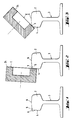
- FIG. 1 shows, by way of example, an internal deformation V of the rail head 2 of a rail 3 which has arisen as a result of longer travel and which can form in a specific longitudinal extent of the rail 3.
- This deformation V usually arises in a transition area 5 between a substantially vertical guide area 4 and a substantially horizontal rolling surface 6 of the rail head 2, which is created over time by rolling.
- the rail head 2 is preferably machined or reprofiled in the region of the deformation V, i.e. the ideal geometry is restored.
- the tool for example a cup grinding wheel 24, is brought with its generatrix E parallel to the essentially vertical guide surface 4 of the rail head 2 to this guide surface 4 in such a way that the deformation V projecting inward beyond this plane is abrasively removed and at the same time the grinding wheel 24 is moved in this setting in the longitudinal direction of the rail in accordance with the rail length to be machined (feed) (FIG. 2).
- the grinding wheel 24 is pivoted such that its generatrix E comes to lie tangentially to the ideal contour of the transition region 5 of the rail head 2. The grinding wheel 24 is guided in this and every further angle setting over the entire length of the rail to be machined, the deformation V correspondingly projecting beyond the ideal contour being processed.
- the swivel range of generatrix E from guide surface 4 to rolling surface 6 is approximately 87 °.
- the result of the grinding is a shape of the rail head 2 which is approximated polygonally to the ideal contour and whose degree of accuracy depends on the number of grinding cycles with different angular positions of the grinding wheel 24.
- both rail tracks 3 are processed simultaneously in the manner described above.
- the control or adjustment of the grinding wheel 24 to the rail head 2 is computer-aided. For this purpose, some data to be determined by sensors about the rail 3 to be machined are resp. the grinding wheel 24 required.
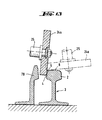
- FIG. 4 shows, by way of example and schematically, a sensor arrangement together with grinding wheel 24 and its actuating members, some of which are only shown by corresponding movement arrows.
- mechanical roller scanners are provided as organs for scanning the rail 3.
- any type of sensory means can be used, provided they appear suitable for this purpose.
- the desired position of the guide surface 4 of the rail head 2 is determined by the sensor 70, whose sensing element 71 acts in the lower region of the guide surface 4, which generally remains intact and can therefore form a reference surface.
- the actual value is determined by sensors 72, 74, which are connected upstream of the grinding wheel 24 with respect to both possible directions of travel Pf1 (feed directions).
- the sensing elements 73, 75 of these sensors 72, 74 preferably engage the upper area of the guide surface 4, on which the deformation V to be removed is located.
- the position of the generatrix E of the grinding wheel 24 can be determined by a sensor 76.
- the grinding wheel infeed can now be carried out, for example via a pressure cylinder 63 in accordance with the first machining step, as described above, and the driving speed (feed Pf1) can also be regulated.
- the grinding result (actual value) can be determined by means of the sensor 72, 74 located behind the grinding wheel 24 with respect to the direction of travel and compared with the target value (sensor 70).
- any corrections to the infeed can be derived therefrom or the position of the generatrix E of the grinding wheel 24, which changes over time due to wear, can also be determined, so that the sensor 76 described above in this regard could be omitted.
- the transition area 5 can be processed in accordance with a program contained in the memory of the computer 77, the content of which can be all delivery data with the angular positions of the grinding wheel 24 relative to the rail head 2 being entered accordingly.
- the various angle settings of the grinding wheel 24 can be entered, for example, by an operator on an input and monitoring device 66.
- the grinding reaction force PF2 which runs transversely to the longitudinal direction of the rail, is introduced into the machine frame 15 via the feed cylinder 63.
- the machine frame 15, which can be moved on the rails by means of wheels 16, has a transverse guide which is formed by guide and support rollers 18, 19 which are supported on the inside on the undeformed area of the guide surfaces 4 of the corresponding rail heads 2.
- the grinding reaction force which is generated on the one rail track, is introduced via the grinding shaft 25 into the machine frame 15 and from there via the guide roller 18 into the opposite rail track.
- This guide roller 18 is preferably rigidly attached to the machine frame 15, the opposite guide roller 19 being spring-mounted on the frame 15 to compensate for any track width differences.
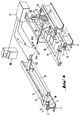
- FIG. 5 schematically shows a device 1 for preferably abrasive processing or correction of the head region 2 of rails 3, in particular the inner, essentially vertical guide region 4 and the rounded transition region 5 up to the essentially horizontal rolling surface 6.
- This device has, for example, modules 7a, 7b which are transportable on the road (truck) and can possibly be placed on the corresponding track system or platform 10 with a truck-side crane arrangement, and which form the actual grinding device 7, as well as an aggregate car 8 which e.g. may include a generator 9, a hydraulic or pneumatic unit 11 (compressor) and the travel drive 12.
- the unit carriage 8 is connected to the grinding device 7 by means of a coupling rod 13.
- Corresponding eyelets 14 or the like are provided on the modules 7a, 7b, 8 of the device 1 for hanging crane hooks etc.
- the grinding device 7 (7a, 7b) has a frame 15 which is provided with rail track wheels 16 at its four corner regions. Additional support rollers 17 are attached in the central region of the frame 15.
- the track wheels 16 are preceded by feelers 21 which can sense any obstacles in the travel path and can stop the travel drive 12 to protect the grinding devices 22.
- the grinding device 7 has two grinding devices 22 which can be operated independently of one another and which are capable of simultaneously machining the rail heads 2 of both rail tracks 3.
- the two grinding devices 22 are essentially of the same design and are arranged in mirror symmetry in the frame 15, as a result of which the description of one grinding device 22 also applies analogously to the other grinding device 22.
- the pivot bracket 26 is pivotally mounted on a vertically movable lift 28 by means of a pivot bearing arrangement 27, the Pivot axis 29 is aligned in the longitudinal direction of the rail.
- the angle setting of the swivel bracket 26 respectively. the grinding shaft 25 takes place via a motorized or manually operated double spindle drive 31.
- the spindle nuts 32 are arranged on the swivel bracket 26 and the spindle holder 33 or mounting on a cross member 34 of the lift 28.
- the spindle nuts 32 and bearings 33 are movably (pivotally) received in corresponding holders 35, 36 in order to meet the requirements of the pivot kinematics.
- the parallel spindles 37, 38 are synchronized by means of chain gear 39.
- a gear motor 41 is preferably provided at a free end of a spindle 37 and a handwheel 42 for driving the spindles 37, 38 is provided at the end of the other spindle 38.
- the swivel range of the swivel bracket 26 and. the grinding shaft 25 forms an angle of approximately 90, i.e. the generating plane of the grinding wheel 24 can be pivoted from a vertical to a horizontal position.
- the angle setting of the grinding shaft 25 can be set or read via an angle scale 43 arranged on the swivel bracket 26 by means of a pointer 44 attached to the lift 28.
- the swivel bracket 26 is mounted in a vertically movable lift 28.
- the lift 28 has guide rollers 45 which cooperate with guide rods 47 arranged fixedly on a feed slide 46.
- the height adjustment of the lift 28 is accomplished by means of a double spindle arrangement 48, the spindle nuts 49 of which are arranged on the lift 28 itself and the spindle bearing 51 of which is arranged on a traverse 52 of the feed carriage 46.
- the parallel spindles 53, 54 are synchronized by means of chain gear 55.
- the spindles 53, 54 can be driven by a geared motor 56 or alternatively by a handwheel 57, which each engage the free end of the individual spindles.
- the grinding wheel 24 in relation to a selected angular position of the grinding wheel 24 can advantageously be set or controlled via a track 58 arranged on the angular scale 43 by means of a pointer 59 attached to the feed carriage 46.
- the lift 28 can be moved into its uppermost position, the grinding wheel 24 coming into a protected position.
- the feed carriage 46 is held horizontally displaceably by means of sliding bushes 61 on longitudinal guide rods 62 fixed in the frame 15 and extending transversely to the direction of travel or longitudinal axis of the rail.
- a controlled pneumatic piston-cylinder arrangement 63 is provided as an actuating element for displacing the feed slide 46, which is supported on the one hand on the frame 15 and on the other hand on the feed slide 46.
- the infeed of the grinding wheel 24 in the direction of the rail head 5 to be machined and the grinding pressure can be adjusted or regulated via the pneumatic cylinder 63.
- Suitable cylinder controls are known to the person skilled in control technology.
- the feed in the longitudinal axis of the rail, i.e. the traction drive is preferably kept infinitely variable and takes place either, as already mentioned above, by means of a geared motor arrangement 12 on the unit carriage 8 or, as shown schematically in FIG. 7, via geared motor units 64 on the grinding device 7 itself.
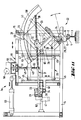
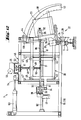
- Suitable braking devices 65 can be part of the grinding device 7, as schematically indicated by an example handwheel in FIGS. 7 to 9.
- the monitoring and setting (switch and control box 66) of all operating parameters, including the visual assessment of the grinding result, is carried out by the corresponding operating personnel, for whom inspection surfaces 67 are provided on the grinding device 7 (FIGS. 7 to 9).
- the generatrix E of the grinding wheel 24, as can be seen in FIG. 10 is brought up to the rail head 5 to be machined, and the rail head is machined to the desired length (driving the grinding device).
- the generation is guided according to the ideal contour of the rail head by a computer program which makes all the settings via the corresponding geared motors or valves.
- a computer program which makes all the settings via the corresponding geared motors or valves.
- Appropriate rotary encoders or displacement sensors are known to the person skilled in the art for monitoring the setting parameters.
Landscapes
- Engineering & Computer Science (AREA)
- Mechanical Engineering (AREA)
- Architecture (AREA)
- Civil Engineering (AREA)
- Structural Engineering (AREA)
- Machines For Laying And Maintaining Railways (AREA)
Applications Claiming Priority (2)
| Application Number | Priority Date | Filing Date | Title |
|---|---|---|---|
| DE4316252 | 1993-05-14 | ||
| DE19934316252 DE4316252C2 (de) | 1993-05-14 | 1993-05-14 | Schienenschleifmaschine |
Publications (2)
| Publication Number | Publication Date |
|---|---|
| EP0624689A2 true EP0624689A2 (fr) | 1994-11-17 |
| EP0624689A3 EP0624689A3 (fr) | 1995-05-17 |
Family
ID=6488151
Family Applications (1)
| Application Number | Title | Priority Date | Filing Date |
|---|---|---|---|
| EP94106636A Withdrawn EP0624689A3 (fr) | 1993-05-14 | 1994-04-28 | Machine de meulage de rails. |
Country Status (2)
| Country | Link |
|---|---|
| EP (1) | EP0624689A3 (fr) |
| DE (1) | DE4316252C2 (fr) |
Cited By (5)
| Publication number | Priority date | Publication date | Assignee | Title |
|---|---|---|---|---|
| EP1400629A3 (fr) * | 2002-09-20 | 2005-03-16 | Wilfried Scherf | Machine de meulage pour rails, notamment pour des rails de grue pour conteneur |
| WO2007033763A1 (fr) * | 2005-09-20 | 2007-03-29 | Robel Bahnbaumaschinen Gmbh | Dispositif et procede pour reprofiler le rail d'une voie |
| EP3028802A1 (fr) * | 2014-12-04 | 2016-06-08 | Elektro-Thermit GmbH & Co. KG | Procede et dispositif de preparation et de post-traitement d'une soudure |
| CN111794024A (zh) * | 2020-07-07 | 2020-10-20 | 中国铁建高新装备股份有限公司 | 无砟轨道的打磨系统及方法 |
| CN115075069A (zh) * | 2022-06-23 | 2022-09-20 | 河北喆速科技有限公司 | 一种打磨装置和具有打磨装置的打磨车 |
Families Citing this family (4)
| Publication number | Priority date | Publication date | Assignee | Title |
|---|---|---|---|---|
| DE4437541C2 (de) * | 1994-10-20 | 1998-08-20 | Elektro Thermit Gmbh | Schleifmaschine |
| DE20004932U1 (de) * | 2000-03-17 | 2001-07-26 | Partech Produktionsekonomi Ab, Skara | Vorrichtung zum Schleifen von Schienen |
| DE202016005093U1 (de) | 2016-08-22 | 2016-11-29 | Spitzke Se | Schienenschleifmaschine für die Bahntechnik |
| CN111872793B (zh) * | 2020-08-06 | 2022-04-12 | 广州坤厚检测技术有限公司 | 一种工业轨道探伤机器人 |
Family Cites Families (9)
| Publication number | Priority date | Publication date | Assignee | Title |
|---|---|---|---|---|
| US3707808A (en) * | 1970-10-05 | 1973-01-02 | Mannix Construction Inc | Rail grinder |
| CH560090A5 (fr) * | 1972-12-29 | 1975-03-27 | Elektro Thermit Gmbh | |
| DE2410564C3 (de) * | 1974-03-06 | 1978-08-10 | Georg Robel Gmbh & Co, 8000 Muenchen | Schienenkopf-Nachformschleifmaschine |
| AT344772B (de) * | 1975-12-01 | 1978-08-10 | Plasser Bahnbaumasch Franz | Schienenschleifmaschine |
| US4178724A (en) * | 1978-03-23 | 1979-12-18 | Harsco Corporation | Rail grinding system |
| DE3243602A1 (de) * | 1982-11-25 | 1984-05-30 | Elektro-Thermit Gmbh, 4300 Essen | Auf einer oder beiden schiene(n) eines gleises verfahrbare schienenschleifmaschine |
| US4785589A (en) * | 1986-02-28 | 1988-11-22 | Les Fils D'auguste Scheuchzer S.A. | Process for measuring and grinding the profile of a rail head |
| US4862647A (en) * | 1987-08-31 | 1989-09-05 | Loram Maintenance Of Way, Inc. | Rail grinding machine |
| DK0444242T3 (da) * | 1990-01-26 | 1993-03-01 | Elaugen Gmbh | Skinne-slibemaskine |
-
1993
- 1993-05-14 DE DE19934316252 patent/DE4316252C2/de not_active Expired - Fee Related
-
1994
- 1994-04-28 EP EP94106636A patent/EP0624689A3/fr not_active Withdrawn
Cited By (5)
| Publication number | Priority date | Publication date | Assignee | Title |
|---|---|---|---|---|
| EP1400629A3 (fr) * | 2002-09-20 | 2005-03-16 | Wilfried Scherf | Machine de meulage pour rails, notamment pour des rails de grue pour conteneur |
| WO2007033763A1 (fr) * | 2005-09-20 | 2007-03-29 | Robel Bahnbaumaschinen Gmbh | Dispositif et procede pour reprofiler le rail d'une voie |
| EP3028802A1 (fr) * | 2014-12-04 | 2016-06-08 | Elektro-Thermit GmbH & Co. KG | Procede et dispositif de preparation et de post-traitement d'une soudure |
| CN111794024A (zh) * | 2020-07-07 | 2020-10-20 | 中国铁建高新装备股份有限公司 | 无砟轨道的打磨系统及方法 |
| CN115075069A (zh) * | 2022-06-23 | 2022-09-20 | 河北喆速科技有限公司 | 一种打磨装置和具有打磨装置的打磨车 |
Also Published As
| Publication number | Publication date |
|---|---|
| DE4316252C2 (de) | 1995-05-18 |
| EP0624689A3 (fr) | 1995-05-17 |
| DE4316252A1 (de) | 1994-11-24 |
Similar Documents
| Publication | Publication Date | Title |
|---|---|---|
| DE69410233T2 (de) | Vorrichtung zur Wiederprofilierung von Eisenbahnschienen | |
| DE69410430T2 (de) | Vorrichtung zur Wiederprofilierung von Eisenbahnschienen | |
| EP2467233B1 (fr) | Dispositif pour manipuler des brames aux fins de meulage des surfaces de brames | |
| DE3015283C2 (de) | Verfahren und gleisverfahrbare Hobel-Maschine zum Abhobeln von Unregelmäßigkeiten an der Schienenkopfoberfläche eines verlegten Gleises | |
| EP3455019B1 (fr) | Machine d'usinage d'engrenages comprenant un dispositif de centrage | |
| DE2612173A1 (de) | Fahrbare schienenschleifmaschine | |
| DE2612174B2 (de) | Schienenschleifmaschine für das Abschleifen von Unregelmäßigkeiten der Schienen-Fahrfläche | |
| DE3222208A1 (de) | Vorrichtung zum fraesen von schienenkoepfen | |
| DD254749A5 (de) | Verfahren zum messen und schleifen des profils eines schienenkopfes und schienenschleifwagen zur durchfuehrung des verfahrens | |
| EP1339919B1 (fr) | Dispositif roulant destine a l'usinage de rails par enlevement de copeaux | |
| CH635151A5 (de) | Gleisverfahrbare maschine zum bearbeiten der schienenkopfoberflaechen. | |
| DE4316252C2 (de) | Schienenschleifmaschine | |
| DE1904125A1 (de) | Vorrichtung und Verfahren zur Behandlung von Gleisen | |
| DE102012108691B4 (de) | Entschichtungsvorrichtung und Entschichtungsverfahren | |
| DE2801110A1 (de) | Fahrbare schienenschleifmaschine | |
| DE69103268T2 (de) | Tangentiale schienenschleifmachine, insbesondere für eisenbahnschienen. | |
| DE2801111A1 (de) | Verfahren und schienenschleiffahrzeug zum abschleifen von unregelmaessigkeiten der schienenkopfoberflaechen | |
| EP1400629B1 (fr) | Machine de meulage pour rails, notamment pour des rails de grue pour conteneur | |
| EP1122040A2 (fr) | Machine de coupe équipée d'un support pour le couteau pouvant suivre des trajectoires courbes | |
| DE202006015507U1 (de) | Vorrichtung zum Schleifen von Schienen | |
| CH693960A5 (de) | Schienenreprofiliermaschine zum Bearbeiten des Laengs- und Querprofils der Schienenstraenge eines Gleises. | |
| EP2565015A1 (fr) | Dispositif et procédé destinés au rééquipement de machines d'enrobage de profilés | |
| DE10058820A1 (de) | Vorrichtung zum Erzeugen von unter regelmässigem Abstand aufeinander folgenden Ausnehmungen in einem langgestreckten Werkstück | |
| DE3834279A1 (de) | Verfahren und anlage zur spanabhebenden bearbeitung von brammen und bloecken | |
| DE3933863A1 (de) | Schleifmaschine |
Legal Events
| Date | Code | Title | Description |
|---|---|---|---|
| PUAI | Public reference made under article 153(3) epc to a published international application that has entered the european phase |
Free format text: ORIGINAL CODE: 0009012 |
|
| 17P | Request for examination filed |
Effective date: 19940504 |
|
| AK | Designated contracting states |
Kind code of ref document: A2 Designated state(s): DE NL |
|
| PUAL | Search report despatched |
Free format text: ORIGINAL CODE: 0009013 |
|
| AK | Designated contracting states |
Kind code of ref document: A3 Designated state(s): DE NL |
|
| 17Q | First examination report despatched |
Effective date: 19960229 |
|
| STAA | Information on the status of an ep patent application or granted ep patent |
Free format text: STATUS: THE APPLICATION HAS BEEN WITHDRAWN |
|
| 18W | Application withdrawn |
Withdrawal date: 19960603 |