EP0625764A2 - Classification O.C.R. accélerée - Google Patents
Classification O.C.R. accélerée Download PDFInfo
- Publication number
- EP0625764A2 EP0625764A2 EP94303486A EP94303486A EP0625764A2 EP 0625764 A2 EP0625764 A2 EP 0625764A2 EP 94303486 A EP94303486 A EP 94303486A EP 94303486 A EP94303486 A EP 94303486A EP 0625764 A2 EP0625764 A2 EP 0625764A2
- Authority
- EP
- European Patent Office
- Prior art keywords
- template
- input
- vector
- vectors
- comparison
- Prior art date
- Legal status (The legal status is an assumption and is not a legal conclusion. Google has not performed a legal analysis and makes no representation as to the accuracy of the status listed.)
- Withdrawn
Links
Images

Classifications
-
- G—PHYSICS
- G06—COMPUTING OR CALCULATING; COUNTING
- G06V—IMAGE OR VIDEO RECOGNITION OR UNDERSTANDING
- G06V10/00—Arrangements for image or video recognition or understanding
- G06V10/70—Arrangements for image or video recognition or understanding using pattern recognition or machine learning
- G06V10/74—Image or video pattern matching; Proximity measures in feature spaces
- G06V10/75—Organisation of the matching processes, e.g. simultaneous or sequential comparisons of image or video features; Coarse-fine approaches, e.g. multi-scale approaches; using context analysis; Selection of dictionaries
Definitions
- This invention relates to the OCR classification of input symbols, and more particularly to comparison function based nearest neighbor classification.
- comparison functions have been employed to classify input character bit maps against a library template bit maps.
- the summation of all of the pixel comparisons in each of the input/template matches produced correlation values which revealed the closest match.
- the present invention employs inter-template comparisons and the "Triangle of Inequality Principle" in order to exclude distant templates and accelerate the recognition procedure.
- European patent application no. 93306854.6 entitled Method and Apparatus for RECOGNITION TEMPLATE ENHANCEMENT teaches the use of a comparison function to enhance a library of templates with respect to the particular font of the input characters.
- European patent application no. 94300472.1 entitled RECOGNITION TEMPLATE ENHANCEMENT teaches enhancement of library templates with a provision for template sub-classes to accommodate multiple fonts and other variations in the input characters.
- the invention aims to provide an improved comparison function based OCR vector recognition method to recognize the nearest neighbor.
- the invention aims to provide such a comparison function based method which is accelerated by employing the Triangle of Inequality Principle.
- the invention aims to provide such a comparison function based method in which inter-template comparison values are pre-compared and stored for immediate use.
- the invention aims to provide such a comparison function based method in which the template vector selection for each iteration is method driven.
- the invention provides a comparison function based OCR method of recognizing the nearest neighbor classification of an input vector S with respect to a library of T template vectors.
- the input vector S defines an unclassified symbol to be recognized, and the library of T template vectors define pre-classified characters available for matching.
- the input vector S is a sequence of elements, each element having a numerical value.
- Each of the template vectors (T1, T2, ... T i ... T T ) is also a sequence of elements having numerical values.
- An initial template vector 1stT i is selected from the library and compared with the input vector S based on an input comparison function to generate an initial input comparison value 1stV.
- An initial comparison value threshold 1stR is determined as a function of the initial input comparison value 1stV.
- Inter-template comparison values are provided between the initial template vector 1stT i and the T-1 other template vectors (T1, T2 .... T T ) based on an inter-template comparison function.
- Template vectors within the library having an inter-template comparison value within the initial comparison value threshold 1stV are identified to form a first candidate group 1stG of template vectors. The group includes the nearest neighbor classification of to the input vector S, and excludes template vectors having an inter-template comparison value outside the value threshold.
- a second template vector 2ndT i is selected from the first candidate group 1stG, and compared with the input vector S to generate a second input comparison value 2ndV, Inter-template comparison values are provided between the second template vector 2ndT i and the non-selected template vectors within the first candidate group 1stG.
- the template vectors within the first candidate group 1stG having an inter-template comparison value within a value threshold determined by the second input comparison value 2ndV are identified to form a second candidate group 2ndG.
- the second group includes the nearest neighbor classification of the input vector S, and excludes template vectors from the first candidate group 1stG outside the value threshold.
- the second group also excludes all of the template vectors excluded in the previous identification step.
- the selecting step and the comparing step and the determining step and the providing inter-template comparison values step and the identifying step are repeated until all of the template vectors have been excluded except a single final template vector FinT i which is the nearest neighbor classification of the input vector S.
- a comparison function based OCR method is employed for recognizing the nearest neighbor classification of an input vector S with respect to a library of T template vectors.
- the input vector S defines an unclassified symbol (the unknown input letter) and the T template vectors define the pre-classified characters (known letters of an alphabet font in memory).
- Nearest neighbor classification is an iterative OCR matching technique in which the closest match between the input vector and the template vectors is recognized by the exclusion of distant templates. The closest match (the nearest neighbor) is accepted as the proper identification of the input symbol.
- the OCR method is accelerated by employing the Triangle of Inequality Principle which excludes distant neighbors in bulk as the iteration cycles proceed.
- the unclassified symbol and each pre-classified characters may be viewed as a point in a multi-dimensional space of E dimensions.
- Each character is defined by a template vector having E elements extending through the E dimensional space.
- the template vectors has E t dimensional elements and the input vector S has E s dimensional elements.
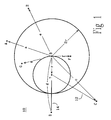
- Each character is defined by a two element template vector (X,Y) extending from the origin of the two dimensional coordinate system of plane 10.
- the position of the character points in plane 10 is for illustration only, and does not reflect the actual nearest neighbor relationship of any particular alphabet font within any given E dimensional space.
- the point for the unknown symbol is represented by the question mark "?", and the related input vector S is also a two element vector.
- the iterative comparison function based method is initiated by selecting one of the template vectors, B for instance.
- the initially selected template vector is compared with the input vector S (?) and with each of the other template vectors (A, C, D, E, F, and G) by means of the comparison function.
- the inter-template comparison values generated by this initial B comparison are the mutual distances ("a”, “c”, “d”, “e”, “f”, and "g", lower-case) between the selected point B and the other template points.
- the input comparison value is the distance ("r") between the selected point B and the input point ?.
- the Triangle of Inequality Principle may be applied to a triangle formed by point B, point "?” and any other template point (such as point C - see triangle 12).
- the principle stipulates that all template points outside of a circle of radius "2r" from the B point (such as point C) are more distant neighbors from point B than the input point "?". That is, the inter-template comparison value "c" is greater than two times the input comparison value "r", and is therefor excluded as the nearest neighbor.
- point D which is in line with point B and point "?”
- the Triangle of Inequality becomes the straight line BD (see line 14).
- Line BD includes point "?” near the middle, and is formed by line segments B? and ?D ("r").
- characters A, C, D, and E have an inter-template comparison value greater than 2r and are excluded from the next iteration cycle reducing the candidates to F and G.
- T template vectors T1, T2, ... T i ... T T
- each element having a numerical value.
- the numerical values of the input vector elements and template vector elements may be the intensity levels (greyscale) of the pixels within a pixel image (see Pixel Matrix section).
- the numerical value of each element may be the number value of a distinguishing structure included in an OCR feature set (see Visual Aspects Section).
- Other less visible recognition parameters such as moments
- a series of numbers may be employed to form the elements of the vectors.
- the selection may be completely random. That is, any template vector in the library (or in the subsequent smaller candidate groups) may be the initial vector (or the selected vector).
- the order of the selection may be a fixed but arbitrary sequence associated with the library, such as for example the alphabetical sequence A-Z, then a-z, and then 0-9, etc. In such a fixed sequence, the same template vector is always the initial vector, and the subsequently selected vectors follow the same order subject to the progressive exclusion of template vectors due to the Triangle of Inequality Principle.
- the selection may be method driven such as frequency of use (F/U) or historical inference (HI) as described in the Selection Ordering section).
- the comparison function is a mathematical relationship for systematically combining the elements of the input vector S with the elements of each selected template vector to generate a progression of scaler input comparison values. Units are not applicable to the comparison values because they are used for comparison of like entities.
- the comparison function may be a dissimilarity type function (see Dissimilarity Function section) which quantifies the differences between the compared vectors.
- the comparison function may be a similarity type function (see Similarity Function section) which quantifies the similarities between the compared vectors.
- an initial comparison value threshold 1stR as a function of the initial input comparison value 1stV.
- the value threshold may be simply twice the input comparison value as employed the dissimilarity comparison function (see Figure 1), or a more complex relationship for other types of comparison functions.
- inter-template comparison value between the initial template vector 1stT i and each of the T-1 other template vectors (T1, T2 .... T T ) based on an inter-template comparison function.
- the inter-template comparison values are also scalers.
- the inter-template comparison function may be identical to the input comparison function, or mathematically equivalent to the input comparison function.
- This first identification step forms a first candidate group 1stG of template vectors which includes the nearest neighbor classification of to the input vector S with respect to the library of T templates.
- the first candidate group excludes template vectors having an inter-template comparison value outside the value threshold.
- This second identification step forms a second candidate group 2ndG of template vectors which includes the nearest neighbor classification of the input vector S.
- the second candidate group excludes template vectors from the first candidate group 1stG having an inter-template comparison value outside the value threshold; and also excludes all of the template vectors excluded in the previous identifying step.
- the one remaining template vector is the nearest neighbor classification of the input vector S with respect to the library of T template vectors.
- Each of the inter-template comparison values (T i T j ) is therefore constant, and may be pre-compared and stored in a memory device for immediate use during the iteration cycles.
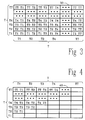
- a full complement of inter-template comparison values (T1 T1 T1 T2 T T T T ) may be stored in a T by T pairwise memory 30 which has T rows and T columns (see Figure 3) and includes T2 entries. All of the inter-template comparison values paired with a selected template vector may be retrieved immediately by addressing the row (or column) of the selected template vector.
- every inter-template comparison value appears twice (once by row and once by column).
- the trivial self comparison values between the same template vector (T1 T1 T2 T2 .. T i T i .. T T T T ) are included along the diagonal. These trivial comparison values have minimum values (zeros for example) for a dissimilarity function and maximum values (ones for example) for a similarity function.
- a non-redundant complement of inter-template comparison values stored in truncated memory 40 include (T2-T)/2 entries. Each inter-template comparison value appears once (by row only), and the trivial comparison values have been eliminated.
- the input vector S and the template vectors may define the input unclassified symbol and the pre-classified characters in a directly visible image format of such as a pixel matrix.
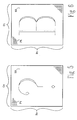
- the input symbol is shown as the symbol "?"
- the selected template vector is shown as the character "B”.
- the images are contained in the contrast difference between foreground pixels and background pixels stored as digital data in a pixel bit map memory. Each element is stored as one pixel.
- the foreground and background may be black and white data in a binary format, or intensity (or shade) level data in greyscale (or color) format.
- the input vector matrix 50 (see Figure 5) has P s pixel elements and each template vector matrix 60 (see Figure 6) has P t pixel elements.
- the unclassified symbol may be defined by the input vector matrix at the same pixel resolution as the pre-classified characters are defined by the template vectors. In this equal resolution case, the number of pixels P s in the input vector matrix is equal to the number of pixels P t in the template vector matrix.
- the pixel image of the input vector is a pixel matrix having R s rows and C s columns
- the pixel image of each of the T template vectors is a pixel matrix having R t rows and C t columns.
- the number of rows R s and columns C s in the pixel image of the input vector is equal to the number of rows R t and columns C t in the pixel image of each of the T template vectors.
- the unclassified symbol may be defined at a different pixel resolution than the pre-classified characters; in which case P s (and R s and C s ) will not be equal to P t (and R t and C t ).
- the resolution of the unclassified input symbol may be a multiple "m" of the resolution of the pre-classified template characters.
- the number of pixel P s in the input vector matrix is a multiple "m" of the number of pixels P t in the template vectors.
- the useful resolution of the matrix is a function of the resolution of the scanner employed to image the printed letter into a vector in memory.
- the 2400 pixel matrix (60x40) may be obtained from a 400 dpi (dots per inch) scanner, and the 600 pixel matrix (30x20) from 200 dpi scanner.
- the number of pixels P s in the input vector matrix may be reduced to match the number of pixels P t in the template vectors, by substituting an average value for each square group of pixels having "m" pixels on a side. That is, each m by m square of pixels of the input vector matrix may be replaced by a single compound pixel for use in the input comparison function. Alternatively, the number of pixels P s may be reduced by using only every mth row and every mth column of the input vector matrix.
- the resolution of the pre-classified template characters may be a multiple "m" of the resolution of the unclassified input symbol, in which case P t is a multiple "m" P s .
- P t may be reduced to match P s by averaging adjacent pixel elements or by using only every 3rd row and 3rd column.
- the sequence of elements in the input vector S may define merely visual aspects of the unclassified symbol, and not the entire image as discussed in the Pixel Image section.
- the sequence of elements in each of the T template vectors defines corresponding visual aspects of the pre-classified characters.
- the visual aspects of the input symbol and template characters may be a feature set which includes such distinguishing structures as: overall height, overall width, stroke width, position of major lines, position of minor lines, image density, total foreground (black) pixel count, center of foreground data, and outline of foreground data in terms of distance and angles (walk around).
- the comparison function may be a dissimilarity function (as presented in connection with Figure 1) in which the input comparison value generated at each iteration is the Euclidian distance "r" between the selected template vector and the input vector S.
- the inter-template comparison function may contain normalization factors (or other adjustment parameters) which renders the inter-template comparison function non-identical (but mathematically equivalent) to the input comparison function.
- the comparison function may be a similarity function which generates increasing comparison values as the iterations proceed and input vector S approaches the nearest neighbor match.
- the sequence of selection of template vectors from the diminishing candidate group may be random or ordered. Ordered selection may optimize the exclusion process resulting in a nearest neighbor classification of the input symbol with fewer iterations.
- the ordering may be based on the frequency of use (F/U) of the template characters in the type of text being processed. Alternatively, the ordering may be based on "historical inference" (HI), the statistical likelihood that any known character will be followed (or preceded) by any particular character remaining in the candidate group. Ordinary English usage may be a suitable ordering basis for most applications. Either of the above two ordering techniques (or other ordering information), will yield successive template selections with the most probable match with the unknown input symbol under the circumstances.
- the following three examples show the nearest neighbor accelerated (NNA) classification of the seven letters in the word "Example” (first without ordering, second with F/U ordering, and third with HI ordering).
- the initial information is baseline data generated without the benefit of NNA, for illustrating the reduction in iterations provided by each of the three acceleration examples.
- the template selection employed for the base line was the random fixed sequence A-Z, then a-z, then 0-9, then punctuation and related symbols (as listed above).
- Input Letter E x a m p l e Number Iterations 35 46 03 14 21 11 01 F/U ordering reduced the number of iterations by a factor of five from the baseline random selection.
- the character "e” (lower-case) is the most frequently used character in ordinary English usage and was the first selection for each input letter.
- the last letter of the word “Example” is the input letter "e”, and was therefore classified correctly on the first selection.
- the other input letters required more iterations based on F/U data.
- the input letter “E” (upper-case) is less common and required 35 iterations.
- the letter "x" is one of the least frequently used letters and required 45 iterations to classify.
- the present disclosure also extends to automatic optical character recognition apparatus, programmed or otherwise constructed to implement the methods described above.
- the components of such an apparatus can take the well known form of a programmable processor provided with memory for storage of templates, input symbols and output symbols, together with input and output devices such as a scanner, printer, modem and the like.
- the invention provides greater speed of recognition for a given processor capacity.
- specialised processing elements can be used in place of a general purpose processor, if desired.
Landscapes
- Engineering & Computer Science (AREA)
- Computer Vision & Pattern Recognition (AREA)
- Theoretical Computer Science (AREA)
- Evolutionary Computation (AREA)
- Computing Systems (AREA)
- Databases & Information Systems (AREA)
- Artificial Intelligence (AREA)
- General Health & Medical Sciences (AREA)
- Medical Informatics (AREA)
- Software Systems (AREA)
- Health & Medical Sciences (AREA)
- Physics & Mathematics (AREA)
- General Physics & Mathematics (AREA)
- Multimedia (AREA)
- Character Discrimination (AREA)
Applications Claiming Priority (2)
| Application Number | Priority Date | Filing Date | Title |
|---|---|---|---|
| US6283093A | 1993-05-17 | 1993-05-17 | |
| US62830 | 1993-05-17 |
Publications (2)
| Publication Number | Publication Date |
|---|---|
| EP0625764A2 true EP0625764A2 (fr) | 1994-11-23 |
| EP0625764A3 EP0625764A3 (fr) | 1995-07-19 |
Family
ID=22045106
Family Applications (1)
| Application Number | Title | Priority Date | Filing Date |
|---|---|---|---|
| EP94303486A Withdrawn EP0625764A3 (fr) | 1993-05-17 | 1994-05-16 | Classification O.C.R. accélerée. |
Country Status (2)
| Country | Link |
|---|---|
| EP (1) | EP0625764A3 (fr) |
| JP (1) | JPH0737037A (fr) |
Cited By (3)
| Publication number | Priority date | Publication date | Assignee | Title |
|---|---|---|---|---|
| GB2457584A (en) * | 2008-02-20 | 2009-08-26 | Siemens Medical Solutions | Template block matching using a similarity function and incremental threshold |
| EP2154814A1 (fr) * | 2008-08-14 | 2010-02-17 | Koninklijke Philips Electronics N.V. | Distribution de clé extensible |
| WO2010033459A1 (fr) * | 2008-09-16 | 2010-03-25 | Viewdle, Inc. | Système et procédé pour le groupage et l’identification d’objets dans une vidéo |
Family Cites Families (1)
| Publication number | Priority date | Publication date | Assignee | Title |
|---|---|---|---|---|
| US5150425A (en) * | 1991-08-30 | 1992-09-22 | Eastman Kodak Company | Character recognition method using correlation search |
-
1994
- 1994-05-16 EP EP94303486A patent/EP0625764A3/fr not_active Withdrawn
- 1994-05-17 JP JP6102933A patent/JPH0737037A/ja not_active Withdrawn
Non-Patent Citations (1)
| Title |
|---|
| MICHAEL T. ORCHARD: "A Fast Nearest Neighbor Search Algorithm", IEEE ICASSP CONFERENCE AT TORONTO CANADA, vol. 4, 14 May 1991 (1991-05-14), pages 2297 - 2300 |
Cited By (6)
| Publication number | Priority date | Publication date | Assignee | Title |
|---|---|---|---|---|
| GB2457584A (en) * | 2008-02-20 | 2009-08-26 | Siemens Medical Solutions | Template block matching using a similarity function and incremental threshold |
| GB2457584B (en) * | 2008-02-20 | 2010-09-29 | Siemens Medical Solutions | Fast block matching in digital images |
| EP2154814A1 (fr) * | 2008-08-14 | 2010-02-17 | Koninklijke Philips Electronics N.V. | Distribution de clé extensible |
| US8542828B2 (en) | 2008-08-14 | 2013-09-24 | Koninklijke Philips N.V. | Cryptographic secret key distribution |
| WO2010033459A1 (fr) * | 2008-09-16 | 2010-03-25 | Viewdle, Inc. | Système et procédé pour le groupage et l’identification d’objets dans une vidéo |
| US8150169B2 (en) | 2008-09-16 | 2012-04-03 | Viewdle Inc. | System and method for object clustering and identification in video |
Also Published As
| Publication number | Publication date |
|---|---|
| JPH0737037A (ja) | 1995-02-07 |
| EP0625764A3 (fr) | 1995-07-19 |
Similar Documents
| Publication | Publication Date | Title |
|---|---|---|
| US11922318B2 (en) | System and method of character recognition using fully convolutional neural networks with attention | |
| US5438630A (en) | Word spotting in bitmap images using word bounding boxes and hidden Markov models | |
| US5745600A (en) | Word spotting in bitmap images using text line bounding boxes and hidden Markov models | |
| US5825919A (en) | Technique for generating bounding boxes for word spotting in bitmap images | |
| US4773099A (en) | Pattern classification means for use in a pattern recognition system | |
| EP0307111B1 (fr) | Appareil de reconnaissance de caractères | |
| US5557689A (en) | Optical word recognition by examination of word shape | |
| EP0147657B1 (fr) | Procédé et dispositif reconnaissance de caractères, basés sur la fréquence d'occurence de caractères | |
| US5347595A (en) | Preprocessing means for use in a pattern classification system | |
| US5539841A (en) | Method for comparing image sections to determine similarity therebetween | |
| US5640466A (en) | Method of deriving wordshapes for subsequent comparison | |
| EP0649113B1 (fr) | Reconnaissance optique multifonte de caractères avec une approche par boíte de connectivité | |
| US5077807A (en) | Preprocessing means for use in a pattern classification system | |
| Pu et al. | A natural learning algorithm based on Hough transform for text lines extraction in handwritten documents | |
| EP0602956A2 (fr) | Reconnaissance de texte | |
| US20010051965A1 (en) | Apparatus for rough classification of words, method for rough classification of words, and record medium recording a control program thereof | |
| EP3539051A1 (fr) | Système et procédé de reconnaissance de caractères à l'aide de réseaux de neurone entièrement convolutifs | |
| KR100220213B1 (ko) | 문자화상의 히스토그램의0-1패턴표현에 기초한 문자인식방법 및 장치 | |
| EP1010128B1 (fr) | Procede de reconnaissance de caracteres sur une matrice de pixels | |
| EP0602955B1 (fr) | Reconnaissance de texte | |
| CN109325138A (zh) | 一种基于扩展与亚像素矩阵结合的图像快速识别方法 | |
| JPH0737037A (ja) | 最近傍分類を認識する比較関数に基づくocr方法 | |
| US5559898A (en) | Comparison inequality function based method for accelerated OCR correlation | |
| Eliaz et al. | Word-level recognition of small sets of hand-written words | |
| JP3361564B2 (ja) | 高速マッチング方法及び装置 |
Legal Events
| Date | Code | Title | Description |
|---|---|---|---|
| PUAI | Public reference made under article 153(3) epc to a published international application that has entered the european phase |
Free format text: ORIGINAL CODE: 0009012 |
|
| AK | Designated contracting states |
Kind code of ref document: A2 Designated state(s): DE FR GB IT |
|
| PUAL | Search report despatched |
Free format text: ORIGINAL CODE: 0009013 |
|
| AK | Designated contracting states |
Kind code of ref document: A3 Designated state(s): DE FR GB IT |
|
| 17P | Request for examination filed |
Effective date: 19951129 |
|
| 17Q | First examination report despatched |
Effective date: 19960102 |
|
| STAA | Information on the status of an ep patent application or granted ep patent |
Free format text: STATUS: THE APPLICATION IS DEEMED TO BE WITHDRAWN |
|
| 18D | Application deemed to be withdrawn |
Effective date: 19980505 |