EP0626409B1 - Verfahren zur Herstellung von Polycarbonaten - Google Patents
Verfahren zur Herstellung von Polycarbonaten Download PDFInfo
- Publication number
- EP0626409B1 EP0626409B1 EP19940303447 EP94303447A EP0626409B1 EP 0626409 B1 EP0626409 B1 EP 0626409B1 EP 19940303447 EP19940303447 EP 19940303447 EP 94303447 A EP94303447 A EP 94303447A EP 0626409 B1 EP0626409 B1 EP 0626409B1
- Authority
- EP
- European Patent Office
- Prior art keywords
- accordance
- bisphenol
- phosgene
- phase transfer
- polycarbonate
- Prior art date
- Legal status (The legal status is an assumption and is not a legal conclusion. Google has not performed a legal analysis and makes no representation as to the accuracy of the status listed.)
- Expired - Lifetime
Links
- 238000000034 method Methods 0.000 title claims description 22
- 239000004417 polycarbonate Substances 0.000 title claims description 21
- 229920000515 polycarbonate Polymers 0.000 title claims description 21
- 125000003118 aryl group Chemical group 0.000 title claims description 3
- ZMANZCXQSJIPKH-UHFFFAOYSA-N Triethylamine Chemical compound CCN(CC)CC ZMANZCXQSJIPKH-UHFFFAOYSA-N 0.000 claims description 30
- IISBACLAFKSPIT-UHFFFAOYSA-N bisphenol A Chemical compound C=1C=C(O)C=CC=1C(C)(C)C1=CC=C(O)C=C1 IISBACLAFKSPIT-UHFFFAOYSA-N 0.000 claims description 30
- YGYAWVDWMABLBF-UHFFFAOYSA-N Phosgene Chemical compound ClC(Cl)=O YGYAWVDWMABLBF-UHFFFAOYSA-N 0.000 claims description 26
- 229930185605 Bisphenol Natural products 0.000 claims description 23
- 239000003444 phase transfer catalyst Substances 0.000 claims description 17
- 239000000203 mixture Substances 0.000 claims description 16
- ISWSIDIOOBJBQZ-UHFFFAOYSA-N phenol group Chemical group C1(=CC=CC=C1)O ISWSIDIOOBJBQZ-UHFFFAOYSA-N 0.000 claims description 12
- AOGYCOYQMAVAFD-UHFFFAOYSA-N chlorocarbonic acid Chemical group OC(Cl)=O AOGYCOYQMAVAFD-UHFFFAOYSA-N 0.000 claims description 11
- 125000000217 alkyl group Chemical group 0.000 claims description 7
- 238000006243 chemical reaction Methods 0.000 claims description 7
- 238000010406 interfacial reaction Methods 0.000 claims description 6
- VDZOOKBUILJEDG-UHFFFAOYSA-M tetrabutylammonium hydroxide Chemical group [OH-].CCCC[N+](CCCC)(CCCC)CCCC VDZOOKBUILJEDG-UHFFFAOYSA-M 0.000 claims description 6
- CJWNFAKWHDOUKL-UHFFFAOYSA-N 2-(2-phenylpropan-2-yl)phenol Chemical group C=1C=CC=C(O)C=1C(C)(C)C1=CC=CC=C1 CJWNFAKWHDOUKL-UHFFFAOYSA-N 0.000 claims description 3
- -1 aromatic phenol compound Chemical class 0.000 claims description 3
- 238000011084 recovery Methods 0.000 claims description 3
- 239000004793 Polystyrene Substances 0.000 claims description 2
- 125000005843 halogen group Chemical group 0.000 claims description 2
- 229910052739 hydrogen Inorganic materials 0.000 claims description 2
- 229910052757 nitrogen Inorganic materials 0.000 claims description 2
- IJGRMHOSHXDMSA-UHFFFAOYSA-N nitrogen Substances N#N IJGRMHOSHXDMSA-UHFFFAOYSA-N 0.000 claims description 2
- QJGQUHMNIGDVPM-UHFFFAOYSA-N nitrogen group Chemical group [N] QJGQUHMNIGDVPM-UHFFFAOYSA-N 0.000 claims description 2
- 125000004437 phosphorous atom Chemical group 0.000 claims description 2
- 229910052698 phosphorus Chemical group 0.000 claims description 2
- 229920002223 polystyrene Polymers 0.000 claims description 2
- NHGXDBSUJJNIRV-UHFFFAOYSA-M tetrabutylammonium chloride Chemical compound [Cl-].CCCC[N+](CCCC)(CCCC)CCCC NHGXDBSUJJNIRV-UHFFFAOYSA-M 0.000 claims 2
- JRMUNVKIHCOMHV-UHFFFAOYSA-M tetrabutylammonium bromide Chemical group [Br-].CCCC[N+](CCCC)(CCCC)CCCC JRMUNVKIHCOMHV-UHFFFAOYSA-M 0.000 claims 1
- RKHXQBLJXBGEKF-UHFFFAOYSA-M tetrabutylphosphanium;bromide Chemical group [Br-].CCCC[P+](CCCC)(CCCC)CCCC RKHXQBLJXBGEKF-UHFFFAOYSA-M 0.000 claims 1
- YMWUJEATGCHHMB-UHFFFAOYSA-N Dichloromethane Chemical compound ClCCl YMWUJEATGCHHMB-UHFFFAOYSA-N 0.000 description 15
- 239000003054 catalyst Substances 0.000 description 11
- FZFAMSAMCHXGEF-UHFFFAOYSA-N chloro formate Chemical compound ClOC=O FZFAMSAMCHXGEF-UHFFFAOYSA-N 0.000 description 11
- HEMHJVSKTPXQMS-UHFFFAOYSA-M Sodium hydroxide Chemical compound [OH-].[Na+] HEMHJVSKTPXQMS-UHFFFAOYSA-M 0.000 description 9
- 238000009833 condensation Methods 0.000 description 9
- 230000005494 condensation Effects 0.000 description 9
- 229940086542 triethylamine Drugs 0.000 description 9
- 150000001412 amines Chemical class 0.000 description 8
- 230000007062 hydrolysis Effects 0.000 description 8
- 238000006460 hydrolysis reaction Methods 0.000 description 8
- VPWNQTHUCYMVMZ-UHFFFAOYSA-N 4,4'-sulfonyldiphenol Chemical class C1=CC(O)=CC=C1S(=O)(=O)C1=CC=C(O)C=C1 VPWNQTHUCYMVMZ-UHFFFAOYSA-N 0.000 description 6
- 238000001514 detection method Methods 0.000 description 5
- KWYUFKZDYYNOTN-UHFFFAOYSA-M Potassium hydroxide Chemical compound [OH-].[K+] KWYUFKZDYYNOTN-UHFFFAOYSA-M 0.000 description 4
- 229920000642 polymer Polymers 0.000 description 4
- 239000011541 reaction mixture Substances 0.000 description 4
- 235000011121 sodium hydroxide Nutrition 0.000 description 4
- 239000012074 organic phase Substances 0.000 description 3
- 239000000243 solution Substances 0.000 description 3
- XLYOFNOQVPJJNP-UHFFFAOYSA-N water Substances O XLYOFNOQVPJJNP-UHFFFAOYSA-N 0.000 description 3
- QPFMBZIOSGYJDE-UHFFFAOYSA-N 1,1,2,2-tetrachloroethane Chemical compound ClC(Cl)C(Cl)Cl QPFMBZIOSGYJDE-UHFFFAOYSA-N 0.000 description 2
- RFFLAFLAYFXFSW-UHFFFAOYSA-N 1,2-dichlorobenzene Chemical compound ClC1=CC=CC=C1Cl RFFLAFLAYFXFSW-UHFFFAOYSA-N 0.000 description 2
- HTVITOHKHWFJKO-UHFFFAOYSA-N Bisphenol B Chemical compound C=1C=C(O)C=CC=1C(C)(CC)C1=CC=C(O)C=C1 HTVITOHKHWFJKO-UHFFFAOYSA-N 0.000 description 2
- HEDRZPFGACZZDS-UHFFFAOYSA-N Chloroform Chemical compound ClC(Cl)Cl HEDRZPFGACZZDS-UHFFFAOYSA-N 0.000 description 2
- JUJWROOIHBZHMG-UHFFFAOYSA-N Pyridine Chemical compound C1=CC=NC=C1 JUJWROOIHBZHMG-UHFFFAOYSA-N 0.000 description 2
- 150000001338 aliphatic hydrocarbons Chemical class 0.000 description 2
- 239000003513 alkali Substances 0.000 description 2
- 229910001854 alkali hydroxide Inorganic materials 0.000 description 2
- 150000008044 alkali metal hydroxides Chemical class 0.000 description 2
- 229910001860 alkaline earth metal hydroxide Inorganic materials 0.000 description 2
- 238000004458 analytical method Methods 0.000 description 2
- 230000015572 biosynthetic process Effects 0.000 description 2
- MVPPADPHJFYWMZ-UHFFFAOYSA-N chlorobenzene Chemical compound ClC1=CC=CC=C1 MVPPADPHJFYWMZ-UHFFFAOYSA-N 0.000 description 2
- 239000003960 organic solvent Substances 0.000 description 2
- 150000002989 phenols Chemical class 0.000 description 2
- 235000011118 potassium hydroxide Nutrition 0.000 description 2
- 238000003756 stirring Methods 0.000 description 2
- 238000003786 synthesis reaction Methods 0.000 description 2
- VZGDMQKNWNREIO-UHFFFAOYSA-N tetrachloromethane Chemical compound ClC(Cl)(Cl)Cl VZGDMQKNWNREIO-UHFFFAOYSA-N 0.000 description 2
- UKDOTCFNLHHKOF-FGRDZWBJSA-N (z)-1-chloroprop-1-ene;(z)-1,2-dichloroethene Chemical group C\C=C/Cl.Cl\C=C/Cl UKDOTCFNLHHKOF-FGRDZWBJSA-N 0.000 description 1
- 0 *C(*)(c(cc1)ccc1O)c(cc1)ccc1O Chemical compound *C(*)(c(cc1)ccc1O)c(cc1)ccc1O 0.000 description 1
- UOCLXMDMGBRAIB-UHFFFAOYSA-N 1,1,1-trichloroethane Chemical compound CC(Cl)(Cl)Cl UOCLXMDMGBRAIB-UHFFFAOYSA-N 0.000 description 1
- SCYULBFZEHDVBN-UHFFFAOYSA-N 1,1-Dichloroethane Chemical compound CC(Cl)Cl SCYULBFZEHDVBN-UHFFFAOYSA-N 0.000 description 1
- KNKRKFALVUDBJE-UHFFFAOYSA-N 1,2-dichloropropane Chemical compound CC(Cl)CCl KNKRKFALVUDBJE-UHFFFAOYSA-N 0.000 description 1
- VWILLUSNXUETFP-UHFFFAOYSA-N 2-[4-(2-hydroxyphenyl)heptan-4-yl]phenol 4-[2-(4-hydroxyphenyl)heptan-2-yl]phenol 2-[2-(2-hydroxyphenyl)hexan-2-yl]phenol 4-[2-(4-hydroxyphenyl)-4-methylpentan-2-yl]phenol 4-[2-(4-hydroxyphenyl)pentan-2-yl]phenol Chemical compound OC1=CC=C(C=C1)C(C)(CCCCC)C1=CC=C(C=C1)O.OC1=CC=C(C=C1)C(C)(CC(C)C)C1=CC=C(C=C1)O.OC1=CC=C(C=C1)C(C)(CCC)C1=CC=C(C=C1)O.OC1=C(C=CC=C1)C(C)(CCCC)C1=C(C=CC=C1)O.OC1=C(C=CC=C1)C(CCC)(CCC)C1=C(C=CC=C1)O VWILLUSNXUETFP-UHFFFAOYSA-N 0.000 description 1
- FZQZRBQKXXGAMZ-UHFFFAOYSA-N 2-benzyl-3-nitropyridine Chemical compound [O-][N+](=O)C1=CC=CN=C1CC1=CC=CC=C1 FZQZRBQKXXGAMZ-UHFFFAOYSA-N 0.000 description 1
- WJQOZHYUIDYNHM-UHFFFAOYSA-N 2-tert-Butylphenol Chemical compound CC(C)(C)C1=CC=CC=C1O WJQOZHYUIDYNHM-UHFFFAOYSA-N 0.000 description 1
- MNHKUCBXXMFQDM-UHFFFAOYSA-N 4-[(4-nitrophenyl)methyl]pyridine Chemical compound C1=CC([N+](=O)[O-])=CC=C1CC1=CC=NC=C1 MNHKUCBXXMFQDM-UHFFFAOYSA-N 0.000 description 1
- WDGLUEUGWLZRPH-UHFFFAOYSA-N 4-[3-(4-hydroxyphenyl)-2,4-dimethylpentan-3-yl]phenol Chemical compound C=1C=C(O)C=CC=1C(C(C)C)(C(C)C)C1=CC=C(O)C=C1 WDGLUEUGWLZRPH-UHFFFAOYSA-N 0.000 description 1
- DGAQECJNVWCQMB-PUAWFVPOSA-M Ilexoside XXIX Chemical compound C[C@@H]1CC[C@@]2(CC[C@@]3(C(=CC[C@H]4[C@]3(CC[C@@H]5[C@@]4(CC[C@@H](C5(C)C)OS(=O)(=O)[O-])C)C)[C@@H]2[C@]1(C)O)C)C(=O)O[C@H]6[C@@H]([C@H]([C@@H]([C@H](O6)CO)O)O)O.[Na+] DGAQECJNVWCQMB-PUAWFVPOSA-M 0.000 description 1
- 230000002411 adverse Effects 0.000 description 1
- 238000013019 agitation Methods 0.000 description 1
- 229910000272 alkali metal oxide Inorganic materials 0.000 description 1
- 150000001340 alkali metals Chemical class 0.000 description 1
- 239000008346 aqueous phase Substances 0.000 description 1
- 150000004945 aromatic hydrocarbons Chemical class 0.000 description 1
- KCXMKQUNVWSEMD-UHFFFAOYSA-N benzyl chloride Chemical class ClCC1=CC=CC=C1 KCXMKQUNVWSEMD-UHFFFAOYSA-N 0.000 description 1
- 239000012267 brine Substances 0.000 description 1
- AXCZMVOFGPJBDE-UHFFFAOYSA-L calcium dihydroxide Chemical compound [OH-].[OH-].[Ca+2] AXCZMVOFGPJBDE-UHFFFAOYSA-L 0.000 description 1
- 239000000920 calcium hydroxide Substances 0.000 description 1
- 229910001861 calcium hydroxide Inorganic materials 0.000 description 1
- 235000011116 calcium hydroxide Nutrition 0.000 description 1
- 238000005119 centrifugation Methods 0.000 description 1
- 229920001577 copolymer Chemical compound 0.000 description 1
- 238000010908 decantation Methods 0.000 description 1
- 238000004090 dissolution Methods 0.000 description 1
- 238000001914 filtration Methods 0.000 description 1
- 238000011835 investigation Methods 0.000 description 1
- 239000007788 liquid Substances 0.000 description 1
- 229910000000 metal hydroxide Inorganic materials 0.000 description 1
- 150000004692 metal hydroxides Chemical class 0.000 description 1
- QBDSZLJBMIMQRS-UHFFFAOYSA-N p-Cumylphenol Chemical compound C=1C=C(O)C=CC=1C(C)(C)C1=CC=CC=C1 QBDSZLJBMIMQRS-UHFFFAOYSA-N 0.000 description 1
- NKTOLZVEWDHZMU-UHFFFAOYSA-N p-cumyl phenol Natural products CC1=CC=C(C)C(O)=C1 NKTOLZVEWDHZMU-UHFFFAOYSA-N 0.000 description 1
- 238000006068 polycondensation reaction Methods 0.000 description 1
- 238000006116 polymerization reaction Methods 0.000 description 1
- 230000000379 polymerizing effect Effects 0.000 description 1
- 238000002360 preparation method Methods 0.000 description 1
- UMJSCPRVCHMLSP-UHFFFAOYSA-N pyridine Natural products COC1=CC=CN=C1 UMJSCPRVCHMLSP-UHFFFAOYSA-N 0.000 description 1
- 230000003134 recirculating effect Effects 0.000 description 1
- 238000010992 reflux Methods 0.000 description 1
- 229910052708 sodium Inorganic materials 0.000 description 1
- 239000011734 sodium Substances 0.000 description 1
- HPALAKNZSZLMCH-UHFFFAOYSA-M sodium;chloride;hydrate Chemical compound O.[Na+].[Cl-] HPALAKNZSZLMCH-UHFFFAOYSA-M 0.000 description 1
- 230000003595 spectral effect Effects 0.000 description 1
- 238000010561 standard procedure Methods 0.000 description 1
- 125000005207 tetraalkylammonium group Chemical group 0.000 description 1
- 125000005497 tetraalkylphosphonium group Chemical group 0.000 description 1
- ZWZVWGITAAIFPS-UHFFFAOYSA-N thiophosgene Chemical compound ClC(Cl)=S ZWZVWGITAAIFPS-UHFFFAOYSA-N 0.000 description 1
- IMFACGCPASFAPR-UHFFFAOYSA-N tributylamine Chemical compound CCCCN(CCCC)CCCC IMFACGCPASFAPR-UHFFFAOYSA-N 0.000 description 1
Classifications
-
- C—CHEMISTRY; METALLURGY
- C08—ORGANIC MACROMOLECULAR COMPOUNDS; THEIR PREPARATION OR CHEMICAL WORKING-UP; COMPOSITIONS BASED THEREON
- C08G—MACROMOLECULAR COMPOUNDS OBTAINED OTHERWISE THAN BY REACTIONS ONLY INVOLVING UNSATURATED CARBON-TO-CARBON BONDS
- C08G64/00—Macromolecular compounds obtained by reactions forming a carbonic ester link in the main chain of the macromolecule
- C08G64/20—General preparatory processes
- C08G64/22—General preparatory processes using carbonyl halides
- C08G64/24—General preparatory processes using carbonyl halides and phenols
Definitions
- the present invention relates to a method for making polycarbonate by phosgenating a bisphenol in the presence of a phase transfer catalyst (PTC).
- PTC phase transfer catalyst
- the present invention relates to the employment of a PTC, such as a tetraalkylammonium or tetraalkyl phosphonium bromide as a condensation catalyst for the polymerization of bisphenol under interfacial reaction conditions.
- a PTC such as a tetraalkylammonium or tetraalkyl phosphonium bromide
- polycarbonates have been made by phosgenating bisphenols under interfacial reaction conditions using a tertiary organic amine, such as triethylamine as a condensation catalyst.
- a tertiary organic amine such as triethylamine
- experience has shown that use of tertiary organic amines results in excess phosgene usage.
- Efforts have been made therefore to develop procedures to minimize excessive phosgene losses.
- a reactor with an overhead condenser can be used to trap phosgene, as shown by Silva, U.S. patent 4,701,544, or the rate of heat generated during the course of bisphenol condensation can be monitored, as shown by Brunelle et al, U.S. patent 4,814,420.
- tertiary organic amines have been found to be highly effective as condensation catalysts for building polycarbonate molecular weight during phosgenation, experience has shown that tertiary organic amines often lead to excessive phosgene usage as a result of phosgene hydrolysis, and/or chloroformate hydrolysis prior to the termination of capping.
- a phosgene hydrolysis rate study it was found that at a triethylamine concentration of 6.64 x10 -3 M, triethylamine effected phosgene hydrolysis at a relative rate of greater than 200 compared to a reference value of 1 without catalyst.
- rate of chloroformate hydrolysis where a relative value of less than 0.01 has been found for a catalyst-free system, triethylamine shows a value of greater than 100.
- condensation catalysts are constantly being evaluated to determine their effectiveness for polymerizing various types of polymers. Considerable effort is being maintained to determine the effectiveness of such condensation catalysts as replacement condensation catalysts for tertiary organic amines in conventional polycarbonate synthesis.
- phase transfer catalyst "PTC” having the formula, (R) 4 Q + X where R is selected from the same or different C (4-10) alkyl group, Q is a nitrogen or phosphorus atom, and X can be a halogen atom, or an -OR 1 group, where R 1 is a member selected from H, C (1-18) alkyl or C (6-18) aryl, has been found effective as a bisphenol condensation catalyst under interfacial reaction conditions between bisphenols, or oligomeric phenols, and chloroformate terminated bisphenols, or chloroformate terminated polycarbonate oligomers.
- the relative rate of phosgene hydrolysis, or chloroformate hydrolysis for the PTC of formula (1) at a molar concentration of 6.64 x10 -3 is considerably less than triethylamine.
- a phase transfer catalyst within formula (1) has been found to have relative rate values of 1.7 to 3.5 for phosgene and about 1 for chloroformate.
- bisphenols which are included within the formula (2) are, for example, 2,2-bis(4-hydroxy phenyl)propane (bisphenol A) 2,2-bis(4-hydroxy phenyl)butane (bisphenol B) 4,4-bis(hydroxy phenyl)heptane 2,2-bis(hydroxy phenyl)hexane 2,2-bis(4-hydroxy phenyl)pentane 2,2-bis(4-hydroxy phenyl)-4-methyl pentane 2,2-bis(4-hydroxy phenyl)heptane, and 3,3-bis(4-hydroxy phenyl)2,4-dimethyl pentane.
- phase transfer catalysts which are included within formula (1) are for example, [CH 3 (CH 2 ) 3 ] 4 NX [CH 3 (CH 2 ) 3 ] 4 PX [CH 3 (CH 2 ) 5 ] 4 NX [CH 3 (CH 2 ) 6 ] 4 NX [CH 3 (CH 2 ) 4 ] 4 NX where X is selected from Cl - , Br - or -OR 1 .
- a mixture of bisphenol and a phenolic chain-stopper is phosgenated under interfacial reaction conditions in the presence of an organic solvent, in the presence of an effective amount of a phase transfer catalyst.
- organic solvents which can be used are, for example, chlorinated aliphatic hydrocarbons, such as methylene chloride, chloroform, carbon tetrachloride, dichloroethane, trichloroethane, tetrachloroethane, dichloropropane and 1,2-dichloroethylene; substituted aromatic hydrocarbons such as, chlorobenzene, o-dichlorobenzene, and the various chlorotoluenes.
- the chlorinated aliphatic hydrocarbons, especially methylene chloride are preferred.
- phase transfer catalyst is from 0.1 to 10 % by weight and preferably from 0.5 to 2 % by weight, based on the weight of bisphenol and phenolic chain-stopper charged to the mixture.
- Sufficient alkali metal hydroxide can be utilized to raise the pH of the bisphenol reaction mixture to 10.5 prior to phosgenation to provide dissolution of some of the bisphenol and chain-stopper into the aqueous phase.
- Aqueous alkali, or alkaline earth metal hydroxide can be used to maintain the pH of the phosgenation mixture which can be in the range of between about 9 to about 12.5 and preferably 10 to 12.
- Some of the alkali metal or alkaline earth metal hydroxides, which can be employed are for example, sodium hydroxide, potassium hydroxide, and calcium hydroxide. Sodium and potassium hydroxides, and particularly sodium hydroxide is preferred.
- the concentration of the alkali hydroxide solution which is utilized is not critical and can be between about 0.2-19 M.
- Aqueous metal hydroxide alkali concentrations of at least 5M are preferred.
- Phosgenation of the bisphenol can be conducted in a wide variety of either batch or continuous reactors.
- Such reactors are, for example, stirred tank reactors, which may be either batch or continuous flow. Additional reactors which are included are agitated column and recirculating loop continuous reactors.
- the volume ratio of aqueous to organic phase during and at the termination of the phosgenation reaction can be in the range of about 0.2-1:1.
- Reaction temperatures can be in the range of between about 15-50°C.
- the reaction may be conducted at reflux which can be 35°-42°C.
- the reaction can be conducted at atmospheric pressures, although sub- or superatmospheric pressures may be employed if desired.
- the mixture is agitated, such as, by using a stirrer or other conventional equipment.
- the phosgenation rate can vary from between about 0.02 - 0.2 mol of phosgene, per mol of bisphenol per minute.
- phenolic chain-stoppers can be used in a proportion of from 1 to 8 mole % based on the total moles of bisphenol and phenolic chain-stopper.
- Some of the phenolic chain-stoppers are, phenol, t-butyl phenol, p-cumyl phenol and chloroformates of these phenols.
- chloroformate end groups Prior to polycarbonate recovery which can be achieved by standard techniques, such as filtration, decantation, and centrifugation, chloroformate end groups are substantially eliminated.
- One procedure which can be used is by agitation of the mixture until the presence of chloroformates cannot be detected.
- the detection procedure of Agree et al can be used employing 4-(4-nitrobenzyl)pyridine (NBP) as shown in Talanta, 1966, 13, 1151-1160.
- NBP 4-(4-nitrobenzyl)pyridine
- Spotting of commercially available phosgene detection paper, such as Chemcassette SP from MDA Scientific of Lincolnshire, Illinois, with a portion of the reaction mixture also can be employed.
- Another chloroformate removal method is by adding low levels, such as 100 - 1000 ppm of a tertiary organic amine, such as triethylamine, followed by the use of additional phosgene to react with phenolic hydroxy.
- a third procedure is the addition of an equivalent level of phenolic hydroxy, such as bisphenol, chain-stopper or mixture based on the level of chloroformate detected by independent analytical techniques, such as a spectral technique or an indicator, such as NBP.
- Phosgene was introduced into a bisphenol phosgenation mixture at a rate of 0.75 g/min, (7.6 mmol/min) for 13.5 min (102 mmol).
- the mixture consisted of 22.9 g of bisphenol A (100 mmol), 0.376 g of phenol (4.0 mmol), 637 ⁇ L of a 40 weight % solution of tetrabutylammonium hydroxide (1.0 mmol) 200 ml of methylene chloride, and 100 ml of water.
- the mixture was maintained at a pH of 10.5 - 11 by drop-wise addition of a 50 weight % aqueous sodium hydroxide solution.
- chloroformates were detected by use of phosgene detection paper or by employing 4-(4-nitrobenzo)pyridine (NBP) as described by A.N. Agree et al previously cited.
- NBP 4-(4-nitrobenzo)pyridine
- the chloroformate end groups were eliminated by stirring the mixture for 50 minutes at a pH of 11.
- the brine was separated from the organic phase and the organic phase was washed with aqueous HCl and several times with water.
- the polycarbonate was obtained which had a molecular weight of 41.5K as determined by GPC analysis.
- the nitrobenzylpyridine detection method indicated a chloroformate concentration of 1390 x10 -6 molar. Upon addition of 0.150 g of bisphenol A to the reaction mixture, the chloroformates were found to have been completely consumed within 4 minutes. A polycarbonate was recovered having a molecular weight of 41.4 K.
Landscapes
- Chemical & Material Sciences (AREA)
- Health & Medical Sciences (AREA)
- Chemical Kinetics & Catalysis (AREA)
- Medicinal Chemistry (AREA)
- Polymers & Plastics (AREA)
- Organic Chemistry (AREA)
- Polyesters Or Polycarbonates (AREA)
Claims (9)
- Verfahren zur Herstellung von Polycarbonat, daswobei R, aus gleichen oder verschieden C(4-10) Alkylgruppen ausgewählt ist, Q ein Stickstoff- oder Phosphoratom ist, X ausgewählt aus einem Halogenatom oder einer -OR1-Gruppe ist, wobei R1 ausgewählt ist aus der Gruppe von H, C(1-18)-Alkyl und C(6-18)-Aryl, und R2, aus gleichen oder verschieden C(1-4)-Alkylgruppen ausgewählt ist.A) das Durchführen der Reaktion unter Grenzflächenreaktionsbedingungen bei einem pH-Wert im Bereich von 9 bis 12,5 zwischen einem phenolischen Kettenstopper und einem Bisphenol der Formel:wobei R2 aus gleichen oder verschieden C(1-4)-Alkylgruppen ausgewählt ist, und einer im wesentlichen stöchiometrischen Menge an Phosgen in Gegenwart eines Anteils Phasentransferkatalysator der Formel:
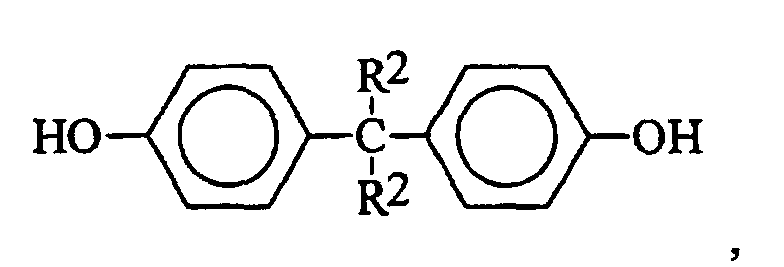 B) im Wesentlichen die Eliminierung der Chlorformiat-Endgruppen aus der aus (A) erhältlichen Mischung vor der Polycarbonat-Rückgewinnung, aufweist,
 - Verfahren gemäß Anspruch 1, wobei das Bisphenol Bisphenol-A ist.
- Verfahren gemäß Anspruch 1, wobei der Phasentransferkatalysator Tetrabutylammoniumhydroxid ist.
- Verfahren gemäß Anspruch 1, wobei der Phasentransferkatalysator Tetrabutylphosphoniumbromid ist.
- Verfahren gemäß Anspruch 1, wobei der Phasentransferkatalysator Tetrabutylammoniumbromid oder Tetrabutylammoniumchlorid ist.
- Verfahren gemäß Anspruch 1, wobei der phenolische Kettenstopper Phenol ist.
- Verfahren gemäß Anspruch 1, wobei der phenolische Kettenstopper Cumylphenol ist.
- Verfahren gemäß Anspruch 1, wobei die Chlorformiat-Endgruppen durch die Zugabe von 100 ppm bis 1000 ppm Triethylamin entfernt werden, gefolgt von der Zugabe von ausreichend Phosgen, um mit den restlichen phenolischen Hydroxigruppen zu reagieren.
- Verfahren gemäß Anspruch 1, wobei die Chlorformiat-Endgruppen durch die Zugabe einer aromatischen Phenolverbindung entfernt werden.
Applications Claiming Priority (2)
| Application Number | Priority Date | Filing Date | Title |
|---|---|---|---|
| US6638293A | 1993-05-24 | 1993-05-24 | |
| US66382 | 1993-05-24 |
Publications (3)
| Publication Number | Publication Date |
|---|---|
| EP0626409A2 EP0626409A2 (de) | 1994-11-30 |
| EP0626409A3 EP0626409A3 (de) | 1997-05-28 |
| EP0626409B1 true EP0626409B1 (de) | 2004-01-21 |
Family
ID=22069155
Family Applications (1)
| Application Number | Title | Priority Date | Filing Date |
|---|---|---|---|
| EP19940303447 Expired - Lifetime EP0626409B1 (de) | 1993-05-24 | 1994-05-13 | Verfahren zur Herstellung von Polycarbonaten |
Country Status (4)
| Country | Link |
|---|---|
| EP (1) | EP0626409B1 (de) |
| JP (1) | JP3108584B2 (de) |
| CN (1) | CN1100109A (de) |
| DE (1) | DE69433495T2 (de) |
Families Citing this family (2)
| Publication number | Priority date | Publication date | Assignee | Title |
|---|---|---|---|---|
| US5391692A (en) * | 1993-05-24 | 1995-02-21 | General Electric Company | Method for making aromatic polycarbonates |
| US5973103A (en) * | 1998-10-22 | 1999-10-26 | General Electric Company | Continuous interfacial method for preparing aromatic polycarbonates |
Family Cites Families (4)
| Publication number | Priority date | Publication date | Assignee | Title |
|---|---|---|---|---|
| US3054772A (en) * | 1957-05-16 | 1962-09-18 | Onderzoekings Inst Res | Production of polycarbonates |
| US3251807A (en) * | 1961-04-25 | 1966-05-17 | Allied Chem | Process for the production of polycarbonate resins |
| DE2503150C2 (de) * | 1975-01-27 | 1982-05-06 | Vasilij Ivanovič Žitkov | Verfahren zur Herstellung von Polykarbonaten |
| US4535143A (en) * | 1984-08-06 | 1985-08-13 | Mobay Chemical Corporation | Process for the preparation of copolycarbonates of sulfonyl diphenol |
-
1994
- 1994-05-13 EP EP19940303447 patent/EP0626409B1/de not_active Expired - Lifetime
- 1994-05-13 DE DE1994633495 patent/DE69433495T2/de not_active Expired - Fee Related
- 1994-05-20 JP JP06105838A patent/JP3108584B2/ja not_active Expired - Fee Related
- 1994-05-24 CN CN 94106193 patent/CN1100109A/zh active Pending
Also Published As
| Publication number | Publication date |
|---|---|
| DE69433495T2 (de) | 2004-11-04 |
| EP0626409A3 (de) | 1997-05-28 |
| EP0626409A2 (de) | 1994-11-30 |
| JPH07126370A (ja) | 1995-05-16 |
| DE69433495D1 (de) | 2004-02-26 |
| CN1100109A (zh) | 1995-03-15 |
| JP3108584B2 (ja) | 2000-11-13 |
Similar Documents
| Publication | Publication Date | Title |
|---|---|---|
| US5519105A (en) | Method for making polycarbonates | |
| US5142088A (en) | Preparation of branched polycarbonates and chloroformates, and intermediates therefor | |
| US6403754B1 (en) | Optimization of polycarbonate preparation by transesterification | |
| US5043203A (en) | Method for making end-capped polycarbonates from bisphenol monochloroformate polycarbonate oligomers with pH control system | |
| JP2004500476A (ja) | ポリカーボネートの製造方法 | |
| JP3448278B2 (ja) | 芳香族ポリカーボネートの連続界面製造方法 | |
| AU629575B2 (en) | Polycarbonate composition and process for manufacturing the same | |
| US4920200A (en) | Hydroquinone-bisphenol cyclic copolycarbonate oligomer | |
| US5391692A (en) | Method for making aromatic polycarbonates | |
| US4384108A (en) | Two-phase interfacial polycarbonate process | |
| CA1223685A (en) | Process for the preparation of copolycarbonates of sulfonyl diphenol | |
| US4814420A (en) | Detecting the stoichiometric end point of phosgenation reactions | |
| US5300624A (en) | Method for making flame retardant polycarbonate | |
| EP0626409A2 (de) | Verfahren zur Herstellung von Polycarbonaten | |
| US5510449A (en) | Catalyst system for polycarbonate manufacture | |
| US4994547A (en) | Linear copolycarbonate from hydroquinone-bisphenol cyclic copolycarbonate | |
| JP3047954B2 (ja) | ジアリールカーボネートを実質的に含まないポリカーボネートの製造方法 | |
| JP3687690B2 (ja) | 高分子型難燃剤および樹脂組成物 | |
| US5739257A (en) | Binary phase transfer/amine catalyst for making aromatic polycarbonates | |
| NL9400785A (nl) | Werkwijze voor het bereiden van polycarbonaat. | |
| US4059566A (en) | Process for controlling the molecular weight of polycarbonates using ammonia or ammonia compounds | |
| JPH04213322A (ja) | 特別なふつ素含有ビスフエノール成分を含有する芳香族ポリカーボネート及びその製造方法 |
Legal Events
| Date | Code | Title | Description |
|---|---|---|---|
| PUAI | Public reference made under article 153(3) epc to a published international application that has entered the european phase |
Free format text: ORIGINAL CODE: 0009012 |
|
| AK | Designated contracting states |
Kind code of ref document: A2 Designated state(s): BE DE ES FR GB IT NL |
|
| PUAL | Search report despatched |
Free format text: ORIGINAL CODE: 0009013 |
|
| AK | Designated contracting states |
Kind code of ref document: A3 Designated state(s): BE DE ES FR GB IT NL |
|
| 17P | Request for examination filed |
Effective date: 19971128 |
|
| 17Q | First examination report despatched |
Effective date: 19980710 |
|
| APAB | Appeal dossier modified |
Free format text: ORIGINAL CODE: EPIDOS NOAPE |
|
| APAB | Appeal dossier modified |
Free format text: ORIGINAL CODE: EPIDOS NOAPE |
|
| APAB | Appeal dossier modified |
Free format text: ORIGINAL CODE: EPIDOS NOAPE |
|
| APAD | Appeal reference recorded |
Free format text: ORIGINAL CODE: EPIDOS REFNE |
|
| APAD | Appeal reference recorded |
Free format text: ORIGINAL CODE: EPIDOS REFNE |
|
| GRAH | Despatch of communication of intention to grant a patent |
Free format text: ORIGINAL CODE: EPIDOS IGRA |
|
| GRAS | Grant fee paid |
Free format text: ORIGINAL CODE: EPIDOSNIGR3 |
|
| GRAA | (expected) grant |
Free format text: ORIGINAL CODE: 0009210 |
|
| AK | Designated contracting states |
Kind code of ref document: B1 Designated state(s): BE DE ES FR GB IT NL |
|
| PG25 | Lapsed in a contracting state [announced via postgrant information from national office to epo] |
Ref country code: NL Free format text: LAPSE BECAUSE OF FAILURE TO SUBMIT A TRANSLATION OF THE DESCRIPTION OR TO PAY THE FEE WITHIN THE PRESCRIBED TIME-LIMIT Effective date: 20040121 Ref country code: IT Free format text: LAPSE BECAUSE OF FAILURE TO SUBMIT A TRANSLATION OF THE DESCRIPTION OR TO PAY THE FEE WITHIN THE PRE;WARNING: LAPSES OF ITALIAN PATENTS WITH EFFECTIVE DATE BEFORE 2007 MAY HAVE OCCURRED AT ANY TIME BEFORE 2007. THE CORRECT EFFECTIVE DATE MAY BE DIFFERENT FROM THE ONE RECORDED.SCRIBED TIME-LIMIT Effective date: 20040121 Ref country code: FR Free format text: LAPSE BECAUSE OF FAILURE TO SUBMIT A TRANSLATION OF THE DESCRIPTION OR TO PAY THE FEE WITHIN THE PRESCRIBED TIME-LIMIT Effective date: 20040121 Ref country code: BE Free format text: LAPSE BECAUSE OF FAILURE TO SUBMIT A TRANSLATION OF THE DESCRIPTION OR TO PAY THE FEE WITHIN THE PRESCRIBED TIME-LIMIT Effective date: 20040121 |
|
| REG | Reference to a national code |
Ref country code: GB Ref legal event code: FG4D |
|
| REF | Corresponds to: |
Ref document number: 69433495 Country of ref document: DE Date of ref document: 20040226 Kind code of ref document: P |
|
| PGFP | Annual fee paid to national office [announced via postgrant information from national office to epo] |
Ref country code: NL Payment date: 20040416 Year of fee payment: 11 |
|
| PG25 | Lapsed in a contracting state [announced via postgrant information from national office to epo] |
Ref country code: ES Free format text: LAPSE BECAUSE OF FAILURE TO SUBMIT A TRANSLATION OF THE DESCRIPTION OR TO PAY THE FEE WITHIN THE PRESCRIBED TIME-LIMIT Effective date: 20040502 |
|
| PGFP | Annual fee paid to national office [announced via postgrant information from national office to epo] |
Ref country code: GB Payment date: 20040505 Year of fee payment: 11 |
|
| PGFP | Annual fee paid to national office [announced via postgrant information from national office to epo] |
Ref country code: FR Payment date: 20040519 Year of fee payment: 11 |
|
| NLV1 | Nl: lapsed or annulled due to failure to fulfill the requirements of art. 29p and 29m of the patents act | ||
| PLBE | No opposition filed within time limit |
Free format text: ORIGINAL CODE: 0009261 |
|
| STAA | Information on the status of an ep patent application or granted ep patent |
Free format text: STATUS: NO OPPOSITION FILED WITHIN TIME LIMIT |
|
| 26N | No opposition filed |
Effective date: 20041022 |
|
| EN | Fr: translation not filed | ||
| EN | Fr: translation not filed | ||
| REG | Reference to a national code |
Ref country code: FR Ref legal event code: ERR Free format text: BOPI DE PUBLICATION N: 05/03 PAGES: 237 PARTIE DU BULLETIN CONCERNEE: BREVETS EUROPEENS DONT LA TRADUCTION N'A PAS ETE REMISE A I'INPI IL Y A LIEU DE SUPPRIMER: LA MENTION DE LA NON REMISE. |
|
| PG25 | Lapsed in a contracting state [announced via postgrant information from national office to epo] |
Ref country code: GB Free format text: LAPSE BECAUSE OF NON-PAYMENT OF DUE FEES Effective date: 20050513 |
|
| APAH | Appeal reference modified |
Free format text: ORIGINAL CODE: EPIDOSCREFNO |
|
| GBPC | Gb: european patent ceased through non-payment of renewal fee |
Effective date: 20050513 |
|
| PGFP | Annual fee paid to national office [announced via postgrant information from national office to epo] |
Ref country code: DE Payment date: 20080630 Year of fee payment: 15 |
|
| PG25 | Lapsed in a contracting state [announced via postgrant information from national office to epo] |
Ref country code: DE Free format text: LAPSE BECAUSE OF NON-PAYMENT OF DUE FEES Effective date: 20091201 |