EP0628090B1 - Article revetu - Google Patents
Article revetu Download PDFInfo
- Publication number
- EP0628090B1 EP0628090B1 EP93905499A EP93905499A EP0628090B1 EP 0628090 B1 EP0628090 B1 EP 0628090B1 EP 93905499 A EP93905499 A EP 93905499A EP 93905499 A EP93905499 A EP 93905499A EP 0628090 B1 EP0628090 B1 EP 0628090B1
- Authority
- EP
- European Patent Office
- Prior art keywords
- coating
- thermal barrier
- layers
- barrier coating
- metallic substrate
- Prior art date
- Legal status (The legal status is an assumption and is not a legal conclusion. Google has not performed a legal analysis and makes no representation as to the accuracy of the status listed.)
- Expired - Lifetime
Links
- 238000000576 coating method Methods 0.000 claims abstract description 190
- 239000011248 coating agent Substances 0.000 claims abstract description 181
- 239000012720 thermal barrier coating Substances 0.000 claims abstract description 148
- 239000000758 substrate Substances 0.000 claims abstract description 82
- 229910052751 metal Inorganic materials 0.000 claims abstract description 21
- 239000002184 metal Substances 0.000 claims abstract description 20
- 229910000601 superalloy Inorganic materials 0.000 claims abstract description 14
- 238000012546 transfer Methods 0.000 claims abstract description 10
- 238000000034 method Methods 0.000 claims description 72
- 238000005240 physical vapour deposition Methods 0.000 claims description 70
- 238000000151 deposition Methods 0.000 claims description 43
- 230000008569 process Effects 0.000 claims description 42
- MCMNRKCIXSYSNV-UHFFFAOYSA-N Zirconium dioxide Chemical compound O=[Zr]=O MCMNRKCIXSYSNV-UHFFFAOYSA-N 0.000 claims description 26
- 230000008021 deposition Effects 0.000 claims description 22
- 229910000951 Aluminide Inorganic materials 0.000 claims description 17
- PXHVJJICTQNCMI-UHFFFAOYSA-N Nickel Chemical compound [Ni] PXHVJJICTQNCMI-UHFFFAOYSA-N 0.000 claims description 17
- BASFCYQUMIYNBI-UHFFFAOYSA-N platinum Chemical compound [Pt] BASFCYQUMIYNBI-UHFFFAOYSA-N 0.000 claims description 14
- RUDFQVOCFDJEEF-UHFFFAOYSA-N yttrium(III) oxide Inorganic materials [O-2].[O-2].[O-2].[Y+3].[Y+3] RUDFQVOCFDJEEF-UHFFFAOYSA-N 0.000 claims description 14
- 239000000203 mixture Substances 0.000 claims description 13
- 229910010293 ceramic material Inorganic materials 0.000 claims description 10
- QVGXLLKOCUKJST-UHFFFAOYSA-N atomic oxygen Chemical compound [O] QVGXLLKOCUKJST-UHFFFAOYSA-N 0.000 claims description 8
- 229910052759 nickel Inorganic materials 0.000 claims description 8
- 239000001301 oxygen Substances 0.000 claims description 8
- 229910052760 oxygen Inorganic materials 0.000 claims description 8
- 229910052697 platinum Inorganic materials 0.000 claims description 7
- 238000007751 thermal spraying Methods 0.000 claims description 7
- 239000011261 inert gas Substances 0.000 claims description 6
- 230000008020 evaporation Effects 0.000 claims description 5
- 238000001704 evaporation Methods 0.000 claims description 5
- 238000005137 deposition process Methods 0.000 claims description 4
- 238000005566 electron beam evaporation Methods 0.000 claims description 4
- 238000004519 manufacturing process Methods 0.000 claims description 4
- 230000015572 biosynthetic process Effects 0.000 claims description 2
- 238000001017 electron-beam sputter deposition Methods 0.000 claims description 2
- 150000002500 ions Chemical class 0.000 claims description 2
- 230000004888 barrier function Effects 0.000 claims 1
- 230000001771 impaired effect Effects 0.000 abstract description 3
- 239000000919 ceramic Substances 0.000 description 147
- 210000002381 plasma Anatomy 0.000 description 39
- XKRFYHLGVUSROY-UHFFFAOYSA-N Argon Chemical compound [Ar] XKRFYHLGVUSROY-UHFFFAOYSA-N 0.000 description 15
- 239000007789 gas Substances 0.000 description 12
- 229910052786 argon Inorganic materials 0.000 description 8
- 238000010894 electron beam technology Methods 0.000 description 8
- 230000003628 erosive effect Effects 0.000 description 7
- 239000001257 hydrogen Substances 0.000 description 7
- 229910052739 hydrogen Inorganic materials 0.000 description 7
- 239000007921 spray Substances 0.000 description 6
- 230000008901 benefit Effects 0.000 description 4
- 239000002131 composite material Substances 0.000 description 4
- 239000000356 contaminant Substances 0.000 description 4
- 230000007797 corrosion Effects 0.000 description 4
- 238000005260 corrosion Methods 0.000 description 4
- 239000000463 material Substances 0.000 description 4
- 238000007789 sealing Methods 0.000 description 4
- 238000004544 sputter deposition Methods 0.000 description 4
- VVTSZOCINPYFDP-UHFFFAOYSA-N [O].[Ar] Chemical compound [O].[Ar] VVTSZOCINPYFDP-UHFFFAOYSA-N 0.000 description 3
- PNEYBMLMFCGWSK-UHFFFAOYSA-N aluminium oxide Inorganic materials [O-2].[O-2].[O-2].[Al+3].[Al+3] PNEYBMLMFCGWSK-UHFFFAOYSA-N 0.000 description 3
- 238000005229 chemical vapour deposition Methods 0.000 description 3
- 239000010936 titanium Substances 0.000 description 3
- XEEYBQQBJWHFJM-UHFFFAOYSA-N Iron Chemical compound [Fe] XEEYBQQBJWHFJM-UHFFFAOYSA-N 0.000 description 2
- 229910018487 Ni—Cr Inorganic materials 0.000 description 2
- RTAQQCXQSZGOHL-UHFFFAOYSA-N Titanium Chemical compound [Ti] RTAQQCXQSZGOHL-UHFFFAOYSA-N 0.000 description 2
- 230000009471 action Effects 0.000 description 2
- -1 argon ions Chemical class 0.000 description 2
- VNNRSPGTAMTISX-UHFFFAOYSA-N chromium nickel Chemical compound [Cr].[Ni] VNNRSPGTAMTISX-UHFFFAOYSA-N 0.000 description 2
- 230000000694 effects Effects 0.000 description 2
- 238000005516 engineering process Methods 0.000 description 2
- 238000002474 experimental method Methods 0.000 description 2
- 150000002431 hydrogen Chemical class 0.000 description 2
- 150000002739 metals Chemical class 0.000 description 2
- 238000007750 plasma spraying Methods 0.000 description 2
- 230000009467 reduction Effects 0.000 description 2
- 241000894007 species Species 0.000 description 2
- 229910052719 titanium Inorganic materials 0.000 description 2
- ZOXJGFHDIHLPTG-UHFFFAOYSA-N Boron Chemical compound [B] ZOXJGFHDIHLPTG-UHFFFAOYSA-N 0.000 description 1
- 241000588731 Hafnia Species 0.000 description 1
- NRTOMJZYCJJWKI-UHFFFAOYSA-N Titanium nitride Chemical compound [Ti]#N NRTOMJZYCJJWKI-UHFFFAOYSA-N 0.000 description 1
- QCWXUUIWCKQGHC-UHFFFAOYSA-N Zirconium Chemical compound [Zr] QCWXUUIWCKQGHC-UHFFFAOYSA-N 0.000 description 1
- 229910045601 alloy Inorganic materials 0.000 description 1
- 239000000956 alloy Substances 0.000 description 1
- 239000004411 aluminium Substances 0.000 description 1
- 229910052782 aluminium Inorganic materials 0.000 description 1
- XAGFODPZIPBFFR-UHFFFAOYSA-N aluminium Chemical compound [Al] XAGFODPZIPBFFR-UHFFFAOYSA-N 0.000 description 1
- 238000013459 approach Methods 0.000 description 1
- 229910052796 boron Inorganic materials 0.000 description 1
- 239000011449 brick Substances 0.000 description 1
- 238000005524 ceramic coating Methods 0.000 description 1
- CETPSERCERDGAM-UHFFFAOYSA-N ceric oxide Chemical compound O=[Ce]=O CETPSERCERDGAM-UHFFFAOYSA-N 0.000 description 1
- 229910000422 cerium(IV) oxide Inorganic materials 0.000 description 1
- 238000004140 cleaning Methods 0.000 description 1
- 238000000280 densification Methods 0.000 description 1
- 239000000284 extract Substances 0.000 description 1
- 229910052735 hafnium Inorganic materials 0.000 description 1
- VBJZVLUMGGDVMO-UHFFFAOYSA-N hafnium atom Chemical compound [Hf] VBJZVLUMGGDVMO-UHFFFAOYSA-N 0.000 description 1
- CJNBYAVZURUTKZ-UHFFFAOYSA-N hafnium(IV) oxide Inorganic materials O=[Hf]=O CJNBYAVZURUTKZ-UHFFFAOYSA-N 0.000 description 1
- 238000009413 insulation Methods 0.000 description 1
- 238000007733 ion plating Methods 0.000 description 1
- 229910052742 iron Inorganic materials 0.000 description 1
- 239000007788 liquid Substances 0.000 description 1
- 238000001000 micrograph Methods 0.000 description 1
- 230000004048 modification Effects 0.000 description 1
- 238000012986 modification Methods 0.000 description 1
- 230000007935 neutral effect Effects 0.000 description 1
- 150000004767 nitrides Chemical class 0.000 description 1
- 230000035699 permeability Effects 0.000 description 1
- 238000000623 plasma-assisted chemical vapour deposition Methods 0.000 description 1
- 238000001878 scanning electron micrograph Methods 0.000 description 1
- 230000035939 shock Effects 0.000 description 1
- 239000007787 solid Substances 0.000 description 1
- 229910052715 tantalum Inorganic materials 0.000 description 1
- GUVRBAGPIYLISA-UHFFFAOYSA-N tantalum atom Chemical compound [Ta] GUVRBAGPIYLISA-UHFFFAOYSA-N 0.000 description 1
- 229910052727 yttrium Inorganic materials 0.000 description 1
- VWQVUPCCIRVNHF-UHFFFAOYSA-N yttrium atom Chemical compound [Y] VWQVUPCCIRVNHF-UHFFFAOYSA-N 0.000 description 1
- 229910052726 zirconium Inorganic materials 0.000 description 1
Images



Classifications
-
- C—CHEMISTRY; METALLURGY
- C23—COATING METALLIC MATERIAL; COATING MATERIAL WITH METALLIC MATERIAL; CHEMICAL SURFACE TREATMENT; DIFFUSION TREATMENT OF METALLIC MATERIAL; COATING BY VACUUM EVAPORATION, BY SPUTTERING, BY ION IMPLANTATION OR BY CHEMICAL VAPOUR DEPOSITION, IN GENERAL; INHIBITING CORROSION OF METALLIC MATERIAL OR INCRUSTATION IN GENERAL
- C23C—COATING METALLIC MATERIAL; COATING MATERIAL WITH METALLIC MATERIAL; SURFACE TREATMENT OF METALLIC MATERIAL BY DIFFUSION INTO THE SURFACE, BY CHEMICAL CONVERSION OR SUBSTITUTION; COATING BY VACUUM EVAPORATION, BY SPUTTERING, BY ION IMPLANTATION OR BY CHEMICAL VAPOUR DEPOSITION, IN GENERAL
- C23C28/00—Coating for obtaining at least two superposed coatings either by methods not provided for in a single one of groups C23C2/00 - C23C26/00 or by combinations of methods provided for in subclasses C23C and C25C or C25D
- C23C28/30—Coatings combining at least one metallic layer and at least one inorganic non-metallic layer
- C23C28/32—Coatings combining at least one metallic layer and at least one inorganic non-metallic layer including at least one pure metallic layer
- C23C28/321—Coatings combining at least one metallic layer and at least one inorganic non-metallic layer including at least one pure metallic layer with at least one metal alloy layer
- C23C28/3215—Coatings combining at least one metallic layer and at least one inorganic non-metallic layer including at least one pure metallic layer with at least one metal alloy layer at least one MCrAlX layer
-
- C—CHEMISTRY; METALLURGY
- C23—COATING METALLIC MATERIAL; COATING MATERIAL WITH METALLIC MATERIAL; CHEMICAL SURFACE TREATMENT; DIFFUSION TREATMENT OF METALLIC MATERIAL; COATING BY VACUUM EVAPORATION, BY SPUTTERING, BY ION IMPLANTATION OR BY CHEMICAL VAPOUR DEPOSITION, IN GENERAL; INHIBITING CORROSION OF METALLIC MATERIAL OR INCRUSTATION IN GENERAL
- C23C—COATING METALLIC MATERIAL; COATING MATERIAL WITH METALLIC MATERIAL; SURFACE TREATMENT OF METALLIC MATERIAL BY DIFFUSION INTO THE SURFACE, BY CHEMICAL CONVERSION OR SUBSTITUTION; COATING BY VACUUM EVAPORATION, BY SPUTTERING, BY ION IMPLANTATION OR BY CHEMICAL VAPOUR DEPOSITION, IN GENERAL
- C23C10/00—Solid state diffusion of only metal elements or silicon into metallic material surfaces
- C23C10/28—Solid state diffusion of only metal elements or silicon into metallic material surfaces using solids, e.g. powders, pastes
- C23C10/34—Embedding in a powder mixture, i.e. pack cementation
- C23C10/36—Embedding in a powder mixture, i.e. pack cementation only one element being diffused
- C23C10/48—Aluminising
-
- C—CHEMISTRY; METALLURGY
- C23—COATING METALLIC MATERIAL; COATING MATERIAL WITH METALLIC MATERIAL; CHEMICAL SURFACE TREATMENT; DIFFUSION TREATMENT OF METALLIC MATERIAL; COATING BY VACUUM EVAPORATION, BY SPUTTERING, BY ION IMPLANTATION OR BY CHEMICAL VAPOUR DEPOSITION, IN GENERAL; INHIBITING CORROSION OF METALLIC MATERIAL OR INCRUSTATION IN GENERAL
- C23C—COATING METALLIC MATERIAL; COATING MATERIAL WITH METALLIC MATERIAL; SURFACE TREATMENT OF METALLIC MATERIAL BY DIFFUSION INTO THE SURFACE, BY CHEMICAL CONVERSION OR SUBSTITUTION; COATING BY VACUUM EVAPORATION, BY SPUTTERING, BY ION IMPLANTATION OR BY CHEMICAL VAPOUR DEPOSITION, IN GENERAL
- C23C14/00—Coating by vacuum evaporation, by sputtering or by ion implantation of the coating forming material
- C23C14/02—Pretreatment of the material to be coated
-
- C—CHEMISTRY; METALLURGY
- C23—COATING METALLIC MATERIAL; COATING MATERIAL WITH METALLIC MATERIAL; CHEMICAL SURFACE TREATMENT; DIFFUSION TREATMENT OF METALLIC MATERIAL; COATING BY VACUUM EVAPORATION, BY SPUTTERING, BY ION IMPLANTATION OR BY CHEMICAL VAPOUR DEPOSITION, IN GENERAL; INHIBITING CORROSION OF METALLIC MATERIAL OR INCRUSTATION IN GENERAL
- C23C—COATING METALLIC MATERIAL; COATING MATERIAL WITH METALLIC MATERIAL; SURFACE TREATMENT OF METALLIC MATERIAL BY DIFFUSION INTO THE SURFACE, BY CHEMICAL CONVERSION OR SUBSTITUTION; COATING BY VACUUM EVAPORATION, BY SPUTTERING, BY ION IMPLANTATION OR BY CHEMICAL VAPOUR DEPOSITION, IN GENERAL
- C23C14/00—Coating by vacuum evaporation, by sputtering or by ion implantation of the coating forming material
- C23C14/02—Pretreatment of the material to be coated
- C23C14/024—Deposition of sublayers, e.g. to promote adhesion of the coating
- C23C14/025—Metallic sublayers
-
- C—CHEMISTRY; METALLURGY
- C23—COATING METALLIC MATERIAL; COATING MATERIAL WITH METALLIC MATERIAL; CHEMICAL SURFACE TREATMENT; DIFFUSION TREATMENT OF METALLIC MATERIAL; COATING BY VACUUM EVAPORATION, BY SPUTTERING, BY ION IMPLANTATION OR BY CHEMICAL VAPOUR DEPOSITION, IN GENERAL; INHIBITING CORROSION OF METALLIC MATERIAL OR INCRUSTATION IN GENERAL
- C23C—COATING METALLIC MATERIAL; COATING MATERIAL WITH METALLIC MATERIAL; SURFACE TREATMENT OF METALLIC MATERIAL BY DIFFUSION INTO THE SURFACE, BY CHEMICAL CONVERSION OR SUBSTITUTION; COATING BY VACUUM EVAPORATION, BY SPUTTERING, BY ION IMPLANTATION OR BY CHEMICAL VAPOUR DEPOSITION, IN GENERAL
- C23C14/00—Coating by vacuum evaporation, by sputtering or by ion implantation of the coating forming material
- C23C14/06—Coating by vacuum evaporation, by sputtering or by ion implantation of the coating forming material characterised by the coating material
- C23C14/08—Oxides
- C23C14/083—Oxides of refractory metals or yttrium
-
- C—CHEMISTRY; METALLURGY
- C23—COATING METALLIC MATERIAL; COATING MATERIAL WITH METALLIC MATERIAL; CHEMICAL SURFACE TREATMENT; DIFFUSION TREATMENT OF METALLIC MATERIAL; COATING BY VACUUM EVAPORATION, BY SPUTTERING, BY ION IMPLANTATION OR BY CHEMICAL VAPOUR DEPOSITION, IN GENERAL; INHIBITING CORROSION OF METALLIC MATERIAL OR INCRUSTATION IN GENERAL
- C23C—COATING METALLIC MATERIAL; COATING MATERIAL WITH METALLIC MATERIAL; SURFACE TREATMENT OF METALLIC MATERIAL BY DIFFUSION INTO THE SURFACE, BY CHEMICAL CONVERSION OR SUBSTITUTION; COATING BY VACUUM EVAPORATION, BY SPUTTERING, BY ION IMPLANTATION OR BY CHEMICAL VAPOUR DEPOSITION, IN GENERAL
- C23C14/00—Coating by vacuum evaporation, by sputtering or by ion implantation of the coating forming material
- C23C14/22—Coating by vacuum evaporation, by sputtering or by ion implantation of the coating forming material characterised by the process of coating
- C23C14/24—Vacuum evaporation
- C23C14/32—Vacuum evaporation by explosion; by evaporation and subsequent ionisation of the vapours, e.g. ion-plating
-
- C—CHEMISTRY; METALLURGY
- C23—COATING METALLIC MATERIAL; COATING MATERIAL WITH METALLIC MATERIAL; CHEMICAL SURFACE TREATMENT; DIFFUSION TREATMENT OF METALLIC MATERIAL; COATING BY VACUUM EVAPORATION, BY SPUTTERING, BY ION IMPLANTATION OR BY CHEMICAL VAPOUR DEPOSITION, IN GENERAL; INHIBITING CORROSION OF METALLIC MATERIAL OR INCRUSTATION IN GENERAL
- C23C—COATING METALLIC MATERIAL; COATING MATERIAL WITH METALLIC MATERIAL; SURFACE TREATMENT OF METALLIC MATERIAL BY DIFFUSION INTO THE SURFACE, BY CHEMICAL CONVERSION OR SUBSTITUTION; COATING BY VACUUM EVAPORATION, BY SPUTTERING, BY ION IMPLANTATION OR BY CHEMICAL VAPOUR DEPOSITION, IN GENERAL
- C23C28/00—Coating for obtaining at least two superposed coatings either by methods not provided for in a single one of groups C23C2/00 - C23C26/00 or by combinations of methods provided for in subclasses C23C and C25C or C25D
-
- C—CHEMISTRY; METALLURGY
- C23—COATING METALLIC MATERIAL; COATING MATERIAL WITH METALLIC MATERIAL; CHEMICAL SURFACE TREATMENT; DIFFUSION TREATMENT OF METALLIC MATERIAL; COATING BY VACUUM EVAPORATION, BY SPUTTERING, BY ION IMPLANTATION OR BY CHEMICAL VAPOUR DEPOSITION, IN GENERAL; INHIBITING CORROSION OF METALLIC MATERIAL OR INCRUSTATION IN GENERAL
- C23C—COATING METALLIC MATERIAL; COATING MATERIAL WITH METALLIC MATERIAL; SURFACE TREATMENT OF METALLIC MATERIAL BY DIFFUSION INTO THE SURFACE, BY CHEMICAL CONVERSION OR SUBSTITUTION; COATING BY VACUUM EVAPORATION, BY SPUTTERING, BY ION IMPLANTATION OR BY CHEMICAL VAPOUR DEPOSITION, IN GENERAL
- C23C28/00—Coating for obtaining at least two superposed coatings either by methods not provided for in a single one of groups C23C2/00 - C23C26/00 or by combinations of methods provided for in subclasses C23C and C25C or C25D
- C23C28/30—Coatings combining at least one metallic layer and at least one inorganic non-metallic layer
- C23C28/34—Coatings combining at least one metallic layer and at least one inorganic non-metallic layer including at least one inorganic non-metallic material layer, e.g. metal carbide, nitride, boride, silicide layer and their mixtures, enamels, phosphates and sulphates
- C23C28/345—Coatings combining at least one metallic layer and at least one inorganic non-metallic layer including at least one inorganic non-metallic material layer, e.g. metal carbide, nitride, boride, silicide layer and their mixtures, enamels, phosphates and sulphates with at least one oxide layer
-
- C—CHEMISTRY; METALLURGY
- C23—COATING METALLIC MATERIAL; COATING MATERIAL WITH METALLIC MATERIAL; CHEMICAL SURFACE TREATMENT; DIFFUSION TREATMENT OF METALLIC MATERIAL; COATING BY VACUUM EVAPORATION, BY SPUTTERING, BY ION IMPLANTATION OR BY CHEMICAL VAPOUR DEPOSITION, IN GENERAL; INHIBITING CORROSION OF METALLIC MATERIAL OR INCRUSTATION IN GENERAL
- C23C—COATING METALLIC MATERIAL; COATING MATERIAL WITH METALLIC MATERIAL; SURFACE TREATMENT OF METALLIC MATERIAL BY DIFFUSION INTO THE SURFACE, BY CHEMICAL CONVERSION OR SUBSTITUTION; COATING BY VACUUM EVAPORATION, BY SPUTTERING, BY ION IMPLANTATION OR BY CHEMICAL VAPOUR DEPOSITION, IN GENERAL
- C23C28/00—Coating for obtaining at least two superposed coatings either by methods not provided for in a single one of groups C23C2/00 - C23C26/00 or by combinations of methods provided for in subclasses C23C and C25C or C25D
- C23C28/30—Coatings combining at least one metallic layer and at least one inorganic non-metallic layer
- C23C28/34—Coatings combining at least one metallic layer and at least one inorganic non-metallic layer including at least one inorganic non-metallic material layer, e.g. metal carbide, nitride, boride, silicide layer and their mixtures, enamels, phosphates and sulphates
- C23C28/345—Coatings combining at least one metallic layer and at least one inorganic non-metallic layer including at least one inorganic non-metallic material layer, e.g. metal carbide, nitride, boride, silicide layer and their mixtures, enamels, phosphates and sulphates with at least one oxide layer
- C23C28/3455—Coatings combining at least one metallic layer and at least one inorganic non-metallic layer including at least one inorganic non-metallic material layer, e.g. metal carbide, nitride, boride, silicide layer and their mixtures, enamels, phosphates and sulphates with at least one oxide layer with a refractory ceramic layer, e.g. refractory metal oxide, ZrO2, rare earth oxides or a thermal barrier system comprising at least one refractory oxide layer
-
- F—MECHANICAL ENGINEERING; LIGHTING; HEATING; WEAPONS; BLASTING
- F01—MACHINES OR ENGINES IN GENERAL; ENGINE PLANTS IN GENERAL; STEAM ENGINES
- F01D—NON-POSITIVE DISPLACEMENT MACHINES OR ENGINES, e.g. STEAM TURBINES
- F01D5/00—Blades; Blade-carrying members; Heating, heat-insulating, cooling or antivibration means on the blades or the members
- F01D5/12—Blades
- F01D5/28—Selecting particular materials; Particular measures relating thereto; Measures against erosion or corrosion
- F01D5/288—Protective coatings for blades
-
- F—MECHANICAL ENGINEERING; LIGHTING; HEATING; WEAPONS; BLASTING
- F05—INDEXING SCHEMES RELATING TO ENGINES OR PUMPS IN VARIOUS SUBCLASSES OF CLASSES F01-F04
- F05D—INDEXING SCHEME FOR ASPECTS RELATING TO NON-POSITIVE-DISPLACEMENT MACHINES OR ENGINES, GAS-TURBINES OR JET-PROPULSION PLANTS
- F05D2260/00—Function
- F05D2260/20—Heat transfer, e.g. cooling
-
- F—MECHANICAL ENGINEERING; LIGHTING; HEATING; WEAPONS; BLASTING
- F05—INDEXING SCHEMES RELATING TO ENGINES OR PUMPS IN VARIOUS SUBCLASSES OF CLASSES F01-F04
- F05D—INDEXING SCHEME FOR ASPECTS RELATING TO NON-POSITIVE-DISPLACEMENT MACHINES OR ENGINES, GAS-TURBINES OR JET-PROPULSION PLANTS
- F05D2300/00—Materials; Properties thereof
- F05D2300/50—Intrinsic material properties or characteristics
- F05D2300/502—Thermal properties
- F05D2300/5024—Heat conductivity
-
- Y—GENERAL TAGGING OF NEW TECHNOLOGICAL DEVELOPMENTS; GENERAL TAGGING OF CROSS-SECTIONAL TECHNOLOGIES SPANNING OVER SEVERAL SECTIONS OF THE IPC; TECHNICAL SUBJECTS COVERED BY FORMER USPC CROSS-REFERENCE ART COLLECTIONS [XRACs] AND DIGESTS
- Y10—TECHNICAL SUBJECTS COVERED BY FORMER USPC
- Y10T—TECHNICAL SUBJECTS COVERED BY FORMER US CLASSIFICATION
- Y10T428/00—Stock material or miscellaneous articles
- Y10T428/12—All metal or with adjacent metals
- Y10T428/12493—Composite; i.e., plural, adjacent, spatially distinct metal components [e.g., layers, joint, etc.]
-
- Y—GENERAL TAGGING OF NEW TECHNOLOGICAL DEVELOPMENTS; GENERAL TAGGING OF CROSS-SECTIONAL TECHNOLOGIES SPANNING OVER SEVERAL SECTIONS OF THE IPC; TECHNICAL SUBJECTS COVERED BY FORMER USPC CROSS-REFERENCE ART COLLECTIONS [XRACs] AND DIGESTS
- Y10—TECHNICAL SUBJECTS COVERED BY FORMER USPC
- Y10T—TECHNICAL SUBJECTS COVERED BY FORMER US CLASSIFICATION
- Y10T428/00—Stock material or miscellaneous articles
- Y10T428/12—All metal or with adjacent metals
- Y10T428/12493—Composite; i.e., plural, adjacent, spatially distinct metal components [e.g., layers, joint, etc.]
- Y10T428/12535—Composite; i.e., plural, adjacent, spatially distinct metal components [e.g., layers, joint, etc.] with additional, spatially distinct nonmetal component
-
- Y—GENERAL TAGGING OF NEW TECHNOLOGICAL DEVELOPMENTS; GENERAL TAGGING OF CROSS-SECTIONAL TECHNOLOGIES SPANNING OVER SEVERAL SECTIONS OF THE IPC; TECHNICAL SUBJECTS COVERED BY FORMER USPC CROSS-REFERENCE ART COLLECTIONS [XRACs] AND DIGESTS
- Y10—TECHNICAL SUBJECTS COVERED BY FORMER USPC
- Y10T—TECHNICAL SUBJECTS COVERED BY FORMER US CLASSIFICATION
- Y10T428/00—Stock material or miscellaneous articles
- Y10T428/12—All metal or with adjacent metals
- Y10T428/12493—Composite; i.e., plural, adjacent, spatially distinct metal components [e.g., layers, joint, etc.]
- Y10T428/12535—Composite; i.e., plural, adjacent, spatially distinct metal components [e.g., layers, joint, etc.] with additional, spatially distinct nonmetal component
- Y10T428/12542—More than one such component
-
- Y—GENERAL TAGGING OF NEW TECHNOLOGICAL DEVELOPMENTS; GENERAL TAGGING OF CROSS-SECTIONAL TECHNOLOGIES SPANNING OVER SEVERAL SECTIONS OF THE IPC; TECHNICAL SUBJECTS COVERED BY FORMER USPC CROSS-REFERENCE ART COLLECTIONS [XRACs] AND DIGESTS
- Y10—TECHNICAL SUBJECTS COVERED BY FORMER USPC
- Y10T—TECHNICAL SUBJECTS COVERED BY FORMER US CLASSIFICATION
- Y10T428/00—Stock material or miscellaneous articles
- Y10T428/12—All metal or with adjacent metals
- Y10T428/12493—Composite; i.e., plural, adjacent, spatially distinct metal components [e.g., layers, joint, etc.]
- Y10T428/12535—Composite; i.e., plural, adjacent, spatially distinct metal components [e.g., layers, joint, etc.] with additional, spatially distinct nonmetal component
- Y10T428/12542—More than one such component
- Y10T428/12549—Adjacent to each other
-
- Y—GENERAL TAGGING OF NEW TECHNOLOGICAL DEVELOPMENTS; GENERAL TAGGING OF CROSS-SECTIONAL TECHNOLOGIES SPANNING OVER SEVERAL SECTIONS OF THE IPC; TECHNICAL SUBJECTS COVERED BY FORMER USPC CROSS-REFERENCE ART COLLECTIONS [XRACs] AND DIGESTS
- Y10—TECHNICAL SUBJECTS COVERED BY FORMER USPC
- Y10T—TECHNICAL SUBJECTS COVERED BY FORMER US CLASSIFICATION
- Y10T428/00—Stock material or miscellaneous articles
- Y10T428/12—All metal or with adjacent metals
- Y10T428/12493—Composite; i.e., plural, adjacent, spatially distinct metal components [e.g., layers, joint, etc.]
- Y10T428/12535—Composite; i.e., plural, adjacent, spatially distinct metal components [e.g., layers, joint, etc.] with additional, spatially distinct nonmetal component
- Y10T428/12611—Oxide-containing component
-
- Y—GENERAL TAGGING OF NEW TECHNOLOGICAL DEVELOPMENTS; GENERAL TAGGING OF CROSS-SECTIONAL TECHNOLOGIES SPANNING OVER SEVERAL SECTIONS OF THE IPC; TECHNICAL SUBJECTS COVERED BY FORMER USPC CROSS-REFERENCE ART COLLECTIONS [XRACs] AND DIGESTS
- Y10—TECHNICAL SUBJECTS COVERED BY FORMER USPC
- Y10T—TECHNICAL SUBJECTS COVERED BY FORMER US CLASSIFICATION
- Y10T428/00—Stock material or miscellaneous articles
- Y10T428/12—All metal or with adjacent metals
- Y10T428/12493—Composite; i.e., plural, adjacent, spatially distinct metal components [e.g., layers, joint, etc.]
- Y10T428/12535—Composite; i.e., plural, adjacent, spatially distinct metal components [e.g., layers, joint, etc.] with additional, spatially distinct nonmetal component
- Y10T428/12611—Oxide-containing component
- Y10T428/12618—Plural oxides
-
- Y—GENERAL TAGGING OF NEW TECHNOLOGICAL DEVELOPMENTS; GENERAL TAGGING OF CROSS-SECTIONAL TECHNOLOGIES SPANNING OVER SEVERAL SECTIONS OF THE IPC; TECHNICAL SUBJECTS COVERED BY FORMER USPC CROSS-REFERENCE ART COLLECTIONS [XRACs] AND DIGESTS
- Y10—TECHNICAL SUBJECTS COVERED BY FORMER USPC
- Y10T—TECHNICAL SUBJECTS COVERED BY FORMER US CLASSIFICATION
- Y10T428/00—Stock material or miscellaneous articles
- Y10T428/12—All metal or with adjacent metals
- Y10T428/12493—Composite; i.e., plural, adjacent, spatially distinct metal components [e.g., layers, joint, etc.]
- Y10T428/12632—Four or more distinct components with alternate recurrence of each type component
-
- Y—GENERAL TAGGING OF NEW TECHNOLOGICAL DEVELOPMENTS; GENERAL TAGGING OF CROSS-SECTIONAL TECHNOLOGIES SPANNING OVER SEVERAL SECTIONS OF THE IPC; TECHNICAL SUBJECTS COVERED BY FORMER USPC CROSS-REFERENCE ART COLLECTIONS [XRACs] AND DIGESTS
- Y10—TECHNICAL SUBJECTS COVERED BY FORMER USPC
- Y10T—TECHNICAL SUBJECTS COVERED BY FORMER US CLASSIFICATION
- Y10T428/00—Stock material or miscellaneous articles
- Y10T428/24—Structurally defined web or sheet [e.g., overall dimension, etc.]
- Y10T428/24942—Structurally defined web or sheet [e.g., overall dimension, etc.] including components having same physical characteristic in differing degree
-
- Y—GENERAL TAGGING OF NEW TECHNOLOGICAL DEVELOPMENTS; GENERAL TAGGING OF CROSS-SECTIONAL TECHNOLOGIES SPANNING OVER SEVERAL SECTIONS OF THE IPC; TECHNICAL SUBJECTS COVERED BY FORMER USPC CROSS-REFERENCE ART COLLECTIONS [XRACs] AND DIGESTS
- Y10—TECHNICAL SUBJECTS COVERED BY FORMER USPC
- Y10T—TECHNICAL SUBJECTS COVERED BY FORMER US CLASSIFICATION
- Y10T428/00—Stock material or miscellaneous articles
- Y10T428/24—Structurally defined web or sheet [e.g., overall dimension, etc.]
- Y10T428/24942—Structurally defined web or sheet [e.g., overall dimension, etc.] including components having same physical characteristic in differing degree
- Y10T428/2495—Thickness [relative or absolute]
- Y10T428/24967—Absolute thicknesses specified
-
- Y—GENERAL TAGGING OF NEW TECHNOLOGICAL DEVELOPMENTS; GENERAL TAGGING OF CROSS-SECTIONAL TECHNOLOGIES SPANNING OVER SEVERAL SECTIONS OF THE IPC; TECHNICAL SUBJECTS COVERED BY FORMER USPC CROSS-REFERENCE ART COLLECTIONS [XRACs] AND DIGESTS
- Y10—TECHNICAL SUBJECTS COVERED BY FORMER USPC
- Y10T—TECHNICAL SUBJECTS COVERED BY FORMER US CLASSIFICATION
- Y10T428/00—Stock material or miscellaneous articles
- Y10T428/24—Structurally defined web or sheet [e.g., overall dimension, etc.]
- Y10T428/24942—Structurally defined web or sheet [e.g., overall dimension, etc.] including components having same physical characteristic in differing degree
- Y10T428/2495—Thickness [relative or absolute]
- Y10T428/24967—Absolute thicknesses specified
- Y10T428/24975—No layer or component greater than 5 mils thick
Definitions
- the present invention is concerned with coatings for metallic substrates, and is particularly concerned with ceramic thermal barrier coatings for metallic components for use in gas turbine engines.
- the ceramic thermal barrier coating deposited by the PVD process exhibits a thermal conductivity which is greater than that of a ceramic thermal barrier coating, of the same or similar composition, deposited by the thermal spray process.
- a thermal conductivity of a zirconia-8% yttria ceramic thermal barrier coating deposited by the PVD process is 2.0 W/m/K and the thermal conductivity for the same ceramic thermal barrier coating deposited by the thermal spray process is 0.8-1.0 W/m/K.
- the greater thermal conductivity of the ceramic thermal barrier coating deposited by the PVD process means that a greater thickness of ceramic is required to achieve the equivalent insulating effect when compared to the ceramic thermal barrier coating deposited by the thermal spray process.
- This is an undesirable property because this necessitates a greater weight of ceramic thermal barrier coating on the metallic components of the gas turbine engine, and this is particularly undesirable for rotating components e.g. turbine blades because the additional weight may limit the temperature of operation due to a corresponding reduction in the creep life of the metallic turbine blade.
- microlaminate Composites as Thermal Barrier Coatings
- M.C.Radhakrishna, H.J. Doerr, C.V. Deshpandey and R.F. Bunshah was presented at the 15th International Conference on Metallurgical Coatings, at San Diego, USA, 11-15th April 1988 and was subsequently presented in Surface and Coatings Technology, 36 (1988) 143-150.
- the paper discloses the use of microlaminate composites to reduce the thermal conductivity of physical vapour deposited thermal barrier coatings.
- the microlaminate composites comprise alternate layers of two different materials, e.g. two different metals, two different ceramics or a metal and a ceramic.
- the paper specifically describes the use of nickel layers interposed between layers of NiCoCrAlY and titanium layers interposed between layers of CoCrAlY. These microlaminates have thermal conductivities of 7.48 W/m/K for a 480 layer Ni/NiCoCrAlY coating system and 6.76 W/m/K for a 480 layer Ti/CoCrAlY coating system.
- the paper suggests that the thermal conductivity of the microlaminate composite may be tailored to obtain thermal conductivity values similar to those of yttrium stabilised zirconia deposited by the thermal spray process by choosing appropriate metal and ceramic microlaminates.
- a further disclosure in published European patent application 0366289A entitled “Multi-Layer Wear Resistant Coatings” uses alternate layers of metallic and ceramic materials to provide an erosion and corrosion resistant coating.
- the coatings may be applied by sputtering, physical vapour deposition or chemical vapour deposition.
- thermal barrier coating necessitates the use of separate sources of metal and ceramic which have to be evaporated, or sputtered, to deposit the alternate layers on the metallic substrate.
- reactive gas sources have to be available to provide reactive gas to react with the evaporated metal to produce the ceramic layers.
- the columnar layers were deposited by sputtering and the dense ceramic sealing layers were deposited by sputtering and applying a RF induced DC bias on the substrate.
- the voltage applied during the period that the bias is applied to the substrate causes renucleation/grain growth within the coating structure and destroys the major, through thickness, columnar boundaries between columnar grains.
- the present invention seeks to provide an article which comprises a metallic substrate having a columnar thermal barrier coating in which the thermal barrier coating has reduced thermal conductivity.
- the present invention provides an article comprising a metallic substrate, a bond coating on the metallic substrate, a thermal barrier coating on the bond coating, the thermal barrier coating comprising a plurality of layers, each layer having columnar grains, the columnar grains in each layer extending substantially perpendicular to the interface between the bond coating and the metallic substrate, adjacent layers having different structures to provide at least one interface between adjacent layers which is substantially parallel to the interface between the bond coating and the metallic substrate to increase the resistance to heat transfer through the thermal barrier coating.
- the metallic substrate may be a superalloy substrate.
- the superalloy substrate may be a nickel superalloy substrate.
- the bond coating may comprise a MCrAlY coating, an aluminide coating, platinum aluminide coating or a combination of any two or more thereof.
- a MCrAlY coating may be provided with an aluminide coating to provide more aluminium content to bond the thermal barrier coating onto the substrate.
- the bond coating may include an interface layer comprising an oxide or oxide/metal, the thermal barrier coating being on the interface layer.
- the thermal barrier coating may be formed from a ceramic material.
- the ceramic material may comprise zirconia, yttria or a mixture thereof.
- Alternate layers of the thermal barrier coating may have substantially the same structure.
- Adjacent layers may have substantially the same thickness.
- the thickness of each layer may be in the range of 0.5 x 10 ⁇ 6m to 10 x 10 ⁇ 6m. Preferably the thickness of each layer is 2 x 10 ⁇ 6m.
- the total thickness of the thermal barrier coating may be up to 300 x 10 ⁇ 6m.
- the layer adjacent to the bond coating may have a high density, preferably the layer adjacent the bond coating has maximum density.
- the article may be a turbine blade or turbine vane.
- the present invention also seeks to provide a method of manufacturing an article comprising applying a bond coating to a metallic substrate, applying a thermal barrier coating to the bond coating by depositing at least one columnar grained layer by vapour deposition and depositing at least one columnar grained layer by plasma assisted vapour deposition to provide an interface between the adjacent layers which is substantially parallel to the interface between the bond coating and the metallic substrate to increase the resistance to heat transfer through the thermal barrier coating.
- the vapour deposition process is physical vapour deposition.
- the physical vapour deposition process may be electron beam evaporation, sputtering or arc evaporation.
- the bond coating may comprise MCrAlY coating, an aluminide coating, platinum aluminide coating or a combination of any two or more thereof.
- the metallic substrate may be a superalloy substrate.
- the thermal barrier coating may comprise a ceramic material.
- the ceramic material may be zirconia or yttria or a mixture thereof.
- the present invention also provides an article comprising a metallic substrate, a bond coating on the metallic substrate, a thermal barrier coating on the bond coating, the thermal barrier coating having columnar grains, the columnar grains extending substantially perpendicular to an interface between the bond coating and the metallic substrate, each of the columnar grains in the thermal barrier coating comprising a plurality of layers, adjacent layers having different structures to provide at least one interface between adjacent layers which is substantially parallel to the interface between the bond coating and the metallic substrate to increase the resistance to heat transfer through the thermal barrier coating.
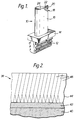
- Figure 1 is a perspective view of a gas turbine engine turbine blade according to the present invention.
- Figure 2 is a sectional view through an article having a thermal barrier coating applied by a first prior art method.
- Figure 3 is a sectional view through an article having a thermal barrier coating applied by a second prior art method.
- Figure 4 is a sectional view through an article having a thermal barrier coating applied according to the present invention.
- Figure 5 is an enlarged view of a portion of the thermal barrier coating shown in figure 4.
- Figure 6 is a graph of voltage applied to the substrate against time during the application of the thermal barrier coating.
- Figure 7 is a sectional view through an apparatus for use in the method of applying the thermal barrier coating according to the present invention.
- Figure 8 is a graph of thermal conductivity against temperature for several thermal barrier coatings.
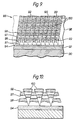
- Figure 9 is a sectional view through an article having an alternative thermal barrier coating applied according to the present invention.
- Figure 10 is an enlarged view of a portion of the thermal barrier coating in Figure 9.
- Figure 11 is a graph of voltage applied to the substrate against time during the application of the thermal barrier coating.
- Figure 12 is a graph of current density against substrate voltage.
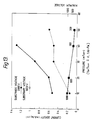
- Figure 13 is a graph of current density against pressure.
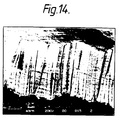
- Figure 14 is a micrograph of a fracture cross-section through an article according to the present invention.
- a gas turbine engine turbine blade 10 is shown in figure 1.
- the turbine blade 10 comprises a shaped root portion 12, for attaching the turbine blade 10 to a turbine rotor, a platform portion 14, for defining a portion of the radially inner boundary of the gas flow path through the turbine, and an aerofoil portion 16, which extracts energy from the hot gases passing through the turbine.
- the platform portion 14, and the aerofoil portion 16, of the turbine blade 10 are provided with a coating system 18 which allows the turbine blade 10 to operate at higher gas temperatures.
- the coating system 18 comprises a bond coating 22, deposited onto the metallic substrate 20 of the turbine blade 10, and a ceramic thermal barrier coating 24 deposited onto the bond coating 22.
- a coating system 38 applied by a first prior art method is shown in figure 2.
- the coating system 38 comprises a bond coating 42, deposited onto the metallic substrate 40 and a ceramic thermal barrier coating 44 deposited onto the bond coating 42.
- the bond coating 42 is generally a MCrAlY coating which has been deposited by thermal spraying or by physical vapour deposition (PVD), or the bond coating may be an aluminide coating.
- the bond coating 42 may additionally have an alumina layer.
- the ceramic thermal barrier coating 44 is generally zirconia or yttria or a mixture thereof which has been deposited onto the bond coating 42 by physical vapour deposition (PVD).
- the ceramic thermal barrier coating 44 has a columnar grained microstructure 46 which has a relatively high thermal conductivity, good strain tolerance, good surface finish and good erosion resistance.
- a coating system 48 applied by a second prior art method is shown in figure 3.
- the coating system 48 comprises a bond coating 52, deposited onto the metallic substrate 50 and a ceramic thermal barrier coating 54 deposited onto the bond coating 52.
- the bond coating 52 is generally a MCrAlY coating which has been deposited by thermal spraying or by physical vapour deposition (PVD), or the bond coating may be an aluminide coating.
- the ceramic thermal barrier coating 54 is generally zirconia or yttria or a mixture thereof which has been deposited onto the bond coating 52 by thermal spraying.
- the ceramic thermal barrier coating 54 has a "brick wall" microstructure which has poor erosion resistance but has a relatively low thermal conductivity when compared to the thermal conductivity of the ceramic thermal barrier coating applied by the first prior art method mentioned above.
- the coating system 18 applied by the method of the present invention is shown more clearly in figures 4 and 5.
- the coating system 18 comprises a bond coating 22, deposited onto the metallic substrate 20 and a ceramic thermal barrier coating 24 deposited onto the bond coating 22.
- the bond coating 22 is generally a MCrAlY coating which has been deposited by thermal spraying or by physical vapour deposition (PVD).
- the bond coating 22 may be an aluminide coating which has been deposited by pack aluminising or may be a platinum-aluminide coating which has been deposited by platinum aluminising.
- the ceramic thermal barrier coating 24 is generally zirconia, yttria or a mixture thereof which has been deposited onto the bond coating 22 by physical vapour deposition (PVD). Alternatively the ceramic thermal barrier coating 24 may comprise any other suitable ceramic.
- the ceramic thermal barrier coating 24 has a columnar grained microstructure 28 which has good strain tolerance, good surface finish and good erosion resistance.
- the ceramic thermal barrier coating 24 has a relatively low thermal conductivity when compared to the ceramic thermal barrier coating 44 of the coating system 38 in figure 2 and is substantially the same or better than the thermal conductivity of the ceramic thermal barrier coating 54 of the coating system 48 in figure 2.
- the ceramic thermal barrier coating 24 in figures 4 and 5 has reduced thickness compared to the ceramic thermal barrier coating 44 in figure 2 for operation at the same temperature. Alternatively the same thickness of ceramic thermal barrier coating 24 may be used to allow operation at higher temperatures.
- the ceramic thermal barrier coating 24 has alternate layers 25 and 27 which have different structure to create interfaces 26 substantially parallel to the metallic substrate 20/bond coating 22 interface. These interfaces 26 provide paths of increased resistance to heat transfer to emulate the good thermal conductivity properties of thermal sprayed ceramic thermal barrier coatings.
- the structure in the alternate layers 25,27 of the ceramic thermal barrier coating 24 is columnar 28 to ensure that the strain tolerance of the ceramic thermal barrier coating 24 is not impaired.
- the columnar grains 28 in the layers 25,27 extend substantially perpendicular to the metallic substrate 20/bond coating 22 interface.
- the difference in structure in layers 25, 27 are the result of variations in the micro-structure and/or density/coarseness of the columnar grains 28 of the ceramic.
- columnar grains 28 in one of the layers 27 continue to grow into the adjacent layer 25 and that there is no interruption of the columnar grains 28 at the interfaces 26 between the layers 25,27. It may also be considered that the columnar grains 28 in the ceramic thermal barrier coating 24 extend through the full thickness of the coating 24, and that each columnar grain 28 has its structure modulated along its length by the provision of the layers 25,27.
- the coating system 18 according to the present invention is applied to the metallic substrate 20 by firstly depositing a MCrAlY bond coating 22 onto the metallic substrate 20 by plasma spraying.
- the MCrAlY may be deposited by physical vapour deposition (PVD).
- PVD physical vapour deposition
- a ceramic thermal barrier coating 24 is then deposited onto the MCrAlY bond coating 22.
- the apparatus 60 comprises a vacuum chamber 62 which has one or more pumps 64 to evacuate the vacuum chamber 62.
- An electron beam from an electron beam gun 66 is arranged to impinge upon a supply of ceramic vapour 68, i.e zirconia-yttria alloy, such that the ceramic is evaporated when the vacuum chamber 62 is evacuated.
- the metallic substrate 20 is also connected into an electrical circuit such that it may given a D.C. or R.F. potential 70.
- the apparatus 60 also includes supplies of argon 74, hydrogen 76 and oxygen 78 which are interconnected to the interior of the vacuum chamber 62 via a pipe 72. Each of the supplies of argon 74, hydrogen 76 and oxygen 78 are provided with valves to control the flow of the gases.
- the metallic substrate 20 with the deposited bond coating 22 is placed into the vacuum chamber 62.
- the vacuum chamber 62 is evacuated and the electron beam gun 66 directs electrons at the supply of ceramic vapour 68 to evaporate ceramic.
- the interior of the vacuum chamber 62 is supplied with controlled amounts of an inert gas and oxygen during the evaporation of the supply of ceramic vapour 68.
- the supply of inert gas, e.g. argon is to maintain the correct glow discharge, or plasma, conditions and the supply of oxygen is to maintain the composition of the ceramic thermal barrier coating at the stoichiometric ratio.
- the ceramic vapour deposits onto the MCrAlY bond coating 22.
- the ceramic vapour is deposited alternately, for predetermined periods of time, by the physical vapour deposition process (PVD) and by a plasma assisted physical vapour deposition process (PAPVD).
- PVD physical vapour deposition process
- PAPVD plasma assisted physical vapour deposition process
- a D.C. or R.F. potential is applied to the metallic substrate 20, this is known as ion plating.
- the first layer 25 of ceramic deposited onto the bond coating 22 is preferably deposited by plasma assisted physical vapour deposition (PAPVD) such that the ceramic at the interface with the bond coating 22 has a relatively high density and preferably has maximum density.
- PAPVD plasma assisted physical vapour deposition
- the use of the plasma assisted physical vapour deposition process is used to control the structure of the ceramic thermal barrier coating 24 all the way through its thickness, by controlling the way that the columnar ceramic grains 28 grow, to tailor the characteristics of the ceramic at particular positions.
- the plasma assisted physical vapour deposition process causes the columnar ceramic grains 28 to be packed together more closely.
- the D.C. or R.F. potential used during the plasma assisted physical vapour deposition process may be adjusted for deposition of different ceramic layers to control the density of the columnar ceramic grains 28.
- the interfaces 26 between the adjacent layers 25,27 should be as abrupt as is practical.
- the abrupt interfaces 26 are preferably achieved by the use of a simple switching action between the physical vapour deposition process and the plasma assisted physical vapour deposition process such that the voltage at the substrate follows a square wave form with time as shown in figure 6.
- the peak voltages in figure 6 correspond to the time when the layers 25 of ceramic are deposited by plasma assisted physical vapour deposition and the minimum voltages in figure 6 correspond to the time when the layers 27 of ceramic are deposited by physical vapour deposition.
- the switching points in figure 6 correspond to the time when the interfaces 26 between the layers 25 and 27 are produced.
- the first coating system comprised a plasma sprayed MCrAlY bond coating applied onto a nickel superalloy, N75 a nickel-chromium superalloy, and a purely physical vapour deposited (PVD) ceramic thermal barrier coating applied onto the bond coating.
- the vacuum chamber was evacuated to a pressure of 0,67 Pa (5 mTorr) and the electron beam gun power was 8KV at 500mA.
- a total coating thickness of 90 x 10 ⁇ 6m was deposited.
- the thermal conductivity of the ceramic thermal barrier coating was measured at a temperature of 1000°C and was 1.0 W/m/K.
- the second coating system comprised a plasma sprayed MCrAlY bond coating applied onto the same nickel superalloy and a purely plasma assisted physical vapour deposited (PAPVD) ceramic thermal barrier coating applied onto the bond coating.
- the vacuum chamber was evacuated to a pressure of 0,93 Pa (7 mTorr) and the electron beam gun power was 8KV at 500mA.
- the R.F. power used during the PAPVD process was 500W.
- a total ceramic coating thickness of 160 x 10 ⁇ 6m was deposited.
- the thermal conductivity of the ceramic thermal barrier coating was measured at a temperature of 1000°C and was 0.55 W/m/K.
- the third coating system comprised a plasma sprayed MCrAlY bond coating applied onto the same nickel superalloy and alternate layers of physical vapour deposited (PVD) and plasma assisted physical vapour deposited (PAPVD) ceramic thermal barrier coating applied onto the bond coating.
- the vacuum chamber was evacuated to a pressure of 0,53 Pa (4 mTorr) and the electron beam gun power was 8KV at 500mA.
- the R.F. power used during the PAPVD process was 500W. A total of 70 layers of ceramic were deposited.
- Each of the 35 layers of ceramic deposited by the physical vapour deposition process (PVD) were 2 x 10 ⁇ 6m thick and each of the 35 layers of ceramic deposited by the plasma assisted physical vapour deposition process (PAPVD) were also 2 x 10 ⁇ 6 m thick.
- the thermal conductivity of the ceramic thermal barrier coating was measured at a temperature of 1000°C and was 0.3 W/m/K.
- the fourth coating system comprised a plasma sprayed MCrAlY bond coating applied onto the same nickel superalloy and alternate layers of physical vapour deposited (PVD) and plasma assisted physical vapour deposited (PAPVD) ceramic thermal barrier coating applied onto the bond coating.
- the vacuum chamber was evacuated to a pressure of 0,53 Pa (4 mTorr) and the electron beam gun power was 8KV at 500mA.
- the R.F. power used during the PAPVD process was 500 W.
- Each of the 35 layers of ceramic deposited by the physical vapour deposition process (PVD) were 2 x 10 ⁇ 6m thick and each of the 35 layers of ceramic deposited by the plasma assisted physical vapour deposition process (PAPVD) were 1 x 10 ⁇ 6m thick.
- the thermal conductivity of the ceramic thermal barrier coating was measured at a temperature of 1000°C and was 1.0 W/m/K.
- Figure 8 shows a graph of thermal conductivity against temperature for each of the four different coating systems.
- Line A indicates the thermal conductivity of the first coating system with temperature.
- Line B indicates the thermal conductivity of the second coating system with temperature.
- Line C indicates the thermal conductivity of the third coating system with temperature and finally line D indicates the thermal conductivity of the fourth coating system with temperature.
- the thermal conductivity of the third coating system is a third of that of the first coating system.
- the first coating system is the ceramic thermal barrier coating applied by the prior art method of physical vapour deposition (PVD).
- the thermal conductivity of the third coating system is also less than that of the second coating system.
- the second coating system is the ceramic thermal barrier coating applied purely by plasma assisted physical vapour deposition (PAPVD).
- the thermal conductivity of the fourth coating system is approximately the same as the first coating system.
- a further coating system 88 applied by the method of the present invention is shown more clearly in figures 9 and 10.
- the coating system 88 comprises a bond coating 92, deposited onto the metallic substrate 90, an interface layer 94 on the bond coating 92 and a ceramic thermal barrier coating 96 deposited onto the interface layer 94.
- the bond coating 92 is generally a MCrAlY coating which has been deposited by thermal spraying or by physical vapour deposition (PVD).
- the bond coating 92 may be an aluminide coating which has been deposited by pack aluminising or may be a platinum-aluminide coating which has been deposited by platinum aluminising.
- the bond coating 92 may be a MCrAlY coating with an aluminide top coating or a MCrAlY coating with a platinum aluminide top coating.
- the interface layer 94 comprises oxides or oxide/metal on the bond coating which improves the adhesion of the ceramic thermal barrier coating 96.
- the oxide is predominantly alumina which has controlled structure and properties.
- the metal comprises the metallic elements in the bond coating.
- the ceramic thermal barrier coating 96 is generally zirconia, yttria or a mixture thereof which has been deposited onto the interface layer 94 by physical vapour deposition (PVD). Alternatively the ceramic thermal barrier coating 96 may comprise any other suitable ceramic.
- the ceramic thermal barrier coating 96 has a columnar grained microstructure 100 which has good strain tolerance, good surface finish and good erosion resistance.
- the ceramic thermal barrier coating 96 has a relatively low thermal conductivity when compared to the ceramic thermal barrier coating 44 of the coating system 38 in figure 2 and is substantially the same or better than the thermal conductivity of the ceramic thermal barrier coating 54 of the coating system 48 in figure 3.
- the ceramic thermal barrier coating 96 in figures 9 and 10 has reduced thickness compared to the ceramic thermal barrier coating 44 in figure 2 for operation at the same temperature. Alternatively the same thickness of ceramic thermal barrier coating 96 may be used to allow operation at higher temperatures.
- the ceramic thermal barrier coating 96 has alternate layers 97 and 98 which have different structure to create interfaces 99 substantially parallel to the metallic substrate 90/bond coating 92 interface. These interfaces 99 provide paths of increased resistance to heat transfer to emulate the good thermal conductivity properties of thermal sprayed ceramic thermal barrier coatings.
- the structure in the alternate layers 97,98 of the ceramic thermal barrier coating 96 is columnar 100 to ensure that the strain tolerance of the ceramic thermal barrier coating 96 is not impaired.
- the columnar grains 100 in the layers 97,98 extend substantially perpendicular to the metallic substrate 90/bond coating 92 interface.
- the difference in structure in layers 97, 98 are the result of variations in the structure and/or density/coarseness of the columnar grains 100 of the ceramic.
- the columnar grains 100 in one of the layers 98 continue to grow into the adjacent layer 97 and there are no interruptions of the columnar grains 100 at the interfaces 99 between the layers 97,98.
- the columnar grains 100 in the ceramic thermal barrier coating 96 extend through the full thickness of the coating 96 and each columnar grain 100 has its structure modulated along its length by the provision of the layers 97,98.
- the coating system 88 is applied to the metallic substrate 90 by firstly depositing a MCrAlY bond coating 92 onto the metallic substrate 90 by plasma spraying.
- the MCrAlY may be deposited by physical vapour deposition (PVD).
- PVD physical vapour deposition
- the surface of the bond coating 92 is then modified to create an oxide or oxide/metal interface layer 94 which has controlled structure and properties to improve the adhesion of the subsequently deposited ceramic thermal barrier coating 96.
- a ceramic thermal barrier coating 96 is then deposited onto the interface layer 94.
- the metallic substrate 90 with the deposited bond coating 92 is placed into the vacuum chamber 62.
- the vacuum chamber 62 is evacuated and an electrical bias, e.g. a D.C. potential or R.F. field, is applied to the metallic substrate 90 prior to the deposition of the columnar grained ceramic thermal barrier coating 96 in order to modify the structure and/or chemistry of the surface of the bond coating 92.
- Controlled amounts of gases are introduced into the interior of the vacuum chamber 62 during this phase of the process, for example argon-oxygen, argon-hydrogen or argon.
- the electrical bias produces chemically active glow discharges or plasmas in the case of argon-oxygen and argon-hydrogen, or produces neutral glow discharges or plasmas in the case of argon.
- the argon plasma may be used to produce argon ions which bombard the surface of the bond coating 92 to clean the surface i.e. to remove undesired oxides and/or any contaminants.
- the argon-hydrogen plasma may be used to provide enhanced cleaning of the surface of the bond coating 92 because the additional hydrogen ions chemically react with the undesired contaminants.
- the argon-oxygen plasma, or argon-hydrogen plasma provides controlled production of desired bonding oxides in an interface 94 on the surface of the bond coating 92.
- the interface 94 improves the adhesion of the subsequently deposited ceramic thermal barrier coating 96.
- the gases used during the modification of the surface of the bond coating 92 to produce the interface layer 94 are then extracted from the vacuum chamber 62.
- the electron beam gun 66 directs electrons at the supply of ceramic vapour 68 to evaporate ceramic.
- the interior of the vacuum chamber 62 is supplied with controlled amounts of an inert gas and oxygen during the evaporation of the supply of ceramic vapour 68.
- the supply of inert gas, e.g. argon, is to maintain the correct glow discharge, or plasma, conditions and the supply of oxygen is to maintain the composition of the ceramic thermal barrier coating at the stoichiometric ratio.
- the ceramic vapour deposits onto the interface layer 94.
- the ceramic vapour is deposited alternately, for predetermined periods of time, by the physical vapour deposition process (PVD) and by a plasma assisted physical vapour deposition process (PAPVD).
- PVD physical vapour deposition process
- PAPVD plasma assisted physical vapour deposition process
- a D.C. or R.F. potential is applied to the metallic substrate 90.
- the first layer 97 of ceramic deposited onto the interface layer 94 is preferably deposited by plasma assisted physical vapour deposition (PAPVD) such that the ceramic at the interface with the interface layer 94 has a relatively high density and preferably has maximum density.
- PAPVD plasma assisted physical vapour deposition
- the use of the plasma assisted physical vapour deposition process is used to control the structure of the ceramic thermal barrier coating 96 all the way through its thickness, by controlling the way that the columnar ceramic grains 100 grow, to tailor the characteristics of the ceramic at particular positions.
- the plasma assisted physical vapour deposition process causes the columnar ceramic grains 100 to be packed together more closely.
- the D.C. or R.F. potential used during the plasma assisted physical vapour deposition process may be adjusted for deposition of different ceramic layers to control the density of the columnar ceramic grains 100.
- an initial large voltage is applied to the metallic substrate 90 to modify the structure and/or chemistry of the surface of the bond coating 92.
- the magnitude of the initial large voltage is determined by the need to remove contaminants or undesirable oxides from the bond coating 92 prior to establishing the desired oxide structure-composition to achieve satisfactory adhesion of the thermal barrier coating 96.
- the desired oxide may be grown thermally or in the presence of a glow discharge.
- the interfaces 99 between the adjacent layers 97,98 are kept as abrupt as is practical.
- the abrupt interfaces 99 are preferably achieved by the use of a simple switching action as shown in region B of figure 11 between the physical vapour deposition process such that the voltage at the substrate follows a square wave form with time.
- the peak voltage in region B of figure 11 correspond to the time when the layers 97 of ceramic are deposited by PAPVD and the minimum voltages in region B of figure 11 correspond to the time when the layers 98 of ceramic are deposited by PVD.
- the switching points correspond to the time when the interfaces 99 are produced.
- the current drawn in the circuit as a function of substrate voltage is shown in figure 12, more current is drawn as the voltage increases.
- the minimum voltages are of the order of three hundred volts as shown in figure 13, and the current densities are typically greater than 0.1 mA/sq cm. This increases at any given pressure with applied substrate voltage.
- FIG. 14 is a scanning electron micrograph of a fracture cross-section through the thermal barrier coating. The continuous columnar grains can be seen extending through the full thickness of the thermal barrier coating and the modulated structure of the columns is evident. The outer portion of the coating was deposited purely in the PVD mode.
- the voltage applied to the substrate during the plasma assisted physical vapour depositions part of the process is sufficient to cause densification of the thermal barrier coating but is not sufficient to cause renucleation/grain growth within the structure with subsequent loss of the major, through thickness, columnar boundaries.
- the physical vapour deposition process described uses electron beam evaporation, however, other physical vapour deposition processes may be used for example sputtering or arc evaporation.
- thermal barrier coatings described in the examples are ceramic materials, however the thermal barrier coating may be any suitable material of low thermal conductivity.
- Materials suitable for use as thermal barrier coatings are generally oxides, for example zirconia, yttria, hafnia, ceria or combinations of any two or more thereof.
- the different layers in the thermal barrier coating are intended to have substantially the same composition, however the process of applying the thermal barrier coating may result in some compositional differences between the different layers.
Landscapes
- Chemical & Material Sciences (AREA)
- Engineering & Computer Science (AREA)
- Mechanical Engineering (AREA)
- Materials Engineering (AREA)
- Organic Chemistry (AREA)
- Metallurgy (AREA)
- Chemical Kinetics & Catalysis (AREA)
- Inorganic Chemistry (AREA)
- Ceramic Engineering (AREA)
- General Engineering & Computer Science (AREA)
- Physical Vapour Deposition (AREA)
- Other Surface Treatments For Metallic Materials (AREA)
- Coating By Spraying Or Casting (AREA)
- Turbine Rotor Nozzle Sealing (AREA)
Abstract
Claims (35)
- Objet (10) comprenant un substrat métallique (20), un revêtement de liaison (22) sur le substrat métallique (20), un revêtement de barrière thermique (24) sur le revêtement de liaison (22), le revêtement de barrière thermique (24) comprenant une pluralité de couches (25, 27), caractérisé en ce que chaque couche (25, 27) comporte des grains colonnaires (28), les grains colonnaires (28) dans chaque couche (25, 27) s'étendant sensiblement perpendiculairement à une interface entre le revêtement de liaison (22) et le substrat métallique (20), les couches adjacentes (25, 27) ayant des structures différentes pour fournir au moins une interface (26) entre les couches adjacentes (25, 27) qui est sensiblement parallèle à l'interface entre le revêtement de liaison (22) et le substrat métallique (20) pour augmenter la résistance au transfert thermique à travers le revêtement de barrière thermique (24).
- Objet selon la revendication 1, caractérisé en ce que le substrat métallique (20) est un substrat de superalliage.
- Objet selon la revendication 2, caractérisé en ce que la substrat de superalliage (20) est un substrat de superalliage de nickel.
- Objet selon l'une quelconque des revendications 1 à 3, caractérisé en ce que le revêtement de liaison (22) comprend un revêtement de MCrAlY, un revêtement d'aluminure, un revêtement d'aluminure de platine ou une combinaison de deux ou plusieurs parmi ceux-ci.
- Objet selon la revendication 4, caractérisé en ce que le revêtement de liaison (92) comprend une couche d'interface (94) comprenant un oxyde ou oxyde/métal, le revêtement de barrière thermique (96) étant sur la couche d'interface (94).
- Objet selon l'une quelconque des revendications 1 à 5, caractérisé en ce que le revêtement de barrière thermique (24) est formé à partir d'un matériau céramique.
- Objet selon la revendication 6, caractérisé en ce que le matériau céramique comprend de la zircone, de l'yttria ou un mélange de ceux-ci.
- Objet selon l'une quelconque des revendications 1 à 7, caractérisé en ce que des couches alternées (25) du revêtement de barrière thermique (24) ont sensiblement la même structure.
- Objet selon la revendication 8, caractérisé en ce que les couches adjacentes (25, 27) ont sensiblement la même épaisseur.
- Objet selon l'une quelconque des revendications 1 à 9, caractérisé en ce que l'épaisseur de chaque couche (25, 27) est située dans le domaine de 0,5 x 10⁻⁶ m à 10 x 10⁻⁶m.
- Objet selon la revendication 10, caractérisé en ce que l'épaisseur de chaque couche (25, 27) est de 2 x 10⁻⁶m.
- Objet selon l'une quelconque des revendications 1 à 11, caractérisé en ce que l'épaisseur totale du revêtement de barrière thermique (24) est égale ou inférieure à 300 x 10⁻⁶ m.
- Objet selon l'une quelconque des revendications 1 à 12, caractérisé en ce que la couche adjacente au revêtement de liaison (22) a une haute densité.
- Objet selon la revendication 13, caractérisé en ce que la couche adjacente au revêtement de liaison (22) a une densité maximale.
- Objet selon l'une quelconque des revendications 1 à 14, caractérisé en ce que l'objet (10) est une aube de turbine ou une pale de turbine.
- Procédé de fabrication d'un objet (10) comprenant d'appliquer un revêtement de liaison (22) sur un substrat métallique (20), d'appliquer un revêtement de barrière thermique (24) sur le revêtement de liaison (22), caractérisé en ce qu'il comprend de déposer au moins une couche de grains colonnaires (27) par dépôt en phase vapeur et de déposer au moins une couche de grains colonnaires (27) par dépôt en phase vapeur assisté au plasma pour fournir une interface (26) entre les couches adjacentes (25, 27) qui est sensiblement parallèle à l'interface entre le revêtement de liaison (22) et le substrat métallique (20) pour augmenter la résistance au transfert thermique à travers le revêtement de barrière thermique (24).
- Procédé selon la revendication 16, caractérisé en ce qu'il comprend de déposer les couches de grains colonnaires (27) par dépôt en phase vapeur de manière alternée avec les couches de grains colonnaires (25) déposées par dépôt en phase vapeur assisté au plasma.
- Procédé selon la revendication 16 ou la revendication 17, caractérisé en ce qu'il comprend de déposer la couche de grains colonnaires (25) adjacente au revêtement de liaison (22) par dépôt en phase vapeur assisté au plasma de telle sorte qu'elle a une haute densité.
- Procédé selon la revendication 18, caractérisé en ce qu'il comprend de déposer la couche de grains colonnaires (25) adjacente au revêtement de liaison (22) de telle sorte qu'elle a une densité maximale.
- Procédé selon l'une quelconque des revendications 16 à 19, caractérisé en ce qu'il comprend d'appliquer une tension de polarisation au substrat métallique (90) et d'alimenter de l'oxygène pour modifier la surface du revêtement de liaison (92) pour produire une couche d'interface (94) comprenant de l'oxyde ou de l'oxyde/métal avant le dépôt des couches de grains colonnaires (97, 98) par le procédé de dépôt en phase vapeur.
- Procédé selon la revendication 20, caractérisé en ce qu'il comprend d'appliquer une tension de polarisation au substrat métallique (90) et d'alimenter un gaz inerte pour produire des ions pour nettoyer la surface du revêtement de liaison (92) avant la formation de la couche d'interface (94).
- Procédé selon l'une quelconque des revendications 16 à 23, caractérisé en ce qu'il comprend de déposer les couches de grains colonnaires (27), déposées par dépôt en phase vapeur et les couches de grains colonnaires (25) déposées par dépôt en phase vapeur assisté au plasma de telle sorte qu'elles ont sensiblement la même épaisseur.
- Procédé selon l'une quelconque des revendications 16 à 23, caractérisé en ce que le procédé de dépôt en phase vapeur est un dépôt en phase vapeur par procédé physique.
- Procédé selon la revendication 23, caractérisé en ce que le procédé de dépôt en phase vapeur par procédé physique est l'évaporation par faisceaux électroniques, la pulvérisation cathodique ou l'évaporation à l'arc.
- Procédé selon l'une quelconque des revendications 16 à 24, caractérisé en ce qu'il comprend de déposer les couches de grains colonnaires (25, 27) avec une épaisseur situe dans le domaine de 0,5 x 10⁻⁶ m à 10 x 10⁻⁶ m.
- Procédé selon l'une quelconque des revendications 16 à 25, caractérisé en ce qu'il comprend de déposer les couches de grains colonnaires (25, 27) avec une épaisseur totale égale ou inférieure à 300 x 10⁻⁶ m.
- Procédé selon la revendication 25, caractérisé en ce que l'épaisseur des couches de grains colonnaires (25, 27) est de 2 x 10⁻⁶ m.
- Procédé selon l'une quelconque des revendications 16 à 27, caractérisé en ce qu'il comprend d'appliquer le revêtement de liaison (22) par métallisation à chaud.
- Procédé selon l'une quelconque des revendications 16 à 28, caractérisé en ce que le revêtement de liaison (22) comprend un revêtement de MCrAlY, un revêtement d'aluminure, un revêtement d'aluminure de platine ou une combinaison de deux ou plusieurs de ceux-ci.
- Procédé selon l'une quelconque des revendications 16 à 29, caractérisé en ce que le substrat métallique (20) est un substrat de superalliage.
- Procédé selon l'une quelconque des revendications 16 à 30, caractérisé en ce que le revêtement de barrière thermique (24) comprend un matériau céramique.
- Procédé selon la revendication 31, caractérisé en ce que le matériau céramique est de la zircone, l'yttria ou un mélange de ceux-ci.
- Objet (10) comprenant un substrat métallique (20), un revêtement de liaison (22) sur le substrat métallique (20), un revêtement de barrière thermique (24) sur le revêtement de liaison (22), le revêtement de barrière thermique (24) ayant des grains colonnaires (28), les grains colonnaires (28) s'étendant sensiblement perpendiculairement à une interface entre le revêtement de liaison (22) et le substrat métallique (20), caractérisé en ce que chaque graine colonnaire (28) dans le revêtement de barrière thermique (24) comprend une pluralité de couches (25, 27), des couches adjacentes (25, 27) ayant des structures différentes pour fournir au moins une interface (26) entre les couches adjacentes (25, 27) qui est sensiblement parallèle à l'interface entre le revêtement de liaison (22) et le substrat métallique (20) pour augmenter la résistance au transfert thermique à travers le revêtement de barrière thermique (24).
- Procédé de fabrication d'un objet (10) comprenant d'appliquer un revêtement de liaison (22) sur un substrat métallique (20), d'appliquer un revêtement de barrière thermique (24) sur le revêtement de liaison (22), caractérisé en ce qu'il comprend d'appliquer une première tension au substrat métallique (20) et de déposer au moins une couche de grains colonnaires (27) par dépôt en phase vapeur, d'appliquer sensiblement instantanément une seconde tension différente au substrat métallique (20) et de déposer au moins une couche de grains colonnaires (25) par dépôt en phase vapeur pour fournir une interface (26) entre les couches adjacentes (25, 27) qui est sensiblement parallèle à l'interface entre le revêtement de liaison (22) et le substrat métallique (20) pour augmenter la résistance au transfert thermique à travers le revêtement de barrière thermique (24).
- Procédé selon la revendication 34, caractérisé en ce que la première tension appliquée est de 0 Volt.
Priority Applications (1)
| Application Number | Priority Date | Filing Date | Title |
|---|---|---|---|
| EP95112194A EP0705912B1 (fr) | 1992-03-05 | 1993-03-03 | Article revêtu |
Applications Claiming Priority (3)
| Application Number | Priority Date | Filing Date | Title |
|---|---|---|---|
| GB929204791A GB9204791D0 (en) | 1992-03-05 | 1992-03-05 | A coated article |
| GB9204791 | 1992-03-05 | ||
| PCT/GB1993/000441 WO1993018199A1 (fr) | 1992-03-05 | 1993-03-03 | Article revetu |
Related Child Applications (2)
| Application Number | Title | Priority Date | Filing Date |
|---|---|---|---|
| EP95112194.6 Division-Into | 1993-03-03 | ||
| EP95112194A Division EP0705912B1 (fr) | 1992-03-05 | 1993-03-03 | Article revêtu |
Publications (2)
| Publication Number | Publication Date |
|---|---|
| EP0628090A1 EP0628090A1 (fr) | 1994-12-14 |
| EP0628090B1 true EP0628090B1 (fr) | 1996-05-15 |
Family
ID=10711558
Family Applications (2)
| Application Number | Title | Priority Date | Filing Date |
|---|---|---|---|
| EP95112194A Expired - Lifetime EP0705912B1 (fr) | 1992-03-05 | 1993-03-03 | Article revêtu |
| EP93905499A Expired - Lifetime EP0628090B1 (fr) | 1992-03-05 | 1993-03-03 | Article revetu |
Family Applications Before (1)
| Application Number | Title | Priority Date | Filing Date |
|---|---|---|---|
| EP95112194A Expired - Lifetime EP0705912B1 (fr) | 1992-03-05 | 1993-03-03 | Article revêtu |
Country Status (6)
| Country | Link |
|---|---|
| US (2) | US5652044A (fr) |
| EP (2) | EP0705912B1 (fr) |
| JP (1) | JPH07504232A (fr) |
| DE (2) | DE69318856T2 (fr) |
| GB (1) | GB9204791D0 (fr) |
| WO (1) | WO1993018199A1 (fr) |
Families Citing this family (100)
| Publication number | Priority date | Publication date | Assignee | Title |
|---|---|---|---|---|
| GB9204791D0 (en) * | 1992-03-05 | 1992-04-22 | Rolls Royce Plc | A coated article |
| CA2110007A1 (fr) * | 1992-12-29 | 1994-06-30 | Adrian M. Beltran | Methode de realisation d'un revetement isolant |
| WO1996011288A1 (fr) * | 1994-10-05 | 1996-04-18 | United Technologies Corporation | Systeme de revetement par couches nanometriques multiples |
| EP0718420B1 (fr) * | 1994-12-24 | 1999-04-21 | Rolls Royce Plc | Revêtement de barrière thermique et méthode pour l'appliquer sur un article en superalliage |
| GB9426257D0 (en) | 1994-12-24 | 1995-03-01 | Rolls Royce Plc | Thermal barrier coating for a superalloy article and method of application |
| DK0826076T3 (da) * | 1995-04-27 | 2000-02-07 | Siemens Ag | Metalkomponent med et belægningssystem med højtemperatur-beskyttelse og en fremgangsmåde til belægning af komponenten |
| DE69615517T2 (de) * | 1995-12-22 | 2002-05-16 | General Electric Co., Schenectady | Körper mit Hochtemperatur-Schutzschicht und Verfahren zum Beschichten |
| US6066405A (en) | 1995-12-22 | 2000-05-23 | General Electric Company | Nickel-base superalloy having an optimized platinum-aluminide coating |
| US5955182A (en) * | 1996-02-05 | 1999-09-21 | Kabushiki Kaisha Toshiba | Heat resisting member and its production method |
| FR2745590B1 (fr) * | 1996-02-29 | 1998-05-15 | Snecma | Revetement de barriere thermique a sous-couche amelioree et pieces revetues par une telle barriere thermique |
| US5792521A (en) * | 1996-04-18 | 1998-08-11 | General Electric Company | Method for forming a multilayer thermal barrier coating |
| US5773078A (en) * | 1996-06-24 | 1998-06-30 | General Electric Company | Method for depositing zirconium oxide on a substrate |
| US6306517B1 (en) * | 1996-07-29 | 2001-10-23 | General Electric Company | Thermal barrier coatings having an improved columnar microstructure |
| GB9617267D0 (en) * | 1996-08-16 | 1996-09-25 | Rolls Royce Plc | A metallic article having a thermal barrier coating and a method of application thereof |
| ES2192690T3 (es) * | 1996-09-03 | 2003-10-16 | Unaxis Balzers Ag | Pieza con recubrimiento protector frente al desgaste. |
| EP0931174B1 (fr) | 1996-09-23 | 2004-06-09 | Siemens Aktiengesellschaft | Procede pour produire une couche calorifuge |
| GB2319783B (en) * | 1996-11-30 | 2001-08-29 | Chromalloy Uk Ltd | A thermal barrier coating for a superalloy article and a method of application thereof |
| US6177200B1 (en) | 1996-12-12 | 2001-01-23 | United Technologies Corporation | Thermal barrier coating systems and materials |
| US6117560A (en) | 1996-12-12 | 2000-09-12 | United Technologies Corporation | Thermal barrier coating systems and materials |
| AU719341B2 (en) * | 1997-01-22 | 2000-05-04 | De Nora Elettrodi S.P.A. | Method of forming robust metal, metal oxide, and metal alloy layers on ion-conductive polymer membranes |
| JP3302589B2 (ja) * | 1997-02-06 | 2002-07-15 | 株式会社日立製作所 | セラミック被覆ガスタービン動翼 |
| GB9717245D0 (en) * | 1997-08-15 | 1997-10-22 | Rolls Royce Plc | A metallic article having a thermal barrier coaring and a method of application thereof |
| US5876860A (en) * | 1997-12-09 | 1999-03-02 | N.V. Interturbine | Thermal barrier coating ceramic structure |
| US6478888B1 (en) * | 1997-12-23 | 2002-11-12 | United Technologies Corporation | Preheat method for EBPVD coating |
| GB9800511D0 (en) * | 1998-01-13 | 1998-03-11 | Rolls Royce Plc | A metallic article having a thermal barrier coating and a method of application thereof |
| CA2229124C (fr) * | 1998-02-09 | 2001-08-14 | Pyrogenesis Inc. | Systeme de revetement a isolant thermique comprenant une couche superieure avec interface graduelle |
| EP0936287A1 (fr) * | 1998-02-16 | 1999-08-18 | Abb Research Ltd. | Element de turbine et procédé pour controler l'oxidation d'un element de turbine |
| DE19807359A1 (de) * | 1998-02-21 | 1999-08-26 | Deutsch Zentr Luft & Raumfahrt | Wärmedämmschichtsystem mit integrierter Aluminiumoxidschicht |
| US6135322A (en) * | 1998-05-29 | 2000-10-24 | Cetrangolo; Edward M. | Display apparatus for a collapsible tube dispenser |
| GB9811456D0 (en) | 1998-05-29 | 1998-07-29 | Rolls Royce Plc | A metallic article having a thermal barrier coating and a method of application thereof |
| FR2779448B1 (fr) * | 1998-06-04 | 2000-12-15 | Snecma | Revetement ceramique a faible conductivite thermique et de type barriere thermique, procede de depot d'un tel revetement ceramique, et piece metallique protegee par ce revetement ceramique |
| US6187453B1 (en) * | 1998-07-17 | 2001-02-13 | United Technologies Corporation | Article having a durable ceramic coating |
| US6106959A (en) * | 1998-08-11 | 2000-08-22 | Siemens Westinghouse Power Corporation | Multilayer thermal barrier coating systems |
| JP2002528643A (ja) | 1998-10-22 | 2002-09-03 | シーメンス アクチエンゲゼルシヤフト | 断熱層付き製品および断熱層の作成方法 |
| US6042898A (en) * | 1998-12-15 | 2000-03-28 | United Technologies Corporation | Method for applying improved durability thermal barrier coatings |
| US6042880A (en) * | 1998-12-22 | 2000-03-28 | General Electric Company | Renewing a thermal barrier coating system |
| US6296945B1 (en) | 1999-09-10 | 2001-10-02 | Siemens Westinghouse Power Corporation | In-situ formation of multiphase electron beam physical vapor deposited barrier coatings for turbine components |
| US6933060B2 (en) | 1999-02-05 | 2005-08-23 | Siemens Westinghouse Power Corporation | Thermal barrier coating resistant to sintering |
| GB2346415A (en) * | 1999-02-05 | 2000-08-09 | Rolls Royce Plc | Vibration damping |
| US6342278B1 (en) * | 1999-08-04 | 2002-01-29 | General Electric Company | Method for forming a thermal barrier coating by electron beam physical vapor deposition |
| US6273678B1 (en) * | 1999-08-11 | 2001-08-14 | General Electric Company | Modified diffusion aluminide coating for internal surfaces of gas turbine components |
| US6294260B1 (en) | 1999-09-10 | 2001-09-25 | Siemens Westinghouse Power Corporation | In-situ formation of multiphase air plasma sprayed barrier coatings for turbine components |
| US20030180571A1 (en) * | 1999-12-14 | 2003-09-25 | The Penn State Research Foundation | Microstructured coatings and materials |
| WO2001043965A1 (fr) * | 1999-12-14 | 2001-06-21 | The Penn State Research Foundation | Revetements de protection refractaire, depot physique en phase gazeuse a faisceau d'electrons |
| US6435835B1 (en) * | 1999-12-20 | 2002-08-20 | United Technologies Corporation | Article having corrosion resistant coating |
| US6316078B1 (en) | 2000-03-14 | 2001-11-13 | The United States Of America As Represented By The Administrator Of The National Aeronautics And Space Administration | Segmented thermal barrier coating |
| DE10016958A1 (de) * | 2000-04-06 | 2001-10-18 | Widia Gmbh | Verfahren zur Herstellung von Multilagenschichten auf Substratkörpern und Verbundwerkstoff, bestehend aus einem beschichteten Substratkörper |
| US6509070B1 (en) * | 2000-09-22 | 2003-01-21 | The United States Of America As Represented By The Secretary Of The Air Force | Laser ablation, low temperature-fabricated yttria-stabilized zirconia oriented films |
| US6511762B1 (en) | 2000-11-06 | 2003-01-28 | General Electric Company | Multi-layer thermal barrier coating with transpiration cooling |
| US6375425B1 (en) | 2000-11-06 | 2002-04-23 | General Electric Company | Transpiration cooling in thermal barrier coating |
| US6812176B1 (en) | 2001-01-22 | 2004-11-02 | Ohio Aerospace Institute | Low conductivity and sintering-resistant thermal barrier coatings |
| US7001859B2 (en) * | 2001-01-22 | 2006-02-21 | Ohio Aerospace Institute | Low conductivity and sintering-resistant thermal barrier coatings |
| US6881452B2 (en) | 2001-07-06 | 2005-04-19 | General Electric Company | Method for improving the TBC life of a single phase platinum aluminide bond coat by preoxidation heat treatment |
| US6703137B2 (en) * | 2001-08-02 | 2004-03-09 | Siemens Westinghouse Power Corporation | Segmented thermal barrier coating and method of manufacturing the same |
| US8357454B2 (en) | 2001-08-02 | 2013-01-22 | Siemens Energy, Inc. | Segmented thermal barrier coating |
| JP4031631B2 (ja) * | 2001-10-24 | 2008-01-09 | 三菱重工業株式会社 | 遮熱コーティング材及びガスタービン部材並びにガスタービン |
| US6579590B2 (en) * | 2001-11-16 | 2003-06-17 | Hitachi Global Storage Technologies Netherlands B.V. | Thermally-assisted magnetic recording disk with multilayered thermal barrier |
| US20060127599A1 (en) * | 2002-02-12 | 2006-06-15 | Wojak Gregory J | Process and apparatus for preparing a diamond substance |
| US7556695B2 (en) | 2002-05-06 | 2009-07-07 | Honeywell International, Inc. | Apparatus to make nanolaminate thermal barrier coatings |
| US6677064B1 (en) | 2002-05-29 | 2004-01-13 | Siemens Westinghouse Power Corporation | In-situ formation of multiphase deposited thermal barrier coatings |
| US7157151B2 (en) * | 2002-09-11 | 2007-01-02 | Rolls-Royce Corporation | Corrosion-resistant layered coatings |
| US7547478B2 (en) | 2002-12-13 | 2009-06-16 | General Electric Company | Article including a substrate with a metallic coating and a protective coating thereon, and its preparation and use in component restoration |
| US7060366B2 (en) | 2003-02-19 | 2006-06-13 | General Electric Company | Article including a substrate with a metallic coating and a chromium-aluminide protective coating thereon, and its preparation and use in component restoration |
| US6764779B1 (en) | 2003-02-24 | 2004-07-20 | Chromalloy Gas Turbine Corporation | Thermal barrier coating having low thermal conductivity |
| US6803135B2 (en) | 2003-02-24 | 2004-10-12 | Chromalloy Gas Turbine Corporation | Thermal barrier coating having low thermal conductivity |
| US20050035085A1 (en) * | 2003-08-13 | 2005-02-17 | Stowell William Randolph | Apparatus and method for reducing metal oxides on superalloy articles |
| DE10342398B4 (de) * | 2003-09-13 | 2008-05-29 | Schott Ag | Schutzschicht für einen Körper sowie Verfahren zur Herstellung und Verwendung von Schutzschichten |
| US6982126B2 (en) * | 2003-11-26 | 2006-01-03 | General Electric Company | Thermal barrier coating |
| US20050153160A1 (en) * | 2004-01-12 | 2005-07-14 | Yourong Liu | Durable thermal barrier coating having low thermal conductivity |
| US7318955B2 (en) * | 2004-09-14 | 2008-01-15 | General Electric Company | Thermal barrier coating with modulated grain structure and method therefor |
| US20060139149A1 (en) * | 2004-12-23 | 2006-06-29 | Faro Todd J | Method, apparatus and system for controlling access to a cabinet |
| US7838083B1 (en) | 2005-01-28 | 2010-11-23 | Sandia Corporation | Ion beam assisted deposition of thermal barrier coatings |
| US7597966B2 (en) * | 2005-06-10 | 2009-10-06 | General Electric Company | Thermal barrier coating and process therefor |
| DE102006001864A1 (de) * | 2006-01-13 | 2007-07-19 | Mtu Aero Engines Gmbh | Verschleißschutzbeschichtung |
| EP1808508A1 (fr) * | 2006-01-17 | 2007-07-18 | Siemens Aktiengesellschaft | Composant disposé dans le conduit d'écoulement d'une turbomachine et procédé de pulvérisation pour produire un revêtement. |
| US7654010B2 (en) * | 2006-02-23 | 2010-02-02 | Tokyo Electron Limited | Substrate processing system, substrate processing method, and storage medium |
| US7842402B2 (en) * | 2006-03-31 | 2010-11-30 | General Electric Company | Machine components and methods of fabricating |
| US7507484B2 (en) * | 2006-12-01 | 2009-03-24 | Siemens Energy, Inc. | Bond coat compositions and arrangements of same capable of self healing |
| DE102007043791A1 (de) | 2007-09-13 | 2009-04-02 | Mtu Aero Engines Gmbh | Verfahren zur Herstellung einer Wärmedämmschicht und Wärmedämmschicht |
| DE102008058614A1 (de) | 2008-11-22 | 2010-05-27 | Mtu Aero Engines Gmbh | Verfahren zur Herstellung einer Wärmedämmschicht, Wärmedämmschicht und Bauteil zur Verwendung in Verdichter- und Turbinenkomponenten |
| FR2938872B1 (fr) * | 2008-11-26 | 2015-11-27 | Snecma | Dispositif anti-usure pour aubes d'un distributeur de turbine d'une turbomachine aeronautique |
| US20100304037A1 (en) * | 2009-06-01 | 2010-12-02 | United Technologies Corporation | Thermal Barrier Coatings and Application Methods |
| US20110086163A1 (en) * | 2009-10-13 | 2011-04-14 | Walbar Inc. | Method for producing a crack-free abradable coating with enhanced adhesion |
| US8642140B2 (en) | 2011-03-09 | 2014-02-04 | United Technologies Corporation | Ceramic coating deposition |
| US9034479B2 (en) | 2011-10-13 | 2015-05-19 | General Electric Company | Thermal barrier coating systems and processes therefor |
| US9023486B2 (en) | 2011-10-13 | 2015-05-05 | General Electric Company | Thermal barrier coating systems and processes therefor |
| EP2581472A1 (fr) * | 2011-10-13 | 2013-04-17 | Siemens Aktiengesellschaft | Couche double céramique à base d'oxyde de zirconium |
| US9023437B2 (en) * | 2012-05-15 | 2015-05-05 | United Technologies Corporation | Ceramic coating deposition |
| US20140083115A1 (en) * | 2012-09-27 | 2014-03-27 | United Technologies Corporation | Article with dielectric mirror coating system |
| US9581032B2 (en) * | 2013-03-15 | 2017-02-28 | United Technologies Corporation | Coated articles and manufacture methods |
| WO2014169222A2 (fr) * | 2013-04-12 | 2014-10-16 | University Of Virginia Patent Foundation | Revêtements de métal et d'alliage métallique résistant à la corrosion contenant des concentrations sursaturées d'éléments inhibiteurs de corrosion et procédés et systèmes de formation de ces revêtements |
| FR3013996B1 (fr) * | 2013-12-02 | 2017-04-28 | Office National Detudes Et De Rech Aerospatiales Onera | Procede de reparation locale de barrieres thermiques |
| KR102214385B1 (ko) * | 2014-04-04 | 2021-02-09 | 아르셀러미탈 | 다층 기판 및 제조 방법 |
| EA026984B1 (ru) * | 2015-02-26 | 2017-06-30 | Артур Игоревич Покровский | Способ нанесения упрочняющего покрытия на изделие из чугуна |
| US20170101874A1 (en) * | 2015-10-12 | 2017-04-13 | United Technologies Corporation | Multi-layered coating with columnar microstructure and branched columnar microstructure |
| US10738636B2 (en) * | 2016-12-14 | 2020-08-11 | Rolls-Royce North American Technologies Inc. | Dual wall airfoil with stiffened trailing edge |
| US10583489B2 (en) * | 2017-04-26 | 2020-03-10 | General Electric Company | Method of providing cooling structure for a component |
| FR3065968B1 (fr) * | 2017-05-05 | 2020-11-20 | Safran | Piece de turbine en superalliage et procede de fabrication associe par bombardement de particules chargees |
| US20200055083A1 (en) * | 2018-08-16 | 2020-02-20 | United Technologies Corporation | Surface treatment for aqueous slurry-based environmental barrier coating |
| US11686208B2 (en) | 2020-02-06 | 2023-06-27 | Rolls-Royce Corporation | Abrasive coating for high-temperature mechanical systems |
Family Cites Families (35)
| Publication number | Priority date | Publication date | Assignee | Title |
|---|---|---|---|---|
| US3819338A (en) * | 1968-09-14 | 1974-06-25 | Deutsche Edelstahlwerke Ag | Protective diffusion layer on nickel and/or cobalt-based alloys |
| DE1796175C2 (de) * | 1968-09-14 | 1974-05-30 | Deutsche Edelstahlwerke Gmbh, 4150 Krefeld | Hochtemperaturkorrosions- und zunderbeständige Diffusionsschutzschicht auf Gegenständen aus hochwarmfesten Legierungen auf Nickel- und/oder Kobaltbasis |
| BE757636A (fr) * | 1969-11-03 | 1971-04-01 | Deutsche Edelstahlwerke Ag | Procede de protection en surface pour objets metalliques |
| BE759275A (fr) * | 1969-12-05 | 1971-04-30 | Deutsche Edelstahlwerke Ag | Procede d'application de couches protectrices diffusees sur despieces en alliage a base de cobalt |
| US3961910A (en) * | 1973-05-25 | 1976-06-08 | Chromalloy American Corporation | Rhodium-containing superalloy coatings and methods of making same |
| US3999956A (en) * | 1975-02-21 | 1976-12-28 | Chromalloy American Corporation | Platinum-rhodium-containing high temperature alloy coating |
| US3979273A (en) * | 1975-05-27 | 1976-09-07 | United Technologies Corporation | Method of forming aluminide coatings on nickel-, cobalt-, and iron-base alloys |
| US4137370A (en) * | 1977-08-16 | 1979-01-30 | The United States Of America As Represented By The Secretary Of The Air Force | Titanium and titanium alloys ion plated with noble metals and their alloys |
| US4123595A (en) * | 1977-09-22 | 1978-10-31 | General Electric Company | Metallic coated article |
| SE8000480L (sv) * | 1979-02-01 | 1980-08-02 | Johnson Matthey Co Ltd | Artikel lemplig for anvendning vid hoga temperaturer |
| GB2046369A (en) * | 1979-04-04 | 1980-11-12 | Rolls Royce | Gas turbine blade |
| DE3064929D1 (en) * | 1979-07-25 | 1983-10-27 | Secr Defence Brit | Nickel and/or cobalt base alloys for gas turbine engine components |
| US4321311A (en) * | 1980-01-07 | 1982-03-23 | United Technologies Corporation | Columnar grain ceramic thermal barrier coatings |
| US4401697A (en) * | 1980-01-07 | 1983-08-30 | United Technologies Corporation | Method for producing columnar grain ceramic thermal barrier coatings |
| US4405659A (en) * | 1980-01-07 | 1983-09-20 | United Technologies Corporation | Method for producing columnar grain ceramic thermal barrier coatings |
| US4321310A (en) * | 1980-01-07 | 1982-03-23 | United Technologies Corporation | Columnar grain ceramic thermal barrier coatings on polished substrates |
| US4477538A (en) * | 1981-02-17 | 1984-10-16 | The United States Of America As Represented By The Secretary Of The Navy | Platinum underlayers and overlayers for coatings |
| JPS57140876A (en) * | 1981-02-23 | 1982-08-31 | Toshiba Corp | Heat resistant ceramic coating |
| GB2117269B (en) * | 1982-03-11 | 1985-08-29 | Rolls Royce | Thermal barrier coating |
| US5514482A (en) * | 1984-04-25 | 1996-05-07 | Alliedsignal Inc. | Thermal barrier coating system for superalloy components |
| US4643951A (en) * | 1984-07-02 | 1987-02-17 | Ovonic Synthetic Materials Company, Inc. | Multilayer protective coating and method |
| JPH07101495B2 (ja) * | 1985-07-03 | 1995-11-01 | 株式会社日立製作所 | 磁気記録媒体 |
| US4880614A (en) * | 1988-11-03 | 1989-11-14 | Allied-Signal Inc. | Ceramic thermal barrier coating with alumina interlayer |
| US4916022A (en) * | 1988-11-03 | 1990-04-10 | Allied-Signal Inc. | Titania doped ceramic thermal barrier coatings |
| US5015502A (en) * | 1988-11-03 | 1991-05-14 | Allied-Signal Inc. | Ceramic thermal barrier coating with alumina interlayer |
| US5238752A (en) * | 1990-05-07 | 1993-08-24 | General Electric Company | Thermal barrier coating system with intermetallic overlay bond coat |
| IL99473A0 (en) * | 1990-09-20 | 1992-08-18 | United Technologies Corp | Columnar ceramic thermal barrier coating with improved adherence |
| US5180285A (en) * | 1991-01-07 | 1993-01-19 | Westinghouse Electric Corp. | Corrosion resistant magnesium titanate coatings for gas turbines |
| US5254413A (en) * | 1991-01-31 | 1993-10-19 | General Electric Company | Method for repair and restoration of a ceramic thermal barrier-coated substrate by providing an intermetallic coating |
| US5236745A (en) * | 1991-09-13 | 1993-08-17 | General Electric Company | Method for increasing the cyclic spallation life of a thermal barrier coating |
| GB9204791D0 (en) * | 1992-03-05 | 1992-04-22 | Rolls Royce Plc | A coated article |
| WO1994015000A1 (fr) * | 1992-12-22 | 1994-07-07 | United Technologies Corporation | Revetement ceramique colonnaire formant une barriere thermique et a adherence amelioree |
| JPH06306640A (ja) * | 1993-04-26 | 1994-11-01 | Mitsubishi Heavy Ind Ltd | 高温被曝材料 |
| US5427866A (en) * | 1994-03-28 | 1995-06-27 | General Electric Company | Platinum, rhodium, or palladium protective coatings in thermal barrier coating systems |
| GB9426257D0 (en) * | 1994-12-24 | 1995-03-01 | Rolls Royce Plc | Thermal barrier coating for a superalloy article and method of application |
-
1992
- 1992-03-05 GB GB929204791A patent/GB9204791D0/en active Pending
-
1993
- 1993-03-03 DE DE69318856T patent/DE69318856T2/de not_active Expired - Lifetime
- 1993-03-03 WO PCT/GB1993/000441 patent/WO1993018199A1/fr not_active Ceased
- 1993-03-03 EP EP95112194A patent/EP0705912B1/fr not_active Expired - Lifetime
- 1993-03-03 US US08/295,712 patent/US5652044A/en not_active Expired - Lifetime
- 1993-03-03 JP JP5515442A patent/JPH07504232A/ja active Pending
- 1993-03-03 EP EP93905499A patent/EP0628090B1/fr not_active Expired - Lifetime
- 1993-03-03 DE DE69302678T patent/DE69302678T2/de not_active Expired - Lifetime
-
1997
- 1997-02-19 US US08/802,105 patent/US5846605A/en not_active Expired - Lifetime
Also Published As
| Publication number | Publication date |
|---|---|
| US5846605A (en) | 1998-12-08 |
| EP0628090A1 (fr) | 1994-12-14 |
| WO1993018199A1 (fr) | 1993-09-16 |
| EP0705912A3 (fr) | 1996-10-16 |
| DE69318856D1 (de) | 1998-07-02 |
| US5652044A (en) | 1997-07-29 |
| EP0705912B1 (fr) | 1998-05-27 |
| DE69318856T2 (de) | 1998-10-15 |
| JPH07504232A (ja) | 1995-05-11 |
| EP0705912A2 (fr) | 1996-04-10 |
| GB9204791D0 (en) | 1992-04-22 |
| DE69302678D1 (de) | 1996-06-20 |
| DE69302678T2 (de) | 1996-09-26 |
Similar Documents
| Publication | Publication Date | Title |
|---|---|---|
| US5652044A (en) | Coated article | |
| EP1111085B1 (fr) | Procédé de fabrication de revêtements en céramiques | |
| EP0916635B1 (fr) | Revêtements céramiques à porosité stratifiée | |
| US5780110A (en) | Method for manufacturing thermal barrier coated articles | |
| EP2017366B1 (fr) | Procédé de fabrication d'un revêtement de matériau dur sur un substrat métallique et un substrat revêtu | |
| US9765635B2 (en) | Erosion and corrosion resistant protective coatings for turbomachinery | |
| EP1109948B1 (fr) | Systeme de revetement a barriere thermique multicouches | |
| EP0902104B1 (fr) | Article métallique ayant une couche colonnaire formant une barrière thermique et procédé pour sa fabrication | |
| EP0969117A2 (fr) | Procédé pour la production d'un système de revêtement de barrière thermique | |
| US20020110698A1 (en) | Thermal barrier coatings and electron-beam, physical vapor deposition for making same | |
| KR20080037578A (ko) | 내침식성 코팅 및 그의 제조방법 | |
| EP2258889B1 (fr) | Procédé et appareillage d'application d'un revêtement de barrière thermique | |
| JP2002528643A (ja) | 断熱層付き製品および断熱層の作成方法 | |
| KR20070067602A (ko) | 기판상에 피막을 형성하는 방법 및 터빈 엔진 부품 | |
| KR20070067607A (ko) | 고강도 Ni-Pt-Al-Hf 접합 코팅 | |
| EP1209321A2 (fr) | Couche thermoprotectrice stabilisée thermiquement et son procédé d'application | |
| US6635124B1 (en) | Method of depositing a thermal barrier coating | |
| JP2003041358A (ja) | 金属基体に断熱コーティングシステムを付与する方法 | |
| US6756082B1 (en) | Thermal barrier coating resistant to sintering | |
| EP1391533B1 (fr) | Méthode pour protéger des articles, et compositions associées | |
| Fancey et al. | Ionization assisted physical vapor deposition of zirconia thermal barrier coatings | |
| US6933060B2 (en) | Thermal barrier coating resistant to sintering | |
| JPH0580549B2 (fr) | ||
| WO2002027066A2 (fr) | Revetement barriere thermique resistant au frittage | |
| Subramanian et al. | Thermal barrier coating resistant to sintering |
Legal Events
| Date | Code | Title | Description |
|---|---|---|---|
| PUAI | Public reference made under article 153(3) epc to a published international application that has entered the european phase |
Free format text: ORIGINAL CODE: 0009012 |
|
| 17P | Request for examination filed |
Effective date: 19940823 |
|
| AK | Designated contracting states |
Kind code of ref document: A1 Designated state(s): DE FR GB |
|
| 17Q | First examination report despatched |
Effective date: 19950516 |
|
| GRAA | (expected) grant |
Free format text: ORIGINAL CODE: 0009210 |
|
| AK | Designated contracting states |
Kind code of ref document: B1 Designated state(s): DE FR GB |
|
| XX | Miscellaneous (additional remarks) |
Free format text: TEILANMELDUNG 95112194.6 EINGEREICHT AM 03/08/95. |
|
| REF | Corresponds to: |
Ref document number: 69302678 Country of ref document: DE Date of ref document: 19960620 |
|
| ET | Fr: translation filed | ||
| PLBE | No opposition filed within time limit |
Free format text: ORIGINAL CODE: 0009261 |
|
| STAA | Information on the status of an ep patent application or granted ep patent |
Free format text: STATUS: NO OPPOSITION FILED WITHIN TIME LIMIT |
|
| 26N | No opposition filed | ||
| REG | Reference to a national code |
Ref country code: GB Ref legal event code: IF02 |
|
| PGFP | Annual fee paid to national office [announced via postgrant information from national office to epo] |
Ref country code: FR Payment date: 20110404 Year of fee payment: 19 |
|
| PGFP | Annual fee paid to national office [announced via postgrant information from national office to epo] |
Ref country code: DE Payment date: 20110325 Year of fee payment: 19 Ref country code: GB Payment date: 20110321 Year of fee payment: 19 |
|
| GBPC | Gb: european patent ceased through non-payment of renewal fee |
Effective date: 20120303 |
|
| REG | Reference to a national code |
Ref country code: FR Ref legal event code: ST Effective date: 20121130 |
|
| REG | Reference to a national code |
Ref country code: DE Ref legal event code: R119 Ref document number: 69302678 Country of ref document: DE Effective date: 20121002 |
|
| PG25 | Lapsed in a contracting state [announced via postgrant information from national office to epo] |
Ref country code: GB Free format text: LAPSE BECAUSE OF NON-PAYMENT OF DUE FEES Effective date: 20120303 Ref country code: FR Free format text: LAPSE BECAUSE OF NON-PAYMENT OF DUE FEES Effective date: 20120402 |
|
| PG25 | Lapsed in a contracting state [announced via postgrant information from national office to epo] |
Ref country code: DE Free format text: LAPSE BECAUSE OF NON-PAYMENT OF DUE FEES Effective date: 20121002 |