EP0628531A1 - Verfahren zur selektiven Etherifizierung eines primären oder secundären Mono- oder Polyalkohols - Google Patents
Verfahren zur selektiven Etherifizierung eines primären oder secundären Mono- oder Polyalkohols Download PDFInfo
- Publication number
- EP0628531A1 EP0628531A1 EP94401189A EP94401189A EP0628531A1 EP 0628531 A1 EP0628531 A1 EP 0628531A1 EP 94401189 A EP94401189 A EP 94401189A EP 94401189 A EP94401189 A EP 94401189A EP 0628531 A1 EP0628531 A1 EP 0628531A1
- Authority
- EP
- European Patent Office
- Prior art keywords
- alcohol
- polyether
- catalyst
- reaction
- etherification
- Prior art date
- Legal status (The legal status is an assumption and is not a legal conclusion. Google has not performed a legal analysis and makes no representation as to the accuracy of the status listed.)
- Granted
Links
Images
Classifications
-
- C—CHEMISTRY; METALLURGY
- C07—ORGANIC CHEMISTRY
- C07C—ACYCLIC OR CARBOCYCLIC COMPOUNDS
- C07C41/00—Preparation of ethers; Preparation of compounds having groups, groups or groups
- C07C41/01—Preparation of ethers
- C07C41/16—Preparation of ethers by reaction of esters of mineral or organic acids with hydroxy or O-metal groups
Definitions
- the present invention relates to a process for the selective etherification of a mono or a primary or secondary polyalcohol ROH of any polyoxygenated or not so as to transform it into a corresponding ether ROR '.
- Alcohols or, more generally, organic compounds having hydroxyl functions find numerous applications in a wide range of branches of chemistry. For some of these applications, among which mention may be made, for example, of the paper, textile or painting industries, etc., it is desirable to block the alcohol functions of these hydroxylated compounds: the existence of OH groups. free can, in fact, prove to be troublesome in particular by inducing side reactions; it would therefore be interesting to be able to modify the structure of certain products to change their physico-chemical behavior by making them, for example, more hydrophobic.
- Etherification reactions of alcohols are classic reactions in the field of organic synthesis, and specialists have known, in particular for a long time, Williamson type reactions by which, in the first instance, one transforms, in the presence of a strong base , alcohol ROH into alcoholate RO- and in a secondly, the alcoholate RO- is transformed into an ether ROR 'by substitution using a halogenated derivative R'X.
- phase transfer catalyst quaternary ammonium salts, crown ethers, cryptands
- This implementation which requires a phase transfer catalyst (quaternary ammonium salts, crown ethers, cryptands) has serious defects, essentially linked to the presence of the aqueous phase (corrosiveness of the medium, secondary reactions, obligation to use of degrading catalysts, difficulty in extracting the products formed when they are soluble in an aqueous medium, etc.).
- a more recent way of implementing Williamson reactions consists in carrying out these in a heterogeneous three-phase solid / liquid / liquid medium.
- the catalyst generally a polyether
- the base is in the dissolved state in the aqueous phase.
- the object of the invention is to remedy these drawbacks by proposing a selective etherification process of the Williamson type, simple and inexpensive, therefore easily transposable on a large scale and in parallel generalizable to any compound having one or more primary or secondary hydroxyl functions. and this whatever the alkyl chain of the halide.
- this process is characterized in that the basic entity in solid form, preferably finely divided, the alcohol to be etherified and the reaction is reacted, in a single step at atmospheric pressure and with stirring. halide in a slightly hydrated medium free of solvent and in the presence of a small amount of a polyether acting as a catalyst, then the ether formed is isolated in a manner known per se.
- the amounts of catalyst used can advantageously be of the order of 5 to 10% relative to the mass of the alcohol to be etherified.
- solvents are currently subject to an increasing number of prohibitions in the industrial environment so as to increase safety and reduce the risk of environmental pollution; as a result, industrial processes which can be carried out in solvent-free media are always highly appreciated by specialists.
- the water molecules present in the reaction medium hydrate the cation of the solid base.
- This hydrated cation is itself solvated by the oxygen of the polyether used as catalyst, which allows the activation of the associated anion of the base so as to allow it to tear off the proton of the alcohol function to be etherified, to form the alcoholate.
- the presence of the solvated cation makes it possible, in parallel, to activate the substitution reaction on the halogenated derivative R'X corresponding to the second phase of the Williamson reaction and making it possible to obtain the desired ether.
- the ionizing effect of the water molecules is combined with the dissociating effect linked to the presence of the oxygen atoms of the polyether so as to enhance the basicity of the anion of the solid base by solvation of the cation associated so as to allow ether to be obtained with high yields and operating conditions of great simplicity of implementation.
- a particular case of the process according to the invention corresponds to the etherification of the alcohol functions of a hydroxylated polyether: such a reaction does not require the addition of a catalyst since this role is fulfilled by the ether functions present in the structure alcohol to etherify; it is therefore a self-catalysis.
- Hydroxy polyethers and in particular polyethylene glycols and polypropylene glycols are widely used industrially, in particular in the field of detergents. The invention could therefore find numerous applications.
- the amount of catalyst used could advantageously be of the order of 5 to 10% relative to the mass of the alcohol to etherify.
- This condition could, for example, be verified by means of a test in which 0.126 mole, or 20 g of 1 decanol, 0.189 mole of potash, or 1, was reacted for 4 hours without thermal input. 5 times the stoichiometric amount and 0.252 mole of butyl bromide, ie 2 times the stoichiometric amount and choosing, as catalyst, polyethylene glycol 350 previously etherified.
- Another essential parameter of the reaction according to the invention is linked to the choice of polyether used as catalyst. It is, in fact, essential that it has a sufficient number of oxygen atoms to solvate, that is to say “coat” the cation of the base so as to allow activation of the corresponding anion and that this "coating" is not prevented by problems of steric hindrance linked to the possible presence of ramifications on the backbone of the polyether.
- the polyether must have at least 5 consecutive ethoxy groups, therefore 6 oxygen atoms per molecule.
- the yield is 95% during the etherification of polyethylene glycols using stoichiometric amounts of reagents.
- the selectivity of this reaction results in obtaining a conversion rate of 100% of the halogenated derivative into ether when using potassium hydroxide and alkyl bromide at a rate of 0.6 times the stoichiometry compared to a polyoxyalkylene having a primary hydroxyl function.
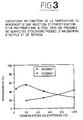
- reaction becomes very exothermic (greater than 100 ° C.) in the case of the alkylation of primary hydroxyl functions of a hydroxylated polyether comprising predominantly ethoxy functions.
- another essential parameter during the implementation of the process according to the invention corresponds to the rate of hydration of the reaction medium.
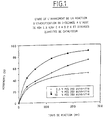
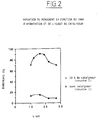
- the rate of hydration of the reaction medium should preferably be chosen so that the ratio of the number of moles of water to the number of moles of strong base is between 0.1 and 5.
- Curve 1 represents the variations in the yield of the etherification reaction as a function of the hydration rate of the reaction medium in the absence of catalyst, while curve 2 represents these same variations in the presence of catalyst.
- barium hydroxide constitutes a basic entity less well suited to this type of reaction since its use during the etherification of polyethylene glycol 400 has led to the expected product with a yield of 56% while under similar operating conditions, the transformation of PEG 400 into corresponding ether was found to be quantitative in the presence of potassium hydroxide (Table V).
- an excess of potassium hydroxide preferably of the order of 2 times the stoichiometric quantity, in the case of the etherification of an alcohol. primary and approximately 3 times the stoichiometric amount for the etherification of a secondary alcohol function, while the halide can be used in stoichiometric amount relative to the alcohol to be etherified.
- stoichiometric amounts of hydroxylated polypropylene glycol 1000 and different alkyl bromides and a 3.5-fold stoichiometric amount of potassium hydroxide were reacted for 3 hours at 20 ° C. and the yields were determined. etherification obtained depending on the nature of the halogenated reagent used.
- Another essential parameter of the invention corresponds to the choice of the halide.
- alkyl bromides and a synthesis temperature close to 20 ° C. are therefore the unique conditions for obtaining ethers with a selectivity of 100%.
Landscapes
- Chemical & Material Sciences (AREA)
- Organic Chemistry (AREA)
- Chemical Kinetics & Catalysis (AREA)
- Organic Low-Molecular-Weight Compounds And Preparation Thereof (AREA)
- Low-Molecular Organic Synthesis Reactions Using Catalysts (AREA)
- Polysaccharides And Polysaccharide Derivatives (AREA)
Applications Claiming Priority (2)
| Application Number | Priority Date | Filing Date | Title |
|---|---|---|---|
| FR9306929A FR2706451B1 (fr) | 1993-06-09 | 1993-06-09 | Procédé d'éthérification d'un mono ou d'un polyalcool primaire ou secondaire. |
| FR9306929 | 1993-06-09 |
Publications (2)
| Publication Number | Publication Date |
|---|---|
| EP0628531A1 true EP0628531A1 (de) | 1994-12-14 |
| EP0628531B1 EP0628531B1 (de) | 1997-10-29 |
Family
ID=9447931
Family Applications (1)
| Application Number | Title | Priority Date | Filing Date |
|---|---|---|---|
| EP94401189A Expired - Lifetime EP0628531B1 (de) | 1993-06-09 | 1994-05-30 | Verfahren zur selektiven Etherifizierung eines primären oder sekundären Mono- oder Polyalkohols |
Country Status (4)
| Country | Link |
|---|---|
| EP (1) | EP0628531B1 (de) |
| AT (1) | ATE159707T1 (de) |
| DE (1) | DE69406493D1 (de) |
| FR (1) | FR2706451B1 (de) |
Cited By (1)
| Publication number | Priority date | Publication date | Assignee | Title |
|---|---|---|---|---|
| CN107304160A (zh) * | 2016-04-18 | 2017-10-31 | 中石化石油工程技术服务有限公司 | 一种生物质醇醚及其制备方法和钻井液 |
Citations (4)
| Publication number | Priority date | Publication date | Assignee | Title |
|---|---|---|---|---|
| EP0021497A1 (de) * | 1979-06-21 | 1981-01-07 | THE PROCTER & GAMBLE COMPANY | Verfahren zur Herstellung von Monoalkyl-Äthern polyoxyalkyler Glykole |
| DE3606173A1 (de) * | 1986-02-26 | 1987-08-27 | Hoechst Ag | Verfahren zur herstellung von ausgangsproduktfreiem diethylenglykoldimethylether durch methylierung von diethylenglykolmonomethylether |
| EP0300527A1 (de) * | 1987-07-24 | 1989-01-25 | ENIRICERCHE S.p.A. | Verfahren zur Herstellung von Polyoxyalkylenglykol-monoäthern |
| DE4138166C1 (en) * | 1991-11-21 | 1992-10-22 | Th. Goldschmidt Ag, 4300 Essen, De | (Meth)allyl:alkoxy:alkylene prodn. - by reacting corresp. alcohol with excess sodium hydroxide or methoxide and simultaneously distilling off formed water or ethanol until specified reduced pressure is reached adding excess alkyl chloride, etc. |
-
1993
- 1993-06-09 FR FR9306929A patent/FR2706451B1/fr not_active Expired - Fee Related
-
1994
- 1994-05-30 EP EP94401189A patent/EP0628531B1/de not_active Expired - Lifetime
- 1994-05-30 AT AT94401189T patent/ATE159707T1/de not_active IP Right Cessation
- 1994-05-30 DE DE69406493T patent/DE69406493D1/de not_active Expired - Lifetime
Patent Citations (4)
| Publication number | Priority date | Publication date | Assignee | Title |
|---|---|---|---|---|
| EP0021497A1 (de) * | 1979-06-21 | 1981-01-07 | THE PROCTER & GAMBLE COMPANY | Verfahren zur Herstellung von Monoalkyl-Äthern polyoxyalkyler Glykole |
| DE3606173A1 (de) * | 1986-02-26 | 1987-08-27 | Hoechst Ag | Verfahren zur herstellung von ausgangsproduktfreiem diethylenglykoldimethylether durch methylierung von diethylenglykolmonomethylether |
| EP0300527A1 (de) * | 1987-07-24 | 1989-01-25 | ENIRICERCHE S.p.A. | Verfahren zur Herstellung von Polyoxyalkylenglykol-monoäthern |
| DE4138166C1 (en) * | 1991-11-21 | 1992-10-22 | Th. Goldschmidt Ag, 4300 Essen, De | (Meth)allyl:alkoxy:alkylene prodn. - by reacting corresp. alcohol with excess sodium hydroxide or methoxide and simultaneously distilling off formed water or ethanol until specified reduced pressure is reached adding excess alkyl chloride, etc. |
Non-Patent Citations (1)
| Title |
|---|
| B. G. ZUPANCIC ET AL: "ZUR GLYKOL-VERETHERUNG IM FEST-FLÜSSIG-ZWEIPHASENSYSTEM", SYNTHESIS., no. 2, February 1979 (1979-02-01), STUTTGART DE, pages 123 - 124 * |
Cited By (1)
| Publication number | Priority date | Publication date | Assignee | Title |
|---|---|---|---|---|
| CN107304160A (zh) * | 2016-04-18 | 2017-10-31 | 中石化石油工程技术服务有限公司 | 一种生物质醇醚及其制备方法和钻井液 |
Also Published As
| Publication number | Publication date |
|---|---|
| ATE159707T1 (de) | 1997-11-15 |
| EP0628531B1 (de) | 1997-10-29 |
| DE69406493D1 (de) | 1997-12-04 |
| FR2706451B1 (fr) | 1995-09-01 |
| FR2706451A1 (fr) | 1994-12-23 |
Similar Documents
| Publication | Publication Date | Title |
|---|---|---|
| EP0239479B1 (de) | Wässrige kolloidale Dispersionen einer Cer-IV-Verbindung und Verfahren zu ihrer Herstellung | |
| WO2021074544A1 (fr) | Alcools alcoxylés et coiffés | |
| JP4949563B2 (ja) | 新規なポリキシロサイド誘導体、それらを製造する方法および界面活性剤としての用途 | |
| EP2643339B1 (de) | Neues hydrotropes mittel, seine verwendung zur löslichkeitsmachung nicht-ionischer tenside und zusammensetzungen damit | |
| EP3584303B1 (de) | Tensidzusammensetzung auf der basis von amidsalzen von glycinbetain, sein herstellungsverfahren und seine verwendungen | |
| EP0466545A1 (de) | Zeolithe auf Basis von Kieselsäure und Oxyden vierwertiger Elemente, Verfahren zu deren Synthese sowie deren Verwendung | |
| JP2008520698A (ja) | セボフルランの調製のための方法 | |
| EP0628531B1 (de) | Verfahren zur selektiven Etherifizierung eines primären oder sekundären Mono- oder Polyalkohols | |
| US5567857A (en) | Fluoroalkylethoxylate compositions having enhanced water solubility | |
| CN103012768B (zh) | 一种高双键保护率烷基封端不饱和聚醚的制备方法 | |
| EP0786442B1 (de) | Verfahren zur Herstellung von Alkylchloriden | |
| NO155668B (no) | Vandig blekemiddel med rensevirkning. | |
| JPS58912A (ja) | エチレングリコ−ルモノアリ−ルエ−テルの芳香性を増強する方法 | |
| JPH09509426A (ja) | アルキルポリグリコシドの連続的漂白方法 | |
| FR2632632A1 (fr) | Procede d'hydroxylation de phenols et d'ethers de phenols | |
| KR101488862B1 (ko) | 고급 알킬폴리글리코시드의 제조방법 | |
| FR2707649A1 (fr) | Procédé de modification, par carboxyalkylation, de dérivés de polysaccharides, dérivés de polysaccharides carboxyalkylés ainsi obtenus et leurs utilisations. | |
| FR2702482A1 (fr) | Nouveau procede de preparation d'alkylpolyosides faiblement colores et a faible teneur en produits de degradation acide. | |
| JPS6038356A (ja) | パラフインのスルホキシド化の際に得られる反応混合物からパラフイン‐スルホン酸またはパラフイン‐スルホナートを穏やかな条件下で単離する方法 | |
| WO1982001546A1 (fr) | Procede pour la synthese de composes hydrogenes et/ou fluores du type polyoxyethylene-alkyl-ether, composes de ce type et application a titre d'agents tensio-actifs non ioniques | |
| JPH02304037A (ja) | アルキレンオキシド付加物の精製方法 | |
| JPH08157401A (ja) | トリメチロールプロパン及びジトリメチロールプロパンの製造方法 | |
| JPS6125739B2 (de) | ||
| WO1996015091A1 (en) | Synthesis of bis(2,2-dinitropropyl)acetal (bdnpa) | |
| JP5467741B2 (ja) | ノニオン界面活性剤組成物の製造方法 |
Legal Events
| Date | Code | Title | Description |
|---|---|---|---|
| PUAI | Public reference made under article 153(3) epc to a published international application that has entered the european phase |
Free format text: ORIGINAL CODE: 0009012 |
|
| AK | Designated contracting states |
Kind code of ref document: A1 Designated state(s): AT BE CH DE DK ES GB GR IE IT LI LU MC NL PT SE |
|
| RIN1 | Information on inventor provided before grant (corrected) |
Inventor name: OLIVERA, FRANCOIS XAVIER Inventor name: GASET, ANTOINE Inventor name: LE BIGOT, YVES Inventor name: ABRIBAT, BENOIT |
|
| 17P | Request for examination filed |
Effective date: 19950420 |
|
| 17Q | First examination report despatched |
Effective date: 19960419 |
|
| GRAG | Despatch of communication of intention to grant |
Free format text: ORIGINAL CODE: EPIDOS AGRA |
|
| GRAH | Despatch of communication of intention to grant a patent |
Free format text: ORIGINAL CODE: EPIDOS IGRA |
|
| GRAH | Despatch of communication of intention to grant a patent |
Free format text: ORIGINAL CODE: EPIDOS IGRA |
|
| GRAA | (expected) grant |
Free format text: ORIGINAL CODE: 0009210 |
|
| AK | Designated contracting states |
Kind code of ref document: B1 Designated state(s): AT BE CH DE DK ES GB GR IE IT LI LU MC NL PT SE |
|
| PG25 | Lapsed in a contracting state [announced via postgrant information from national office to epo] |
Ref country code: NL Free format text: LAPSE BECAUSE OF FAILURE TO SUBMIT A TRANSLATION OF THE DESCRIPTION OR TO PAY THE FEE WITHIN THE PRESCRIBED TIME-LIMIT Effective date: 19971029 Ref country code: IT Free format text: LAPSE BECAUSE OF FAILURE TO SUBMIT A TRANSLATION OF THE DESCRIPTION OR TO PAY THE FEE WITHIN THE PRE;WARNING: LAPSES OF ITALIAN PATENTS WITH EFFECTIVE DATE BEFORE 2007 MAY HAVE OCCURRED AT ANY TIME BEFORE 2007. THE CORRECT EFFECTIVE DATE MAY BE DIFFERENT FROM THE ONE RECORDED.SCRIBED TIME-LIMIT Effective date: 19971029 Ref country code: GR Free format text: LAPSE BECAUSE OF FAILURE TO SUBMIT A TRANSLATION OF THE DESCRIPTION OR TO PAY THE FEE WITHIN THE PRESCRIBED TIME-LIMIT Effective date: 19971029 Ref country code: GB Free format text: LAPSE BECAUSE OF FAILURE TO SUBMIT A TRANSLATION OF THE DESCRIPTION OR TO PAY THE FEE WITHIN THE PRESCRIBED TIME-LIMIT Effective date: 19971029 Ref country code: ES Free format text: THE PATENT HAS BEEN ANNULLED BY A DECISION OF A NATIONAL AUTHORITY Effective date: 19971029 Ref country code: DK Free format text: LAPSE BECAUSE OF NON-PAYMENT OF DUE FEES Effective date: 19971029 Ref country code: AT Free format text: LAPSE BECAUSE OF FAILURE TO SUBMIT A TRANSLATION OF THE DESCRIPTION OR TO PAY THE FEE WITHIN THE PRESCRIBED TIME-LIMIT Effective date: 19971029 |
|
| REF | Corresponds to: |
Ref document number: 159707 Country of ref document: AT Date of ref document: 19971115 Kind code of ref document: T |
|
| REG | Reference to a national code |
Ref country code: CH Ref legal event code: EP |
|
| REF | Corresponds to: |
Ref document number: 69406493 Country of ref document: DE Date of ref document: 19971204 |
|
| PG25 | Lapsed in a contracting state [announced via postgrant information from national office to epo] |
Ref country code: SE Effective date: 19980129 Ref country code: PT Free format text: LAPSE BECAUSE OF FAILURE TO SUBMIT A TRANSLATION OF THE DESCRIPTION OR TO PAY THE FEE WITHIN THE PRESCRIBED TIME-LIMIT Effective date: 19980129 |
|
| PG25 | Lapsed in a contracting state [announced via postgrant information from national office to epo] |
Ref country code: DE Free format text: LAPSE BECAUSE OF FAILURE TO SUBMIT A TRANSLATION OF THE DESCRIPTION OR TO PAY THE FEE WITHIN THE PRESCRIBED TIME-LIMIT Effective date: 19980130 |
|
| NLV1 | Nl: lapsed or annulled due to failure to fulfill the requirements of art. 29p and 29m of the patents act | ||
| GBV | Gb: ep patent (uk) treated as always having been void in accordance with gb section 77(7)/1977 [no translation filed] |
Effective date: 19971029 |
|
| PG25 | Lapsed in a contracting state [announced via postgrant information from national office to epo] |
Ref country code: LU Free format text: LAPSE BECAUSE OF NON-PAYMENT OF DUE FEES Effective date: 19980530 |
|
| PG25 | Lapsed in a contracting state [announced via postgrant information from national office to epo] |
Ref country code: LI Free format text: LAPSE BECAUSE OF NON-PAYMENT OF DUE FEES Effective date: 19980531 Ref country code: CH Free format text: LAPSE BECAUSE OF NON-PAYMENT OF DUE FEES Effective date: 19980531 Ref country code: BE Free format text: LAPSE BECAUSE OF NON-PAYMENT OF DUE FEES Effective date: 19980531 |
|
| PG25 | Lapsed in a contracting state [announced via postgrant information from national office to epo] |
Ref country code: IE Free format text: LAPSE BECAUSE OF NON-PAYMENT OF DUE FEES Effective date: 19980605 |
|
| PG25 | Lapsed in a contracting state [announced via postgrant information from national office to epo] |
Ref country code: MC Free format text: THE PATENT HAS BEEN ANNULLED BY A DECISION OF A NATIONAL AUTHORITY Effective date: 19980625 |
|
| REG | Reference to a national code |
Ref country code: IE Ref legal event code: FD4D Ref document number: 77207 Country of ref document: IE |
|
| PLBE | No opposition filed within time limit |
Free format text: ORIGINAL CODE: 0009261 |
|
| STAA | Information on the status of an ep patent application or granted ep patent |
Free format text: STATUS: NO OPPOSITION FILED WITHIN TIME LIMIT |
|
| 26N | No opposition filed | ||
| BERE | Be: lapsed |
Owner name: PRODUITS CHIMIQUES DU SIDOBRE-SINNOVA Effective date: 19980531 |
|
| REG | Reference to a national code |
Ref country code: CH Ref legal event code: PL |