EP0628538B1 - Verfahren zur acylierung von Threonin-Derivaten und deren Verwendung zur Herstellung von 1,4-Dihydropyridinen - Google Patents
Verfahren zur acylierung von Threonin-Derivaten und deren Verwendung zur Herstellung von 1,4-Dihydropyridinen Download PDFInfo
- Publication number
- EP0628538B1 EP0628538B1 EP94112407A EP94112407A EP0628538B1 EP 0628538 B1 EP0628538 B1 EP 0628538B1 EP 94112407 A EP94112407 A EP 94112407A EP 94112407 A EP94112407 A EP 94112407A EP 0628538 B1 EP0628538 B1 EP 0628538B1
- Authority
- EP
- European Patent Office
- Prior art keywords
- substituted
- carbon atoms
- alkoxy
- halogen
- alkyl
- Prior art date
- Legal status (The legal status is an assumption and is not a legal conclusion. Google has not performed a legal analysis and makes no representation as to the accuracy of the status listed.)
- Expired - Lifetime
Links
- 238000002360 preparation method Methods 0.000 title claims abstract description 10
- 238000000034 method Methods 0.000 title claims description 10
- 150000003587 threonine derivatives Chemical class 0.000 title abstract description 3
- YNGDWRXWKFWCJY-UHFFFAOYSA-N 1,4-Dihydropyridine Chemical class C1C=CNC=C1 YNGDWRXWKFWCJY-UHFFFAOYSA-N 0.000 title description 3
- 230000010933 acylation Effects 0.000 title 1
- 238000005917 acylation reaction Methods 0.000 title 1
- 150000001875 compounds Chemical class 0.000 claims abstract description 38
- 229910052760 oxygen Inorganic materials 0.000 claims abstract description 35
- 229910052739 hydrogen Inorganic materials 0.000 claims abstract description 34
- 239000001257 hydrogen Substances 0.000 claims abstract description 32
- 125000002496 methyl group Chemical group [H]C([H])([H])* 0.000 claims abstract description 30
- UFHFLCQGNIYNRP-UHFFFAOYSA-N Hydrogen Chemical compound [H][H] UFHFLCQGNIYNRP-UHFFFAOYSA-N 0.000 claims abstract description 29
- 239000001301 oxygen Substances 0.000 claims abstract description 28
- QVGXLLKOCUKJST-UHFFFAOYSA-N atomic oxygen Chemical compound [O] QVGXLLKOCUKJST-UHFFFAOYSA-N 0.000 claims abstract description 21
- WASQWSOJHCZDFK-UHFFFAOYSA-N diketene Chemical compound C=C1CC(=O)O1 WASQWSOJHCZDFK-UHFFFAOYSA-N 0.000 claims abstract description 6
- 125000004435 hydrogen atom Chemical group [H]* 0.000 claims abstract description 6
- 125000002887 hydroxy group Chemical group [H]O* 0.000 claims abstract 16
- 229910052736 halogen Inorganic materials 0.000 claims description 88
- 150000002367 halogens Chemical group 0.000 claims description 88
- 125000004432 carbon atom Chemical group C* 0.000 claims description 71
- 125000001997 phenyl group Chemical group [H]C1=C([H])C([H])=C(*)C([H])=C1[H] 0.000 claims description 70
- 125000000217 alkyl group Chemical group 0.000 claims description 66
- -1 C1-C2-alkyl Chemical group 0.000 claims description 60
- 125000000449 nitro group Chemical group [O-][N+](*)=O 0.000 claims description 49
- 125000004093 cyano group Chemical group *C#N 0.000 claims description 46
- 125000003178 carboxy group Chemical group [H]OC(*)=O 0.000 claims description 35
- 125000002023 trifluoromethyl group Chemical group FC(F)(F)* 0.000 claims description 35
- 125000000753 cycloalkyl group Chemical group 0.000 claims description 25
- 125000000876 trifluoromethoxy group Chemical group FC(F)(F)O* 0.000 claims description 25
- 125000000229 (C1-C4)alkoxy group Chemical group 0.000 claims description 20
- 125000004454 (C1-C6) alkoxycarbonyl group Chemical group 0.000 claims description 18
- 125000003917 carbamoyl group Chemical group [H]N([H])C(*)=O 0.000 claims description 18
- 125000000113 cyclohexyl group Chemical group [H]C1([H])C([H])([H])C([H])([H])C([H])(*)C([H])([H])C1([H])[H] 0.000 claims description 16
- 125000004191 (C1-C6) alkoxy group Chemical group 0.000 claims description 14
- 150000002431 hydrogen Chemical class 0.000 claims description 14
- ZAMOUSCENKQFHK-UHFFFAOYSA-N Chlorine atom Chemical compound [Cl] ZAMOUSCENKQFHK-UHFFFAOYSA-N 0.000 claims description 13
- 125000004663 dialkyl amino group Chemical group 0.000 claims description 13
- PXGOKWXKJXAPGV-UHFFFAOYSA-N Fluorine Chemical compound FF PXGOKWXKJXAPGV-UHFFFAOYSA-N 0.000 claims description 12
- 125000005842 heteroatom Chemical group 0.000 claims description 12
- 125000003342 alkenyl group Chemical group 0.000 claims description 11
- 125000005117 dialkylcarbamoyl group Chemical group 0.000 claims description 11
- 239000000460 chlorine Substances 0.000 claims description 10
- 229910052801 chlorine Inorganic materials 0.000 claims description 10
- 125000004169 (C1-C6) alkyl group Chemical group 0.000 claims description 9
- 125000001559 cyclopropyl group Chemical group [H]C1([H])C([H])([H])C1([H])* 0.000 claims description 9
- 125000004178 (C1-C4) alkyl group Chemical group 0.000 claims description 8
- 125000003118 aryl group Chemical group 0.000 claims description 8
- 239000011737 fluorine Substances 0.000 claims description 8
- 229910052731 fluorine Inorganic materials 0.000 claims description 8
- 125000000623 heterocyclic group Chemical group 0.000 claims description 8
- 125000006274 (C1-C3)alkoxy group Chemical group 0.000 claims description 7
- QGZKDVFQNNGYKY-UHFFFAOYSA-N Ammonia Chemical compound N QGZKDVFQNNGYKY-UHFFFAOYSA-N 0.000 claims description 7
- 125000003282 alkyl amino group Chemical group 0.000 claims description 7
- 125000002924 primary amino group Chemical group [H]N([H])* 0.000 claims description 7
- 125000004209 (C1-C8) alkyl group Chemical group 0.000 claims description 6
- 125000001511 cyclopentyl group Chemical group [H]C1([H])C([H])([H])C([H])([H])C([H])(*)C1([H])[H] 0.000 claims description 6
- 125000000956 methoxy group Chemical group [H]C([H])([H])O* 0.000 claims description 6
- 125000004076 pyridyl group Chemical group 0.000 claims description 6
- 229920006395 saturated elastomer Polymers 0.000 claims description 6
- 229910052717 sulfur Inorganic materials 0.000 claims description 6
- 125000004433 nitrogen atom Chemical group N* 0.000 claims description 5
- 125000002915 carbonyl group Chemical group [*:2]C([*:1])=O 0.000 claims description 4
- 125000000999 tert-butyl group Chemical group [H]C([H])([H])C(*)(C([H])([H])[H])C([H])([H])[H] 0.000 claims description 4
- 125000006273 (C1-C3) alkyl group Chemical group 0.000 claims description 3
- 125000004455 (C1-C3) alkylthio group Chemical group 0.000 claims description 3
- 125000004648 C2-C8 alkenyl group Chemical group 0.000 claims description 3
- NINIDFKCEFEMDL-UHFFFAOYSA-N Sulfur Chemical compound [S] NINIDFKCEFEMDL-UHFFFAOYSA-N 0.000 claims description 3
- 229910021529 ammonia Inorganic materials 0.000 claims description 3
- CPPKAGUPTKIMNP-UHFFFAOYSA-N cyanogen fluoride Chemical compound FC#N CPPKAGUPTKIMNP-UHFFFAOYSA-N 0.000 claims description 2
- 125000004925 dihydropyridyl group Chemical group N1(CC=CC=C1)* 0.000 claims description 2
- 125000002950 monocyclic group Chemical group 0.000 claims description 2
- 229910052757 nitrogen Inorganic materials 0.000 claims description 2
- 239000005864 Sulphur Substances 0.000 claims 2
- 125000002485 formyl group Chemical class [H]C(*)=O 0.000 claims 1
- 239000000543 intermediate Substances 0.000 abstract description 7
- COLPLFZHPXIFCQ-UHFFFAOYSA-N 1,4-dihydropyridine-3,5-dicarboxylic acid Chemical compound OC(=O)C1=CNC=C(C(O)=O)C1 COLPLFZHPXIFCQ-UHFFFAOYSA-N 0.000 abstract 1
- 125000000341 threoninyl group Chemical group [H]OC([H])(C([H])([H])[H])C([H])(N([H])[H])C(*)=O 0.000 abstract 1
- XEKOWRVHYACXOJ-UHFFFAOYSA-N Ethyl acetate Chemical compound CCOC(C)=O XEKOWRVHYACXOJ-UHFFFAOYSA-N 0.000 description 16
- YXFVVABEGXRONW-UHFFFAOYSA-N Toluene Chemical compound CC1=CC=CC=C1 YXFVVABEGXRONW-UHFFFAOYSA-N 0.000 description 15
- 125000004356 hydroxy functional group Chemical group O* 0.000 description 14
- KFZMGEQAYNKOFK-UHFFFAOYSA-N Isopropanol Chemical compound CC(C)O KFZMGEQAYNKOFK-UHFFFAOYSA-N 0.000 description 10
- 0 C1CC*CC1 Chemical compound C1CC*CC1 0.000 description 8
- YMWUJEATGCHHMB-UHFFFAOYSA-N Dichloromethane Chemical compound ClCCl YMWUJEATGCHHMB-UHFFFAOYSA-N 0.000 description 8
- LFQSCWFLJHTTHZ-UHFFFAOYSA-N Ethanol Chemical compound CCO LFQSCWFLJHTTHZ-UHFFFAOYSA-N 0.000 description 8
- 125000003545 alkoxy group Chemical group 0.000 description 7
- XLYOFNOQVPJJNP-UHFFFAOYSA-N water Substances O XLYOFNOQVPJJNP-UHFFFAOYSA-N 0.000 description 7
- RTZKZFJDLAIYFH-UHFFFAOYSA-N Diethyl ether Chemical compound CCOCC RTZKZFJDLAIYFH-UHFFFAOYSA-N 0.000 description 6
- MYMOFIZGZYHOMD-UHFFFAOYSA-N Dioxygen Chemical compound O=O MYMOFIZGZYHOMD-UHFFFAOYSA-N 0.000 description 6
- OKKJLVBELUTLKV-UHFFFAOYSA-N Methanol Chemical compound OC OKKJLVBELUTLKV-UHFFFAOYSA-N 0.000 description 6
- ZMANZCXQSJIPKH-UHFFFAOYSA-N Triethylamine Chemical compound CCN(CC)CC ZMANZCXQSJIPKH-UHFFFAOYSA-N 0.000 description 6
- 239000013078 crystal Substances 0.000 description 5
- 238000002844 melting Methods 0.000 description 5
- 230000008018 melting Effects 0.000 description 5
- 239000000203 mixture Substances 0.000 description 5
- 125000004765 (C1-C4) haloalkyl group Chemical group 0.000 description 4
- CSCPPACGZOOCGX-UHFFFAOYSA-N Acetone Chemical compound CC(C)=O CSCPPACGZOOCGX-UHFFFAOYSA-N 0.000 description 4
- VYPSYNLAJGMNEJ-UHFFFAOYSA-N Silicium dioxide Chemical compound O=[Si]=O VYPSYNLAJGMNEJ-UHFFFAOYSA-N 0.000 description 4
- 239000002253 acid Substances 0.000 description 4
- 239000007858 starting material Substances 0.000 description 4
- 125000004767 (C1-C4) haloalkoxy group Chemical group 0.000 description 3
- QTBSBXVTEAMEQO-UHFFFAOYSA-N Acetic acid Chemical compound CC(O)=O QTBSBXVTEAMEQO-UHFFFAOYSA-N 0.000 description 3
- WDJHALXBUFZDSR-UHFFFAOYSA-N Acetoacetic acid Natural products CC(=O)CC(O)=O WDJHALXBUFZDSR-UHFFFAOYSA-N 0.000 description 3
- 125000004453 alkoxycarbonyl group Chemical group 0.000 description 3
- 125000004414 alkyl thio group Chemical group 0.000 description 3
- WOWBFOBYOAGEEA-UHFFFAOYSA-N diafenthiuron Chemical compound CC(C)C1=C(NC(=S)NC(C)(C)C)C(C(C)C)=CC(OC=2C=CC=CC=2)=C1 WOWBFOBYOAGEEA-UHFFFAOYSA-N 0.000 description 3
- 125000004494 ethyl ester group Chemical group 0.000 description 3
- VLKZOEOYAKHREP-UHFFFAOYSA-N n-Hexane Chemical compound CCCCCC VLKZOEOYAKHREP-UHFFFAOYSA-N 0.000 description 3
- 239000003921 oil Substances 0.000 description 3
- 239000000047 product Substances 0.000 description 3
- 238000000926 separation method Methods 0.000 description 3
- 125000006677 (C1-C3) haloalkoxy group Chemical group 0.000 description 2
- 125000004739 (C1-C6) alkylsulfonyl group Chemical group 0.000 description 2
- 125000004737 (C1-C6) haloalkoxy group Chemical group 0.000 description 2
- 125000000171 (C1-C6) haloalkyl group Chemical group 0.000 description 2
- AKCMQURCNWKZPS-UHFFFAOYSA-N 2,6-dimethyl-5-nitro-4-phenyl-1,4-dihydropyridine-3-carboxylic acid Chemical compound [O-][N+](=O)C1=C(C)NC(C)=C(C(O)=O)C1C1=CC=CC=C1 AKCMQURCNWKZPS-UHFFFAOYSA-N 0.000 description 2
- OYRPMZZLRMIPOM-UHFFFAOYSA-N 3-nitro-4-phenylbut-3-en-2-one Chemical compound CC(=O)C([N+]([O-])=O)=CC1=CC=CC=C1 OYRPMZZLRMIPOM-UHFFFAOYSA-N 0.000 description 2
- HBAQYPYDRFILMT-UHFFFAOYSA-N 8-[3-(1-cyclopropylpyrazol-4-yl)-1H-pyrazolo[4,3-d]pyrimidin-5-yl]-3-methyl-3,8-diazabicyclo[3.2.1]octan-2-one Chemical class C1(CC1)N1N=CC(=C1)C1=NNC2=C1N=C(N=C2)N1C2C(N(CC1CC2)C)=O HBAQYPYDRFILMT-UHFFFAOYSA-N 0.000 description 2
- VEXZGXHMUGYJMC-UHFFFAOYSA-N Hydrochloric acid Chemical compound Cl VEXZGXHMUGYJMC-UHFFFAOYSA-N 0.000 description 2
- AYFVYJQAPQTCCC-GBXIJSLDSA-N L-threonine Chemical compound C[C@@H](O)[C@H](N)C(O)=O AYFVYJQAPQTCCC-GBXIJSLDSA-N 0.000 description 2
- NQRYJNQNLNOLGT-UHFFFAOYSA-N Piperidine Chemical compound C1CCNCC1 NQRYJNQNLNOLGT-UHFFFAOYSA-N 0.000 description 2
- 125000004442 acylamino group Chemical group 0.000 description 2
- 244000309464 bull Species 0.000 description 2
- 238000006243 chemical reaction Methods 0.000 description 2
- 238000004440 column chromatography Methods 0.000 description 2
- 239000013067 intermediate product Substances 0.000 description 2
- 238000004519 manufacturing process Methods 0.000 description 2
- TVHCXXXXQNWQLP-DMTCNVIQSA-N methyl (2s,3r)-2-amino-3-hydroxybutanoate Chemical compound COC(=O)[C@@H](N)[C@@H](C)O TVHCXXXXQNWQLP-DMTCNVIQSA-N 0.000 description 2
- OPZWAOJFQFYYIX-KOLCDFICSA-N methyl (2s,3r)-3-hydroxy-2-(phenylmethoxycarbonylamino)butanoate Chemical compound COC(=O)[C@H]([C@@H](C)O)NC(=O)OCC1=CC=CC=C1 OPZWAOJFQFYYIX-KOLCDFICSA-N 0.000 description 2
- 230000000144 pharmacologic effect Effects 0.000 description 2
- BWHMMNNQKKPAPP-UHFFFAOYSA-L potassium carbonate Chemical compound [K+].[K+].[O-]C([O-])=O BWHMMNNQKKPAPP-UHFFFAOYSA-L 0.000 description 2
- 239000000741 silica gel Substances 0.000 description 2
- 229910002027 silica gel Inorganic materials 0.000 description 2
- 239000008030 superplasticizer Substances 0.000 description 2
- FYSNRJHAOHDILO-UHFFFAOYSA-N thionyl chloride Chemical compound ClS(Cl)=O FYSNRJHAOHDILO-UHFFFAOYSA-N 0.000 description 2
- JOXIMZWYDAKGHI-UHFFFAOYSA-N toluene-4-sulfonic acid Chemical compound CC1=CC=C(S(O)(=O)=O)C=C1 JOXIMZWYDAKGHI-UHFFFAOYSA-N 0.000 description 2
- 125000006771 (C1-C6) haloalkylthio group Chemical group 0.000 description 1
- VZAWCLCJGSBATP-UHFFFAOYSA-N 1-cycloundecyl-1,2-diazacycloundecane Chemical compound C1CCCCCCCCCC1N1NCCCCCCCCC1 VZAWCLCJGSBATP-UHFFFAOYSA-N 0.000 description 1
- PBEJTRAJWCNHRS-UHFFFAOYSA-N 2-phenylmethoxybenzaldehyde Chemical compound O=CC1=CC=CC=C1OCC1=CC=CC=C1 PBEJTRAJWCNHRS-UHFFFAOYSA-N 0.000 description 1
- JPXPPUOCSLMCHK-UHFFFAOYSA-N 5-methoxycarbonyl-2,6-dimethyl-4-(3-nitrophenyl)-1,4-dihydropyridine-3-carboxylic acid Chemical compound COC(=O)C1=C(C)NC(C)=C(C(O)=O)C1C1=CC=CC([N+]([O-])=O)=C1 JPXPPUOCSLMCHK-UHFFFAOYSA-N 0.000 description 1
- XMWINMVFKPHMJB-UHFFFAOYSA-N CC1=CCCC=C1 Chemical compound CC1=CCCC=C1 XMWINMVFKPHMJB-UHFFFAOYSA-N 0.000 description 1
- DHEUSUBEEZDCTP-JZMYEYFNSA-N C[C@@H]1OC2OCC2CC1=N Chemical compound C[C@@H]1OC2OCC2CC1=N DHEUSUBEEZDCTP-JZMYEYFNSA-N 0.000 description 1
- 208000024172 Cardiovascular disease Diseases 0.000 description 1
- 238000006000 Knoevenagel condensation reaction Methods 0.000 description 1
- 239000004473 Threonine Substances 0.000 description 1
- PXGKGQWMIMUYPF-UHFFFAOYSA-N [fluoro(nitro)-lambda3-chloranyl]formonitrile Chemical compound C(#N)Cl(F)[N+](=O)[O-] PXGKGQWMIMUYPF-UHFFFAOYSA-N 0.000 description 1
- 150000007513 acids Chemical class 0.000 description 1
- 150000001299 aldehydes Chemical class 0.000 description 1
- 125000005153 alkyl sulfamoyl group Chemical group 0.000 description 1
- XAGFODPZIPBFFR-UHFFFAOYSA-N aluminium Chemical compound [Al] XAGFODPZIPBFFR-UHFFFAOYSA-N 0.000 description 1
- 229910052782 aluminium Inorganic materials 0.000 description 1
- 229940024606 amino acid Drugs 0.000 description 1
- 150000001413 amino acids Chemical class 0.000 description 1
- HSDAJNMJOMSNEV-UHFFFAOYSA-N benzyl chloroformate Chemical compound ClC(=O)OCC1=CC=CC=C1 HSDAJNMJOMSNEV-UHFFFAOYSA-N 0.000 description 1
- 150000001722 carbon compounds Chemical class 0.000 description 1
- 239000012230 colorless oil Substances 0.000 description 1
- 239000000470 constituent Substances 0.000 description 1
- 238000010276 construction Methods 0.000 description 1
- 238000001816 cooling Methods 0.000 description 1
- 238000002425 crystallisation Methods 0.000 description 1
- 230000008025 crystallization Effects 0.000 description 1
- 238000000354 decomposition reaction Methods 0.000 description 1
- 125000004786 difluoromethoxy group Chemical group [H]C(F)(F)O* 0.000 description 1
- IJKVHSBPTUYDLN-UHFFFAOYSA-N dihydroxy(oxo)silane Chemical compound O[Si](O)=O IJKVHSBPTUYDLN-UHFFFAOYSA-N 0.000 description 1
- 239000003480 eluent Substances 0.000 description 1
- 150000002081 enamines Chemical class 0.000 description 1
- 230000032050 esterification Effects 0.000 description 1
- 238000005886 esterification reaction Methods 0.000 description 1
- 150000002148 esters Chemical class 0.000 description 1
- 238000001704 evaporation Methods 0.000 description 1
- 230000008020 evaporation Effects 0.000 description 1
- 125000004438 haloalkoxy group Chemical group 0.000 description 1
- 125000004995 haloalkylthio group Chemical group 0.000 description 1
- LYUBYLJQOZIBQB-UHFFFAOYSA-N methyl 2-[(3-nitrophenyl)methylidene]-3-oxobutanoate Chemical compound COC(=O)C(C(C)=O)=CC1=CC=CC([N+]([O-])=O)=C1 LYUBYLJQOZIBQB-UHFFFAOYSA-N 0.000 description 1
- 239000012452 mother liquor Substances 0.000 description 1
- 238000006053 organic reaction Methods 0.000 description 1
- 229910000027 potassium carbonate Inorganic materials 0.000 description 1
- 238000012746 preparative thin layer chromatography Methods 0.000 description 1
- 125000006239 protecting group Chemical group 0.000 description 1
- 238000000746 purification Methods 0.000 description 1
- 239000002002 slurry Substances 0.000 description 1
- 239000012265 solid product Substances 0.000 description 1
- 238000003756 stirring Methods 0.000 description 1
- 239000011593 sulfur Substances 0.000 description 1
- 239000000725 suspension Substances 0.000 description 1
- 238000004809 thin layer chromatography Methods 0.000 description 1
- 229960002898 threonine Drugs 0.000 description 1
Classifications
-
- C—CHEMISTRY; METALLURGY
- C07—ORGANIC CHEMISTRY
- C07D—HETEROCYCLIC COMPOUNDS
- C07D211/00—Heterocyclic compounds containing hydrogenated pyridine rings, not condensed with other rings
- C07D211/04—Heterocyclic compounds containing hydrogenated pyridine rings, not condensed with other rings with only hydrogen or carbon atoms directly attached to the ring nitrogen atom
- C07D211/80—Heterocyclic compounds containing hydrogenated pyridine rings, not condensed with other rings with only hydrogen or carbon atoms directly attached to the ring nitrogen atom having two double bonds between ring members or between ring members and non-ring members
- C07D211/82—Heterocyclic compounds containing hydrogenated pyridine rings, not condensed with other rings with only hydrogen or carbon atoms directly attached to the ring nitrogen atom having two double bonds between ring members or between ring members and non-ring members with only hydrogen atoms, hydrocarbon or substituted hydrocarbon radicals, directly attached to ring carbon atoms
-
- C—CHEMISTRY; METALLURGY
- C07—ORGANIC CHEMISTRY
- C07C—ACYCLIC OR CARBOCYCLIC COMPOUNDS
- C07C233/00—Carboxylic acid amides
- C07C233/01—Carboxylic acid amides having carbon atoms of carboxamide groups bound to hydrogen atoms or to acyclic carbon atoms
- C07C233/45—Carboxylic acid amides having carbon atoms of carboxamide groups bound to hydrogen atoms or to acyclic carbon atoms having the nitrogen atom of at least one of the carboxamide groups bound to a carbon atom of a hydrocarbon radical substituted by carboxyl groups
- C07C233/46—Carboxylic acid amides having carbon atoms of carboxamide groups bound to hydrogen atoms or to acyclic carbon atoms having the nitrogen atom of at least one of the carboxamide groups bound to a carbon atom of a hydrocarbon radical substituted by carboxyl groups with the substituted hydrocarbon radical bound to the nitrogen atom of the carboxamide group by an acyclic carbon atom
- C07C233/47—Carboxylic acid amides having carbon atoms of carboxamide groups bound to hydrogen atoms or to acyclic carbon atoms having the nitrogen atom of at least one of the carboxamide groups bound to a carbon atom of a hydrocarbon radical substituted by carboxyl groups with the substituted hydrocarbon radical bound to the nitrogen atom of the carboxamide group by an acyclic carbon atom having the carbon atom of the carboxamide group bound to a hydrogen atom or to a carbon atom of an acyclic saturated carbon skeleton
-
- A—HUMAN NECESSITIES
- A61—MEDICAL OR VETERINARY SCIENCE; HYGIENE
- A61P—SPECIFIC THERAPEUTIC ACTIVITY OF CHEMICAL COMPOUNDS OR MEDICINAL PREPARATIONS
- A61P9/00—Drugs for disorders of the cardiovascular system
-
- A—HUMAN NECESSITIES
- A61—MEDICAL OR VETERINARY SCIENCE; HYGIENE
- A61P—SPECIFIC THERAPEUTIC ACTIVITY OF CHEMICAL COMPOUNDS OR MEDICINAL PREPARATIONS
- A61P9/00—Drugs for disorders of the cardiovascular system
- A61P9/08—Vasodilators for multiple indications
-
- A—HUMAN NECESSITIES
- A61—MEDICAL OR VETERINARY SCIENCE; HYGIENE
- A61P—SPECIFIC THERAPEUTIC ACTIVITY OF CHEMICAL COMPOUNDS OR MEDICINAL PREPARATIONS
- A61P9/00—Drugs for disorders of the cardiovascular system
- A61P9/10—Drugs for disorders of the cardiovascular system for treating ischaemic or atherosclerotic diseases, e.g. antianginal drugs, coronary vasodilators, drugs for myocardial infarction, retinopathy, cerebrovascula insufficiency, renal arteriosclerosis
-
- C—CHEMISTRY; METALLURGY
- C07—ORGANIC CHEMISTRY
- C07C—ACYCLIC OR CARBOCYCLIC COMPOUNDS
- C07C233/00—Carboxylic acid amides
- C07C233/64—Carboxylic acid amides having carbon atoms of carboxamide groups bound to carbon atoms of six-membered aromatic rings
- C07C233/81—Carboxylic acid amides having carbon atoms of carboxamide groups bound to carbon atoms of six-membered aromatic rings having the nitrogen atom of at least one of the carboxamide groups bound to a carbon atom of a hydrocarbon radical substituted by carboxyl groups
- C07C233/82—Carboxylic acid amides having carbon atoms of carboxamide groups bound to carbon atoms of six-membered aromatic rings having the nitrogen atom of at least one of the carboxamide groups bound to a carbon atom of a hydrocarbon radical substituted by carboxyl groups with the substituted hydrocarbon radical bound to the nitrogen atom of the carboxamide group by an acyclic carbon atom
- C07C233/83—Carboxylic acid amides having carbon atoms of carboxamide groups bound to carbon atoms of six-membered aromatic rings having the nitrogen atom of at least one of the carboxamide groups bound to a carbon atom of a hydrocarbon radical substituted by carboxyl groups with the substituted hydrocarbon radical bound to the nitrogen atom of the carboxamide group by an acyclic carbon atom of an acyclic saturated carbon skeleton
-
- C—CHEMISTRY; METALLURGY
- C07—ORGANIC CHEMISTRY
- C07C—ACYCLIC OR CARBOCYCLIC COMPOUNDS
- C07C251/00—Compounds containing nitrogen atoms doubly-bound to a carbon skeleton
- C07C251/02—Compounds containing nitrogen atoms doubly-bound to a carbon skeleton containing imino groups
- C07C251/04—Compounds containing nitrogen atoms doubly-bound to a carbon skeleton containing imino groups having carbon atoms of imino groups bound to hydrogen atoms or to acyclic carbon atoms
- C07C251/06—Compounds containing nitrogen atoms doubly-bound to a carbon skeleton containing imino groups having carbon atoms of imino groups bound to hydrogen atoms or to acyclic carbon atoms to carbon atoms of a saturated carbon skeleton
- C07C251/08—Compounds containing nitrogen atoms doubly-bound to a carbon skeleton containing imino groups having carbon atoms of imino groups bound to hydrogen atoms or to acyclic carbon atoms to carbon atoms of a saturated carbon skeleton being acyclic
-
- C—CHEMISTRY; METALLURGY
- C07—ORGANIC CHEMISTRY
- C07C—ACYCLIC OR CARBOCYCLIC COMPOUNDS
- C07C271/00—Derivatives of carbamic acids, i.e. compounds containing any of the groups, the nitrogen atom not being part of nitro or nitroso groups
- C07C271/06—Esters of carbamic acids
- C07C271/08—Esters of carbamic acids having oxygen atoms of carbamate groups bound to acyclic carbon atoms
- C07C271/10—Esters of carbamic acids having oxygen atoms of carbamate groups bound to acyclic carbon atoms with the nitrogen atoms of the carbamate groups bound to hydrogen atoms or to acyclic carbon atoms
- C07C271/22—Esters of carbamic acids having oxygen atoms of carbamate groups bound to acyclic carbon atoms with the nitrogen atoms of the carbamate groups bound to hydrogen atoms or to acyclic carbon atoms to carbon atoms of hydrocarbon radicals substituted by carboxyl groups
-
- C—CHEMISTRY; METALLURGY
- C07—ORGANIC CHEMISTRY
- C07C—ACYCLIC OR CARBOCYCLIC COMPOUNDS
- C07C275/00—Derivatives of urea, i.e. compounds containing any of the groups, the nitrogen atoms not being part of nitro or nitroso groups
- C07C275/28—Derivatives of urea, i.e. compounds containing any of the groups, the nitrogen atoms not being part of nitro or nitroso groups having nitrogen atoms of urea groups bound to carbon atoms of six-membered aromatic rings of a carbon skeleton
-
- C—CHEMISTRY; METALLURGY
- C07—ORGANIC CHEMISTRY
- C07C—ACYCLIC OR CARBOCYCLIC COMPOUNDS
- C07C311/00—Amides of sulfonic acids, i.e. compounds having singly-bound oxygen atoms of sulfo groups replaced by nitrogen atoms, not being part of nitro or nitroso groups
- C07C311/15—Sulfonamides having sulfur atoms of sulfonamide groups bound to carbon atoms of six-membered aromatic rings
- C07C311/16—Sulfonamides having sulfur atoms of sulfonamide groups bound to carbon atoms of six-membered aromatic rings having the nitrogen atom of at least one of the sulfonamide groups bound to hydrogen atoms or to an acyclic carbon atom
- C07C311/19—Sulfonamides having sulfur atoms of sulfonamide groups bound to carbon atoms of six-membered aromatic rings having the nitrogen atom of at least one of the sulfonamide groups bound to hydrogen atoms or to an acyclic carbon atom to an acyclic carbon atom of a hydrocarbon radical substituted by carboxyl groups
-
- C—CHEMISTRY; METALLURGY
- C07—ORGANIC CHEMISTRY
- C07D—HETEROCYCLIC COMPOUNDS
- C07D211/00—Heterocyclic compounds containing hydrogenated pyridine rings, not condensed with other rings
- C07D211/04—Heterocyclic compounds containing hydrogenated pyridine rings, not condensed with other rings with only hydrogen or carbon atoms directly attached to the ring nitrogen atom
- C07D211/80—Heterocyclic compounds containing hydrogenated pyridine rings, not condensed with other rings with only hydrogen or carbon atoms directly attached to the ring nitrogen atom having two double bonds between ring members or between ring members and non-ring members
- C07D211/84—Heterocyclic compounds containing hydrogenated pyridine rings, not condensed with other rings with only hydrogen or carbon atoms directly attached to the ring nitrogen atom having two double bonds between ring members or between ring members and non-ring members with hetero atoms or with carbon atoms having three bonds to hetero atoms, with at the most one bond to halogen directly attached to ring carbon atoms
- C07D211/90—Carbon atoms having three bonds to hetero atoms with at the most one bond to halogen
Definitions
- dihydropyridinecarboxylic acids can be prepared from the corresponding dihydropyridinecarboxylic acid ⁇ -cyanoeethyl esters (cf. DOS 39 29 545).
- the compounds according to the invention exist in stereoisomeric forms which either behave like image and mirror image (enantiomers) or do not behave like image and mirror image (diastereomers).
- the invention relates to both the antipodes and the racemic forms as well as the diastereomer mixtures.
- the racemic forms, like the diastereomers, can be separated into the stereoisomerically uniform constituents in a known manner (cf. E.L. Eliel, Stereochemistry of Carbon Compounds, McGraw Hill, 1962).
- the compounds according to the invention are new and can be used as intermediates for the preparation of 1,4-dihydropyridines with valuable pharmacological properties. These dihydropyridines affect the contractility of the heart and can therefore be used to combat cardiovascular diseases. The possibility of producing pure enantiomers enables the desired pharmacological properties of the compounds to be optimized in different directions. More detailed information on the use of the compounds II as intermediates can be found in the parent application No. 89 110 528.0.
- aldehydes of the general formula (III) used as starting materials are known or can be prepared by known methods [DOS 21 65 260; 24 01 665; TD Harris, GP Roth, J. Org. Chem. 44 , 2004 (1979); WJ Dale, HE Hennis, J. Am. Chem. Soc. 78: 2543 (1956); Chem. Abstr. 59 , 13929 (1963)].
- the enamines of the general formula (IV) used as starting materials are known or can be prepared by known methods [DOS 2 228 377; FA, Glickman, AC Cope, J. Am. Chem. Soc. 67 , 1017 (1945)].
- the ylidene- ⁇ -ketocarboxylic acid derivatives of the general formula (VI) used as starting materials are known or can be prepared by known methods [G. Jones “The Knoevenagel Condensation” in Organic Reactions Vol. XV, 204 (1967)].
Landscapes
- Chemical & Material Sciences (AREA)
- Organic Chemistry (AREA)
- Health & Medical Sciences (AREA)
- Engineering & Computer Science (AREA)
- Bioinformatics & Cheminformatics (AREA)
- Life Sciences & Earth Sciences (AREA)
- General Health & Medical Sciences (AREA)
- Cardiology (AREA)
- Heart & Thoracic Surgery (AREA)
- Chemical Kinetics & Catalysis (AREA)
- General Chemical & Material Sciences (AREA)
- Medicinal Chemistry (AREA)
- Nuclear Medicine, Radiotherapy & Molecular Imaging (AREA)
- Pharmacology & Pharmacy (AREA)
- Veterinary Medicine (AREA)
- Animal Behavior & Ethology (AREA)
- Public Health (AREA)
- Vascular Medicine (AREA)
- Urology & Nephrology (AREA)
- Pharmaceuticals Containing Other Organic And Inorganic Compounds (AREA)
- Hydrogenated Pyridines (AREA)
- Plural Heterocyclic Compounds (AREA)
- Organic Low-Molecular-Weight Compounds And Preparation Thereof (AREA)
- Nitrogen Condensed Heterocyclic Rings (AREA)
- Cephalosporin Compounds (AREA)
- Nitrogen And Oxygen Or Sulfur-Condensed Heterocyclic Ring Systems (AREA)
- Preparation Of Compounds By Using Micro-Organisms (AREA)
- Saccharide Compounds (AREA)
- Low-Molecular Organic Synthesis Reactions Using Catalysts (AREA)
Description
- Die vorliegende Teilanmeldung aus der Anmeldung Nr. 89 110 528.0 betrifft neue Zwischenprodukte und Verfahren zu ihrer Herstellung sowie ihre Verwendung bei der Herstellung von 1,4-Dihydropyridinen.
- Es ist bereits bekannt geworden, daß man Dihydropyridincarbonsäuren aus den entsprechenden Dihydropyridincarbonsäure-β-cyanoeethylestern darstellen kann (vgl. DOS 39 29 545).
- In der Publikation Bull. of the Chem. Soc., Japan, Bd. 52 (10), Seiten 3111-3112 (1979) wird bereits die Umsetzung von Diketen mit einem Carboxylgruppen tragenden Threoninderivat in Gegenwart äquimolarer Mengen Triethylamin beschrieben. Für die nachfolgende Veresterung werden mehrere Tage benötigt und das dort beschriebene Reinigungsverfahren über präparative Dünnschichtchromatographie ist kaum geeignet für ein technisches Herstellungsverfahren, das zumindest im kg-Maßstab arbeiten sollte.
- Gegenstand der Erfindung sind Verbindungen der allgemeinen Formeln (II)

- R4
- für geradkettiges oder verzweigtes Alkyl oder Alkenyl mit bis zu 12 Kohlenstoffatomen steht. das gegebenenfalls substituiert sein kann durch Halogen, Hydroxy, C1-C6-Alkoxyl Trifluormethyl, Carboxy, C1-C6-Alkoxycarbonyl oder Phenyl, das substituiert sein kann durch Nitro, Halogen, C1-C2-Alkyl, C1-C4-Alkoxy, Trifluormethyl oder Trifluormethoxy, oder
- für Cycloalkyl mit 3 bis 8 Kohlenstoffatomen steht, oder
- für Phenyl steht, das gegebenenfalls substituiert sein kann durch Nitro, Halogen, C1-C2-Alkyl oder C1-C4-Alkoxy,
- Y -
- für einen Rest

worin
A - für Wasserstoff oder Methyl steht
und
B - für eine Gruppe der Formel -NH, -NH-CO-, -NH-CS-, -NH-COO-, -NH-SO2- oder -NH-CO-NH- oder -NH-CS-NH- steht.
R13 -- für geradkettiges oder verzweigtes Alkyl mit bis zu 12 Kohlenstoffatomen steht, das substituiert sein kann durch Halogen, Hydroxy, Carboxy, Cyano, C1-C8-Alkoxycarbonyl, Carbonyl, Alkylamino oder Dialkylamino mit bis zu 8 Kohlenstoffatomen, Carbamoyl, C1-C6-Alkoxy oder Phenyl, das substituiert sein kann durch Nitro, Cyano, Trifluormethyl, Trifluormethoxy, Halogen, C1-C6-Alkoxy oder C1-C2-Alkyl, oder
- für Cycloalkyl mit 3 bis 8 Kohlenstoffatomen, oder
- für Phenyl steht, das substituiert sein kann durch Halogen, C1-C3-Alkyl, C1-C3-Alkoxy, C1-C3-Halogenalkyl oder C1-C3-Halogenalkoxy,
R14 - für Wasserstoff steht, oder- für geradkettiges oder verzweigtes Alkyl oder Alkenyl mit jeweils bis zu 12 Kohlenstoffatomen steht, das substituiert sein kann durch Halogen, Hydroxy, C1-C8-Alkoxy, Nitro, Cyano, C1-C8-Alkylthio, Carboxy, C1-C8-Alkoxycarbonyl oder Phenyl, das substutiert sein kann durch Nitro, Cyano, Trifluormethyl, Trifluormethoxy, C1-C8-Alkyl, Halogen oder C1-C8-Alkoxy, oder
- für Cycloalkyl mit 3 bis 8 Kohlenstoffatomen steht; oder
- für Aryl mit 6 bis 10 Kohlenstoffatomen steht, das bis zu 5-fach gleich oder verschieden substituiert sein kann durch Nitro; Cyano, Halogen, C1-C8-Alkyl, C1-C8-Alkoxy, C1-C8-Alkylthio, Carbamoyl, Dialkylcarbamoyl mit jeweils bis zu 6 Kohlenstoffatomen je Alkylgruppe, Carboxy, C1-C8-Alkoxycarbonyl, C1-C6-Halogenalkyl, C1-C6-Halogenalkoxy, C1-C6-Halogenalkylthio, C1-C6-Alkylsulfonyl, C1-C6-Alkylsulfamoyl, Amino, C1-C8-Alkylamino, Di-alkylamino mit jeweils bis zu 8 Kohlenstoffatomen je Alkylgruppe oder C1-C8-Acylamino; oder
- für einen 5- bis 7-gliedrigen gesättigten oder ungesättigten, heterocyclischen Ring steht, der als Heteroatom ein bis drei Sauerstoff-, Schwefel- und/oder Stickstoffatome enthalten kann,
D - für Sauerstoff oder für die Gruppe =NH steht und
D*- für Hydroxy oder die Gruppe NH2 steht, und
E - für Wasserstoff oder im Falle (IIa) für Wasserstoff oder die Gruppe =CHR1 steht, wobei
R1- für geradkettiges oder verzweigtes Alkyl mit bis zu 6 Kohlenstoffatomen steht, das gegebenenfalls substituiert sein kann durch Halogen, Hydroxy, C1-C8-Alkoxy, Carboxy, C1-C8-Alkoxycarbonyl oder Phenyl, oder- für Cycloalkyl mit 3 bis 6 Kohlenstoffatomen steht, oder
- für Aryl mit 6 bis 10 Kohlenstoffatomen steht, das bis zu 3-fach gleich oder verschieden substituiert sein kann durch Nitro, Cyano, C1-C6-Halogenalkyl, Halogen, C1-C6-Alkyl, C1-C6-Alkoxycarbonyl oder durch C1-C6-Halogenalkoxy, C1-C4-Halogenalkylthio, Carbamoyl, Dialkylcarbamoyl mit bis zu 6 Kohlenstoffatomen je Alkylgruppe, C2-C8-Alkenyl, das gegebenenfalls substituiert sein kann durch C1-C6-Alkoxycarbonyl, oder durch gegebenenfalls durch C1-C6-Alkyl, C1-C6-Alkoxy, Nitro, Halogen, Cyano, C1-C4-Halogenalkyl oder C1-C4-Halogenalkoxy substituiertes Phenylsulfonyloxy, oder durch C1-C8-Alkylamino, Dialkylamino mit jeweils bis zu 6 Kohlenstoffatomen je Alkylgruppe, C1-C8-Acylamino oder durch C1-C8-Alkoxy oder C1-C8-Alkylthio, die gegebenenfalls substituiert sein können durch Cyclohexyl oder Phenyl, das seinerseits substituiert sein kann durch Halogen, C1-C6-Alkyl, C1-C6-Alkoxy, Nitro, C1-C4-Halogenalkyl, C1-C2-Alkoxycarbonyl, Cyano oder C1-C4-Halogenalkoxy, oder
- für einen mono-, bi- oder tricyclischen, gesättigten oder ungesättigten Heterocyclus steht, der bis zu 3 Heteroatome aus der Gruppe H, O oder S enthalten kann, der substituiert sein kann durch C1-C4-Alkylthio,
- Die erfindungsgemäßen Verbindungen existieren in stereoisomeren Formen, die sich entweder wie Bild und Spiegelbild (Enantiomere) oder die sich nicht wie Bild und Spiegelbild (Diastereomere) verhalten. Die Erfindung betrifft sowohl die Antipoden als auch die Racemformen sowie die Diastereomerengemische. Die Racemformen lassen sich ebenso wie die Diastereomeren in bekannter Weise in die stereoisomer einheitlichen Bestandteile trennen (vgl. E.L. Eliel, Stereochemistry of Carbon Compounds, McGraw Hill, 1962).
- Bevorzugt sind Verbindungen der allgemeinen Formel (II),
in welcher - R1 -
- für geradkettiges oder verzweigtes Alkyl mit bis zu 4 Kohlenstoffatomen steht, das gegebenenfalls substituiert sein kann durch Phenyl, C1-C2-Alkoxycarbonyl oder Carboxy, oder
- für Phenyl steht, das bis zu 3-fach gleich oder verschieden substituiert sein kann durch Nitro, Cyano, C1-C4-Halogenalkyl, Halogen, C1-C4-Alkyl, C1-C4-Alkoxycarbonyl, C1-C2-Halogenalkoxy, C1-C2-Halogenalkylthio, C1-C4-Alkoxycarbonyl, oder durch gegebenenfalls durch C1-C2-Alkyl oder Halogen, substituiertes Phenylsulfonyloxy oder durch C1-C4-Alkoxy oder C1-C4-Alkylthio, die substituiert sein können durch Cyclohexyl oder Phenyl, das gegebenenfalls substituiert sein kann durch Halogen, C1-C4-Alkyl, C1-C4-Alkoxy, Nitro, C1-C4-Halogenalkyl, Cyano oder C1-C4-Halogenalkoxy, oder
- für einen mono- oder bicyclischen ungesättigten Heterocyclus steht, der bis zu 3 Heteroatome aus der Gruppe H, O oder S enthalten kann, der gegebenenfalls substituiert sein kann durch C1-C3-Alkylthio, und
- R4
- - für geradkettiges oder verzweigtes Alkyl mit bis zu 6 Kohlenstoffatomen steht, das durch Halogen, Hydroxy, Carboxy, C1-C4-Alkoxycarbonyl substituiert sein kann, oder durch Phenyl substituiert sein kann, das seinerseits substituiert sein kann durch Halogen, C1-C2-Alkyl, C1-C2-Alkoxy, Trifluormethyl oder Trifluormethoxy, oder
- für Cycloalkyl mit 3 bis 6 Kohlenstoffatomen steht, oder
- für Phenyl steht, das gegebenenfalls substituiert sein kann durch Halogen, C1-C2-Alkyl oder C1-C2-Alkoxy
- Y -
- für einen Rest

A - für Wasserstoff oder Methyl steht
und
B - für eine Gruppe der Formel -NH, -NH-CO-, -NH-COO-, -NH-SO2- oder -NH-CO-NH- steht
und
R13- für geradkettiges oder verzweigtes Alkyl mit bis zu 8 Kohlenstoffatomen steht, das substituiert sein kann durch Halogen, Hydroxy, C1-C3-Alkoxy, Trifluormethyl, Carboxy, C1-C6-Alkoxycarbonyl oder Phenyl, das seinerseits substituiert sein kann durch Trifluormethyl, Trifluormethoxy, Halogen, C1-C3-Alkoxy oder C1-C2-Alkyl, oder
- für Cycloalkyl mit 3 bis 6 Kohlenstoffatomen steht, oder
- für Phenyl steht, das durch Halogen, C1-C2-Alkyl oder C1-C2-Alkoxy substituiert sein kann,
R14 -- Wasserstoff bedeutet, oder
- für geradkettiges oder verzweigtes Alkyl oder Alkenyl mit jeweils bis zu 8 Kohlenstoffatomen steht, das substituiert sein kann durch Halogen, Hydroxy, C1-C4-Alkoxy, Cyano, C1-C4-Alkylthio, Carboxy, C1-C4-Alkoxycarbonyl oder Phenyl, das seinerseits substituiert sein kann durch Trifluormethyl, Trifluormethoxy, C1-C4-Alkyl, Halogen oder C1-C4-Alkoxy, oder
- für Cycloalkyl mit 3 bis 6 Kohlenstoffatomen steht, oder
- für Phenyl steht, das bis zu 2-fach gleich oder verschieden substituiert sein kann durch Nitro, Cyano, Halogen, C1-C4-Alkyl, C1-C4-Alkoxy, C1-C4-Alkylthio, Carbamoyl, Dialkylcarbamoyl mit bis zu 4 Kohlenstoffatomen je Alkylgruppe, Carboxy, C1-C6-Alkoxycarbonyl, C1-C3-Halogenalkyl, C1-C3-Halogenalkoxy, C1-C3-Halogenalkylthio, C1-C3-Alkylsulfonyl, C1-C3-Alkylsulfamoyl, Amino, C1-C4-Alkylamino, Dialkylamino mit jeweils bis zu 4 Kohlenstoffatomen je Alkylgruppe oder C1-C4-Acylamino, oder
- für einen 5- bis 6-gliedrigen ungesättigten heterocyclischen Ring steht, der als Heteroatom ein Stickstoffatom enthalten kann.
- Besonders bevorzugt sind Verbindungen der allgemeinen Formel (II),
in welcher - R1 -
- für geradkettiges oder verzweigtes Alkyl mit bis zu 4 Kohlenstoffatomen steht, oder
- für Cyclopropyl, Cyclopentyl oder Cyclohexyl steht, oder
- für Phenyl steht, das bis zu 2-fach gleich oder verschieden substituiert sein kann durch Nitro, Cyano, Trifluormethyl, Fluor, Chlor, Methyl, Methoxy, Trifluormethoxy, Difluormethoxy, gegebenenfalls durch Methyl, Fluor oder Chlor substituiertes Phenylsulfonyloxy, oder durch C1-C4-Alkoxy oder C1-C4-Alkylthio, die jeweils substituiert sein können durch Cyclohexyl oder Phenyl, das seinerseits durch Methyl, Fluor, Chlor oder Methoxy substituiert sein kann, oder - für Pyridyl steht
- R4 -
- für geradkettiges oder verzweigtes Alkyl mit bis zu 4 Kohlenstoffatomen steht, oder
- für Cyclopropyl steht,
- Y -
- für einen Rest

A - für Wasserstoff oder Methyl steht,
und
B - für eine Gruppe der Formel -NH-, -NH-CO-, -NH-COO-, -NH-SO2- oder -NH-CO-NH- steht,
und
R13 - für geradkettiges oder verzweigtes Alkyl mit bis zu 6 Kohlenstoffatomen steht, das substituiert sein kann durch Hydroxy, Methoxy oder Phenyl,
und
R14- Wasserstoff bedeutet, oder
- für geradkettiges oder verzweigtes Alkyl mit bis zu 6 Kohlenstoffatomen steht, das substituiert sein kann durch Hydroxy, C1-C2-Alkoxycarbonyl oder durch Phenyl, das seinerseits substituiert sein kann durch Methyl, Trifluormethyl, Fluor oder Chlor, oder
- für Cyclopropyl, Cyclopentyl oder Cyclohexyl steht, oder
- für Phenyl steht, das bis zu 2-fach gleich oder verschieden substituiert sein kann durch Nitro, Cyano, Fluor, Chlor, C1-C2-Alkyl, C1-C4-Alkoxy, C1-C2-Alkylthio, Carbamoyl, Carboxy, C1-C4-Alkoxycarbonyl, Trifluormethyl, Trifluormethoxy, C1-C2-Alkylsulfamoyl oder C1-C2-Alkylamino, oder
- für Pyridyl steht.
- Die erfindungsgemäßen Verbindungen sind neu und können als Zwischenprodukte für die Herstellung von 1,4-Dihydropyridinen mit wertvollen pharmakologischen Eigenschaften eingesetzt werden. Diese Dihydropyridine beeinflussen die Kontraktionskraft des Herzens und können deshalb zur Bekämpfung von cardiovaskulären Erkrankungen verwendet werden. Durch die Möglichkeit, reine Enantiomere herzustellen, lassen sich die gewünschten pharmakologischen Eigenschaften der Verbindungen in unterschiedlichen Richtungen optimieren. Ausführlichere Angaben zur Verwendung der Verbindungen II als Zwischenprodukte sind aus der Stammanmeldung Nr. 89 110 528.0 ersichtlich.
- Die Verbindungen der allgemeinen Formel (II) sind neu. Nur L-3-Oxobutansäure-(2-benzyloxycarbonyl-2-tert.butoxy-carbonyl-1-methyl)-ethylester wird als Schutzgruppe beim Aufbau von Aminosäuren eingesetzt [vgl. Bull. Chem. Soc. Jpn. 52 (16), 3111 - 3112].
- Gegenstand der Erfindung sind die Ausgangsprodukte der allgemeinen Formel (II), in der R4, Y, D und E die oben angegebene Bedeutung haben, mit der Maßgabe, daß Y nicht tert.Butyl sein kann, wenn R4 = Methyl, D = Sauerstoff und E = zwei Wasserstoffatome bedeuten.
- Die neuen Verbindungen der Formel (II) können nach verschiedenen Verfahren hergestellt werden. So lassen sich z.B. Verbindungen der Formel II, in der
- R4 -
- für Methyl,
- D -
- für Sauerstoff
- E -
- für Wasserstoff steht,
- [A] Verbindungen der allgemeinen Formel (VIII)
HO-Y (VIII)
in welcher
Y die oben angegebene Bedeutung hat,
mit Diketen der allgemeinen Formel (IX)
Die Verbindungen der Formel (II),
in der- R4 und Y die oben angegebene Bedeutung haben,
- D - für Sauerstoff
E - für zwei Wasserstoffatome steht,
können auch hergestellt werden, indem man - [B] Verbindungen der Formel (VIII) mit Verbindungen der allgemeinen Formel (X)
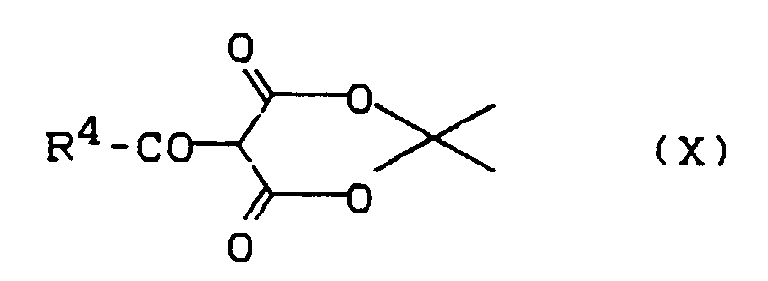
R4 die oben angegebene Bedeutung hat,
umsetzt.
Man erhält die Verbindungen der allgemeinen Formel (II),
in der
R4 und Y die oben angegebene Bedeutung haben,
D - für =NH steht bzw. D* für NH2 steht,
und
E - für Wasserstoff steht,
indem man - [C] Verbindungen der allgemeinen Formel (II),
in welcher
R4 und Y die oben angegebene Bedeutung haben,
D - für Sauerstoff steht
und
E - für Wasserstoff steht,
mit Ammoniak umsetzt.
Verbindungen der allgemeinen Formel (II),
in welcher
R4 und Y die oben angegebene Bedeutung haben,
D - Sauerstoff bedeutet
und
E - für die Gruppe R1-CH= steht,
erhält man, indem man - [D] Verbindungen der allgemeinen Formel (III),
in der R1 die oben angegebene Bedeutung hat,
mit Verbindungen der allgemeinen Formel (II),
in welcher
R4 und Y die oben angegebene Bedeutung haben,
D - für Sauerstoff
und
E - für Wasserstoff steht,
umsetzt. - Die als Ausgangsstoffe eingesetzten Aldehyde der allgemeinen Formel (III) sind bekannt oder können nach bekannten Methoden hergestellt werden [DOS 21 65 260; 24 01 665; T.D. Harris, G.P. Roth, J. Org. Chem. 44, 2004 (1979); W.J. Dale, H.E. Hennis, J. Am. Chem. Soc. 78, 2543 (1956); Chem. Abstr. 59, 13929 (1963)].
- Die als Ausgangsstoffe eingesetzten Enamine der allgemeinen Formel (IV) sind bekannt oder können nach bekannten Methoden hergestellt werden [DOS 2 228 377; F.A., Glickman, A.C. Cope, J. Am. Chem. Soc. 67, 1017 (1945)].
- Die als Ausgangsstoffe eingesetzten Yliden-β-ketocarbonsäurederivate der allgemeinen Formel (VI) sind bekannt oder können nach bekannten Methoden hergestellt werden [G. Jones "The Knoevenagel Condensation" in Organic Reactions Bd. XV, 204 (1967)].
- Die Ausgangsstoffe der Formel (VIII) sind teilweise bekannt oder können nach bekannten Methoden hergestellt werden [vgl. Houben-Weyl, Methoden der organischen Chemie, Band 15, Tei 1, E. Wünsch, Seite 46 ff.].
- Die Verbindungen der Formel (IX) und ihre Reaktionen sind bekannt [vgl. R.J. Clemens, Chem. Rev. 88, 241 (1986)].
- Die Verbindungen der Formel (X) sind zum Teil bekannt oder können nach üblicher Methode hergestellt werden [vgl. J. Org. Chem. 43, 1087 (1978)].
-

- a) Herstellung von (2S, 3R)-2-Amino-3-hydroxybuttersäure-methylester
109 ml (1,5 mol) Thionylchlorid werden bei 0°C unter starker Kühlung in 240 ml Methanol getropft. Anschließend werden 60 g (0,5 mol) L-Threonin zugefügt und 2 Tage bei Raumtemperatur gerührt, wobei eine klare Lösung entsteht. Nach dem Einengen erhält man 85 g eines farblosen Öles. - b) Herstellung von (2S, 3R)-2-Benzyloxycarbonylamino-3-hydroxybuttersäuremethylester
34,1 g (0,201 mol) (2S, 3R)-2-Amino-3-hydroxybuttersäuremethylester werden in 300 ml Essigester mit einer Lösung von 40 g Kaliumcarbonat in 200 ml Wasser vermischt. Bei 0°C werden dann 33 ml (0,215 mol) 90 %iges Benzyloxycarbonylchlorid zugetropft. Es wird 2 Stunden bei 0 - 5°C nachgerührt, getrennt, die Essigesterphase 2-mal mit Wasser gewaschen, getrocknet und eingeengt. Die erhaltenen Kristalle werden mit Hexan versetzt und abgesaugt. Man erhält 42,2 g (78,6 %) farblose Kristalle vom Schmelzpunkt 96°C.
35 g (0,13 mol) (2S, 3R)-2-Benzyloxycarbonylamino-3-hydroxy-buttersäuremethylester werden in 75 ml absolutem Toluol mit 0,2 ml Triethylamin versetzt. Bei 90°C werden 9,8 ml (0,13 mmol) Diketen gelöst in 10 ml absolutem Toluol zugetropft, wobei die Temperatur zwischen 90°C und 98°C gehalten wird. Es wird 2 Stunden bei 95°C nachgerührt, abgekühlt, 1-mal mit Wasser geschüttelt, getrocknet und eingeengt. Man erhält 44,3 g (96,6 % der Theorie) eines braun gefärbten Öles. - 3-Imino-acetessigsäure-(1R, 2S)-[1-methyl-2-methoxycarbonyl-2-(4-nitrophenylsulfamoyl)]-ethylester bzw. β-Aminocrotonsäure-(1R, 2S)-[1-methyl-2-methoxycarbonyl-2-(4-nitrophenylsulfamoyl)]-ethylester

- 2-(2-Benzyloxybenzyliden)-3-oxo-buttersäure-(1R, 2S)-[1-methyl-2-methoxycarbonyl-2-(3,5-dinitrophenylcarbamoyl)]-ethylester

- Analog der Vorschrift der Zwischenproduktes Nr. 1 bis 3 wurden die in der folgenden Tabelle aufgeführten Zwischenprodukte erhalten.


- 1,4-Dihydro-2,6-dimethyl-3-nitro-4-phenyl-pyridin-5-carbonsäure-(1R, 2S)-[1-methyl-2-methoxycarbonyl-2-(4-tolyl-sulfamoyl)]-ethylester

- Rf-Wert = 0,18 und 0,4 g eines Diastereomeren
- Rf-Wert = 0,146
- DC: Kieselgel Alurolle, Kieselgel 60, F 254,
- Schichtdicke 0,2 mm (Merck)
- Fließmittel:
- Methylenchlorid/Essigester im Volumenverhältnis 20:1
- 1,4-Dihydro-2,6-dimethyl-4-(3-nitrophenyl)-pyridin-3-carbonsäuremethylester-5-carbonsäure-(1R, 2S)-[1-methyl-2-methoxycarbonyl-2-(4-tolylsulfamoyl)]-ethylester

[α]
- 1,4-Dihydro-2,6-dimethyl-3-nitro-4-phenyl-pyridin-5-carbonsäure-(1R, 2S)-(1-methyl-2-methoxycarbonyl-2-phenyl-carbamoyl)-ethylester

- 1,4-Dihydro-2,6-dimethyl-4-(3-nitrophenyl)-pyridin-3-carbonsäuremethylester-5-carbonsäure-(1R, 2S)-1-methyl-2-methoxy-carbonyl-2-(p-tolylsulfamoyl)-ethylester Aus der Mutterlauge der Verbindung aus Beispiel 2 werden
- 3,6 g (29,9 % der Theorie) des zweiten Diastereomers durch Säulenchromatographie als Öl erhalten. Rf-Wert: 0,38
Fließmittel: Toluol/Aceton (4:1) - (-)1,4-Dihydro-2,6-dimethyl-4-(3-nitrophenyl)-pyridin-3,5-dicarbonsäure-3-methylester

[α]
Analog den Beispiel 1 bis 4 wurden die in der folgenden Tabelle aufgeführen Beispiele erhalten.
Y die oben angegebene Bedeutung hat,
herstellen, indem man
Claims (5)
- Verbindungen der allgemeinen Formeln (II)
 R4 für geradkettiges oder verzweigtes Alkyl oder Alkenyl mit bis zu 12 Kohlenstoffatomen steht, das gegebenenfalls substituiert sein kann durch Halogen, Hydroxy, C1-C6-Alkoxy, Trifluormethyl, Carboxy, C1-C6-Alkoxycarbonyl oder Phenyl, das substituiert sein kann durch Nitro, Halogen, C1-C2-Alkyl, C1-C4-Alkoxy, Trifluormethyl oder Trifluormethoxy, oderund- für Cycloalkyl mit 3 bis 8 Kohlenstoffatomen steht, oder- für Phenyl steht, das gegebenenfalls substituiert sein kann durch Nitro, Halogen, C1-C2-Alkyl oder C1-C4-Alkoxy,Y - für einen Restmit der Maßgabe, daß Y nicht tert.-Butyl sein kann; wenn R4 für Methyl, D für Sauerstoff und E für zwei Wasserstoffatome steht.
 A - für Wasserstoff oder Methyl steht
undB - für eine Gruppe der Formel -NH, -NH-CO-, -NH-CS-, -NH-COO-, -NH-SO2- oder -NH-CO-NH- oder -NH-CS-NH- steht,R13- für geradkettiges oder verzweigtes Alkyl mit bis zu 12 Kohlenstoffatomen steht, das substituiert sein kann durch Halogen, Hydroxy, Carboxy, Cyano, C1-C8-Alkoxycarbonyl, Carbonyl, Alkylamino oder Dialkylamino mit bis zu 8 Kohlenstoffatomen, Carbamoyl, C1-C6-Alkoxy oder Phenyl, das substituiert sein kann durch Nitro, Cyano, Trifluormethyl, Trifluormethoxy, Halogen, C1-C6-Alkoxy oder C1-C2-Alkyl, oder- für Cycloalkyl mit 3 bis 8 Kohlenstoffatomen, oder- für Phenyl steht, das substituiert sein kann durch Halogen, C1-C3-Alkyl, C1-C3-Alkoxy, C1-C3-Halogenalkyl oder C1-C3-Halogenalkoxy,R14- für Wasserstoff steht, oder- für geradkettiges oder verzweigtes Alkyl oder Alkenyl mit jeweils bis zu 12 Kohlenstoffatomen steht, das substituiert sein kann durch Halogen, Hydroxy, C1-C8-Alkoxy, Nitro, Cyano, C1-C8-Alkylthio, Carboxy, C1-C8-Alkoxycarbonyl oder Phenyl, das substutiert sein kann durch Nitro, Cyano, Trifluormethyl, Trifluormethoxy, C1-C8-Alkyl, Halogen oder C1-C8-Alkoxy, oder- für Cycloalkyl mit 3 bis 8 Kohlenstoff-Atomen steht, oder- für Aryl mit 6 bis 10 Kohlenstoffatomen steht, das bis zu 5-fach gleich oder verschieden substituiert sein kann durch Nitro, Cyano, Halogen, C1-C8-Alkyl, C1-C8-Alkoxy, C1-C8-Alkylthio, Carbamoyl, Dialkylcarbamoyl mit jeweils bis zu 6 Kohlenstoffatomen je Alkylgruppe, Carboxy, C1-C8-Alkoxycarbonyl, C1-C6-Halogenalkyl, C1-C6-Halogenalkoxy, C1-C6-Halogenalkylthio, C1-C6-Alkylsulfonyl, C1-C6-Alkylsulfamoyl, Amino, C1-C8-Alkylamino, Di-alkylamino mit jeweils bis zu 8 Kohlenstoffatomen je Alkylgruppe oder C1-C8-Acylamino, oder- für einen 5- bis 7-gliedrigen gesättigten oder ungesättigten, heterocyclischen Ring steht, der als Heteroatom ein bis drei Sauerstoff-, Schwefel- und/oder Stickstoffatome enthalten kann,D - für Sauerstoff oder für die Gruppe =NH steht undD*- für Hydroxy oder die Gruppe NH2 steht, undE - für Wasserstoff oder im Falle (IIa) für Wasserstoff oder die Gruppe =CHR1 steht, wobeiR1 - für geradkettiges oder verzweigtes Alkyl mit bis zu 6 Kohlenstoffatomen steht, das gegebenenfalls substituiert sein kann durch Halogen, Hydroxy, C1-C8-Alkoxy, Carboxy, C1-C8-Alkoxycarbonyl oder Phenyl, oder- für Cycloalkyl mit 3 bis 6 Kohlenstoffatomen steht, oder- für Aryl mit 6 bis 10 Kohlenstoffatomen steht, das bis zu 3-fach gleich oder verschieden substituiert sein kann durch Nitro, Cyano, C1-C6-Halogenalkyl, Halogen, C1-C6-Alkyl, C1-C6-Alkoxycarbonyl oder durch C1-C6-Halogenalkoxy, C1-C4-Halogenalkylthio, Carbamoyl, Dialkylcarbamoyl mit bis zu 6 Kohlenstoffatomen je Alkylgruppe, C2-C8-Alkenyl, das gegebenenfalls substituiert sein kann durch C1-C6-Alkoxycarbonyl, oder durch gegebenenfalls durch C1-C6-Alkyl, C1-C6-Alkoxy, Nitro, Halogen, Cyano, C1-C4-Halogenalkyl oder C1-C4-Halogenalkoxy substituiertes Phenylsulfonyloxy, oder durch C1-C8-Alkylamino, Dialkylamino mit jeweils bis zu 6 Kohlenstoffatomen je Alkylgruppe, C1-C8-Acylamino oder durch C1-C8-Alkoxy oder C1-C8-Alkylthio, die gegebenenfalls substituiert sein können durch Cyclohexyl oder Phenyl, das seinerseits substituiert sein kann durch Halogen, C1-C6-Alkyl, C1-C6-Alkoxy, Nitro, C1-C4-Halogenalkyl, C1-C2-Alkoxycarbonyl,Cyano oder C1-C4-Halogenalkoxy, oder- für einen mono-, bi- oder tricyclischen, gesättigten oder ungesättigten Heterocyclus steht, der bis zu 3 Heteroatome aus der Gruppe N, O oder S enthalten kann, der substituiert sein kann durch C1-C4-Alkylthio, - Verbindungen der allgemeinen Formel (II) gemäß Anspruch 1,
in welcherR1 - für geradkettiges oder verzweigtes Alkyl mit bis zu 4 Kohlenstoffatomen steht, das gegebenenfalls substituiert sein kann durch Phenyl, C1-C2-Alkoxycarbonyl oder Carboxy, oder - für Phenyl steht, das bis zu 3-fach gleich oder verschieden substituiert sein kann durch Nitro, Cyano, C1-C4-Halogenalkyl, Halogen, C1-C4-Alkyl, C1-C4-Alkoxycarbonyl, C1-C2-Halogenalkoxy, C1-C2-Halogenalkylthio, C1-C4-Alkoxycarbonyl, oder durch gegebenenfalls durch C1-C2-Alkyl oder Halogen, substituiertes Phenylsulfonyloxy oder durch C1-C4-Alkoxy oder C1-C4-Alkylthio, die substituiert sein können durch Cyclohexyl oder Phenyl, das gegebenenfalls substituiert sein kann durch Halogen, C1-C4-Alkyl, C1-C4-Alkoxy, Nitro, C1-C4-Halogenalkyl, Cyano oder C1-C4-Halogenalkoxy, oder- für einen mono- oder bicyclischen ungesättigten Heterocyclus steht, der bis zu 3 Heteroatome aus der Gruppe N, O oder S enthalten kann, der gegebenenfalls substituiert sein kann durch C1-C3-Alkylthio
undR4- für geradkettiges oder verzweigtes Alkyl mit bis zu 6 Kohlenstoffatomen steht, das durch Halogen, Hydroxy, Carboxy, C1-C4-Alkoxycarbonyl substituiert sein kann, oder durch Phenyl substituiert sein kann, das seinerseits substituiert sein kann durch Halogen, C1-C2-Alkyl, C1-C2-Alkoxy, Trifluormethyl oder Trifluormethoxy, oder- für Cycloalkyl mit 3 bis 6 Kohlenstoffatomen steht, oder- für Phenyl steht, das gegebenenfalls substituiert sein kann durch Halogen, C1-C2-Alkyl oder C1-C2-AlkoxyundY - für einen Rest A - für Wasserstoff oder Methyl steht
undB - für eine Gruppe der Formel -NH, -NH-CO-, -NH-COO-, -NH-SO2- oder -NH-CO-NH- steht
undR13- für geradkettiges oder verzweigtes Alkyl mit bis zu 8 Kohlenstoffatomen steht, das substituiert sein kann durch Halogen, Hydroxy, C1-C3-Alkoxy, Trifluormethyl, Carboxy, C1-C6-Alkoxycarbonyl oder Phenyl, das seinerseits substituiert sein kann durch Trifluormethyl, Trifluormethoxy, Halogen, C1-C3-Alkoxy oder C1-C2-Alkyl, oder- für Cycloalkyl mit 3 bis 6 Kohlenstoffatomen steht, oder- für Phenyl steht, das durch Halogen, C1-C2-Alkyl oder C1-C2-Alkoxy substituiert sein kann,undR14- Wasserstoff bedeutet, oder- für geradkettiges oder verzweigtes Alkyl oder Alkenyl mit jeweils bis zu 8 Kohlenstoffatomen steht, das substituiert sein kann durch Halogen, Hydroxy, C1-C4-Alkoxy, Cyano, C1-C4-Alkylthio, Carboxy, C1-C4-Alkoxycarbonyl oder Phenyl, das seinerseits substituiert sein kann durch Trifluormethyl, Trifluormethoxy, C1-C4-Alkyl, Halogen oder C1-C4-Alkoxy, oder- für Cycloalkyl mit 3 bis 6 Kohlenstoffatomen steht, oder- für Phenyl steht, das bis zu 2-fach gleich oder verschieden substituiert sein kann durch Nitro, Cyano, Halogen, C1-C4-Alkyl, C1-C4-Alkoxy, C1-C4-Alkylthio, Carbamoyl, Dialkylcarbamoyl mit bis zu 4 Kohlenstoffatomen je Alkylgruppe, Carboxy, C1-C6-Alkoxycarbonyl, C1-C3-Halogenalkyl, C1-C3-Halogenalkoxy, C1-C3-Halogenalkylthio, C1-C3-Alkylsulfonyl, C1-C3-Alkylsulfamoyl, Amino, C1-C4-Alkylamino, Dialkylamino mit jeweils bis zu 4 Kohlenstoffatomen je Alkylgruppe oder C1-C4-Acylamino; oder- für einen 5- bis 6-gliedrigen ungesättigten heterocyclischen Ring steht, der als Heteroatom ein Stickstoffatom enthalten kann, - Verbindungen der allgemeinen Formel (II) gemäß Anspruch 1,
in welcherR1- für geradkettiges oder verzweigtes Alkyl mit bis zu 4 Kohlenstoffatomen steht, oder- für Cyclopropyl, Cyclopentyl oder Cyclohexyl steht, oder- für Phenyl steht, das bis zu 2-fach gleich oder verschieden substituiert sein kann durch Nitro, Cyano, Trifluormethyl, Fluor, Chlor, Methyl, Methoxy, Trifluormethoxy, Difluormethoxy, gegebenenfalls durch Methyl, Fluor oder Chlor substituiertes Phenylsulfonyloxy, oder durch C1-C4-Alkoxy oder C1-C4-Alkylthio, die jeweils substituiert sein können durch Cyclohexyl oder Phenyl, das seinerseits durch Methyl, Fluor, Chlor oder Methoxy substituiert sein kann, oder- für Pyridyl stehtundR4- für geradkettiges oder verzweigtes Alkyl mit bis zu 4 Kohlenstoffatomen steht, oder- für Cyclopropyl steht,undY - für einen Rest A - für Wasserstoff oder Methyl steht,
undB - für eine Gruppe der Formel -NH-, -NH-CO-, -NH-COO- oder -NH-SO2- oder -NH-CO-NH-steht,
undR13 - für geradkettiges oder verzweigtes Alkyl mit bis zu 6 Kohlenstoffatomen steht, das substituiert sein kann durch Hydroxy, Methoxy oder Phenyl,
undR14- Wasserstoff bedeutet, oder- für geradkettiges oder verzweigtes Alkyl mit bis zu 6 Kohlenstoffatomen steht, das substituiert sein kann durch Hydroxy, C1-C2-Alkoxycarbonyl oder durch Phenyl, das seinerseits substituiert sein kann durch Methyl, Trifluormethyl, Fluor oder Chlor, oder- für Cyclopropyl, Cyclopentyl oder Cyclohexyl steht, oder- für Phenyl steht, das bis zu 2-fach gleich oder verschieden substituiert sein kann
durch Nitro, Cyano, Fluor, Chlor, C1-C2-Alkyl, C1-C4-Alkoxy, C1-C2-Alkylthio, Carbamoyl, Carboxy, C1-C4-Alkoxycarbonyl, Trifluormethyl, Trifluormethoxy, C1-C2-Alkylsulfamoyl oder C1-C2-Alkylamino, oder- für Pyridyl steht. - Verfahren zur Herstellung von Verbindungen der allgemeinen Formel (II)
 R4 - für geradkettiges oder verzweigtes Alkyl oder Alkenyl mit bis zu 12 Kohlenstoffatomen steht, das gegebenenfalls substituiert sein kann durch Halogen, Hydroxy, C1-C6-Alkoxy, Trifluormethyl, Carboxy, C1-C6-Alkoxycarbonyl oder Phenyl, das substituiert sein kann durch Nitro, Halogen, C1-C2-Alkyl, C1-C4-Alkoxy, Trifluormethyl oder Trifluormethoxy, oder- für Cycloalkyl mit 3 bis 8 Kohlenstoffatomen steht, oder- für Phenyl steht, das gegebenenfalls substituiert sein kann durch Nitro, Halogen, C1-C2-Alkyl oder C1-C4-Alkoxy,undY - für einen Rest
 A - für Wasserstoff oder Methyl steht
undB - für eine Gruppe der Formel -NH, -NH-CO-, -NH-CS-, -NH-COO-, -NH-SO2- oder -NH-CO-NH- oder -NH-CS-NH- steht,R13- für geradkettiges oder verzweigtes Alkyl mit bis zu 12 Kohlenstoffatomen steht, das substituiert sein kann durch Halogen, Hydroxy, Carboxy, Cyano, C1-C8-Alkoxycarbonyl, Carbonyl, Alkylamino oder Dialkylamino mit bis zu 8 Kohlenstoffatomen, Carbamoyl, C1-C6-Alkoxy oder Phenyl, das substituiert sein kann durch Nitro, Cyano, Trifluormethyl, Trifluormethoxy, Halogen, C1-C6-Alkoxy oder C1-C2-Alkyl, oder- für Cycloalkyl mit 3 bis 8 Kohlenstoffatomen, oder- für Phenyl steht, das substituiert sein kann durch Halogen, C1-C3-Alkyl, C1-C3-Alkoxy, C1-C3-Halogenalkyl oder C1-C3-Halogenalkoxy,R14- für Wasserstoff steht, oder- für geradkettiges oder verzweigtes Alkyl oder Alkenyl mit jeweils bis zu 12 Kohlenstoffatomen steht, das substituiert sein kann durch Halogen, Hydroxy, C1-C8-Alkoxy, Nitro, Cyano, C1-C8-Alkylthio, Carboxy, C1-C8-Alkoxycarbonyl oder Phenyl, das substutiert sein kann durch Nitro, Cyano, Trifluormethyl, Trifluormethoxy, C1-C8-Alkyl, Halogen oder C1-C8-Alkoxy, oder- für Cycloalkyl mit 3 bis 8 Kohlenstoffatomen steht, oder- für Aryl mit 6 bis 10 Kohlenstoffatomen steht, das bis zu 5-fach oleich oder verschieden substituiert sein kann durch Nitro, Cyano, Halogen, C1-C5-Alkyl, C1-C8-Alkoxy, C1-C8-Alkylthio, Carbamoyl, Dialkylcarbamoyl mit jeweils bis zu 6 Kohlenstoffatomen je Alkylgruppe, Carboxy, C1-C8-Alkoxycarbonyl, C1-C6-Halogenalkyl, C1-C6-Halogenalkoxy, C1-C6-Halogenalkylthio, C1-C6-Alkylsulfonyl, C1-C6-Alkylsulfamoyl, Amino, C1-C8-Alkylamino, Dialkylamino mit jeweils bis zu 8 Kohlenstoffatomen je Alkylgruppe oder C1-C8-Acylamino, oder- für einen 5- bis 7-gliedrigen gesättigten oder ungesättigten, heterocyclischen Ring steht, der als Heteroatom ein bis drei Sauerstoff-, Schwefel- und/oder Stickstoffatome enthalten kann,D - für Sauerstoff oder für die Gruppe =NH stehtD*- für Hydroxy oder die Gruppe NH2 steht, undE - für Wasserstoff oder für den Fall (IIa) für Wasserstoff oder die Gruppe =CHR1 steht, wobeiR1mit der Maßgabe, daß Y nicht tert.-Butyl sein kann, wenn R4 für Methyl, D für Sauerstoff und E für zwei Wasserstoffatome steht,- für geradkettiges oder verzweigtes Alkyl mit bis zu 6 Kohlenstoffatomen steht, das gegebenenfalls substituiert sein kann durch Halogen, Hydroxy, C1-C8-Alkoxy, Carboxy, C1-C8-Alkoxycarbonyl oder Phenyl, oder- für Cycloalkyl mit 3 bis 6 Kohlenstoffatomen steht, oder- für Aryl mit 6 bis 10 Kohlenstoffatomen steht, das bis zu 3-fach gleich oder verschieden substituiert sein kann durch Nitro, Cyano, C1-C6-Halogenalkyl, Halogen, C1-C6-Alkyl, C1-C6-Alkoxycarbonyl oder durch C1-C6-Halogenalkoxy, C1-C4-Halogenalkylthio, Carbamoyl, Dialkylcarbamoyl mit bis zu 6 Kohlenstoffatomen je Alkylgruppe, C2-C8-Alkenyl, das gegebenenfalls substituiert sein kann durch C1-C6-Alkoxycarbonyl, oder durch gegebenenfalls durch C1-C6-Alkyl, C1-C6-Alkoxy, Nitro, Halogen, Cyano, C1-C4-Halogenalkyl oder C1-C4-Halogenalkoxy substituiertes Phenylsulfonyloxy, oder durch C1-C8-Alkylamino, Dialkylamino mit jeweils bis zu 6 Kohlenstoffatomen je Alkylgruppe, C1-C8-Acylamino oder durch C1-C8-Alkoxy oder C1-C8-Alkylthio, die gegebenenfalls substituiert sein können durch Cyclohexyl oder Phenyl, das seinerseits substituiert sein kann durch Halogen, C1-C6-Alkyl, C1-C6-Alkoxy, Nitro, C1-C4-Halogenalkyl, C1-C2-Alkoxycarbonyl,Cyano oder C1-C4-Halogenalkoxy, oder- für einen mono-, bi- oder tricyclischen, gesättigten oder ungesättigten Heterocyclus steht, der bis zu 3 Heteroatome aus der Gruppe N, O oder S enthalten kann, der substituiert sein kann durch C1-C4-Alkylthio,
dadurch gekennzeichnet, daß man(A) für die Herstellung von Verbindungen der Formel (II),
in welcher
R4 für Methyl steht,
D für Sauerstoff steht,
E für Wasserstoff steht und
Y die oben angegebene Bedeutung hat,
Verbindungen der allgemeinen Formel (VIII)
HO-Y (VIII)
in welcher
Y die oben angegebene Bedeutung hat,
mit Diketen der allgemeinen Formel (IX)
oder(B) Verbindungen der Formel (II),
in welcher
R4 und Y die oben angegebene Bedeutung haben,
D für Sauerstoff steht und
E für Wasserstoff steht, herstellt,
indem man Verbindungen der Formel (VIII) mit Verbindungen der allgemeinen Formel (X)
R4 die oben angegebene Bedeutung hat,
umsetzt,
oder(C) Verbindungen der allgemeinen Formel (II),
in welcher
R4 und Y die oben angegebene Bedeutung haben;
D für -NH steht bzw. D* für NH2 steht, und
E für Wasserstoff steht;
herstellt,
indem man Verbindungen der allgemeinen Formel (II),
in welcher
D für Sauerstoff steht und
R4 und Y die oben angegebene Bedeutung haben und
E für Wasserstoff steht;
mit Ammoniak umsetzt,
oder(D) Verbindungen der allgemeinen Formel (II),umsetzt.
in welcher
R4 und Y die oben angegebene Bedeutung haben,
D Sauerstoff bedeutet und
E für die Gruppe =CH-R1 steht,
erhält, indem man Aldehyde der allgemeinen Formel (III),
in welcher
R1 die oben angegebene Bedeutung hat,
mit Verbindungen der allgemeinen Formel (II),
in welcher
D für Sauerstoff und
E für Wasserstoff steht und
R4 und Y die oben angegebene Bedeutung haben, - Verwendung von Verbindungen der allgemeinen Formel (II) zur Herstellung von pharmakologisch wirksamen Dihydropyridinen.
Applications Claiming Priority (3)
| Application Number | Priority Date | Filing Date | Title |
|---|---|---|---|
| DE3821334 | 1988-06-24 | ||
| DE3821334A DE3821334A1 (de) | 1988-06-24 | 1988-06-24 | 1,4-dihydropyridin-threonin-derivate, verfahren zu ihrer herstellung, zwischenprodukte und ihre verwendung als arzneimittel |
| EP89110528A EP0347678B1 (de) | 1988-06-24 | 1989-06-10 | 1,4-Dihydropyridin-threonin-Derivate und Verfahren zu ihrer Herstellung |
Related Parent Applications (2)
| Application Number | Title | Priority Date | Filing Date |
|---|---|---|---|
| EP89110528A Division EP0347678B1 (de) | 1988-06-24 | 1989-06-10 | 1,4-Dihydropyridin-threonin-Derivate und Verfahren zu ihrer Herstellung |
| EP89110528.0 Division | 1989-06-10 |
Publications (2)
| Publication Number | Publication Date |
|---|---|
| EP0628538A1 EP0628538A1 (de) | 1994-12-14 |
| EP0628538B1 true EP0628538B1 (de) | 1997-01-22 |
Family
ID=6357161
Family Applications (2)
| Application Number | Title | Priority Date | Filing Date |
|---|---|---|---|
| EP94112407A Expired - Lifetime EP0628538B1 (de) | 1988-06-24 | 1989-06-10 | Verfahren zur acylierung von Threonin-Derivaten und deren Verwendung zur Herstellung von 1,4-Dihydropyridinen |
| EP89110528A Expired - Lifetime EP0347678B1 (de) | 1988-06-24 | 1989-06-10 | 1,4-Dihydropyridin-threonin-Derivate und Verfahren zu ihrer Herstellung |
Family Applications After (1)
| Application Number | Title | Priority Date | Filing Date |
|---|---|---|---|
| EP89110528A Expired - Lifetime EP0347678B1 (de) | 1988-06-24 | 1989-06-10 | 1,4-Dihydropyridin-threonin-Derivate und Verfahren zu ihrer Herstellung |
Country Status (18)
| Country | Link |
|---|---|
| US (2) | US5017590A (de) |
| EP (2) | EP0628538B1 (de) |
| JP (2) | JPH0253774A (de) |
| KR (1) | KR910000643A (de) |
| CN (1) | CN1039583A (de) |
| AT (2) | ATE148095T1 (de) |
| AU (1) | AU3644289A (de) |
| CA (1) | CA1337074C (de) |
| DD (1) | DD284001A5 (de) |
| DE (3) | DE3821334A1 (de) |
| DK (1) | DK312989A (de) |
| ES (1) | ES2098084T3 (de) |
| FI (1) | FI893066A7 (de) |
| GR (1) | GR3022713T3 (de) |
| HU (1) | HUT50772A (de) |
| IL (1) | IL90696A0 (de) |
| PT (1) | PT90943B (de) |
| ZA (1) | ZA894778B (de) |
Families Citing this family (2)
| Publication number | Priority date | Publication date | Assignee | Title |
|---|---|---|---|---|
| DE3737340A1 (de) * | 1987-11-04 | 1989-05-24 | Bayer Ag | Neue fluormethoxyphenyl-dihydropyridine, verfahren zur herstellung und ihre verwendung in arzneimitteln |
| DE4003541C1 (de) * | 1990-02-06 | 1991-08-08 | Alter S.A., Madrid, Es |
Family Cites Families (4)
| Publication number | Priority date | Publication date | Assignee | Title |
|---|---|---|---|---|
| DE1813436C3 (de) * | 1968-12-07 | 1979-01-11 | Bayer Ag, 5090 Leverkusen | N-Substituierte 2,6-Dimethyl-l,4dihydropyridine |
| DE2935451A1 (de) * | 1979-09-01 | 1981-03-19 | Bayer Ag, 5090 Leverkusen | Optisch aktive 1,4-dihydropyridine, verfahren zu ihrer herstellung und ihre verwendung als arneimittel |
| DE3244178A1 (de) * | 1982-11-30 | 1984-05-30 | Bayer Ag, 5090 Leverkusen | 1,4-dihydropyridinderivate, verfahren zu ihrer herstellung sowie ihre verwendung in arzneimitteln |
| DE3714438A1 (de) * | 1987-04-30 | 1988-11-10 | Bayer Ag | Optisch aktive dihydropyridinlactone, verfahren zu ihrer herstellung und ihre verwendung |
-
1988
- 1988-06-24 DE DE3821334A patent/DE3821334A1/de not_active Withdrawn
-
1989
- 1989-06-10 AT AT94112407T patent/ATE148095T1/de not_active IP Right Cessation
- 1989-06-10 DE DE58909778T patent/DE58909778D1/de not_active Expired - Fee Related
- 1989-06-10 DE DE58909770T patent/DE58909770D1/de not_active Expired - Fee Related
- 1989-06-10 ES ES94112407T patent/ES2098084T3/es not_active Expired - Lifetime
- 1989-06-10 EP EP94112407A patent/EP0628538B1/de not_active Expired - Lifetime
- 1989-06-10 AT AT89110528T patent/ATE149154T1/de not_active IP Right Cessation
- 1989-06-10 EP EP89110528A patent/EP0347678B1/de not_active Expired - Lifetime
- 1989-06-14 AU AU36442/89A patent/AU3644289A/en not_active Abandoned
- 1989-06-15 US US07/367,408 patent/US5017590A/en not_active Expired - Fee Related
- 1989-06-21 IL IL90696A patent/IL90696A0/xx unknown
- 1989-06-21 DD DD89329829A patent/DD284001A5/de not_active IP Right Cessation
- 1989-06-22 CA CA000603600A patent/CA1337074C/en not_active Expired - Fee Related
- 1989-06-22 PT PT90943A patent/PT90943B/pt not_active IP Right Cessation
- 1989-06-22 FI FI893066A patent/FI893066A7/fi not_active Application Discontinuation
- 1989-06-23 HU HU893207A patent/HUT50772A/hu unknown
- 1989-06-23 ZA ZA894778A patent/ZA894778B/xx unknown
- 1989-06-23 JP JP1159798A patent/JPH0253774A/ja active Pending
- 1989-06-23 KR KR1019890008686A patent/KR910000643A/ko not_active Withdrawn
- 1989-06-23 DK DK312989A patent/DK312989A/da not_active Application Discontinuation
- 1989-06-24 CN CN89104392A patent/CN1039583A/zh active Pending
-
1990
- 1990-11-09 US US07/612,162 patent/US5138091A/en not_active Expired - Fee Related
-
1997
- 1997-03-03 GR GR970400402T patent/GR3022713T3/el unknown
- 1997-08-06 JP JP9224214A patent/JPH1067743A/ja active Pending
Also Published As
| Publication number | Publication date |
|---|---|
| CN1039583A (zh) | 1990-02-14 |
| DD284001A5 (de) | 1990-10-31 |
| EP0347678A2 (de) | 1989-12-27 |
| ATE148095T1 (de) | 1997-02-15 |
| ZA894778B (en) | 1990-03-28 |
| EP0628538A1 (de) | 1994-12-14 |
| PT90943A (pt) | 1989-12-29 |
| FI893066A0 (fi) | 1989-06-22 |
| DE3821334A1 (de) | 1989-12-28 |
| ES2098084T3 (es) | 1997-04-16 |
| EP0347678B1 (de) | 1997-02-26 |
| AU3644289A (en) | 1997-01-23 |
| ATE149154T1 (de) | 1997-03-15 |
| EP0347678A3 (de) | 1990-12-05 |
| DE58909778D1 (de) | 1997-04-03 |
| HUT50772A (en) | 1990-03-28 |
| JPH0253774A (ja) | 1990-02-22 |
| FI893066A7 (fi) | 1989-12-25 |
| JPH1067743A (ja) | 1998-03-10 |
| GR3022713T3 (en) | 1997-06-30 |
| DE58909770D1 (de) | 1997-03-06 |
| PT90943B (pt) | 1994-11-30 |
| DK312989A (da) | 1989-12-25 |
| DK312989D0 (da) | 1989-06-23 |
| IL90696A0 (en) | 1990-01-18 |
| US5138091A (en) | 1992-08-11 |
| KR910000643A (ko) | 1991-01-29 |
| US5017590A (en) | 1991-05-21 |
| CA1337074C (en) | 1995-09-19 |
Similar Documents
| Publication | Publication Date | Title |
|---|---|---|
| EP0088276B1 (de) | Neue Verbindungen, Verfahren zu ihrer Herstellung sowie ihre Verwendung als Arzneimittel | |
| EP0088274B1 (de) | Neue 1,4-Dihydropyridine, Verfahren zu ihrer Herstellung und ihrer Verwendung in Arzneimitteln | |
| DE3751978T2 (de) | Dihydropyridin-Derivate, ihre Herstellung und ihre Anwendung | |
| DD154014A5 (de) | Verfahren zur herstellung von optisch aktiven-1,4-dihydropyridinen | |
| DE3248548A1 (de) | Acylderivate von 1,4:3,6-dianhydro-hexiten, verfahren zu ihrer herstellung und ihre verwendung als arzneimittel | |
| EP0001769A1 (de) | 1,4-Dihydropyridincarbonsäureester mit schwefelhaltigen Estergruppen, ihre Herstellung und ihre Verwendung als Arzneimittel | |
| EP0039863B1 (de) | 1,4-Dihydropyridine mit unterschiedlichen Substituenten in 2- und 6-Position, Verfahren zu ihrer Herstellung und ihre Verwendung in Arzneimitteln | |
| EP0110259B1 (de) | 1,4-Dihydropyridinderivate, Verfahren zu ihrer Herstellung sowie ihre Verwendung in Arzneimitteln | |
| DE69003936T2 (de) | Verfahren zur herstellung von enantiomerreinen polysubstituierten 1,4-dihydropyridinen. | |
| DE3711991A1 (de) | Dihydropyridinamide, verfahren zu ihrer herstellung und ihre verwendung in arzneimitteln | |
| EP0202625B1 (de) | Verfahren zur Herstellung von 2,6-Dimethyl-4-(3'-nitrophenyl)-1,4-dihydropyridin-3,5-dicarbonsäure-3 beta-(N-benzyl-N-methylamino)-ethylester-5-methylester und dessen Hydrochlorid-Salz | |
| DE3737340A1 (de) | Neue fluormethoxyphenyl-dihydropyridine, verfahren zur herstellung und ihre verwendung in arzneimitteln | |
| EP0157324A2 (de) | Tetrahydrothienopyridine, Verfahren zu ihrer Herstellung sowie ihre Verwendung als Arzneimittel | |
| EP0347678B1 (de) | 1,4-Dihydropyridin-threonin-Derivate und Verfahren zu ihrer Herstellung | |
| DE68923159T2 (de) | Verfahren zur Herstellung von 1,4-Dihydropyridin-Derivaten. | |
| EP0362632A2 (de) | Basische 4-Aryl-DHP-amide, Verfahren zu ihrer Herstellung und ihre Verwendung in Arzneimitteln | |
| EP0166296B1 (de) | Verfahren zur Herstellung optisch aktiver 1,4-Dihydropyridine | |
| DE2639498A1 (de) | Neue schwefelhaltige amino-dihydropyridine, verfahren zu ihrer herstellung sowie ihre verwendung als arzneimittel | |
| DE69131444T2 (de) | Optisch aktive 1,4-Dihydropyridinderivate sowie Verfahren zu ihrer Herstellung | |
| DE19524337C1 (de) | Verfahren zur Herstellung von beta-Amino-alpha-hydroxycarbonsäuren und deren Derivaten | |
| EP0225574B1 (de) | Neue, fluorhaltige 1,4-Dihydropyridine, Verfahren zu ihrer Herstellung sowie ihre Verwendung als Arzneimittel | |
| EP0538690A1 (de) | Aryl-Chinolyl-substituierte 1,4-Dihydropyridin-dicarbonsäurederivate, Verfahren zu ihrer Herstellung und ihre Verwendung in Arzneimitteln | |
| EP0189898A1 (de) | 1,6-Naphthyridinon-Derivate und Verfahren zu deren Herstellung | |
| AT395976B (de) | Verfahren zur herstellung von dihydropyridinverbindungen oder ihren salzen | |
| DE3137376C2 (de) | Verfahren zur Herstellung von 1,5-Alkylen-3-aryl-hydantoin-Derivaten |
Legal Events
| Date | Code | Title | Description |
|---|---|---|---|
| PUAI | Public reference made under article 153(3) epc to a published international application that has entered the european phase |
Free format text: ORIGINAL CODE: 0009012 |
|
| AC | Divisional application: reference to earlier application |
Ref document number: 347678 Country of ref document: EP |
|
| AK | Designated contracting states |
Kind code of ref document: A1 Designated state(s): AT BE CH DE ES FR GB GR IT LI LU NL SE |
|
| 17P | Request for examination filed |
Effective date: 19950608 |
|
| 17Q | First examination report despatched |
Effective date: 19951024 |
|
| GRAG | Despatch of communication of intention to grant |
Free format text: ORIGINAL CODE: EPIDOS AGRA |
|
| GRAH | Despatch of communication of intention to grant a patent |
Free format text: ORIGINAL CODE: EPIDOS IGRA |
|
| GRAH | Despatch of communication of intention to grant a patent |
Free format text: ORIGINAL CODE: EPIDOS IGRA |
|
| GRAA | (expected) grant |
Free format text: ORIGINAL CODE: 0009210 |
|
| AC | Divisional application: reference to earlier application |
Ref document number: 347678 Country of ref document: EP |
|
| AK | Designated contracting states |
Kind code of ref document: B1 Designated state(s): AT BE CH DE ES FR GB GR IT LI LU NL SE |
|
| REF | Corresponds to: |
Ref document number: 148095 Country of ref document: AT Date of ref document: 19970215 Kind code of ref document: T |
|
| REG | Reference to a national code |
Ref country code: CH Ref legal event code: EP |
|
| REG | Reference to a national code |
Ref country code: CH Ref legal event code: NV Representative=s name: E. BLUM & CO. PATENTANWAELTE |
|
| REF | Corresponds to: |
Ref document number: 58909770 Country of ref document: DE Date of ref document: 19970306 |
|
| ITF | It: translation for a ep patent filed | ||
| ET | Fr: translation filed | ||
| REG | Reference to a national code |
Ref country code: ES Ref legal event code: FG2A Ref document number: 2098084 Country of ref document: ES Kind code of ref document: T3 |
|
| GBT | Gb: translation of ep patent filed (gb section 77(6)(a)/1977) |
Effective date: 19970409 |
|
| REG | Reference to a national code |
Ref country code: GR Ref legal event code: FG4A Free format text: 3022713 |
|
| PLBE | No opposition filed within time limit |
Free format text: ORIGINAL CODE: 0009261 |
|
| STAA | Information on the status of an ep patent application or granted ep patent |
Free format text: STATUS: NO OPPOSITION FILED WITHIN TIME LIMIT |
|
| 26N | No opposition filed | ||
| PGFP | Annual fee paid to national office [announced via postgrant information from national office to epo] |
Ref country code: DE Payment date: 19980515 Year of fee payment: 10 |
|
| PGFP | Annual fee paid to national office [announced via postgrant information from national office to epo] |
Ref country code: SE Payment date: 19980526 Year of fee payment: 10 |
|
| PGFP | Annual fee paid to national office [announced via postgrant information from national office to epo] |
Ref country code: GR Payment date: 19980528 Year of fee payment: 10 Ref country code: FR Payment date: 19980528 Year of fee payment: 10 |
|
| PGFP | Annual fee paid to national office [announced via postgrant information from national office to epo] |
Ref country code: CH Payment date: 19980605 Year of fee payment: 10 |
|
| PGFP | Annual fee paid to national office [announced via postgrant information from national office to epo] |
Ref country code: ES Payment date: 19980615 Year of fee payment: 10 |
|
| PGFP | Annual fee paid to national office [announced via postgrant information from national office to epo] |
Ref country code: AT Payment date: 19980616 Year of fee payment: 10 |
|
| PGFP | Annual fee paid to national office [announced via postgrant information from national office to epo] |
Ref country code: BE Payment date: 19980624 Year of fee payment: 10 |
|
| PGFP | Annual fee paid to national office [announced via postgrant information from national office to epo] |
Ref country code: LU Payment date: 19980629 Year of fee payment: 10 |
|
| PGFP | Annual fee paid to national office [announced via postgrant information from national office to epo] |
Ref country code: NL Payment date: 19980630 Year of fee payment: 10 |
|
| PGFP | Annual fee paid to national office [announced via postgrant information from national office to epo] |
Ref country code: GB Payment date: 19990609 Year of fee payment: 11 |
|
| PG25 | Lapsed in a contracting state [announced via postgrant information from national office to epo] |
Ref country code: LU Free format text: LAPSE BECAUSE OF NON-PAYMENT OF DUE FEES Effective date: 19990610 Ref country code: AT Free format text: LAPSE BECAUSE OF NON-PAYMENT OF DUE FEES Effective date: 19990610 |
|
| PG25 | Lapsed in a contracting state [announced via postgrant information from national office to epo] |
Ref country code: ES Free format text: LAPSE BECAUSE OF NON-PAYMENT OF DUE FEES Effective date: 19990611 |
|
| PG25 | Lapsed in a contracting state [announced via postgrant information from national office to epo] |
Ref country code: SE Free format text: THE PATENT HAS BEEN ANNULLED BY A DECISION OF A NATIONAL AUTHORITY Effective date: 19990629 |
|
| PG25 | Lapsed in a contracting state [announced via postgrant information from national office to epo] |
Ref country code: LI Free format text: LAPSE BECAUSE OF NON-PAYMENT OF DUE FEES Effective date: 19990630 Ref country code: GR Free format text: LAPSE BECAUSE OF NON-PAYMENT OF DUE FEES Effective date: 19990630 Ref country code: FR Free format text: THE PATENT HAS BEEN ANNULLED BY A DECISION OF A NATIONAL AUTHORITY Effective date: 19990630 Ref country code: CH Free format text: LAPSE BECAUSE OF NON-PAYMENT OF DUE FEES Effective date: 19990630 Ref country code: BE Free format text: LAPSE BECAUSE OF NON-PAYMENT OF DUE FEES Effective date: 19990630 |
|
| BERE | Be: lapsed |
Owner name: BAYER A.G. Effective date: 19990630 |
|
| PG25 | Lapsed in a contracting state [announced via postgrant information from national office to epo] |
Ref country code: NL Free format text: LAPSE BECAUSE OF NON-PAYMENT OF DUE FEES Effective date: 20000101 |
|
| REG | Reference to a national code |
Ref country code: CH Ref legal event code: PL |
|
| EUG | Se: european patent has lapsed |
Ref document number: 94112407.5 |
|
| NLV4 | Nl: lapsed or anulled due to non-payment of the annual fee |
Effective date: 20000101 |
|
| PG25 | Lapsed in a contracting state [announced via postgrant information from national office to epo] |
Ref country code: DE Free format text: LAPSE BECAUSE OF NON-PAYMENT OF DUE FEES Effective date: 20000503 |
|
| PG25 | Lapsed in a contracting state [announced via postgrant information from national office to epo] |
Ref country code: GB Free format text: LAPSE BECAUSE OF NON-PAYMENT OF DUE FEES Effective date: 20000610 |
|
| REG | Reference to a national code |
Ref country code: FR Ref legal event code: ST |
|
| GBPC | Gb: european patent ceased through non-payment of renewal fee |
Effective date: 20000610 |
|
| REG | Reference to a national code |
Ref country code: ES Ref legal event code: FD2A Effective date: 20010503 |
|
| PG25 | Lapsed in a contracting state [announced via postgrant information from national office to epo] |
Ref country code: IT Free format text: LAPSE BECAUSE OF NON-PAYMENT OF DUE FEES;WARNING: LAPSES OF ITALIAN PATENTS WITH EFFECTIVE DATE BEFORE 2007 MAY HAVE OCCURRED AT ANY TIME BEFORE 2007. THE CORRECT EFFECTIVE DATE MAY BE DIFFERENT FROM THE ONE RECORDED. Effective date: 20050610 |